
Chemistry of Matter Properties and Interactions of Elements
- Slides: 31
Chemistry of Matter Properties and Interactions of Elements MS State Objectives 2. a. and 2. b.
Elements n Elements are substances that cannot be broken down into simpler substances. Made up of only one type of atom n Basic building blocks of matter n n The smallest particle of an element is an atom.
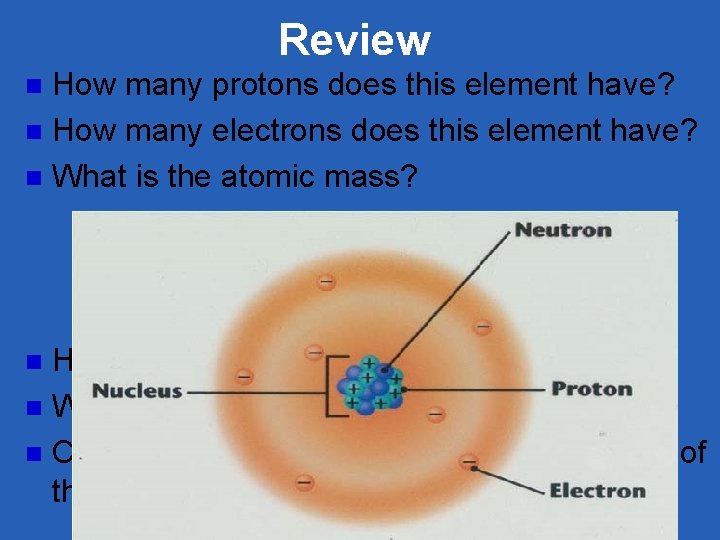
Review How many protons does this element have? n How many electrons does this element have? n What is the atomic mass? n How many neutrons does this atom have? n What is the atomic number? n Can you tell which element this is using any of this information? Explain. n
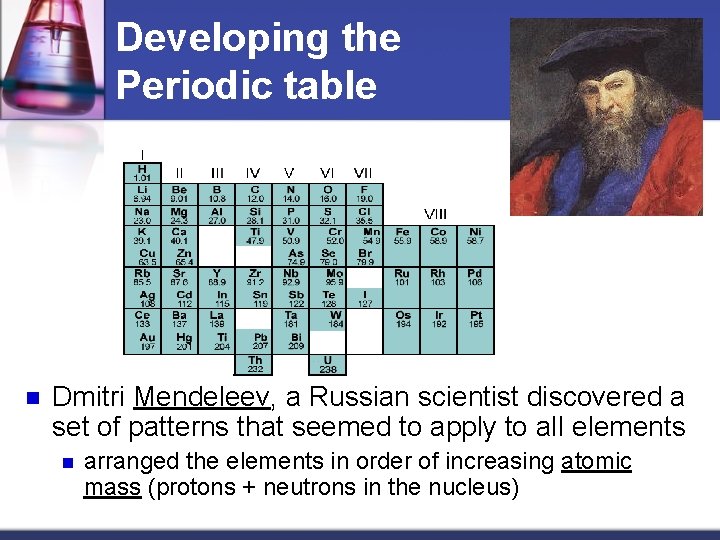
Developing the Periodic table n Dmitri Mendeleev, a Russian scientist discovered a set of patterns that seemed to apply to all elements n arranged the elements in order of increasing atomic mass (protons + neutrons in the nucleus)
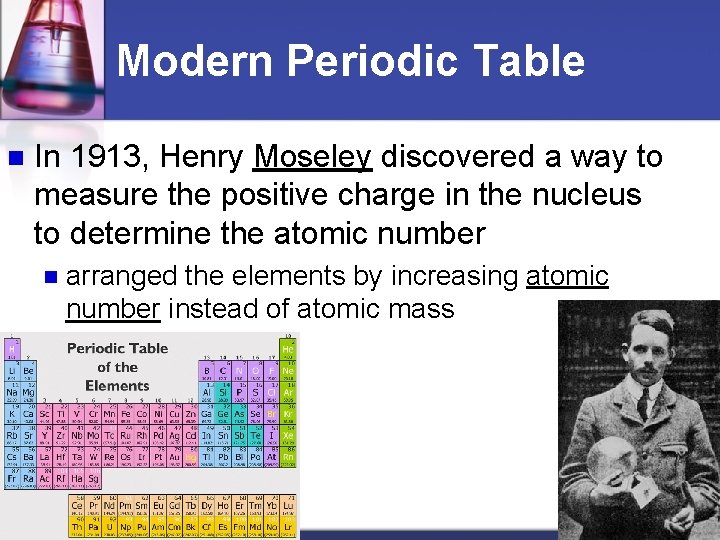
Modern Periodic Table n In 1913, Henry Moseley discovered a way to measure the positive charge in the nucleus to determine the atomic number n arranged the elements by increasing atomic number instead of atomic mass
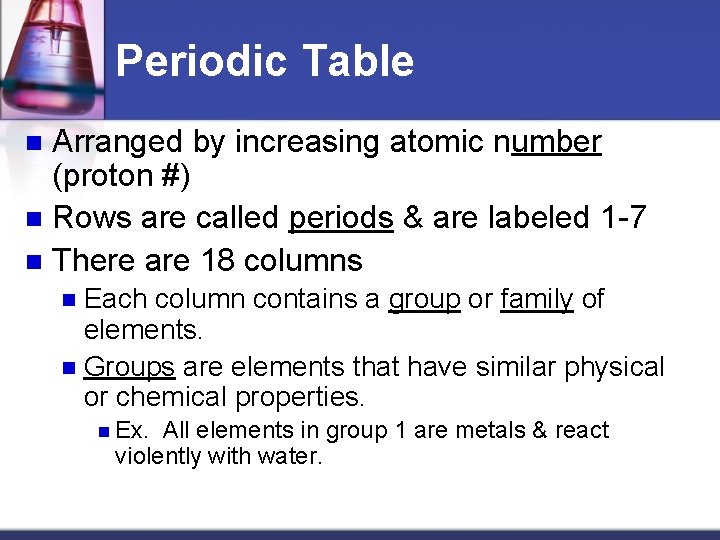
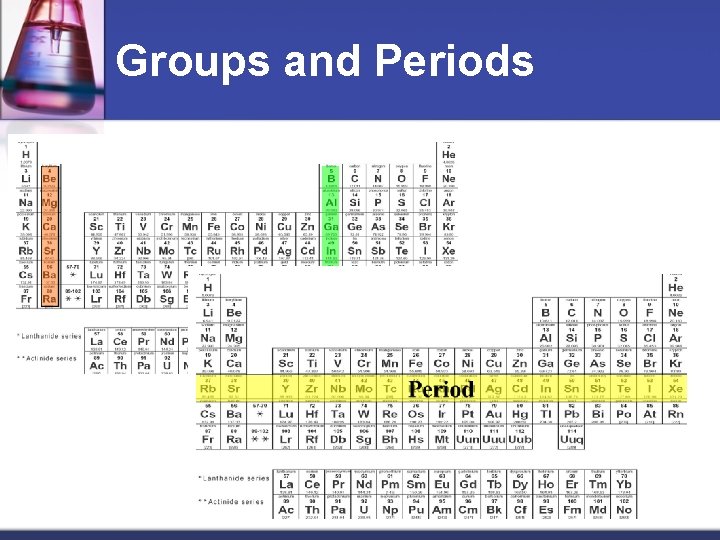
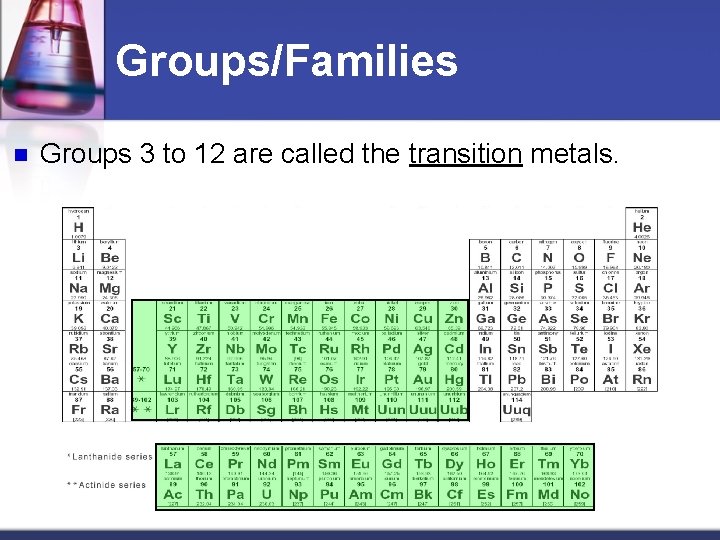
Periodic Table Arranged by increasing atomic number (proton #) n Rows are called periods & are labeled 1 -7 n There are 18 columns n Each column contains a group or family of elements. n Groups are elements that have similar physical or chemical properties. n n Ex. All elements in group 1 are metals & react violently with water.
Groups and Periods
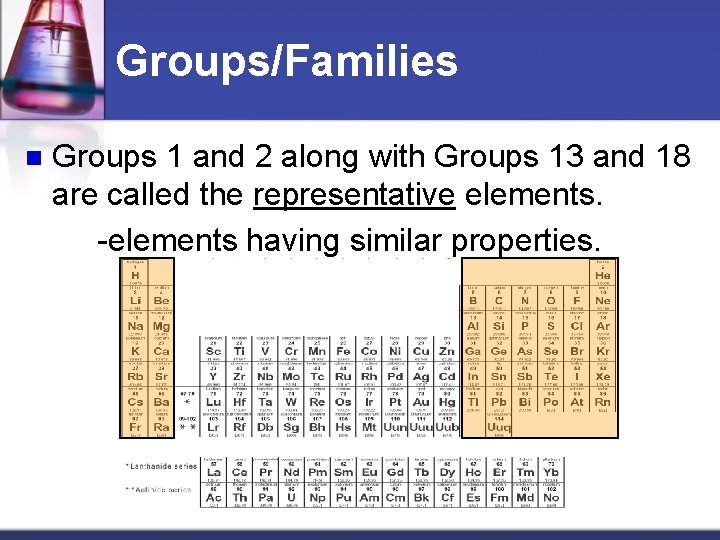
Groups/Families n Groups 1 and 2 along with Groups 13 and 18 are called the representative elements. -elements having similar properties.
Groups/Families n Groups 3 to 12 are called the transition metals.
How Elements Interact State Objective 2. a.
Physical vs. Chemical Change n Physical change occurs when the physical properties are changed, such as size or shape. n n Ex. Folding a piece of paper or a change in the state of matter: solid, liquid, gas Chemical change occurs when the chemical properties of the substance cause a change producing a new substance (the atoms have rearranged)
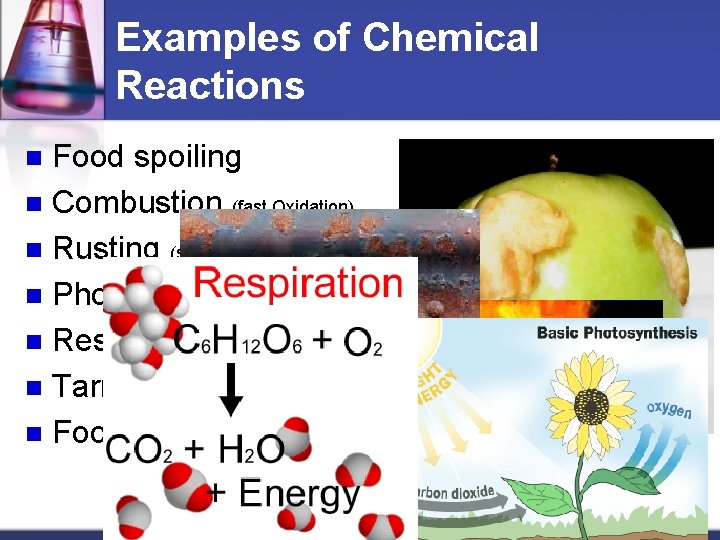
Examples of Chemical Reactions Food spoiling n Combustion (fast Oxidation) n Rusting (slow oxidation) n Photosynthesis n Respiration n Tarnishing n Food Cooking n
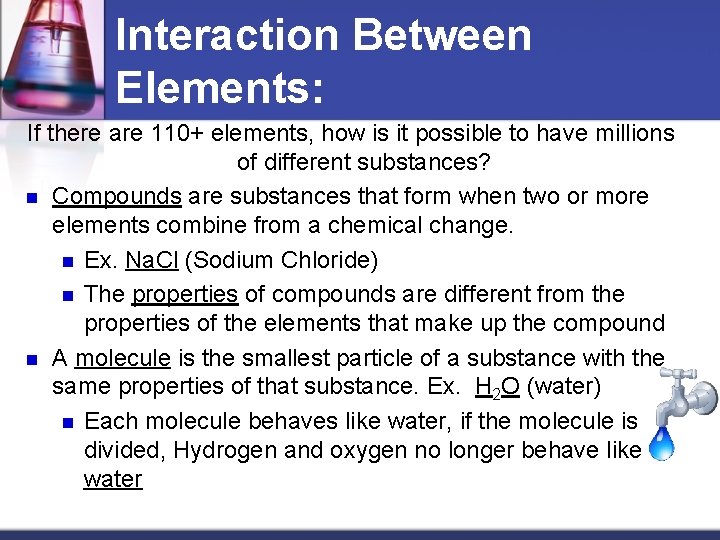
Interaction Between Elements: If there are 110+ elements, how is it possible to have millions of different substances? n Compounds are substances that form when two or more elements combine from a chemical change. n Ex. Na. Cl (Sodium Chloride) n The properties of compounds are different from the properties of the elements that make up the compound n A molecule is the smallest particle of a substance with the same properties of that substance. Ex. H 2 O (water) n Each molecule behaves like water, if the molecule is divided, Hydrogen and oxygen no longer behave like water
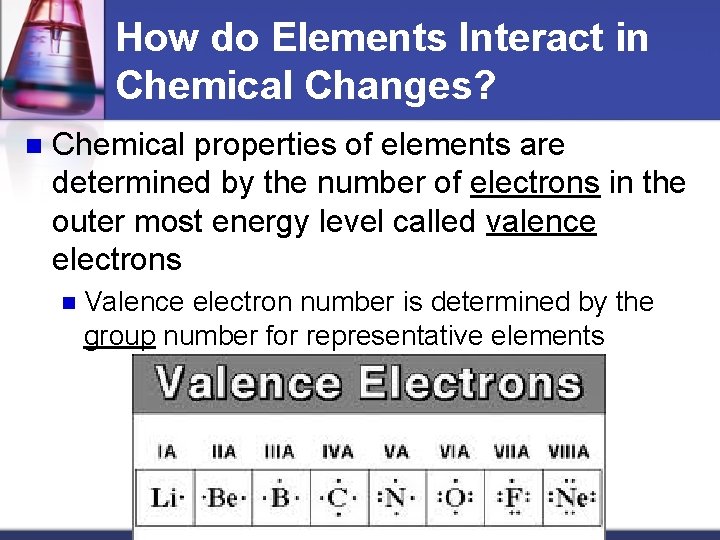
How do Elements Interact in Chemical Changes? n Chemical properties of elements are determined by the number of electrons in the outer most energy level called valence electrons n Valence electron number is determined by the group number for representative elements
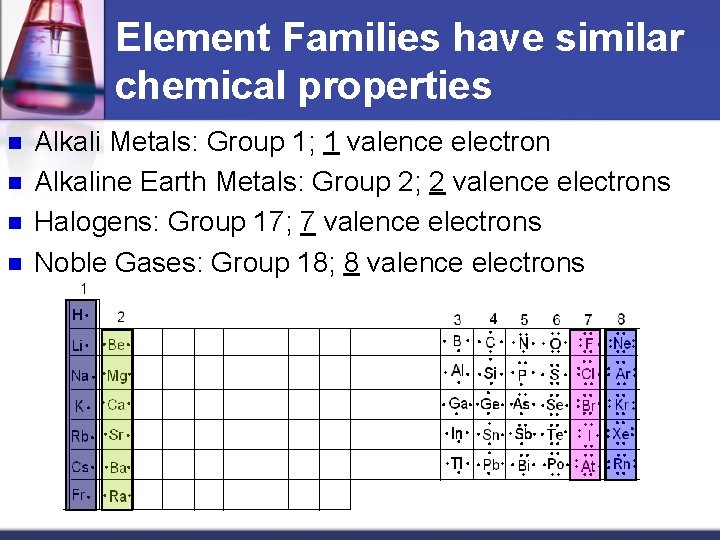
Element Families have similar chemical properties n n Alkali Metals: Group 1; 1 valence electron Alkaline Earth Metals: Group 2; 2 valence electrons Halogens: Group 17; 7 valence electrons Noble Gases: Group 18; 8 valence electrons
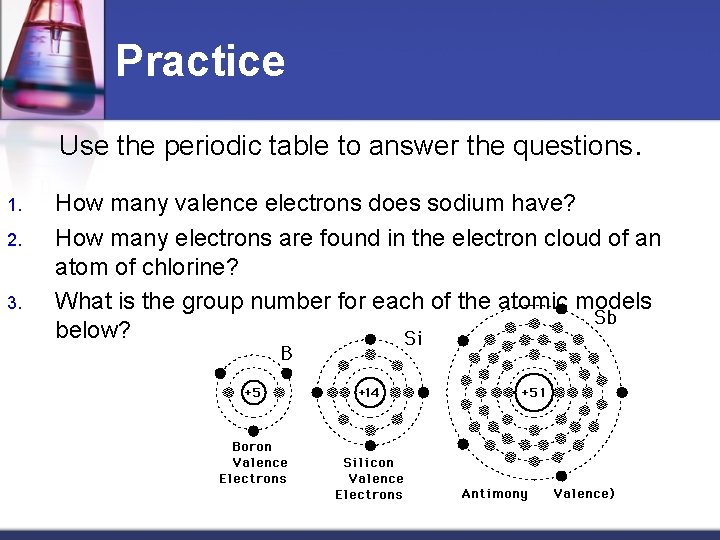
Practice Use the periodic table to answer the questions. 1. 2. 3. How many valence electrons does sodium have? How many electrons are found in the electron cloud of an atom of chlorine? What is the group number for each of the atomic models below?
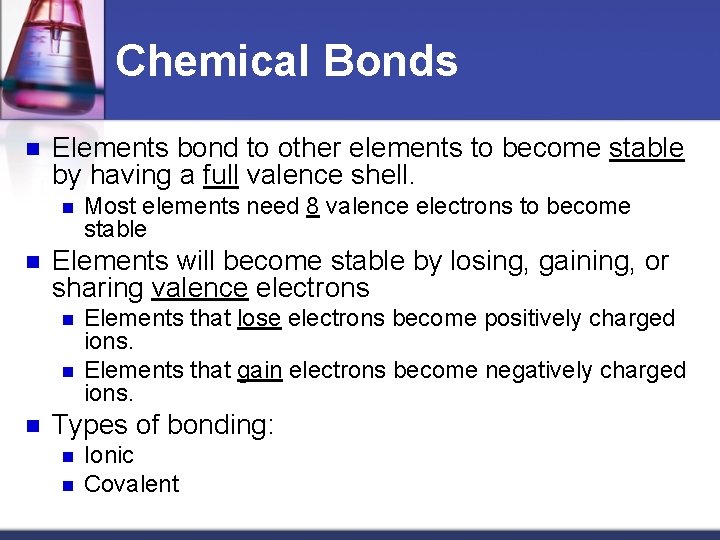
Chemical Bonds n Elements bond to other elements to become stable by having a full valence shell. n n Elements will become stable by losing, gaining, or sharing valence electrons n n n Most elements need 8 valence electrons to become stable Elements that lose electrons become positively charged ions. Elements that gain electrons become negatively charged ions. Types of bonding: n n Ionic Covalent
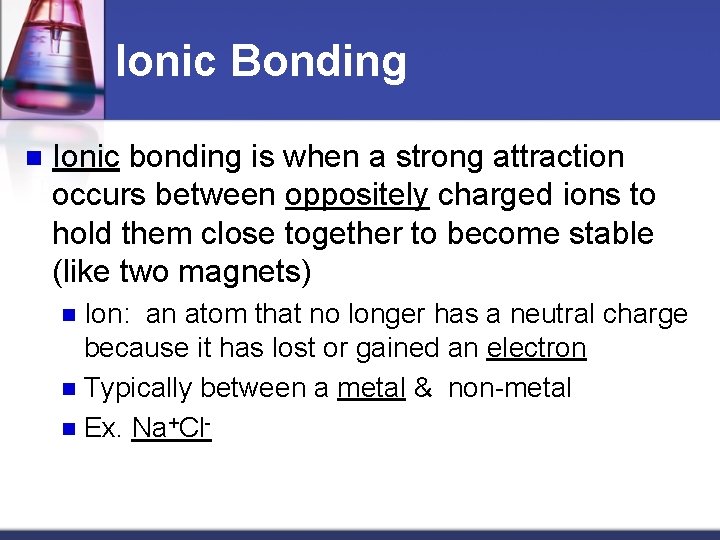
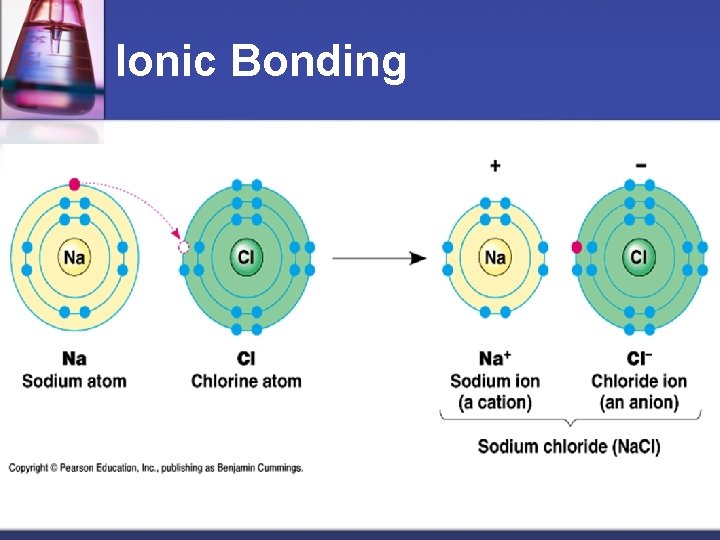
Ionic Bonding n Ionic bonding is when a strong attraction occurs between oppositely charged ions to hold them close together to become stable (like two magnets) Ion: an atom that no longer has a neutral charge because it has lost or gained an electron n Typically between a metal & non-metal n Ex. Na+Cln
Ionic Bonding
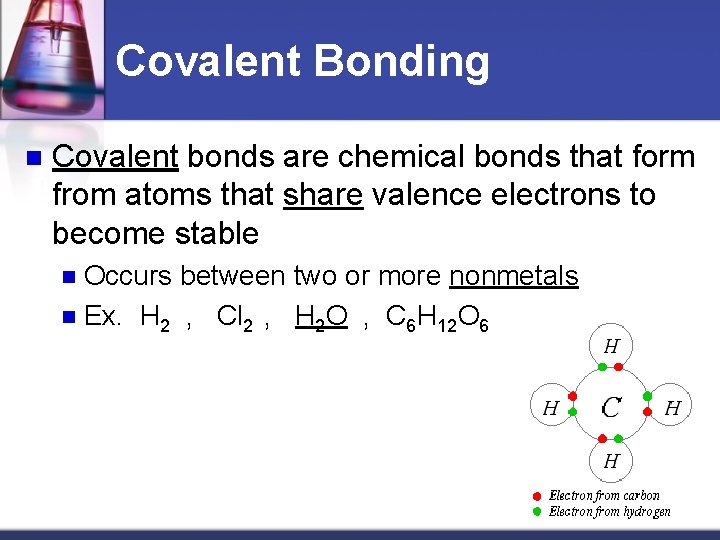
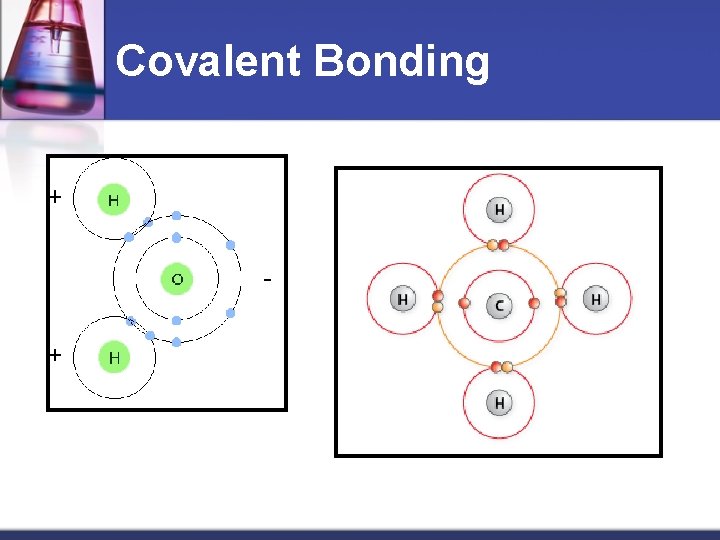
Covalent Bonding n Covalent bonds are chemical bonds that form from atoms that share valence electrons to become stable Occurs between two or more nonmetals n Ex. H 2 , Cl 2 , H 2 O , C 6 H 12 O 6 n
Covalent Bonding
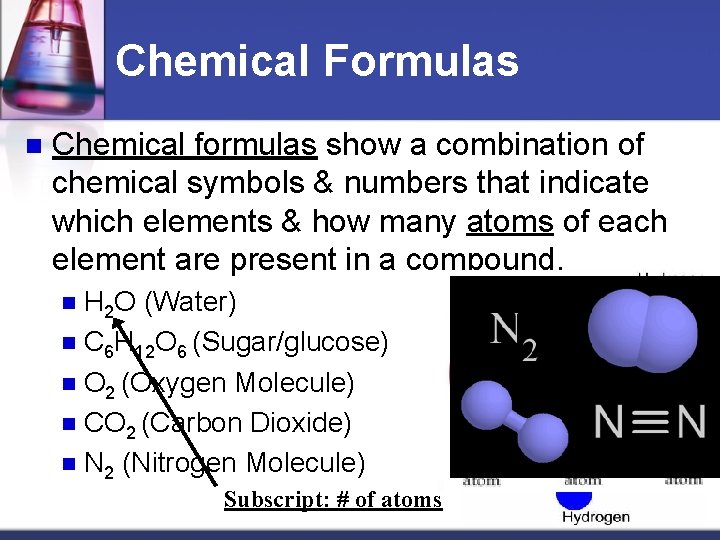
Chemical Formulas n Chemical formulas show a combination of chemical symbols & numbers that indicate which elements & how many atoms of each element are present in a compound. H 2 O (Water) n C 6 H 12 O 6 (Sugar/glucose) n O 2 (Oxygen Molecule) n CO 2 (Carbon Dioxide) n N 2 (Nitrogen Molecule) n Subscript: # of atoms
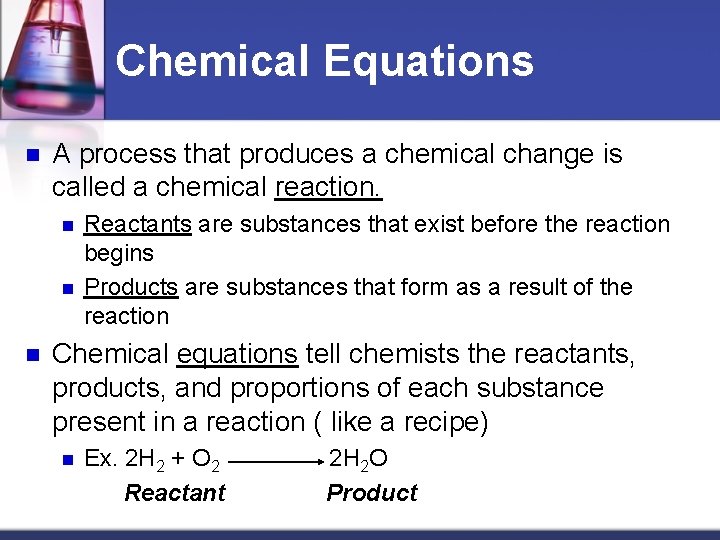
Chemical Equations n A process that produces a chemical change is called a chemical reaction. n n n Reactants are substances that exist before the reaction begins Products are substances that form as a result of the reaction Chemical equations tell chemists the reactants, products, and proportions of each substance present in a reaction ( like a recipe) n Ex. 2 H 2 + O 2 Reactant 2 H 2 O Product
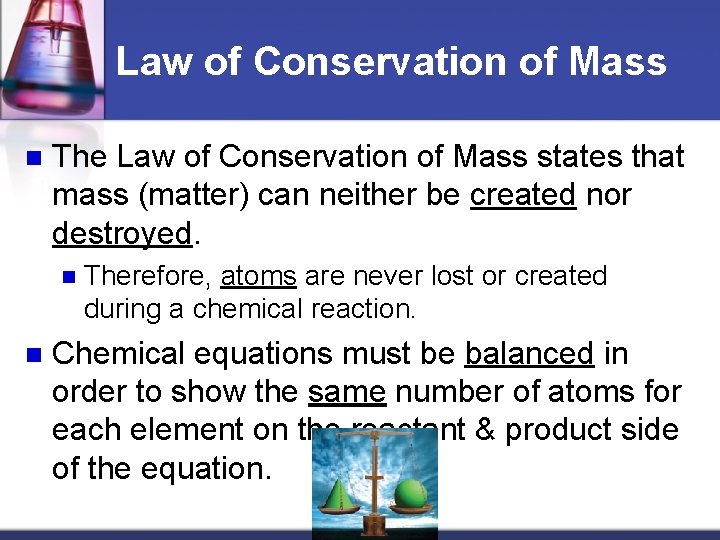
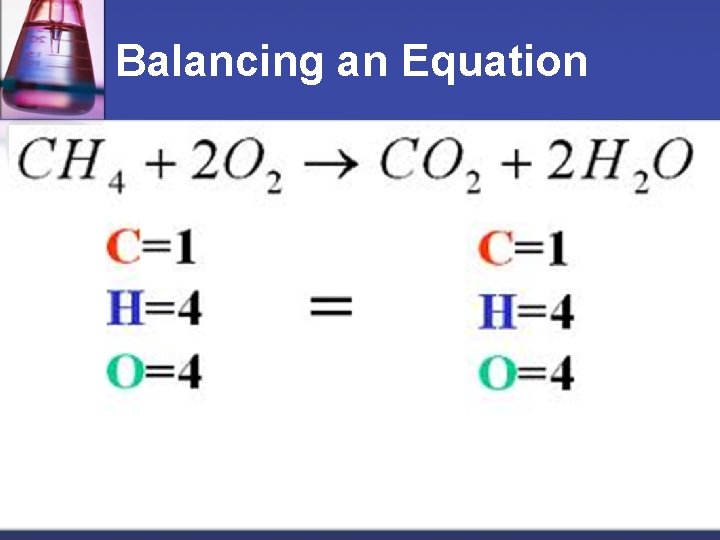
Law of Conservation of Mass n The Law of Conservation of Mass states that mass (matter) can neither be created nor destroyed. n n Therefore, atoms are never lost or created during a chemical reaction. Chemical equations must be balanced in order to show the same number of atoms for each element on the reactant & product side of the equation.
Balancing an Equation n Ex. 2 H 2 + O 2 Reactant 2 H 2 O Product
Chemistry of Matter Forming Acids & Bases State Correlation 2 b
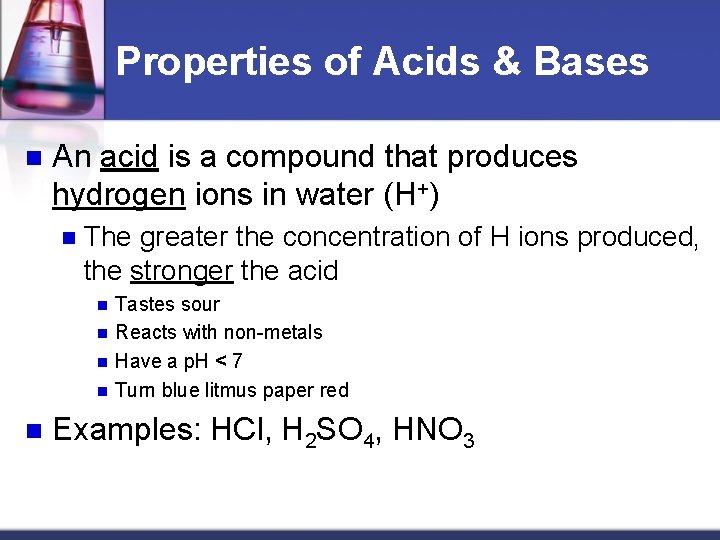
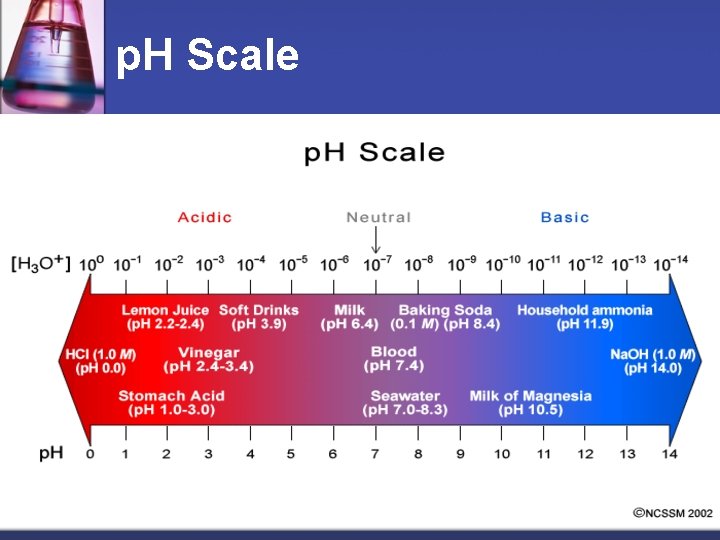
Properties of Acids & Bases n An acid is a compound that produces hydrogen ions in water (H+) n The greater the concentration of H ions produced, the stronger the acid n n n Tastes sour Reacts with non-metals Have a p. H < 7 Turn blue litmus paper red Examples: HCl, H 2 SO 4, HNO 3
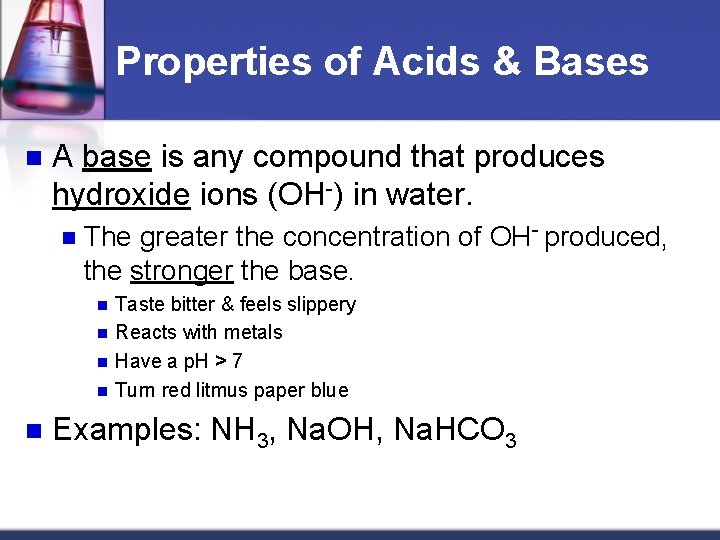
Properties of Acids & Bases n A base is any compound that produces hydroxide ions (OH-) in water. n The greater the concentration of OH- produced, the stronger the base. n n n Taste bitter & feels slippery Reacts with metals Have a p. H > 7 Turn red litmus paper blue Examples: NH 3, Na. OH, Na. HCO 3
p. H Scale
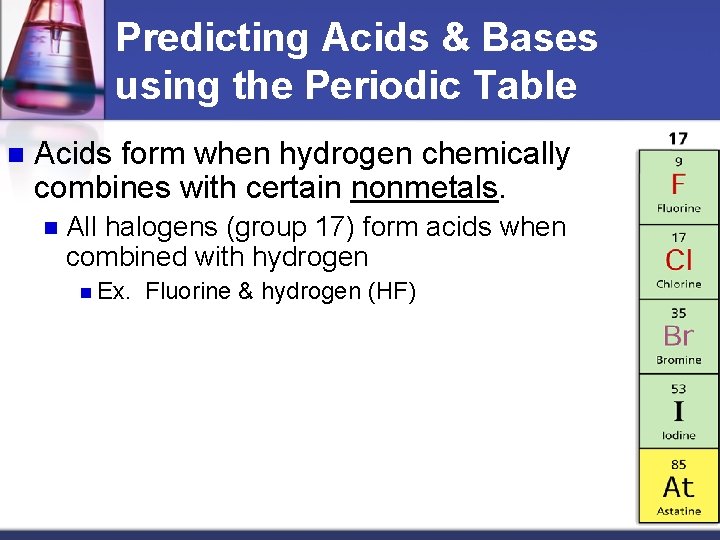
Predicting Acids & Bases using the Periodic Table n Acids form when hydrogen chemically combines with certain nonmetals. n All halogens (group 17) form acids when combined with hydrogen n Ex. Fluorine & hydrogen (HF)
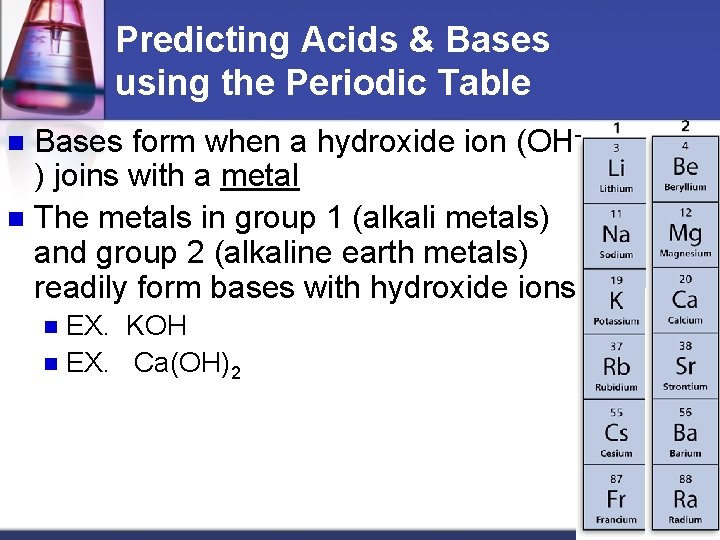
Predicting Acids & Bases using the Periodic Table Bases form when a hydroxide ion (OH) joins with a metal n The metals in group 1 (alkali metals) and group 2 (alkaline earth metals) readily form bases with hydroxide ions n EX. KOH n EX. Ca(OH)2 n