
Chemistry of Life The main atoms of life
- Slides: 61
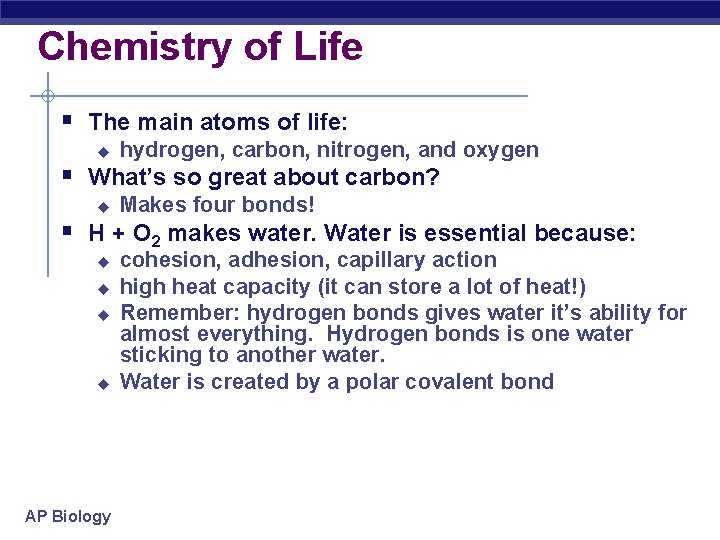
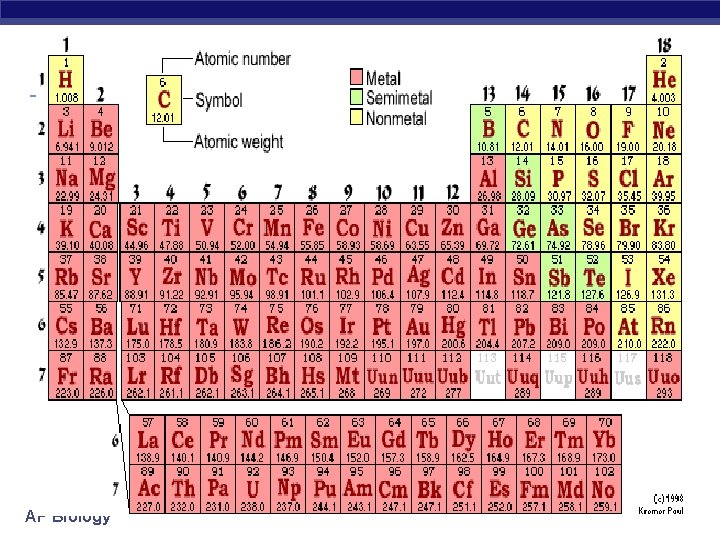
Chemistry of Life § The main atoms of life: u hydrogen, carbon, nitrogen, and oxygen u Makes four bonds! § What’s so great about carbon? § H + O 2 makes water. Water is essential because: u u AP Biology cohesion, adhesion, capillary action high heat capacity (it can store a lot of heat!) Remember: hydrogen bonds gives water it’s ability for almost everything. Hydrogen bonds is one water sticking to another water. Water is created by a polar covalent bond
AP Biology
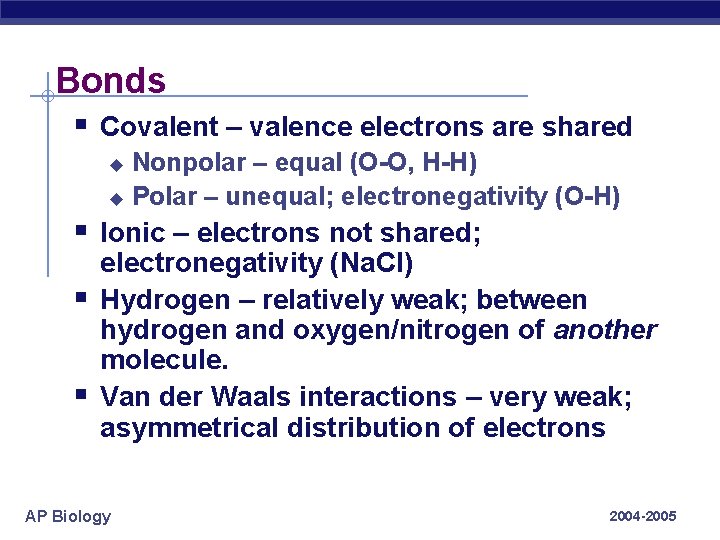
Bonds § Covalent – valence electrons are shared Nonpolar – equal (O-O, H-H) u Polar – unequal; electronegativity (O-H) u § Ionic – electrons not shared; § § electronegativity (Na. Cl) Hydrogen – relatively weak; between hydrogen and oxygen/nitrogen of another molecule. Van der Waals interactions – very weak; asymmetrical distribution of electrons AP Biology 2004 -2005
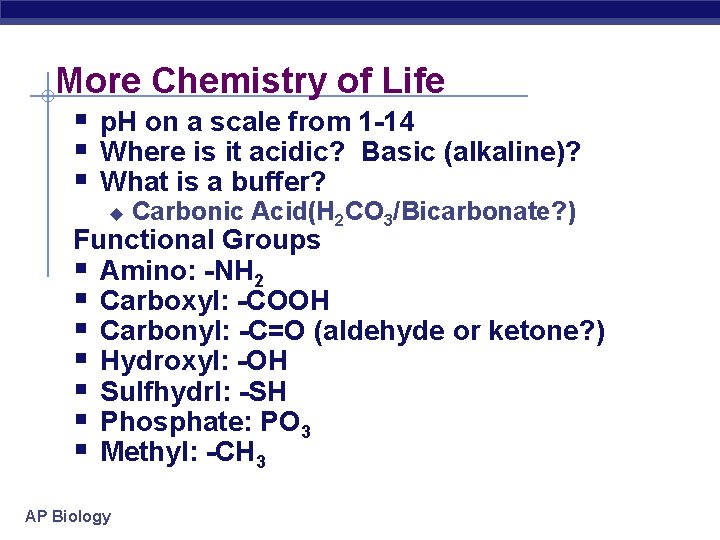
More Chemistry of Life § p. H on a scale from 1 -14 § Where is it acidic? Basic (alkaline)? § What is a buffer? u Carbonic Acid(H 2 CO 3/Bicarbonate? ) Functional Groups § Amino: -NH 2 § Carboxyl: -COOH § Carbonyl: -C=O (aldehyde or ketone? ) § Hydroxyl: -OH § Sulfhydrl: -SH § Phosphate: PO 3 § Methyl: -CH 3 AP Biology
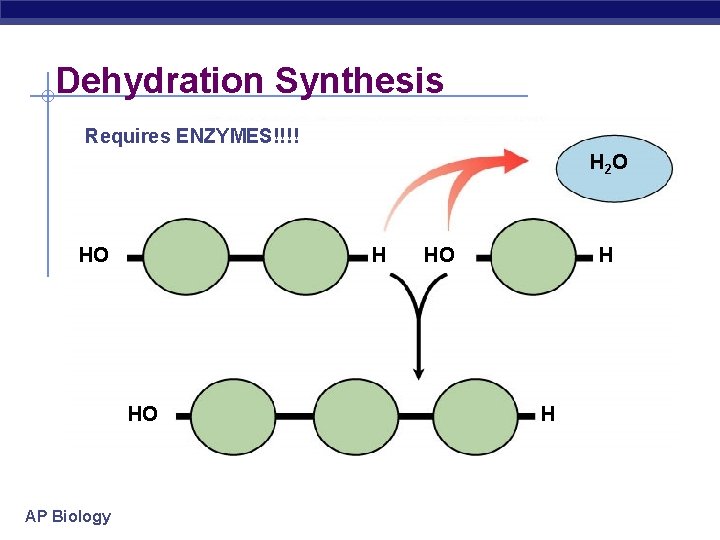
Dehydration Synthesis Requires ENZYMES!!!! H 2 O HO H HO AP Biology HO H H
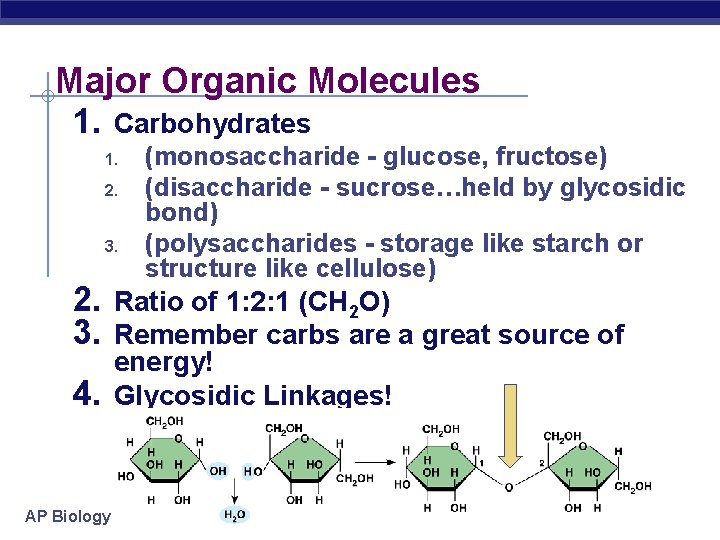
Major Organic Molecules 1. Carbohydrates 1. 2. 3. (monosaccharide - glucose, fructose) (disaccharide - sucrose…held by glycosidic bond) (polysaccharides - storage like starch or structure like cellulose) 2. Ratio of 1: 2: 1 (CH 2 O) 3. Remember carbs are a great source of 4. AP Biology energy! Glycosidic Linkages!
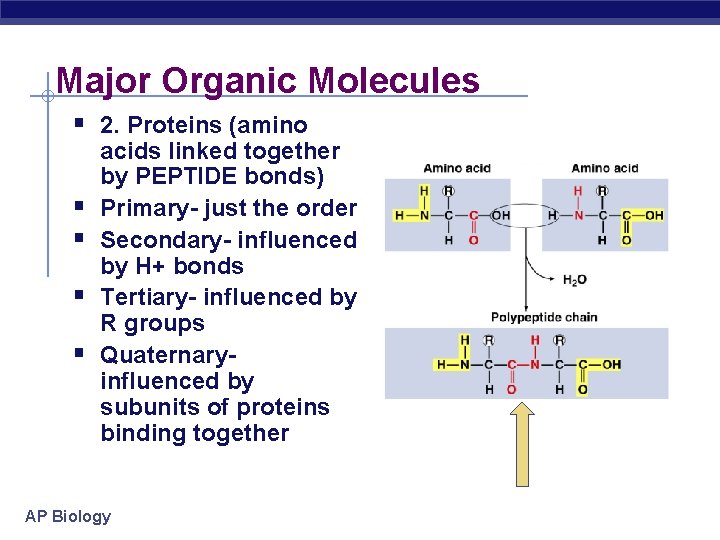
Major Organic Molecules § 2. Proteins (amino § § acids linked together by PEPTIDE bonds) Primary- just the order Secondary- influenced by H+ bonds Tertiary- influenced by R groups Quaternaryinfluenced by subunits of proteins binding together AP Biology
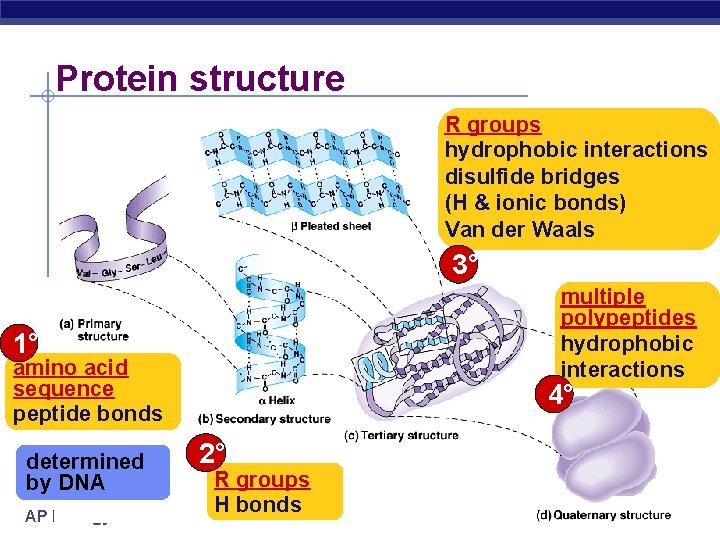
Protein structure R groups hydrophobic interactions disulfide bridges (H & ionic bonds) Van der Waals 3° multiple polypeptides hydrophobic interactions 1° amino acid sequence peptide bonds determined by DNA AP Biology 4° 2° R groups H bonds
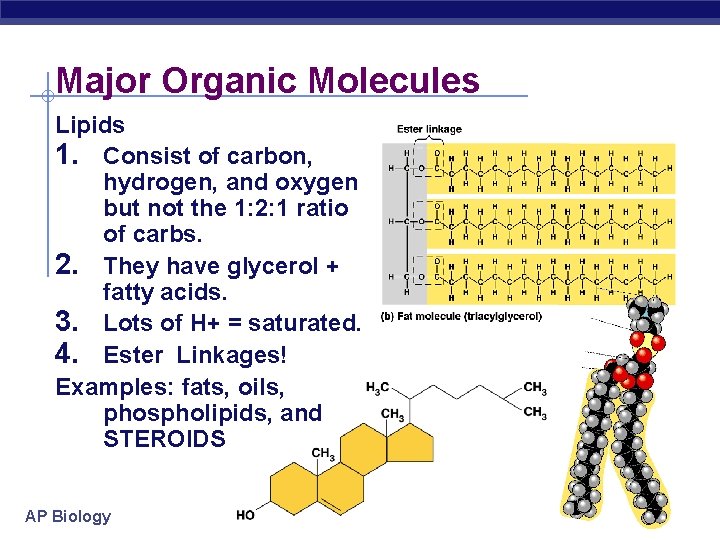
Major Organic Molecules Lipids 1. Consist of carbon, hydrogen, and oxygen but not the 1: 2: 1 ratio of carbs. 2. They have glycerol + fatty acids. 3. Lots of H+ = saturated. 4. Ester Linkages! Examples: fats, oils, phospholipids, and STEROIDS AP Biology
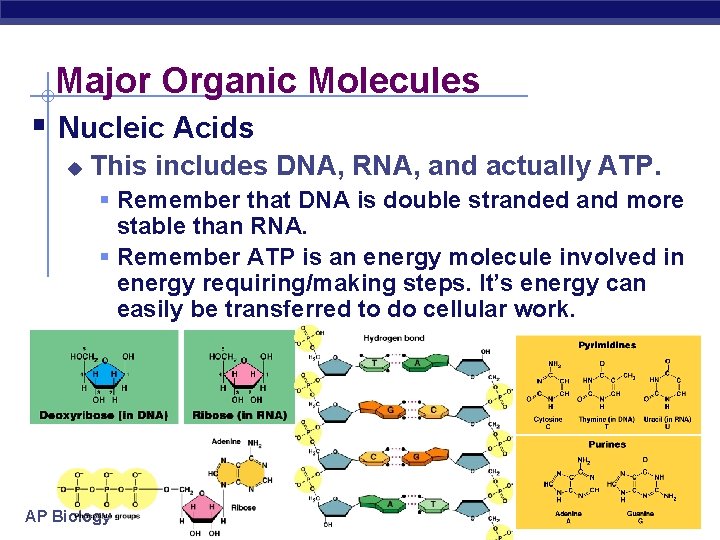
Major Organic Molecules § Nucleic Acids u This includes DNA, RNA, and actually ATP. § Remember that DNA is double stranded and more stable than RNA. § Remember ATP is an energy molecule involved in energy requiring/making steps. It’s energy can easily be transferred to do cellular work. AP Biology
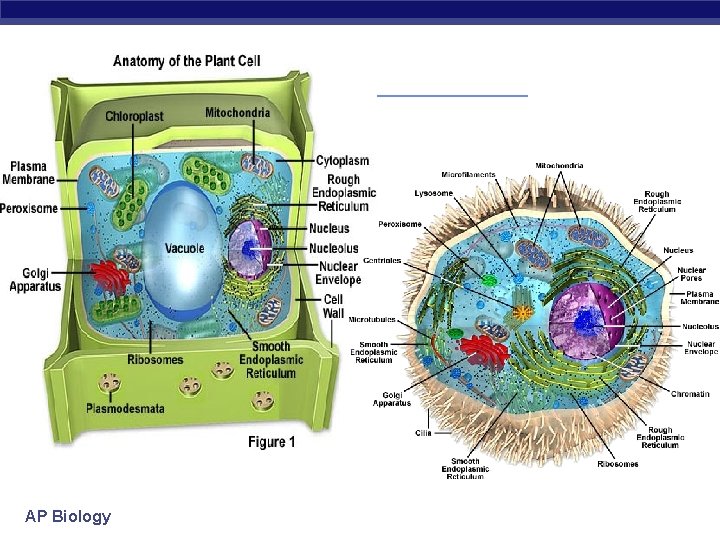
AP Biology
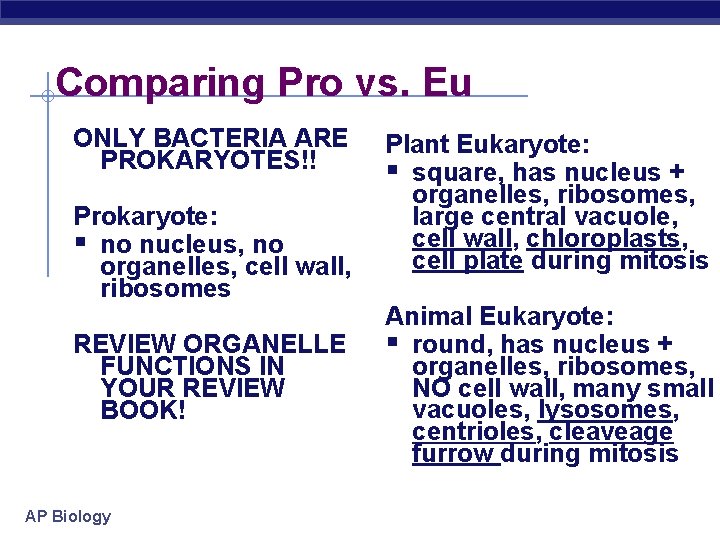
Comparing Pro vs. Eu ONLY BACTERIA ARE PROKARYOTES!! Prokaryote: § no nucleus, no organelles, cell wall, ribosomes REVIEW ORGANELLE FUNCTIONS IN YOUR REVIEW BOOK! AP Biology Plant Eukaryote: § square, has nucleus + organelles, ribosomes, large central vacuole, cell wall, chloroplasts, cell plate during mitosis Animal Eukaryote: § round, has nucleus + organelles, ribosomes, NO cell wall, many small vacuoles, lysosomes, centrioles, cleaveage furrow during mitosis
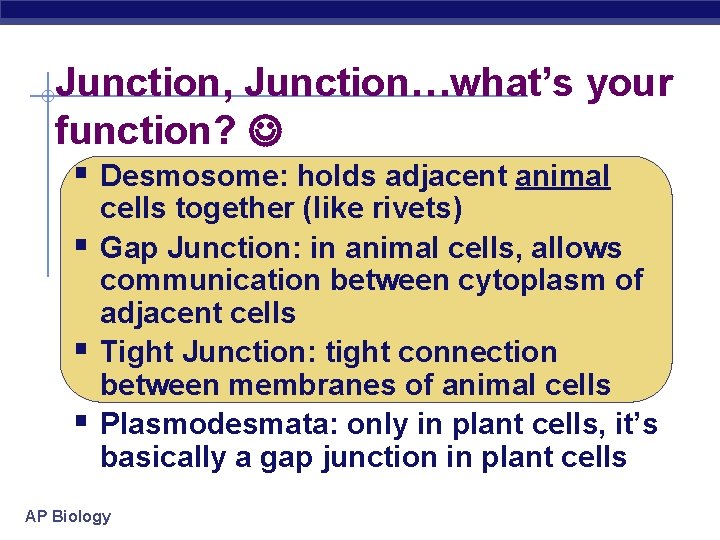
Junction, Junction…what’s your function? § Desmosome: holds adjacent animal § § § cells together (like rivets) Gap Junction: in animal cells, allows communication between cytoplasm of adjacent cells Tight Junction: tight connection between membranes of animal cells Plasmodesmata: only in plant cells, it’s basically a gap junction in plant cells AP Biology
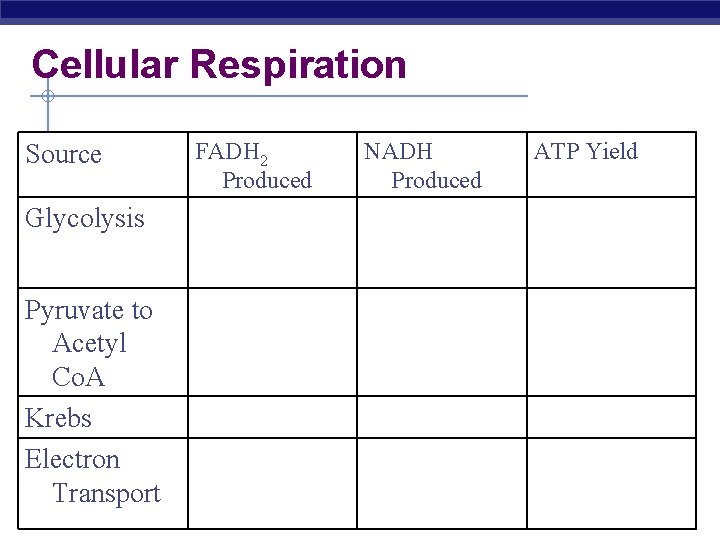
Cellular Respiration Source Glycolysis Pyruvate to Acetyl Co. A Krebs Electron Transport AP Biology FADH 2 Produced NADH Produced ATP Yield
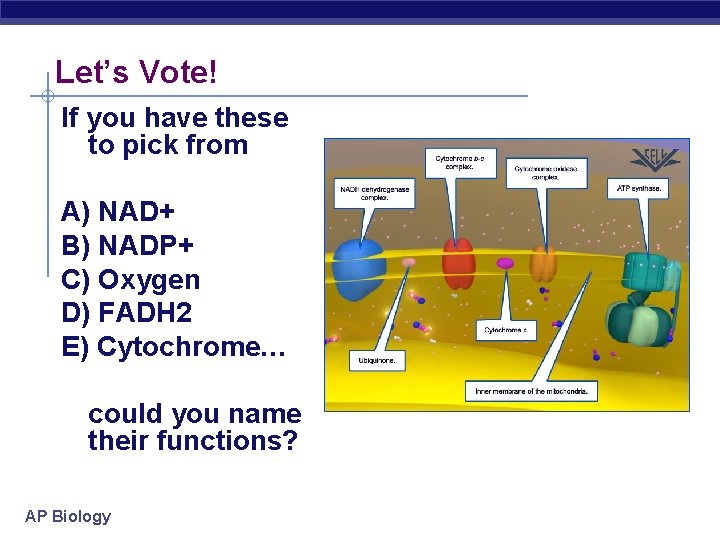
Let’s Vote! If you have these to pick from A) NAD+ B) NADP+ C) Oxygen D) FADH 2 E) Cytochrome… could you name their functions? AP Biology
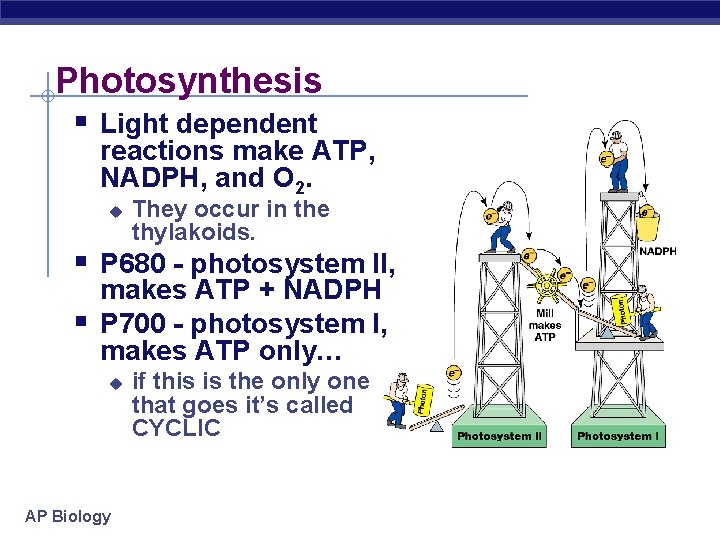
Photosynthesis § Light dependent reactions make ATP, NADPH, and O 2. u They occur in the thylakoids. § P 680 - photosystem II, § makes ATP + NADPH P 700 - photosystem I, makes ATP only… u AP Biology if this is the only one that goes it’s called CYCLIC
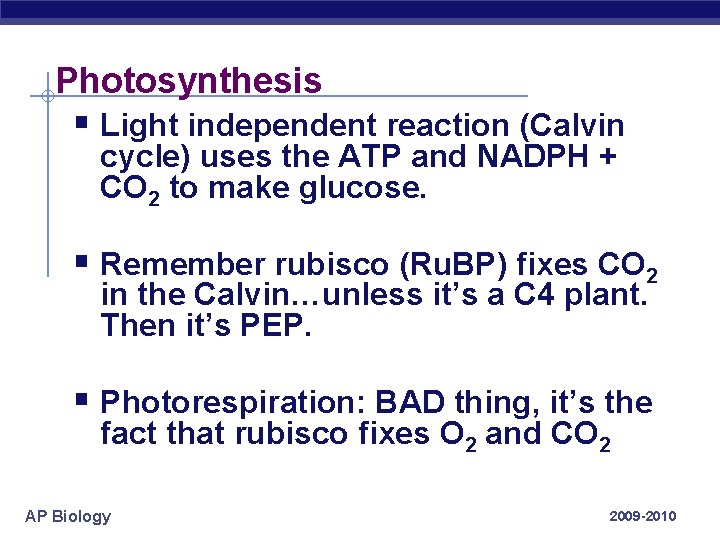
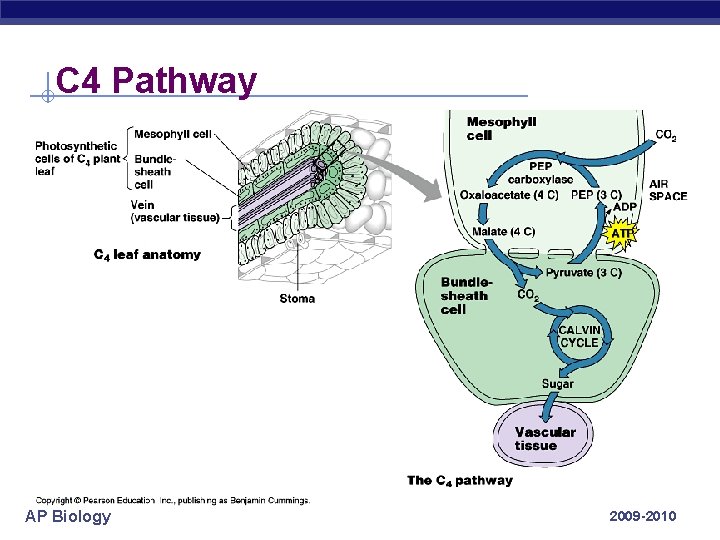
Photosynthesis § Light independent reaction (Calvin cycle) uses the ATP and NADPH + CO 2 to make glucose. § Remember rubisco (Ru. BP) fixes CO 2 in the Calvin…unless it’s a C 4 plant. Then it’s PEP. § Photorespiration: BAD thing, it’s the fact that rubisco fixes O 2 and CO 2 AP Biology 2009 -2010
C 4 Pathway AP Biology 2009 -2010
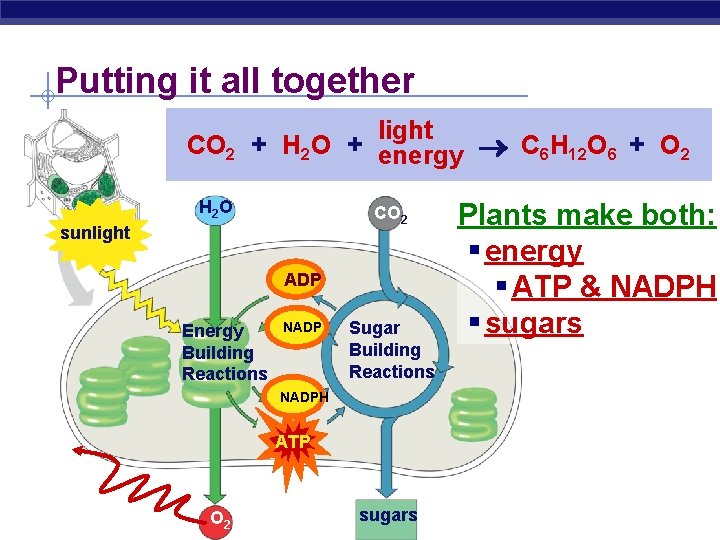
Putting it all together light CO 2 + H 2 O + energy C 6 H 12 O 6 + O 2 H 2 O CO 2 sunlight ADP Energy Building Reactions NADP Sugar Building Reactions NADPH ATP AP Biology O 2 sugars Plants make both: § energy § ATP & NADPH § sugars
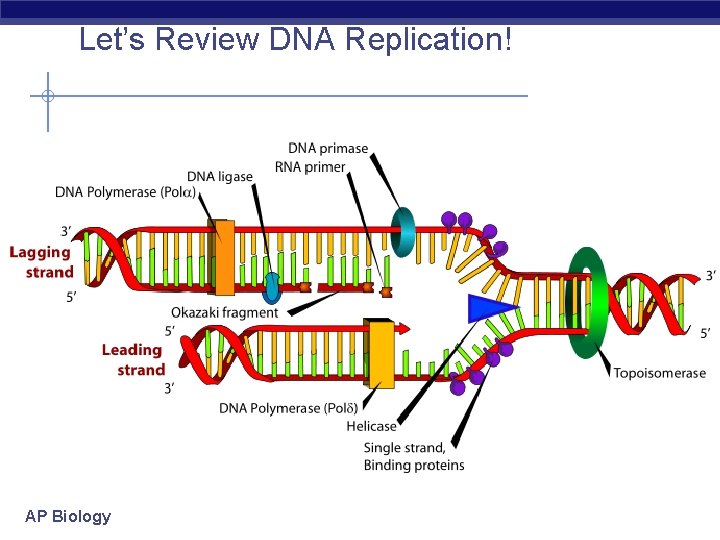
Let’s Review DNA Replication! AP Biology
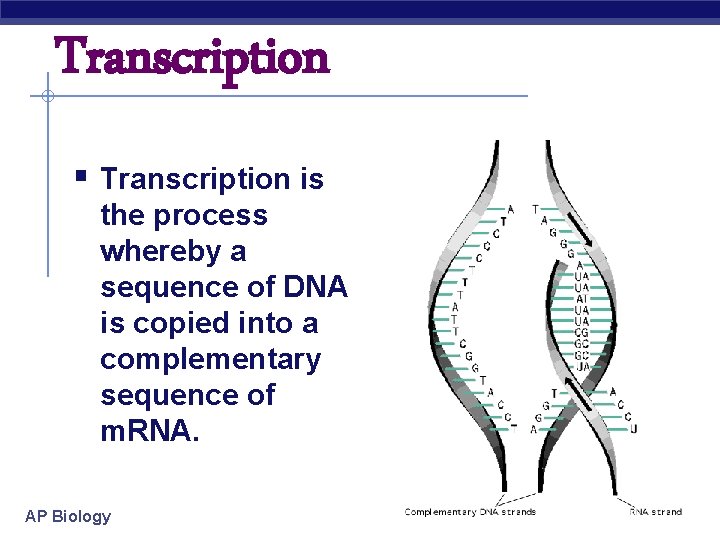
Transcription § Transcription is the process whereby a sequence of DNA is copied into a complementary sequence of m. RNA. AP Biology
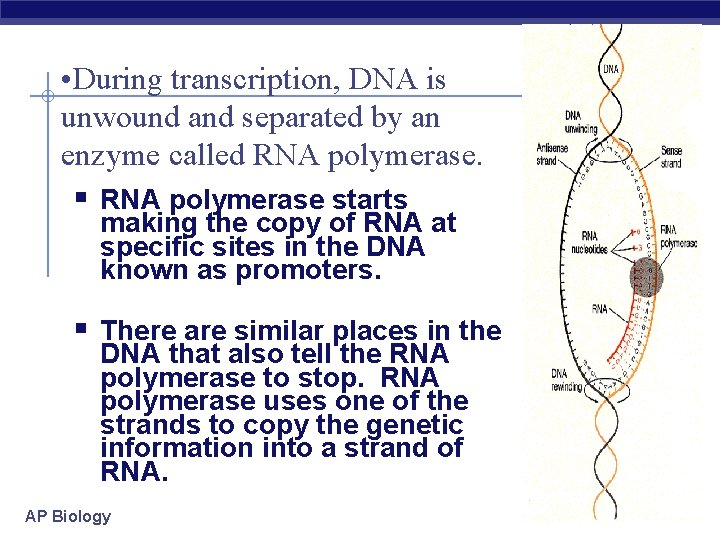
• During transcription, DNA is unwound and separated by an enzyme called RNA polymerase. § RNA polymerase starts making the copy of RNA at specific sites in the DNA known as promoters. § There are similar places in the DNA that also tell the RNA polymerase to stop. RNA polymerase uses one of the strands to copy the genetic information into a strand of RNA. AP Biology
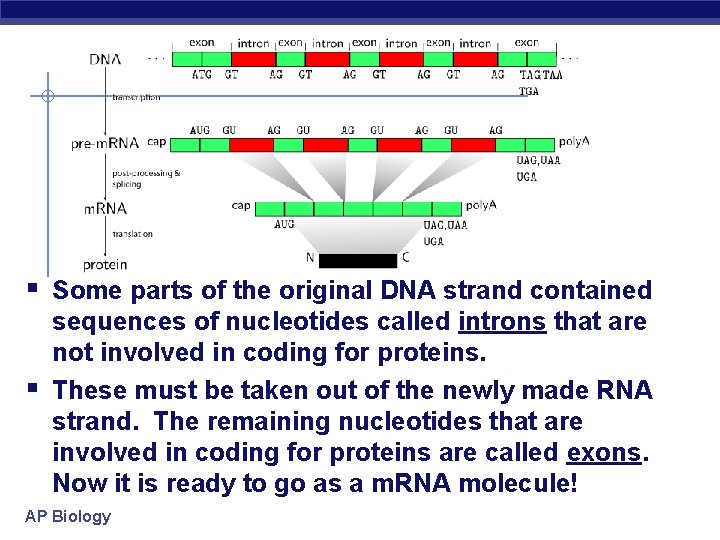
§ Some parts of the original DNA strand contained § sequences of nucleotides called introns that are not involved in coding for proteins. These must be taken out of the newly made RNA strand. The remaining nucleotides that are involved in coding for proteins are called exons. Now it is ready to go as a m. RNA molecule! AP Biology
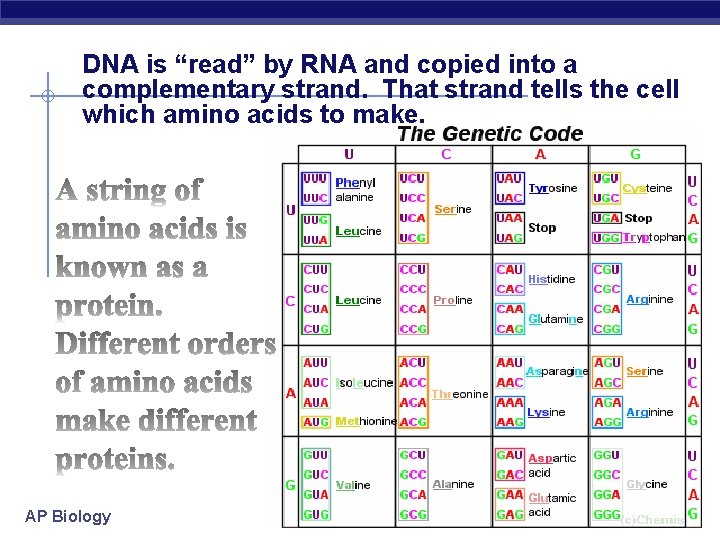
DNA is “read” by RNA and copied into a complementary strand. That strand tells the cell which amino acids to make. m. RNA AP Biology
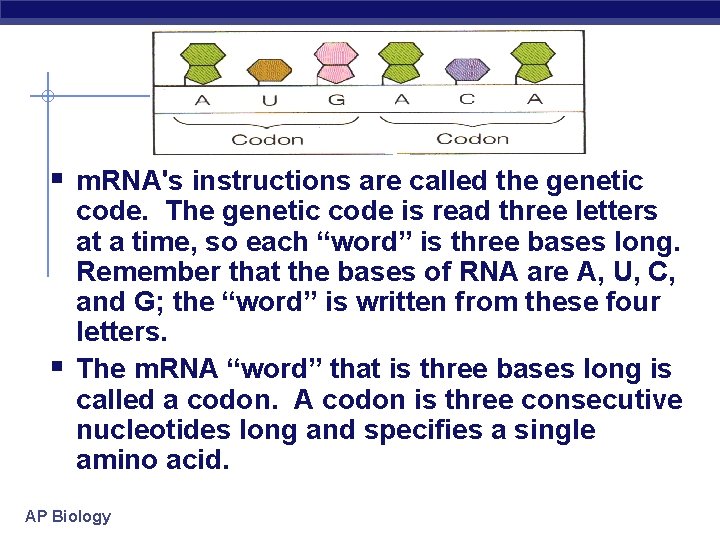
§ m. RNA's instructions are called the genetic § code. The genetic code is read three letters at a time, so each “word” is three bases long. Remember that the bases of RNA are A, U, C, and G; the “word” is written from these four letters. The m. RNA “word” that is three bases long is called a codon. A codon is three consecutive nucleotides long and specifies a single amino acid. AP Biology
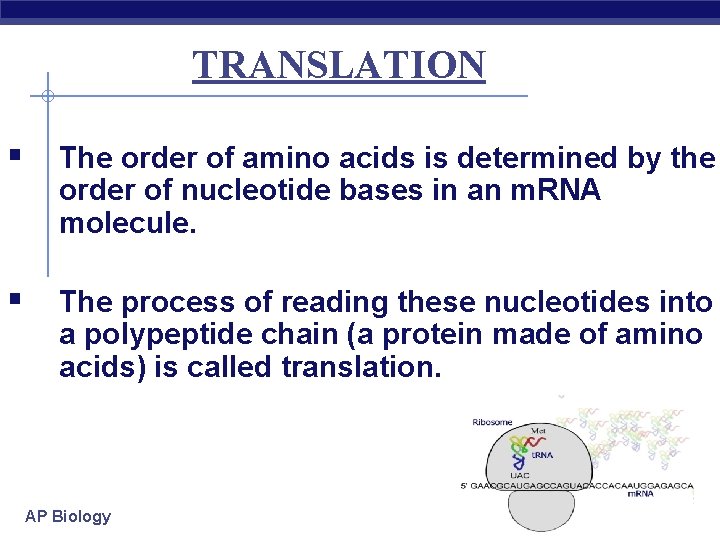
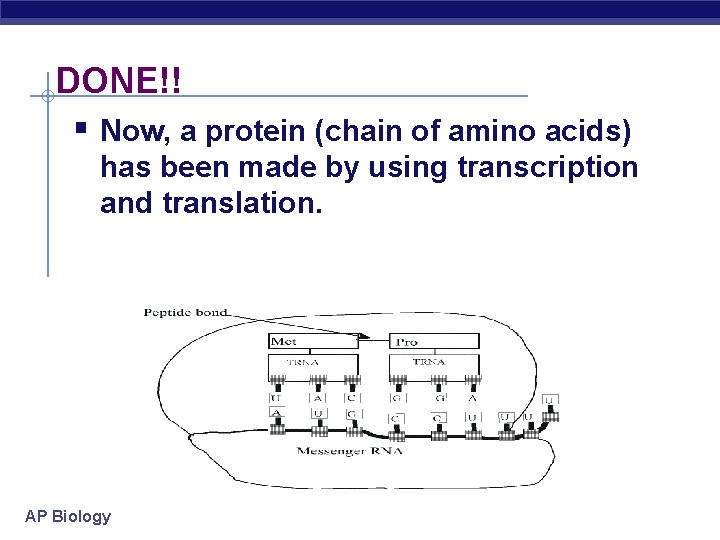
TRANSLATION § The order of amino acids is determined by the order of nucleotide bases in an m. RNA molecule. § The process of reading these nucleotides into a polypeptide chain (a protein made of amino acids) is called translation. AP Biology
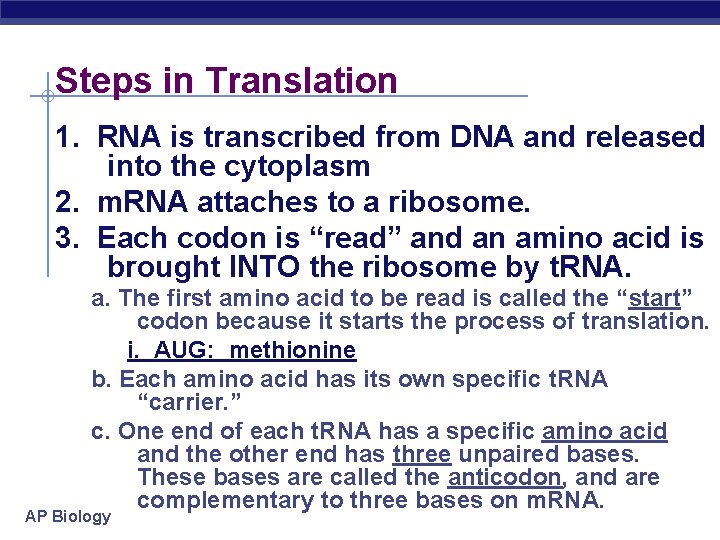
Steps in Translation 1. RNA is transcribed from DNA and released into the cytoplasm 2. m. RNA attaches to a ribosome. 3. Each codon is “read” and an amino acid is brought INTO the ribosome by t. RNA. a. The first amino acid to be read is called the “start” codon because it starts the process of translation. i. AUG: methionine b. Each amino acid has its own specific t. RNA “carrier. ” c. One end of each t. RNA has a specific amino acid and the other end has three unpaired bases. These bases are called the anticodon, and are complementary to three bases on m. RNA. AP Biology
Translation Steps Cont. 4. The amino acid is strung together to make a protein inside the ribosome by forming a peptide bond between each amino acid and by being removed from the t. RNA molecule. 5. This process continues until the ribosome reaches a stop codon on the m. RNA molecule. This signals the process of translation to stop and a complete protein is now formed. a. There are three stop codons: UAA, UAG, and UGA AP Biology
DONE!! § Now, a protein (chain of amino acids) has been made by using transcription and translation. AP Biology
Questions to Think About… Answer these with either transcription or translation… 1. Which one should happen in the 2. 3. 4. 5. nucleus (if a eukaryote)? (think about this!) Which one makes m. RNA? Which one directly makes protein? Which one occurs first? Which one requires RNA polymerase? AP Biology
Molecular Genetics § A) B) C) D) E) F) G) H) I) AP Biology Replication vs. Transcription vs. Translation…Think about where these are involved! DNA polymerase RNA polymerase DNA ligase Okazaki fragments Restriction Enzyme Reverse Transcriptase Primer Promoter Helicase
Frequently Missed Genetic Words § Epistasis (example: albinism) § Pleiotrophy (example: siamese cat color § § and cross eyed) Polygenic Inheritance (example: skin) Complete Dominance vs. Incomplete Dominance vs. Multiple Alleles AP Biology
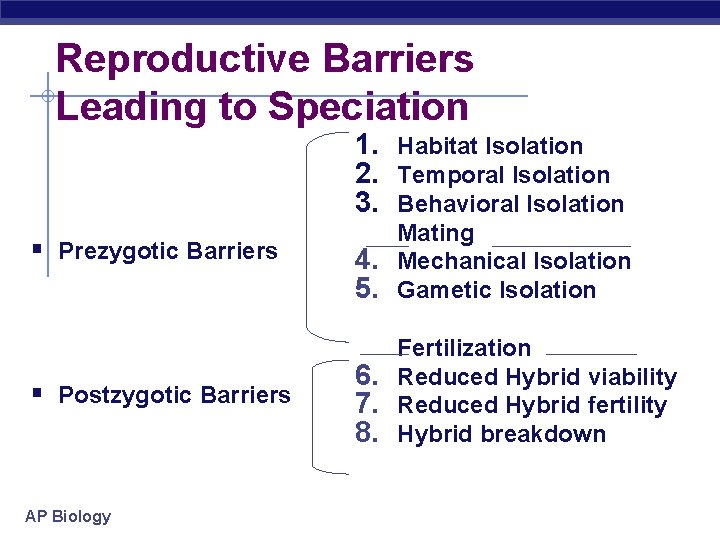
Reproductive Barriers Leading to Speciation 1. Habitat Isolation 2. Temporal Isolation 3. Behavioral Isolation § Prezygotic Barriers § Postzygotic Barriers AP Biology 4. 5. Mating Mechanical Isolation Gametic Isolation 6. 7. 8. Fertilization Reduced Hybrid viability Reduced Hybrid fertility Hybrid breakdown
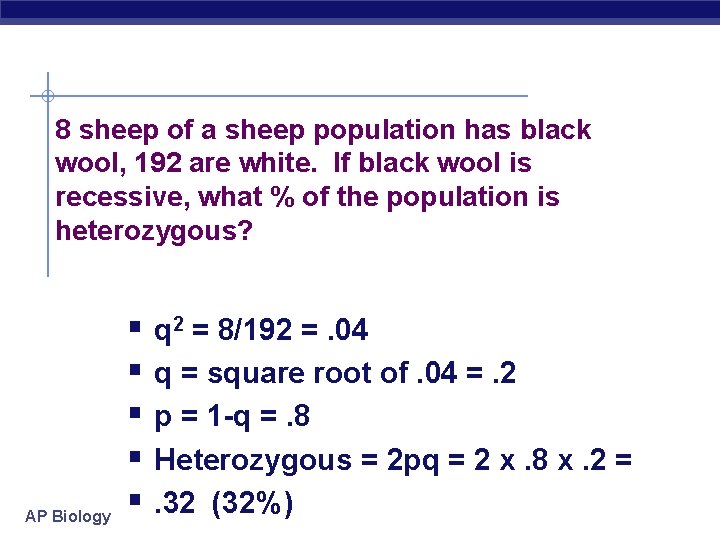
8 sheep of a sheep population has black wool, 192 are white. If black wool is recessive, what % of the population is heterozygous? AP Biology § q 2 = 8/192 =. 04 § q = square root of. 04 =. 2 § p = 1 -q =. 8 § Heterozygous = 2 pq = 2 x. 8 x. 2 = §. 32 (32%)
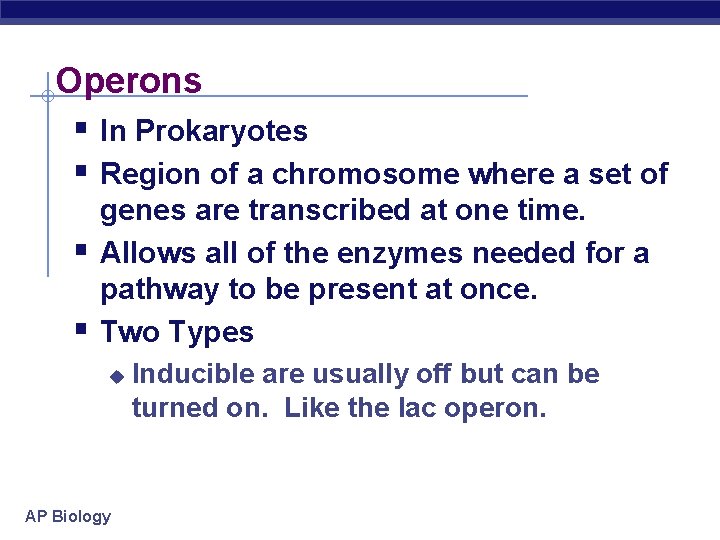
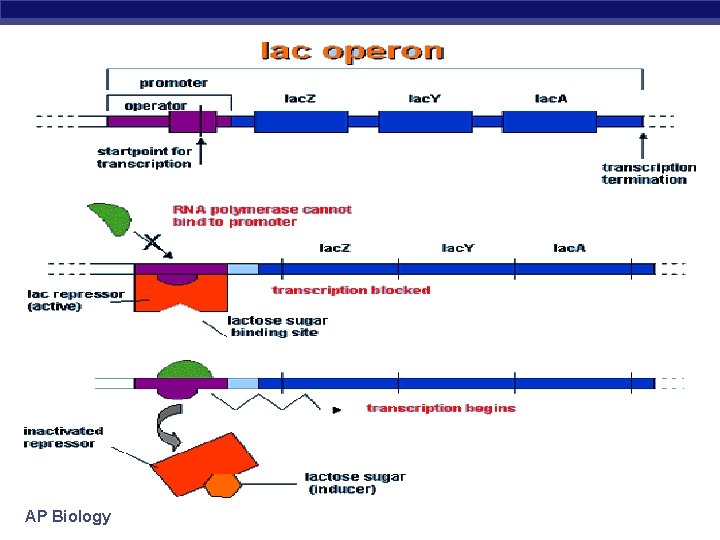
Operons § In Prokaryotes § Region of a chromosome where a set of § § genes are transcribed at one time. Allows all of the enzymes needed for a pathway to be present at once. Two Types u AP Biology Inducible are usually off but can be turned on. Like the lac operon.
AP Biology
In Prokaryotes… § -DNA is circular § -It is smaller that eukaryotic DNA § -Less elaborately structured § -And also, you should know, that it is loosely anchored by fiber that is anchored to the plasma membrane (and it’s not in a nucleus…there is no nucleus!) AP Biology
But…in eukaryotes… § -It is complex, with a large amount of § § protein to form chromatin -Highly extended and tangled in interphase -And then of course for mitosis it gets short, thick, “fat” and able to be seen visibly when stained AP Biology
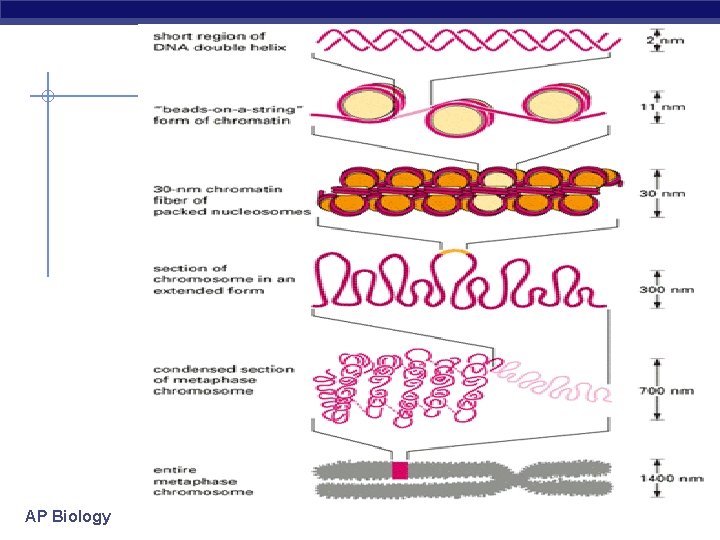
DNA Packing § -You need to do it because there is an § § enormous amount of DNA -There are four levels you will be required to know. (This is similar to the primary, secondary, tertiary, and quaternary structure of a protein in a way…we’re starting out small and getting to the bigger picture) What are those four levels? AP Biology
AP Biology
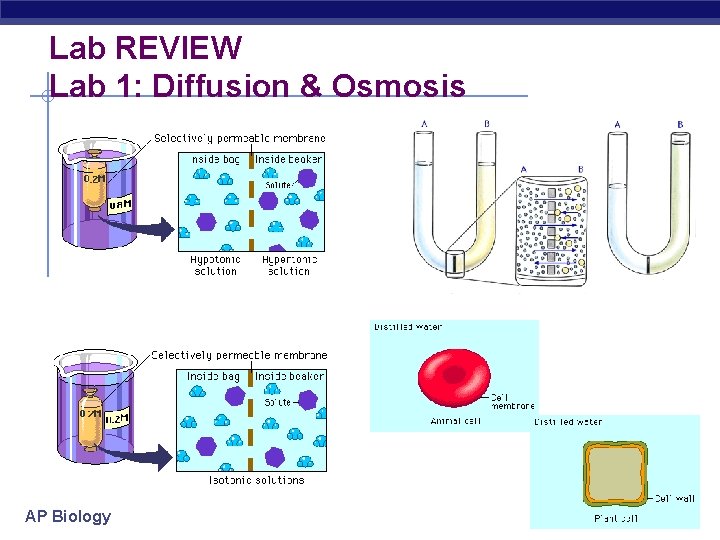
Lab REVIEW Lab 1: Diffusion & Osmosis AP Biology 2004 -2005
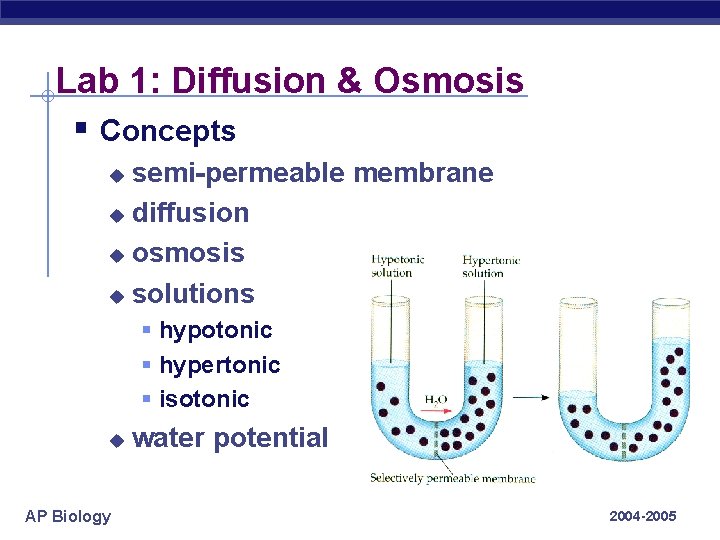
Lab 1: Diffusion & Osmosis § Concepts semi-permeable membrane u diffusion u osmosis u solutions u § hypotonic § hypertonic § isotonic u AP Biology water potential 2004 -2005
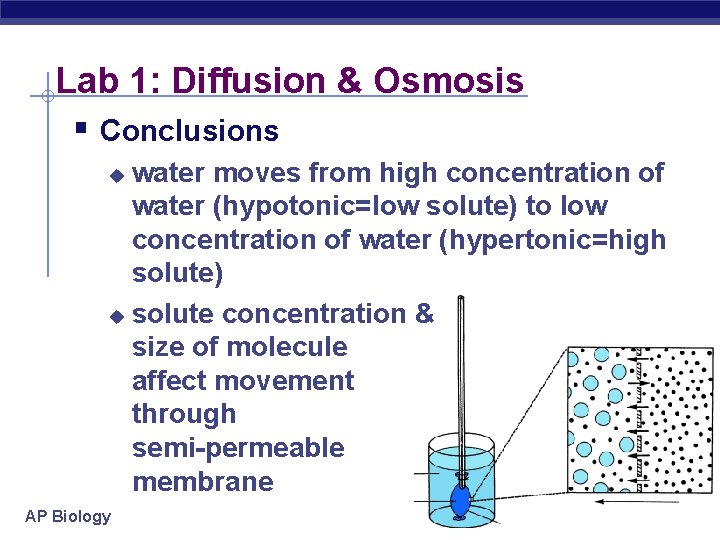
Lab 1: Diffusion & Osmosis § Conclusions water moves from high concentration of water (hypotonic=low solute) to low concentration of water (hypertonic=high solute) u solute concentration & size of molecule affect movement through semi-permeable membrane u AP Biology 2004 -2005
Lab 1: Diffusion & Osmosis ESSAY 1992 A laboratory assistant prepared solutions of 0. 8 M, 0. 6 M, 0. 4 M, and 0. 2 M sucrose, but forgot to label them. After realizing the error, the assistant randomly labeled the flasks containing these four unknown solutions as flask A, flask B, flask C, and flask D. Design an experiment, based on the principles of diffusion and osmosis, that the assistant could use to determine which of the flasks contains each of the four unknown solutions. Include in your answer: a. a description of how you would set up and perform the experiment; b. the results you would expect from your experiment; and c. an explanation of those results based on the principles involved. Be sure to clearly state the principles addressed in your discussion. AP Biology 2004 -2005
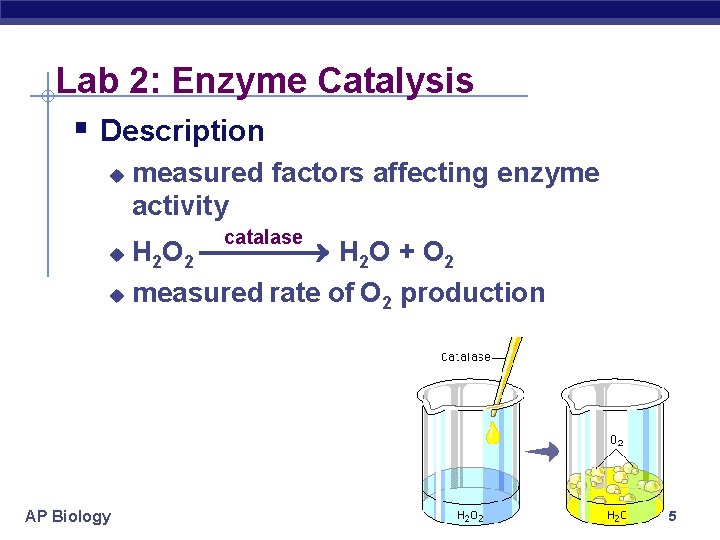
Lab 2: Enzyme Catalysis § Description u measured factors affecting enzyme activity catalase H 2 O 2 H 2 O + O 2 u measured rate of O 2 production u AP Biology 2004 -2005
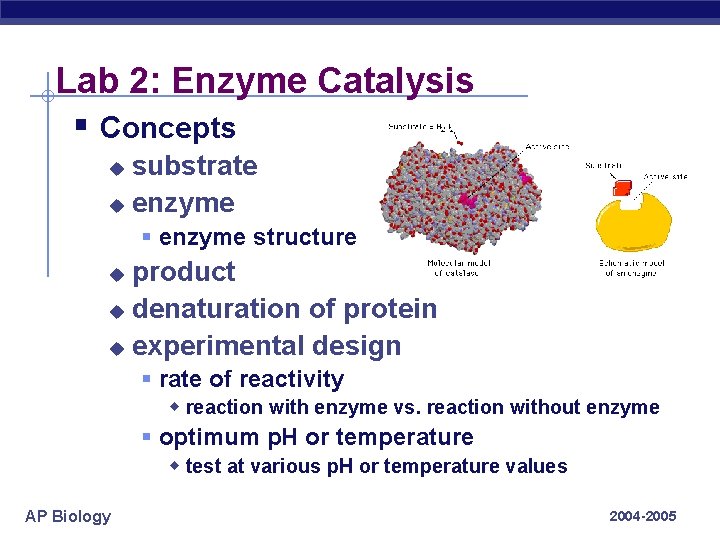
Lab 2: Enzyme Catalysis § Concepts substrate u enzyme u § enzyme structure product u denaturation of protein u experimental design u § rate of reactivity w reaction with enzyme vs. reaction without enzyme § optimum p. H or temperature w test at various p. H or temperature values AP Biology 2004 -2005
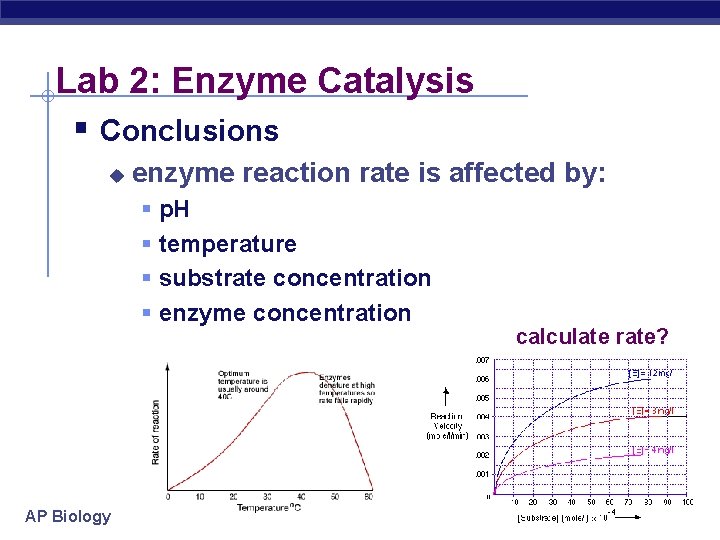
Lab 2: Enzyme Catalysis § Conclusions u enzyme reaction rate is affected by: § § AP Biology p. H temperature substrate concentration enzyme concentration calculate rate? 2004 -2005
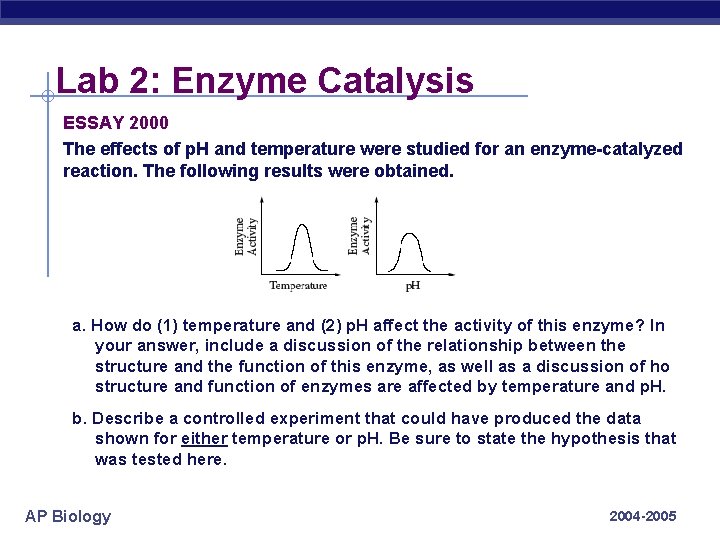
Lab 2: Enzyme Catalysis ESSAY 2000 The effects of p. H and temperature were studied for an enzyme-catalyzed reaction. The following results were obtained. a. How do (1) temperature and (2) p. H affect the activity of this enzyme? In your answer, include a discussion of the relationship between the structure and the function of this enzyme, as well as a discussion of ho structure and function of enzymes are affected by temperature and p. H. b. Describe a controlled experiment that could have produced the data shown for either temperature or p. H. Be sure to state the hypothesis that was tested here. AP Biology 2004 -2005
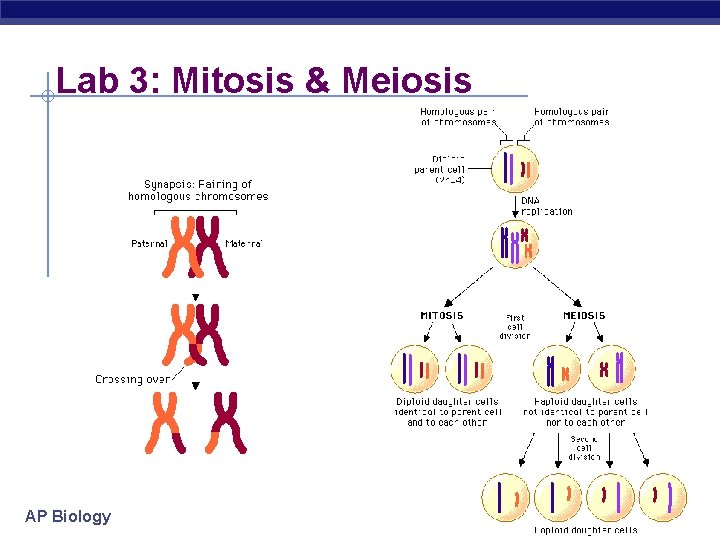
Lab 3: Mitosis & Meiosis AP Biology 2004 -2005
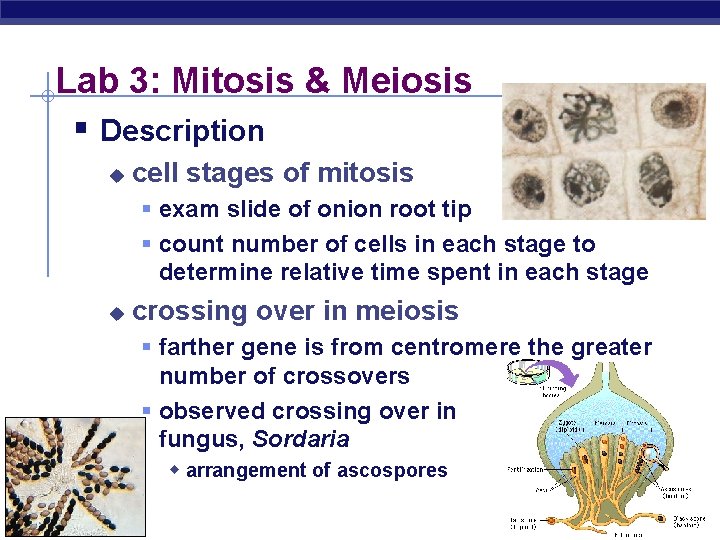
Lab 3: Mitosis & Meiosis § Description u cell stages of mitosis § exam slide of onion root tip § count number of cells in each stage to determine relative time spent in each stage u crossing over in meiosis § farther gene is from centromere the greater number of crossovers § observed crossing over in fungus, Sordaria w arrangement of ascospores AP Biology 2004 -2005
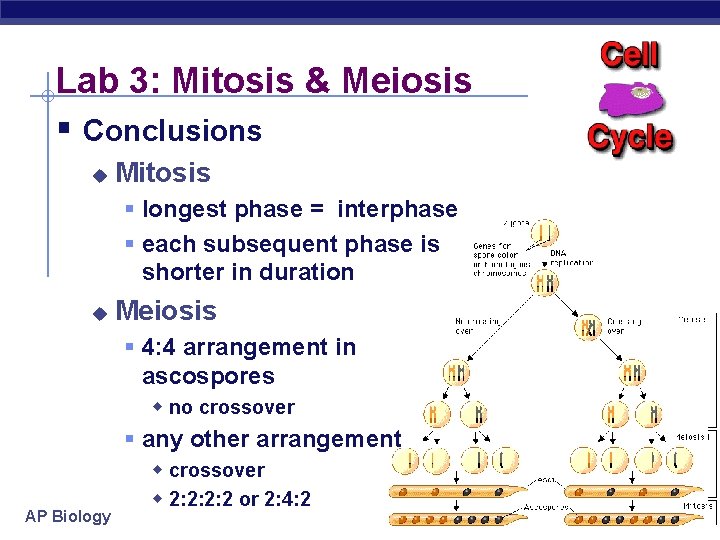
Lab 3: Mitosis & Meiosis § Conclusions u Mitosis § longest phase = interphase § each subsequent phase is shorter in duration u AP Biology Meiosis § 4: 4 arrangement in ascospores w no crossover § any other arrangement w crossover w 2: 2: 2: 2 or 2: 4: 2 2004 -2005
Lab 3: Mitosis & Meiosis ESSAY 1987 Discuss the process of cell division in animals. Include a description of mitosis and cytokinesis, and of the other phases of the cell cycle. Do not include meiosis. ESSAY 2004 Meiosis reduces chromosome number and rearranges genetic information. a. Explain how the reduction and rearrangement are accomplished in meiosis. b. Several human disorders occur as a result of defects in the meiotic process. Identify ONE such chromosomal abnormality; what effects does it have on the phenotype of people with the disorder? Describe how this abnormality could result from a defect in meiosis. c. Production of offspring by parthenogenesis or cloning bypasses the typical meiotic process. Describe either parthenogenesis or cloning and compare the genomes of the offspring with those of the parents. AP Biology 2004 -2005
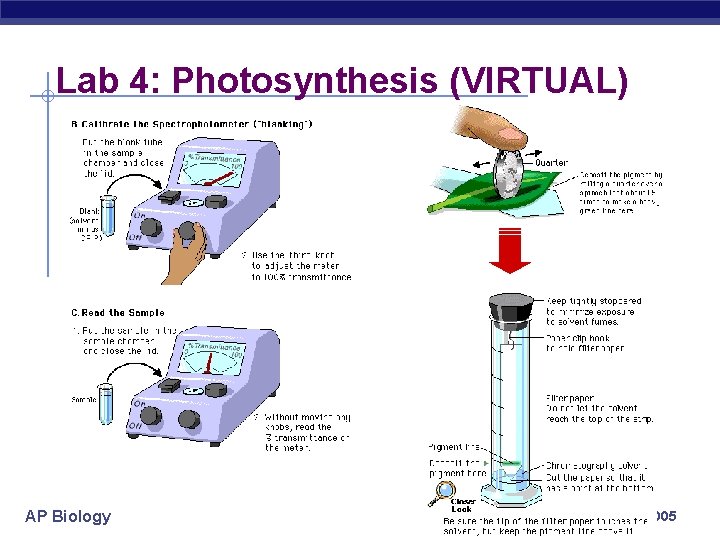
Lab 4: Photosynthesis (VIRTUAL) AP Biology 2004 -2005
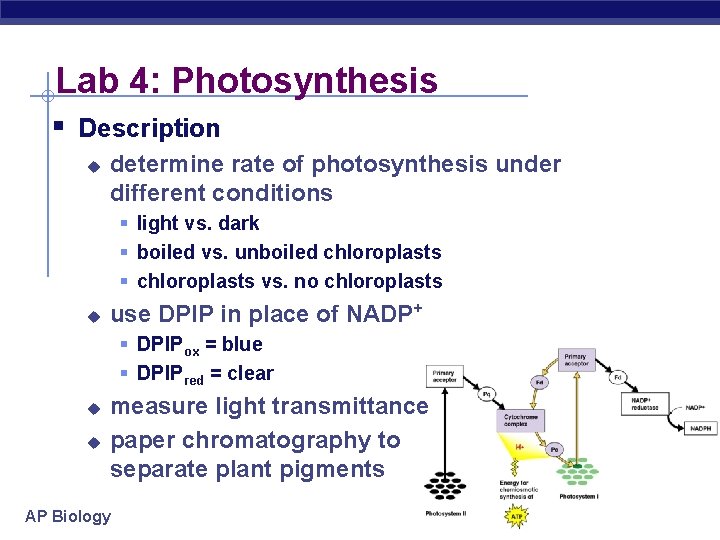
Lab 4: Photosynthesis § Description u determine rate of photosynthesis under different conditions § light vs. dark § boiled vs. unboiled chloroplasts § chloroplasts vs. no chloroplasts u use DPIP in place of NADP+ § DPIPox = blue § DPIPred = clear u u measure light transmittance paper chromatography to separate plant pigments AP Biology 2004 -2005
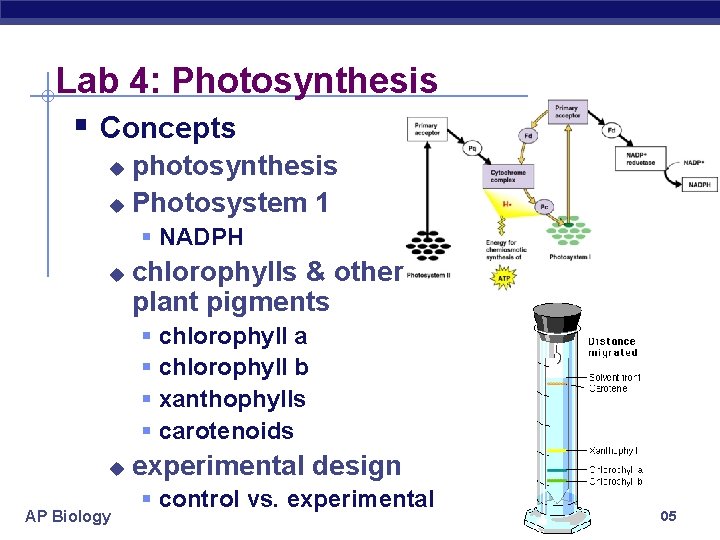
Lab 4: Photosynthesis § Concepts photosynthesis u Photosystem 1 u § NADPH u chlorophylls & other plant pigments § § u AP Biology chlorophyll a chlorophyll b xanthophylls carotenoids experimental design § control vs. experimental 2004 -2005
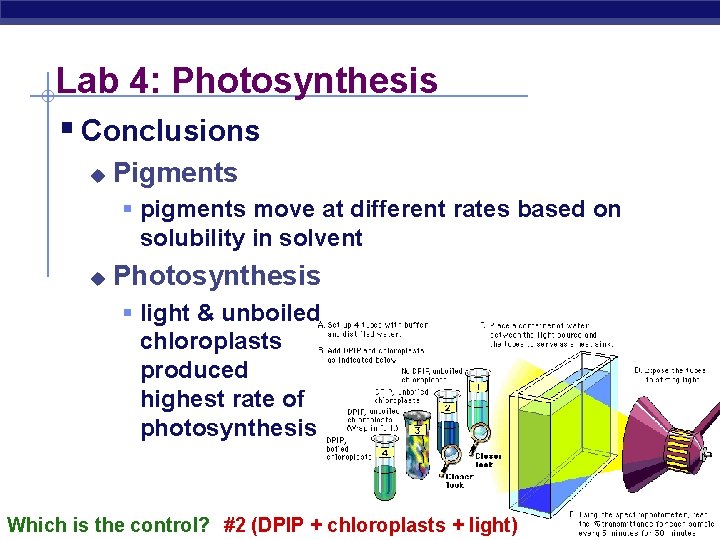
Lab 4: Photosynthesis § Conclusions u Pigments § pigments move at different rates based on solubility in solvent u Photosynthesis § light & unboiled chloroplasts produced highest rate of photosynthesis AP Biology Which is the control? #2 (DPIP + chloroplasts + light) 2004 -2005
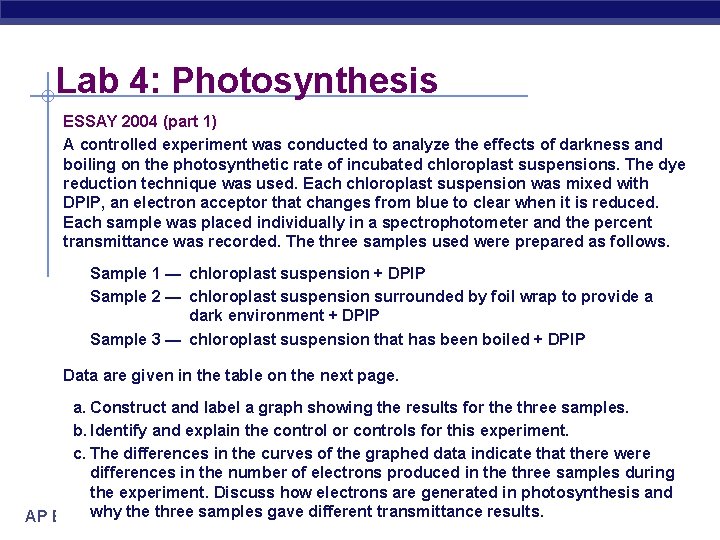
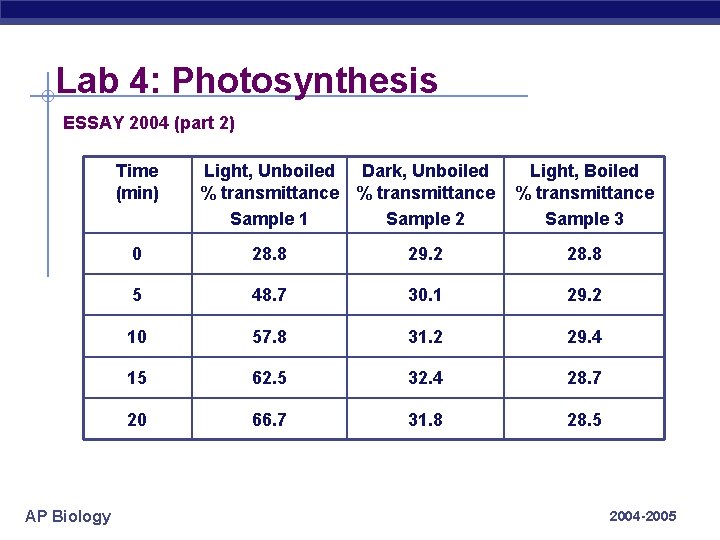
Lab 4: Photosynthesis ESSAY 2004 (part 1) A controlled experiment was conducted to analyze the effects of darkness and boiling on the photosynthetic rate of incubated chloroplast suspensions. The dye reduction technique was used. Each chloroplast suspension was mixed with DPIP, an electron acceptor that changes from blue to clear when it is reduced. Each sample was placed individually in a spectrophotometer and the percent transmittance was recorded. The three samples used were prepared as follows. Sample 1 — chloroplast suspension + DPIP Sample 2 — chloroplast suspension surrounded by foil wrap to provide a dark environment + DPIP Sample 3 — chloroplast suspension that has been boiled + DPIP Data are given in the table on the next page. a. Construct and label a graph showing the results for the three samples. b. Identify and explain the control or controls for this experiment. c. The differences in the curves of the graphed data indicate that there were differences in the number of electrons produced in the three samples during the experiment. Discuss how electrons are generated in photosynthesis and why the three samples gave different transmittance results. 2004 -2005 AP Biology
Lab 4: Photosynthesis ESSAY 2004 (part 2) Time (min) AP Biology Light, Unboiled Dark, Unboiled % transmittance Sample 1 Sample 2 Light, Boiled % transmittance Sample 3 0 28. 8 29. 2 28. 8 5 48. 7 30. 1 29. 2 10 57. 8 31. 2 29. 4 15 62. 5 32. 4 28. 7 20 66. 7 31. 8 28. 5 2004 -2005
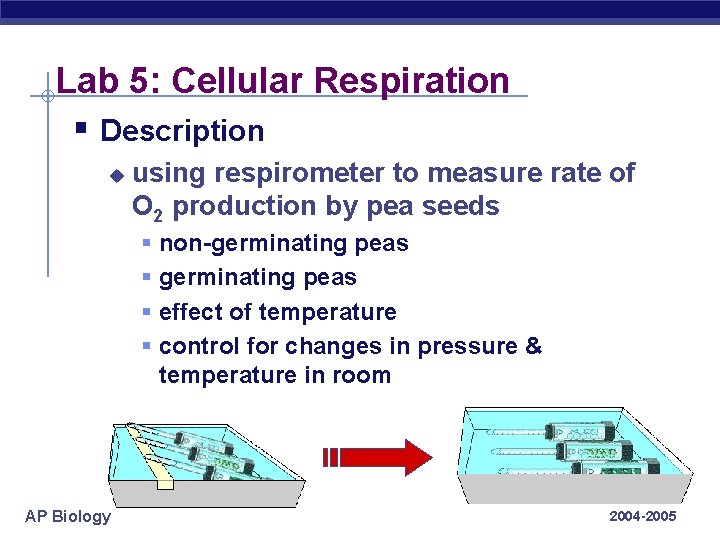
Lab 5: Cellular Respiration § Description u using respirometer to measure rate of O 2 production by pea seeds § § AP Biology non-germinating peas effect of temperature control for changes in pressure & temperature in room 2004 -2005
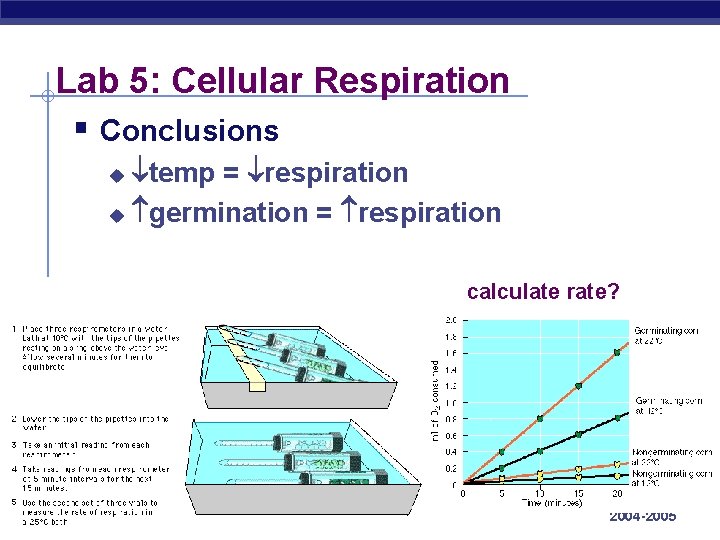
Lab 5: Cellular Respiration § Conclusions temp = respiration u germination = respiration u calculate rate? AP Biology 2004 -2005
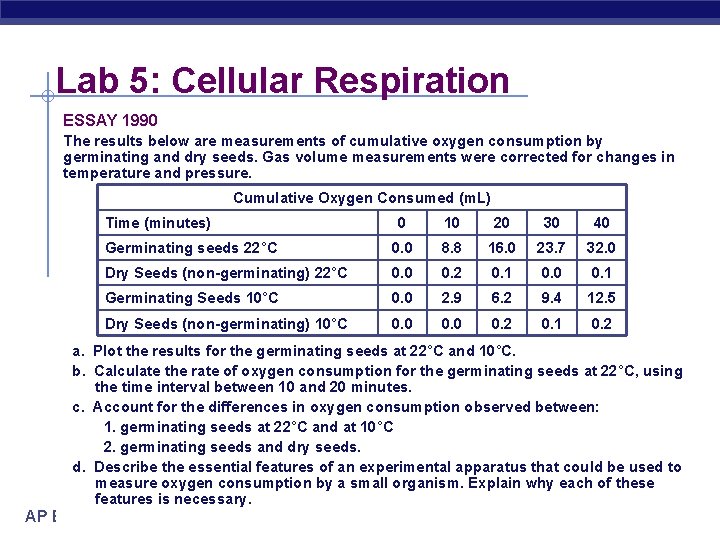
Lab 5: Cellular Respiration ESSAY 1990 The results below are measurements of cumulative oxygen consumption by germinating and dry seeds. Gas volume measurements were corrected for changes in temperature and pressure. Cumulative Oxygen Consumed (m. L) Time (minutes) 0 10 20 30 40 Germinating seeds 22°C 0. 0 8. 8 16. 0 23. 7 32. 0 Dry Seeds (non-germinating) 22°C 0. 0 0. 2 0. 1 0. 0 0. 1 Germinating Seeds 10°C 0. 0 2. 9 6. 2 9. 4 12. 5 Dry Seeds (non-germinating) 10°C 0. 0 0. 2 0. 1 0. 2 a. Plot the results for the germinating seeds at 22°C and 10°C. b. Calculate the rate of oxygen consumption for the germinating seeds at 22°C, using the time interval between 10 and 20 minutes. c. Account for the differences in oxygen consumption observed between: 1. germinating seeds at 22°C and at 10°C 2. germinating seeds and dry seeds. d. Describe the essential features of an experimental apparatus that could be used to measure oxygen consumption by a small organism. Explain why each of these features is necessary. AP Biology 2004 -2005