
Chemistry of Life Macromolecules Carbohydrates Lipids Proteins Nucleic
Chemistry of Life �Macromolecules �Carbohydrates �Lipids �Proteins �Nucleic Acids 1 Outline
Review � Most common elements in living things are carbon, hydrogen, nitrogen, oxygen, phosphorus, and sulfur. These six elements constitute about 96% of your body weight. � Compounds are formed when two or more elements combine � Example: H 2 O, Na. Cl
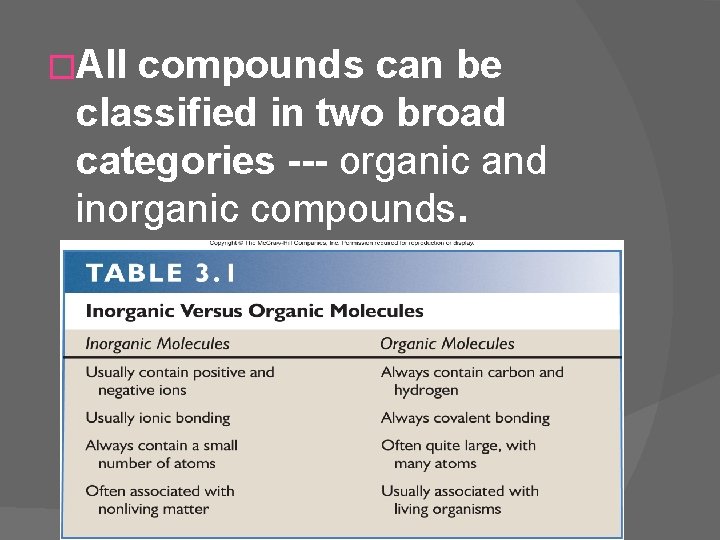
�All compounds can be classified in two broad categories --- organic and inorganic compounds.
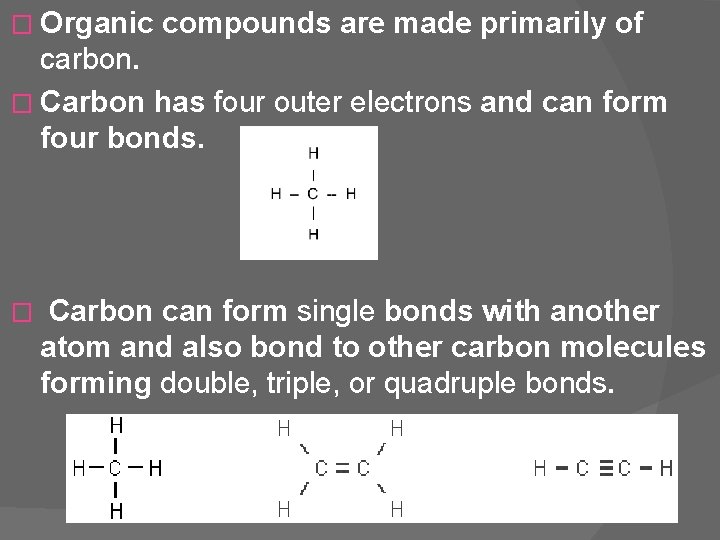
� Organic compounds are made primarily of carbon. � Carbon has four outer electrons and can form four bonds. � Carbon can form single bonds with another atom and also bond to other carbon molecules forming double, triple, or quadruple bonds.
Organic Macromolecules � Carbohydrates, lipids, proteins, and nucleic acids are called macromolecules because of their large size. �Usually consist of many repeating units ○ Monomer - Small molecular unit that is the building block of a large molecule ○ Polymer - Long chains of monomers ○ E. g. amino acids (monomer) are linked to form a protein (polymer) � Some examples: 5
Common Foods Copyright © The Mc. Graw-Hill Companies, Inc. Permission required for reproduction or display. © The Mc. Graw Hill Companies, Inc. /John Thoeming, photographer 6
Animation Please note that due to differing operating systems, some animations will not appear until the presentation is viewed in Presentation Mode (Slide Show view). You may see blank slides in the “Normal” or “Slide Sorter” views. All animations will appear after viewing in Presentation Mode and playing each animation. Most animations will require the latest version of the Flash Player, which is available at http: //get. adobe. com/flashplayer.
Carbohydrates: Monosaccharides � Single � Quite sugar molecules soluble and sweet to taste � Examples �Glucose (photosynthesis!), Fructose (fruit) and Galactose (dairy) Six carbon atoms 8 Chemical Formula: C 6 H 12 O 6
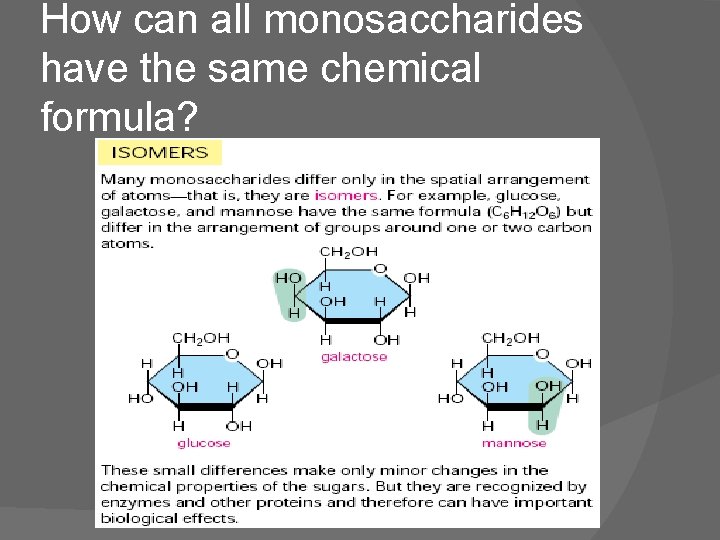
How can all monosaccharides have the same chemical formula?
Carbohydrates: Disaccharides � Contain two monosaccharides joined together � Soluble and sweet to taste � Examples �Lactose is composed of galactose and glucose and is found in milk �Sucrose (table sugar) is composed of glucose and fructose �Maltose is composed of two glucose molecules 10

Disaccharides
Carbohydrates: Polysaccharides POLYSACCHARIDE: long polymer chains made of more than two monosaccharides 1. Starch found in plant and used for short-term energy storage 2. Glycogen is used by animals to store energy in the liver and muscle cells 12
Carbohydrates: Polysaccharides 3. Cellulose: makes up plant cell walls ○ Main component of wood and many natural fibers ○ Indigestible by most animals (Also known as fiber!) 4. Chitin: makes up the shells of arthropods (crabs for example) and the cell walls of fungi. ○ Very resistant to wear and digestion 13
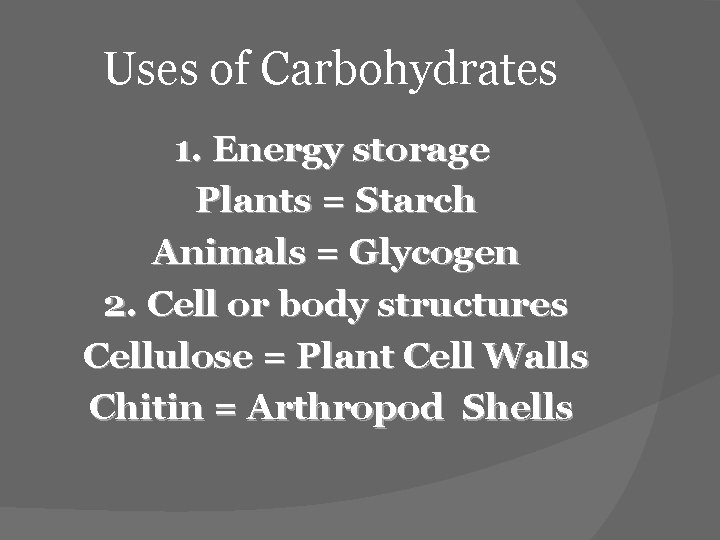
Uses of Carbohydrates 1. Energy storage Plants = Starch Animals = Glycogen 2. Cell or body structures Cellulose = Plant Cell Walls Chitin = Arthropod Shells
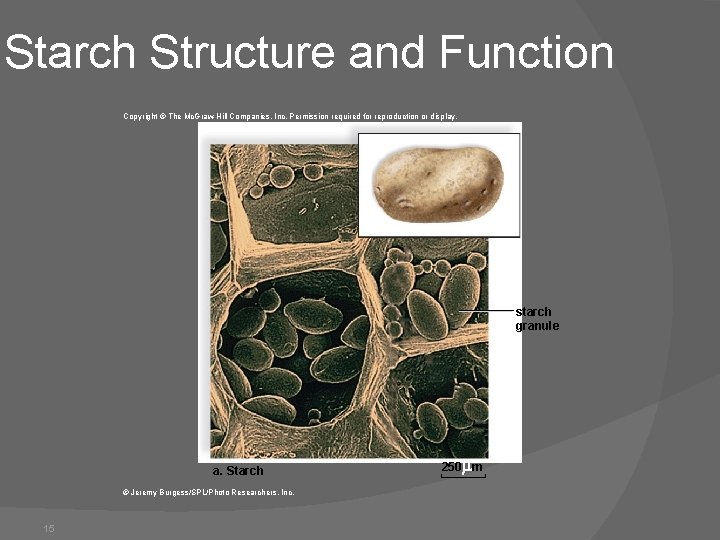
Starch Structure and Function Copyright © The Mc. Graw-Hill Companies, Inc. Permission required for reproduction or display. starch granule a. Starch © Jeremy Burgess/SPL/Photo Researchers, Inc. 15 250 mm
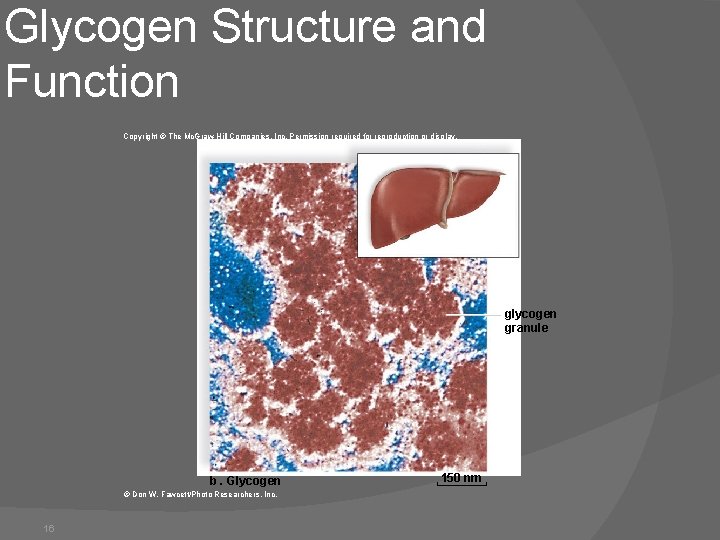
Glycogen Structure and Function Copyright © The Mc. Graw-Hill Companies, Inc. Permission required for reproduction or display. glycogen granule b. Glycogen © Don W. Fawcett/Photo Researchers, Inc. 16 150 nm
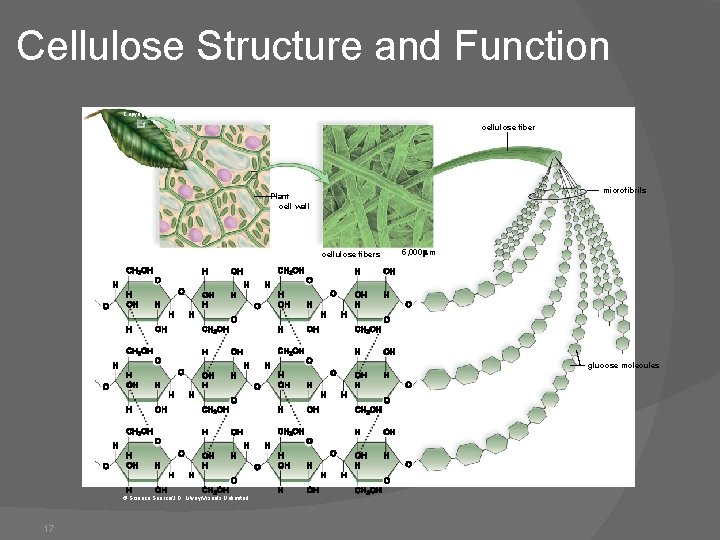
Cellulose Structure and Function Copyright © The Mc. Graw-Hill Companies, Inc. Permission required for reproduction or display. cellulose fiber microfibrils Plant cell wall cellulose fibers 5, 000 m glucose molecules © Science Source/J. D. Litvay/Visuals Unlimited 17
- Slides: 17