
Chemistry of Life Chapter 3 Section 3 Carbon
Chemistry of Life Chapter 3 - Section 3: Carbon Compounds Section 3
Chemistry of Life Key Ideas • What are the chemicals of life made from? • What is the role of carbohydrates in cells? • What do lipids do? • What determines the function of proteins? • What do nucleic acids do? Section 3
Chemistry of Life Section 3 Building Blocks of Cells • The parts of a cell are made up f large, complex molecules, often called biomolecules. • Large, complex biomolecules are built from a few smaller, simpler, repeating units arranged in an extremely precise way. • The basic unit of most biomolecules contain atoms of carbon. Carbon atoms can form covalent bonds with as many as four other atoms.
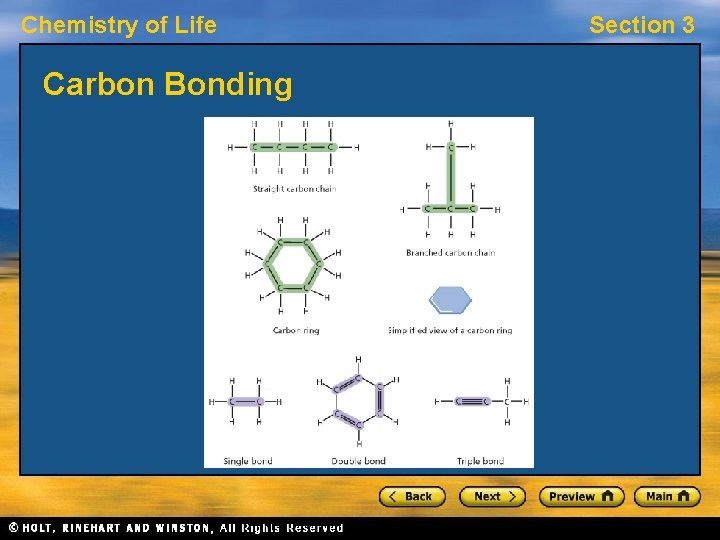
Chemistry of Life Carbon Bonding Section 3
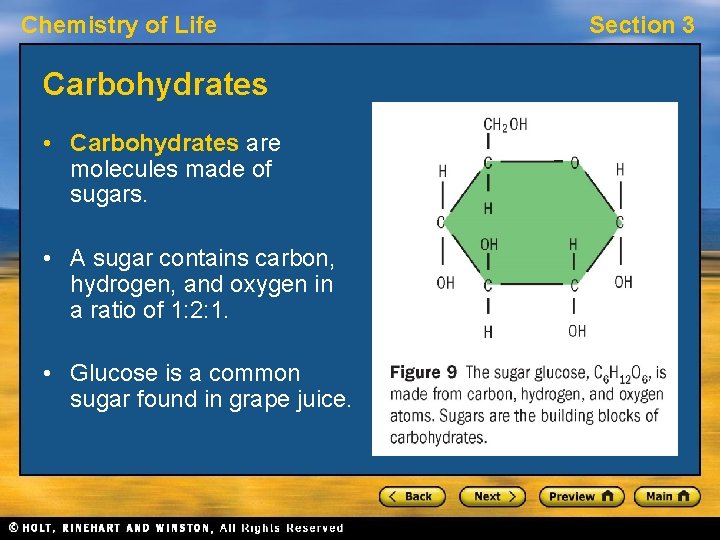
Chemistry of Life Carbohydrates • Carbohydrates are molecules made of sugars. • A sugar contains carbon, hydrogen, and oxygen in a ratio of 1: 2: 1. • Glucose is a common sugar found in grape juice. Section 3
Chemistry of Life Section 3 Carbohydrates, continued • Glucose is a monosaccharide, or “single sugar. ” • Two sugars can be linked to make a disaccharide. • Many sugars can be linked to make a polysaccharide. • Monosaccharides and disaccharides are considered simple carbohydrates. Polysaccharides are considered complex carbohydrates.
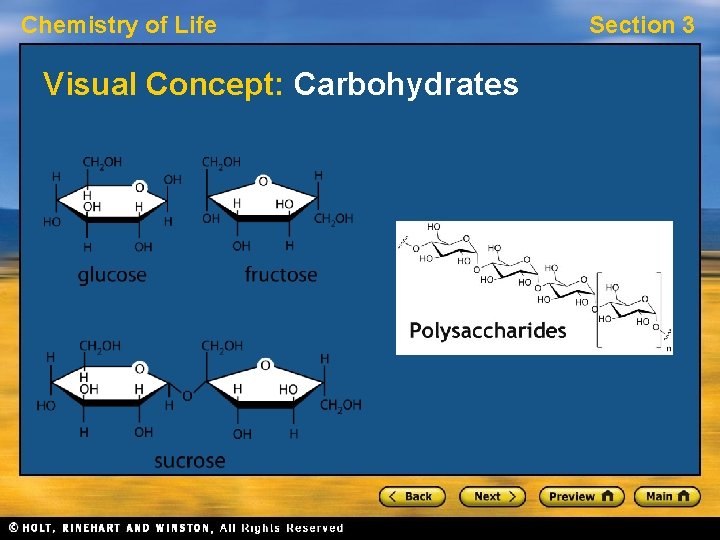
Chemistry of Life Visual Concept: Carbohydrates Section 3
Chemistry of Life Section 3 Carbohydrates, continued • Cells use carbohydrates for sources of energy, structural materials, and cellular identification. • Carbohydrates are a major source of energy for many organisms, including humans.
Chemistry of Life Section 3 Carbohydrates, continued • Chitin (ky-tin) and cellulose are complex carbohydrates that provide support. • Chitin is found in the shells of insects and the cell walls of mushrooms. Cellulose is found in the cell walls of plants. • In a complex organism, cells recognize neighboring cells by the short, branched chains of varying sugar units on their outer surface.
Chemistry of Life Section 3 Lipids • Lipids are another class of biomolecules, which includes fats, phospholipids, steroids, and waxes. • Lipids consist of chains of carbon atoms bonded to each other and to hydrogen atoms. This structure makes lipids repel water. • The main functions of lipids include storing energy and controlling water molecules.
Chemistry of Life Section 3 Lipids, continued • The main purpose of fats is to store energy. • Fats can store energy even more efficiently than carbohydrates. • The cell’s boundary is made of phospholipids. The structure of cell membranes depends on how this molecule interacts with water. • Waxes, found on the surfaces of plants and aquatic bird feathers, help prevent evaporation of water from the cells of the organism.

Chemistry of Life Visual Concept: Types of Lipids Section 3
Chemistry of Life Section 3 Proteins • Proteins are chains of amino acids that twist and fold into certain shapes that determine what the proteins do. • There are many types of proteins that perform many types of functions. • Proteins may be involved in structure, support, movement, communication, transportation, and carrying out chemical reactions.
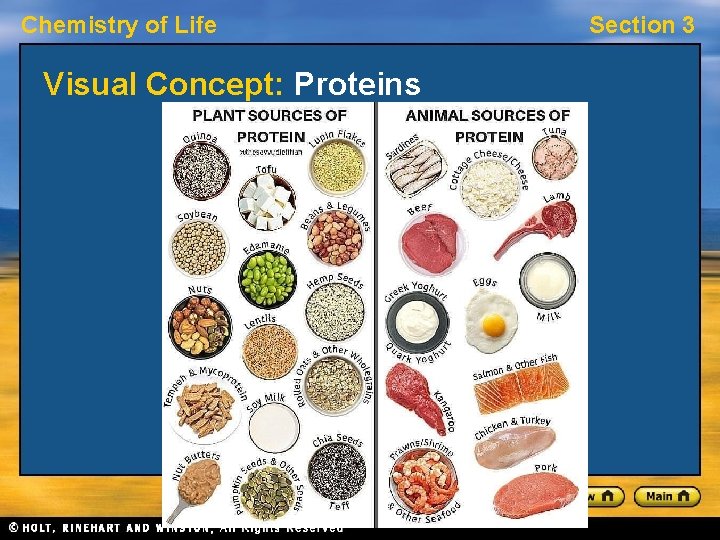
Chemistry of Life Visual Concept: Proteins Section 3
Chemistry of Life Section 3 Proteins, continued Amino Acids • A protein is a molecule made up of amino acids, building blocks that link to form proteins. • Every amino acid has an amino group and a carboxyl group. Units of amino acids can form links called peptide bonds. • The side group gives an amino acid its unique properties. Twenty different amino acids are found in proteins.
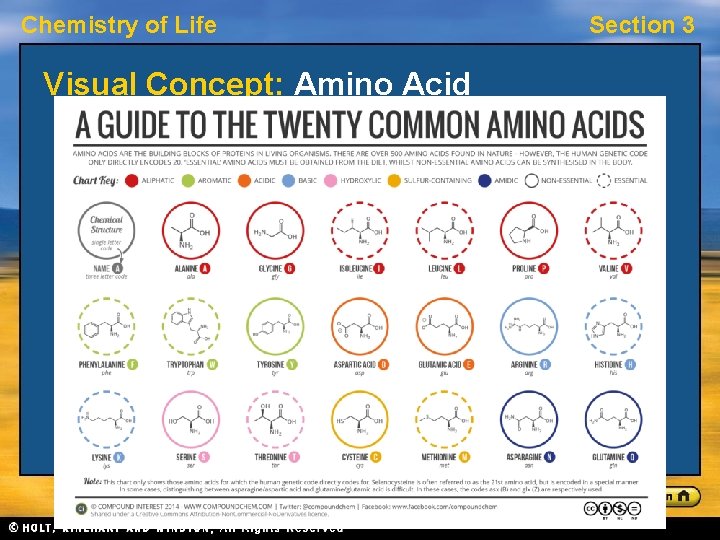
Chemistry of Life Visual Concept: Amino Acid Section 3
Chemistry of Life Section 3 Proteins, continued Levels of Structure • For each type of protein, amino acids are arranged in a specific order, the protein’s primary structure. • The interactions of the various side groups may form coils and folds, the protein’s secondary structure. • The overall shape of a single chain of amino acids is the protein’s tertiary structure. • The quaternary structure is the overall shape that results from combining the chains to form proteins.
Chemistry of Life Section 3 Nucleic Acids • A nucleic acid is a long chain of nucleotide units. • A nucleotide is a molecule made up of three parts: a sugar, a base, and a phosphate group. • Nucleotides of deoxyribonucleic acid, or DNA, contain the sugar deoxyribose. • Nucleotides of ribonucleic acid, or RNA, contain the sugar ribose.
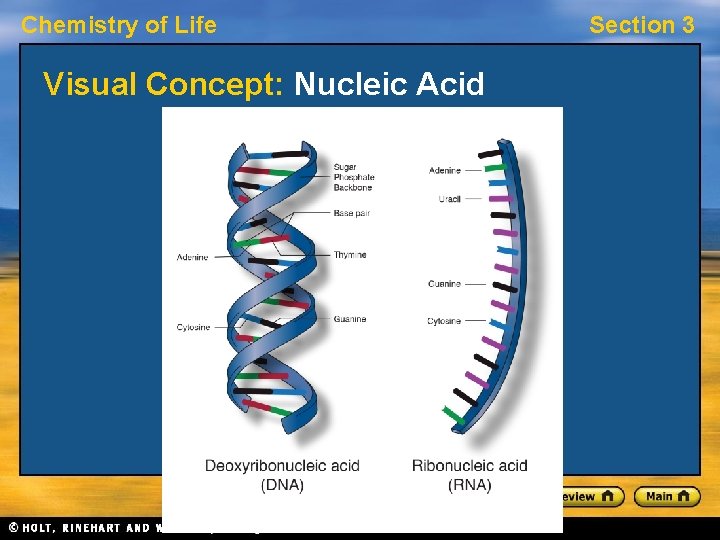
Chemistry of Life Visual Concept: Nucleic Acid Section 3
Chemistry of Life Section 3 Nucleic Acids, continued Hereditary Information • DNA molecules act as “instructions” for the processes of an organism’s life. • DNA consists of two strands of nucleotides that spiral around each other. • RNA also interacts with DNA to help decode the information. • Nucleic acids store and transmit hereditary information.
Chemistry of Life Section 3 Nucleic Acids, continued Energy Carriers • Some single nucleotides have other important roles. • Adenosine triphosphate, or ATP, is a nucleotide that has three phosphate groups and supplies energy to cells. • Energy is released in the reaction that breaks off the third phosphate group. • Other single nucleotides transfer electrons or hydrogen atoms for other life processes.
Chemistry of Life Section 3 Summary • Large, complex biomolecules are built from a few smaller, simpler, repeating units arranged in an extremely precise way. • Cells use carbohydrates for sources of energy, structural materials, and cellular identification. • The main functions of lipids include storing energy and controlling water movement
Chemistry of Life Section 3 Summary, continued • Proteins are chains of amino acids that twist and fold into shapes that determine what the protein does. • Nucleic acids store and transmit hereditary information.
- Slides: 23