
Chemistry of Life Chapter 3 Section 2 Water
- Slides: 12
Chemistry of Life Chapter 3 Section 2 • Water and Solutions Section 2
Chemistry of Life Section 2 Properties of Water • Water has many unique properties that make it an important substance for life. • 1. Most of the unique properties of water result because water molecules form hydrogen bonds with each other. • 2. When water freezes, the crystal structure formed due to hydrogen bonding traps air which makes ice less dense than liquid water.
Chemistry of Life Section 2 Properties of Water, continued • 3. Water can absorb a large amount of heat without changing temperature. This property can help organisms maintain a constant internal temperature. What is this property called? Homeostasis • 4. The attraction of particles of the same substance, such as water, is called cohesion. Cohesion keep water from evaporating easily; thus, water is a liquid at ordinary temperatures. • 5. Water molecules also stick to other polar molecules. This attraction between particles of different substances is called adhesion.
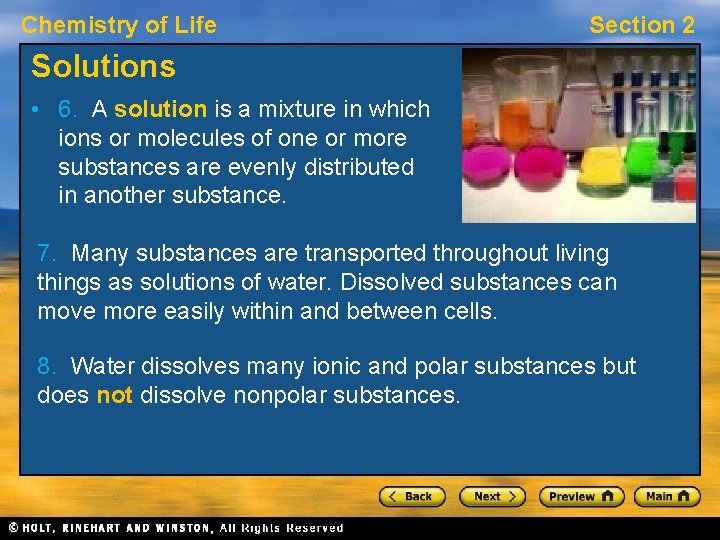
Chemistry of Life Section 2 Solutions • 6. A solution is a mixture in which ions or molecules of one or more substances are evenly distributed in another substance. 7. Many substances are transported throughout living things as solutions of water. Dissolved substances can move more easily within and between cells. 8. Water dissolves many ionic and polar substances but does not dissolve nonpolar substances.
Chemistry of Life Section 2 Acids and Bases • Some water molecules break apart to form hydronium and hydroxide ions. • In pure water, hydronium and hydroxide ions are present in equal numbers. • Acids and bases are compounds that change the balance of these ions.
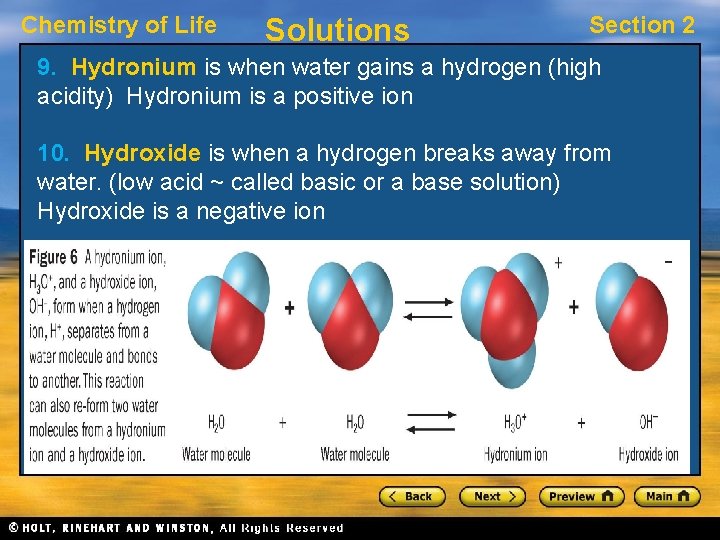
Chemistry of Life Solutions Section 2 9. Hydronium is when water gains a hydrogen (high acidity) Hydronium is a positive ion 10. Hydroxide is when a hydrogen breaks away from water. (low acid ~ called basic or a base solution) Hydroxide is a negative ion
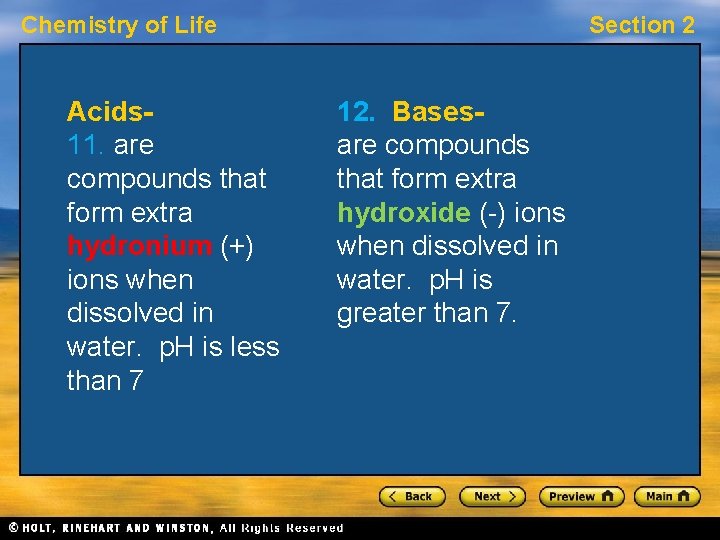
Chemistry of Life Acids 11. are compounds that form extra hydronium (+) ions when dissolved in water. p. H is less than 7 Section 2 12. Basesare compounds that form extra hydroxide (-) ions when dissolved in water. p. H is greater than 7.
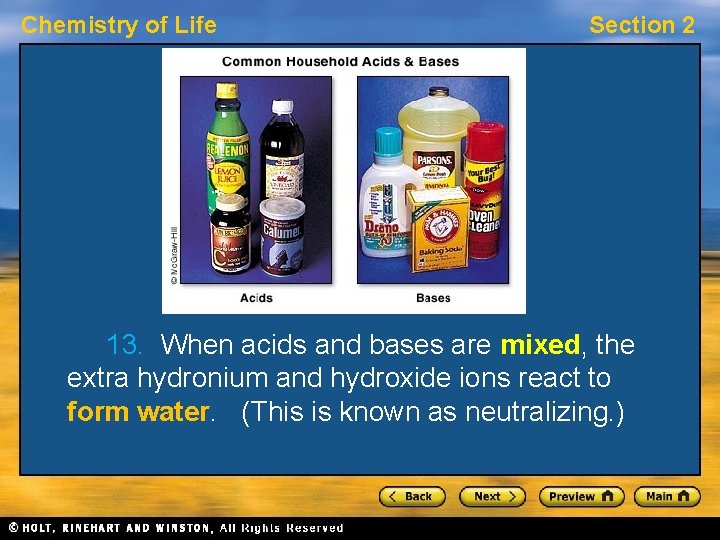
Chemistry of Life Section 2 Visual Concept: Bases 13. When acids and bases are mixed, the extra hydronium and hydroxide ions react to form water. (This is known as neutralizing. )
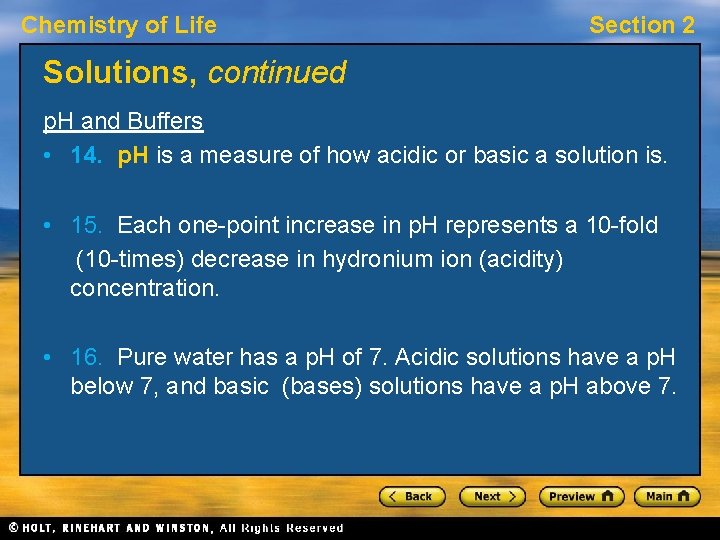
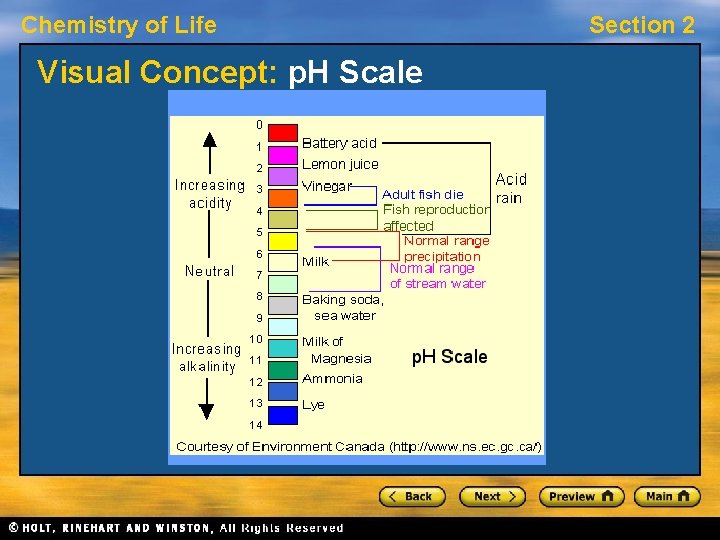
Chemistry of Life Section 2 Solutions, continued p. H and Buffers • 14. p. H is a measure of how acidic or basic a solution is. • 15. Each one-point increase in p. H represents a 10 -fold (10 -times) decrease in hydronium ion (acidity) concentration. • 16. Pure water has a p. H of 7. Acidic solutions have a p. H below 7, and basic (bases) solutions have a p. H above 7.
Chemistry of Life Visual Concept: p. H Scale Section 2
Chemistry of Life Section 2 Solutions, continued p. H and Buffers • 17. The p. H of solutions in living things must be stable. • For a stable p. H to be maintained, the solutions in living things contain buffers. • 18. A buffer is a substance that reacts to prevent p. H changes in a solution.
Chemistry of Life Section 2 Summary • The hydrogen bonding between water molecules explains many of the unique properties that make water an important substance for life. • Acids and bases change the concentration of hydronium ions in aqueous solutions. The p. H of solutions in living things must be stable.