
Chemistry of Life All living organisms are composed
- Slides: 29
Chemistry of Life
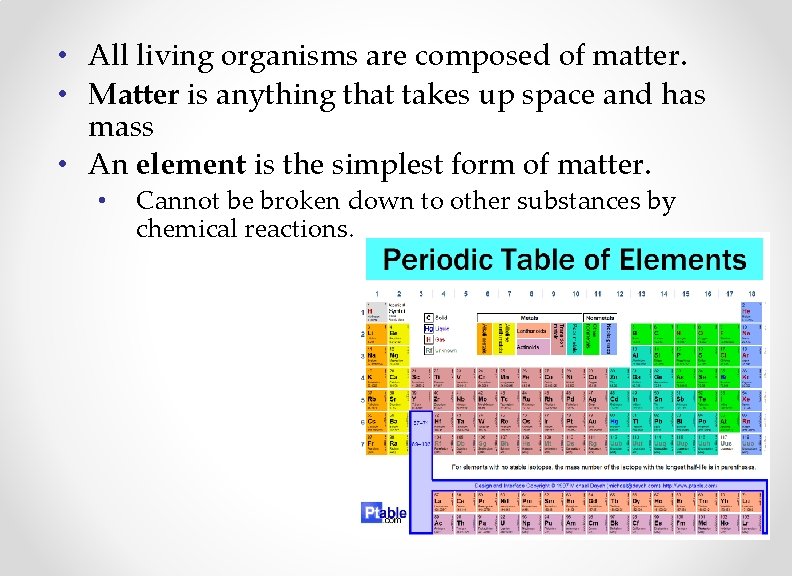
• All living organisms are composed of matter. • Matter is anything that takes up space and has mass • An element is the simplest form of matter. • Cannot be broken down to other substances by chemical reactions.
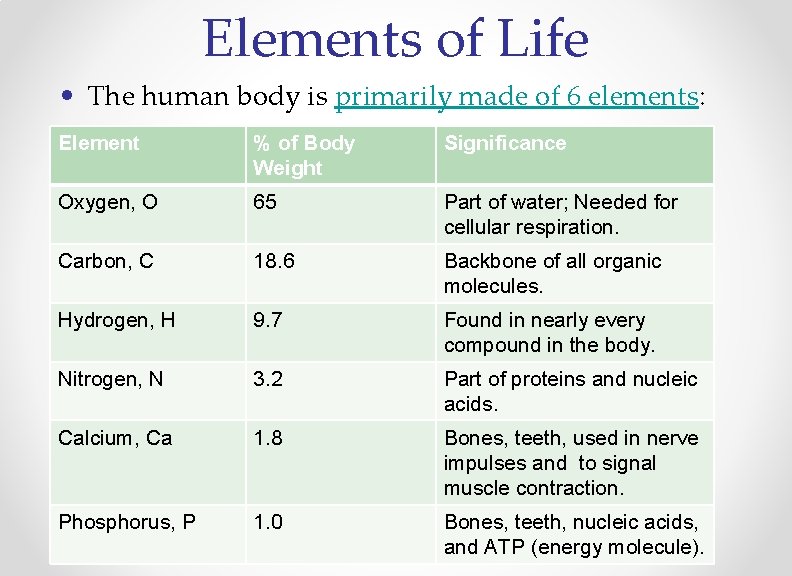
Elements of Life • The human body is primarily made of 6 elements: Element % of Body Weight Significance Oxygen, O 65 Part of water; Needed for cellular respiration. Carbon, C 18. 6 Backbone of all organic molecules. Hydrogen, H 9. 7 Found in nearly every compound in the body. Nitrogen, N 3. 2 Part of proteins and nucleic acids. Calcium, Ca 1. 8 Bones, teeth, used in nerve impulses and to signal muscle contraction. Phosphorus, P 1. 0 Bones, teeth, nucleic acids, and ATP (energy molecule).
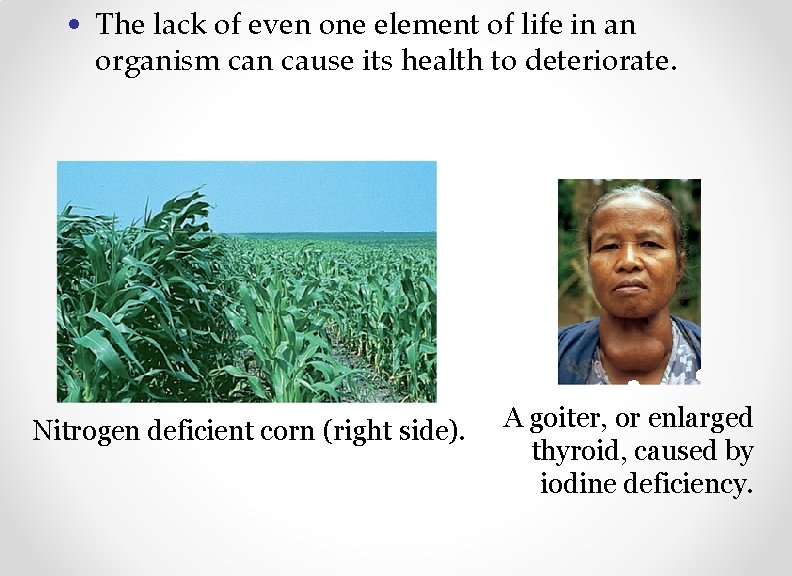
• The lack of even one element of life in an organism can cause its health to deteriorate. Nitrogen deficient corn (right side). A goiter, or enlarged thyroid, caused by iodine deficiency.
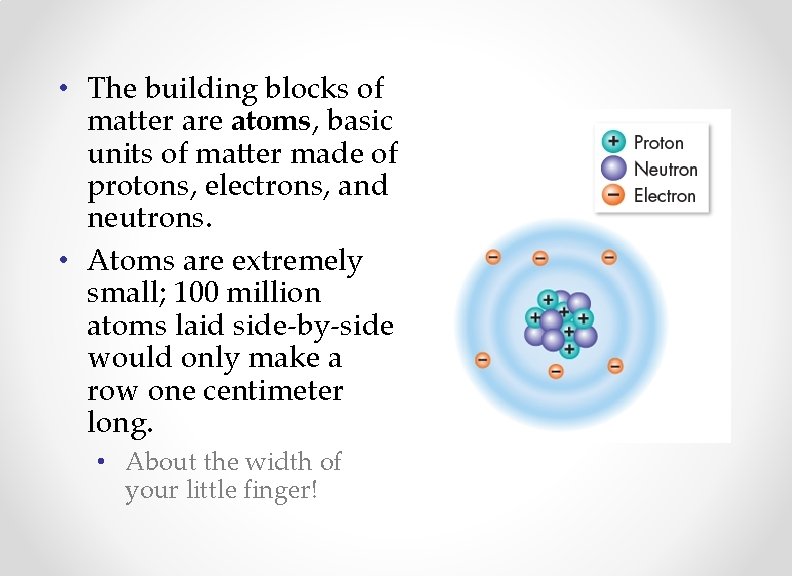
• The building blocks of matter are atoms, basic units of matter made of protons, electrons, and neutrons. • Atoms are extremely small; 100 million atoms laid side-by-side would only make a row one centimeter long. • About the width of your little finger!
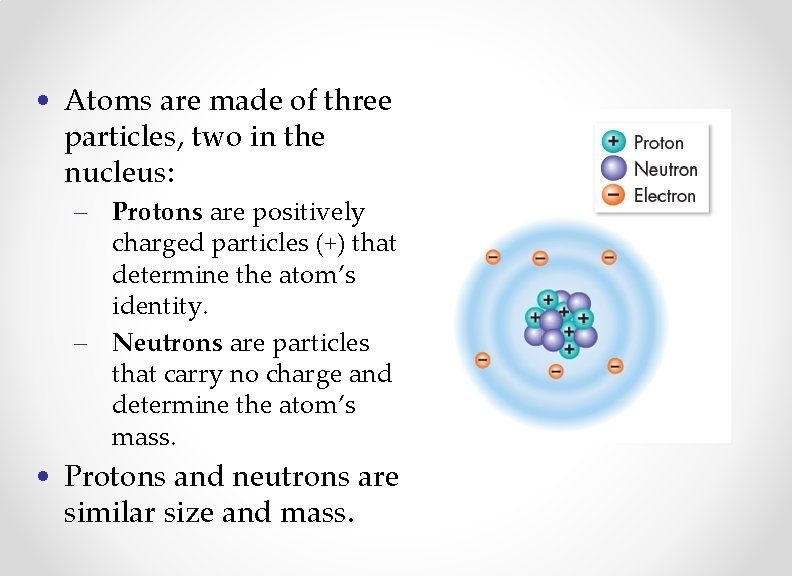
• Atoms are made of three particles, two in the nucleus: – Protons are positively charged particles (+) that determine the atom’s identity. – Neutrons are particles that carry no charge and determine the atom’s mass. • Protons and neutrons are similar size and mass.
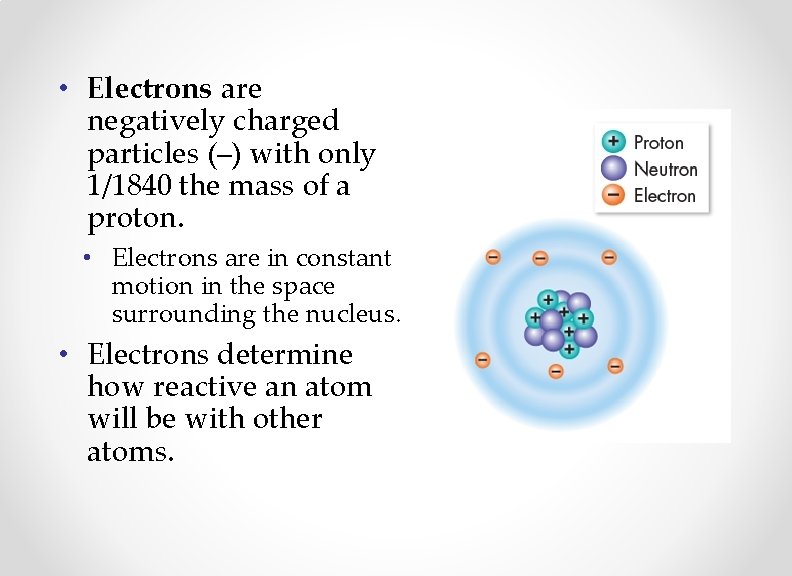
• Electrons are negatively charged particles (–) with only 1/1840 the mass of a proton. • Electrons are in constant motion in the space surrounding the nucleus. • Electrons determine how reactive an atom will be with other atoms.
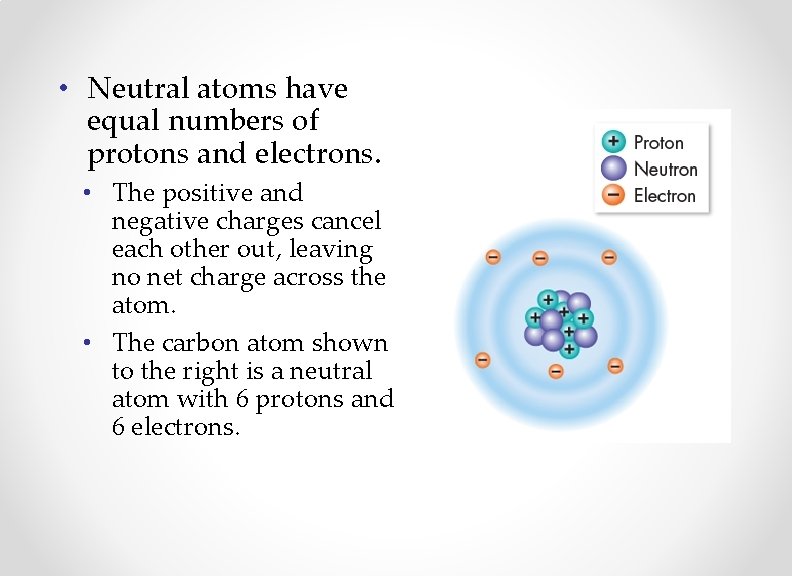
• Neutral atoms have equal numbers of protons and electrons. • The positive and negative charges cancel each other out, leaving no net charge across the atom. • The carbon atom shown to the right is a neutral atom with 6 protons and 6 electrons.
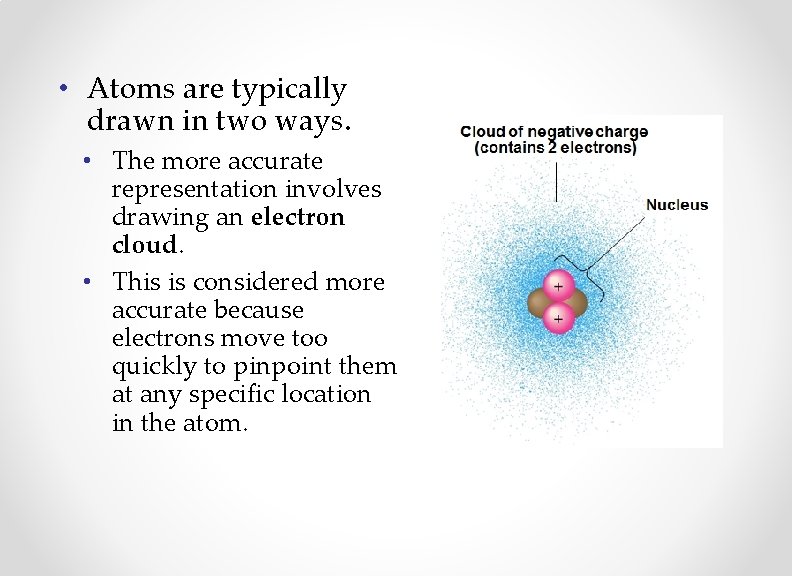
• Atoms are typically drawn in two ways. • The more accurate representation involves drawing an electron cloud. • This is considered more accurate because electrons move too quickly to pinpoint them at any specific location in the atom.
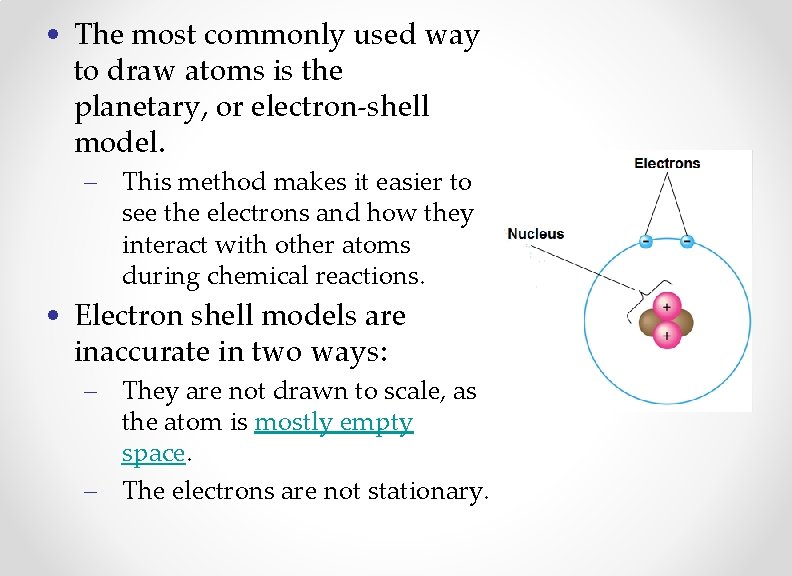
• The most commonly used way to draw atoms is the planetary, or electron-shell model. – This method makes it easier to see the electrons and how they interact with other atoms during chemical reactions. • Electron shell models are inaccurate in two ways: – They are not drawn to scale, as the atom is mostly empty space. – The electrons are not stationary.
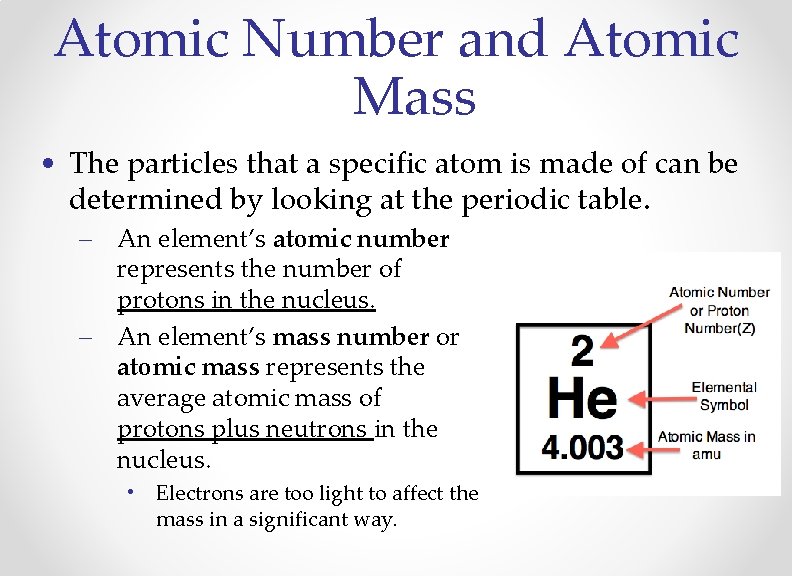
Atomic Number and Atomic Mass • The particles that a specific atom is made of can be determined by looking at the periodic table. – An element’s atomic number represents the number of protons in the nucleus. – An element’s mass number or atomic mass represents the average atomic mass of protons plus neutrons in the nucleus. • Electrons are too light to affect the mass in a significant way.
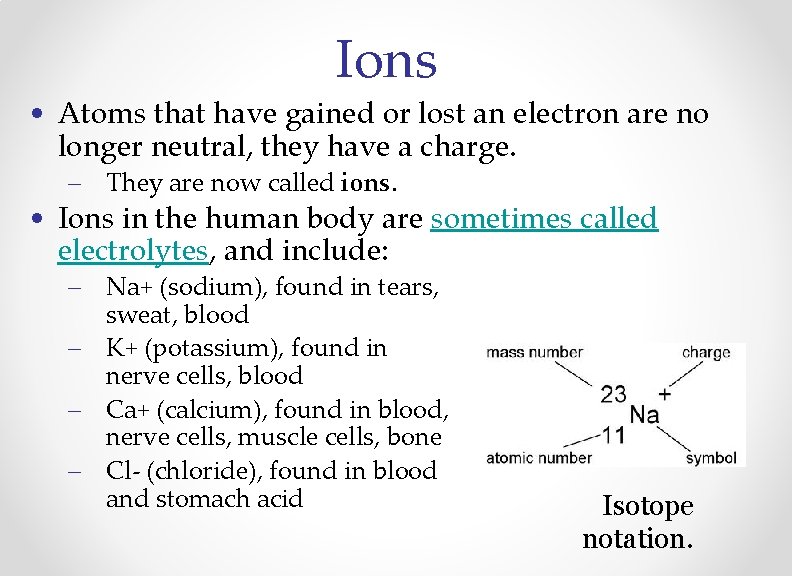
Ions • Atoms that have gained or lost an electron are no longer neutral, they have a charge. – They are now called ions. • Ions in the human body are sometimes called electrolytes, and include: – Na+ (sodium), found in tears, sweat, blood – K+ (potassium), found in nerve cells, blood – Ca+ (calcium), found in blood, nerve cells, muscle cells, bone – Cl- (chloride), found in blood and stomach acid Isotope notation.
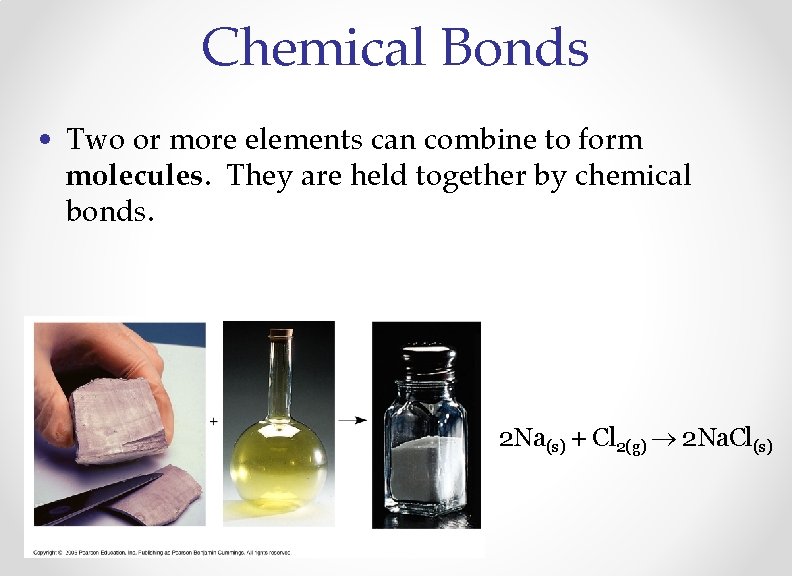
Chemical Bonds • Two or more elements can combine to form molecules. They are held together by chemical bonds. 2 Na(s) + Cl 2(g) 2 Na. Cl(s)
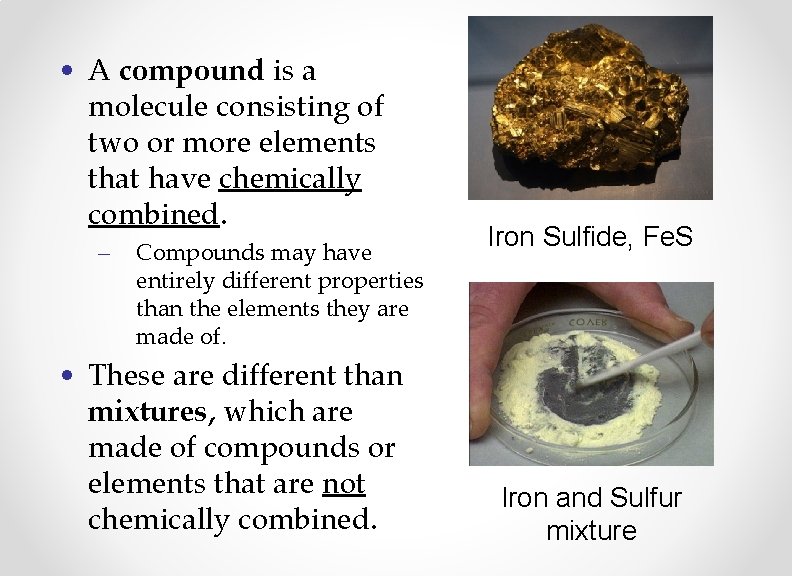
• A compound is a molecule consisting of two or more elements that have chemically combined. – Compounds may have entirely different properties than the elements they are made of. • These are different than mixtures, which are made of compounds or elements that are not chemically combined. Iron Sulfide, Fe. S Iron and Sulfur mixture
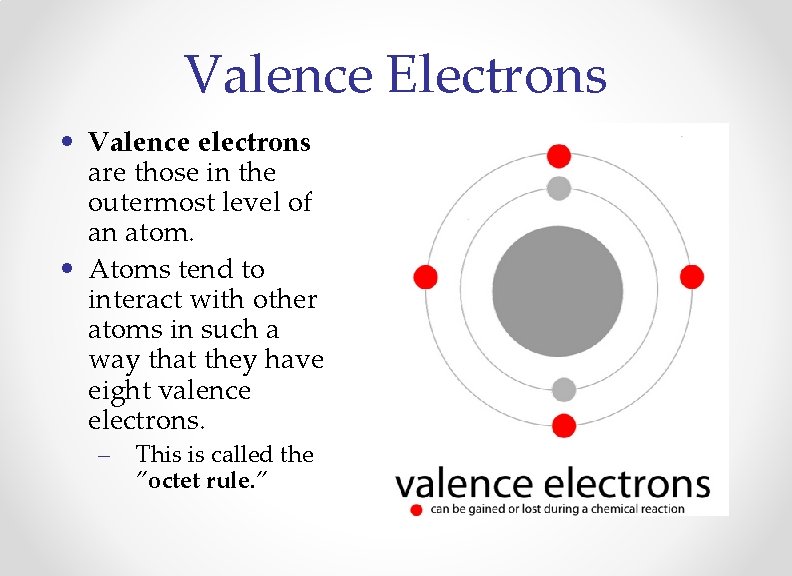
Valence Electrons • Valence electrons are those in the outermost level of an atom. • Atoms tend to interact with other atoms in such a way that they have eight valence electrons. – This is called the ”octet rule. ”
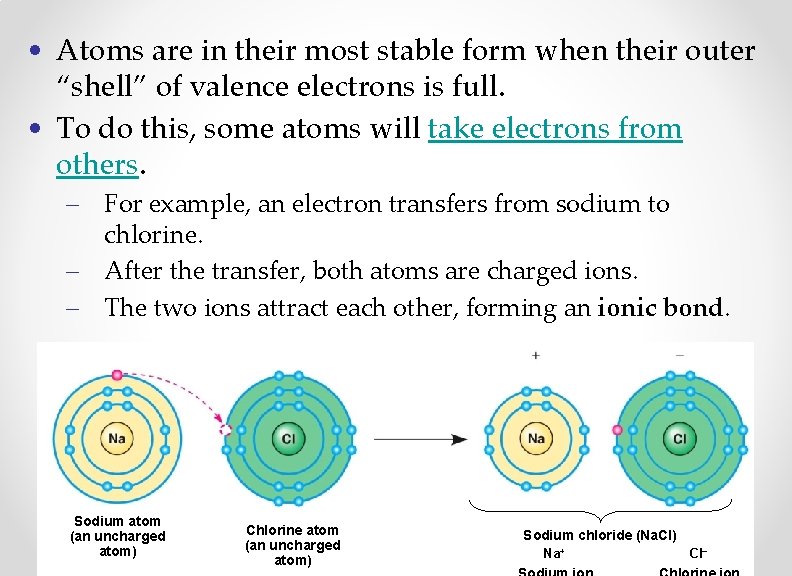
• Atoms are in their most stable form when their outer “shell” of valence electrons is full. • To do this, some atoms will take electrons from others. – For example, an electron transfers from sodium to chlorine. – After the transfer, both atoms are charged ions. – The two ions attract each other, forming an ionic bond. Sodium atom (an uncharged atom) Chlorine atom (an uncharged atom) Sodium chloride (Na. Cl) Na+ Cl–
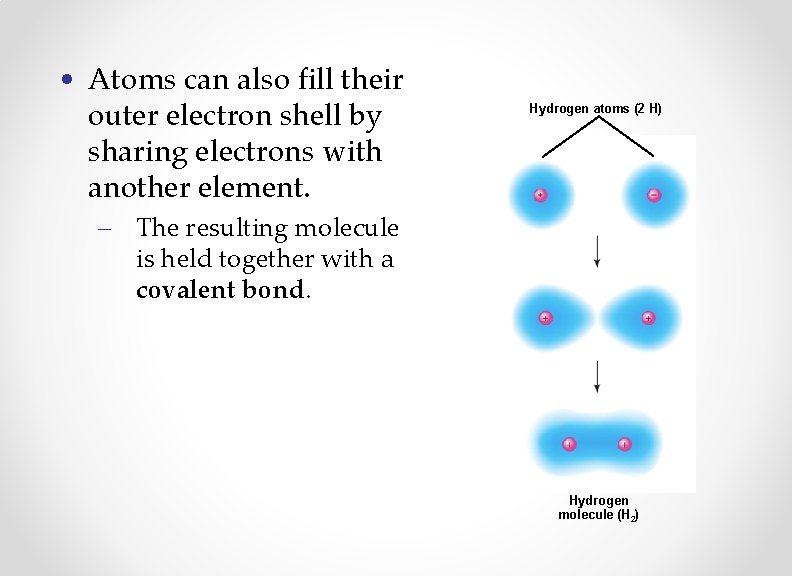
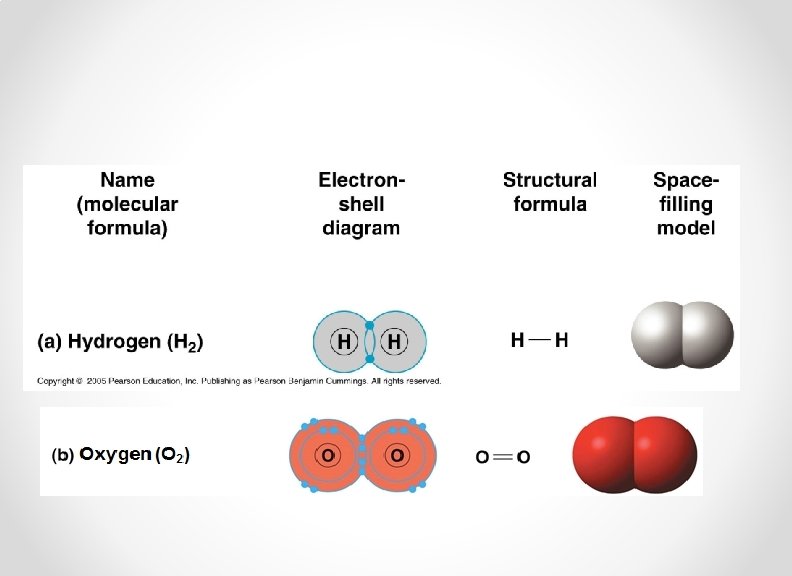
• Atoms can also fill their outer electron shell by sharing electrons with another element. Hydrogen atoms (2 H) – The resulting molecule is held together with a covalent bond. Hydrogen molecule (H 2)
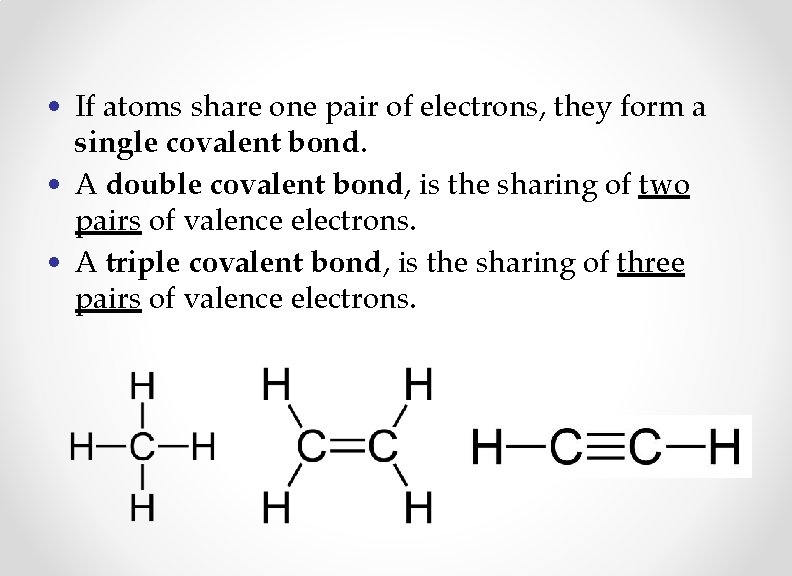
• If atoms share one pair of electrons, they form a single covalent bond. • A double covalent bond, is the sharing of two pairs of valence electrons. • A triple covalent bond, is the sharing of three pairs of valence electrons.
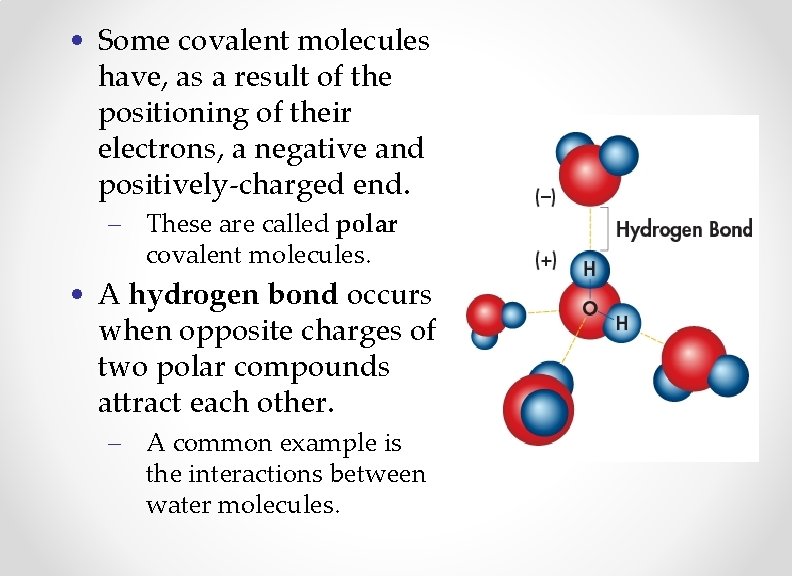
• Some covalent molecules have, as a result of the positioning of their electrons, a negative and positively-charged end. – These are called polar covalent molecules. • A hydrogen bond occurs when opposite charges of two polar compounds attract each other. – A common example is the interactions between water molecules.
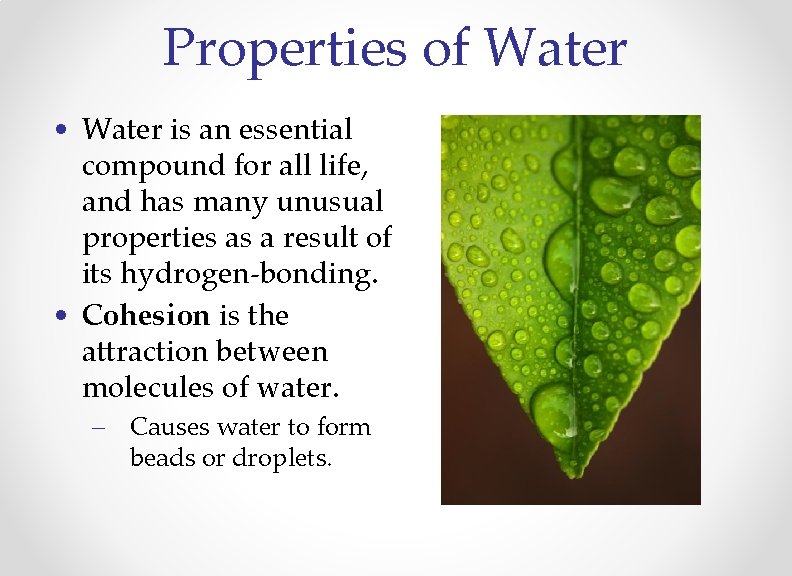
Properties of Water • Water is an essential compound for all life, and has many unusual properties as a result of its hydrogen-bonding. • Cohesion is the attraction between molecules of water. – Causes water to form beads or droplets.
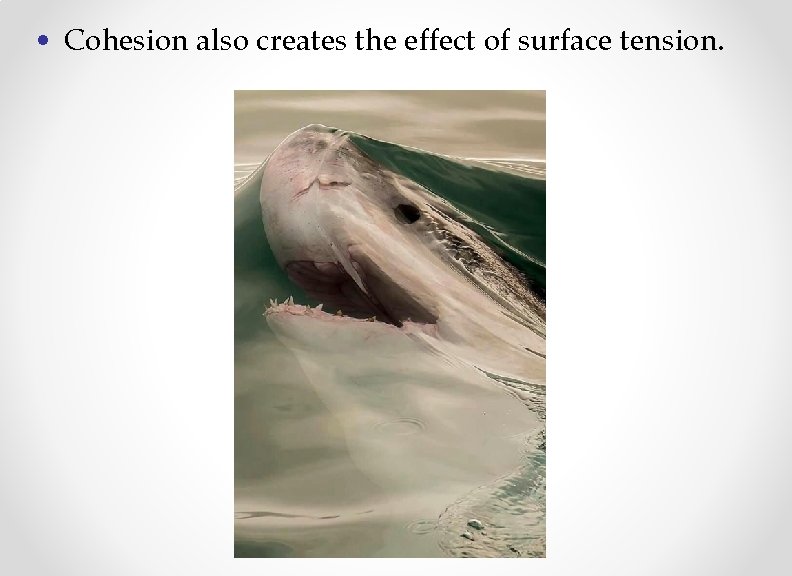
• Cohesion also creates the effect of surface tension.
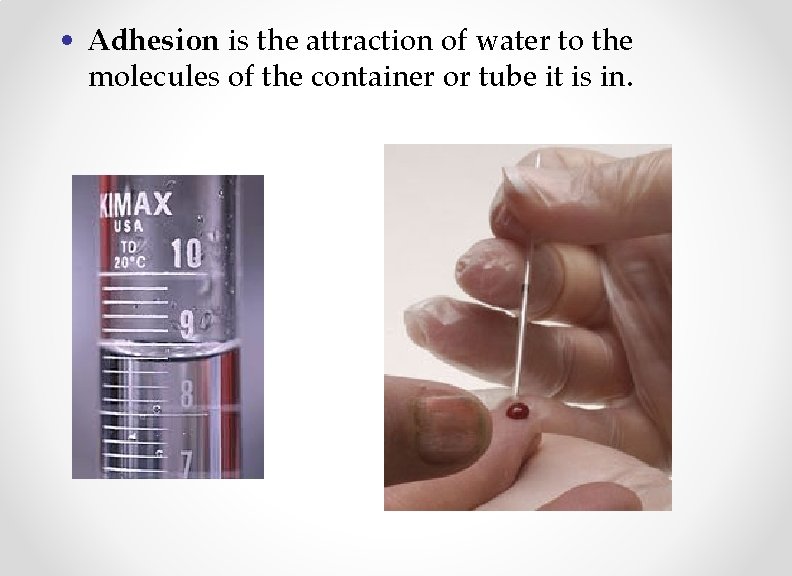
• Adhesion is the attraction of water to the molecules of the container or tube it is in.
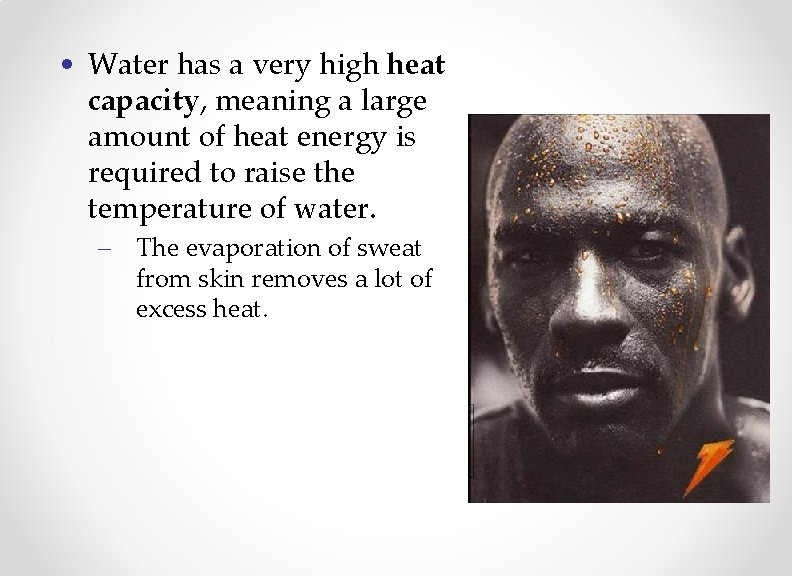
• Water has a very high heat capacity, meaning a large amount of heat energy is required to raise the temperature of water. – The evaporation of sweat from skin removes a lot of excess heat.
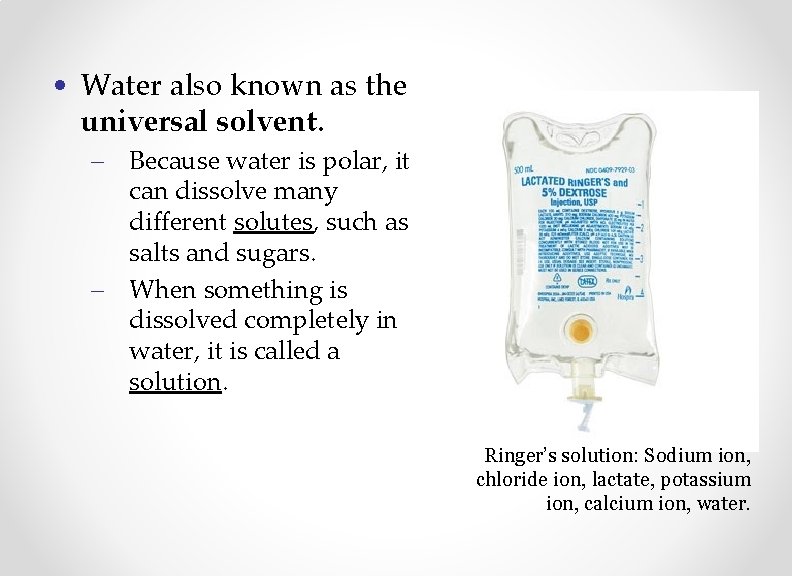
• Water also known as the universal solvent. – Because water is polar, it can dissolve many different solutes, such as salts and sugars. – When something is dissolved completely in water, it is called a solution. Ringer’s solution: Sodium ion, chloride ion, lactate, potassium ion, calcium ion, water.
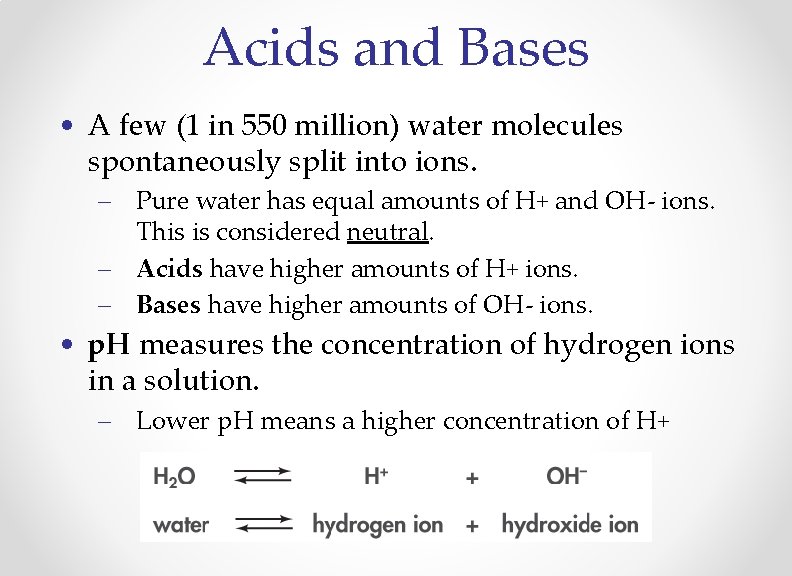
Acids and Bases • A few (1 in 550 million) water molecules spontaneously split into ions. – Pure water has equal amounts of H+ and OH- ions. This is considered neutral. – Acids have higher amounts of H+ ions. – Bases have higher amounts of OH- ions. • p. H measures the concentration of hydrogen ions in a solution. – Lower p. H means a higher concentration of H+
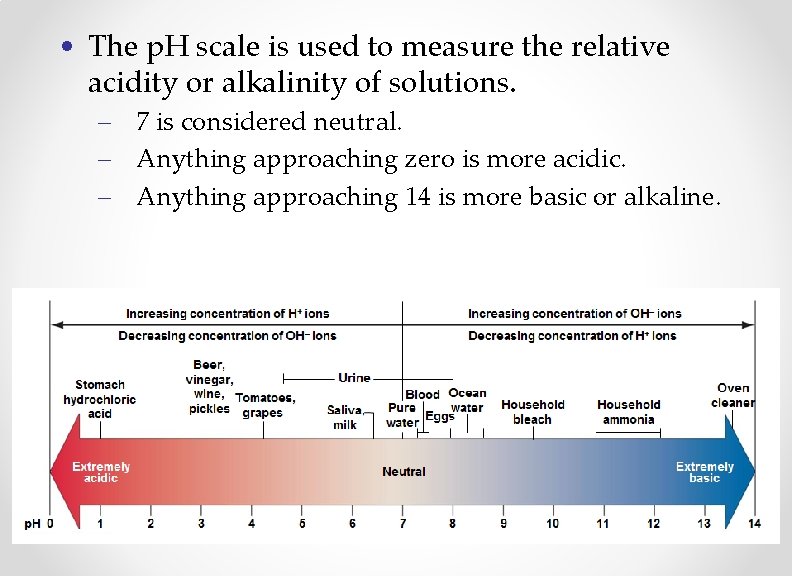
• The p. H scale is used to measure the relative acidity or alkalinity of solutions. – 7 is considered neutral. – Anything approaching zero is more acidic. – Anything approaching 14 is more basic or alkaline.
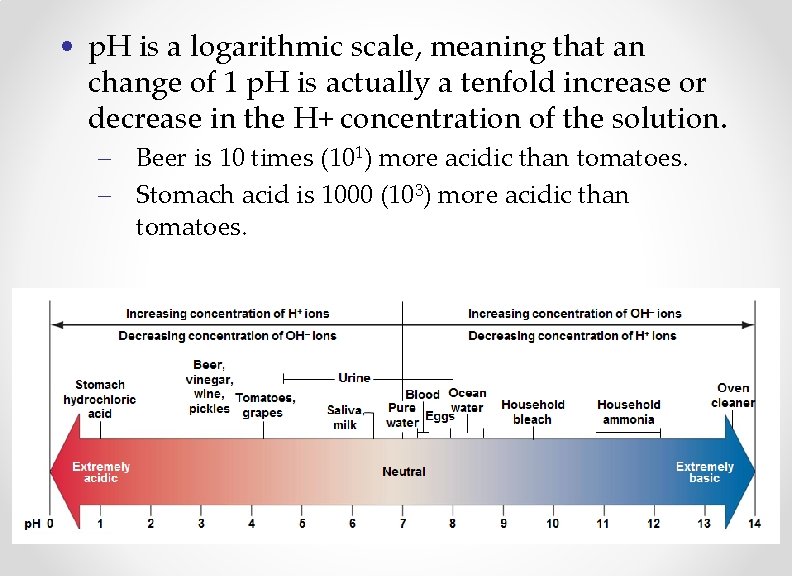
• p. H is a logarithmic scale, meaning that an change of 1 p. H is actually a tenfold increase or decrease in the H+ concentration of the solution. – Beer is 10 times (101) more acidic than tomatoes. – Stomach acid is 1000 (103) more acidic than tomatoes.
p. H and Homeostasis • • Blood requires a p. H of 7. 35 -7. 45. Sweat has a p. H between 4. 0 -6. 8. Saliva p. H is normally around 6. 0. Blood and other body fluids contain buffers, which can “absorb” increases on H+ (acid) or OH- (base) ions. – This keeps blood p. H within a narrow range, no matter how acidic or alkaline your diet is.