
CHEMISTRY OF FBLOCK ELEMENTS Presented By K N

CHEMISTRY OF F-BLOCK ELEMENTS Presented By : K. N. S. SWAMI. , M. Sc. , SET Guest Faculty in Chemistry P. R. Government College (Autonomous), Kakinada.
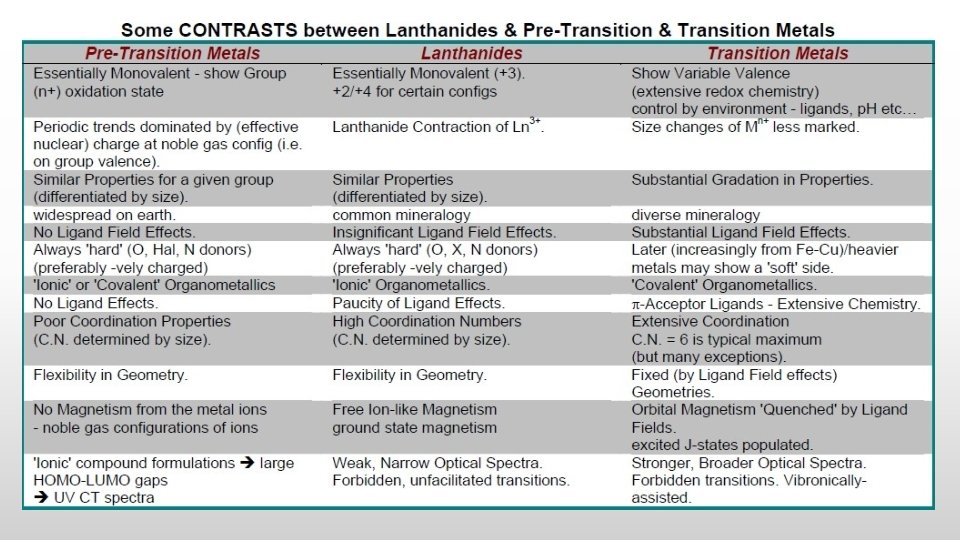
Contents Ø Introduction q. Lanthanides Ø Electronic Configurations Ø Oxidation States Ø Chemical Reactivity Ø Lanthanide Contraction Ø Variation Of Properties Metallic Radii Density Electronegativity Ionization Enthalpy Ø Magnetic Behavior Ø Color Properties Ø Lanthanide Complexes Ø Separation Of Lanthanides Ion Exchange Solvent Extraction Ø Some Contrasts Between Lanthanides And Pre -transition & Transition Metals q. Actinides Ø Electronic Configurations Ø Oxidation States
Ø Actinide Contraction Ø Variation In Properties Ø Complex Formation Tendency Ø Chemical Properties Ø Similarities And Differences Between Lanthanides And Actinides Ø Magnetic & Spectral Properties Rreference Books v Inorganic Chemistry For B. Sc. Of all Indian Universities By R. L. Madan and G. D. Tuli. v Inorganic Chemistry by Catherine E. Housecraft and Alan G. Sharpe. v Inorganic Chemistry Principles of Structure and Reactivity By James E. Huheey, Ellen A. Keiter, Richard L. Keiter. v Concise of Inorganic Chemistry By J. D. Lee
Introduction:
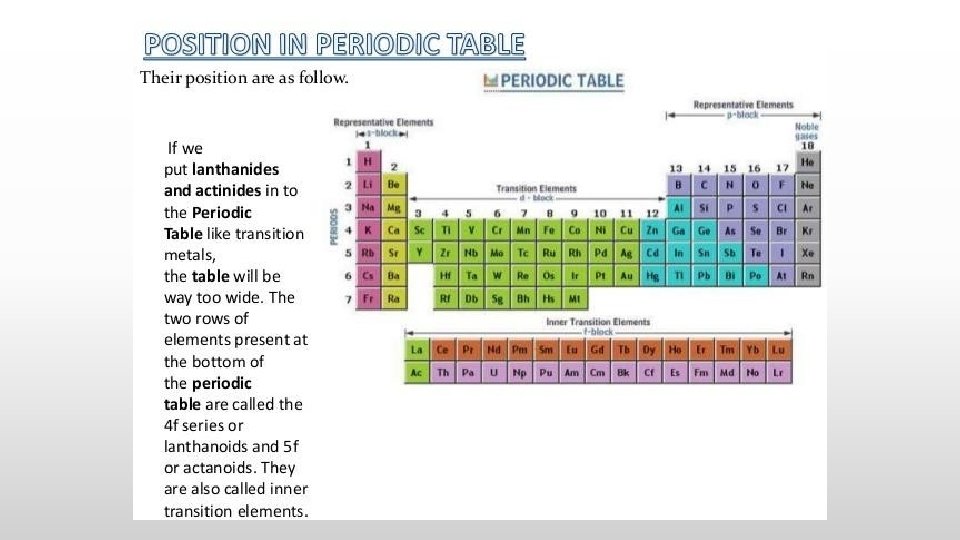
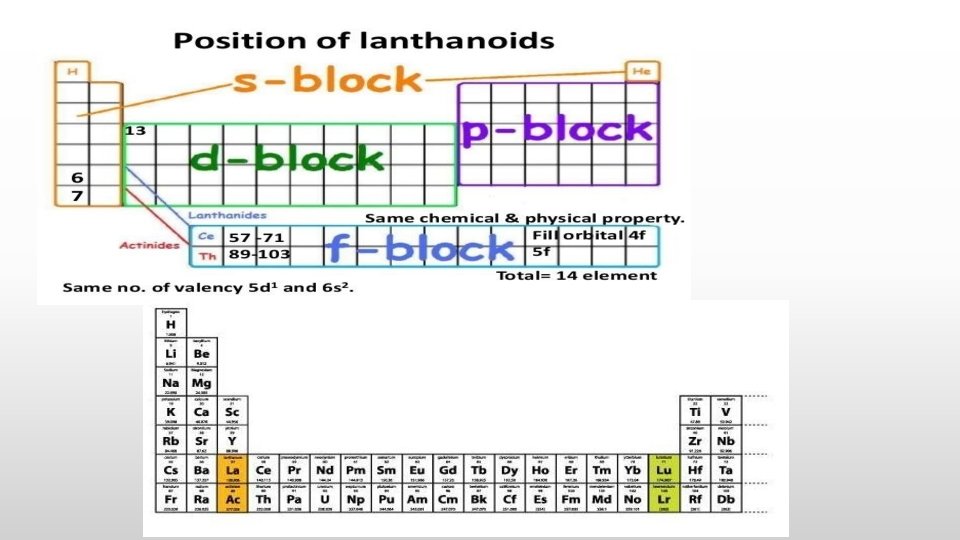
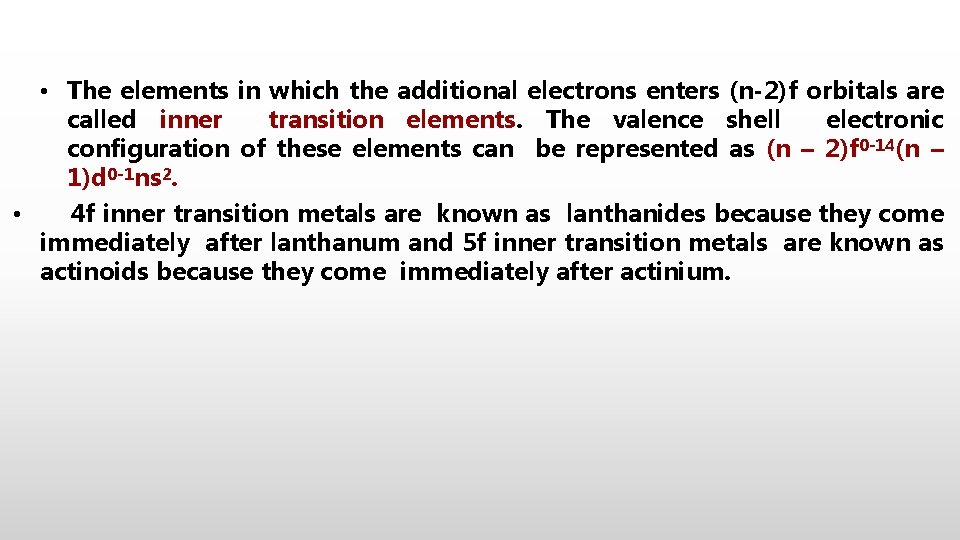
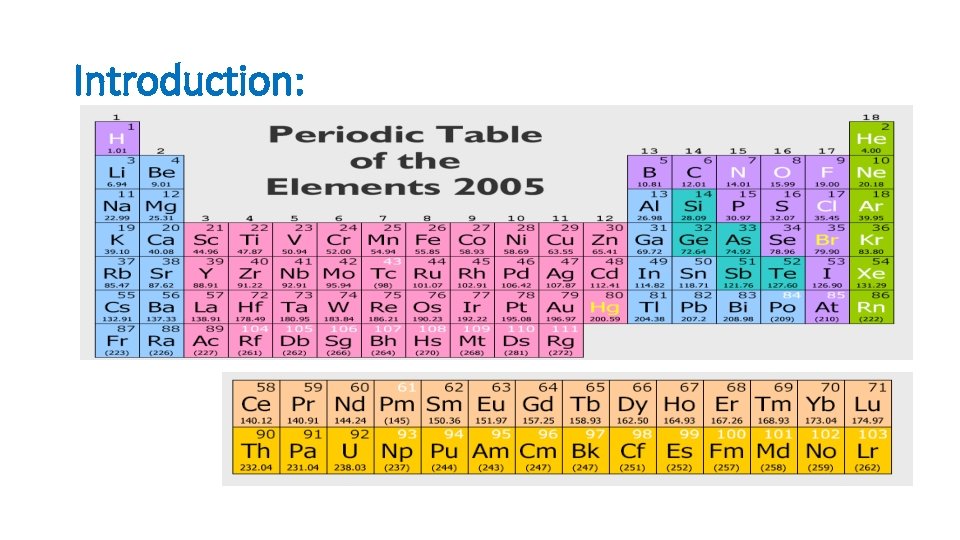
• The elements in which the additional electrons enters (n-2)f orbitals are called inner transition elements. The valence shell electronic configuration of these elements can be represented as (n – 2)f 0 -14(n – 1)d 0 -1 ns 2. • 4 f inner transition metals are known as lanthanides because they come immediately after lanthanum and 5 f inner transition metals are known as actinoids because they come immediately after actinium.


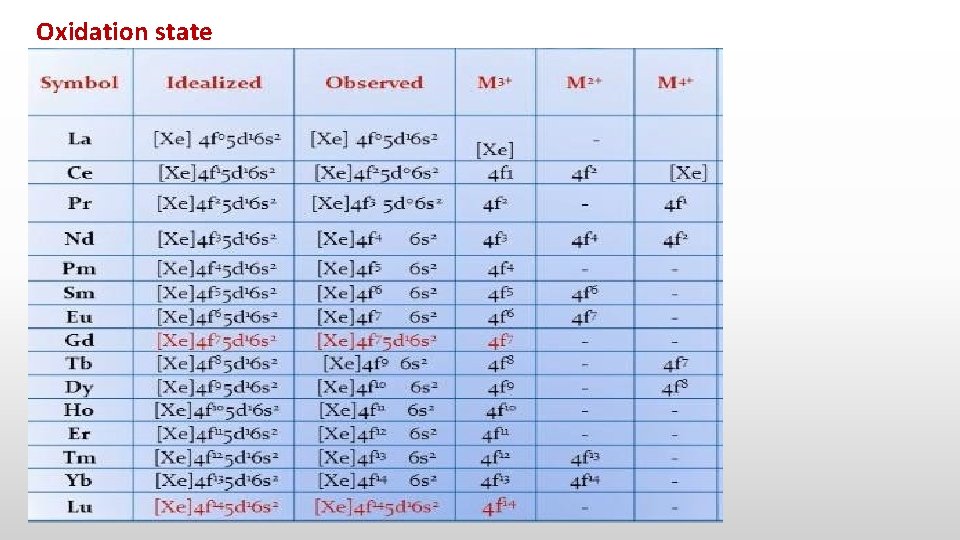
Electronic Configuration Element name Lanthanum Cerium Praesodymiu m Neodymium Promethium Samarium Europium Gadolinium Terbium Dysprosium Holmium Erbium Thulium Ytterbium Lutetium Symbol Z Ln Ln 3+ Radius La Ce Pr 57 58 59 [Xe]6 s 25 d 1 [Xe]4 f 16 s 25 d 1 [Xe]4 f 36 s 2 [Xe]4 f 0 [Xe]4 f 1 [Xe]4 f 2 Ln 3+/ pm 116 114 113 Nd Pm Sm Eu Eu Tb Dy Ho Er Tm Yb Lu 60 61 62 63 64 65 66 67 68 69 70 71 [Xe]4 f 46 s 2 [Xe]4 f 56 s 2 [Xe]4 f 66 s 2 [Xe]4 f 76 s 25 d 1 [Xe] 4 f 96 s 2 [Xe] 4 f 106 s 2 [Xe] 4 f 116 s 2 [Xe] 4 f 126 s 2 [Xe] 4 f 136 s 2 [Xe] 4 f 146 s 25 d 1 [Xe]4 f 3 [Xe]4 f 4 [Xe]4 f 5 [Xe]4 f 6 [Xe]4 f 7 [Xe]4 f 8 [Xe]4 f 9 [Xe]4 f 10 [Xe]4 f 11 [Xe]4 f 12 [Xe]4 f 13 [Xe]4 f 14 111 109 108 107 105 104 103 102 100 99 99 98
Oxidation state
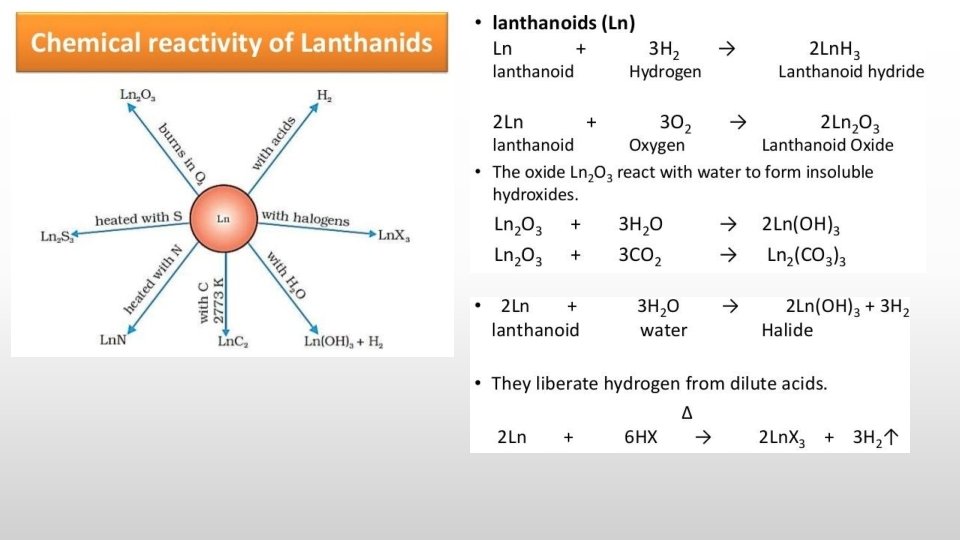
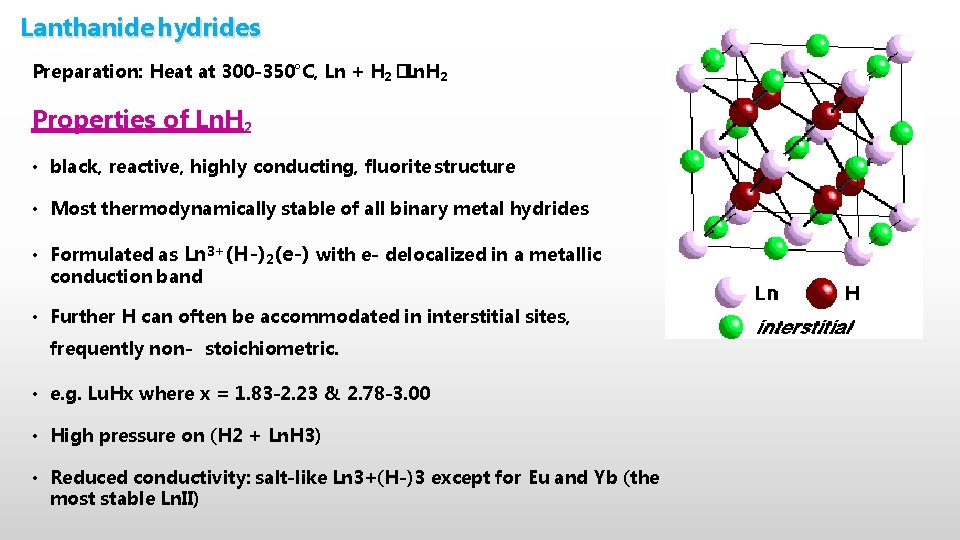
Lanthanide hydrides Preparation: Heat at 300 -350°C, Ln + H 2 � Ln. H 2 Properties of Ln. H 2 • black, reactive, highly conducting, fluorite structure • Most thermodynamically stable of all binary metal hydrides • Formulated as Ln 3+(H-)2(e-) with e- delocalized in a metallic conduction band • Further H can often be accommodated in interstitial sites, frequently non- stoichiometric. • e. g. Lu. Hx where x = 1. 83 -2. 23 & 2. 78 -3. 00 • High pressure on (H 2 + Ln. H 3) • Reduced conductivity: salt-like Ln 3+(H-)3 except for Eu and Yb (the most stable Ln. II)
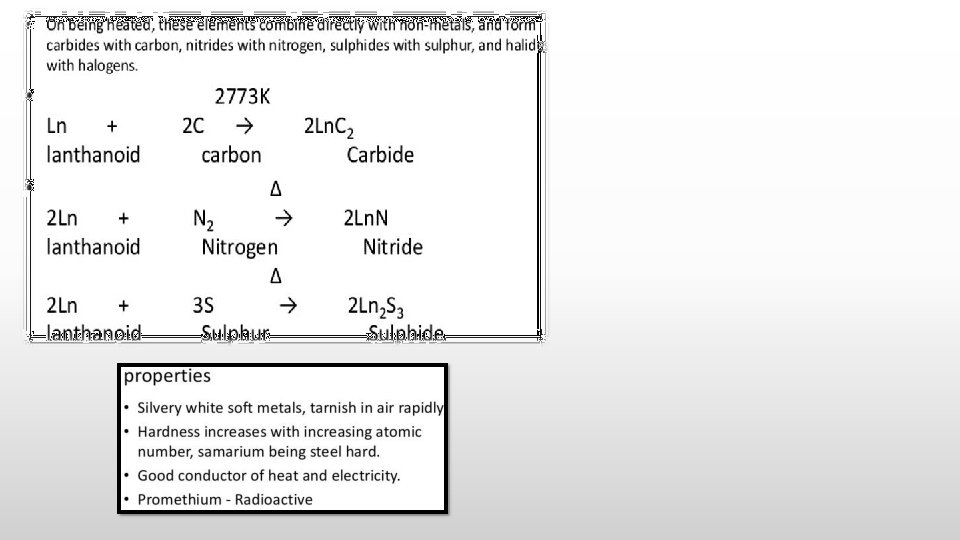
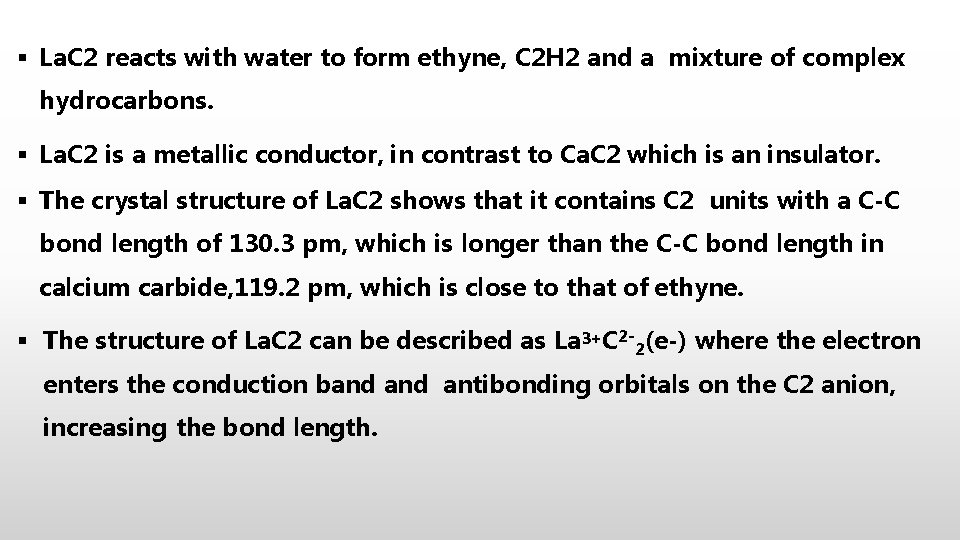
La. C 2 reacts with water to form ethyne, C 2 H 2 and a mixture of complex hydrocarbons. La. C 2 is a metallic conductor, in contrast to Ca. C 2 which is an insulator. The crystal structure of La. C 2 shows that it contains C 2 units with a C-C bond length of 130. 3 pm, which is longer than the C-C bond length in calcium carbide, 119. 2 pm, which is close to that of ethyne. The structure of La. C 2 can be described as La 3+C 2 -2(e-) where the electron enters the conduction band antibonding orbitals on the C 2 anion, increasing the bond length.
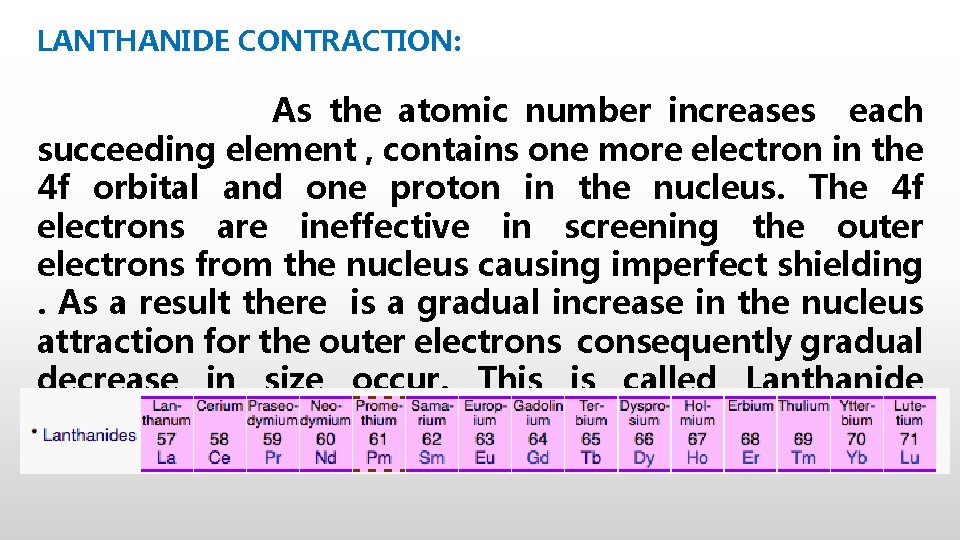
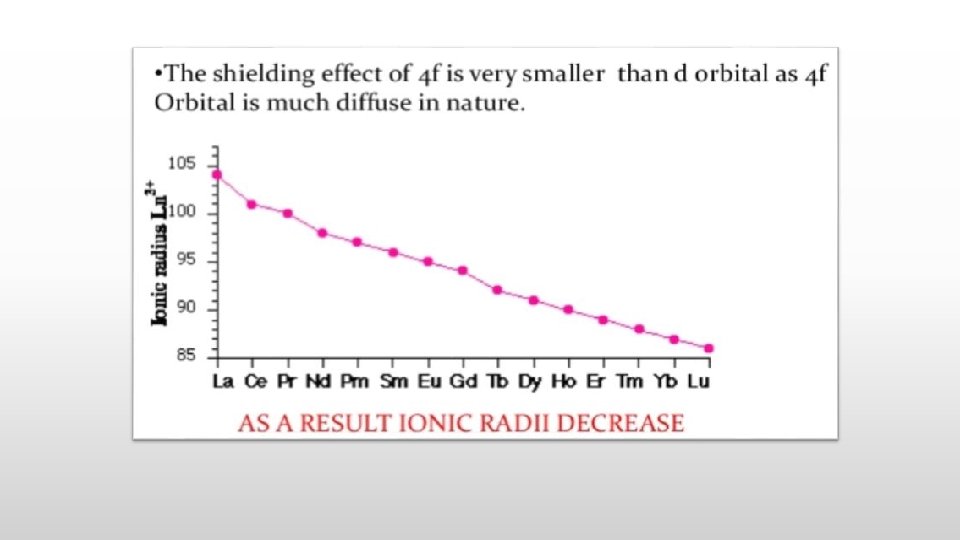
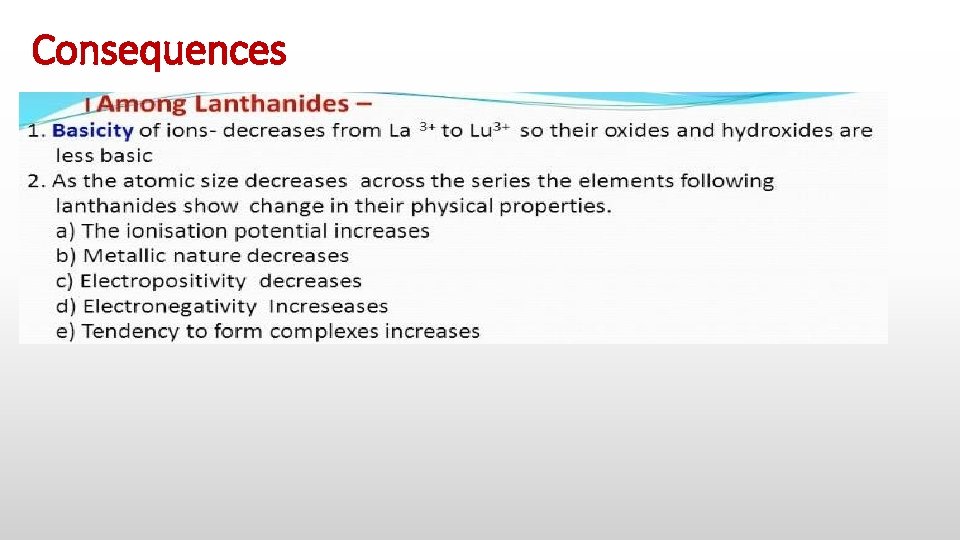
LANTHANIDE CONTRACTION: As the atomic number increases each succeeding element , contains one more electron in the 4 f orbital and one proton in the nucleus. The 4 f electrons are ineffective in screening the outer electrons from the nucleus causing imperfect shielding . As a result there is a gradual increase in the nucleus attraction for the outer electrons consequently gradual decrease in size occur. This is called Lanthanide contraction.
Consequences
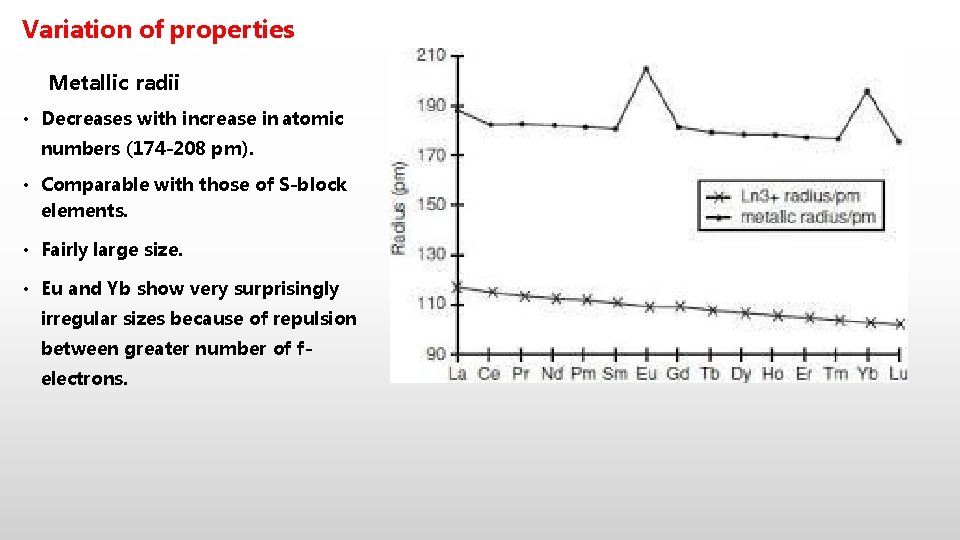
Variation of properties Metallic radii • Decreases with increase in atomic numbers (174 -208 pm). • Comparable with those of S-block elements. • Fairly large size. • Eu and Yb show very surprisingly irregular sizes because of repulsion between greater number of f- electrons.
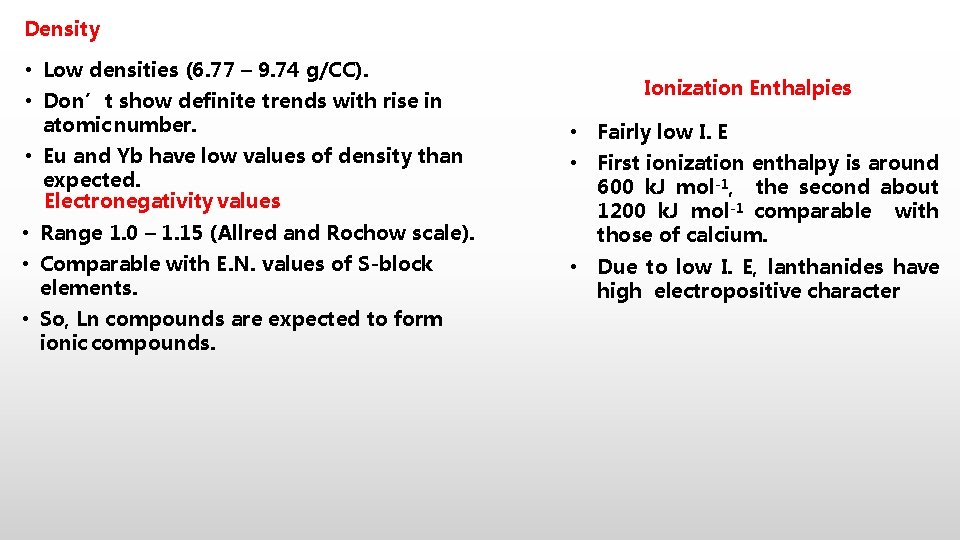
Density • Low densities (6. 77 – 9. 74 g/CC). • Don’t show definite trends with rise in atomic number. • Eu and Yb have low values of density than expected. Electronegativity values Ionization Enthalpies • Fairly low I. E • Range 1. 0 – 1. 15 (Allred and Rochow scale). • First ionization enthalpy is around 600 k. J mol-1, the second about 1200 k. J mol-1 comparable with those of calcium. • Comparable with E. N. values of S-block elements. • Due to low I. E, lanthanides have high electropositive character • So, Ln compounds are expected to form ionic compounds.
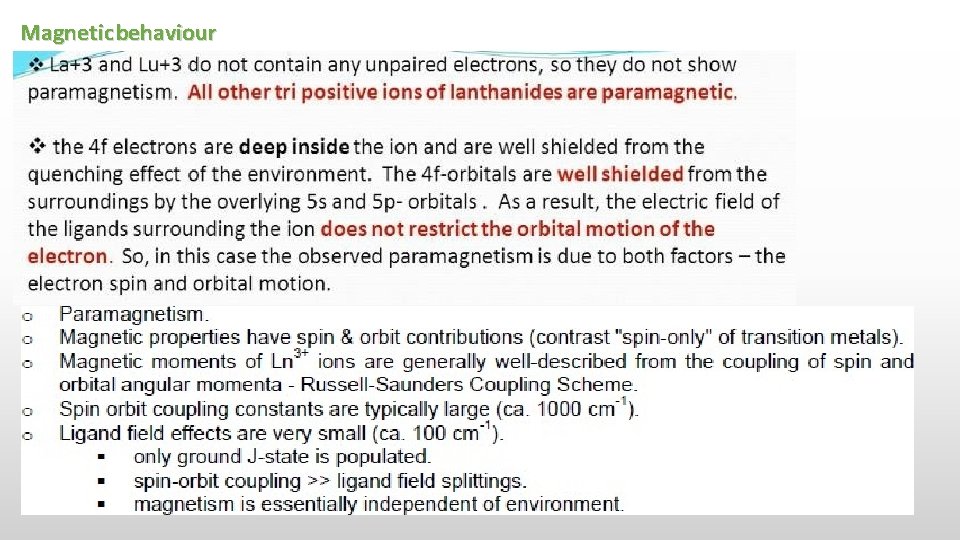
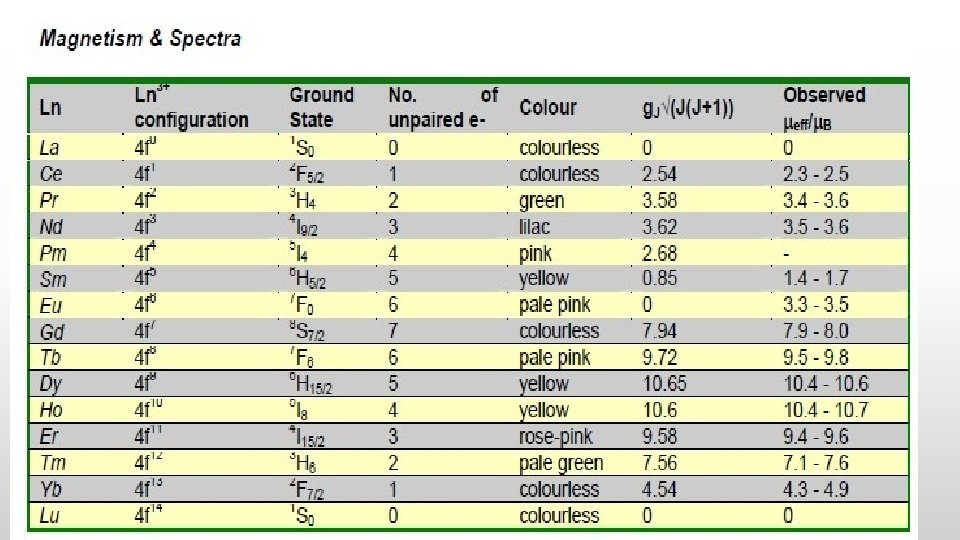
Magnetic behaviour
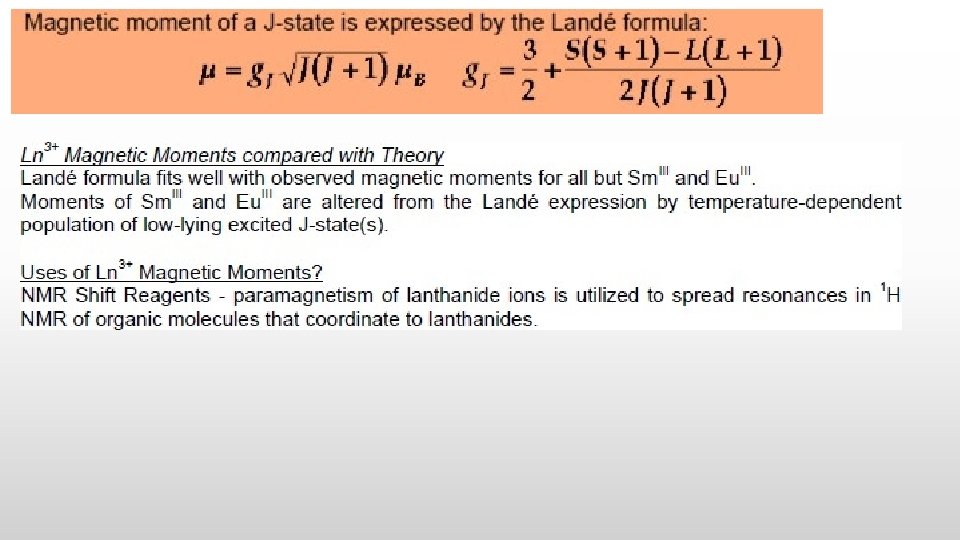
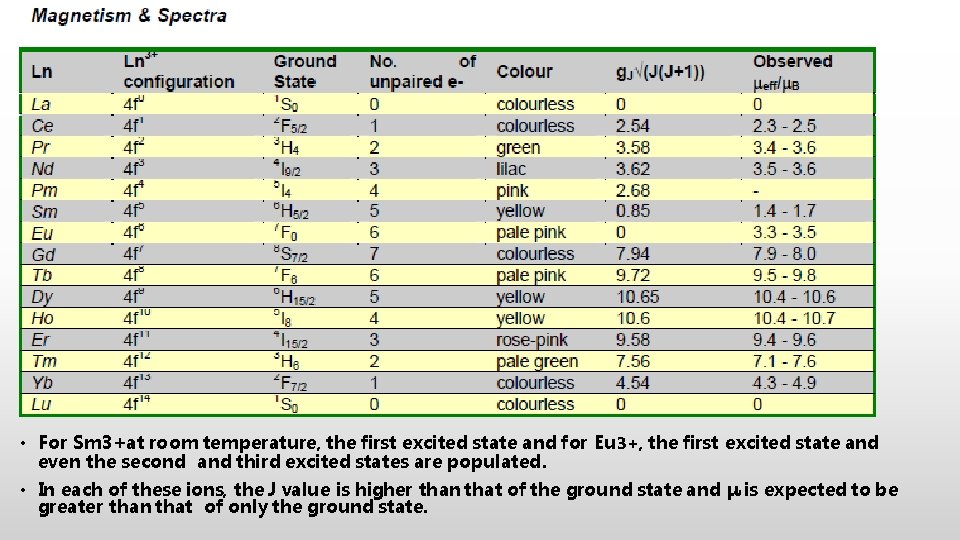
• For Sm 3+at room temperature, the first excited state and for Eu 3+, the first excited state and even the second and third excited states are populated. • In each of these ions, the J value is higher than that of the ground state and μ is expected to be greater than that of only the ground state. J
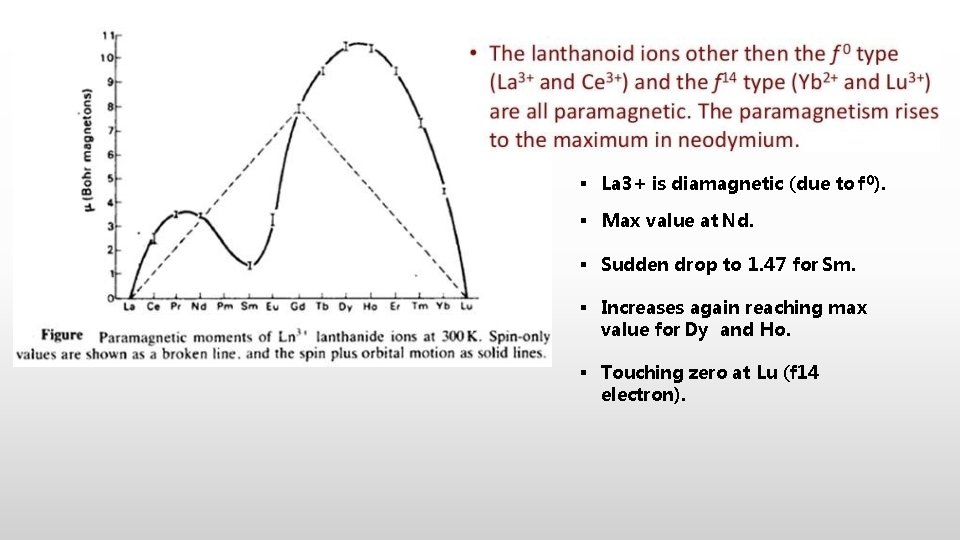
La 3+ is diamagnetic (due to f 0). Max value at Nd. Sudden drop to 1. 47 for Sm. Increases again reaching max value for Dy and Ho. Touching zero at Lu (f 14 electron).
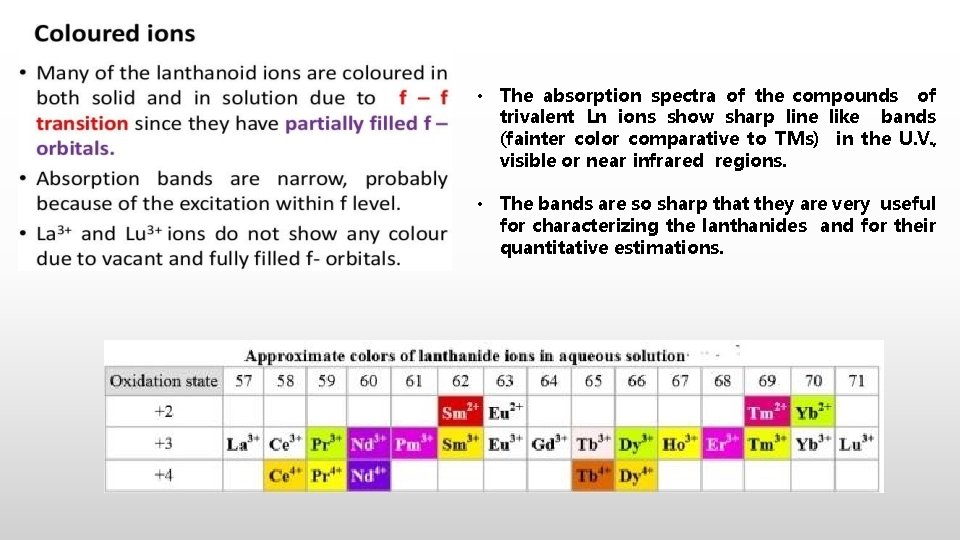
• The absorption spectra of the compounds of trivalent Ln ions show sharp line like bands (fainter color comparative to TMs) in the U. V. , visible or near infrared regions. • The bands are so sharp that they are very useful for characterizing the lanthanides and for their quantitative estimations.
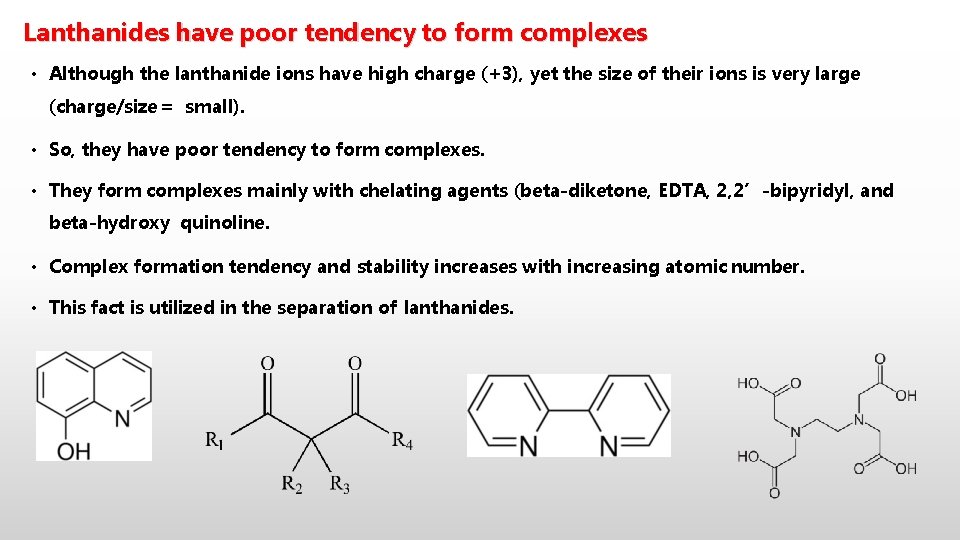
Lanthanides have poor tendency to form complexes • Although the lanthanide ions have high charge (+3), yet the size of their ions is very large (charge/size = small). • So, they have poor tendency to form complexes. • They form complexes mainly with chelating agents (beta-diketone, EDTA, 2, 2’-bipyridyl, and beta-hydroxy quinoline. • Complex formation tendency and stability increases with increasing atomic number. • This fact is utilized in the separation of lanthanides.
Chemistry of all lanthanides is almost identical • They all have similar outer electronic configuration and display mainly +3 oxidation state in their compounds. • Their similarity is much closer than that of ordinary transition elements because lanthanides differ mainly in the number of 4 f electrons. • 4 f electrons are buried deep in the atoms. • Important uses of Lanthanides Due to L. C. there is very small difference in the size of all the 15 trivalent lanthanide ions. • Ce glass cuts off heat and UV light and so used in glare- reducing spectacles. • Ce-Mg alloys are used in flashlight powders. • Nd oxide dissolved in selenium oxychloride is one of the most powerful liquid lasers known so far. • Ce salts are used in analysis, dyeing, lead accumulators, medicines and as catalyst. • Ln elements and their compounds are being used in nuclear control, shielding and fluxing devices. • Since lanthanides improve the workability of steel when heated, so alloys of lanthanides with Fe
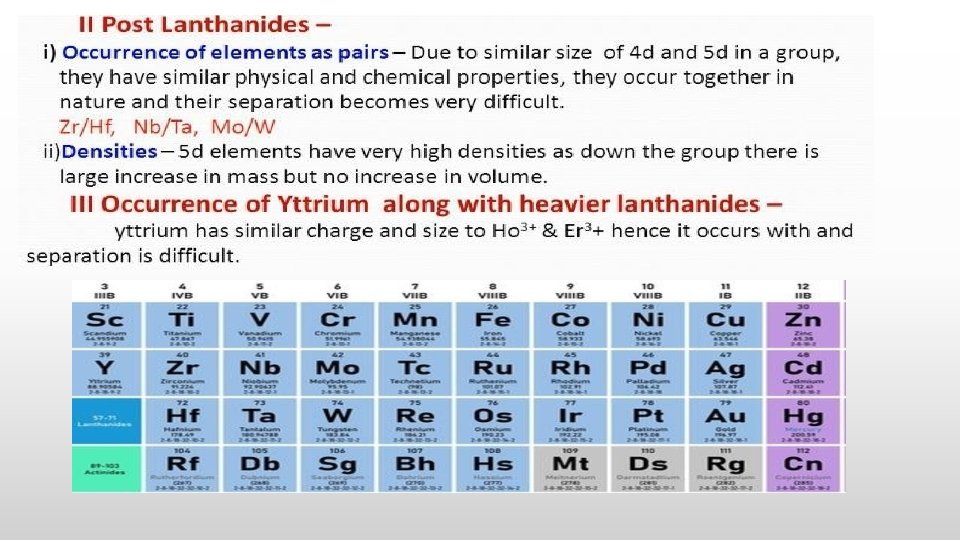
SEPARATION OF LANTHANIDES: Except promethium, they occur together in earth’s crust in various forms and very difficult to separate from each other because all the lanthanides have the same size and charge (of +3 unit). The chemical properties of these elements which depend on the size and charge are, therefore, almost identical. Hence, their isolation from one another is quite difficult. However, the following methods have been used to separate them from one another.
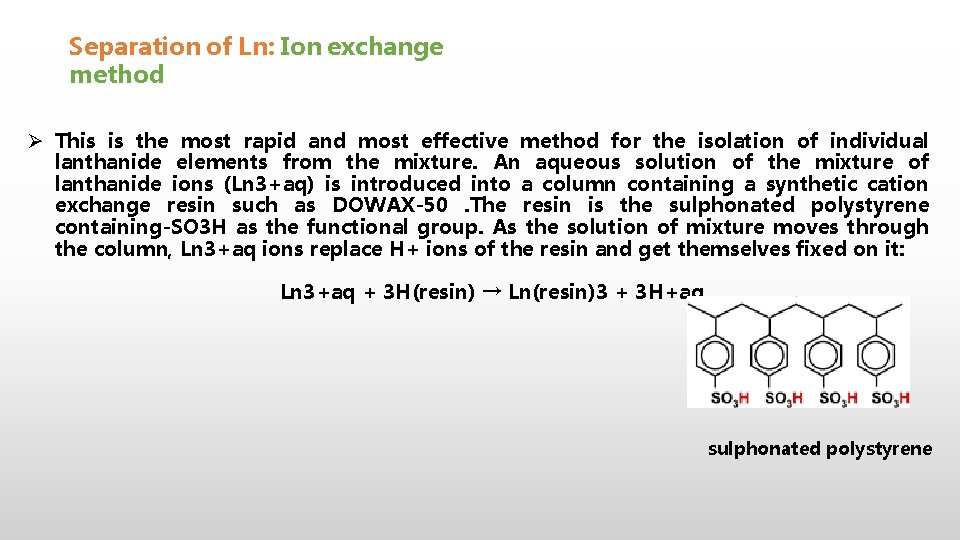
Separation of Ln: Ion exchange method Ø This is the most rapid and most effective method for the isolation of individual lanthanide elements from the mixture. An aqueous solution of the mixture of lanthanide ions (Ln 3+aq) is introduced into a column containing a synthetic cation exchange resin such as DOWAX-50 . The resin is the sulphonated polystyrene containing-SO 3 H as the functional group. As the solution of mixture moves through the column, Ln 3+aq ions replace H+ ions of the resin and get themselves fixed on it: Ln 3+aq + 3 H(resin) → Ln(resin)3 + 3 H+aq sulphonated polystyrene
Ø The bonding of the lanthanide ion to the resin depends on its size, i. e, the smaller the size of the lanthanide ion, the more firmly it is bound to the resin and vice versa. Since lanthanide ions are hydrated, therefore size of the hydrated ions should be considered for binding purpose. Hydration of the ions depends upon size i. e, smaller the size of the ion greater will be the hydration. Therefore in case of lanthanide ions, the smallest lanthanide ion, namely will be the most heavily hydrated. Thus it will have the maximum size and therefore the least firmly bound to the resin while reverse will be the case with La+3 which will be the most firmly bound to the resin Ø A solution containing several lanthanide ions is dropped slowly down a column of synthetic ion exchange resin so that the lanthanide ions are bound less firmly to the resin in the order La+3 to Lu+3. They are then eluted from the column by using a solution containing citric acid and ammonium citrate. For the ammonium ions elute the metal ions from the resin as: 3 NH 4+ + Ln (resin) → 3 NH 4 resin + Ln+3
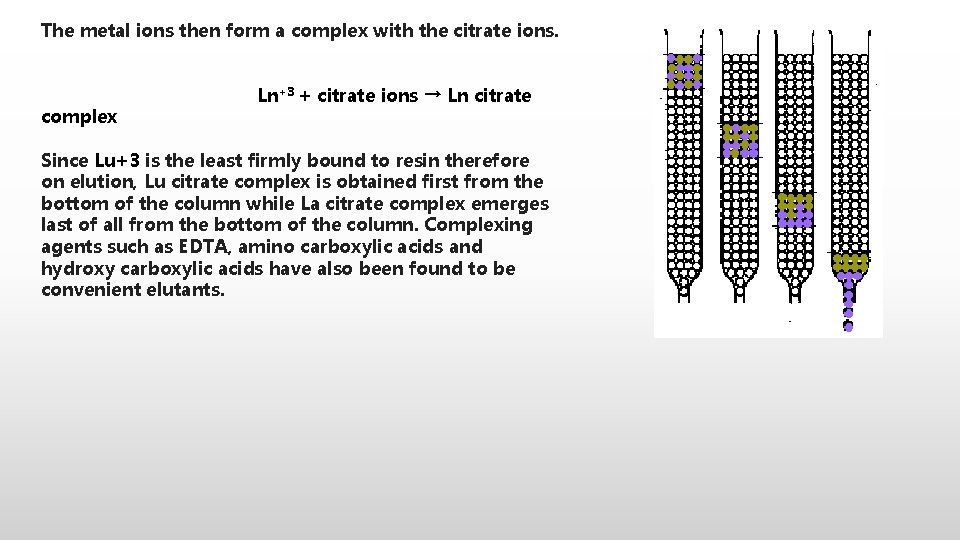
The metal ions then form a complex with the citrate ions. complex Ln+3 + citrate ions → Ln citrate Since Lu+3 is the least firmly bound to resin therefore on elution, Lu citrate complex is obtained first from the bottom of the column while La citrate complex emerges last of all from the bottom of the column. Complexing agents such as EDTA, amino carboxylic acids and hydroxy carboxylic acids have also been found to be convenient elutants.
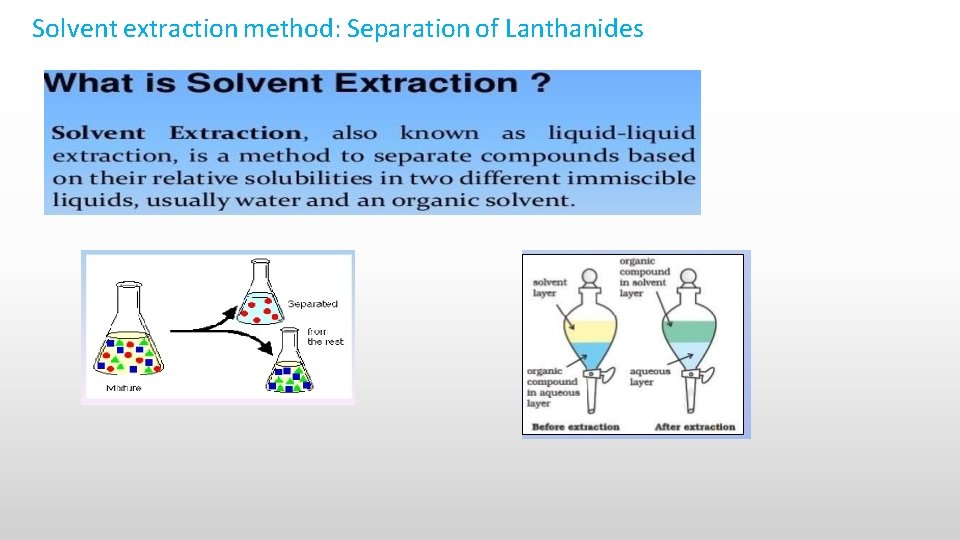
Solvent extraction method: Separation of Lanthanides
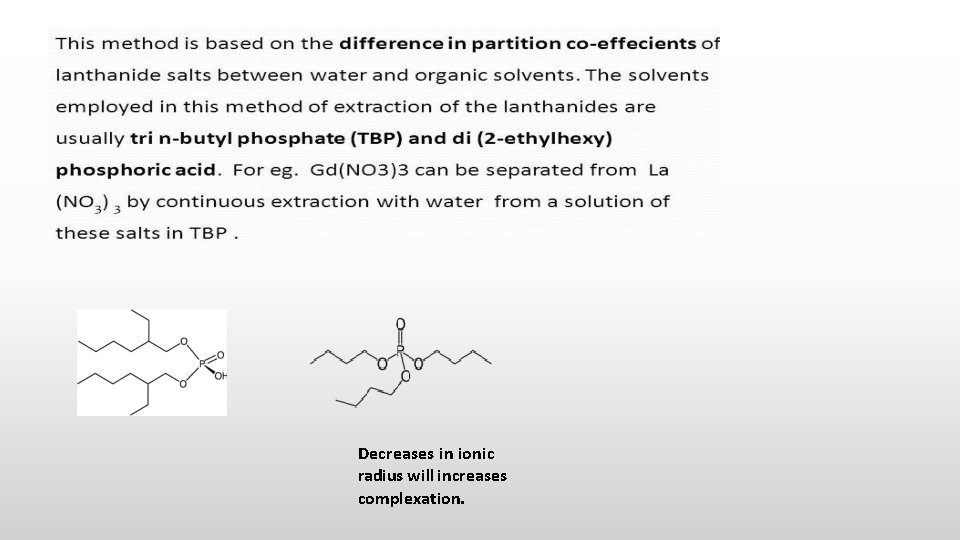
Decreases in ionic radius will increases complexation.
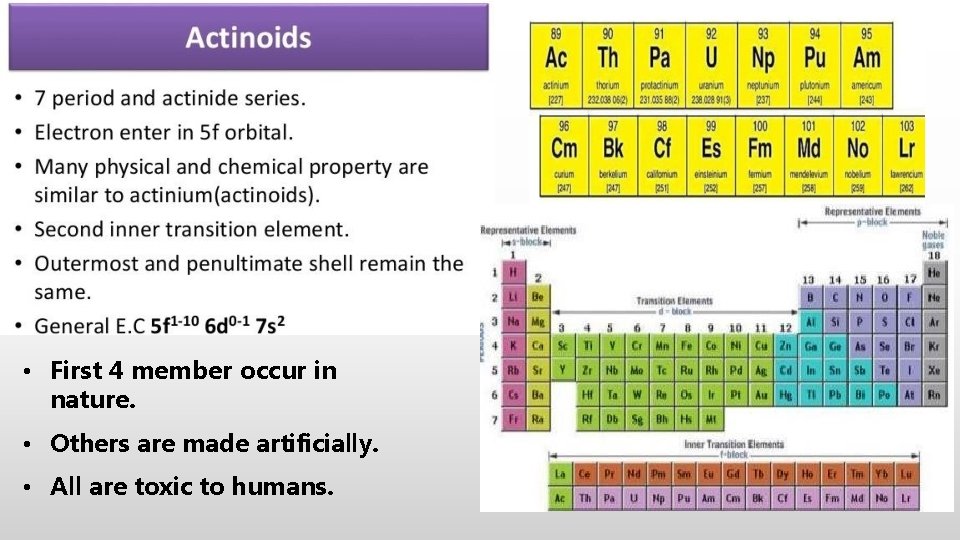
• First 4 member occur in nature. • Others are made artificially. • All are toxic to humans.
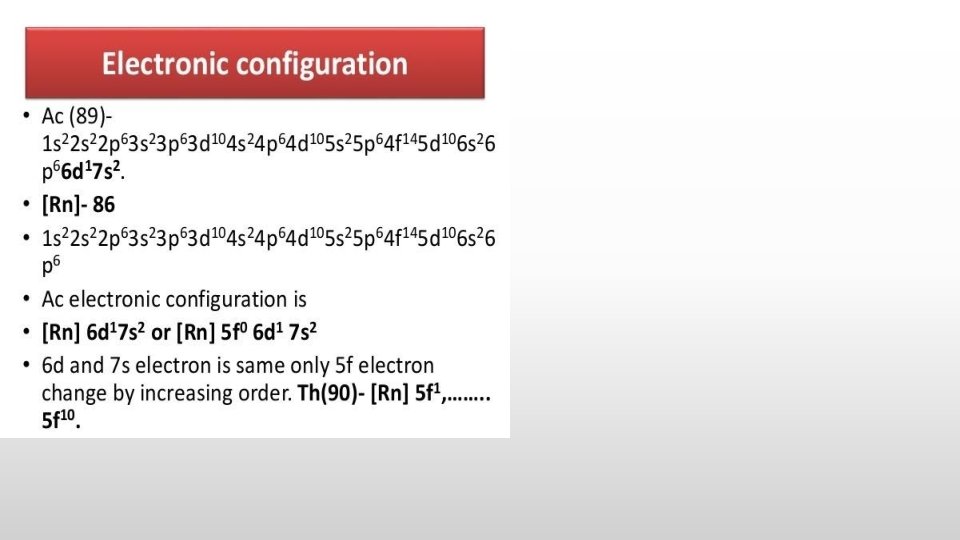
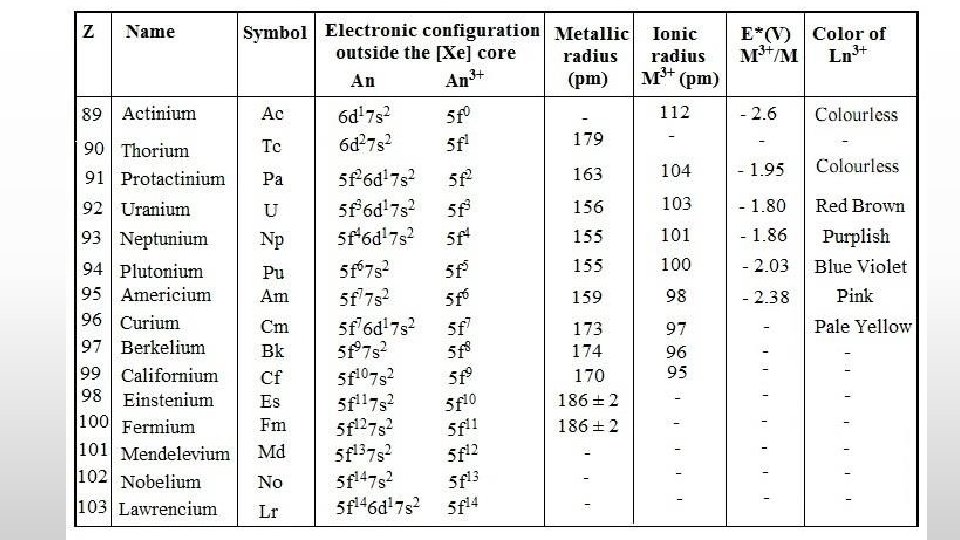
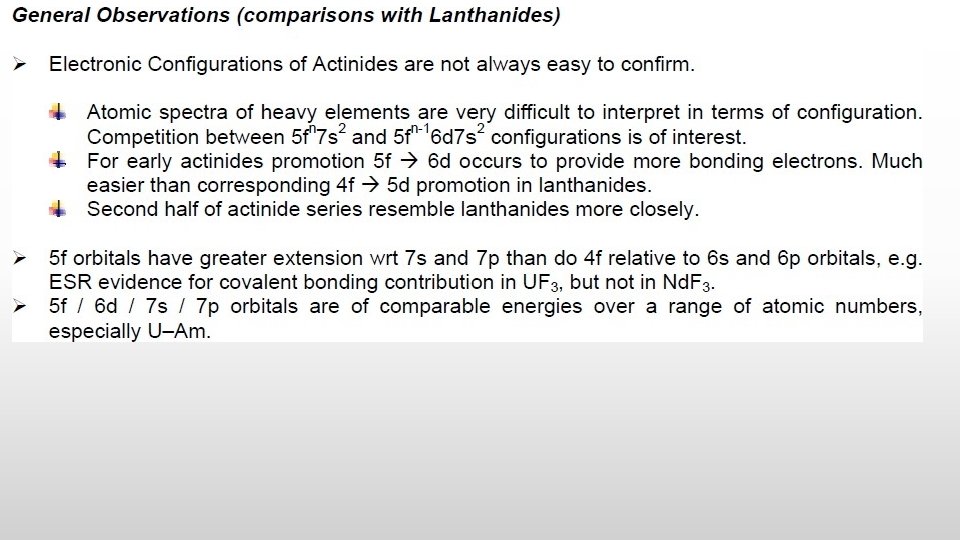
As there is not much difference between 5 f and 6 d, it becomes difficult to know whether the electron has entered 5 f or 6 d. This makes predicting electronic configuration difficult. • The ground state electronic configuration of actinium, [Rn]6 d 17 s 2 is identical to that of lanthanum and certainly the two elements possess alike chemical properties. • The difference in energy between 5 f and 6 d orbitals in the starting of the actinide series is less than that between the 4 f and 5 d orbitals for the lanthanides. • Thus, both 5 f and 6 d orbitals are comprised in accommodating successive electrons. • Therefore the filling of 5 f orbitals in actinides is not quite so regular as the filling of 4 f orbitals in case of the lanthanides. • By the time plutonium and following members of the series are reached, the 5 f orbitals seem evidently to be of lower energy than the 6 d orbitals, and therefore the electrons preferably fill the former. Actinides show higher oxidation states than Lanthanides
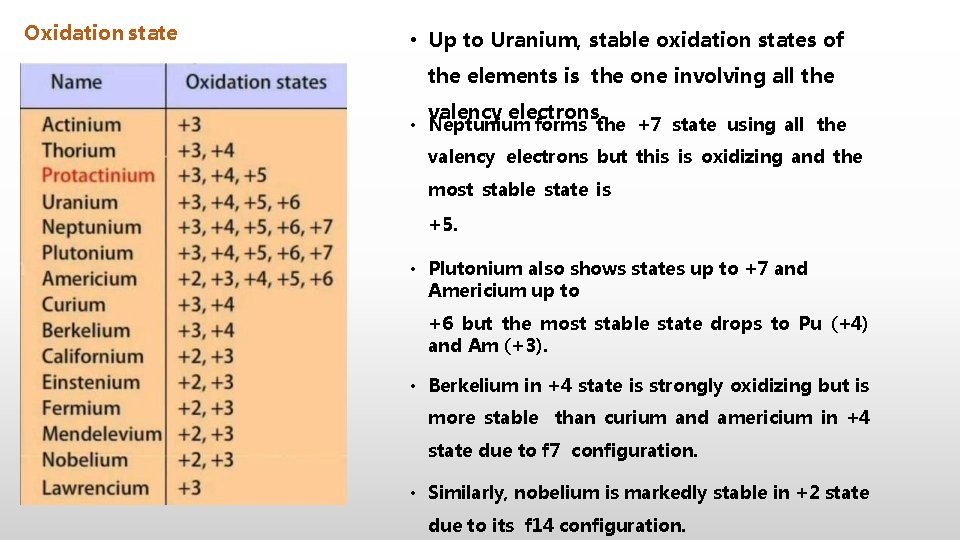
Oxidation state • Up to Uranium, stable oxidation states of the elements is the one involving all the valency electrons. • Neptunium forms the +7 state using all the valency electrons but this is oxidizing and the most stable state is +5. • Plutonium also shows states up to +7 and Americium up to +6 but the most stable state drops to Pu (+4) and Am (+3). • Berkelium in +4 state is strongly oxidizing but is more stable than curium and americium in +4 state due to f 7 configuration. • Similarly, nobelium is markedly stable in +2 state due to its f 14 configuration.
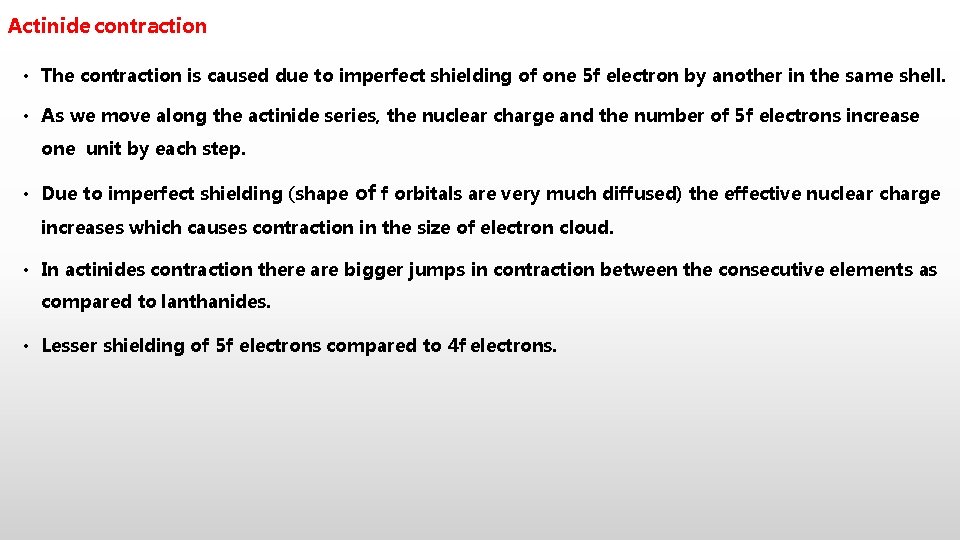
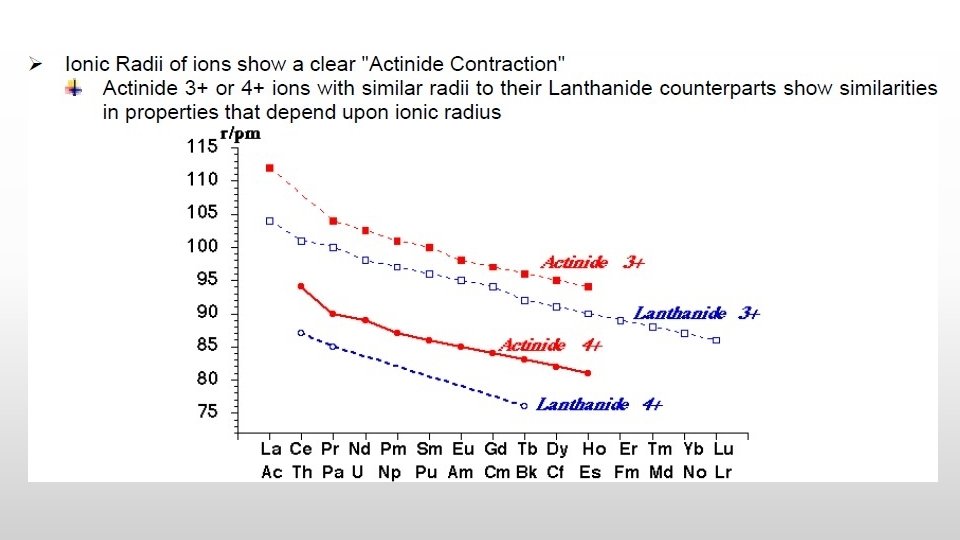
Actinide contraction • The contraction is caused due to imperfect shielding of one 5 f electron by another in the same shell. • As we move along the actinide series, the nuclear charge and the number of 5 f electrons increase one unit by each step. • Due to imperfect shielding (shape of f orbitals are very much diffused) the effective nuclear charge increases which causes contraction in the size of electron cloud. • In actinides contraction there are bigger jumps in contraction between the consecutive elements as compared to lanthanides. • Lesser shielding of 5 f electrons compared to 4 f electrons.
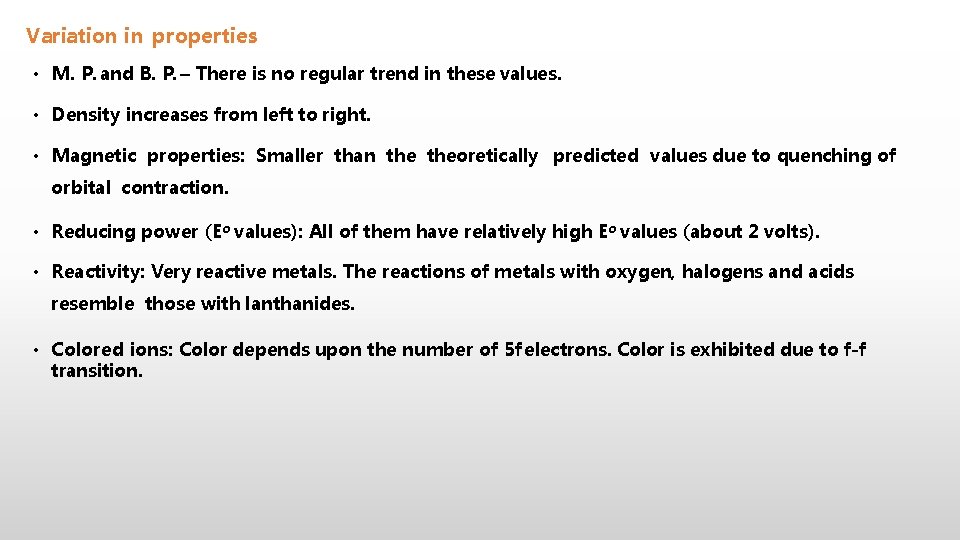
Variation in properties • M. P. and B. P. – There is no regular trend in these values. • Density increases from left to right. • Magnetic properties: Smaller than theoretically predicted values due to quenching of orbital contraction. • Reducing power (Eo values): All of them have relatively high Eo values (about 2 volts). • Reactivity: Very reactive metals. The reactions of metals with oxygen, halogens and acids resemble those with lanthanides. • Colored ions: Color depends upon the number of 5 f electrons. Color is exhibited due to f-f transition.
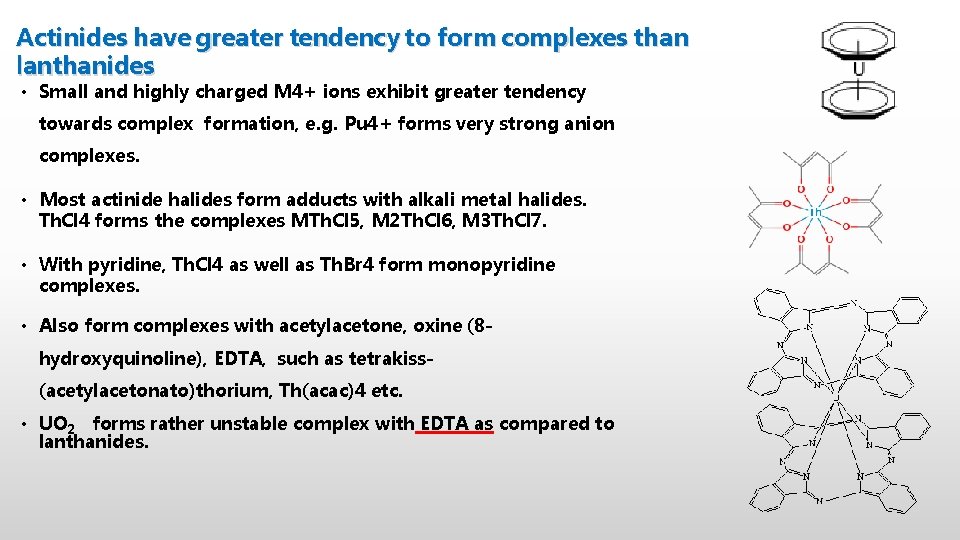
Actinides have greater tendency to form complexes than lanthanides • Small and highly charged M 4+ ions exhibit greater tendency towards complex formation, e. g. Pu 4+ forms very strong anion complexes. • Most actinide halides form adducts with alkali metal halides. Th. Cl 4 forms the complexes MTh. Cl 5, M 2 Th. Cl 6, M 3 Th. Cl 7. • With pyridine, Th. Cl 4 as well as Th. Br 4 form monopyridine complexes. • Also form complexes with acetylacetone, oxine (8 hydroxyquinoline), EDTA, such as tetrakiss(acetylacetonato)thorium, Th(acac)4 etc. • UO 2 forms rather unstable complex with EDTA as compared to lanthanides.
Chemical properties All the actinides are not stable with respect to the radioactive disintegration, although the halflives of the richest isotopes of thorium and uraniumare so long that for numerous purposes their radioactivity can be neglected. Like lanthanides, actinidesare as well electropositive and reactive metals. They react by water, oxygen, hydrogen, halogens and acids. Their hydrides are nonstoichiometric having ideal formulae MH 2 and MH 3. The metals as well react with most of the non-metals particularly whenever heated.
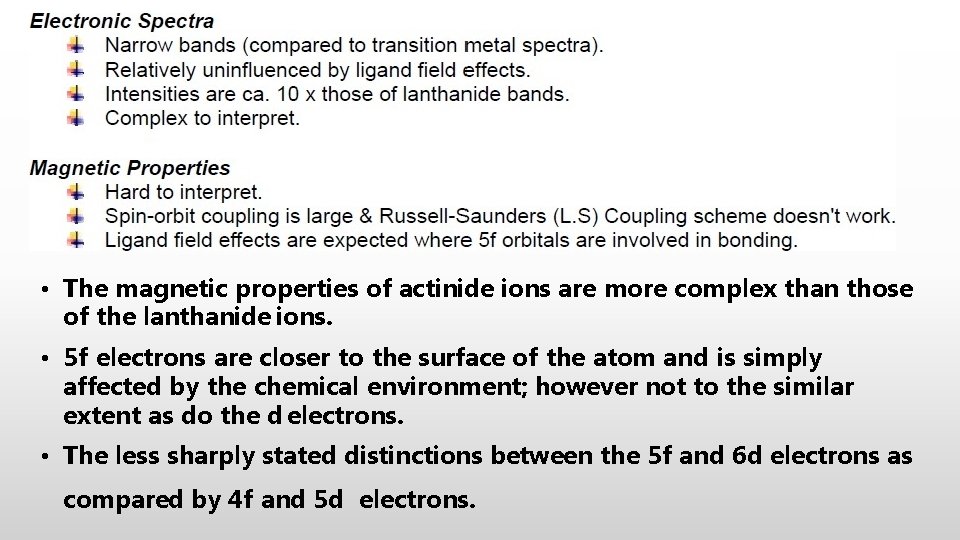
• The magnetic properties of actinide ions are more complex than those of the lanthanide ions. • 5 f electrons are closer to the surface of the atom and is simply affected by the chemical environment; however not to the similar extent as do the d electrons. • The less sharply stated distinctions between the 5 f and 6 d electrons as compared by 4 f and 5 d electrons.
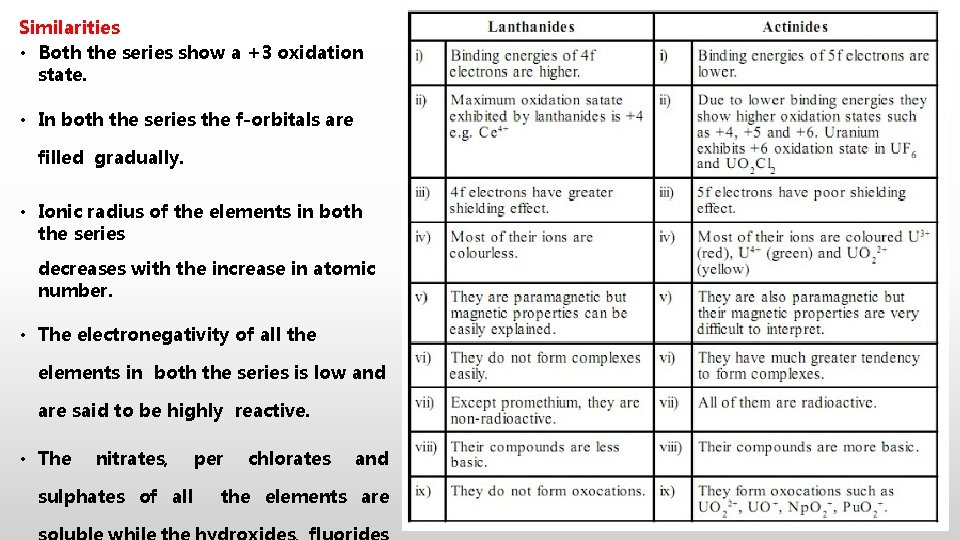
Similarities • Both the series show a +3 oxidation state. • In both the series the f-orbitals are filled gradually. • Ionic radius of the elements in both the series decreases with the increase in atomic number. • The electronegativity of all the elements in both the series is low and are said to be highly reactive. • The nitrates, per chlorates and sulphates of all the elements are

k n a Th u o Y
- Slides: 50