
CHEMISTRY OF CARBOHYDRATES Dr Vinitha Ramanath Pai Professor
CHEMISTRY OF CARBOHYDRATES Dr. Vinitha Ramanath Pai Professor Dept. of Biochemistry, YMC 1
CHEMISTRY OF CARBOHYDRATES Class I August 13, 2018 3
Introduction Carbohydrates are……. . • Widely distributed in plant and animal kingdoms • One of the most abundant class of bio - molecules in nature • Functions : Structural role and Metabolic role. 4
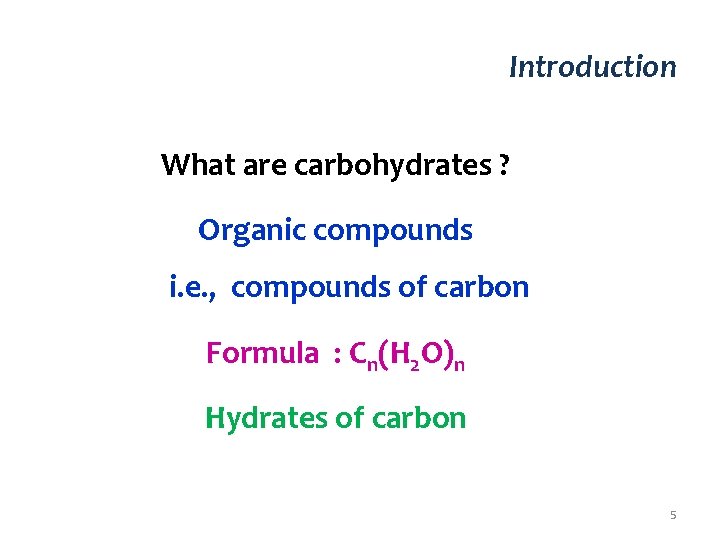
Introduction What are carbohydrates ? Organic compounds i. e. , compounds of carbon Formula : Cn(H 2 O)n Hydrates of carbon 5
Class I Specific learning objectives of this class • To define carbohydrates • To enlist the importance of carbohydrates • To classify carbohydrates with examples for each class, subclass 6
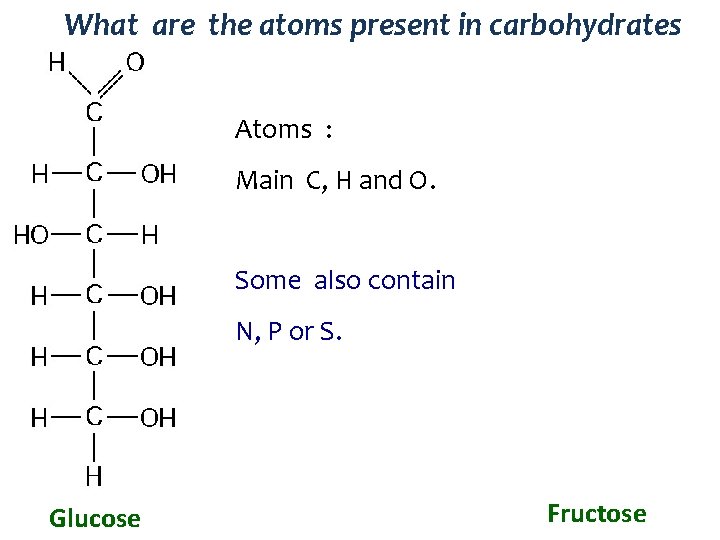
What are the atoms present in carbohydrates Atoms : Main C, H and O. Some also contain N, P or S. Glucose Fructose 7
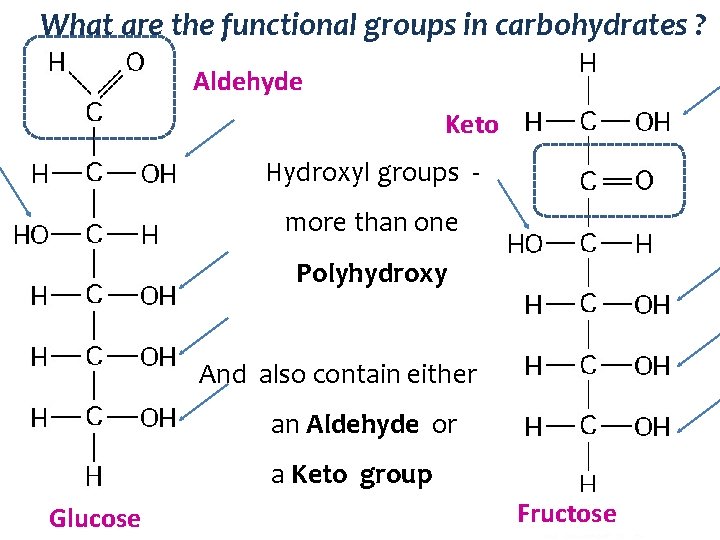
What are the functional groups in carbohydrates ? Aldehyde Keto Hydroxyl groups - more than one Polyhydroxy And also contain either an Aldehyde or a Keto group Glucose Fructose 8
Specific learning objective 1 : Definition Carbohydrates are……. . • Polyhydroxy aldehydes or Polyhydroxy ketones, or compounds which give them on hydrolysis. • Polyhydroxy alcohols with free or potentially free aldehyde / keto groups or compounds which yield these on hydrolysis. 9
Biological Importance of carbohydrates Carbohydrates have structural and metabolic functions Metabolic functions • Carbohydrates and energy : • Main source of metabolic energy in the body, Specific learning objective 2 : e. g. , Glucose Enlist the Importance of carbohydrates • Storage forms of energy, e. gs. , Starch in plants Glycogen in animals • Ribose is a component of ATP (energy coin of the cell) 10
Biological Importance……Metabolic functions………. • Dietary fibre, e. gs. , cellulose, hemicellulose, and pectins • Detoxification of drugs and bilirubin , e. g. , Glucuronic acid • Synthesis of other compounds, i. e. , lipids and amino acids - from the carbon skeletons of carbohydrates. 11
Biological Importance……. Carbohydrates have the following structural functions • Components of structural biomolecules and cell membranes : • Mucopolysaccharides of ground substances of tissues, synovial fluid of joints, etc. • Glycoproteins of blood group antigens, • Glycoproteins and glycolipids of cell membranes, • Cellulose of plants, • Chitin of insects, etc. 12
Biological Importance……. Carbohydrates have the following functions • Components of biomolecules : • e. gs. : In nucleic acids : Ribose in RNA and Deoxyribose in DNA • Nucleotides, e. g. , ATP , c. AMP contain Ribose 13
Medical Importance: • Some important disorders associated with carbohydrates are- q Diabetes mellitus, q Lactose intolerance, q Galactosemia, q Glycogen storage diseases and, q Mucopolysaccharidoses. 14
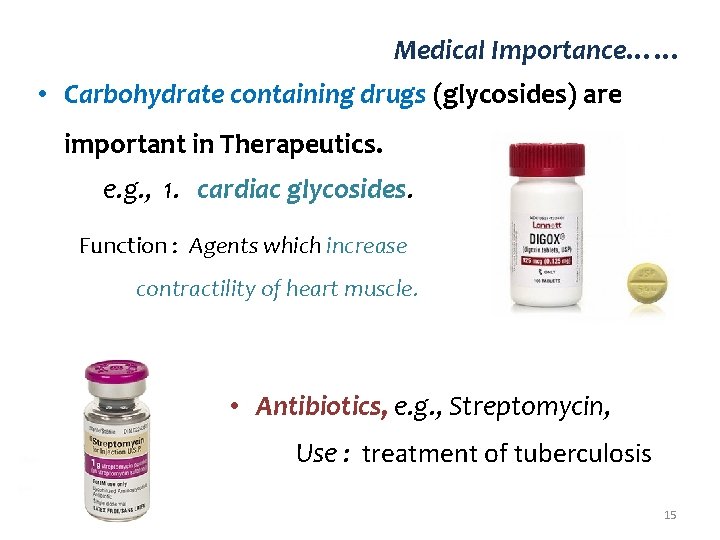
Medical Importance…… • Carbohydrate containing drugs (glycosides) are important in Therapeutics. e. g. , 1. cardiac glycosides. Function : Agents which increase contractility of heart muscle. • Antibiotics, e. g. , Streptomycin, Use : treatment of tuberculosis 15
Specific learning objective 3 : Classification of Carbohydrates – into classes, sub-classes with suitable examples 16
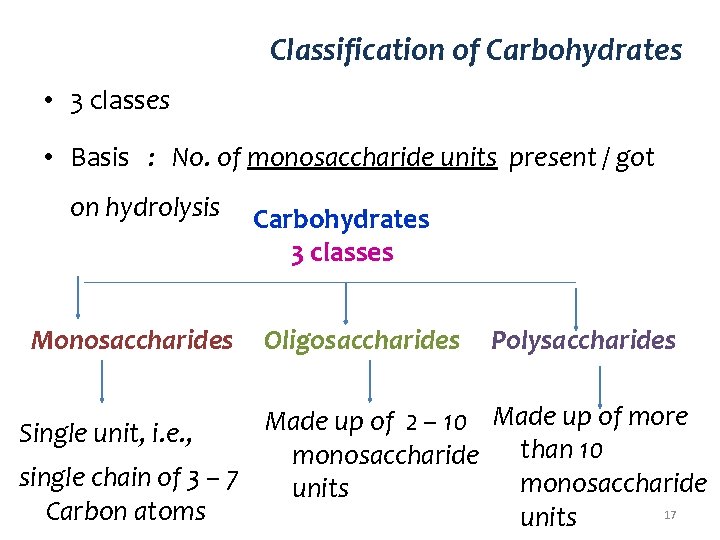
Classification of Carbohydrates • 3 classes • Basis : No. of monosaccharide units present / got on hydrolysis Carbohydrates 3 classes Monosaccharides Oligosaccharides Polysaccharides Made up of more Made up of 2 – 10 Single unit, i. e. , monosaccharide than 10 single chain of 3 – 7 monosaccharide units 17 Carbon atoms units
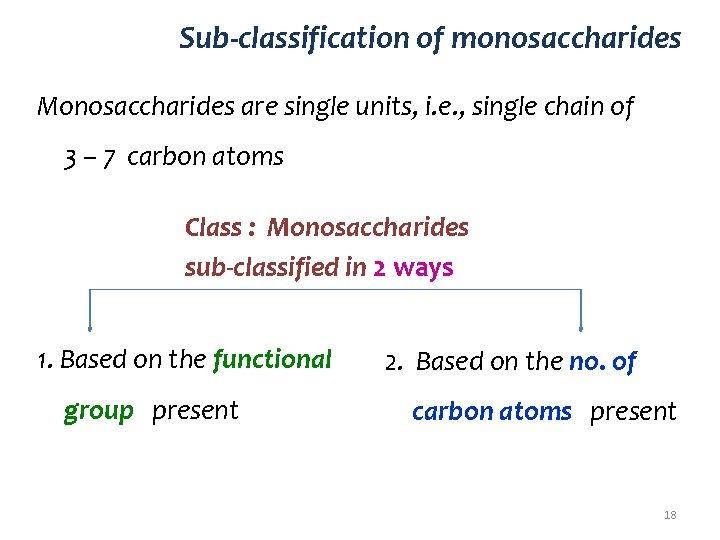
Sub-classification of monosaccharides Monosaccharides are single units, i. e. , single chain of 3 – 7 carbon atoms Class : Monosaccharides sub-classified in 2 ways 1. Based on the functional group present 2. Based on the no. of carbon atoms present 18
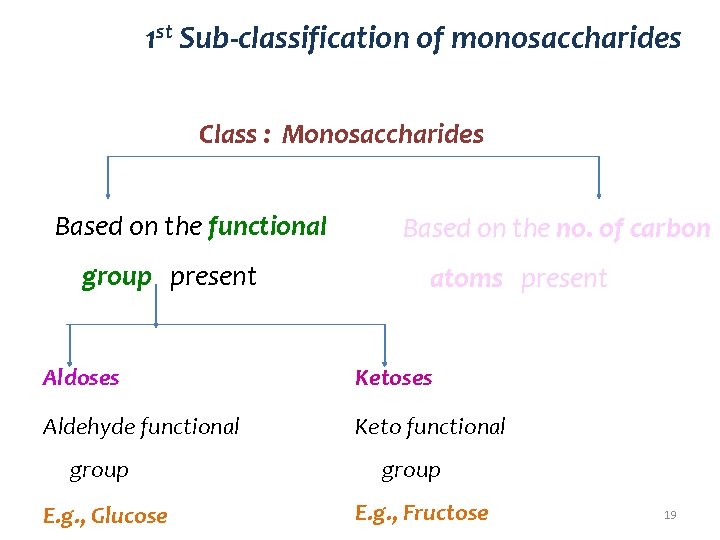
1 st Sub-classification of monosaccharides Class : Monosaccharides Based on the functional group present Based on the no. of carbon atoms present Aldoses Ketoses Aldehyde functional Keto functional group E. g. , Glucose group E. g. , Fructose 19
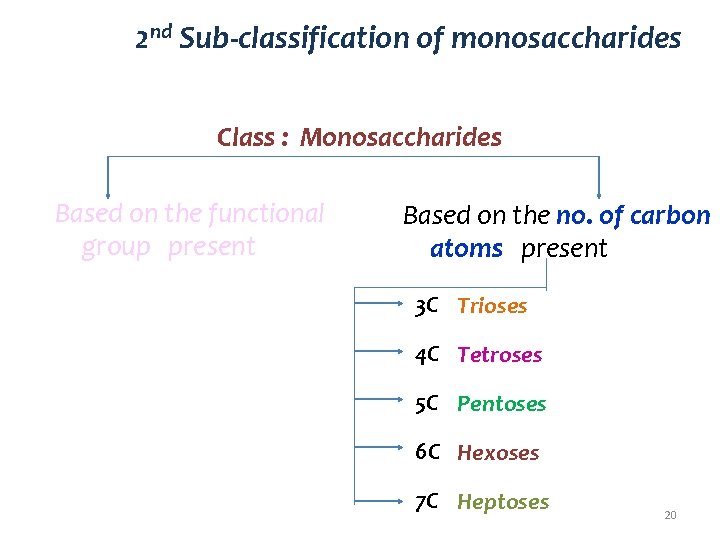
2 nd Sub-classification of monosaccharides Class : Monosaccharides Based on the functional group present Based on the no. of carbon atoms present 3 C Trioses 4 C Tetroses 5 C Pentoses 6 C Hexoses 7 C Heptoses 20
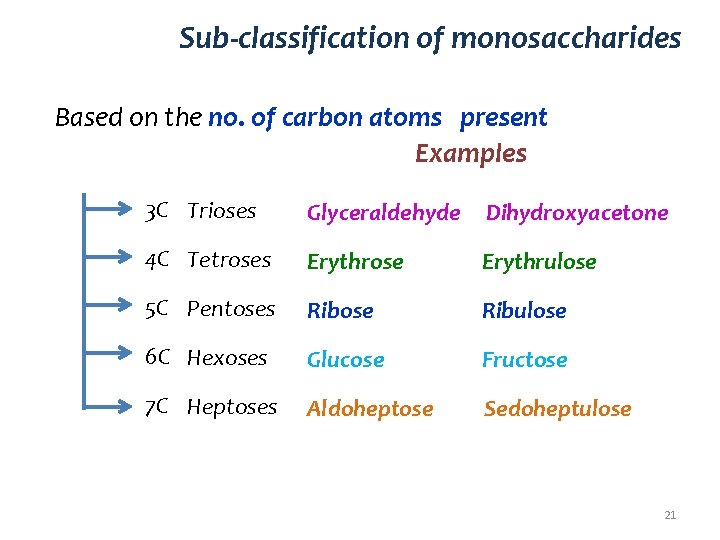
Sub-classification of monosaccharides Based on the no. of carbon atoms present Examples 3 C Trioses Glyceraldehyde Dihydroxyacetone 4 C Tetroses Erythrose Erythrulose 5 C Pentoses Ribose Ribulose 6 C Hexoses Glucose Fructose 7 C Heptoses Aldoheptose Sedoheptulose 21
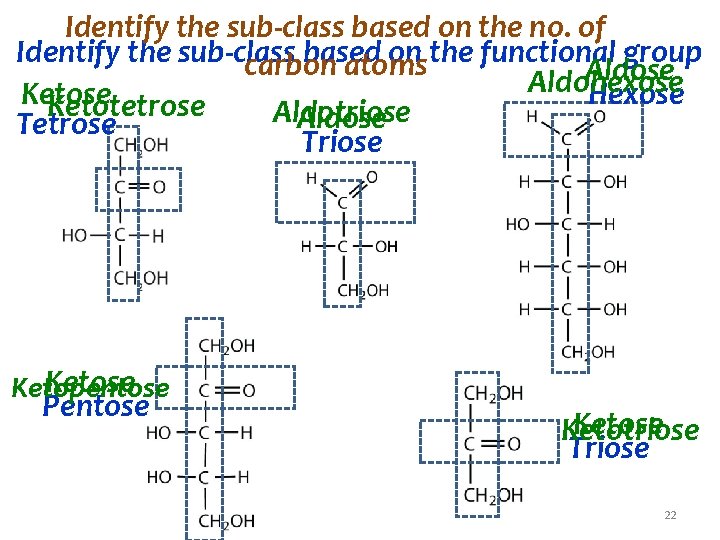
Identify the sub-class based on the no. of Identify the sub-class based on the functional group carbon atoms Aldose Aldohexose Ketose Hexose Ketotetrose Aldotriose Aldose Tetrose Triose Ketopentose Pentose Ketotriose Triose 22
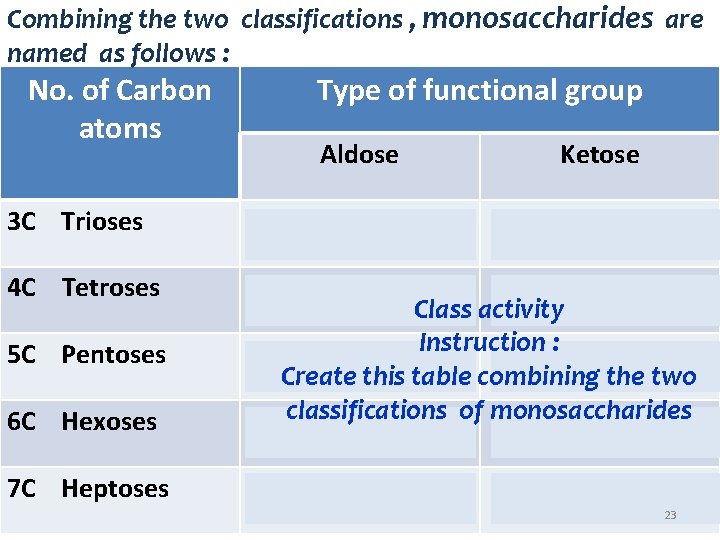
Combining the two classifications , monosaccharides are named as follows : No. of Carbon atoms 3 C Trioses 4 C Tetroses Type of functional group Aldose Ketose Aldotriose Ketotriose 6 C Hexoses Aldotetrose Ketotetrose Class activity : Aldopentose. Instruction Ketopentose Create this table combining the two classifications Aldohexose of monosaccharides Ketohexose 7 C Heptoses Aldoheptose 5 C Pentoses Ketoheptose 23
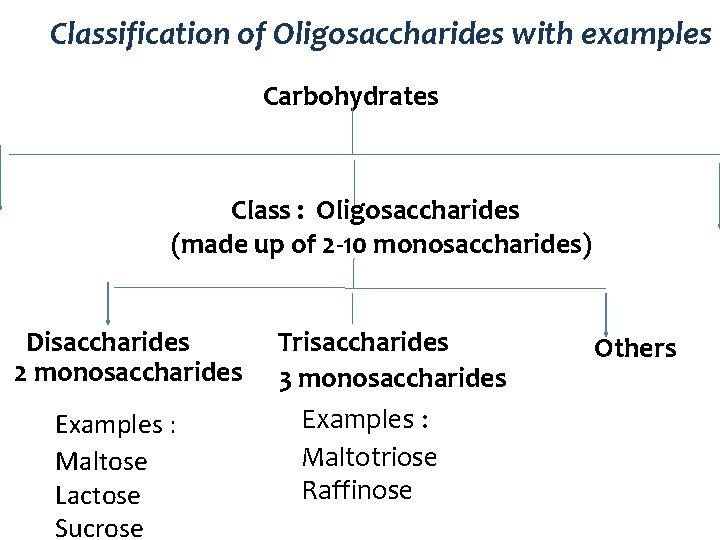
Classification of Oligosaccharides with examples Carbohydrates Class : Oligosaccharides (made up of 2 -10 monosaccharides) Disaccharides 2 monosaccharides Examples : Maltose Lactose Sucrose Trisaccharides 3 monosaccharides Examples : Maltotriose Raffinose Others
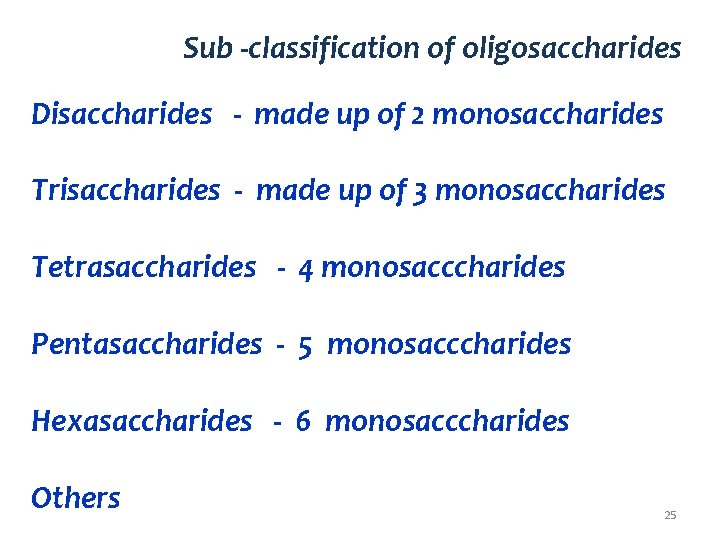
Sub -classification of oligosaccharides Disaccharides - made up of 2 monosaccharides Trisaccharides - made up of 3 monosaccharides Tetrasaccharides - 4 monosacccharides Pentasaccharides - 5 monosacccharides Hexasaccharides - 6 monosacccharides Others 25
Glycosidic bonds : Is the bond which links monosaccharides in oligosaccharides and polysaccharides. Formation : formed by dehydration between two hydroxyl groups on two monosaccharides. 26
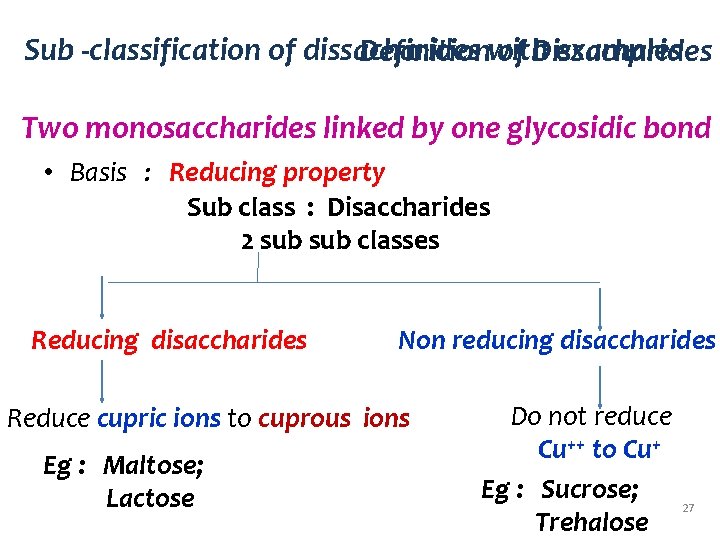
Sub -classification of dissacharides examples Definitionwith of Dissacharides Two monosaccharides linked by one glycosidic bond • Basis : Reducing property Sub class : Disaccharides 2 sub classes Reducing disaccharides Non reducing disaccharides Reduce cupric ions to cuprous ions Eg : Maltose; Lactose Do not reduce Cu++ to Cu+ Eg : Sucrose; Trehalose 27
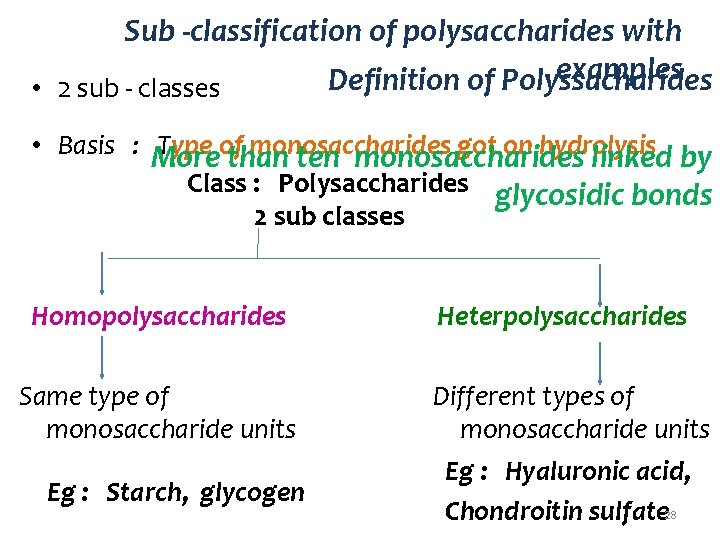
Sub -classification of polysaccharides with examples Definition of Polyssacharides • 2 sub - classes • Basis : More Type of monosaccharides got on hydrolysis than ten monosaccharides linked by Class : Polysaccharides glycosidic bonds 2 sub classes Homopolysaccharides Same type of monosaccharide units Eg : Starch, glycogen Heterpolysaccharides Different types of monosaccharide units Eg : Hyaluronic acid, Chondroitin sulfate 28
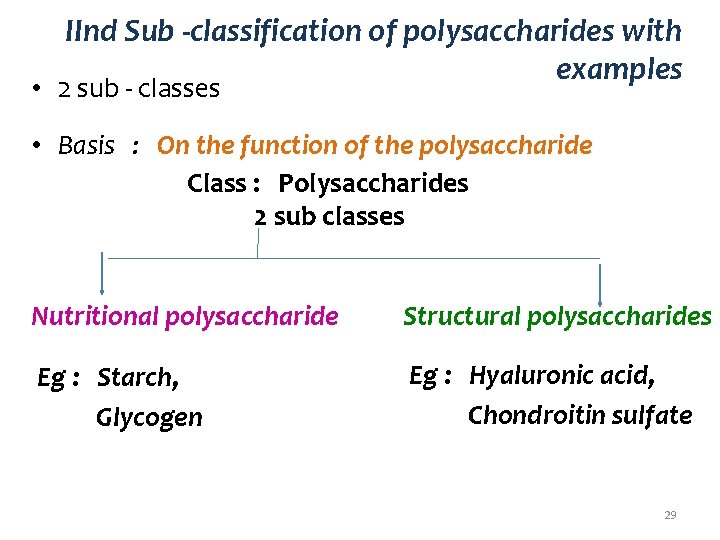
IInd Sub -classification of polysaccharides with examples • 2 sub - classes • Basis : On the function of the polysaccharide Class : Polysaccharides 2 sub classes Nutritional polysaccharide Structural polysaccharides Eg : Starch, Glycogen Eg : Hyaluronic acid, Chondroitin sulfate 29
• Assignment of this class • Classification of carbohydrates with examples for each class/ subclass in the form of a flow chart. References: 1. D. M. Vasudevan - Textbook of Biochemistry for Medical Students. 2. U. Satyanarayana – Biochemistry. 3. Harper's Illustrated Biochemistry. 30 th edition. Victor W. Rodwell, David A. Bender, Kathleen M. Botham, Peter J. Kennelly, P. Anthony 30 Weil.
Topic for self-directed learning for the next class • (i) Definition and examples for : • Isomers, • Isomerism, • Asymmetric carbon (chiral carbon) • (ii) Types of isomerism : • Functional /Geometrical/Stereo isomerism and • Optical isomerism 31
Chemistry of carbohydrates IInd class 14 August 2018 32
Review of the previous class • Defined carbohydrates • Enlisted the importance of carbohydrates • Classified carbohydrates with examples for each class/ subclass 33
Class II Specific learning objectives of this class To study the general characteristics of monosaccharides To study the types of stereoisomerism in monosaccharides and their importance • To list the derivatives of monosaccharides and their importance 34
Class II Specific learning objectives I To study the general characteristics of monosaccharides (as part of the introduction) 35
Introduction to monosaccharides • General information of monosaccharides • Single chain of carbon atoms • Numbering of the carbon atoms • Ring structures of monosaccharides • Examples of monosacchaarides • Naming keto sugars. 36
Introduction to monosaccharides • Monosaccharides are the ……. • Simplest carbohydrates • Have single chain of carbon atoms (3 - 7 carbons) • The basic units of all carbohydrates • Hydrolysis products of oligosaccharides and polysaccharides. • Empirical formula is Cn(H 20)n. (n = no. of carbon atoms) • Mono-and disaccharides are referred to as ‘sugars’ - 37 they are sweet to taste (Greek: saccharon means sugar).
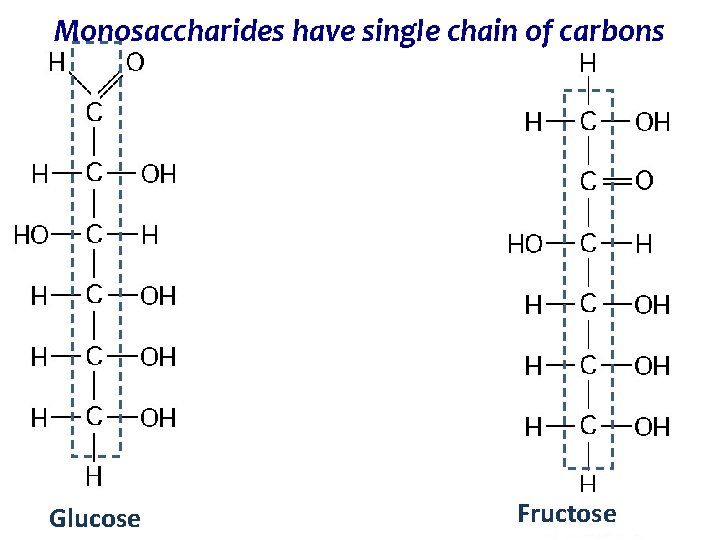
Monosaccharides have single chain of carbons Glucose Fructose 38
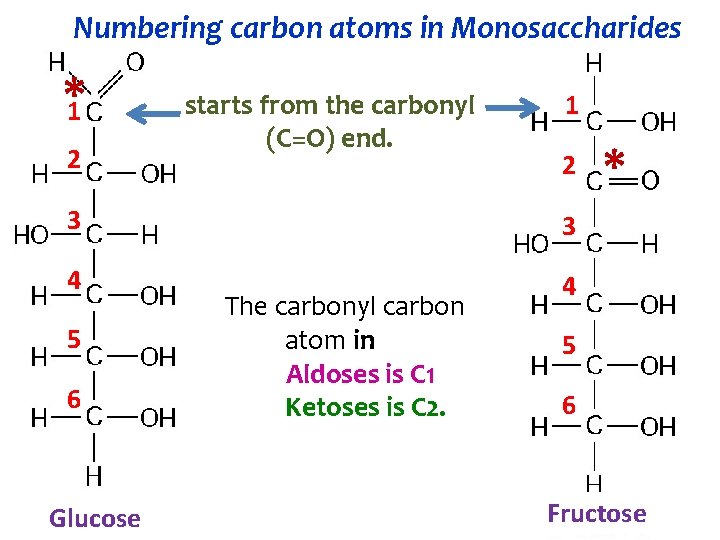
Numbering carbon atoms in Monosaccharides *1 2 starts from the carbonyl (C=O) end. 1 2 3 3 4 4 5 6 Glucose The carbonyl carbon atom in Aldoses is C 1 Ketoses is C 2. * 5 6 Fructose 39
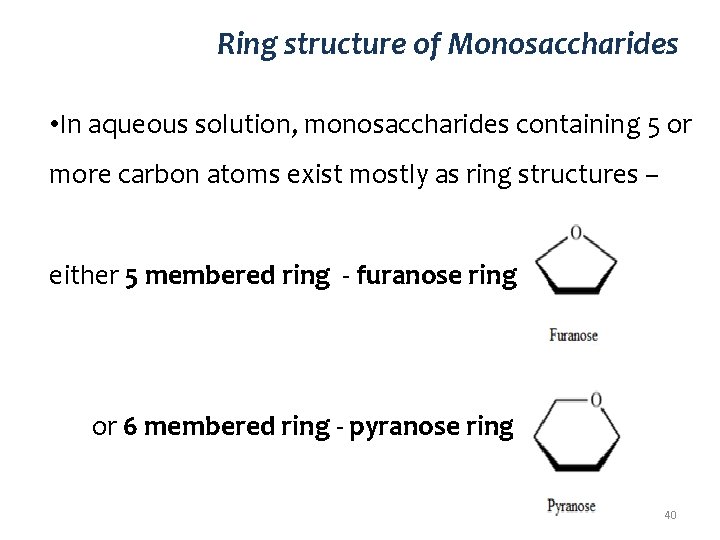
Ring structure of Monosaccharides • In aqueous solution, monosaccharides containing 5 or more carbon atoms exist mostly as ring structures – either 5 membered ring - furanose ring or 6 membered ring - pyranose ring 40
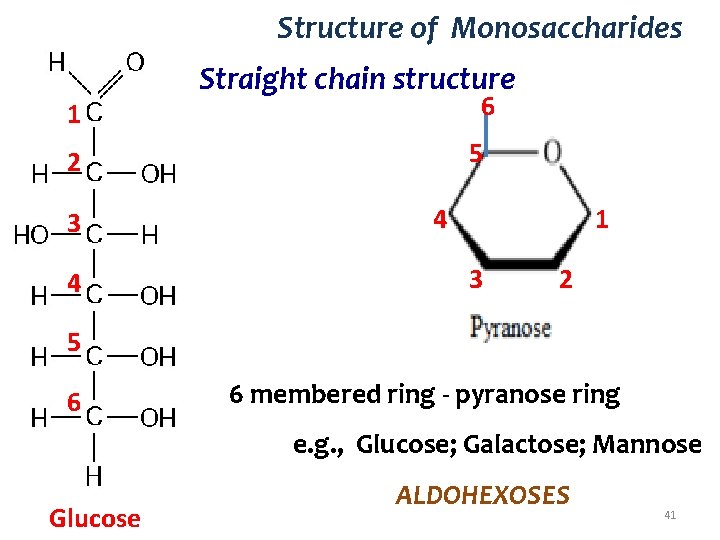
Structure of Monosaccharides 1 Straight chain structure 6 5 2 3 4 4 1 3 2 5 6 6 membered ring - pyranose ring e. g. , Glucose; Galactose; Mannose Glucose ALDOHEXOSES 41
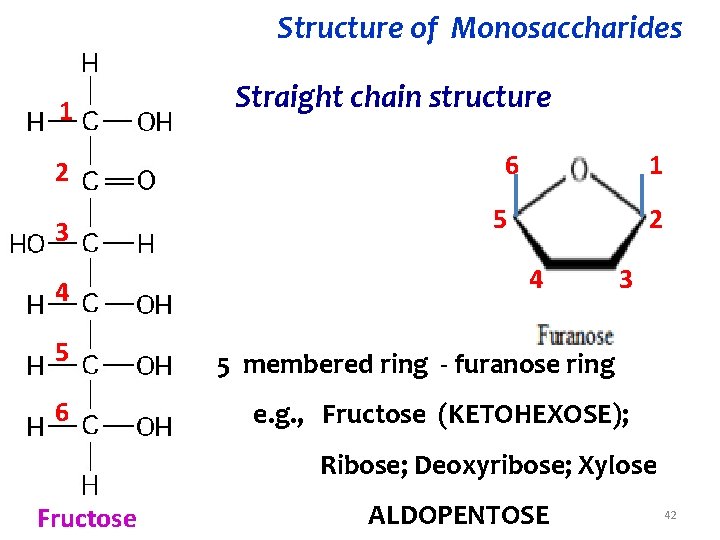
Structure of Monosaccharides 1 2 3 4 Straight chain structure 6 1 5 2 4 3 5 5 membered ring - furanose ring 6 e. g. , Fructose (KETOHEXOSE); Ribose; Deoxyribose; Xylose Fructose ALDOPENTOSE 42
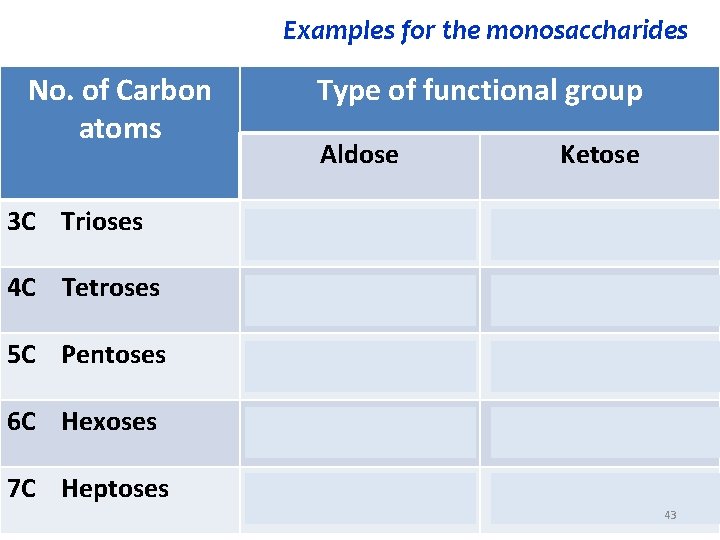
Examples for the monosaccharides No. of Carbon atoms Type of functional group Aldose Ketose Glyceraldehyde Dihydroxy acetone 4 C Tetroses Erythrose Erythrulose 5 C Pentoses Ribose Ribulose 6 C Hexoses Glucose Fructose 7 C Heptoses - Sedoheptulose 3 C Trioses 43
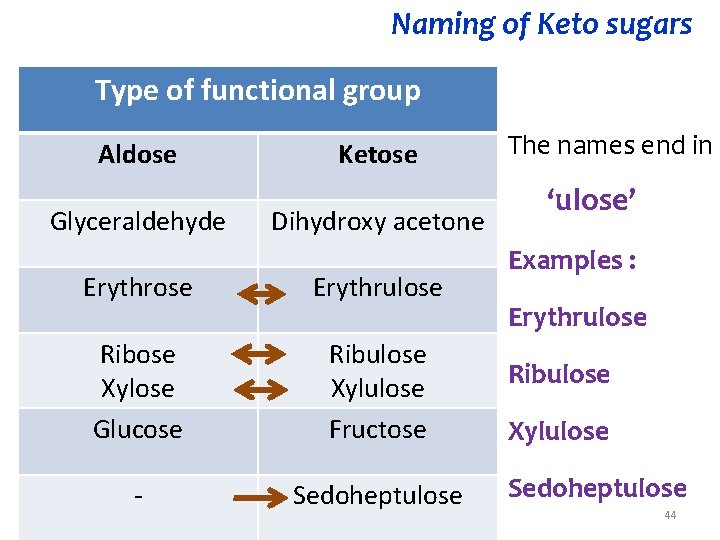
Naming of Keto sugars Type of functional group Aldose Glyceraldehyde Ketose Dihydroxy acetone Erythrose Erythrulose Ribose Xylose Glucose Ribulose Xylulose Fructose - Sedoheptulose The names end in ‘ulose’ Examples : Erythrulose Ribulose Xylulose Sedoheptulose 44
Quiz ahead ……………. . • 5 multiple choice questions……. • (Answers on slide 38) 45
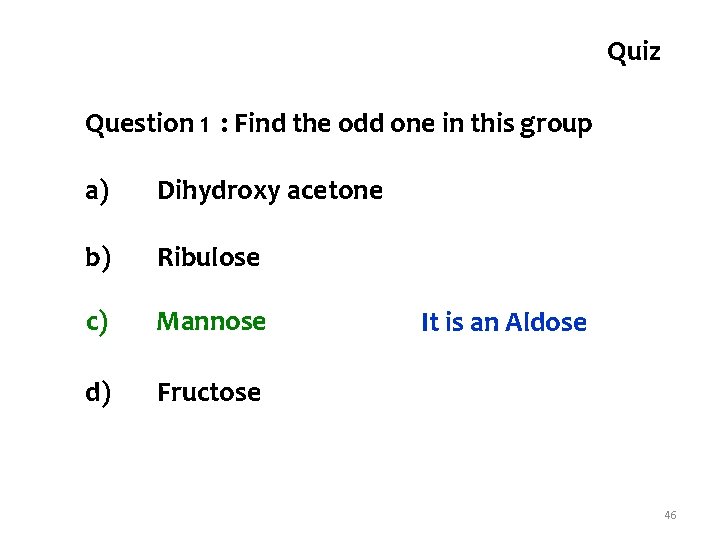
Quiz Question 1 : Find the odd one in this group a) Dihydroxy acetone b) Ribulose c) Mannose c) Mannose d) It is an Aldose Fructose 46
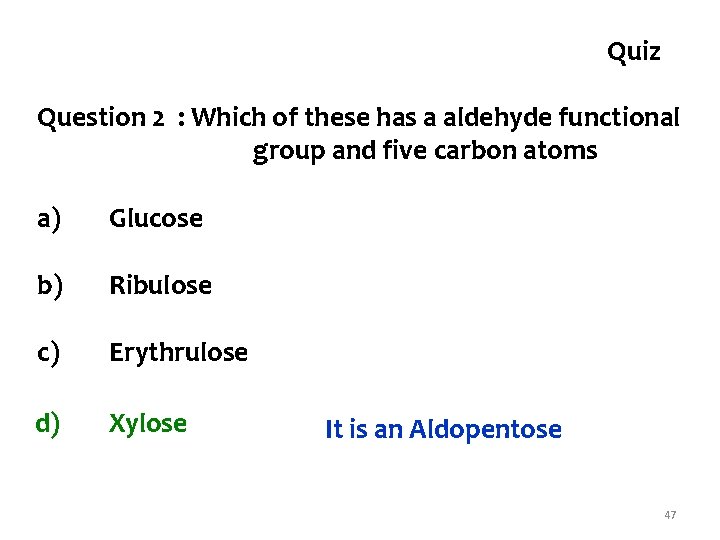
Quiz Question 2 : Which of these has a aldehyde functional group and five carbon atoms a) Glucose b) Ribulose c) Erythrulose d) Xylose d) Xylose It is an Aldopentose 47
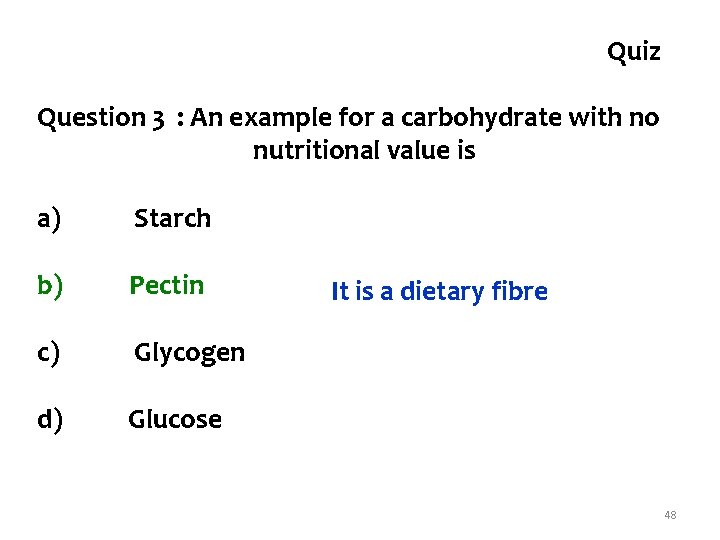
Quiz Question 3 : An example for a carbohydrate with no nutritional value is a) Starch b) Pectin b) Pectin c) Glycogen d) Glucose It is a dietary fibre 48
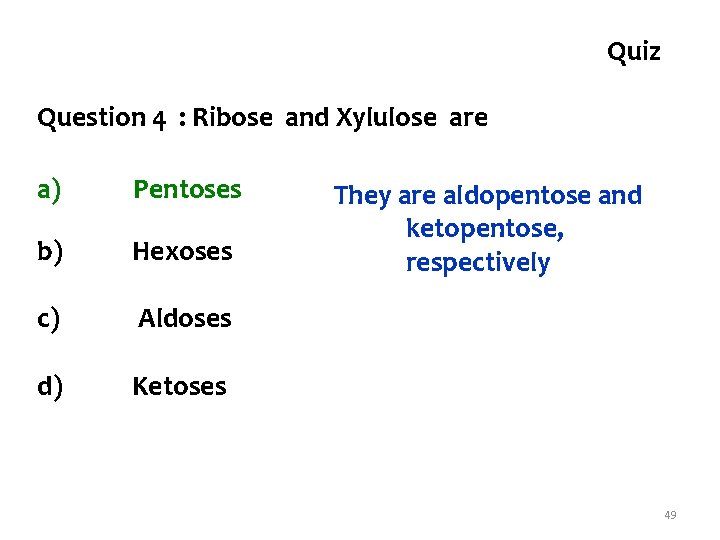
Quiz Question 4 : Ribose and Xylulose are a) Pentoses a) Pentoses b) Hexoses c) Aldoses d) Ketoses They are aldopentose and ketopentose, respectively 49
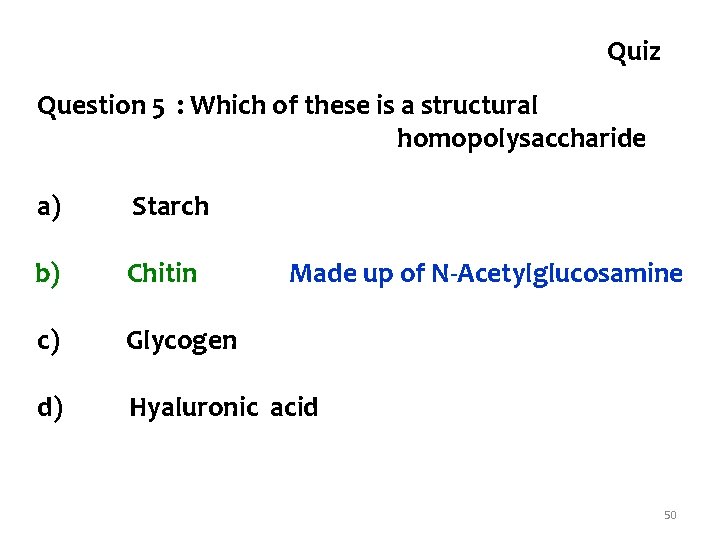
Quiz Question 5 : Which of these is a structural homopolysaccharide a) Starch b) Chitin b) Chitin Made up of N-Acetylglucosamine c) Glycogen d) Hyaluronic acid 50
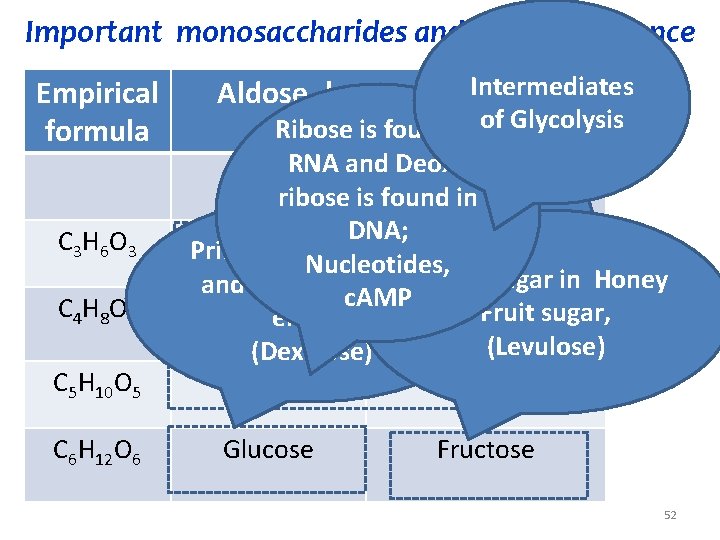
Important monosaccharides and their importance Empirical formula C 3 H 6 O 3 C 4 H 8 O 4 C 5 H 10 O 5 C 6 H 12 O 6 Intermediates Aldose- ketose Isomerism Ribose is found inof Glycolysis RNA and Deoxy Aldose Ketose ribose is. Intermediates found in of HMP Shunt DNA; Glyceraldehyde Dihydroxy acetone Principal blood sugar pathway Nucleotides, Main sugar in Honey and main source of c. AMP Erythrulose Erythrose Fruit sugar, energy (Levulose) (Dextrose) Ribose Ribulose Glucose Fructose 52
Class II Specific learning objective 2 To study the types of stereoisomerism in monosaccharides and their importance 53
Isomerism in Monosaccharides exhibit basically 2 types of isomerism – 1. Aldose - ketose isomerism 2. Stereoisomerism 54
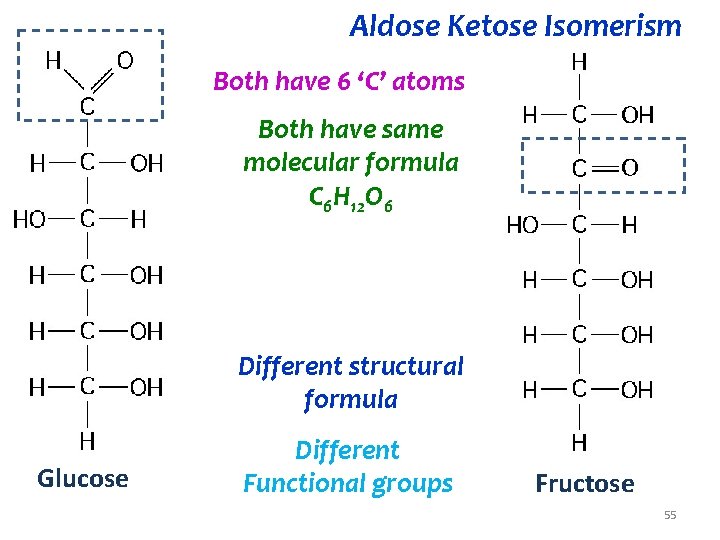
Aldose Ketose Isomerism Both have 6 ‘C’ atoms Both have same molecular formula C 6 H 12 O 6 Different structural formula Glucose Different Functional groups Fructose 55
1. Aldose-ketose isomerism Monosaccharides having Same number of carbon atoms and molecular formula but different structural formula, i. e. , due to different functional groups (aldehyde or keto) are referred to as aldose-ketose isomers. 56
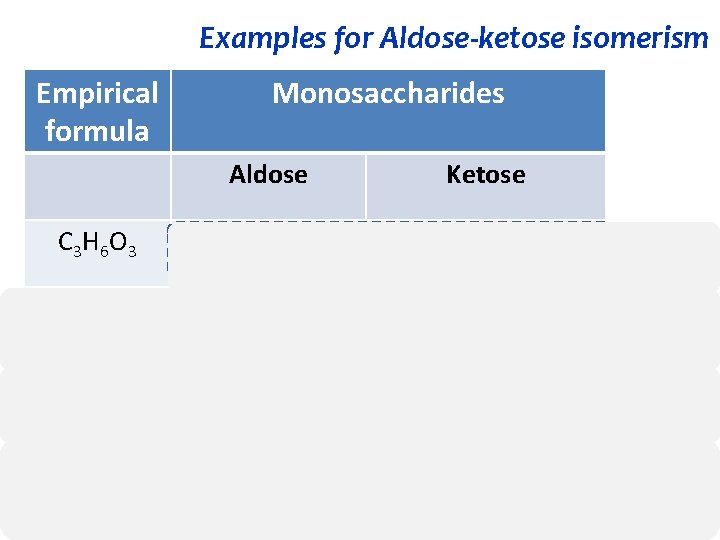
Examples for Aldose-ketose isomerism Empirical formula Monosaccharides Aldose C 3 H 6 O 3 Ketose Glyceraldehyde Dihydroxy acetone C 4 H 8 O 4 Erythrose Erythrulose C 5 H 10 O 5 Ribose Ribulose C 6 H 12 O 6 Glucose Fructose 57
2. Stereoisomerism Stereoisomers have Ø same empirical formula and structural formulae but Ø differ in their configuration (arrangement of atoms/groups in space). Which compounds show stereoisomerism ? Ø Compounds having asymmetric carbon atoms exhibit stereoisomerism. 58
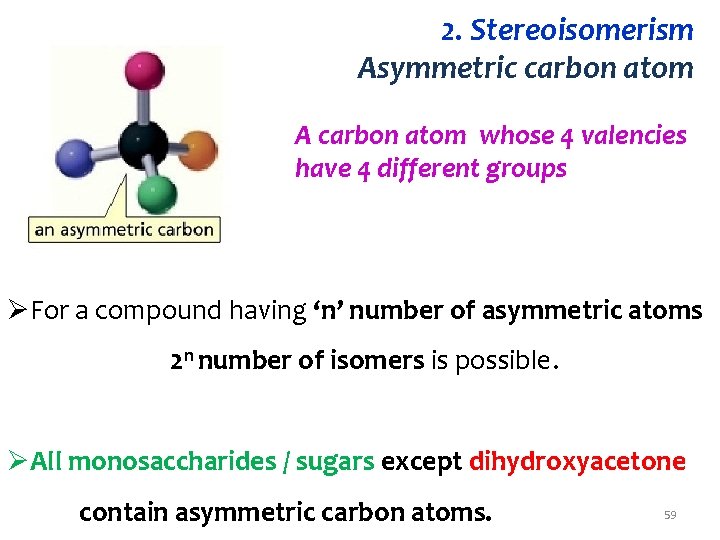
2. Stereoisomerism Asymmetric carbon atom A carbon atom whose 4 valencies have 4 different groups ØFor a compound having ‘n’ number of asymmetric atoms 2 n number of isomers is possible. ØAll monosaccharides / sugars except dihydroxyacetone contain asymmetric carbon atoms. 59
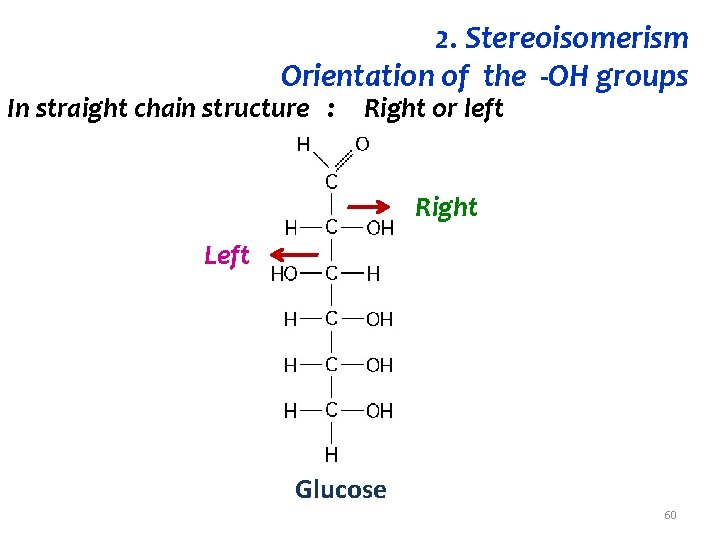
2. Stereoisomerism Orientation of the -OH groups In straight chain structure : Right or left Right Left Glucose 60
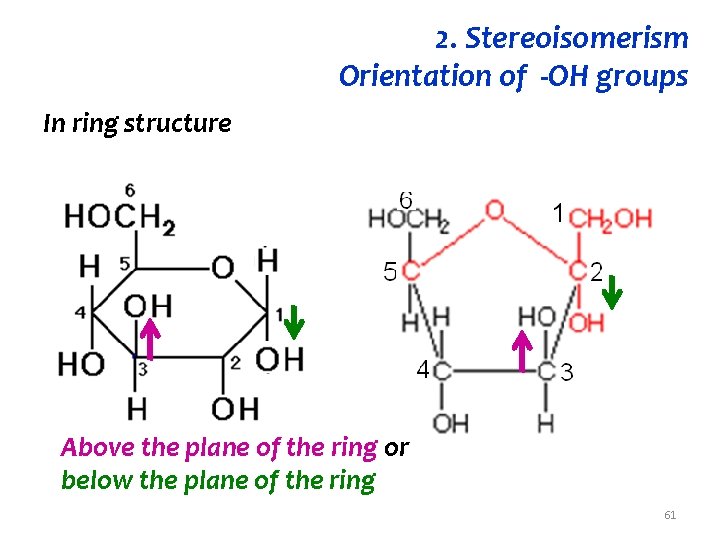
2. Stereoisomerism Orientation of -OH groups In ring structure Above the plane of the ring or below the plane of the ring 61
Types of Stereoisomerisms are of 3 types Basis : based on the configuration around an (any one) asymmetric carbon atom a) D-L Stereoisomerism b) Epimerism c) Anomerism 63
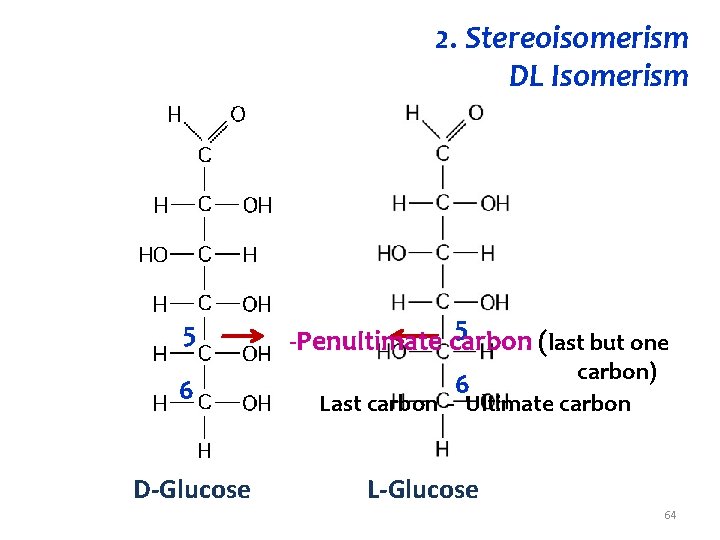
2. Stereoisomerism DL Isomerism 5 6 D-Glucose 5 -Penultimate carbon (last but one carbon) 6 Last carbon - Ultimate carbon L-Glucose 64
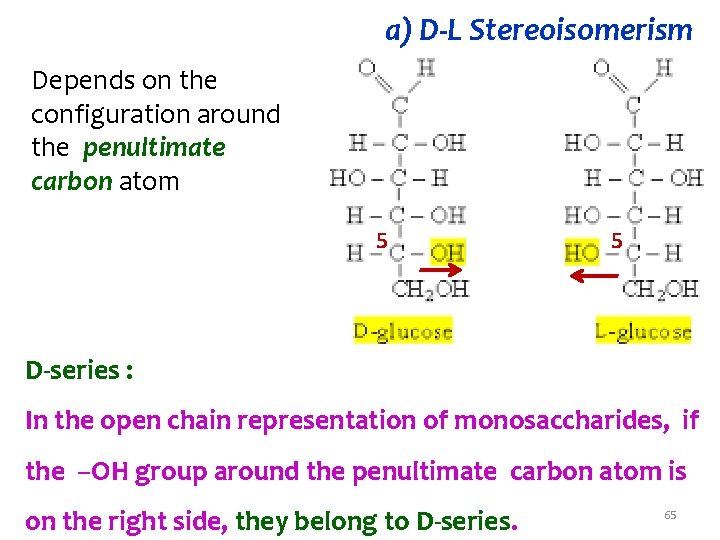
a) D-L Stereoisomerism Depends on the configuration around the penultimate carbon atom 5 5 D-series : In the open chain representation of monosaccharides, if the –OH group around the penultimate carbon atom is on the right side, they belong to D-series. 65
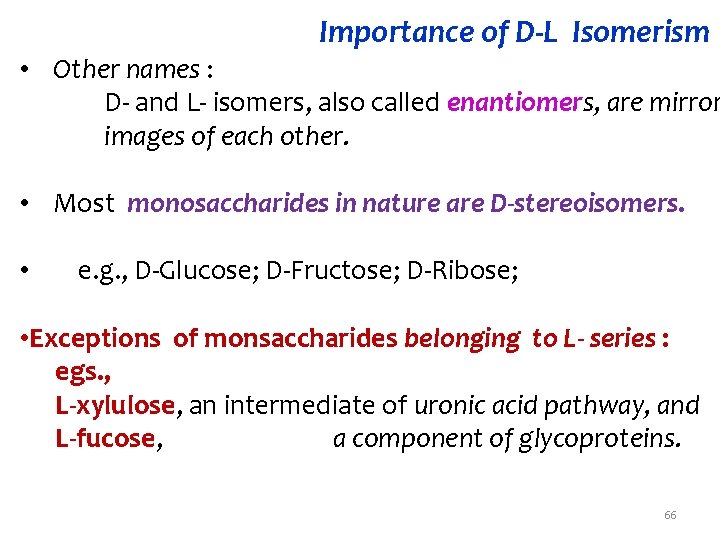
Importance of D-L Isomerism • Other names : D- and L- isomers, also called enantiomers, are mirror images of each other. • Most monosaccharides in nature are D-stereoisomers. • e. g. , D-Glucose; D-Fructose; D-Ribose; • Exceptions of monsaccharides belonging to L- series : egs. , L-xylulose, an intermediate of uronic acid pathway, and L-fucose, a component of glycoproteins. 66
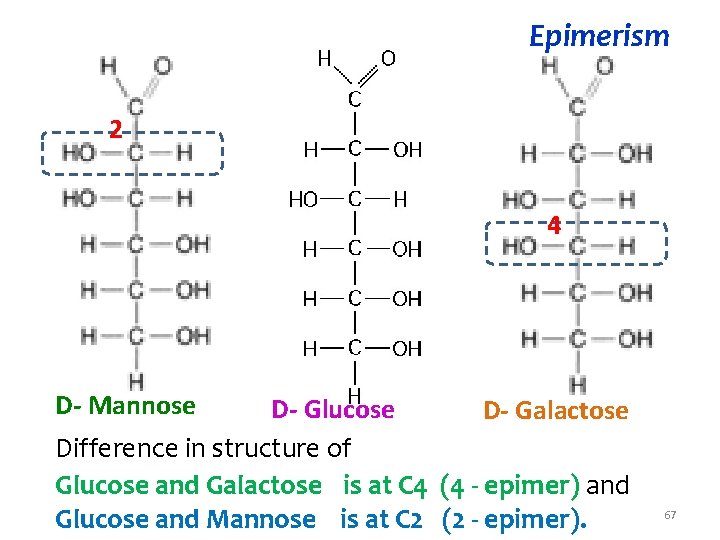
Epimerism 2 4 D- Mannose D- Glucose D- Galactose Difference in structure of Glucose and Galactose is at C 4 (4 - epimer) and Glucose and Mannose is at C 2 (2 - epimer). 67
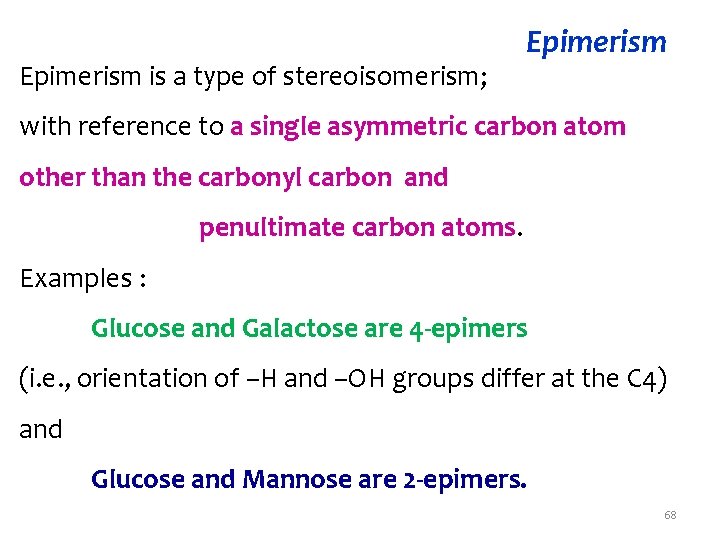
Epimerism is a type of stereoisomerism; Epimerism with reference to a single asymmetric carbon atom other than the carbonyl carbon and penultimate carbon atoms. Examples : Glucose and Galactose are 4 -epimers (i. e. , orientation of –H and –OH groups differ at the C 4) and Glucose and Mannose are 2 -epimers. 68
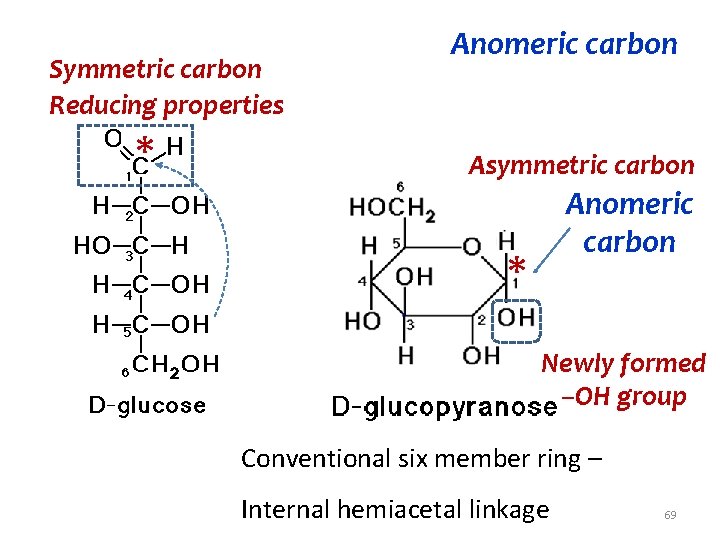
Symmetric carbon Reducing properties * Anomeric carbon Asymmetric carbon Anomeric carbon * Newly formed –OH group Conventional six member ring – Internal hemiacetal linkage 69
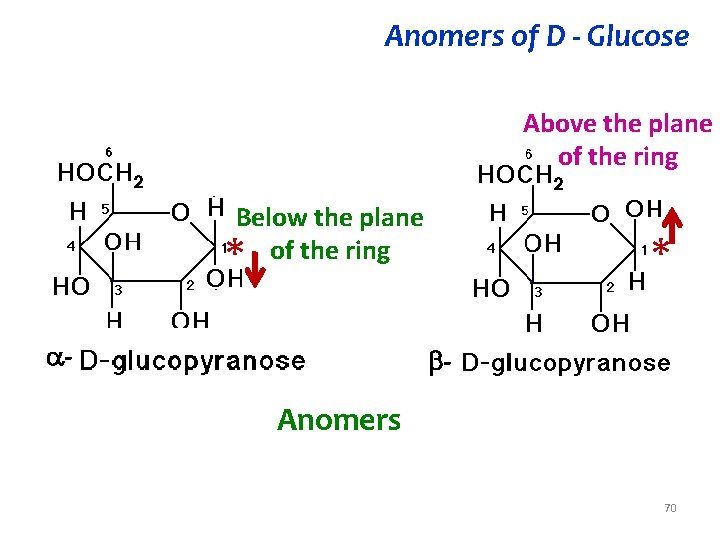
Anomers of D - Glucose Above the plane of the ring Below the plane of the ring * * - - Anomers 70
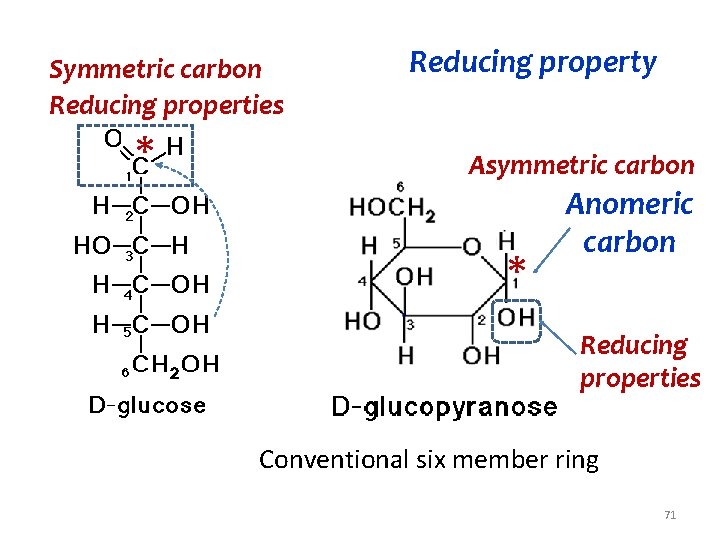
Symmetric carbon Reducing properties * Reducing property Asymmetric carbon * Anomeric carbon Reducing properties Conventional six member ring 71
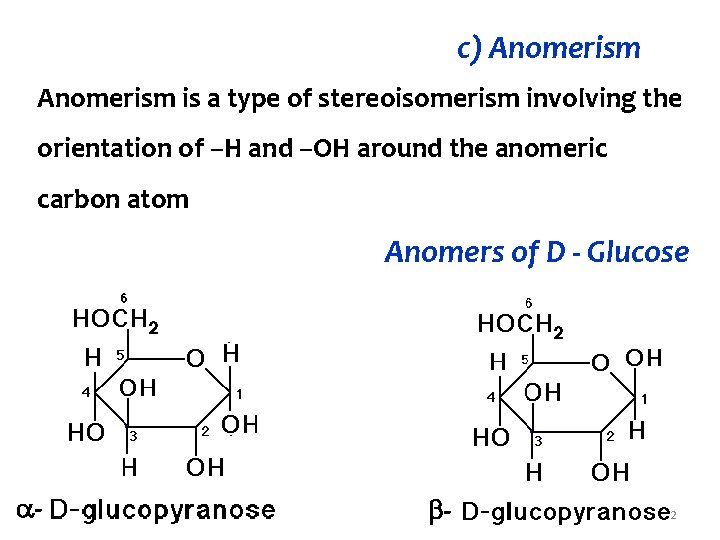
c) Anomerism is a type of stereoisomerism involving the orientation of –H and –OH around the anomeric carbon atom Anomers of D - Glucose - - 72
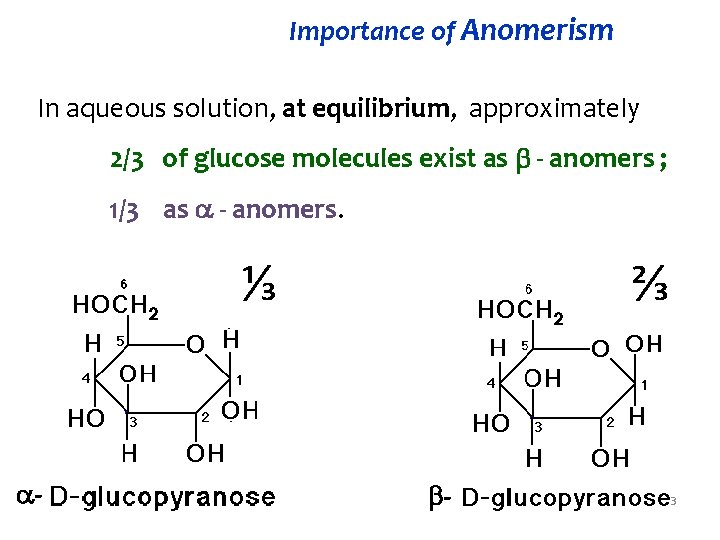
Importance of Anomerism In aqueous solution, at equilibrium, approximately 2/3 of glucose molecules exist as - anomers ; 1/3 as - anomers. ⅓ - ⅔ - 73
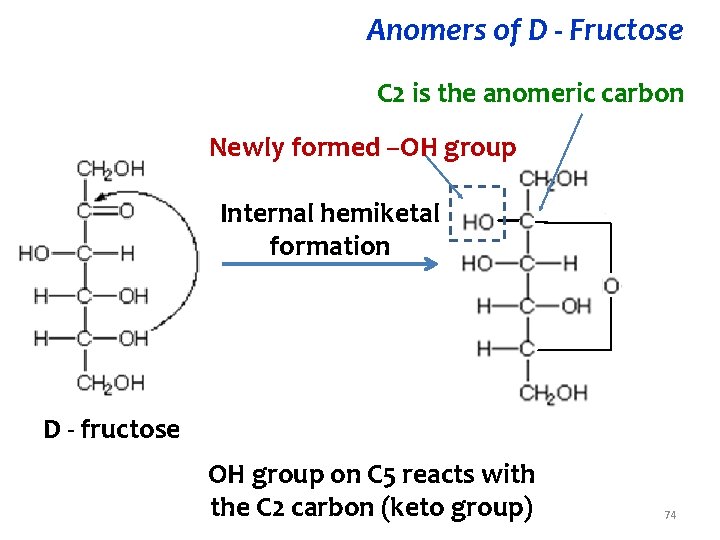
Anomers of D - Fructose C 2 is the anomeric carbon Newly formed –OH group Internal hemiketal formation D - fructose OH group on C 5 reacts with the C 2 carbon (keto group) 74
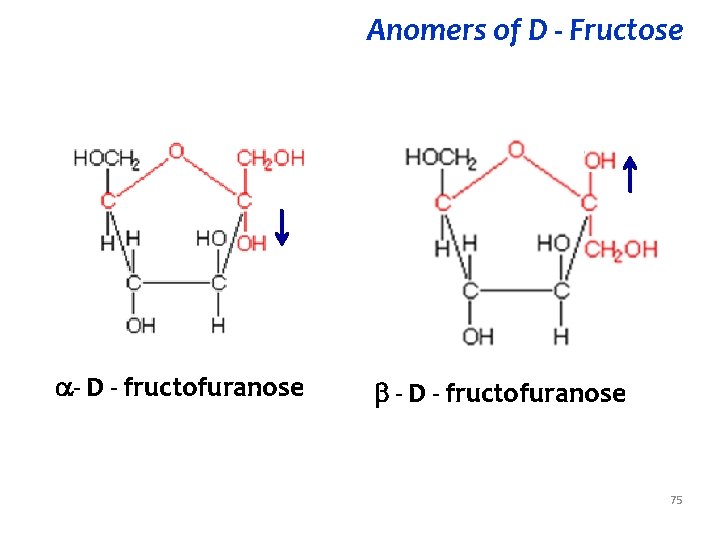
Anomers of D - Fructose - D - fructofuranose 75
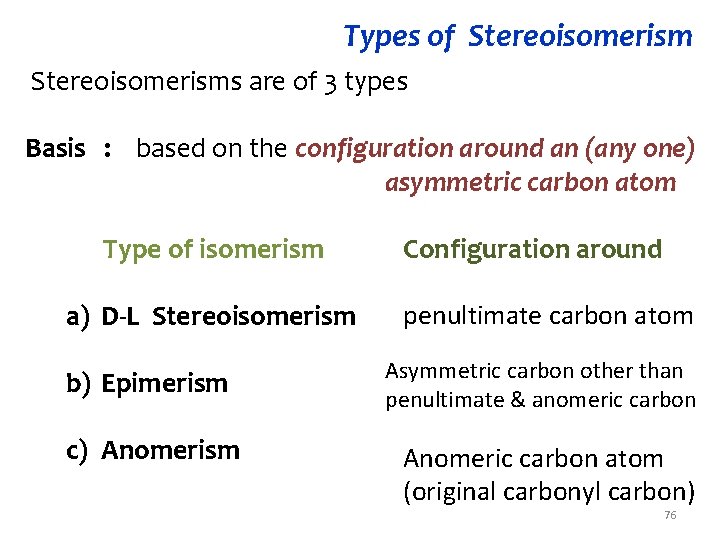
Types of Stereoisomerisms are of 3 types Basis : based on the configuration around an (any one) asymmetric carbon atom Type of isomerism a) D-L Stereoisomerism b) Epimerism c) Anomerism Configuration around penultimate carbon atom Asymmetric carbon other than penultimate & anomeric carbon Anomeric carbon atom (original carbonyl carbon) 76
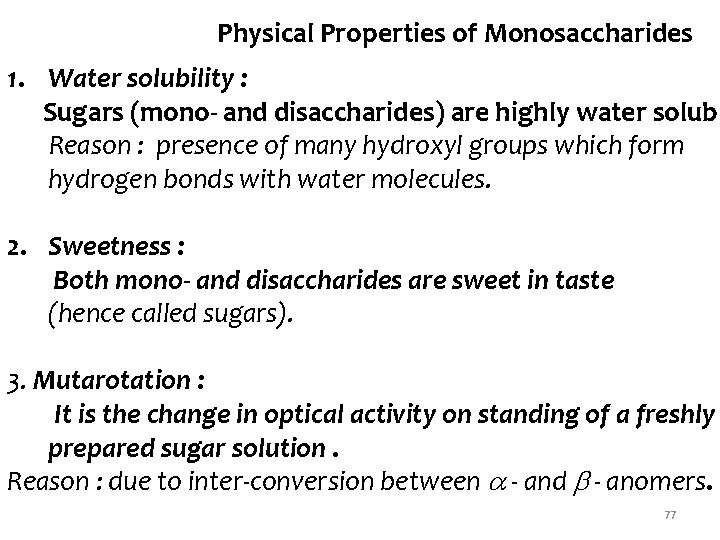
Physical Properties of Monosaccharides 1. Water solubility : Sugars (mono- and disaccharides) are highly water solubl Reason : presence of many hydroxyl groups which form hydrogen bonds with water molecules. 2. Sweetness : Both mono- and disaccharides are sweet in taste (hence called sugars). 3. Mutarotation : It is the change in optical activity on standing of a freshly prepared sugar solution. Reason : due to inter-conversion between - and - anomers. 77
Class II Specific learning objective 3 • To list the derivatives of monosaccharides and their importance 79
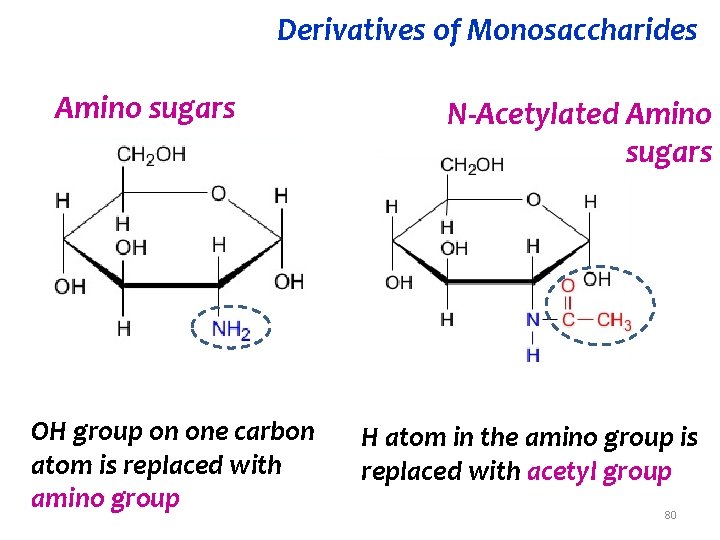
Derivatives of Monosaccharides Amino sugars OH group on one carbon atom is replaced with amino group N-Acetylated Amino sugars H atom in the amino group is replaced with acetyl group 80
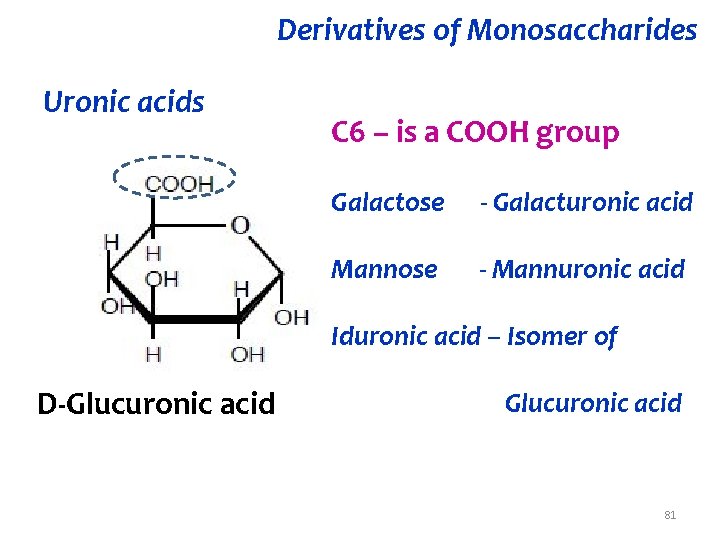
Derivatives of Monosaccharides Uronic acids C 6 – is a COOH group Galactose - Galacturonic acid Mannose - Mannuronic acid Iduronic acid – Isomer of D-Glucuronic acid 81
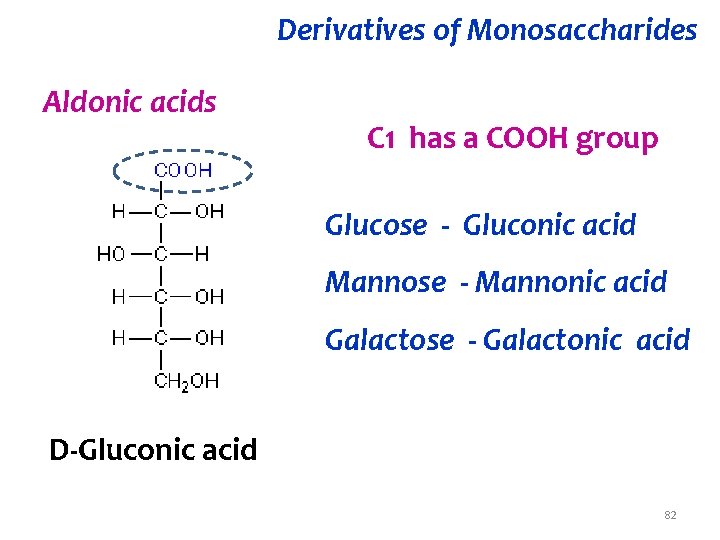
Derivatives of Monosaccharides Aldonic acids C 1 has a COOH group Glucose - Gluconic acid Mannose - Mannonic acid Galactose - Galactonic acid D-Gluconic acid 82
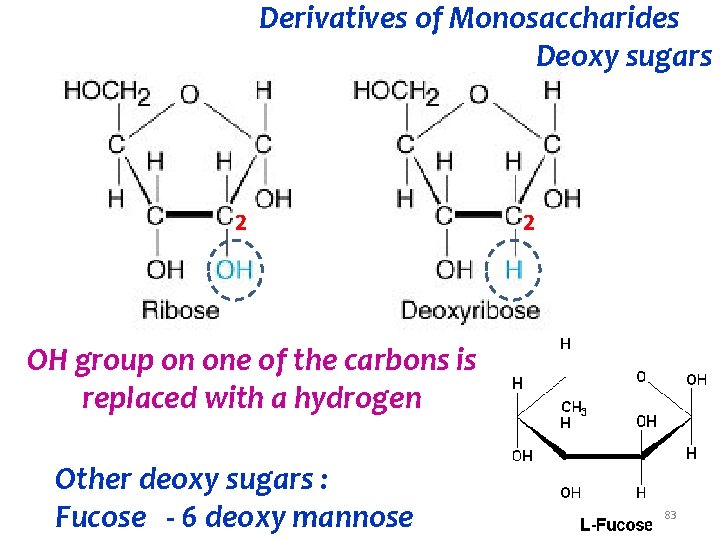
Derivatives of Monosaccharides Deoxy sugars 2 2 OH group on one of the carbons is replaced with a hydrogen Other deoxy sugars : Fucose - 6 deoxy mannose 83
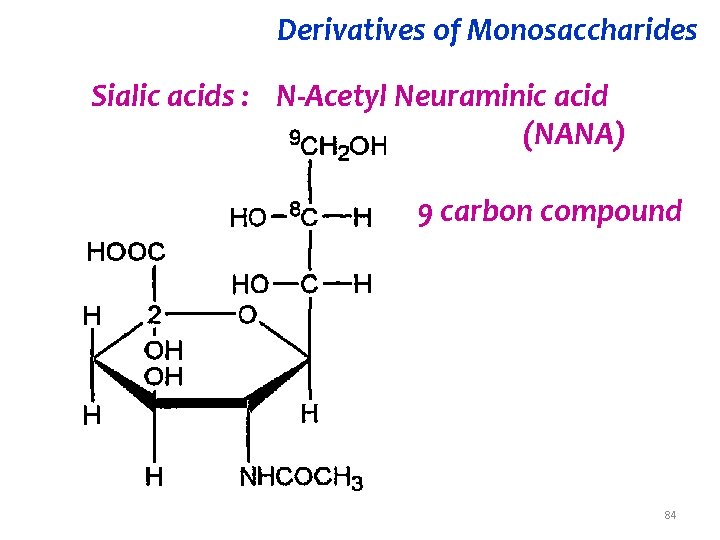
Derivatives of Monosaccharides Sialic acids : N-Acetyl Neuraminic acid (NANA) 2 9 carbon compound 84
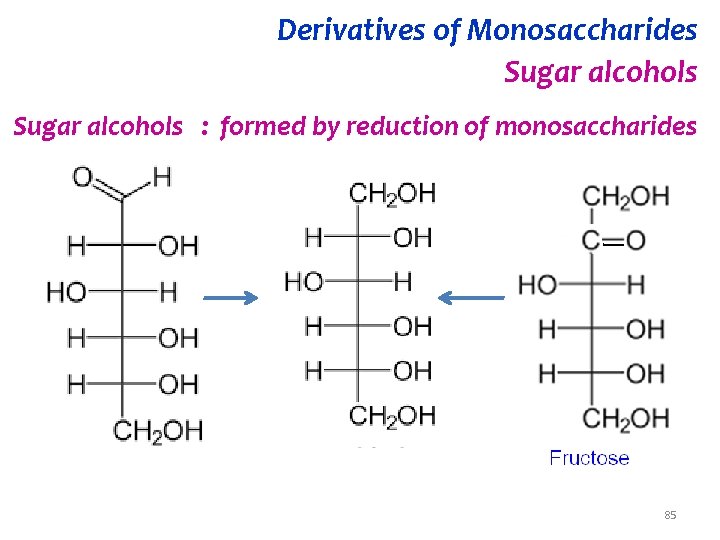
Derivatives of Monosaccharides Sugar alcohols : formed by reduction of monosaccharides 85
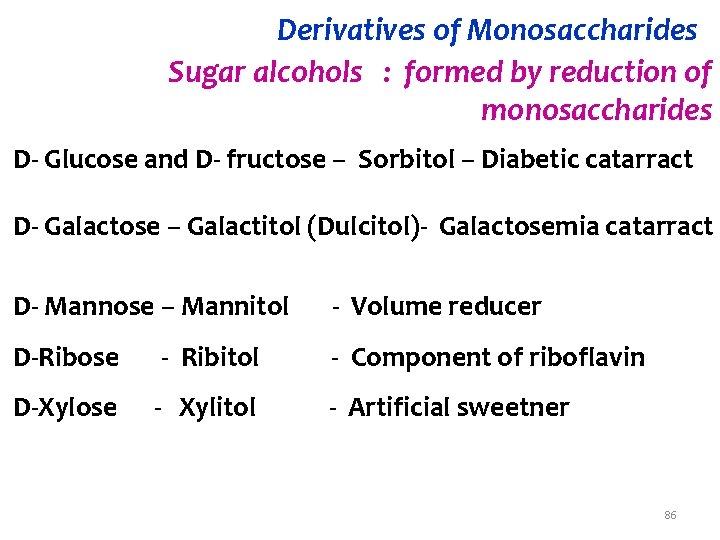
Derivatives of Monosaccharides Sugar alcohols : formed by reduction of monosaccharides D- Glucose and D- fructose – Sorbitol – Diabetic catarract D- Galactose – Galactitol (Dulcitol)- Galactosemia catarract D- Mannose – Mannitol - Volume reducer D-Ribose - Ribitol - Component of riboflavin D-Xylose - Xylitol - Artificial sweetner 86
Class II Summary of this class q Studied the general characteristics of monosaccharides q Studied the types of stereoisomerism in monosaccharides and their importance q Listed the derivatives of monosaccharides and their importance 87
Assignment of this class 1. Definition and examples for i) DL Isomers, ii) Epimers, iii) Anomers 2. List the derivatives of monosaccharides with their function References: 1. D. M. Vasudevan - Textbook of Biochemistry for Medical Students. 2. U. Satyanarayana – Biochemistry. 3. Harper's Illustrated Biochemistry. 30 th edition. Victor W. Rodwell, David A. Bender, Kathleen M. Botham, Peter J. Kennelly, P. Anthony Weil. 88
Topic for self-directed learning for the next class • Structure and function of disaccharides • i) D-Maltose, • ii) D-Lactose, iii) D-Sucrose, iv) D-Cellobiose, v) D-Trehalose 89
Chemistry of carbohydrates IIIrd class 16 August 2018 90
Summary of the previous class q General characteristics of monosaccharides q Types of stereoisomerism in monosaccharides and their importance q Listed the derivatives of monosaccharides and their importance 91
Class III Specific learning objectives of this class v To understand the formation of a glycosidic bond between two monosaccharides and identify the types v To list the important disaccharides and their functions v To list the important trisaccharides and their functions v To list the homopolysaccharides of importance, with structure and their significance 92
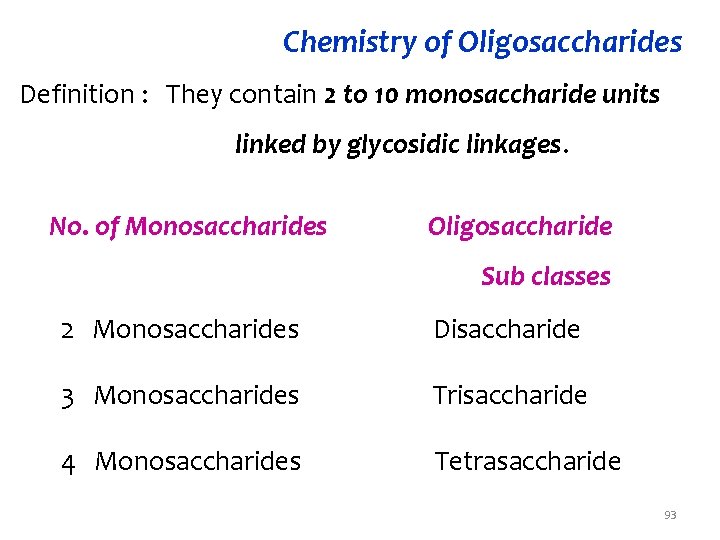
Chemistry of Oligosaccharides Definition : They contain 2 to 10 monosaccharide units linked by glycosidic linkages. No. of Monosaccharides Oligosaccharide Sub classes 2 Monosaccharides Disaccharide 3 Monosaccharides Trisaccharide 4 Monosaccharides Tetrasaccharide 93
Class III Specific learning objective I v To understand the formation of a glycosidic bond between two monosaccharides and identify the types of glycosidic bonds 94
Glycosidic bonds : Is the bond which links monosaccharides in oligosaccharides and polysaccharides. Formation : formed by dehydration between two hydroxyl groups on two monosaccharides. 95
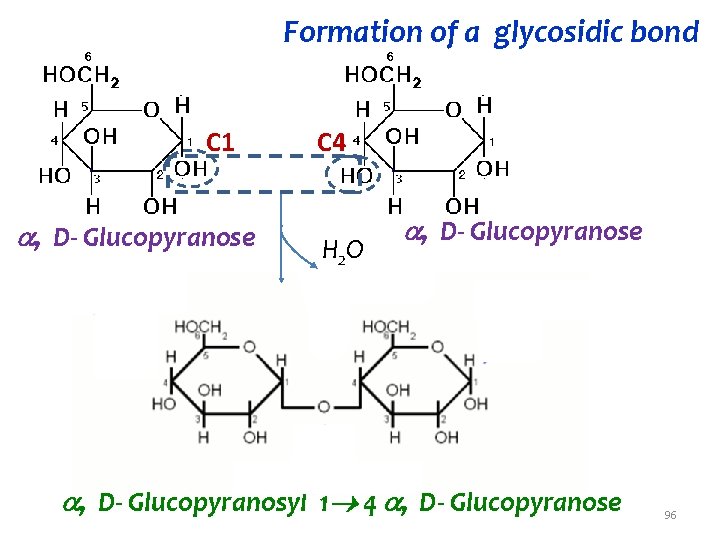
Formation of a glycosidic bond C 1 , D- Glucopyranose C 4 H 2 O , D- Glucopyranose , D- Glucopyranosyl 1 4 , D- Glucopyranose 96
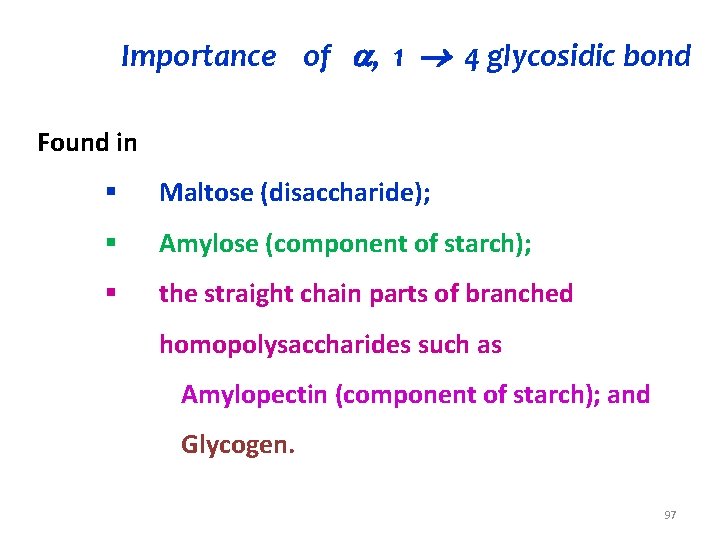
Importance of , 1 4 glycosidic bond Found in § Maltose (disaccharide); § Amylose (component of starch); § the straight chain parts of branched homopolysaccharides such as Amylopectin (component of starch); and Glycogen. 97
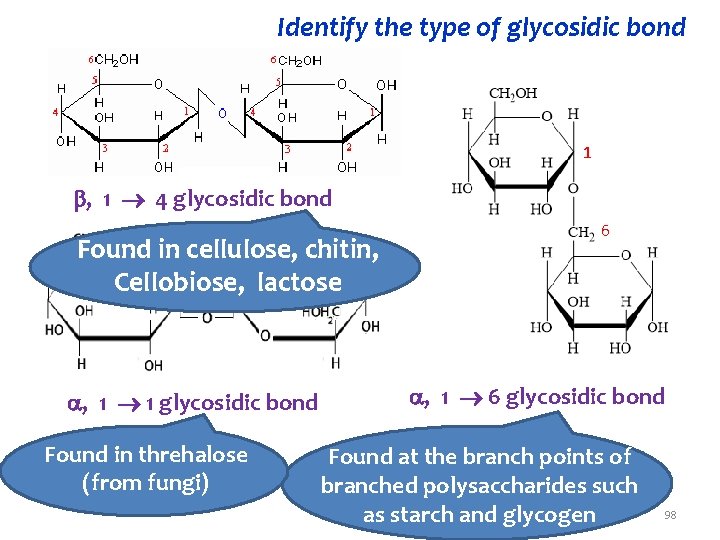
Identify the type of glycosidic bond 1 , 1 4 glycosidic bond Found in cellulose, chitin, Cellobiose, lactose 1 1 , 1 1 glycosidic bond Found in threhalose (from fungi) 6 , 1 6 glycosidic bond Found at the branch points of branched polysaccharides such as starch and glycogen 98
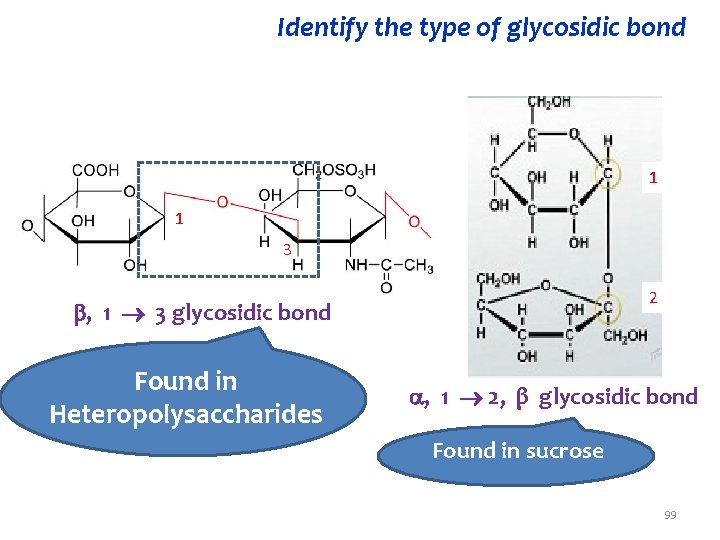
Identify the type of glycosidic bond 1 1 3 2 , 1 3 glycosidic bond Found in Heteropolysaccharides , 1 2, β glycosidic bond Found in sucrose 99
Glycosidic bonds Glycosidic bond is formed between hydroxyl groups of a) Two monosaccharides Eg : Glucose + Glucose or b) A monosaccharide and a non carbohydrate Glycone + Aglycone Example : the drugs Cardiac glycosides; Streptomycin 100

Class III Specific learning objective 2 v To list the important disaccharides and their functions 101
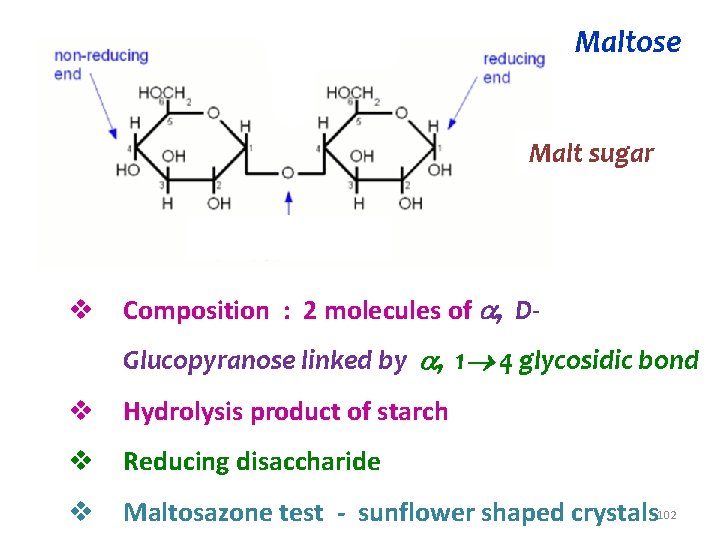
Maltose Malt sugar v Composition : 2 molecules of , DGlucopyranose linked by , 1 4 glycosidic bond v Hydrolysis product of starch v Reducing disaccharide v Maltosazone test - sunflower shaped crystals 102
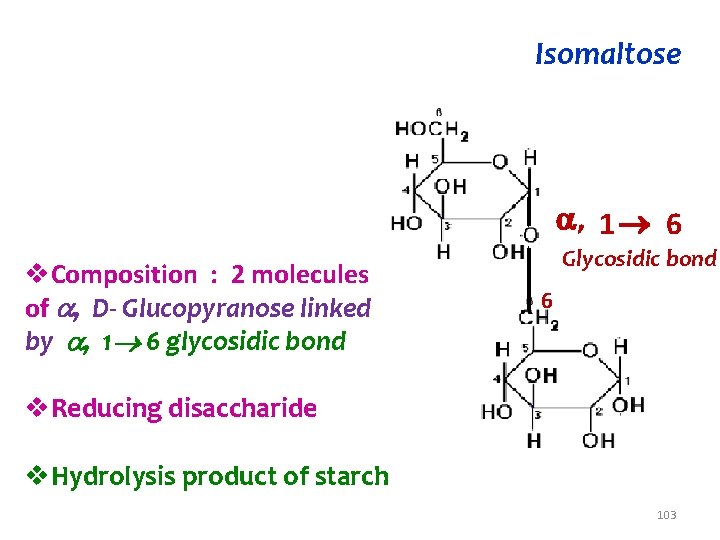
Isomaltose , 1 6 v. Composition : 2 molecules of , D- Glucopyranose linked by , 1 6 glycosidic bond Glycosidic bond 6 v. Reducing disaccharide v. Hydrolysis product of starch 103
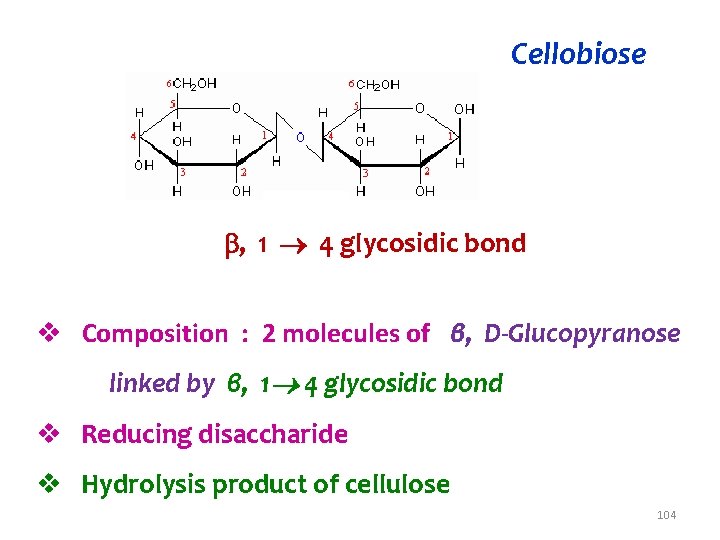
Cellobiose , 1 4 glycosidic bond v Composition : 2 molecules of β, D-Glucopyranose linked by β, 1 4 glycosidic bond v Reducing disaccharide v Hydrolysis product of cellulose 104
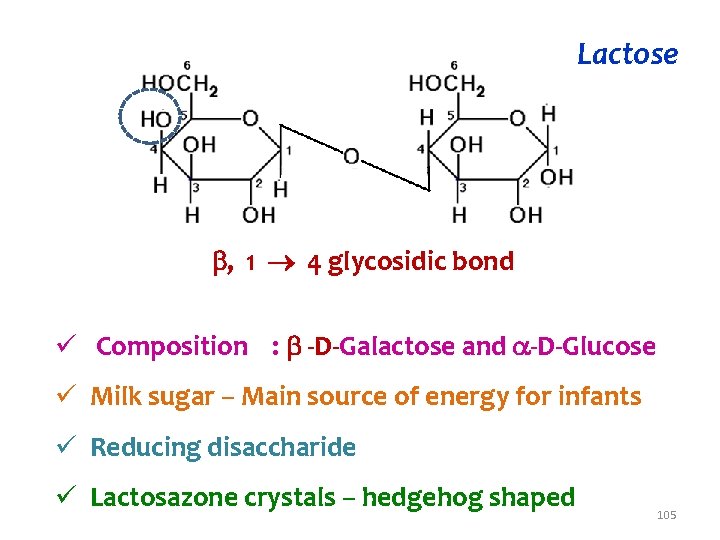
Lactose , 1 4 glycosidic bond ü Composition : -D-Galactose and -D-Glucose ü Milk sugar – Main source of energy for infants ü Reducing disaccharide ü Lactosazone crystals – hedgehog shaped 105
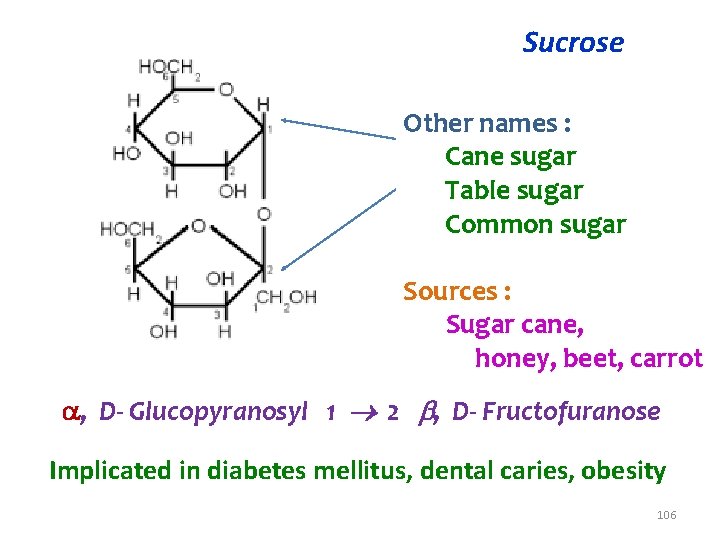
Sucrose Other names : Anomeric carbon Cane sugar Table sugar Non reducing sugar Common sugar Anomeric carbons of both monosaccharides Sources : are involved in linkage Sugar cane, honey, beet, carrot , D- Glucopyranosyl 1 2 , D- Fructofuranose Implicated in diabetes mellitus, dental caries, obesity 106
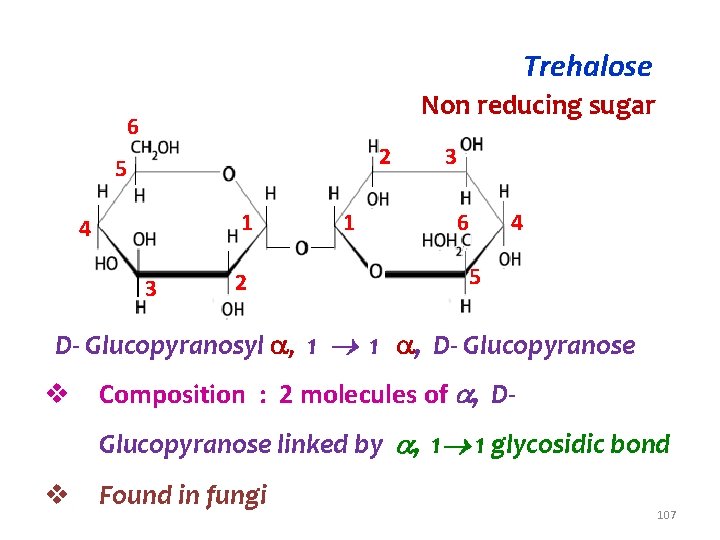
Trehalose Non reducing sugar 6 2 5 1 4 3 2 1 3 6 4 5 D- Glucopyranosyl , 1 1 , D- Glucopyranose v Composition : 2 molecules of , DGlucopyranose linked by , 1 1 glycosidic bond v Found in fungi 107
Quiz ahead ……………. . • 5 multiple choice questions……. ………………. the answers are on slide 91 108
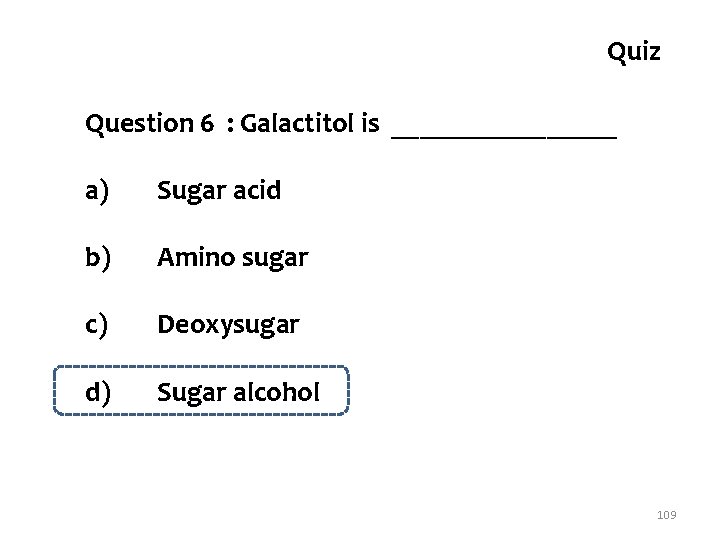
Quiz Question 6 : Galactitol is ________ a) Sugar acid b) Amino sugar c) Deoxysugar d) Sugar alcohol 109
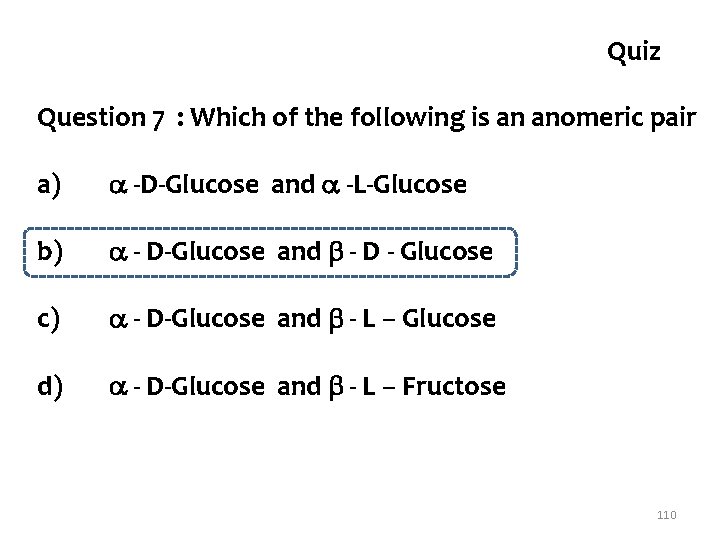
Quiz Question 7 : Which of the following is an anomeric pair a) -D-Glucose and -L-Glucose b) - D-Glucose and - D - Glucose c) - D-Glucose and - L – Glucose d) - D-Glucose and - L – Fructose 110
Quiz Question 8 : Anomeric carbon of D-Ribose is_____ a) C 5 b) C 4 c) C 1 d) C 2 111
Quiz Question 9 : Which of the following is not true about -D-Glucose a) It has reducing property b) It has four asymmetric carbon atoms c) It is stored as starch in animals d) It is a Aldohexose 112
Quiz Question 10 : Mannonic acid is _______ a) Aldonic acid b) Uronic acid c) Sialic acid d) N-Acetylated amino sugar 113
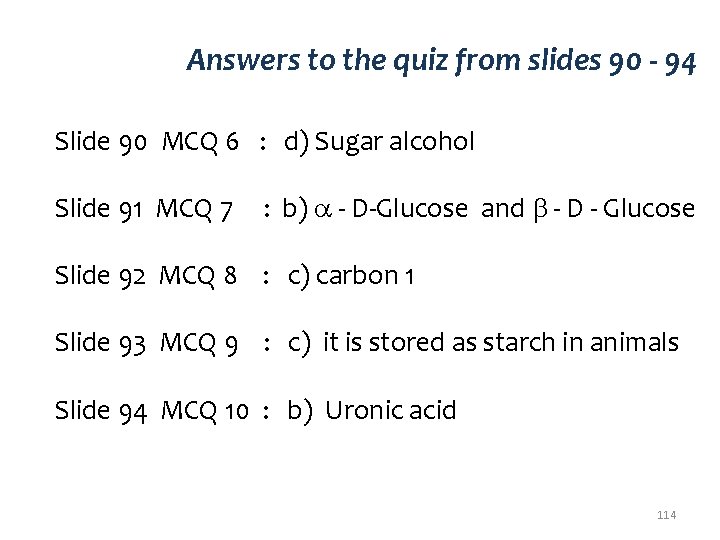
Answers to the quiz from slides 90 - 94 Slide 90 MCQ 6 : d) Sugar alcohol Slide 91 MCQ 7 : b) - D-Glucose and - D - Glucose Slide 92 MCQ 8 : c) carbon 1 Slide 93 MCQ 9 : c) it is stored as starch in animals Slide 94 MCQ 10 : b) Uronic acid 114
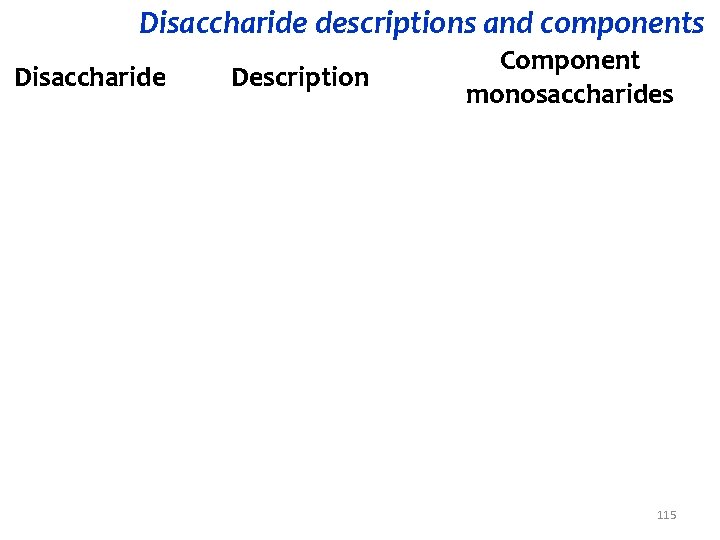
Disaccharide descriptions and components Disaccharide Sucrose Maltose Isomaltose Description Component monosaccharides common table sugar Glucose α, 1→ 2 , fructose product of starch hydrolysis Glucose α, 1 → 4 glucose Glucose α, 1→ 6 glucose Lactose main sugar in milk Galactose β, 1→ 4 glucose Cellobiose product of cellulose Glucose β, 1→ 4 glucose hydrolysis Trehalose found in fungi Glucose α, 1→ 1 glucose 115
Class III Specific learning objective 3 v To list the important trisaccharides and their functions 116
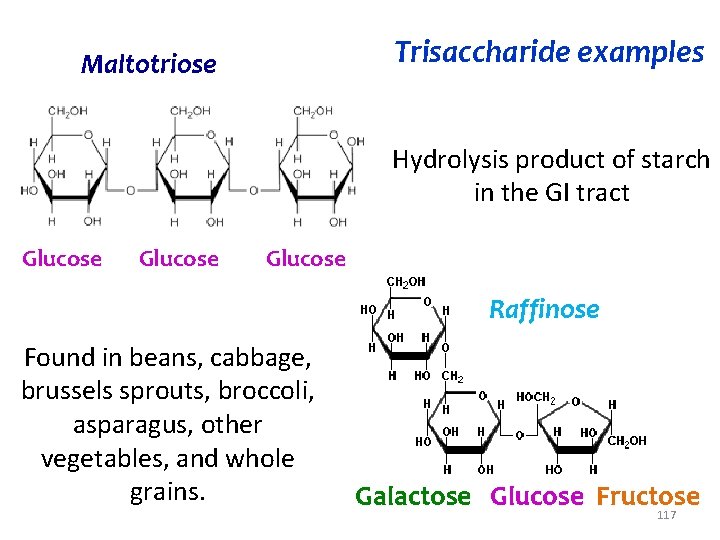
Maltotriose Trisaccharide examples Hydrolysis product of starch in the GI tract Glucose Raffinose Found in beans, cabbage, brussels sprouts, broccoli, asparagus, other vegetables, and whole grains. Galactose Glucose Fructose 117

Class III Specific learning objective 4 v To list the homopolysaccharides of importance and their significance 118
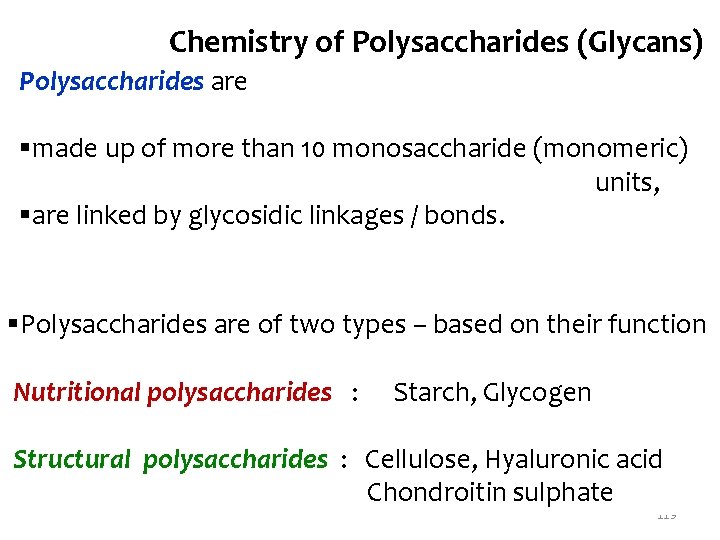
Chemistry of Polysaccharides (Glycans) Polysaccharides are §made up of more than 10 monosaccharide (monomeric) units, §are linked by glycosidic linkages / bonds. §Are of two types – based on their composition §Polysaccharides are of two types – based on their function Homopolysaccharides : Same type of monosaccharides Nutritional polysaccharides : Starch, Glycogen Heteropolysaccharides : Monosaccharides and or their derivatives. Structural polysaccharides : Cellulose, Hyaluronic acid Chondroitin sulphate 119
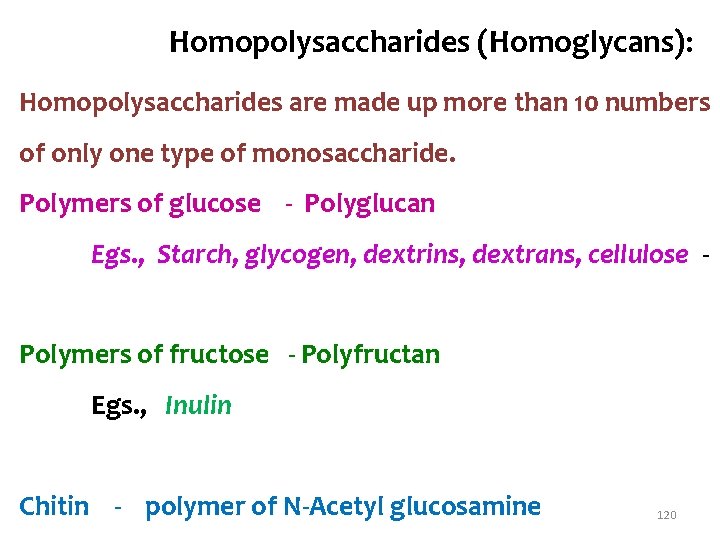
Homopolysaccharides (Homoglycans): Homopolysaccharides are made up more than 10 numbers of only one type of monosaccharide. Polymers of glucose - Polyglucan Egs. , Starch, glycogen, dextrins, dextrans, cellulose - Polymers of fructose - Polyfructan Egs. , Inulin Chitin - polymer of N-Acetyl glucosamine 120
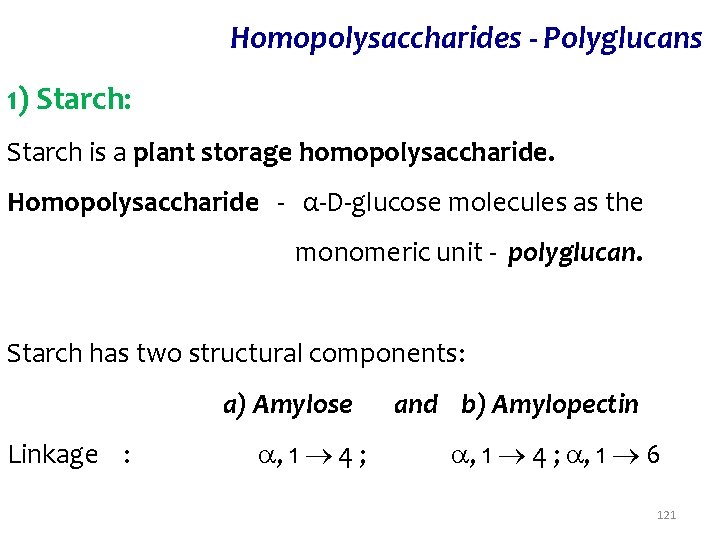
Homopolysaccharides - Polyglucans 1) Starch: Starch is a plant storage homopolysaccharide. Homopolysaccharide - α-D-glucose molecules as the monomeric unit - polyglucan. Starch has two structural components: a) Amylose and b) Amylopectin Linkage : , 1 4 ; , 1 6 121
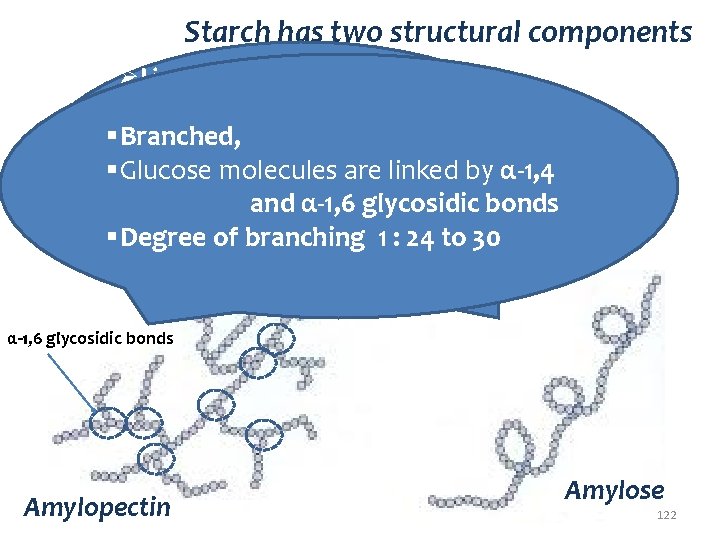
Starch has two structural components ØLinear, non-branched, Ø In solution exists as a helical §Branched, structure. §Ø Glucose molecules are linked by α-1, 4 60 -600 glucose molecules in and α-1, 6 glycosidic bonds the chain §Ø Degree of branching 1 : 24 to 30 Glucose molecules are linked by α-1, 4 glycosidic bonds. α-1, 6 glycosidic bonds Amylopectin Amylose 122
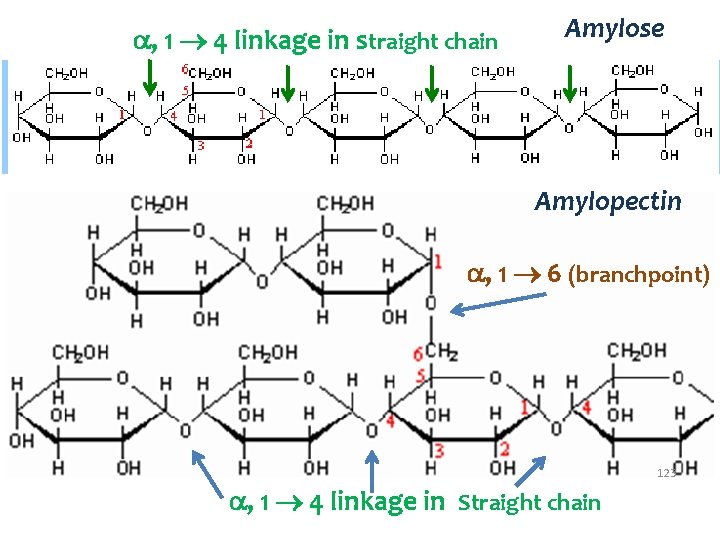
, 1 4 linkage in straight chain Amylose Amylopectin , 1 6 (branchpoint) 123 , 1 4 linkage in Straight chain
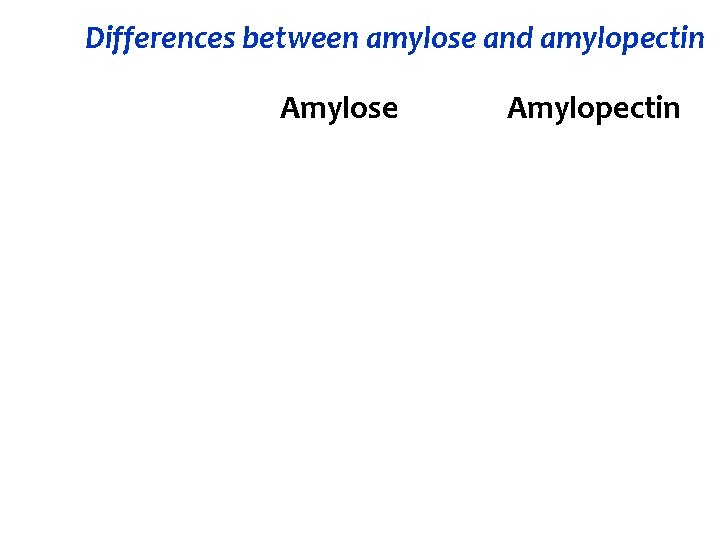
Differences between amylose and amylopectin Content Amylose Amylopectin 15 - 20% 80 – 85% Number of glucose units High molecular weight Branched 60 – 600 Structure unbranched (1 Branch for 24 – 30 glucose residues) Linkages α, 1→ 4 ; α, 1→ 6 Structure in solution Helical Non helical Iodine reaction Blue colour No blue colour 125
Homopolysaccharides - Polyglucans 2. Glycogen: is an animal storage-homopolysaccharide v. In the body glycogen exists covalently attached to a protein called glycogenin. v. Polyglucan. v. Structure is branched. v. Glycogen is more branched (has more branches) than amylopectin. 126
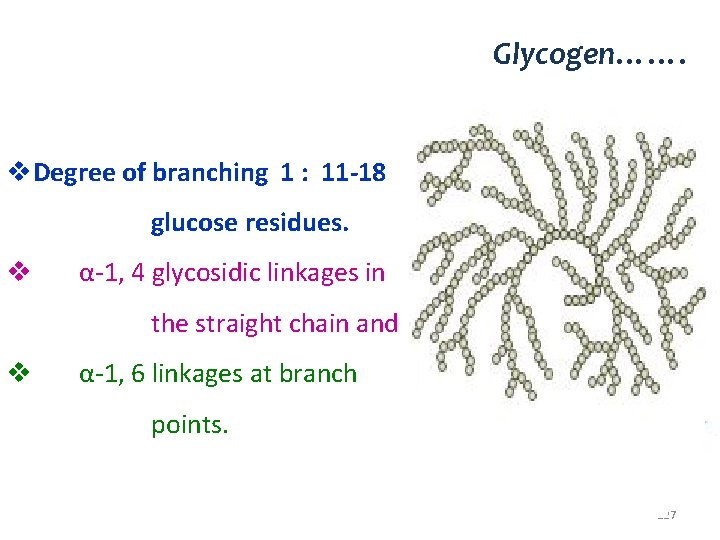
Glycogen……. v. Degree of branching 1 : 11 -18 glucose residues. v α-1, 4 glycosidic linkages in the straight chain and v α-1, 6 linkages at branch points. 127
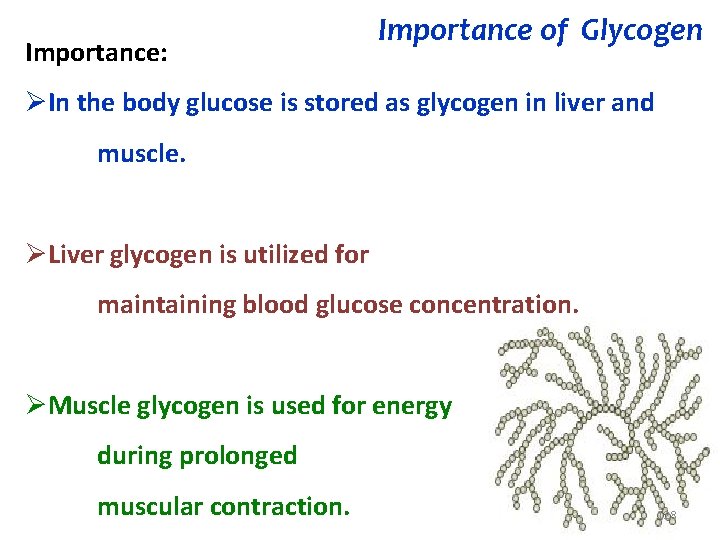
Importance: Importance of Glycogen ØIn the body glucose is stored as glycogen in liver and muscle. ØLiver glycogen is utilized for maintaining blood glucose concentration. ØMuscle glycogen is used for energy during prolonged muscular contraction. 128
Homopolysaccharides - Polyglucans 3. Dextrins Source : formed during the course of hydrolysis (digestion) of starch. 4. Dextrans v. High molecular weight, highly branched, Polyglucan. v. Application : used medicinally as an as a volume expander in hypovolemic shock. 129
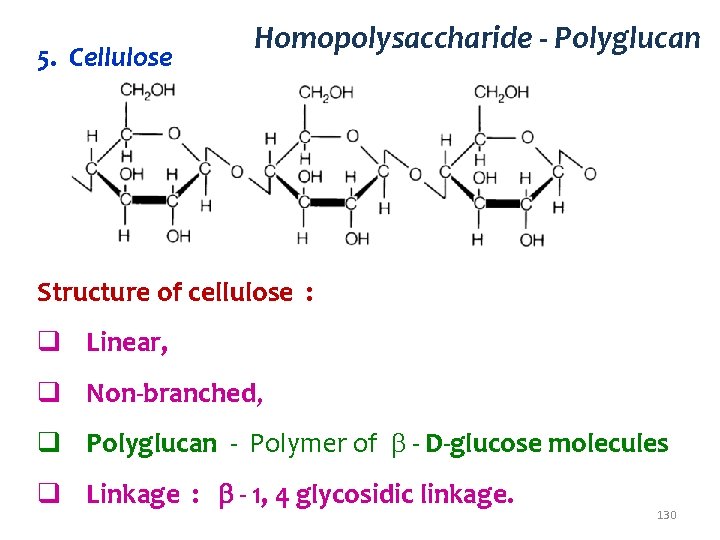
5. Cellulose Homopolysaccharide - Polyglucan Structure of cellulose : q Linear, q Non-branched, q Polyglucan - Polymer of - D-glucose molecules q Linkage : - 1, 4 glycosidic linkage. 130
Cellulose…… Function : Cellulose is the main cell wall polysaccharide of plants. Source: Cellulose occurs only in plants. Cellulose is the most common dietary fiber present in the plant derived food. Importance of dietary fiber : Dietary fibers are undigestible in the GIT of humans. Reason : the enzyme cellulase required to digest -1, 4 glycosidic linkages in cellulose, is absent in the body. 131
Functions of Dietary fiber Their regular consumption prevents constipation, high blood levels of cholesterol (hypercholesterolemia) colon cancer and helps control blood glucose level of diabetics. Other polysaccharide dietary fibers are hemicelluloses and pectins. 132
Class III Summary of this class v The formation of a glycosidic bond between two monosaccharides and identified the types v Listed the important disaccharides and their functions v Listed the important trisaccharides and their functions v Listed the homopolysaccharides (polyglucans) of importance, with structure and their significance 133
Assignment of this class • Write about the structural features and natural sources of the following: a) sucrose b) lactose c) maltose (4) • Polysaccharides (2/4) • Describe the structure and biomedical importance of homopolysaccharides. (2/4) • Difference between starch and glycogen. (2) • Bring out the salient features of structure of starch. How does it differ from that of cellulose? (2) • Bring out the salient features of structure of an animal homo-polysaccharide. (2) 134

Topic for self-directed learning for the next class • Enlist the heteropolysaccharides and their functions 135
Chemistry of carbohydrates IVth class 18 August 2018 136
Class III Summary of the previous class v The formation of a glycosidic bond between two monosaccharides and identified the types v Listed the important disaccharides and their functions v Listed the important trisaccharides and their functions v Listed the homopolysaccharides (polyglucans) of importance, with structure and their significance 137
Class III Specific learning objectives for this class v To list the homopolysaccharides (other than polyglucans) of importance, with structure and their significance v To list the heteropolysaccharides of importance and their composition and functions v To study the properties of mutarotation and inversion 138
Class III Specific learning objective 1 v To list the homopolysaccharides (other than polyglucans) of importance, with structure and their significance 139
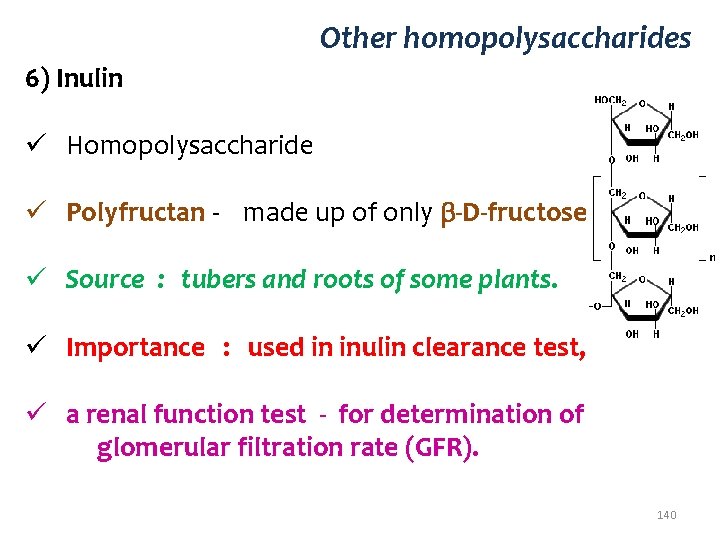
Other homopolysaccharides 6) Inulin ü Homopolysaccharide ü Polyfructan - made up of only -D-fructose ü Source : tubers and roots of some plants. ü Importance : used in inulin clearance test, ü a renal function test - for determination of glomerular filtration rate (GFR). 140
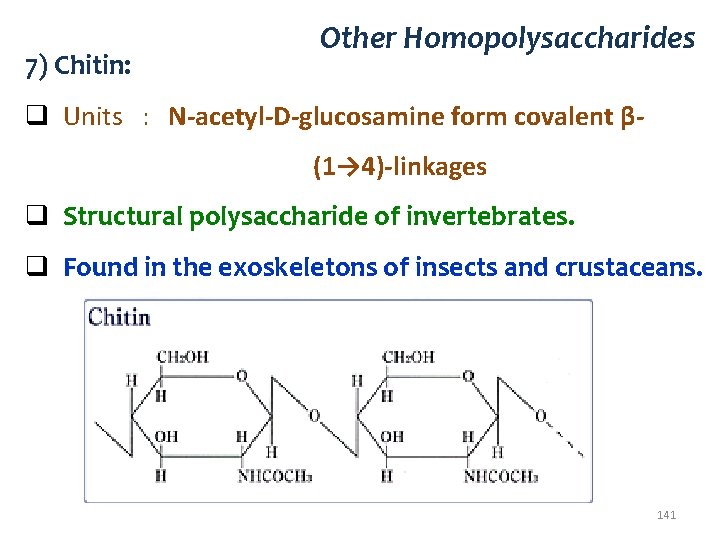
7) Chitin: Other Homopolysaccharides q Units : N-acetyl-D-glucosamine form covalent β(1→ 4)-linkages q Structural polysaccharide of invertebrates. q Found in the exoskeletons of insects and crustaceans. 141
Revision exercises ahead ……………. . –Answers on slide 121 142
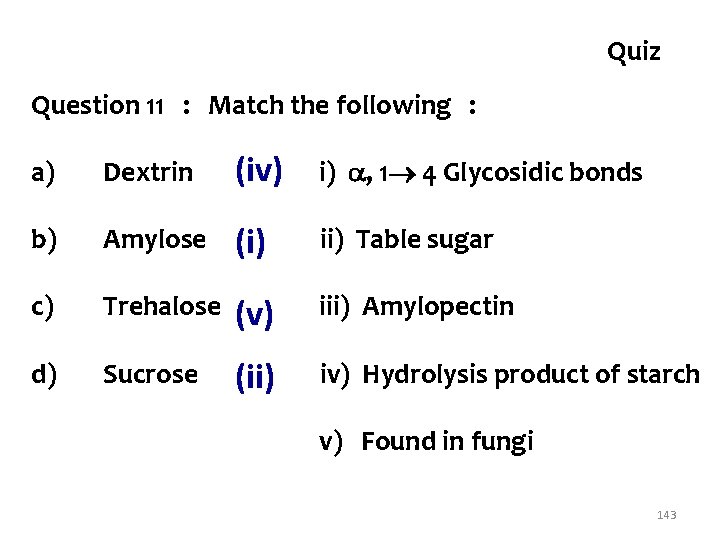
Quiz Question 11 : Match the following : a) Dextrin (iv) b) Amylose ii) Table sugar (i) c) Trehalose (v) d) Sucrose iv) Hydrolysis product of starch (ii) i) , 1 4 Glycosidic bonds iii) Amylopectin v) Found in fungi 143
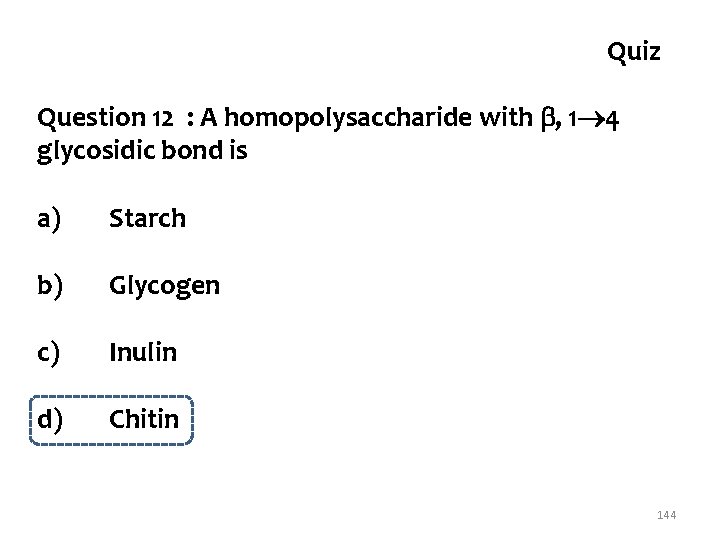
Quiz Question 12 : A homopolysaccharide with , 1 4 glycosidic bond is a) Starch b) Glycogen c) Inulin d) Chitin 144
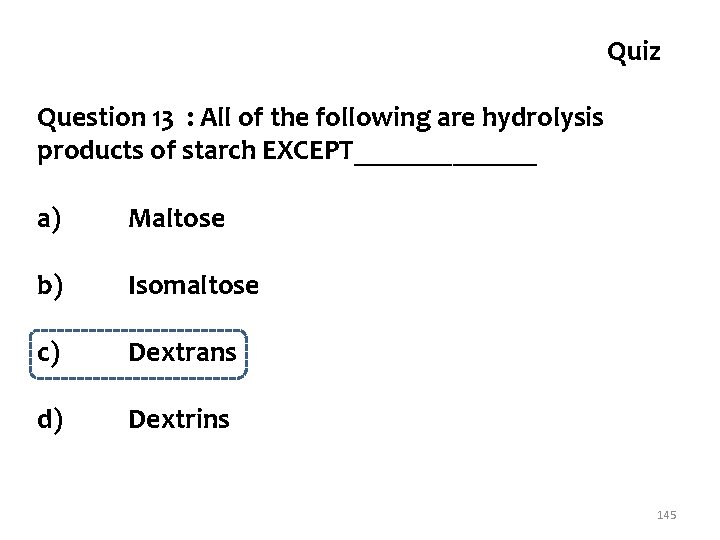
Quiz Question 13 : All of the following are hydrolysis products of starch EXCEPT_______ a) Maltose b) Isomaltose c) Dextrans d) Dextrins 145
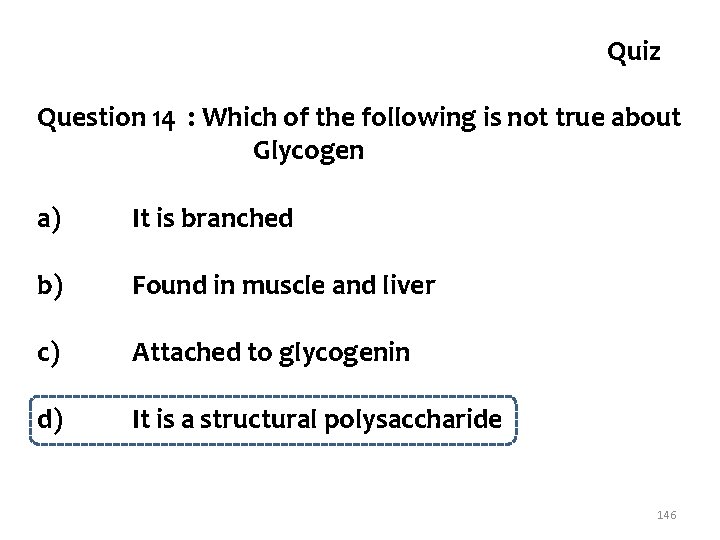
Quiz Question 14 : Which of the following is not true about Glycogen a) It is branched b) Found in muscle and liver c) Attached to glycogenin d) It is a structural polysaccharide 146
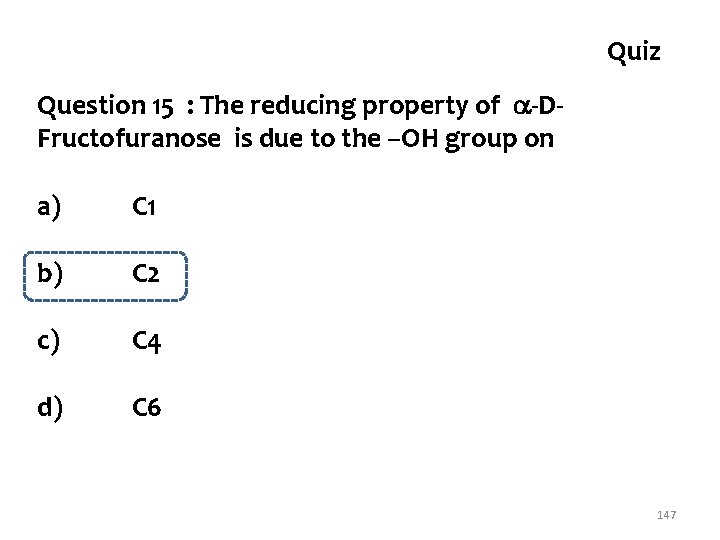
Quiz Question 15 : The reducing property of -DFructofuranose is due to the –OH group on a) C 1 b) C 2 c) C 4 d) C 6 147
Class III Specific learning objective 2 v To list the heteropolysaccharides of importance and their composition and functions 148
Heteropolysaccharides Ø Other name : heteroglycans Ø contain more than ten number of Ø Two or more types of monosaccharide units. Ø Examples: Mucopolysaccharides, Agar, Pectins, etc. Animal tissue heteropolysaccharides : Mucopolysaccharides or Glycosaminoglycans (GAGs) 149
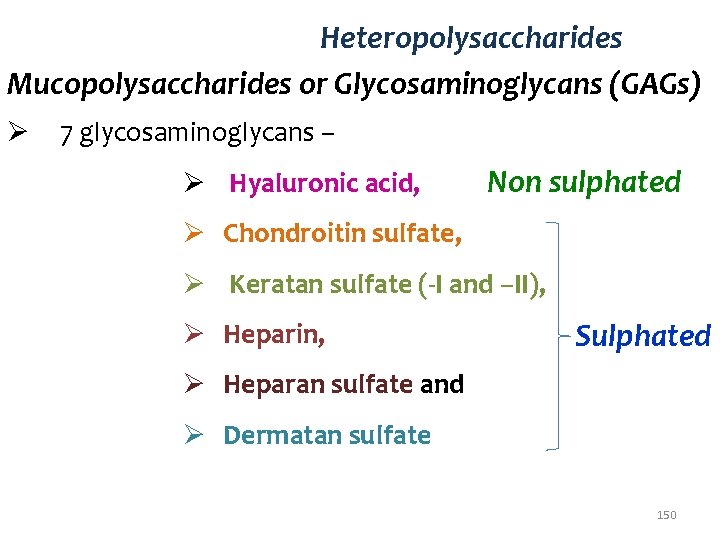
Heteropolysaccharides Mucopolysaccharides or Glycosaminoglycans (GAGs) Ø 7 glycosaminoglycans – Ø Hyaluronic acid, Non sulphated Ø Chondroitin sulfate, Ø Keratan sulfate (-I and –II), Ø Heparin, Sulphated Ø Heparan sulfate and Ø Dermatan sulfate 150
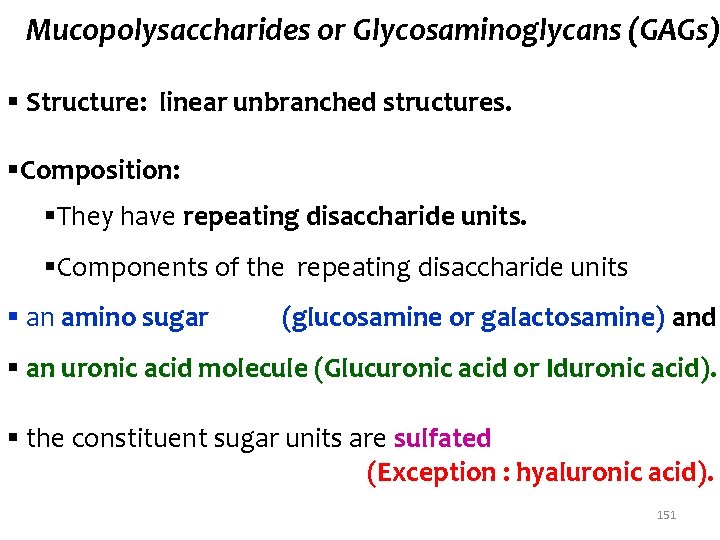
Mucopolysaccharides or Glycosaminoglycans (GAGs) § Structure: linear unbranched structures. §Composition: §They have repeating disaccharide units. §Components of the repeating disaccharide units § an amino sugar (glucosamine or galactosamine) and § an uronic acid molecule (Glucuronic acid or Iduronic acid). § the constituent sugar units are sulfated (Exception : hyaluronic acid). 151
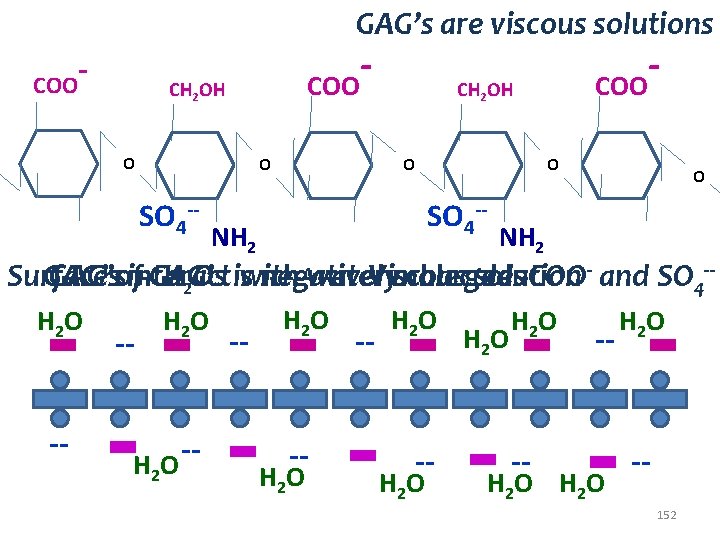
GAG’s are viscous solutions COO CH 2 OH O O SO 4 -- NH 2 O NH 2 Surface GAG’sofinteract +GAG’s H 2 O iswith negatively -----water Viscous molecules charged solution -COO- and SO 4 -H 2 O -- -HO 2 -- H 2 O H 2 O -- -- H 2 O -152
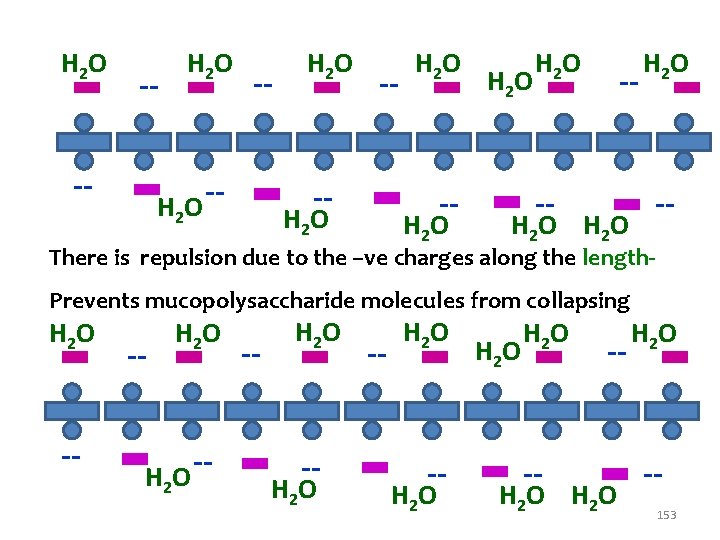
H 2 O -- -- -- -HO H 2 O -- -- -- H 2 O 2 H 2 O -- -- H 2 O There is repulsion due to the –ve charges along the length- Prevents mucopolysaccharide molecules from collapsing H 2 O -- -HO 2 -- H 2 O H 2 O -- -- H 2 O -153
Heteropolysaccharides Mucopolysaccharides or Glycosaminoglycans (GAGs)……. § GAG’s have many –ve charges along the length of the chain Reason : Presence of uronic acid and sulfate groups makes the mucopolysaccharides polyanionic Property: There is repulsion due to the –ve charges along the length - Prevents mucopolysaccharide molecules from collapsing increases the capacity to hold water and form viscous solutions. 154
Heteropolysaccharides Mucopolysaccharides or Glycosaminoglycans (GAGs)……. Function : Most of the mucopolysaccharides are structural components of connective tissues. They are good lubricants and shock absorbers giving cushioning effect/ compressibility, in connective tissue. 155
Heteropolysaccharides Mucopolysaccharides or Glycosaminoglycans (GAGs)……. Hyaluronic acid : composed of Serves as a lubricant and shock absorber. D-Glucuronic acid and Found in synovial fluid of joints, N-Acetyl glucosamine ; linkage is β(1, 3) vitreous humor of the eye, the umbilical cord, loose connective tissue and cartilage. 156
Mucopolysaccharides or Glycosaminoglycans (GAGs)……. Chondroitin 4 - and 6 sulfates: composed of Most abundant GAGs in the body. • Found in cartilage, tendons, ligaments, and aorta. • D-Glucuronic acid and • Form proteoglycan N Acetyl Galactosamine aggregates, with hyaluronic acid. -4 - or 6 -sulfate; linkage is β(1, 3) • In cartilage, they bind collagen - hold fibers in a tight, strong network. 157
Heteropolysaccharides Mucopolysaccharides or Glycosaminoglycans (GAGs)……. Dermatan sulfate: composed of L-Iduronic acid, Found in D-Glucuronic acid N Acetyl Galactosamine-4 -sulfate; Skin, Blood vessels, and Heart valves sulfated; linkages is β and α(1, 3) 158
Mucopolysaccharides or Glycosaminoglycans (GAGs)……. • Heparin and Heparan Heparin is an intracellular sulfates (HS): component of mast cells that composed of line arteries, especially in liver, L- Iduronic acid / lungs, and skin. D-glucuronic acid and • Serves as an anticoagulant. D-glucosamine-6 • HS -Extracellular GAG, found in sulfate; basement membrane and as a linkage is α and β, (1, 4) ubiquitous component of cell surfaces. 159
Mucopolysaccharides or Glycosaminoglycans (GAGs)……. Most heterogeneous GAGs because they contain additional monosaccharides Keratan sulfates (KS): such as L-fucose, NANA, and mannose. composed of D -Galactose and N Acetyl Glucosamine -6 -sulfate; linkage is β(1, 4) • KS II is found in loose connective tissue proteoglycan aggregates with chondroitin sulfate. KS I is found in cornea. 160
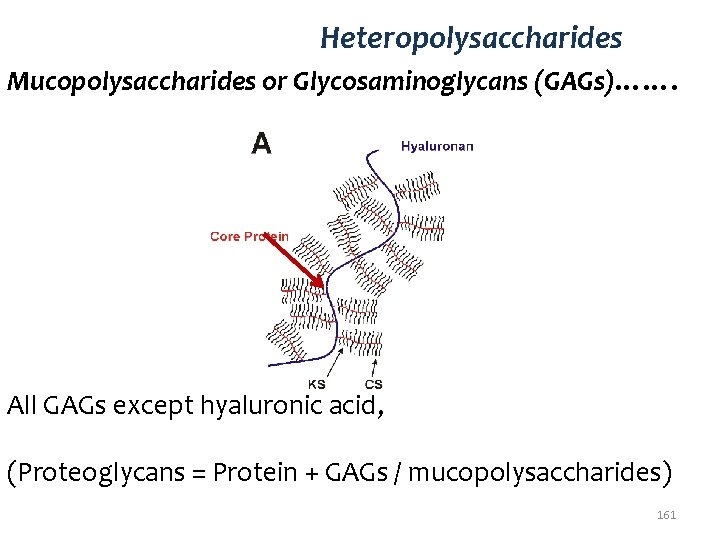
Heteropolysaccharides Mucopolysaccharides or Glycosaminoglycans (GAGs)……. All GAGs except hyaluronic acid, (Proteoglycans = Protein + GAGs / mucopolysaccharides) 161
Class III Specific learning objective 3 v To study the properties of mutarotation and inversion 162
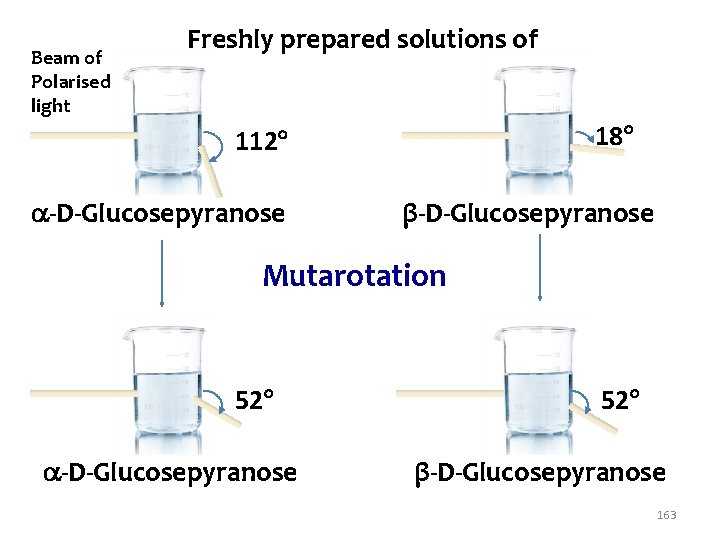
Beam of Polarised light Freshly prepared solutions of 18 112 -D-Glucosepyranose β-D-Glucosepyranose Let stand for some time Mutarotation 52 -D-Glucosepyranose 52 β-D-Glucosepyranose 163
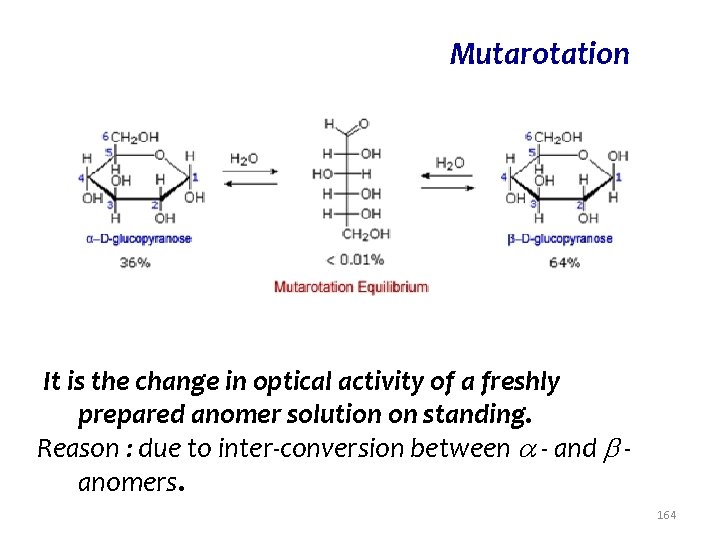
Mutarotation It is the change in optical activity of a freshly prepared anomer solution on standing. Reason : due to inter-conversion between - and anomers. 164
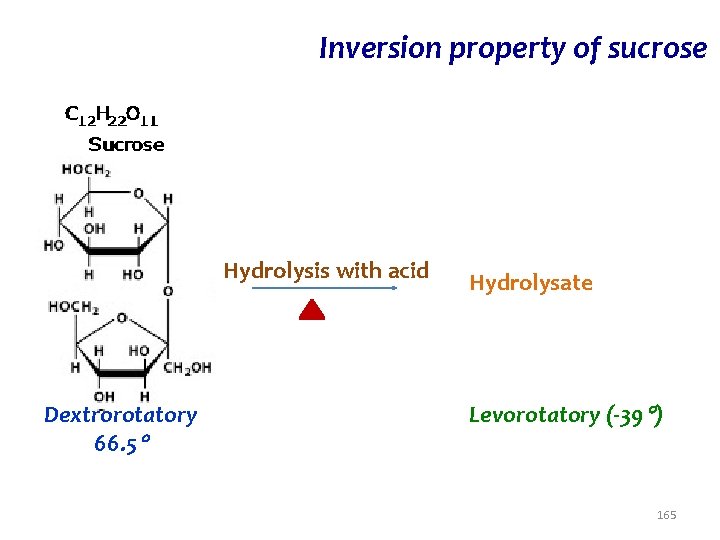
Inversion property of sucrose Hydrolysis with acid Dextrorotatory 66. 5 Hydrolysate Levorotatory (-39 ) 165
Class III Summary of this class v Listed the homopolysaccharides (other than polyglucans) of importance, with structure and their significance v Listed the heteropolysaccharides of importance and their composition and functions v Studied the properties of mutarotation and inversion 166
Assignment questions for this class • Explain the terms homopolysaccharides and heteropolysaccharides. Write briefly on hyaluronic acid (3/4) • Heteropolysacchrides (3) • Glycosaminoglycans (3) • What are mucopolysaccharides? Name the functions and composition of any four mucopolysaccharides. (4) • Name Mucopolysaccharides. Mention their function (3) • Function of carbohydrates (3) 167

Student Feedback Topic : Chemistry of carbohydrates Faculty : Vinitha Ramanath Pai Grading : 1 needs improvement 1. Presentation skill / enthusiasm 2 average 2. Clarity of presentation 3 Good 4. Very good 3. Organization of the lectures 5. Excellent 4. Explanation of topics 5. Activity / quiz / Question answer session 6. Clarity of the slides 7. Any two things you liked about these lectures 8. Any two things which can be improved further 168

Thank you 169
- Slides: 164