
Chemistry Notes The Periodic Table Every element has
Chemistry Notes: The Periodic Table
Every element has its own unique symbol. • For some elements the symbol is simply the first letter of the element’s name. – Examples: Hydrogen = H, Sulfur = S, Carbon = C • Symbols for other elements use the first letter plus one other letter of the element’s name. The first letter is CAPITALIZED and the second letter is not. – Examples: Aluminum = Al, Platinum = Pt, cadmium = Cd • The origins of some symbols are not as obvious. Some elements have symbols that refer to the element’s name in latin. – Examples: gold = Au, lead = Pb, copper = Cu

The Periodic Table • Column (up and down)= Group or Family • 18 columns on the Periodic Table • Row (side to side)= Period • 7 rows on the Periodic Table
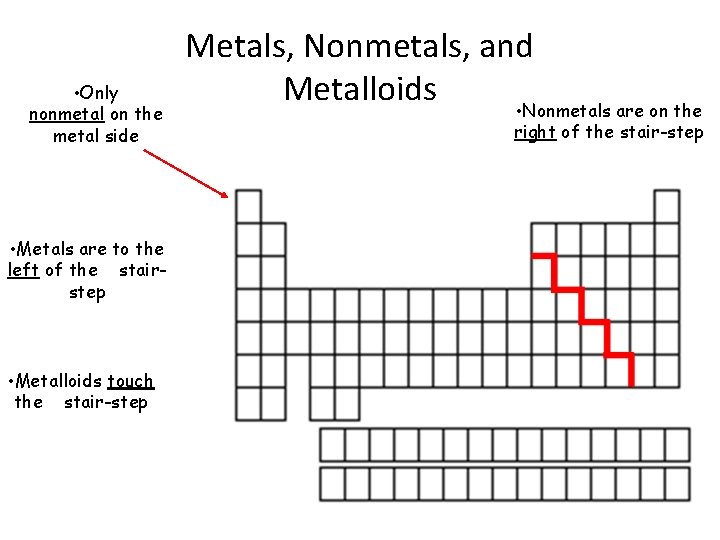
• Only nonmetal on the metal side • Metals are to the left of the stairstep • Metalloids touch the stair-step Metals, Nonmetals, and Metalloids • Nonmetals are on the right of the stair-step
Valence Electrons and Reactivity • Valence electrons are the electrons farthest from the nucleus. Atoms have different numbers of valence electrons. • Reactivity: how likely an atom is to interact (react) with other atoms. Some elements are very reactive, while others almost never react.

The Groups/Families of the Periodic Table • Elements on the periodic table can be grouped into families (or groups) based on their chemical properties. – We call them “families” because the elements in each family are “related. ” • Each family has a specific name to differentiate it from the other families in the periodic table. • Elements in each family react differently with other elements.
Family Flip Cards for Element On a series of paper slips, create a book section for each of the following groups/families (column) of elements. Section must include: • the provided notes • at least some of the elements listed as examples • List chemical properties/reactivity that family share. (see group 1 for example).
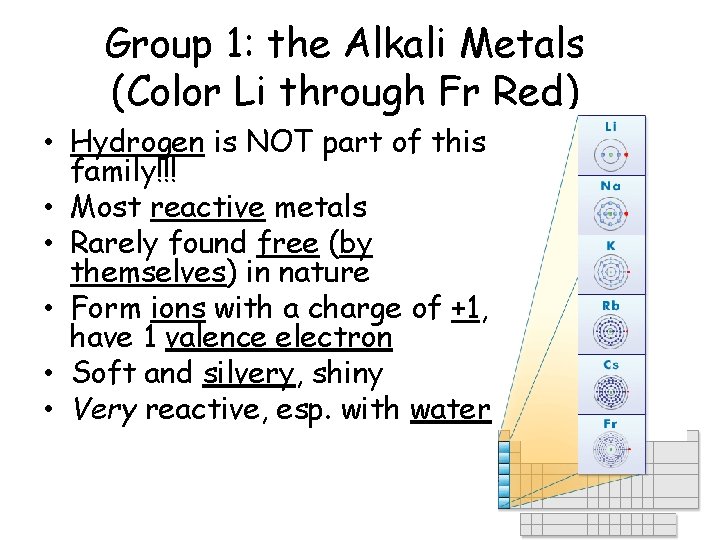
Group 1: the Alkali Metals (Color Li through Fr Red) • Hydrogen is NOT part of this family!!! • Most reactive metals • Rarely found free (by themselves) in nature • Form ions with a charge of +1, have 1 valence electron • Soft and silvery, shiny • Very reactive, esp. with water
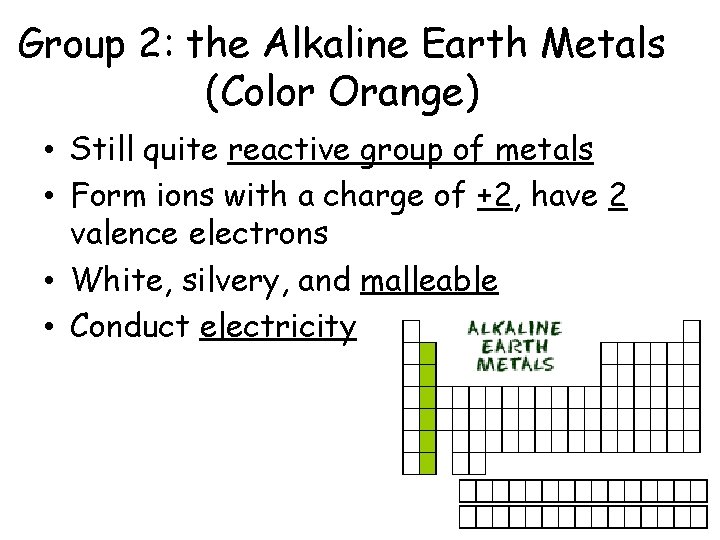
Group 2: the Alkaline Earth Metals (Color Orange) • Still quite reactive group of metals • Form ions with a charge of +2, have 2 valence electrons • White, silvery, and malleable • Conduct electricity
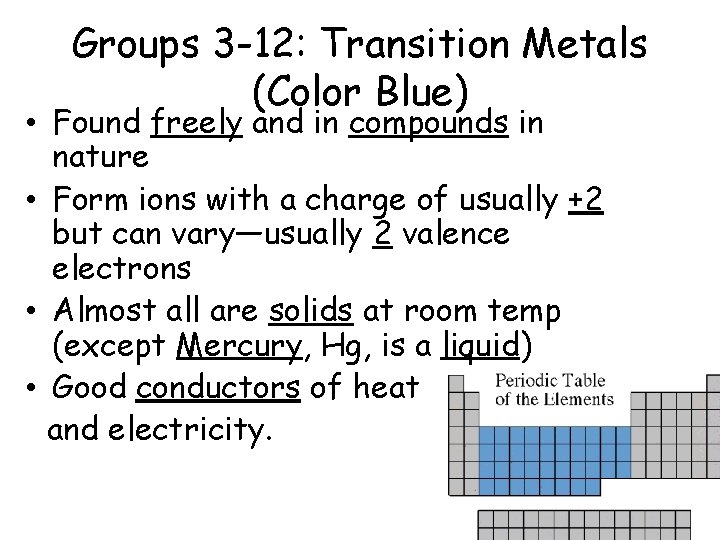
Groups 3 -12: Transition Metals (Color Blue) • Found freely and in compounds in nature • Form ions with a charge of usually +2 but can vary—usually 2 valence electrons • Almost all are solids at room temp (except Mercury, Hg, is a liquid) • Good conductors of heat and electricity.
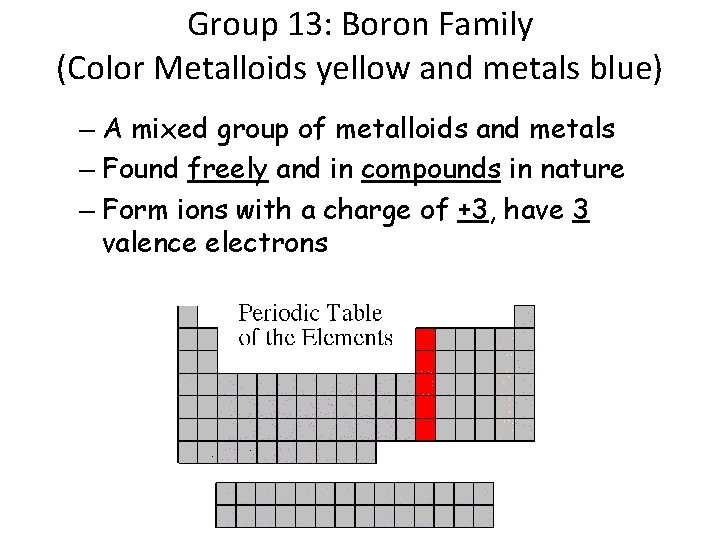
Group 13: Boron Family (Color Metalloids yellow and metals blue) – A mixed group of metalloids and metals – Found freely and in compounds in nature – Form ions with a charge of +3, have 3 valence electrons
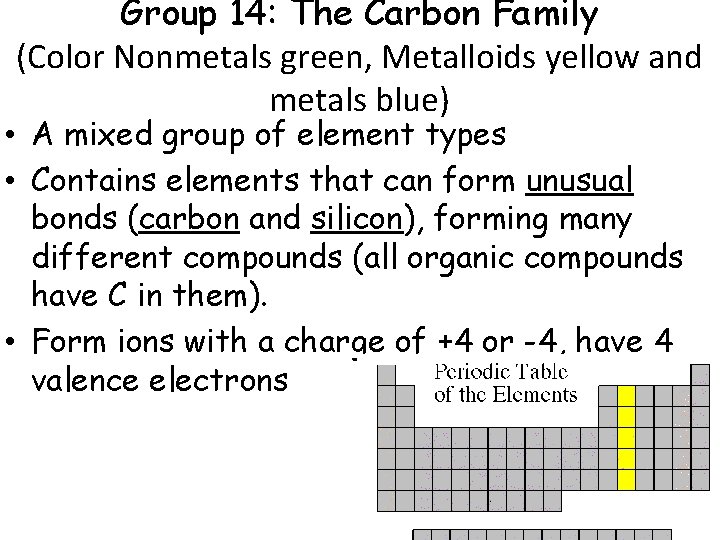
Group 14: The Carbon Family (Color Nonmetals green, Metalloids yellow and metals blue) • A mixed group of element types • Contains elements that can form unusual bonds (carbon and silicon), forming many different compounds (all organic compounds have C in them). • Form ions with a charge of +4 or -4, have 4 valence electrons
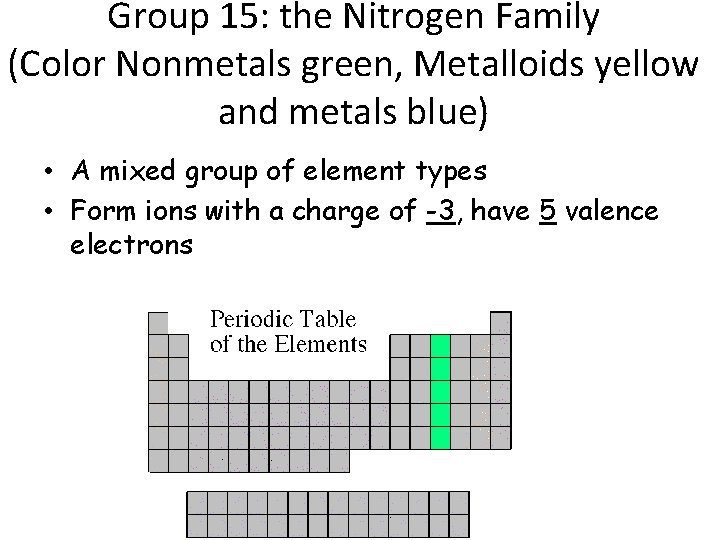
Group 15: the Nitrogen Family (Color Nonmetals green, Metalloids yellow and metals blue) • A mixed group of element types • Form ions with a charge of -3, have 5 valence electrons
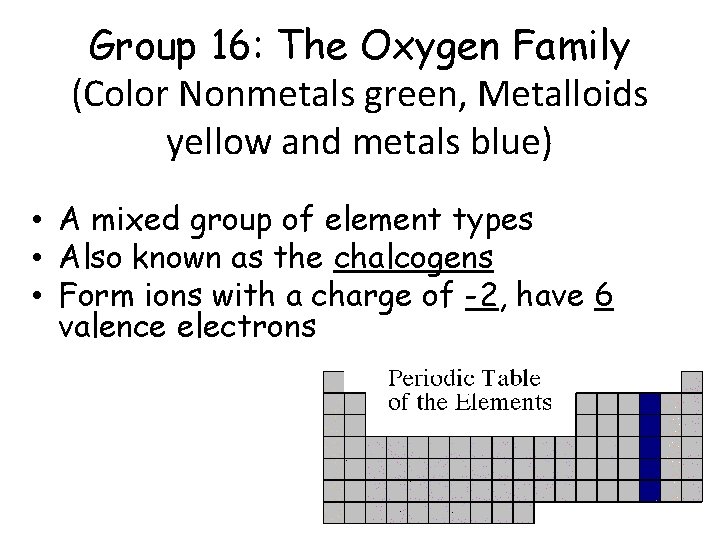
Group 16: The Oxygen Family (Color Nonmetals green, Metalloids yellow and metals blue) • A mixed group of element types • Also known as the chalcogens • Form ions with a charge of -2, have 6 valence electrons
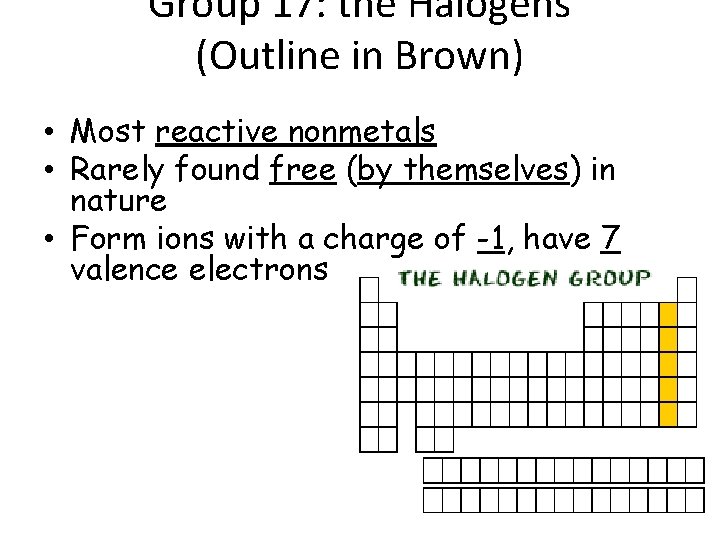
Group 17: the Halogens (Outline in Brown) • Most reactive nonmetals • Rarely found free (by themselves) in nature • Form ions with a charge of -1, have 7 valence electrons
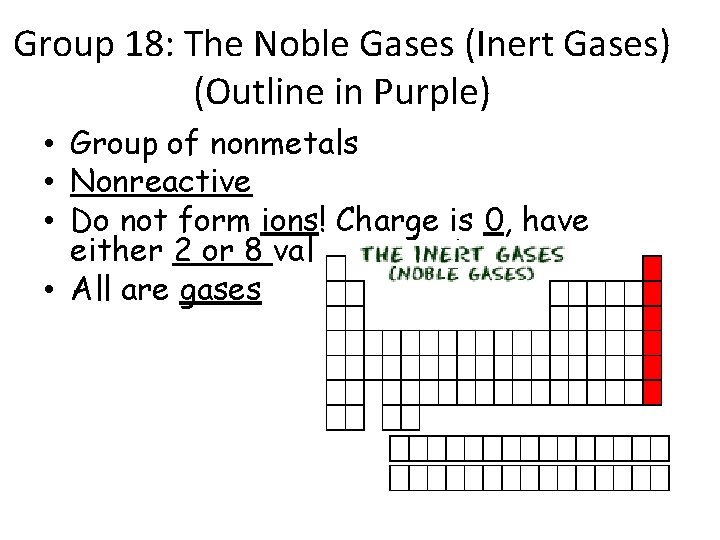
Group 18: The Noble Gases (Inert Gases) (Outline in Purple) • Group of nonmetals • Nonreactive • Do not form ions! Charge is 0, have either 2 or 8 valence electrons • All are gases
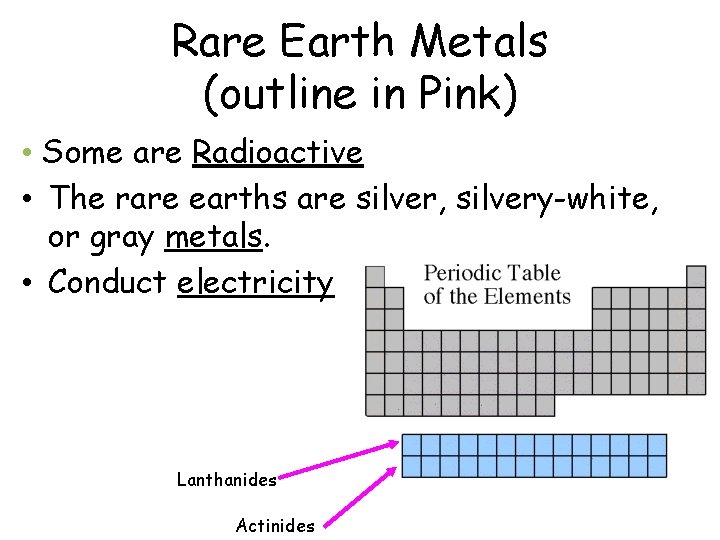
Rare Earth Metals (outline in Pink) • Some are Radioactive • The rare earths are silver, silvery-white, or gray metals. • Conduct electricity Lanthanides Actinides
- Slides: 17