
Chemistry Notes Electron Configurations Electron Configurations Studying the


- Slides: 19
Chemistry Notes Electron Configurations
Electron Configurations Studying the arrangement of electrons in atoms helps one understand chemical activity. From an electron configuration you can determine: n n Most stable electron arrangement Charge Bonding patterns Etc.
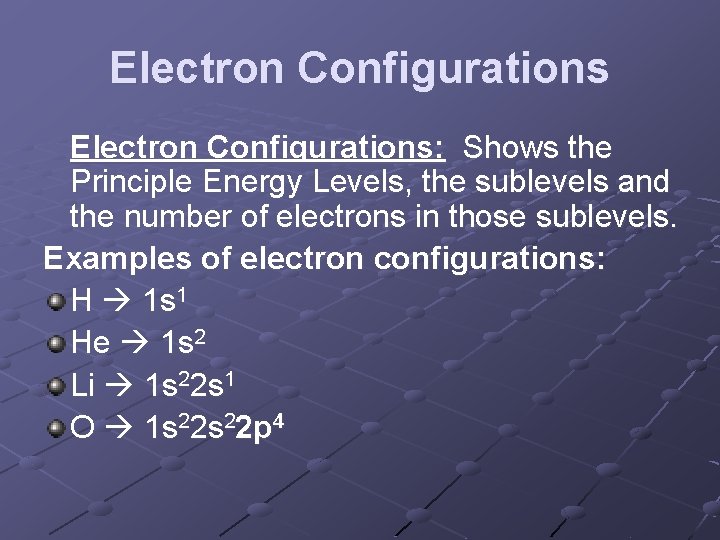
Electron Configurations: Shows the Principle Energy Levels, the sublevels and the number of electrons in those sublevels. Examples of electron configurations: H 1 s 1 He 1 s 2 Li 1 s 22 s 1 O 1 s 22 p 4
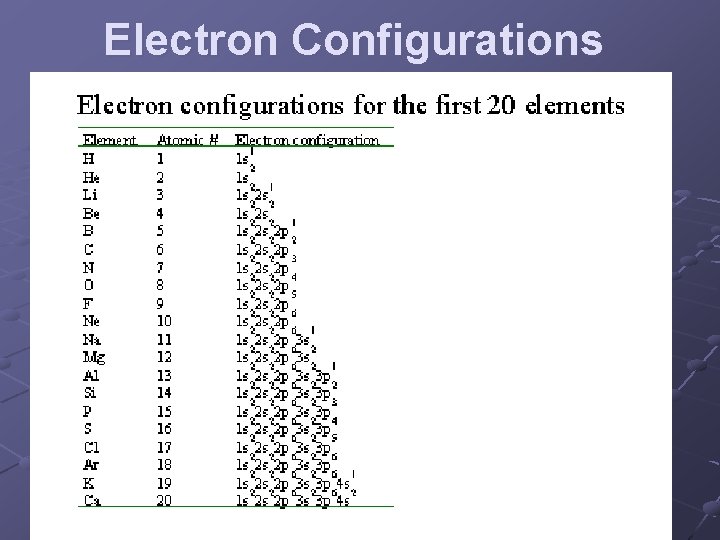
Electron Configurations
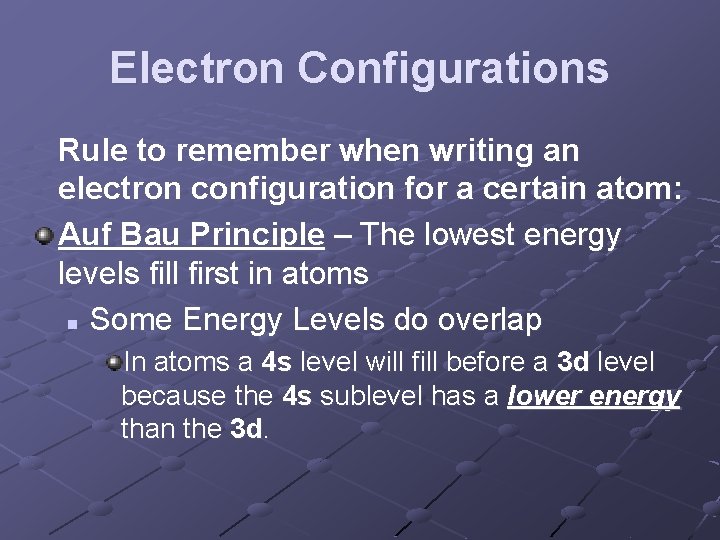
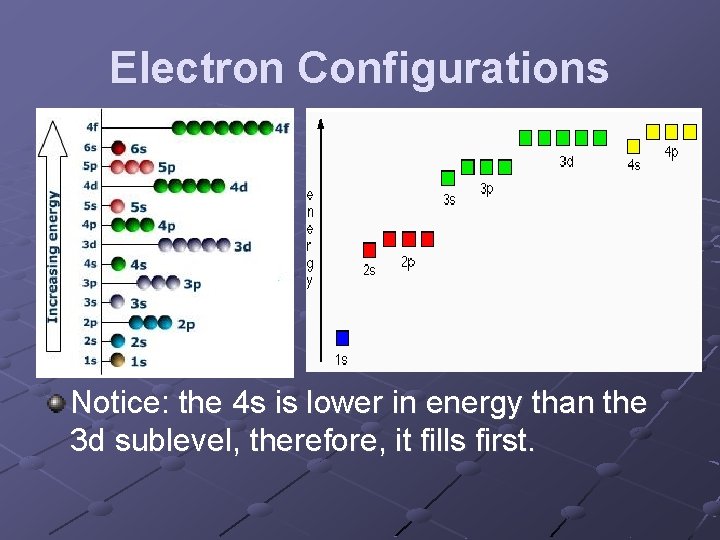
Electron Configurations Rule to remember when writing an electron configuration for a certain atom: Auf Bau Principle – The lowest energy levels fill first in atoms n Some Energy Levels do overlap In atoms a 4 s level will fill before a 3 d level because the 4 s sublevel has a lower energy than the 3 d.
Electron Configurations Notice: the 4 s is lower in energy than the 3 d sublevel, therefore, it fills first.
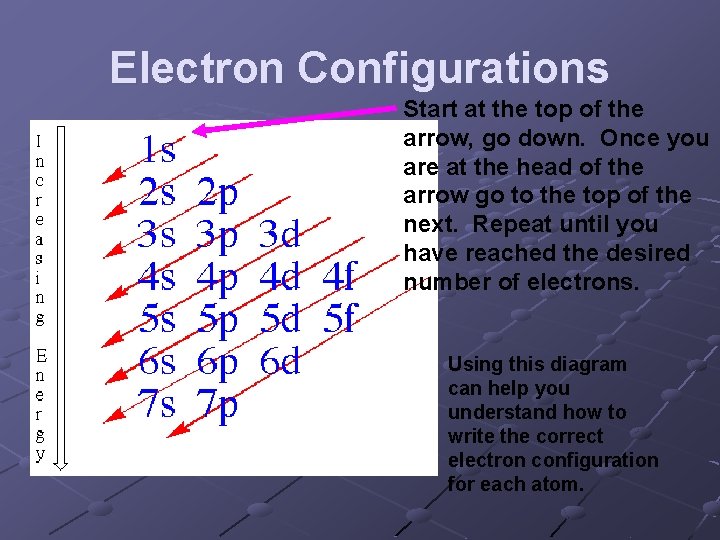
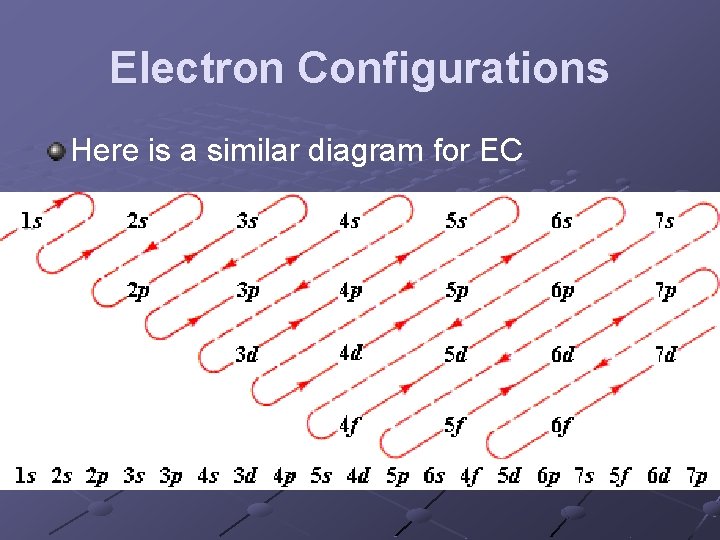
Electron Configurations Start at the top of the arrow, go down. Once you are at the head of the arrow go to the top of the next. Repeat until you have reached the desired number of electrons. Using this diagram can help you understand how to write the correct electron configuration for each atom.
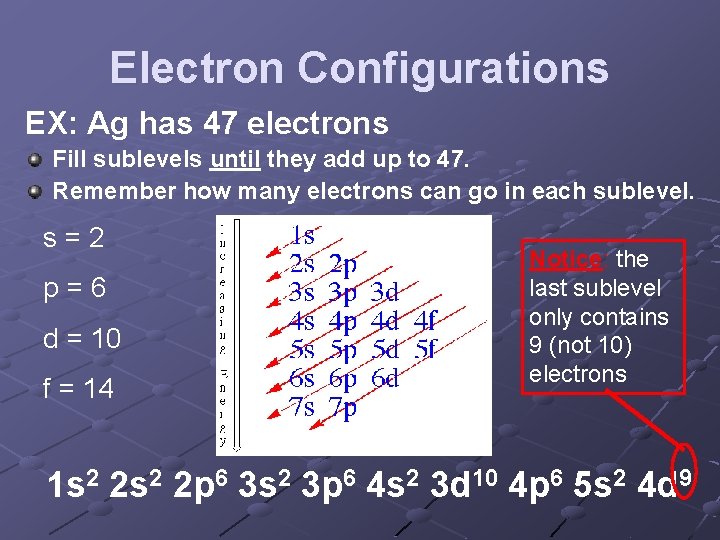
Electron Configurations EX: Ag has 47 electrons Fill sublevels until they add up to 47. Remember how many electrons can go in each sublevel. s=2 p=6 d = 10 f = 14 Notice: the last sublevel only contains 9 (not 10) electrons 1 s 2 2 p 6 3 s 2 3 p 6 4 s 2 3 d 10 4 p 6 5 s 2 4 d 9
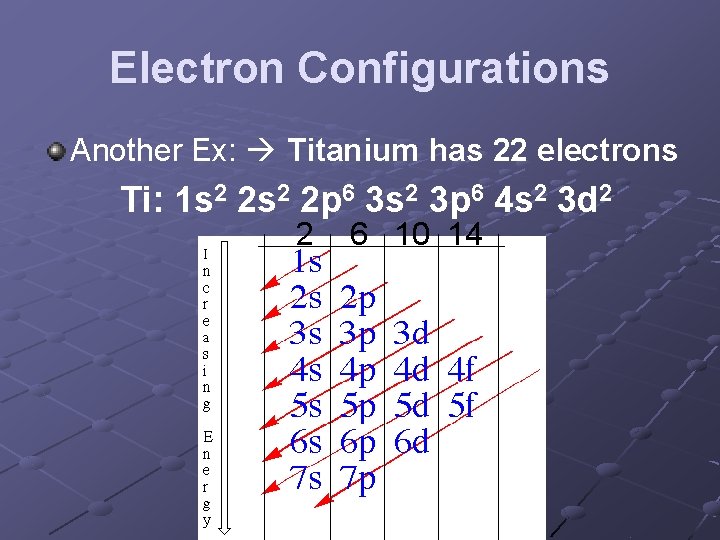
Electron Configurations Another Ex: Titanium has 22 electrons Ti: 1 s 2 2 p 6 3 s 2 3 p 6 4 s 2 3 d 2 2 6 10 14
Electron Configurations Here is a similar diagram for EC
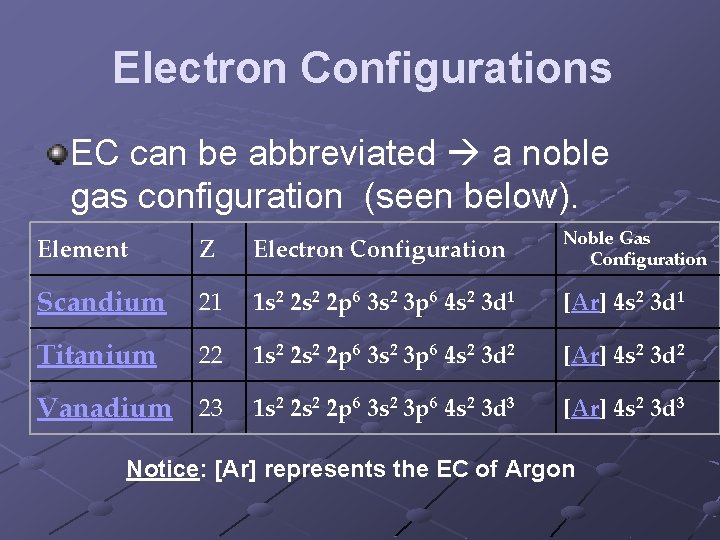
Electron Configurations EC can be abbreviated a noble gas configuration (seen below). Element Z Electron Configuration Noble Gas Configuration Scandium 21 1 s 2 2 p 6 3 s 2 3 p 6 4 s 2 3 d 1 [Ar] 4 s 2 3 d 1 Titanium 22 1 s 2 2 p 6 3 s 2 3 p 6 4 s 2 3 d 2 [Ar] 4 s 2 3 d 2 Vanadium 23 1 s 2 2 p 6 3 s 2 3 p 6 4 s 2 3 d 3 [Ar] 4 s 2 3 d 3 Notice: [Ar] represents the EC of Argon
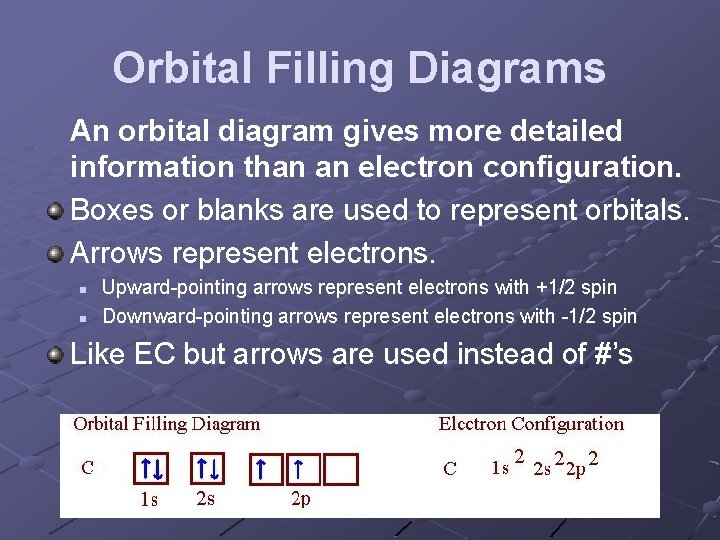
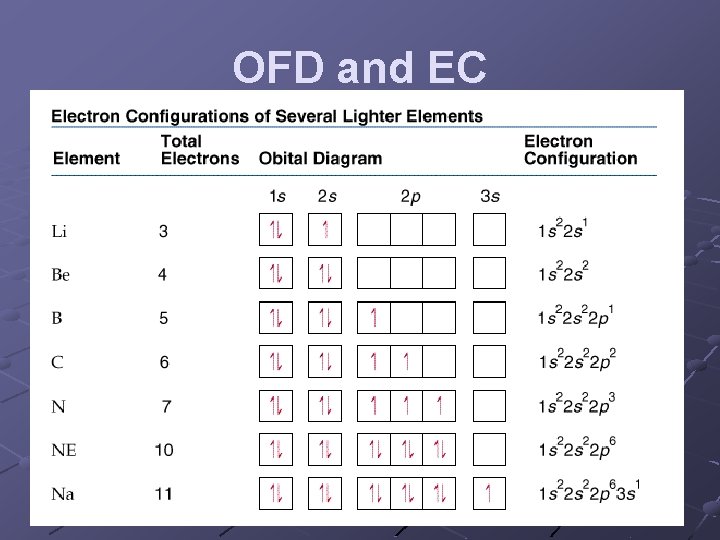
Orbital Filling Diagrams An orbital diagram gives more detailed information than an electron configuration. Boxes or blanks are used to represent orbitals. Arrows represent electrons. n n Upward-pointing arrows represent electrons with +1/2 spin Downward-pointing arrows represent electrons with -1/2 spin Like EC but arrows are used instead of #’s
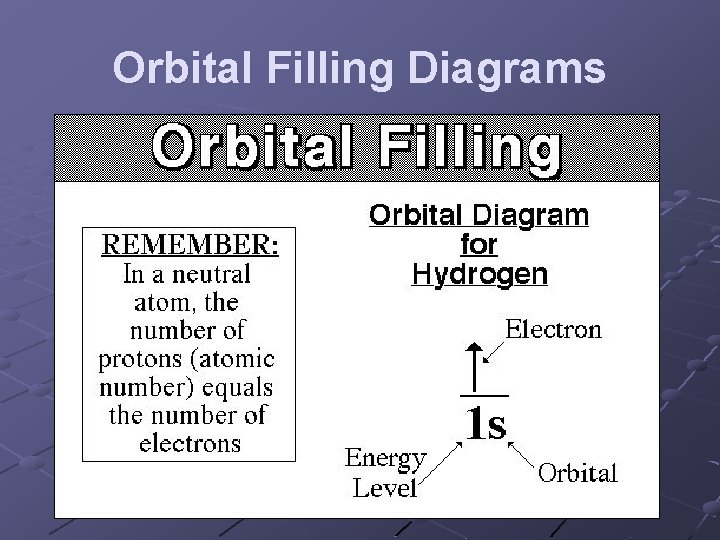
Orbital Filling Diagrams
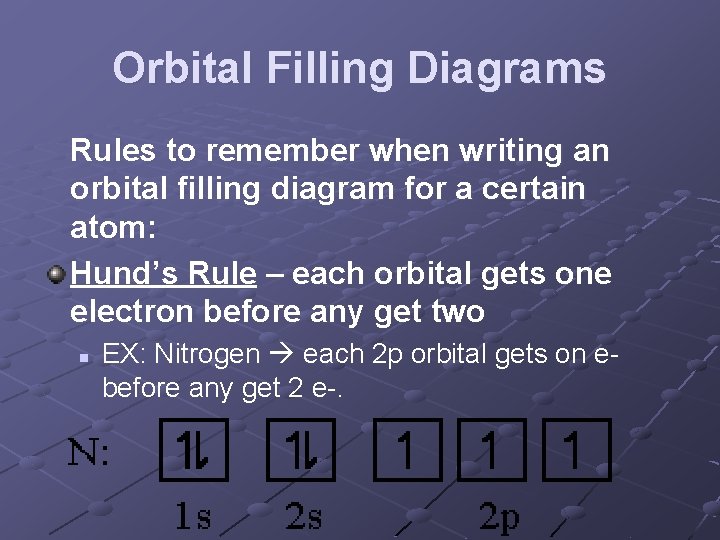
Orbital Filling Diagrams Rules to remember when writing an orbital filling diagram for a certain atom: Hund’s Rule – each orbital gets one electron before any get two n EX: Nitrogen each 2 p orbital gets on ebefore any get 2 e-.
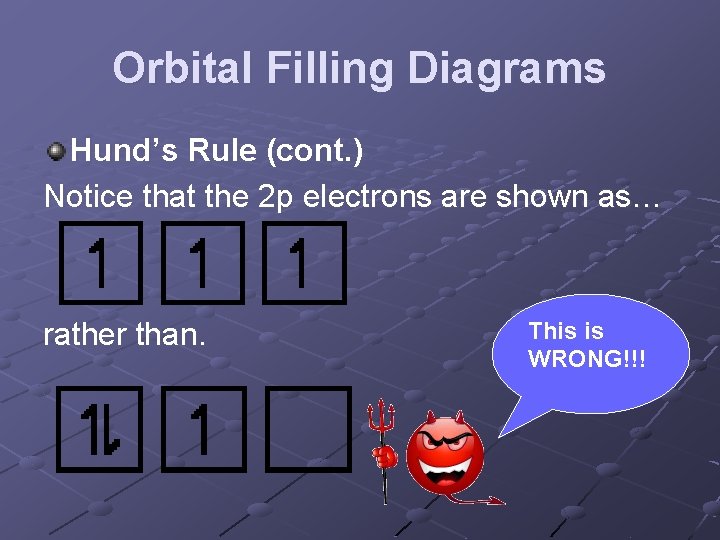
Orbital Filling Diagrams Hund’s Rule (cont. ) Notice that the 2 p electrons are shown as… rather than. This is WRONG!!!
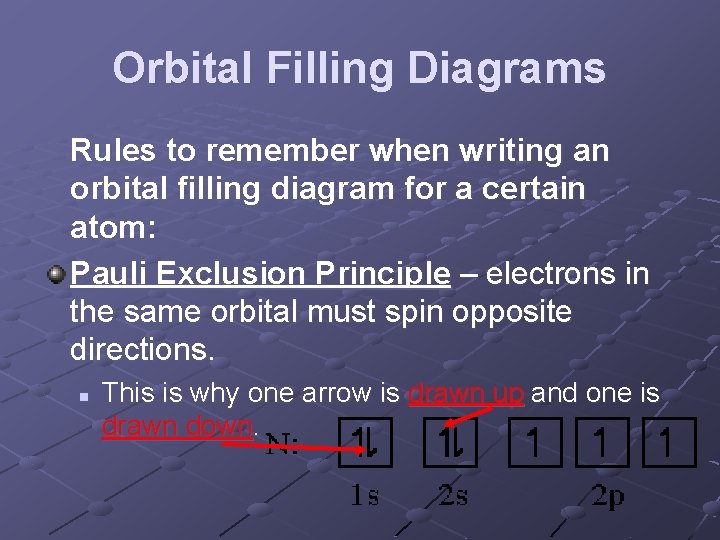
Orbital Filling Diagrams Rules to remember when writing an orbital filling diagram for a certain atom: Pauli Exclusion Principle – electrons in the same orbital must spin opposite directions. n This is why one arrow is drawn up and one is drawn down.
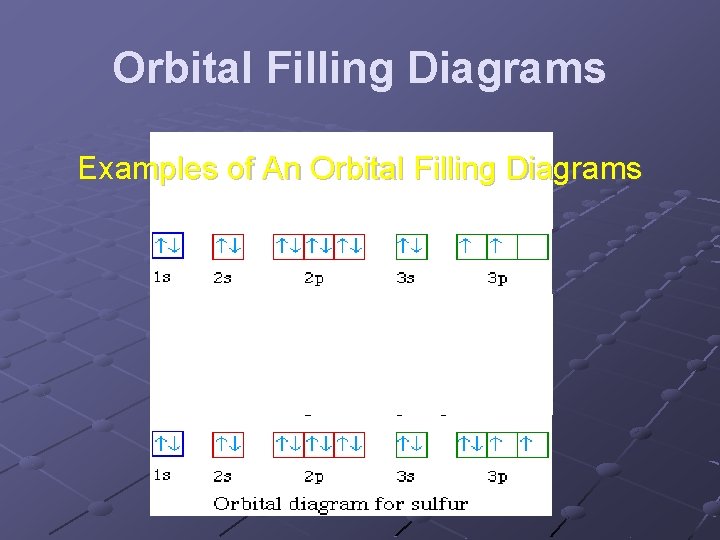
Orbital Filling Diagrams Examples of An Orbital Filling Diagrams
OFD and EC
Summary Be able to… Explain what EC and OFD are Write and EC n Recall the Auf Bau Principle Write and OFD n n Recall Hund’s Rule Recall the Pauli Exclusion Principle