
Chemistry Measurement Notes Chapter 3 Significant Figures Scientific
- Slides: 11
Chemistry Measurement Notes Chapter 3: Significant Figures, Scientific Notation, Metric Conversions
Measurement l Units: – – – l Mass = Volume = Length = Temperature= Density= Heat= Without units, data has no meaning….
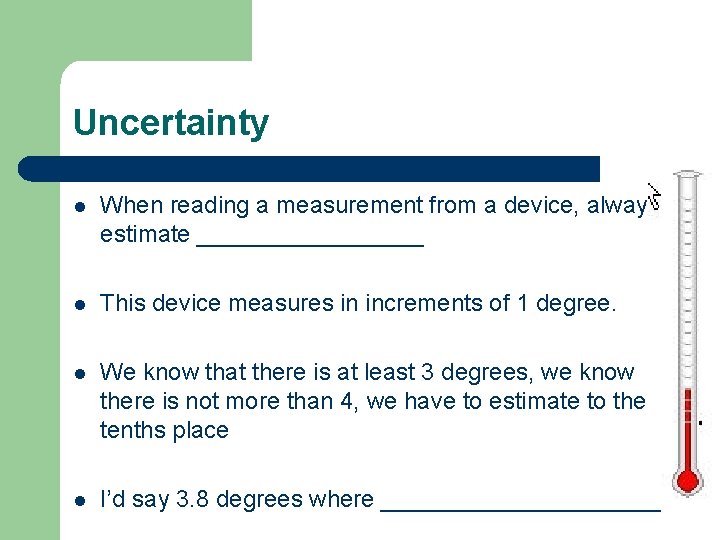
Uncertainty l When reading a measurement from a device, always estimate _________ l This device measures in increments of 1 degree. l We know that there is at least 3 degrees, we know there is not more than 4, we have to estimate to the tenths place l I’d say 3. 8 degrees where ___________
Accuracy vs. Precision l Accuracy- l Precision- l Example- a substance has a density of 3. 00 g/m. L. In the lab, you find the density to be:
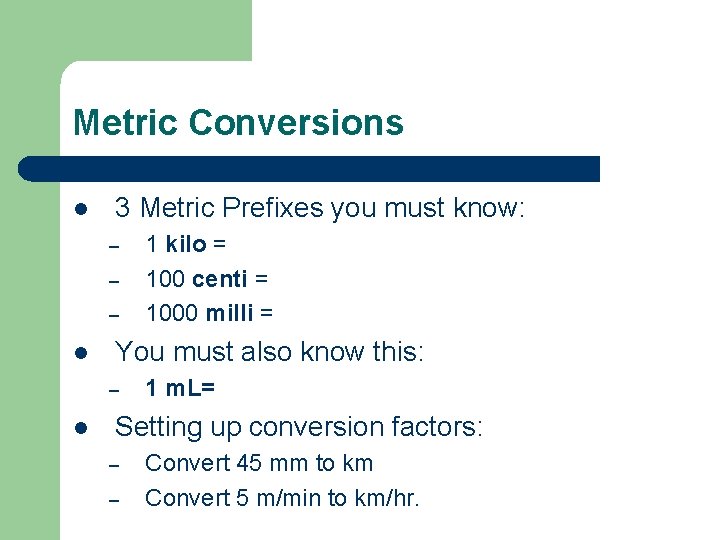
Metric Conversions l 3 Metric Prefixes you must know: – – – l You must also know this: – l 1 kilo = 100 centi = 1000 milli = 1 m. L= Setting up conversion factors: – – Convert 45 mm to km Convert 5 m/min to km/hr.
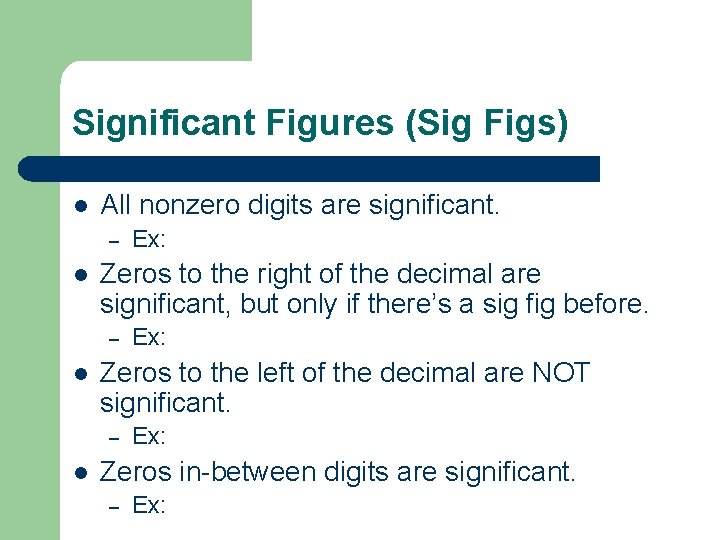
Significant Figures (Sig Figs) l All nonzero digits are significant. – l Zeros to the right of the decimal are significant, but only if there’s a sig fig before. – l Ex: Zeros to the left of the decimal are NOT significant. – l Ex: Zeros in-between digits are significant. – Ex:
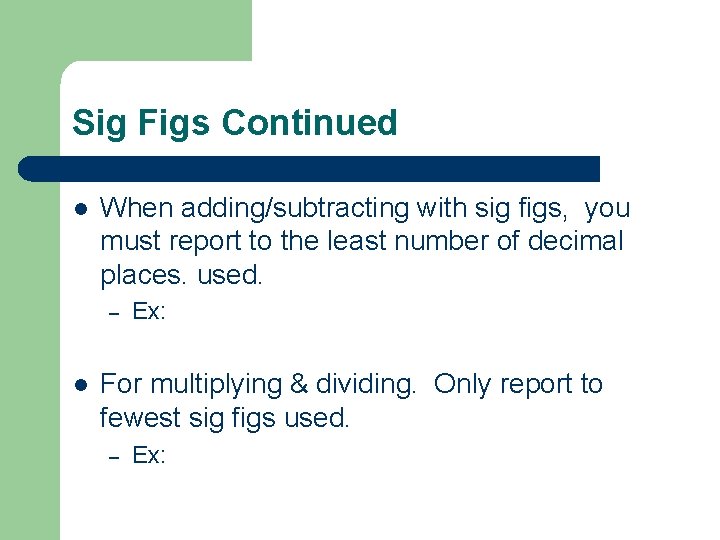
Sig Figs Continued l When adding/subtracting with sig figs, you must report to the least number of decimal places. used. – l Ex: For multiplying & dividing. Only report to fewest sig figs used. – Ex:
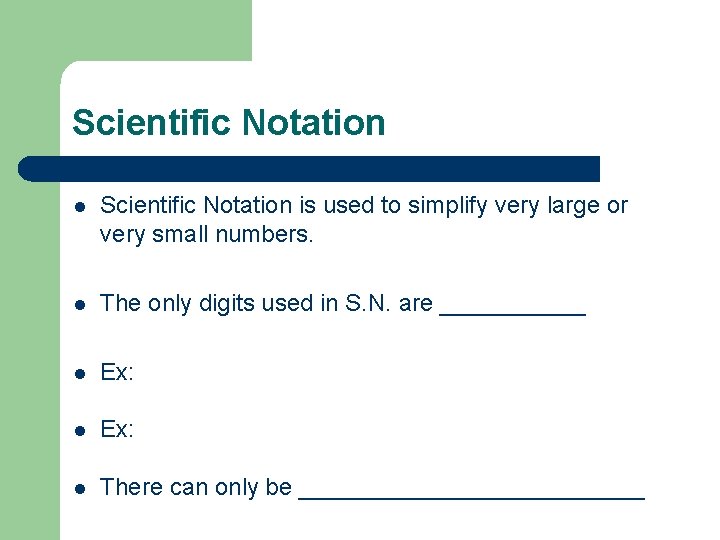
Scientific Notation l Scientific Notation is used to simplify very large or very small numbers. l The only digits used in S. N. are ______ l Ex: l There can only be _____________
Calculating with S. N. l When you multiply, – l When you divide, – l Ex: For addition and subtraction, – Ex:
Celsius to Kelvin
Error & Uncertainty in Measurement l Plus/Minus Notation l Percent Error