
Chemistry Matter Unit What is matter What is
- Slides: 61
Chemistry – Matter Unit • What is matter? • What is chemistry? • What is the organization of matter? • What is the nature of matter?
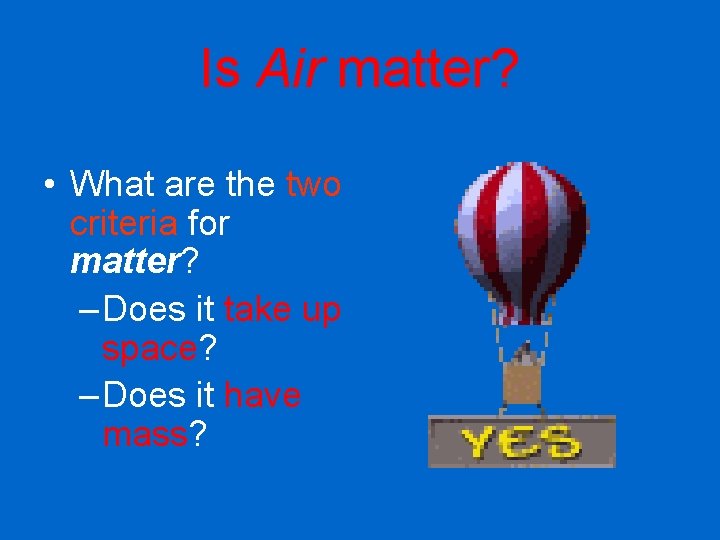
Is Air matter? • What are the two criteria for matter? – Does it take up space? – Does it have mass?
What is chemistry? • “Chemistry is the study of the composition, structure, and the properties of matter and the changes it undergoes. ”
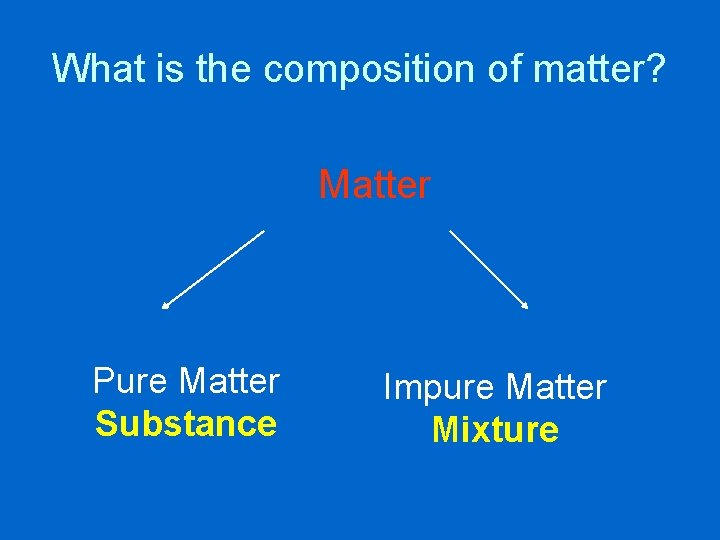
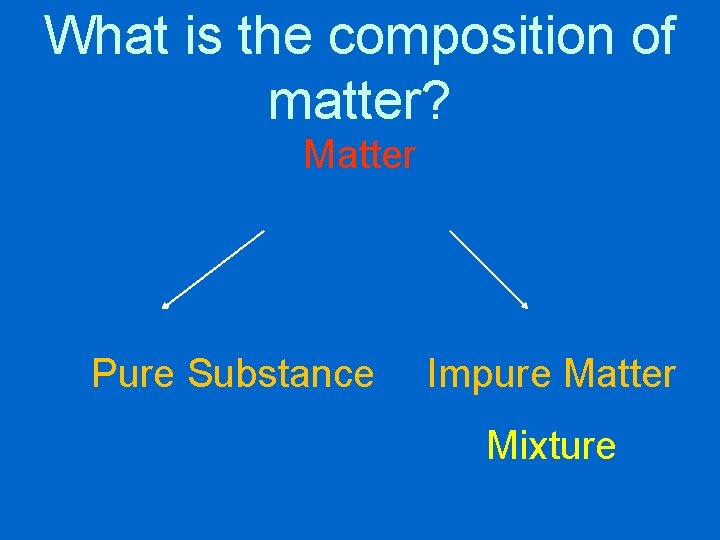
What is the composition of matter? Matter Pure Matter Substance Impure Matter Mixture
What is a pure substance? • A pure substance has a definite composition (proportion). • The composition of a substance will have the same percent of elements no matter where the sample was obtained. – Water from Lake Okechobee and water from the Atlantic Ocean (once cleaned up) will have the same composition of hydrogen to oxygen. – Gold is the same as other gold (once cleaned up).
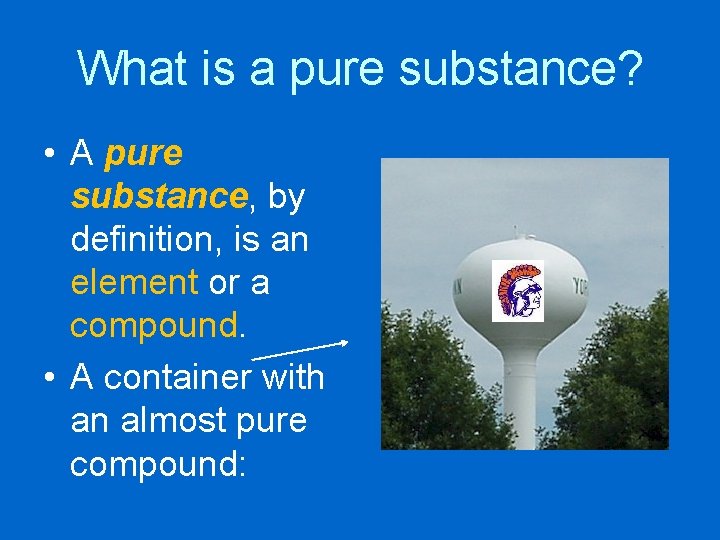
What is a pure substance? • A pure substance, by definition, is an element or a compound. • A container with an almost pure compound:
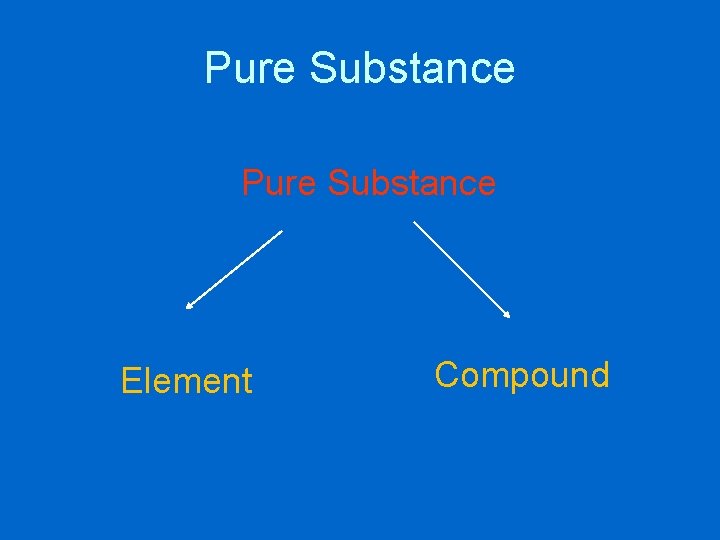
Pure Substance Element Compound
What is an element? • “a pure substance made of only one kind of atom” • A substance that cannot be decomposed any farther by simple chemical means • An element has a definite composition. Gold from South Africa is the same, when purified, as a sample from California.
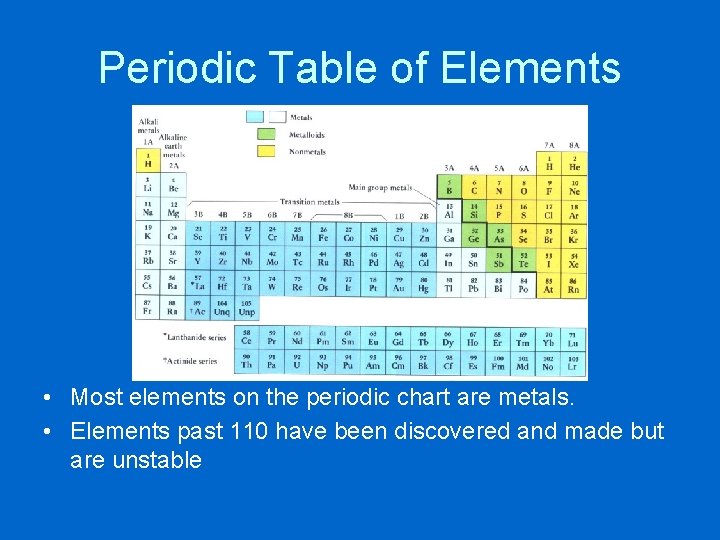
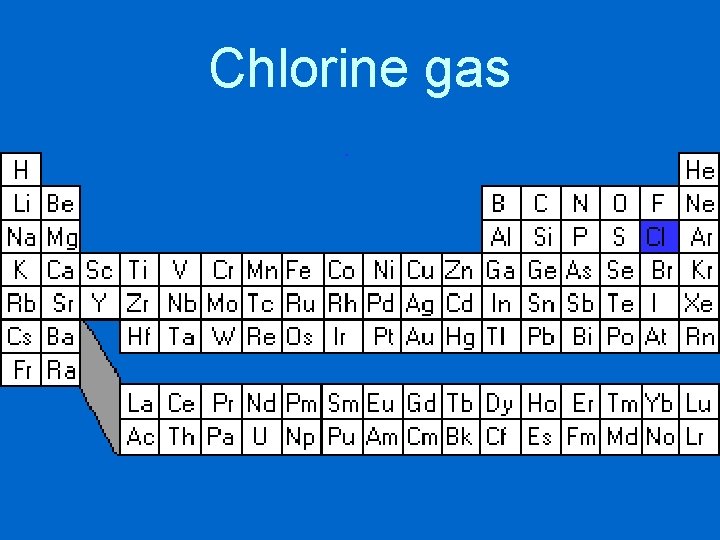
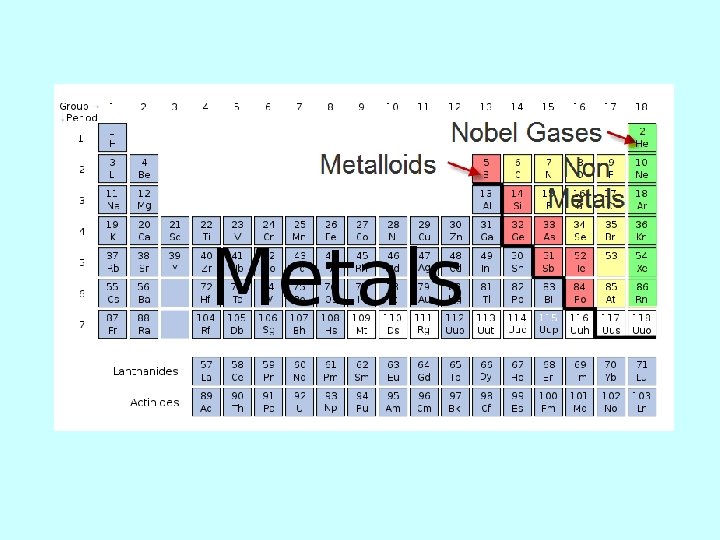
Periodic Table of Elements • Most elements on the periodic chart are metals. • Elements past 110 have been discovered and made but are unstable
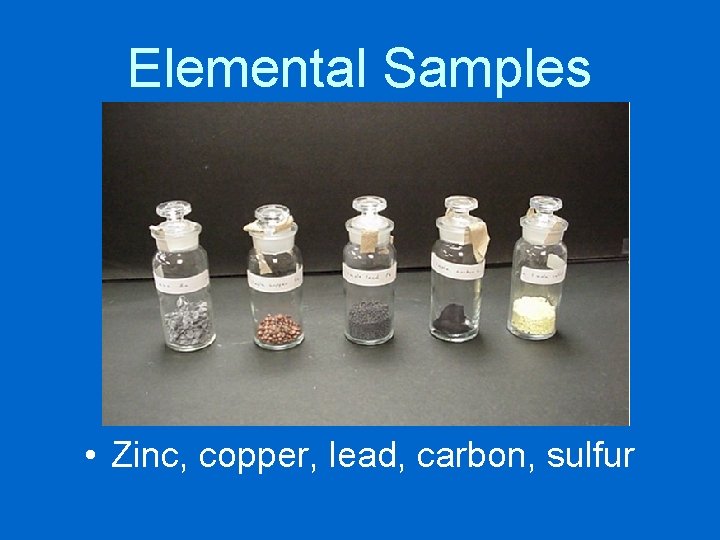
Elemental Samples • Zinc, copper, lead, carbon, sulfur
What is a compound? • “A compound is a substance that is made from the atoms of two or more elements that are chemically bonded. ” • The definition is actually more involved than this.
What is a compound? • A compound is a substance that cannot be decomposed any farther by simple physical means. • A compound has a definite composition by mass. • A compound is made up of two or more elements chemically combined.
What is a compound? • A compound no longer has the properties of its constituent elements. • Table salt, Na. Cl or sodium chloride, is a compound of the element sodium and the element chlorine.
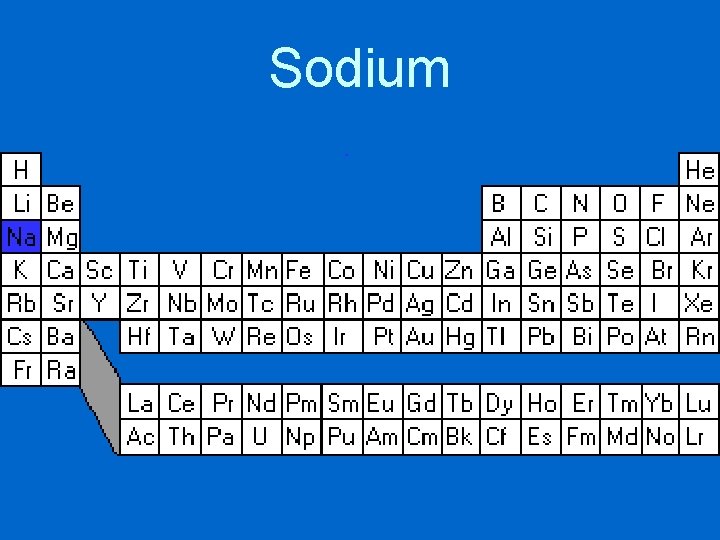
Sodium
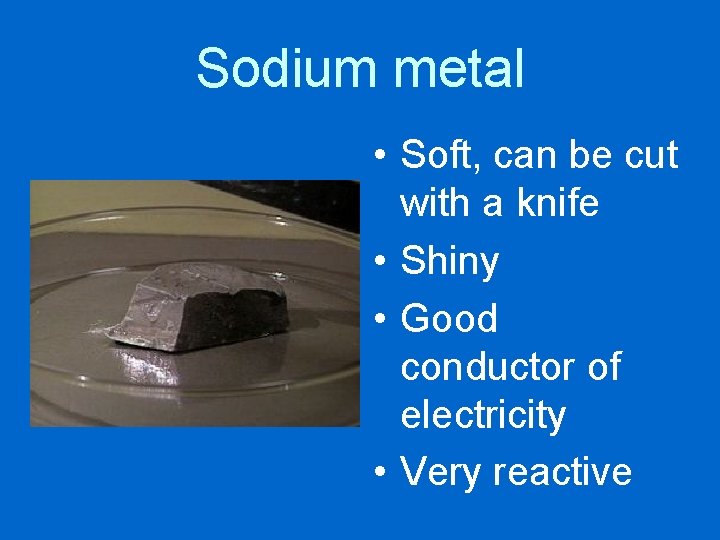
Sodium metal • Soft, can be cut with a knife • Shiny • Good conductor of electricity • Very reactive
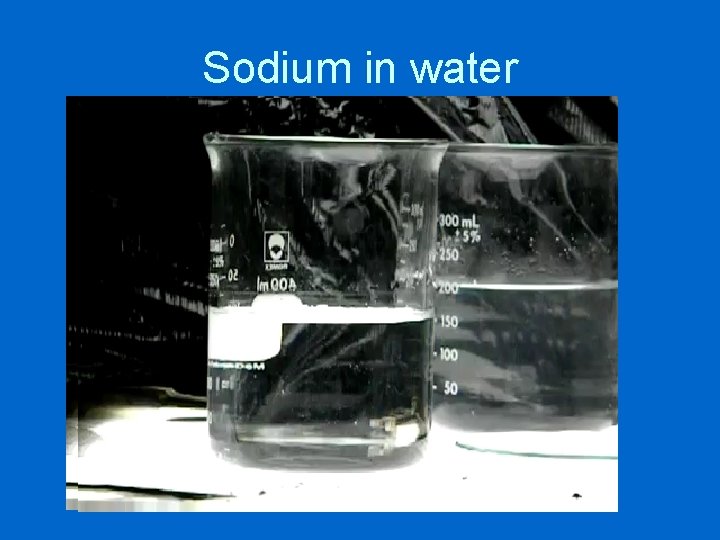
Sodium in water
Chlorine gas
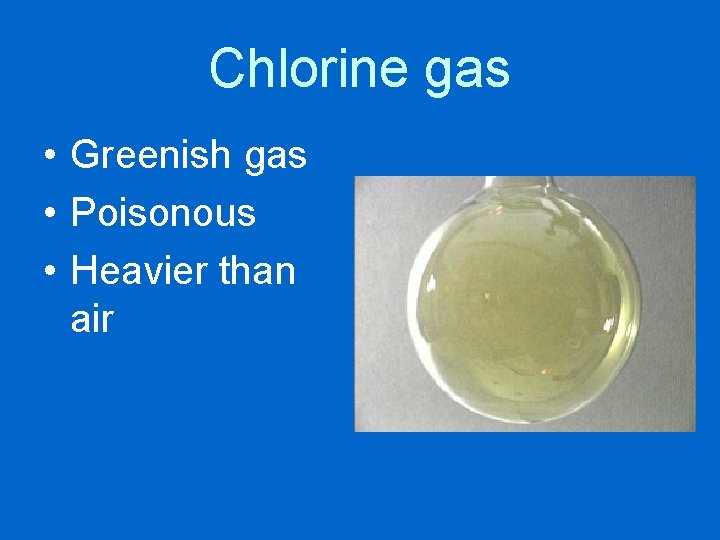
Chlorine gas • Greenish gas • Poisonous • Heavier than air
Sodium in chlorine gas
Sodium chloride, Na. Cl • Sodium chloride dissolves in water rather than reacts with water. • Sodium chloride is a white solid, not a poisonous green gas. • Sodium chloride is its own substance with its own properties, not those of either sodium or chlorine.
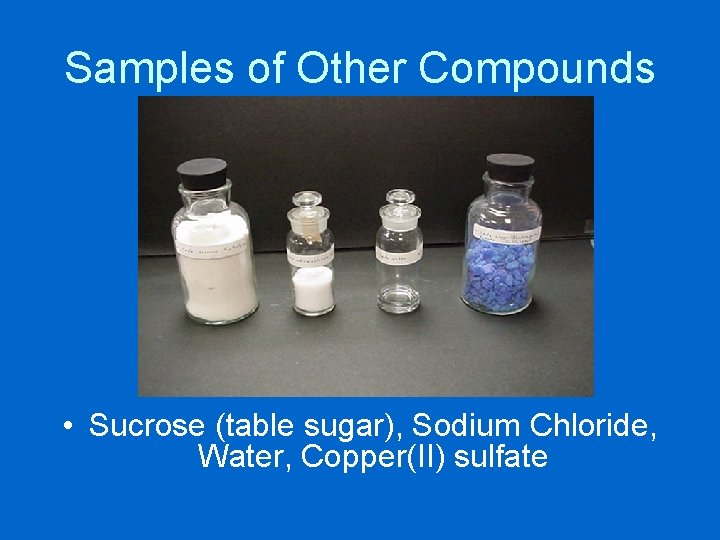
Samples of Other Compounds • Sucrose (table sugar), Sodium Chloride, Water, Copper(II) sulfate
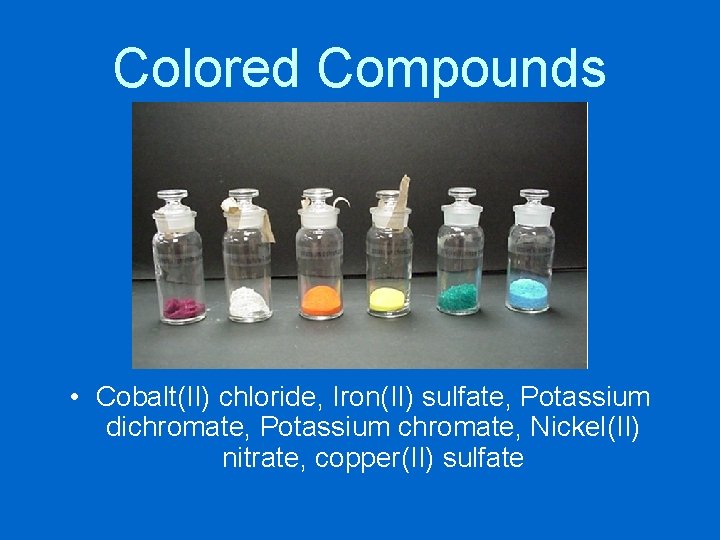
Colored Compounds • Cobalt(II) chloride, Iron(II) sulfate, Potassium dichromate, Potassium chromate, Nickel(II) nitrate, copper(II) sulfate
What is the composition of matter? Matter Pure Substance Impure Matter Mixture
Impure Matter - Mixture • “A mixture is a blend of two or more kinds of matter, each of which retains its own identity and properties. ” • A mixture is made up of two or more substances that are not chemically combined.
Mixtures • Mixtures can be separated by simple physical means. • Two mixtures containing the same substances may not have the same proportions. • Example: Very salty water versus barely salty water. Very sweet sugar water versus slightly sweet sugar water.
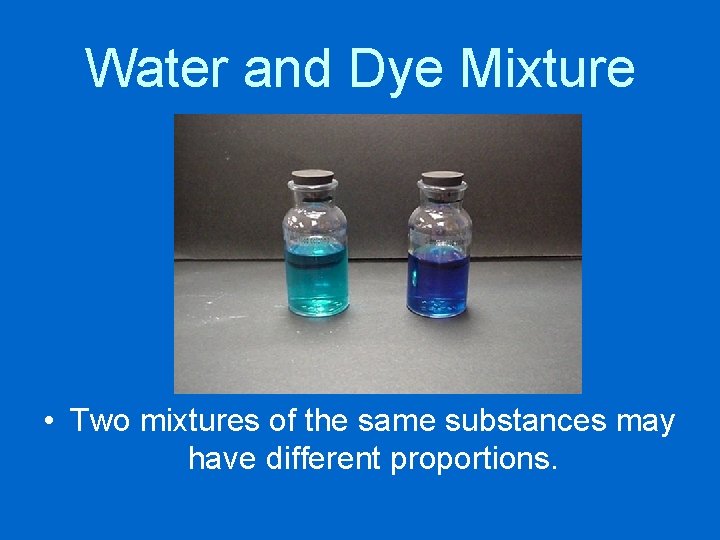
Water and Dye Mixture • Two mixtures of the same substances may have different proportions.
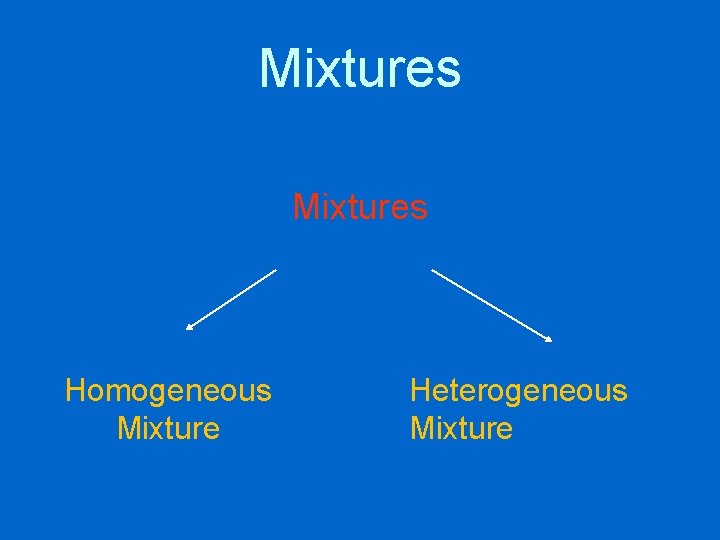
Mixtures Homogeneous Mixture Heterogeneous Mixture
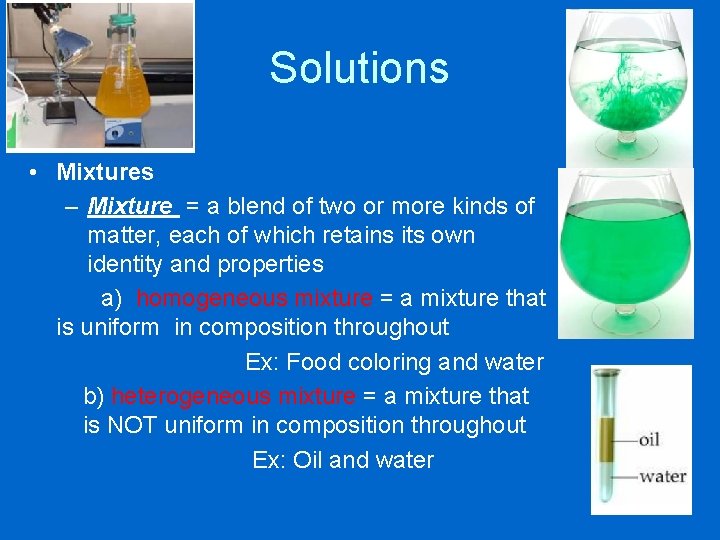
Solutions • Mixtures – Mixture = a blend of two or more kinds of matter, each of which retains its own identity and properties a) homogeneous mixture = a mixture that is uniform in composition throughout Ex: Food coloring and water b) heterogeneous mixture = a mixture that is NOT uniform in composition throughout Ex: Oil and water
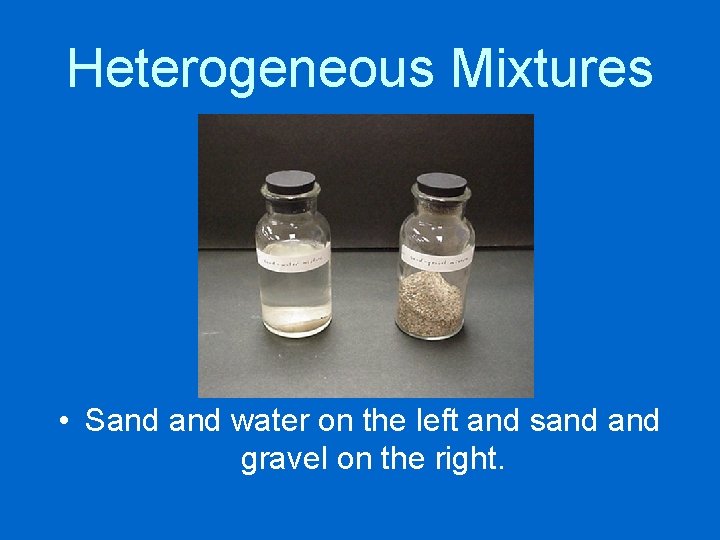
Heterogeneous Mixtures • Sand water on the left and sand gravel on the right.
THE NATURE OF SOLUTIONS: 1) Solvent = the substance that does the dissolving in a solution a) Typically present in the greatest amount b) Typically a liquid c) Water is the most common or “universal” solvent 2) Solute = substance being dissolved in a solution a) Typically present in the least amount b) Typically a solid
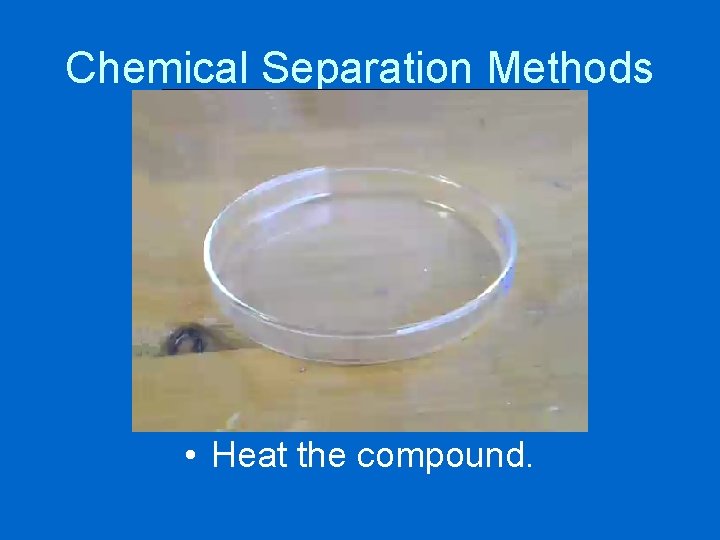
Chemical Separation Methods • Heat the compound.
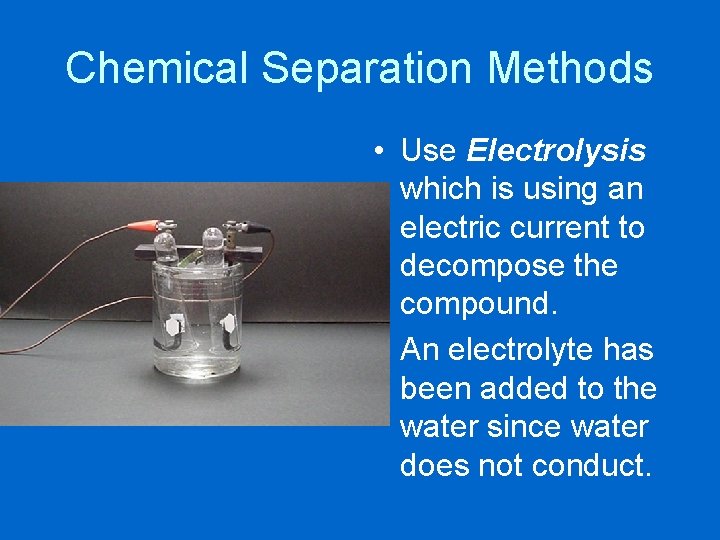
Chemical Separation Methods • Use Electrolysis which is using an electric current to decompose the compound. • An electrolyte has been added to the water since water does not conduct.
Mixtures • How can mixtures be separated? –Use Physical Separation Methods. What are examples of physical separation methods?
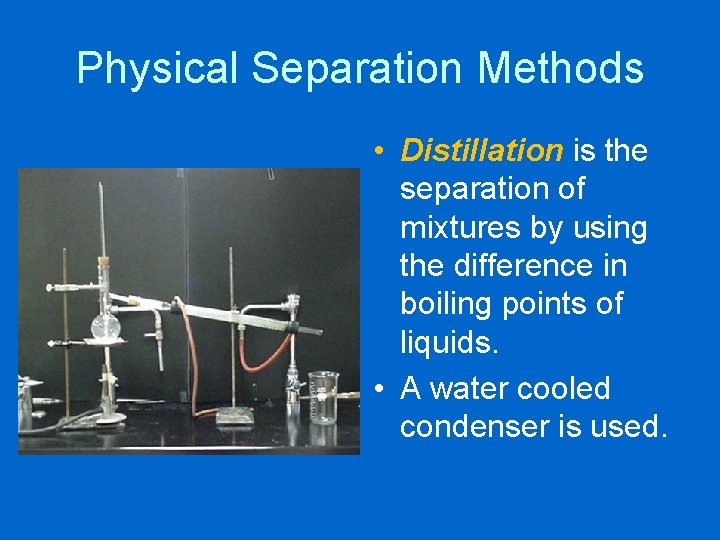
Physical Separation Methods • Distillation is the separation of mixtures by using the difference in boiling points of liquids. • A water cooled condenser is used.
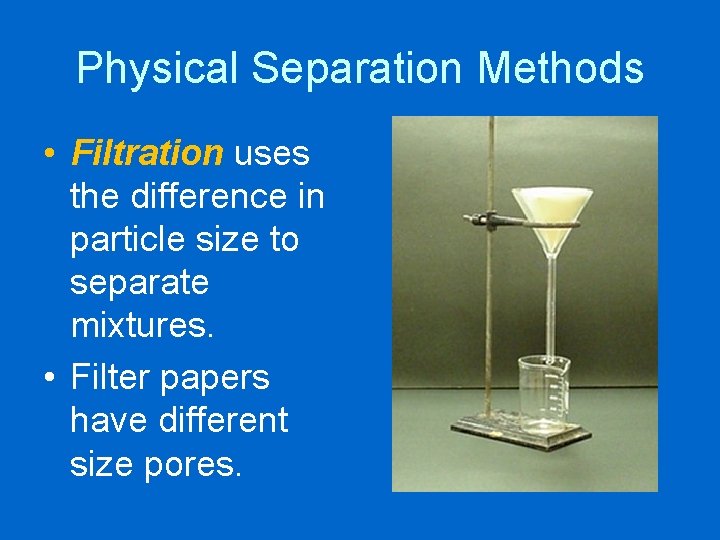
Physical Separation Methods • Filtration uses the difference in particle size to separate mixtures. • Filter papers have different size pores.
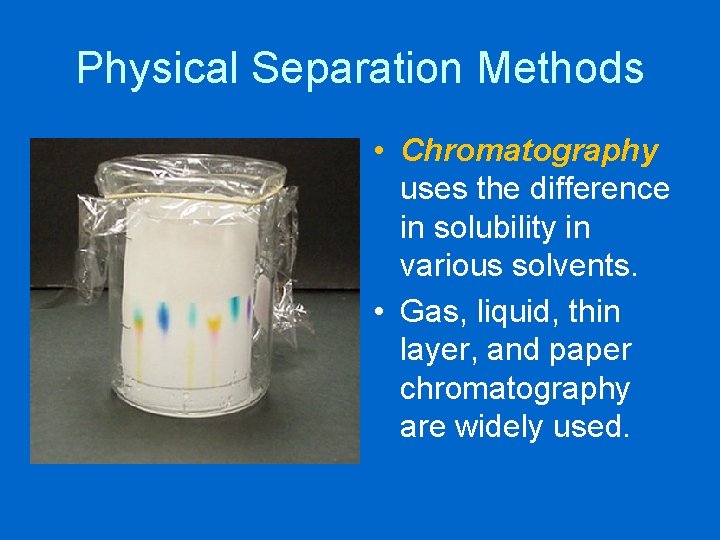
Physical Separation Methods • Chromatography uses the difference in solubility in various solvents. • Gas, liquid, thin layer, and paper chromatography are widely used.
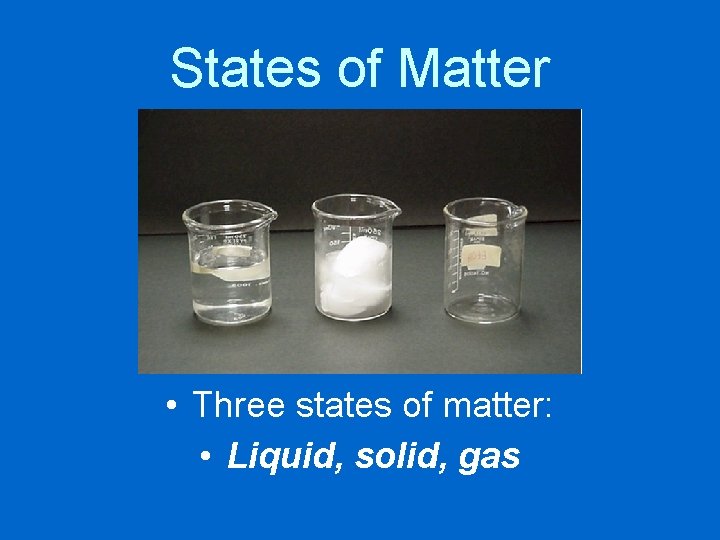
States of Matter • Three states of matter: • Liquid, solid, gas
Physical Changes • During physical changes matter changes in appearance without forming new substances. • What some examples of physical changes?
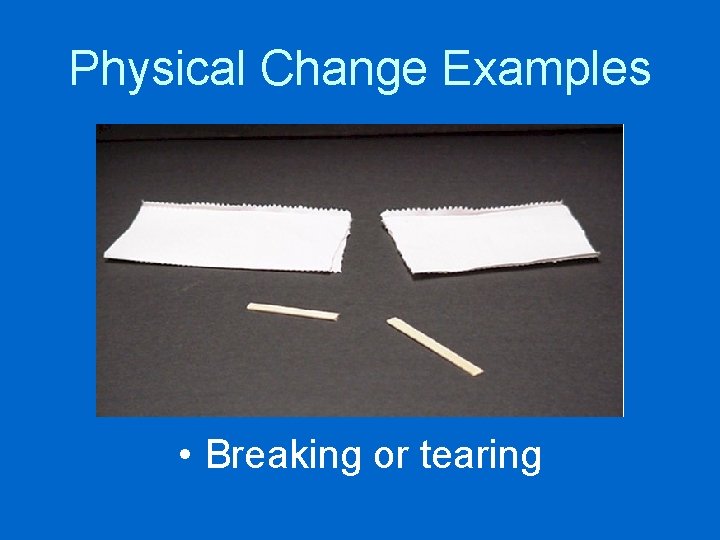
Physical Change Examples • Breaking or tearing
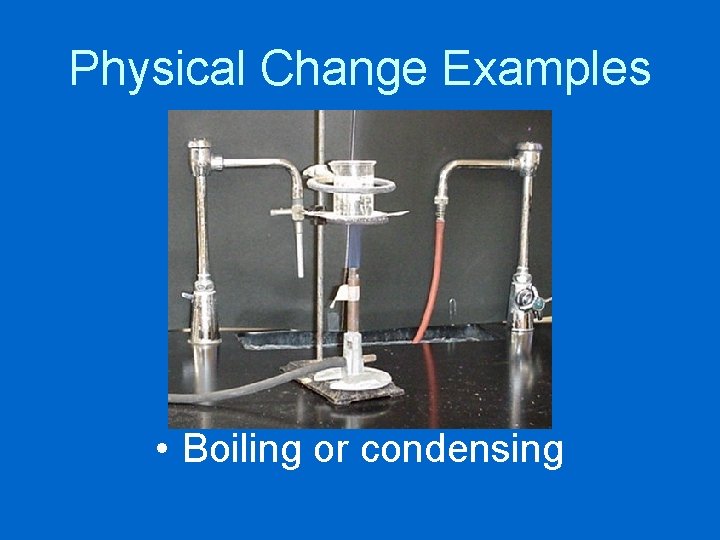
Physical Change Examples • Boiling or condensing
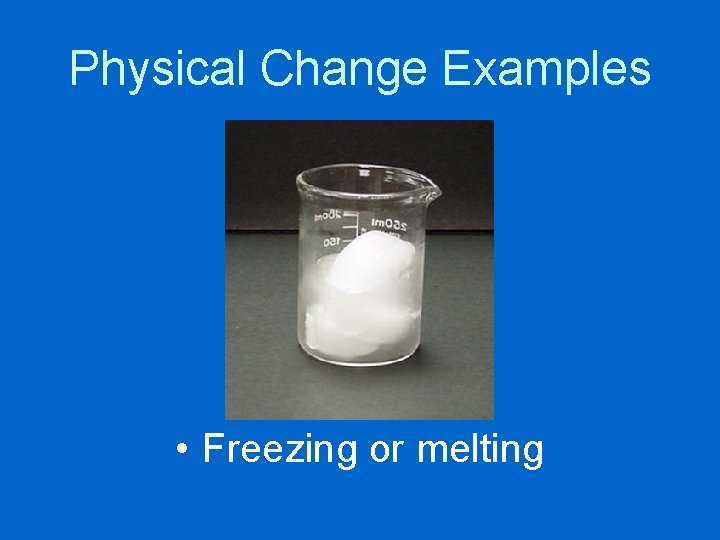
Physical Change Examples • Freezing or melting
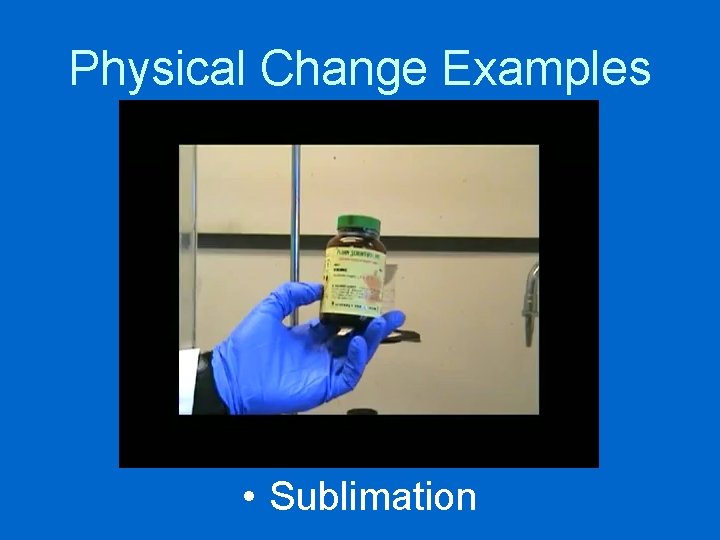
Physical Change Examples • Sublimation
Physical Change Examples • Sublimation: • “The change of state directly to a gas is known as sublimation. ” • “The reverse process is called deposition, the change of state from a gas directly to a solid. ”
Chemical Changes • During chemical changes new substances are formed with different properties than the original substances. • What is an example of a chemical change?
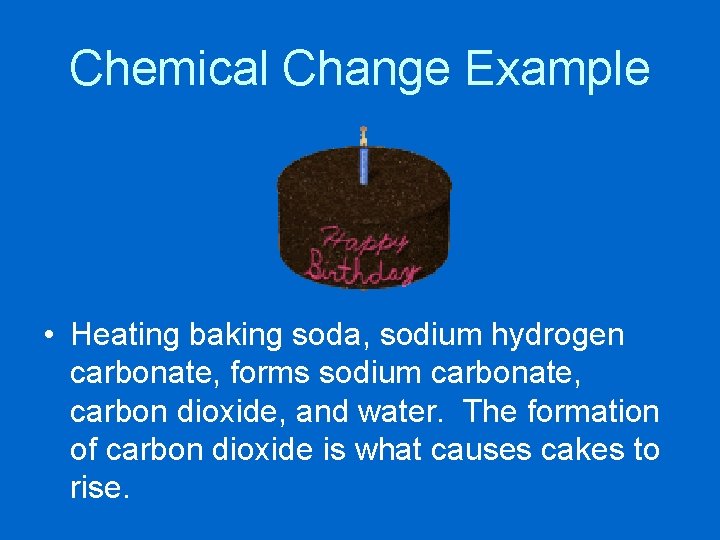
Chemical Change Example • Heating baking soda, sodium hydrogen carbonate, forms sodium carbonate, carbon dioxide, and water. The formation of carbon dioxide is what causes cakes to rise.
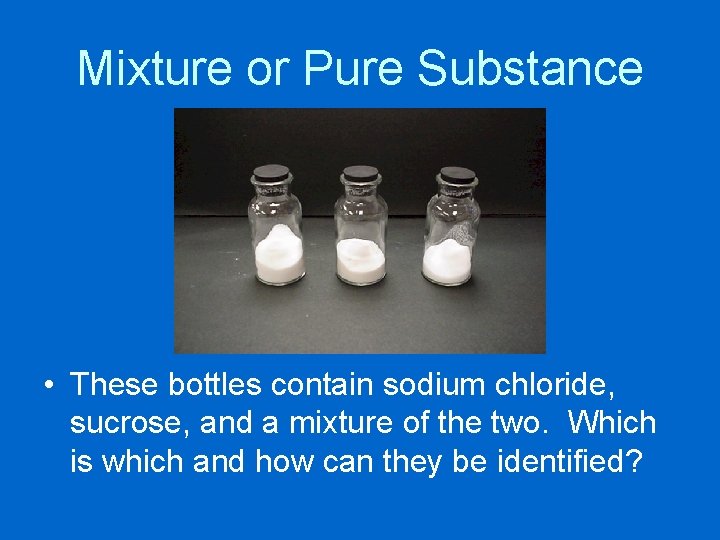
Mixture or Pure Substance • These bottles contain sodium chloride, sucrose, and a mixture of the two. Which is which and how can they be identified?
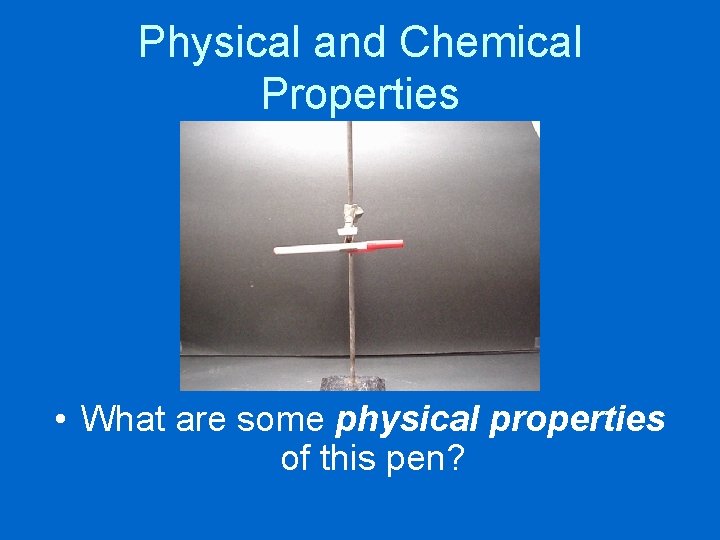
Physical and Chemical Properties • What are some physical properties of this pen?
Physical Properties • Examples: – Color – Hardness – Texture – Volume – Length – Mass
Physical Properties • More Examples: – Density (mass/volume ratio) – Odor – Sound – Boiling point – Melting point – Magnetism
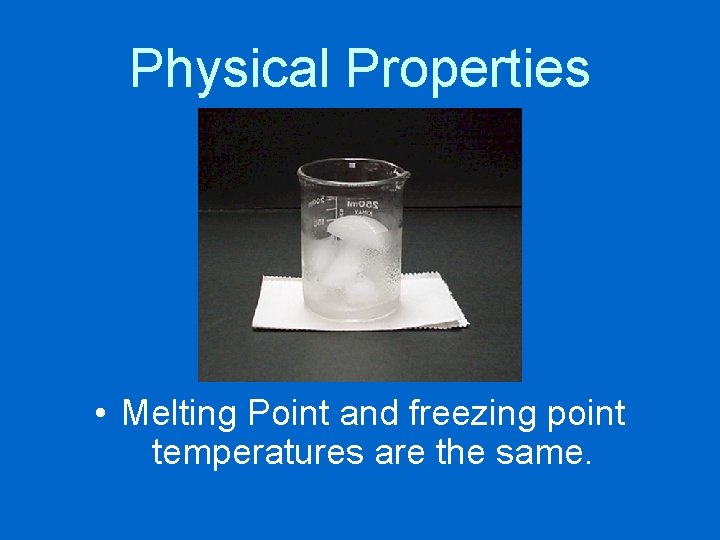
Physical Properties • Melting Point and freezing point temperatures are the same.
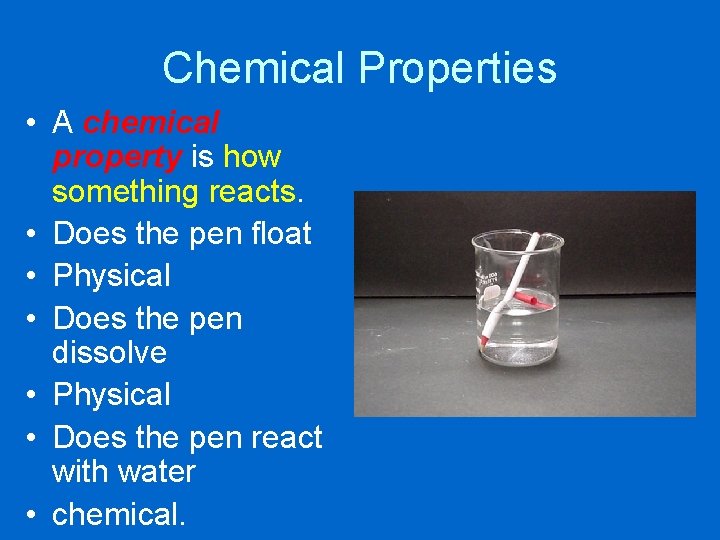
Chemical Properties • A chemical property is how something reacts. • Does the pen float • Physical • Does the pen dissolve • Physical • Does the pen react with water • chemical.
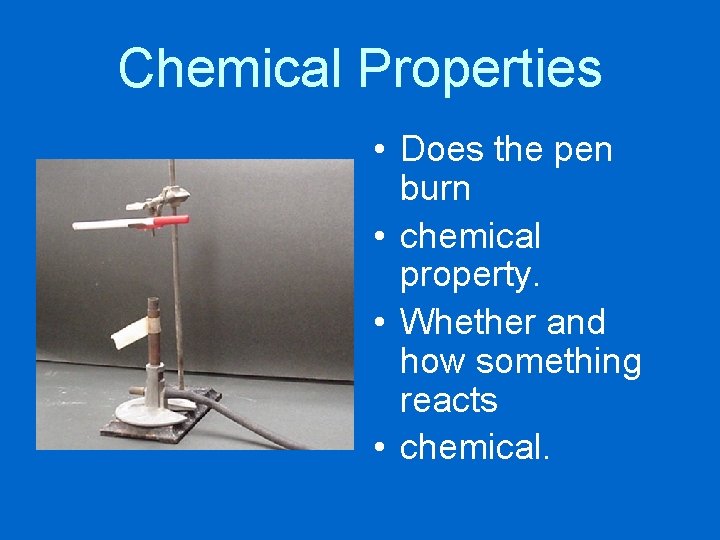
Chemical Properties • Does the pen burn • chemical property. • Whether and how something reacts • chemical.
Extensive vs Intensive • Extensive Properties depend upon the amount of matter that is present. • Intensive Properties do not depend on the amount of matter present. These properties are the same for a given substance regardless of how much of the substance is present.
Periodic Table
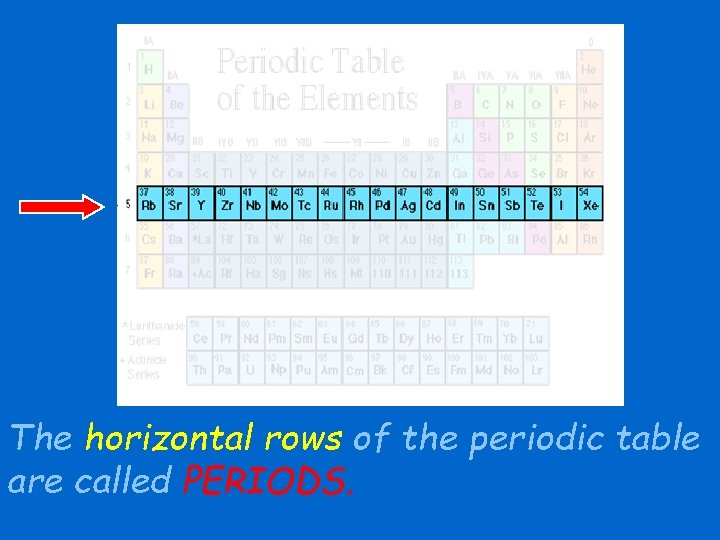
The horizontal rows of the periodic table are called PERIODS.
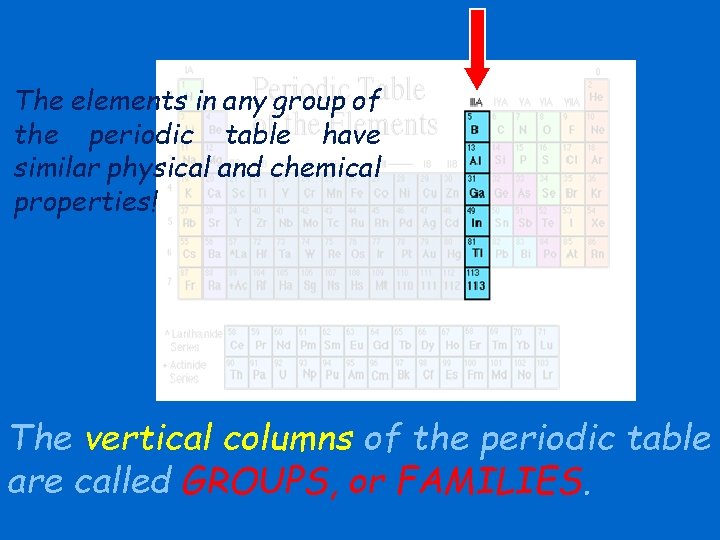
The elements in any group of the periodic table have similar physical and chemical properties! The vertical columns of the periodic table are called GROUPS, or FAMILIES.
silicon
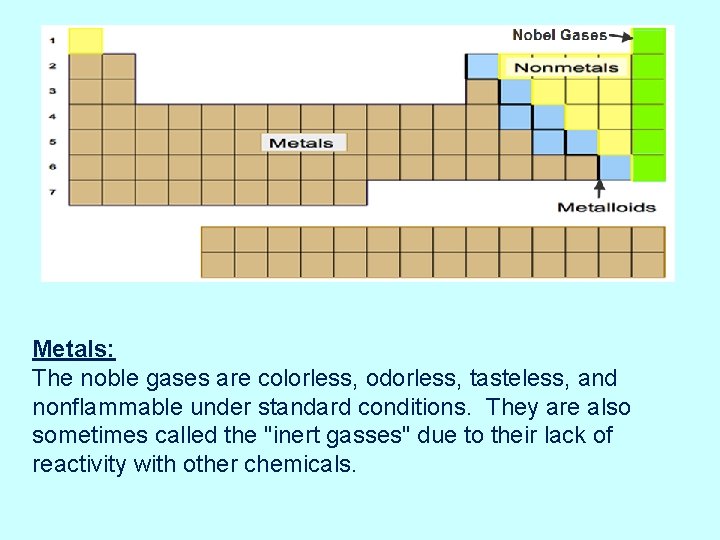
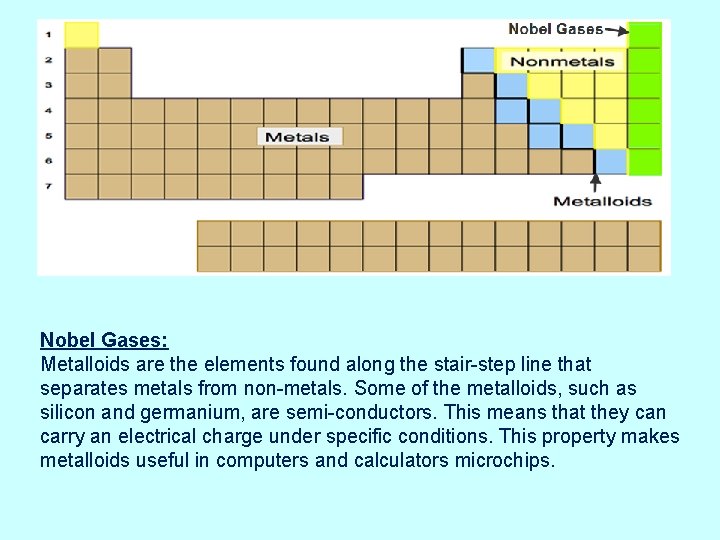
Metals: The noble gases are colorless, odorless, tasteless, and nonflammable under standard conditions. They are also sometimes called the "inert gasses" due to their lack of reactivity with other chemicals.
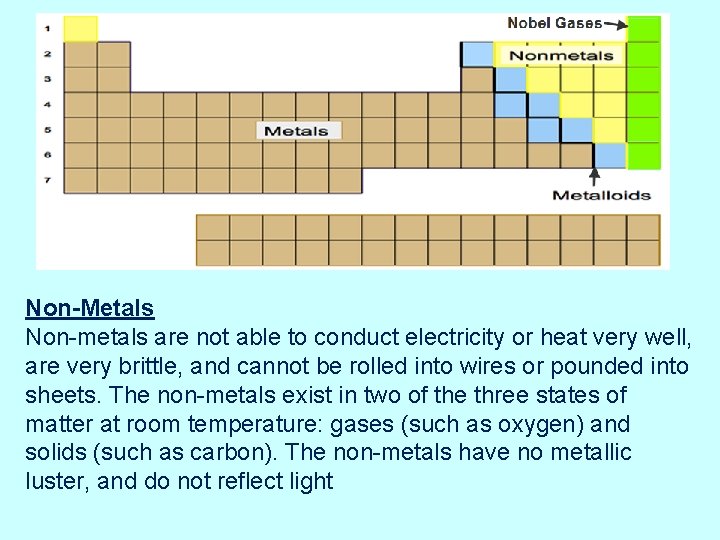
Non-Metals Non-metals are not able to conduct electricity or heat very well, are very brittle, and cannot be rolled into wires or pounded into sheets. The non-metals exist in two of the three states of matter at room temperature: gases (such as oxygen) and solids (such as carbon). The non-metals have no metallic luster, and do not reflect light
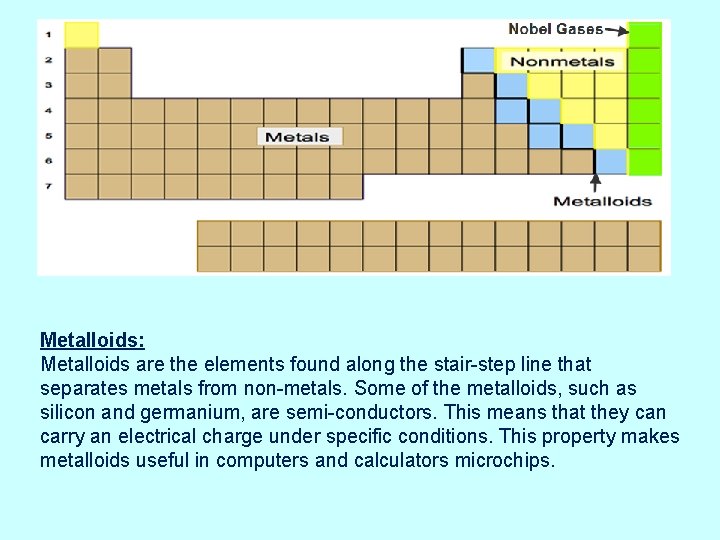
Metalloids: Metalloids are the elements found along the stair-step line that separates metals from non-metals. Some of the metalloids, such as silicon and germanium, are semi-conductors. This means that they can carry an electrical charge under specific conditions. This property makes metalloids useful in computers and calculators microchips.
Nobel Gases: Metalloids are the elements found along the stair-step line that separates metals from non-metals. Some of the metalloids, such as silicon and germanium, are semi-conductors. This means that they can carry an electrical charge under specific conditions. This property makes metalloids useful in computers and calculators microchips.