
Chemistry Lab WriteUp It is important to understand
Chemistry Lab Write-Up It is important to understand why you have to “write-up” a lab. A laboratory report (or lab write-up) is a tool used in science to communicate between scientists. Scientist come across reports of experiments and sometimes wish to duplicate an experiment. To be sure that the listed results were indeed accurate and not made up, the lab must be able to be duplicated. This is where accurate and effective communication comes into play. You must write-up your lab so that someone can duplicate your results to verify what you have done.
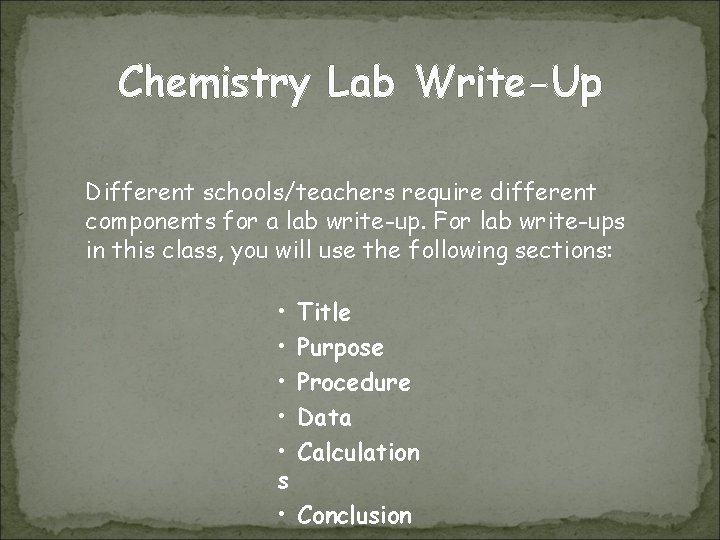
Chemistry Lab Write-Up Different schools/teachers require different components for a lab write-up. For lab write-ups in this class, you will use the following sections: • • • s • Title Purpose Procedure Data Calculation Conclusion
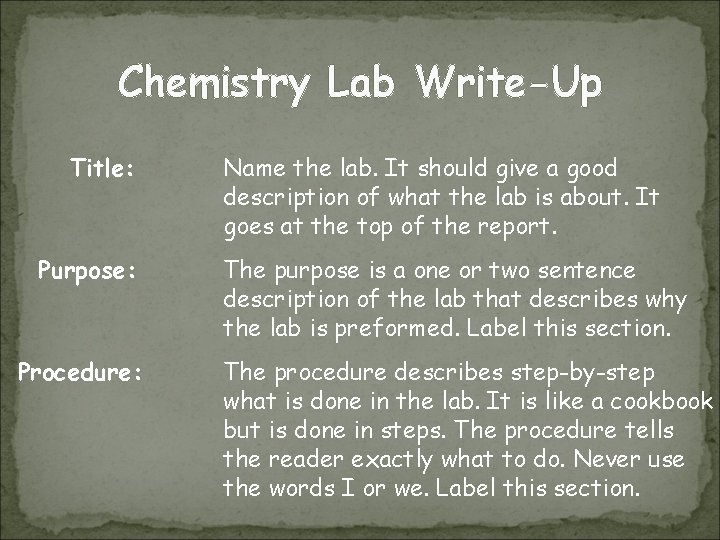
Chemistry Lab Write-Up Title: Purpose: Procedure: Name the lab. It should give a good description of what the lab is about. It goes at the top of the report. The purpose is a one or two sentence description of the lab that describes why the lab is preformed. Label this section. The procedure describes step-by-step what is done in the lab. It is like a cookbook but is done in steps. The procedure tells the reader exactly what to do. Never use the words I or we. Label this section.
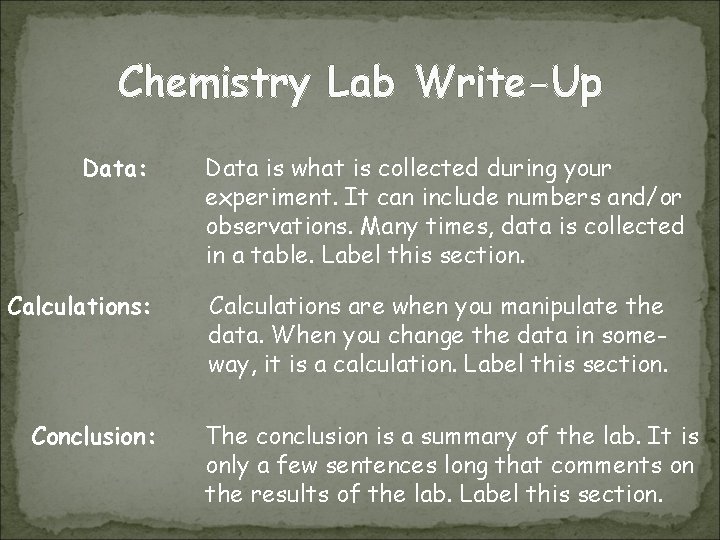
Chemistry Lab Write-Up Data: Calculations: Conclusion: Data is what is collected during your experiment. It can include numbers and/or observations. Many times, data is collected in a table. Label this section. Calculations are when you manipulate the data. When you change the data in someway, it is a calculation. Label this section. The conclusion is a summary of the lab. It is only a few sentences long that comments on the results of the lab. Label this section.
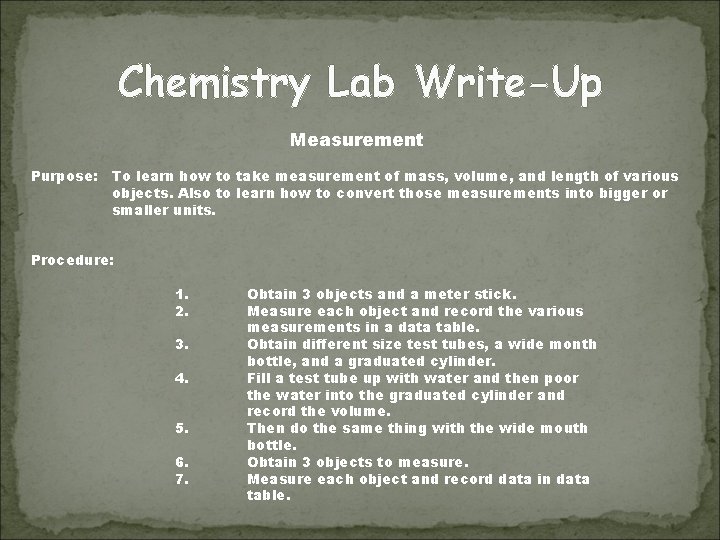
Chemistry Lab Write-Up Measurement Purpose: To learn how to take measurement of mass, volume, and length of various objects. Also to learn how to convert those measurements into bigger or smaller units. Procedure: 1. 2. 3. 4. 5. 6. 7. Obtain 3 objects and a meter stick. Measure each object and record the various measurements in a data table. Obtain different size test tubes, a wide month bottle, and a graduated cylinder. Fill a test tube up with water and then poor the water into the graduated cylinder and record the volume. Then do the same thing with the wide mouth bottle. Obtain 3 objects to measure. Measure each object and record data in data table.
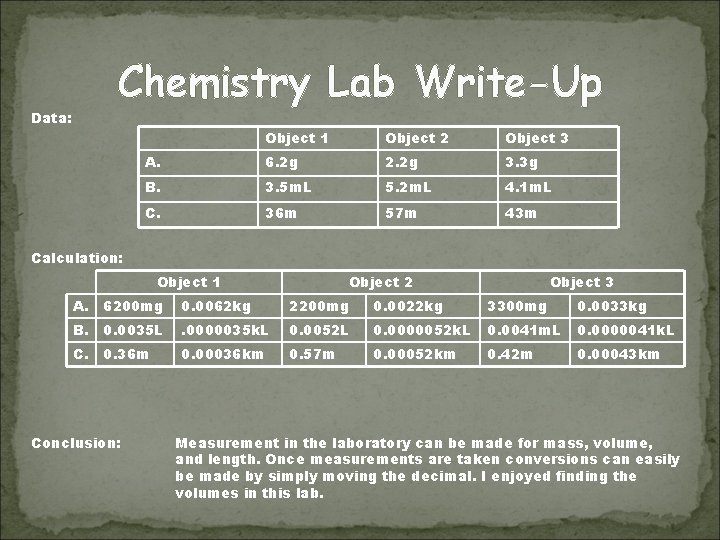
Chemistry Lab Write-Up Data: Object 1 Object 2 Object 3 A. 6. 2 g 2. 2 g 3. 3 g B. 3. 5 m. L 5. 2 m. L 4. 1 m. L C. 36 m 57 m 43 m Calculation: Object 1 Object 2 Object 3 A. 6200 mg 0. 0062 kg 2200 mg 0. 0022 kg 3300 mg 0. 0033 kg B. 0. 0035 L . 0000035 k. L 0. 0052 L 0. 0000052 k. L 0. 0041 m. L 0. 0000041 k. L C. 0. 36 m 0. 00036 km 0. 57 m 0. 00052 km 0. 42 m 0. 00043 km Conclusion: Measurement in the laboratory can be made for mass, volume, and length. Once measurements are taken conversions can easily be made by simply moving the decimal. I enjoyed finding the volumes in this lab.
- Slides: 6