
Chemistry Joke THE BASE IS UNDER A SALT
Chemistry Joke THE BASE IS UNDER A SALT!
� Acids and bases are two classes of chemical compounds that we encounter frequently in everyday living. � Vinegar and lemon juice are common acids. � Ammonia and bleach are common bases. � Acids and bases have opposite properties and the ability to cancel or neutralize each other. � Almost all acids begin with H+, and most bases end with OH-.
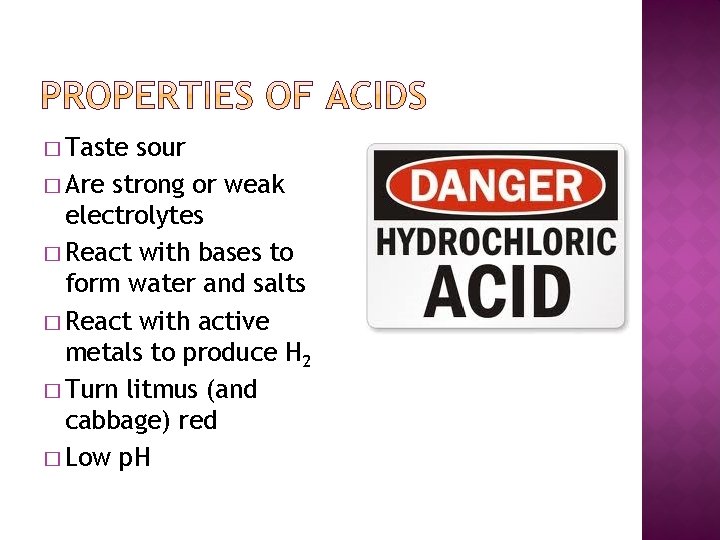
� Taste sour � Are strong or weak electrolytes � React with bases to form water and salts � React with active metals to produce H 2 � Turn litmus (and cabbage) red � Low p. H
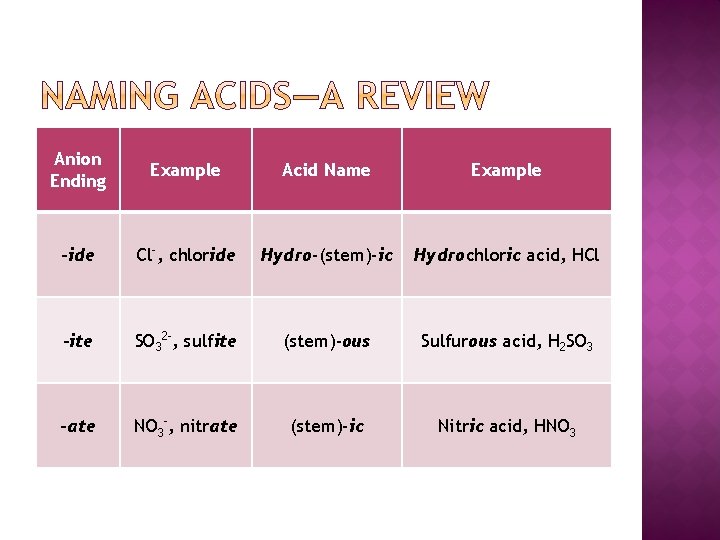
Anion Ending Example Acid Name Example -ide Cl-, chloride Hydro-(stem)-ic Hydrochloric acid, HCl -ite SO 32 -, sulfite (stem)-ous Sulfurous acid, H 2 SO 3 -ate NO 3 -, nitrate (stem)-ic Nitric acid, HNO 3
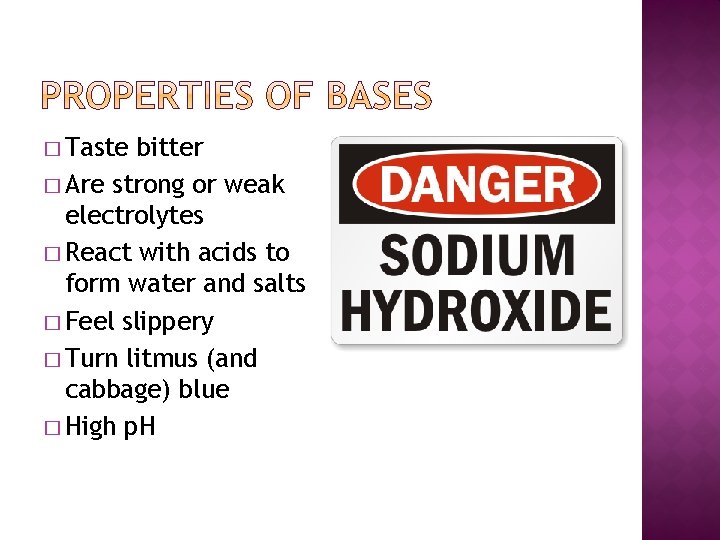
� Taste bitter � Are strong or weak electrolytes � React with acids to form water and salts � Feel slippery � Turn litmus (and cabbage) blue � High p. H
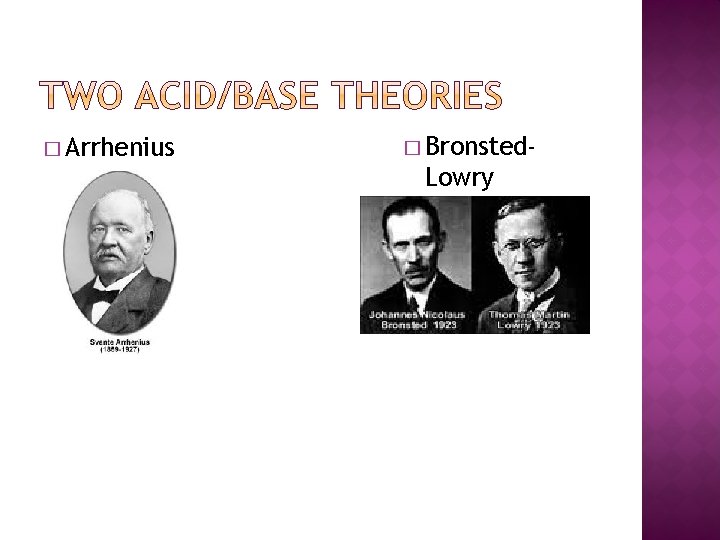
� Arrhenius � Bronsted- Lowry
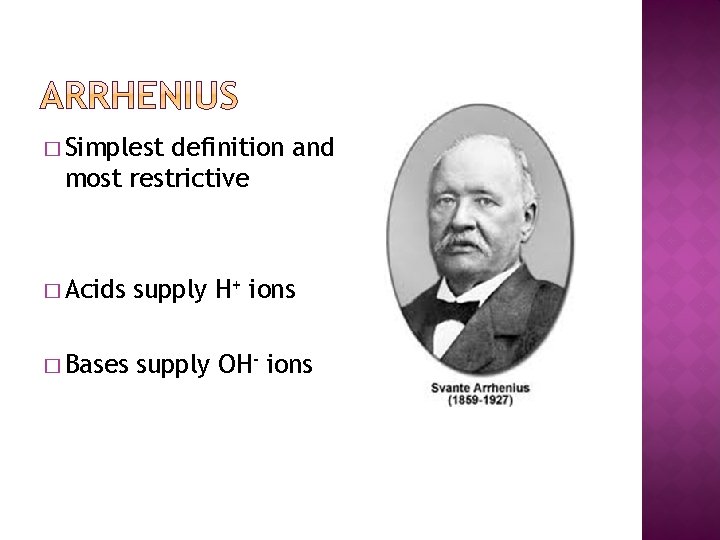
� Simplest definition and most restrictive � Acids supply H+ ions � Bases supply OH- ions
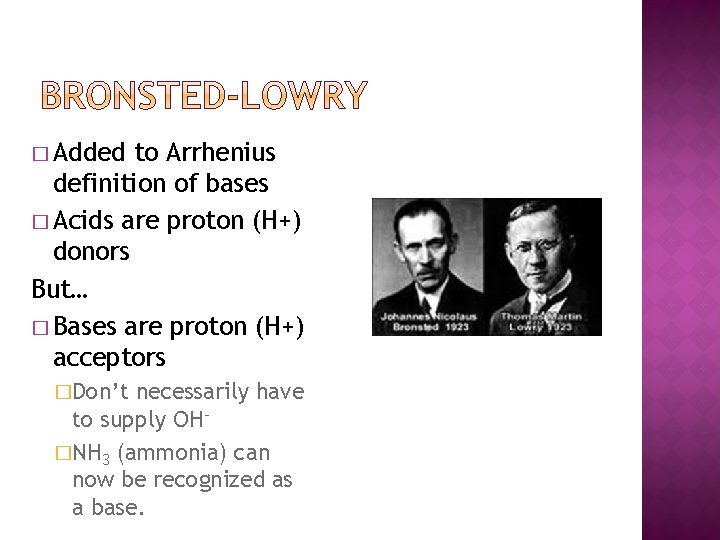
� Added to Arrhenius definition of bases � Acids are proton (H+) donors But… � Bases are proton (H+) acceptors �Don’t necessarily have to supply OH�NH 3 (ammonia) can now be recognized as a base.
� Bronsted-Lowry also defined conjugate acids and bases. � HA + H 2 O A − + H 3 O + � HA is an acid. The product A- is its conjugate base. � H 2 O is behaving as a base. The product H 3 O+ is its conjugate acid. � These pairs differ by only one H+. �The compound with the extra H+ is the acid.
� Sometimes when water molecules collide, a hydrogen ion transfers. � H 20 + H 20 H 3 O+ + OHHydronium ion � Sometimes Hydroxide ion the self-ionization of water is shown as: H 20(l) H+(aq)+ OH-(aq) � H+ and H 3 O+ are often used interchangeably. � Water can act as both an acid and a base, producing both H+ and OH- ions.
� Strength in acids and bases does NOT refer to how corrosive or dangerous they are. � Strong acids and bases dissociate (break apart) completely in water. � At equilibrium, there is no acid or base left that has not ionized (separated into its ions) � One of the most corrosive and dangerous acids, HF, is actually a weak acid.
� http: //www. mhhe. com/physsci/chemistry/c hang 7/esp/folder_structure/ac/m 2/s 1/acm 2 s 1_1. htm
� When an acid reacts with a base, both are neutralized as water and a salt are produced. � Predict the products and write the balanced equation for the reaction of sulfuric acid with potassium hydroxide.
Chemistry Joke Q: Why do chemistry professors like to teach about A: Because it’s ammonia? very basic material!
- Slides: 15