
Chemistry is Hard Why Blooms Taxonomy l Psychologist
Chemistry is Hard Why?
Bloom’s Taxonomy l Psychologist who studied how people think l Broke thinking into levels of complexity l Each level required using the information below l The lowest level is knowledgememorizing textbook definitions l Easiest but least useful
Bloom’s Taxonomy l Understanding- being able to put the knowledge into you own words l Application- being able to use the information in new situations l Analysis- breaking the information into meaningful pieces l Synthesis- being able to put information together to generate new learning
Bloom’s Taxonomy l Evaluation- using all the information, making and defending value judgments about the information.
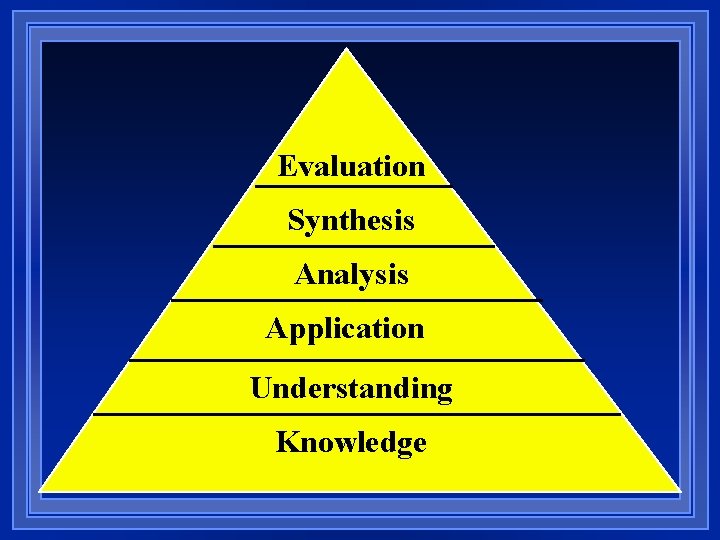
Evaluation Synthesis Analysis Application Understanding Knowledge
What does this have to do with chemistry? l In the past, many of your classes relied on memorization. l Knowledge level l Chemistry focuses on the higher levels. l I don’t ask you to memorize a lot of terms l I ask you to learn processes and techniques and then apply them to novel situations
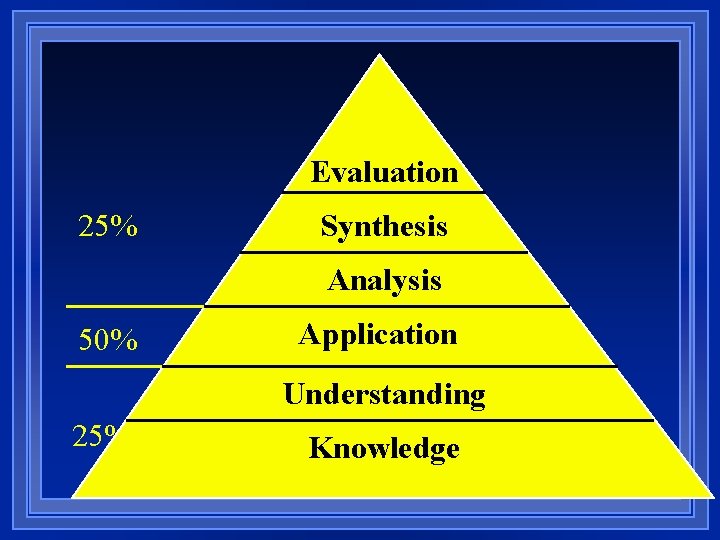
Evaluation 25% Synthesis Analysis 50% Application Understanding 25% Knowledge
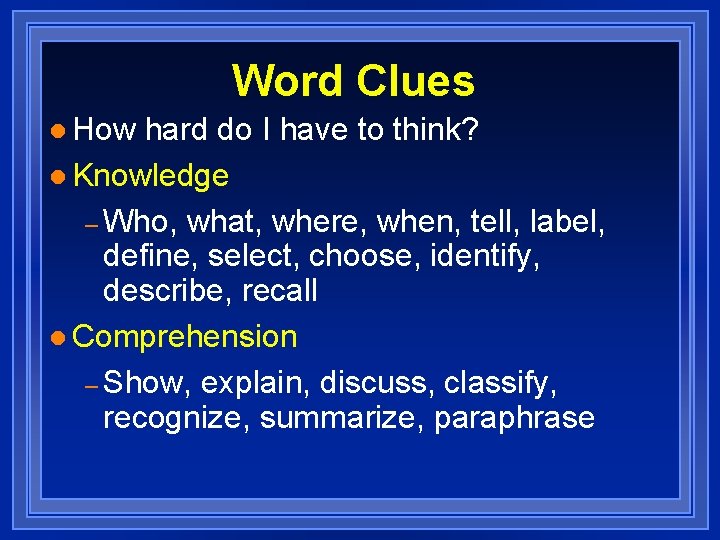
Word Clues l How hard do I have to think? l Knowledge – Who, what, where, when, tell, label, define, select, choose, identify, describe, recall l Comprehension – Show, explain, discuss, classify, recognize, summarize, paraphrase
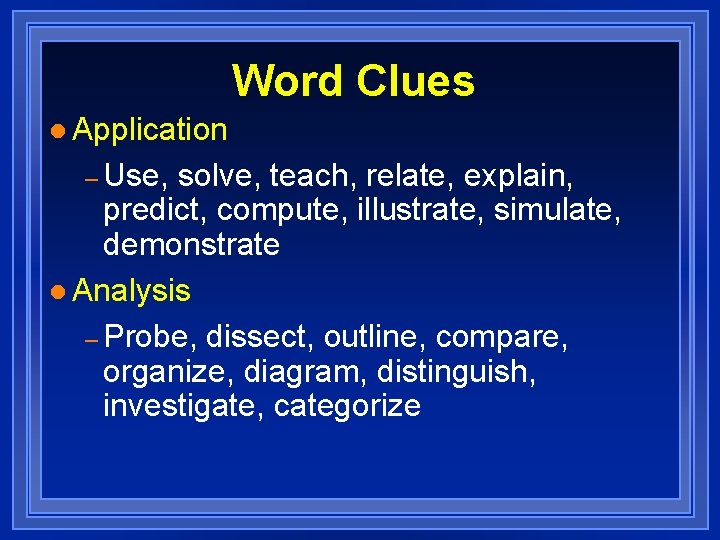
Word Clues l Application – Use, solve, teach, relate, explain, predict, compute, illustrate, simulate, demonstrate l Analysis – Probe, dissect, outline, compare, organize, diagram, distinguish, investigate, categorize
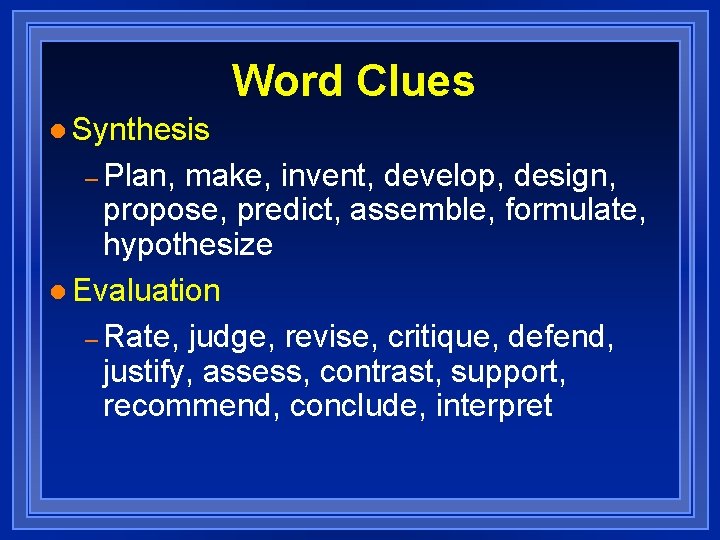
Word Clues l Synthesis – Plan, make, invent, develop, design, propose, predict, assemble, formulate, hypothesize l Evaluation – Rate, judge, revise, critique, defend, justify, assess, contrast, support, recommend, conclude, interpret
Information Processing Theory l Describes how we learn something new
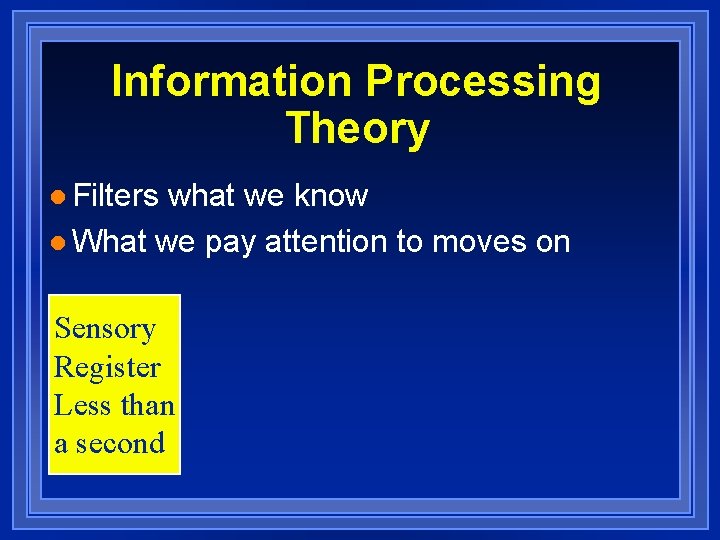
Information Processing Theory l Filters what we know l What we pay attention to moves on Sensory Register Less than a second
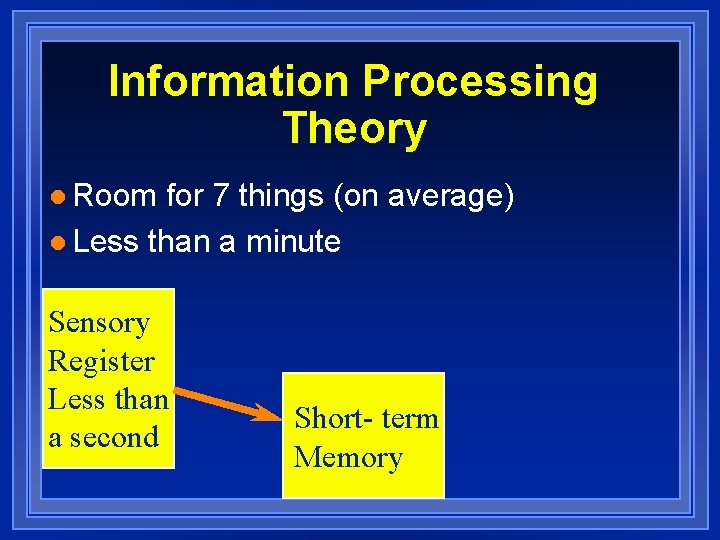
Information Processing Theory l Room for 7 things (on average) l Less than a minute Sensory Register Less than a second Short- term Memory
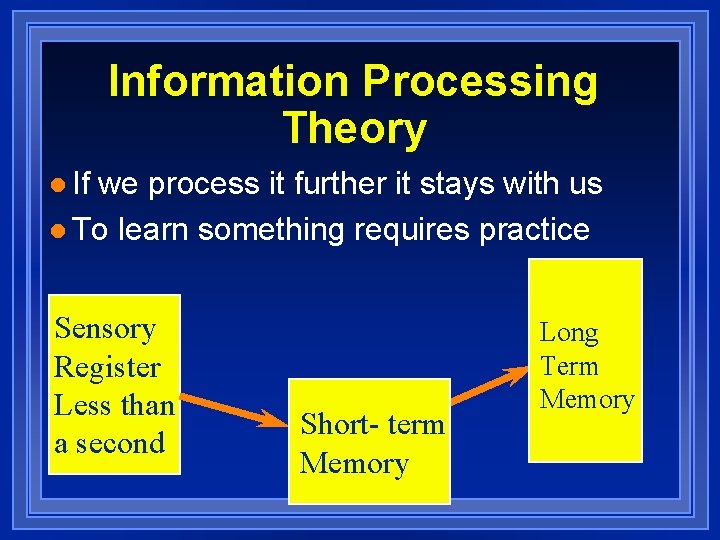
Information Processing Theory l If we process it further it stays with us l To learn something requires practice Sensory Register Less than a second Short- term Memory Long Term Memory
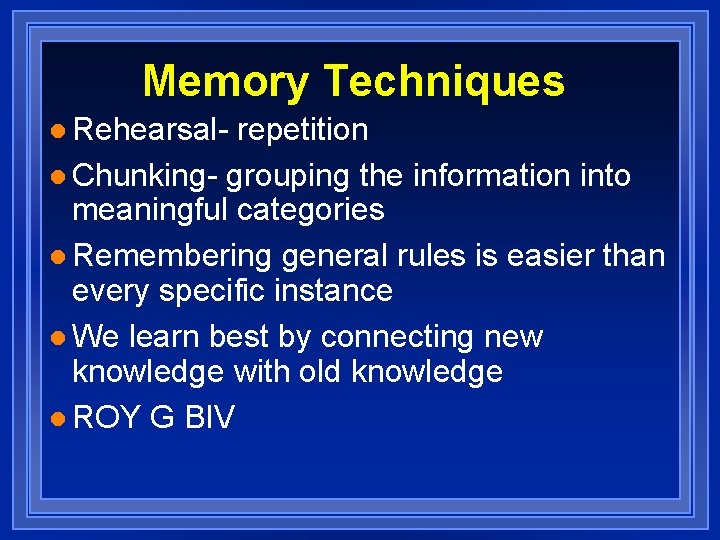
Memory Techniques l Rehearsal- repetition l Chunking- grouping the information into meaningful categories l Remembering general rules is easier than every specific instance l We learn best by connecting new knowledge with old knowledge l ROY G BIV
Another Reason Chemistry is hard l Requires math skills. l Uses math to explain l Prerequisite l Algebra is used in this class regularly. l Used to describe the world around us
What can you do?
Laboratory Safety Rules
l While working in the science laboratory, you will have certain important __________ that do not responsibilities apply to other classrooms. You will be working with materials and apparatus which, if handled carelessly or improperly, have the potential to cause _________ or discomfort to injury someone else as well as yourself.
l. A science laboratory can be a safe place in which to work if you, the student, are foresighted, alert, and cautious. Violating any of the following regulations will result suspended in you being ________ from class or ___________ from permanently removed the class. The following practices will be followed:
An instructor _____ must be present during the performance of all laboratory work. teacher l 2. Report any accident to the _____ immediately, no matter how_____, minor including reporting any burn, scratch, cut, or corrosive liquid on skin or clothing. l 3. Prepare for each laboratory activity by reading all instructions before coming to ____ directions implicitly and class. Follow all _____ modification intelligently. Make note of any _____ in procedure given by the instructor. l 1.
4. Any science project or individually planned experiment must be approved by the teacher. _____ 5. Use only those materials and equipment authorized by the instructor. _____ immediately of any 6. Inform the teacher ______ equipment not working properly. 7. Clean up any nonhazardous _______ spill on the floor or workspace ______. immediately
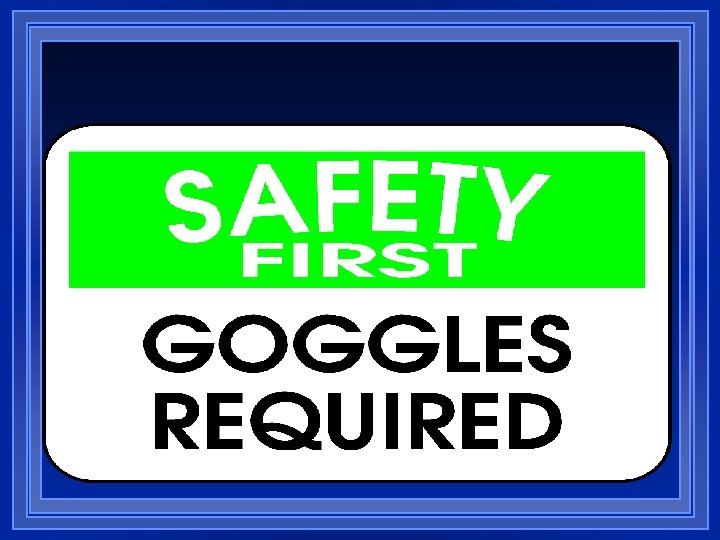
eye protection Wear appropriate _______, as directed by the instructor, whenever you are working in the laboratory. Safety goggles must be worn during hazardous _____ activities involving caustic/corrosive chemicals, heating of liquids, and other activities that may injure the eyes. l 8.
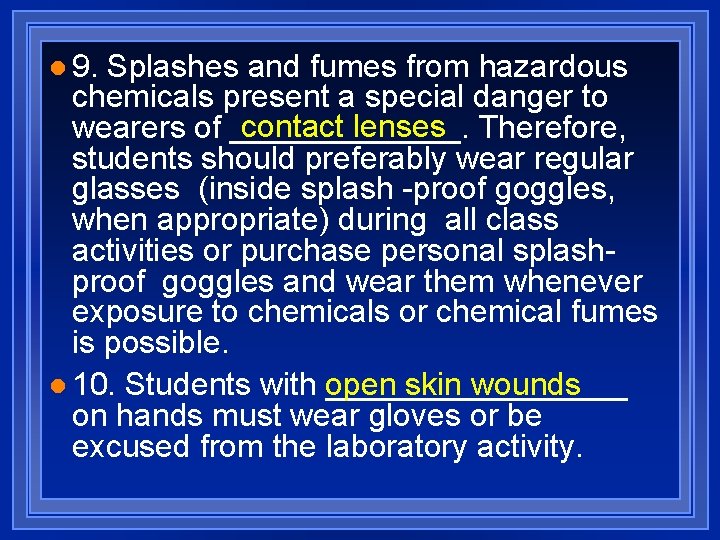
l 9. Splashes and fumes from hazardous chemicals present a special danger to contact lenses Therefore, wearers of _______. students should preferably wear regular glasses (inside splash -proof goggles, when appropriate) during all class activities or purchase personal splashproof goggles and wear them whenever exposure to chemicals or chemical fumes is possible. skin wounds l 10. Students with open _________ on hands must wear gloves or be excused from the laboratory activity.
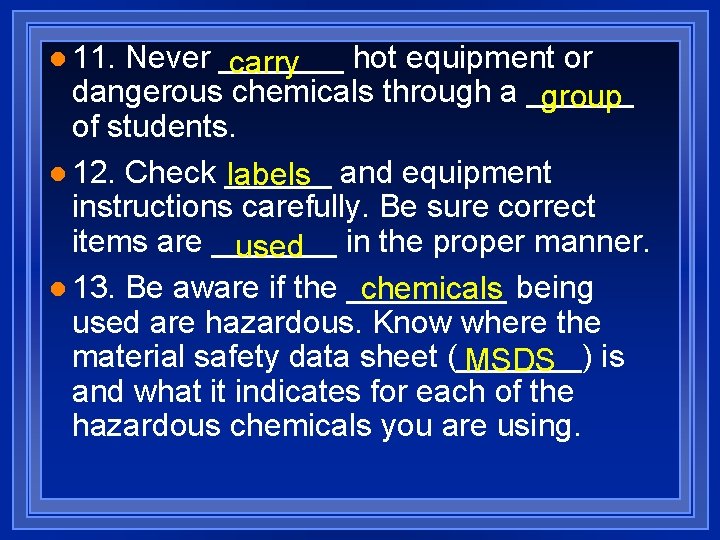
l 11. Never _______ hot equipment or carry dangerous chemicals through a ______ group of students. l 12. Check ______ labels and equipment instructions carefully. Be sure correct items are _______ used in the proper manner. l 13. Be aware if the _____ chemicals being used are hazardous. Know where the material safety data sheet (_______) MSDS is and what it indicates for each of the hazardous chemicals you are using.
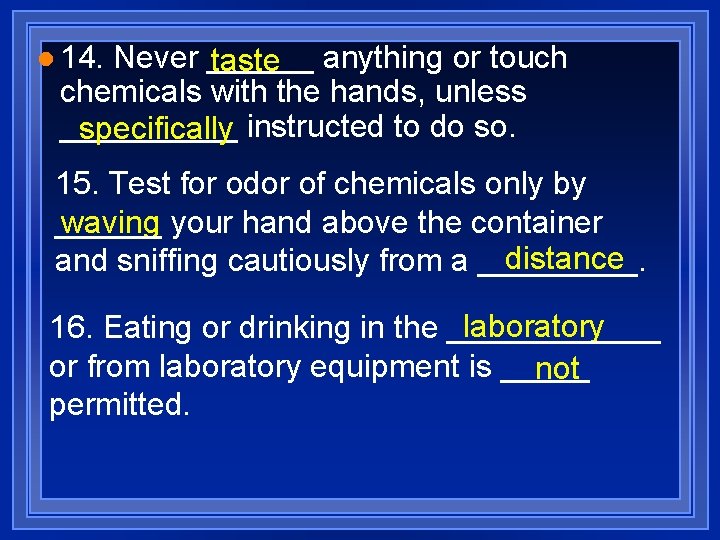
l 14. Never ______ taste anything or touch chemicals with the hands, unless _____ specifically instructed to do so. 15. Test for odor of chemicals only by waving your hand above the container ______ distance and sniffing cautiously from a _____. laboratory 16. Eating or drinking in the ______ or from laboratory equipment is _____ not permitted.
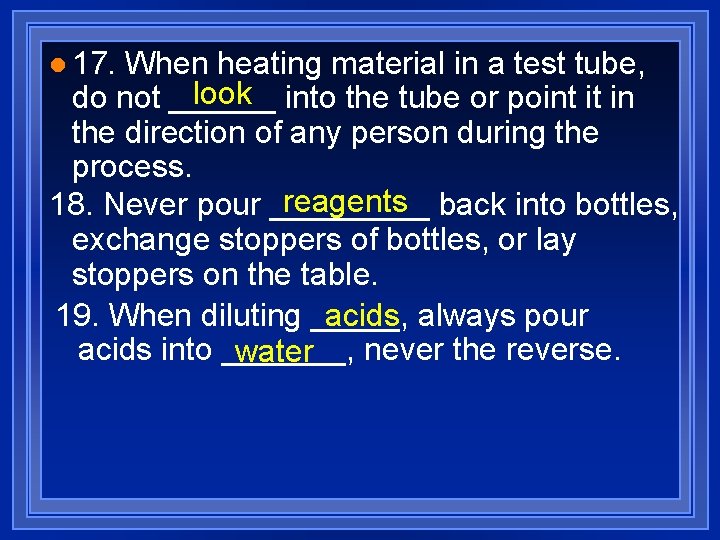
l 17. When heating material in a test tube, look into the tube or point it in do not ______ the direction of any person during the process. reagents back into bottles, 18. Never pour _____ exchange stoppers of bottles, or lay stoppers on the table. 19. When diluting _____, acids always pour acids into _______, never the reverse. water
l 20. Wash hands as necessary and wash conclusion of the thoroughly at the _____ laboratory period. 21. To treat a burn from an acid or alkali, immediately with wash the affected area ______ plenty of running water. If the eye is involved, irrigate it at the eyewash station without interruption for ___ 15 minutes. Report the incident to your ______ instructor. _______. immediately
location Know the _____ of the emergency shower, eyewash and facewash station, fire blanket, fire extinguisher, fire alarm box, and exits. l 23. Know the proper fire and earthquake drill _______. procedures l 24. Roll long sleeves above the wrist _______. Long, hanging necklaces, bulky jewelry, and excessive and bulky clothing should worn in the laboratory. not be _____ l 25. Confine long hair during a laboratory activity. _____ l 22.
- Slides: 30