
Chemistry in Biology Section 3 Water and Solutions
Chemistry in Biology Section 3: Water and Solutions Section 4: The Building Blocks of Life Click on a lesson name to select.
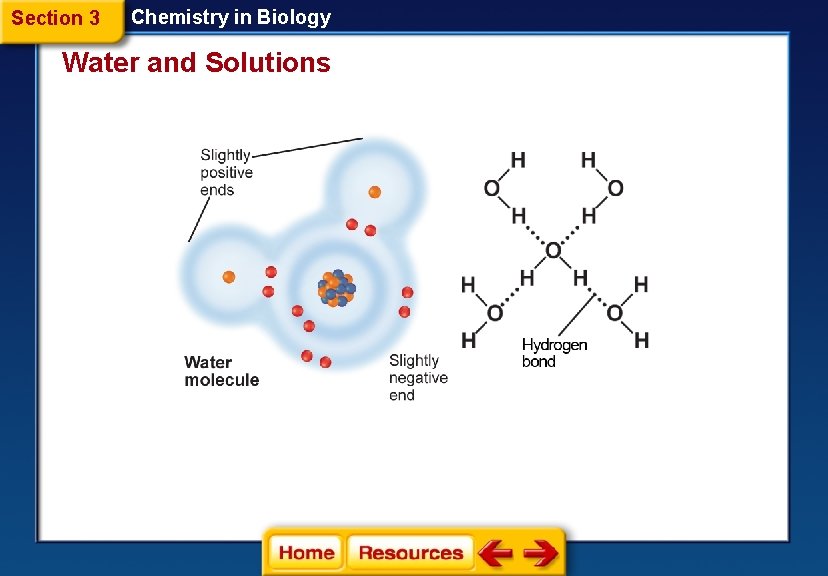
Section 3 Chemistry in Biology Water and Solutions Water’s Polarity § Molecules that have an unequal distribution of charges are called polar molecules. § Polarity is the property of having two opposite poles. § A hydrogen bond is a weak interaction involving a hydrogen atom and a fluorine, oxygen, or nitrogen atom.
Section 3 Chemistry in Biology Water and Solutions
Section 3 Chemistry in Biology Water and Solutions Homogenous Mixtures § A mixture that has a uniform composition throughout § A solvent is a substance in which another substance is dissolved. § A solute is the substance that is dissolved in the solvent.
Section 3 Chemistry in Biology Water and Solutions Heterogeneous Mixtures § In a heterogeneous mixture, the components remain distinct.
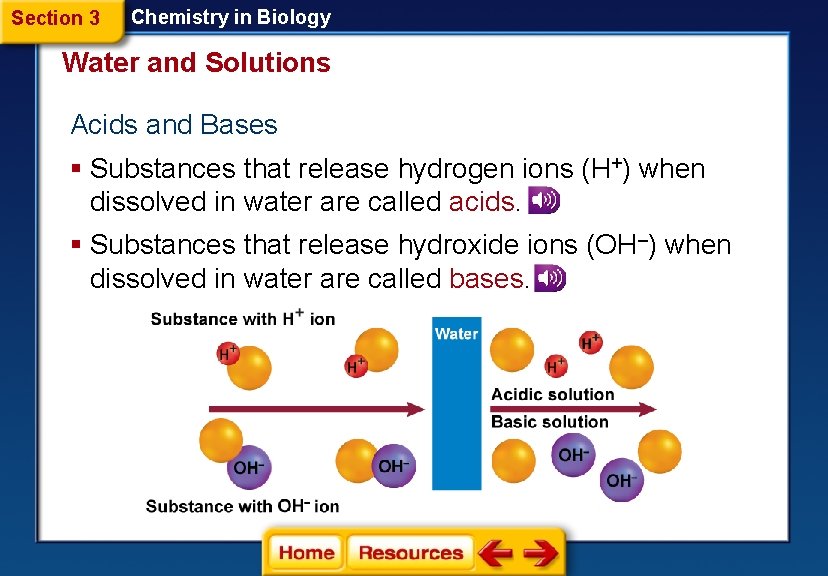
Section 3 Chemistry in Biology Water and Solutions Acids and Bases § Substances that release hydrogen ions (H+) when dissolved in water are called acids. § Substances that release hydroxide ions (OH–) when dissolved in water are called bases.
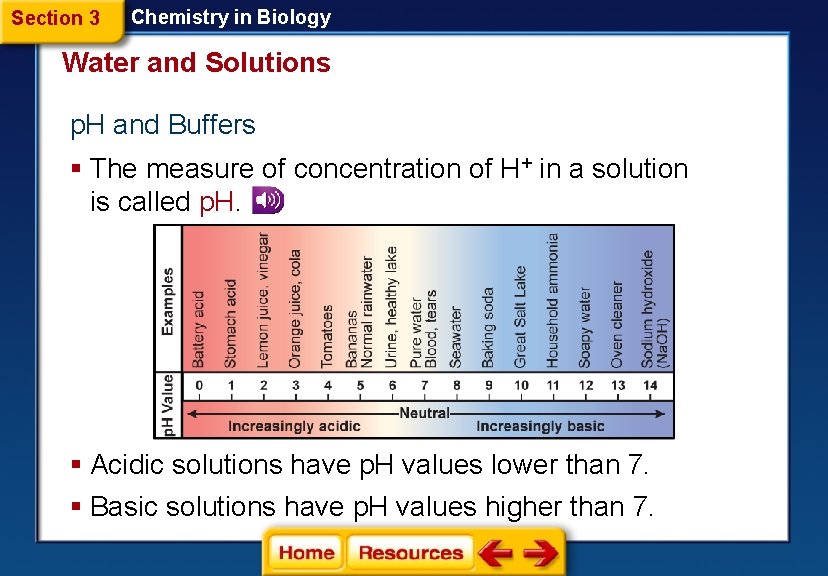
Section 3 Chemistry in Biology Water and Solutions p. H and Buffers § The measure of concentration of H+ in a solution is called p. H. § Acidic solutions have p. H values lower than 7. § Basic solutions have p. H values higher than 7.
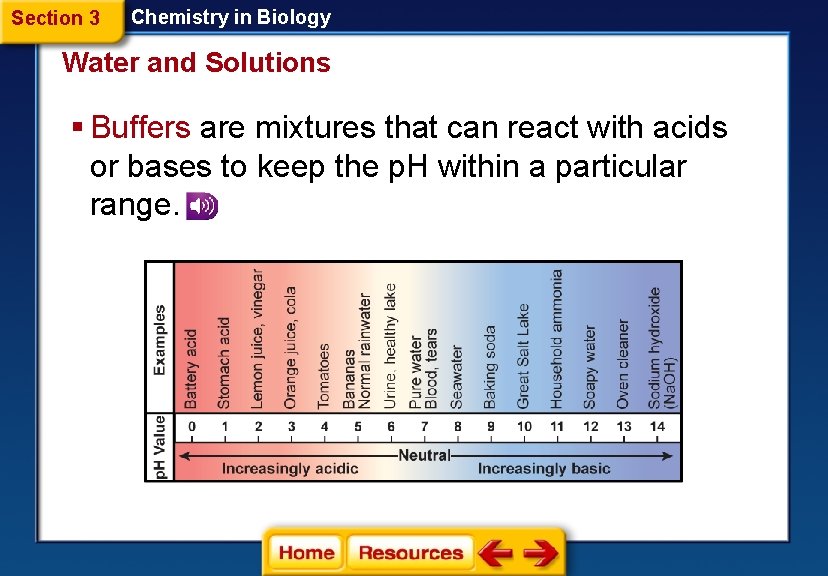
Section 3 Chemistry in Biology Water and Solutions § Buffers are mixtures that can react with acids or bases to keep the p. H within a particular range.
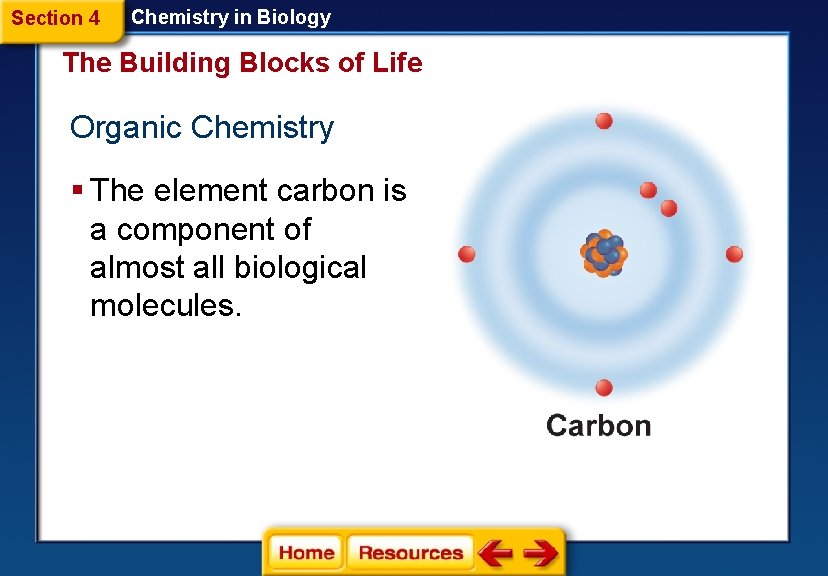
Section 4 Chemistry in Biology The Building Blocks of Life Organic Chemistry § The element carbon is a component of almost all biological molecules.
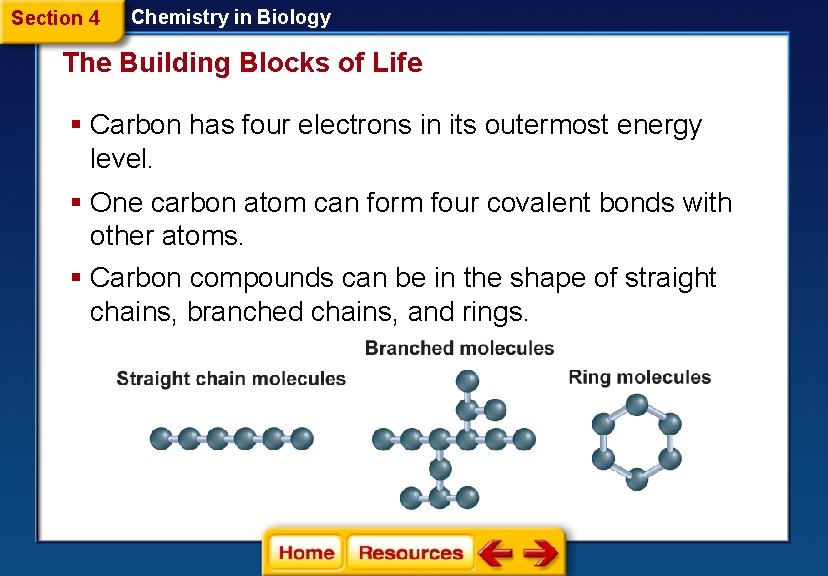
Section 4 Chemistry in Biology The Building Blocks of Life § Carbon has four electrons in its outermost energy level. § One carbon atom can form four covalent bonds with other atoms. § Carbon compounds can be in the shape of straight chains, branched chains, and rings.
Section 4 Chemistry in Biology The Building Blocks of Life Macromolecules § Carbon atoms can be joined to form carbon molecules. § Macromolecules are large molecules formed by joining smaller organic molecules together. § Polymers are molecules made from repeating units of identical or nearly identical compounds linked together by a series of covalent bonds.
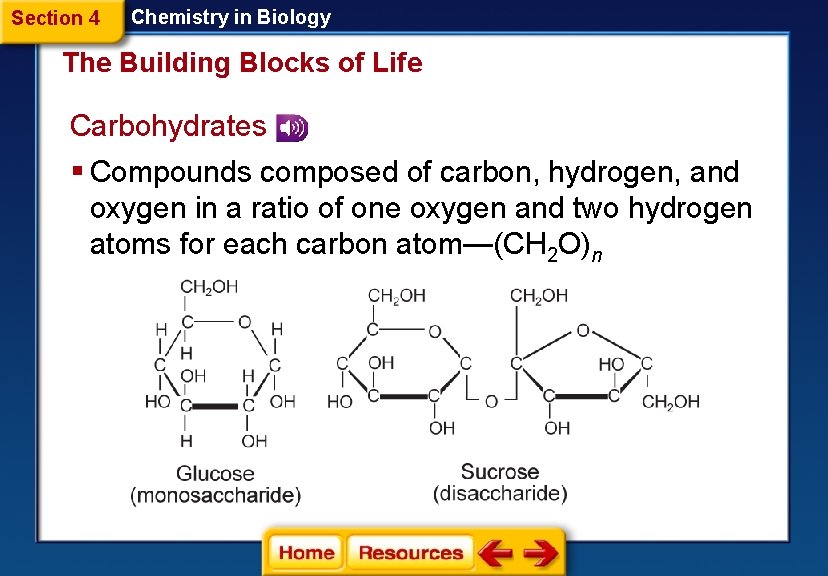
Section 4 Chemistry in Biology The Building Blocks of Life Carbohydrates § Compounds composed of carbon, hydrogen, and oxygen in a ratio of one oxygen and two hydrogen atoms for each carbon atom—(CH 2 O)n
Section 4 Chemistry in Biology The Building Blocks of Life § Values of n ranging from three to seven are called simple sugars, or monosaccharides. § Two monosaccharides joined together form a disaccharide. § Longer carbohydrate molecules are called polysaccharides.
Section 4 Chemistry in Biology The Building Blocks of Life Lipids § Molecules made mostly of carbon and hydrogen § A triglyceride is a fat if it is solid at room temperature and an oil if it is liquid at room temperature.
Section 4 Chemistry in Biology The Building Blocks of Life § Lipids that have tail chains with only single bonds between the carbon atoms are called saturated fats. § Lipids that have at least one double bond between carbon atoms in the tail chain are called unsaturated fats. § Fats with more than one double bond in the tail are called polyunsaturated fats.
Section 4 Chemistry in Biology The Building Blocks of Life Proteins § A compound made of small carbon compounds called amino acids § Amino acids are small compounds that are made of carbon, nitrogen, oxygen, hydrogen, and sometimes sulfur.
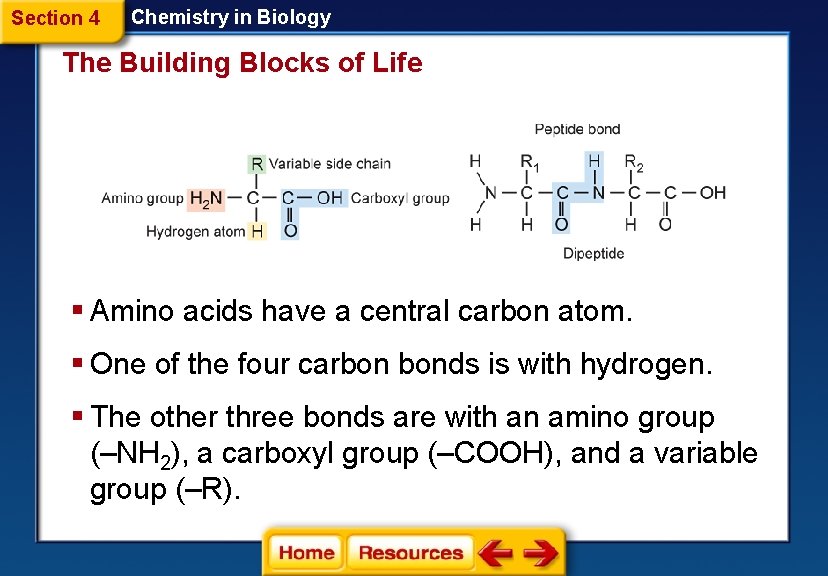
Section 4 Chemistry in Biology The Building Blocks of Life § Amino acids have a central carbon atom. § One of the four carbon bonds is with hydrogen. § The other three bonds are with an amino group (–NH 2), a carboxyl group (–COOH), and a variable group (–R).
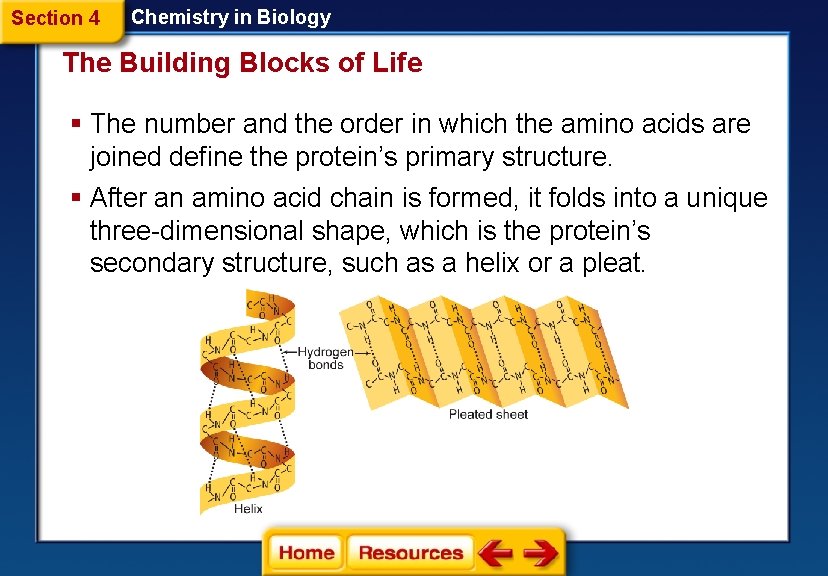
Section 4 Chemistry in Biology The Building Blocks of Life § The number and the order in which the amino acids are joined define the protein’s primary structure. § After an amino acid chain is formed, it folds into a unique three-dimensional shape, which is the protein’s secondary structure, such as a helix or a pleat.
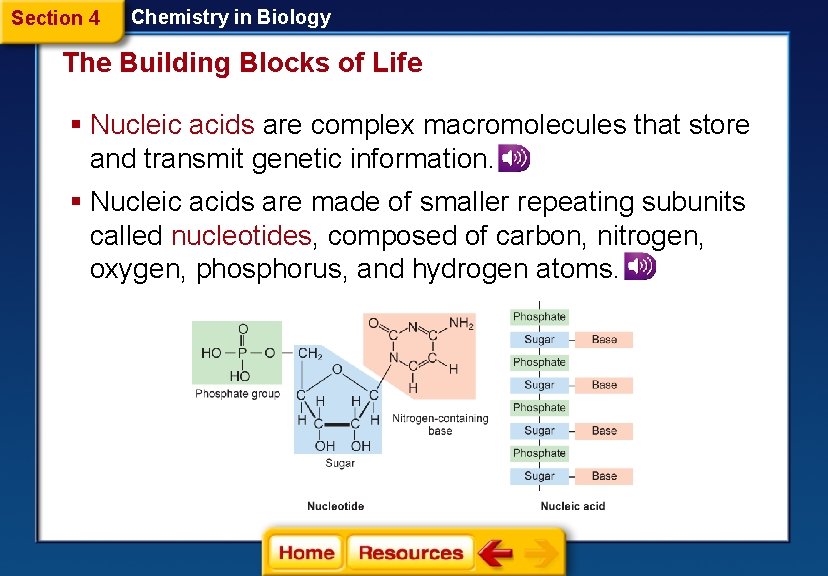
Section 4 Chemistry in Biology The Building Blocks of Life § Nucleic acids are complex macromolecules that store and transmit genetic information. § Nucleic acids are made of smaller repeating subunits called nucleotides, composed of carbon, nitrogen, oxygen, phosphorus, and hydrogen atoms.
Section 3 Chemistry in Biology Vocabulary Section 3 polar molecule base hydrogen bond mixture solution solvent solute acid p. H buffer
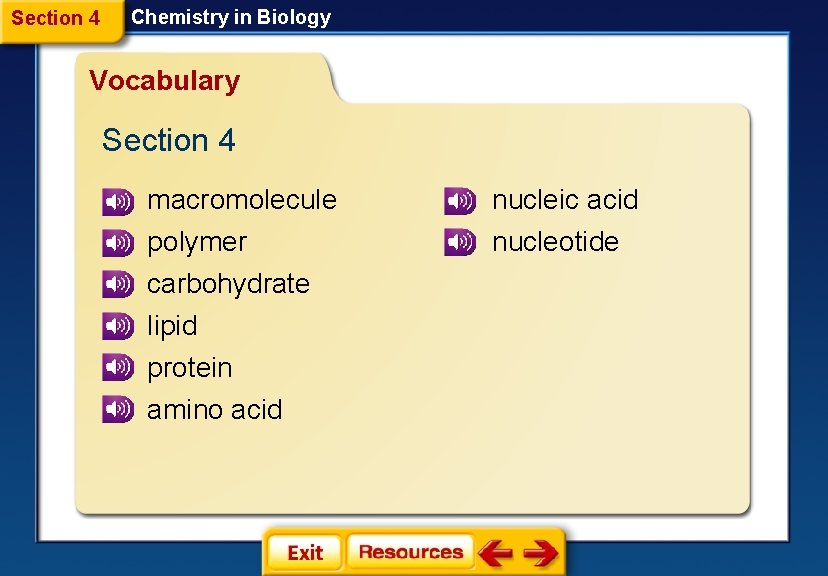
Section 4 Chemistry in Biology Vocabulary Section 4 macromolecule nucleic acid polymer carbohydrate lipid protein amino acid nucleotide
- Slides: 21