
Chemistry for Changing Times 11 th Edition Hill
- Slides: 52
Chemistry for Changing Times 11 th Edition Hill and Kolb Chapter 12 Chemistry John Singer Jackson Community College, Jackson, MI © 2007 Prentice Hall
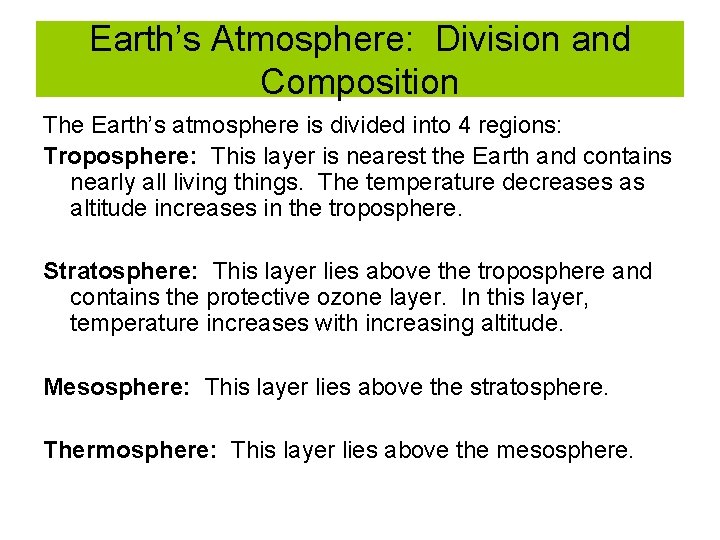
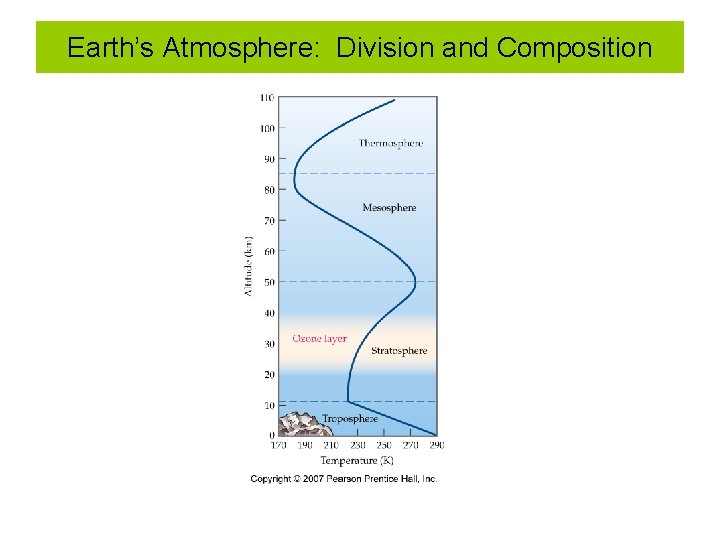
Earth’s Atmosphere: Division and Composition The Earth’s atmosphere is divided into 4 regions: Troposphere: This layer is nearest the Earth and contains nearly all living things. The temperature decreases as altitude increases in the troposphere. Stratosphere: This layer lies above the troposphere and contains the protective ozone layer. In this layer, temperature increases with increasing altitude. Mesosphere: This layer lies above the stratosphere. Thermosphere: This layer lies above the mesosphere.
Earth’s Atmosphere: Division and Composition
Earth’s Atmosphere: Division and Composition
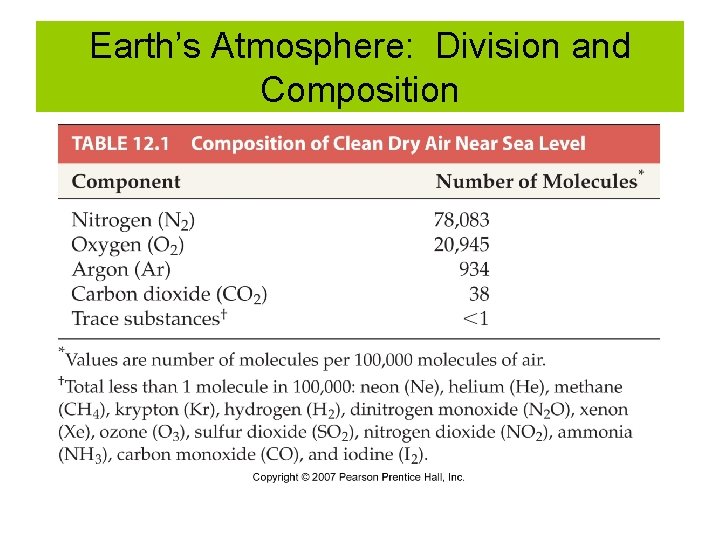
Chemistry of the Atmosphere Nitrogen comprises about 78% of all gases in the atmosphere. No animals and most plants can use the nitrogen available in the atmosphere as N 2 molecules. Organisms must first “fix” or use “fixed” nitrogen. Fixed means that the nitrogen atoms are combined with another element.
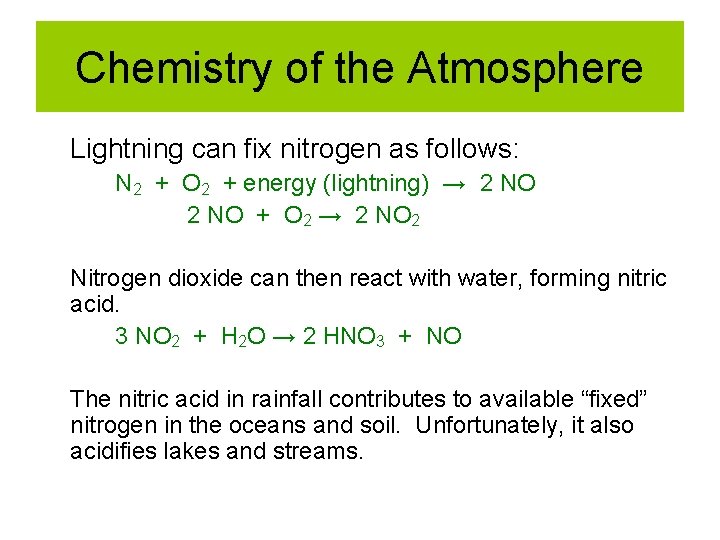
Chemistry of the Atmosphere Lightning can fix nitrogen as follows: N 2 + O 2 + energy (lightning) → 2 NO + O 2 → 2 NO 2 Nitrogen dioxide can then react with water, forming nitric acid. 3 NO 2 + H 2 O → 2 HNO 3 + NO The nitric acid in rainfall contributes to available “fixed” nitrogen in the oceans and soil. Unfortunately, it also acidifies lakes and streams.
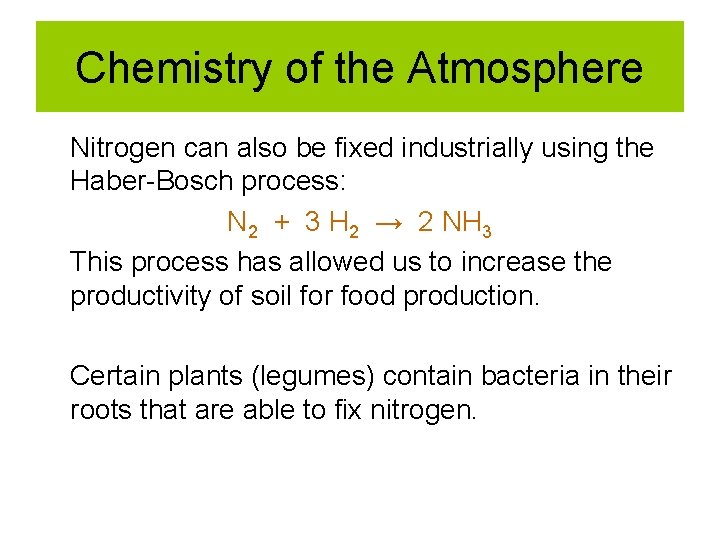
Chemistry of the Atmosphere Nitrogen can also be fixed industrially using the Haber-Bosch process: N 2 + 3 H 2 → 2 NH 3 This process has allowed us to increase the productivity of soil for food production. Certain plants (legumes) contain bacteria in their roots that are able to fix nitrogen.
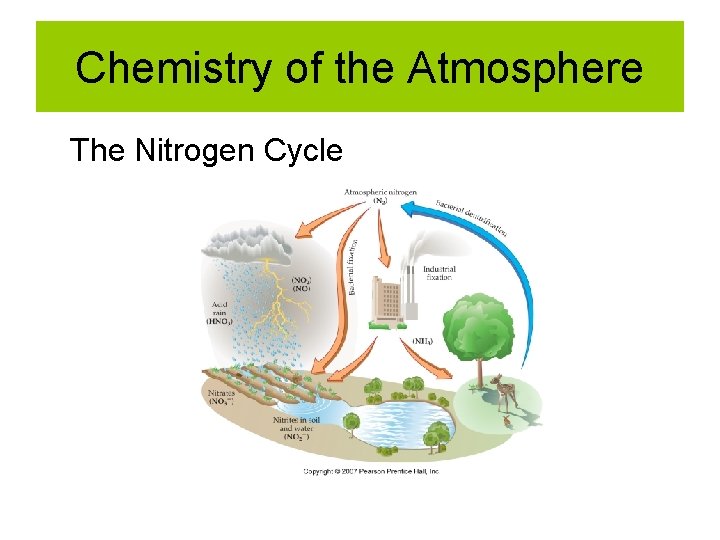
Chemistry of the Atmosphere The Nitrogen Cycle
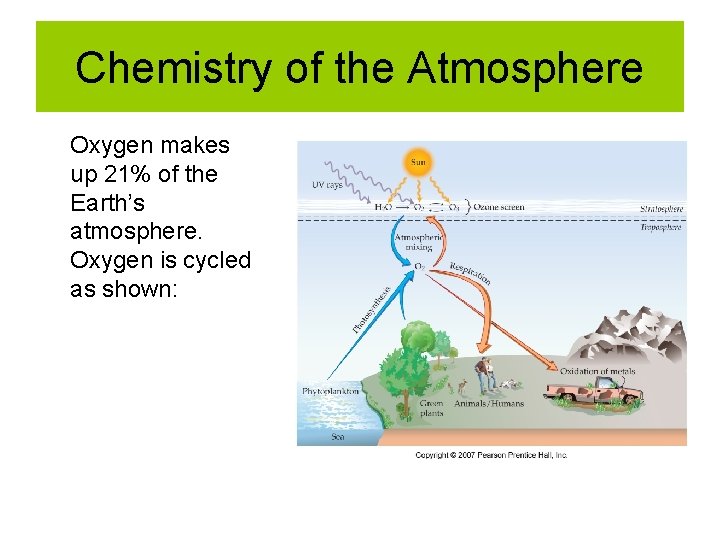
Chemistry of the Atmosphere Oxygen makes up 21% of the Earth’s atmosphere. Oxygen is cycled as shown: •
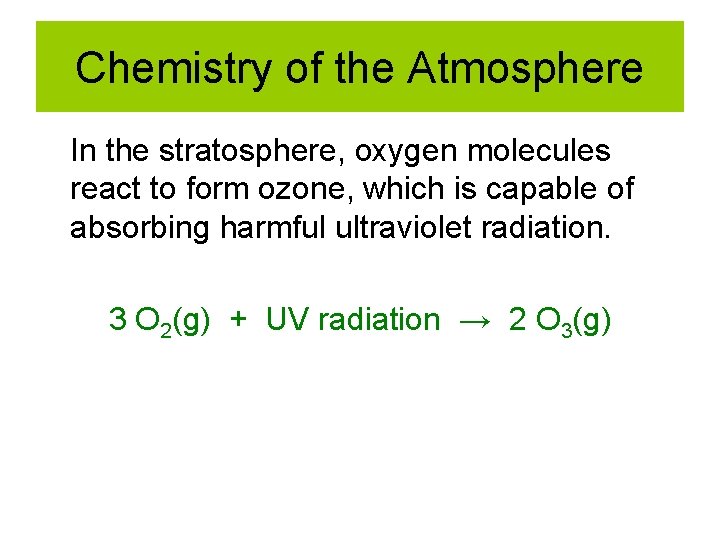
Chemistry of the Atmosphere In the stratosphere, oxygen molecules react to form ozone, which is capable of absorbing harmful ultraviolet radiation. 3 O 2(g) + UV radiation → 2 O 3(g)
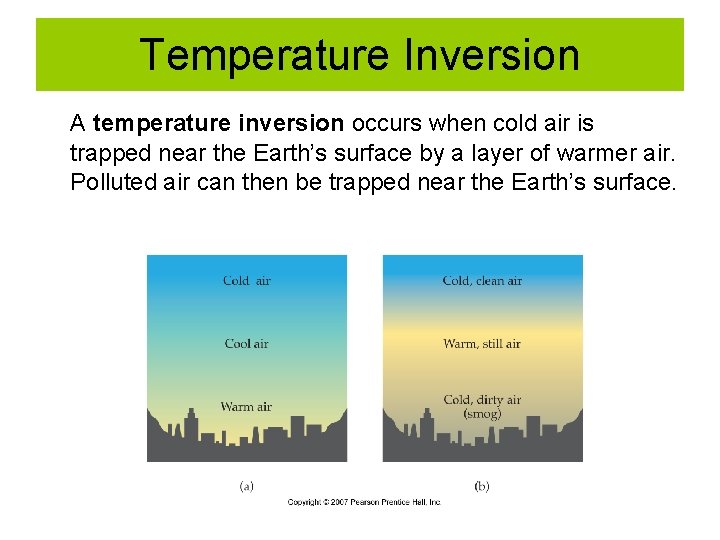
Temperature Inversion A temperature inversion occurs when cold air is trapped near the Earth’s surface by a layer of warmer air. Polluted air can then be trapped near the Earth’s surface.
Natural Pollution Wildfires, windblown dust, and volcanic action can all contribute to air pollution.
The Air Our Ancestors Breathed Air pollution has always been with us. Humans have always altered their environment. Clearing of land use of fire have always impacted the atmosphere.
Pollution Goes Global A pollutant is any substance in the wrong place at the wrong time. With increased urbanization and globalization, air pollution has become a global concern.
Industrial Smog The term smog is a contraction of smoke and fog. Air that has been polluted by industrial activity is called industrial smog.
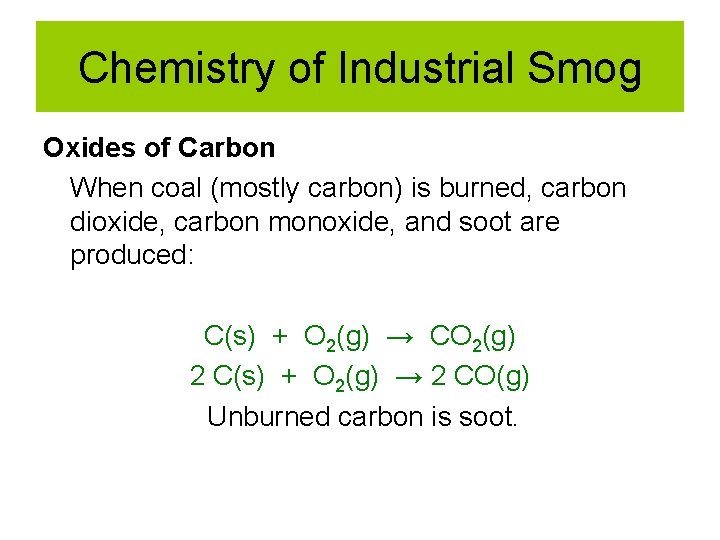
Chemistry of Industrial Smog Oxides of Carbon When coal (mostly carbon) is burned, carbon dioxide, carbon monoxide, and soot are produced: C(s) + O 2(g) → CO 2(g) 2 C(s) + O 2(g) → 2 CO(g) Unburned carbon is soot.
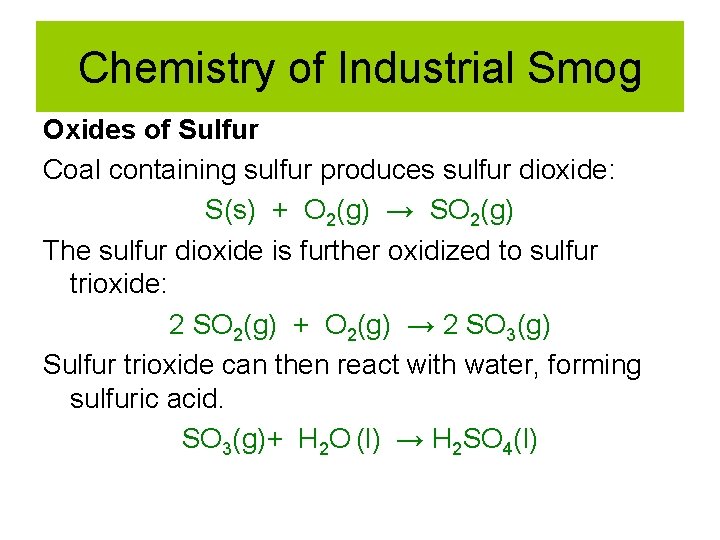
Chemistry of Industrial Smog Oxides of Sulfur Coal containing sulfur produces sulfur dioxide: S(s) + O 2(g) → SO 2(g) The sulfur dioxide is further oxidized to sulfur trioxide: 2 SO 2(g) + O 2(g) → 2 SO 3(g) Sulfur trioxide can then react with water, forming sulfuric acid. SO 3(g)+ H 2 O (l) → H 2 SO 4(l)
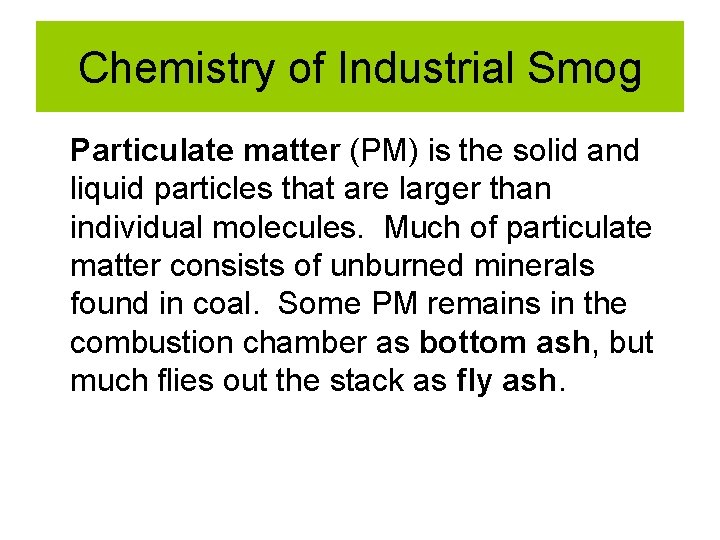
Chemistry of Industrial Smog Particulate matter (PM) is the solid and liquid particles that are larger than individual molecules. Much of particulate matter consists of unburned minerals found in coal. Some PM remains in the combustion chamber as bottom ash, but much flies out the stack as fly ash.
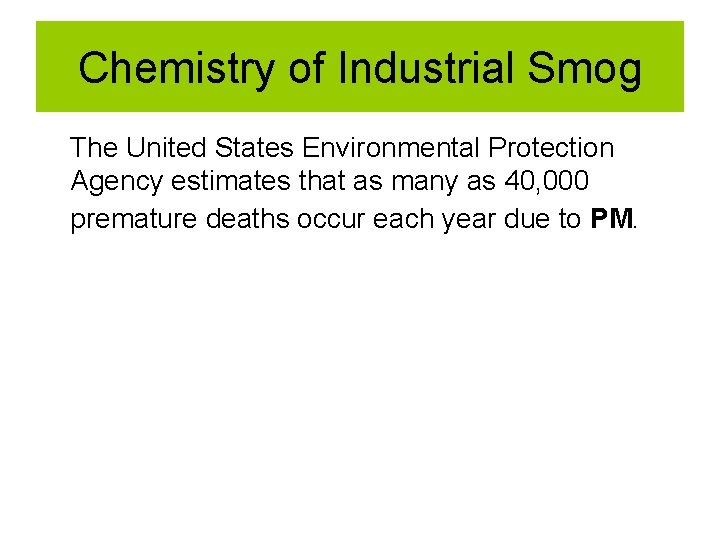
Chemistry of Industrial Smog The United States Environmental Protection Agency estimates that as many as 40, 000 premature deaths occur each year due to PM.
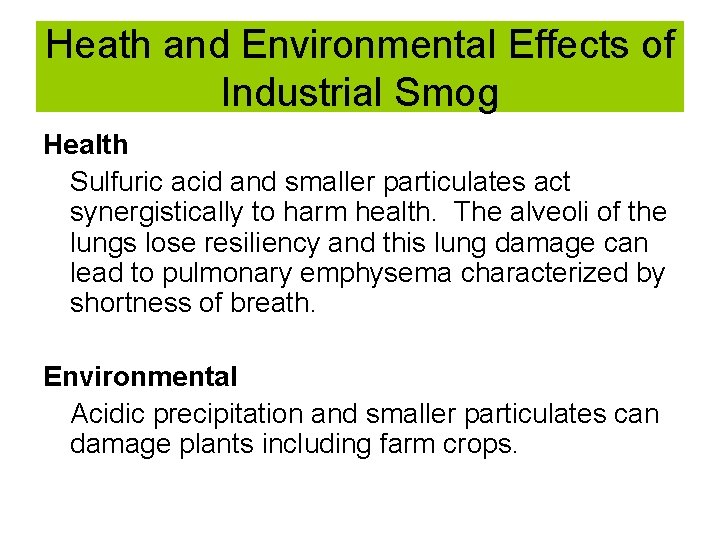
Heath and Environmental Effects of Industrial Smog Health Sulfuric acid and smaller particulates act synergistically to harm health. The alveoli of the lungs lose resiliency and this lung damage can lead to pulmonary emphysema characterized by shortness of breath. Environmental Acidic precipitation and smaller particulates can damage plants including farm crops.
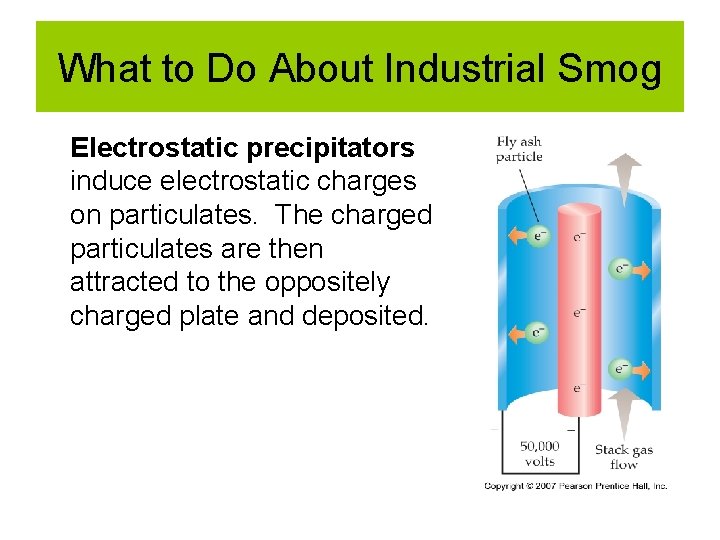
What to Do About Industrial Smog Electrostatic precipitators induce electrostatic charges on particulates. The charged particulates are then attracted to the oppositely charged plate and deposited. •
What to Do About Industrial Smog Bag filtration works like a giant vacuum cleaner. Flue gases are passed through a series of filters in a bag house which removes particulates. A cyclone separator works by cycling stack gases in a spiral motion. Heavier particulates hit the outer walls of the separator and deposit out of the gas stream.
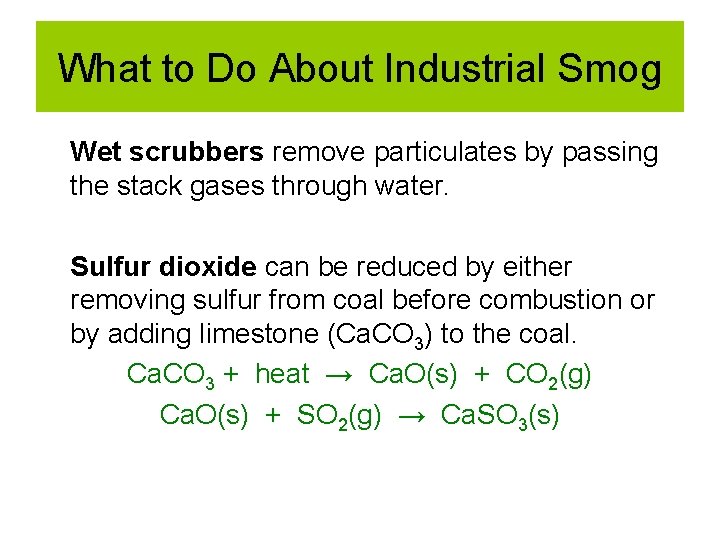
What to Do About Industrial Smog Wet scrubbers remove particulates by passing the stack gases through water. Sulfur dioxide can be reduced by either removing sulfur from coal before combustion or by adding limestone (Ca. CO 3) to the coal. Ca. CO 3 + heat → Ca. O(s) + CO 2(g) Ca. O(s) + SO 2(g) → Ca. SO 3(s)
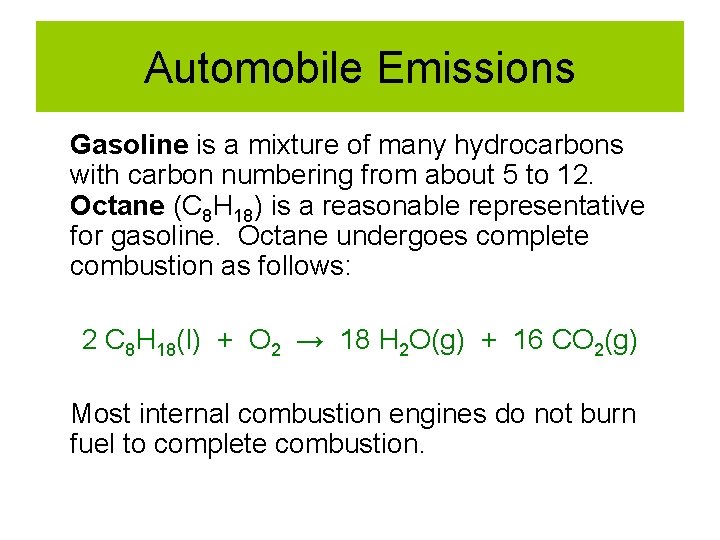
Automobile Emissions Gasoline is a mixture of many hydrocarbons with carbon numbering from about 5 to 12. Octane (C 8 H 18) is a reasonable representative for gasoline. Octane undergoes complete combustion as follows: 2 C 8 H 18(l) + O 2 → 18 H 2 O(g) + 16 CO 2(g) Most internal combustion engines do not burn fuel to complete combustion.
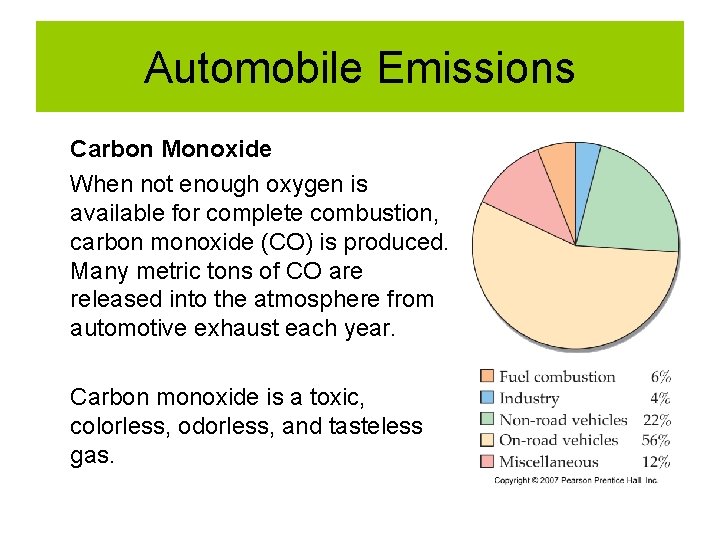
Automobile Emissions Carbon Monoxide • When not enough oxygen is available for complete combustion, carbon monoxide (CO) is produced. Many metric tons of CO are released into the atmosphere from automotive exhaust each year. Carbon monoxide is a toxic, colorless, odorless, and tasteless gas.
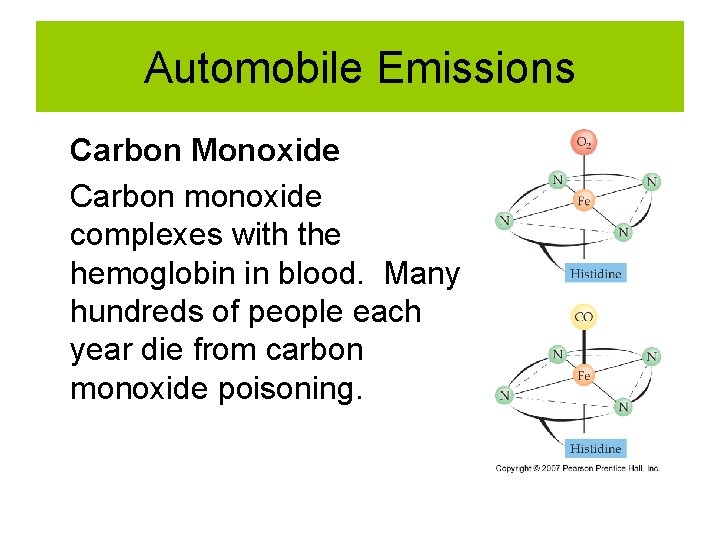
Automobile Emissions • Carbon Monoxide Carbon monoxide complexes with the hemoglobin in blood. Many hundreds of people each year die from carbon monoxide poisoning.
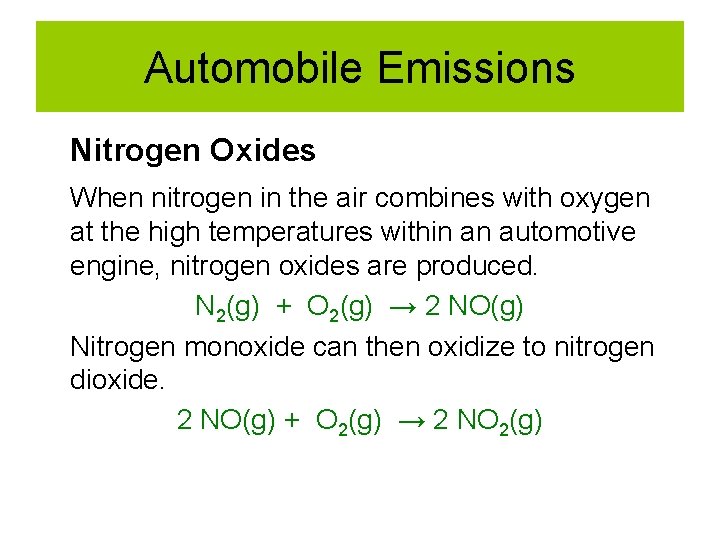
Automobile Emissions Nitrogen Oxides When nitrogen in the air combines with oxygen at the high temperatures within an automotive engine, nitrogen oxides are produced. N 2(g) + O 2(g) → 2 NO(g) Nitrogen monoxide can then oxidize to nitrogen dioxide. 2 NO(g) + O 2(g) → 2 NO 2(g)
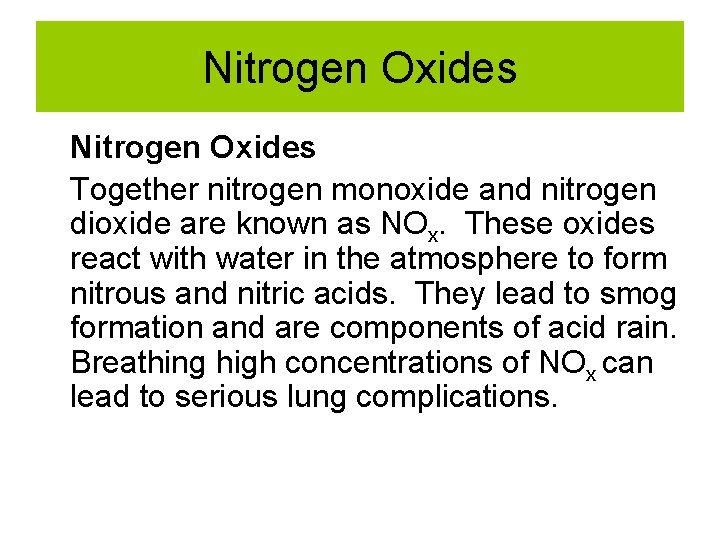
Nitrogen Oxides Together nitrogen monoxide and nitrogen dioxide are known as NOx. These oxides react with water in the atmosphere to form nitrous and nitric acids. They lead to smog formation and are components of acid rain. Breathing high concentrations of NOx can lead to serious lung complications.
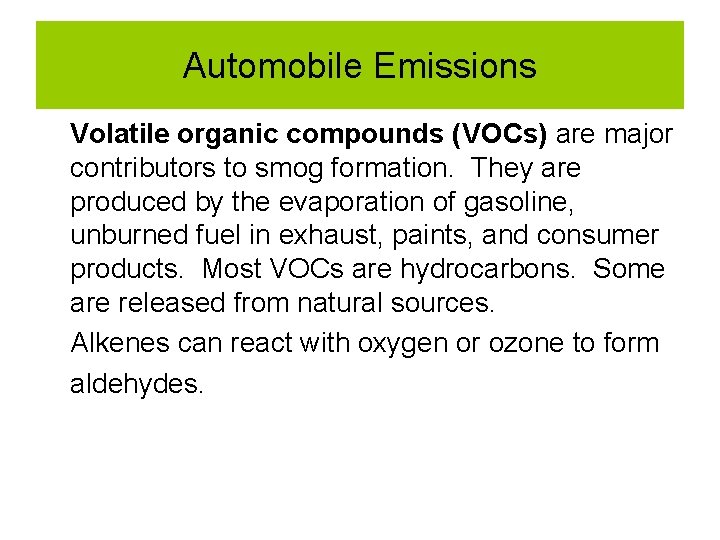
Automobile Emissions Volatile organic compounds (VOCs) are major contributors to smog formation. They are produced by the evaporation of gasoline, unburned fuel in exhaust, paints, and consumer products. Most VOCs are hydrocarbons. Some are released from natural sources. Alkenes can react with oxygen or ozone to form aldehydes.
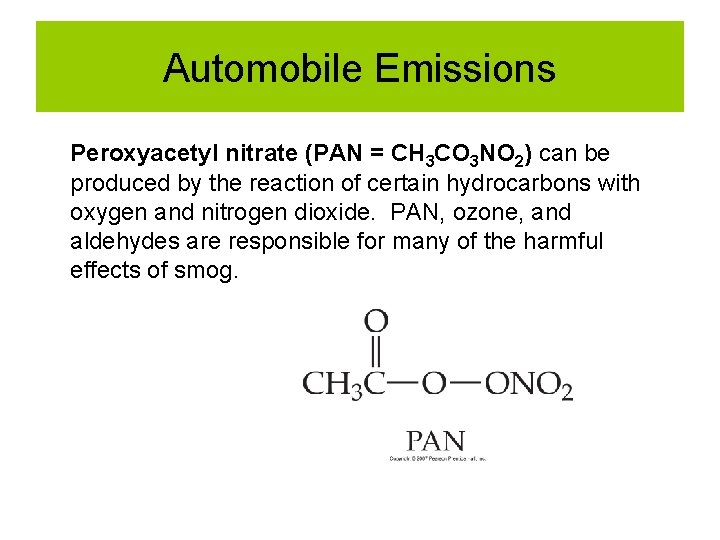
Automobile Emissions Peroxyacetyl nitrate (PAN = CH 3 CO 3 NO 2) can be produced by the reaction of certain hydrocarbons with oxygen and nitrogen dioxide. PAN, ozone, and aldehydes are responsible for many of the harmful effects of smog.
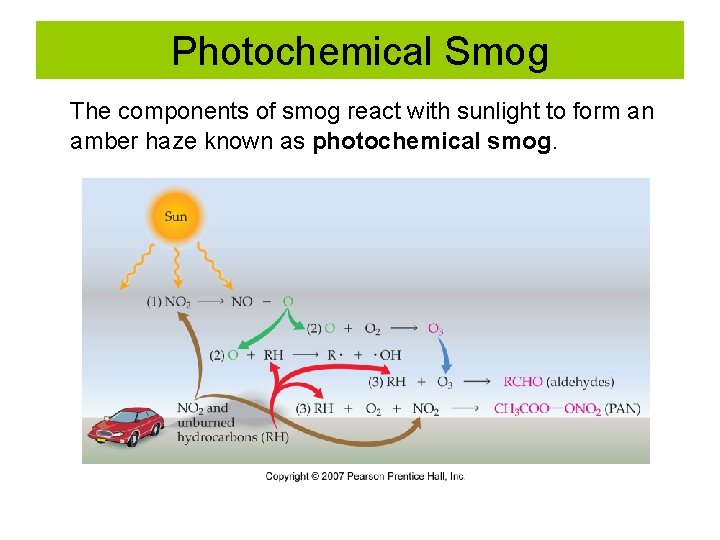
Photochemical Smog The components of smog react with sunlight to form an amber haze known as photochemical smog.
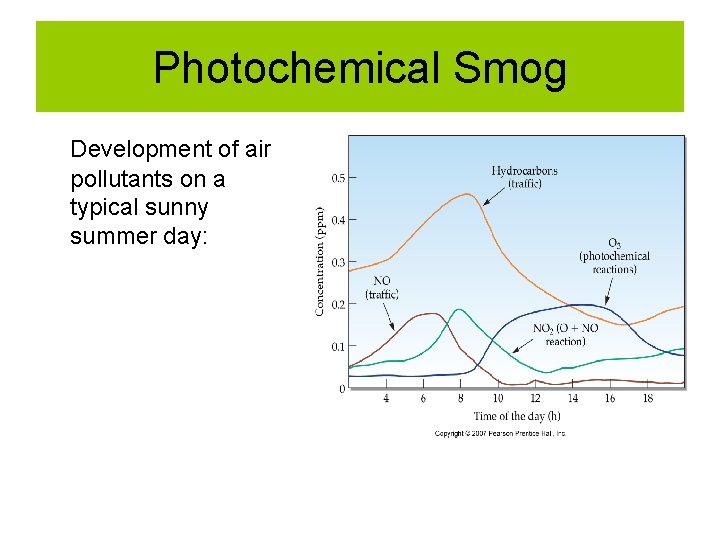
Photochemical Smog Development of air pollutants on a typical sunny summer day: •
Solutions to Photochemical Smog Reducing the quantities of the pollutants entering the atmosphere is the answer to how to reduce photochemical smog. Improved design of gasoline storage and dispensing systems reduces the emissions of hydrocarbon VOCs. Catalytic converters reduce hydrocarbon and carbon monoxide emissions from automobiles.
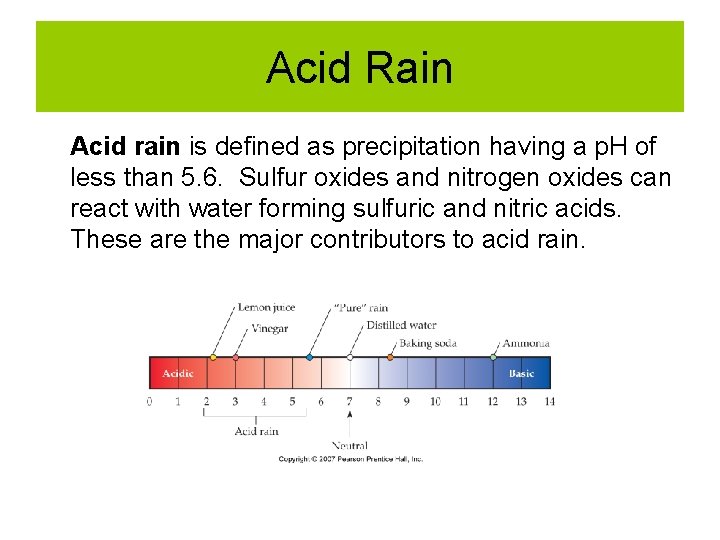
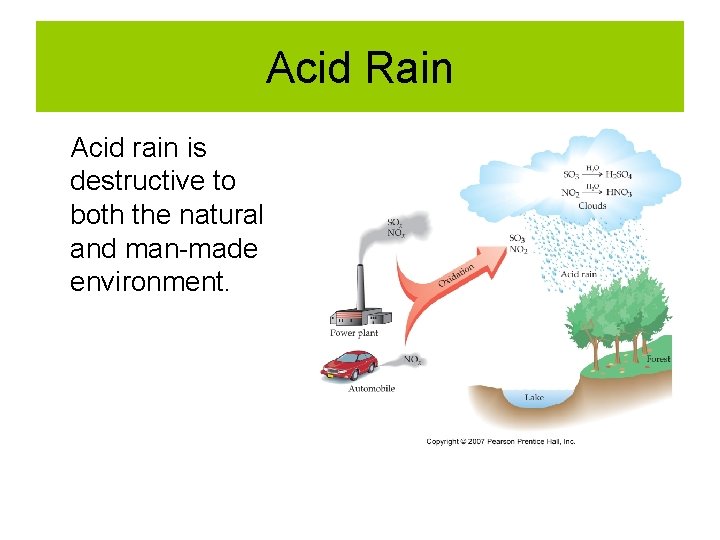
Acid Rain Acid rain is defined as precipitation having a p. H of less than 5. 6. Sulfur oxides and nitrogen oxides can react with water forming sulfuric and nitric acids. These are the major contributors to acid rain.
Acid Rain Acid rain is destructive to both the natural and man-made environment.
Indoor Air Pollution Indoor air pollution is a major health concern. The EPA estimates that pollutant levels of indoor air ranges from 2 -100 times higher than the levels of outdoor air.
Indoor Air Pollution CO and NOx are released by gas kitchen stoves, cigarette smoke, and free-standing unvented kerosene heaters. Mold will grow wherever there is moisture. Mold spores can exacerbate asthma, bronchitis, and other lung diseases. Ozone is released from copy machines, electronic air cleaners, and other devices. Ozone is a respiratory tract irritant.
Indoor Air Pollution Cigarettes and Second-hand Smoke Cigarette smoke has been shown to contain at least 40 different carcinogens. The EPA considers second-hand smoke to be a Class A carcinogen. Regular exposure to smoke and second-hand smoke has been shown to increase the risk of heart disease, lung cancer, miscarriage, and sudden infant death syndrome (SIDS).
Indoor Air Pollution Radon is a radioactive noble gas. It is colorless, odorless, and tasteless. Radon is released naturally from rock and soil. Radon decays by alpha emission. Polonium-218 is a daughter isotope of radon. It deposits in lung tissue and continues to emit radiation.
Ozone: The Double-Edged Sword Ozone (O 3) is an allotrope of oxygen (O 2). Ozone in the troposphere is a hazardous, toxic substance. It contributes to smog and indoor air pollution. Ozone in the stratosphere shields life on Earth from harmful ultraviolet radiation.
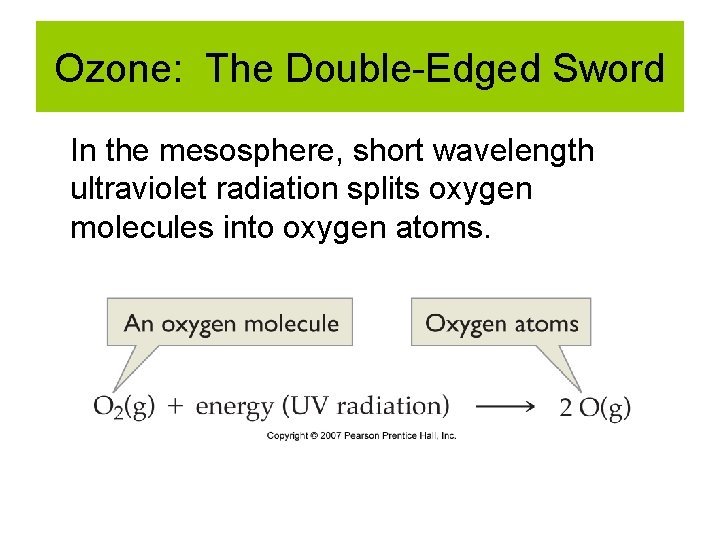
Ozone: The Double-Edged Sword In the mesosphere, short wavelength ultraviolet radiation splits oxygen molecules into oxygen atoms.
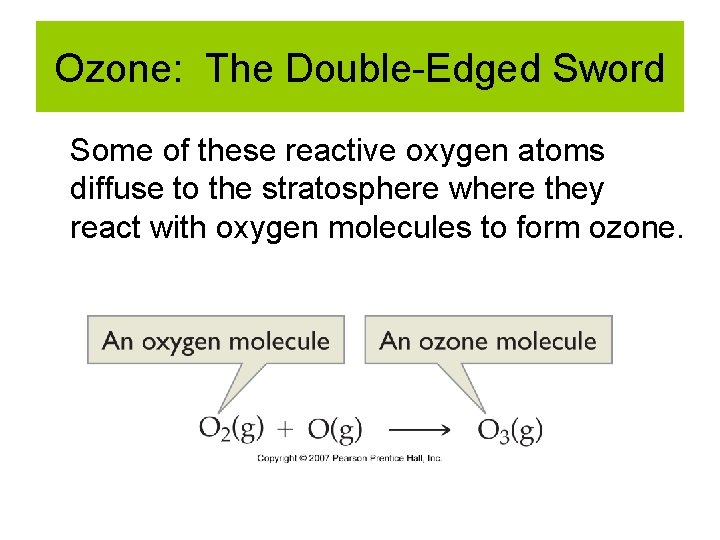
Ozone: The Double-Edged Sword Some of these reactive oxygen atoms diffuse to the stratosphere where they react with oxygen molecules to form ozone.
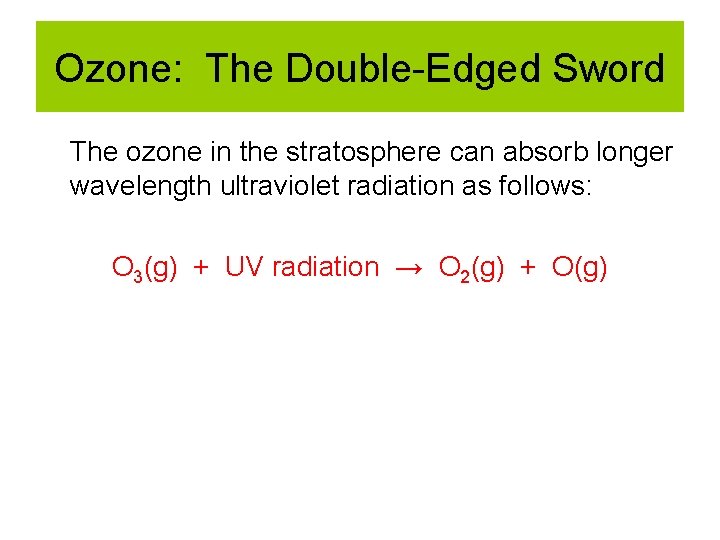
Ozone: The Double-Edged Sword The ozone in the stratosphere can absorb longer wavelength ultraviolet radiation as follows: O 3(g) + UV radiation → O 2(g) + O(g)
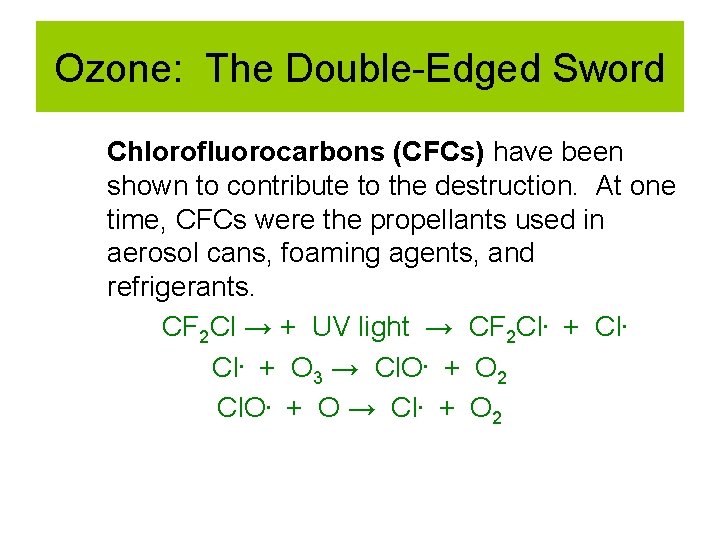
Ozone: The Double-Edged Sword Chlorofluorocarbons (CFCs) have been shown to contribute to the destruction. At one time, CFCs were the propellants used in aerosol cans, foaming agents, and refrigerants. CF 2 Cl → + UV light → CF 2 Cl. + O 3 → Cl. O. + O 2 Cl. O. + O → Cl. + O 2
Ozone: The Double-Edged Sword Many countries have banned the use of CFCs. Effective substitutes have been developed.
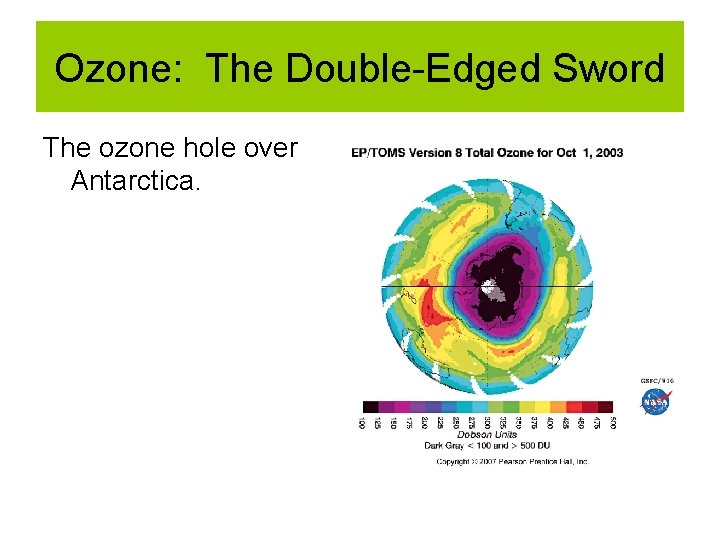
Ozone: The Double-Edged Sword The ozone hole over Antarctica.
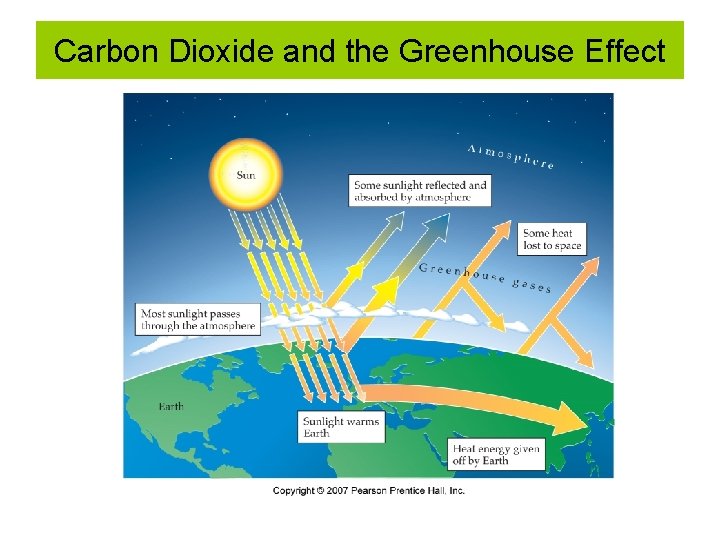
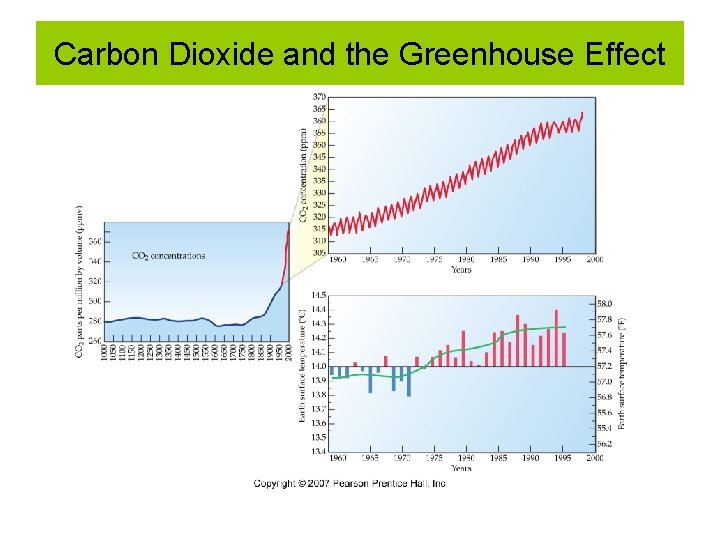
Carbon Dioxide and the Greenhouse Effect Carbon dioxide (CO 2) is known as a greenhouse gas. CO 2 and some other gases will allow solar energy to penetrate the atmosphere, but trap heat in (much like a greenhouse). Human activity has contributed tremendous amounts of CO 2 to the atmosphere in recent decades. There is much evidence to show that global warming is indeed occurring.
Carbon Dioxide and the Greenhouse Effect
Carbon Dioxide and the Greenhouse Effect
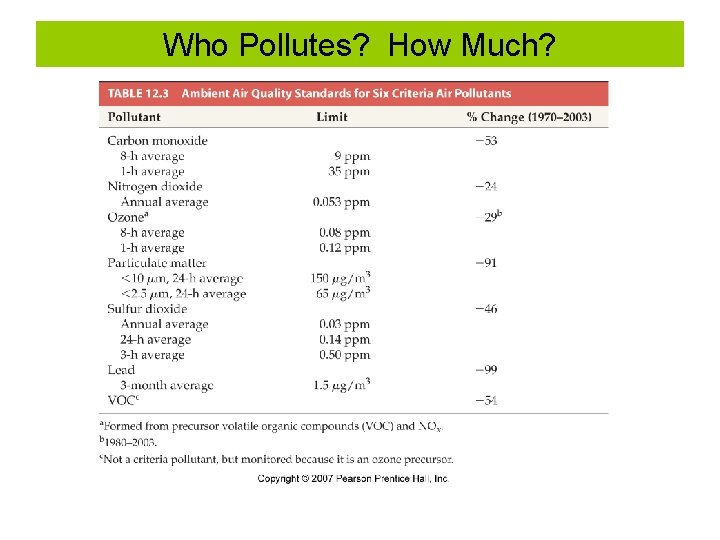
Who Pollutes? How Much?
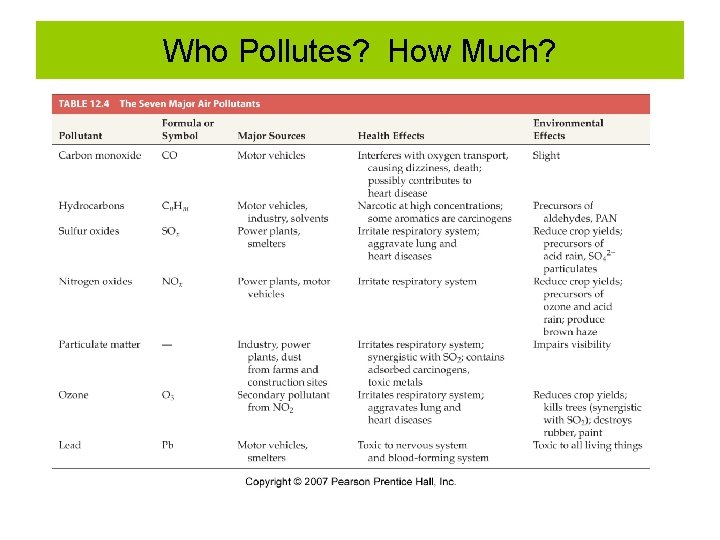
Who Pollutes? How Much?
Paying the Price Air pollution costs us tens of billions of dollars each year. There is no cheap and easy fix.