
CHEMISTRY DMCU 1233 Thermochemistry Chapter 7 IMRAN SYAKIR
- Slides: 24
CHEMISTRY - DMCU 1233 Thermochemistry Chapter 7 IMRAN SYAKIR BIN MOHAMAD | MOHD HAIZAL BIN MOHD HUSIN FACULTY OF MECHANICAL ENGINEERING 1
The Nature & Types of Energy is the capacity to do work • Thermal energy is the energy associated with the random motion of atoms and molecules • Chemical energy is the energy stored within the bonds of chemical substances • Nuclear energy is the energy stored within the collection of neutrons and protons in the atom • Electrical energy is the energy associated with the flow of electrons • Potential energy is the energy available by virtue of an object’s position 2
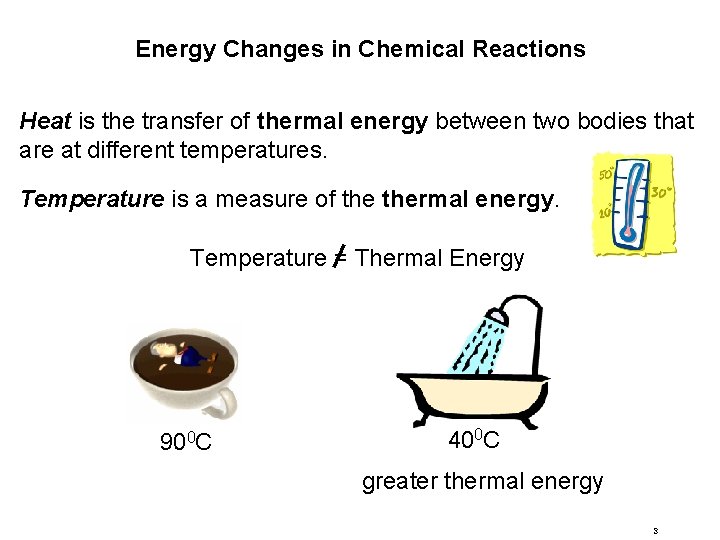
Energy Changes in Chemical Reactions Heat is the transfer of thermal energy between two bodies that are at different temperatures. Temperature is a measure of thermal energy. Temperature = Thermal Energy 900 C 400 C greater thermal energy 3
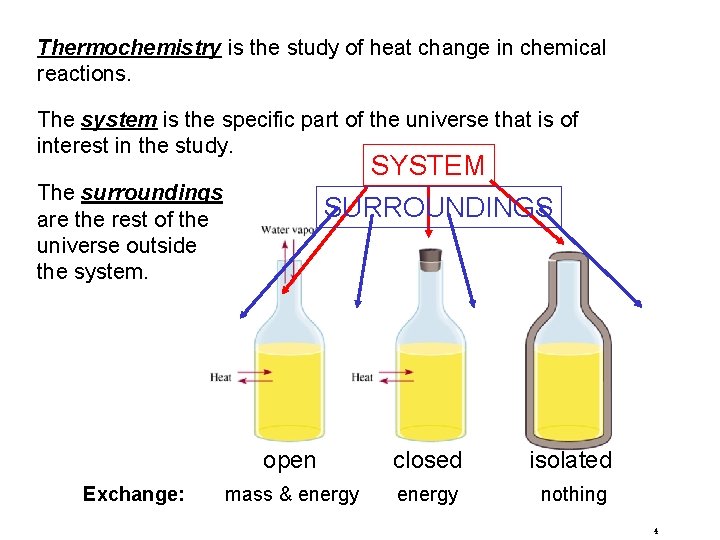
Thermochemistry is the study of heat change in chemical reactions. The system is the specific part of the universe that is of interest in the study. SYSTEM SURROUNDINGS The surroundings are the rest of the universe outside the system. Exchange: open closed isolated mass & energy nothing 4
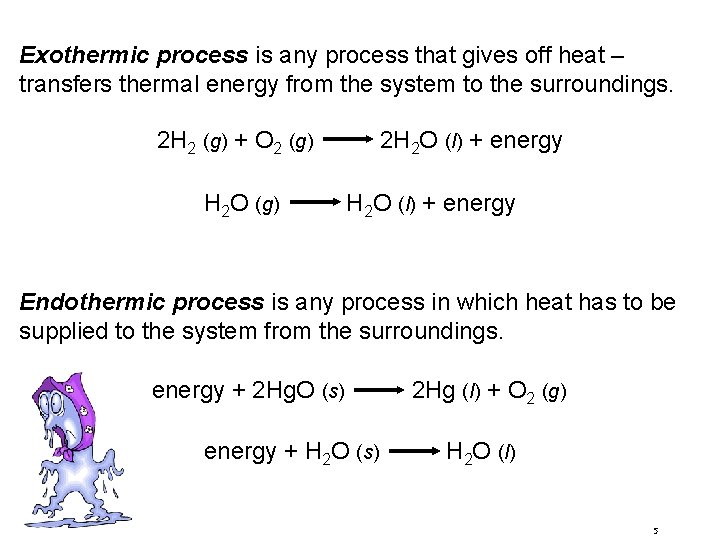
Exothermic process is any process that gives off heat – transfers thermal energy from the system to the surroundings. 2 H 2 (g) + O 2 (g) H 2 O (g) 2 H 2 O (l) + energy Endothermic process is any process in which heat has to be supplied to the system from the surroundings. energy + 2 Hg. O (s) energy + H 2 O (s) 2 Hg (l) + O 2 (g) H 2 O (l) 5
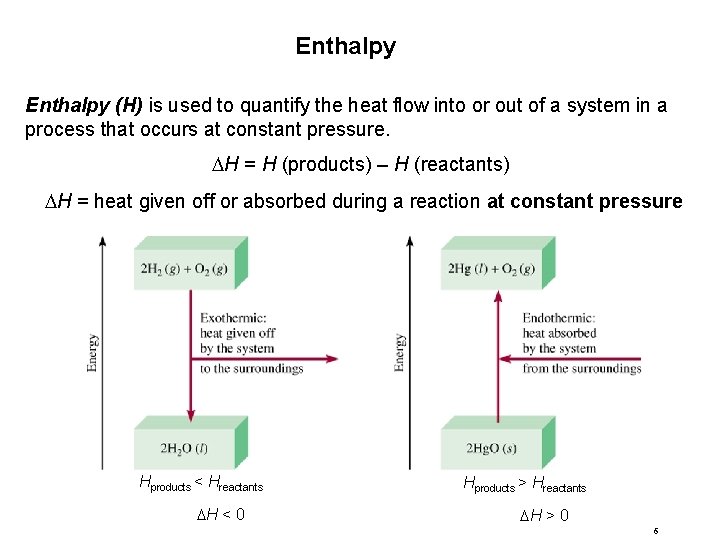
Enthalpy (H) is used to quantify the heat flow into or out of a system in a process that occurs at constant pressure. H = H (products) – H (reactants) H = heat given off or absorbed during a reaction at constant pressure Hproducts < Hreactants H < 0 Hproducts > Hreactants H > 0 6
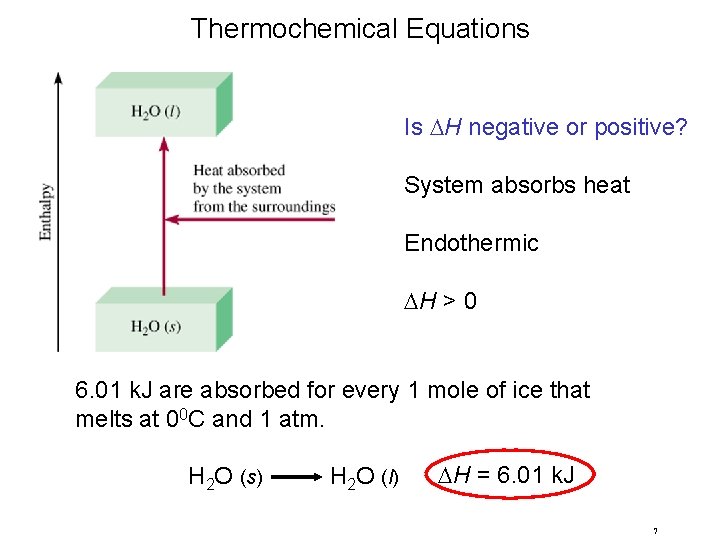
Thermochemical Equations Is H negative or positive? System absorbs heat Endothermic H > 0 6. 01 k. J are absorbed for every 1 mole of ice that melts at 00 C and 1 atm. H 2 O (s) H 2 O (l) H = 6. 01 k. J 7
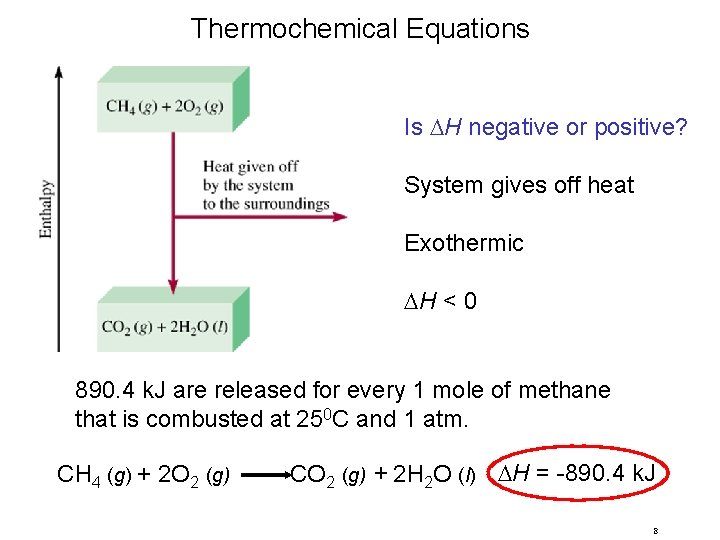
Thermochemical Equations Is H negative or positive? System gives off heat Exothermic H < 0 890. 4 k. J are released for every 1 mole of methane that is combusted at 250 C and 1 atm. CH 4 (g) + 2 O 2 (g) CO 2 (g) + 2 H 2 O (l) H = -890. 4 k. J 8
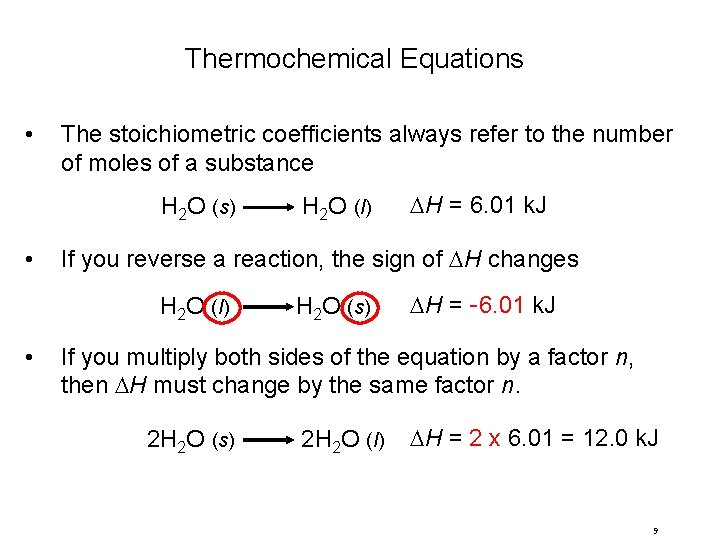
Thermochemical Equations • The stoichiometric coefficients always refer to the number of moles of a substance H 2 O (s) • H = 6. 01 k. J If you reverse a reaction, the sign of H changes H 2 O (l) • H 2 O (l) H 2 O (s) H = -6. 01 k. J If you multiply both sides of the equation by a factor n, then H must change by the same factor n. 2 H 2 O (s) 2 H 2 O (l) H = 2 x 6. 01 = 12. 0 k. J 9
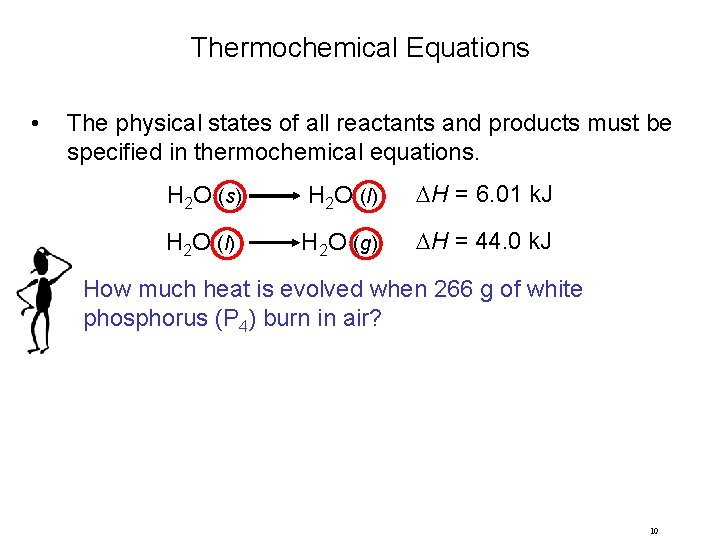
Thermochemical Equations • The physical states of all reactants and products must be specified in thermochemical equations. H 2 O (s) H 2 O (l) H = 6. 01 k. J H 2 O (l) H 2 O (g) H = 44. 0 k. J How much heat is evolved when 266 g of white phosphorus (P 4) burn in air? 10
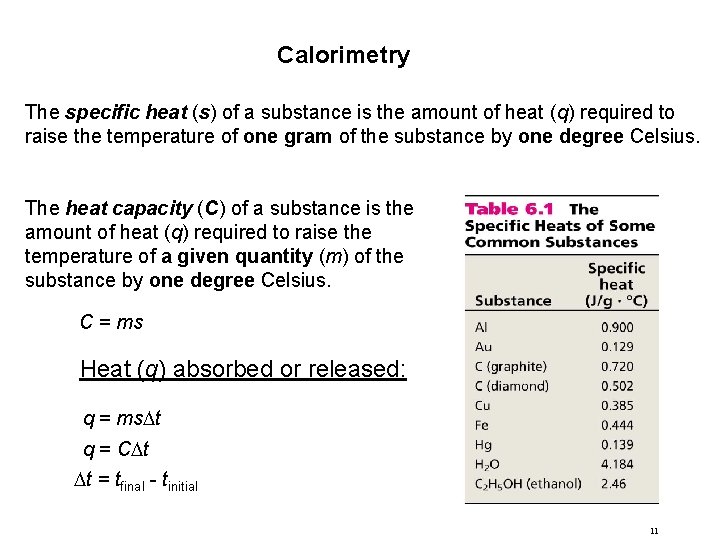
Calorimetry The specific heat (s) of a substance is the amount of heat (q) required to raise the temperature of one gram of the substance by one degree Celsius. The heat capacity (C) of a substance is the amount of heat (q) required to raise the temperature of a given quantity (m) of the substance by one degree Celsius. C = ms Heat (q) absorbed or released: q = ms t q = C t t = tfinal - tinitial 11
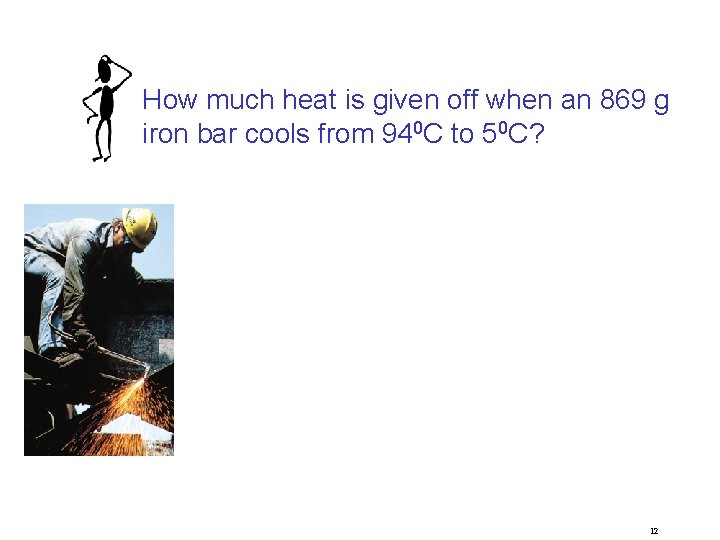
How much heat is given off when an 869 g iron bar cools from 940 C to 50 C? 12
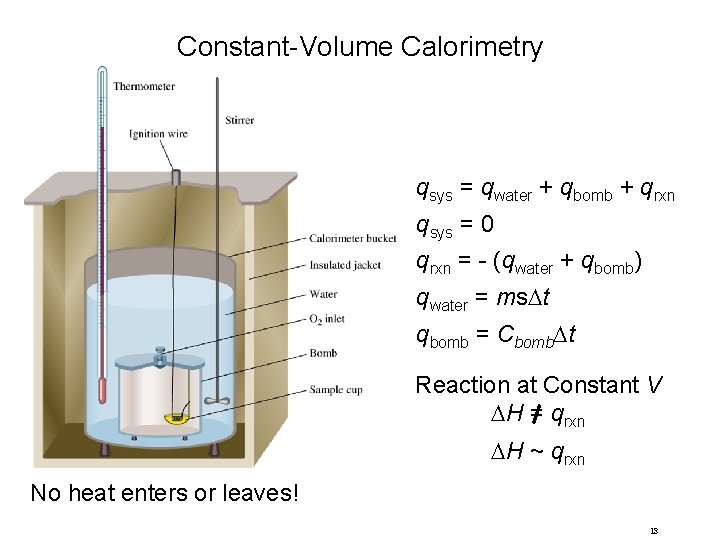
Constant-Volume Calorimetry qsys = qwater + qbomb + qrxn qsys = 0 qrxn = - (qwater + qbomb) qwater = ms t qbomb = Cbomb t Reaction at Constant V H = qrxn H ~ qrxn No heat enters or leaves! 13
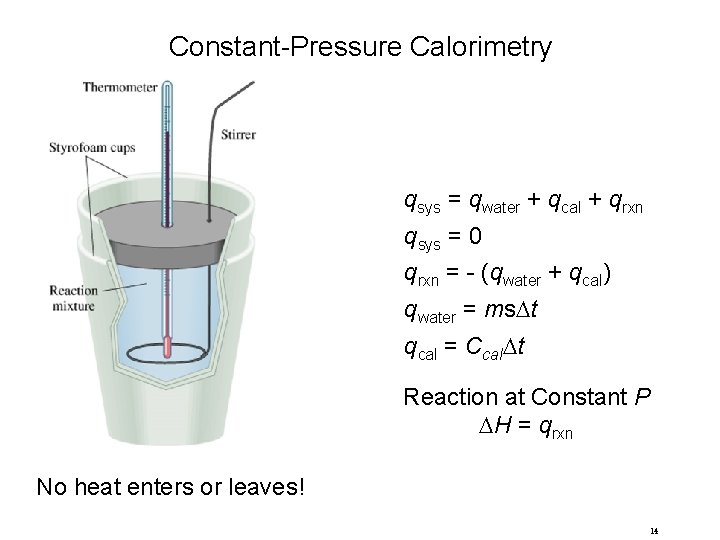
Constant-Pressure Calorimetry qsys = qwater + qcal + qrxn qsys = 0 qrxn = - (qwater + qcal) qwater = ms t qcal = Ccal t Reaction at Constant P H = qrxn No heat enters or leaves! 14
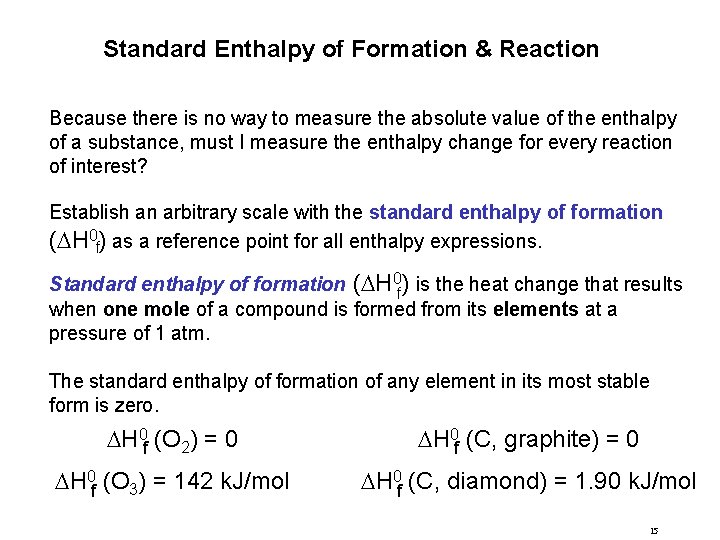
Standard Enthalpy of Formation & Reaction Because there is no way to measure the absolute value of the enthalpy of a substance, must I measure the enthalpy change for every reaction of interest? Establish an arbitrary scale with the standard enthalpy of formation ( H 0 f) as a reference point for all enthalpy expressions. Standard enthalpy of formation ( H 0 f) is the heat change that results when one mole of a compound is formed from its elements at a pressure of 1 atm. The standard enthalpy of formation of any element in its most stable form is zero. H 0 f (O 2) = 0 H 0 f (C, graphite) = 0 H 0 f (O 3) = 142 k. J/mol H 0 f (C, diamond) = 1. 90 k. J/mol 15
Back to Q&A 16
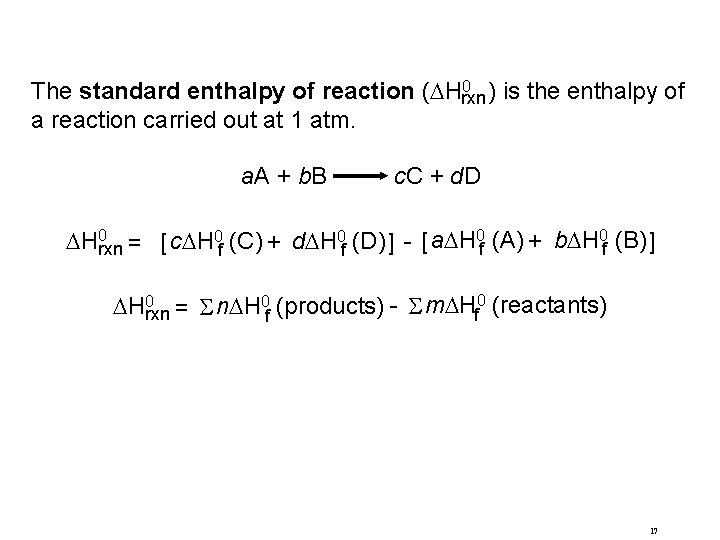
0 ) is the enthalpy of The standard enthalpy of reaction ( Hrxn a reaction carried out at 1 atm. a. A + b. B c. C + d. D H 0 rxn = [ c H 0 f (C) + d H 0 f (D) ] - [ a H 0 f (A) + b H 0 f (B) ] H 0 rxn = S n H 0 f (products) - S m Hf 0 (reactants) 17
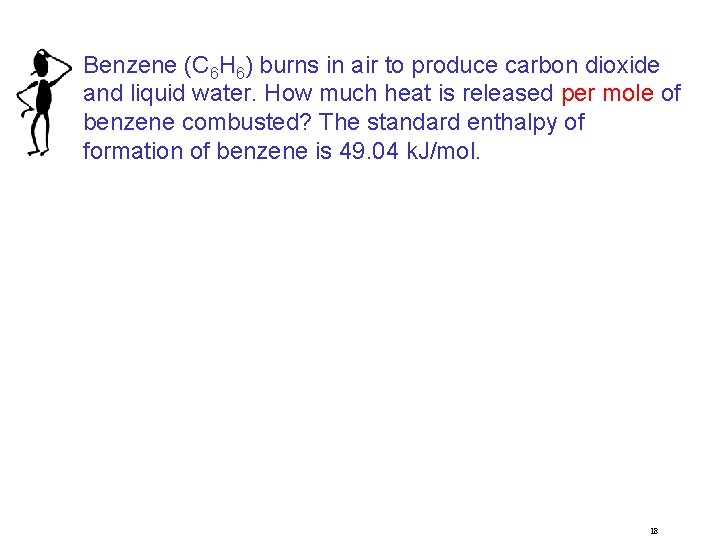
Benzene (C 6 H 6) burns in air to produce carbon dioxide and liquid water. How much heat is released per mole of benzene combusted? The standard enthalpy of formation of benzene is 49. 04 k. J/mol. 18
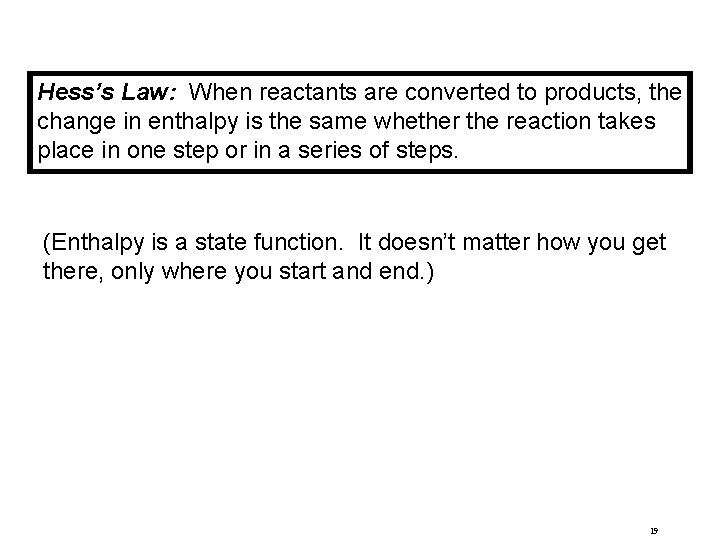
Hess’s Law: When reactants are converted to products, the change in enthalpy is the same whether the reaction takes place in one step or in a series of steps. (Enthalpy is a state function. It doesn’t matter how you get there, only where you start and end. ) 19
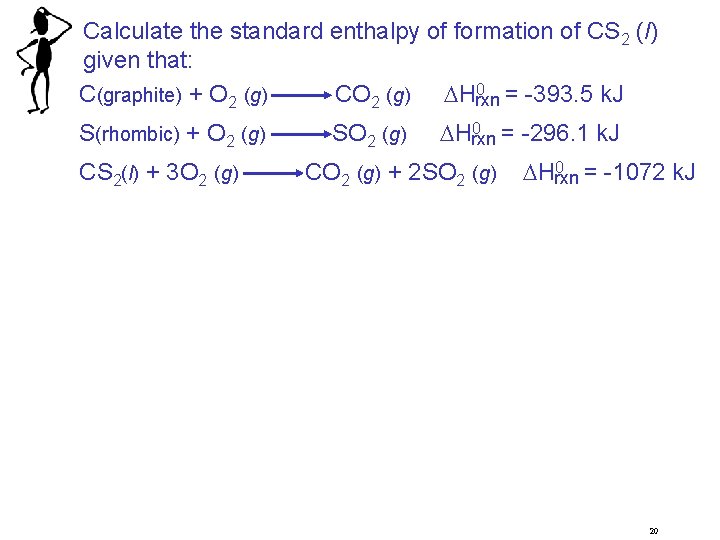
Calculate the standard enthalpy of formation of CS 2 (l) given that: 0 = -393. 5 k. J C(graphite) + O 2 (g) CO 2 (g) Hrxn S(rhombic) + O 2 (g) CS 2(l) + 3 O 2 (g) SO 2 (g) 0 = -296. 1 k. J Hrxn CO 2 (g) + 2 SO 2 (g) 0 = -1072 k. J Hrxn 20
Q & A session Question 1 Question 2 Question 3 21
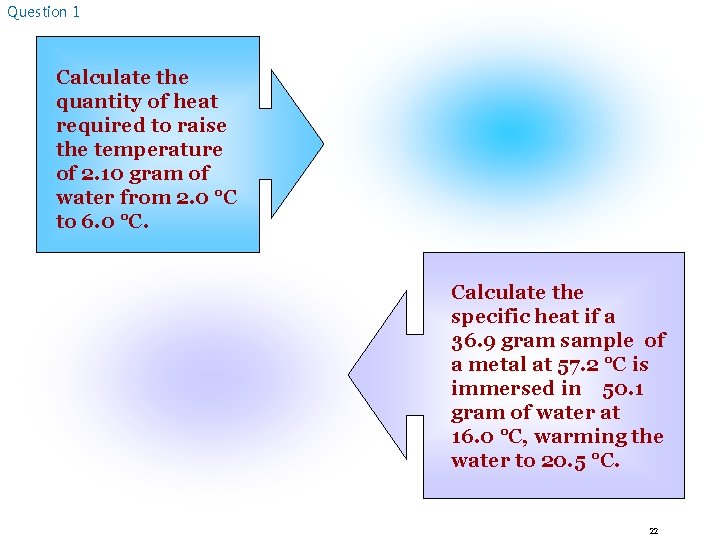
Question 1 Calculate the quantity of heat required to raise the temperature of 2. 10 gram of water from 2. 0 °C to 6. 0 °C. Calculate the specific heat if a 36. 9 gram sample of a metal at 57. 2 °C is immersed in 50. 1 gram of water at 16. 0 °C, warming the water to 20. 5 °C. 22
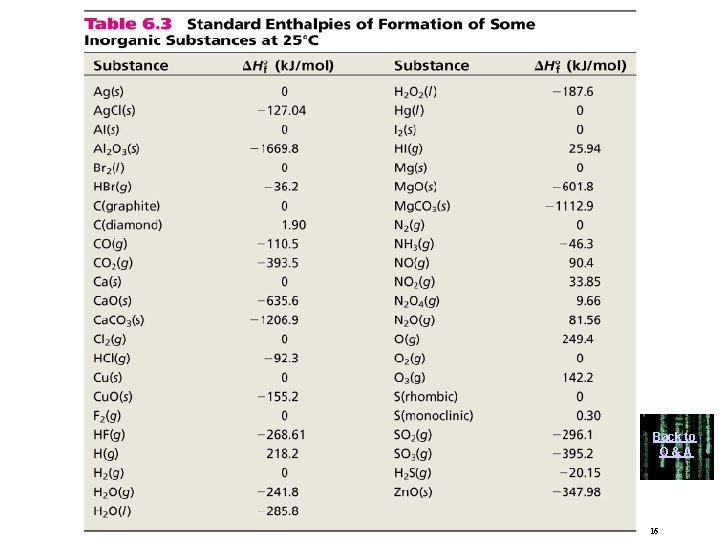
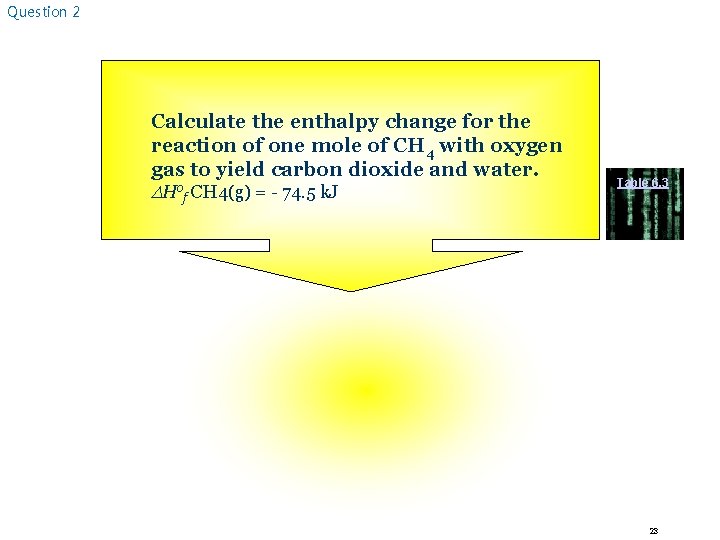
Question 2 Calculate the enthalpy change for the reaction of one mole of CH 4 with oxygen gas to yield carbon dioxide and water. Hof CH 4(g) = - 74. 5 k. J Table 6. 3 23
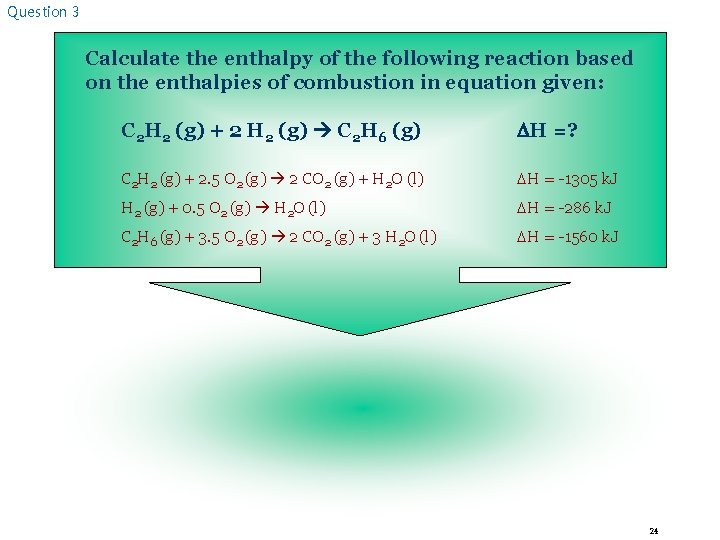
Question 3 Calculate the enthalpy of the following reaction based on the enthalpies of combustion in equation given: C 2 H 2 (g) + 2 H 2 (g) C 2 H 6 (g) H =? C 2 H 2 (g) + 2. 5 O 2 (g) 2 CO 2 (g) + H 2 O (l) H = -1305 k. J H 2 (g) + 0. 5 O 2 (g) H 2 O (l) H = -286 k. J C 2 H 6 (g) + 3. 5 O 2 (g) 2 CO 2 (g) + 3 H 2 O (l) H = -1560 k. J 24