
Chemistry Chapter 7 Ionic and Metallic Bonding Heart
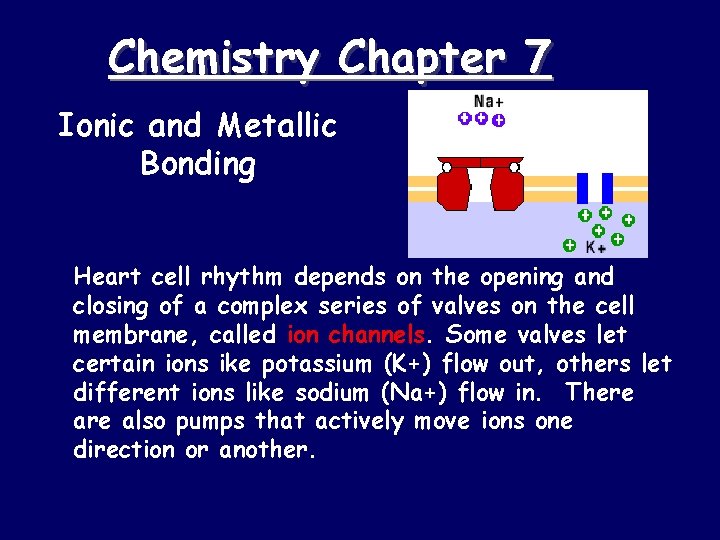
Chemistry Chapter 7 Ionic and Metallic Bonding Heart cell rhythm depends on the opening and closing of a complex series of valves on the cell membrane, called ion channels. Some valves let certain ions ike potassium (K+) flow out, others let different ions like sodium (Na+) flow in. There also pumps that actively move ions one direction or another.
Ions • Valence electrons: e- in the highest occupied energy level of an element’s atoms. • Cation: A positive ion (metals) Na Na+ + e. Mg 2+, Al 3+ • Anion: A negative ion (non-metals) Cl + e- Cl. F - , S 2 -
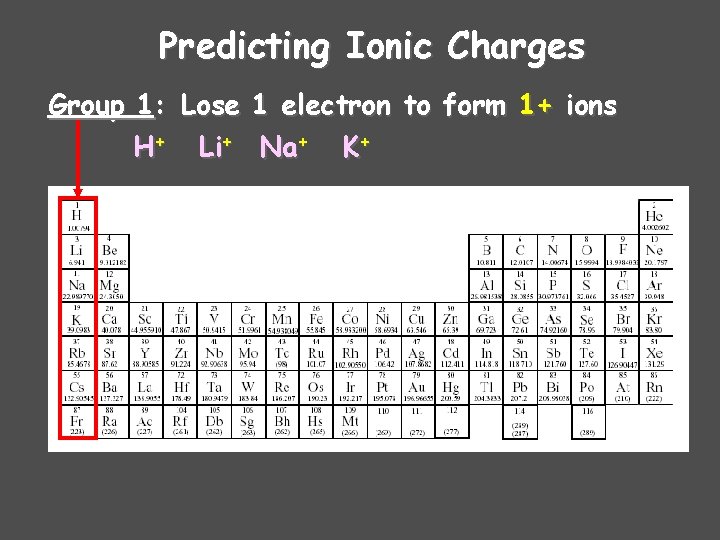
Predicting Ionic Charges Group 1: Lose 1 electron to form 1+ ions H+ Li+ Na+ K+
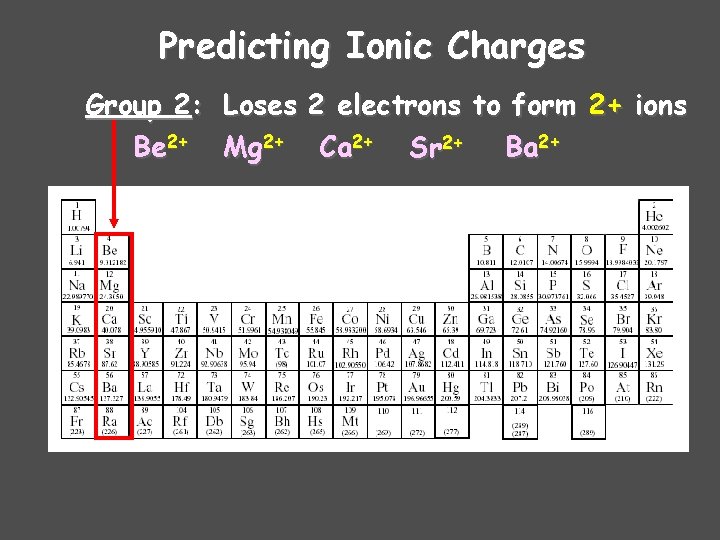
Predicting Ionic Charges Group 2: Loses 2 electrons to form 2+ ions Be 2+ Mg 2+ Ca 2+ Sr 2+ Ba 2+
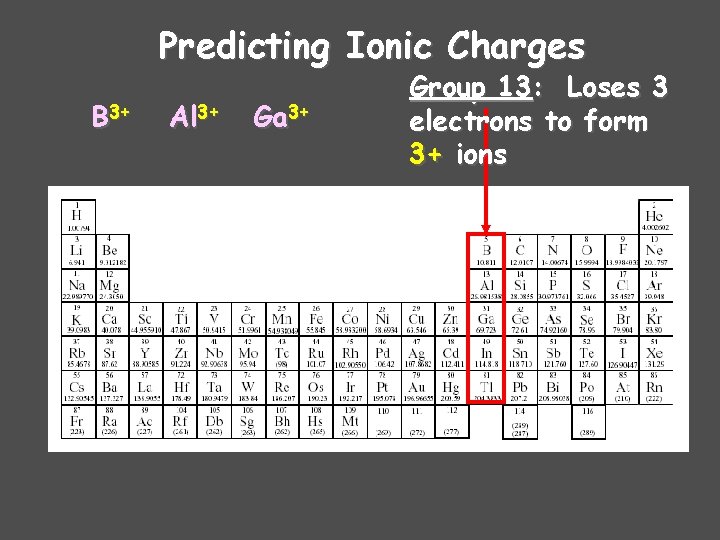
Predicting Ionic Charges B 3+ Al 3+ Ga 3+ Group 13: Loses 3 electrons to form 3+ ions
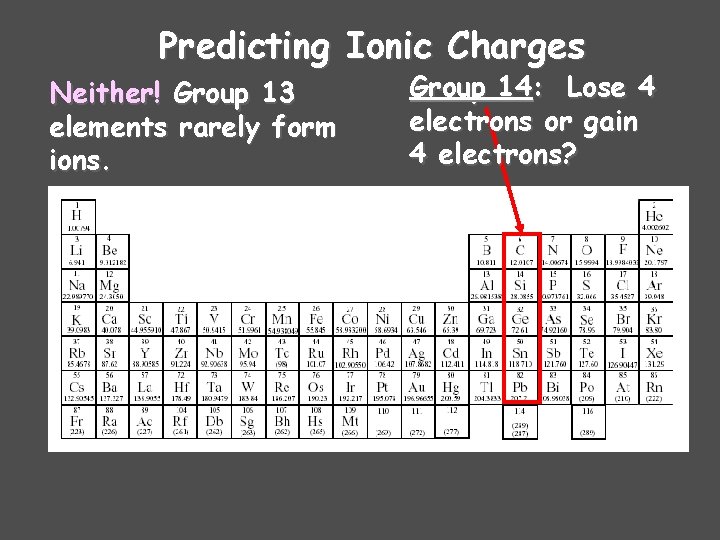
Predicting Ionic Charges Neither! Group 13 elements rarely form ions. Group 14: Lose 4 electrons or gain 4 electrons?
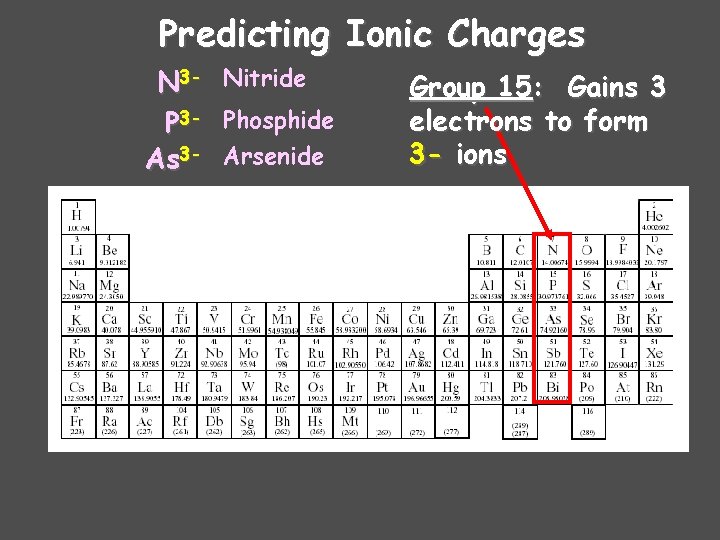
Predicting Ionic Charges N 3 - Nitride P 3 - Phosphide As 3 - Arsenide Group 15: Gains 3 electrons to form 3 - ions
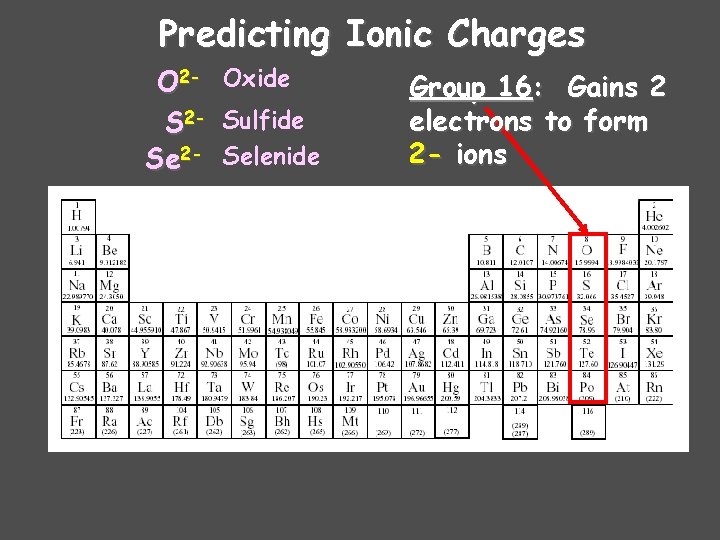
Predicting Ionic Charges O 2 - Oxide S 2 - Sulfide Se 2 - Selenide Group 16: Gains 2 electrons to form 2 - ions
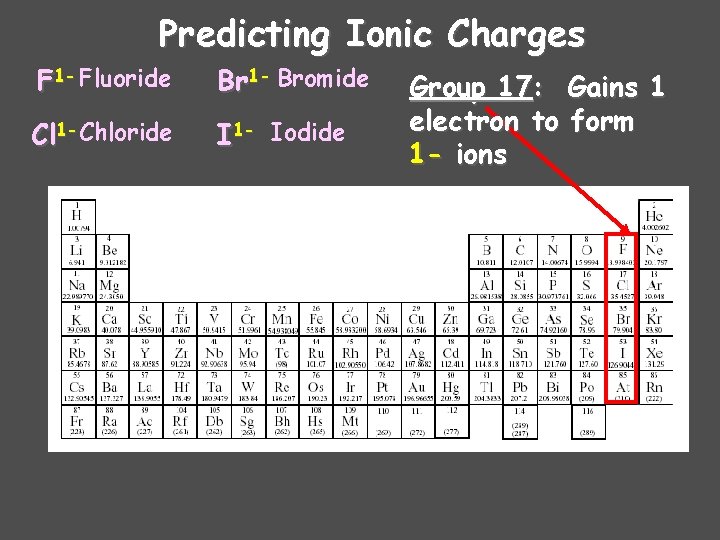
Predicting Ionic Charges F 1 - Fluoride Br 1 - Bromide Cl 1 -Chloride I 1 - Iodide Group 17: Gains 1 electron to form 1 - ions
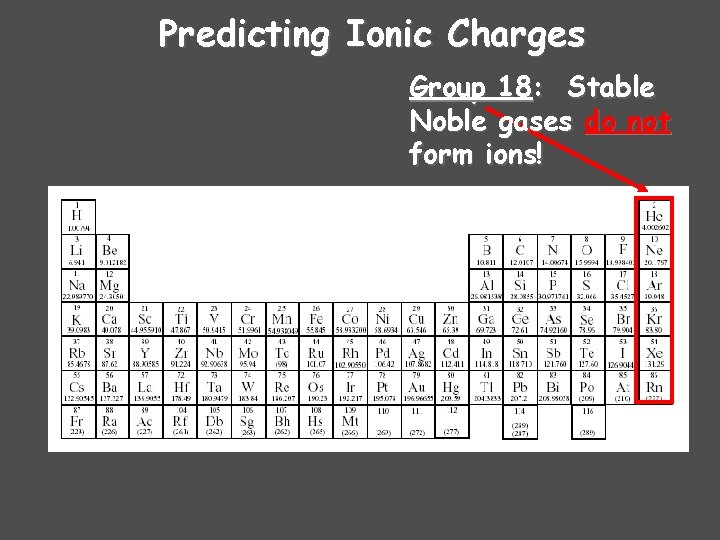
Predicting Ionic Charges Group 18: Stable Noble gases do not form ions!
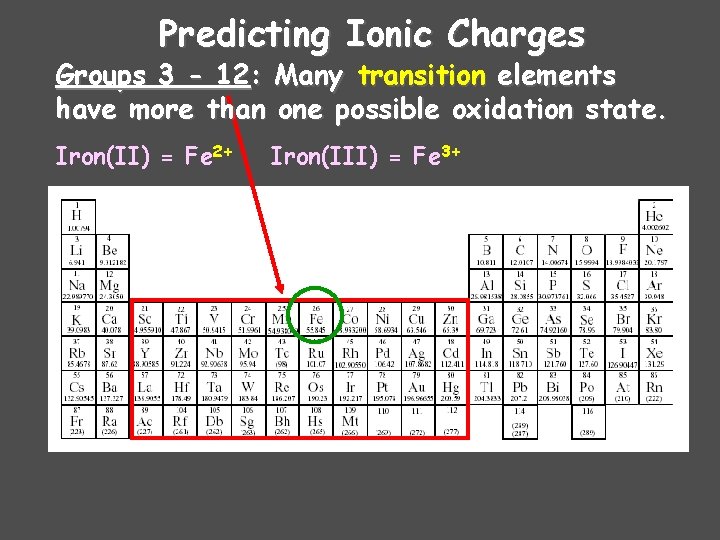
Predicting Ionic Charges Groups 3 - 12: Many transition elements have more than one possible oxidation state. Iron(II) = Fe 2+ Iron(III) = Fe 3+
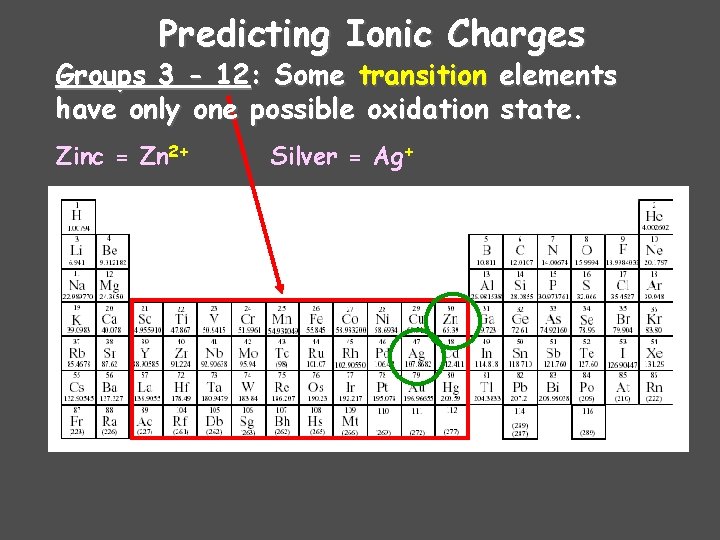
Predicting Ionic Charges Groups 3 - 12: Some transition elements have only one possible oxidation state. Zinc = Zn 2+ Silver = Ag+
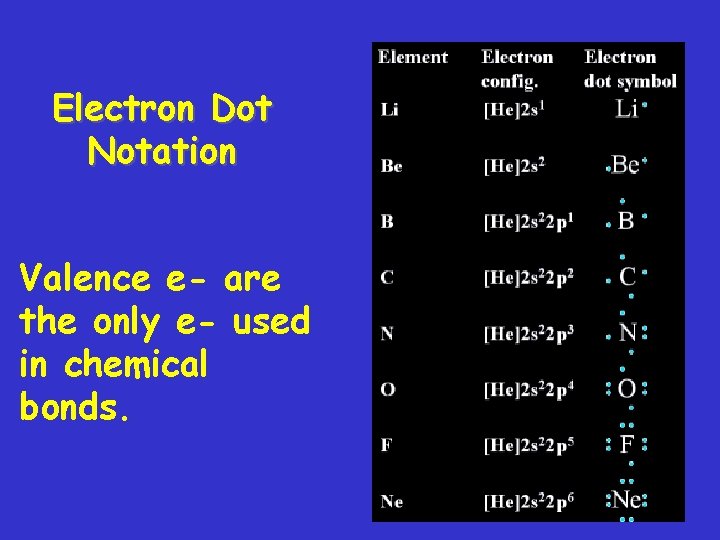
Electron Dot Notation Valence e- are the only e- used in chemical bonds.
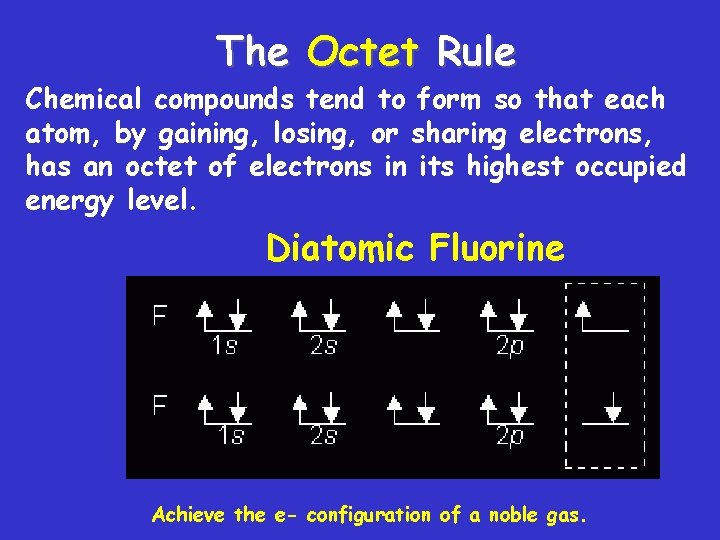
The Octet Rule Chemical compounds tend to form so that each atom, by gaining, losing, or sharing electrons, has an octet of electrons in its highest occupied energy level. Diatomic Fluorine Achieve the e- configuration of a noble gas.
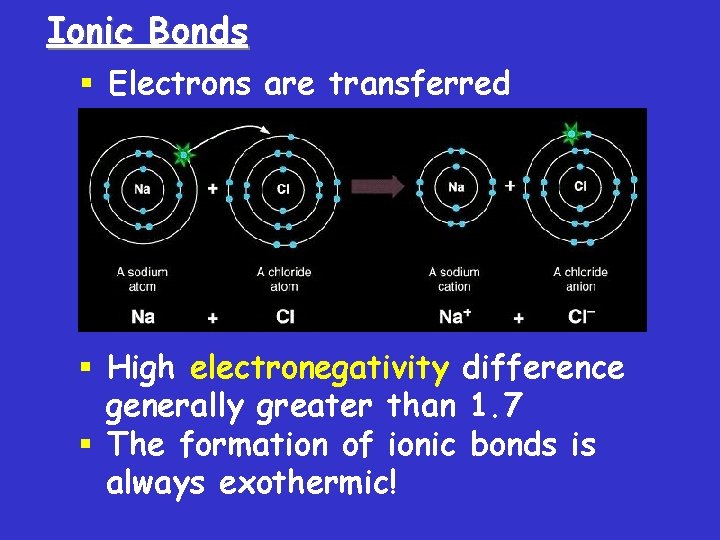
Ionic Bonds § Electrons are transferred § High electronegativity difference generally greater than 1. 7 § The formation of ionic bonds is always exothermic!
Ionic Compounds • Ionic bonds form between metals and non-metals • Metal atoms lose electrons to form positive ions • Non-metal atoms gain electrons to form negative ions • The oppositely charged ions attract one another and create an electrically neutral compound.
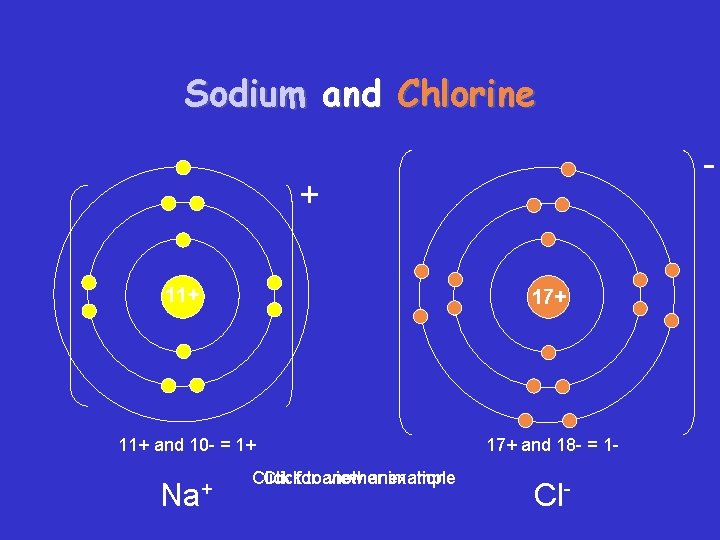
Sodium and Chlorine - + 11+ 17+ 11+ and 10 - = 1+ 17+ and 18 - = 1 - Na+ Clickfor toanother view animation example Cl-
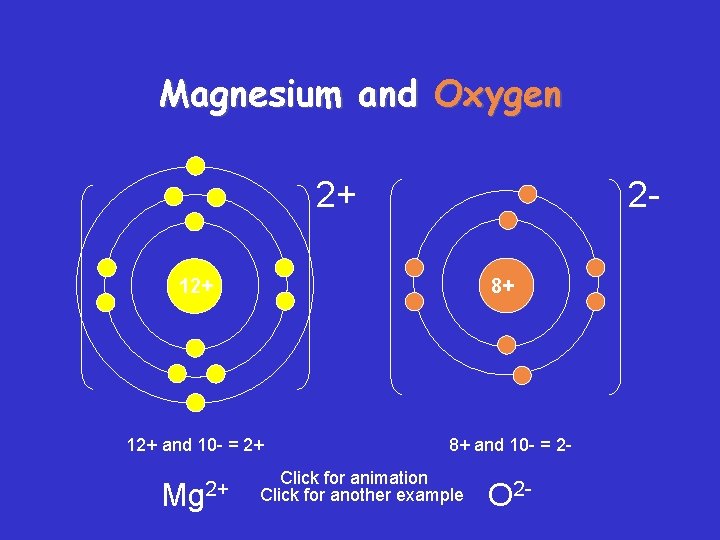
Magnesium and Oxygen 2+ 2 - 12+ 8+ 12+ and 10 - = 2+ Mg 2+ 8+ and 10 - = 2 - Click for animation Click for another example O 2 -
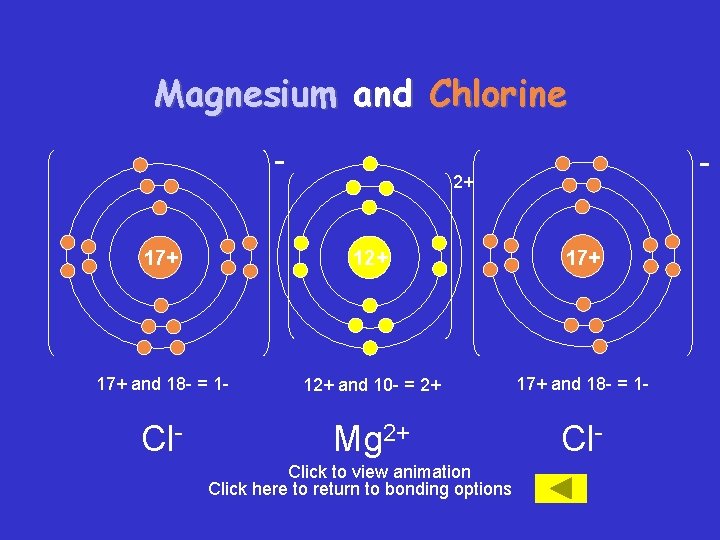
Magnesium and Chlorine - - 2+ 17+ 17+ and 18 - = 1 - 12+ and 10 - = 2+ 17+ and 18 - = 1 - Cl- Mg 2+ Cl- Click to view animation Click here to return to bonding options
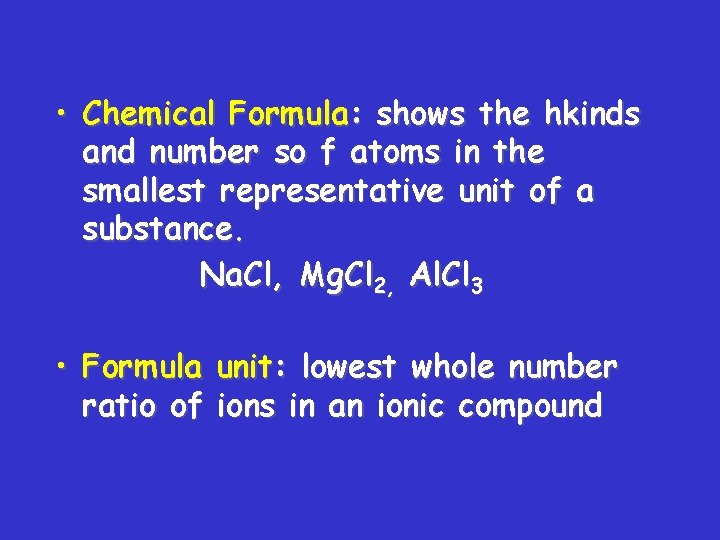
• Chemical Formula: shows the hkinds and number so f atoms in the smallest representative unit of a substance. Na. Cl, Mg. Cl 2, Al. Cl 3 • Formula unit: lowest whole number ratio of ions in an ionic compound
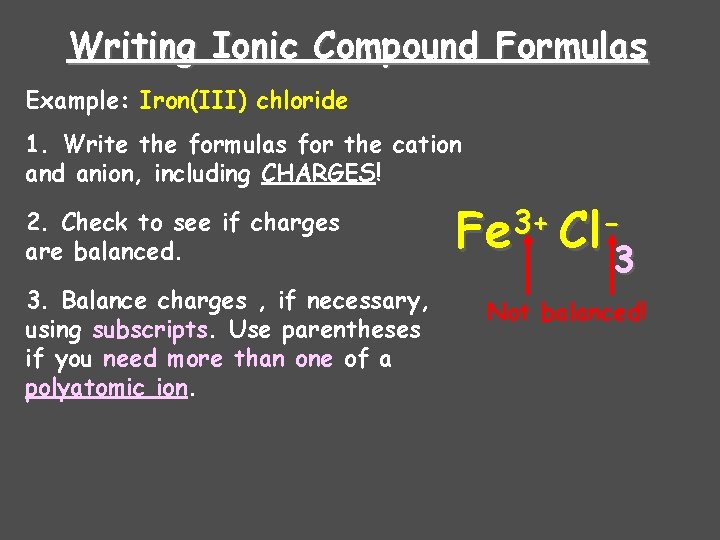
Writing Ionic Compound Formulas Example: Iron(III) chloride 1. Write the formulas for the cation and anion, including CHARGES! 2. Check to see if charges are balanced. 3. Balance charges , if necessary, using subscripts. Use parentheses if you need more than one of a polyatomic ion. Fe 3+ Cl 3 3 Not balanced!
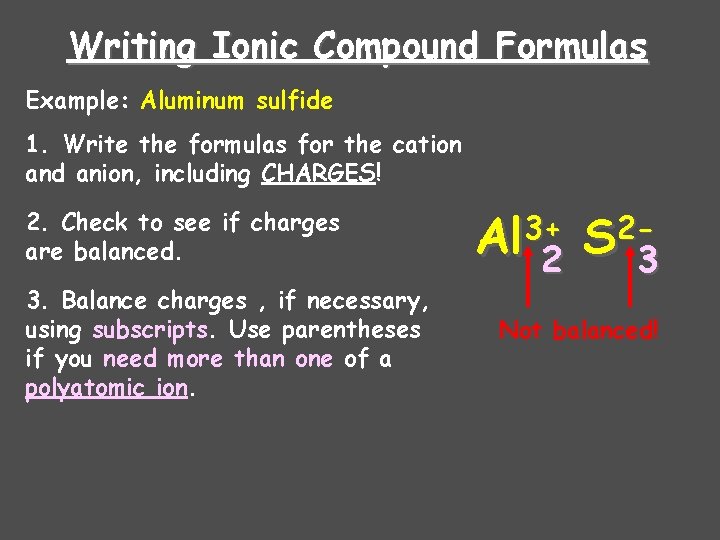
Writing Ionic Compound Formulas Example: Aluminum sulfide 1. Write the formulas for the cation and anion, including CHARGES! 2. Check to see if charges are balanced. 3. Balance charges , if necessary, using subscripts. Use parentheses if you need more than one of a polyatomic ion. 3+ Al 2 2 S 3 Not balanced!
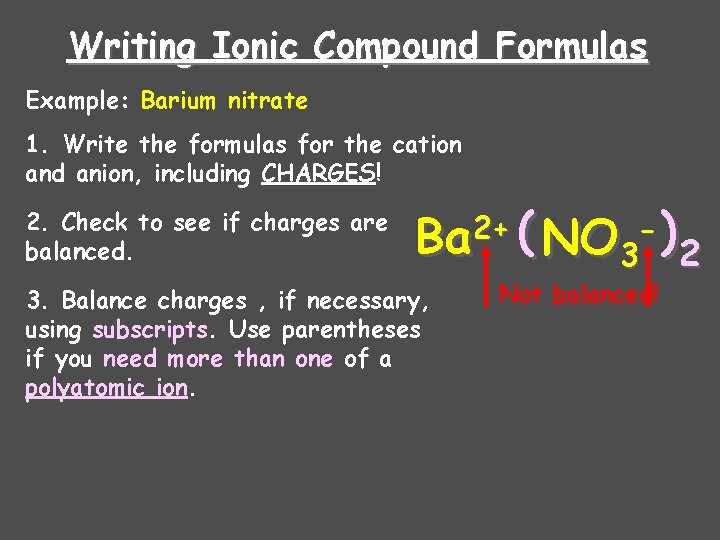
Writing Ionic Compound Formulas Example: Barium nitrate 1. Write the formulas for the cation and anion, including CHARGES! 2. Check to see if charges are balanced. 2+ ( Ba NO 3 ) 2 3. Balance charges , if necessary, using subscripts. Use parentheses if you need more than one of a polyatomic ion. Not balanced!
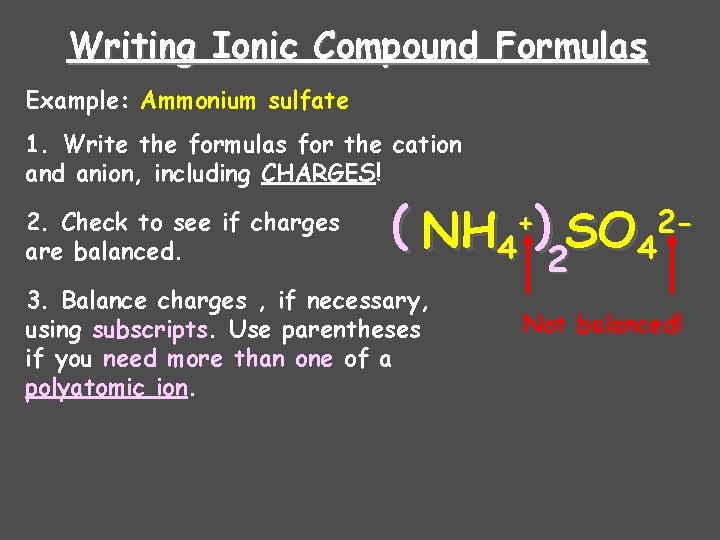
Writing Ionic Compound Formulas Example: Ammonium sulfate 1. Write the formulas for the cation and anion, including CHARGES! 2. Check to see if charges are balanced. ( NH 4+) SO 42 - 3. Balance charges , if necessary, using subscripts. Use parentheses if you need more than one of a polyatomic ion. 2 Not balanced!
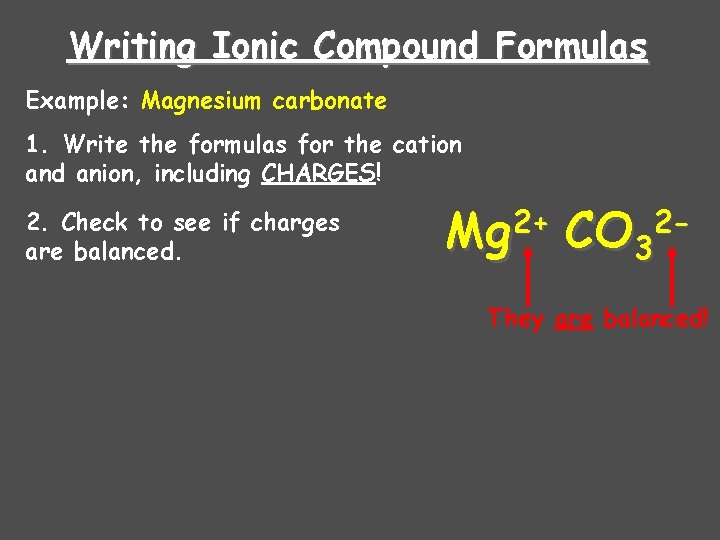
Writing Ionic Compound Formulas Example: Magnesium carbonate 1. Write the formulas for the cation and anion, including CHARGES! 2. Check to see if charges are balanced. Mg 2+ CO 32 They are balanced!
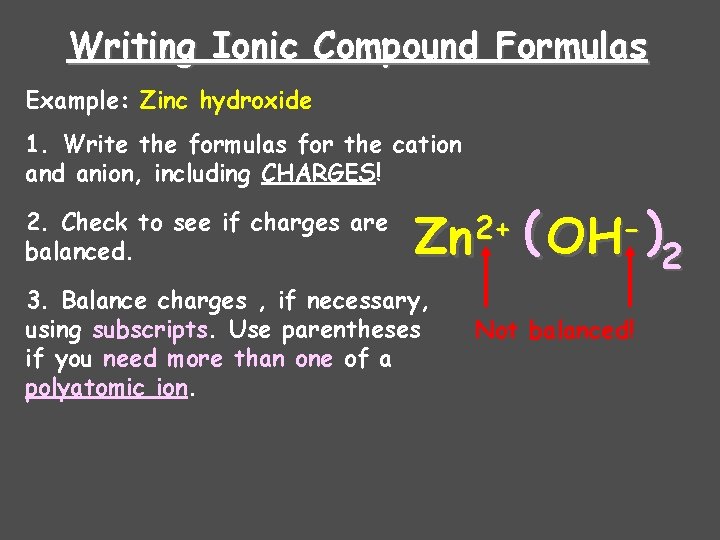
Writing Ionic Compound Formulas Example: Zinc hydroxide 1. Write the formulas for the cation and anion, including CHARGES! 2. Check to see if charges are balanced. 2+ ( Zn OH ) 3. Balance charges , if necessary, using subscripts. Use parentheses if you need more than one of a polyatomic ion. 2 Not balanced!
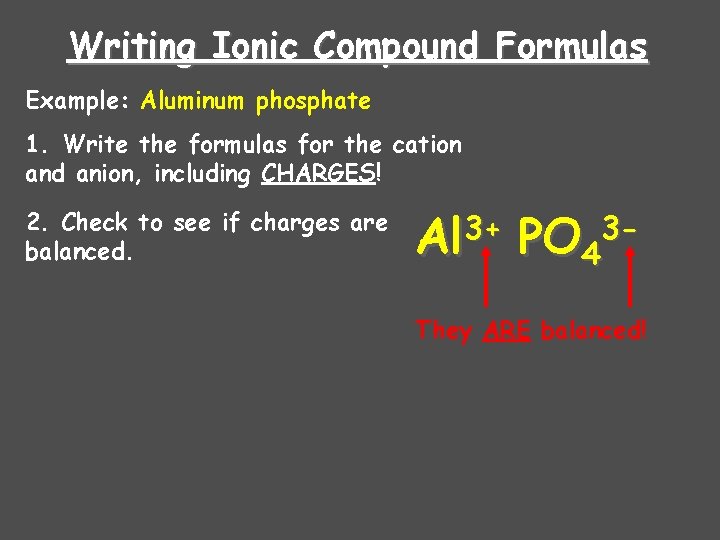
Writing Ionic Compound Formulas Example: Aluminum phosphate 1. Write the formulas for the cation and anion, including CHARGES! 2. Check to see if charges are balanced. 3+ Al 3 PO 4 They ARE balanced!
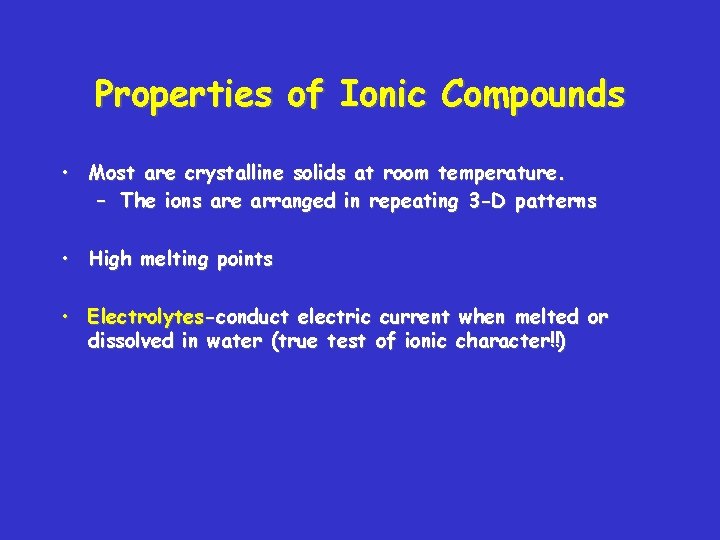
Properties of Ionic Compounds • Most are crystalline solids at room temperature. – The ions are arranged in repeating 3 -D patterns • High melting points • Electrolytes-conduct electric current when melted or dissolved in water (true test of ionic character!!)
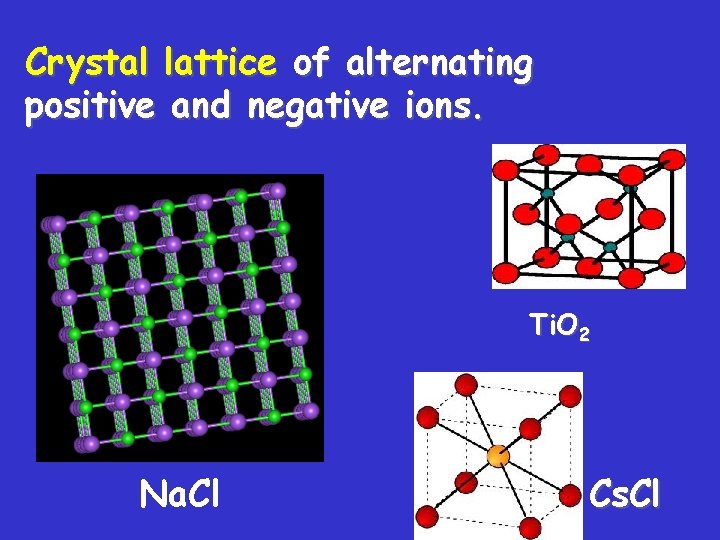
Crystal lattice of alternating positive and negative ions. Ti. O 2 Na. Cl Cs. Cl
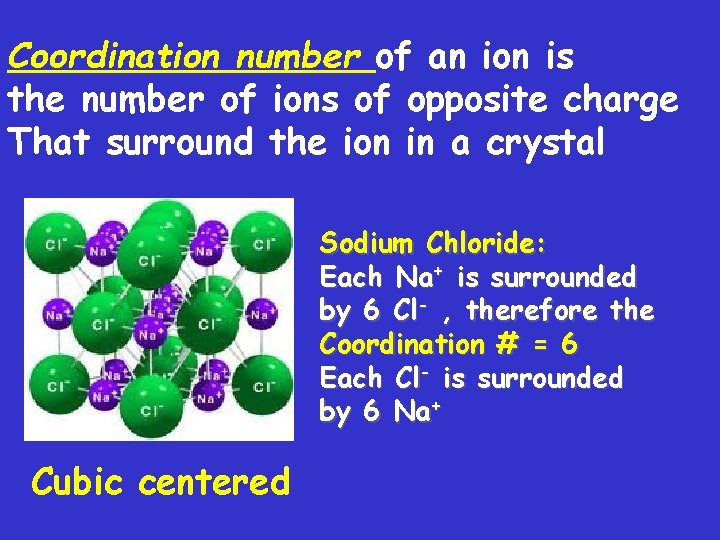
Coordination number of an ion is the number of ions of opposite charge That surround the ion in a crystal Sodium Chloride: Each Na+ is surrounded by 6 Cl- , therefore the Coordination # = 6 Each Cl- is surrounded by 6 Na+ Cubic centered
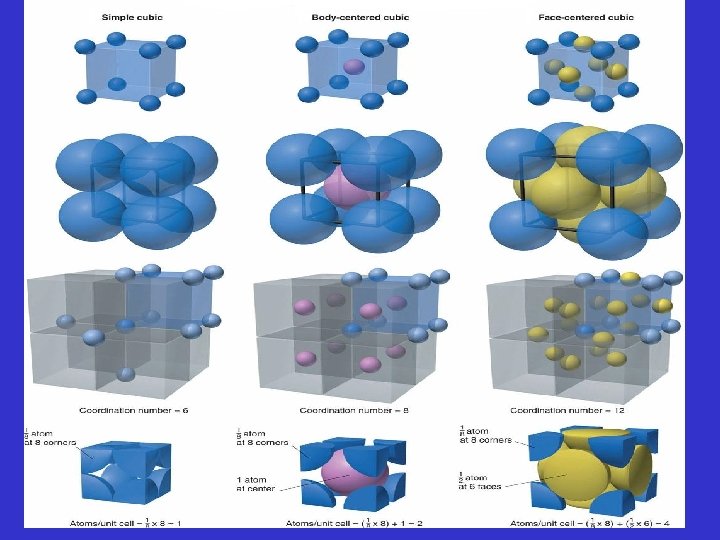
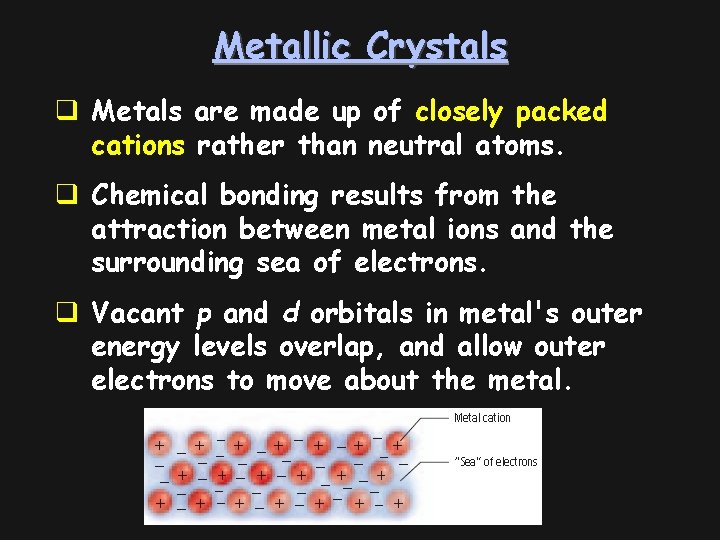
Metallic Crystals q Metals are made up of closely packed cations rather than neutral atoms. q Chemical bonding results from the attraction between metal ions and the surrounding sea of electrons. q Vacant p and d orbitals in metal's outer energy levels overlap, and allow outer electrons to move about the metal.
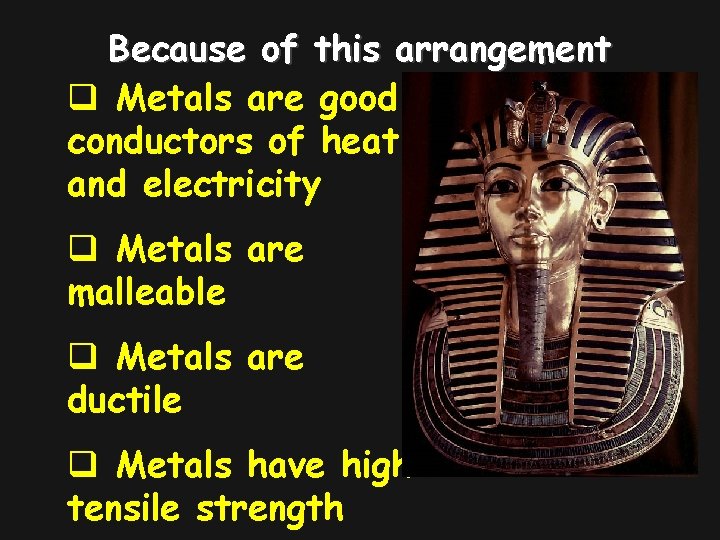
Because of this arrangement q Metals are good conductors of heat and electricity q Metals are malleable q Metals are ductile q Metals have high tensile strength
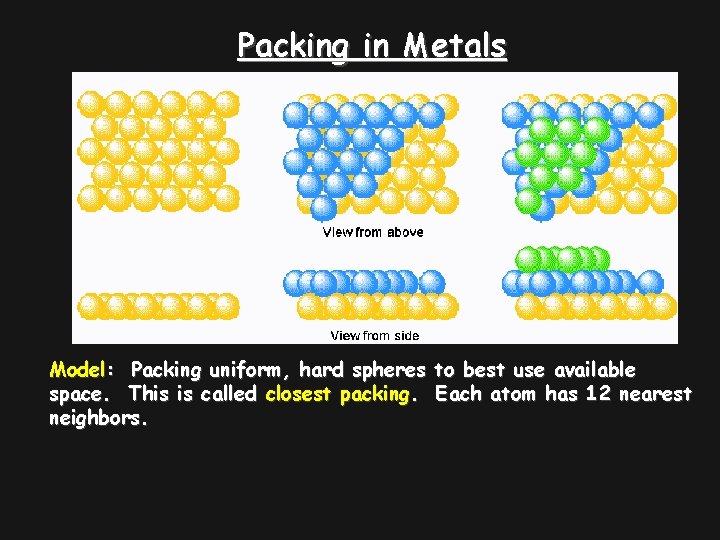
Packing in Metals Model: Packing uniform, hard spheres to best use available space. This is called closest packing. Each atom has 12 nearest neighbors.
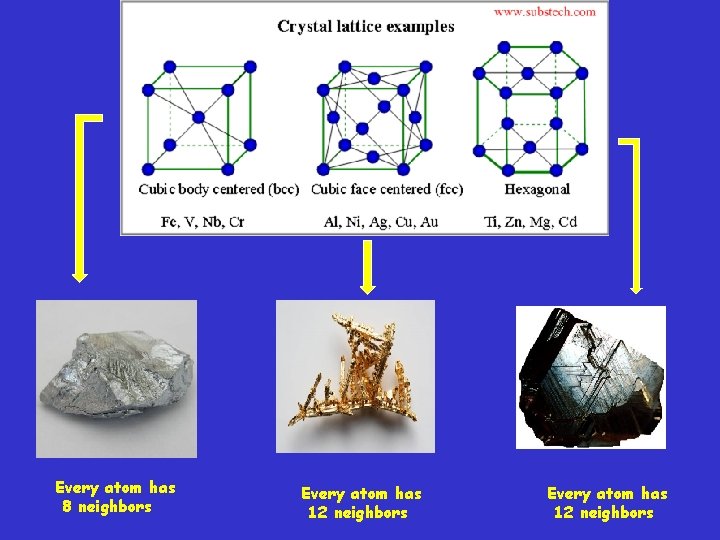
Every atom has 8 neighbors Every atom has 12 neighbors
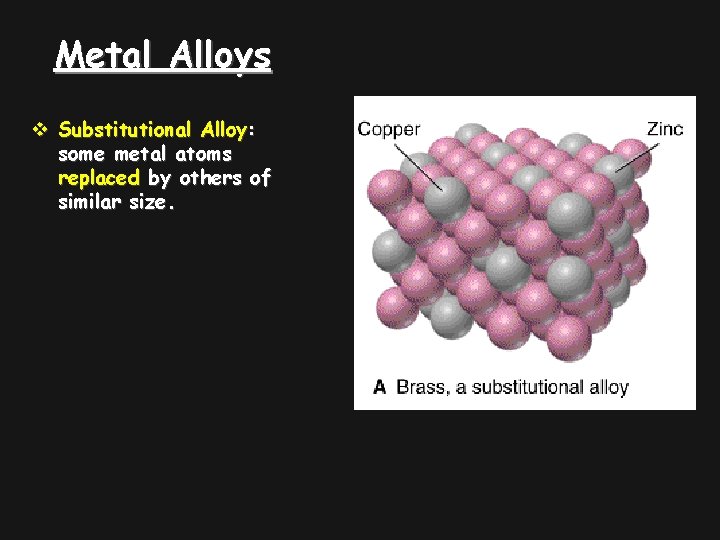
Metal Alloys v Substitutional Alloy: some metal atoms replaced by others of similar size.
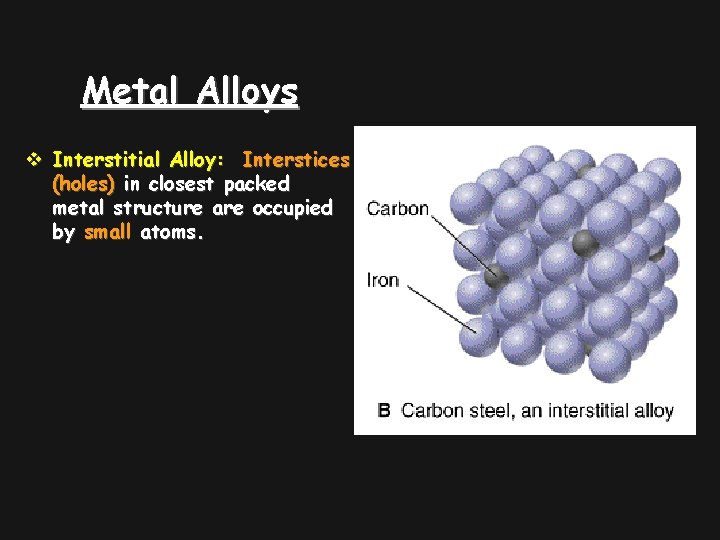
Metal Alloys v Interstitial Alloy: Interstices (holes) in closest packed metal structure are occupied by small atoms.
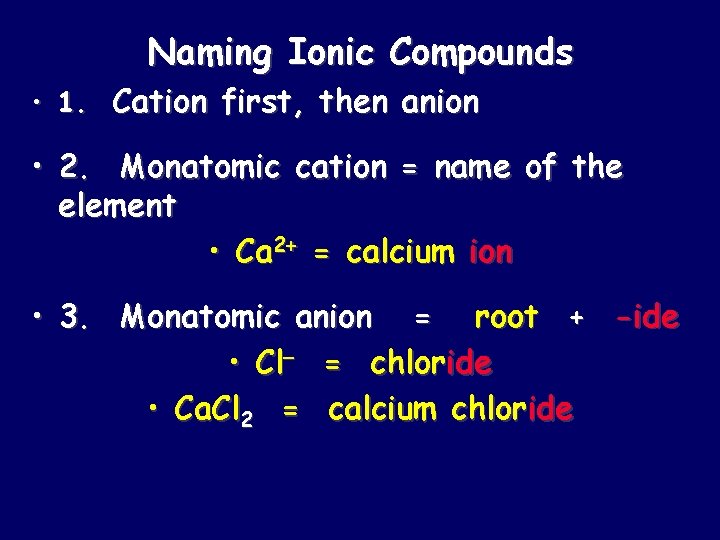
Naming Ionic Compounds • 1. Cation first, then anion • 2. Monatomic cation = name of the element • Ca 2+ = calcium ion • 3. Monatomic anion = root + -ide • Cl- = chloride • Ca. Cl 2 = calcium chloride
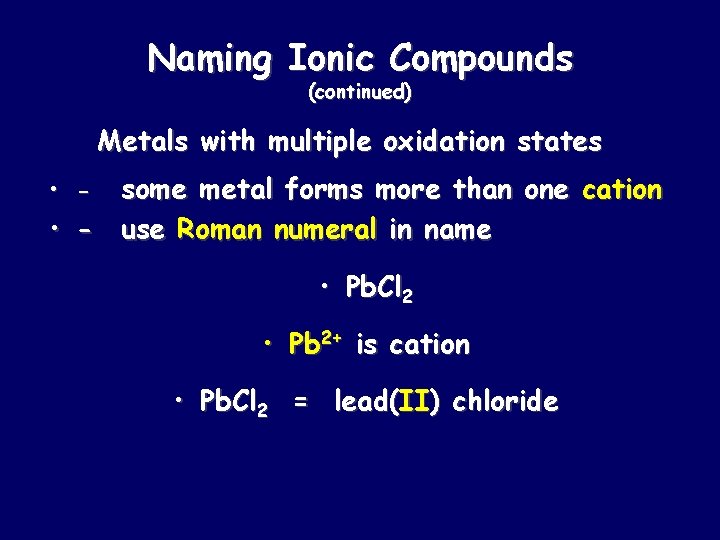
Naming Ionic Compounds (continued) Metals with multiple oxidation states some metal forms more than one cation • - use Roman numeral in name • - • Pb. Cl 2 • Pb 2+ is cation • Pb. Cl 2 = lead(II) chloride
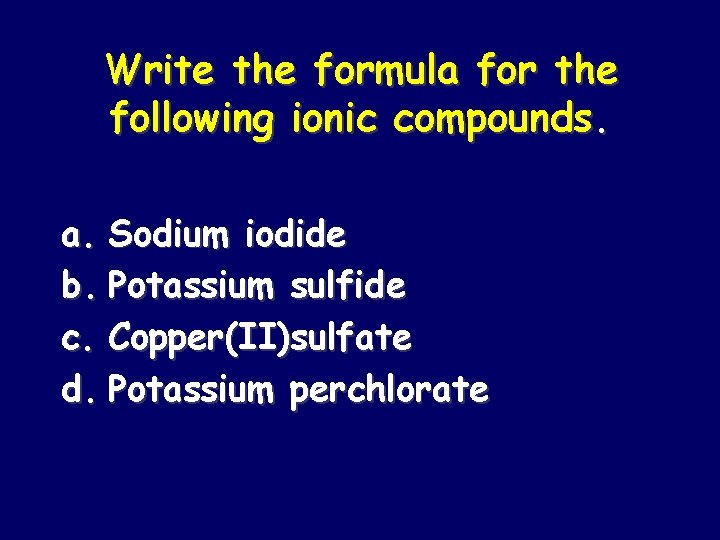
Write the formula for the following ionic compounds. a. Sodium iodide b. Potassium sulfide c. Copper(II)sulfate d. Potassium perchlorate
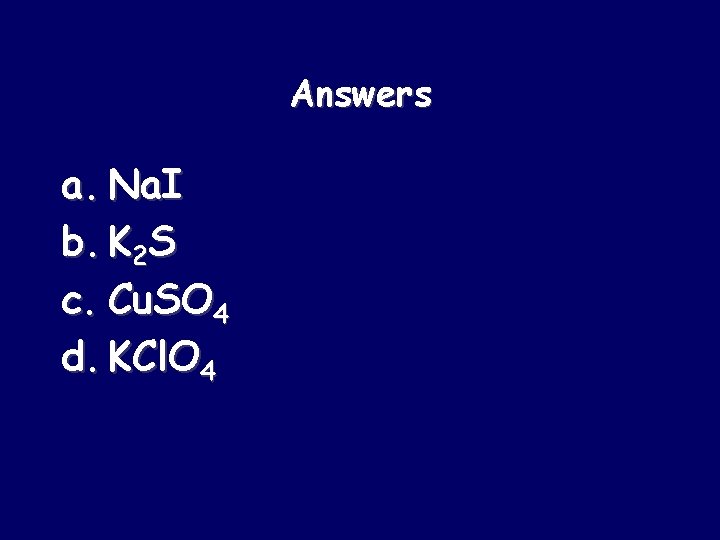
Answers a. Na. I b. K 2 S c. Cu. SO 4 d. KCl. O 4
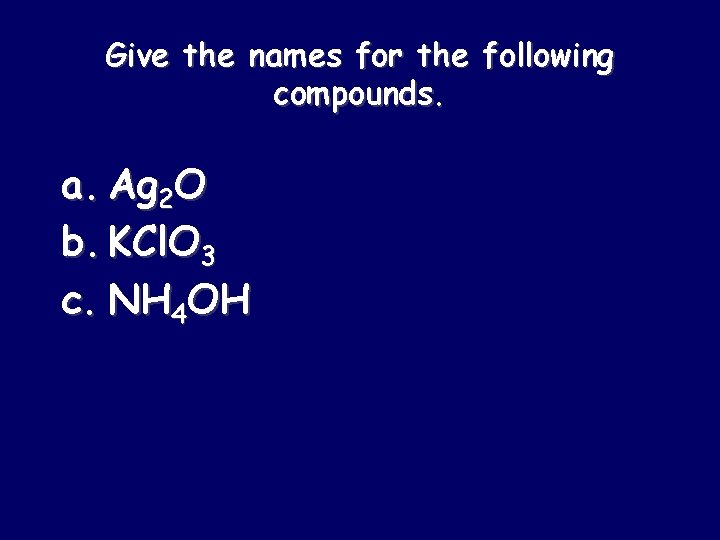
Give the names for the following compounds. a. Ag 2 O b. KCl. O 3 c. NH 4 OH
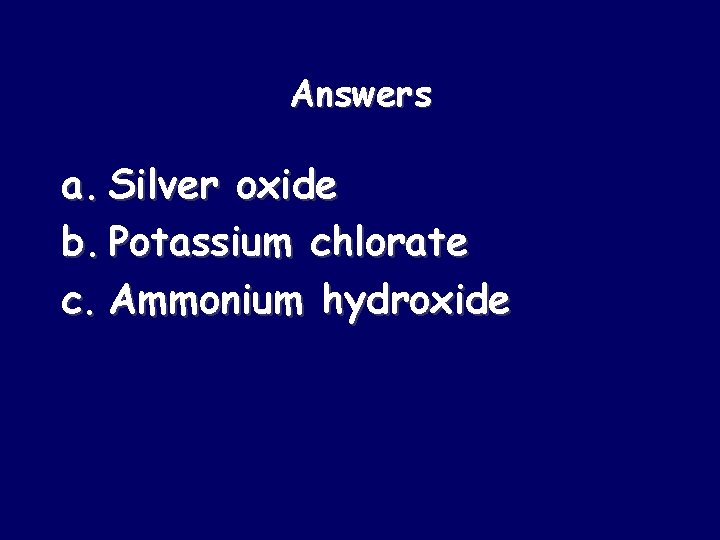
Answers a. Silver oxide b. Potassium chlorate c. Ammonium hydroxide
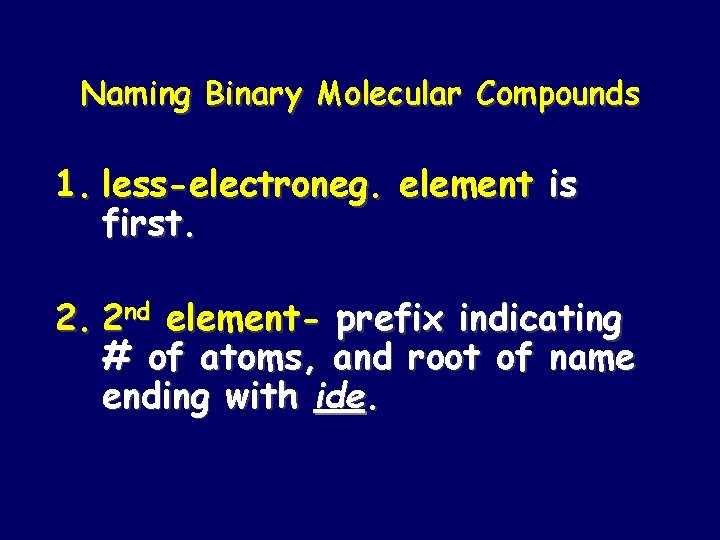
Naming Binary Molecular Compounds 1. less-electroneg. element is first. 2. 2 nd element- prefix indicating # of atoms, and root of name ending with ide.
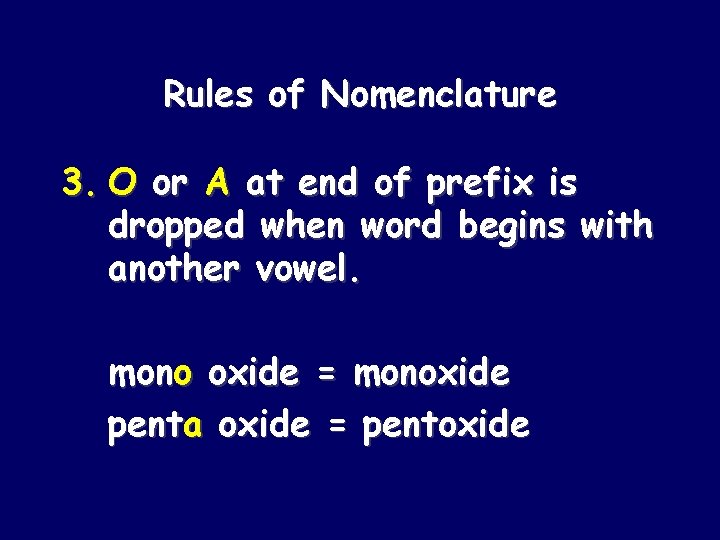
Rules of Nomenclature 3. O or A at end of prefix is dropped when word begins with another vowel. mono oxide = monoxide penta oxide = pentoxide
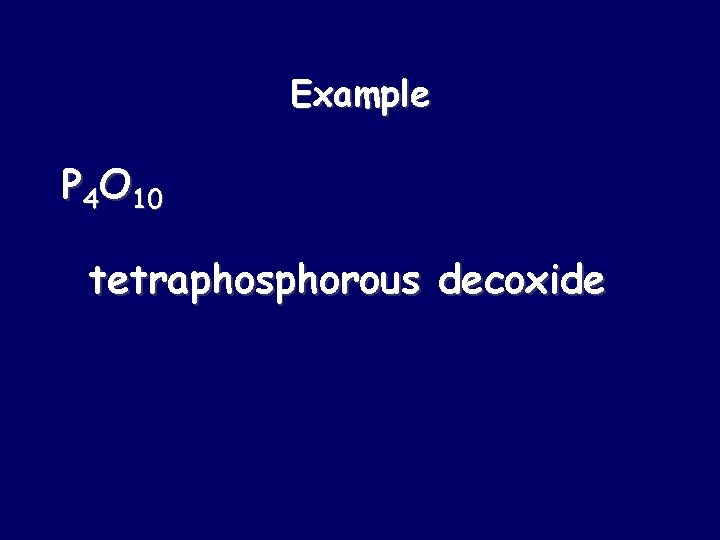
Example P 4 O 10 tetraphosphorous decoxide
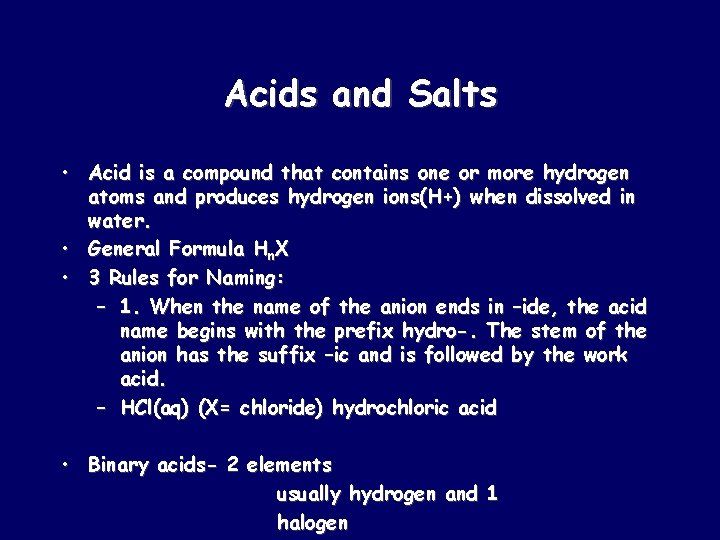
Acids and Salts • Acid is a compound that contains one or more hydrogen atoms and produces hydrogen ions(H+) when dissolved in water. • General Formula Hn. X • 3 Rules for Naming: – 1. When the name of the anion ends in –ide, the acid name begins with the prefix hydro-. The stem of the anion has the suffix –ic and is followed by the work acid. – HCl(aq) (X= chloride) hydrochloric acid • Binary acids- 2 elements usually hydrogen and 1 halogen
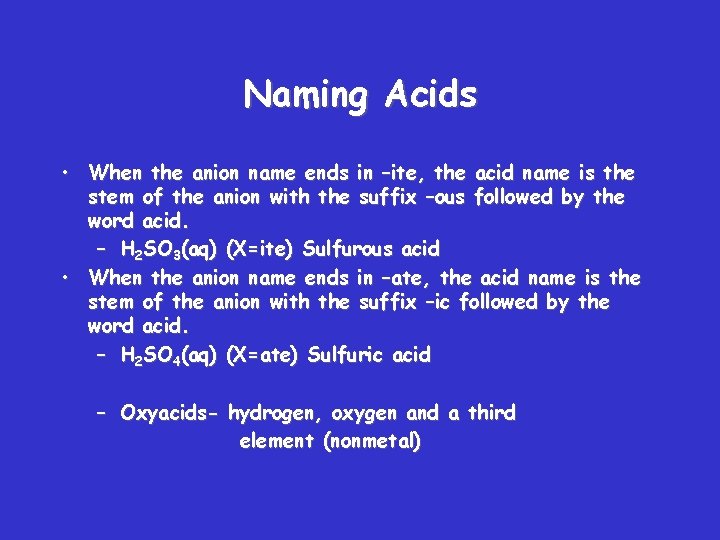
Naming Acids • When the anion name ends in –ite, the acid name is the stem of the anion with the suffix –ous followed by the word acid. – H 2 SO 3(aq) (X=ite) Sulfurous acid • When the anion name ends in –ate, the acid name is the stem of the anion with the suffix –ic followed by the word acid. – H 2 SO 4(aq) (X=ate) Sulfuric acid – Oxyacids- hydrogen, oxygen and a third element (nonmetal)
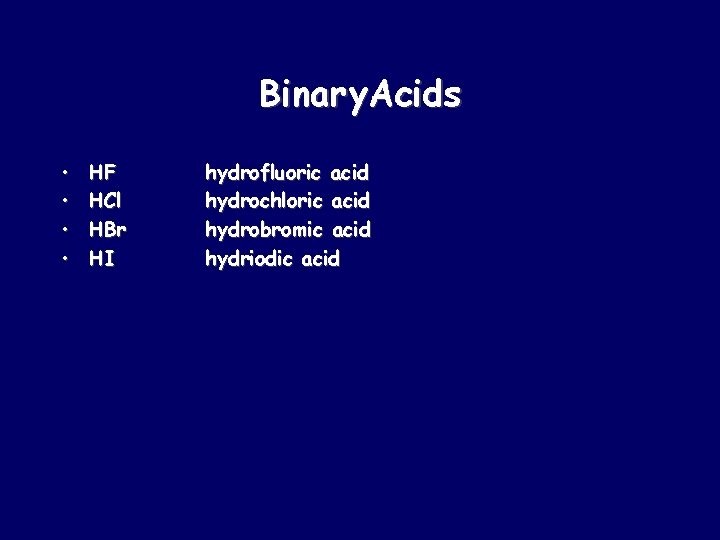
Binary. Acids • • HF HCl HBr HI hydrofluoric acid hydrochloric acid hydrobromic acid hydriodic acid
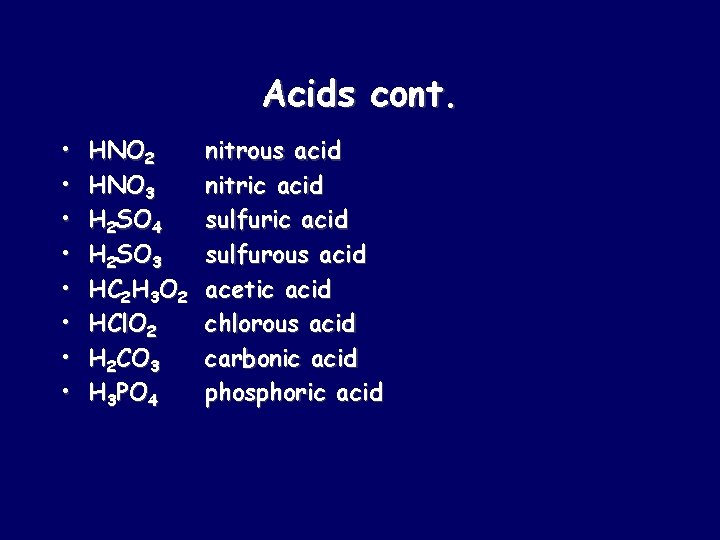
Acids cont. • • HNO 2 HNO 3 H 2 SO 4 H 2 SO 3 HC 2 H 3 O 2 HCl. O 2 H 2 CO 3 H 3 PO 4 nitrous acid nitric acid sulfurous acid acetic acid chlorous acid carbonic acid phosphoric acid
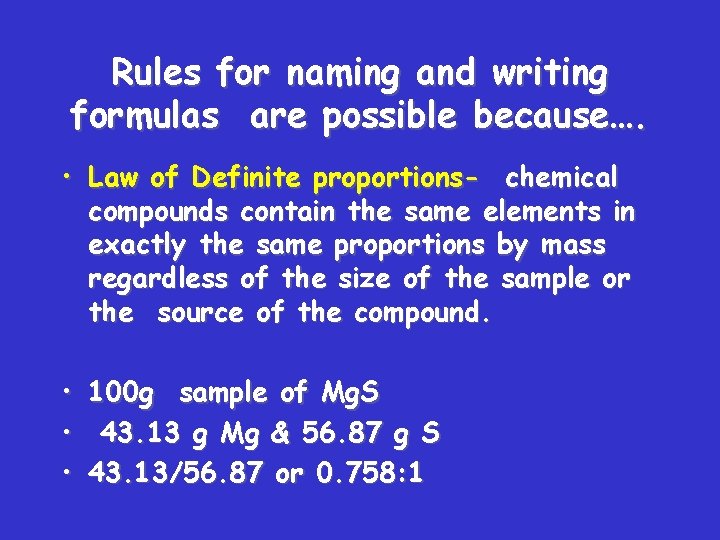
Rules for naming and writing formulas are possible because…. • Law of Definite proportions- chemical compounds contain the same elements in exactly the same proportions by mass regardless of the size of the sample or the source of the compound. • 100 g sample of Mg. S • 43. 13 g Mg & 56. 87 g S • 43. 13/56. 87 or 0. 758: 1
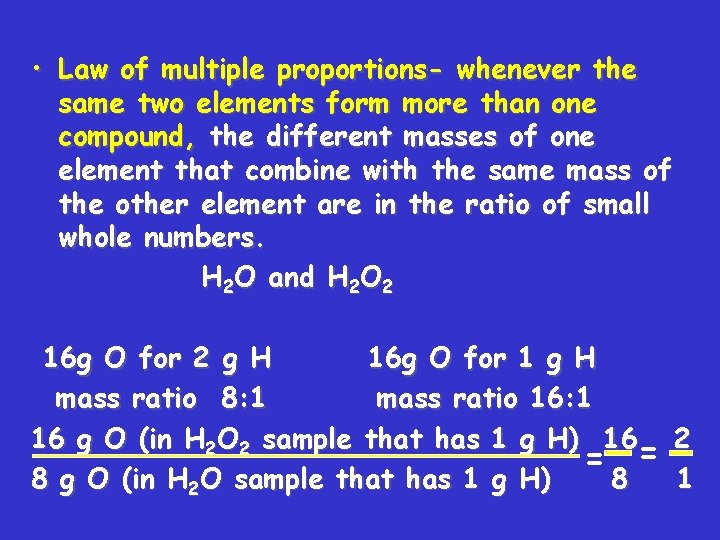
• Law of multiple proportions- whenever the same two elements form more than one compound, the different masses of one element that combine with the same mass of the other element are in the ratio of small whole numbers. H 2 O and H 2 O 2 16 g O for 2 g H 16 g O for 1 g H mass ratio 8: 1 mass ratio 16: 1 16 g O (in H 2 O 2 sample that has 1 g H) 16 2 = = 8 g O (in H 2 O sample that has 1 g H) 8 1
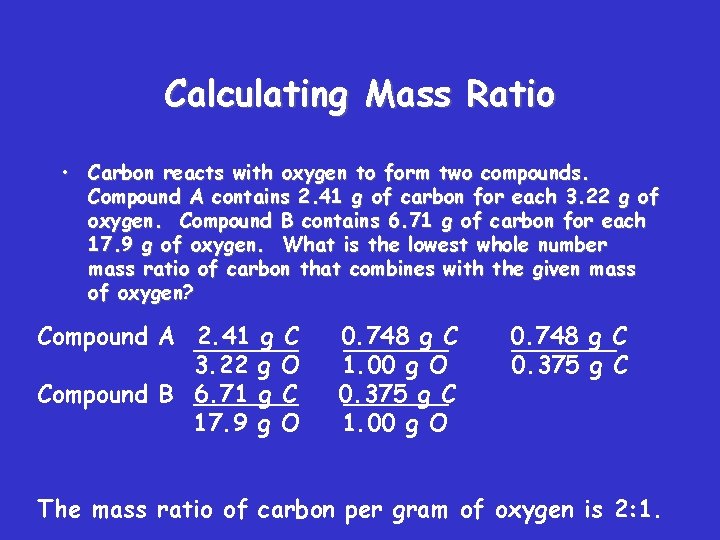
Calculating Mass Ratio • Carbon reacts with oxygen to form two compounds. Compound A contains 2. 41 g of carbon for each 3. 22 g of oxygen. Compound B contains 6. 71 g of carbon for each 17. 9 g of oxygen. What is the lowest whole number mass ratio of carbon that combines with the given mass of oxygen? Compound A 2. 41 g C 3. 22 g O Compound B 6. 71 g C 17. 9 g O 0. 748 g C 1. 00 g O 0. 375 g C 1. 00 g O 0. 748 g C 0. 375 g C The mass ratio of carbon per gram of oxygen is 2: 1.
7 -2 Oxidation Numbers • Used to indicate the distribution of e- in a molecular compound
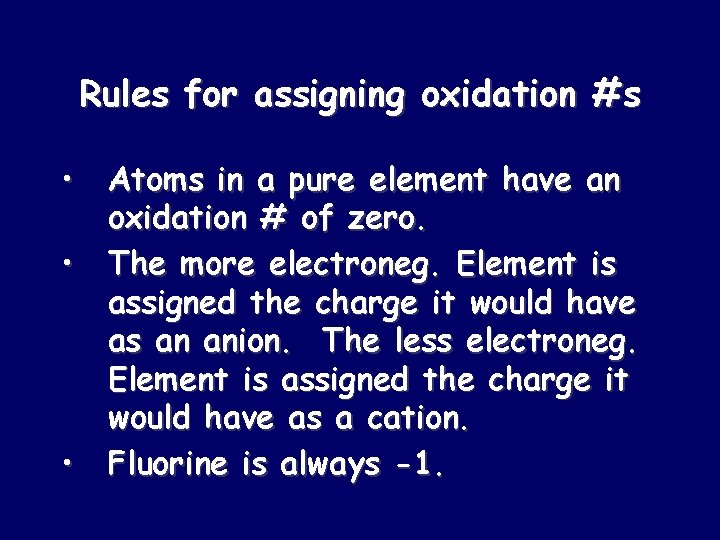
Rules for assigning oxidation #s • Atoms in a pure element have an oxidation # of zero. • The more electroneg. Element is assigned the charge it would have as an anion. The less electroneg. Element is assigned the charge it would have as a cation. • Fluorine is always -1.
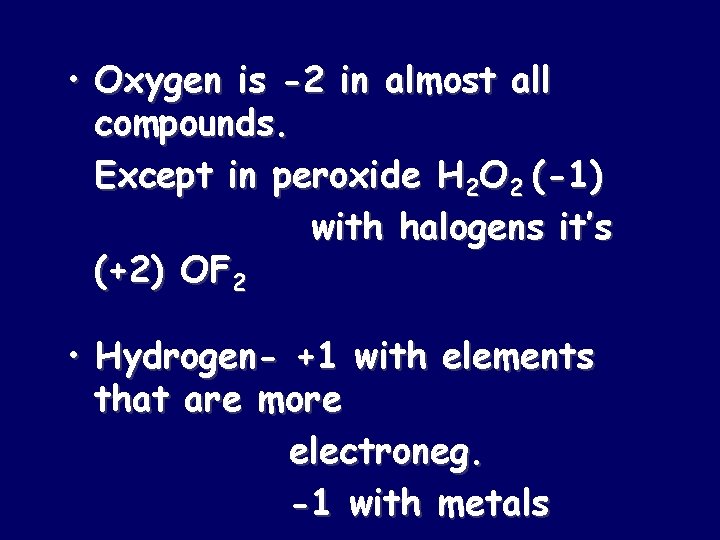
• Oxygen is -2 in almost all compounds. Except in peroxide H 2 O 2 (-1) with halogens it’s (+2) OF 2 • Hydrogen- +1 with elements that are more electroneg. -1 with metals
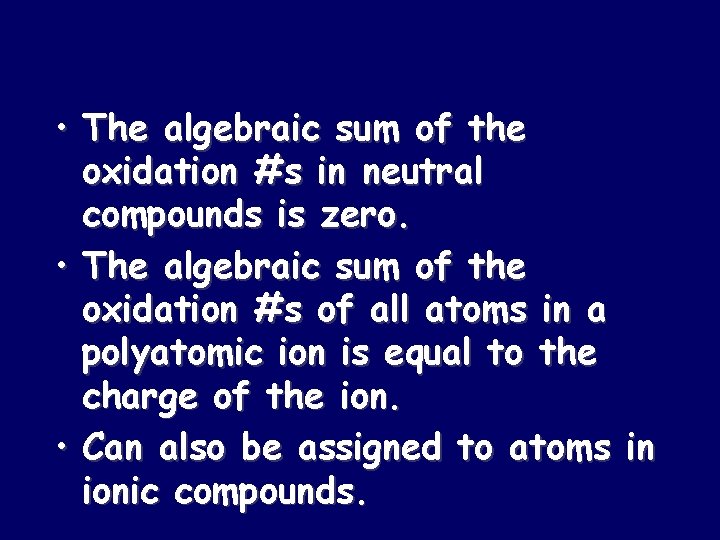
• The algebraic sum of the oxidation #s in neutral compounds is zero. • The algebraic sum of the oxidation #s of all atoms in a polyatomic ion is equal to the charge of the ion. • Can also be assigned to atoms in ionic compounds.
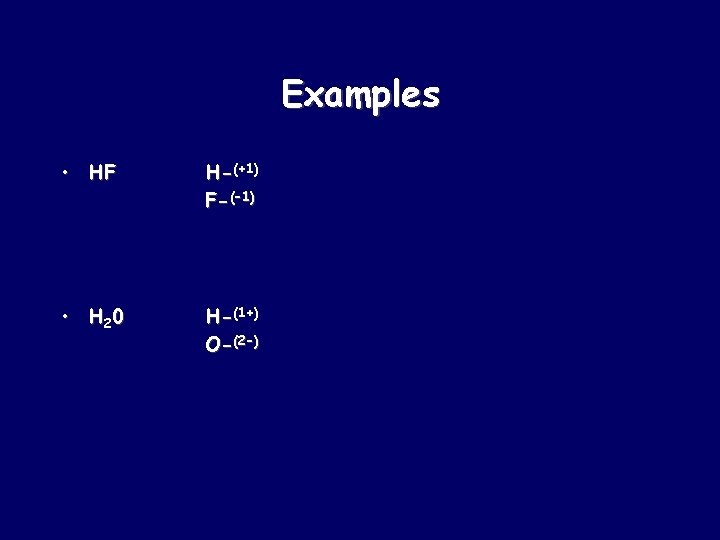
Examples • HF H-(+1) F-(-1) • H 20 H-(1+) O-(2 -)
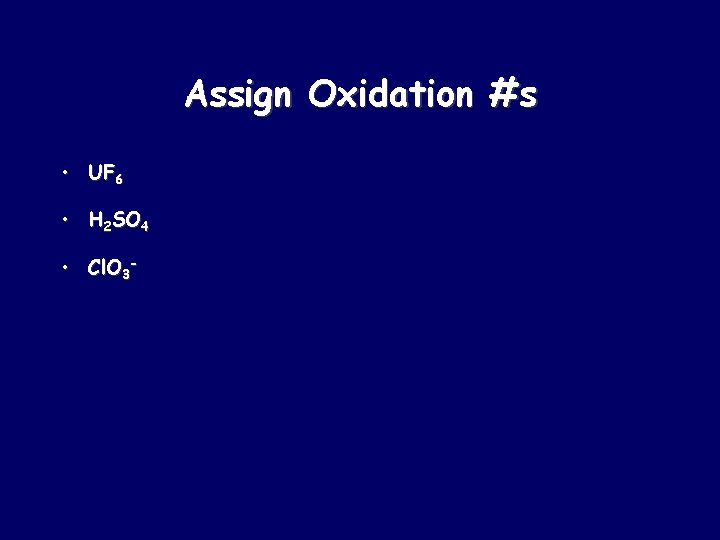
Assign Oxidation #s • UF 6 • H 2 SO 4 • Cl. O 3 -
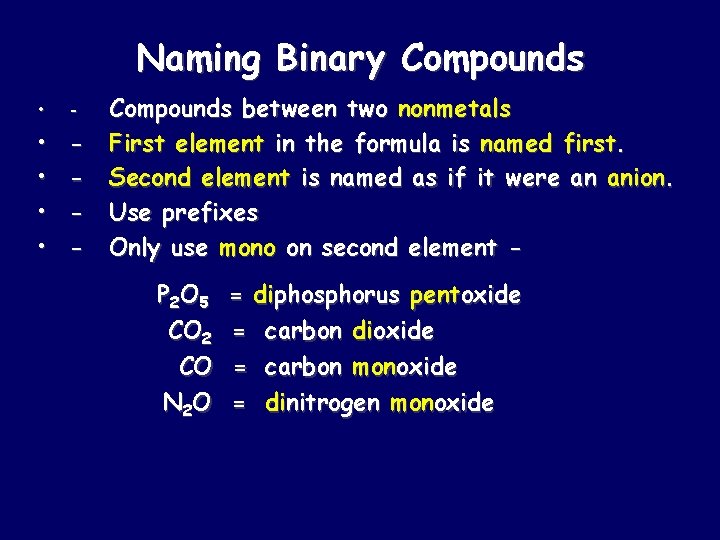
Naming Binary Compounds • - • • - Compounds between two nonmetals First element in the formula is named first. Second element is named as if it were an anion. Use prefixes Only use mono on second element P 2 O 5 CO 2 CO N 2 O = diphosphorus pentoxide = carbon dioxide = carbon monoxide = dinitrogen monoxide
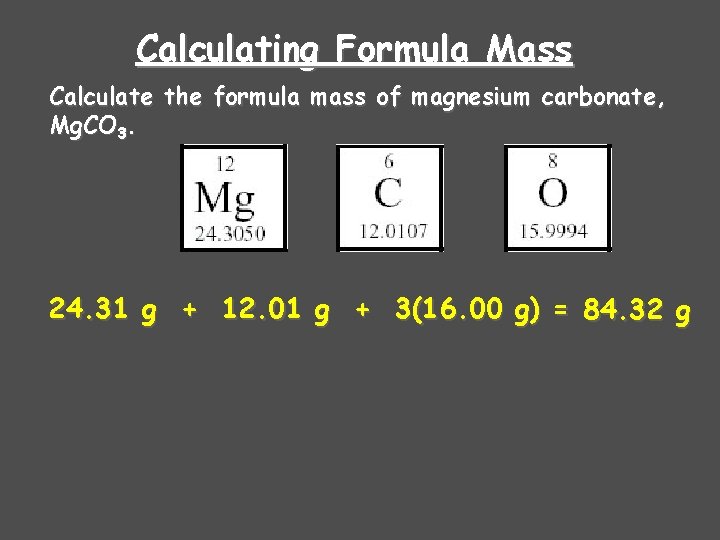
Calculating Formula Mass Calculate the formula mass of magnesium carbonate, Mg. CO 3. 24. 31 g + 12. 01 g + 3(16. 00 g) = 84. 32 g
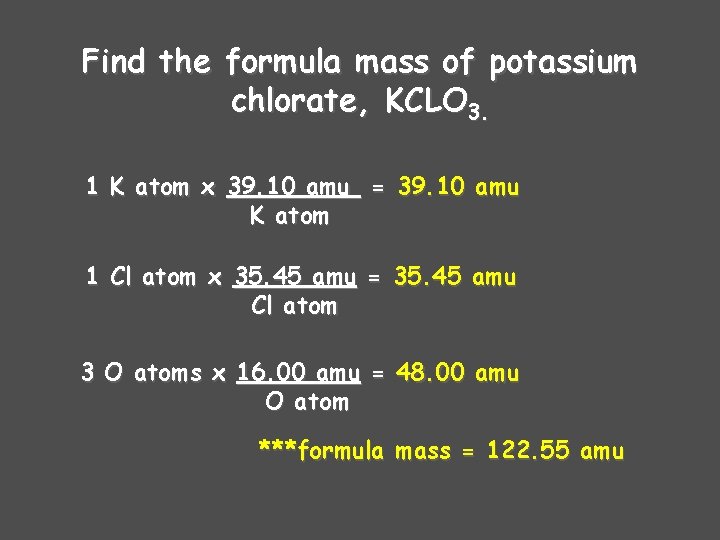
Find the formula mass of potassium chlorate, KCLO 3. 1 K atom x 39. 10 amu = 39. 10 amu K atom 1 Cl atom x 35. 45 amu = 35. 45 amu Cl atom 3 O atoms x 16. 00 amu = 48. 00 amu O atom ***formula mass = 122. 55 amu
Molar Mass • = mass in grams of one mole (6. 022 x 1023 particles) of a substance. • Molar mass of compound sum the masses of the elements present in a mole of the molecules or formula units that make up the compound.
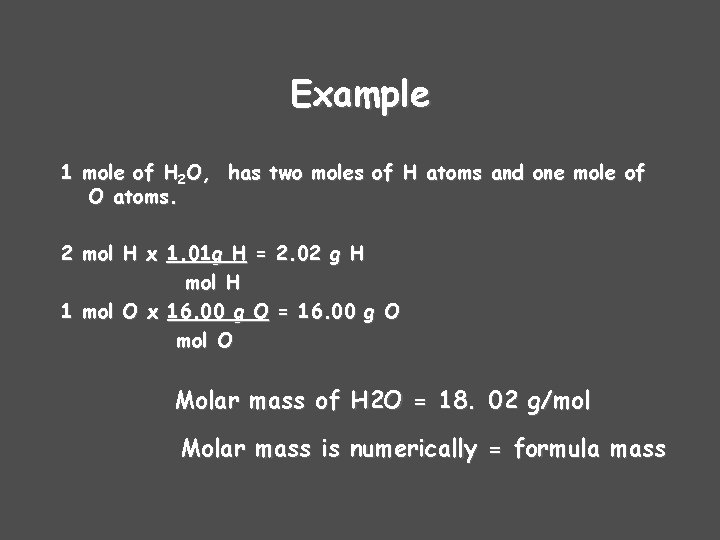
Example 1 mole of H 2 O, has two moles of H atoms and one mole of O atoms. 2 mol H x 1. 01 g H = 2. 02 g H mol H 1 mol O x 16. 00 g O = 16. 00 g O mol O Molar mass of H 2 O = 18. 02 g/mol Molar mass is numerically = formula mass
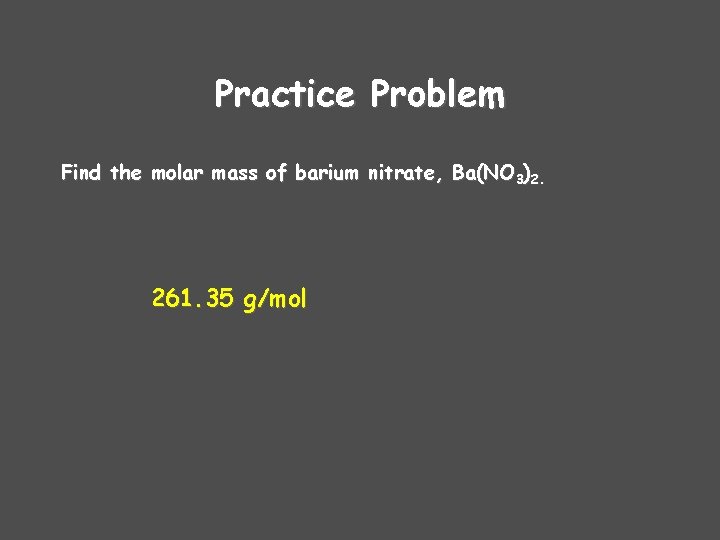
Practice Problem Find the molar mass of barium nitrate, Ba(NO 3)2. 261. 35 g/mol
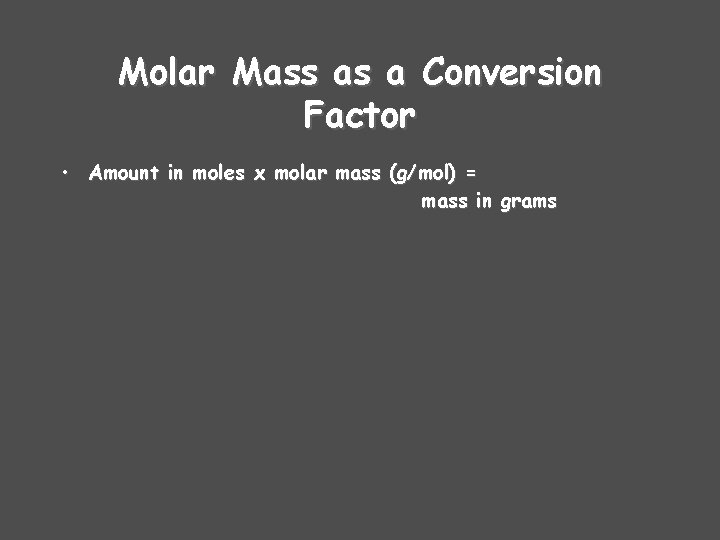
Molar Mass as a Conversion Factor • Amount in moles x molar mass (g/mol) = mass in grams
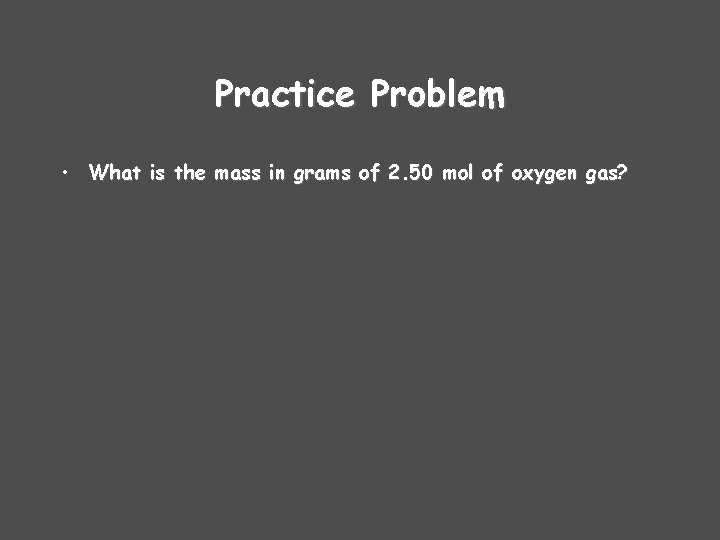
Practice Problem • What is the mass in grams of 2. 50 mol of oxygen gas?
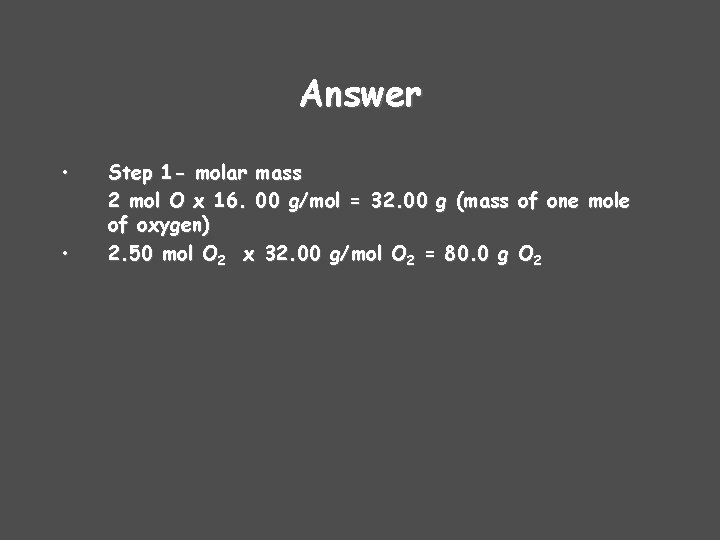
Answer • • Step 1 - molar mass 2 mol O x 16. 00 g/mol = 32. 00 g (mass of one mole of oxygen) 2. 50 mol O 2 x 32. 00 g/mol O 2 = 80. 0 g O 2
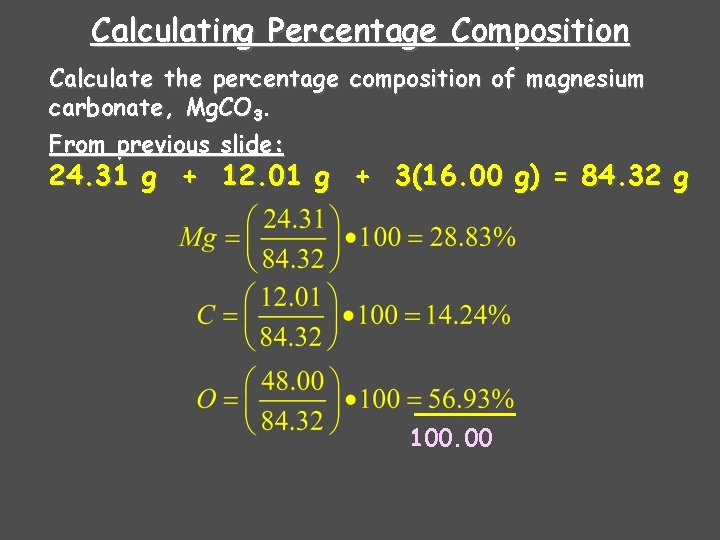
Calculating Percentage Composition Calculate the percentage composition of magnesium carbonate, Mg. CO 3. From previous slide: 24. 31 g + 12. 01 g + 3(16. 00 g) = 84. 32 g 100. 00
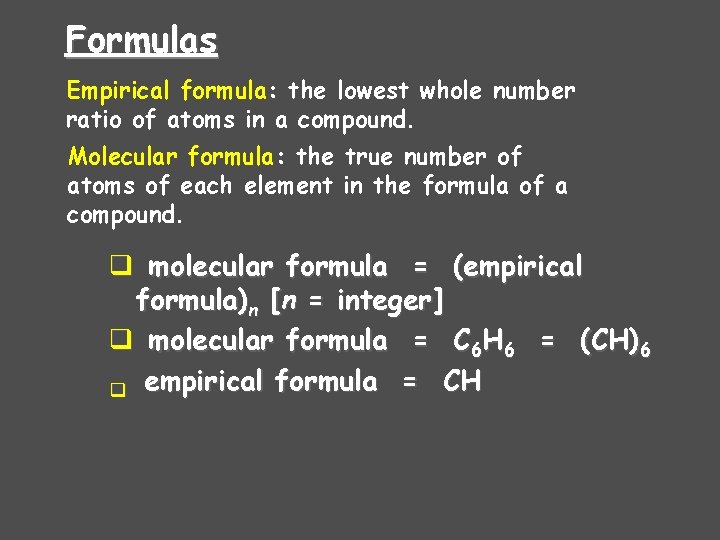
Formulas Empirical formula: the lowest whole number ratio of atoms in a compound. Molecular formula: the true number of atoms of each element in the formula of a compound. q molecular formula = (empirical formula)n [n = integer] q molecular formula = C 6 H 6 = (CH)6 q empirical formula = CH
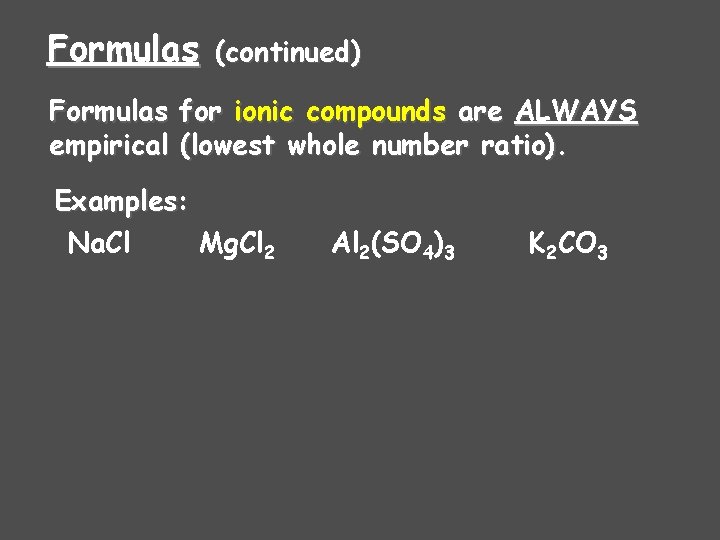
Formulas (continued) Formulas for ionic compounds are ALWAYS empirical (lowest whole number ratio). Examples: Na. Cl Mg. Cl 2 Al 2(SO 4)3 K 2 CO 3
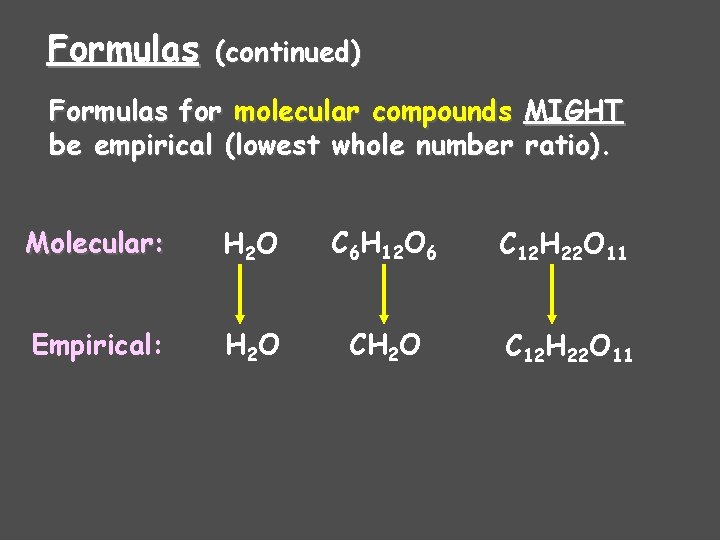
Formulas (continued) Formulas for molecular compounds MIGHT be empirical (lowest whole number ratio). Molecular: H 2 O C 6 H 12 O 6 C 12 H 22 O 11 Empirical: H 2 O CH 2 O C 12 H 22 O 11
Empirical Formula Determination 1. Base calculation on 100 grams of compound. 2. Determine moles of each element in 100 grams of compound. 3. Divide each value of moles by the smallest of the values. 4. Multiply each number by an integer to obtain all whole numbers.
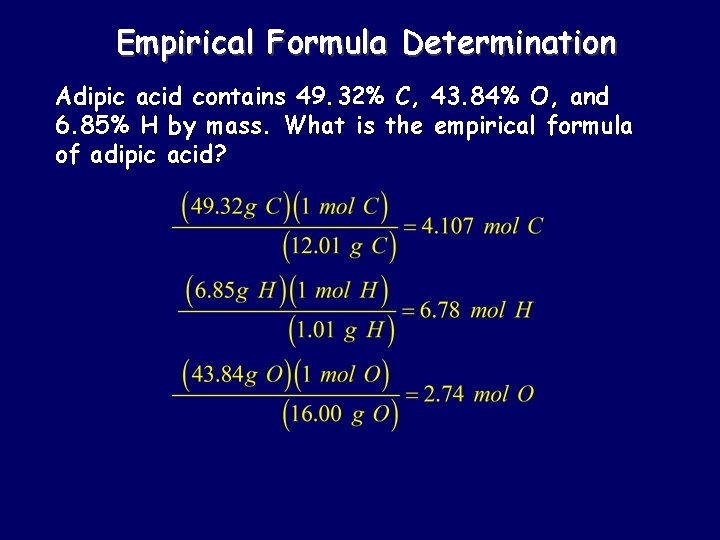
Empirical Formula Determination Adipic acid contains 49. 32% C, 43. 84% O, and 6. 85% H by mass. What is the empirical formula of adipic acid?
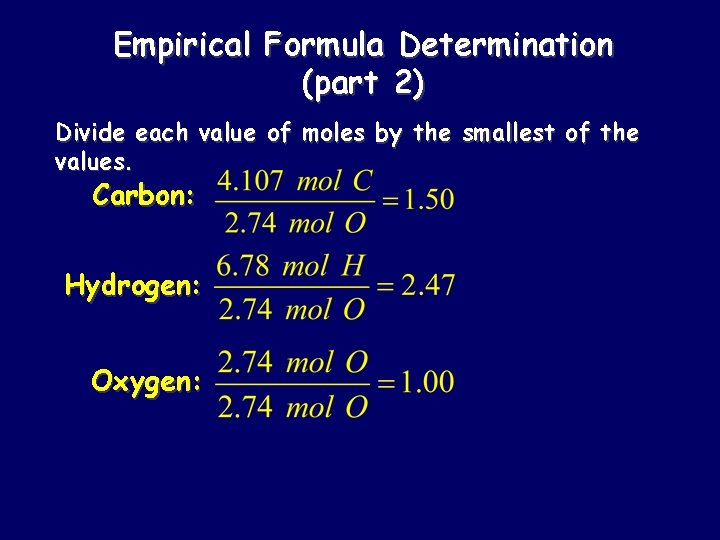
Empirical Formula Determination (part 2) Divide each value of moles by the smallest of the values. Carbon: Hydrogen: Oxygen:
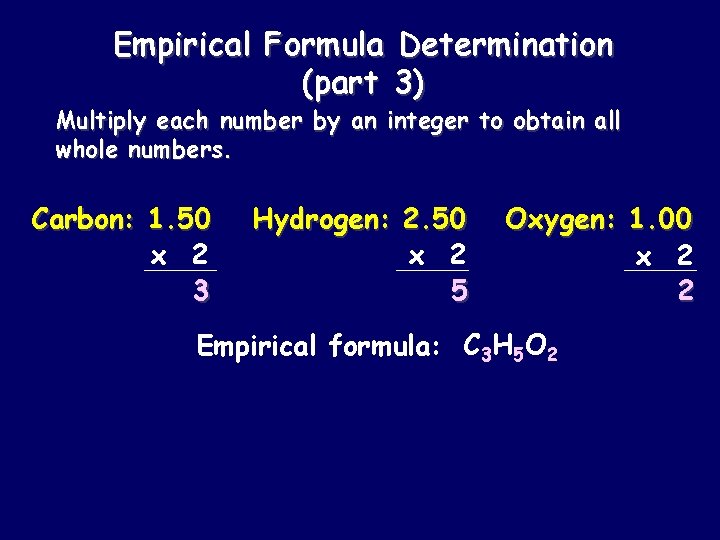
Empirical Formula Determination (part 3) Multiply each number by an integer to obtain all whole numbers. Carbon: 1. 50 x 2 3 Hydrogen: 2. 50 x 2 5 Oxygen: 1. 00 x 2 2 Empirical formula: C 3 H 5 O 2
Finding the Molecular Formula The empirical formula for adipic acid is C 3 H 5 O 2. The molecular mass of adipic acid is 146 g/mol. What is the molecular formula of adipic acid? 1. Find the formula mass of C 3 H 5 O 2 3(12. 01 g) + 5(1. 01) + 2(16. 00) = 73. 08 g
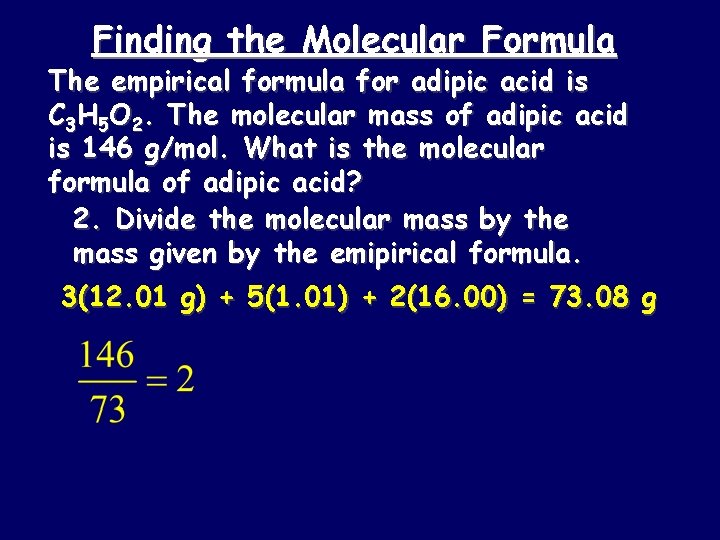
Finding the Molecular Formula The empirical formula for adipic acid is C 3 H 5 O 2. The molecular mass of adipic acid is 146 g/mol. What is the molecular formula of adipic acid? 2. Divide the molecular mass by the mass given by the emipirical formula. 3(12. 01 g) + 5(1. 01) + 2(16. 00) = 73. 08 g
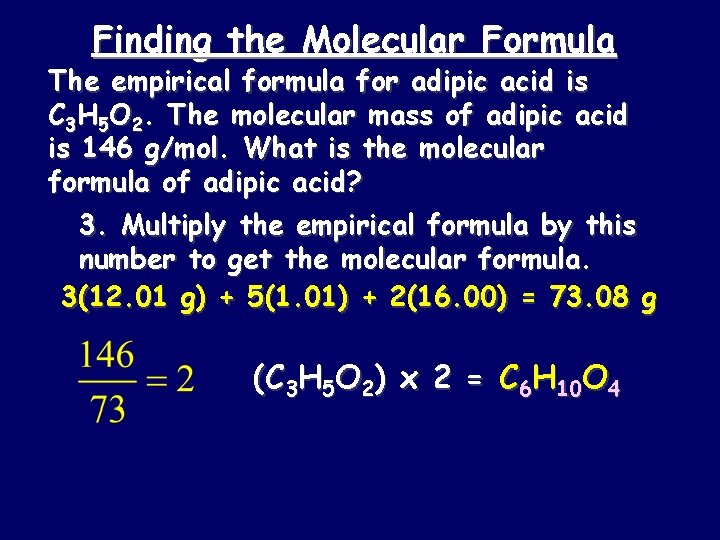
Finding the Molecular Formula The empirical formula for adipic acid is C 3 H 5 O 2. The molecular mass of adipic acid is 146 g/mol. What is the molecular formula of adipic acid? 3. Multiply the empirical formula by this number to get the molecular formula. 3(12. 01 g) + 5(1. 01) + 2(16. 00) = 73. 08 g (C 3 H 5 O 2) x 2 = C 6 H 10 O 4
- Slides: 79