
CHEMISTRY CHAPTER 5 CHEMICAL FORMULAS 5 1 Using
- Slides: 15
CHEMISTRY CHAPTER 5 { CHEMICAL FORMULAS
5. 1 Using Symbols to Write Chemical Formulas A. Chemical formula – is a type of nontation made with numbers and chemical symbols. 1. Symbol – is an abbreviation for the name of an element. B. Molecule – may be a single atom, a group of two or more atoms of the same element, or a group of atoms of different elements. 1. Monoatomic – one atom molecule a) helium, neon, krypton, xenon, radon 2. Diatomic – two atom molecules a) hydrogen, oxygen, nitrogen, chlorine b) bromine (liquid), Iodine (solid)
5. 2 Kinds of Formulas A. Steps to determine the formula of compound X 1. Qualitative Analysis – done to determine what elements are in the compound. 2. Quantitative Analysis – done to determine the relative mass of the element in a compound a) Emperical formula – indicates the simplest whole-number ratio in which the atoms of the elements are present in the compound. (Ex: C 2 H 25 O) b) Molecular formula – shows the number of atoms of each element in one molecule of the substance. c) Empirical and Molecular may be the same.
5. 3 Using Symbols To Write Formulas A. Elements exist as three (3) different types 1. Metals a) ductile – can be drawn into wires b) malleable – hammered into sheets c) luster – shine in way typical of metal d) good conductors e) examples: iron and copper 2. Non-Metals a) brittle – breaks into pieces b) lack luster c) poor conductors d) example: oxygen, sulfur, phosphorus
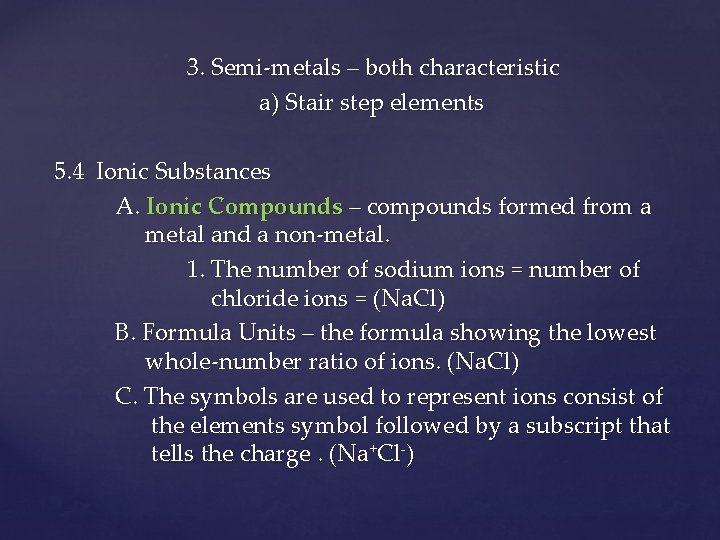
3. Semi-metals – both characteristic a) Stair step elements 5. 4 Ionic Substances A. Ionic Compounds – compounds formed from a metal and a non-metal. 1. The number of sodium ions = number of chloride ions = (Na. Cl) B. Formula Units – the formula showing the lowest whole-number ratio of ions. (Na. Cl) C. The symbols are used to represent ions consist of the elements symbol followed by a subscript that tells the charge. (Na+Cl-)
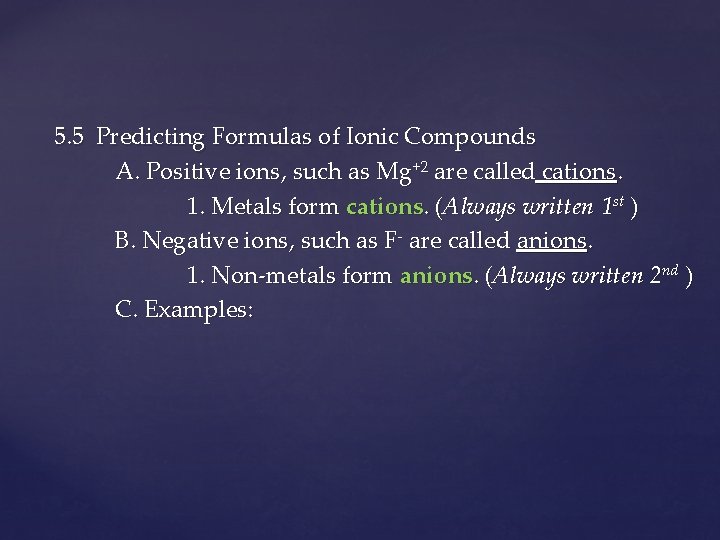
5. 5 Predicting Formulas of Ionic Compounds A. Positive ions, such as Mg+2 are called cations. 1. Metals form cations. (Always written 1 st ) B. Negative ions, such as F- are called anions. 1. Non-metals form anions. (Always written 2 nd ) C. Examples:
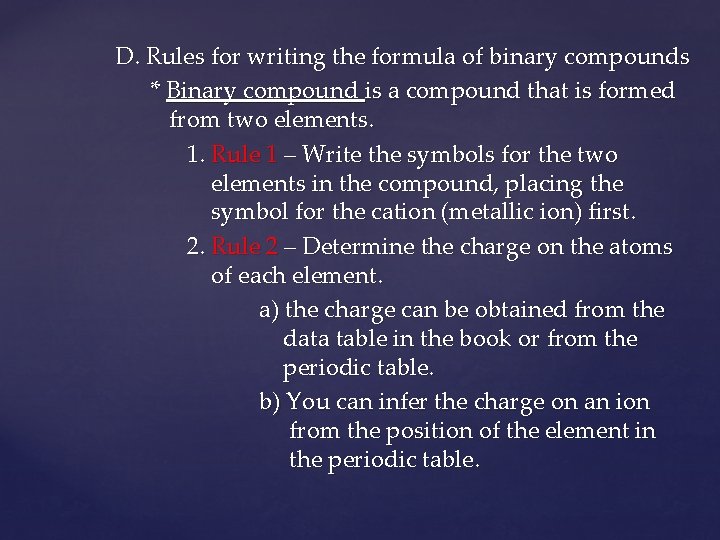
D. Rules for writing the formula of binary compounds * Binary compound is a compound that is formed from two elements. 1. Rule 1 – Write the symbols for the two elements in the compound, placing the symbol for the cation (metallic ion) first. 2. Rule 2 – Determine the charge on the atoms of each element. a) the charge can be obtained from the data table in the book or from the periodic table. b) You can infer the charge on an ion from the position of the element in the periodic table.
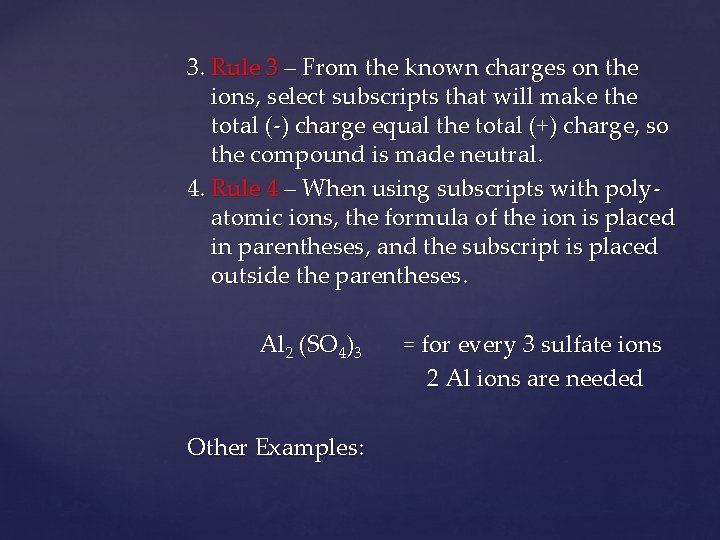
3. Rule 3 – From the known charges on the ions, select subscripts that will make the total (-) charge equal the total (+) charge, so the compound is made neutral. 4. Rule 4 – When using subscripts with polyatomic ions, the formula of the ion is placed in parentheses, and the subscript is placed outside the parentheses. Al 2 (SO 4)3 Other Examples: = for every 3 sulfate ions 2 Al ions are needed
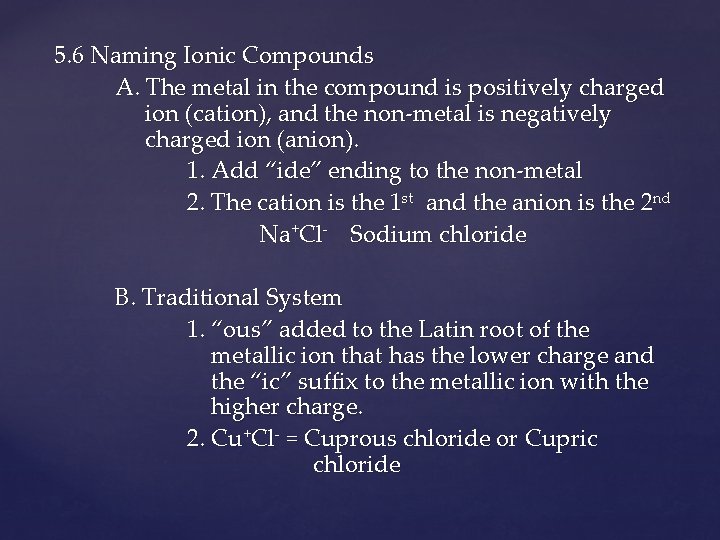
5. 6 Naming Ionic Compounds A. The metal in the compound is positively charged ion (cation), and the non-metal is negatively charged ion (anion). 1. Add “ide” ending to the non-metal 2. The cation is the 1 st and the anion is the 2 nd Na+Cl- Sodium chloride B. Traditional System 1. “ous” added to the Latin root of the metallic ion that has the lower charge and the “ic” suffix to the metallic ion with the higher charge. 2. Cu+Cl- = Cuprous chloride or Cupric chloride
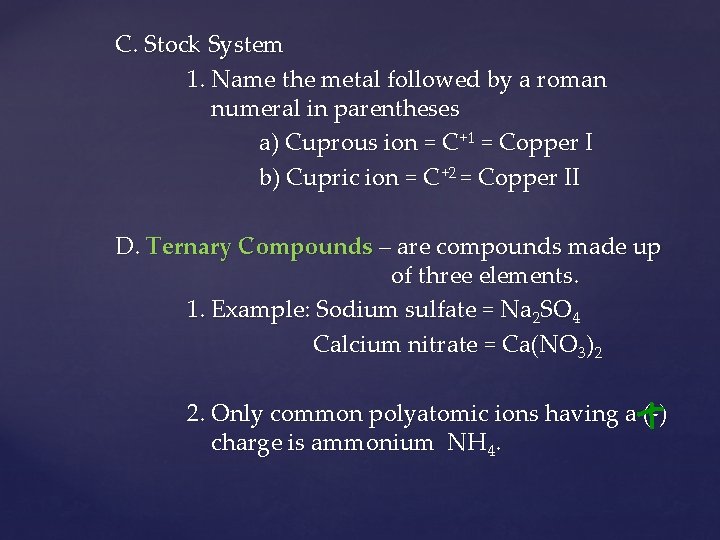
C. Stock System 1. Name the metal followed by a roman numeral in parentheses a) Cuprous ion = C+1 = Copper I b) Cupric ion = C+2 = Copper II D. Ternary Compounds – are compounds made up of three elements. 1. Example: Sodium sulfate = Na 2 SO 4 Calcium nitrate = Ca(NO 3)2 2. Only common polyatomic ions having a (-) charge is ammonium NH 4.
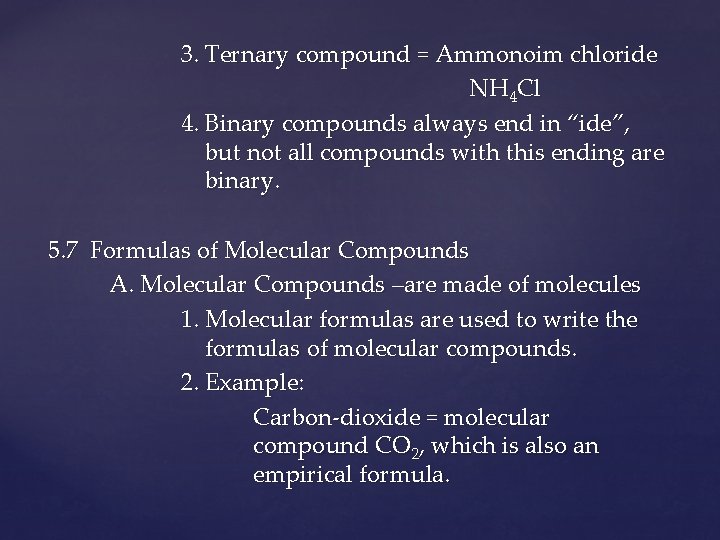
3. Ternary compound = Ammonoim chloride NH 4 Cl 4. Binary compounds always end in “ide”, but not all compounds with this ending are binary. 5. 7 Formulas of Molecular Compounds A. Molecular Compounds –are made of molecules 1. Molecular formulas are used to write the formulas of molecular compounds. 2. Example: Carbon-dioxide = molecular compound CO 2, which is also an empirical formula.
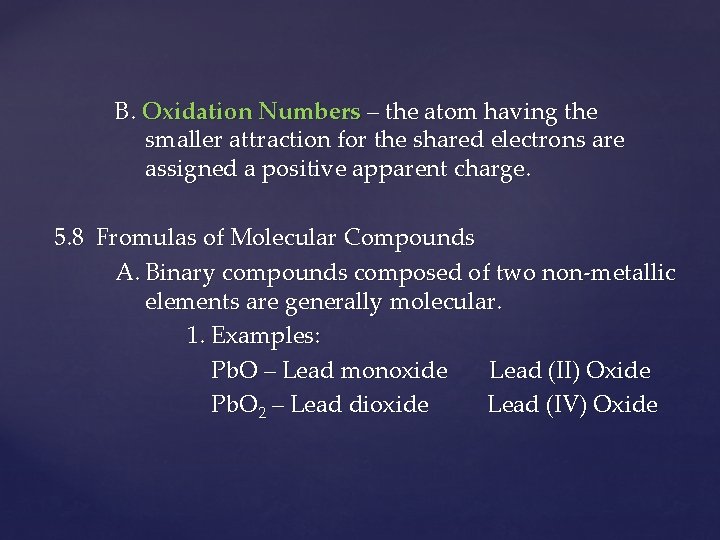
B. Oxidation Numbers – the atom having the smaller attraction for the shared electrons are assigned a positive apparent charge. 5. 8 Fromulas of Molecular Compounds A. Binary compounds composed of two non-metallic elements are generally molecular. 1. Examples: Pb. O – Lead monoxide Lead (II) Oxide Pb. O 2 – Lead dioxide Lead (IV) Oxide
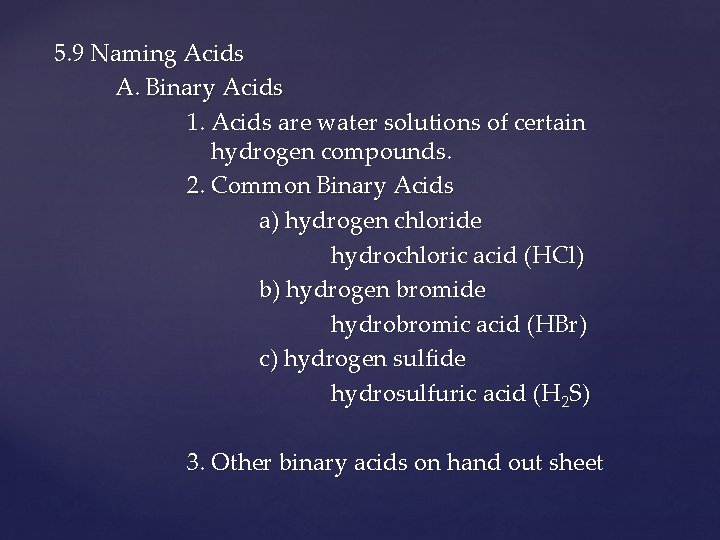
5. 9 Naming Acids A. Binary Acids 1. Acids are water solutions of certain hydrogen compounds. 2. Common Binary Acids a) hydrogen chloride hydrochloric acid (HCl) b) hydrogen bromide hydrobromic acid (HBr) c) hydrogen sulfide hydrosulfuric acid (H 2 S) 3. Other binary acids on hand out sheet
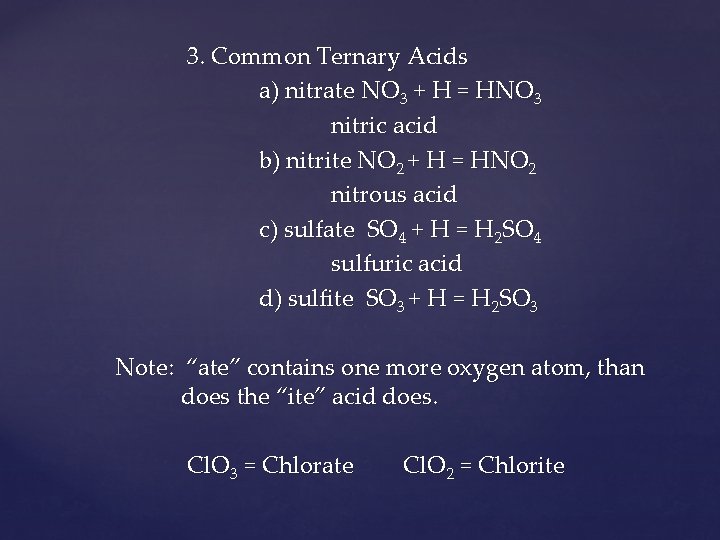
3. Common Ternary Acids a) nitrate NO 3 + H = HNO 3 nitric acid b) nitrite NO 2 + H = HNO 2 nitrous acid c) sulfate SO 4 + H = H 2 SO 4 sulfuric acid d) sulfite SO 3 + H = H 2 SO 3 Note: “ate” contains one more oxygen atom, than does the “ite” acid does. Cl. O 3 = Chlorate Cl. O 2 = Chlorite
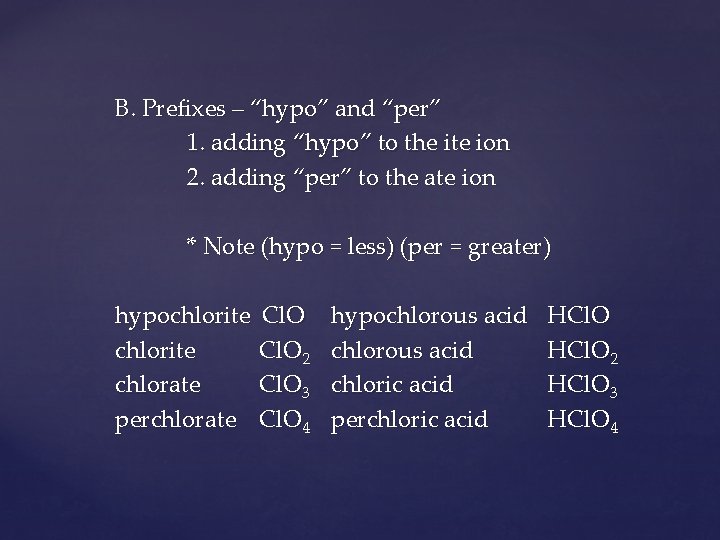
B. Prefixes – “hypo” and “per” 1. adding “hypo” to the ite ion 2. adding “per” to the ate ion * Note (hypo = less) (per = greater) hypochlorite chlorate perchlorate Cl. O 2 Cl. O 3 Cl. O 4 hypochlorous acid chloric acid perchloric acid HCl. O 2 HCl. O 3 HCl. O 4