
CHEMISTRY Chapter 11 SOLUTIONS AND COLLOIDS Power Point



- Slides: 58
CHEMISTRY Chapter 11 SOLUTIONS AND COLLOIDS Power. Point Image Slideshow
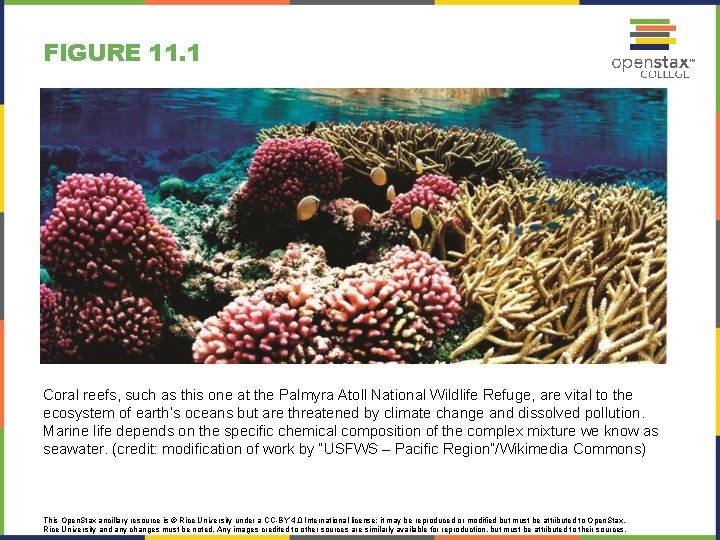
FIGURE 11. 1 Coral reefs, such as this one at the Palmyra Atoll National Wildlife Refuge, are vital to the ecosystem of earth’s oceans but are threatened by climate change and dissolved pollution. Marine life depends on the specific chemical composition of the complex mixture we know as seawater. (credit: modification of work by “USFWS – Pacific Region”/Wikimedia Commons) This Open. Stax ancillary resource is © Rice University under a CC-BY 4. 0 International license; it may be reproduced or modified but must be attributed to Open. Stax, Rice University and any changes must be noted. Any images credited to other sources are similarly available for reproduction, but must be attributed to their sources.
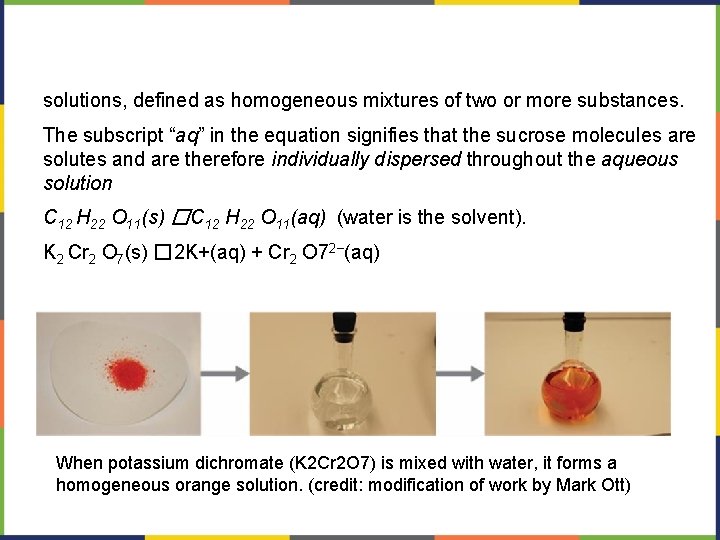
solutions, defined as homogeneous mixtures of two or more substances. The subscript “aq” in the equation signifies that the sucrose molecules are solutes and are therefore individually dispersed throughout the aqueous solution C 12 H 22 O 11(s) �C 12 H 22 O 11(aq) (water is the solvent). K 2 Cr 2 O 7(s) � 2 K+(aq) + Cr 2 O 72−(aq) When potassium dichromate (K 2 Cr 2 O 7) is mixed with water, it forms a homogeneous orange solution. (credit: modification of work by Mark Ott)
SOLUTIONS EXHIBIT THESE DEFINING TRAITS: They are homogeneous; that is, after a solution is mixed, it has the same composition at all points throughout (its composition is uniform). • The physical state of a solution—solid, liquid, or gas—is typically the same as that of the solvent • The components of a solution are dispersed on a molecular scale; that is, they consist of a mixture of separated molecules, atoms, and/or ions. • The dissolved solute in a solution will not settle out or separate from the solvent. • The composition of a solution, or the concentrations of its components, can be varied continuously, within limits. The Formation of Solutions The formation of a solution is an example of a spontaneous This Open. Stax ancillary resource is © Rice University under a CC-BY 4. 0 International license; it may be reproduced or modified but must be attributed to Open. Stax, Rice University and any changes must be noted. Any images credited to other sources are similarly available for reproduction, but must be attributed to their sources.
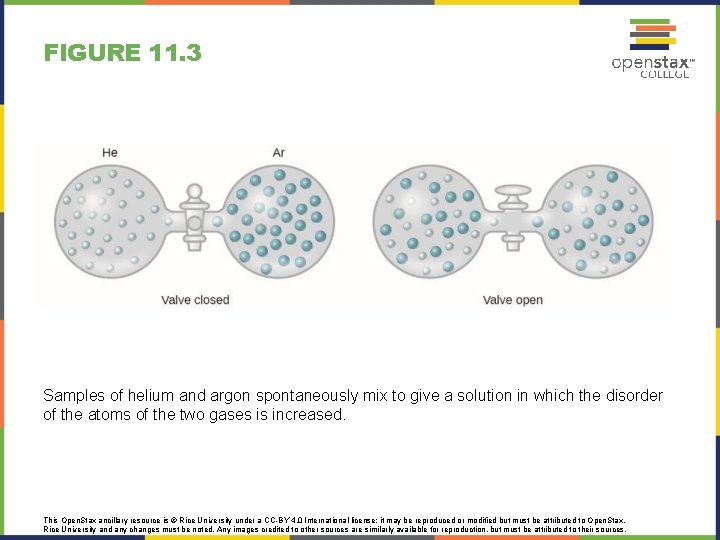
FIGURE 11. 3 Samples of helium and argon spontaneously mix to give a solution in which the disorder of the atoms of the two gases is increased. This Open. Stax ancillary resource is © Rice University under a CC-BY 4. 0 International license; it may be reproduced or modified but must be attributed to Open. Stax, Rice University and any changes must be noted. Any images credited to other sources are similarly available for reproduction, but must be attributed to their sources.
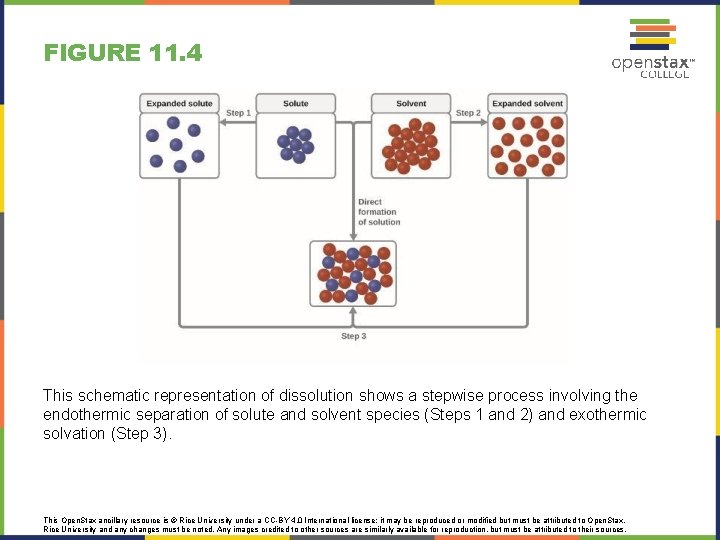
FIGURE 11. 4 This schematic representation of dissolution shows a stepwise process involving the endothermic separation of solute and solvent species (Steps 1 and 2) and exothermic solvation (Step 3). This Open. Stax ancillary resource is © Rice University under a CC-BY 4. 0 International license; it may be reproduced or modified but must be attributed to Open. Stax, Rice University and any changes must be noted. Any images credited to other sources are similarly available for reproduction, but must be attributed to their sources.
FIGURE 11. 5 A mixture of nonpolar cooking oil and polar water does not yield a solution. (credit: Gautam Dogra) This Open. Stax ancillary resource is © Rice University under a CC-BY 4. 0 International license; it may be reproduced or modified but must be attributed to Open. Stax, Rice University and any changes must be noted. Any images credited to other sources are similarly available for reproduction, but must be attributed to their sources.
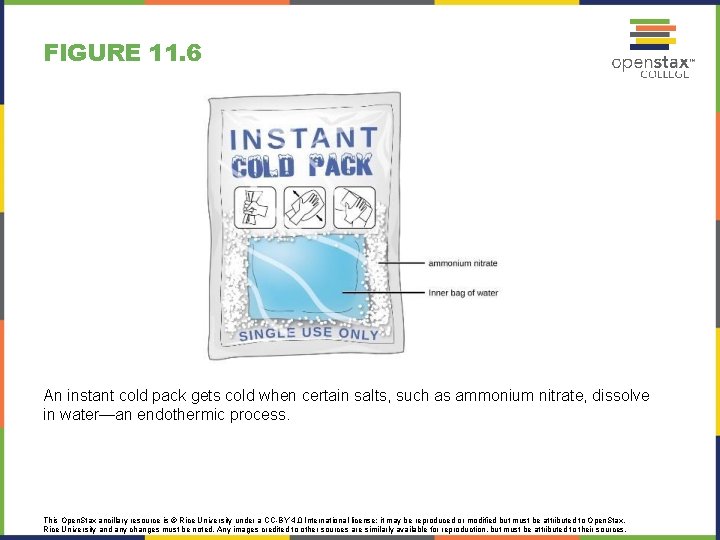
FIGURE 11. 6 An instant cold pack gets cold when certain salts, such as ammonium nitrate, dissolve in water—an endothermic process. This Open. Stax ancillary resource is © Rice University under a CC-BY 4. 0 International license; it may be reproduced or modified but must be attributed to Open. Stax, Rice University and any changes must be noted. Any images credited to other sources are similarly available for reproduction, but must be attributed to their sources.
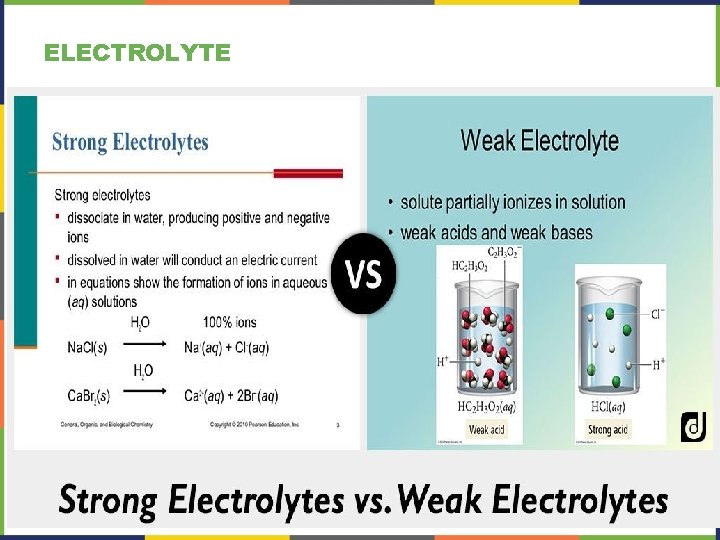
ELECTROLYTE An electrolyte is a substance that produces an electrically conducting solution when dissolved in a polar solvent, such as water. The dissolved electrolyte separates into cations and anions, which disperse uniformly through the solvent This Open. Stax ancillary resource is © Rice University under a CC-BY 4. 0 International license; it may be reproduced or modified but must be attributed to Open. Stax, Rice University and any changes must be noted. Any images credited to other sources are similarly available for reproduction, but must be attributed to their sources.
ELECTROLYTE
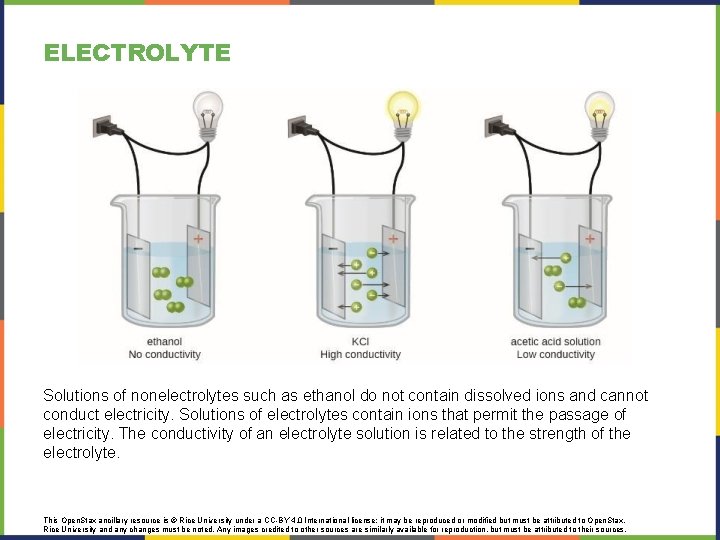
ELECTROLYTE Solutions of nonelectrolytes such as ethanol do not contain dissolved ions and cannot conduct electricity. Solutions of electrolytes contain ions that permit the passage of electricity. The conductivity of an electrolyte solution is related to the strength of the electrolyte. This Open. Stax ancillary resource is © Rice University under a CC-BY 4. 0 International license; it may be reproduced or modified but must be attributed to Open. Stax, Rice University and any changes must be noted. Any images credited to other sources are similarly available for reproduction, but must be attributed to their sources.
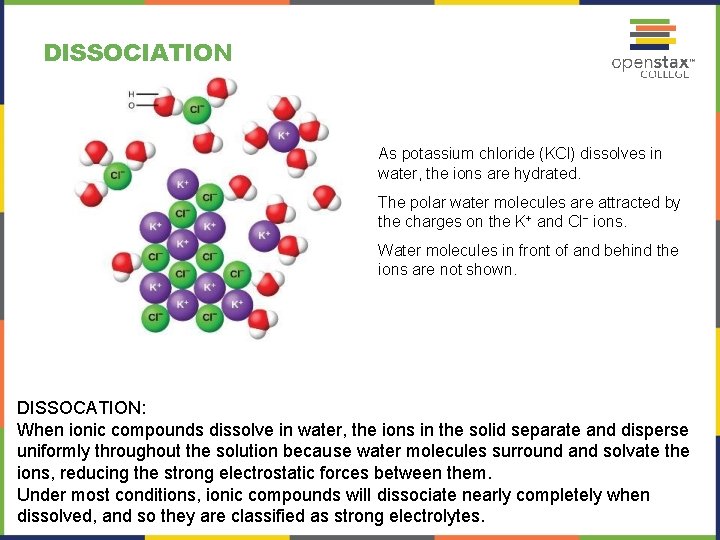
DISSOCIATION As potassium chloride (KCl) dissolves in water, the ions are hydrated. The polar water molecules are attracted by the charges on the K+ and Cl− ions. Water molecules in front of and behind the ions are not shown. DISSOCATION: When ionic compounds dissolve in water, the ions in the solid separate and disperse uniformly throughout the solution because water molecules surround and solvate the ions, reducing the strong electrostatic forces between them. Under most conditions, ionic compounds will dissociate nearly completely when dissolved, and so they are classified as strong electrolytes.
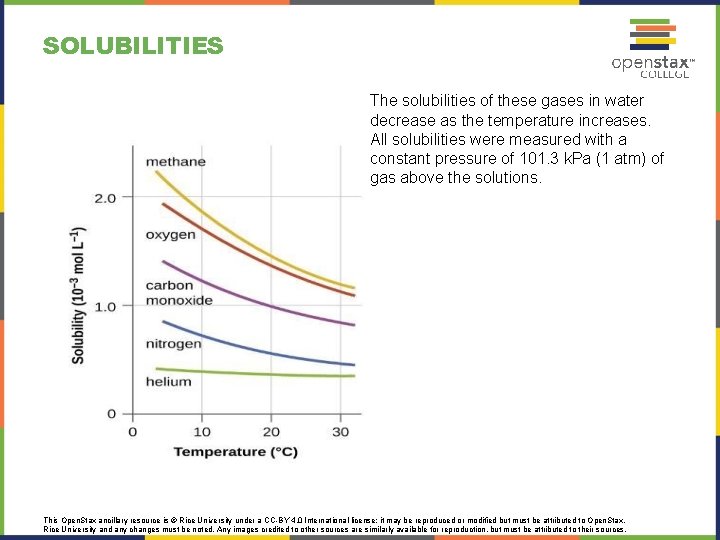
SOLUBILITIES The solubilities of these gases in water decrease as the temperature increases. All solubilities were measured with a constant pressure of 101. 3 k. Pa (1 atm) of gas above the solutions. This Open. Stax ancillary resource is © Rice University under a CC-BY 4. 0 International license; it may be reproduced or modified but must be attributed to Open. Stax, Rice University and any changes must be noted. Any images credited to other sources are similarly available for reproduction, but must be attributed to their sources.
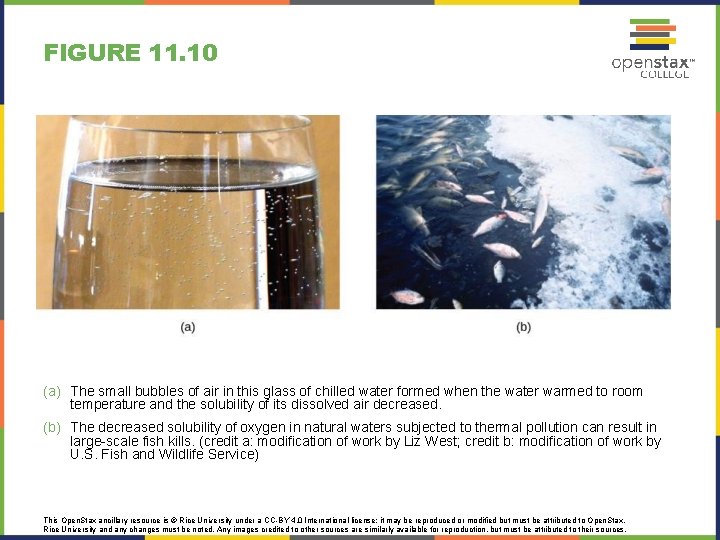
FIGURE 11. 10 (a) The small bubbles of air in this glass of chilled water formed when the water warmed to room temperature and the solubility of its dissolved air decreased. (b) The decreased solubility of oxygen in natural waters subjected to thermal pollution can result in large-scale fish kills. (credit a: modification of work by Liz West; credit b: modification of work by U. S. Fish and Wildlife Service) This Open. Stax ancillary resource is © Rice University under a CC-BY 4. 0 International license; it may be reproduced or modified but must be attributed to Open. Stax, Rice University and any changes must be noted. Any images credited to other sources are similarly available for reproduction, but must be attributed to their sources.
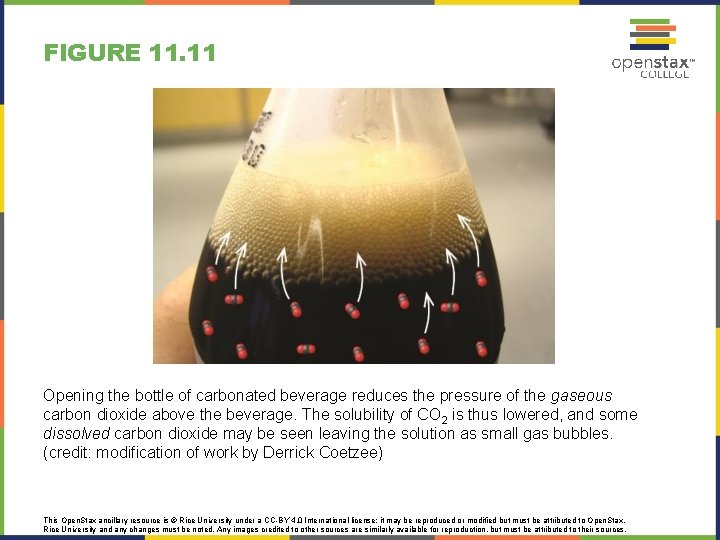
FIGURE 11. 11 Opening the bottle of carbonated beverage reduces the pressure of the gaseous carbon dioxide above the beverage. The solubility of CO 2 is thus lowered, and some dissolved carbon dioxide may be seen leaving the solution as small gas bubbles. (credit: modification of work by Derrick Coetzee) This Open. Stax ancillary resource is © Rice University under a CC-BY 4. 0 International license; it may be reproduced or modified but must be attributed to Open. Stax, Rice University and any changes must be noted. Any images credited to other sources are similarly available for reproduction, but must be attributed to their sources.
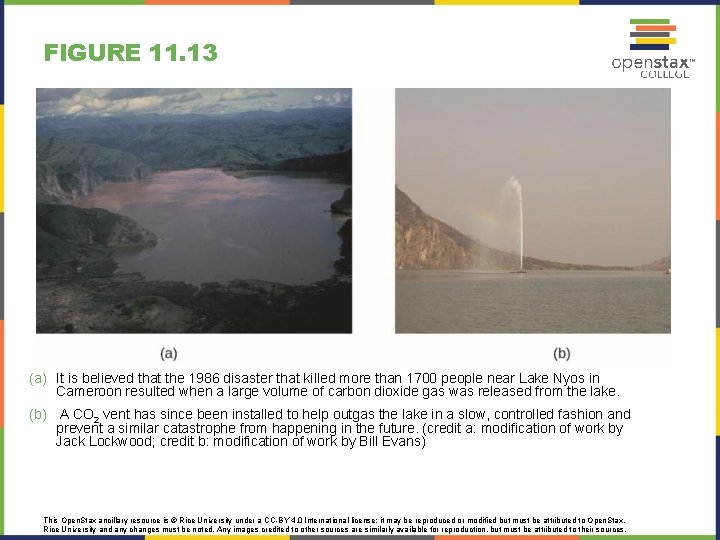
FIGURE 11. 13 (a) It is believed that the 1986 disaster that killed more than 1700 people near Lake Nyos in Cameroon resulted when a large volume of carbon dioxide gas was released from the lake. (b) A CO 2 vent has since been installed to help outgas the lake in a slow, controlled fashion and prevent a similar catastrophe from happening in the future. (credit a: modification of work by Jack Lockwood; credit b: modification of work by Bill Evans) This Open. Stax ancillary resource is © Rice University under a CC-BY 4. 0 International license; it may be reproduced or modified but must be attributed to Open. Stax, Rice University and any changes must be noted. Any images credited to other sources are similarly available for reproduction, but must be attributed to their sources.
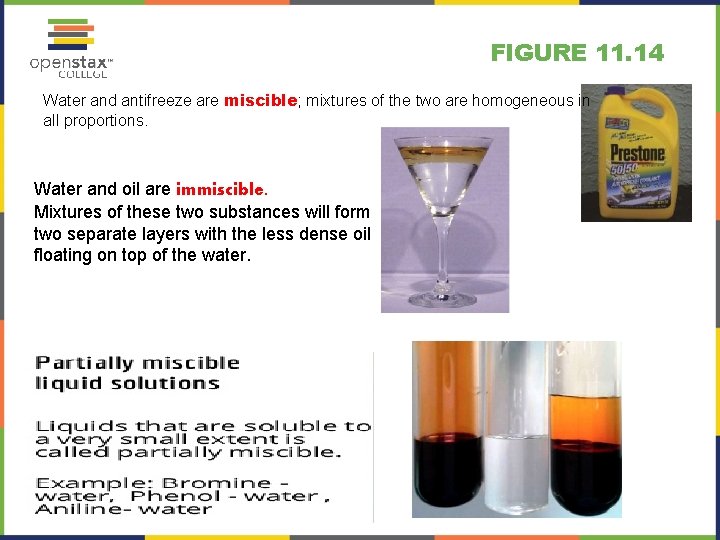
FIGURE 11. 14 Water and antifreeze are miscible; mixtures of the two are homogeneous in all proportions. Water and oil are immiscible. Mixtures of these two substances will form two separate layers with the less dense oil floating on top of the water.
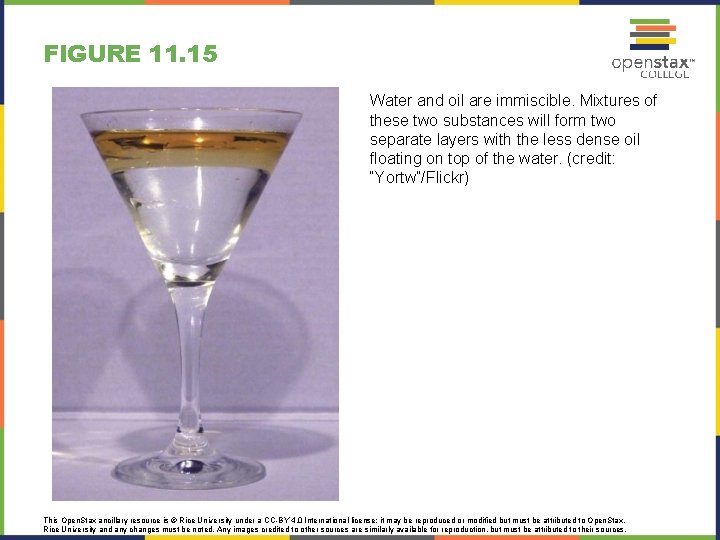
FIGURE 11. 15 Water and oil are immiscible. Mixtures of these two substances will form two separate layers with the less dense oil floating on top of the water. (credit: “Yortw”/Flickr) This Open. Stax ancillary resource is © Rice University under a CC-BY 4. 0 International license; it may be reproduced or modified but must be attributed to Open. Stax, Rice University and any changes must be noted. Any images credited to other sources are similarly available for reproduction, but must be attributed to their sources.
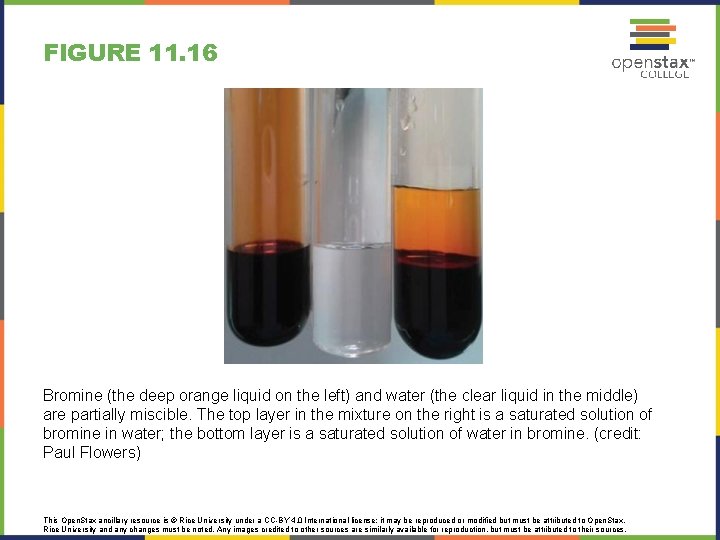
FIGURE 11. 16 Bromine (the deep orange liquid on the left) and water (the clear liquid in the middle) are partially miscible. The top layer in the mixture on the right is a saturated solution of bromine in water; the bottom layer is a saturated solution of water in bromine. (credit: Paul Flowers) This Open. Stax ancillary resource is © Rice University under a CC-BY 4. 0 International license; it may be reproduced or modified but must be attributed to Open. Stax, Rice University and any changes must be noted. Any images credited to other sources are similarly available for reproduction, but must be attributed to their sources.
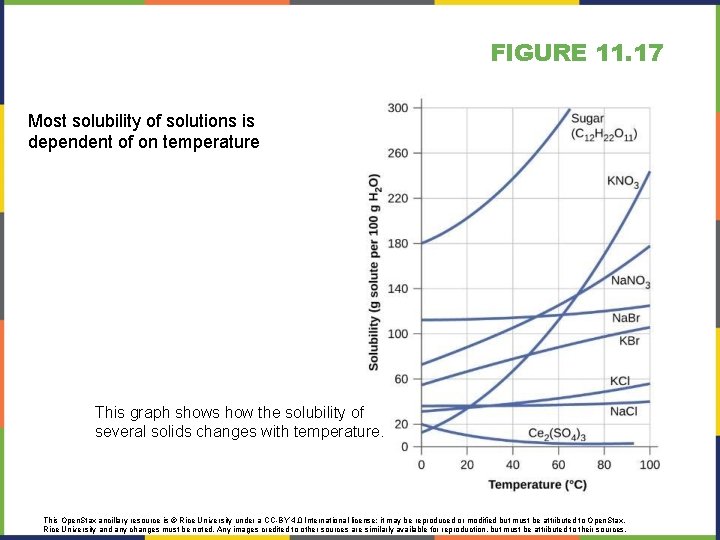
FIGURE 11. 17 Most solubility of solutions is dependent of on temperature This graph shows how the solubility of several solids changes with temperature. This Open. Stax ancillary resource is © Rice University under a CC-BY 4. 0 International license; it may be reproduced or modified but must be attributed to Open. Stax, Rice University and any changes must be noted. Any images credited to other sources are similarly available for reproduction, but must be attributed to their sources.
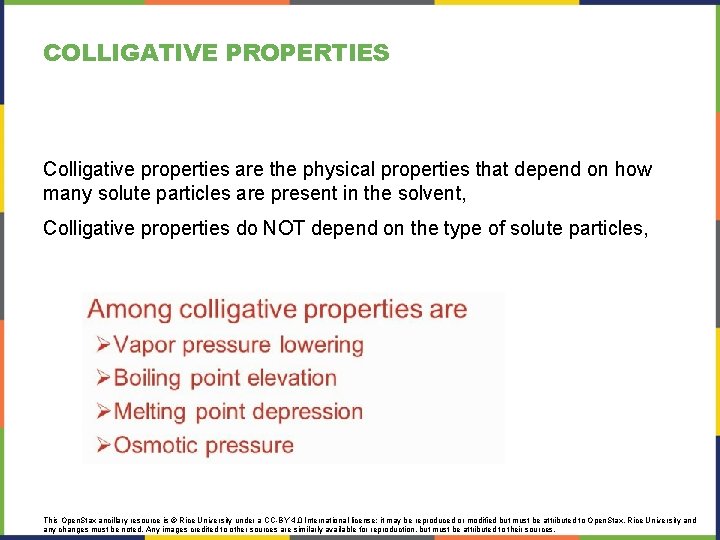
COLLIGATIVE PROPERTIES Colligative properties are the physical properties that depend on how many solute particles are present in the solvent, Colligative properties do NOT depend on the type of solute particles, This Open. Stax ancillary resource is © Rice University under a CC-BY 4. 0 International license; it may be reproduced or modified but must be attributed to Open. Stax, Rice University and any changes must be noted. Any images credited to other sources are similarly available for reproduction, but must be attributed to their sources.
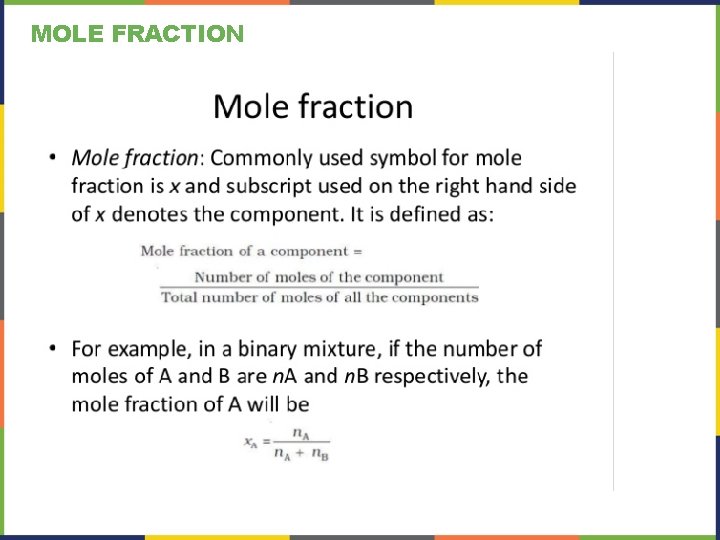
MOLE FRACTION
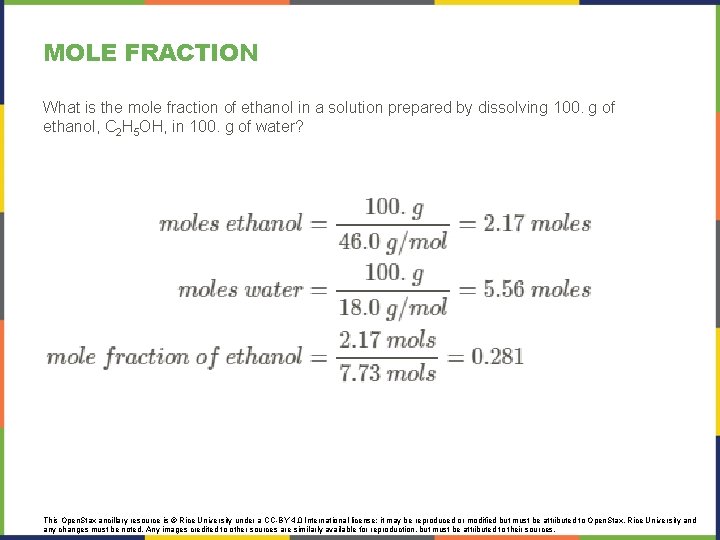
MOLE FRACTION What is the mole fraction of ethanol in a solution prepared by dissolving 100. g of ethanol, C 2 H 5 OH, in 100. g of water? This Open. Stax ancillary resource is © Rice University under a CC-BY 4. 0 International license; it may be reproduced or modified but must be attributed to Open. Stax, Rice University and any changes must be noted. Any images credited to other sources are similarly available for reproduction, but must be attributed to their sources.
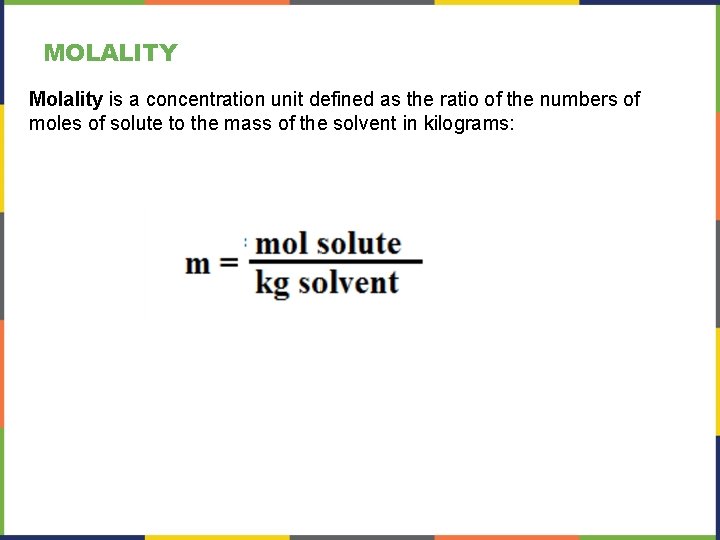
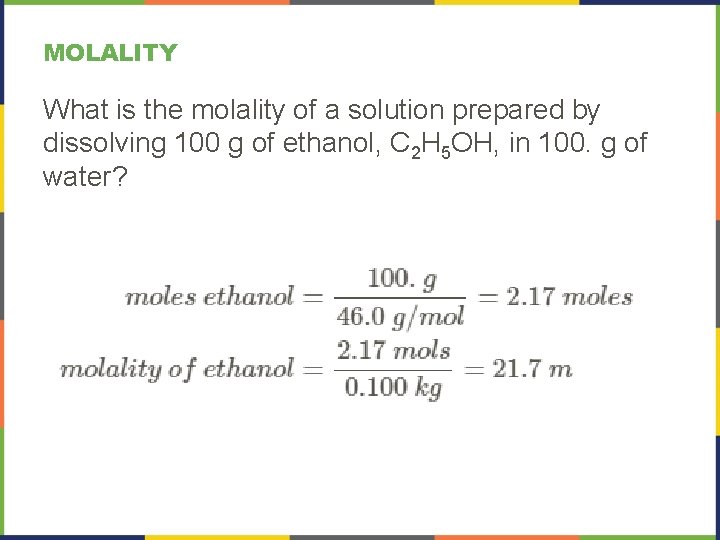
MOLALITY Molality is a concentration unit defined as the ratio of the numbers of moles of solute to the mass of the solvent in kilograms:
MOLALITY What is the molality of a solution prepared by dissolving 100 g of ethanol, C 2 H 5 OH, in 100. g of water?
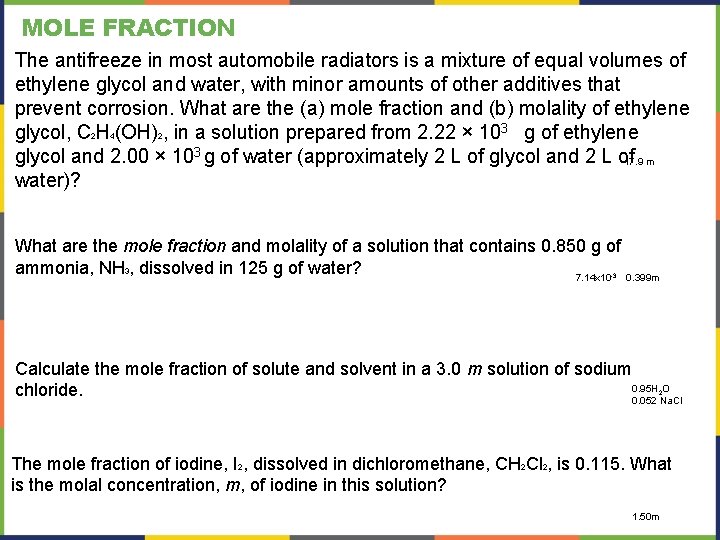
MOLE FRACTION The antifreeze in most automobile radiators is a mixture of equal volumes of ethylene glycol and water, with minor amounts of other additives that prevent corrosion. What are the (a) mole fraction and (b) molality of ethylene glycol, C H (OH) , in a solution prepared from 2. 22 × 103 g of ethylene glycol and 2. 00 × 103 g of water (approximately 2 L of glycol and 2 L of 17. 9 m water)? 2 4 2 What are the mole fraction and molality of a solution that contains 0. 850 g of ammonia, NH 3, dissolved in 125 g of water? 7. 14 x 10 -3 0. 399 m Calculate the mole fraction of solute and solvent in a 3. 0 m solution of sodium 0. 95 H O chloride. 0. 052 Na. Cl 2 The mole fraction of iodine, I 2, dissolved in dichloromethane, CH 2 Cl 2, is 0. 115. What is the molal concentration, m, of iodine in this solution? 1. 50 m
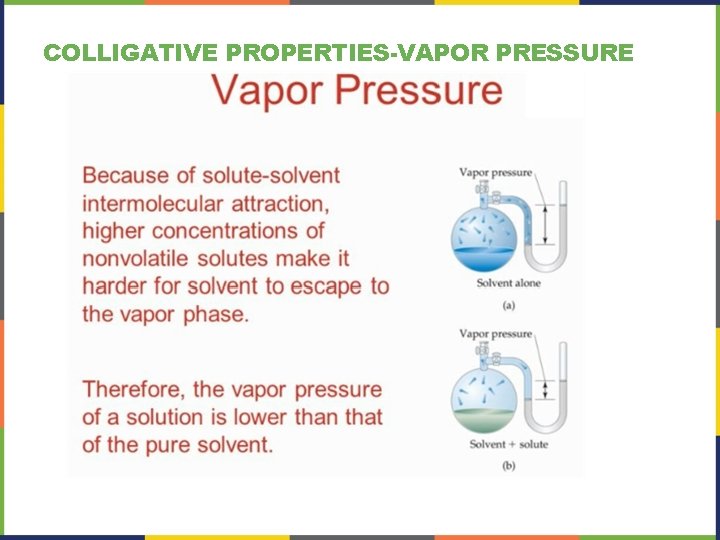
COLLIGATIVE PROPERTIES-VAPOR PRESSURE
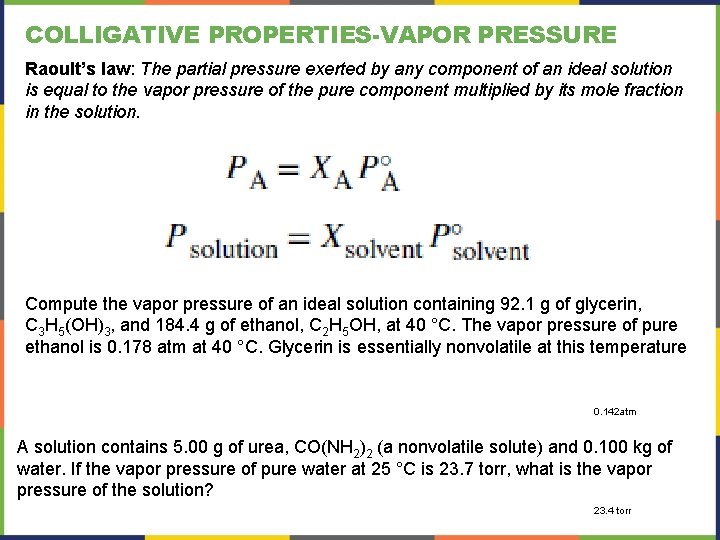
COLLIGATIVE PROPERTIES-VAPOR PRESSURE Raoult’s law: The partial pressure exerted by any component of an ideal solution is equal to the vapor pressure of the pure component multiplied by its mole fraction in the solution. Compute the vapor pressure of an ideal solution containing 92. 1 g of glycerin, C 3 H 5(OH)3, and 184. 4 g of ethanol, C 2 H 5 OH, at 40 °C. The vapor pressure of pure ethanol is 0. 178 atm at 40 °C. Glycerin is essentially nonvolatile at this temperature 0. 142 atm A solution contains 5. 00 g of urea, CO(NH 2)2 (a nonvolatile solute) and 0. 100 kg of water. If the vapor pressure of pure water at 25 °C is 23. 7 torr, what is the vapor pressure of the solution? 23. 4 torr
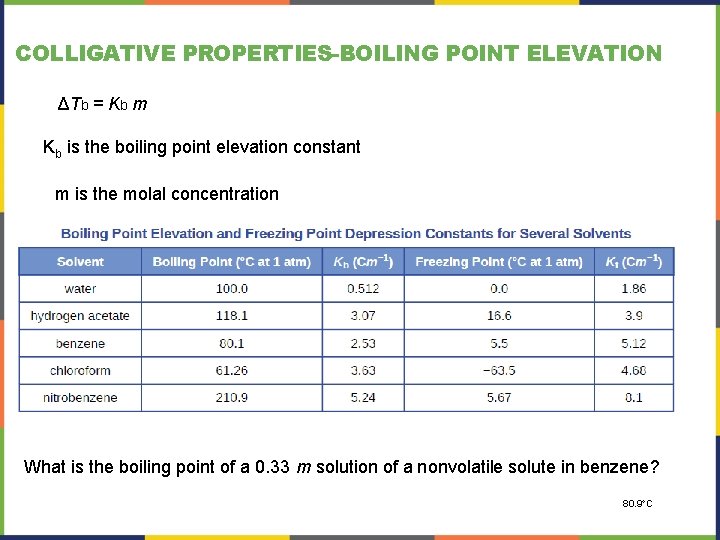
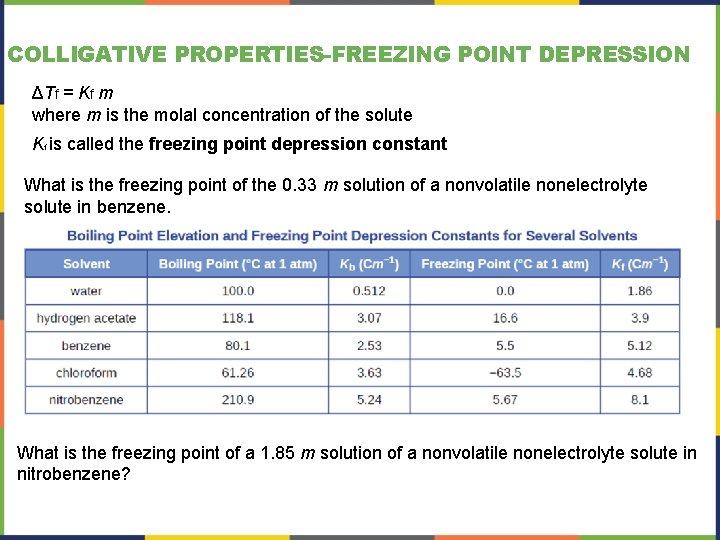
COLLIGATIVE PROPERTIES-BOILING POINT ELEVATION ΔTb = Kb m Kb is the boiling point elevation constant m is the molal concentration What is the boiling point of a 0. 33 m solution of a nonvolatile solute in benzene? 80. 9 C
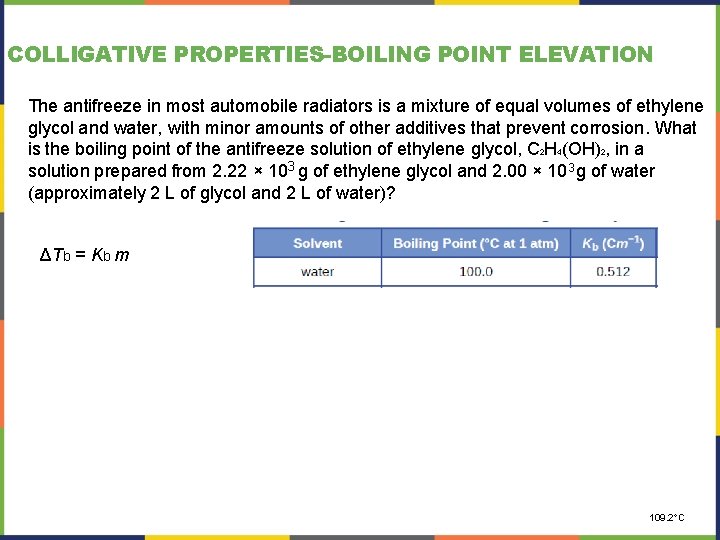
COLLIGATIVE PROPERTIES-BOILING POINT ELEVATION The antifreeze in most automobile radiators is a mixture of equal volumes of ethylene glycol and water, with minor amounts of other additives that prevent corrosion. What is the boiling point of the antifreeze solution of ethylene glycol, C 2 H 4(OH)2, in a solution prepared from 2. 22 × 103 g of ethylene glycol and 2. 00 × 103 g of water (approximately 2 L of glycol and 2 L of water)? ΔTb = Kb m 109. 2 C
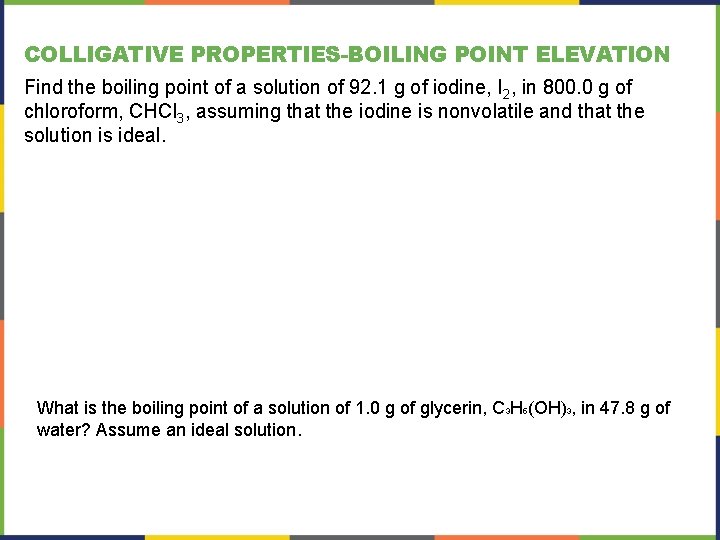
COLLIGATIVE PROPERTIES-BOILING POINT ELEVATION Find the boiling point of a solution of 92. 1 g of iodine, I 2, in 800. 0 g of chloroform, CHCl 3, assuming that the iodine is nonvolatile and that the solution is ideal. What is the boiling point of a solution of 1. 0 g of glycerin, C 3 H 5(OH)3, in 47. 8 g of water? Assume an ideal solution.
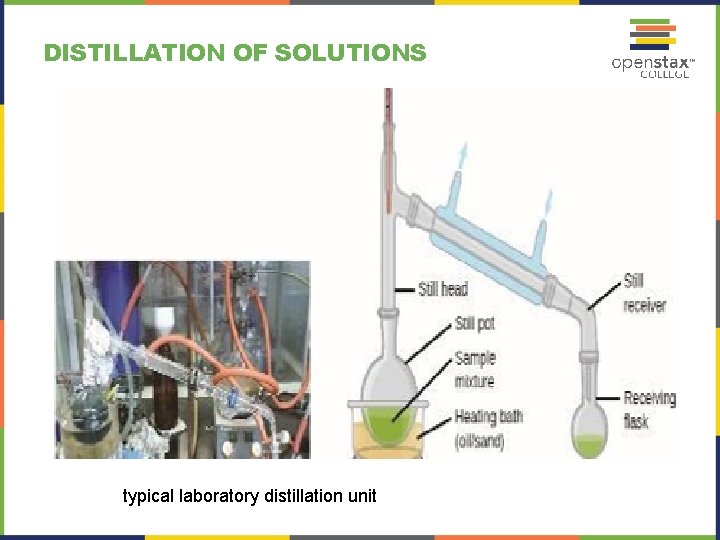
DISTILLATION OF SOLUTIONS typical laboratory distillation unit
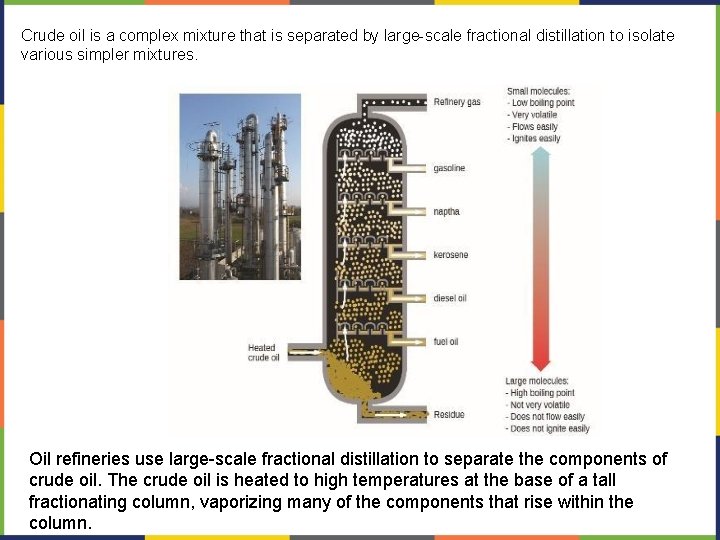
Crude oil is a complex mixture that is separated by large-scale fractional distillation to isolate various simpler mixtures. Oil refineries use large-scale fractional distillation to separate the components of crude oil. The crude oil is heated to high temperatures at the base of a tall fractionating column, vaporizing many of the components that rise within the column.
COLLIGATIVE PROPERTIES-FREEZING POINT DEPRESSION ΔTf = Kf m where m is the molal concentration of the solute Kf is called the freezing point depression constant What is the freezing point of the 0. 33 m solution of a nonvolatile nonelectrolyte solute in benzene. What is the freezing point of a 1. 85 m solution of a nonvolatile nonelectrolyte solute in nitrobenzene?
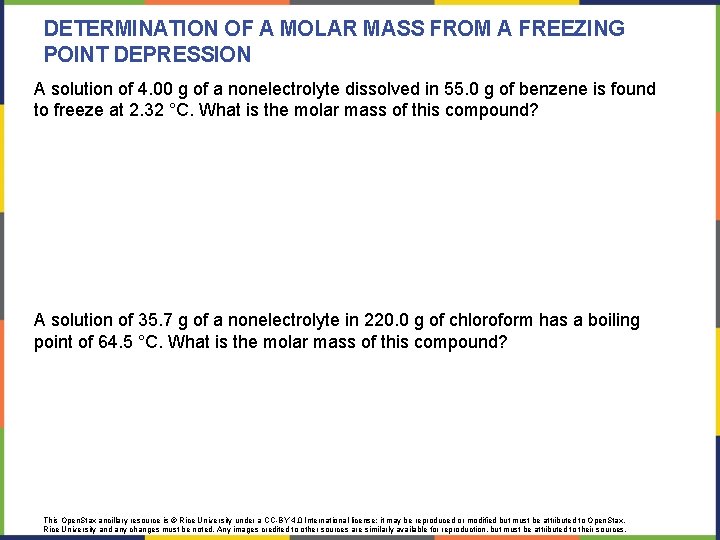
DETERMINATION OF A MOLAR MASS FROM A FREEZING POINT DEPRESSION A solution of 4. 00 g of a nonelectrolyte dissolved in 55. 0 g of benzene is found to freeze at 2. 32 °C. What is the molar mass of this compound? A solution of 35. 7 g of a nonelectrolyte in 220. 0 g of chloroform has a boiling point of 64. 5 °C. What is the molar mass of this compound? This Open. Stax ancillary resource is © Rice University under a CC-BY 4. 0 International license; it may be reproduced or modified but must be attributed to Open. Stax, Rice University and any changes must be noted. Any images credited to other sources are similarly available for reproduction, but must be attributed to their sources.
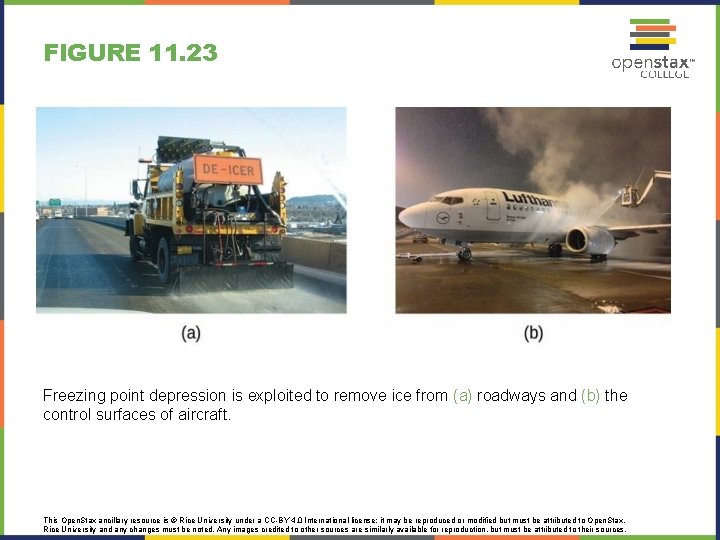
FIGURE 11. 23 Freezing point depression is exploited to remove ice from (a) roadways and (b) the control surfaces of aircraft. This Open. Stax ancillary resource is © Rice University under a CC-BY 4. 0 International license; it may be reproduced or modified but must be attributed to Open. Stax, Rice University and any changes must be noted. Any images credited to other sources are similarly available for reproduction, but must be attributed to their sources.
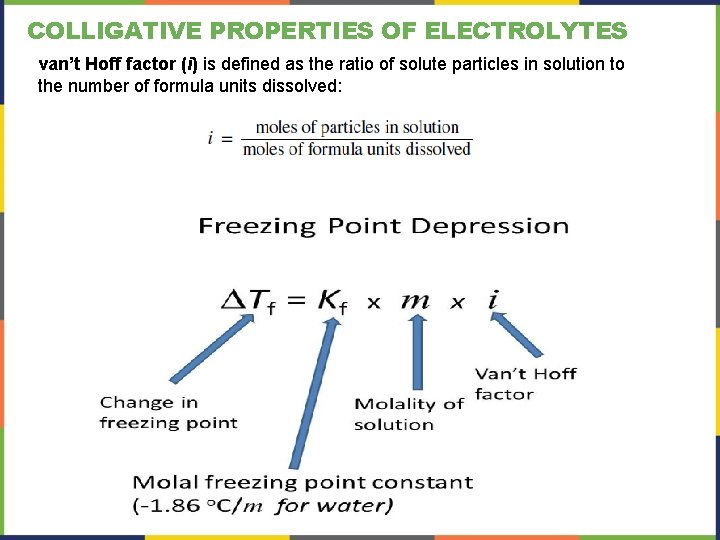
COLLIGATIVE PROPERTIES OF ELECTROLYTES van’t Hoff factor (i) is defined as the ratio of solute particles in solution to the number of formula units dissolved:
COLLIGATIVE PROPERTIES OF ELECTROLYTES This Open. Stax ancillary resource is © Rice University under a CC-BY 4. 0 International license; it may be reproduced or modified but must be attributed to Open. Stax, Rice University and any changes must be noted. Any images credited to other sources are similarly available for reproduction, but must be attributed to their sources.
COLLIGATIVE PROPERTIES These phase diagrams show water (solid curves) and an aqueous solution of nonelectrolyte (dashed curves). Colligative effects on vapor pressure, boiling point, and freezing point are summarized by comparing the phase diagrams for a pure liquid and a solution derived from that liquid. Phase diagrams for water and an aqueous solution
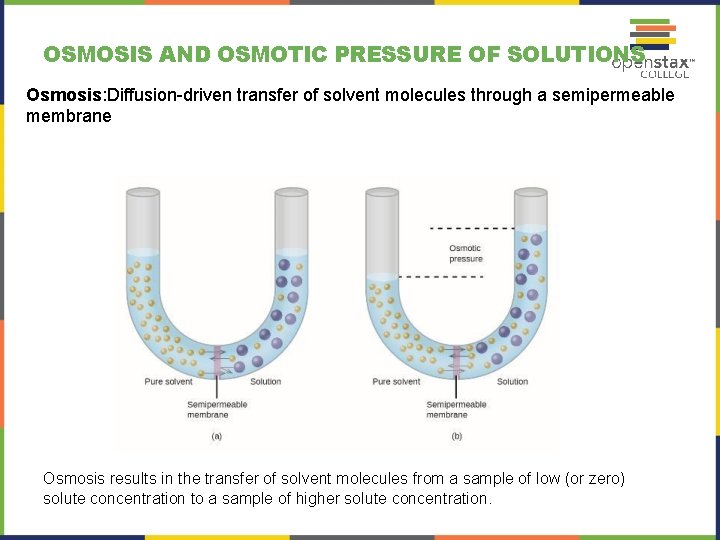
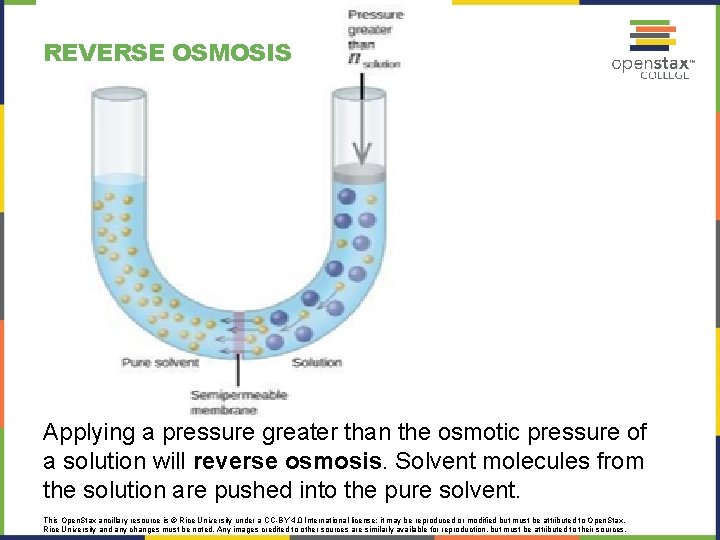
OSMOSIS AND OSMOTIC PRESSURE OF SOLUTIONS Osmosis: Diffusion-driven transfer of solvent molecules through a semipermeable membrane Osmosis results in the transfer of solvent molecules from a sample of low (or zero) solute concentration to a sample of higher solute concentration.
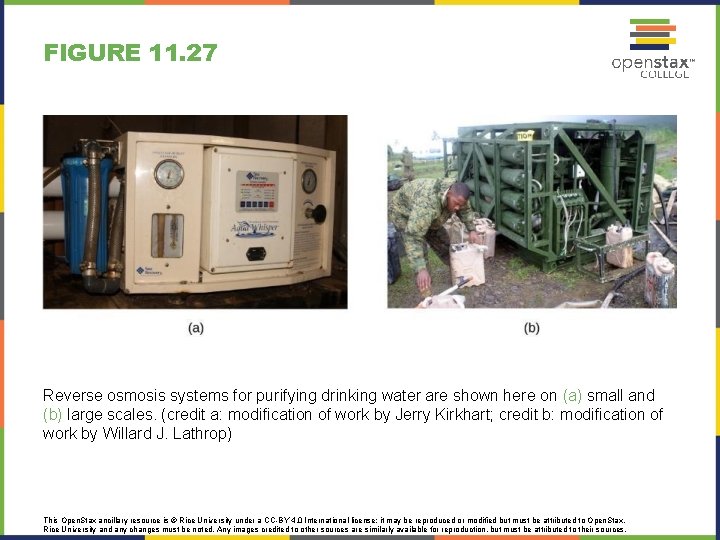
FIGURE 11. 27 Reverse osmosis systems for purifying drinking water are shown here on (a) small and (b) large scales. (credit a: modification of work by Jerry Kirkhart; credit b: modification of work by Willard J. Lathrop) This Open. Stax ancillary resource is © Rice University under a CC-BY 4. 0 International license; it may be reproduced or modified but must be attributed to Open. Stax, Rice University and any changes must be noted. Any images credited to other sources are similarly available for reproduction, but must be attributed to their sources.
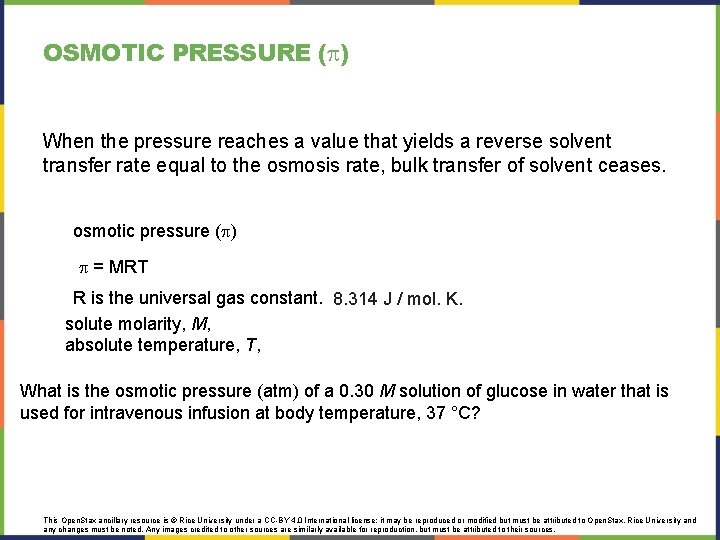
OSMOTIC PRESSURE ( ) When the pressure reaches a value that yields a reverse solvent transfer rate equal to the osmosis rate, bulk transfer of solvent ceases. osmotic pressure ( ) = MRT R is the universal gas constant. 8. 314 J / mol. K. solute molarity, M, absolute temperature, T, What is the osmotic pressure (atm) of a 0. 30 M solution of glucose in water that is used for intravenous infusion at body temperature, 37 °C? This Open. Stax ancillary resource is © Rice University under a CC-BY 4. 0 International license; it may be reproduced or modified but must be attributed to Open. Stax, Rice University and any changes must be noted. Any images credited to other sources are similarly available for reproduction, but must be attributed to their sources.
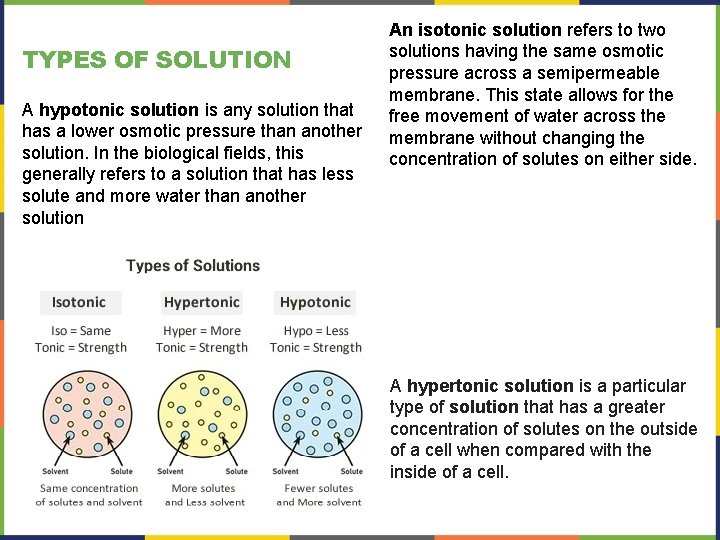
TYPES OF SOLUTION A hypotonic solution is any solution that has a lower osmotic pressure than another solution. In the biological fields, this generally refers to a solution that has less solute and more water than another solution An isotonic solution refers to two solutions having the same osmotic pressure across a semipermeable membrane. This state allows for the free movement of water across the membrane without changing the concentration of solutes on either side. A hypertonic solution is a particular type of solution that has a greater concentration of solutes on the outside of a cell when compared with the inside of a cell.
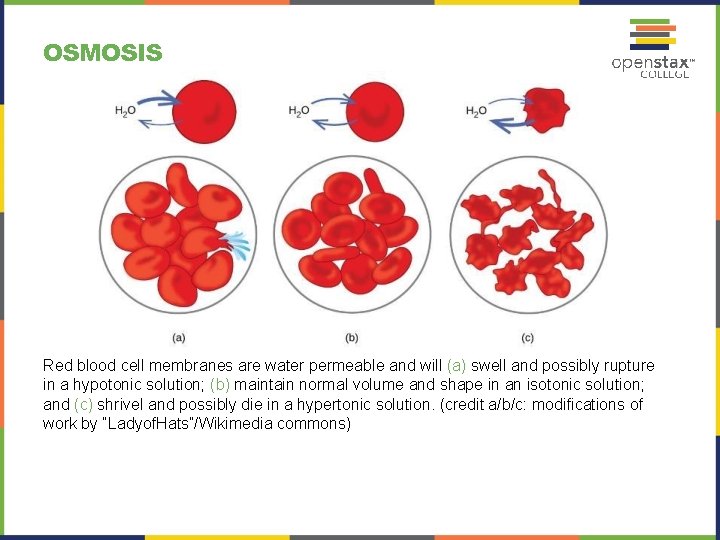
OSMOSIS Red blood cell membranes are water permeable and will (a) swell and possibly rupture in a hypotonic solution; (b) maintain normal volume and shape in an isotonic solution; and (c) shrivel and possibly die in a hypertonic solution. (credit a/b/c: modifications of work by “Ladyof. Hats”/Wikimedia commons)
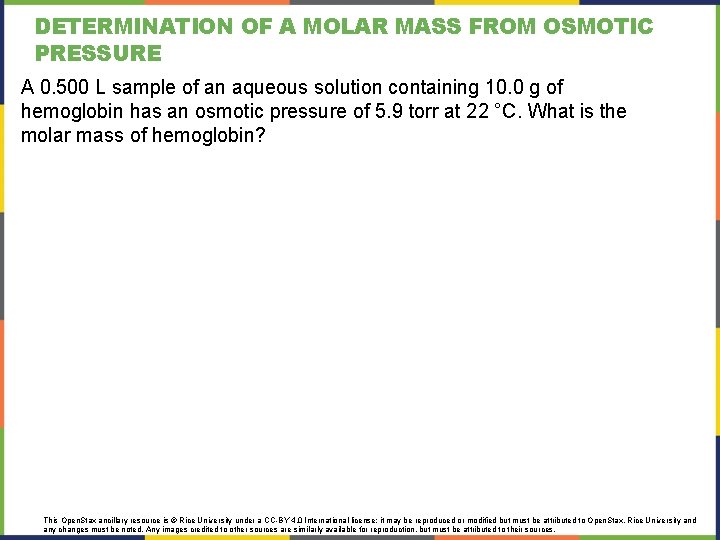
DETERMINATION OF A MOLAR MASS FROM OSMOTIC PRESSURE A 0. 500 L sample of an aqueous solution containing 10. 0 g of hemoglobin has an osmotic pressure of 5. 9 torr at 22 °C. What is the molar mass of hemoglobin? This Open. Stax ancillary resource is © Rice University under a CC-BY 4. 0 International license; it may be reproduced or modified but must be attributed to Open. Stax, Rice University and any changes must be noted. Any images credited to other sources are similarly available for reproduction, but must be attributed to their sources.
REVERSE OSMOSIS Applying a pressure greater than the osmotic pressure of a solution will reverse osmosis. Solvent molecules from the solution are pushed into the pure solvent. This Open. Stax ancillary resource is © Rice University under a CC-BY 4. 0 International license; it may be reproduced or modified but must be attributed to Open. Stax, Rice University and any changes must be noted. Any images credited to other sources are similarly available for reproduction, but must be attributed to their sources.
OSMOTIC PRESSURE ( ) What is the osmotic pressure (atm) a solution with a volume of 0. 750 L that contains 5. 0 g of methanol, CH 3 OH, in water at 37 °C? What is the molar mass of a protein if a solution of 0. 02 g of the protein in 25. 0 m. L of solution has an osmotic pressure of 0. 56 torr at 25 °C? This Open. Stax ancillary resource is © Rice University under a CC-BY 4. 0 International license; it may be reproduced or modified but must be attributed to Open. Stax, Rice University and any changes must be noted. Any images credited to other sources are similarly available for reproduction, but must be attributed to their sources.
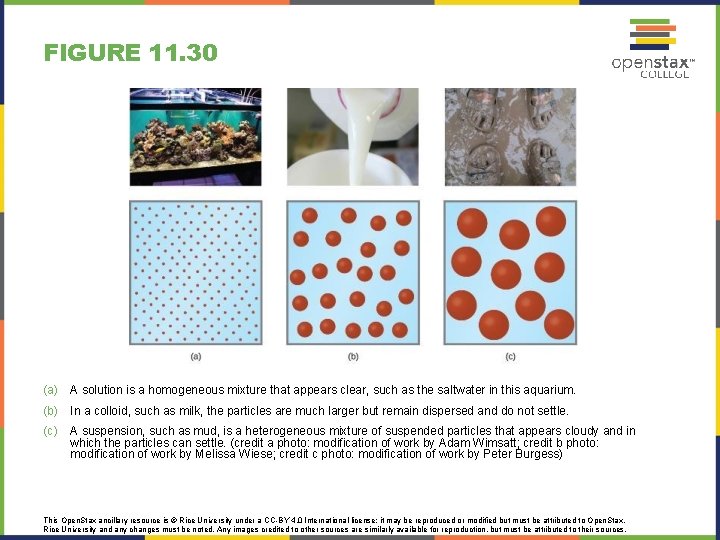
FIGURE 11. 30 (a) A solution is a homogeneous mixture that appears clear, such as the saltwater in this aquarium. (b) In a colloid, such as milk, the particles are much larger but remain dispersed and do not settle. (c) A suspension, such as mud, is a heterogeneous mixture of suspended particles that appears cloudy and in which the particles can settle. (credit a photo: modification of work by Adam Wimsatt; credit b photo: modification of work by Melissa Wiese; credit c photo: modification of work by Peter Burgess) This Open. Stax ancillary resource is © Rice University under a CC-BY 4. 0 International license; it may be reproduced or modified but must be attributed to Open. Stax, Rice University and any changes must be noted. Any images credited to other sources are similarly available for reproduction, but must be attributed to their sources.
FIGURE 11. 31 The paths of searchlight beams are made visible when light is scattered by colloidalsize particles in the air (fog, smoke, etc. ). Called the Tyndall Effect Clouds are colloidal mixtures. This Open. Stax ancillary resource is © Rice University under a CC-BY 4. 0 International license; it may be reproduced or modified but must be attributed to Open. Stax, Rice University and any changes must be noted. Any images credited to other sources are similarly available for reproduction, but must be attributed to their sources.
COLLOIDS The particulate component typically present in a relatively minor amount is called the dispersed phase and the substance or solution throughout which the particulate is dispersed is called the dispersion medium. This Open. Stax ancillary resource is © Rice University under a CC-BY 4. 0 International license; it may be reproduced or modified but must be attributed to Open. Stax, Rice University and any changes must be noted. Any images credited to other sources are similarly available for reproduction, but must be attributed to their sources.
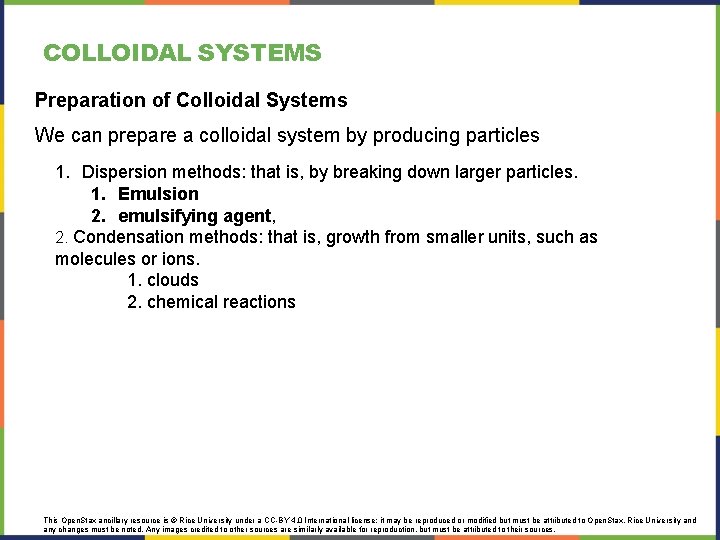
COLLOIDAL SYSTEMS Preparation of Colloidal Systems We can prepare a colloidal system by producing particles 1. Dispersion methods: that is, by breaking down larger particles. 1. Emulsion 2. emulsifying agent, 2. Condensation methods: that is, growth from smaller units, such as molecules or ions. 1. clouds 2. chemical reactions This Open. Stax ancillary resource is © Rice University under a CC-BY 4. 0 International license; it may be reproduced or modified but must be attributed to Open. Stax, Rice University and any changes must be noted. Any images credited to other sources are similarly available for reproduction, but must be attributed to their sources.
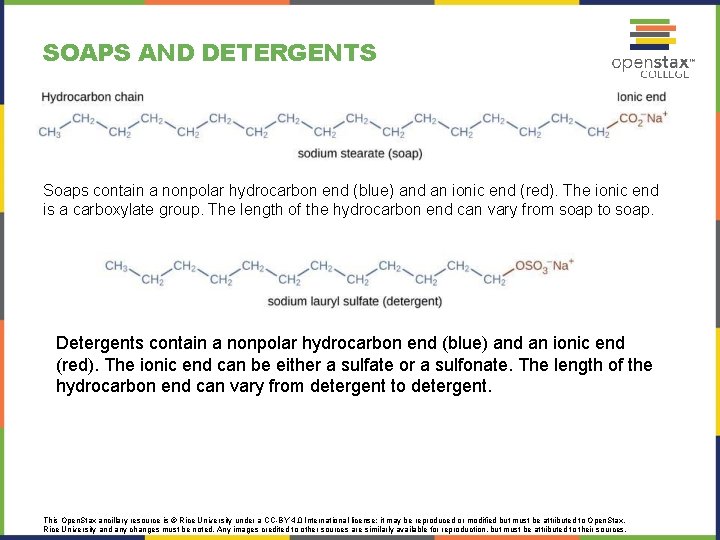
SOAPS AND DETERGENTS Soaps contain a nonpolar hydrocarbon end (blue) and an ionic end (red). The ionic end is a carboxylate group. The length of the hydrocarbon end can vary from soap to soap. Detergents contain a nonpolar hydrocarbon end (blue) and an ionic end (red). The ionic end can be either a sulfate or a sulfonate. The length of the hydrocarbon end can vary from detergent to detergent. This Open. Stax ancillary resource is © Rice University under a CC-BY 4. 0 International license; it may be reproduced or modified but must be attributed to Open. Stax, Rice University and any changes must be noted. Any images credited to other sources are similarly available for reproduction, but must be attributed to their sources.
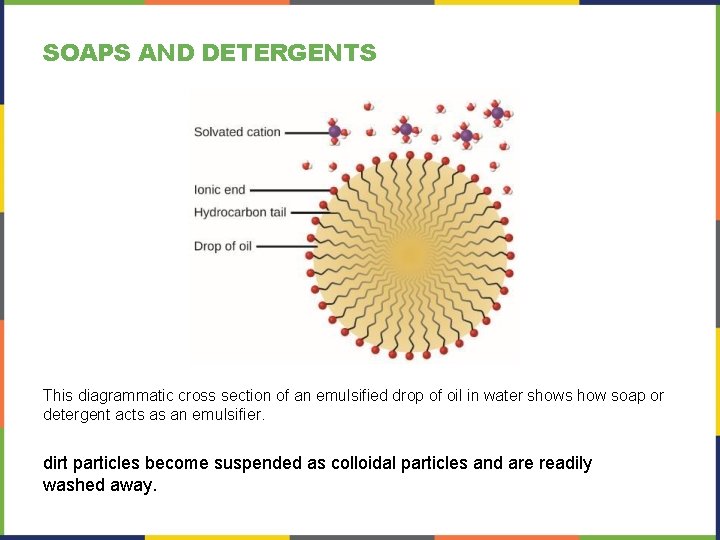
SOAPS AND DETERGENTS This diagrammatic cross section of an emulsified drop of oil in water shows how soap or detergent acts as an emulsifier. dirt particles become suspended as colloidal particles and are readily washed away.
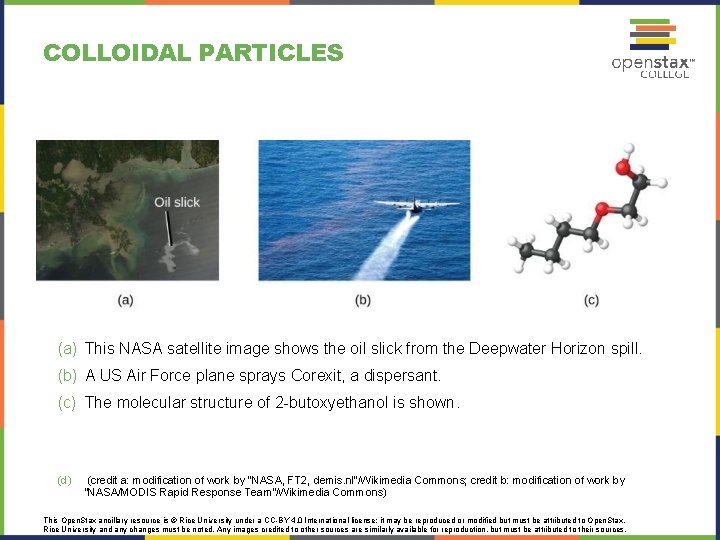
COLLOIDAL PARTICLES (a) This NASA satellite image shows the oil slick from the Deepwater Horizon spill. (b) A US Air Force plane sprays Corexit, a dispersant. (c) The molecular structure of 2 -butoxyethanol is shown. (d) (credit a: modification of work by “NASA, FT 2, demis. nl”/Wikimedia Commons; credit b: modification of work by “NASA/MODIS Rapid Response Team”/Wikimedia Commons) This Open. Stax ancillary resource is © Rice University under a CC-BY 4. 0 International license; it may be reproduced or modified but must be attributed to Open. Stax, Rice University and any changes must be noted. Any images credited to other sources are similarly available for reproduction, but must be attributed to their sources.
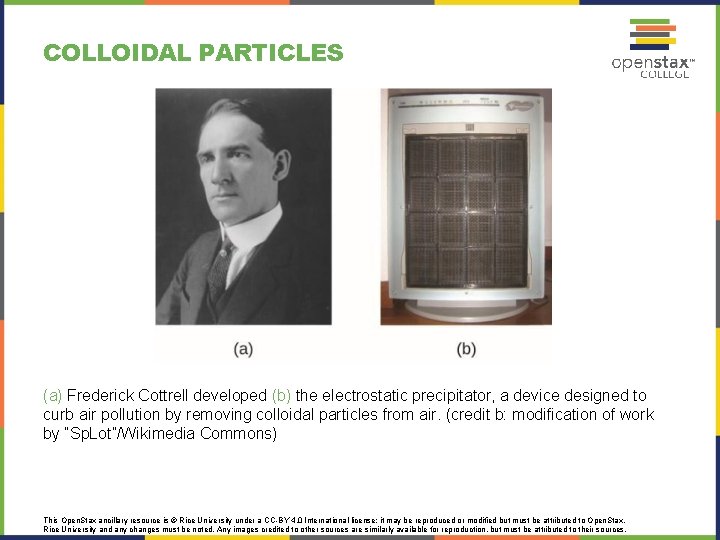
COLLOIDAL PARTICLES (a) Frederick Cottrell developed (b) the electrostatic precipitator, a device designed to curb air pollution by removing colloidal particles from air. (credit b: modification of work by “Sp. Lot”/Wikimedia Commons) This Open. Stax ancillary resource is © Rice University under a CC-BY 4. 0 International license; it may be reproduced or modified but must be attributed to Open. Stax, Rice University and any changes must be noted. Any images credited to other sources are similarly available for reproduction, but must be attributed to their sources.
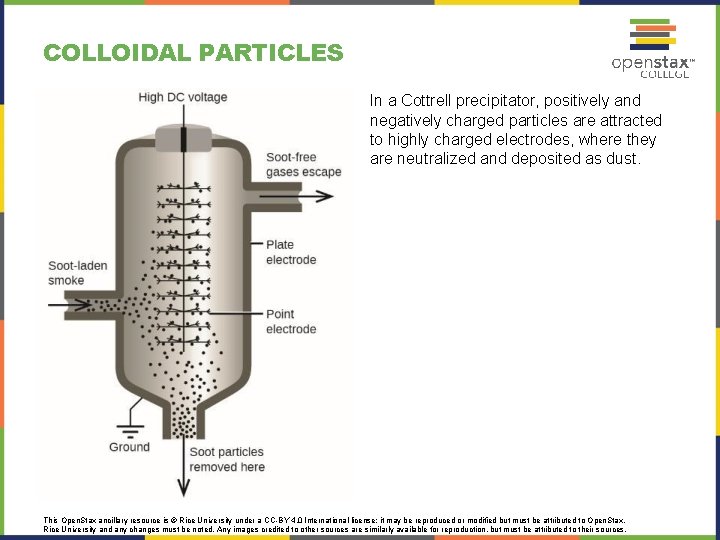
COLLOIDAL PARTICLES In a Cottrell precipitator, positively and negatively charged particles are attracted to highly charged electrodes, where they are neutralized and deposited as dust. This Open. Stax ancillary resource is © Rice University under a CC-BY 4. 0 International license; it may be reproduced or modified but must be attributed to Open. Stax, Rice University and any changes must be noted. Any images credited to other sources are similarly available for reproduction, but must be attributed to their sources.
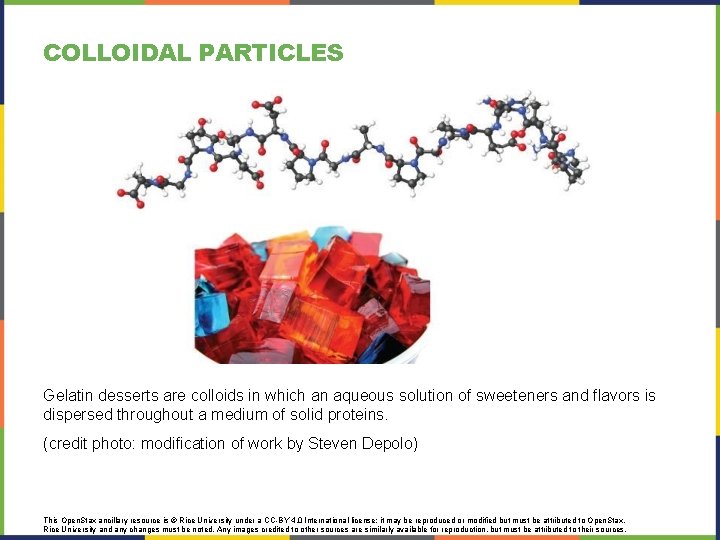
COLLOIDAL PARTICLES Gelatin desserts are colloids in which an aqueous solution of sweeteners and flavors is dispersed throughout a medium of solid proteins. (credit photo: modification of work by Steven Depolo) This Open. Stax ancillary resource is © Rice University under a CC-BY 4. 0 International license; it may be reproduced or modified but must be attributed to Open. Stax, Rice University and any changes must be noted. Any images credited to other sources are similarly available for reproduction, but must be attributed to their sources.