
Chemistry Chapter 1 Atomic structure and the periodic
- Slides: 3
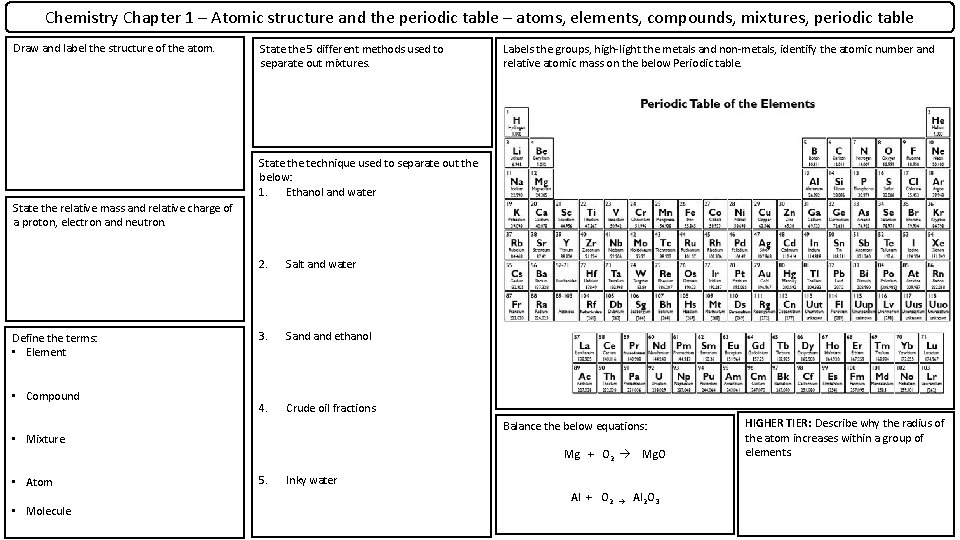
Chemistry Chapter 1 – Atomic structure and the periodic table – atoms, elements, compounds, mixtures, periodic table Draw and label the structure of the atom. State the 5 different methods used to separate out mixtures. Labels the groups, high-light the metals and non-metals, identify the atomic number and relative atomic mass on the below Periodic table. State the technique used to separate out the below: 1. Ethanol and water State the relative mass and relative charge of a proton, electron and neutron. Define the terms: • Element • Compound 2. Salt and water 3. Sand ethanol 4. Crude oil fractions Balance the below equations: • Mixture Mg + O 2 Mg. O • Atom • Molecule 5. Inky water Al + O 2 Al 2 O 3 HIGHER TIER: Describe why the radius of the atom increases within a group of elements.
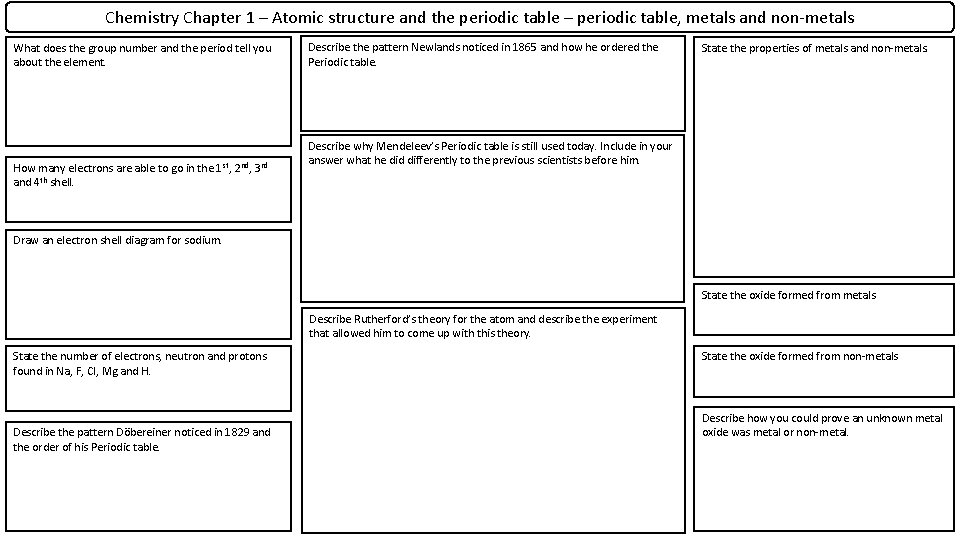
Chemistry Chapter 1 – Atomic structure and the periodic table – periodic table, metals and non-metals What does the group number and the period tell you about the element. How many electrons are able to go in the 1 st, 2 nd, 3 rd and 4 th shell. Describe the pattern Newlands noticed in 1865 and how he ordered the Periodic table. State the properties of metals and non-metals. Describe why Mendeleev’s Periodic table is still used today. Include in your answer what he did differently to the previous scientists before him. Draw an electron shell diagram for sodium. State the oxide formed from metals Describe Rutherford’s theory for the atom and describe the experiment that allowed him to come up with this theory. State the number of electrons, neutron and protons found in Na, F, Cl, Mg and H. Describe the pattern Döbereiner noticed in 1829 and the order of his Periodic table. State the oxide formed from non-metals Describe how you could prove an unknown metal oxide was metal or non-metal.
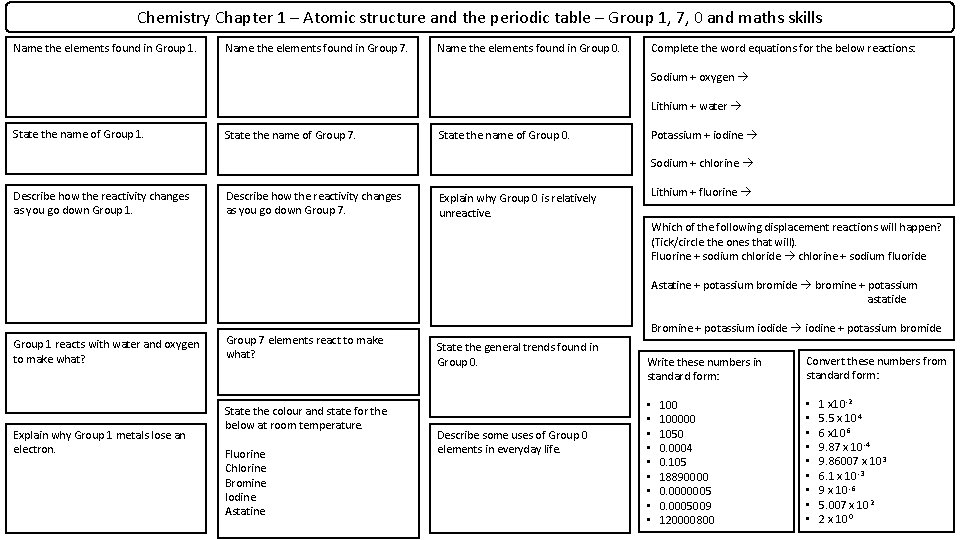
Chemistry Chapter 1 – Atomic structure and the periodic table – Group 1, 7, 0 and maths skills Name the elements found in Group 1. Name the elements found in Group 7. Name the elements found in Group 0. Complete the word equations for the below reactions: Sodium + oxygen Lithium + water State the name of Group 1. State the name of Group 7. State the name of Group 0. Potassium + iodine Sodium + chlorine Describe how the reactivity changes as you go down Group 1. Describe how the reactivity changes as you go down Group 7. Explain why Group 0 is relatively unreactive. Lithium + fluorine Which of the following displacement reactions will happen? (Tick/circle the ones that will). Fluorine + sodium chloride chlorine + sodium fluoride Astatine + potassium bromide bromine + potassium astatide Group 1 reacts with water and oxygen to make what? Explain why Group 1 metals lose an electron. Group 7 elements react to make what? State the colour and state for the below at room temperature. Fluorine Chlorine Bromine Iodine Astatine Bromine + potassium iodide iodine + potassium bromide State the general trends found in Group 0. Describe some uses of Group 0 elements in everyday life. Write these numbers in standard form: • • • 100000 1050 0. 0004 0. 105 18890000 0. 0000005 0. 0005009 120000800 Convert these numbers from standard form: • • • 1 x 10 -2 5. 5 x 10⁴ 6 x 10⁶ 9. 87 x 10 -4 9. 86007 x 10 3 6. 1 x 10 -3 9 x 10 -6 5. 007 x 10 2 2 x 100