
Chemistry Bonding and Structure Key Concepts Most metals
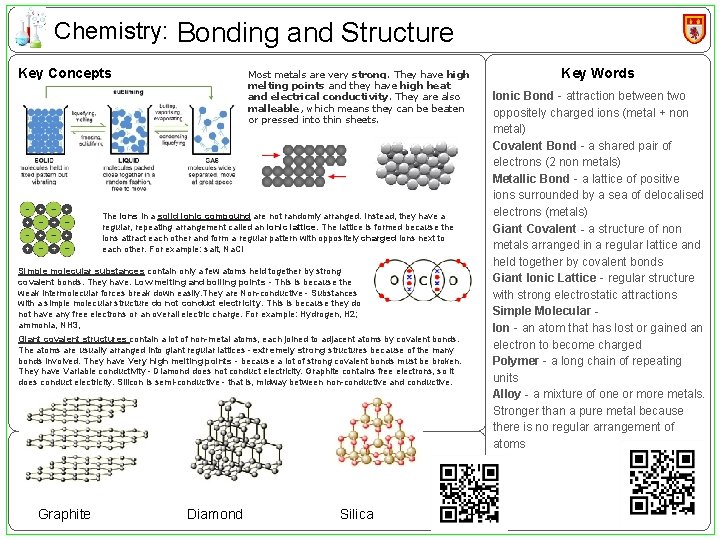
Chemistry: Bonding and Structure Key Concepts Most metals are very strong. They have high melting points and they have high heat and electrical conductivity. They are also malleable, which means they can be beaten or pressed into thin sheets. The ions in a solid ionic compound are not randomly arranged. Instead, they have a regular, repeating arrangement called an ionic lattice. The lattice is formed because the ions attract each other and form a regular pattern with oppositely charged ions next to each other. For example: salt, Na. Cl Simple molecular substances contain only a few atoms held together by strong covalent bonds. They have. Low melting and boiling points - This is because the weak intermolecular forces break down easily. They are Non-conductive - Substances with a simple molecular structure do not conduct electricity. This is because they do not have any free electrons or an overall electric charge. For example: Hydrogen, H 2; ammonia, NH 3, Giant covalent structures contain a lot of non-metal atoms, each joined to adjacent atoms by covalent bonds. The atoms are usually arranged into giant regular lattices - extremely strong structures because of the many bonds involved. They have Very high melting points - because a lot of strong covalent bonds must be broken. They have Variable conductivity - Diamond does not conduct electricity. Graphite contains free electrons, so it does conduct electricity. Silicon is semi-conductive - that is, midway between non-conductive and conductive. Numeracy Graphite Diamond Silica Key Words Ionic Bond - attraction between two oppositely charged ions (metal + non metal) Covalent Bond - a shared pair of electrons (2 non metals) Metallic Bond - a lattice of positive ions surrounded by a sea of delocalised electrons (metals) Giant Covalent - a structure of non metals arranged in a regular lattice and held together by covalent bonds Giant Ionic Lattice - regular structure with strong electrostatic attractions Simple Molecular Ion - an atom that has lost or gained an electron to become charged Polymer - a long chain of repeating units Alloy - a mixture of one or more metals. Stronger than a pure metal because there is no regular arrangement of atoms
- Slides: 1