
Chemistry B 11 Chapter 18 Metabolic pathways ATP
Chemistry B 11 Chapter 18 Metabolic pathways & ATP production
Metabolism Chemical reactions in cells that break down or build molecules. Produce energy and provide substances for cell growth. Catabolic reactions: Give off energy Complex molecules Simple molecules + Energy Anabolic reactions: Require energy Simple molecules + Energy (in cell) Complex molecules

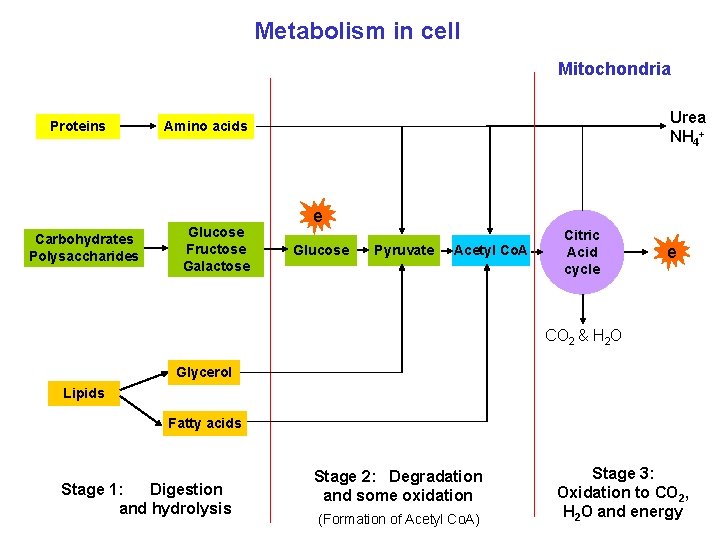
Metabolism in cell Mitochondria Proteins Carbohydrates Polysaccharides Urea NH 4+ Amino acids Glucose Fructose Galactose e Glucose Pyruvate Acetyl Co. A Citric Acid cycle e CO 2 & H 2 O Glycerol Lipids Fatty acids Stage 1: Digestion and hydrolysis Stage 2: Degradation and some oxidation (Formation of Acetyl Co. A) Stage 3: Oxidation to CO 2, H 2 O and energy
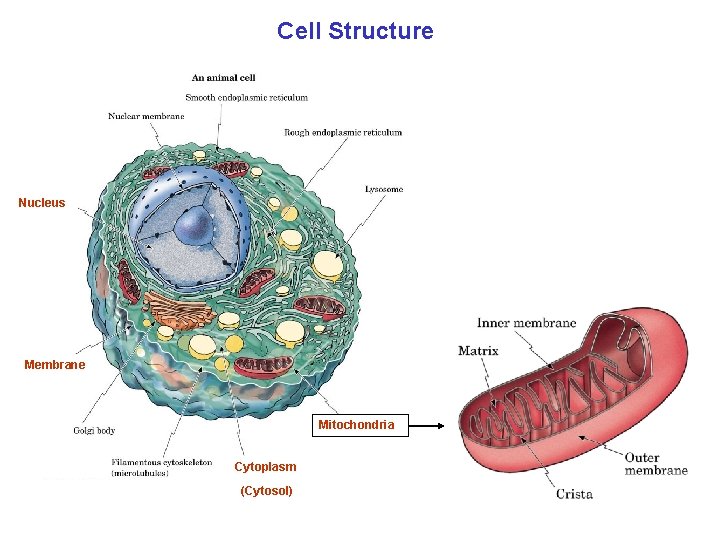
Cell Structure Nucleus Membrane Mitochondria Cytoplasm (Cytosol)
Cell Structure Nucleus: holds the genes that control DNA replication and protein synthesis of the cell. Cytoplasm: consists all the materials between nucleus and cell membrane. Cytosol: fluid part of the cytoplasm (electrolytes and enzymes). Mitochondria: energy producing factories. Enzymes in matrix catalyze the oxidation of carbohydrates, fats , and amino acids. Produce CO 2, H 2 O, and energy.
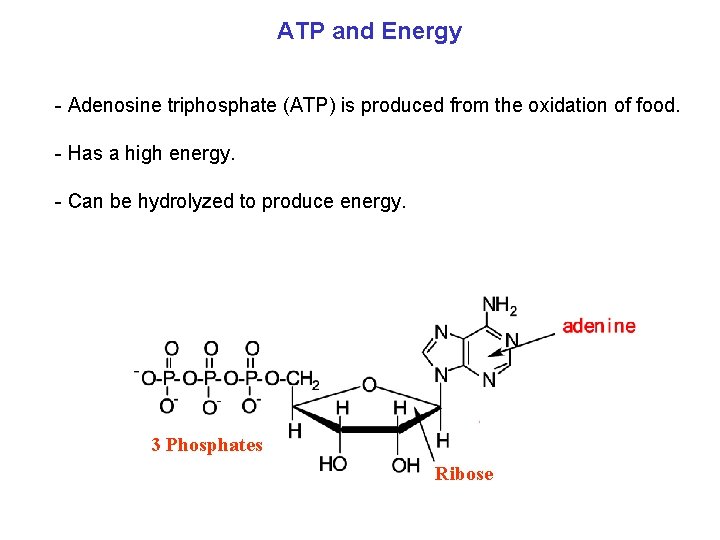
ATP and Energy - Adenosine triphosphate (ATP) is produced from the oxidation of food. - Has a high energy. - Can be hydrolyzed to produce energy. 3 Phosphates Ribose
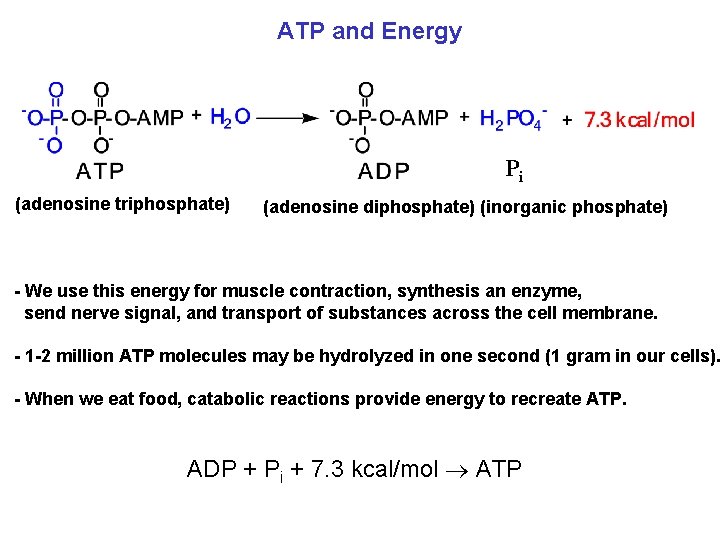
ATP and Energy Pi (adenosine triphosphate) (adenosine diphosphate) (inorganic phosphate) - We use this energy for muscle contraction, synthesis an enzyme, send nerve signal, and transport of substances across the cell membrane. - 1 -2 million ATP molecules may be hydrolyzed in one second (1 gram in our cells). - When we eat food, catabolic reactions provide energy to recreate ATP. ADP + Pi + 7. 3 kcal/mol ATP
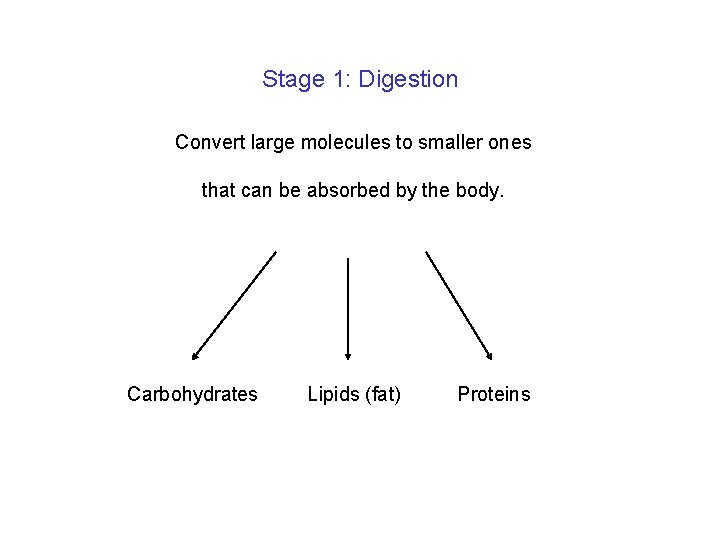
Stage 1: Digestion Convert large molecules to smaller ones that can be absorbed by the body. Carbohydrates Lipids (fat) Proteins
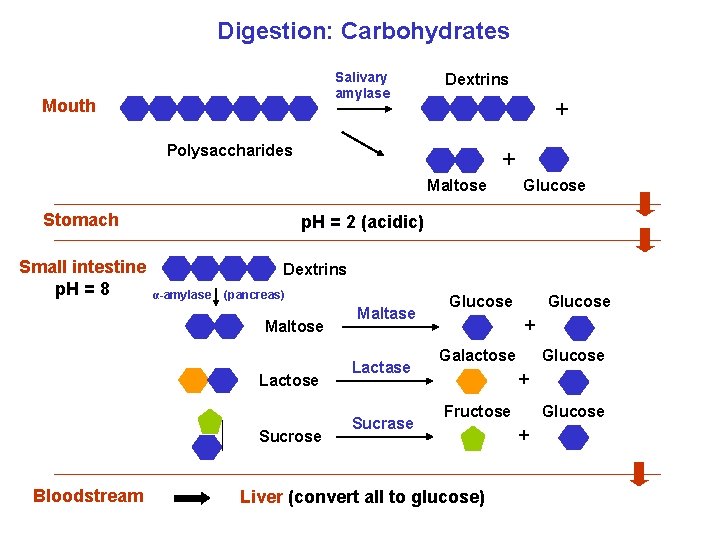
Digestion: Carbohydrates Salivary amylase Mouth Dextrins + Polysaccharides + Maltose Stomach Small intestine p. H = 8 p. H = 2 (acidic) Dextrins α-amylase (pancreas) Maltose Lactose Sucrose Bloodstream Glucose Maltase Lactase Sucrase Glucose + Galactose Glucose + Fructose Liver (convert all to glucose) Glucose +
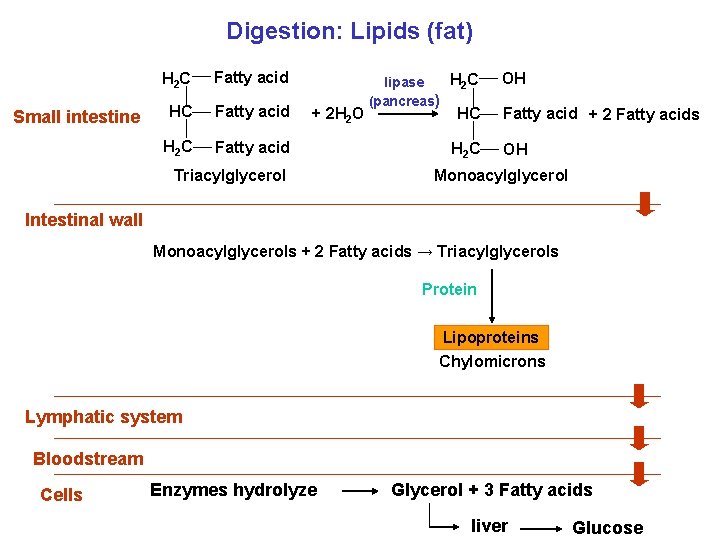
Digestion: Lipids (fat) Small intestine H 2 C Fatty acid + 2 H 2 O Triacylglycerol H 2 C lipase (pancreas) OH H 2 C OH HC Fatty acid + 2 Fatty acids Monoacylglycerol Intestinal wall Monoacylglycerols + 2 Fatty acids → Triacylglycerols Protein Lipoproteins Chylomicrons Lymphatic system Bloodstream Cells Enzymes hydrolyze Glycerol + 3 Fatty acids liver Glucose
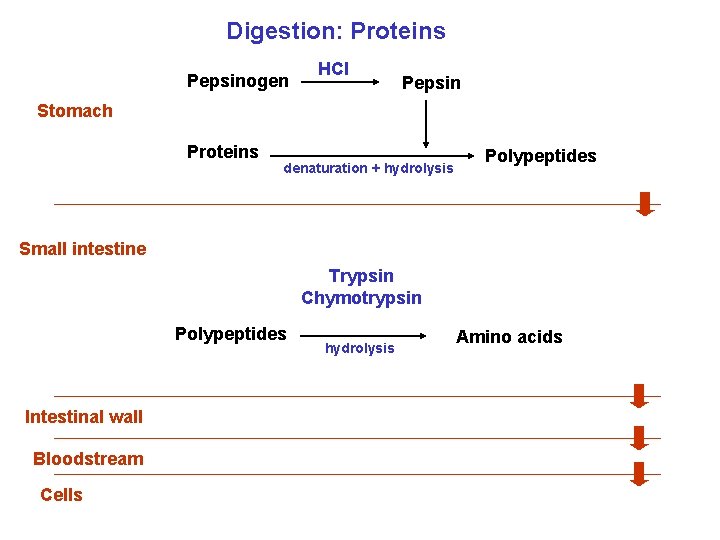
Digestion: Proteins Pepsinogen HCl Pepsin Stomach Proteins denaturation + hydrolysis Polypeptides Small intestine Trypsin Chymotrypsin Polypeptides Intestinal wall Bloodstream Cells hydrolysis Amino acids
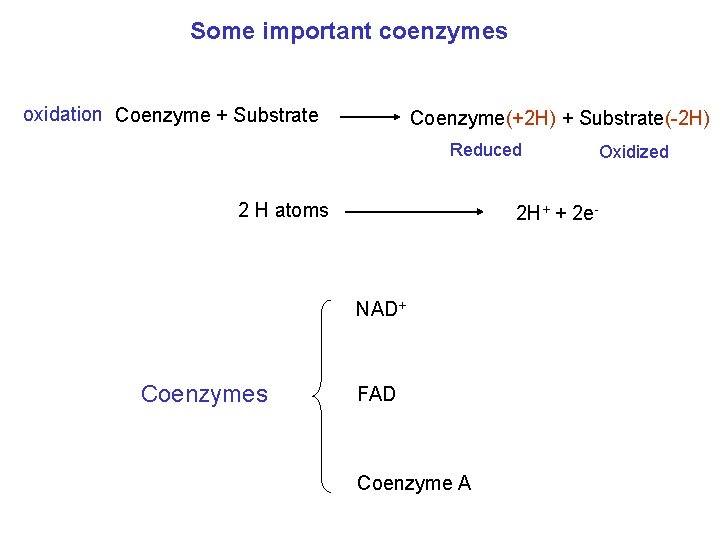
Some important coenzymes oxidation Coenzyme + Substrate Coenzyme(+2 H) + Substrate(-2 H) Reduced 2 H atoms 2 H+ + 2 e- NAD+ Coenzymes Oxidized FAD Coenzyme A
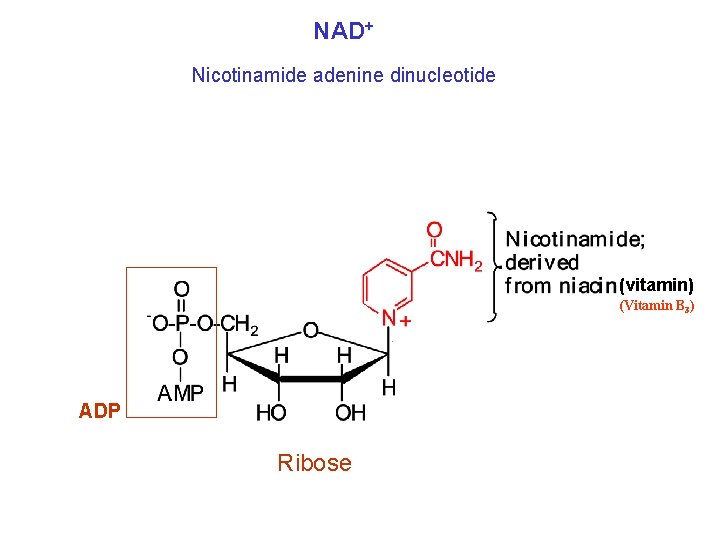
NAD+ Nicotinamide adenine dinucleotide (vitamin) (Vitamin B 3) ADP Ribose
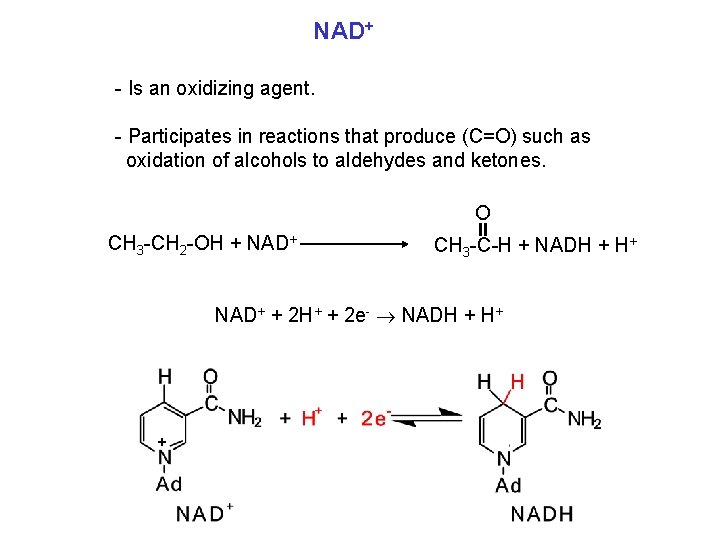
NAD+ - Is an oxidizing agent. - Participates in reactions that produce (C=O) such as oxidation of alcohols to aldehydes and ketones. O CH 3 -CH 2 -OH + NAD+ CH 3 -C-H + NADH + H+ NAD+ + 2 H+ + 2 e- NADH + H+ +
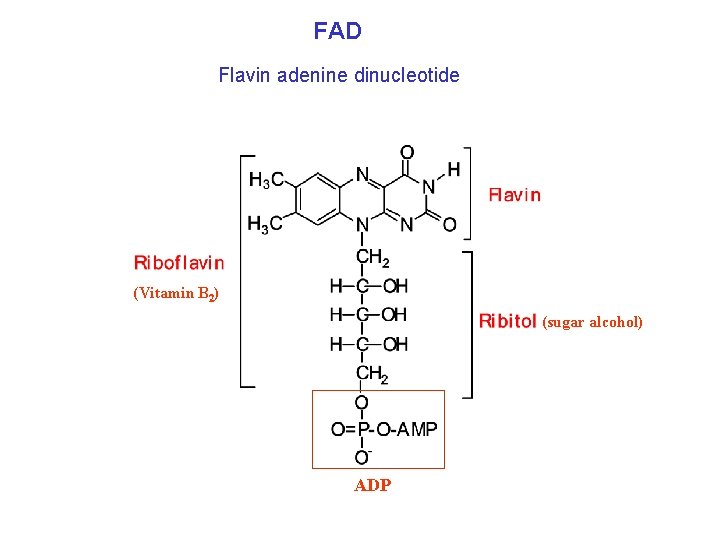
FAD Flavin adenine dinucleotide (Vitamin B 2) (sugar alcohol) ADP
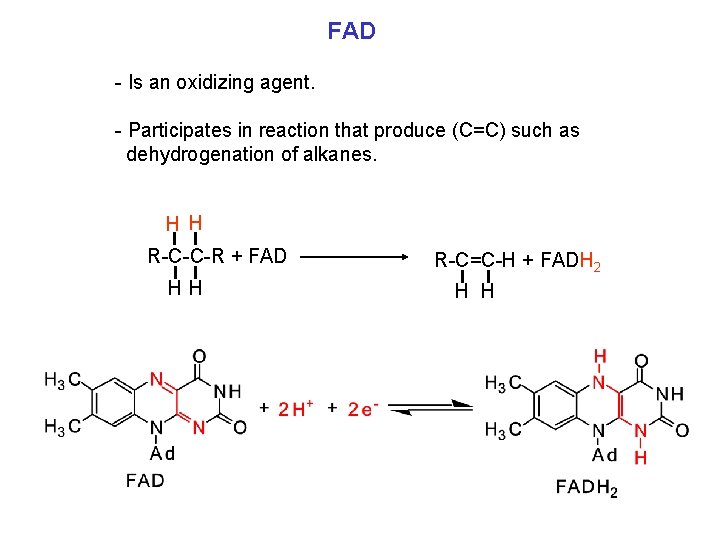
FAD - Is an oxidizing agent. - Participates in reaction that produce (C=C) such as dehydrogenation of alkanes. H H R-C-C-R + FAD HH R-C=C-H + FADH 2 H H
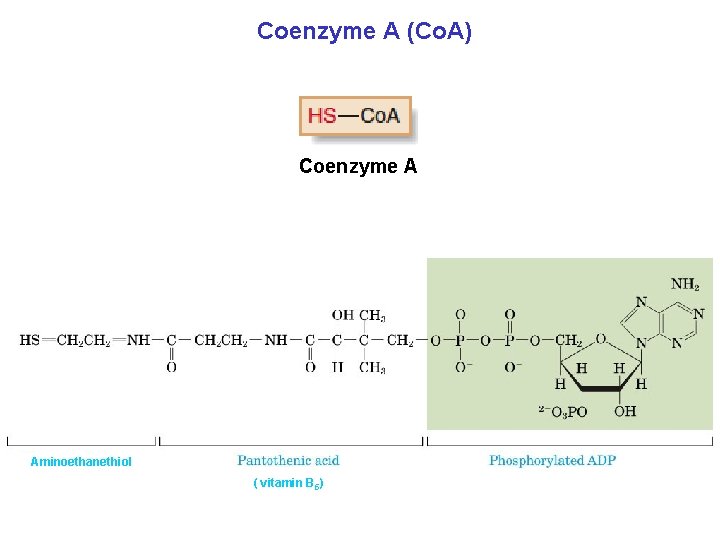
Coenzyme A (Co. A) Coenzyme A Aminoethanethiol ( vitamin B 5)
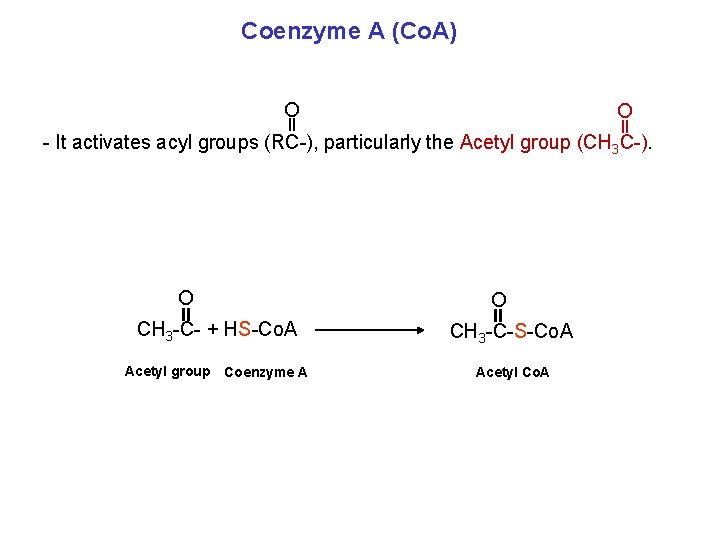
Coenzyme A (Co. A) O O - It activates acyl groups (RC-), particularly the Acetyl group (CH 3 C-). O O CH 3 -C- + HS-Co. A CH 3 -C-S-Co. A Acetyl group Coenzyme A Acetyl Co. A
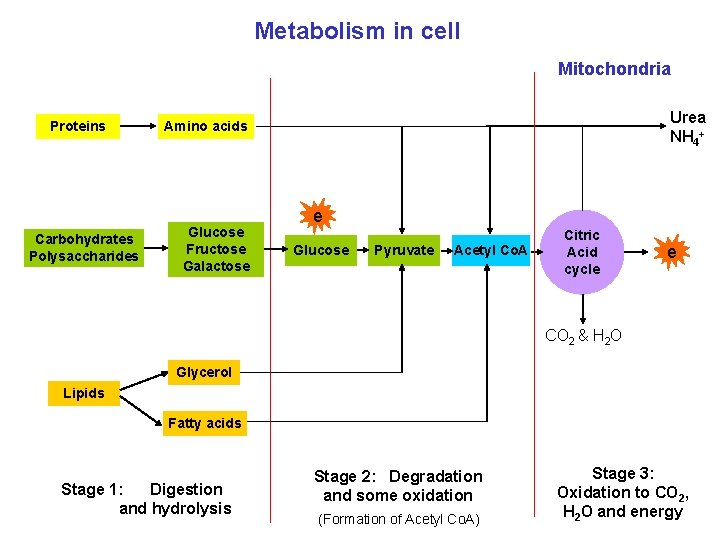
Metabolism in cell Mitochondria Proteins Carbohydrates Polysaccharides Urea NH 4+ Amino acids Glucose Fructose Galactose e Glucose Pyruvate Acetyl Co. A Citric Acid cycle e CO 2 & H 2 O Glycerol Lipids Fatty acids Stage 1: Digestion and hydrolysis Stage 2: Degradation and some oxidation (Formation of Acetyl Co. A) Stage 3: Oxidation to CO 2, H 2 O and energy
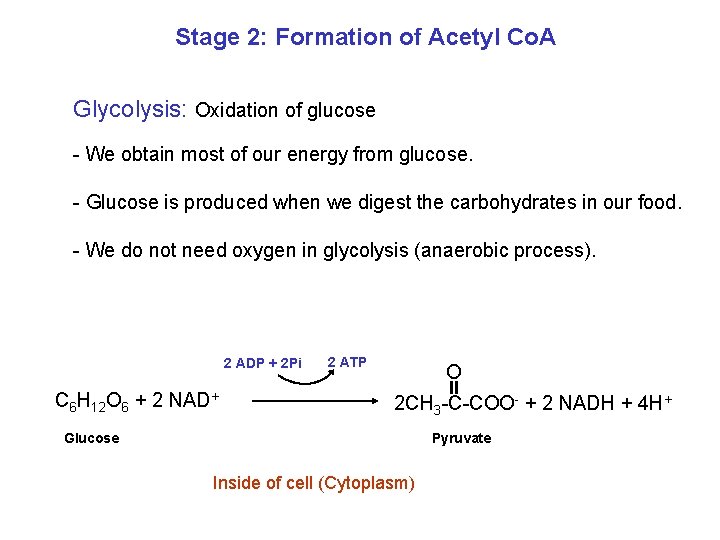
Stage 2: Formation of Acetyl Co. A Glycolysis: Oxidation of glucose - We obtain most of our energy from glucose. - Glucose is produced when we digest the carbohydrates in our food. - We do not need oxygen in glycolysis (anaerobic process). 2 ADP + 2 Pi C 6 H 12 O 6 + 2 NAD+ 2 ATP O 2 CH 3 -C-COO- + 2 NADH + 4 H+ Glucose Pyruvate Inside of cell (Cytoplasm)
Pathways for pyruvate - Pyruvate can produce more energy. Aerobic conditions: if we have enough oxygen. Anaerobic conditions: if we do not have enough oxygen.
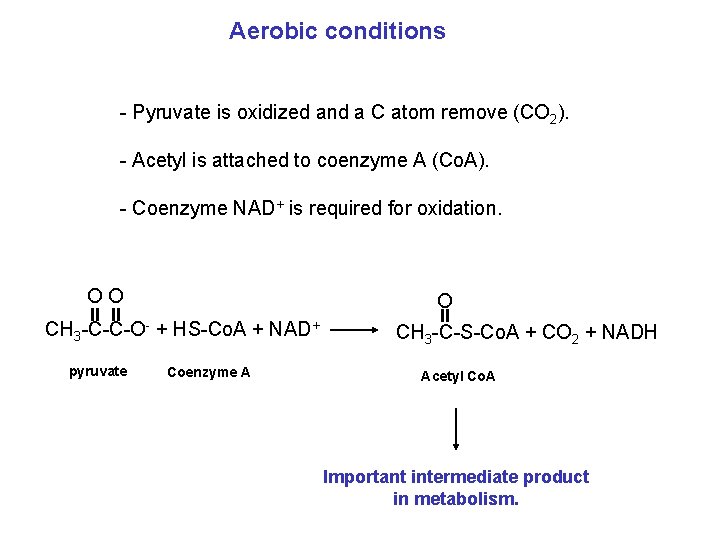
Aerobic conditions - Pyruvate is oxidized and a C atom remove (CO 2). - Acetyl is attached to coenzyme A (Co. A). - Coenzyme NAD+ is required for oxidation. OO O CH 3 -C-C-O- + HS-Co. A + NAD+ pyruvate Coenzyme A CH 3 -C-S-Co. A + CO 2 + NADH Acetyl Co. A Important intermediate product in metabolism.
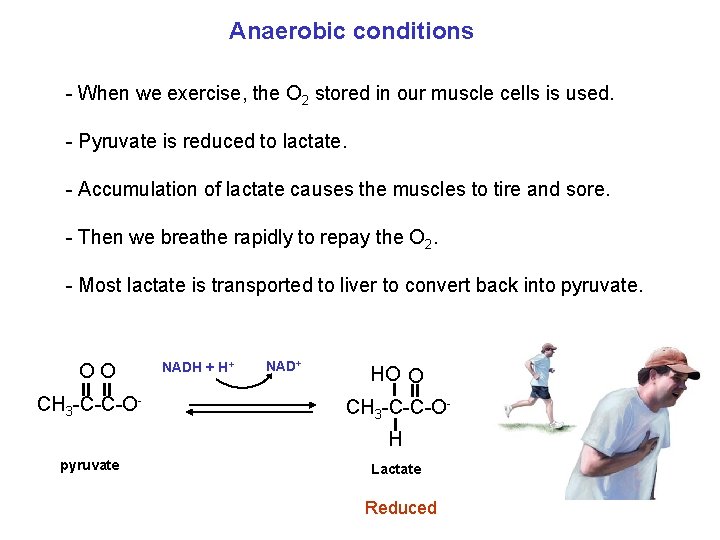
Anaerobic conditions - When we exercise, the O 2 stored in our muscle cells is used. - Pyruvate is reduced to lactate. - Accumulation of lactate causes the muscles to tire and sore. - Then we breathe rapidly to repay the O 2. - Most lactate is transported to liver to convert back into pyruvate. OO CH 3 -C-C-O- NADH + H+ NAD+ HO O CH 3 -C-C-OH pyruvate Lactate Reduced
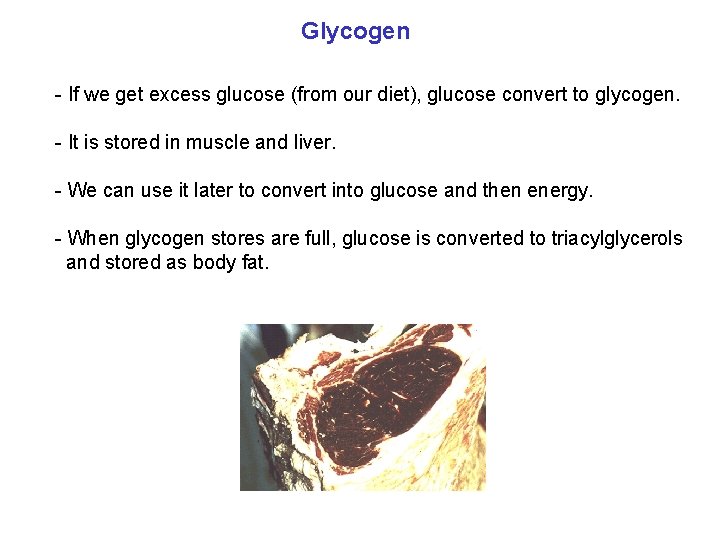
Glycogen - If we get excess glucose (from our diet), glucose convert to glycogen. - It is stored in muscle and liver. - We can use it later to convert into glucose and then energy. - When glycogen stores are full, glucose is converted to triacylglycerols and stored as body fat.
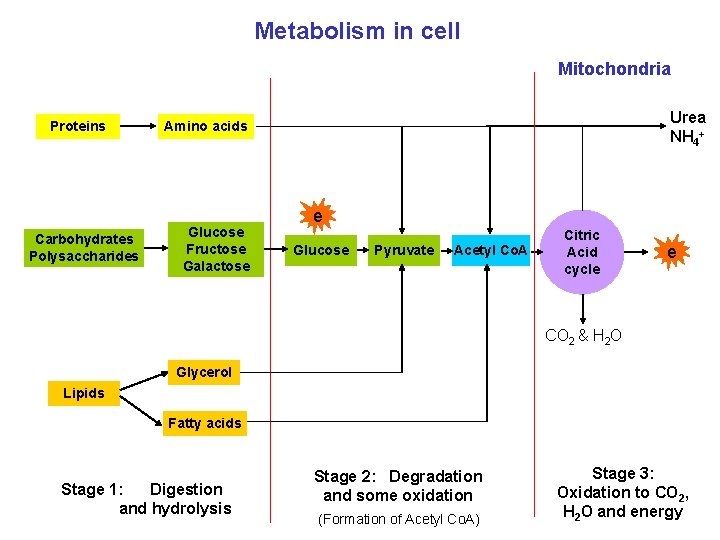
Metabolism in cell Mitochondria Proteins Carbohydrates Polysaccharides Urea NH 4+ Amino acids Glucose Fructose Galactose e Glucose Pyruvate Acetyl Co. A Citric Acid cycle e CO 2 & H 2 O Glycerol Lipids Fatty acids Stage 1: Digestion and hydrolysis Stage 2: Degradation and some oxidation (Formation of Acetyl Co. A) Stage 3: Oxidation to CO 2, H 2 O and energy
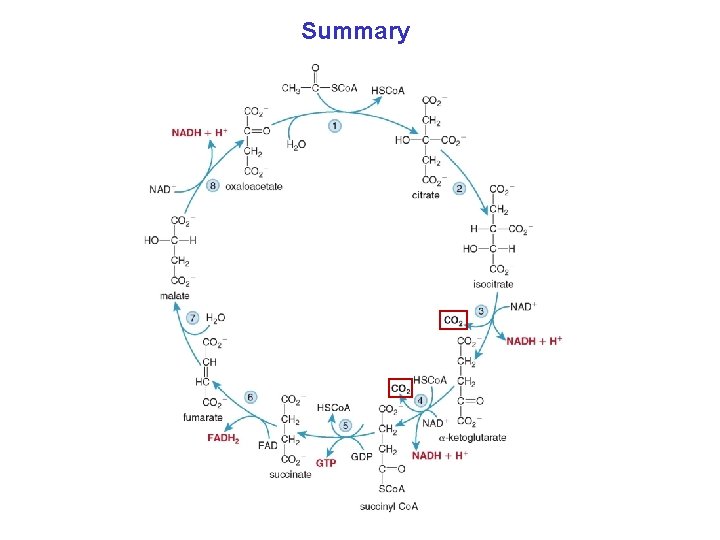
Step 3: Citric Acid Cycle - Is a central pathway in metabolism. - Uses acetyl Co. A from the degradation of carbohydrates, lipids, and proteins. - Two CO 2 are given off. - There are four oxidation steps in the cycle provide H+ and electrons to reduce FAD and NAD+ (FADH 2 and NADH). 8 reactions
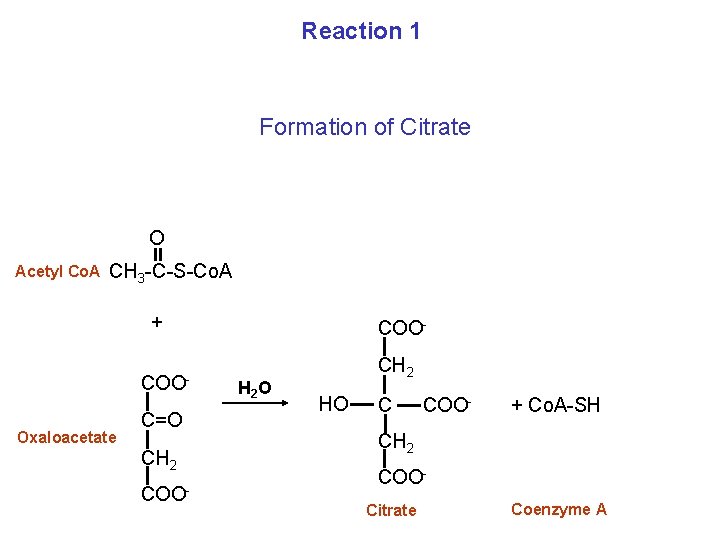
Reaction 1 Formation of Citrate O Acetyl Co. A CH 3 -C-S-Co. A + COO- Oxaloacetate C=O CH 2 COO- COOH 2 O CH 2 HO C COO- + Co. A-SH CH 2 COOCitrate Coenzyme A
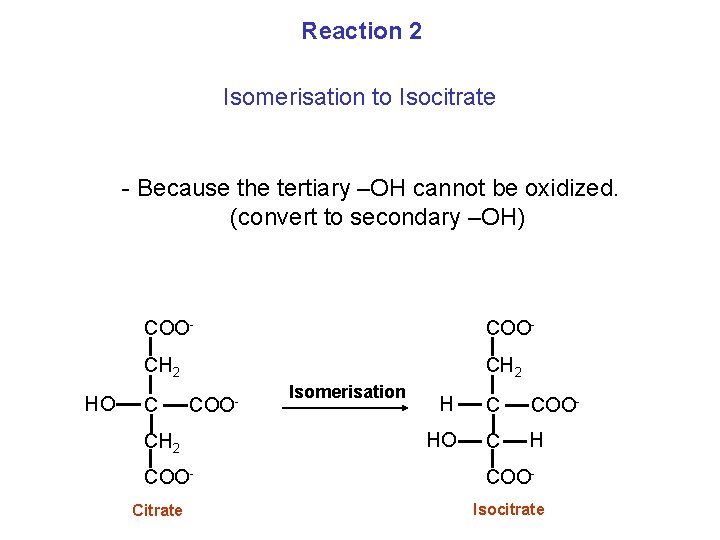
Reaction 2 Isomerisation to Isocitrate - Because the tertiary –OH cannot be oxidized. (convert to secondary –OH) HO COO- CH 2 COOCitrate Isomerisation H C COO- HO C H COOIsocitrate
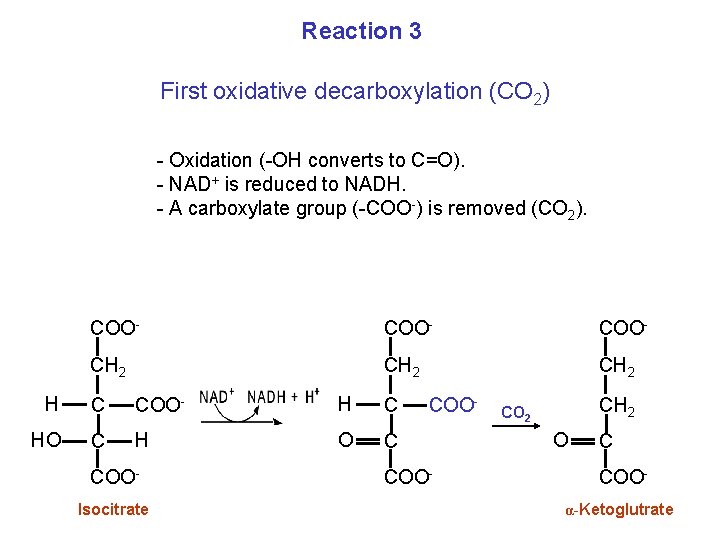
Reaction 3 First oxidative decarboxylation (CO 2) - Oxidation (-OH converts to C=O). - NAD+ is reduced to NADH. - A carboxylate group (-COO-) is removed (CO 2). COO- CH 2 H C COO- H C HO C H O C COOIsocitrate COO- CH 2 CO 2 O C COO- α-Ketoglutrate
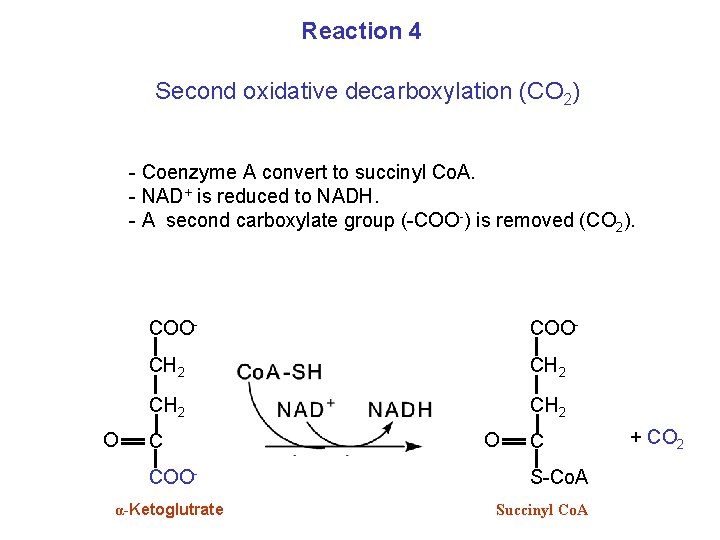
Reaction 4 Second oxidative decarboxylation (CO 2) - Coenzyme A convert to succinyl Co. A. - NAD+ is reduced to NADH. - A second carboxylate group (-COO-) is removed (CO 2). O COO- CH 2 C COO- α-Ketoglutrate O C S-Co. A Succinyl Co. A + CO 2
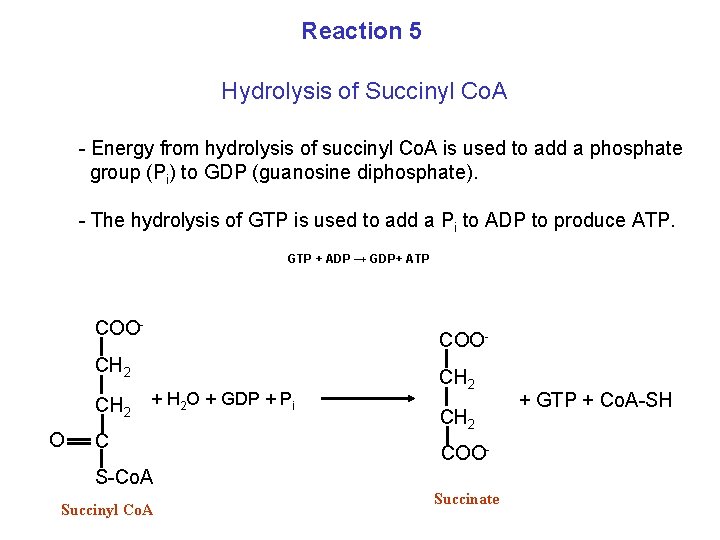
Reaction 5 Hydrolysis of Succinyl Co. A - Energy from hydrolysis of succinyl Co. A is used to add a phosphate group (Pi) to GDP (guanosine diphosphate). - The hydrolysis of GTP is used to add a Pi to ADP to produce ATP. GTP + ADP → GDP+ ATP COOCH 2 + H 2 O + GDP + Pi O C COOCH 2 COO- S-Co. A Succinyl Co. A Succinate + GTP + Co. A-SH
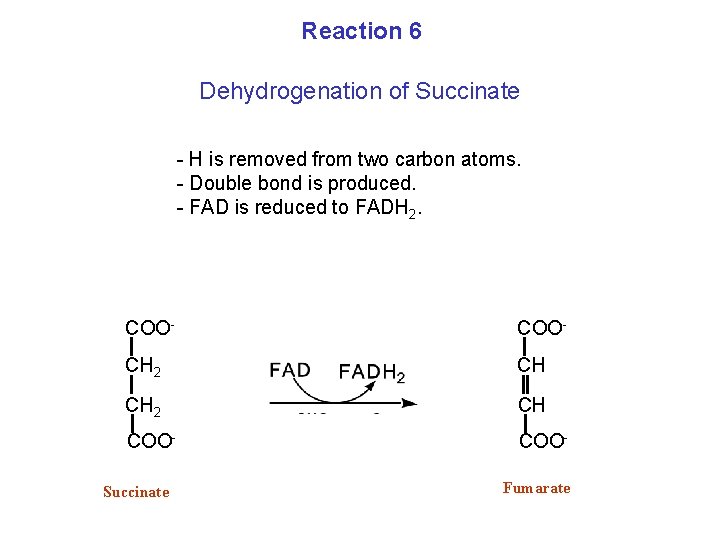
Reaction 6 Dehydrogenation of Succinate - H is removed from two carbon atoms. - Double bond is produced. - FAD is reduced to FADH 2. COO- CH 2 CH COO- Succinate Fumarate
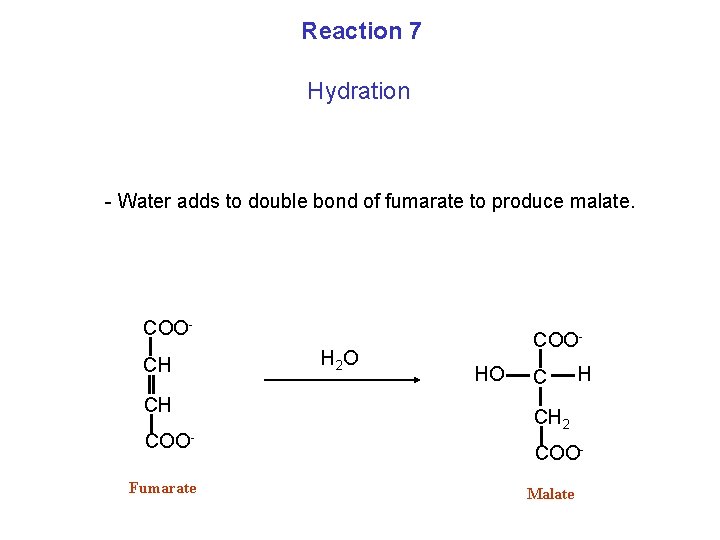
Reaction 7 Hydration - Water adds to double bond of fumarate to produce malate. COOCH CH COOFumarate H 2 O COOHO C H CH 2 COOMalate
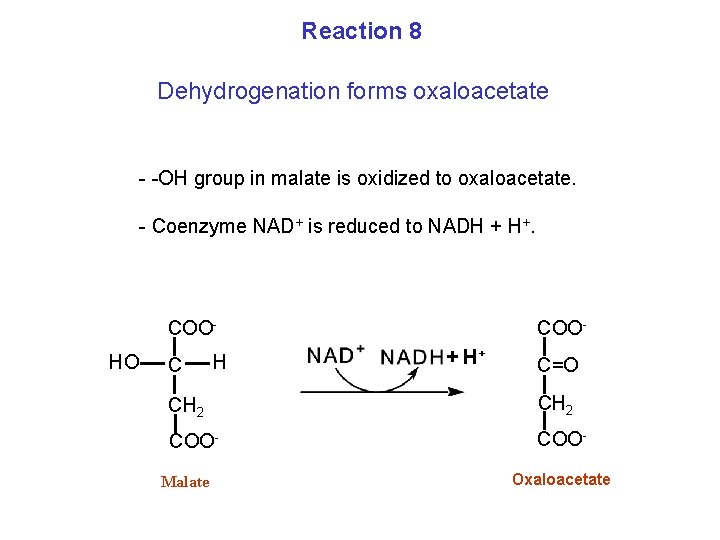
Reaction 8 Dehydrogenation forms oxaloacetate - -OH group in malate is oxidized to oxaloacetate. - Coenzyme NAD+ is reduced to NADH + H+. COOHO C H COO+ H+ C=O CH 2 COO- Malate Oxaloacetate
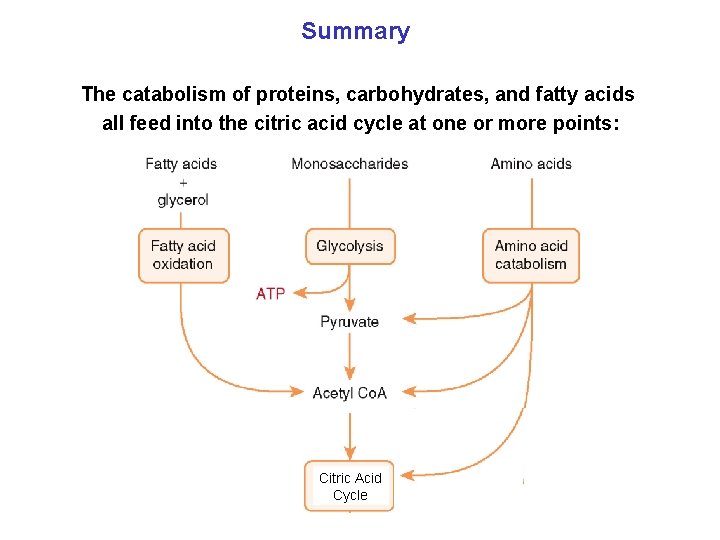
Summary The catabolism of proteins, carbohydrates, and fatty acids all feed into the citric acid cycle at one or more points: Citric Acid Cycle
Summary
Summary
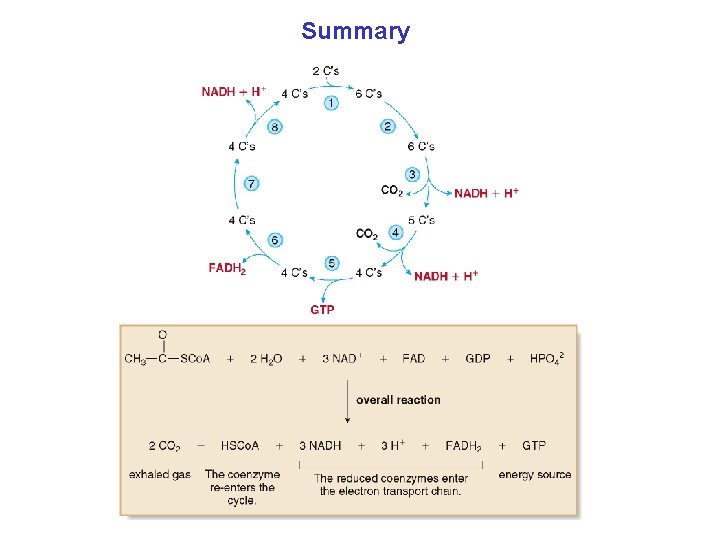
Summary The main function of the citric acid cycle is to produce reduced coenzymes (NADH and FADH 2). These molecules enter the electron transport chain (Stage 4) and ultimately produce ATP. Feedback Mechanism The rate of the citric acid cycle depends on the body’s need for energy. When energy demands are high and ATP is low → the cycle is activated. When energy demands are low and NADH is high → the cycle is inhibited.
Stage 4: Electron Transport & Oxidative Phosphorylation - Most of energy generated during this stage. - It is an aerobic respiration (O 2 is required). 1. Electron Transport Chain (Respiratory Chain) 2. Oxidative Phosphorylation
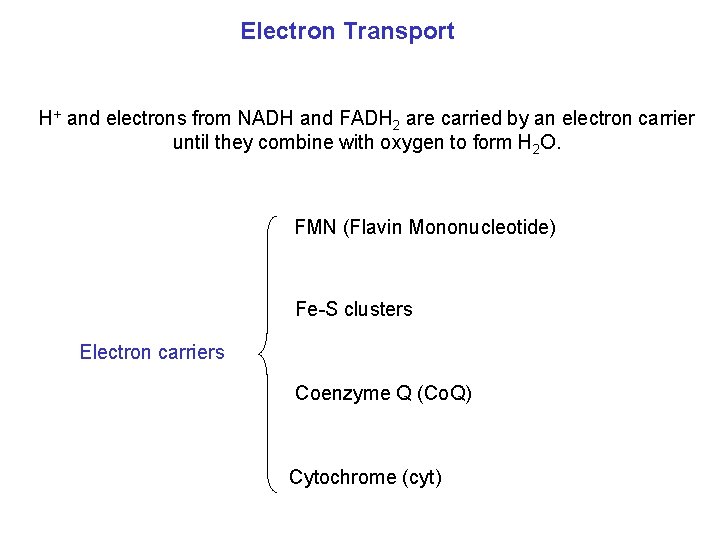
Electron Transport H+ and electrons from NADH and FADH 2 are carried by an electron carrier until they combine with oxygen to form H 2 O. FMN (Flavin Mononucleotide) Fe-S clusters Electron carriers Coenzyme Q (Co. Q) Cytochrome (cyt)
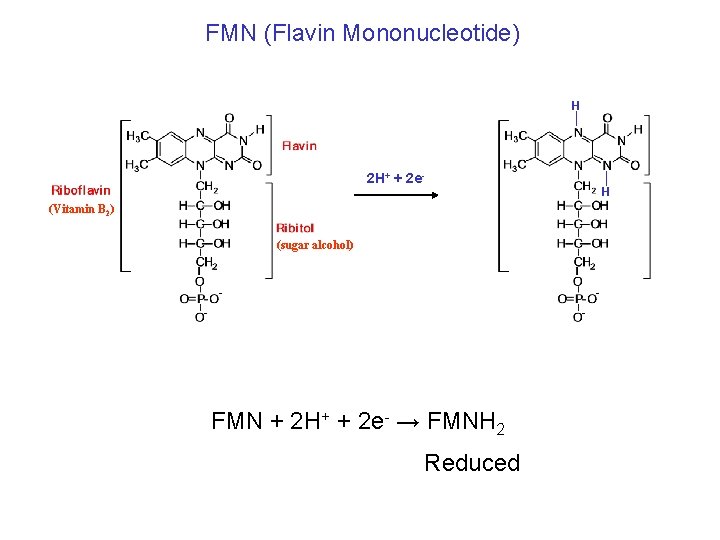
FMN (Flavin Mononucleotide) H 2 H+ + 2 e- H (Vitamin B 2) (sugar alcohol) - - FMN + 2 H+ + 2 e- → FMNH 2 Reduced
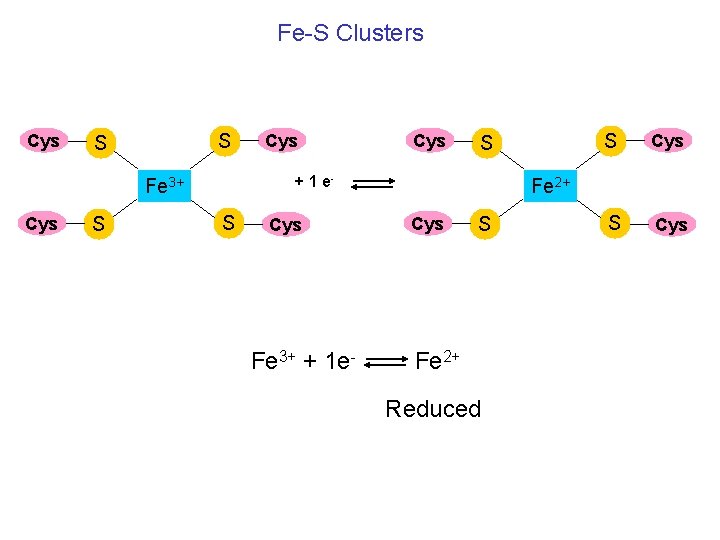
Fe-S Clusters Cys S S S Cys S + 1 e- Fe 3+ Cys S Cys Fe 3+ + 1 e- S Cys Fe 2+ Cys S Fe 2+ Reduced
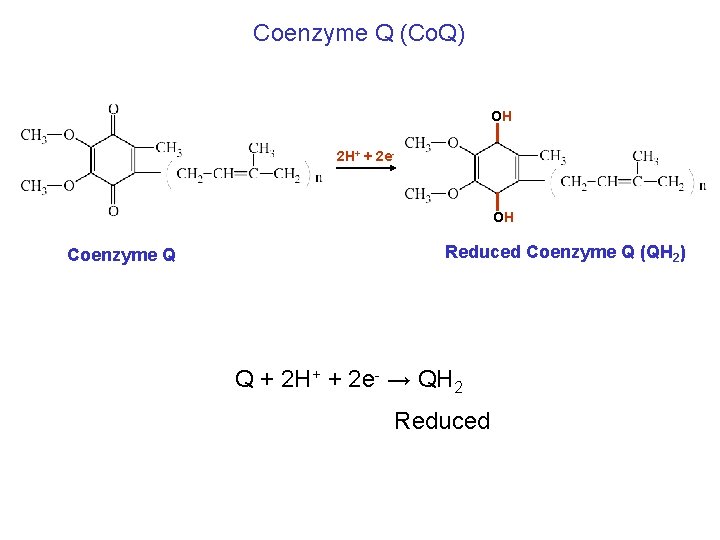
Coenzyme Q (Co. Q) OH 2 H+ + 2 e- OH Coenzyme Q Reduced Coenzyme Q (QH 2) Q + 2 H+ + 2 e- → QH 2 Reduced
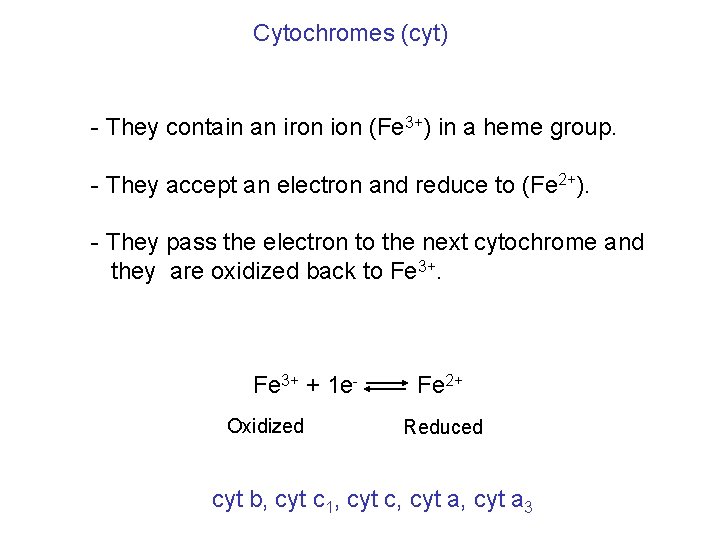
Cytochromes (cyt) - They contain an iron ion (Fe 3+) in a heme group. - They accept an electron and reduce to (Fe 2+). - They pass the electron to the next cytochrome and they are oxidized back to Fe 3+ + 1 e. Oxidized Fe 2+ Reduced cyt b, cyt c 1, cyt c, cyt a 3
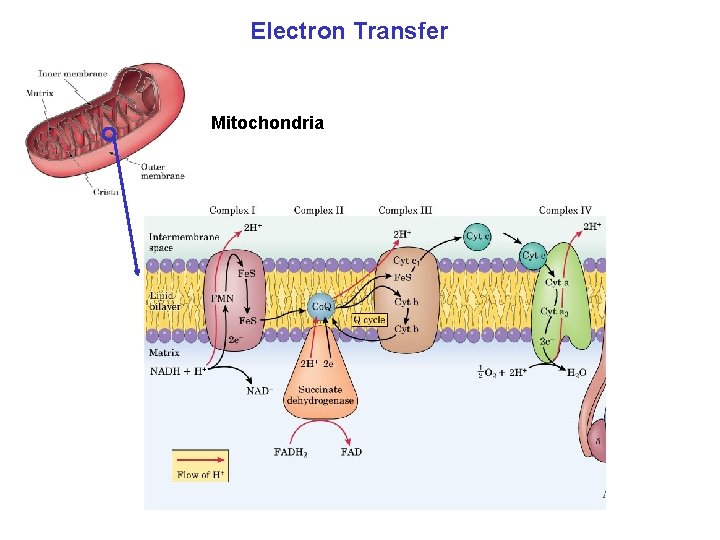
Electron Transfer Mitochondria
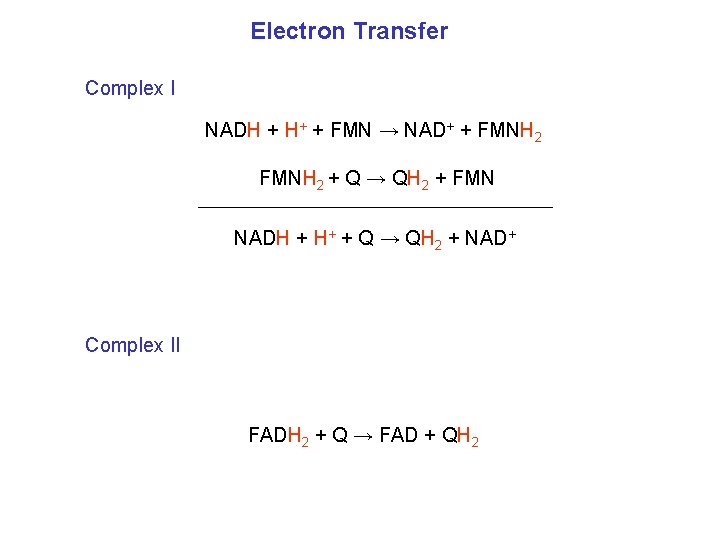
Electron Transfer Complex I NADH + H+ + FMN → NAD+ + FMNH 2 + Q → QH 2 + FMN NADH + H+ + Q → QH 2 + NAD+ Complex II FADH 2 + Q → FAD + QH 2
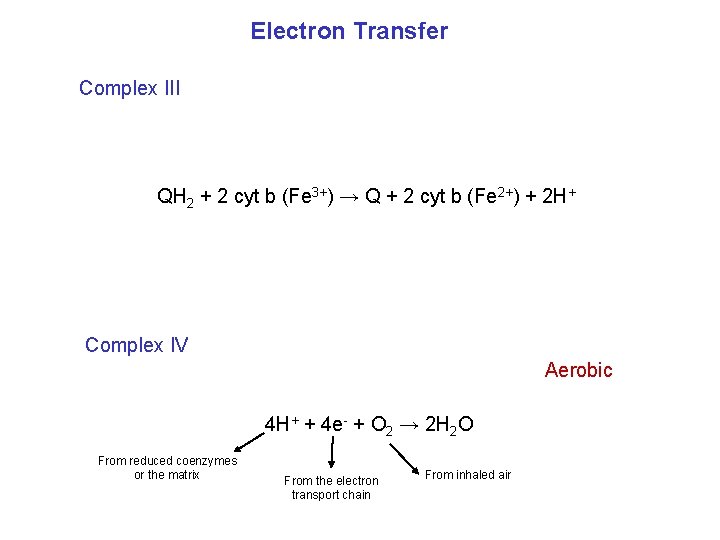
Electron Transfer Complex III QH 2 + 2 cyt b (Fe 3+) → Q + 2 cyt b (Fe 2+) + 2 H+ Complex IV Aerobic 4 H+ + 4 e- + O 2 → 2 H 2 O From reduced coenzymes or the matrix From the electron transport chain From inhaled air
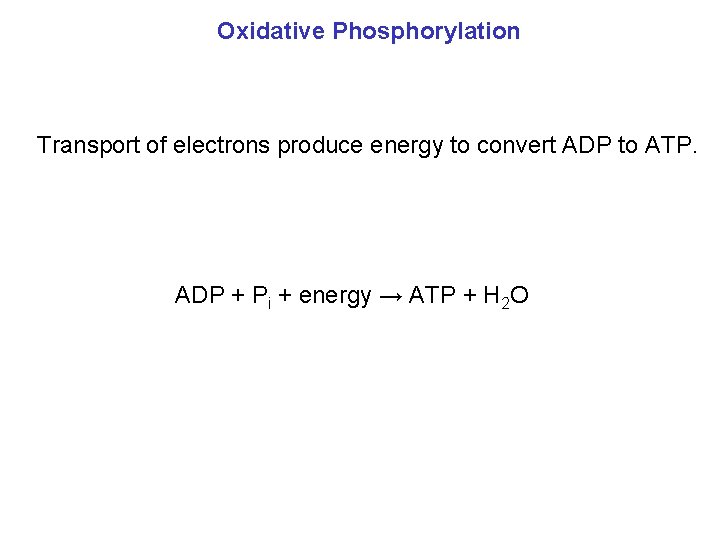
Oxidative Phosphorylation Transport of electrons produce energy to convert ADP to ATP. ADP + Pi + energy → ATP + H 2 O
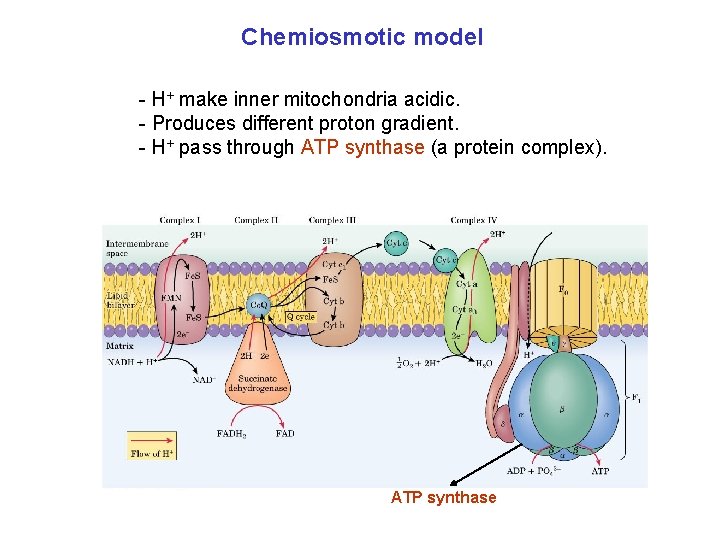
Chemiosmotic model - H+ make inner mitochondria acidic. - Produces different proton gradient. - H+ pass through ATP synthase (a protein complex). ATP synthase
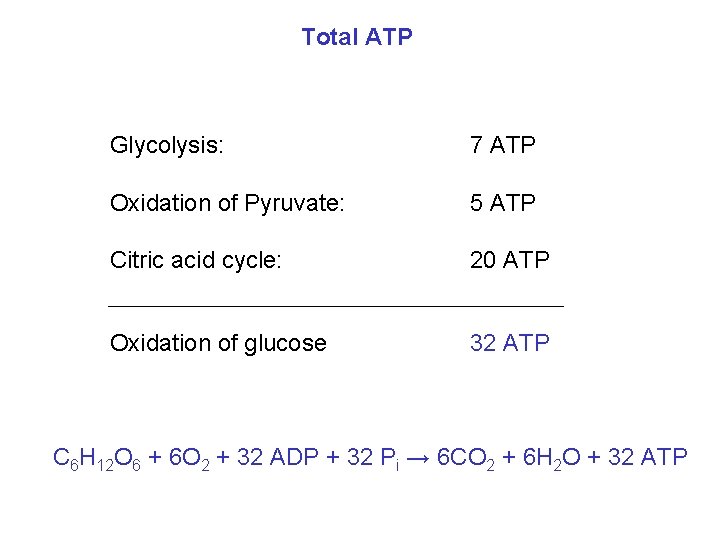
Total ATP Glycolysis: 7 ATP Oxidation of Pyruvate: 5 ATP Citric acid cycle: 20 ATP Oxidation of glucose 32 ATP C 6 H 12 O 6 + 6 O 2 + 32 ADP + 32 Pi → 6 CO 2 + 6 H 2 O + 32 ATP
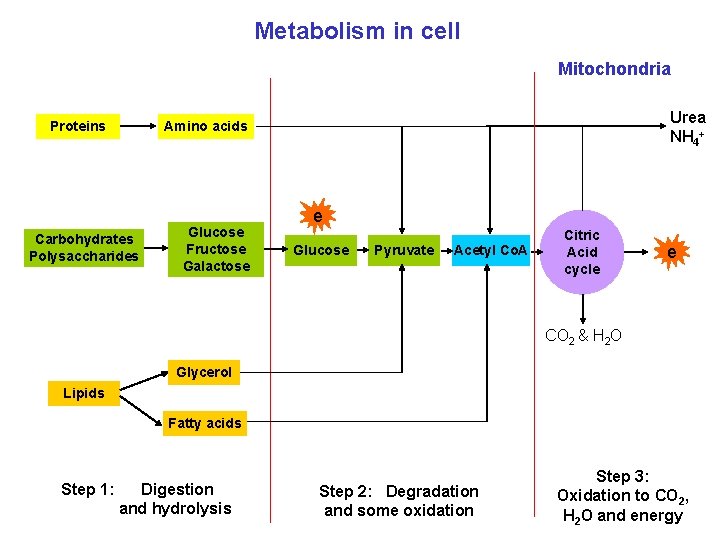
Metabolism in cell Mitochondria Proteins Urea NH 4+ Amino acids Carbohydrates Polysaccharides Glucose Fructose Galactose e Glucose Pyruvate Acetyl Co. A Citric Acid cycle e CO 2 & H 2 O Glycerol Lipids Fatty acids Step 1: Digestion and hydrolysis Step 2: Degradation and some oxidation Step 3: Oxidation to CO 2, H 2 O and energy
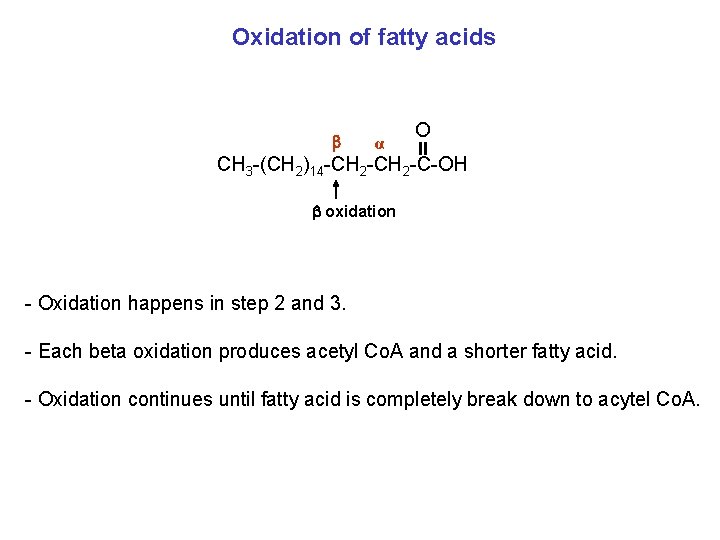
Oxidation of fatty acids α O CH 3 -(CH 2)14 -CH 2 -C-OH oxidation - Oxidation happens in step 2 and 3. - Each beta oxidation produces acetyl Co. A and a shorter fatty acid. - Oxidation continues until fatty acid is completely break down to acytel Co. A.
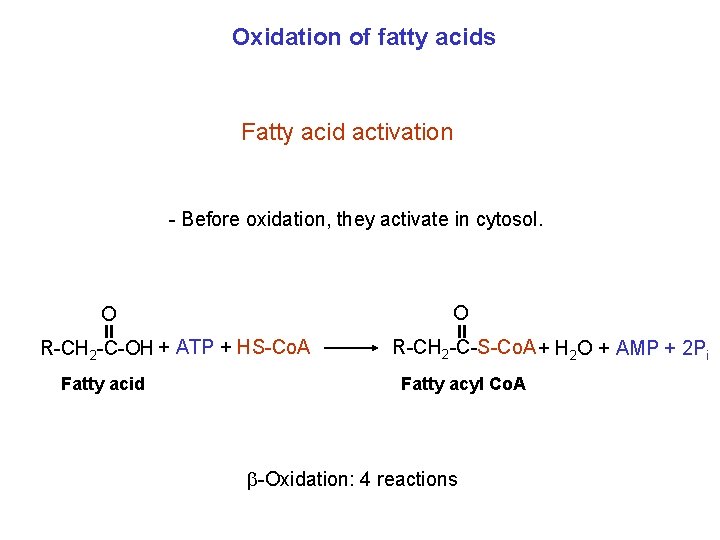
Oxidation of fatty acids Fatty acid activation - Before oxidation, they activate in cytosol. O O R-CH 2 -C-OH + ATP + HS-Co. A Fatty acid R-CH 2 -C-S-Co. A + H 2 O + AMP + 2 Pi Fatty acyl Co. A -Oxidation: 4 reactions
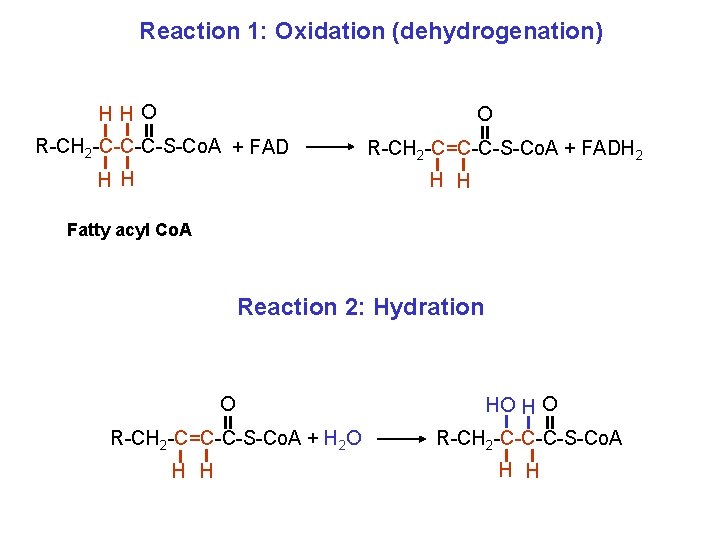
Reaction 1: Oxidation (dehydrogenation) HHO O R-CH 2 -C-C-C-S-Co. A + FAD H H R-CH 2 -C=C-C-S-Co. A + FADH 2 H H Fatty acyl Co. A Reaction 2: Hydration O R-CH 2 -C=C-C-S-Co. A + H 2 O H H HO H O R-CH 2 -C-C-C-S-Co. A H H
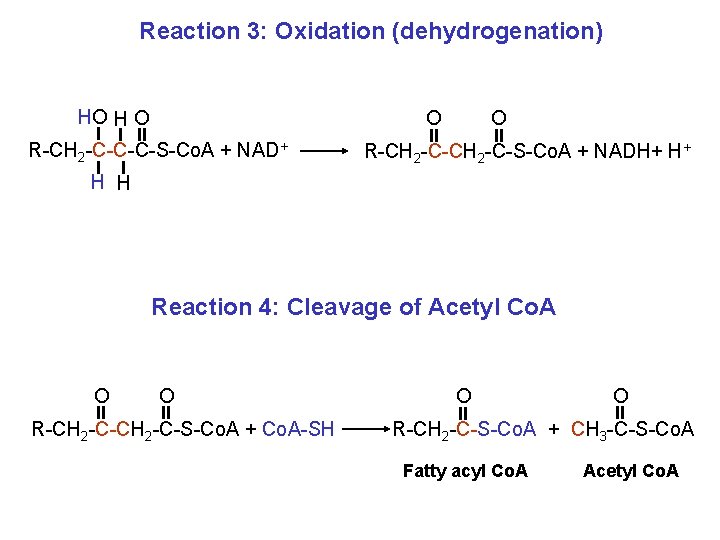
Reaction 3: Oxidation (dehydrogenation) HO H O O R-CH 2 -C-C-C-S-Co. A + NAD+ O R-CH 2 -C-S-Co. A + NADH+ H+ H H Reaction 4: Cleavage of Acetyl Co. A O O R-CH 2 -C-S-Co. A + Co. A-SH O O R-CH 2 -C-S-Co. A + CH 3 -C-S-Co. A Fatty acyl Co. A Acetyl Co. A
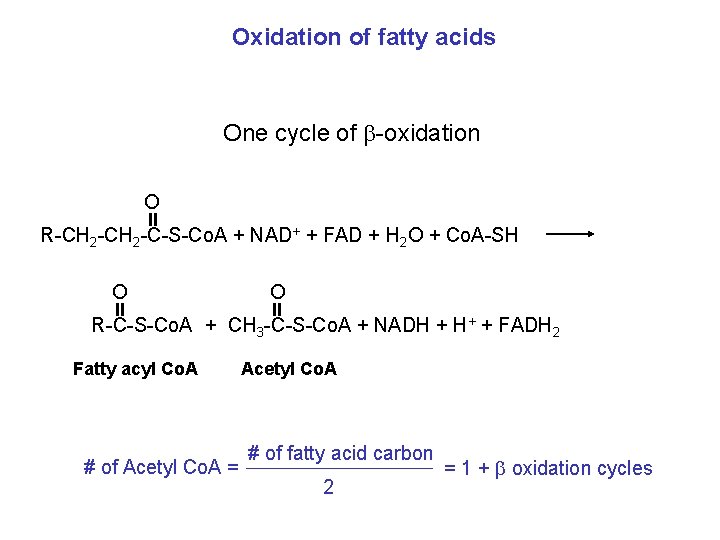
Oxidation of fatty acids One cycle of -oxidation O R-CH 2 -C-S-Co. A + NAD+ + FAD + H 2 O + Co. A-SH O O R-C-S-Co. A + CH 3 -C-S-Co. A + NADH + H+ + FADH 2 Fatty acyl Co. A # of Acetyl Co. A = Acetyl Co. A # of fatty acid carbon 2 = 1 + oxidation cycles
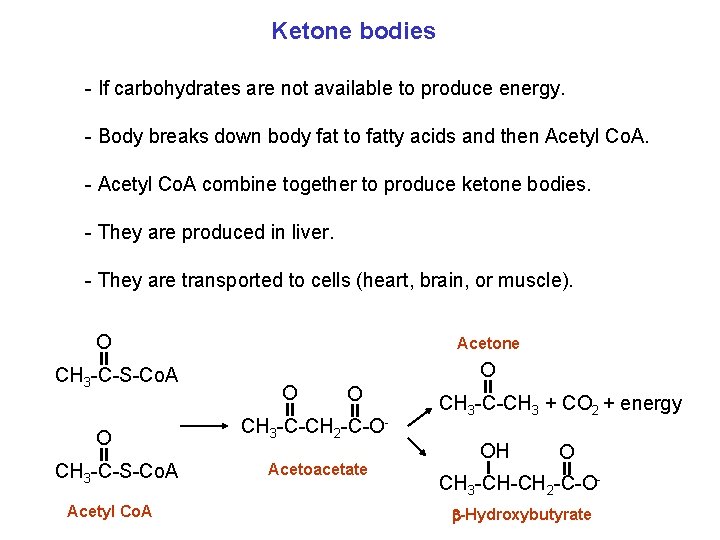
Ketone bodies - If carbohydrates are not available to produce energy. - Body breaks down body fat to fatty acids and then Acetyl Co. A. - Acetyl Co. A combine together to produce ketone bodies. - They are produced in liver. - They are transported to cells (heart, brain, or muscle). O CH 3 -C-S-Co. A Acetyl Co. A Acetone O O O CH 3 -C-CH 2 -C-OAcetoacetate CH 3 -C-CH 3 + CO 2 + energy OH O CH 3 -CH-CH 2 -C-O -Hydroxybutyrate
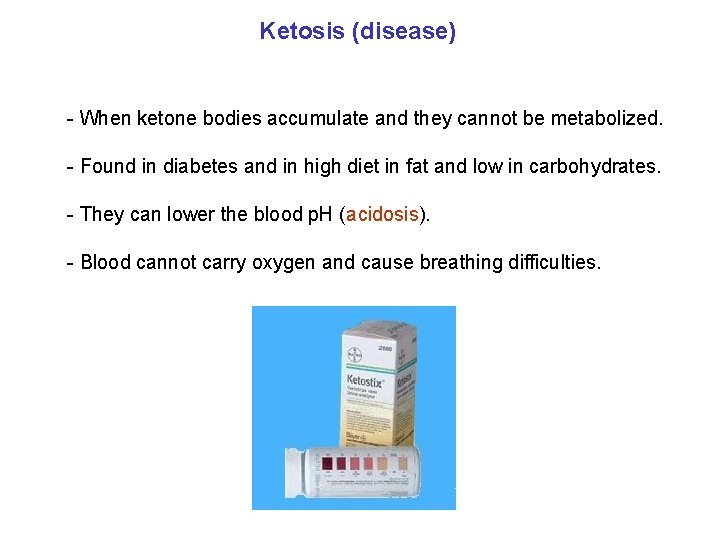
Ketosis (disease) - When ketone bodies accumulate and they cannot be metabolized. - Found in diabetes and in high diet in fat and low in carbohydrates. - They can lower the blood p. H (acidosis). - Blood cannot carry oxygen and cause breathing difficulties.
Fatty acid synthesis - When glycogen store is full (no more energy need). - Excess acetyl Co. A convert to 16 -C fatty acid (palmitic acid) in cytosol. - New fatty acids are attached to glycerol to make triacylglycerols. (are stored as body fat)
Metabolism in cell Mitochondria Proteins Carbohydrates Polysaccharides Urea NH 4+ Amino acids Glucose Fructose Galactose e Glucose Pyruvate Acetyl Co. A Citric Acid cycle e CO 2 & H 2 O Glycerol Lipids Fatty acids Stage 1: Digestion and hydrolysis Stage 2: Degradation and some oxidation (Formation of Acetyl Co. A) Stage 3: Oxidation to CO 2, H 2 O and energy
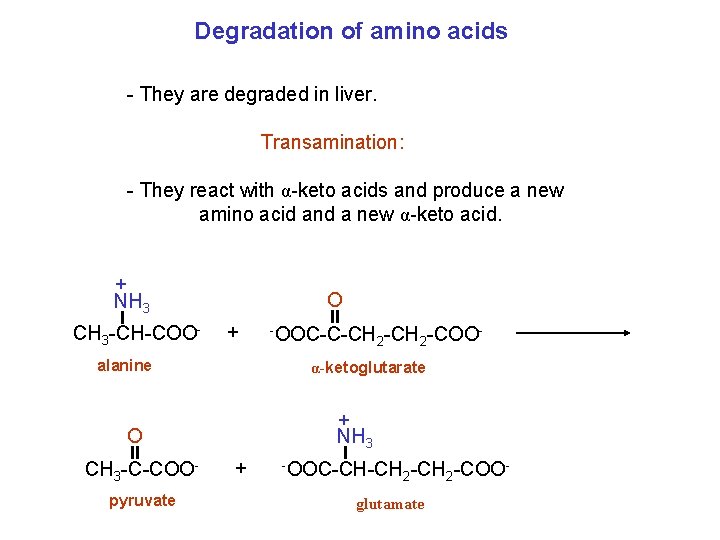
Degradation of amino acids - They are degraded in liver. Transamination: - They react with α-keto acids and produce a new amino acid and a new α-keto acid. + NH 3 CH 3 -CH-COO- O + alanine pyruvate 2 -CH 2 -COO - α-ketoglutarate + NH 3 O CH 3 -C-COO- -OOC-C-CH + -OOC-CH-CH 2 -COO glutamate -
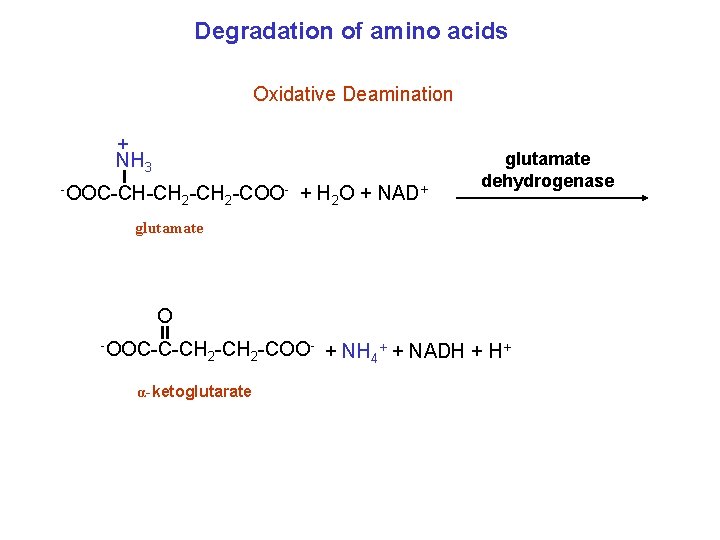
Degradation of amino acids Oxidative Deamination + NH 3 -OOC-CH-CH 2 -COO - + H 2 O + NAD+ glutamate dehydrogenase glutamate O -OOC-C-CH 2 -COO α-ketoglutarate - + NH 4+ + NADH + H+
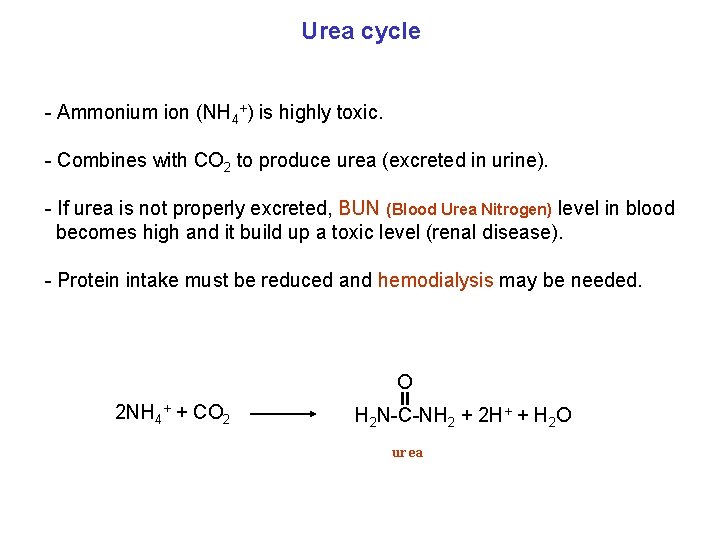
Urea cycle - Ammonium ion (NH 4+) is highly toxic. - Combines with CO 2 to produce urea (excreted in urine). - If urea is not properly excreted, BUN (Blood Urea Nitrogen) level in blood becomes high and it build up a toxic level (renal disease). - Protein intake must be reduced and hemodialysis may be needed. O 2 NH 4+ + CO 2 H 2 N-C-NH 2 + 2 H+ + H 2 O urea
Energy from amino acids - C from transamination are used as intermediates of the citric acid cycle. - amino acid with 3 C: pyruvate - amino acid with 4 C: oxaloacetate - amino acid with 5 C: α-ketoglutarate - 10% of our energy comes from amino acids. - But, if carbohydrates and fat stores are finished, we take energy from them.
- Slides: 64