
Chemistry B 11 Chapter 1 2 Matter Energy
Chemistry B 11 Chapter 1 -2 Matter, Energy and Measurement
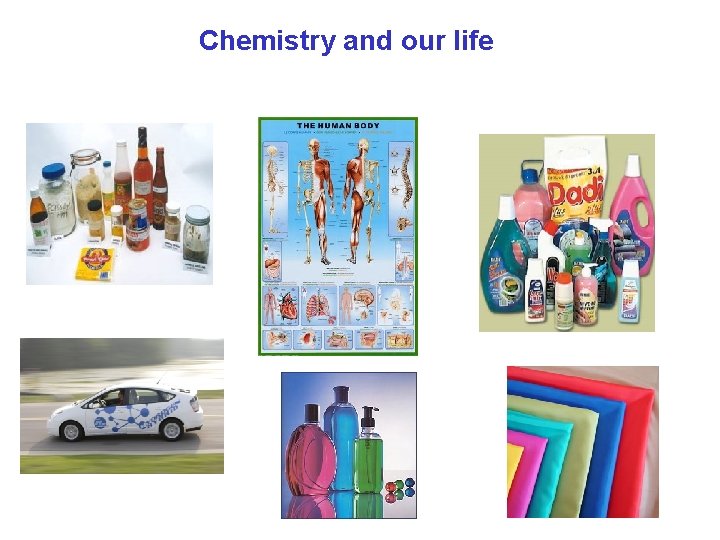
Chemistry and our life
Chemistry & Matter: has mass and takes space. Chemistry: science that deals with matter and its changes. Central to Science All sciences are connected to chemistry.
Changes Chemical change (chemical reaction): substance(s) are used up (disappear) → others form burning paper or dissolving salt Physical change: identities of the substances do not change. (change of state) (Gas, Liquid, Solid) evaporation of water, melting of a solid, sublimation
Scientific method fact: is a statement based on direct experience. hypothesis: is statement that is proposed without actual proof. theory: is the same as a hypothesis except that we have a stronger belief in it because there is more evidence, some proof, supporting it. serendipity: observation by chance (luck).
Significant Figures Exact numbers: we do not use a measuring devise. (Counting numbers) Number of students in class, 1 m = 100 cm Inexact numbers: we use a measuring devise. (measuring numbers) Temperature of room, mass of table
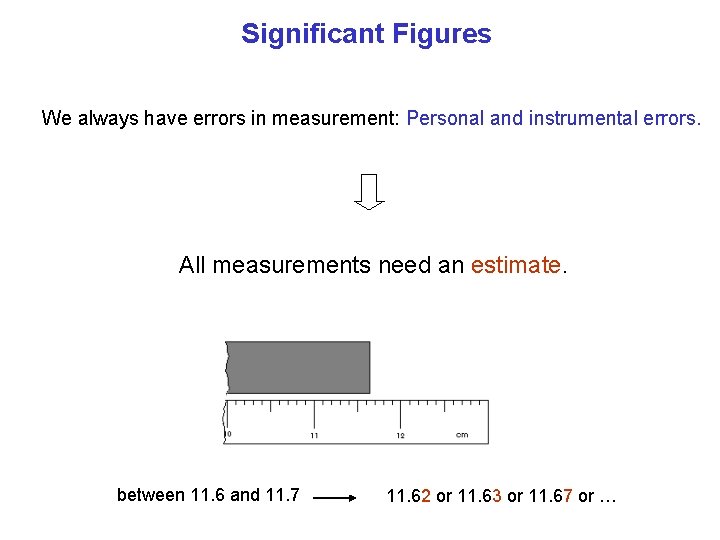
Significant Figures We always have errors in measurement: Personal and instrumental errors. All measurements need an estimate. between 11. 6 and 11. 7 11. 62 or 11. 63 or 11. 67 or …
Significant Figures Certain numbers: 11. 6 Uncertain number: 11. 66 (estimated digit - only the last digit) Significant Figures: all numbers recorded in a measurement. (certain and uncertain) When we report, we show uncertainty with ± 11. 66 ± 0. 01
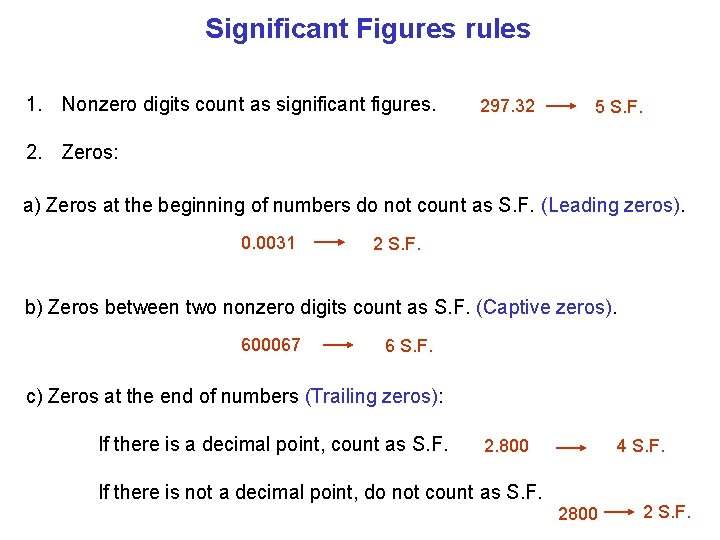
Significant Figures rules 1. Nonzero digits count as significant figures. 297. 32 5 S. F. 2. Zeros: a) Zeros at the beginning of numbers do not count as S. F. (Leading zeros). 0. 0031 2 S. F. b) Zeros between two nonzero digits count as S. F. (Captive zeros). 600067 6 S. F. c) Zeros at the end of numbers (Trailing zeros): If there is a decimal point, count as S. F. 2. 800 4 S. F. If there is not a decimal point, do not count as S. F. 2800 2 S. F.
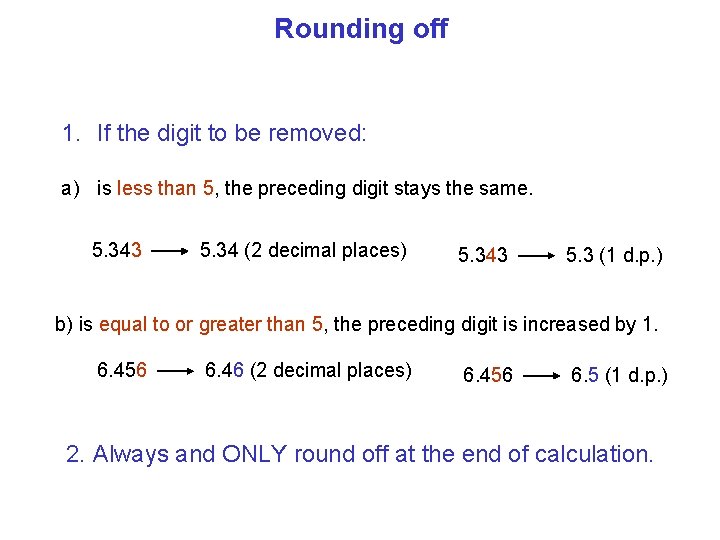
Rounding off 1. If the digit to be removed: a) is less than 5, the preceding digit stays the same. 5. 343 5. 34 (2 decimal places) 5. 343 5. 3 (1 d. p. ) b) is equal to or greater than 5, the preceding digit is increased by 1. 6. 456 6. 46 (2 decimal places) 6. 456 6. 5 (1 d. p. ) 2. Always and ONLY round off at the end of calculation.
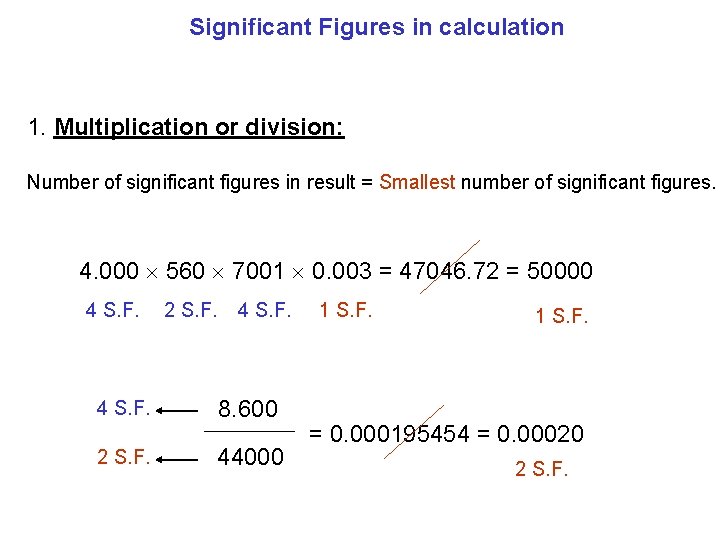
Significant Figures in calculation 1. Multiplication or division: Number of significant figures in result = Smallest number of significant figures. 4. 000 560 7001 0. 003 = 47046. 72 = 50000 4 S. F. 2 S. F. 4 S. F. 8. 600 44000 1 S. F. = 0. 000195454 = 0. 00020 2 S. F.
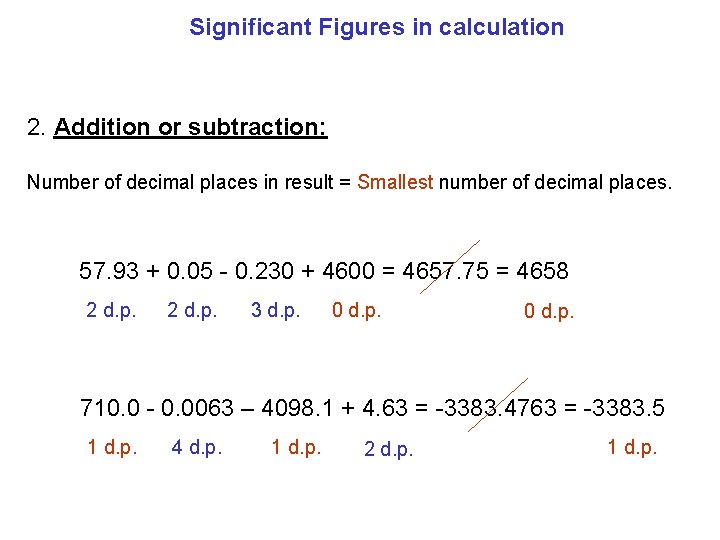
Significant Figures in calculation 2. Addition or subtraction: Number of decimal places in result = Smallest number of decimal places. 57. 93 + 0. 05 - 0. 230 + 4600 = 4657. 75 = 4658 2 d. p. 3 d. p. 0 d. p. 710. 0 - 0. 0063 – 4098. 1 + 4. 63 = -3383. 4763 = -3383. 5 1 d. p. 4 d. p. 1 d. p. 2 d. p. 1 d. p.
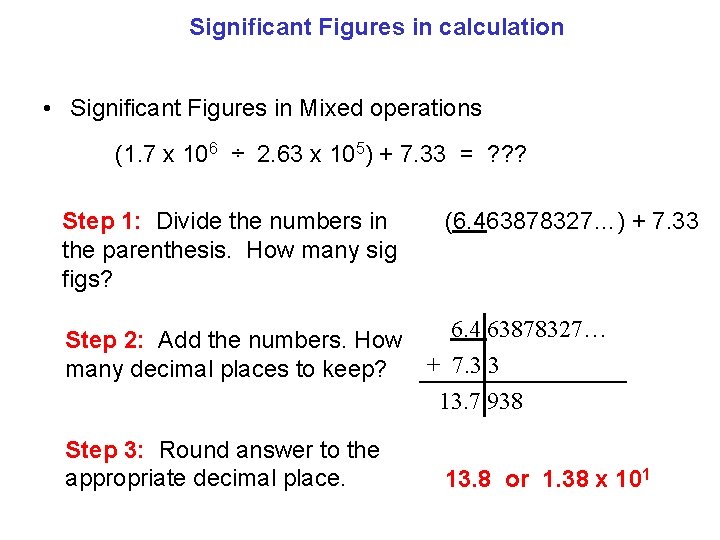
Significant Figures in calculation • Significant Figures in Mixed operations (1. 7 x 10⁶ ÷ 2. 63 x 105) + 7. 33 = ? ? ? Step 1: Divide the numbers in the parenthesis. How many sig figs? Step 2: Add the numbers. How many decimal places to keep? Step 3: Round answer to the appropriate decimal place. (6. 463878327…) + 7. 33 6. 4 63878327… + 7. 3 3 13. 7 938 13. 8 or 1. 38 x 101
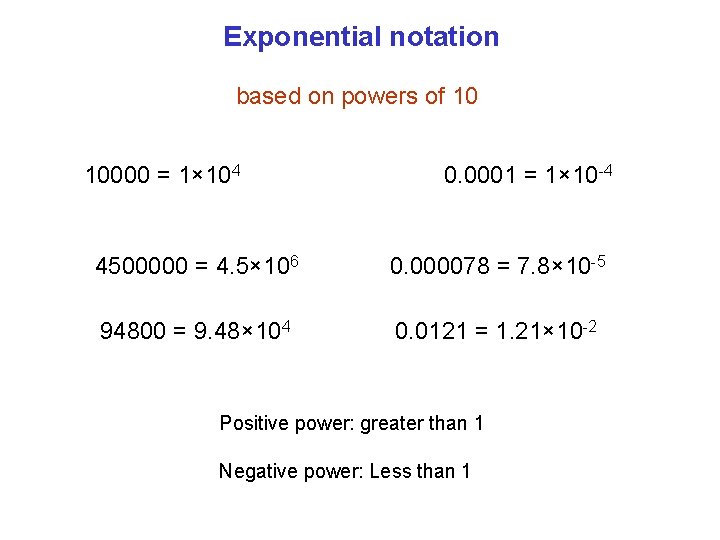
Exponential notation based on powers of 10 10000 = 1× 10⁴ 0. 0001 = 1× 10 -4 4500000 = 4. 5× 10⁶ 0. 000078 = 7. 8× 10 -5 94800 = 9. 48× 104 0. 0121 = 1. 21× 10 -2 Positive power: greater than 1 Negative power: Less than 1
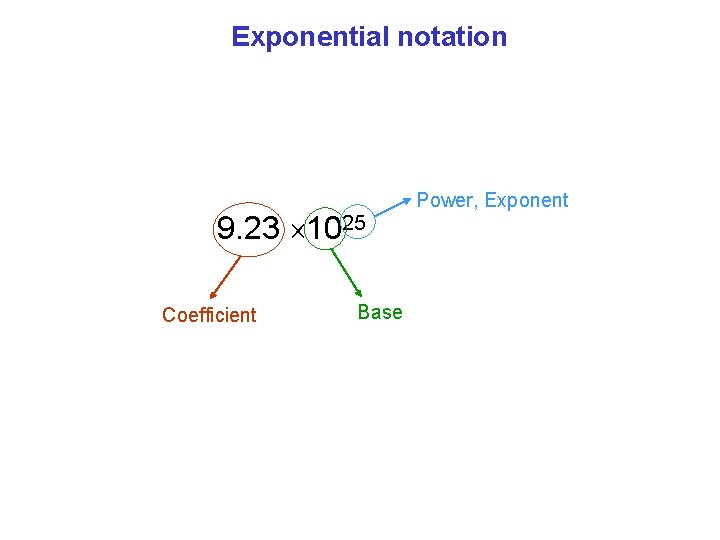
Exponential notation 9. 23 1025 Coefficient Base Power, Exponent
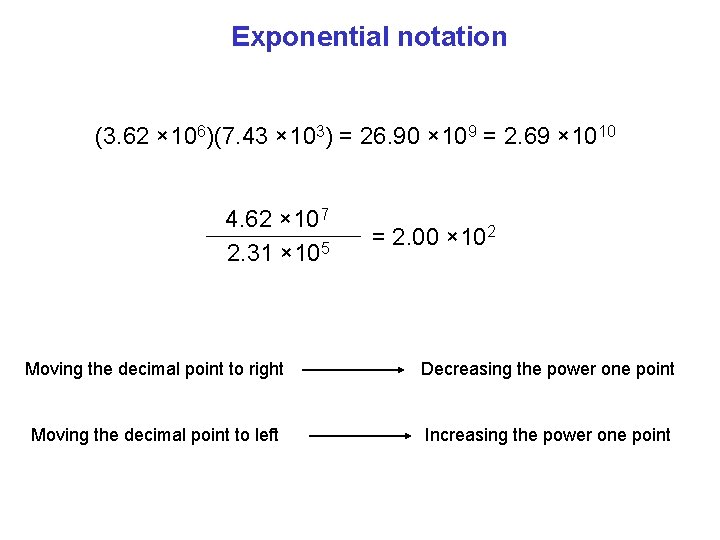
Exponential notation (3. 62 × 106)(7. 43 × 103) = 26. 90 × 109 = 2. 69 × 1010 4. 62 × 107 2. 31 × 105 = 2. 00 × 102 Moving the decimal point to right Decreasing the power one point Moving the decimal point to left Increasing the power one point
Measurements
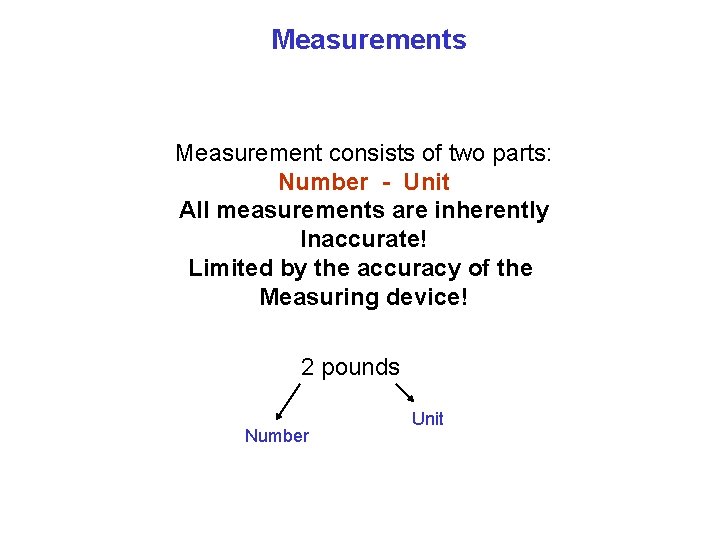
Measurements Measurement consists of two parts: Number - Unit All measurements are inherently Inaccurate! Limited by the accuracy of the Measuring device! 2 pounds Number Unit
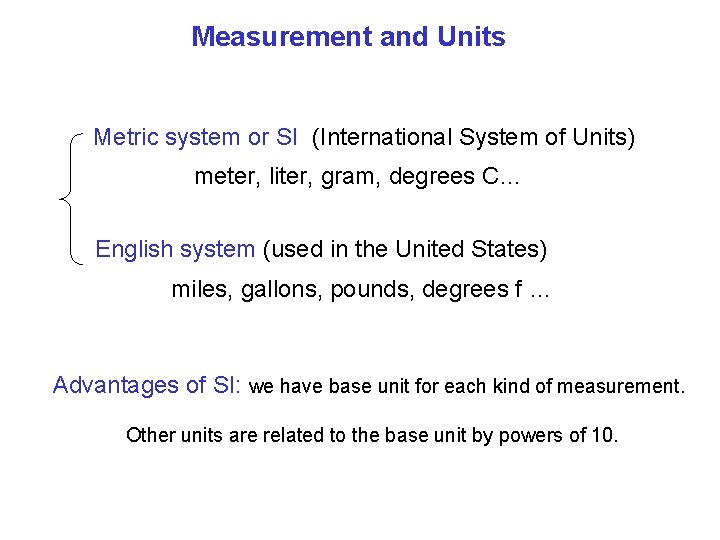
Measurement and Units Metric system or SI (International System of Units) meter, liter, gram, degrees C… English system (used in the United States) miles, gallons, pounds, degrees f … Advantages of SI: we have base unit for each kind of measurement. Other units are related to the base unit by powers of 10.
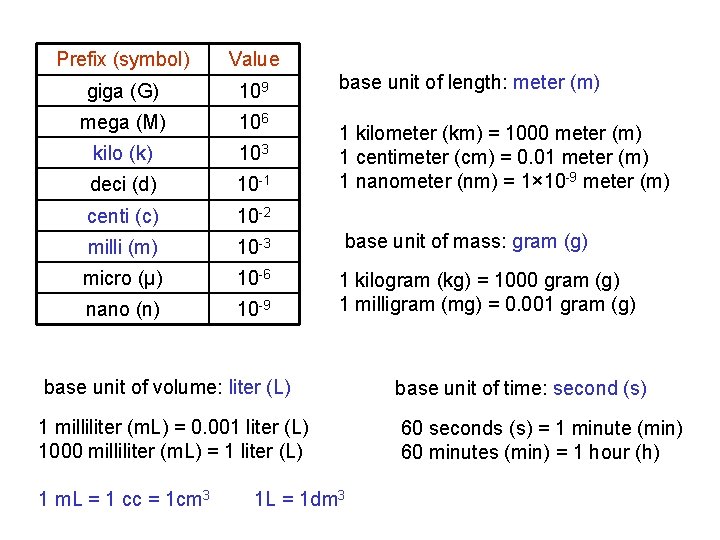
Prefix (symbol) Value giga (G) 109 mega (M) 106 kilo (k) 103 deci (d) 10 -1 centi (c) 10 -2 milli (m) 10 -3 base unit of mass: gram (g) micro (µ) 10 -6 nano (n) 10 -9 1 kilogram (kg) = 1000 gram (g) 1 milligram (mg) = 0. 001 gram (g) base unit of length: meter (m) 1 kilometer (km) = 1000 meter (m) 1 centimeter (cm) = 0. 01 meter (m) 1 nanometer (nm) = 1× 10 -9 meter (m) base unit of volume: liter (L) base unit of time: second (s) 1 milliliter (m. L) = 0. 001 liter (L) 1000 milliliter (m. L) = 1 liter (L) 60 seconds (s) = 1 minute (min) 60 minutes (min) = 1 hour (h) 1 m. L = 1 cc = 1 cm 3 1 L = 1 dm 3
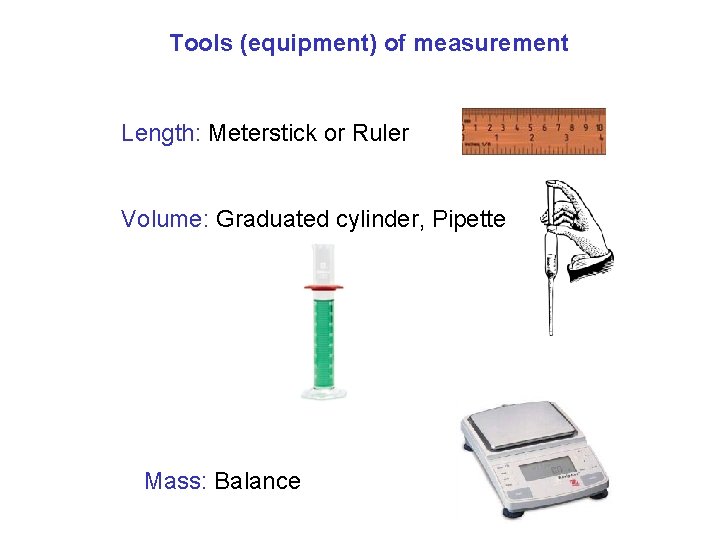
Tools (equipment) of measurement Length: Meterstick or Ruler Volume: Graduated cylinder, Pipette Mass: Balance
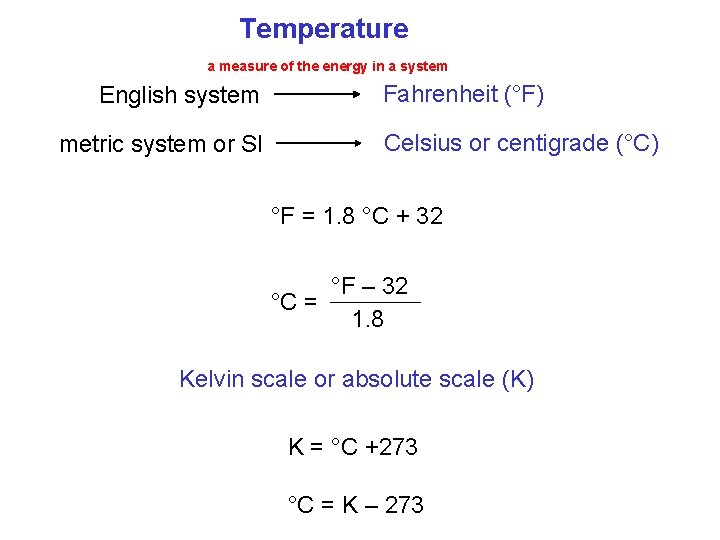
Temperature a measure of the energy in a system English system metric system or SI Fahrenheit (°F) Celsius or centigrade (°C) °F = 1. 8 °C + 32 °F – 32 °C = 1. 8 Kelvin scale or absolute scale (K) K = °C +273 °C = K – 273
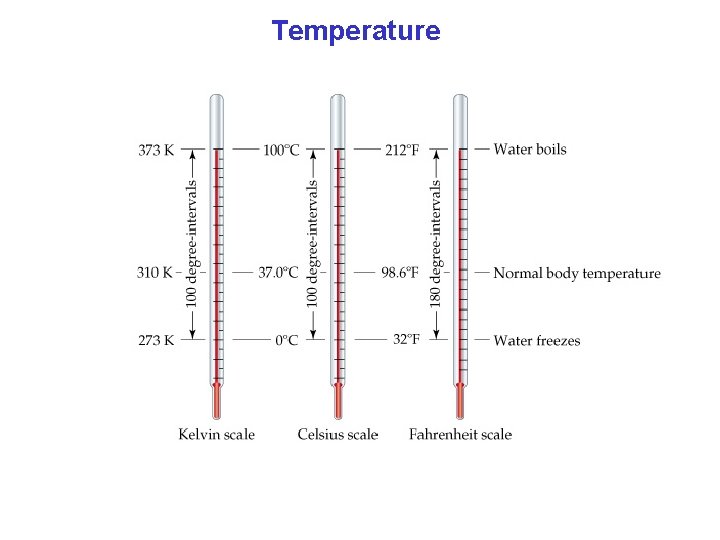
Temperature
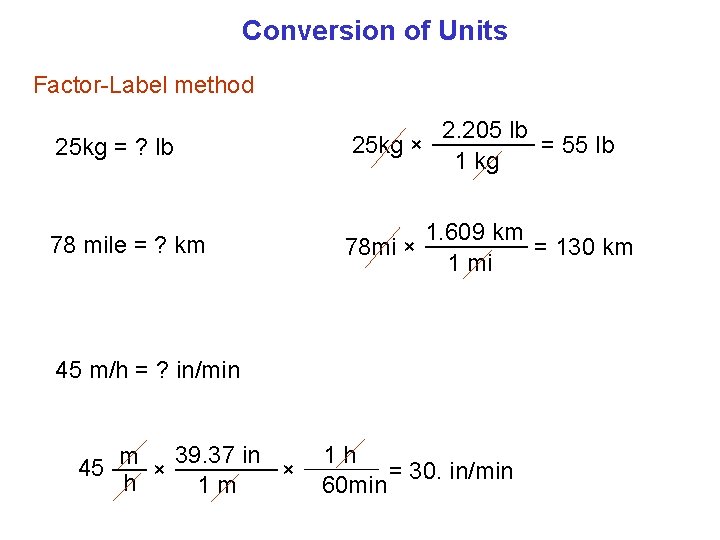
Conversion of Units Factor-Label method 25 kg = ? lb 2. 205 lb = 55 lb 25 kg × 1 kg 78 mile = ? km 78 mi × 1. 609 km = 130 km 1 mi 45 m/h = ? in/min 39. 37 in 45 m × × h 1 m 1 h = 30. in/min 60 min
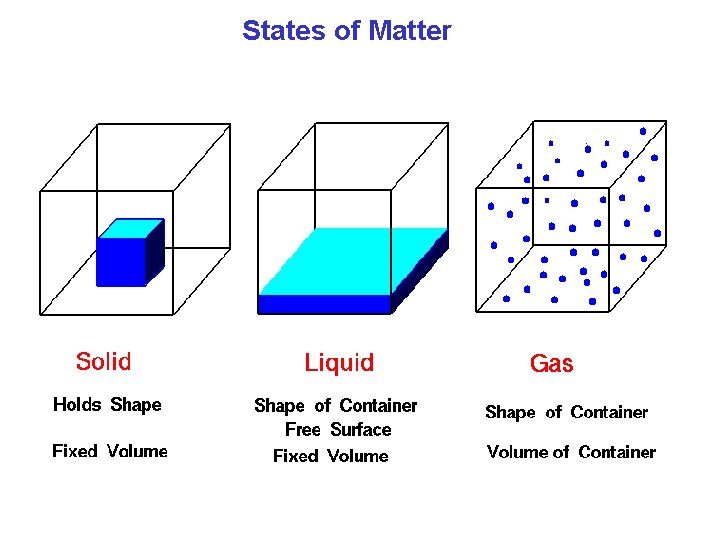
States of Matter
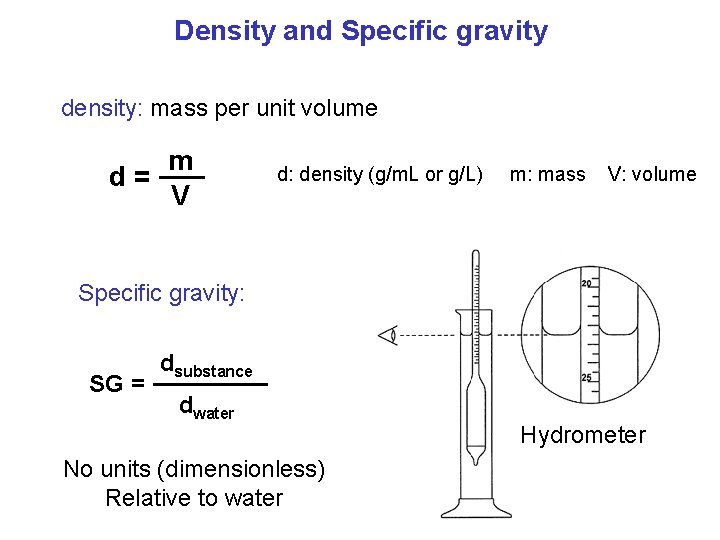
Density and Specific gravity density: mass per unit volume m d= V d: density (g/m. L or g/L) m: mass V: volume Specific gravity: SG = dsubstance dwater No units (dimensionless) Relative to water Hydrometer
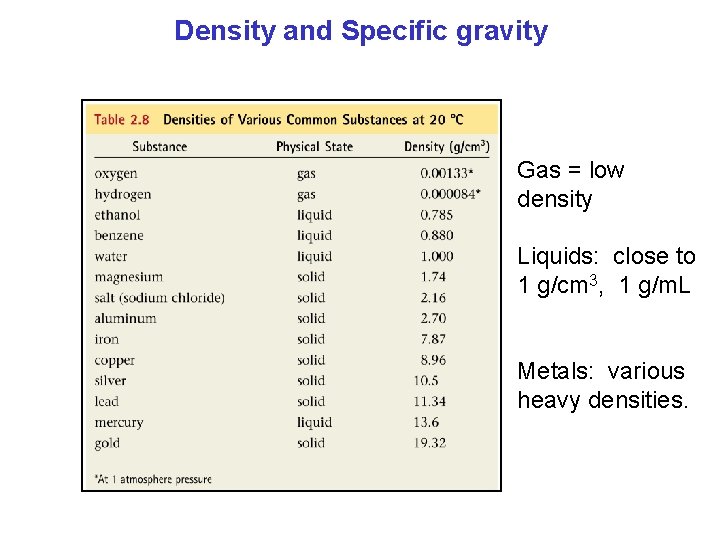
Density and Specific gravity Gas = low density Liquids: close to 1 g/cm 3, 1 g/m. L Metals: various heavy densities.
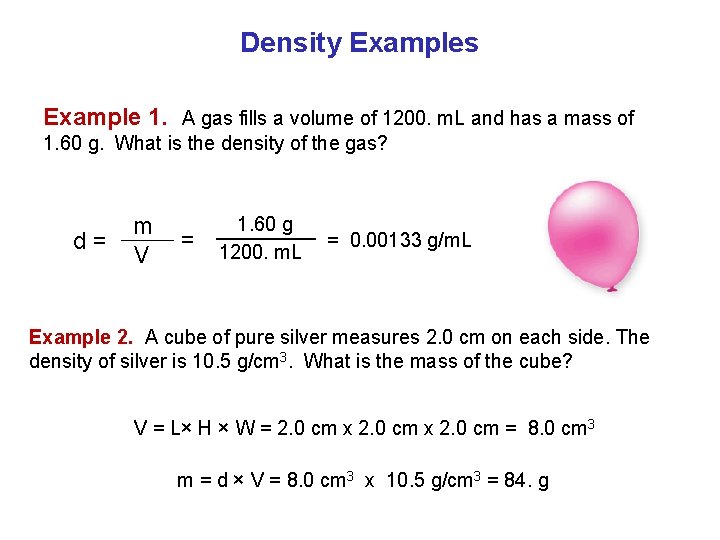
Density Examples Example 1. A gas fills a volume of 1200. m. L and has a mass of 1. 60 g. What is the density of the gas? d= m V = 1. 60 g 1200. m. L = 0. 00133 g/m. L Example 2. A cube of pure silver measures 2. 0 cm on each side. The density of silver is 10. 5 g/cm 3. What is the mass of the cube? V = L× H × W = 2. 0 cm x 2. 0 cm = 8. 0 cm 3 m = d × V = 8. 0 cm 3 x 10. 5 g/cm 3 = 84. g
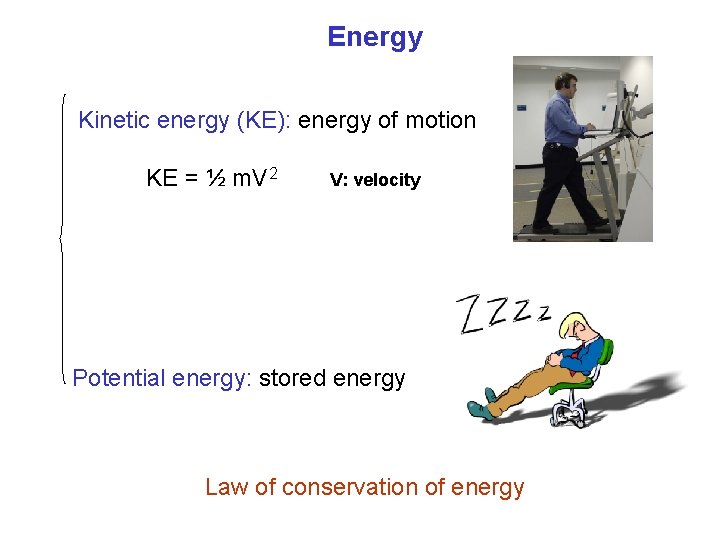
Energy Kinetic energy (KE): energy of motion KE = ½ m. V 2 V: velocity Potential energy: stored energy Law of conservation of energy
Heat and Temperature units of heat: calorie (cal) or joule (J) 1 cal = 4. 184 J Amount of heat = specific heat × mass × change in temperature Amount of heat(cal) = mg × (T 2 – T 1) x SH cal/g °C SH = Specific heat (cal/g °C) Water = 1 T 2 = final temperature (C) T 1 = initial temperature (C)
- Slides: 30