
Chemistry Atoms First Julia Burdge Jason Overby Chapter
Chemistry: Atoms First Julia Burdge & Jason Overby Chapter 8. 3 and 8. 4 Book Homework: 25, 27, 29, 31, 33, 37, 43, 47, 49, 51, 53, 55 and 57 Kent L. Mc. Corkle Cosumnes River College Sacramento, CA Copyright (c) The Mc. Graw-Hill Companies, Inc. Permission required for reproduction or display.
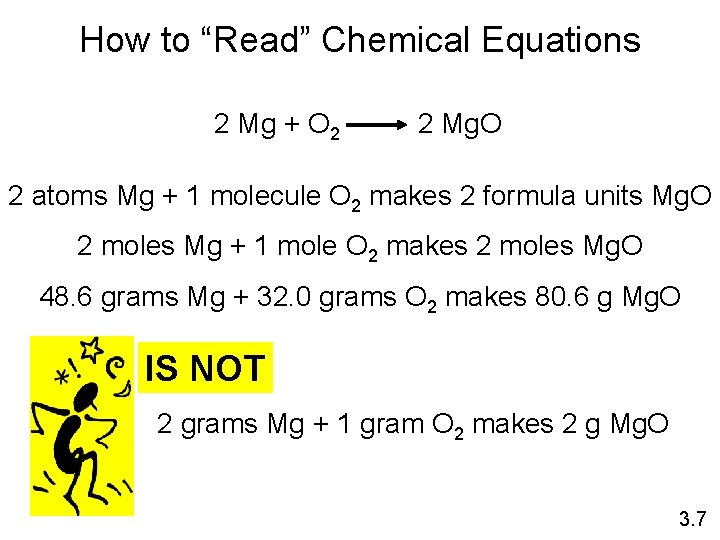
How to “Read” Chemical Equations 2 Mg + O 2 2 Mg. O 2 atoms Mg + 1 molecule O 2 makes 2 formula units Mg. O 2 moles Mg + 1 mole O 2 makes 2 moles Mg. O 48. 6 grams Mg + 32. 0 grams O 2 makes 80. 6 g Mg. O IS NOT 2 grams Mg + 1 gram O 2 makes 2 g Mg. O 3. 7
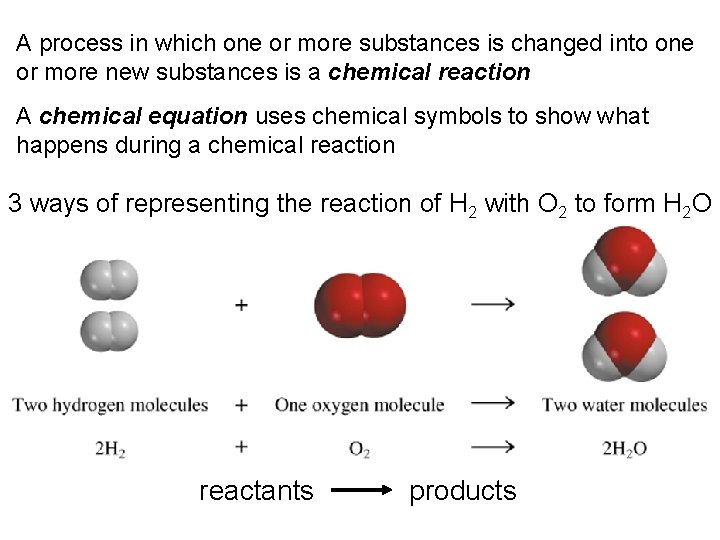
A process in which one or more substances is changed into one or more new substances is a chemical reaction A chemical equation uses chemical symbols to show what happens during a chemical reaction 3 ways of representing the reaction of H 2 with O 2 to form H 2 O reactants products
8. 1 Chemical Equations A chemical equation uses chemical symbols to denote what occurs in a chemical reaction. NH 3 + HCl → NH 4 Cl Ammonia and hydrogen chloride react to produce ammonium chloride. Each chemical species that appears to the left of the arrow is called a reactant. NH 3 + HCl → NH 4 Cl Each species that appears to the right of the arrow is called a product. NH 3 + HCl → NH 4 Cl
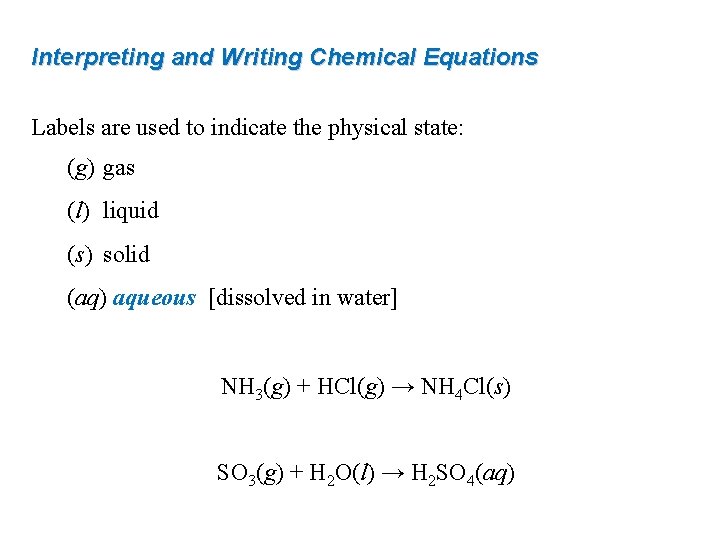
Interpreting and Writing Chemical Equations Labels are used to indicate the physical state: (g) gas (l) liquid (s) solid (aq) aqueous [dissolved in water] NH 3(g) + HCl(g) → NH 4 Cl(s) SO 3(g) + H 2 O(l) → H 2 SO 4(aq)
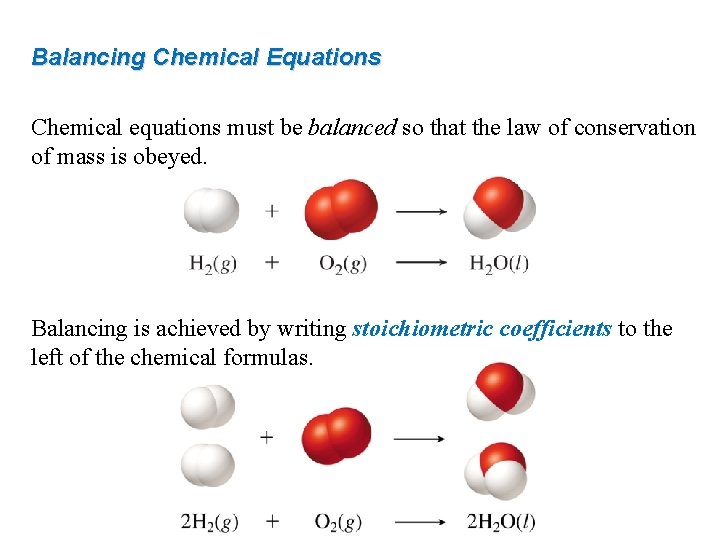
Balancing Chemical Equations Chemical equations must be balanced so that the law of conservation of mass is obeyed. Balancing is achieved by writing stoichiometric coefficients to the left of the chemical formulas.
Balancing Chemical Equations Generally, it will facilitate the balancing process if you do the following: 1) Change the coefficients of compounds before changing the coefficients of elements. 2) Treat polyatomic ions that appear on both sides of the equation as units. 3) Count atoms and/or polyatomic ions carefully, and track their numbers each time you change a coefficient.
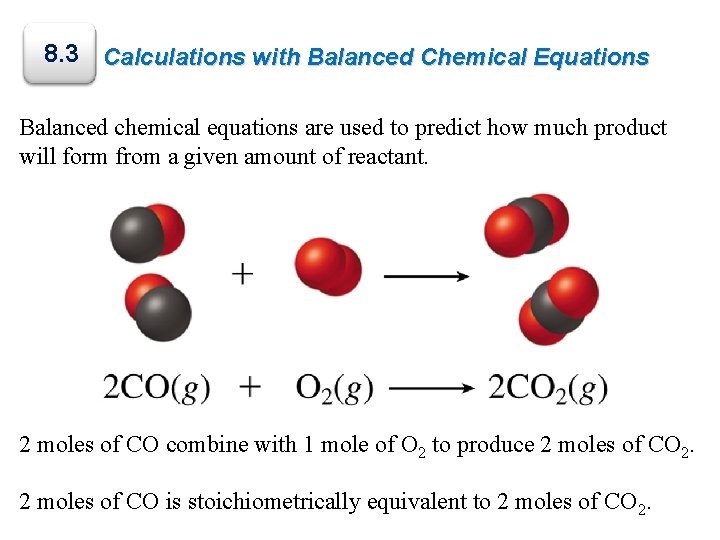
8. 3 Calculations with Balanced Chemical Equations Balanced chemical equations are used to predict how much product will form from a given amount of reactant. 2 moles of CO combine with 1 mole of O 2 to produce 2 moles of CO 2. 2 moles of CO is stoichiometrically equivalent to 2 moles of CO 2.
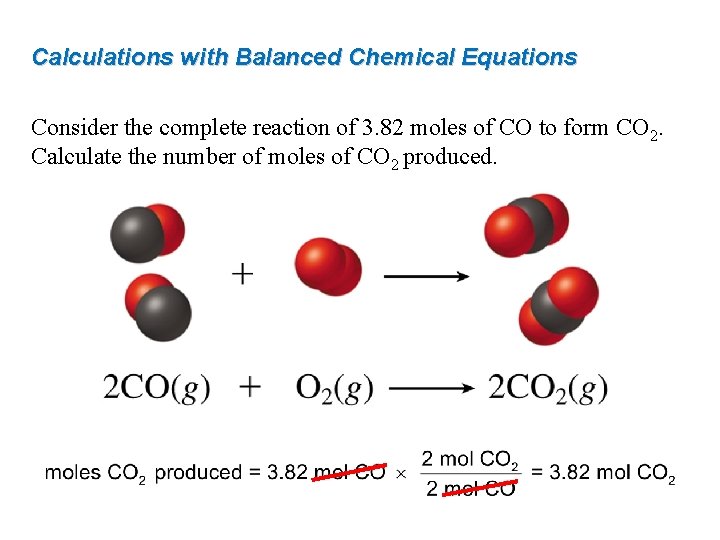
Calculations with Balanced Chemical Equations Consider the complete reaction of 3. 82 moles of CO to form CO 2. Calculate the number of moles of CO 2 produced.
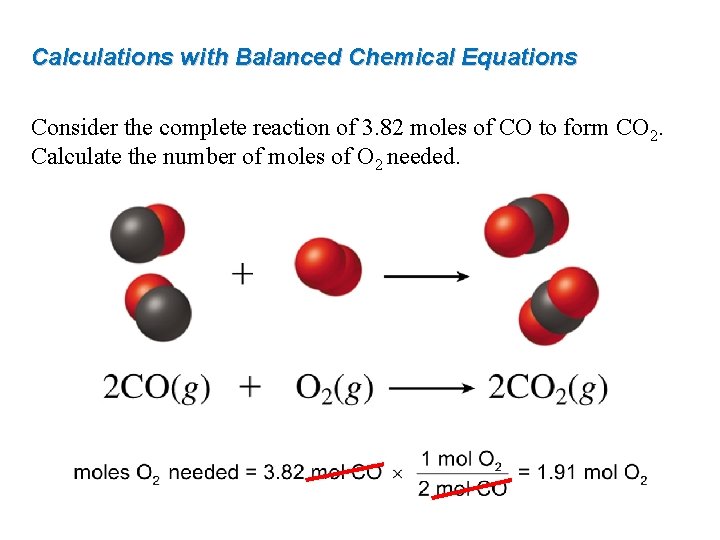
Calculations with Balanced Chemical Equations Consider the complete reaction of 3. 82 moles of CO to form CO 2. Calculate the number of moles of O 2 needed.
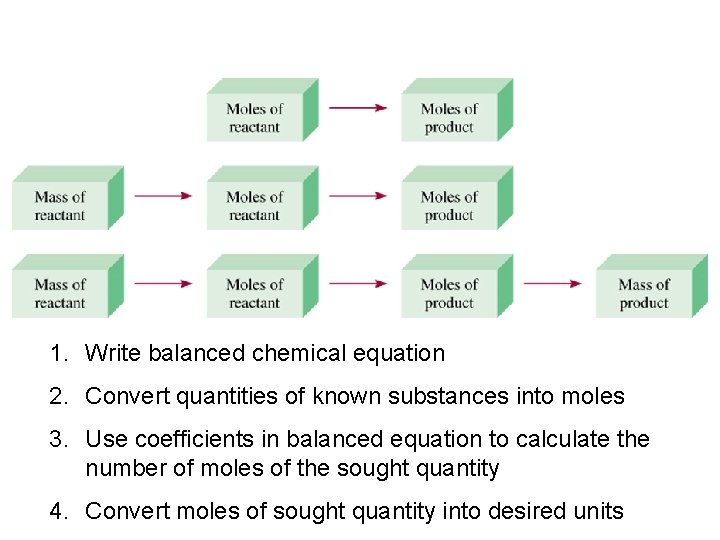
Mass Changes in Chemical Reactions 1. Write balanced chemical equation 2. Convert quantities of known substances into moles 3. Use coefficients in balanced equation to calculate the number of moles of the sought quantity 4. Convert moles of sought quantity into desired units 3. 8
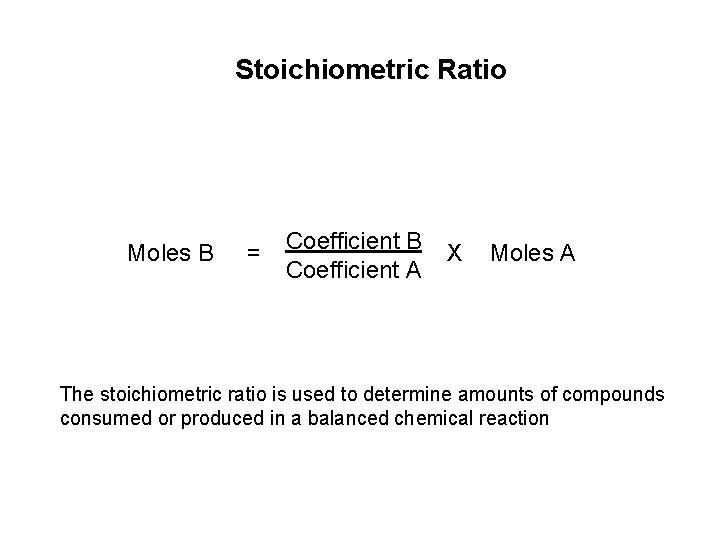
Stoichiometric Ratio Moles B = Coefficient B Coefficient A X Moles A The stoichiometric ratio is used to determine amounts of compounds consumed or produced in a balanced chemical reaction
![Worked Example 8. 5 Urea [(NH 2)2 CO] is a by-product of protein metabolism.](http://slidetodoc.com/presentation_image/37d1167e591d8c33e5d9d6d1fec68578/image-13.jpg "Worked Example 8. 5 Urea [(NH 2)2 CO] is a by-product of protein metabolism.")
Worked Example 8. 5 Urea [(NH 2)2 CO] is a by-product of protein metabolism. This waste product is formed in the liver and then filtered from the blood and excreted in the urine by the kidneys. Urea can be synthesized in the laboratory by the combination of ammonia and carbon dioxide according to the equation (a) Calculate the amount of urea that will be produced by the complete reaction of 5. 25 moles of ammonia. (b) Determine the stoichiometric amount of carbon dioxide required to react with 5. 25 moles of ammonia. Strategy Use the balanced chemical equation to determine the correct stoichiometric conversion factors, and then multiply by the number of moles of ammonia given.
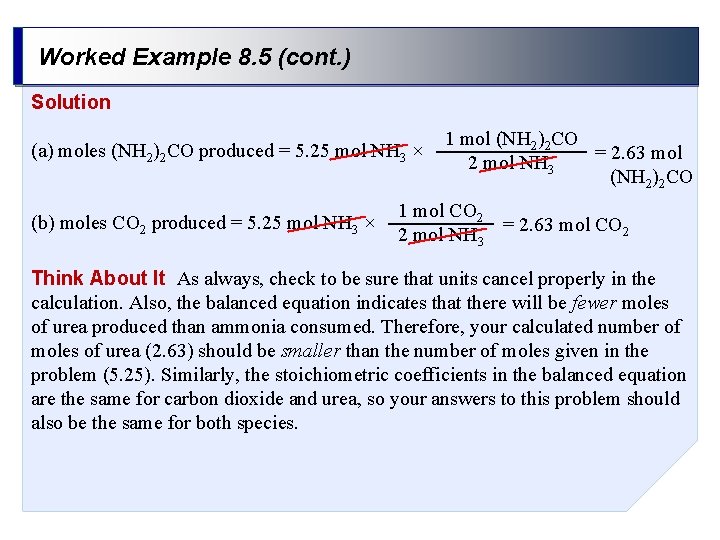
Worked Example 8. 5 (cont. ) Solution (a) moles (NH 2)2 CO produced = 5. 25 mol NH 3 × (b) moles CO 2 produced = 5. 25 mol NH 3 × 1 mol (NH 2)2 CO = 2. 63 mol 2 mol NH 3 (NH 2)2 CO 1 mol CO 2 = 2. 63 mol CO 2 2 mol NH 3 Think About It As always, check to be sure that units cancel properly in the calculation. Also, the balanced equation indicates that there will be fewer moles of urea produced than ammonia consumed. Therefore, your calculated number of moles of urea (2. 63) should be smaller than the number of moles given in the problem (5. 25). Similarly, the stoichiometric coefficients in the balanced equation are the same for carbon dioxide and urea, so your answers to this problem should also be the same for both species.
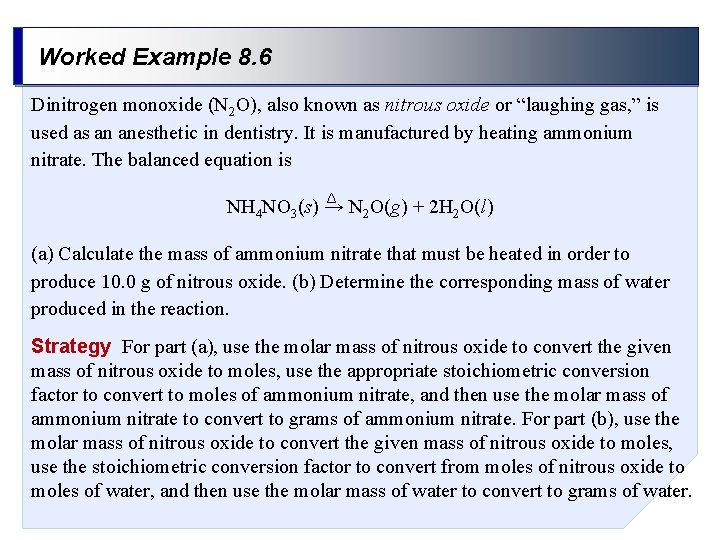
Worked Example 8. 6 Dinitrogen monoxide (N 2 O), also known as nitrous oxide or “laughing gas, ” is used as an anesthetic in dentistry. It is manufactured by heating ammonium nitrate. The balanced equation is Δ NH 4 NO 3(s) → N 2 O(g) + 2 H 2 O(l) (a) Calculate the mass of ammonium nitrate that must be heated in order to produce 10. 0 g of nitrous oxide. (b) Determine the corresponding mass of water produced in the reaction. Strategy For part (a), use the molar mass of nitrous oxide to convert the given mass of nitrous oxide to moles, use the appropriate stoichiometric conversion factor to convert to moles of ammonium nitrate, and then use the molar mass of ammonium nitrate to convert to grams of ammonium nitrate. For part (b), use the molar mass of nitrous oxide to convert the given mass of nitrous oxide to moles, use the stoichiometric conversion factor to convert from moles of nitrous oxide to moles of water, and then use the molar mass of water to convert to grams of water.
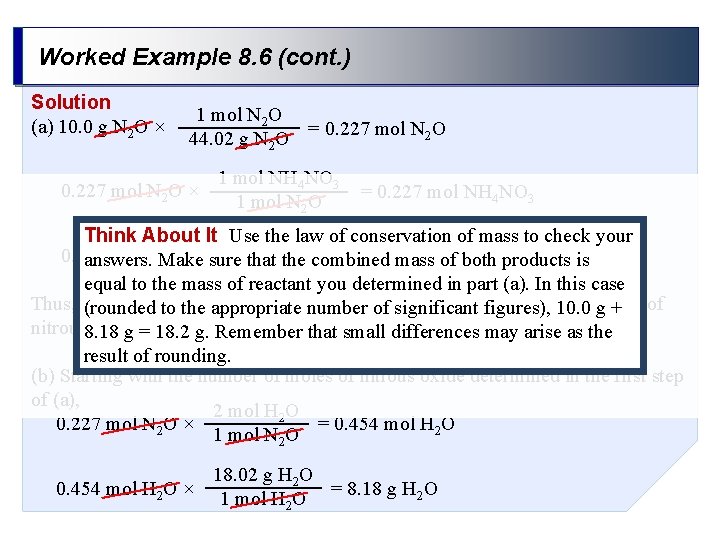
Worked Example 8. 6 (cont. ) Solution (a) 10. 0 g N 2 O × 1 mol N 2 O = 0. 227 mol N 2 O 44. 02 g N 2 O 0. 227 mol N 2 O × 1 mol NH 4 NO 3 1 mol N 2 O = 0. 227 mol NH 4 NO 3 Think About It Use 80. 05 the law of 4 conservation of mass to check your g NH NO 3 = 18. 2 g NH 4 NO 3 is 0. 227 mol NH answers. Make the combined 4 NOsure 3 × that 1 mol NH 4 NO 3 mass of both products equal to the mass of reactant you determined in part (a). In this case Thus, 18. 2 g of ammonium nitrate number must beof heated in order to produce (rounded to the appropriate significant figures), 10. 0 g + g of nitrous 8. 18 oxide. g = 18. 2 g. Remember that small differences may arise as the result of rounding. (b) Starting with the number of moles of nitrous oxide determined in the first step of (a), 2 mol H 2 O 0. 227 mol N 2 O × = 0. 454 mol H 2 O 1 mol N 2 O 0. 454 mol H 2 O × 18. 02 g H 2 O = 8. 18 g H 2 O 1 mol H 2 O
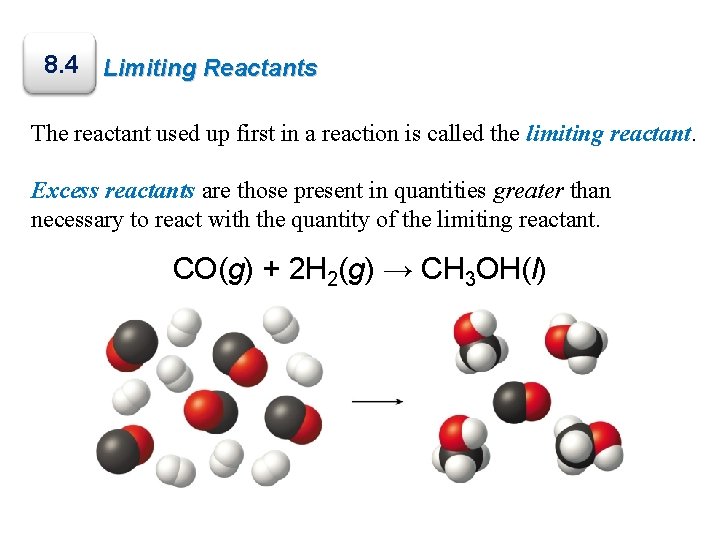
8. 4 Limiting Reactants The reactant used up first in a reaction is called the limiting reactant. Excess reactants are those present in quantities greater than necessary to react with the quantity of the limiting reactant. CO(g) + 2 H 2(g) → CH 3 OH(l)
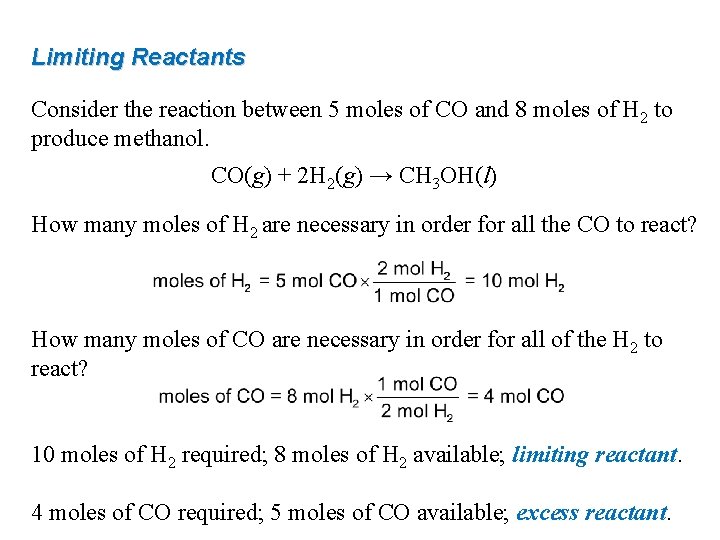
Limiting Reactants Consider the reaction between 5 moles of CO and 8 moles of H 2 to produce methanol. CO(g) + 2 H 2(g) → CH 3 OH(l) How many moles of H 2 are necessary in order for all the CO to react? How many moles of CO are necessary in order for all of the H 2 to react? 10 moles of H 2 required; 8 moles of H 2 available; limiting reactant. 4 moles of CO required; 5 moles of CO available; excess reactant.
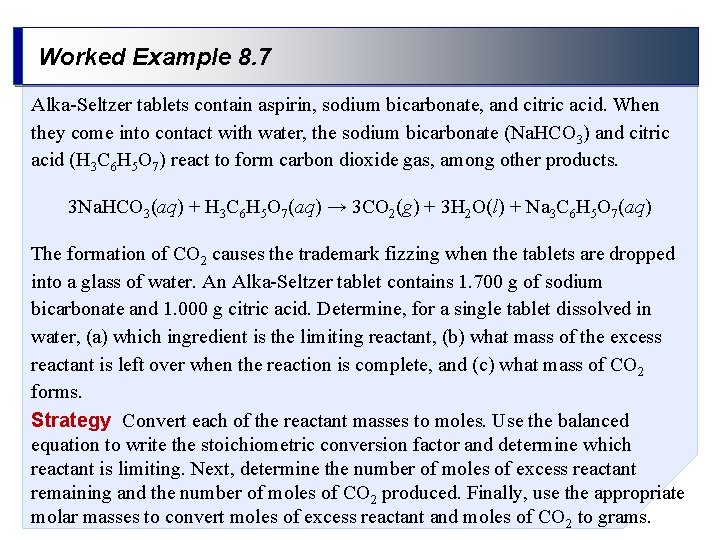
Worked Example 8. 7 Alka-Seltzer tablets contain aspirin, sodium bicarbonate, and citric acid. When they come into contact with water, the sodium bicarbonate (Na. HCO 3) and citric acid (H 3 C 6 H 5 O 7) react to form carbon dioxide gas, among other products. 3 Na. HCO 3(aq) + H 3 C 6 H 5 O 7(aq) → 3 CO 2(g) + 3 H 2 O(l) + Na 3 C 6 H 5 O 7(aq) The formation of CO 2 causes the trademark fizzing when the tablets are dropped into a glass of water. An Alka-Seltzer tablet contains 1. 700 g of sodium bicarbonate and 1. 000 g citric acid. Determine, for a single tablet dissolved in water, (a) which ingredient is the limiting reactant, (b) what mass of the excess reactant is left over when the reaction is complete, and (c) what mass of CO 2 forms. Strategy Convert each of the reactant masses to moles. Use the balanced equation to write the stoichiometric conversion factor and determine which reactant is limiting. Next, determine the number of moles of excess reactant remaining and the number of moles of CO 2 produced. Finally, use the appropriate molar masses to convert moles of excess reactant and moles of CO 2 to grams.
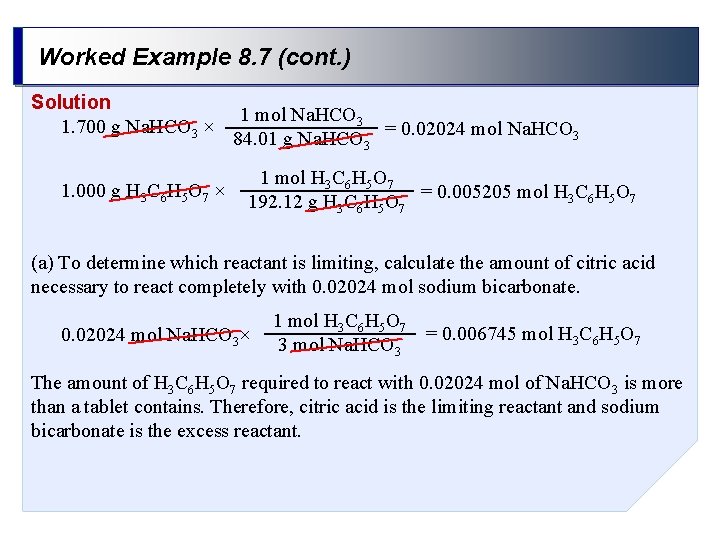
Worked Example 8. 7 (cont. ) Solution 1. 700 g Na. HCO 3 × 1. 000 g H 3 C 6 H 5 O 7 × 1 mol Na. HCO 3 = 0. 02024 mol Na. HCO 3 84. 01 g Na. HCO 3 1 mol H 3 C 6 H 5 O 7 = 0. 005205 mol H 3 C 6 H 5 O 7 192. 12 g H 3 C 6 H 5 O 7 (a) To determine which reactant is limiting, calculate the amount of citric acid necessary to react completely with 0. 02024 mol sodium bicarbonate. 0. 02024 mol Na. HCO 3× 1 mol H 3 C 6 H 5 O 7 = 0. 006745 mol H 3 C 6 H 5 O 7 3 mol Na. HCO 3 The amount of H 3 C 6 H 5 O 7 required to react with 0. 02024 mol of Na. HCO 3 is more than a tablet contains. Therefore, citric acid is the limiting reactant and sodium bicarbonate is the excess reactant.
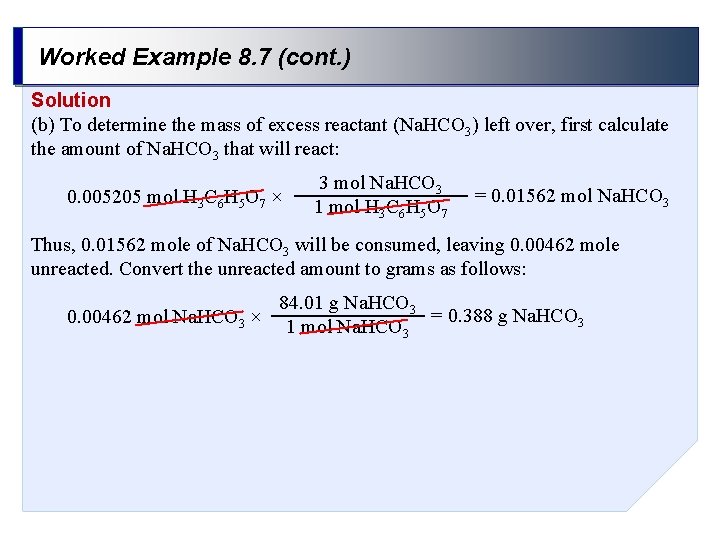
Worked Example 8. 7 (cont. ) Solution (b) To determine the mass of excess reactant (Na. HCO 3) left over, first calculate the amount of Na. HCO 3 that will react: 0. 005205 mol H 3 C 6 H 5 O 7 × 3 mol Na. HCO 3 1 mol H 3 C 6 H 5 O 7 = 0. 01562 mol Na. HCO 3 Thus, 0. 01562 mole of Na. HCO 3 will be consumed, leaving 0. 00462 mole unreacted. Convert the unreacted amount to grams as follows: 0. 00462 mol Na. HCO 3 × 84. 01 g Na. HCO 3 = 0. 388 g Na. HCO 3 1 mol Na. HCO 3
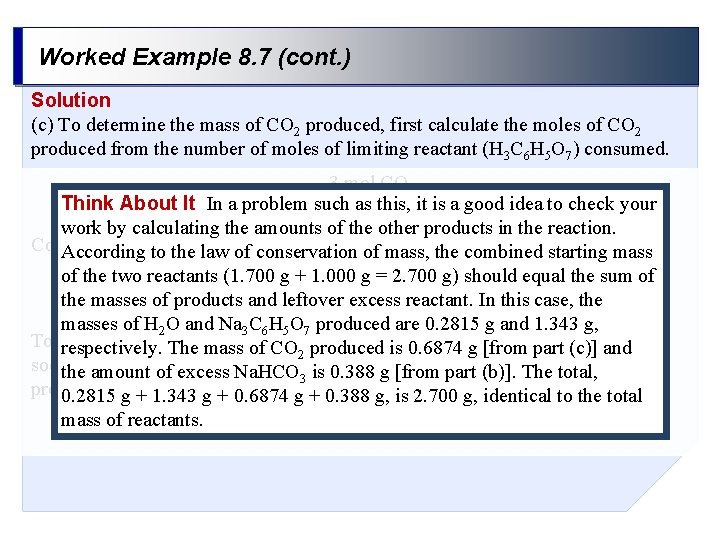
Worked Example 8. 7 (cont. ) Solution (c) To determine the mass of CO 2 produced, first calculate the moles of CO 2 produced from the number of moles of limiting reactant (H 3 C 6 H 5 O 7) consumed. 3 mol CO 2 =good 0. 01562 mol CO 2 your 0. 005205 mol H C H O × 7 Think About It 3 In 6 a 5 problem this, it is a idea to check 1 such mol as H 3 C H O 6 5 7 work by calculating the amounts of the other products in the reaction. Convert this amount as follows: of mass, the combined starting mass According to the to lawgrams of conservation of the two reactants (1. 700 1. 000 g = 2. 700 g) should equal the sum of 44. 01 gg+CO 2 0. 01562 mol CO × = 0. 6874 g CO 2 the masses of products 1 and leftover mol CO 2 excess reactant. 2 In this case, the masses of H 2 O and Na 3 C 6 H 5 O 7 produced are 0. 2815 g and 1. 343 g, To summarize the. The results: acid is theislimiting (b) (c)] 0. 388 respectively. mass(a) of citric CO 2 produced 0. 6874 greactant, [from part andg sodium bicarbonate remains unreacted, and (c) 0. 6874 g carbon dioxide is the amount of excess Na. HCO 3 is 0. 388 g [from part (b)]. The total, produced. 0. 2815 g + 1. 343 g + 0. 6874 g + 0. 388 g, is 2. 700 g, identical to the total mass of reactants.
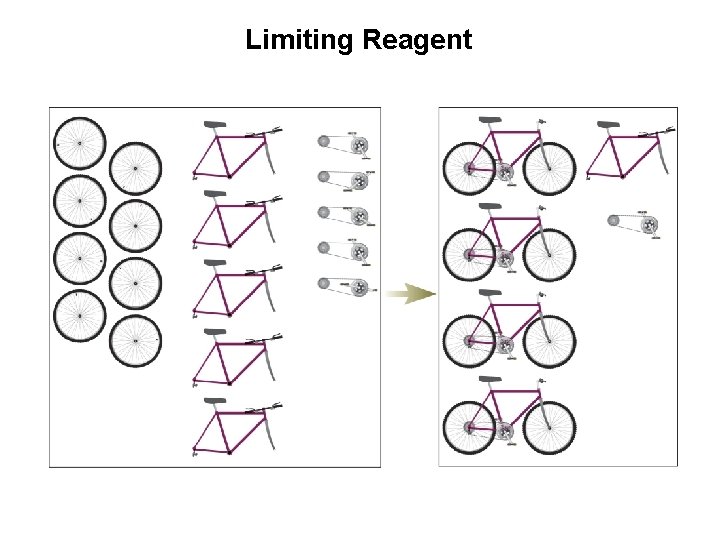
Limiting Reagent The reactant that is completely consumed by the reaction The number of bicycles that can be assembled is limited by whichever part runs out first. In the inventory shown in this figure, wheels are that part.
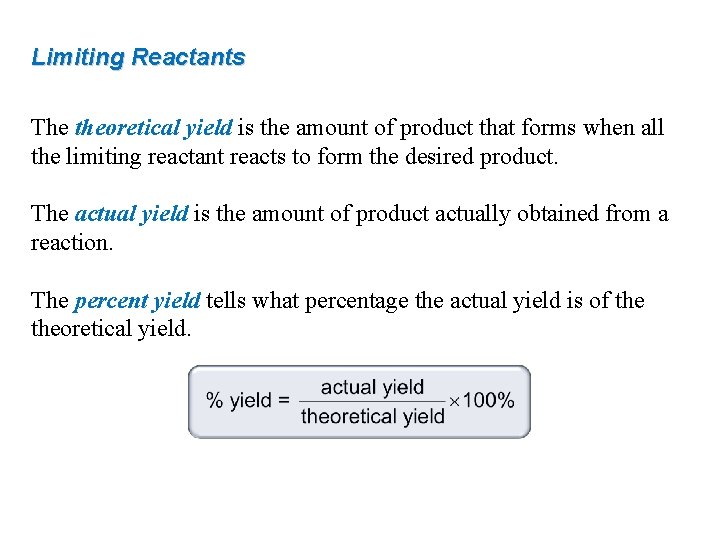
Limiting Reactants The theoretical yield is the amount of product that forms when all the limiting reactant reacts to form the desired product. The actual yield is the amount of product actually obtained from a reaction. The percent yield tells what percentage the actual yield is of theoretical yield.
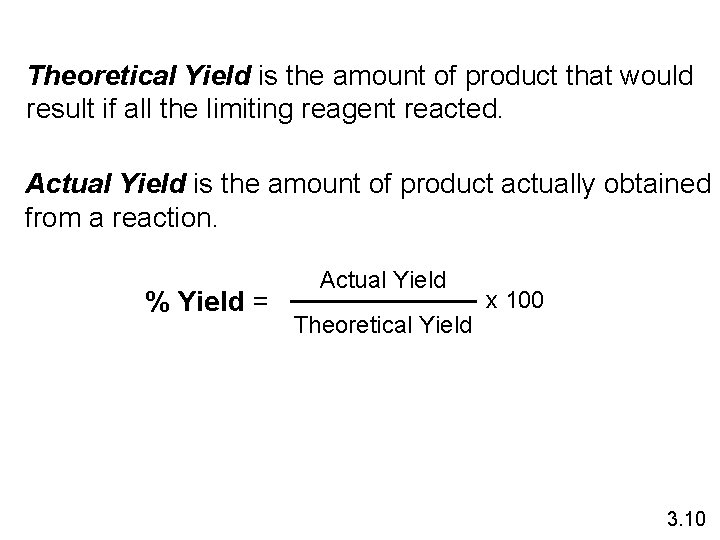
Theoretical Yield is the amount of product that would result if all the limiting reagent reacted. Actual Yield is the amount of product actually obtained from a reaction. % Yield = Actual Yield Theoretical Yield x 100 3. 10
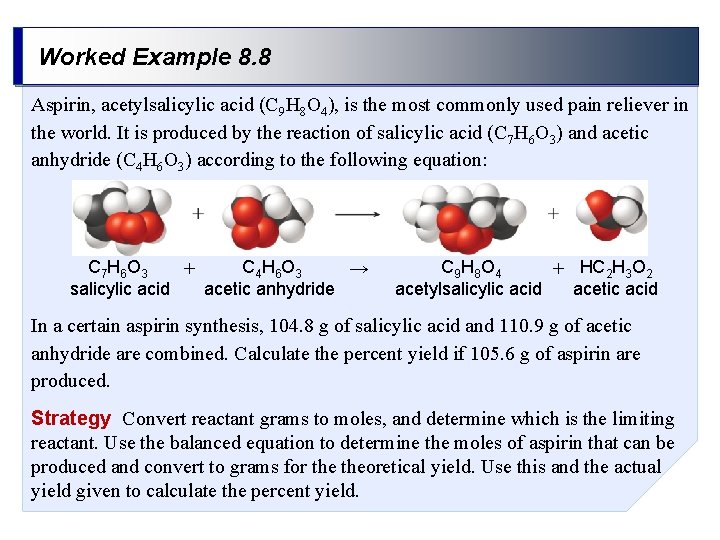
Worked Example 8. 8 Aspirin, acetylsalicylic acid (C 9 H 8 O 4), is the most commonly used pain reliever in the world. It is produced by the reaction of salicylic acid (C 7 H 6 O 3) and acetic anhydride (C 4 H 6 O 3) according to the following equation: C 7 H 6 O 3 C 4 H 6 O 3 + → salicylic acid acetic anhydride C 9 H 8 O 4 + HC 2 H 3 O 2 acetylsalicylic acid acetic acid In a certain aspirin synthesis, 104. 8 g of salicylic acid and 110. 9 g of acetic anhydride are combined. Calculate the percent yield if 105. 6 g of aspirin are produced. Strategy Convert reactant grams to moles, and determine which is the limiting reactant. Use the balanced equation to determine the moles of aspirin that can be produced and convert to grams for theoretical yield. Use this and the actual yield given to calculate the percent yield.
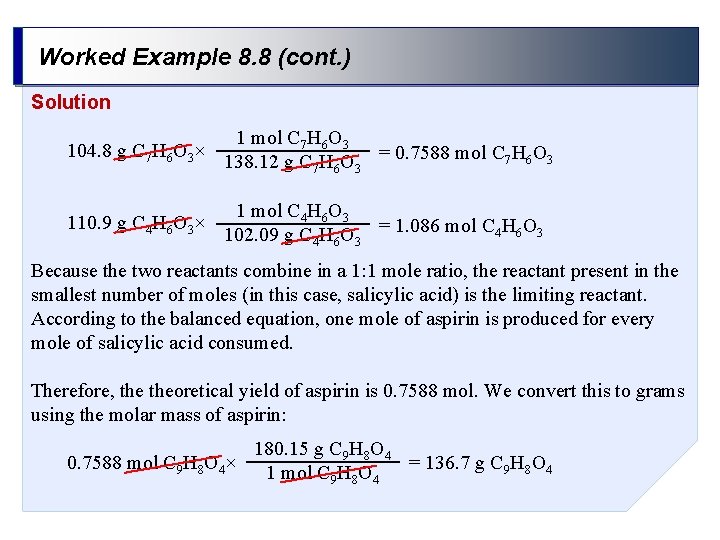
Worked Example 8. 8 (cont. ) Solution 104. 8 g C 7 H 6 O 3× 1 mol C 7 H 6 O 3 138. 12 g C 7 H 6 O 3 = 0. 7588 mol C 7 H 6 O 3 110. 9 g C 4 H 6 O 3× 1 mol C 4 H 6 O 3 102. 09 g C 4 H 6 O 3 = 1. 086 mol C 4 H 6 O 3 Because the two reactants combine in a 1: 1 mole ratio, the reactant present in the smallest number of moles (in this case, salicylic acid) is the limiting reactant. According to the balanced equation, one mole of aspirin is produced for every mole of salicylic acid consumed. Therefore, theoretical yield of aspirin is 0. 7588 mol. We convert this to grams using the molar mass of aspirin: 180. 15 g C 9 H 8 O 4 0. 7588 mol C 9 H 8 O 4× 1 mol C 9 H 8 O 4 = 136. 7 g C 9 H 8 O 4
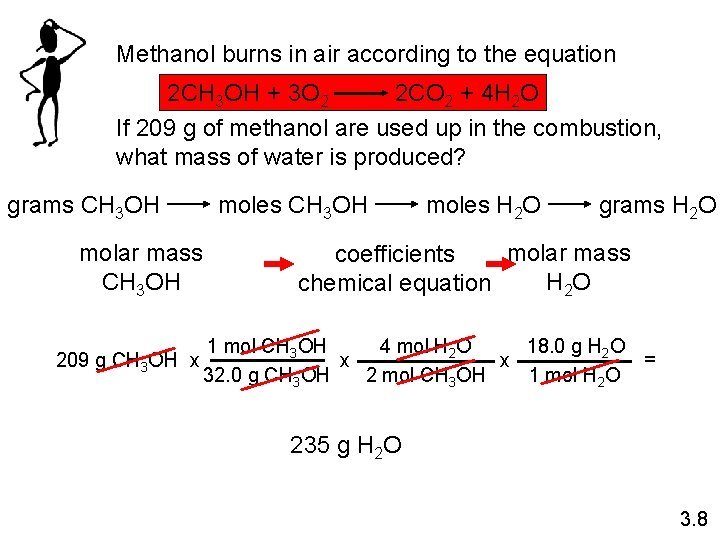
Methanol burns in air according to the equation 2 CH 3 OH + 3 O 2 2 CO 2 + 4 H 2 O If 209 g of methanol are used up in the combustion, what mass of water is produced? grams CH 3 OH moles CH 3 OH molar mass CH 3 OH 209 g CH 3 OH x moles H 2 O grams H 2 O molar mass coefficients H 2 O chemical equation 4 mol H 2 O 18. 0 g H 2 O 1 mol CH 3 OH = x x 32. 0 g CH 3 OH 1 mol H 2 O 2 mol CH 3 OH 235 g H 2 O 3. 8
- Slides: 28