
Chemistry Atoms Compounds and Mixtures Lab Rat Scientific
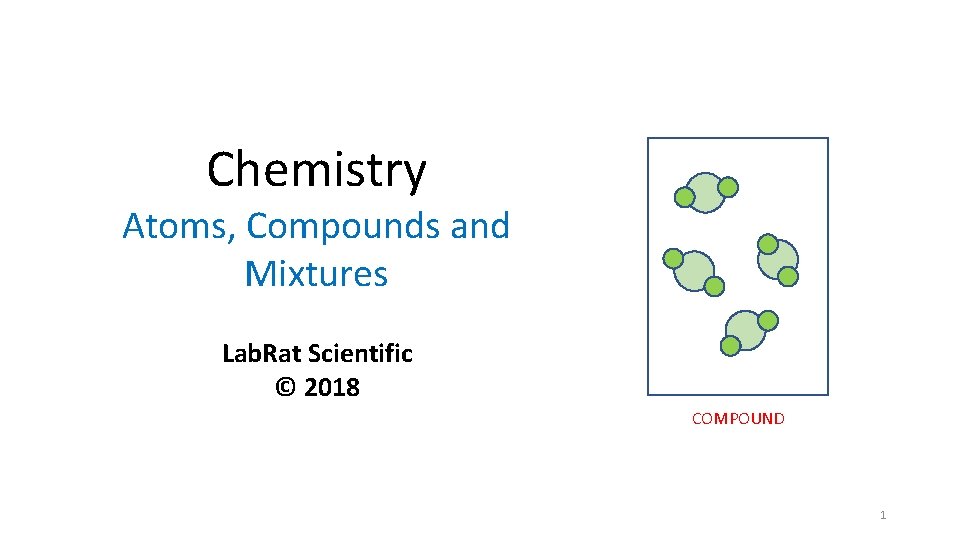
Chemistry Atoms, Compounds and Mixtures Lab. Rat Scientific © 2018 COMPOUND 1
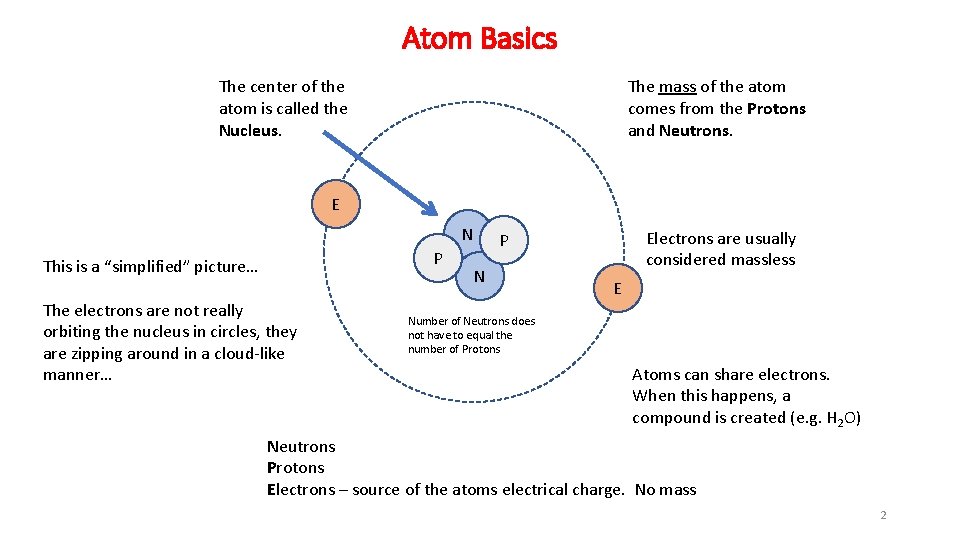
Atom Basics The mass of the atom comes from the Protons and Neutrons. The center of the atom is called the Nucleus. E N P This is a “simplified” picture… The electrons are not really orbiting the nucleus in circles, they are zipping around in a cloud-like manner… Electrons are usually considered massless P N E Number of Neutrons does not have to equal the number of Protons Atoms can share electrons. When this happens, a compound is created (e. g. H 2 O) Neutrons Protons Electrons – source of the atoms electrical charge. No mass 2
Atom Basics • The number of Protons defines the element • Atoms have a neutral charge and thus the Protons (+ charge) are equal in number to Electrons (- charge). ‒ However, atoms can have electrons stripped away or added. When this happens they are known as IONS ‒ The element stays the same (due to the fact that the number of Protons stays the same) • The mass of an atom comes from the Neutrons and Protons ‒ Electrons can be considered massless • The number of neutrons does not have to match the number of protons • The Atomic Number comes from the number of Protons in an atom ‒ The number of protons defines the element 3

Compounds versus Mixtures Or Atoms of Element #1 Atoms of Element #2 MIXTURE In a mixture, the atoms do not chemically combine with one another. An example is mixing salt and pepper – you can still see the separate white salt and the black pepper… COMPOUND In a compound, the atoms chemically combine (share electrons) and a new substance is created. Hydrogen and Oxygen chemically combine to produce water… 4
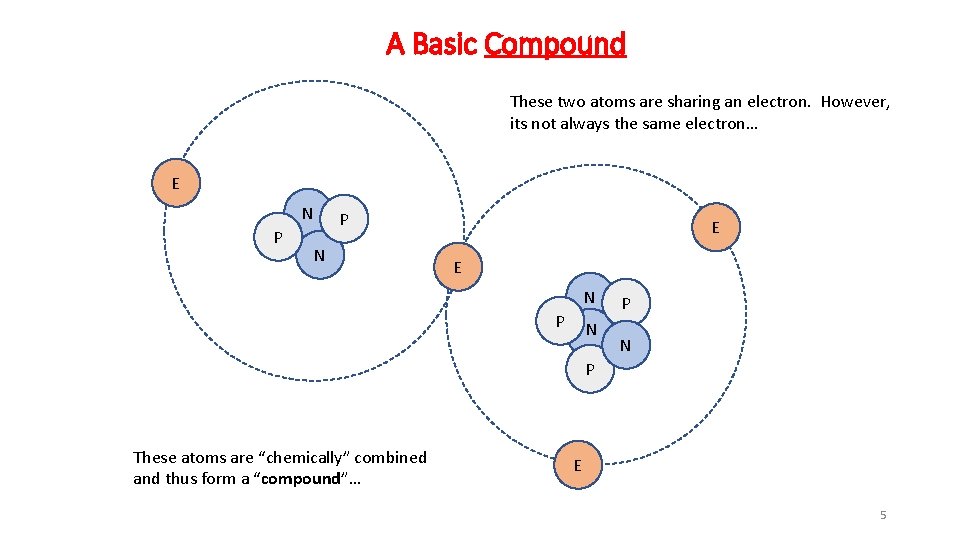
A Basic Compound These two atoms are sharing an electron. However, its not always the same electron… E N P P N E E N P N P These atoms are “chemically” combined and thus form a “compound”… E 5
Atom Bonding Atoms can be bound together in two ways: Covalent Bond = Shared electrons Ionic Bond One atom steals an electron from another. Both atoms then have an electrical charge; one being positive and one being negative. These opposite charges attract… Ionic bonding only occurs with certain atoms. = 6
Questions?
- Slides: 7