
Chemistry and Cells Overview Basic Biochemistry Study of
Chemistry and Cells: Overview

Basic Biochemistry • Study of chemical compositions and reactions of living things • Organic – Molecule with carbon, often large • Inorganic – All other chemcals in the body

Inorganic Molecules • Water • Salts • Acids and Bases
Organic Molecules • Carbohydrates: sugars, energy • Lipids: fats • Protein: major players in cellular structure and function • Nucleic Acids: DNA, RNA
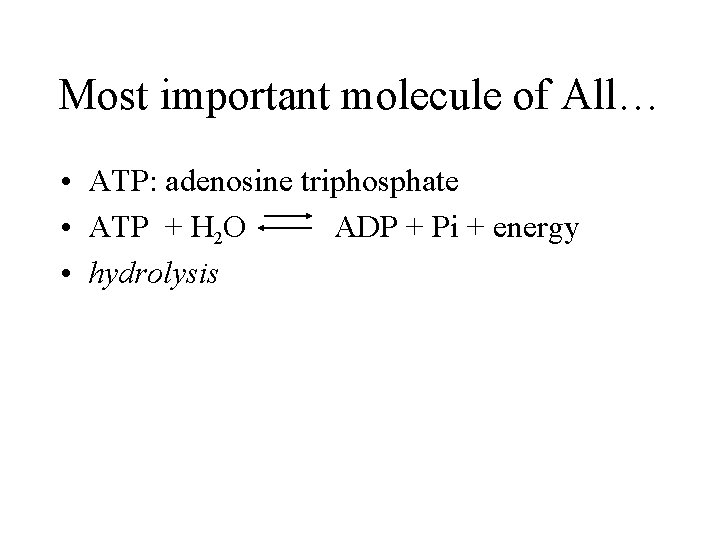
Most important molecule of All… • ATP: adenosine triphosphate • ATP + H 2 O ADP + Pi + energy • hydrolysis
Cell Theory • The cell is the basic unit of life • Every living thing is made of cells • Every cell comes from a pre-existing cell
Parts of the cell • Plasma membrane – Fluid mosaic model – Function: • Protective barrier • Membrane transport • Cytoplasm – Material between the plasma membrane and nucleus – Site where most cellular activities occur
Cytoplasmic Organelles • Mitochondria: “power plants of the cell” – Produce ATP (cellular energy) – Complex organelles, have own DNA and RNA and can reproduce themselves • Ribosomes: site of protein synthesis
Cytoplasmic Organelles • Endoplasmic Reticulum: “network” – Rough • studded with ribosomes • “membrane factory” – Smooth • Involved in synthesis and processing of “fat”
Cytoplasmic Organelles • Golgi Apparatus: “traffic director” – Transports newly formed proteins from the rough ER to their final destination – Modify, concentrate and packages proteins along the way • Lysosomes: the cell’s “demolition crew” – Digests biological molecules – Involved in detoxification
The Nucleus • Control Center: contains entire genetic information • Bound by nuclear envelope • Nucleoli: site of ribosome production • Chromatin: composed of DNA and histones
Cell Life Cycle: Interphase • G 1: cells are active and growing • S: DNA replicates itself • G 2: growth and final preparation for division
Mitotic Phase: M • Prophase: sister chromatids align, mitotic spindle forms • Metaphase: nuclear membrane fragments, centromeres align at equator of mitotic spindle • Anaphase: daughter chromosomes are pulled to opposite sides of the cell • Telophase: new nuclear membrane forms around each set of chromosomes, cleavage of two cells • See figure 3. 30 on pg. 100
Protein Synthsis • Transcription – transfer of information from DNA to complimentary m. RNA (RNA polymerase) – Within nucleus • Translation: – m. RNA travels to ribosome where t. RNA brings appropriate amino acids to align to m. RNA codons
- Slides: 14