
CHEMISTRY AND AP BIO LESSON 1 CHEMISTRY REVIEW
CHEMISTRY AND AP BIO LESSON 1
CHEMISTRY REVIEW Atoms are the basic component for all matter and therefore living organisms Atoms and their bonding are what provide energy for all living organisms Atoms are made up of sub atomic particles Elements are substances that cannot be broken down into other substances with chemical reactions. Ex: Carbon Compounds are two or more elements that may combine in a fixed ratio Ex: Carbon Dioxide, Sodium Chloride

ELEMENTS An element is a pure substance made of only one kind of atom.
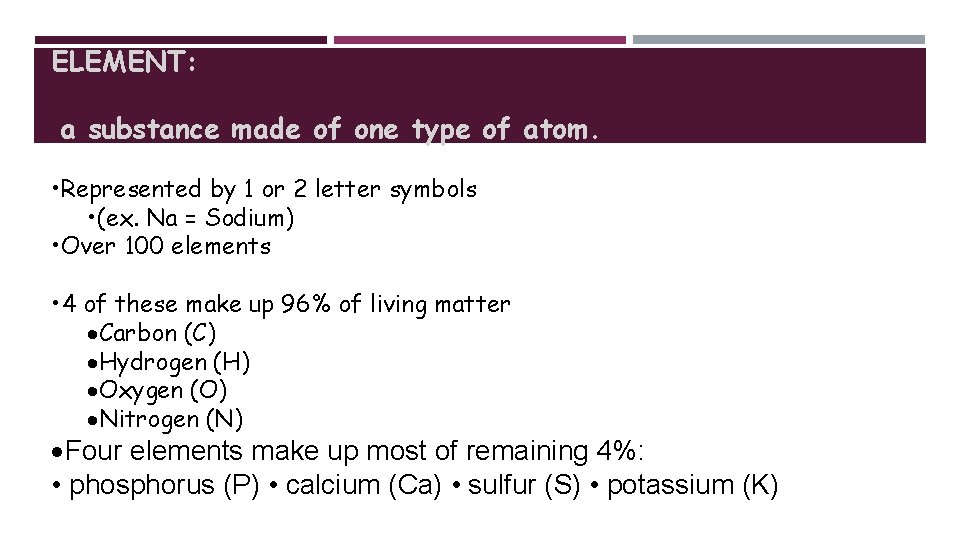
ELEMENT: a substance made of one type of atom. • Represented by 1 or 2 letter symbols • (ex. Na = Sodium) • Over 100 elements • 4 of these make up 96% of living matter Carbon (C) Hydrogen (H) Oxygen (O) Nitrogen (N) Four elements make up most of remaining 4%: • phosphorus (P) • calcium (Ca) • sulfur (S) • potassium (K)
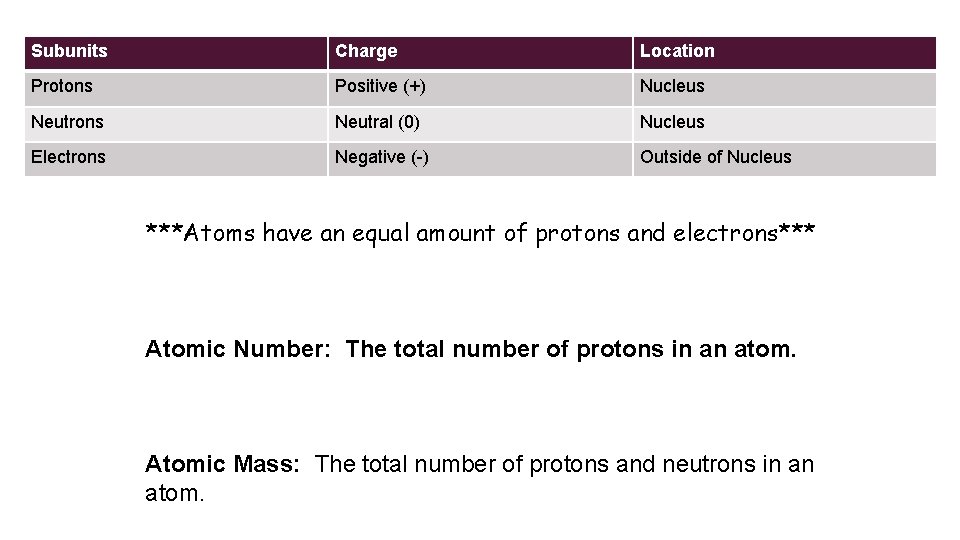
Subunits Charge Location Protons Positive (+) Nucleus Neutrons Neutral (0) Nucleus Electrons Negative (-) Outside of Nucleus ***Atoms have an equal amount of protons and electrons*** Atomic Number: The total number of protons in an atom. Atomic Mass: The total number of protons and neutrons in an atom.
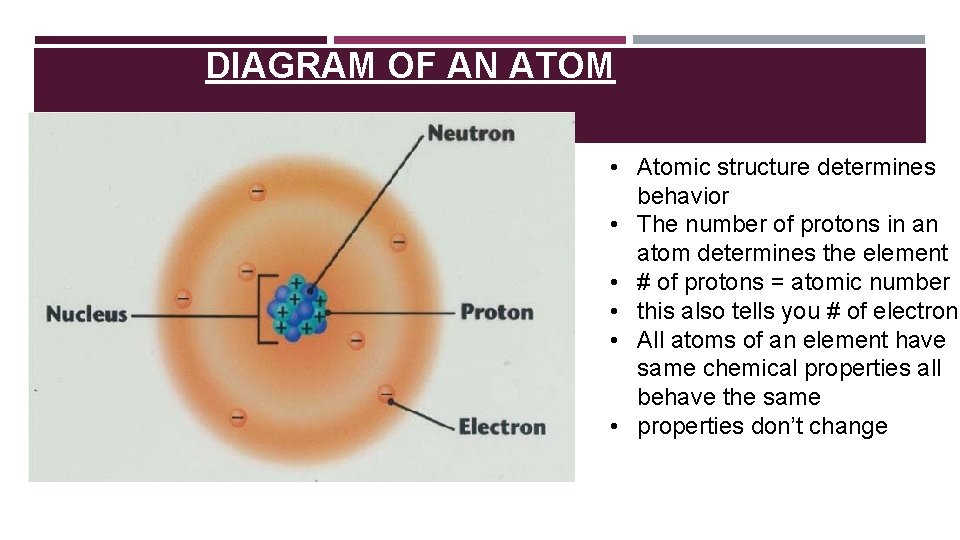
DIAGRAM OF AN ATOM • Atomic structure determines behavior • The number of protons in an atom determines the element • # of protons = atomic number • this also tells you # of electrons • All atoms of an element have same chemical properties all behave the same • properties don’t change

DRAWING AN ATOM Nucleus: center of atom, containing Protons and Neutrons Electron Orbitals: outer shells of atoms containing electrons

ISOTOPE Radioactive form of an element that has the same number of protons, but a different number of neutrons The normal version of carbon is Carbon 12 but the isotope version is Carbon 14. It is formed in the atmosphere due to cosmic rays being absorbed by nitrogen Ex. Uranium 238 - naturally occurring and radioactive 8
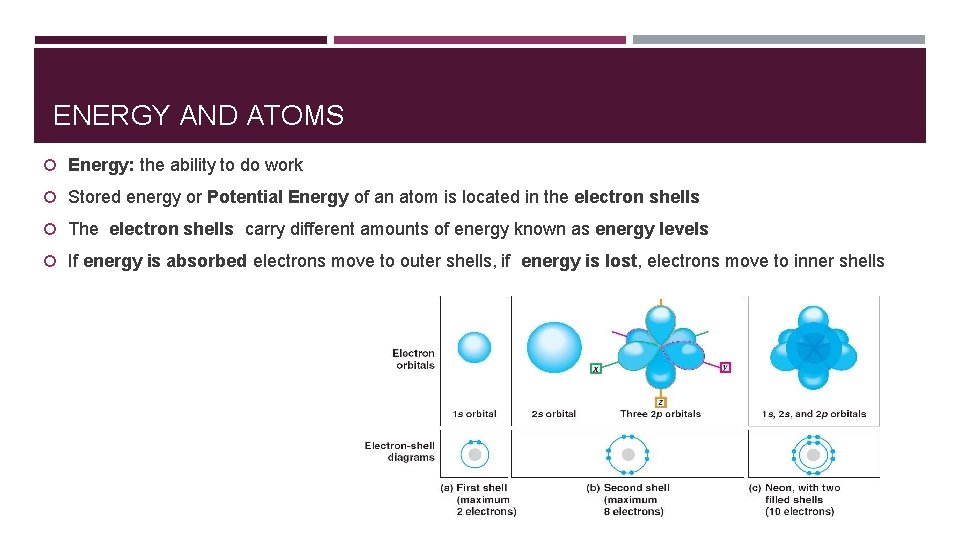
ENERGY AND ATOMS Energy: the ability to do work Stored energy or Potential Energy of an atom is located in the electron shells The electron shells carry different amounts of energy known as energy levels If energy is absorbed electrons move to outer shells, if energy is lost, electrons move to inner shells
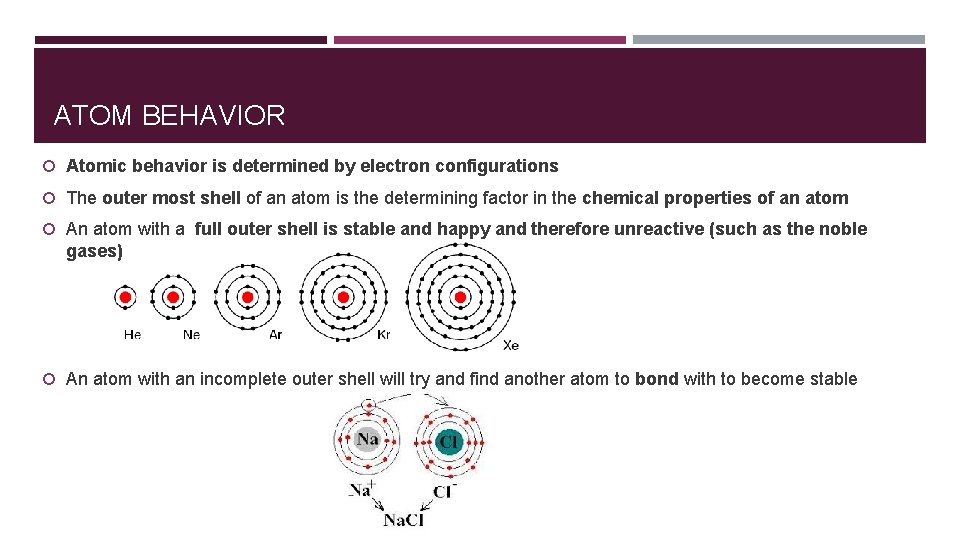
ATOM BEHAVIOR Atomic behavior is determined by electron configurations The outer most shell of an atom is the determining factor in the chemical properties of an atom An atom with a full outer shell is stable and happy and therefore unreactive (such as the noble gases) An atom with an incomplete outer shell will try and find another atom to bond with to become stable
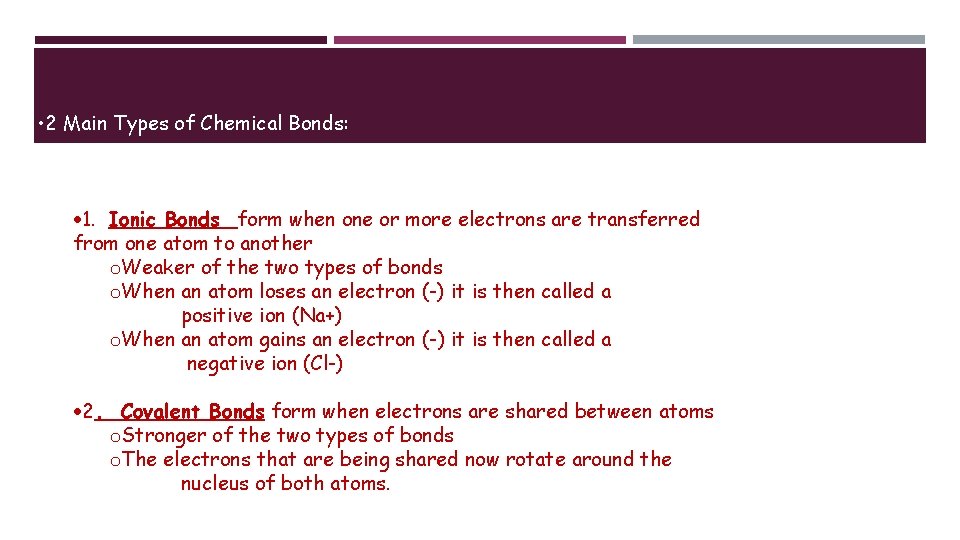
• 2 Main Types of Chemical Bonds: 1. Ionic Bonds form when one or more electrons are transferred from one atom to another o. Weaker of the two types of bonds o. When an atom loses an electron (-) it is then called a positive ion (Na+) o. When an atom gains an electron (-) it is then called a negative ion (Cl-) 2. Covalent Bonds form when electrons are shared between atoms o. Stronger of the two types of bonds o. The electrons that are being shared now rotate around the nucleus of both atoms.
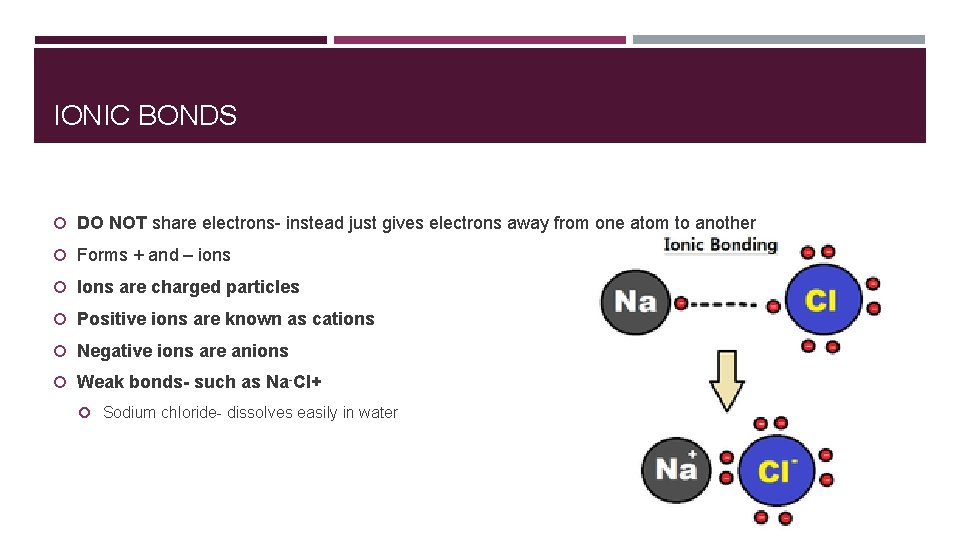
IONIC BONDS DO NOT share electrons- instead just gives electrons away from one atom to another Forms + and – ions Ions are charged particles Positive ions are known as cations Negative ions are anions Weak bonds- such as Na-Cl+ Sodium chloride- dissolves easily in water
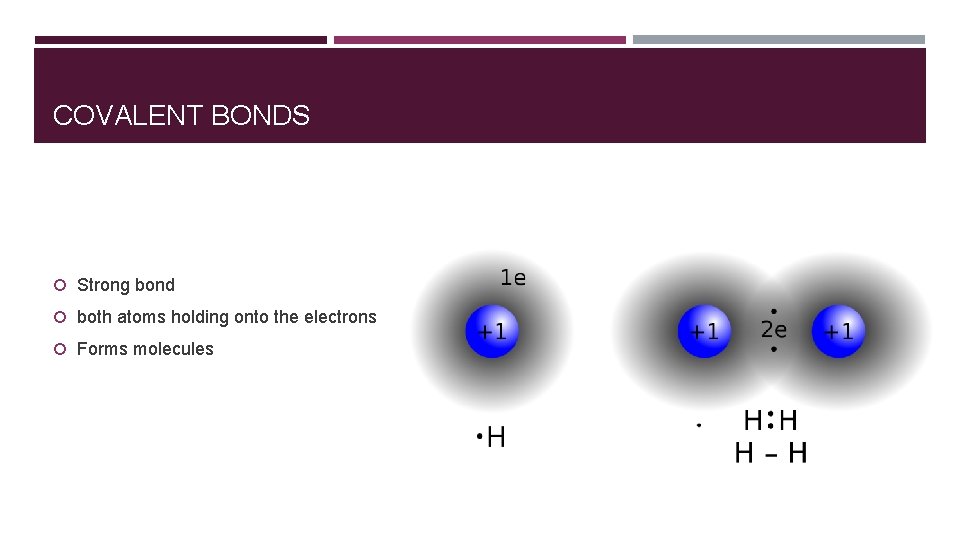
COVALENT BONDS Strong bond both atoms holding onto the electrons Forms molecules
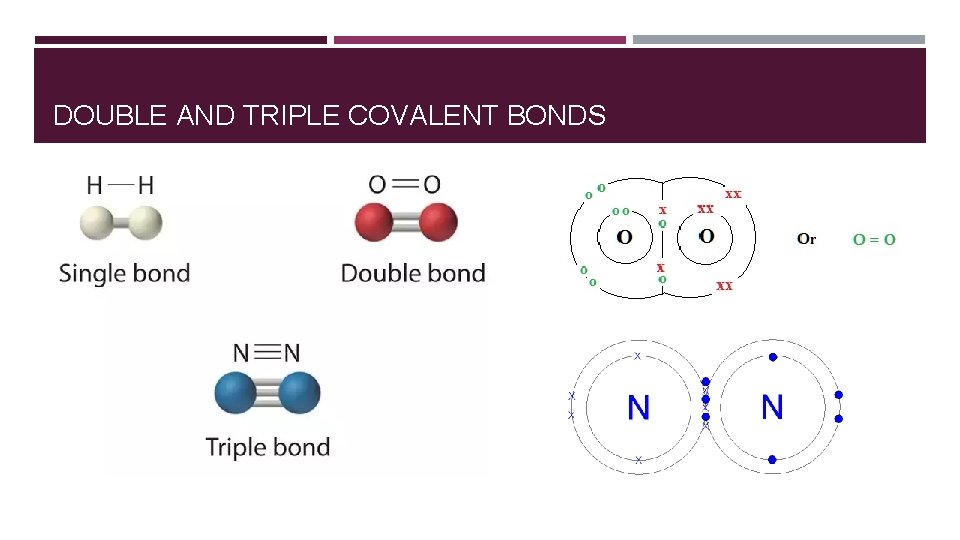
DOUBLE AND TRIPLE COVALENT BONDS
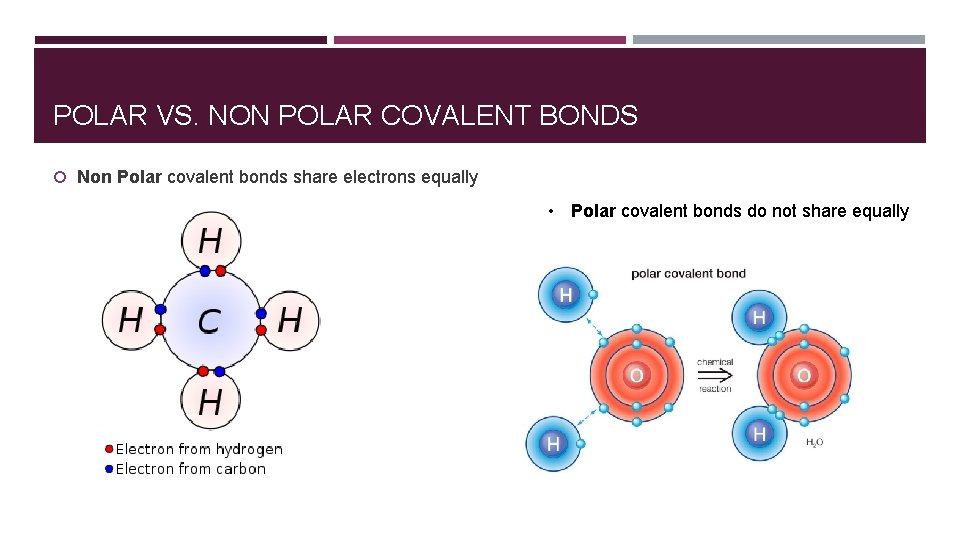
POLAR VS. NON POLAR COVALENT BONDS Non Polar covalent bonds share electrons equally • Polar covalent bonds do not share equally
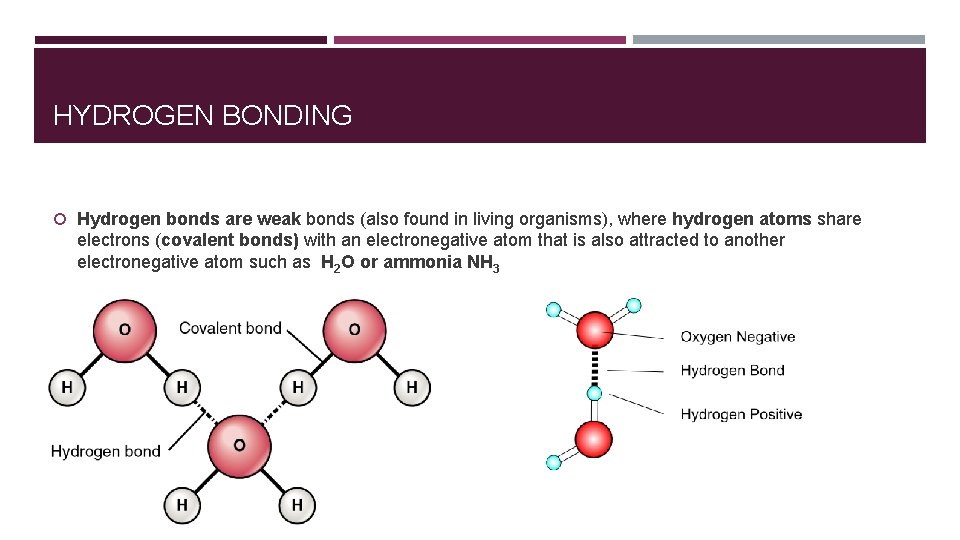
HYDROGEN BONDING Hydrogen bonds are weak bonds (also found in living organisms), where hydrogen atoms share electrons (covalent bonds) with an electronegative atom that is also attracted to another electronegative atom such as H 2 O or ammonia NH 3
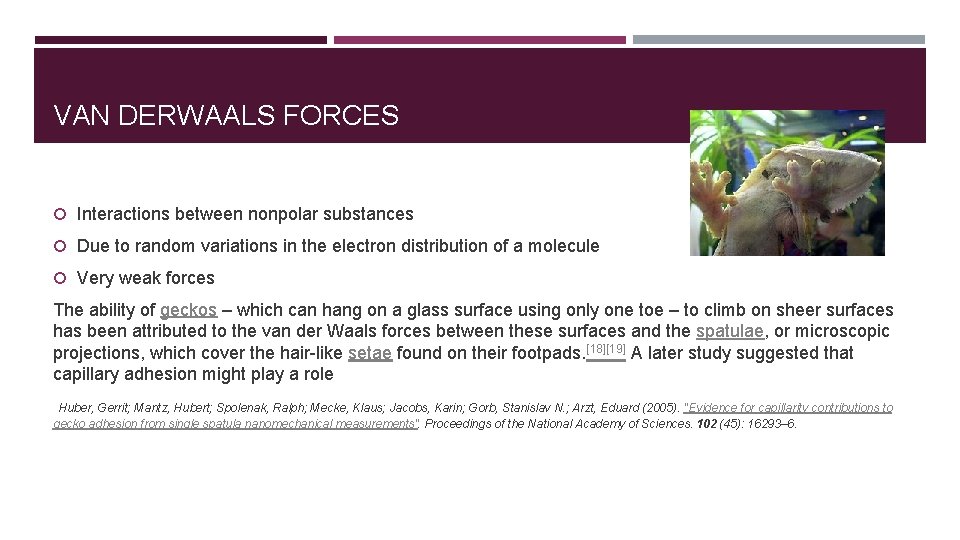
VAN DERWAALS FORCES Interactions between nonpolar substances Due to random variations in the electron distribution of a molecule Very weak forces The ability of geckos – which can hang on a glass surface using only one toe – to climb on sheer surfaces has been attributed to the van der Waals forces between these surfaces and the spatulae, or microscopic projections, which cover the hair-like setae found on their footpads. [18][19] A later study suggested that capillary adhesion might play a role Huber, Gerrit; Mantz, Hubert; Spolenak, Ralph; Mecke, Klaus; Jacobs, Karin; Gorb, Stanislav N. ; Arzt, Eduard (2005). "Evidence for capillarity contributions to gecko adhesion from single spatula nanomechanical measurements". Proceedings of the National Academy of Sciences. 102 (45): 16293– 6.
- Slides: 17