
Chemistry 9 Chemistry of the Atmosphere Section 1
- Slides: 1
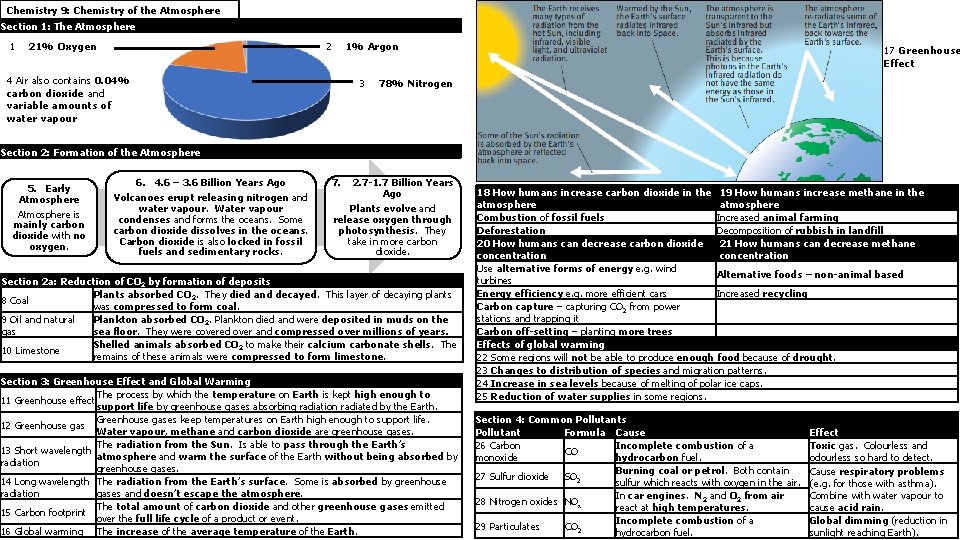
Chemistry 9: Chemistry of the Atmosphere Section 1: The Atmosphere 1 21% Oxygen 2 1% Argon 4 Air also contains 0. 04% carbon dioxide and variable amounts of water vapour 3 17 Greenhouse Effect 78% Nitrogen Section 2: Formation of the Atmosphere 5. Early Atmosphere is mainly carbon dioxide with no oxygen. 6. 4. 6 – 3. 6 Billion Years Ago Volcanoes erupt releasing nitrogen and water vapour. Water vapour condenses and forms the oceans. Some carbon dioxide dissolves in the oceans. Carbon dioxide is also locked in fossil fuels and sedimentary rocks. 7. 2. 7 -1. 7 Billion Years Ago Plants evolve and release oxygen through photosynthesis. They take in more carbon dioxide. Section 2 a: Reduction of CO 2 by formation of deposits Plants absorbed CO 2. They died and decayed. This layer of decaying plants 8 Coal was compressed to form coal. 9 Oil and natural Plankton absorbed CO 2. Plankton died and were deposited in muds on the gas sea floor. They were covered over and compressed over millions of years. Shelled animals absorbed CO 2 to make their calcium carbonate shells. The 10 Limestone remains of these animals were compressed to form limestone. Section 3: Greenhouse Effect and Global Warming The process by which the temperature on Earth is kept high enough to 11 Greenhouse effect support life by greenhouse gases absorbing radiation radiated by the Earth. Greenhouse gases keep temperatures on Earth high enough to support life. 12 Greenhouse gas Water vapour, methane and carbon dioxide are greenhouse gases. The radiation from the Sun. Is able to pass through the Earth’s 13 Short wavelength atmosphere and warm the surface of the Earth without being absorbed by radiation greenhouse gases. 14 Long wavelength The radiation from the Earth’s surface. Some is absorbed by greenhouse radiation gases and doesn’t escape the atmosphere. The total amount of carbon dioxide and other greenhouse gases emitted 15 Carbon footprint over the full life cycle of a product or event. 16 Global warming The increase of the average temperature of the Earth. 18 How humans increase carbon dioxide in the 19 How humans increase methane in the atmosphere Combustion of fossil fuels Increased animal farming Deforestation Decomposition of rubbish in landfill 20 How humans can decrease carbon dioxide 21 How humans can decrease methane concentration Use alternative forms of energy e. g. wind Alternative foods – non-animal based turbines Energy efficiency e. g. more efficient cars Increased recycling Carbon capture – capturing CO 2 from power stations and trapping it Carbon off-setting – planting more trees Effects of global warming 22 Some regions will not be able to produce enough food because of drought. 23 Changes to distribution of species and migration patterns. 24 Increase in sea levels because of melting of polar ice caps. 25 Reduction of water supplies in some regions. Section 4: Common Pollutants Pollutant Formula Cause 26 Carbon Incomplete combustion of a CO monoxide hydrocarbon fuel. Burning coal or petrol. Both contain 27 Sulfur dioxide SO 2 sulfur which reacts with oxygen in the air. In car engines. N 2 and O 2 from air 28 Nitrogen oxides NOx react at high temperatures. Incomplete combustion of a 29 Particulates CO 2 hydrocarbon fuel. Effect Toxic gas. Colourless and odourless so hard to detect. Cause respiratory problems (e. g. for those with asthma). Combine with water vapour to cause acid rain. Global dimming (reduction in sunlight reaching Earth).