
Chemistry 48101 Winter 2003 Instructor Dr Upali Siriwardane



- Slides: 45
Chemistry 481(01) Winter 2003 • Instructor: Dr. Upali Siriwardane • e-mail: upali@chem. latech. edu • Office: CTH 311 Phone 257 -4941 • Office Hours: • 8: 00 -9: 00 a. m. & 11: 00 -12: 00 a. m. M, W; • 8: 00 -10: 00 a. m. Tu, Th, F. • April 10, 2003(Test 1): Chapter 4, 5 & 6 • April 24, 2003 (Test 2): Chapter 7, 8 -12, & 13 • May 22, 2003 (Test 3) Chapter 14, 16 &17 • May 23, Make Up: Comprehensive covering all Chapters
Reaction mechanisms of d-metal Complexes NIKAM N. D. DEPARTMENT OF CHEMISTRY
Reactions of Metal Complexes Formation constants – the chelate effect – Irving William Series – Lability Reaction Mechanisms – I, A, D Mechanisms – a, d Rate Determining Step Substitution of Square Planar Complexes – the trans effect Substitution of Octahedral Complexes
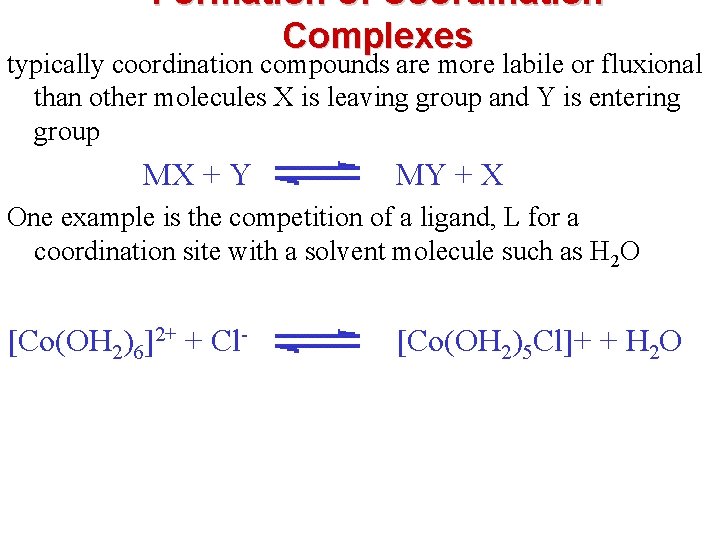
Formation of Coordination Complexes typically coordination compounds are more labile or fluxional than other molecules X is leaving group and Y is entering group MX + Y MY + X One example is the competition of a ligand, L for a coordination site with a solvent molecule such as H 2 O [Co(OH 2)6]2+ + Cl- [Co(OH 2)5 Cl]+ + H 2 O
Formation Constants Consider formation as a series of formation equilibria: Summarized as:
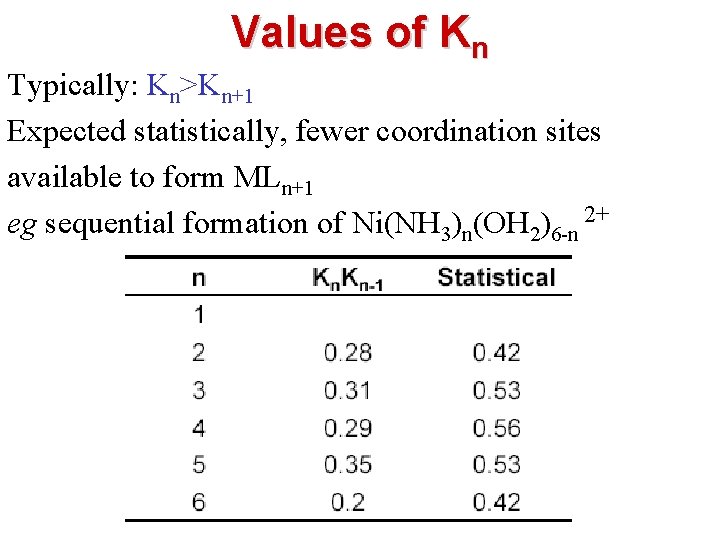
Values of Kn Typically: Kn>Kn+1 Expected statistically, fewer coordination sites available to form MLn+1 eg sequential formation of Ni(NH 3)n(OH 2)6 -n 2+
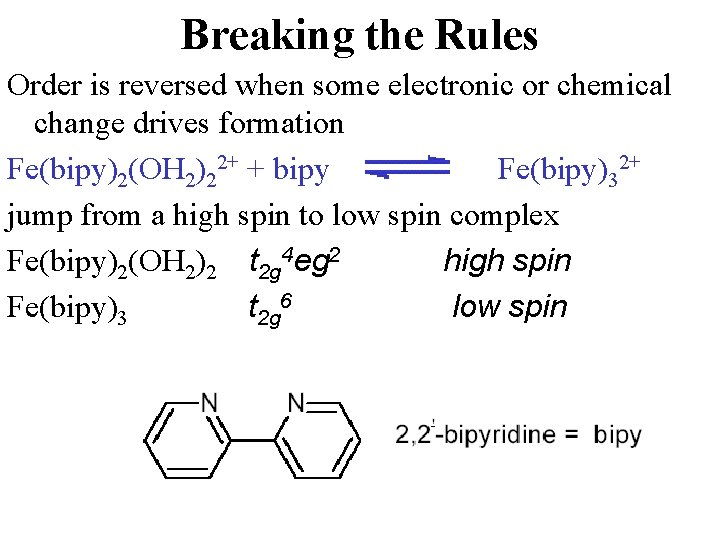
Breaking the Rules Order is reversed when some electronic or chemical change drives formation Fe(bipy)2(OH 2)22+ + bipy Fe(bipy)32+ jump from a high spin to low spin complex Fe(bipy)2(OH 2)2 t 2 g 4 eg 2 high spin Fe(bipy)3 t 2 g 6 low spin
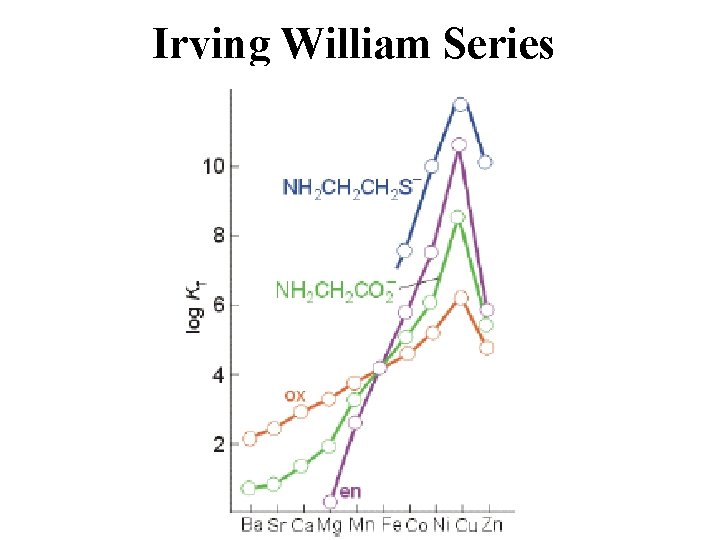
Irving William Series Values of log Kf for 2+ ions including transition metal species acidity (acceptance of e-) increases across the per. table, thus forming more and more stable complexes for the same ligand system Kf series for transition metals: Mn 2+< Fe 2+ < Co 2+ < Ni 2+ < Cu 2+ >Zn 2+
Irving William Series
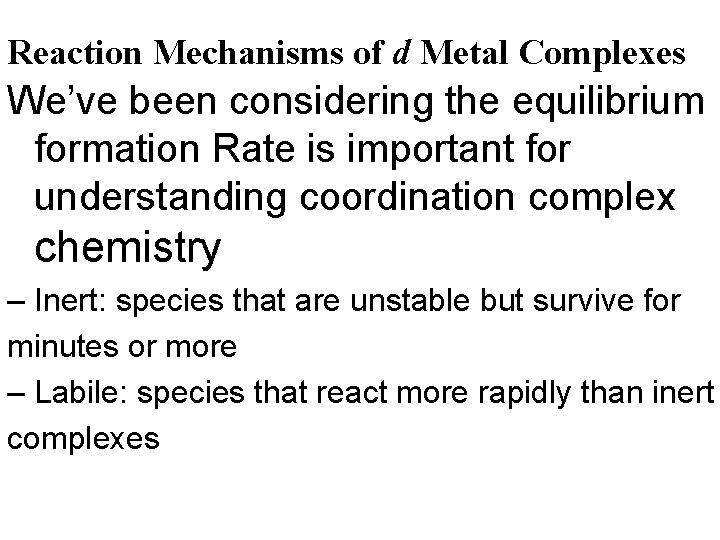
Reaction Mechanisms of d Metal Complexes We’ve been considering the equilibrium formation Rate is important for understanding coordination complex chemistry – Inert: species that are unstable but survive for minutes or more – Labile: species that react more rapidly than inert complexes
Labile vs. Inert General Rules: – For 2+ ion, d metals are moderately labile particularly d 10 (Hg 2+, Zn 2+) – Strong field d 3 and d 6 octahedral complexes are inert. i. e. Cr(III) and Co(III) – Increasing Ligand Field Stabilization Energy improves inertness – 2 nd and 3 rd row metals are generally more inert
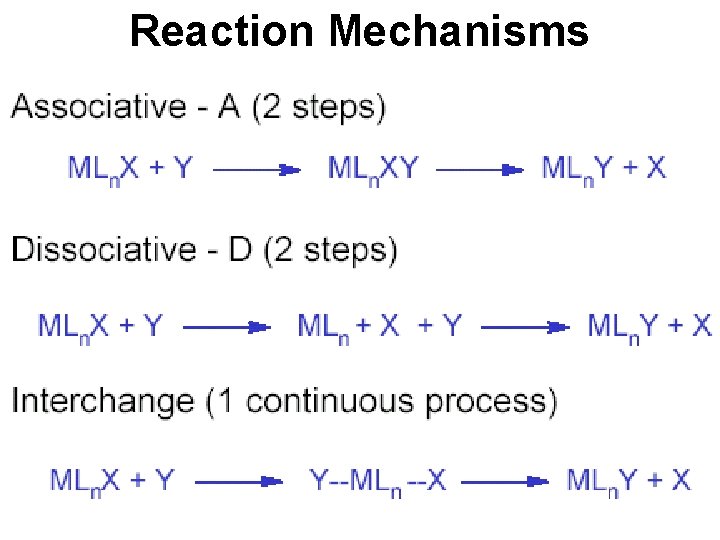
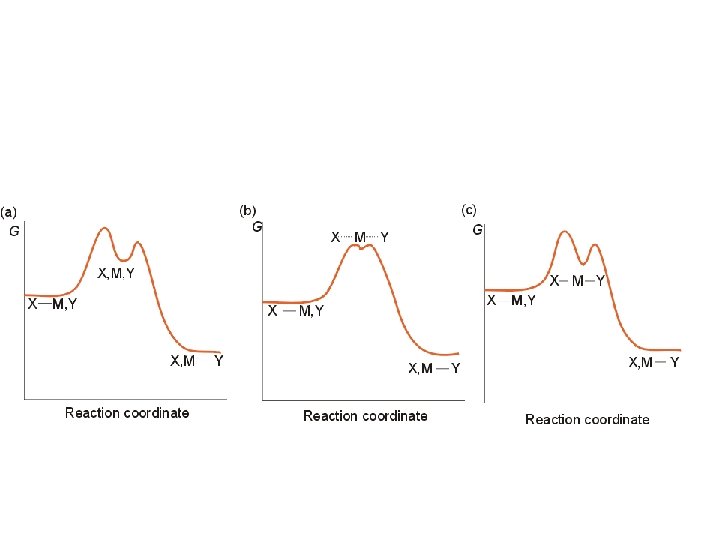
Associative vs Dissociative Reactions • Ligand substitution reactions are either associative or dissociative – Associative: reaction intermediate has higher coordination number than reactants or products • lower coordination number complexes • Rates depend on the entering group – Dissociative: reaction intermediate has lower coordination number than reactants or products • Octahedral complexes and smaller metal centers • Rates depend on leaving group
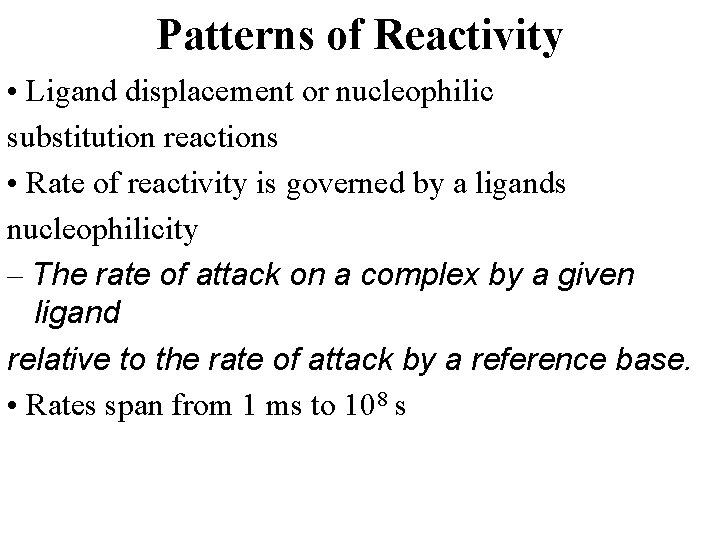
Patterns of Reactivity • Ligand displacement or nucleophilic substitution reactions • Rate of reactivity is governed by a ligands nucleophilicity – The rate of attack on a complex by a given ligand relative to the rate of attack by a reference base. • Rates span from 1 ms to 108 s
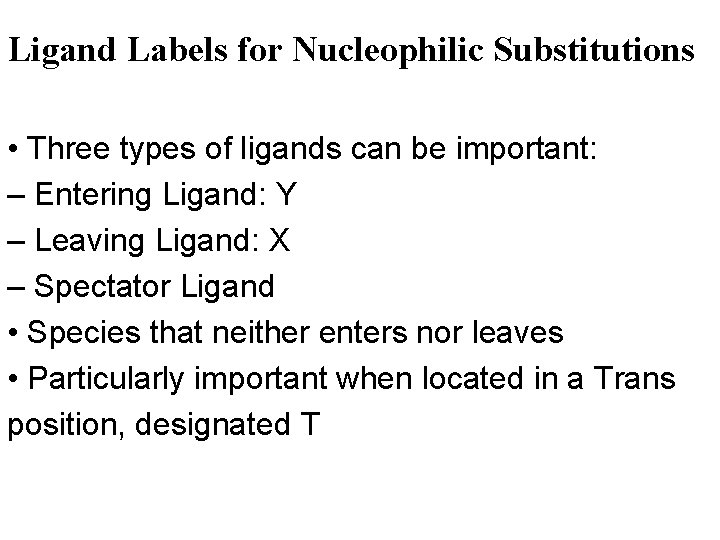
Ligand Labels for Nucleophilic Substitutions • Three types of ligands can be important: – Entering Ligand: Y – Leaving Ligand: X – Spectator Ligand • Species that neither enters nor leaves • Particularly important when located in a Trans position, designated T
Reaction Mechanisms
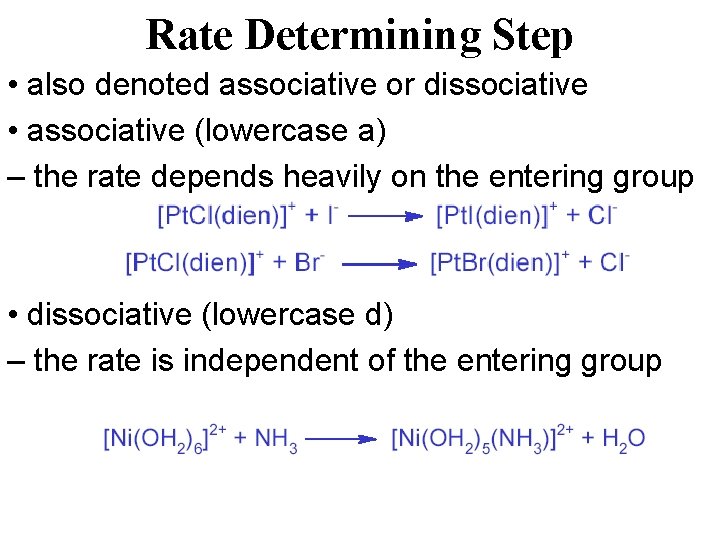
Rate Determining Step • also denoted associative or dissociative • associative (lowercase a) – the rate depends heavily on the entering group • dissociative (lowercase d) – the rate is independent of the entering group
Substitution of Square Planar Complexes • substitution of square planar complexes is almost always Aa mechanisms – rate depends on the entering group – rate determining step is the M-Y bond formation • impacted by the Trans effect – the ligand trans to the leaving ligand (X) can alter the reaction rate
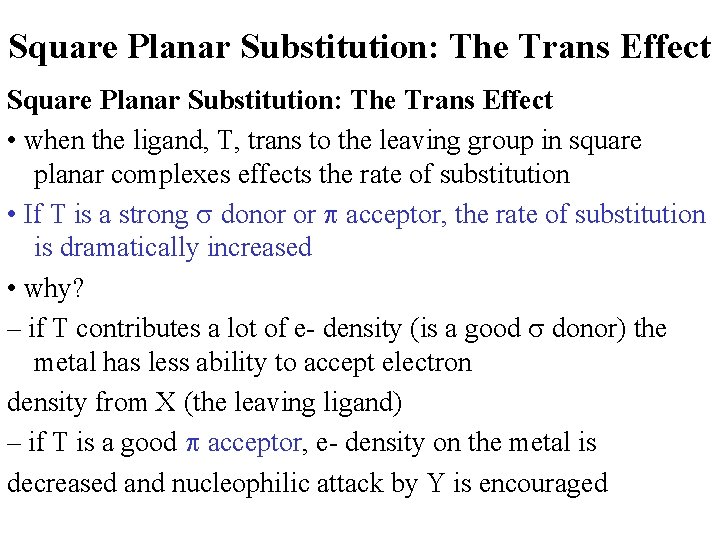
Square Planar Substitution: The Trans Effect • when the ligand, T, trans to the leaving group in square planar complexes effects the rate of substitution • If T is a strong s donor or p acceptor, the rate of substitution is dramatically increased • why? – if T contributes a lot of e- density (is a good s donor) the metal has less ability to accept electron density from X (the leaving ligand) – if T is a good p acceptor, e- density on the metal is decreased and nucleophilic attack by Y is encouraged
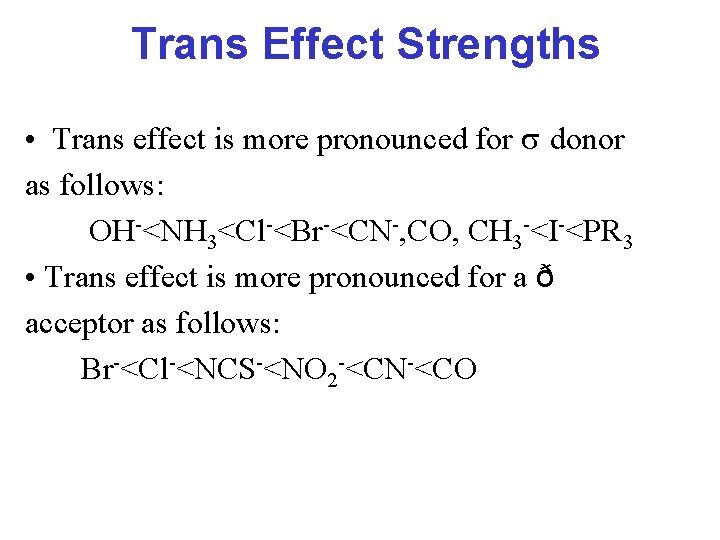
Trans Effect Strengths • Trans effect is more pronounced for s donor as follows: OH-<NH 3<Cl-<Br-<CN-, CO, CH 3 -<I-<PR 3 • Trans effect is more pronounced for a ð acceptor as follows: Br-<Cl-<NCS-<NO 2 -<CN-<CO
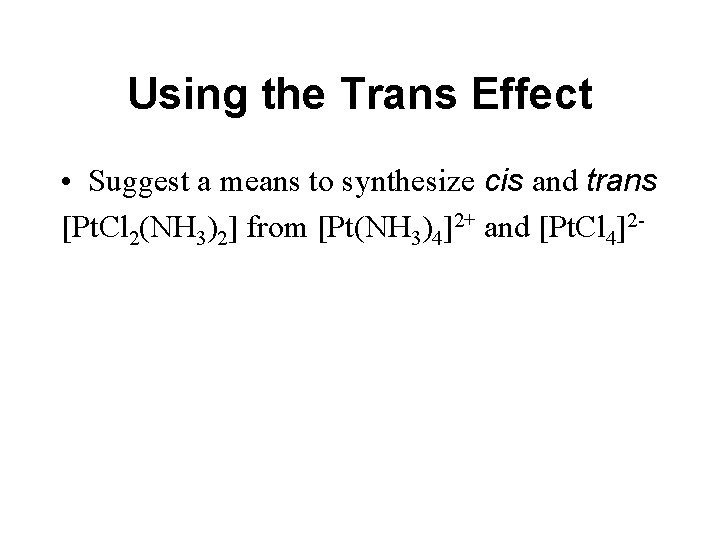
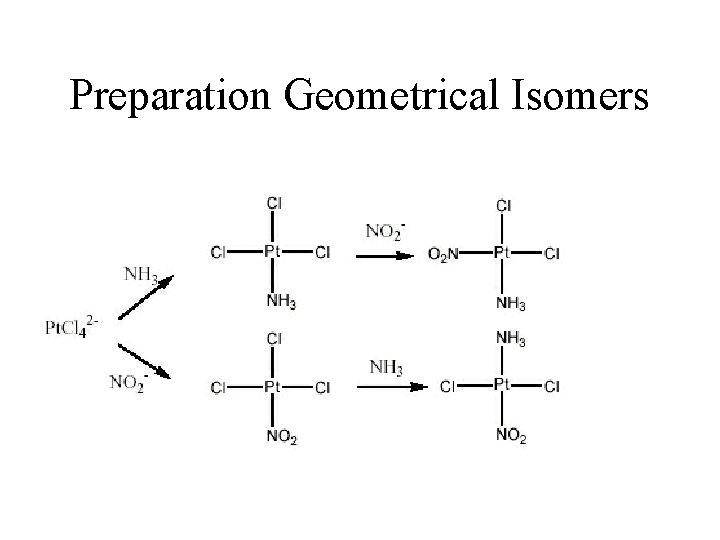
Using the Trans Effect • Suggest a means to synthesize cis and trans [Pt. Cl 2(NH 3)2] from [Pt(NH 3)4]2+ and [Pt. Cl 4]2 -
Preparation Geometrical Isomers
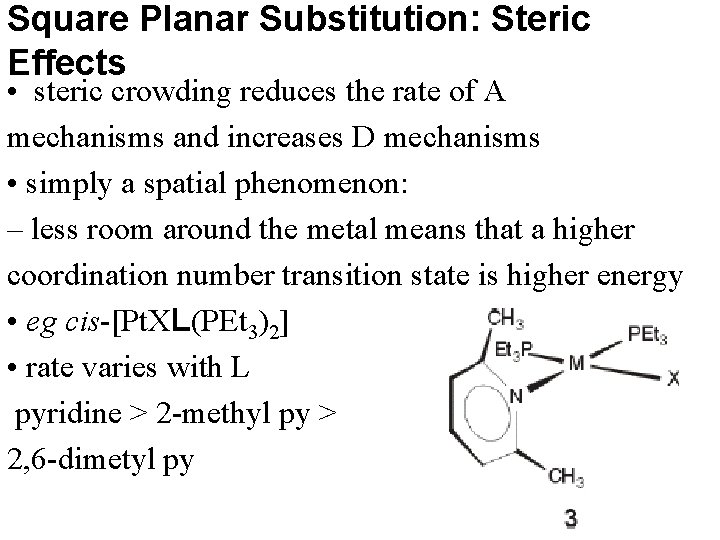
Square Planar Substitution: Steric Effects • steric crowding reduces the rate of A mechanisms and increases D mechanisms • simply a spatial phenomenon: – less room around the metal means that a higher coordination number transition state is higher energy • eg cis-[Pt. XL(PEt 3)2] • rate varies with L pyridine > 2 -methyl py > 2, 6 -dimetyl py
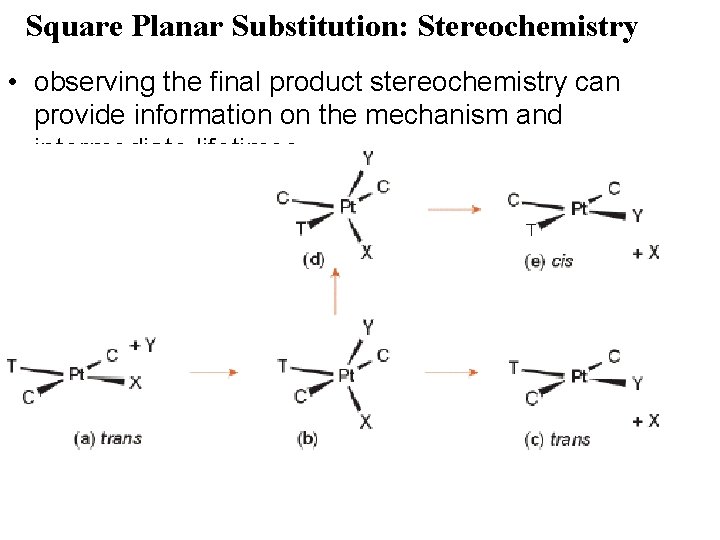
Square Planar Substitution: Stereochemistry • observing the final product stereochemistry can provide information on the mechanism and intermediate lifetimes
Square Planar Substitution: Volume of activation • changes in volume along a reaction pathway can be determined • usually by observing reaction rate as a function of pressure • a negative DV‡ suggests an associative complex
Square Planar Substitution: Entropy of Activation • the change in entropy from the reactants to the activated complex is DS‡ • determined by the temperature dependence of the rate • associative mechanism has –’ve DS‡ • as expected from increasing order of the system by loss of freedom for the entering group without release of the leaving group
Substitution of Square Planar Complexes • Trans Effect – ligand trans to X can increase substitution if it is a good s donor or p acceptor • Steric Effects – bulky cis ligands reduce Y nucleophilic attack • Stereochemistry – cis/trans conserved for A mechanism unless activated complex is long lived • DV‡ and DS‡ are both negative for A mechanism
Substitution of Octahedral Complexes • I is the most important reaction mechanism for substitution of Oh complexes • but is it Ia or Id – recall it depends on the rate determining step being Y—M formation vs M—X breaking – associative (lowercase a) • the rate depends heavily on the entering group – dissociative (lowercase d) • the rate is independent of the entering group
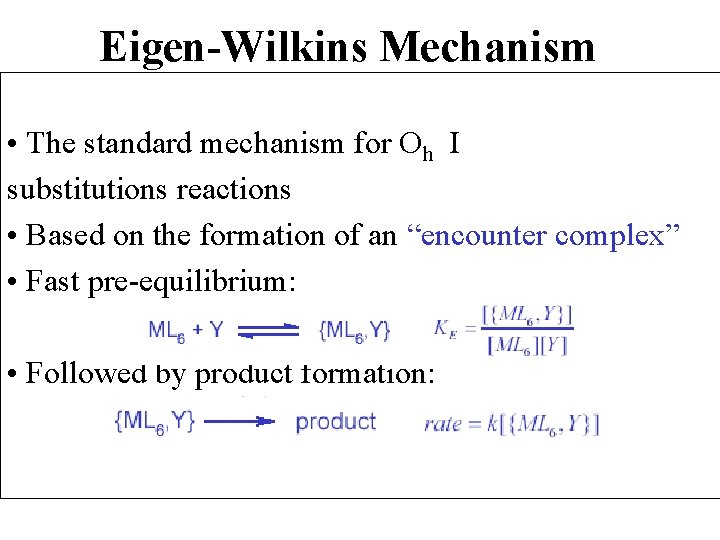
Eigen-Wilkins Mechanism • The standard mechanism for Oh I substitutions reactions • Based on the formation of an “encounter complex” • Fast pre-equilibrium: • Followed by product formation:
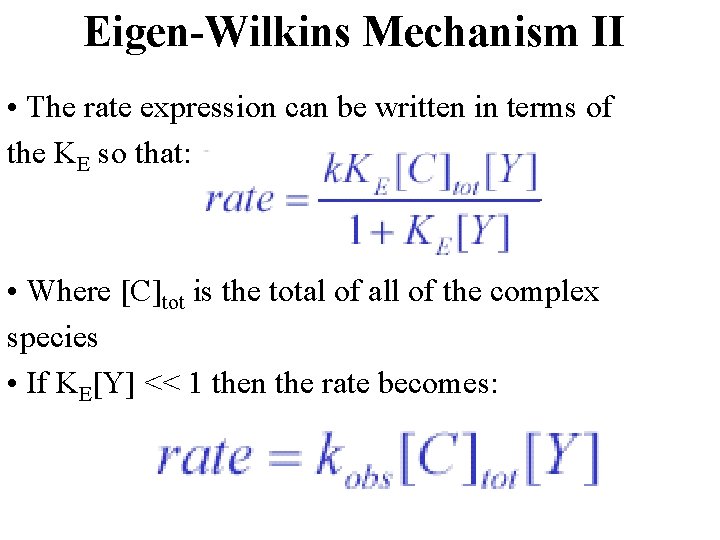
Eigen-Wilkins Mechanism II • The rate expression can be written in terms of the KE so that: • Where [C]tot is the total of all of the complex species • If KE[Y] << 1 then the rate becomes:
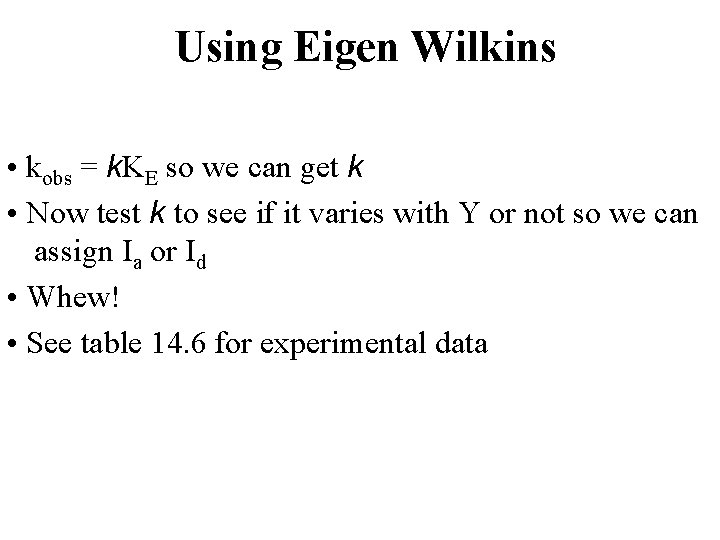
Using Eigen Wilkins • kobs = k. KE so we can get k • Now test k to see if it varies with Y or not so we can assign Ia or Id • Whew! • See table 14. 6 for experimental data
Oh Substitution General Rules • Most 3 d metals undergo Id substitutions – I. e. the rate determining step is independent of the entering group and primarily is the breaking of the M—X bond • Larger metals (4 d, 5 d) lean towards Ia • Also low d electron density encourages partly Ia characteristics
Oh: Effects of Ligands • Leaving Group – Nature of X is important as expected for Id as bond breaking of M-X is the rate determining step • Spectator ligands (cis-trans effect) – No clear trans effect for Oh complexes – In general, good spectator sigma donors will stabilize the complex after the departure of the leaving group
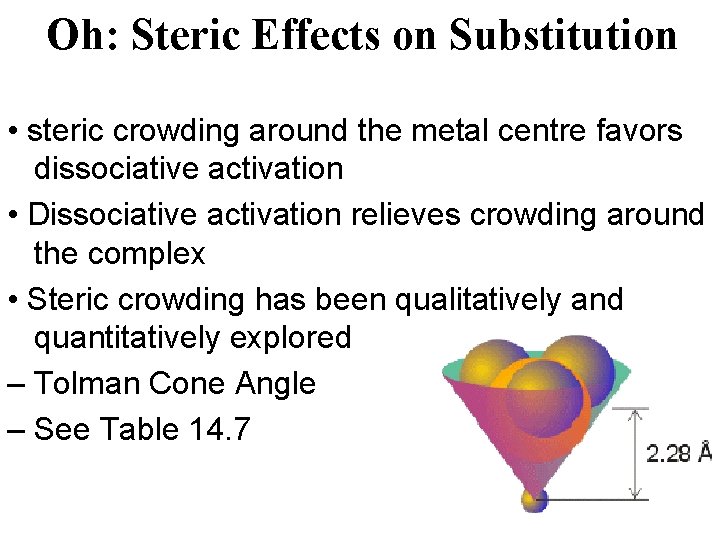
Oh: Steric Effects on Substitution • steric crowding around the metal centre favors dissociative activation • Dissociative activation relieves crowding around the complex • Steric crowding has been qualitatively and quantitatively explored – Tolman Cone Angle – See Table 14. 7
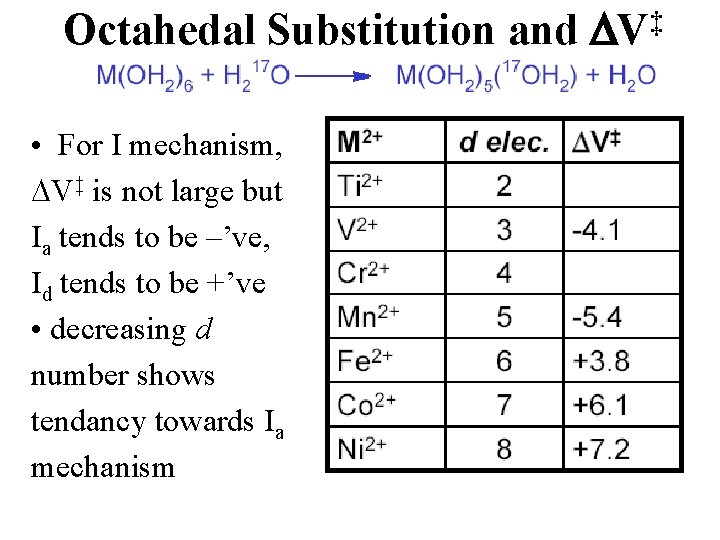
Octahedal Substitution and DV‡ • For I mechanism, DV‡ is not large but Ia tends to be –’ve, Id tends to be +’ve • decreasing d number shows tendancy towards Ia mechanism
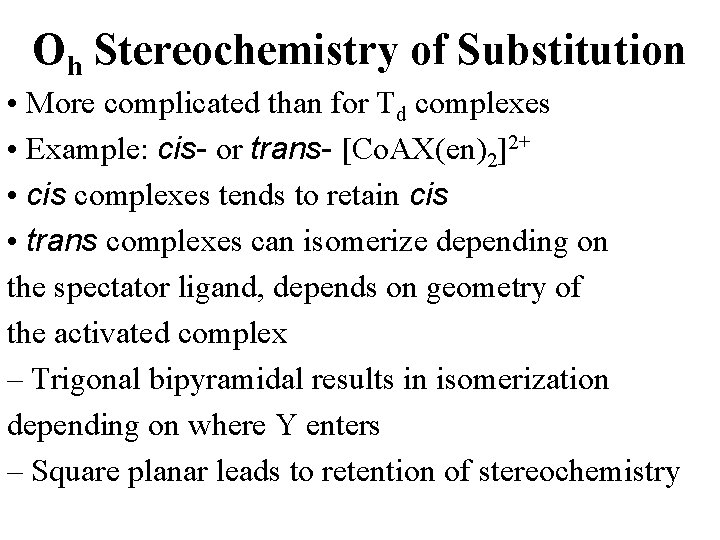
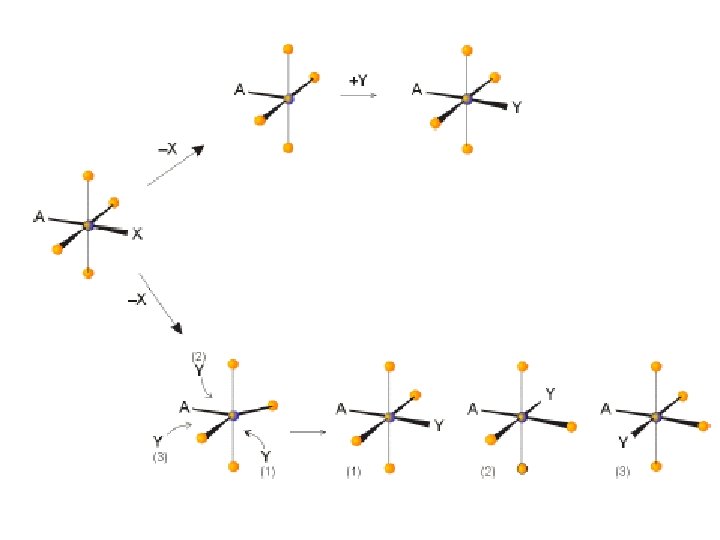
Oh Stereochemistry of Substitution • More complicated than for Td complexes • Example: cis- or trans- [Co. AX(en)2]2+ • cis complexes tends to retain cis • trans complexes can isomerize depending on the spectator ligand, depends on geometry of the activated complex – Trigonal bipyramidal results in isomerization depending on where Y enters – Square planar leads to retention of stereochemistry
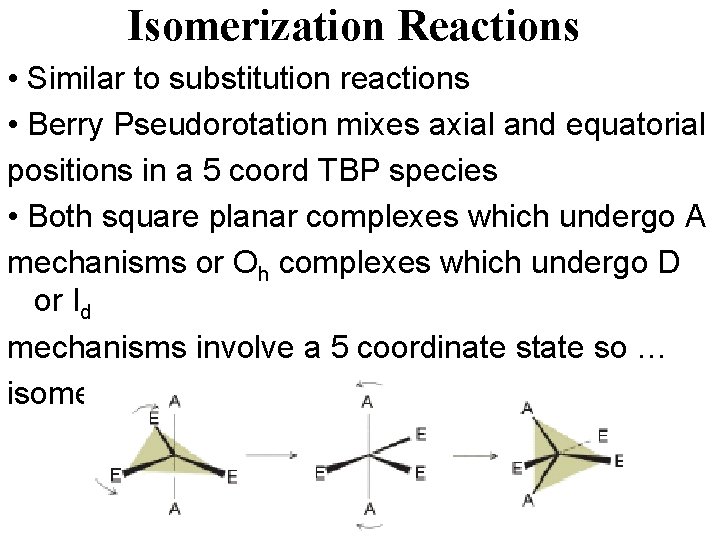
Isomerization Reactions • Similar to substitution reactions • Berry Pseudorotation mixes axial and equatorial positions in a 5 coord TBP species • Both square planar complexes which undergo A mechanisms or Oh complexes which undergo D or Id mechanisms involve a 5 coordinate state so … isomerization is possible
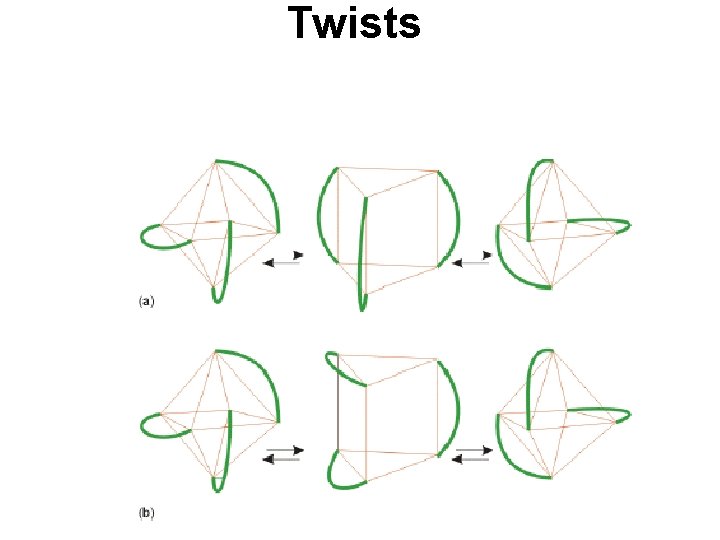
Twisted Oh Isomerizations • Oh complexes may also isomerize via “twist” mechanisms • Does not require loss of ligands or breaking bonds, just depends on energy barriers between confirmations – Bailar Twist (a) – Ray Dutt Twist (b) • Both occur via trigonal prismatic confirmation
Twists
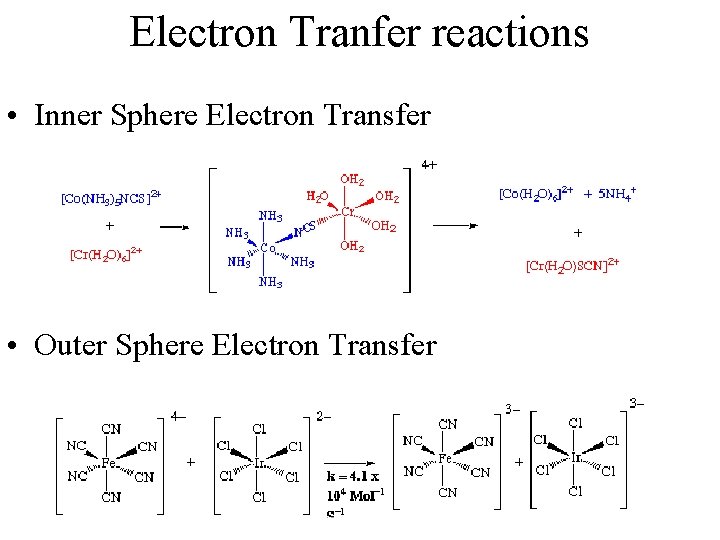
Electron Tranfer reactions • Inner Sphere Electron Transfer • Outer Sphere Electron Transfer
Inner Sphere Electron Transfer
Outer Sphere Electron Transfer