
Chemistry 30 S Unit 2 Gases and the

- Slides: 14
Chemistry 30 S Unit 2: Gases and the Atmosphere
Learning Outcomes • C 11 -2 -03 Examine the historical development of the measurement of pressure. Examples: the contributions of Galileo Galilei, Evangelista Torricelli, Otto von Guericke, Blaise Pascal, Christiaan Huygens, John Dalton, Joseph Louis Gay-Lussac, Amadeo Avogadro… • C 11 -2 -04 Describe the various units used to measure pressure. Include: atmospheres (atm), kilopascals (k. Pa), millimetres of mercury (mm. Hg), millibars (mb)
Defining Gas Pressure • Recall: • According to Kinetic-Molecular Theory gas particles are constantly moving and their collisions are completely elastic • As they move they collide with the sides of the container • The force per unit area due to these collisions = GAS PRESSURE
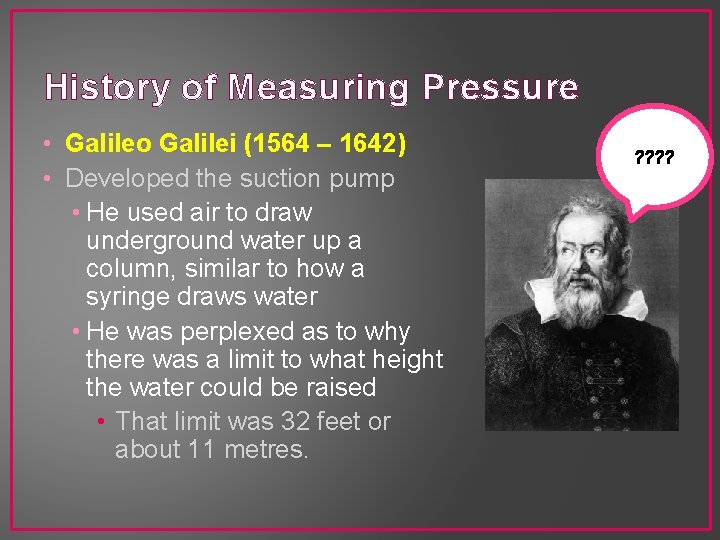
History of Measuring Pressure • Galileo Galilei (1564 – 1642) • Developed the suction pump • He used air to draw underground water up a column, similar to how a syringe draws water • He was perplexed as to why there was a limit to what height the water could be raised • That limit was 32 feet or about 11 metres. ? ?
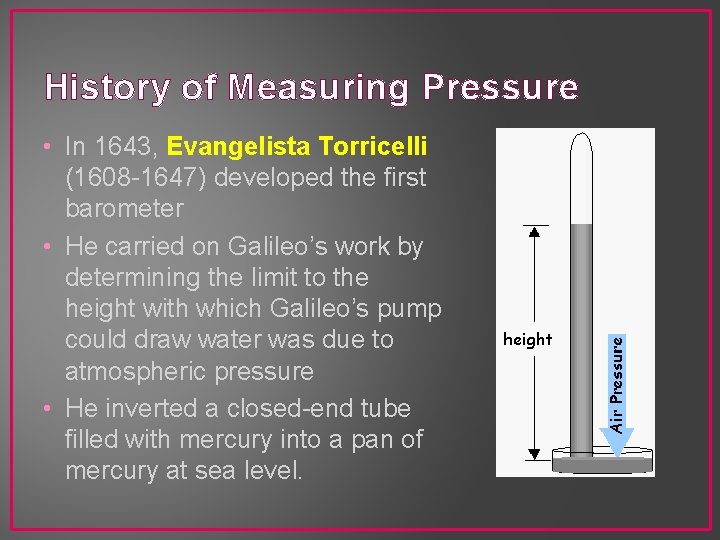
History of Measuring Pressure • In 1643, Evangelista Torricelli (1608 -1647) developed the first barometer • He carried on Galileo’s work by determining the limit to the height with which Galileo’s pump could draw water was due to atmospheric pressure • He inverted a closed-end tube filled with mercury into a pan of mercury at sea level.
History of Measuring Pressure • The height of the column of mercury in the tube (in mm. Hg) is equal to the atmospheric pressure acting on the mercury in the pan. • He determined that the height of mercury supported by atmospheric pressure at sea level is 760 mm or 76 cm. • He did the same experiment with water first, but found that the glass tube he had to use was too long and fragile Therefore, Standard Pressure = 760 mm Hg
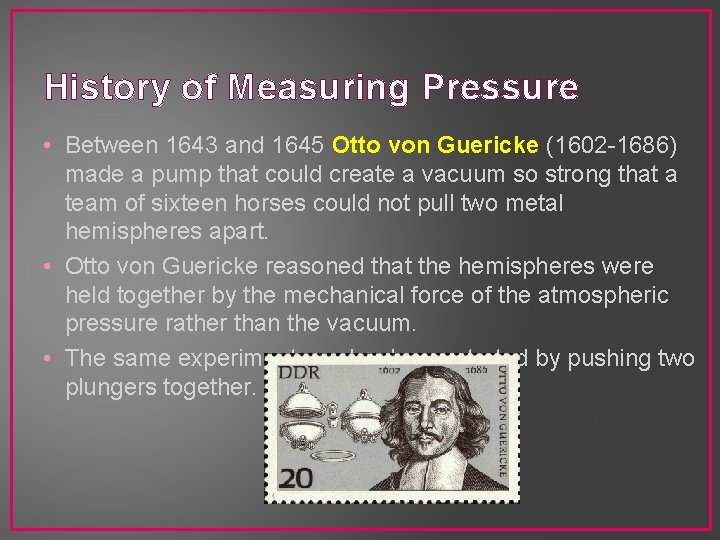
History of Measuring Pressure • Between 1643 and 1645 Otto von Guericke (1602 -1686) made a pump that could create a vacuum so strong that a team of sixteen horses could not pull two metal hemispheres apart. • Otto von Guericke reasoned that the hemispheres were held together by the mechanical force of the atmospheric pressure rather than the vacuum. • The same experiment can be demonstrated by pushing two plungers together.
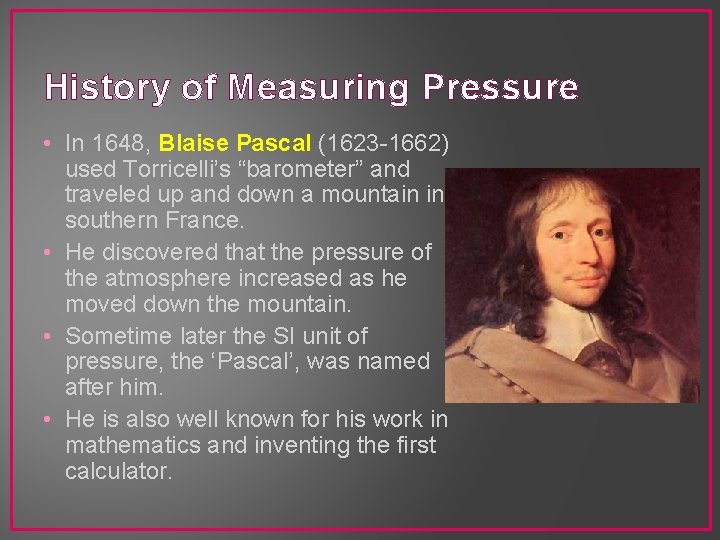
History of Measuring Pressure • In 1648, Blaise Pascal (1623 -1662) used Torricelli’s “barometer” and traveled up and down a mountain in southern France. • He discovered that the pressure of the atmosphere increased as he moved down the mountain. • Sometime later the SI unit of pressure, the ‘Pascal’, was named after him. • He is also well known for his work in mathematics and inventing the first calculator.
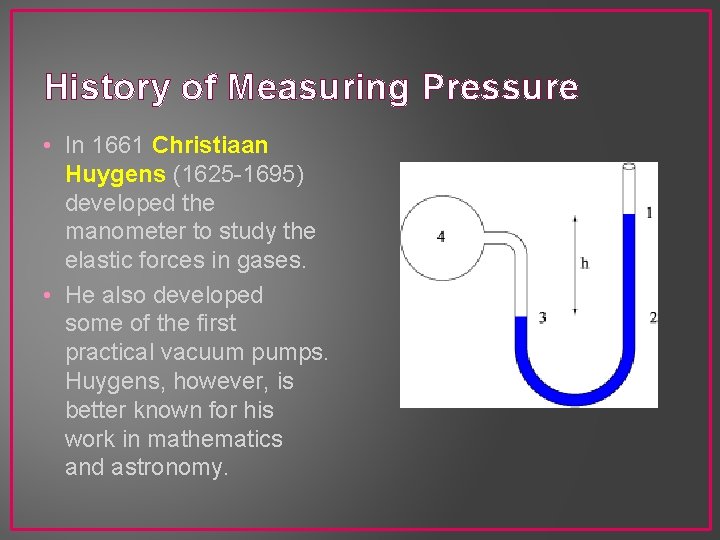
History of Measuring Pressure • In 1661 Christiaan Huygens (1625 -1695) developed the manometer to study the elastic forces in gases. • He also developed some of the first practical vacuum pumps. Huygens, however, is better known for his work in mathematics and astronomy.
History of Measuring Pressure • In 1801, a couple years before publishing his atomic theory, John Dalton (1766 -1844) stated that in a mixture of gases the total pressure is equal to the sum of the pressure of each gas, if it were in a container alone. • The pressure exerted by each gas is called its partial pressure. • This is known as Dalton’s Law of Partial Pressures. • Another way of stating this relationship is the total pressure of gases in a container is the sum of the pressures of each gas. Ptotal = Pgas. A + Pgas. B + Pgas. C…
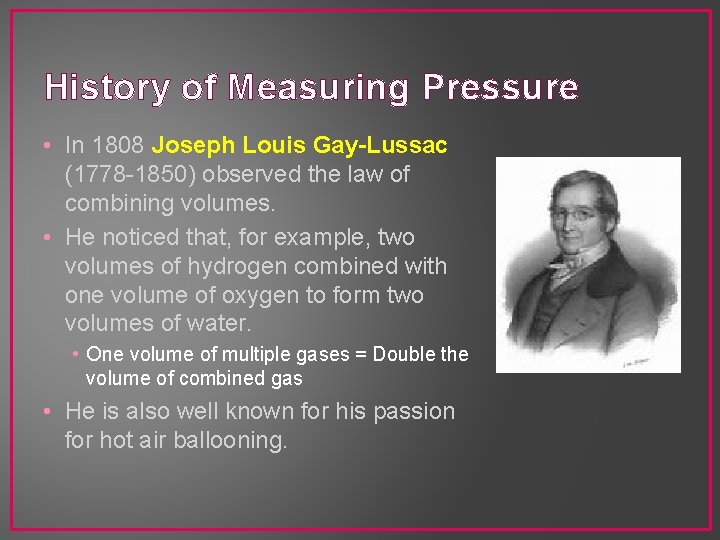
History of Measuring Pressure • In 1808 Joseph Louis Gay-Lussac (1778 -1850) observed the law of combining volumes. • He noticed that, for example, two volumes of hydrogen combined with one volume of oxygen to form two volumes of water. • One volume of multiple gases = Double the volume of combined gas • He is also well known for his passion for hot air ballooning.
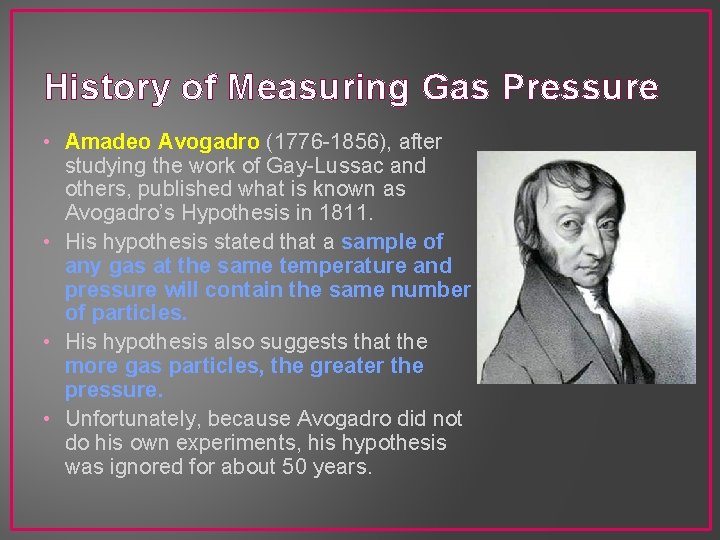
History of Measuring Gas Pressure • Amadeo Avogadro (1776 -1856), after studying the work of Gay-Lussac and others, published what is known as Avogadro’s Hypothesis in 1811. • His hypothesis stated that a sample of any gas at the same temperature and pressure will contain the same number of particles. • His hypothesis also suggests that the more gas particles, the greater the pressure. • Unfortunately, because Avogadro did not do his own experiments, his hypothesis was ignored for about 50 years.
Units of Pressure • Kilo. Pascal (k. Pa) • Newton of pressure per square metre of area • 1 Pascal is quite small, so we report in kilopascals • SI unit of pressure • Millibar • Meteorological unit of atmospheric pressure • One bar is equal to standard atmospheric pressure or 1 atmosphere. • Atmosphere (atm) • Derived from standard atmospheric pressure at sea level • 1 atmosphere is equal to 760 mm. Hg, or 101. 325 k. Pa
Units of Pressure • Mm of mercury • Not a common unit used today outside the laboratory, however, many barometers found in the home use both mm of mercury as well as another unit like kilopascals • Pounds per Square Inch (psi) • An imperial unit of pressure, common in everyday life • E. g. 1 k. Pa = 0. 145 PSI