
Chemistry 223 Chapter 26 Coordination Complexes dblock elements
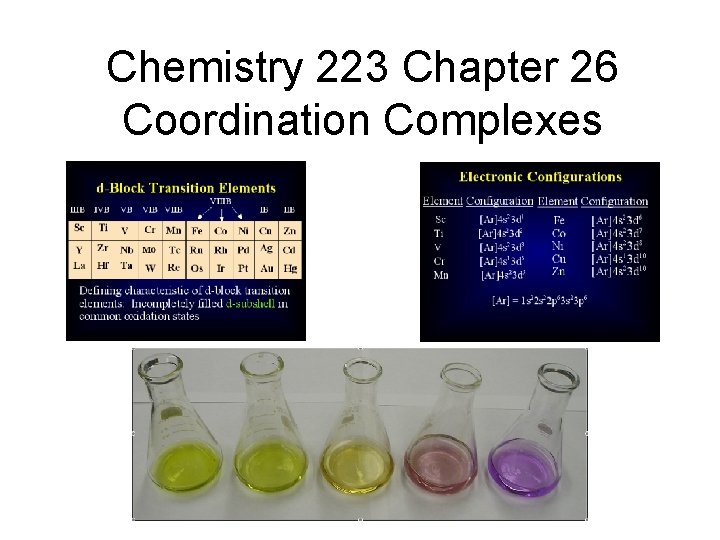
Chemistry 223 Chapter 26 Coordination Complexes
d-block elements a. k. a. transition metals d-block elements are: • all metals • all have partially filled d subshells • exhibit horizontal & vertical similarities • alloys & compounds are important components of materials in modern world • most first-row transition metals are essential for life
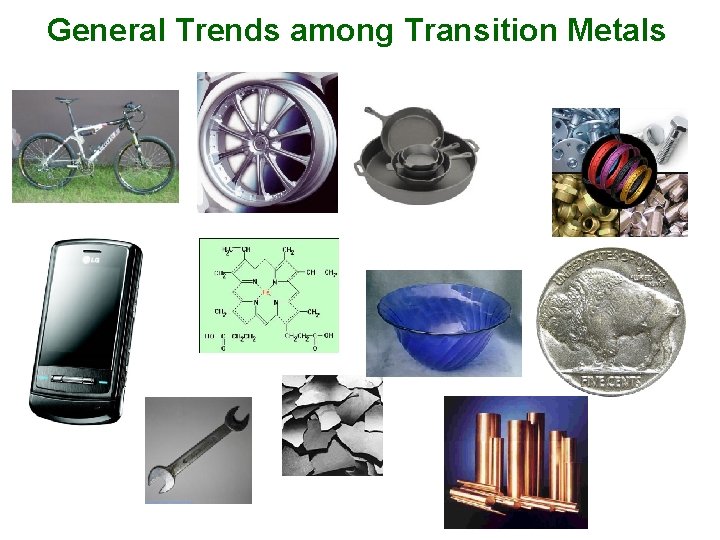
General Trends among Transition Metals
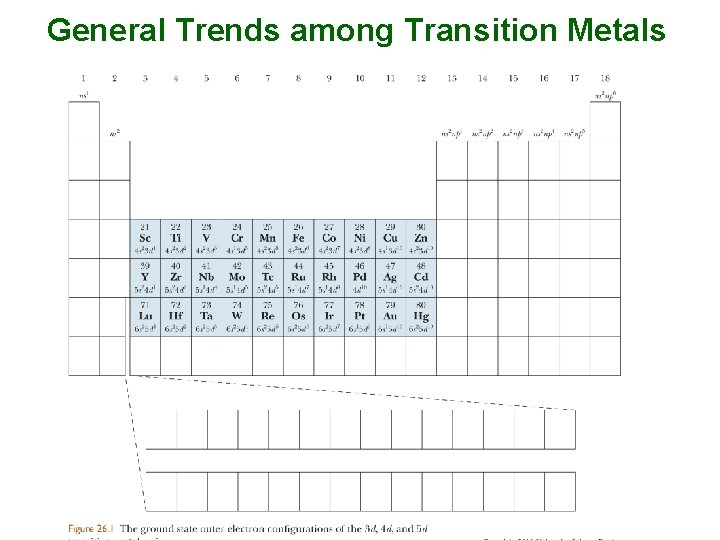
General Trends among Transition Metals
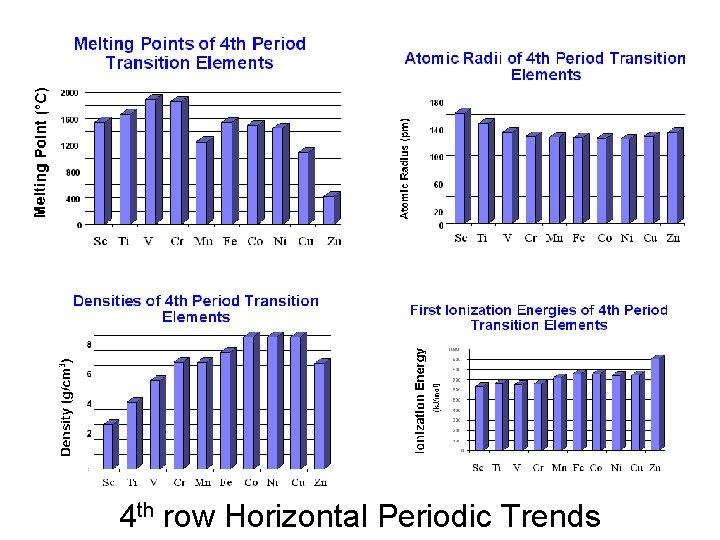
4 th row Horizontal Periodic Trends
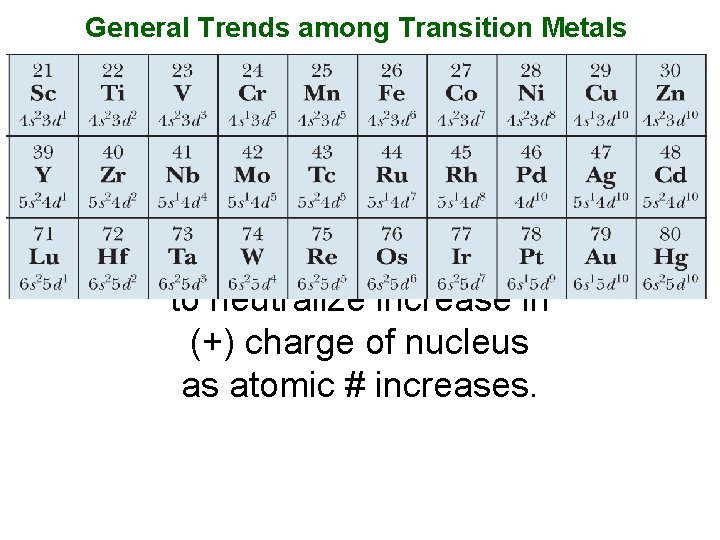
General Trends among Transition Metals Going across row from left to right , e-’s are added to 3 d subshell to neutralize increase in (+) charge of nucleus as atomic # increases.
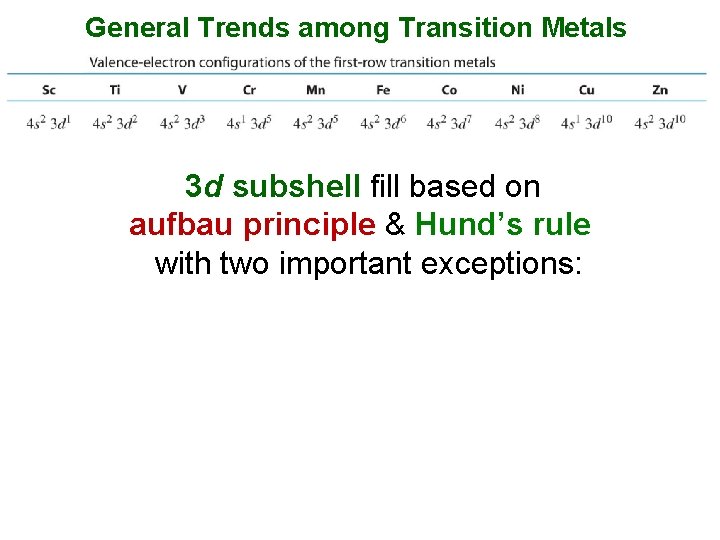
General Trends among Transition Metals 3 d subshell fill based on aufbau principle & Hund’s rule with two important exceptions:
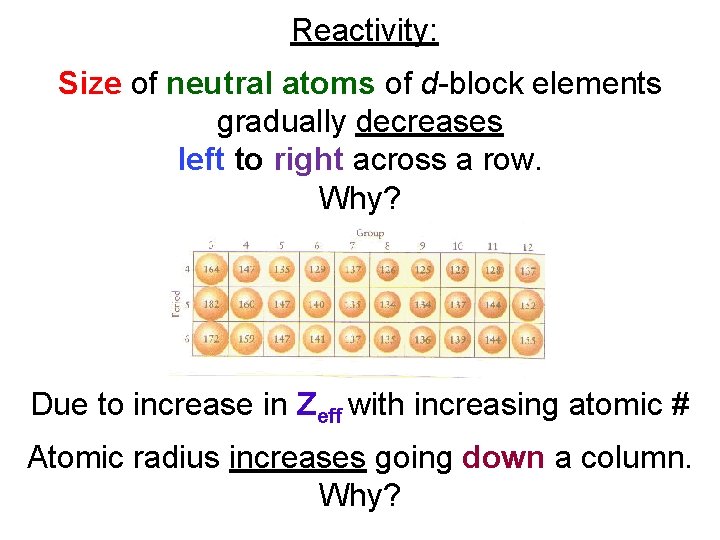
Reactivity: Size of neutral atoms of d-block elements gradually decreases left to right across a row. Why? Due to increase in Zeff with increasing atomic # Atomic radius increases going down a column. Why?
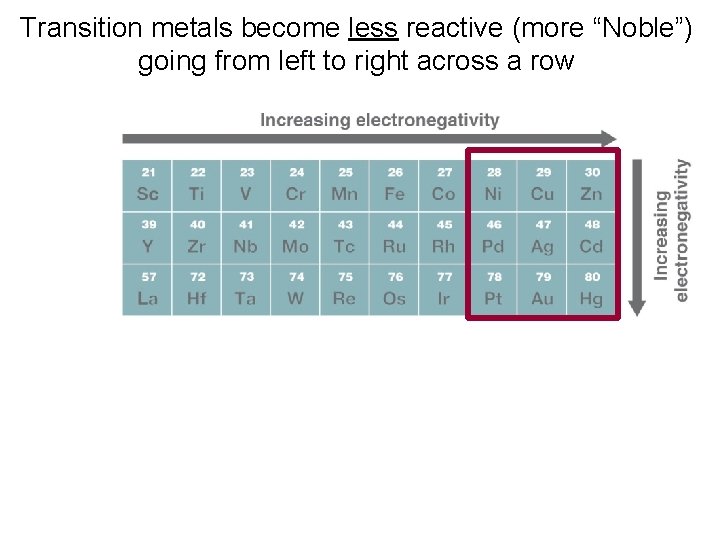
Transition metals become less reactive (more “Noble”) going from left to right across a row
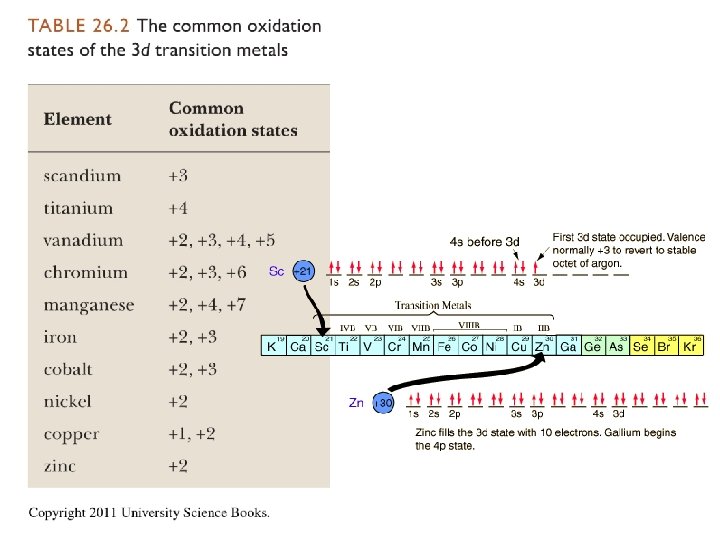
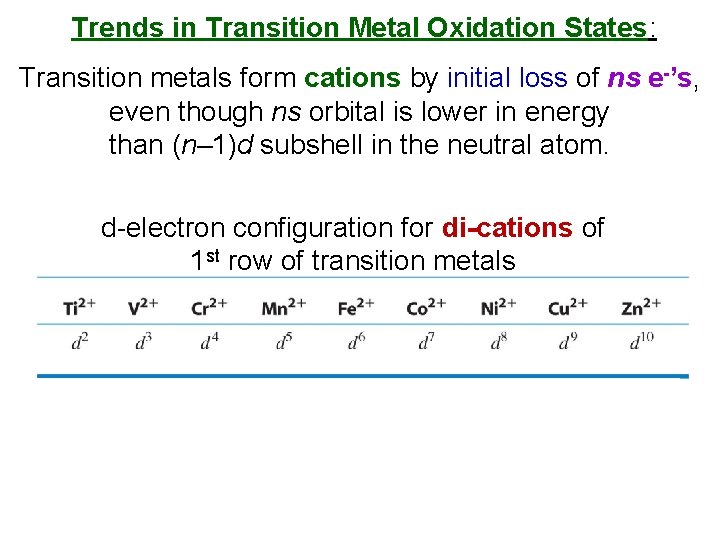
Trends in Transition Metal Oxidation States: Transition metals form cations by initial loss of ns e-’s, even though ns orbital is lower in energy than (n– 1)d subshell in the neutral atom. d-electron configuration for di-cations of 1 st row of transition metals
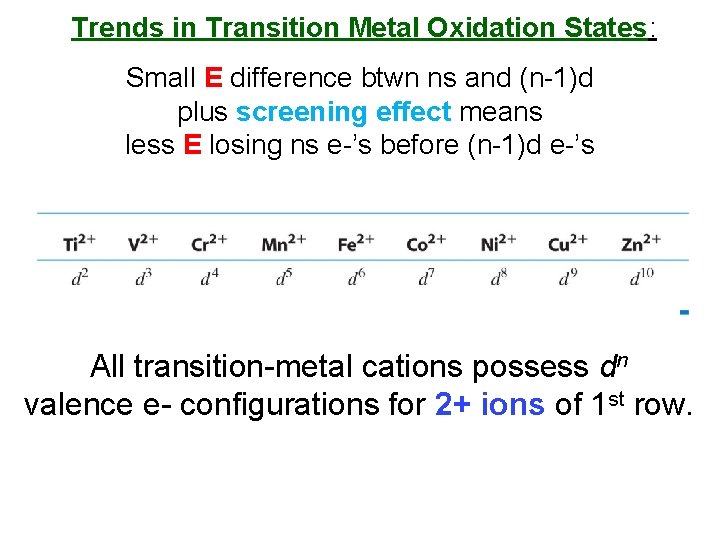
Trends in Transition Metal Oxidation States: Small E difference btwn ns and (n-1)d plus screening effect means less E losing ns e-’s before (n-1)d e-’s All transition-metal cations possess dn valence e- configurations for 2+ ions of 1 st row.
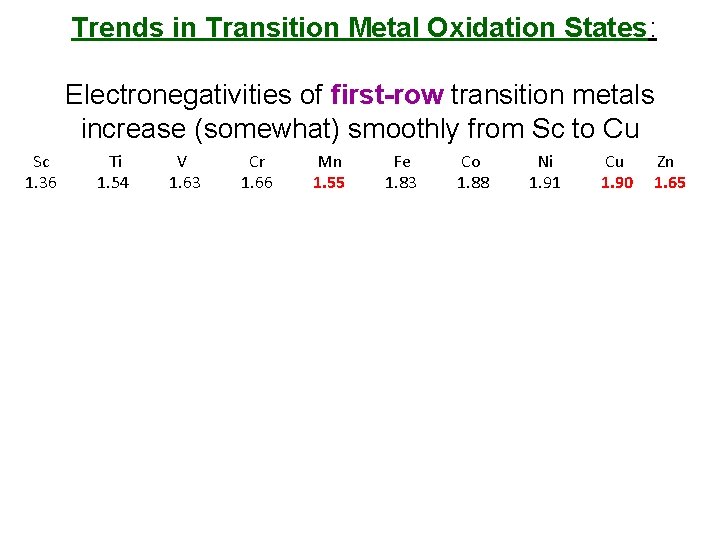
Trends in Transition Metal Oxidation States: Electronegativities of first-row transition metals increase (somewhat) smoothly from Sc to Cu Sc 1. 36 Ti 1. 54 V 1. 63 Cr 1. 66 Mn 1. 55 Fe 1. 83 Co 1. 88 Ni 1. 91 Cu Zn 1. 90 1. 65
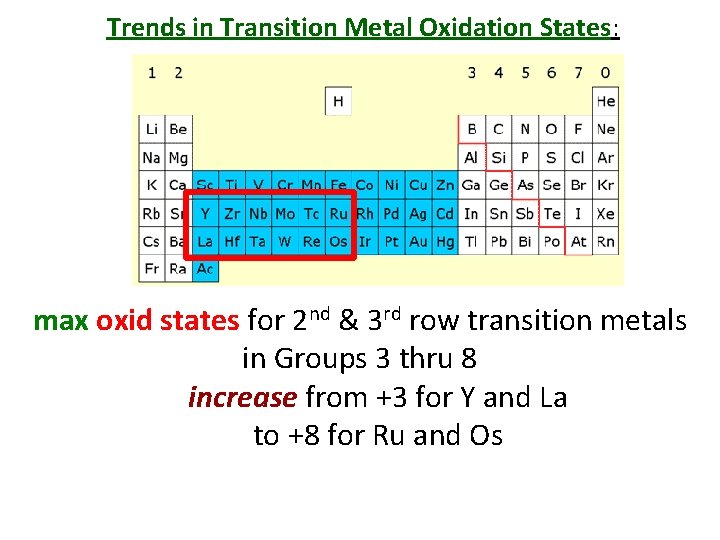
Trends in Transition Metal Oxidation States: max oxid states for 2 nd & 3 rd row transition metals in Groups 3 thru 8 increase from +3 for Y and La to +8 for Ru and Os
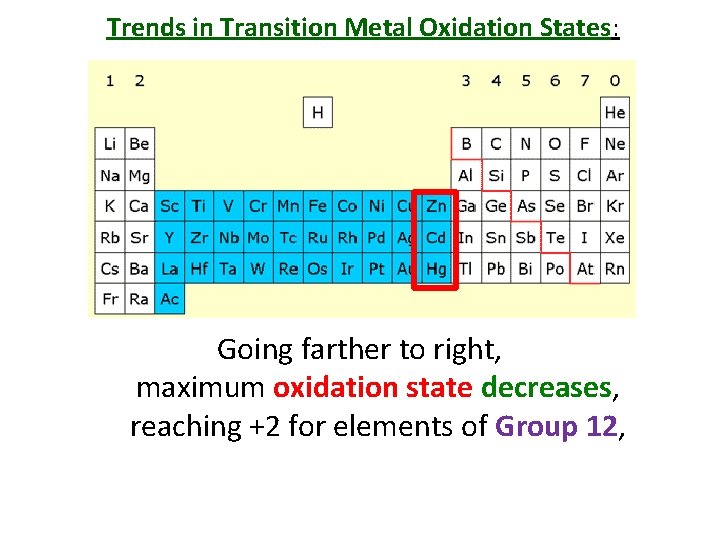
Trends in Transition Metal Oxidation States: Going farther to right, maximum oxidation state decreases, reaching +2 for elements of Group 12,
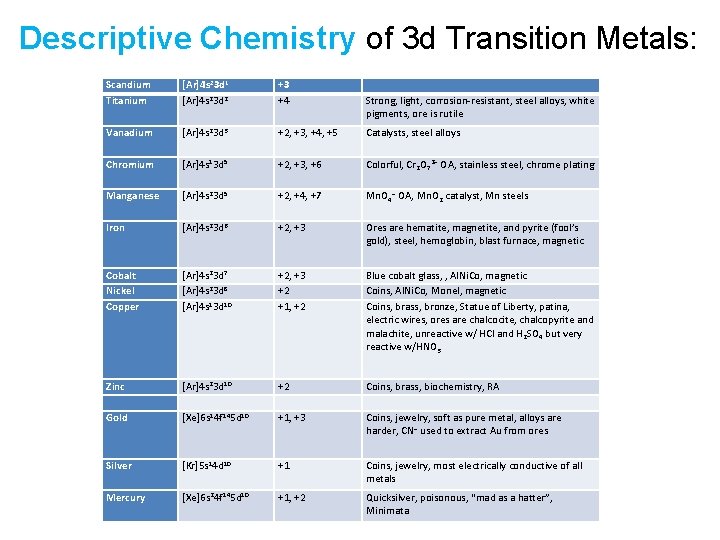
Descriptive Chemistry of 3 d Transition Metals: Scandium Titanium [Ar]4 s 23 d 1 [Ar]4 s 23 d 2 +3 +4 Strong, light, corrosion-resistant, steel alloys, white pigments, ore is rutile Vanadium [Ar]4 s 23 d 3 +2, +3, +4, +5 Catalysts, steel alloys Chromium [Ar]4 s 13 d 5 +2, +3, +6 Colorful, Cr 2 O 72− OA, stainless steel, chrome plating Manganese [Ar]4 s 23 d 5 +2, +4, +7 Mn. O 4− OA, Mn. O 2 catalyst, Mn steels Iron [Ar]4 s 23 d 6 +2, +3 Ores are hematite, magnetite, and pyrite (fool’s gold), steel, hemoglobin, blast furnace, magnetic Cobalt Nickel Copper [Ar]4 s 23 d 7 [Ar]4 s 23 d 8 [Ar]4 s 13 d 10 +2, +3 +2 +1, +2 Blue cobalt glass, , Al. Ni. Co, magnetic Coins, Al. Ni. Co, Monel, magnetic Coins, brass, bronze, Statue of Liberty, patina, electric wires, ores are chalcocite, chalcopyrite and malachite, unreactive w/ HCl and H 2 SO 4 but very reactive w/HNO 3 Zinc Gold [Ar]4 s 23 d 10 [Xe]6 s 14 f 145 d 10 +2 +1, +3 Coins, brass, biochemistry, RA Coins, jewelry, soft as pure metal, alloys are harder, CN− used to extract Au from ores Silver [Kr]5 s 14 d 10 +1 Coins, jewelry, most electrically conductive of all metals Mercury [Xe]6 s 24 f 145 d 10 +1, +2 Quicksilver, poisonous, “mad as a hatter”, Minimata
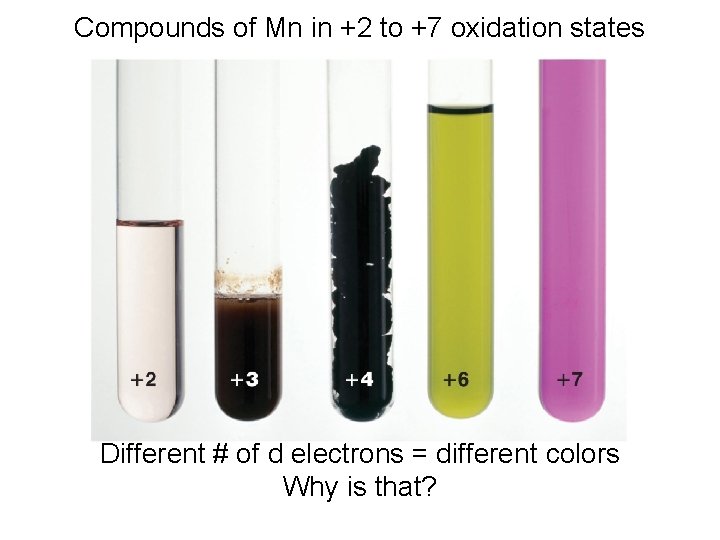
Compounds of Mn in +2 to +7 oxidation states Different # of d electrons = different colors Why is that?
Coordination Compounds Metallic elements act as Lewis acids form complexes with various Lewis bases. Metal complex:
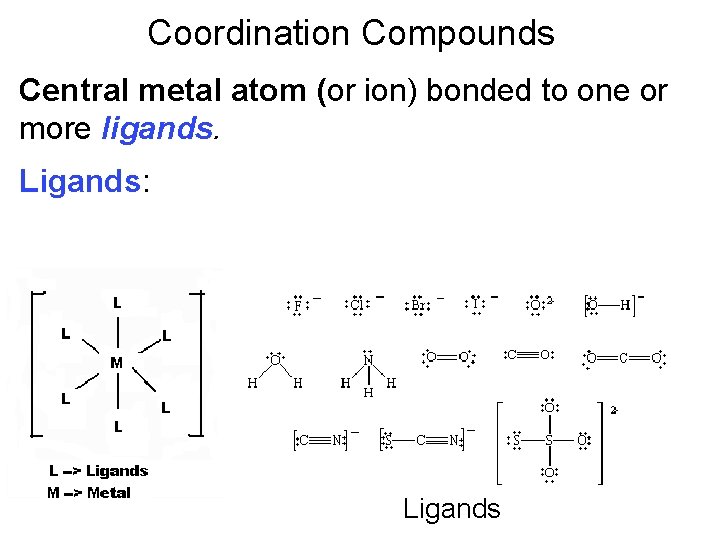
Coordination Compounds Central metal atom (or ion) bonded to one or more ligands. Ligands: Ligands
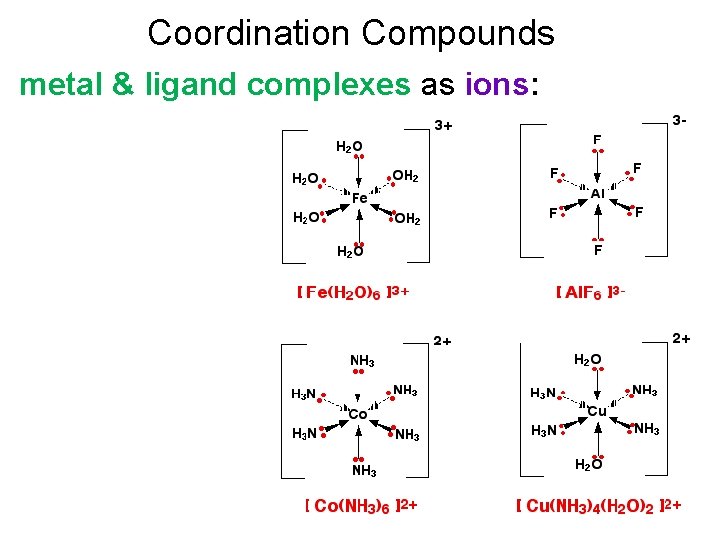
Coordination Compounds metal & ligand complexes as ions:
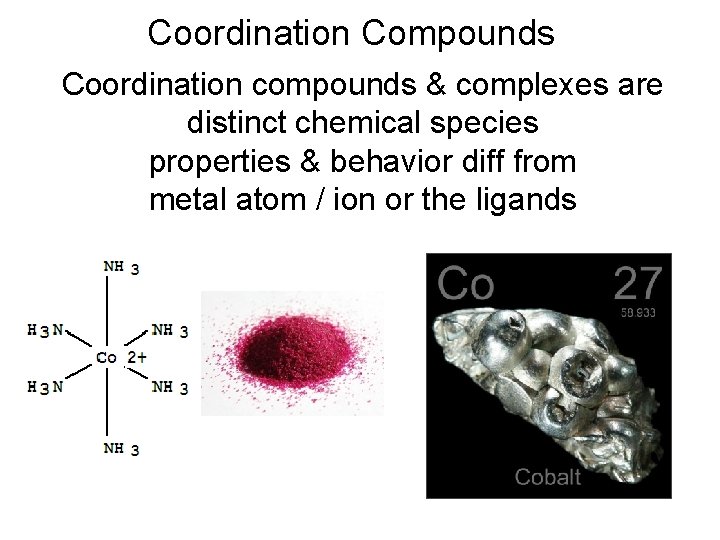
Coordination Compounds Coordination compounds & complexes are distinct chemical species properties & behavior diff from metal atom / ion or the ligands
History of Coordination Compounds Coordination compounds used since ancient times, but chemical nature unclear. Werner: modern theory of coordination chemistry - based on studies of several series of metal halide complexes with ammonia
History of Coordination Compounds Werner postulated that metal ions have 2 different kinds of valence: 1. primary valence (oxidation state) = 2. secondary valence (coordination #)
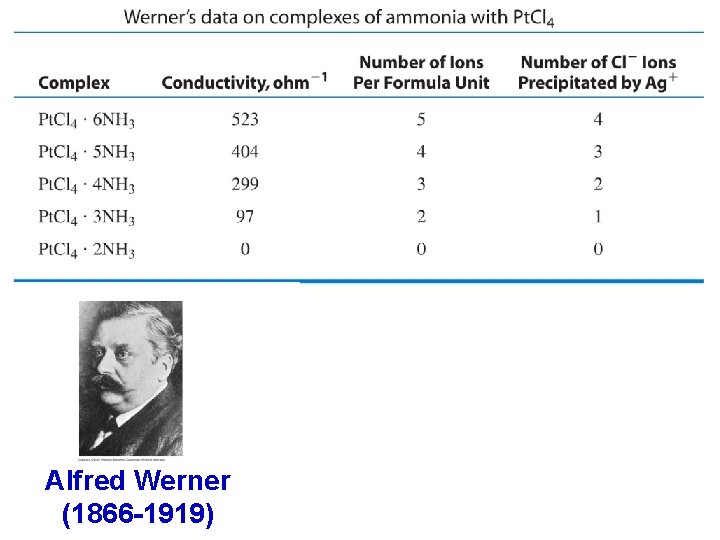
Alfred Werner (1866 -1919)
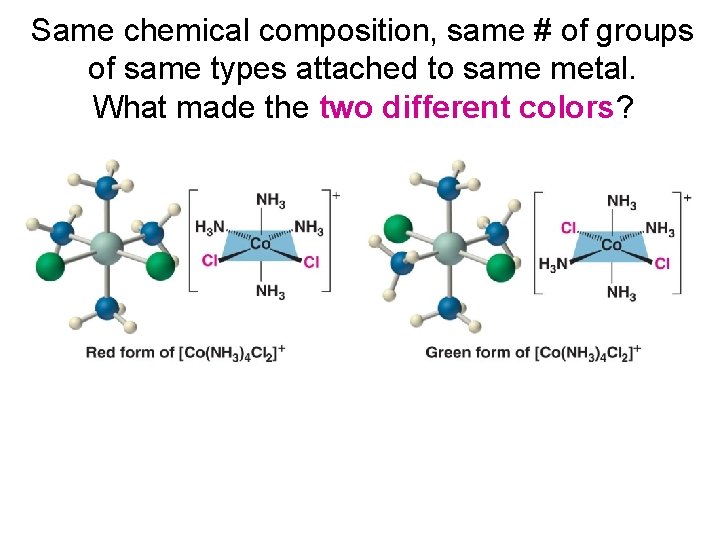
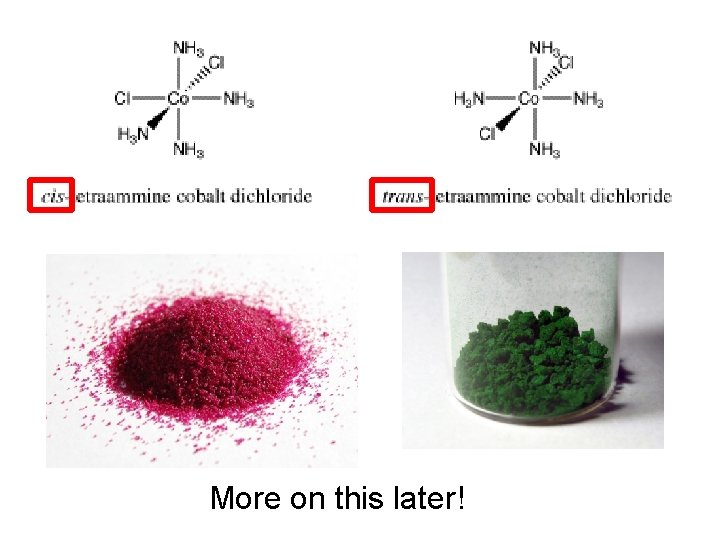
Same chemical composition, same # of groups of same types attached to same metal. What made the two different colors?
Structures of Metal Complexes Coordination #’s of metal ions in metal complexes can range from 2 to 9. Differences in E btwn different arrangements of ligands greatest for complexes w/ low coordination #’s & decrease as coordination # increases.
Structures of Metal Complexes Only one or two structures possible for complexes w/ low coordination #’s. Several different energetically = structures are possible for complexes with high coordination #’s (n > 6)
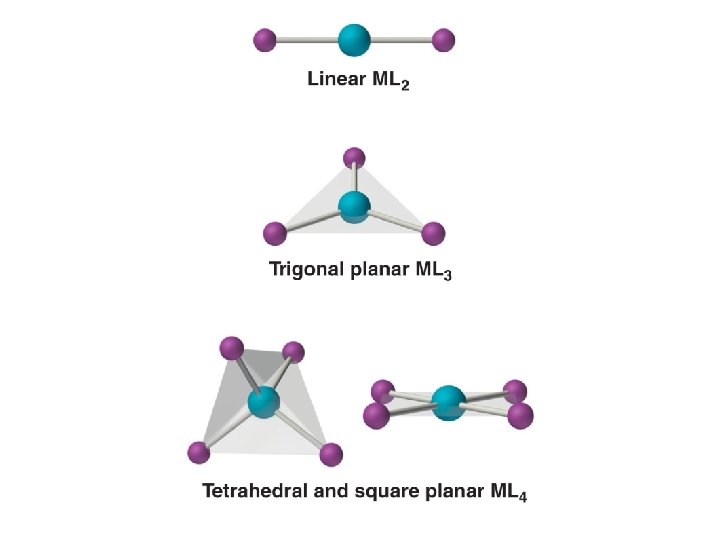
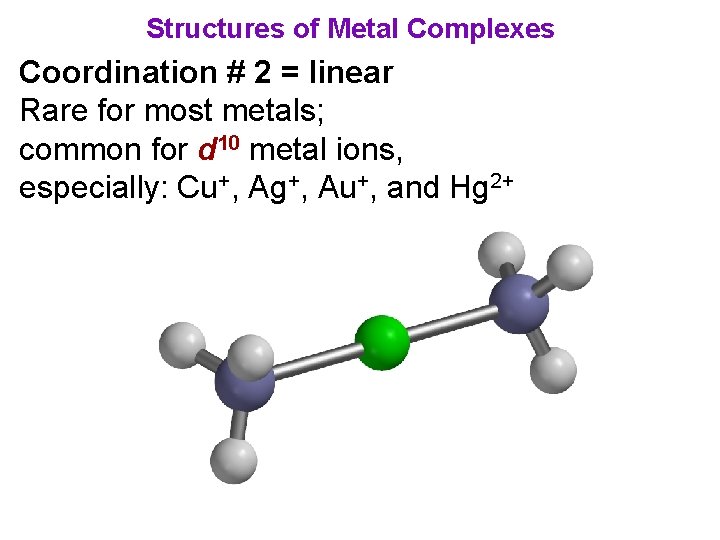
Structures of Metal Complexes Coordination # 2 = linear Rare for most metals; common for d 10 metal ions, especially: Cu+, Ag+, Au+, and Hg 2+
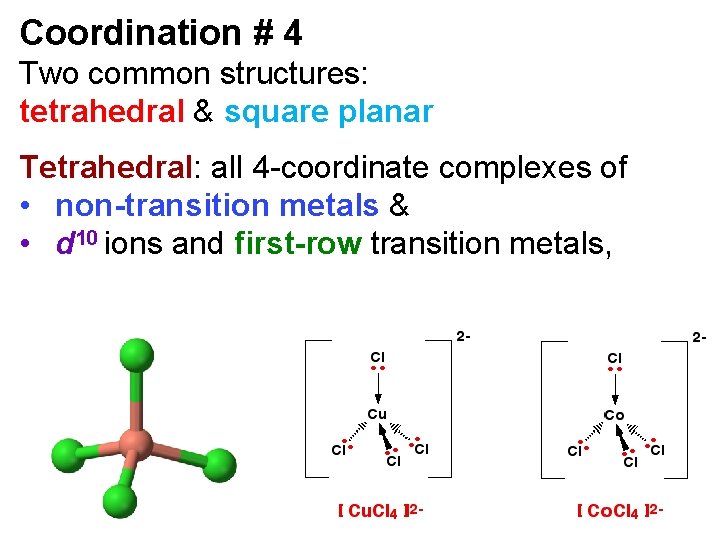
Coordination # 4 Two common structures: tetrahedral & square planar Tetrahedral: all 4 -coordinate complexes of • non-transition metals & • d 10 ions and first-row transition metals,
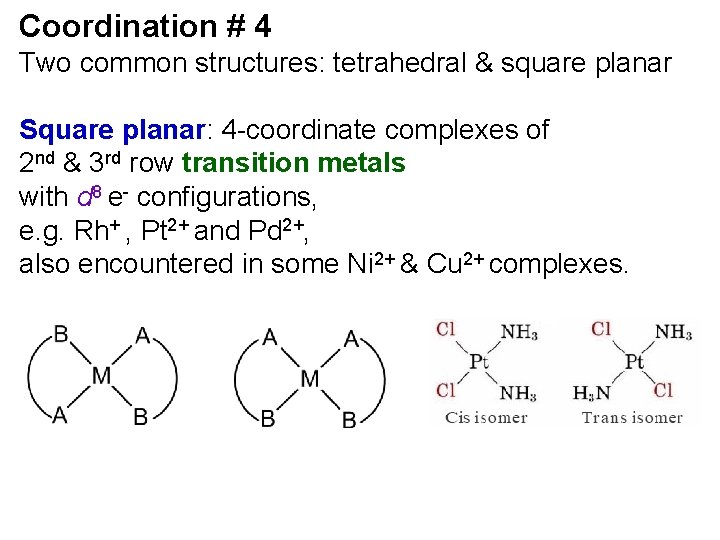
Coordination # 4 Two common structures: tetrahedral & square planar Square planar: 4 -coordinate complexes of 2 nd & 3 rd row transition metals with d 8 e- configurations, e. g. Rh+ , Pt 2+ and Pd 2+, also encountered in some Ni 2+ & Cu 2+ complexes.
Structures of Metal Complexes Coordination # 6 Most common: six ligands at vertices of an octahedron or a distorted octahedron.
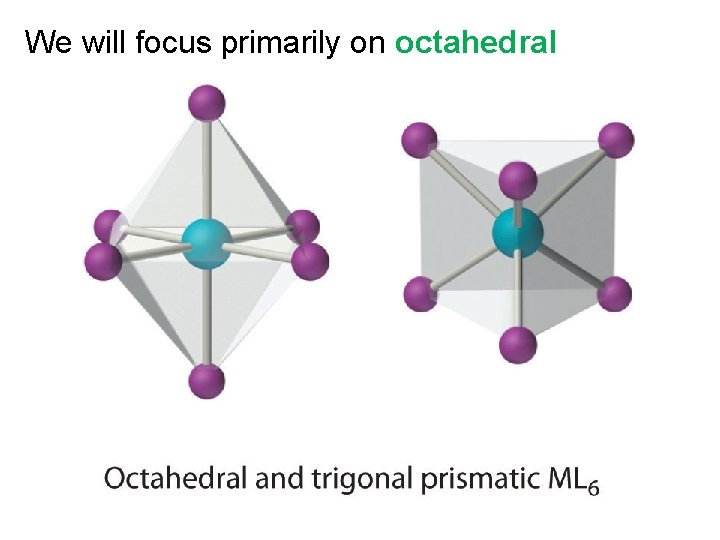
We will focus primarily on octahedral
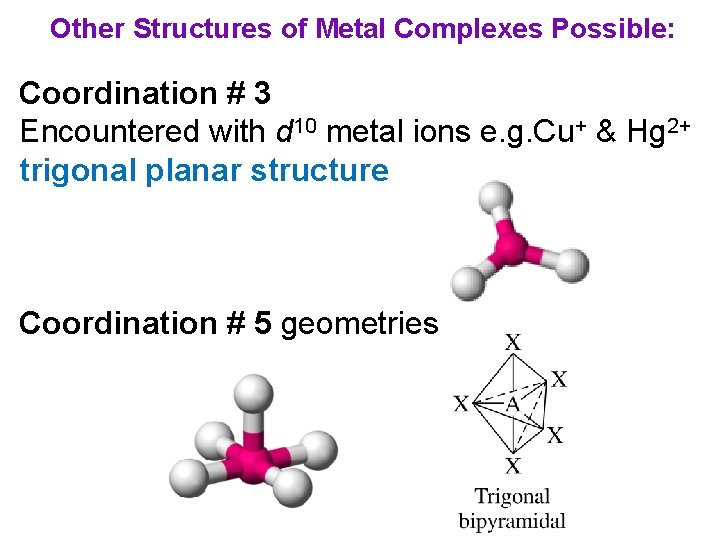
Other Structures of Metal Complexes Possible: Coordination # 3 Encountered with d 10 metal ions e. g. Cu+ & Hg 2+ trigonal planar structure Coordination # 5 geometries
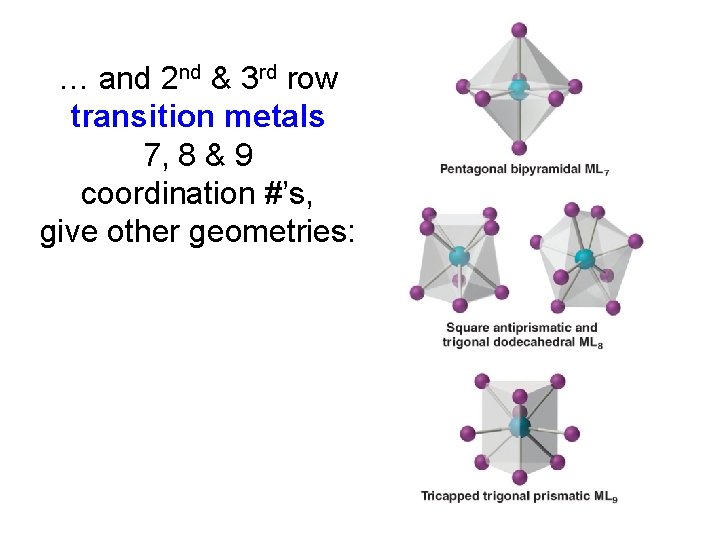
… and 2 nd & 3 rd row transition metals 7, 8 & 9 coordination #’s, give other geometries:
Metal-ligand interaction is an example of Lewis acid-base interaction. Lewis acid Lewis bases Must have
Transition metal ions tend to form coordination complexes which we encountered back in Chapter 22. e. g. Ag. Cl is more soluble in 0. 10 M NH 3 than it is in pure water because Ag+ forms a complex with NH 3 with a very large formation constant: Ag+ + 2 NH 3 Ag(NH 3)2+
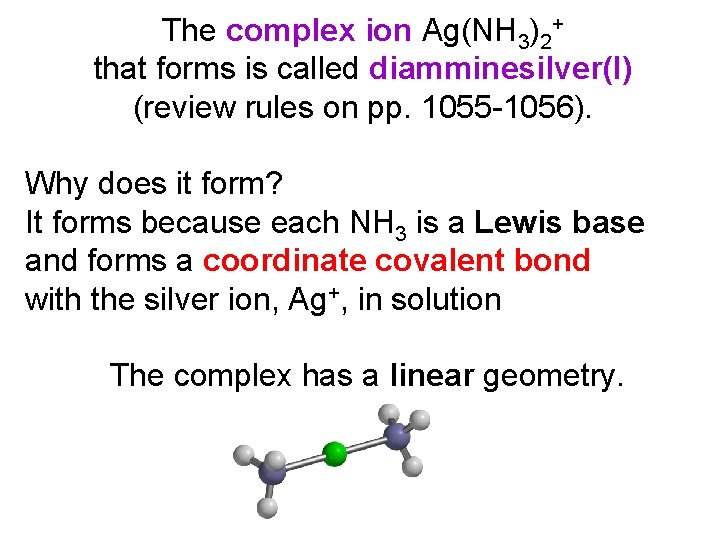
The complex ion Ag(NH 3)2+ that forms is called diamminesilver(I) (review rules on pp. 1055 -1056). Why does it form? It forms because each NH 3 is a Lewis base and forms a coordinate covalent bond with the silver ion, Ag+, in solution The complex has a linear geometry.
to purify the Ag(NH 3)2+ complex ion & store it in a bottle it would need an anion to neutralize the charge e. g. diamminesilver(I) chloride, [Ag(NH 3)2+]Cl or diamminesilver(I) nitrate: [Ag(NH 3)2+]NO 3.
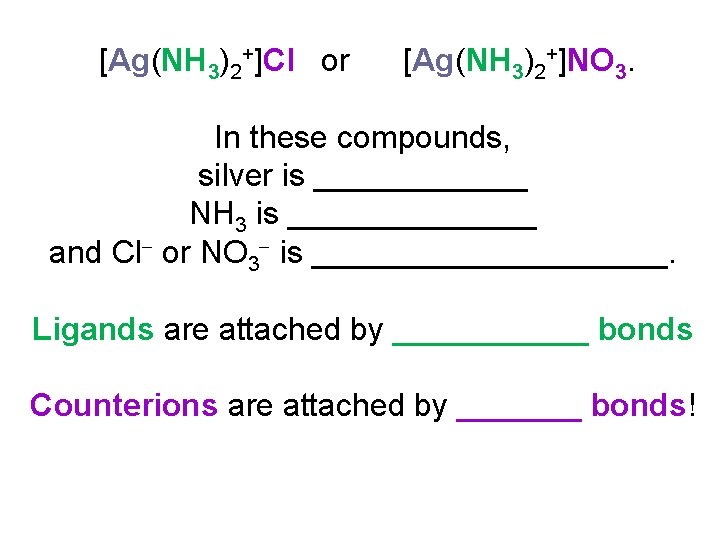
[Ag(NH 3)2+]Cl or [Ag(NH 3)2+]NO 3. In these compounds, silver is ______ NH 3 is _______ and Cl or NO 3 is __________. Ligands are attached by ______ bonds Counterions are attached by _______ bonds!
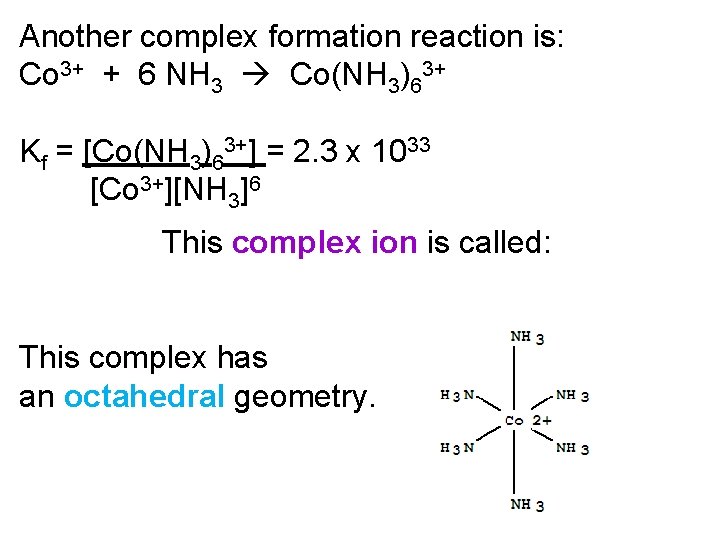
Another complex formation reaction is: Co 3+ + 6 NH 3 Co(NH 3)63+ Kf = [Co(NH 3)63+] = 2. 3 x 1033 [Co 3+][NH 3]6 This complex ion is called: This complex has an octahedral geometry.
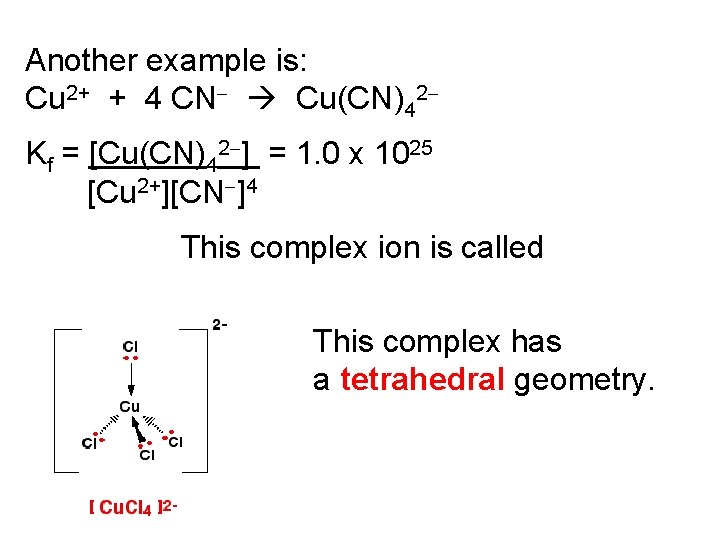
Another example is: Cu 2+ + 4 CN Cu(CN)42 Kf = [Cu(CN)42 ] = 1. 0 x 1025 [Cu 2+][CN ]4 This complex ion is called This complex has a tetrahedral geometry.
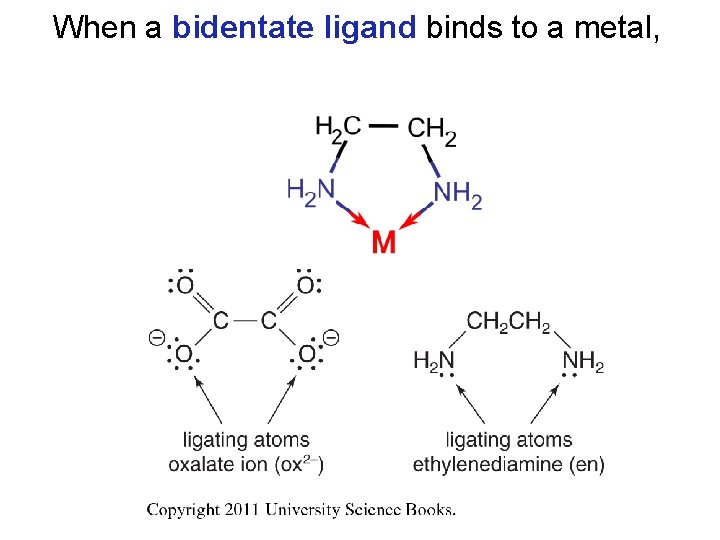
When a bidentate ligand binds to a metal,
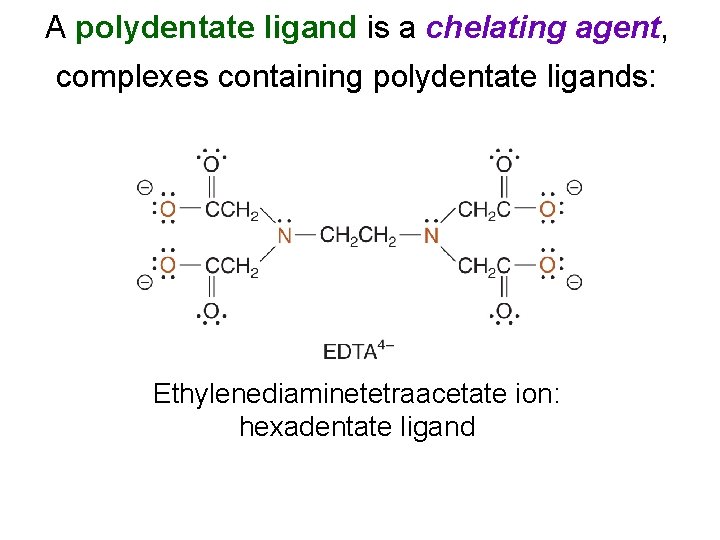
A polydentate ligand is a chelating agent, complexes containing polydentate ligands: Ethylenediaminetetraacetate ion: hexadentate ligand
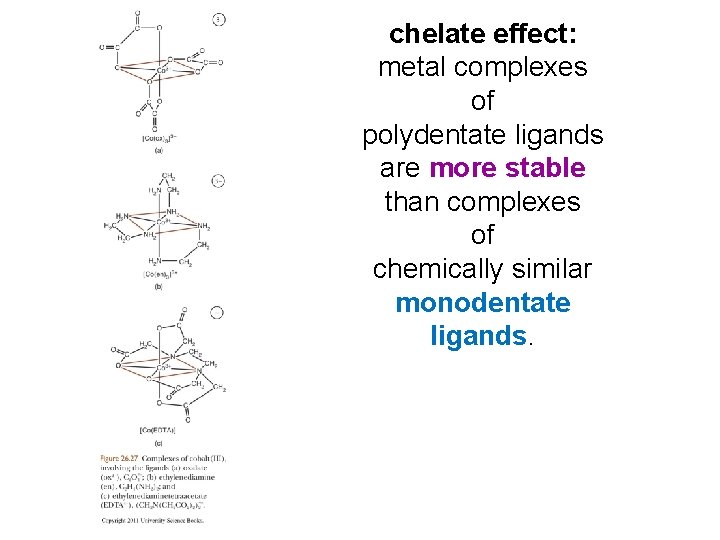
chelate effect: metal complexes of polydentate ligands are more stable than complexes of chemically similar monodentate ligands.
Nomenclature (IUPAC) rules for Naming coordination compounds: • Cation named before anion (as usual); but, transition metal atom in the complex is named last with oxidation state in roman numerals in parentheses
Nomenclature (IUPAC) rules for Naming coordination compounds: • Cation named before anion (as usual), no ; • anion ending for transition metal will be “ate” e. g. Cobalt anion = [Ni(NH 3)6] (NO 3)2 cation complex K 3 [Co(Cl)6] anion complex
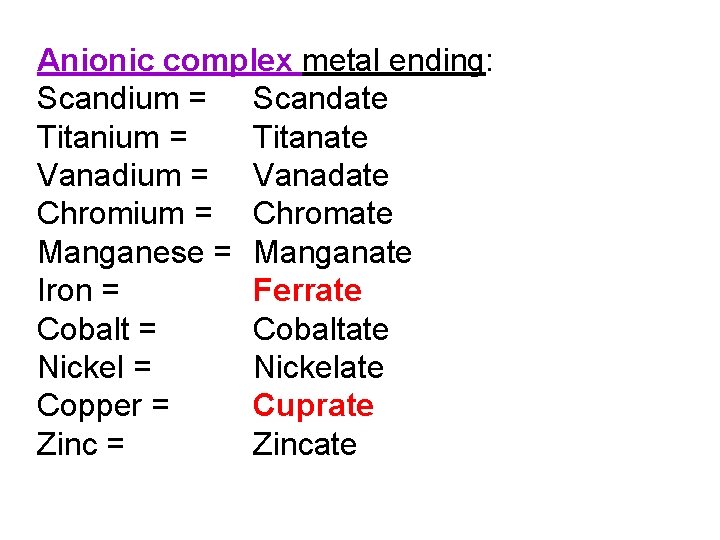
Anionic complex metal ending: Scandium = Scandate Titanium = Titanate Vanadium = Vanadate Chromium = Chromate Manganese = Manganate Iron = Ferrate Cobalt = Cobaltate Nickel = Nickelate Copper = Cuprate Zinc = Zincate
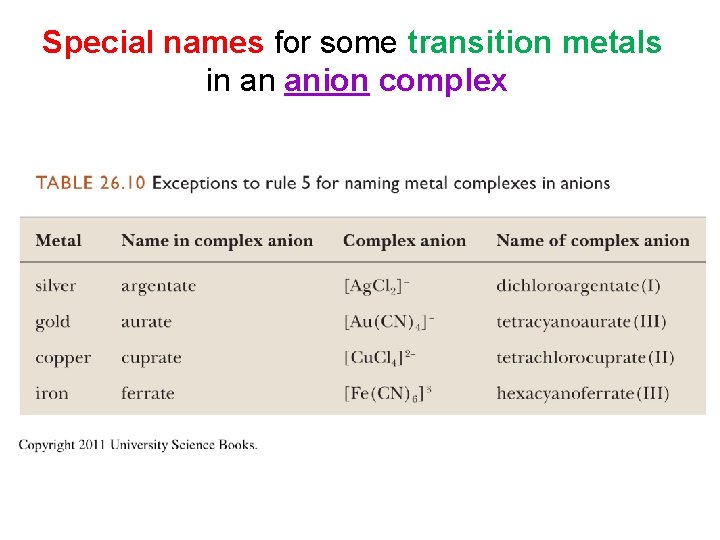
Special names for some transition metals in an anion complex
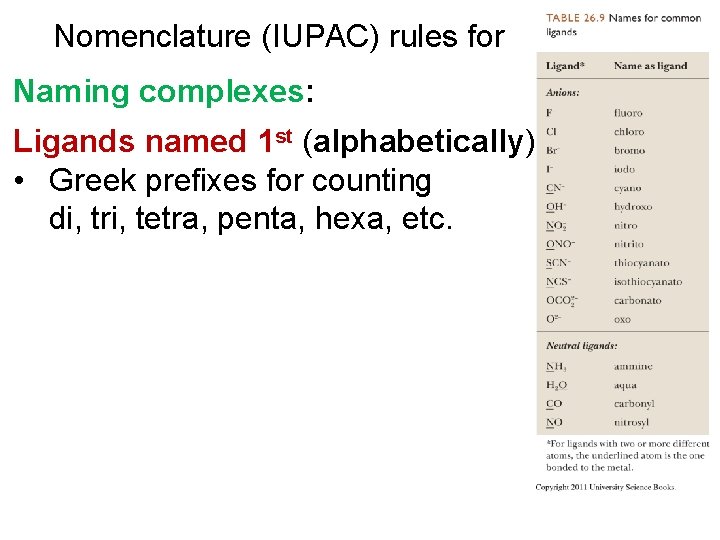
Nomenclature (IUPAC) rules for Naming complexes: Ligands named 1 st (alphabetically) • Greek prefixes for counting di, tri, tetra, penta, hexa, etc.
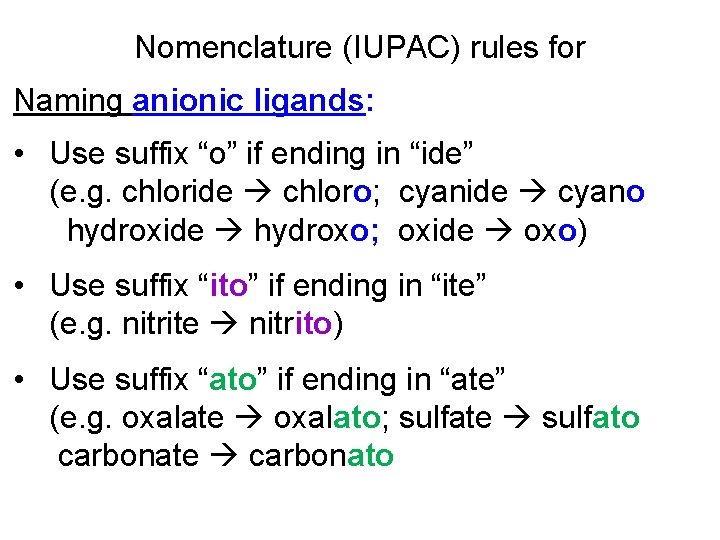
Nomenclature (IUPAC) rules for Naming anionic ligands: • Use suffix “o” if ending in “ide” (e. g. chloride chloro; cyanide cyano hydroxide hydroxo; oxide oxo) • Use suffix “ito” if ending in “ite” (e. g. nitrite nitrito) • Use suffix “ato” if ending in “ate” (e. g. oxalate oxalato; sulfate sulfato carbonate carbonato
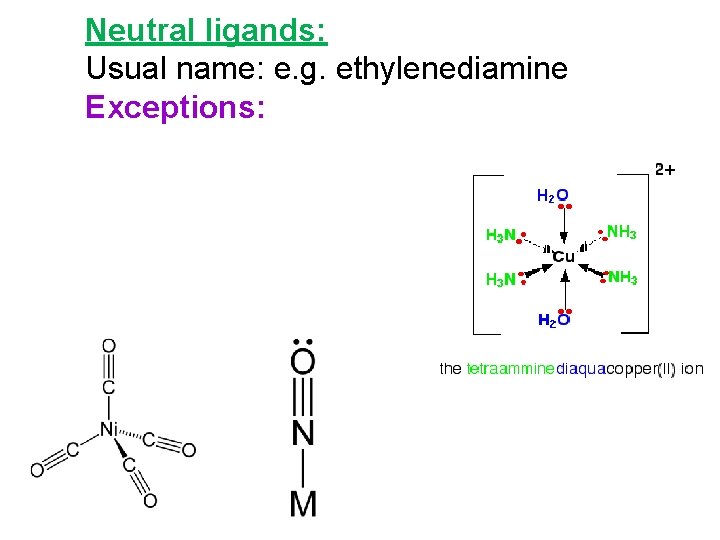
Neutral ligands: Usual name: e. g. ethylenediamine Exceptions:
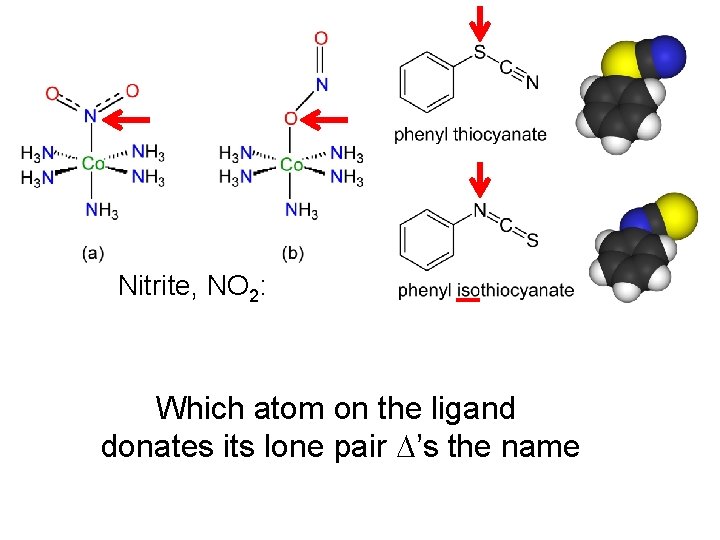
Nitrite, NO 2: Which atom on the ligand donates its lone pair ’s the name
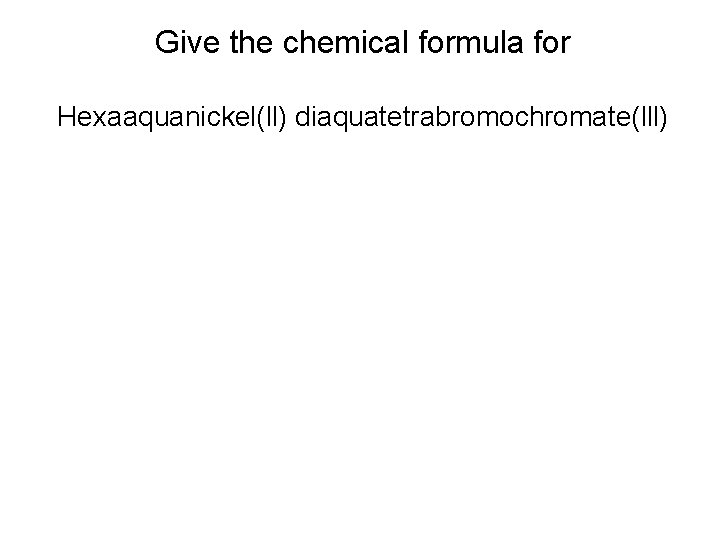
Give the chemical formula for Hexaaquanickel(ll) diaquatetrabromochromate(lll)
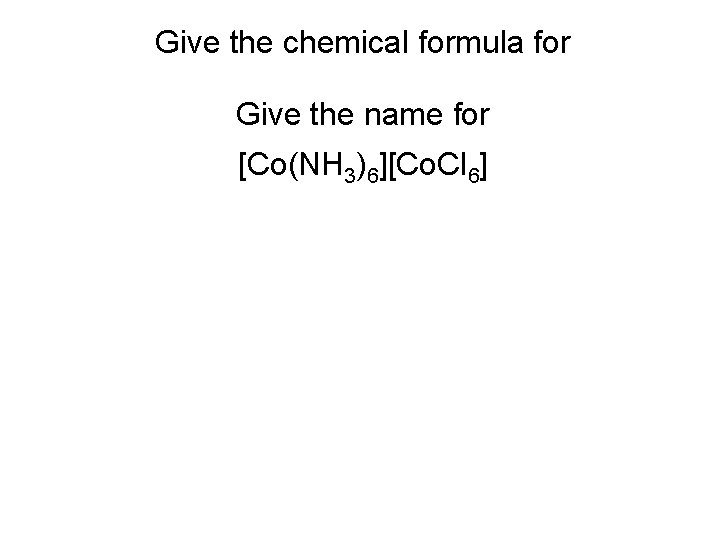
Give the chemical formula for Give the name for [Co(NH 3)6][Co. Cl 6]
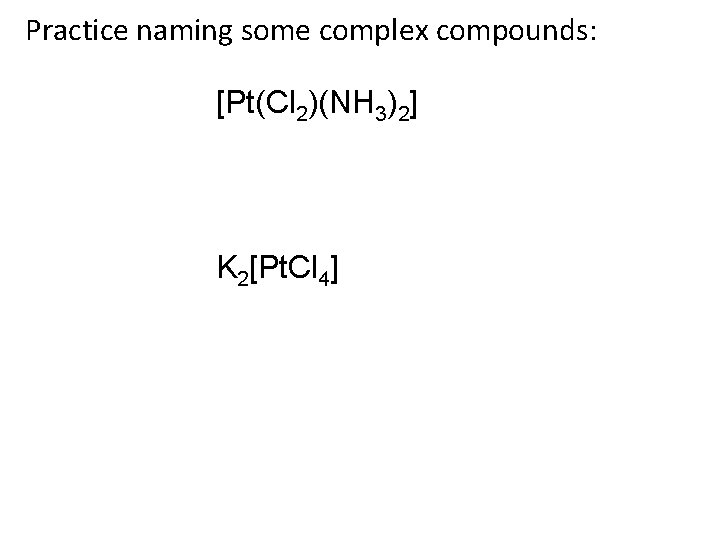
Practice naming some complex compounds: [Pt(Cl 2)(NH 3)2] K 2[Pt. Cl 4]
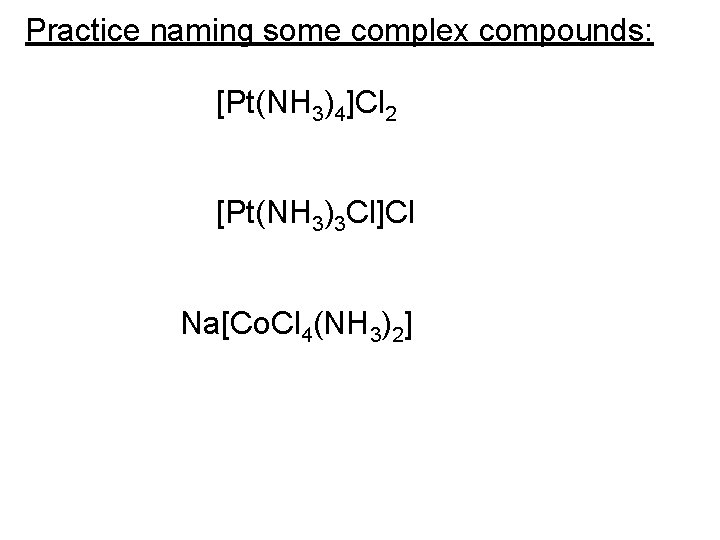
Practice naming some complex compounds: [Pt(NH 3)4]Cl 2 [Pt(NH 3)3 Cl]Cl Na[Co. Cl 4(NH 3)2]
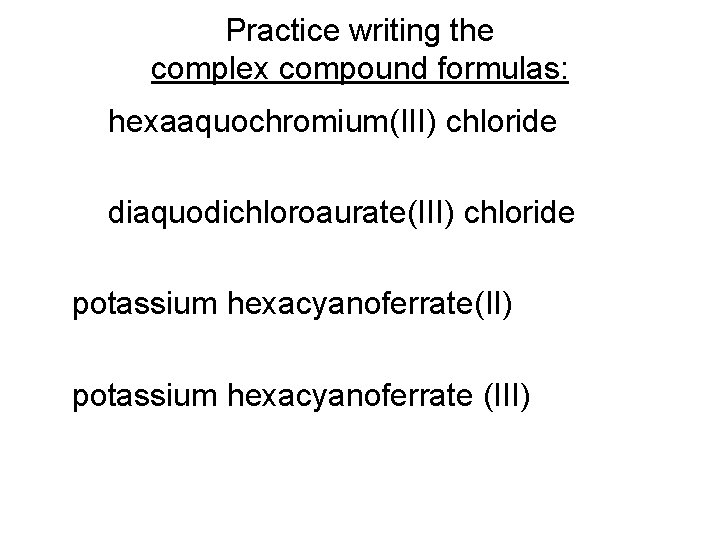
Practice writing the complex compound formulas: hexaaquochromium(III) chloride diaquodichloroaurate(III) chloride potassium hexacyanoferrate(II) potassium hexacyanoferrate (III)
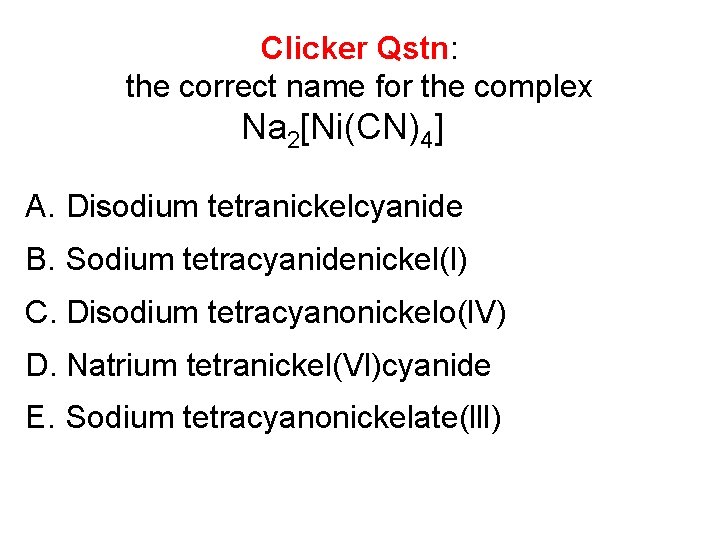
Clicker Qstn: the correct name for the complex Na 2[Ni(CN)4] A. Disodium tetranickelcyanide B. Sodium tetracyanidenickel(l) C. Disodium tetracyanonickelo(l. V) D. Natrium tetranickel(Vl)cyanide E. Sodium tetracyanonickelate(lll)
Constitutional (Structural) Isomers 1. Ionization isomers 2. Linkage isomers
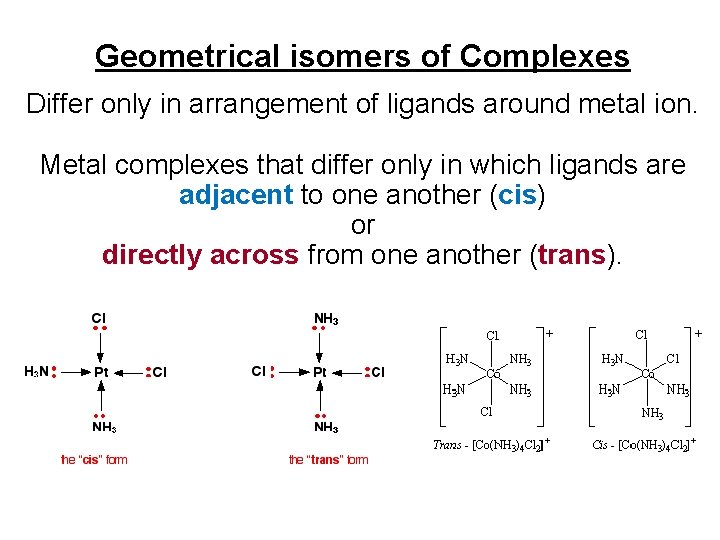
Geometrical isomers of Complexes Differ only in arrangement of ligands around metal ion. Metal complexes that differ only in which ligands are adjacent to one another (cis) or directly across from one another (trans).
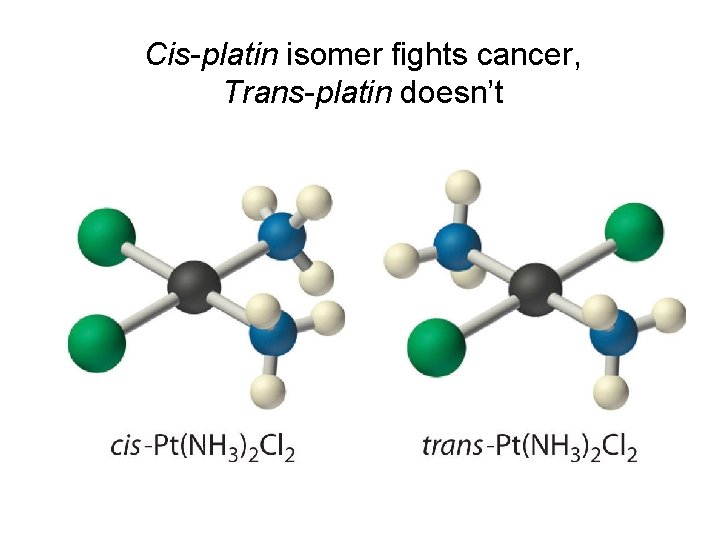
Cis-platin isomer fights cancer, Trans-platin doesn’t
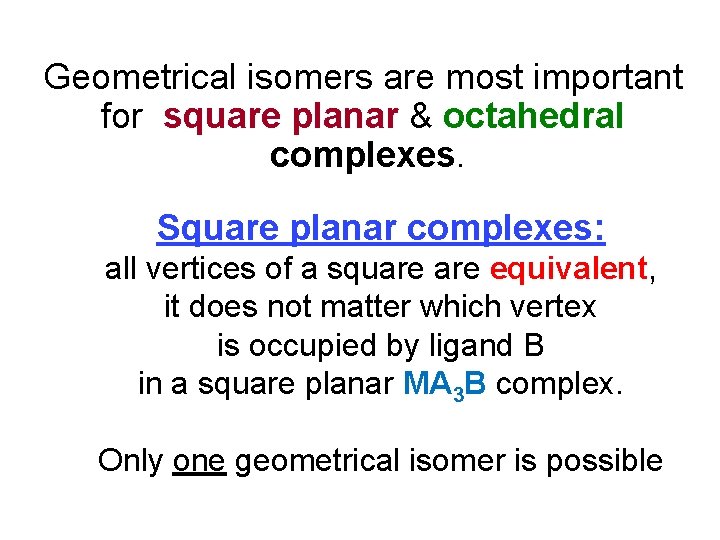
Geometrical isomers are most important for square planar & octahedral complexes. Square planar complexes: all vertices of a square equivalent, it does not matter which vertex is occupied by ligand B in a square planar MA 3 B complex. Only one geometrical isomer is possible
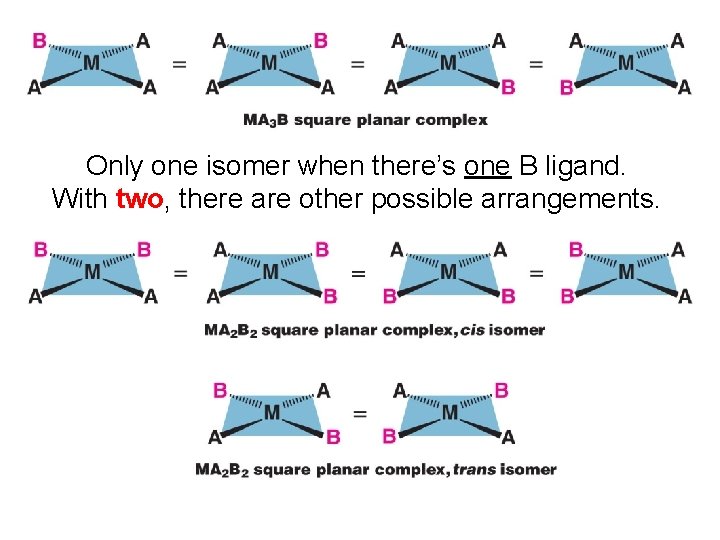
Only one isomer when there’s one B ligand. With two, there are other possible arrangements.
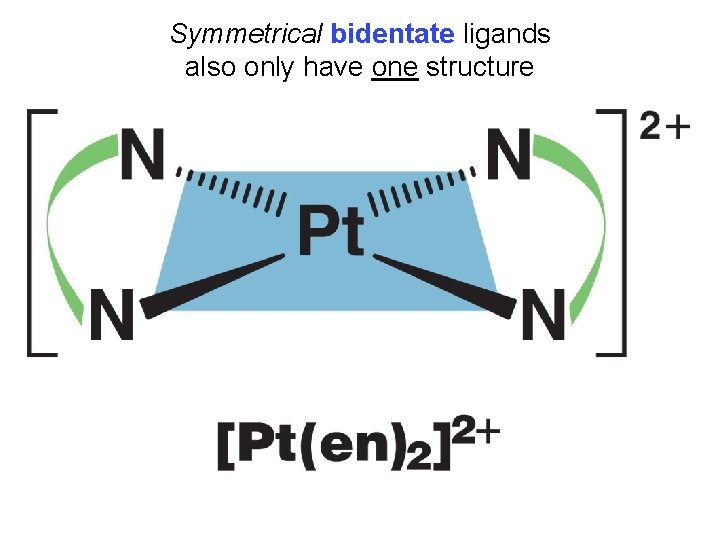
Symmetrical bidentate ligands also only have one structure
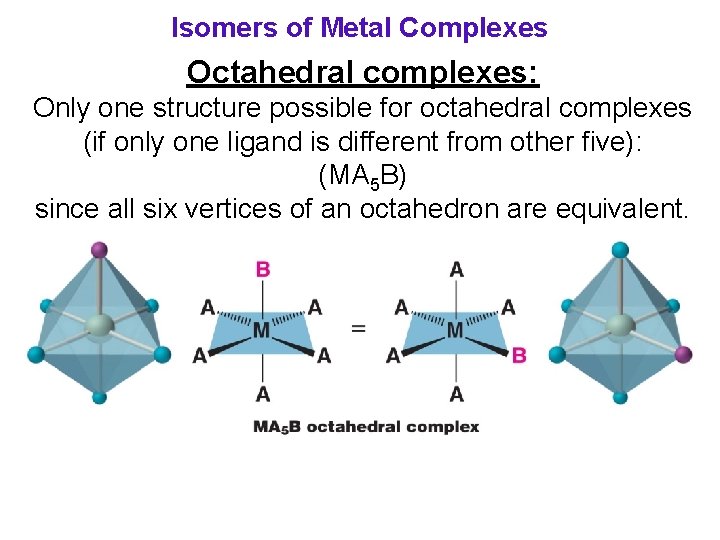
Isomers of Metal Complexes Octahedral complexes: Only one structure possible for octahedral complexes (if only one ligand is different from other five): (MA 5 B) since all six vertices of an octahedron are equivalent.
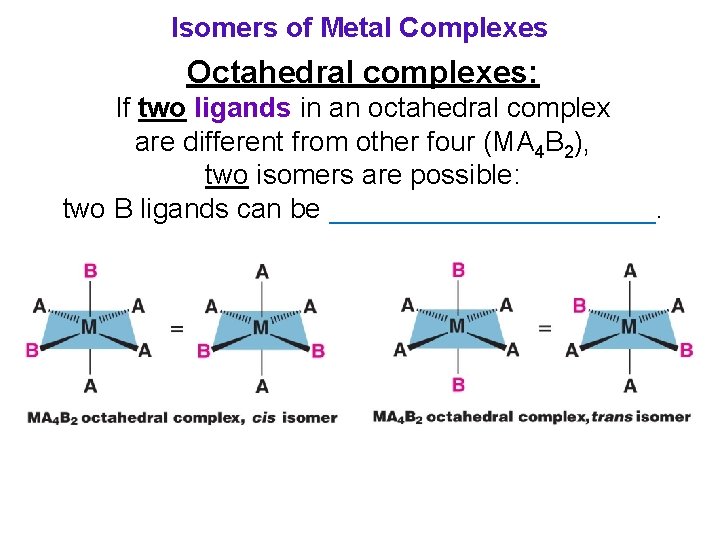
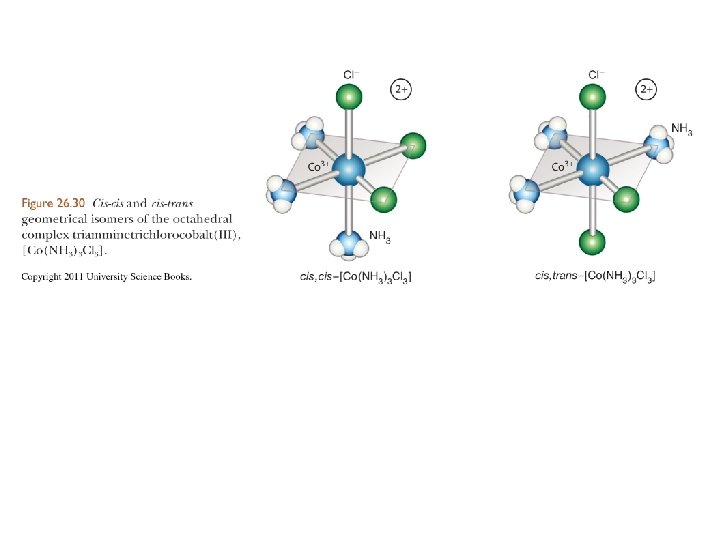
Isomers of Metal Complexes Octahedral complexes: If two ligands in an octahedral complex are different from other four (MA 4 B 2), two isomers are possible: two B ligands can be ___________.
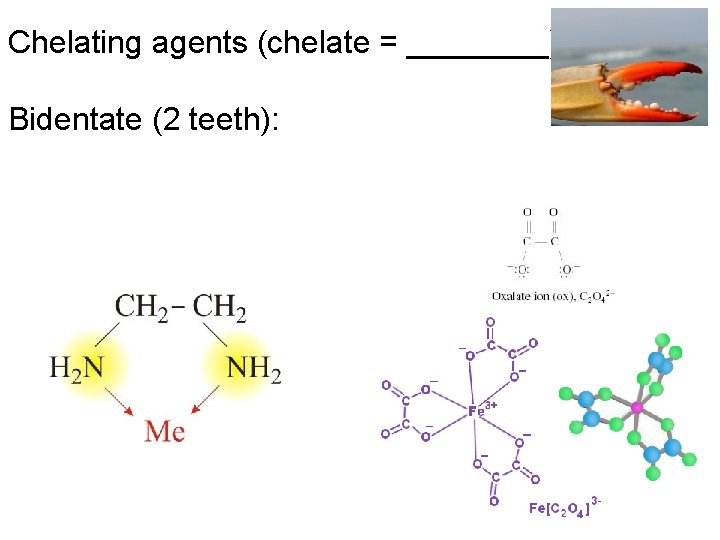
Chelating agents (chelate = ____) Bidentate (2 teeth):
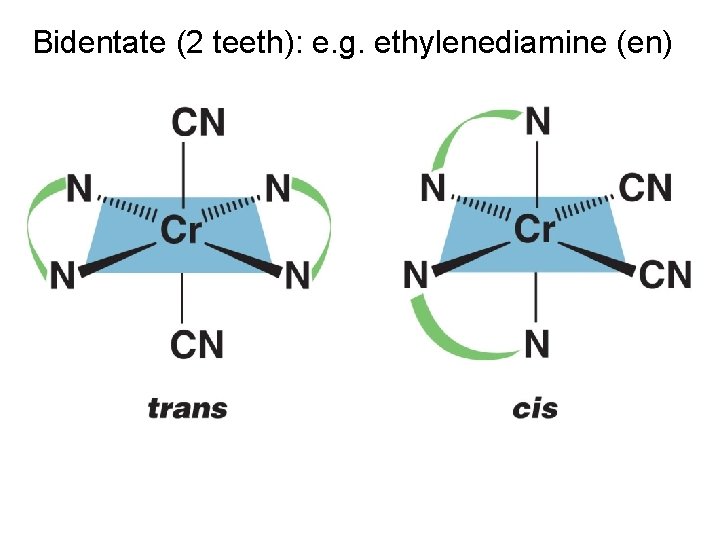
Bidentate (2 teeth): e. g. ethylenediamine (en)
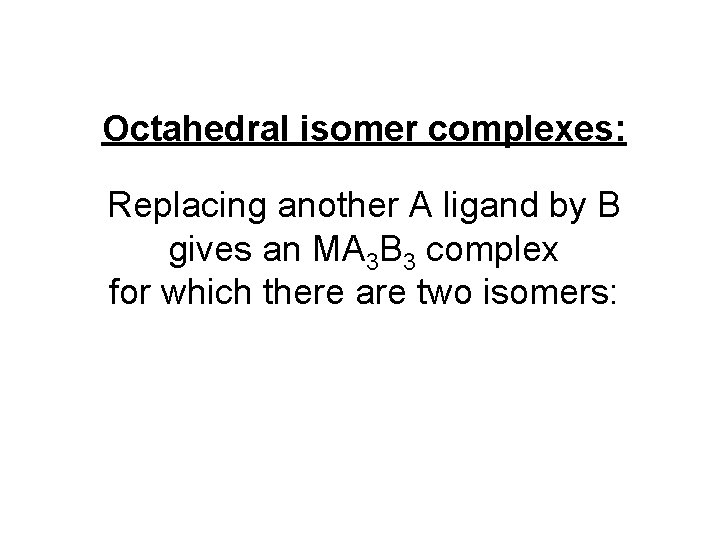
Octahedral isomer complexes: Replacing another A ligand by B gives an MA 3 B 3 complex for which there are two isomers:
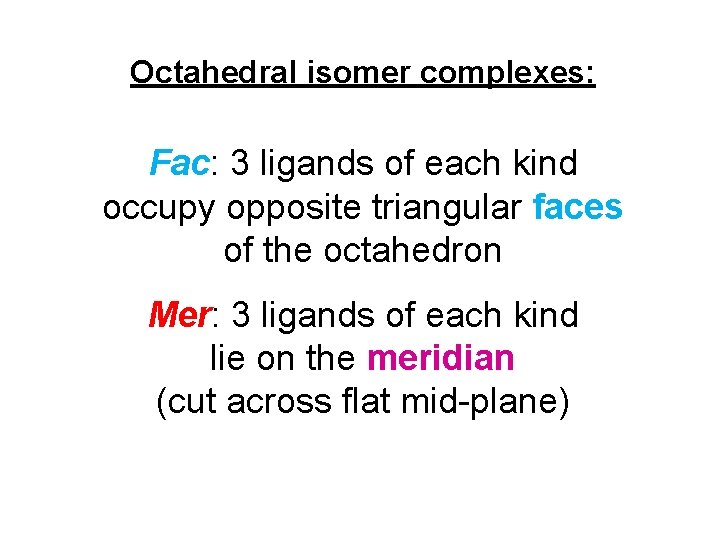
Octahedral isomer complexes: Fac: 3 ligands of each kind occupy opposite triangular faces of the octahedron Mer: 3 ligands of each kind lie on the meridian (cut across flat mid-plane)
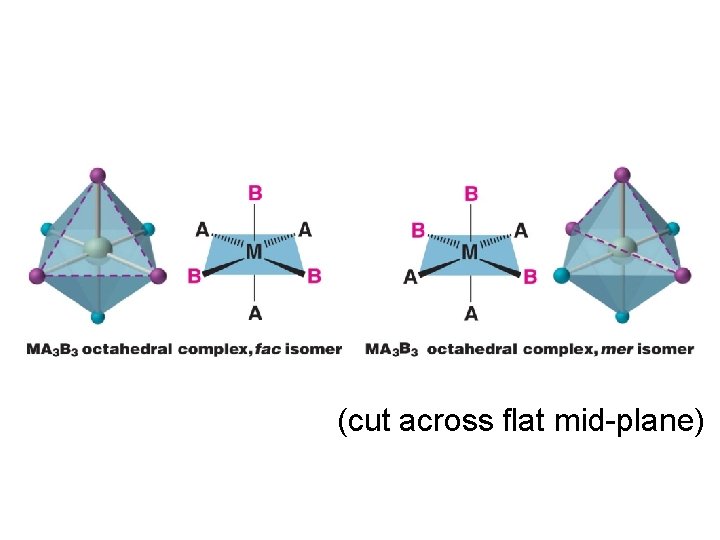
(cut across flat mid-plane)
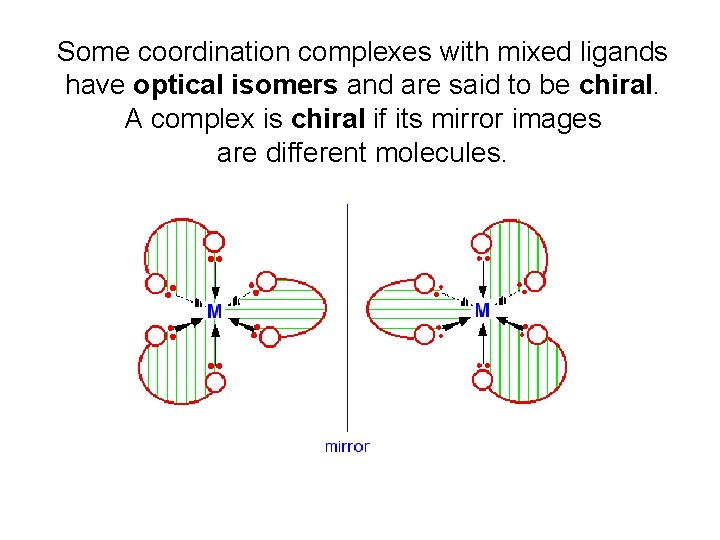
Some coordination complexes with mixed ligands have optical isomers and are said to be chiral. A complex is chiral if its mirror images are different molecules.
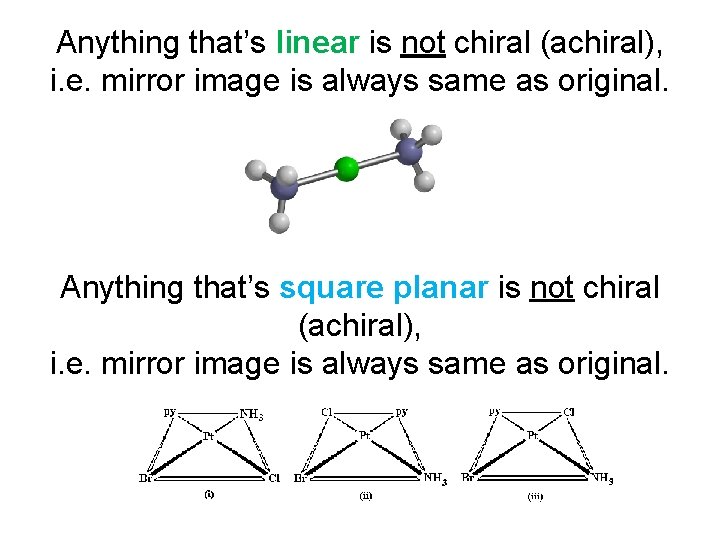
Anything that’s linear is not chiral (achiral), i. e. mirror image is always same as original. Anything that’s square planar is not chiral (achiral), i. e. mirror image is always same as original.
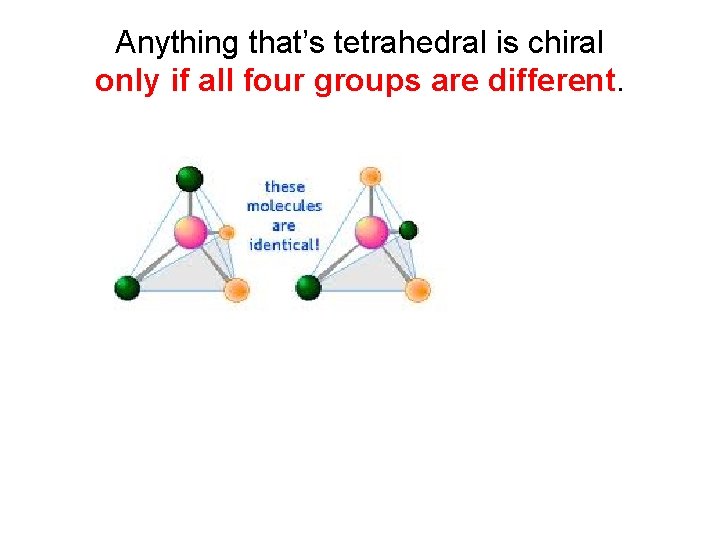
Anything that’s tetrahedral is chiral only if all four groups are different.
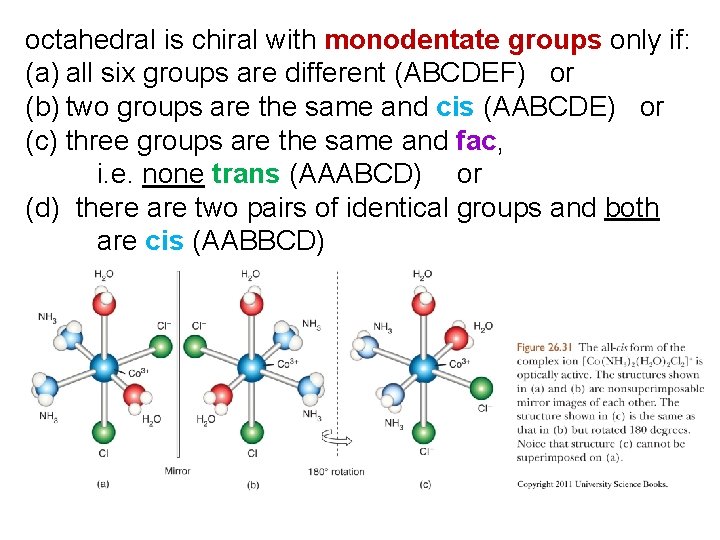
octahedral is chiral with monodentate groups only if: (a) all six groups are different (ABCDEF) or (b) two groups are the same and cis (AABCDE) or (c) three groups are the same and fac, i. e. none trans (AAABCD) or (d) there are two pairs of identical groups and both are cis (AABBCD)
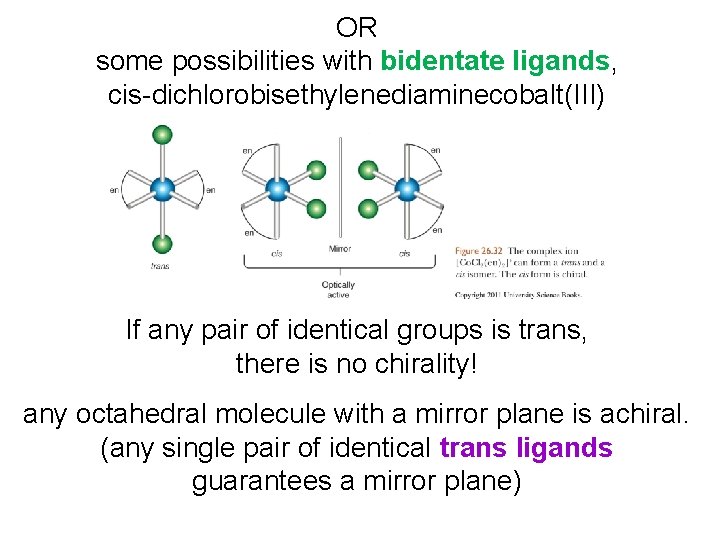
OR some possibilities with bidentate ligands, cis-dichlorobisethylenediaminecobalt(III) If any pair of identical groups is trans, there is no chirality! any octahedral molecule with a mirror plane is achiral. (any single pair of identical trans ligands guarantees a mirror plane)
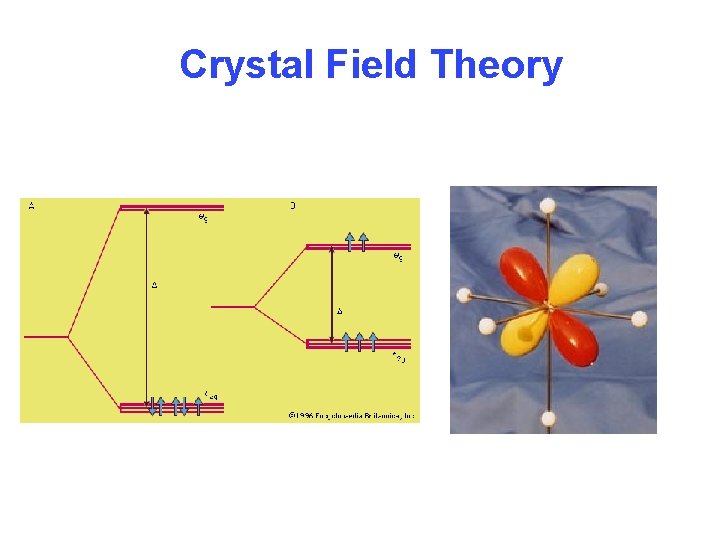
Crystal Field Theory
Crystal Field Theory Bonding model explaining many important properties of transition-metal complexes:
Crystal Field Theory Central assumption of CFT: metal-ligand connections are electrostatic interactions btwn a central metal ion and a set of negatively charged ligands (or ligand dipoles) arranged around metal ion.
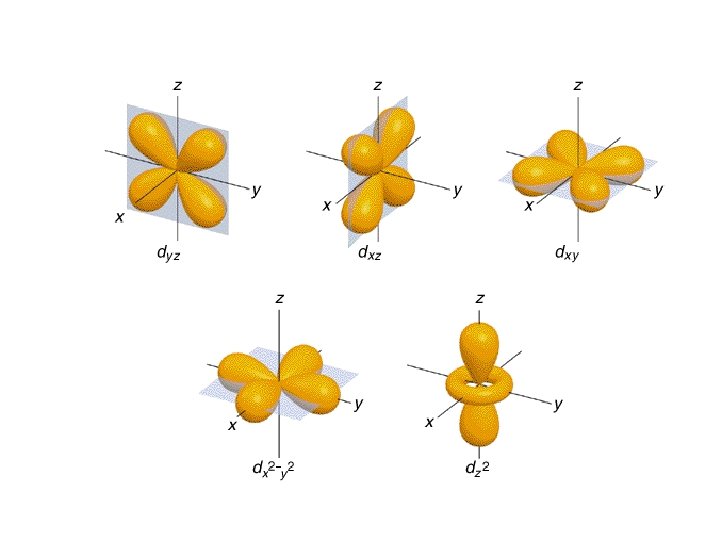
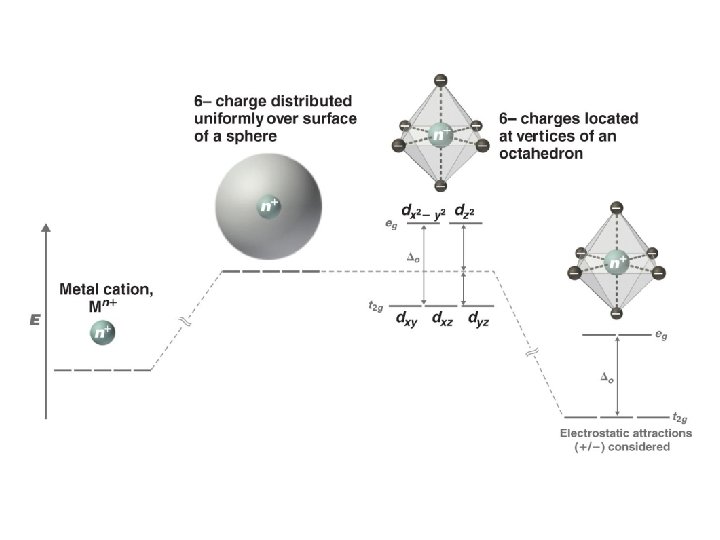
d-Orbital Splittings five d orbitals are initially degenerate (same energy). When the 6 (-) charges are distributed uniformly over surface of a sphere, d orbitals remain degenerate.
d-Orbital Splittings But! Their energy will be higher due to
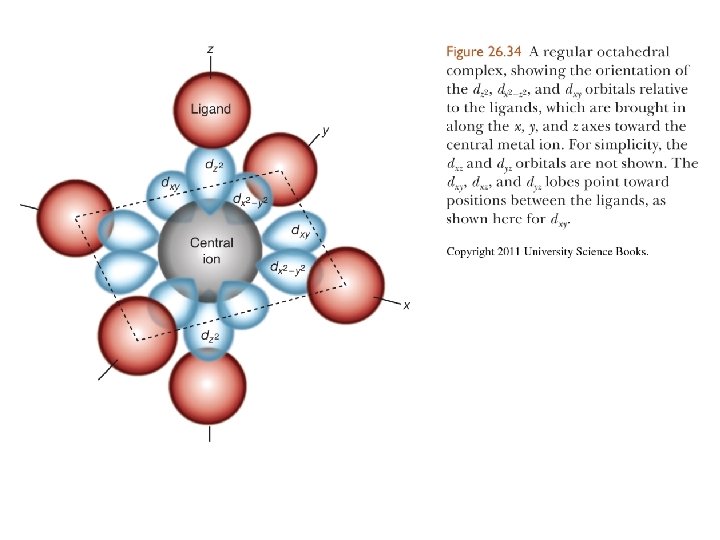
d-Orbital Splittings If the 6 (-) charges are placed at vertices of an octahedron, avg energy of d orbitals does not change.
d-Orbital Splittings But! It does remove their degeneracy and the 5 d orbitals split into two groups
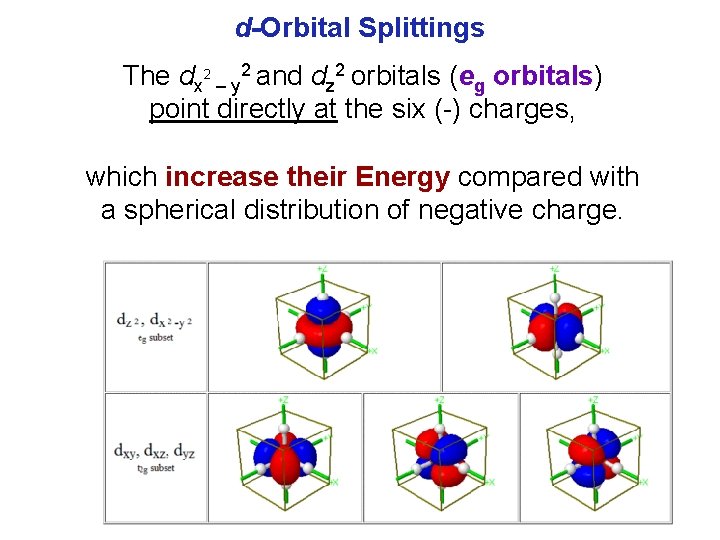
d-Orbital Splittings The dx 2 – y 2 and dz 2 orbitals (eg orbitals) point directly at the six (-) charges, which increase their Energy compared with a spherical distribution of negative charge.
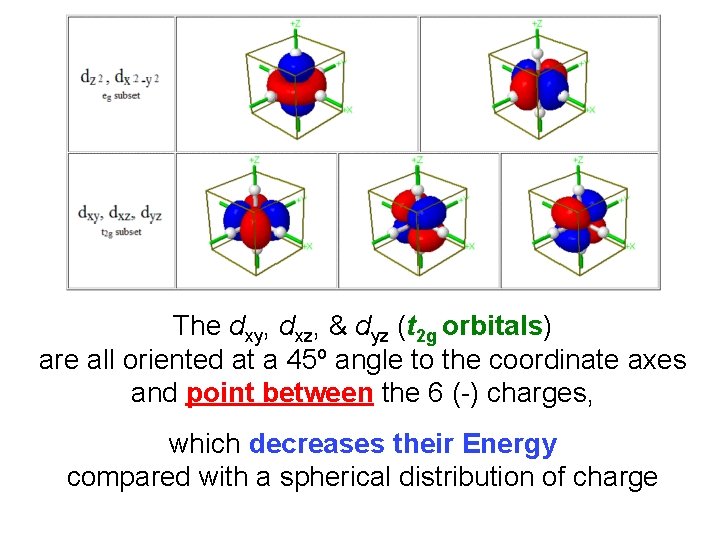
The dxy, dxz, & dyz (t 2 g orbitals) are all oriented at a 45º angle to the coordinate axes and point between the 6 (-) charges, which decreases their Energy compared with a spherical distribution of charge
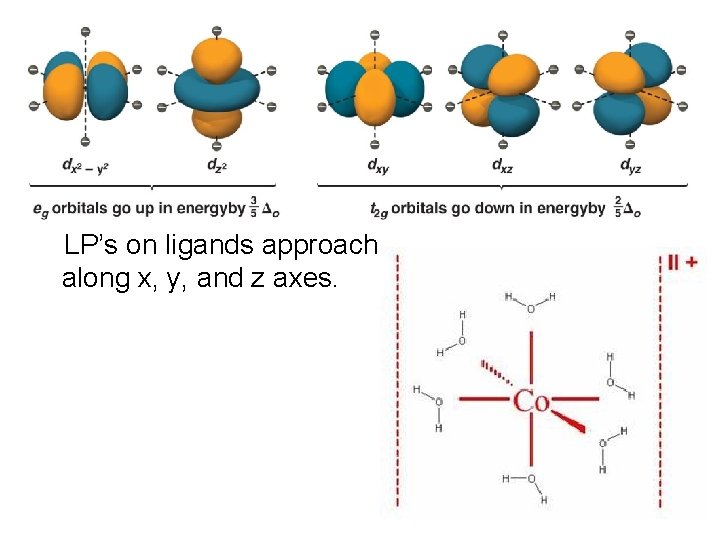
As LP’s on ligands approach As along x, y, and z axes.
d-Orbital Splittings Difference in E btwn the two sets of d orbitals is crystal field splitting energy.
d-Orbital Splittings Magnitude of the splitting depends on: Splitting of d orbitals in a crystal field does not total energy of the five d orbitals
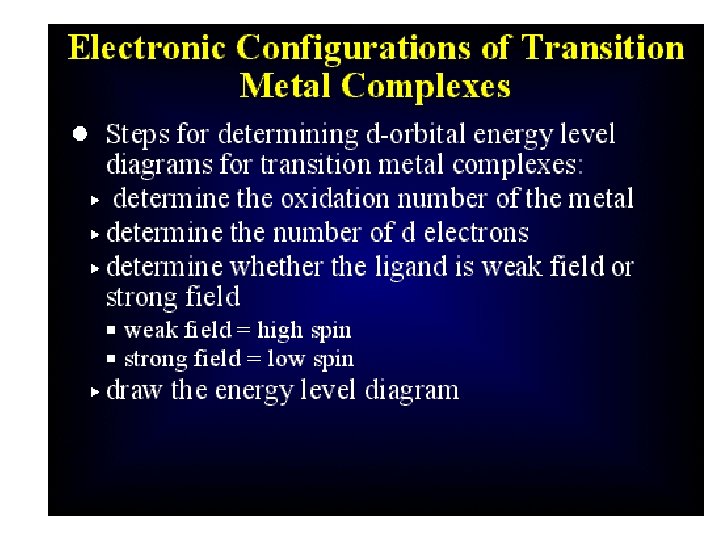
Electronic Structures of Metal Complexes Using d-orbital energy-level diagram: electronic structures & some properties of transition-metal complexes can be predicted. Start with Ti 3+ ion, (contains a single d electron), proceed across first row of transition metals by adding a single e- at a time.
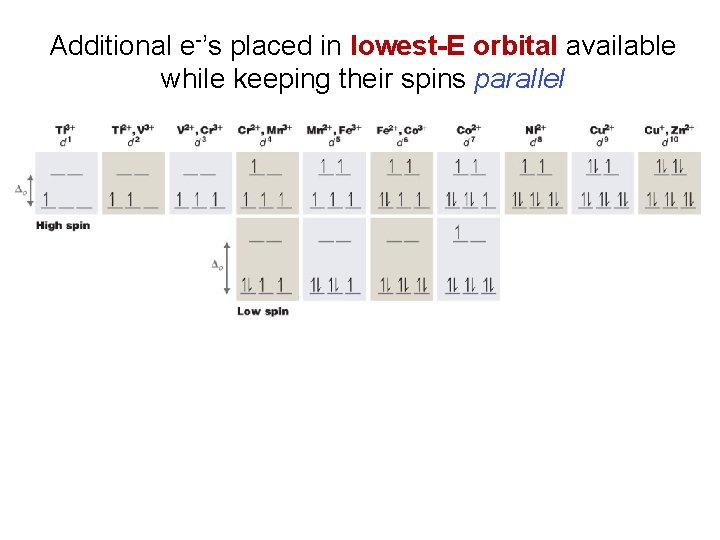
Additional e-’s placed in lowest-E orbital available while keeping their spins parallel
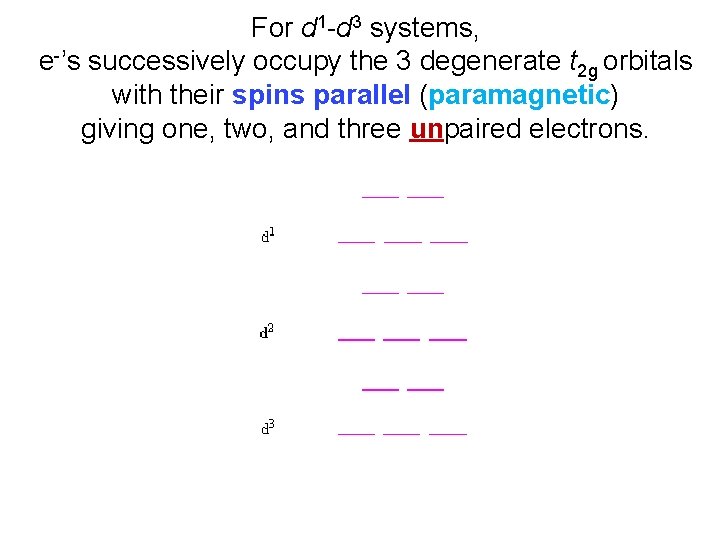
For d 1 -d 3 systems, e-’s successively occupy the 3 degenerate t 2 g orbitals with their spins parallel (paramagnetic) giving one, two, and three unpaired electrons.
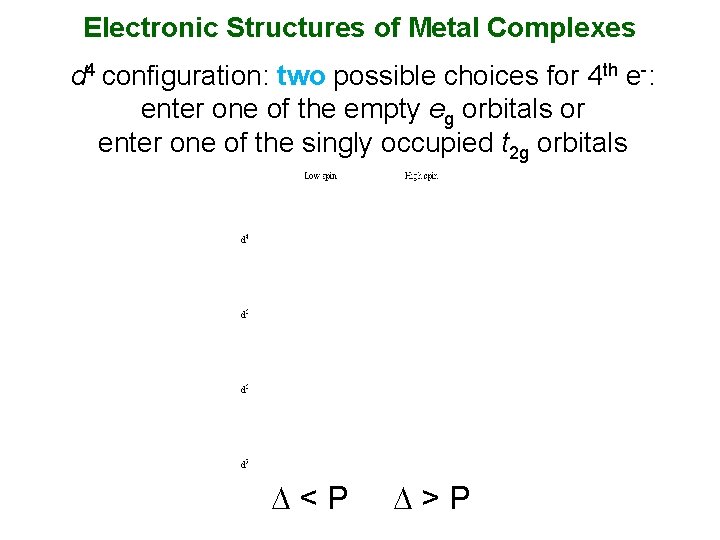
Electronic Structures of Metal Complexes d 4 configuration: two possible choices for 4 th e-: enter one of the empty eg orbitals or enter one of the singly occupied t 2 g orbitals < P > P
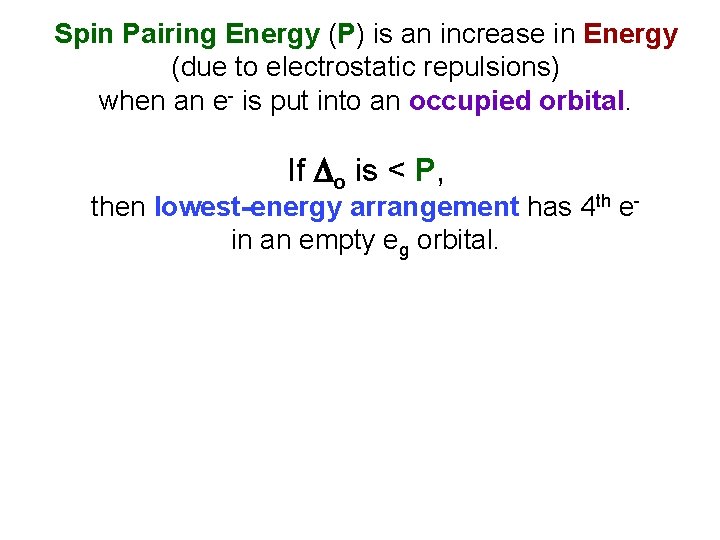
Spin Pairing Energy (P) is an increase in Energy (due to electrostatic repulsions) when an e- is put into an occupied orbital. If o is < P, then lowest-energy arrangement has 4 th e- in an empty eg orbital.
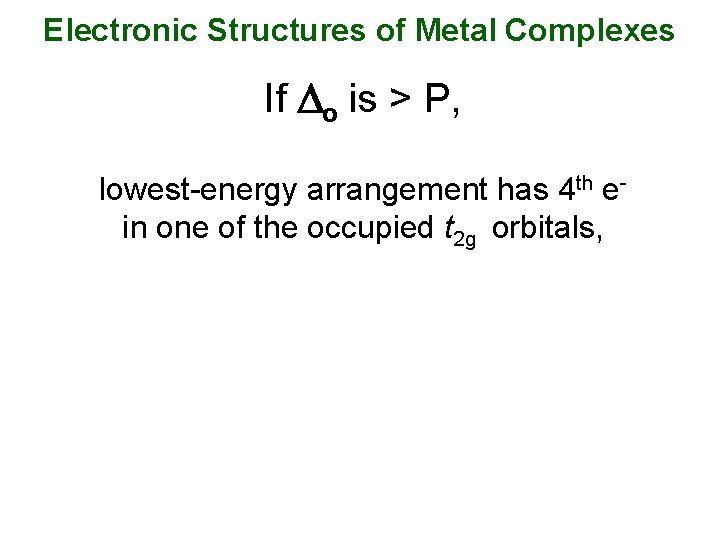
Electronic Structures of Metal Complexes If o is > P, lowest-energy arrangement has 4 th e- in one of the occupied t 2 g orbitals,
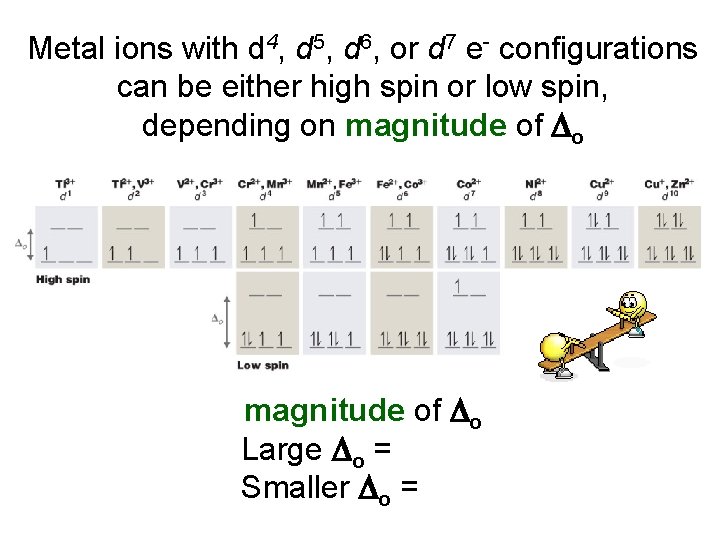
Metal ions with d 4, d 5, d 6, or d 7 e- configurations can be either high spin or low spin, depending on magnitude of o Large o = Smaller o =
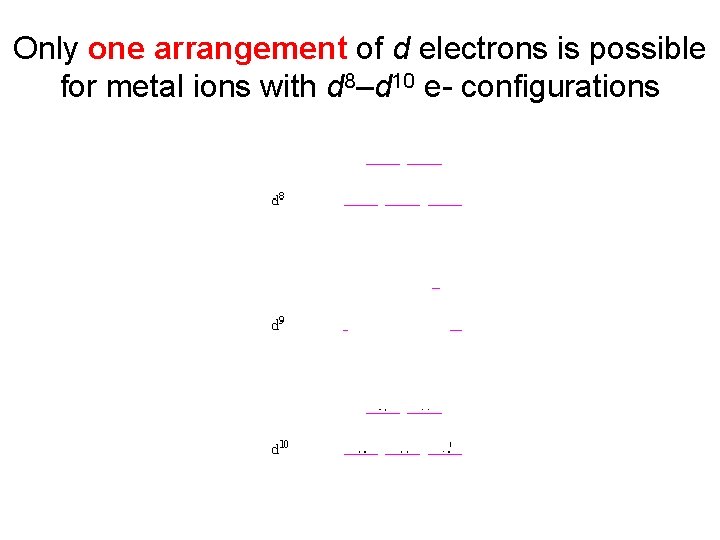
Only one arrangement of d electrons is possible for metal ions with d 8–d 10 e- configurations
Factors That Affect the Magnitude of o magnitude of o dictates whether a complex with 4, 5, 6, or 7 d e-’s is high spin or low spin: 1. Large values of o yield a low-spin complex 2. Small values of o a high-spin complex
Which affects its: • Magnetic properties • Structure • Reactivity
Factors That Affect the Magnitude of o Nature of the ligands For a series of chem similar ligands, magnitude of o decreases as size of donor atom increases because smaller, more localized charges interact
Factors That Affect the Magnitude of o Nature of the ligands
Nature of the ligands experimentally observed order of the crystal field splitting energies produced by different ligands is called: the spectrochemical series
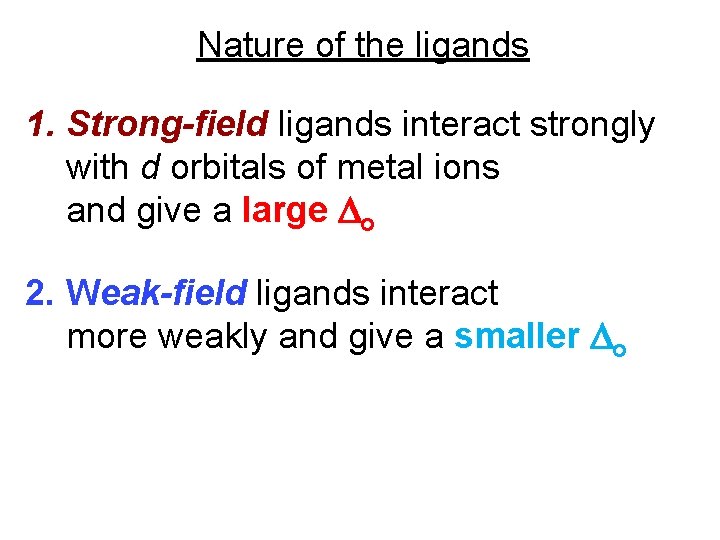
Nature of the ligands 1. Strong-field ligands interact strongly with d orbitals of metal ions and give a large o 2. Weak-field ligands interact more weakly and give a smaller o
The Spectrochemical Series splitting of d orbitals in crystal field model not only depends on geometry of the complex also depends on nature of the metal ion, charge on this ion, and the ligands that surround the metal.
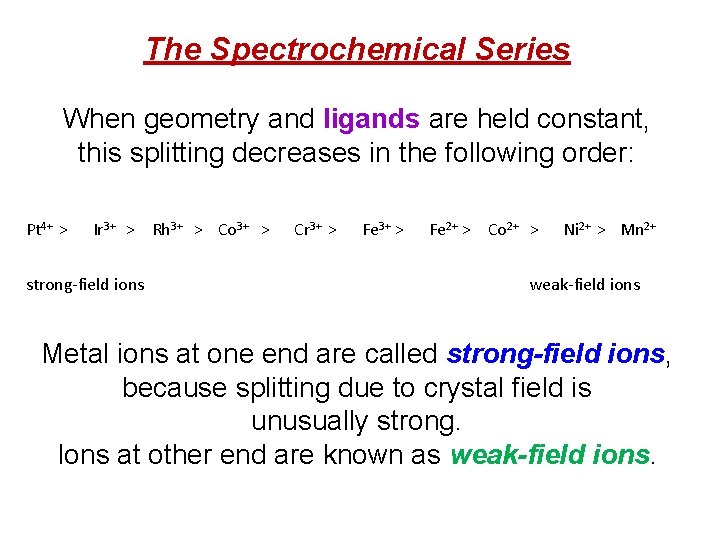
The Spectrochemical Series When geometry and ligands are held constant, this splitting decreases in the following order: Pt 4+ > Ir 3+ > Rh 3+ > Co 3+ > strong-field ions Cr 3+ > Fe 2+ > Co 2+ > Ni 2+ > Mn 2+ weak-field ions Metal ions at one end are called strong-field ions, because splitting due to crystal field is unusually strong. Ions at other end are known as weak-field ions.
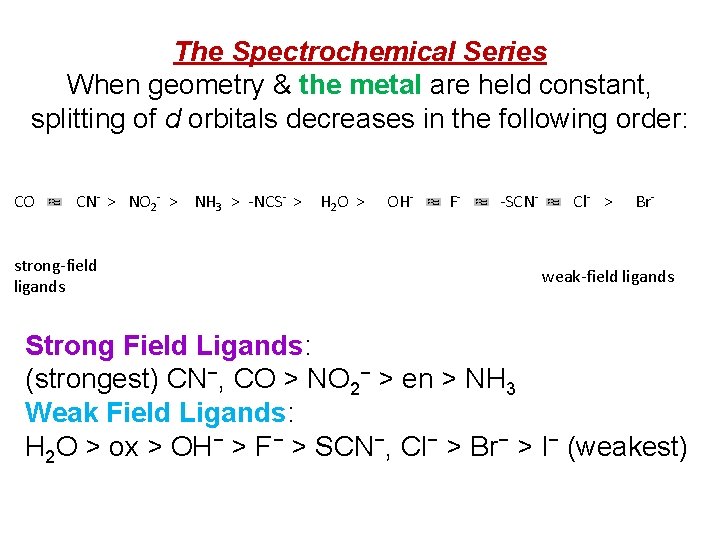
The Spectrochemical Series When geometry & the metal are held constant, splitting of d orbitals decreases in the following order: CO CN- > NO 2 - > NH 3 > -NCS- > H 2 O > strong-field ligands OH- F- -SCN- Cl- > Br- weak-field ligands Strong Field Ligands: (strongest) CN−, CO > NO 2− > en > NH 3 Weak Field Ligands: H 2 O > ox > OH− > F− > SCN−, Cl− > Br− > I− (weakest)
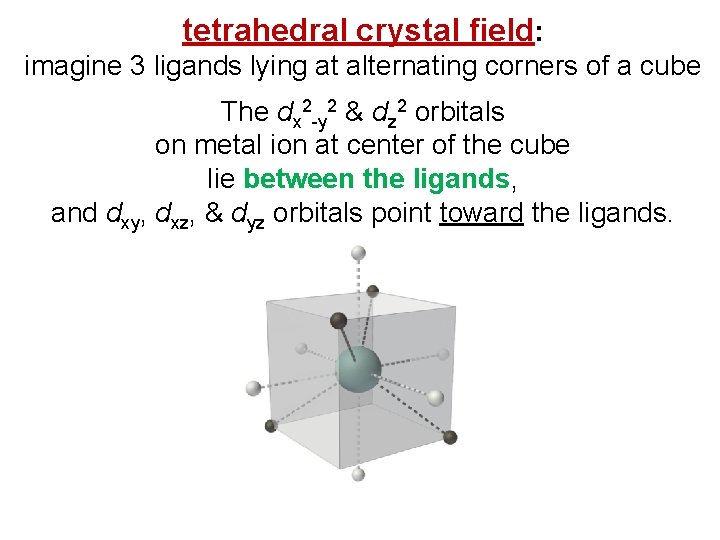
tetrahedral crystal field: imagine 3 ligands lying at alternating corners of a cube The dx 2 -y 2 & dz 2 orbitals on metal ion at center of the cube lie between the ligands, and dxy, dxz, & dyz orbitals point toward the ligands.
Tetrahedral Complexes Splitting of energies of orbitals in tetrahedral complex, o, is smaller than in an octahedral complex for two reasons: 1. d orbitals interact less strongly with ligands in a tetrahedral arrangement. 2. Only four negative charges rather than six, which decreases electrostatic interactions
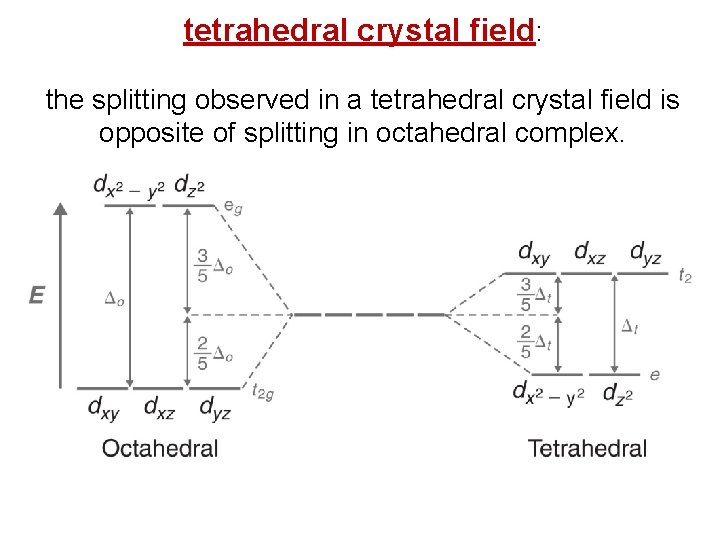
tetrahedral crystal field: the splitting observed in a tetrahedral crystal field is opposite of splitting in octahedral complex.
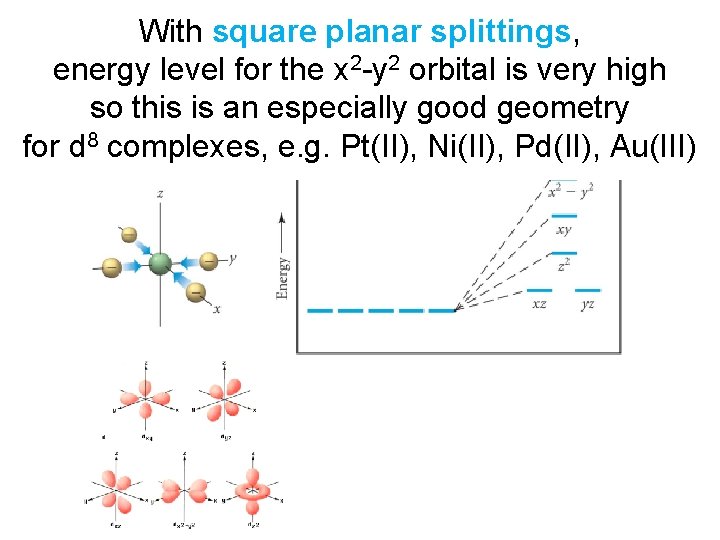
With square planar splittings, energy level for the x 2 -y 2 orbital is very high so this is an especially good geometry for d 8 complexes, e. g. Pt(II), Ni(II), Pd(II), Au(III)
Factors That Affect the Magnitude of o Charge on the metal ion Increasing charge on a metal ion has 2 effects: 1. Radius of metal ion decreases 2. Neg charged ligands are more strongly attracted to it. Both factors decrease metal-ligand distance, which causes (-) charged ligands to interact more strongly with the d orbitals. magnitude of o increases as charge on metal ion increases
Factors That Affect the Magnitude of o Principal quantum # of the metal For a series of complexes of metals from same group in periodic table with same charge and same ligands: magnitude of o increases with increasing quantum #:
Factors That Affect the Magnitude of o Principal quantum # of the metal o (3 d) << o (4 d) < o (5 d) Increase in o w/ increasing principal quantum # is due to: larger radius of valence orbitals going down a column. Repulsive ligand-ligand interactions are important for smaller metal ions, which results in shorter M–L distances and stronger d-orbital-ligand interactions
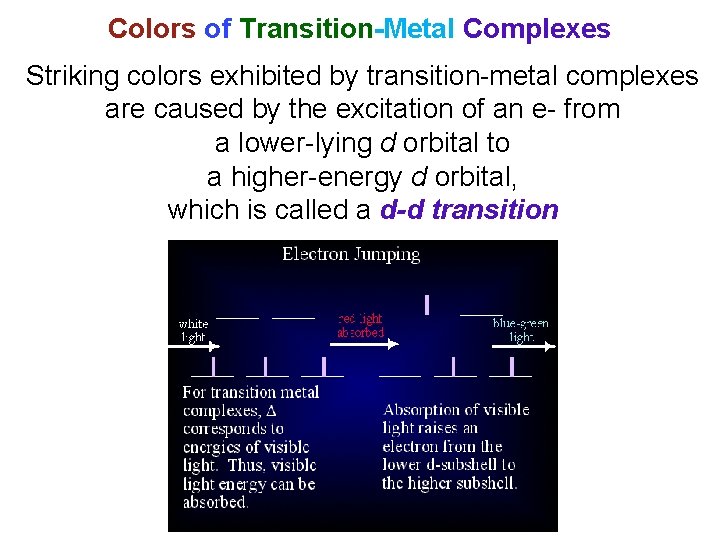
Colors of Transition-Metal Complexes Striking colors exhibited by transition-metal complexes are caused by the excitation of an e- from a lower-lying d orbital to a higher-energy d orbital, which is called a d-d transition
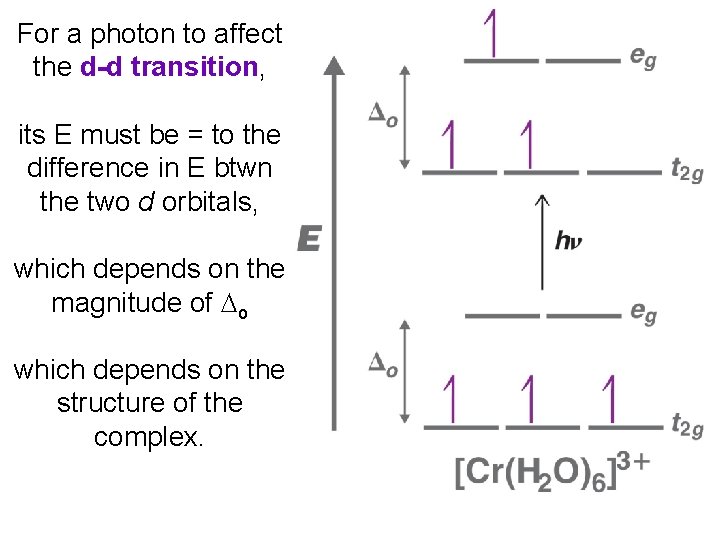
For a photon to affect the d-d transition, its E must be = to the difference in E btwn the two d orbitals, which depends on the magnitude of o which depends on the structure of the complex.
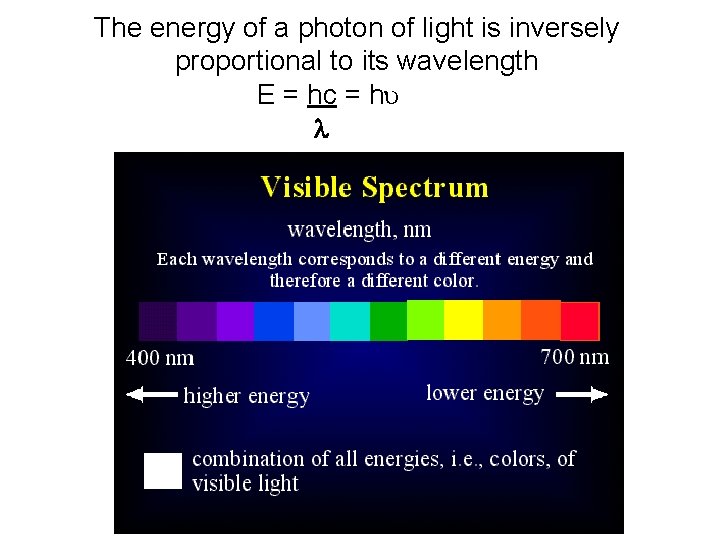
The energy of a photon of light is inversely proportional to its wavelength E = hc = hu l
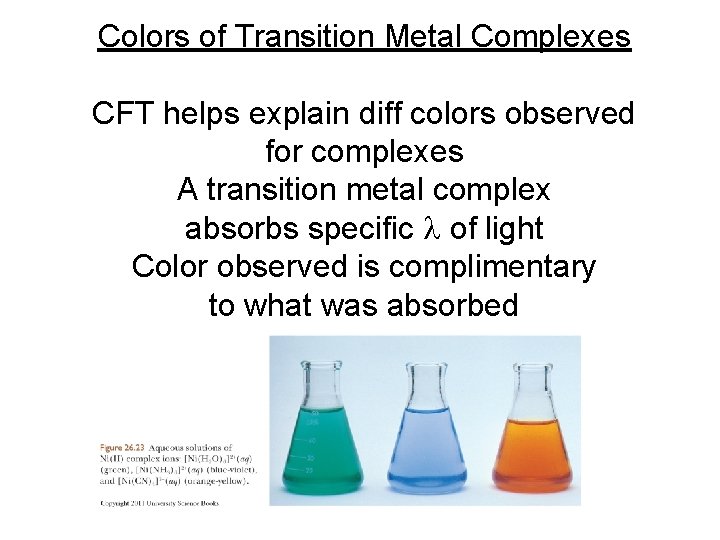
Colors of Transition Metal Complexes CFT helps explain diff colors observed for complexes A transition metal complex absorbs specific l of light Color observed is complimentary to what was absorbed
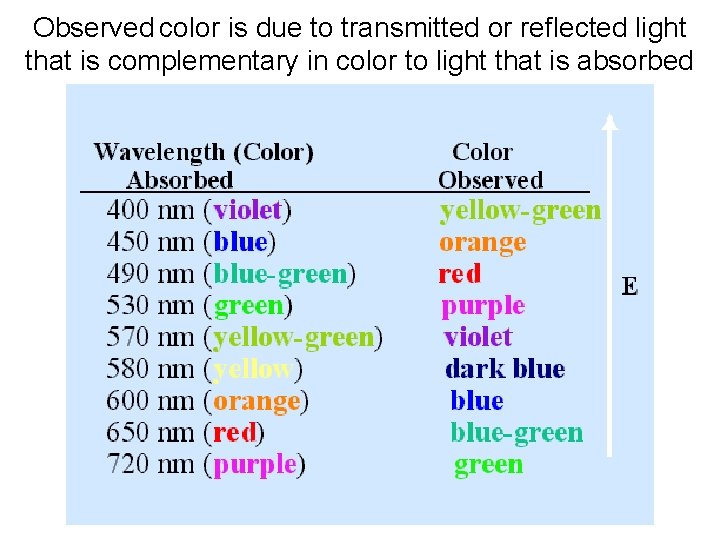
Observed color is due to transmitted or reflected light that is complementary in color to light that is absorbed
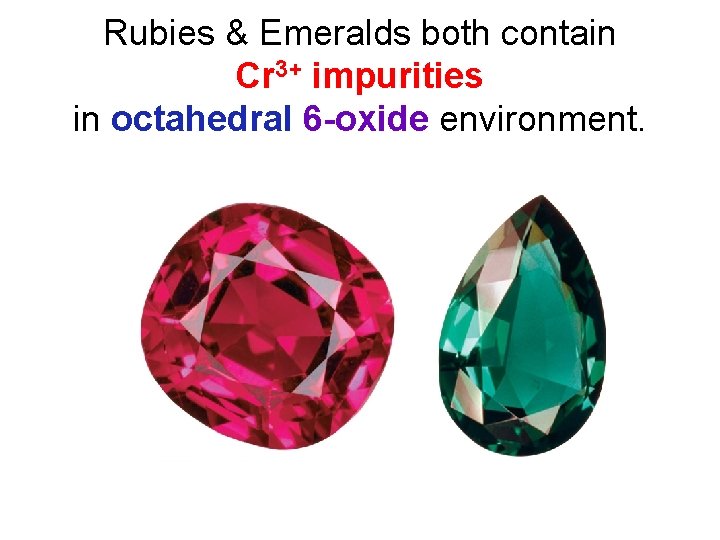
Rubies & Emeralds both contain Cr 3+ impurities in octahedral 6 -oxide environment.
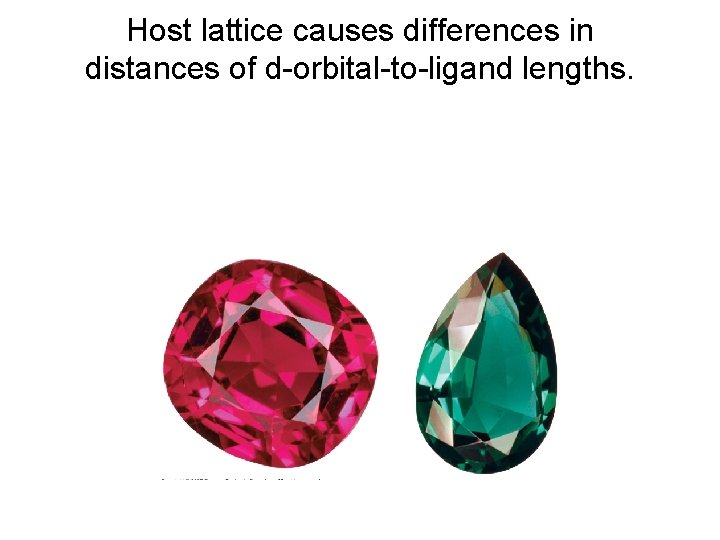
Host lattice causes differences in distances of d-orbital-to-ligand lengths.
Applications: Chelating Agents: EDTA used to treat victims of heavy metal poisoning Chemical Analysis: Dimethylglyoxime turns red in presence of Ni(II) and yellow in the presence of Pd(II). Thiocyanate blood-red in presence of Fe(III) and blue in the presence of Co(II).
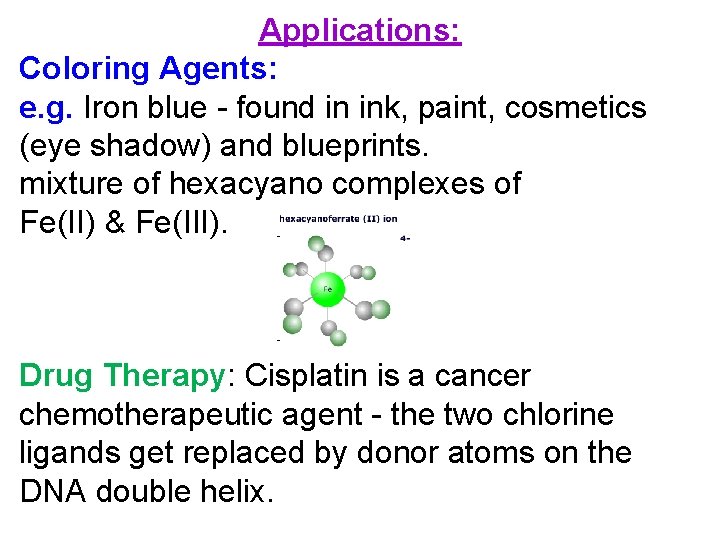
Applications: Coloring Agents: e. g. Iron blue - found in ink, paint, cosmetics (eye shadow) and blueprints. mixture of hexacyano complexes of Fe(II) & Fe(III). Drug Therapy: Cisplatin is a cancer chemotherapeutic agent - the two chlorine ligands get replaced by donor atoms on the DNA double helix.
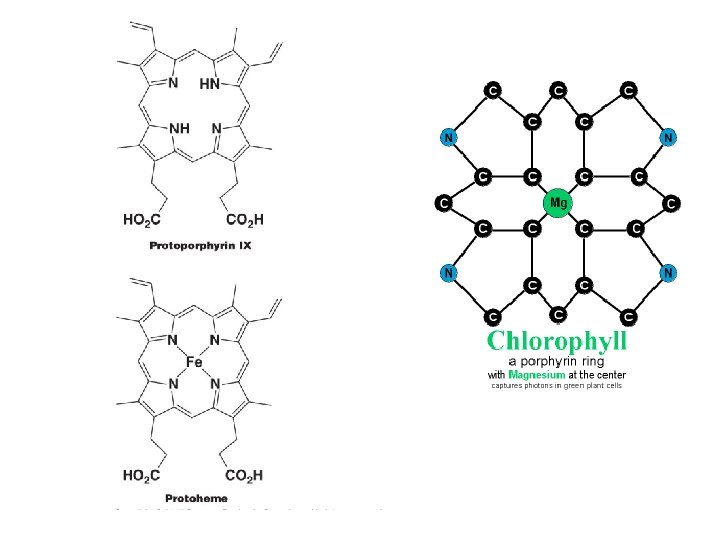
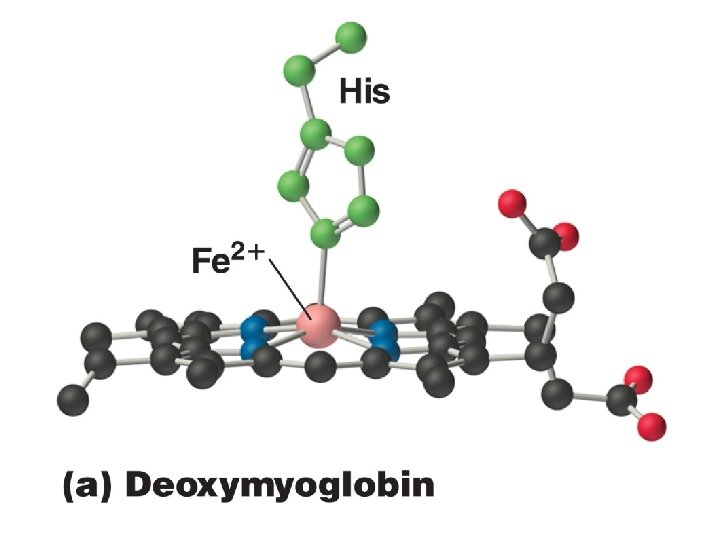
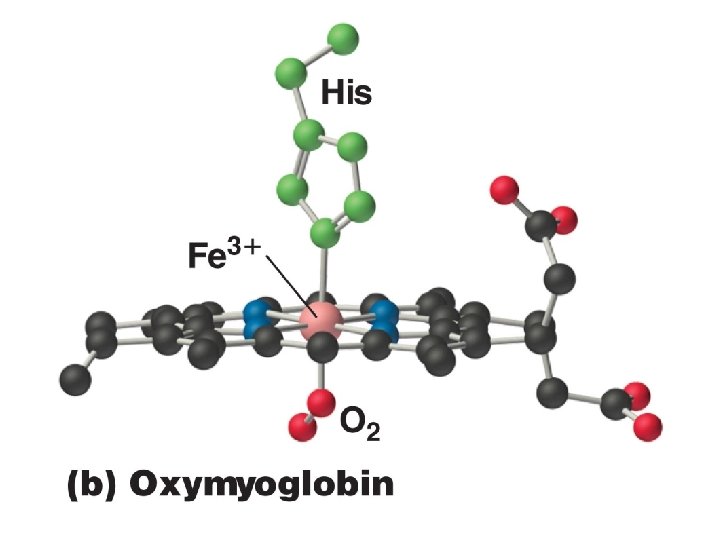
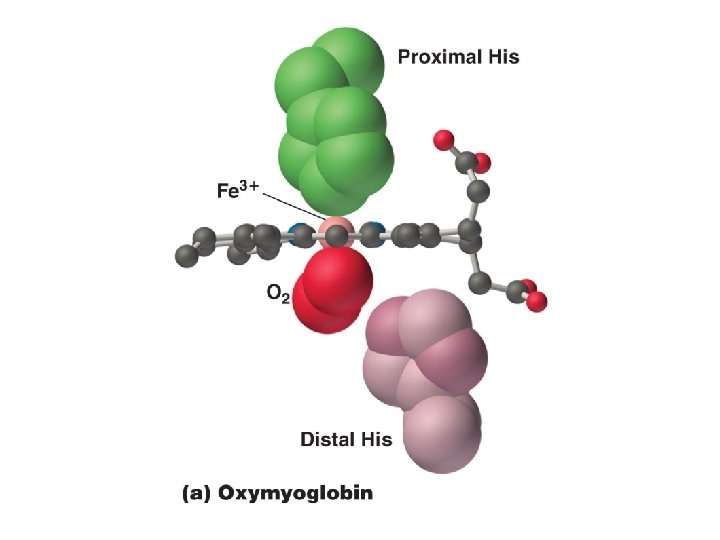
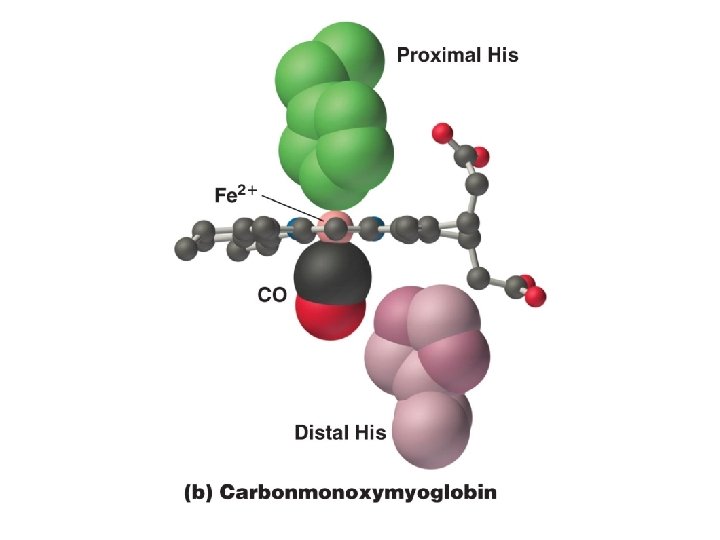
Biomolecules: Hemoglobin and cytochrome c contain Fe-heme complexes. Chlorophyll contains a Mg-porphyrin complex.
- Slides: 134