
Chemistry 200 Focus 6 Acids and Bases Acids
Chemistry 200 Focus 6 Acids and Bases
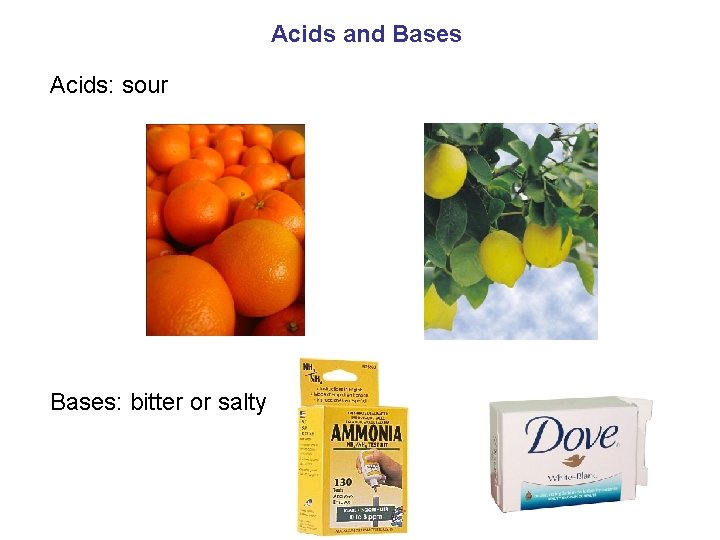
Acids and Bases Acids: sour Bases: bitter or salty
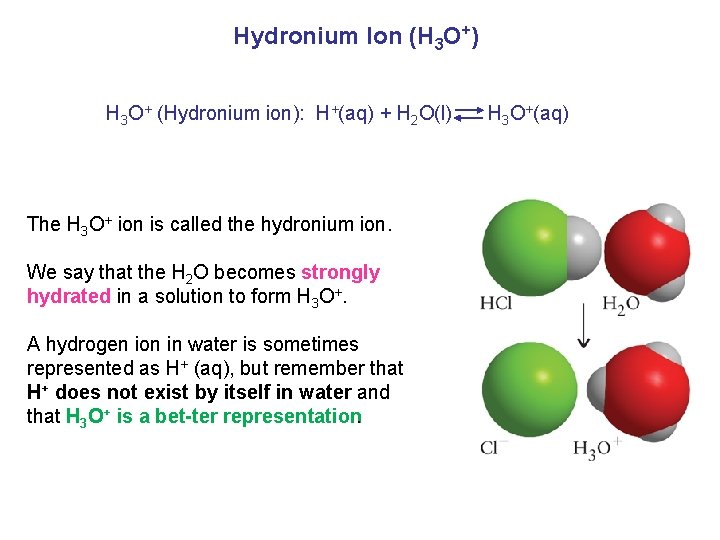
Hydronium Ion (H 3 O+) H 3 O+ (Hydronium ion): H+(aq) + H 2 O(l) H 3 O+(aq) The H 3 O+ ion is called the hydronium ion. We say that the H 2 O becomes strongly hydrated in a solution to form H 3 O+. A hydrogen ion in water is sometimes represented as H+ (aq), but remember that H+ does not exist by itself in water and that H 3 O+ is a bet ter representation.
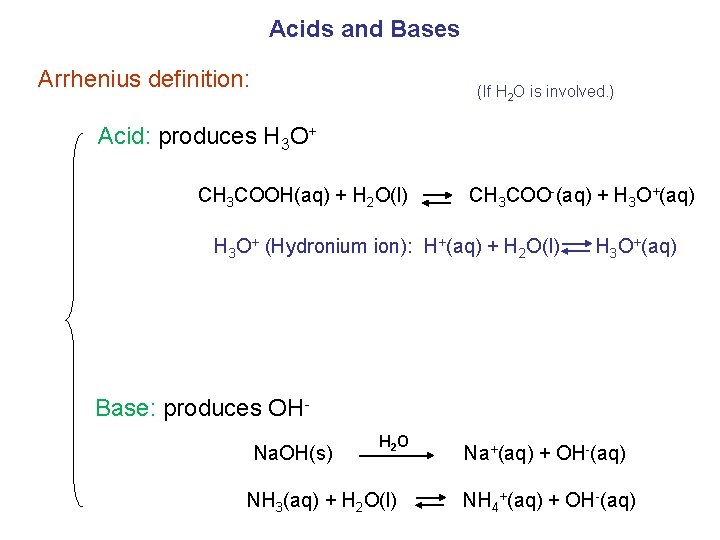
Acids and Bases Arrhenius definition: (If H 2 O is involved. ) Acid: produces H 3 O+ CH 3 COOH(aq) + H 2 O(l) CH 3 COO (aq) + H 3 O+(aq) H 3 O+ (Hydronium ion): H+(aq) + H 2 O(l) H 3 O+(aq) Base: produces OH Na. OH(s) H 2 O Na+(aq) + OH (aq) NH 3(aq) + H 2 O(l) NH 4+(aq) + OH (aq)
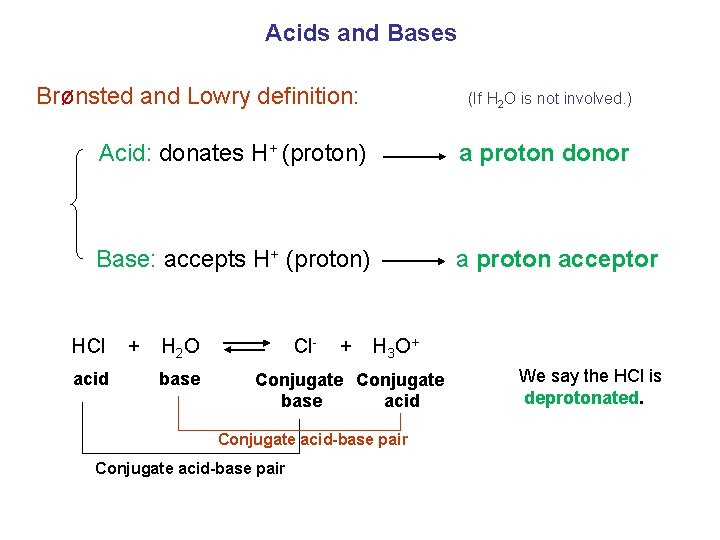
Acids and Bases Brønsted and Lowry definition: (If H 2 O is not involved. ) Acid: donates H+ (proton) a proton donor Base: accepts H+ (proton) a proton acceptor HCl + H 2 O Cl + H 3 O+ acid base Conjugate base acid Conjugate acid base pair We say the HCl is deprotonated.
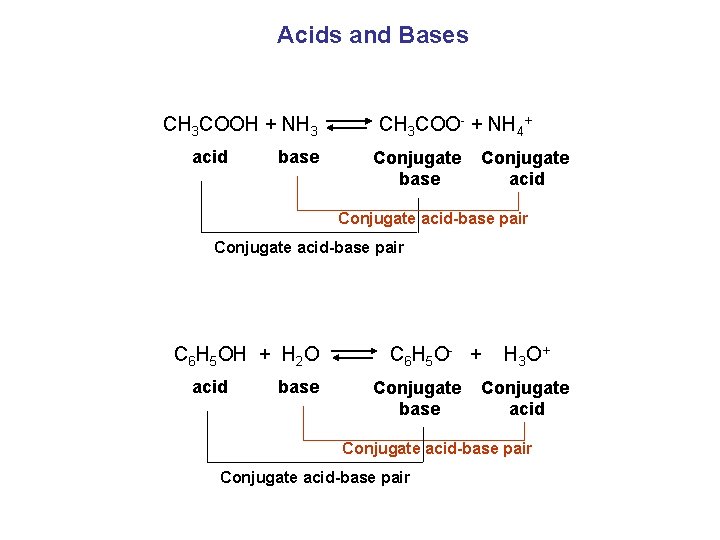
Acids and Bases CH 3 COOH + NH 3 acid base CH 3 COO + NH 4+ Conjugate base Conjugate acid base pair C 6 H 5 OH + H 2 O acid base C 6 H 5 O + H 3 O+ Conjugate base Conjugate acid base pair
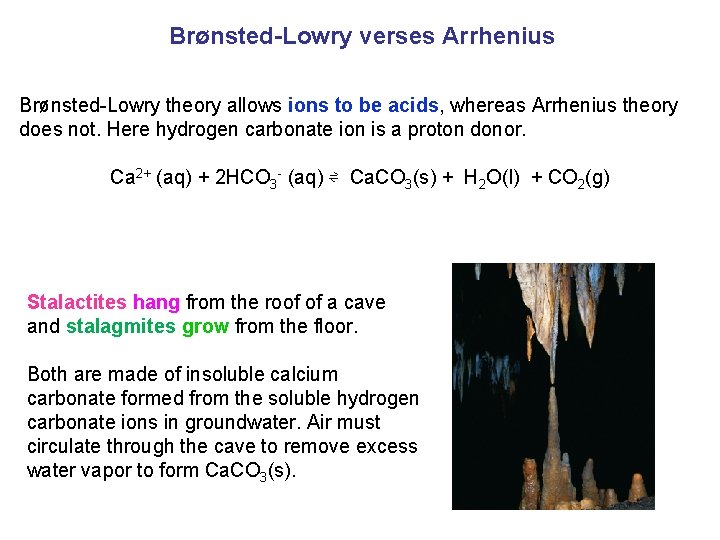
Brønsted Lowry verses Arrhenius Brønsted Lowry theory allows ions to be acids, whereas Arrhenius theory does not. Here hydrogen carbonate ion is a proton donor. Ca 2+ (aq) + 2 HCO 3 (aq) ⇌ Ca. CO 3(s) + H 2 O(l) + CO 2(g) Stalactites hang from the roof of a cave and stalagmites grow from the floor. Both are made of insoluble calcium carbonate formed from the soluble hydrogen carbonate ions in groundwater. Air must circulate through the cave to remove excess water vapor to form Ca. CO 3(s).
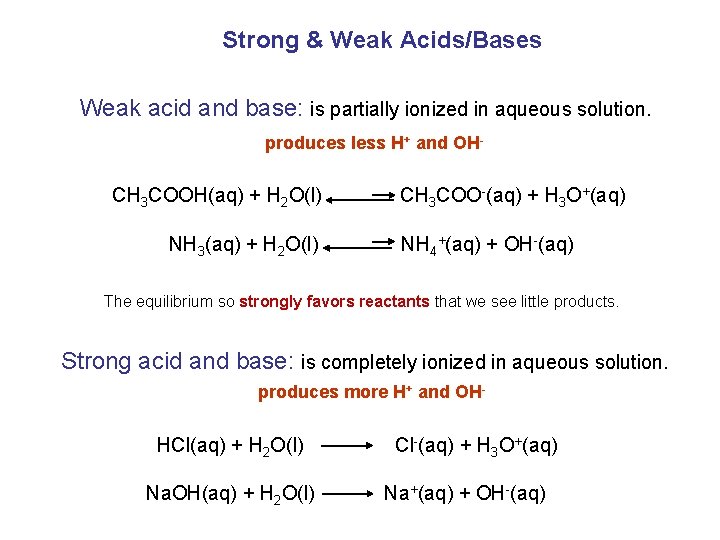
Strong & Weak Acids/Bases Weak acid and base: is partially ionized in aqueous solution. produces less H+ and OH CH 3 COOH(aq) + H 2 O(l) NH 3(aq) + H 2 O(l) CH 3 COO (aq) + H 3 O+(aq) NH 4+(aq) + OH (aq) The equilibrium so strongly favors reactants that we see little products. Strong acid and base: is completely ionized in aqueous solution. produces more H+ and OH HCl(aq) + H 2 O(l) Na. OH(aq) + H 2 O(l) Cl (aq) + H 3 O+(aq) Na+(aq) + OH (aq)
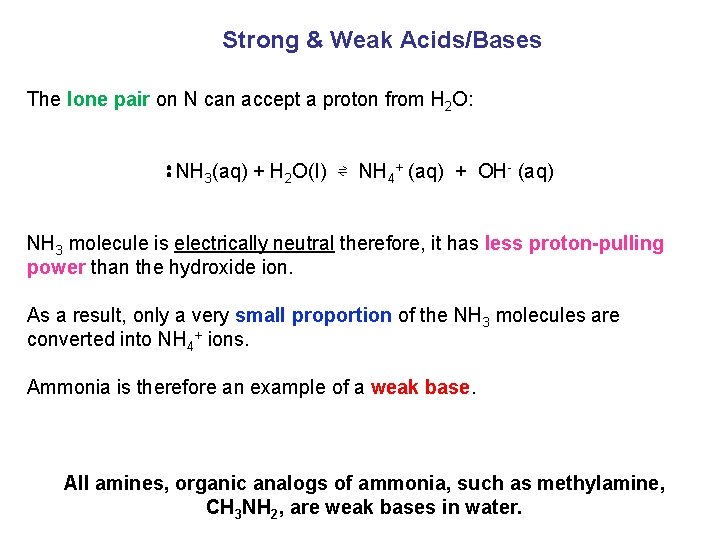
Strong & Weak Acids/Bases The lone pair on N can accept a proton from H 2 O: NH 3(aq) + H 2 O(I) ⇌ NH 4+ (aq) + OH (aq) NH 3 molecule is electrically neutral therefore, it has less proton pulling power than the hydroxide ion. As a result, only a very small proportion of the NH 3 molecules are converted into NH 4+ ions. Ammonia is therefore an example of a weak base. All amines, organic analogs of ammonia, such as methylamine, CH 3 NH 2, are weak bases in water.
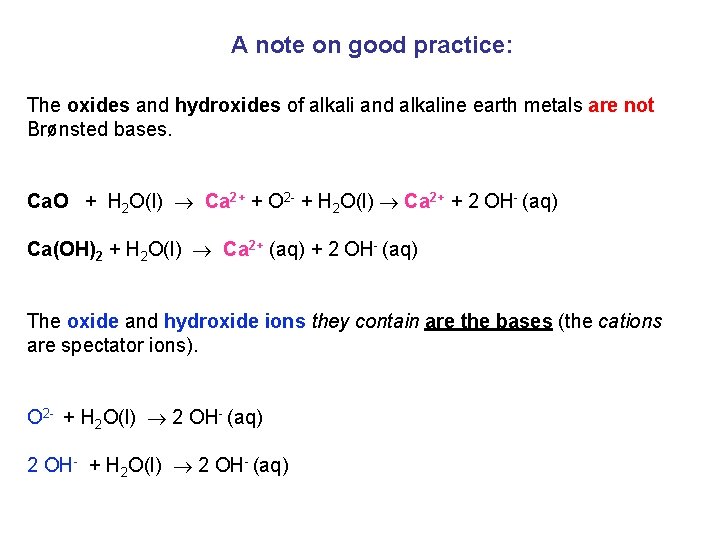
A note on good practice: The oxides and hydroxides of alkali and alkaline earth metals are not Brønsted bases. Ca. O + H 2 O(l) Ca 2+ + O 2 + H 2 O(l) Ca 2+ + 2 OH (aq) Ca(OH)2 + H 2 O(l) Ca 2+ (aq) + 2 OH (aq) The oxide and hydroxide ions they contain are the bases (the cations are spectator ions). O 2 + H 2 O(l) 2 OH (aq) 2 OH + H 2 O(l) 2 OH (aq)
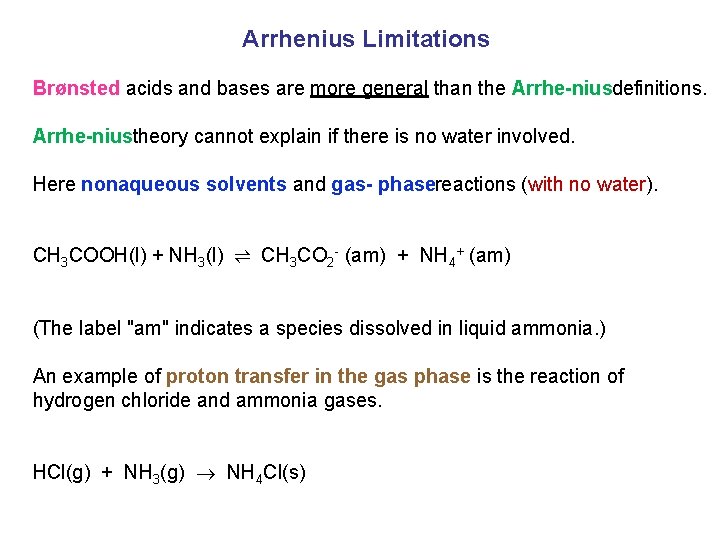
Arrhenius Limitations Brønsted acids and bases are more general than the Arrhe nius definitions. Arrhe niustheory cannot explain if there is no water involved. Here nonaqueous solvents and gas phase reactions (with no water). CH 3 COOH(l) + NH 3(l) ⇌ CH 3 CO 2 (am) + NH 4+ (am) (The label "am" indicates a species dissolved in liquid ammonia. ) An example of proton transfer in the gas phase is the reaction of hydrogen chloride and ammonia gases. HCl(g) + NH 3(g) NH 4 Cl(s)
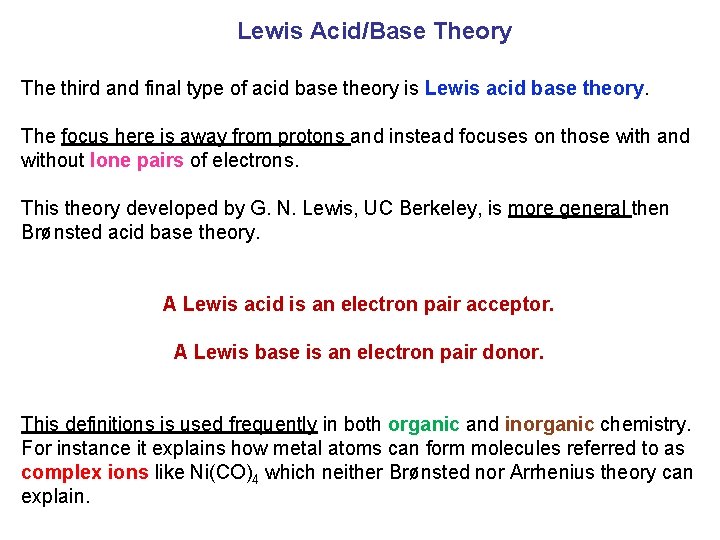
Lewis Acid/Base Theory The third and final type of acid base theory is Lewis acid base theory. The focus here is away from protons and instead focuses on those with and without lone pairs of electrons. This theory developed by G. N. Lewis, UC Berkeley, is more general then Brønsted acid base theory. A Lewis acid is an electron pair acceptor. A Lewis base is an electron pair donor. This definitions is used frequently in both organic and inorganic chemistry. For instance it explains how metal atoms can form molecules referred to as complex ions like Ni(CO)4 which neither Brønsted nor Arrhenius theory can explain.
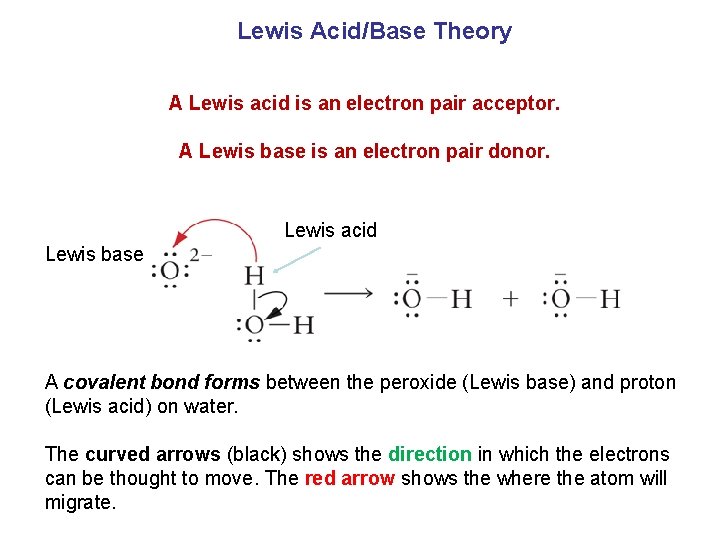
Lewis Acid/Base Theory A Lewis acid is an electron pair acceptor. A Lewis base is an electron pair donor. Lewis acid Lewis base A covalent bond forms between the peroxide (Lewis base) and proton (Lewis acid) on water. The curved arrows (black) shows the direction in which the electrons can be thought to move. The red arrow shows the where the atom will migrate.
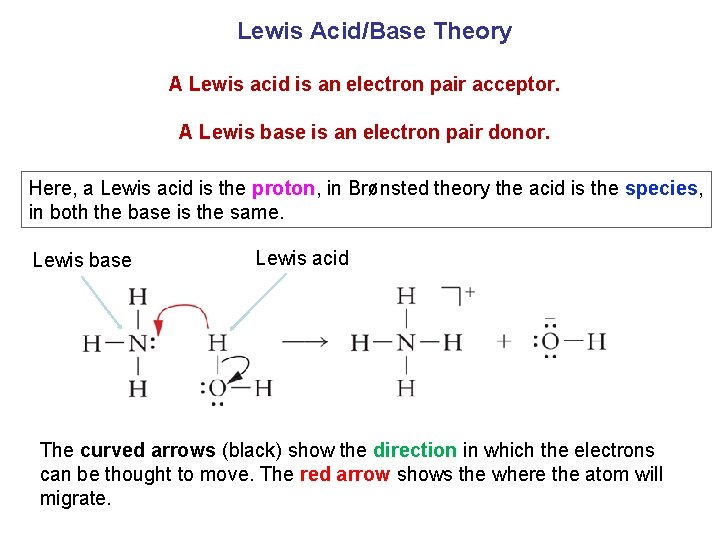
Lewis Acid/Base Theory A Lewis acid is an electron pair acceptor. A Lewis base is an electron pair donor. Here, a Lewis acid is the proton, in Brønsted theory the acid is the species, in both the base is the same. Lewis base Lewis acid The curved arrows (black) show the direction in which the electrons can be thought to move. The red arrow shows the where the atom will migrate.
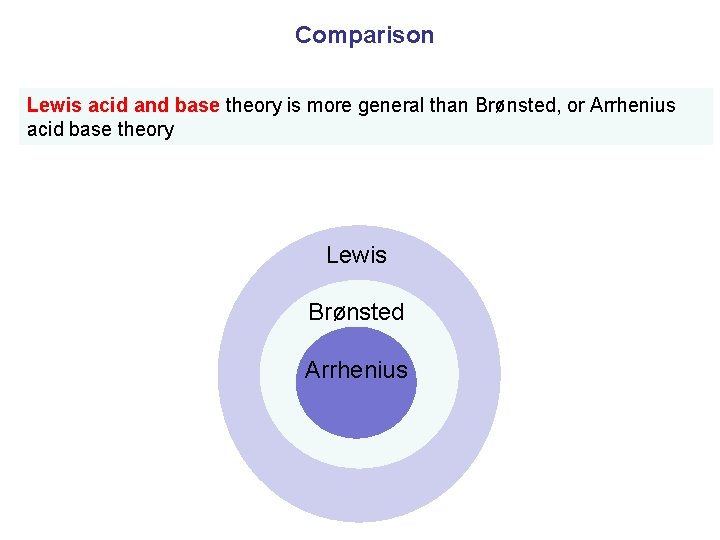
Comparison Lewis acid and base theory is more general than Brønsted, or Arrhenius acid base theory Lewis Brønsted Arrhenius
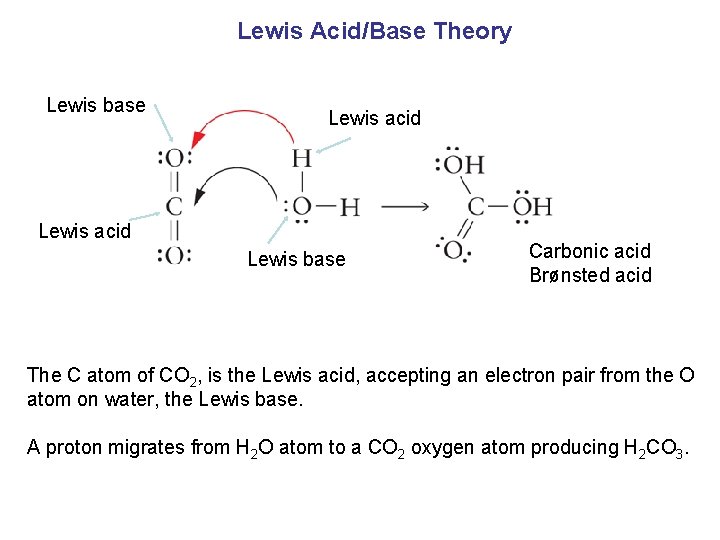
Lewis Acid/Base Theory Lewis base Lewis acid Lewis base Carbonic acid Brønsted acid The C atom of CO 2, is the Lewis acid, accepting an electron pair from the O atom on water, the Lewis base. A proton migrates from H 2 O atom to a CO 2 oxygen atom producing H 2 CO 3.
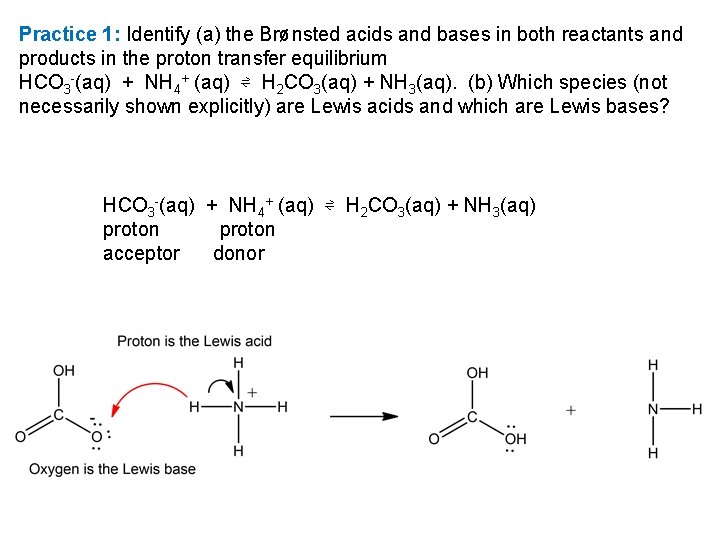
Practice 1: Identify (a) the Brønsted acids and bases in both reactants and products in the proton transfer equilibrium HCO 3 (aq) + NH 4+ (aq) ⇌ H 2 CO 3(aq) + NH 3(aq). (b) Which species (not necessarily shown explicitly) are Lewis acids and which are Lewis bases? HCO 3 (aq) + NH 4+ (aq) ⇌ H 2 CO 3(aq) + NH 3(aq) proton acceptor donor
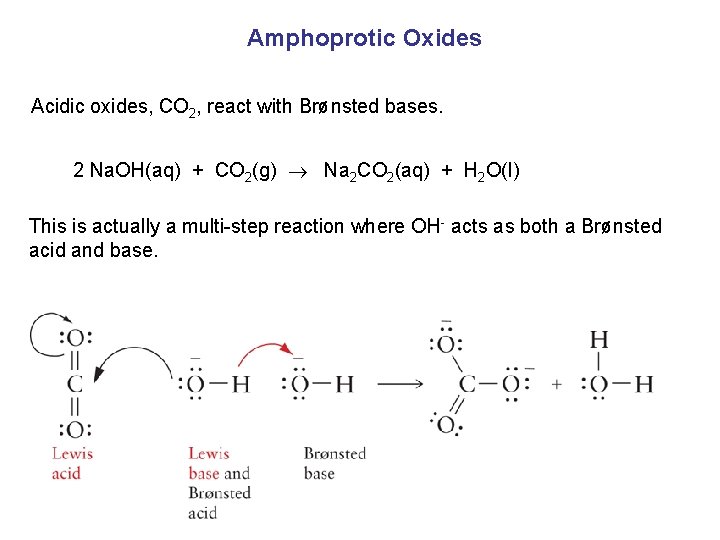
Amphoprotic Oxides Acidic oxides, CO 2, react with Brønsted bases. 2 Na. OH(aq) + CO 2(g) Na 2 CO 2(aq) + H 2 O(l) This is actually a multi step reaction where OH acts as both a Brønsted acid and base.
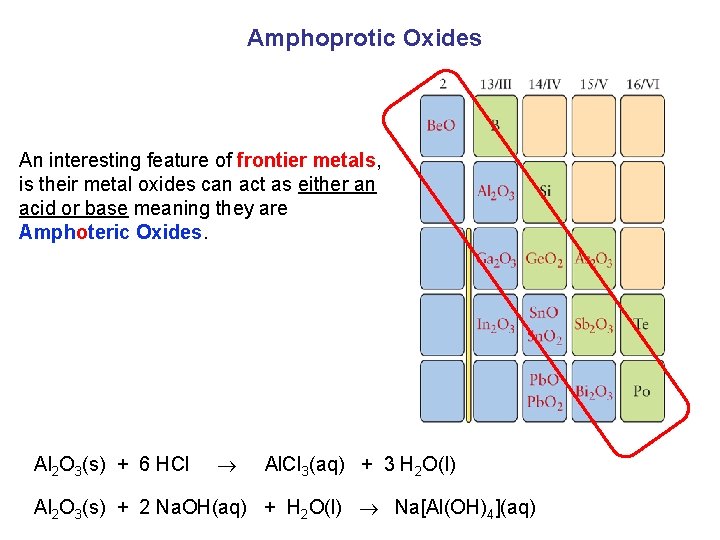
Amphoprotic Oxides An interesting feature of frontier metals, is their metal oxides can act as either an acid or base meaning they are Amphoteric Oxides. Al 2 O 3(s) + 6 HCl Al. Cl 3(aq) + 3 H 2 O(l) Al 2 O 3(s) + 2 Na. OH(aq) + H 2 O(l) Na[Al(OH)4](aq)

Amphiprotic Water is amphiprotic H 2 O(l) + H 2 O(l) ⇌ H 3 O+ (aq) + OH (aq) HCN(aq) + H 2 O(l) ⇌ H 3 O+ (aq) + CN (aq) water is a Brønsted base NH 3(aq) + H 2 O(l) ⇌ OH (aq) + NH 4+ (aq) water is a Brønsted acid Distinguish between amphoteric and amphiprotic: Aluminum metal is amphoteric (it reacts with both acids and bases), but it has no hydrogen atoms to donate as protons, so it is not amphiprotic.
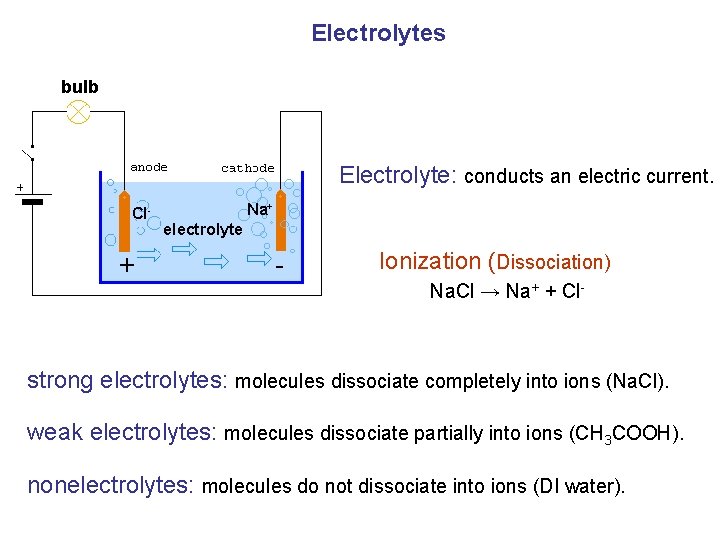
Electrolytes bulb Electrolyte: conducts an electric current. Cl + Na+ electrolyte Ionization (Dissociation) Na. Cl → Na+ + Cl strong electrolytes: molecules dissociate completely into ions (Na. Cl). weak electrolytes: molecules dissociate partially into ions (CH 3 COOH). nonelectrolytes: molecules do not dissociate into ions (DI water).
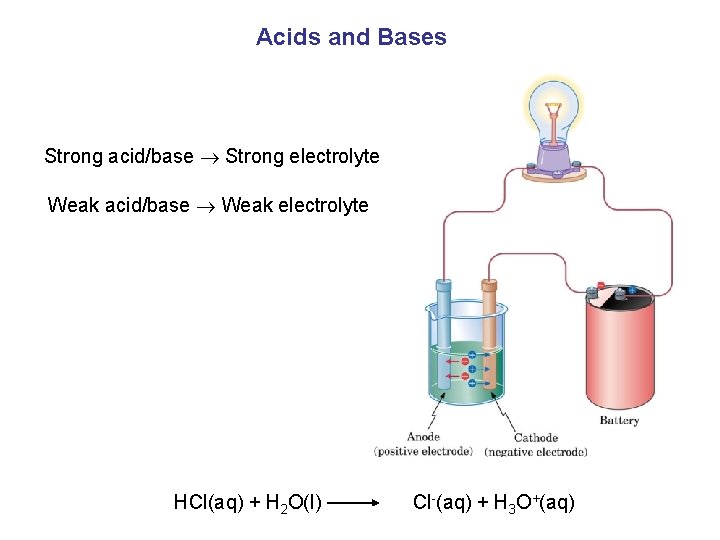
Acids and Bases Strong acid/base Strong electrolyte Weak acid/base Weak electrolyte HCl(aq) + H 2 O(l) Cl (aq) + H 3 O+(aq)
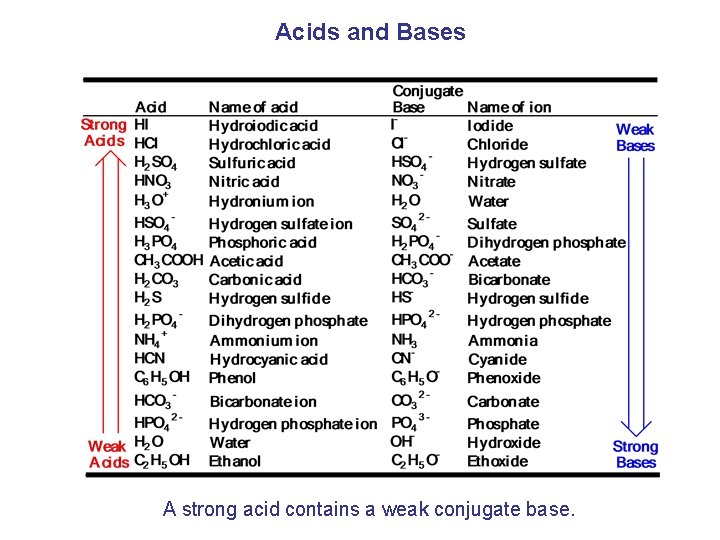
Acids and Bases A strong acid contains a weak conjugate base.
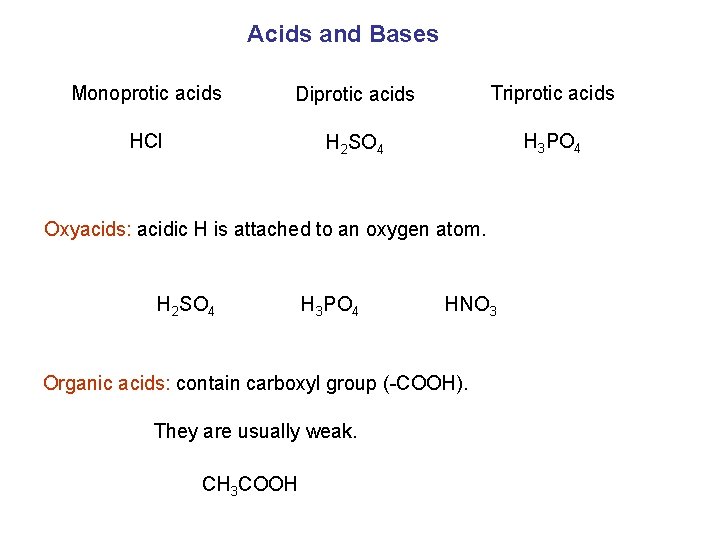
Acids and Bases Monoprotic acids Diprotic acids Triprotic acids HCl H 2 SO 4 H 3 PO 4 Oxyacids: acidic H is attached to an oxygen atom. H 2 SO 4 H 3 PO 4 HNO 3 Organic acids: contain carboxyl group ( COOH). They are usually weak. CH 3 COOH
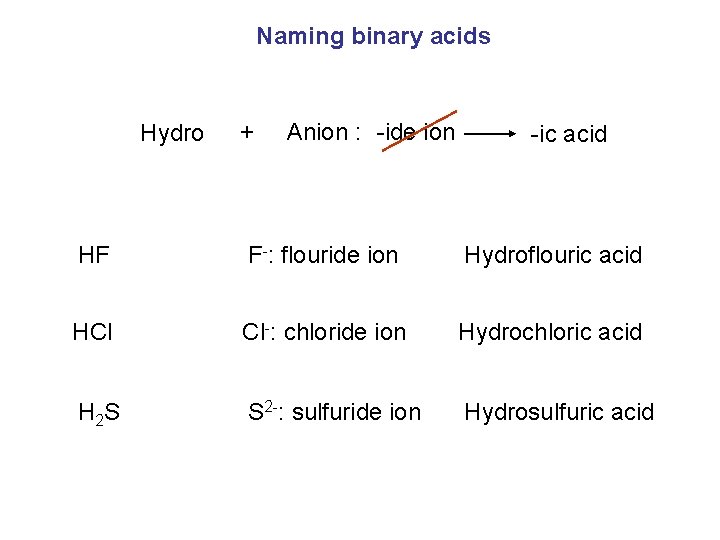
Naming binary acids Hydro + Anion : ide ion ic acid HF F : flouride ion Hydroflouric acid HCl Cl : chloride ion Hydrochloric acid H 2 S S 2 : sulfuride ion Hydrosulfuric acid
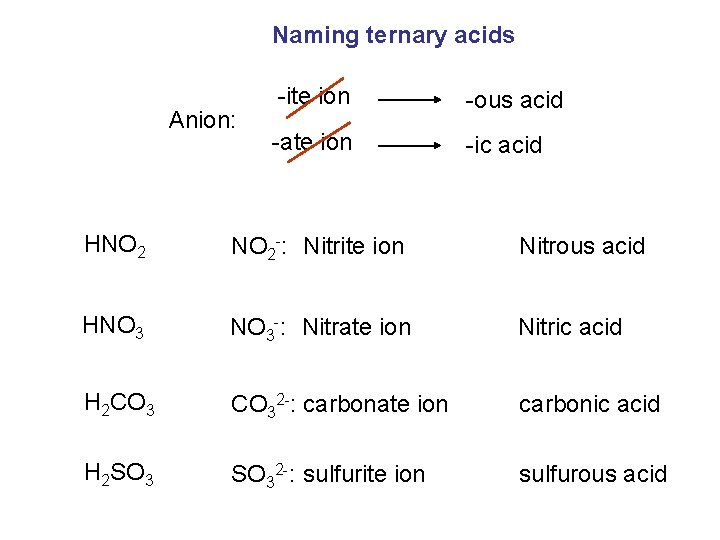
Naming ternary acids Anion: ite ion ous acid ate ion ic acid HNO 2 : Nitrite ion Nitrous acid HNO 3 : Nitrate ion Nitric acid H 2 CO 32 : carbonate ion carbonic acid H 2 SO 32 : sulfurite ion sulfurous acid

Equilibrium constant for water H 2 O(l) + H 2 O(l) ⇌ H 3 O+ (aq) + OH (aq) KW = [H 3 O+] [OH ] = (1× 10 7) = 1× 10 14 Equilibrium constant for water [H 3 O+] [OH ] = 10 14
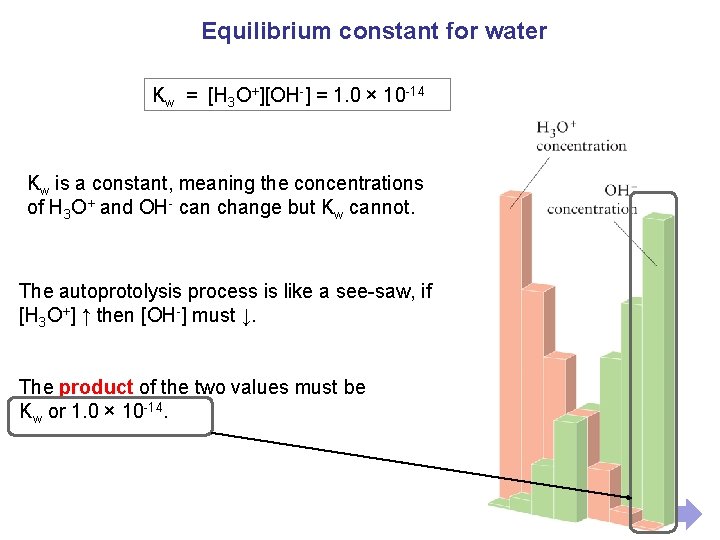
Equilibrium constant for water Kw = [H 3 O+][OH ] = 1. 0 × 10 14 Kw is a constant, meaning the concentrations of H 3 O+ and OH can change but Kw cannot. The autoprotolysis process is like a see saw, if [H 3 O+] ↑ then [OH ] must ↓. The product of the two values must be Kw or 1. 0 × 10 14. 28
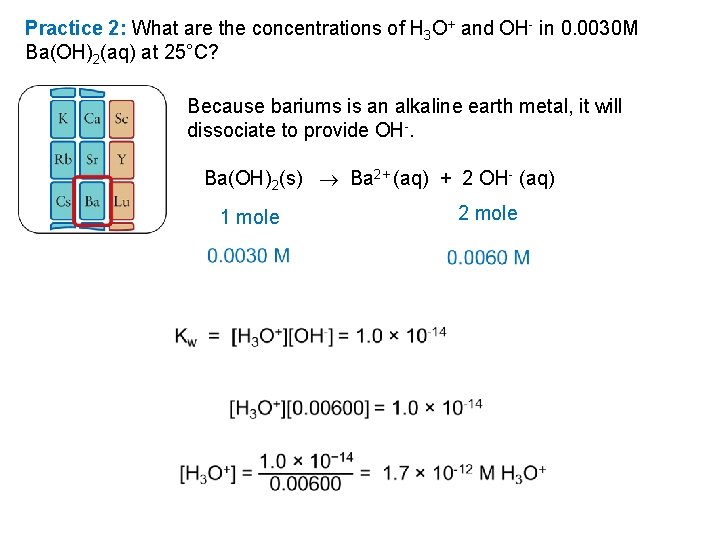
Practice 2: What are the concentrations of H 3 O+ and OH in 0. 0030 M Ba(OH)2(aq) at 25°C? Because bariums is an alkaline earth metal, it will dissociate to provide OH. Ba(OH)2(s) Ba 2+ (aq) + 2 OH (aq) 2 mole 1 mole
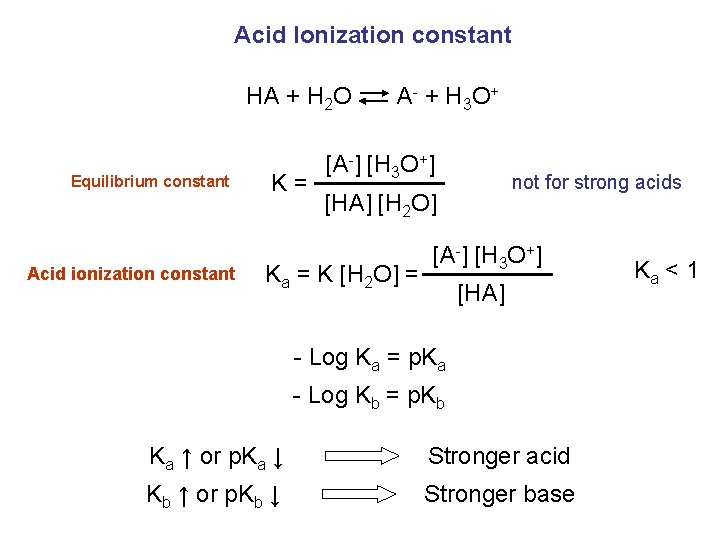
Acid Ionization constant HA + H 2 O Equilibrium constant Acid ionization constant K = A + H 3 O+ [A ] [H 3 O+] not for strong acids [HA] [H 2 O] Ka = K [H 2 O] = [A ] [H 3 O+] [HA] Log Ka = p. Ka Log Kb = p. Kb Ka ↑ or p. Ka ↓ Stronger acid Kb ↑ or p. Kb ↓ Stronger base Ka < 1
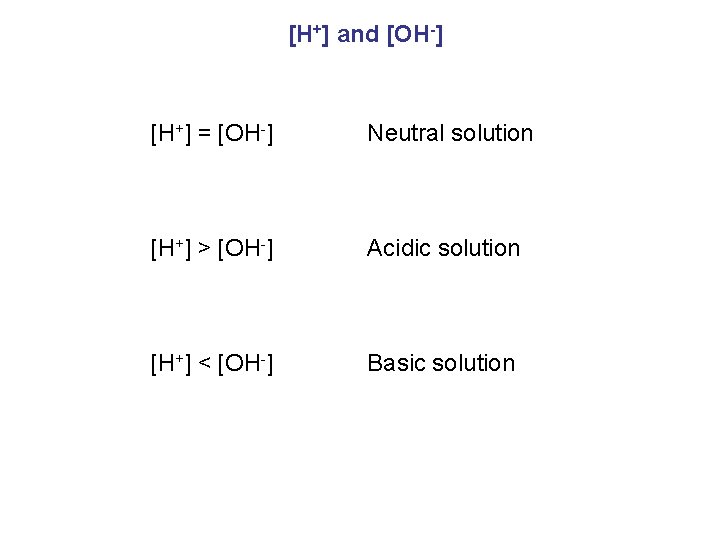
[H+] and [OH ] [H+] = [OH ] Neutral solution [H+] > [OH ] Acidic solution [H+] < [OH ] Basic solution
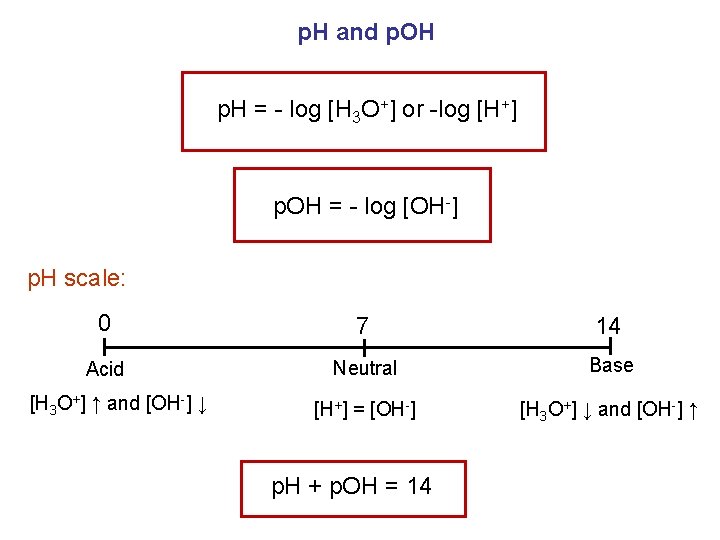
p. H and p. OH p. H = log [H 3 O+] or log [H+] p. OH = log [OH ] p. H scale: 0 7 14 Acid Neutral Base [H+] = [OH ] [H 3 O+] ↓ and [OH ] ↑ [H 3 O+] ↑ and [OH ] ↓ p. H + p. OH = 14
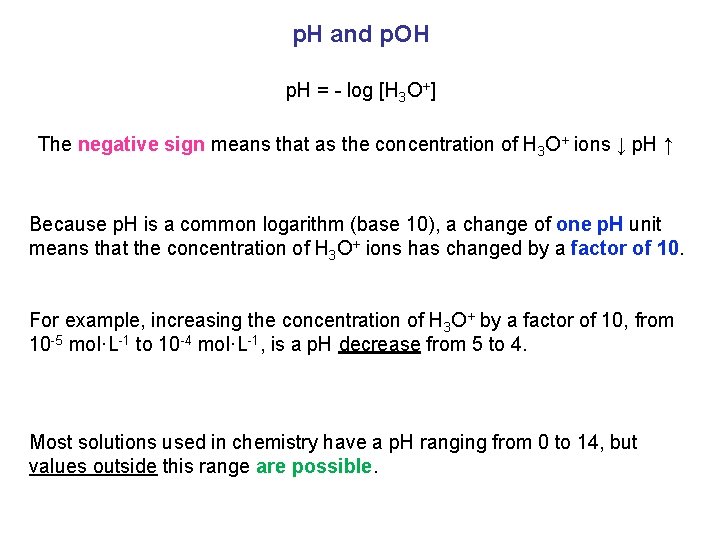
p. H and p. OH p. H = log [H 3 O+] The negative sign means that as the concentration of H 3 O+ ions ↓ p. H ↑ Because p. H is a common logarithm (base 10), a change of one p. H unit means that the concentration of H 3 O+ ions has changed by a factor of 10. For example, increasing the concentration of H 3 O+ by a factor of 10, from 10 5 mol·L 1 to 10 4 mol·L 1, is a p. H decrease from 5 to 4. Most solutions used in chemistry have a p. H ranging from 0 to 14, but values outside this range are possible.
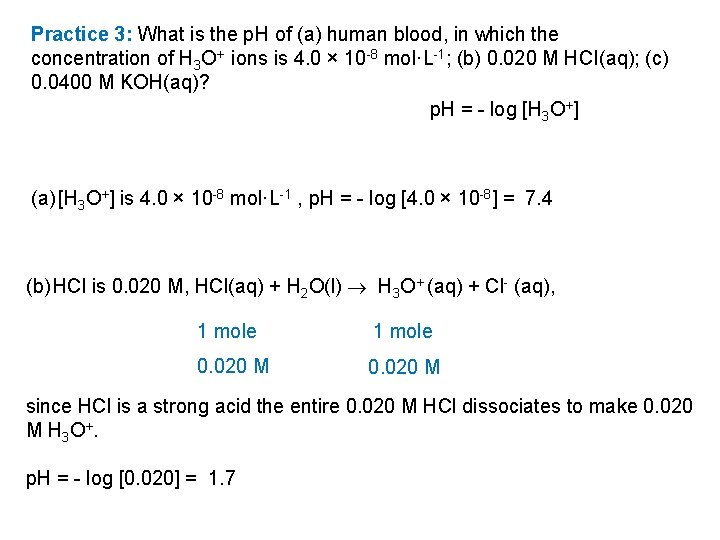
Practice 3: What is the p. H of (a) human blood, in which the concentration of H 3 O+ ions is 4. 0 × 10 8 mol·L 1; (b) 0. 020 M HCI(aq); (c) 0. 0400 M KOH(aq)? p. H = log [H 3 O+] (a) [H 3 O+] is 4. 0 × 10 8 mol·L 1 , p. H = log [4. 0 × 10 8] = 7. 4 (b) HCl is 0. 020 M, HCl(aq) + H 2 O(l) H 3 O+ (aq) + Cl (aq), 1 mole 0. 020 M since HCl is a strong acid the entire 0. 020 M HCl dissociates to make 0. 020 M H 3 O+. p. H = log [0. 020] = 1. 7
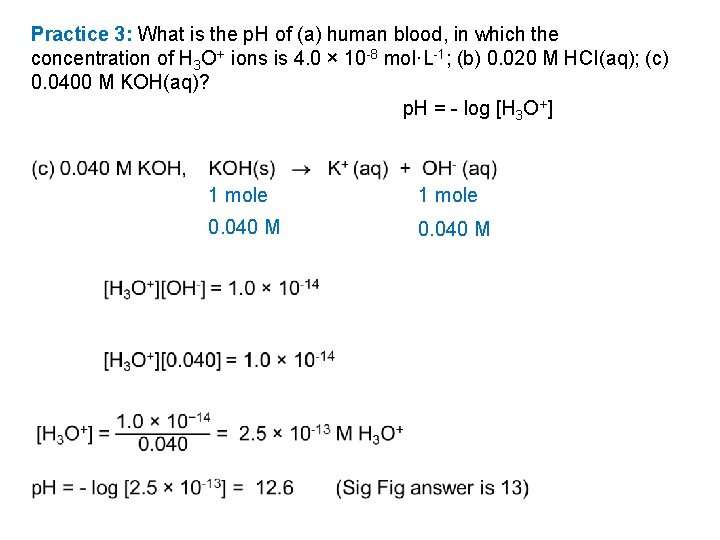
Practice 3: What is the p. H of (a) human blood, in which the concentration of H 3 O+ ions is 4. 0 × 10 8 mol·L 1; (b) 0. 020 M HCI(aq); (c) 0. 0400 M KOH(aq)? p. H = log [H 3 O+] 1 mole 0. 040 M
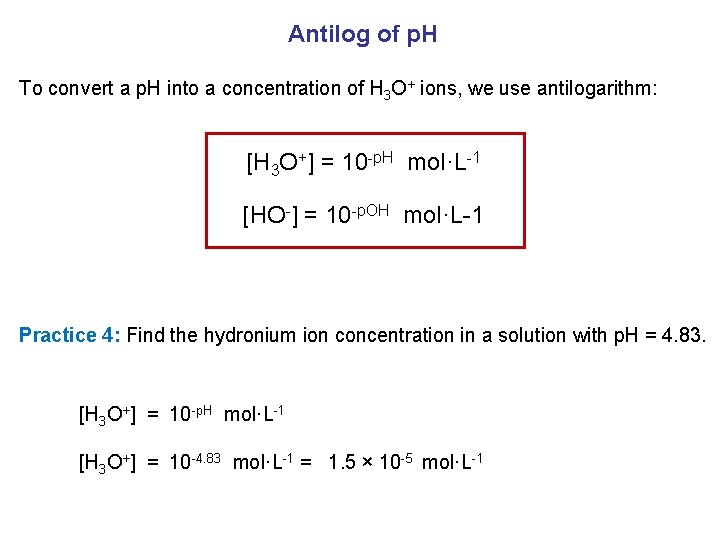
Antilog of p. H To convert a p. H into a concentration of H 3 O+ ions, we use antilogarithm: [H 3 O+] = 10 p. H mol·L 1 [HO ] = 10 p. OH mol·L 1 Practice 4: Find the hydronium ion concentration in a solution with p. H = 4. 83. [H 3 O+] = 10 p. H mol·L 1 [H 3 O+] = 10 4. 83 mol·L 1 = 1. 5 × 10 5 mol·L 1
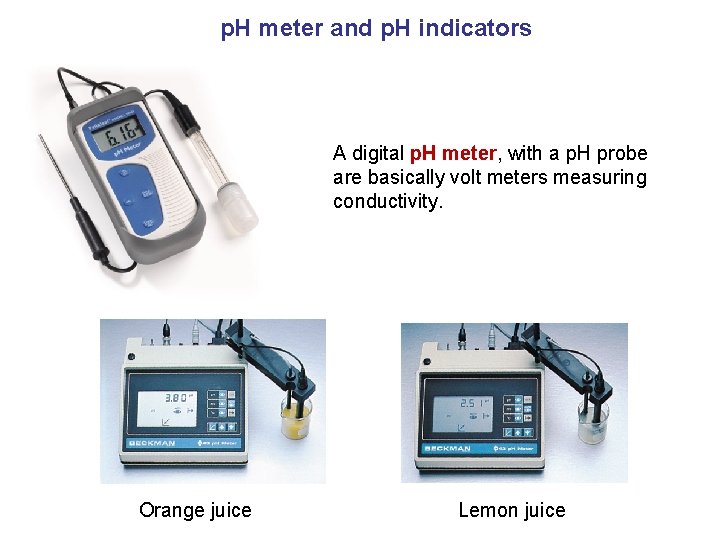
p. H meter and p. H indicators A digital p. H meter, with a p. H probe are basically volt meters measuring conductivity. Orange juice Lemon juice
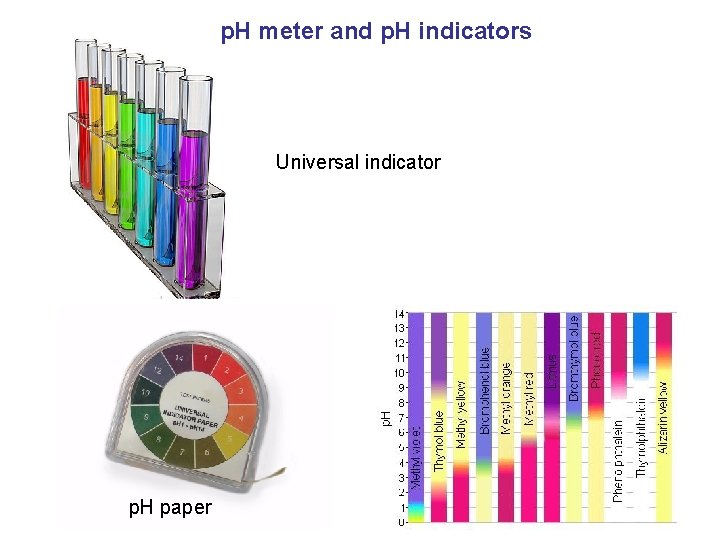
p. H meter and p. H indicators Universal indicator p. H paper
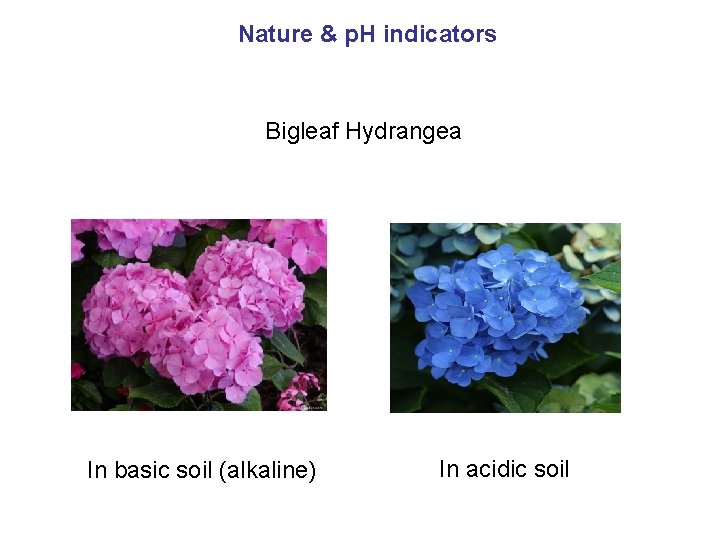
Nature & p. H indicators Bigleaf Hydrangea In basic soil (alkaline) In acidic soil
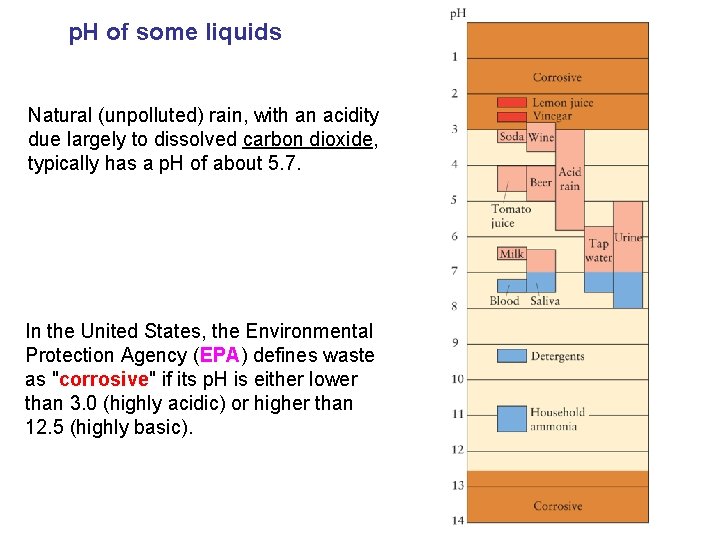
p. H of some liquids Natural (unpolluted) rain, with an acidity due largely to dissolved carbon dioxide, typically has a p. H of about 5. 7. In the United States, the Environmental Protection Agency (EPA) defines waste as "corrosive" if its p. H is either lower than 3. 0 (highly acidic) or higher than 12. 5 (highly basic).
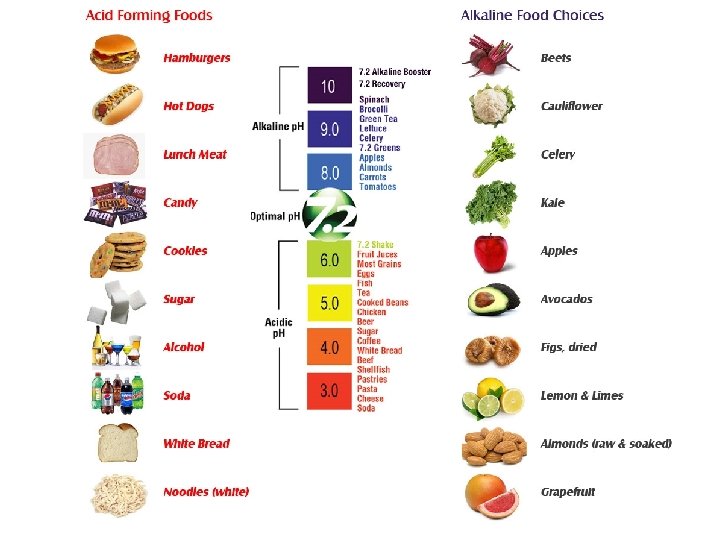
p. H of some food/drinks
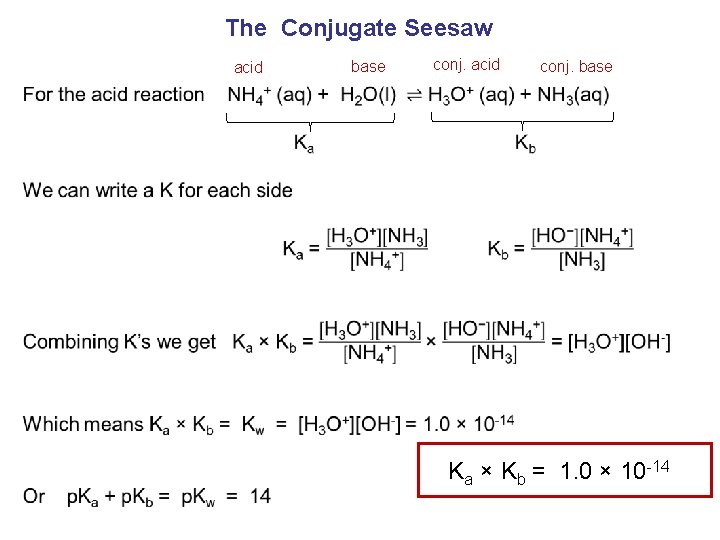
The Conjugate Seesaw acid base conj. acid conj. base Ka × Kb = 1. 0 × 10 14
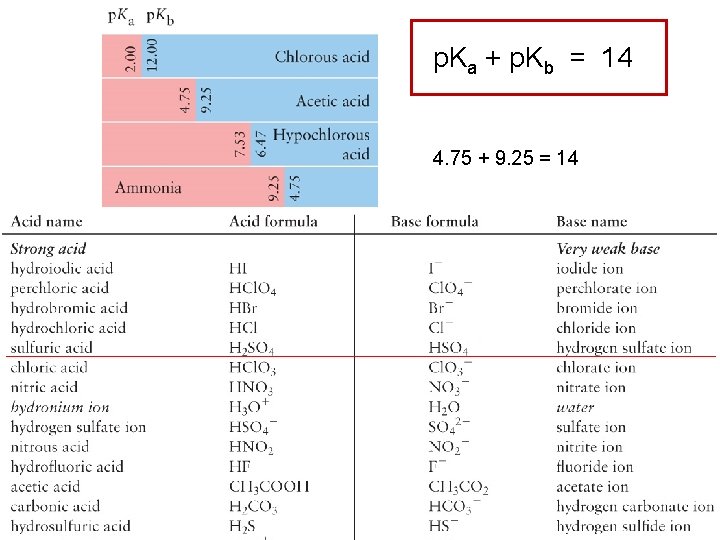
p. Ka + p. Kb = 14 4. 75 + 9. 25 = 14
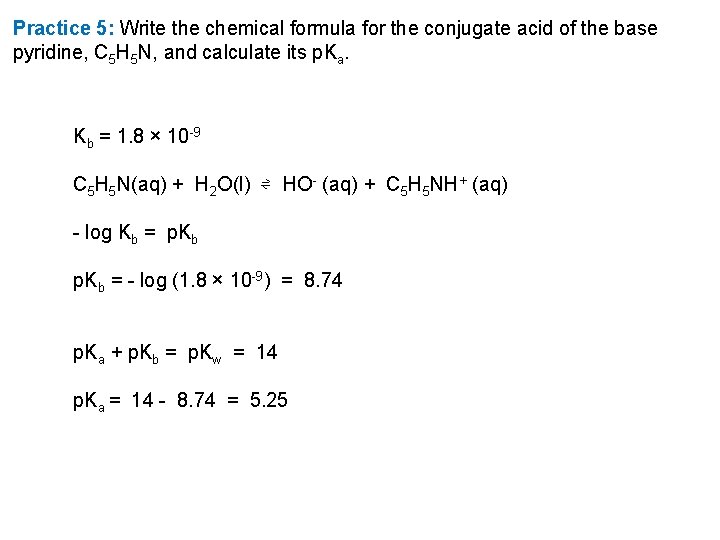
Practice 5: Write the chemical formula for the conjugate acid of the base pyridine, C 5 H 5 N, and calculate its p. Ka. Kb = 1. 8 × 10 9 C 5 H 5 N(aq) + H 2 O(l) ⇌ HO (aq) + C 5 H 5 NH+ (aq) log Kb = p. Kb = log (1. 8 × 10 9) = 8. 74 p. Ka + p. Kb = p. Kw = 14 p. Ka = 14 8. 74 = 5. 25
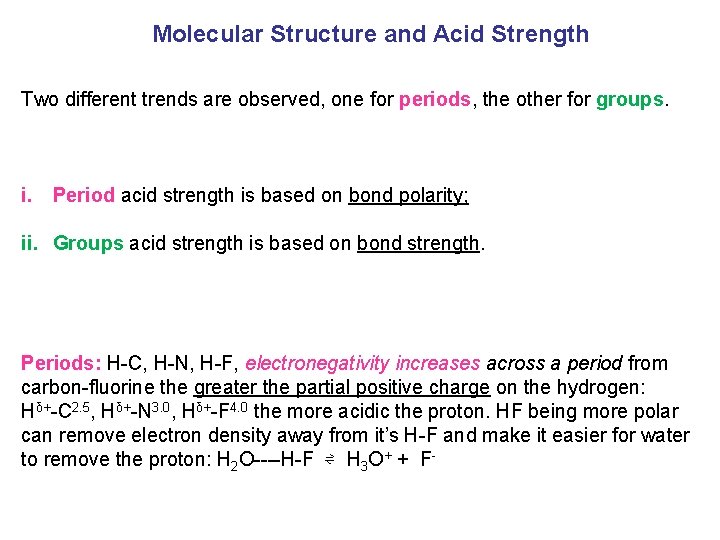
Molecular Structure and Acid Strength Two different trends are observed, one for periods, the other for groups. i. Period acid strength is based on bond polarity; ii. Groups acid strength is based on bond strength. Periods: H C, H N, H F, electronegativity increases across a period from carbon fluorine the greater the partial positive charge on the hydrogen: Hδ+ C 2. 5, Hδ+ N 3. 0, Hδ+ F 4. 0 the more acidic the proton. HF being more polar can remove electron density away from it’s H F and make it easier for water to remove the proton: H 2 O H F ⇌ H 3 O+ + F
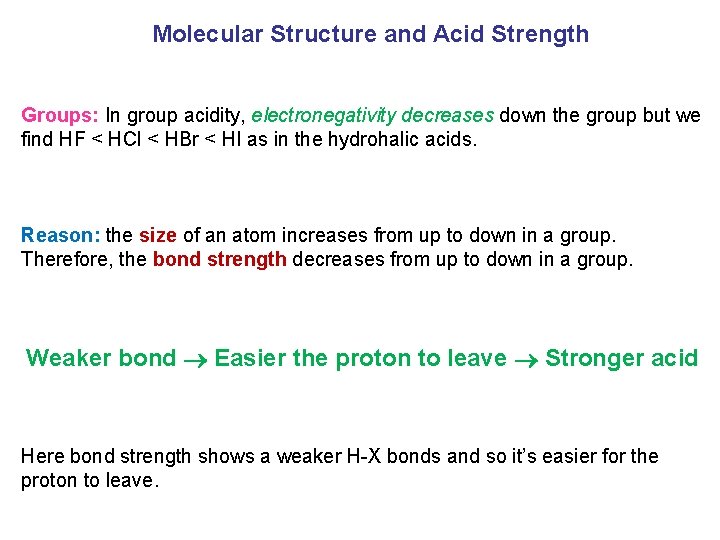
Molecular Structure and Acid Strength Groups: In group acidity, electronegativity decreases down the group but we find HF < HCl < HBr < HI as in the hydrohalic acids. Reason: the size of an atom increases from up to down in a group. Therefore, the bond strength decreases from up to down in a group. Weaker bond Easier the proton to leave Stronger acid Here bond strength shows a weaker H X bonds and so it’s easier for the proton to leave.
Molecular Structure and Acid Strength: Oxoacids There are 2 ways to compare oxoacids: i. A group with the same number of oxygen's for instance HCl. O, HBr. O, HIO ii. A family of the same element with different numbers of oxygen's (HCl. O, HCl. O 2, HCl. O 3, HCl. O 4)
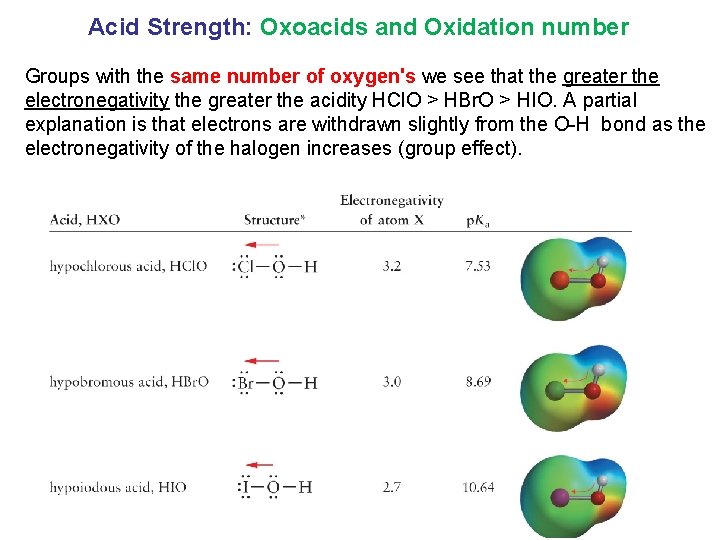
Acid Strength: Oxoacids and Oxidation number Groups with the same number of oxygen's we see that the greater the electronegativity the greater the acidity HCl. O > HBr. O > HIO. A partial explanation is that electrons are withdrawn slightly from the O H bond as the electronegativity of the halogen increases (group effect).
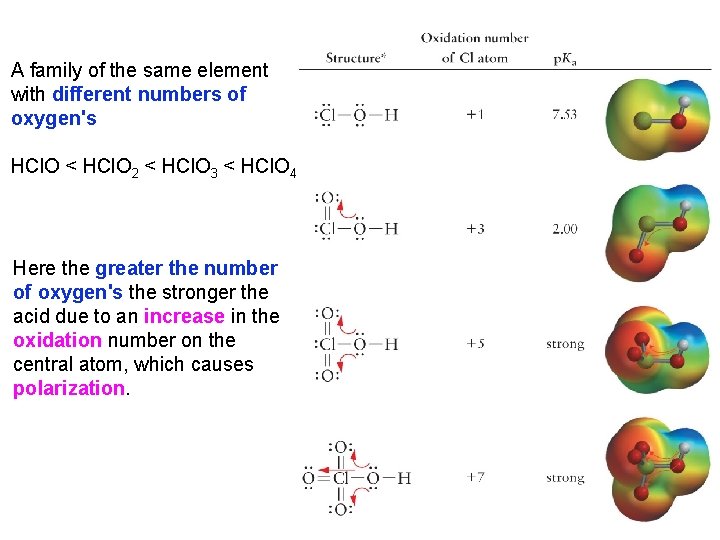
A family of the same element with different numbers of oxygen's HCl. O < HCl. O 2 < HCl. O 3 < HCl. O 4. Here the greater the number of oxygen's the stronger the acid due to an increase in the oxidation number on the central atom, which causes polarization.
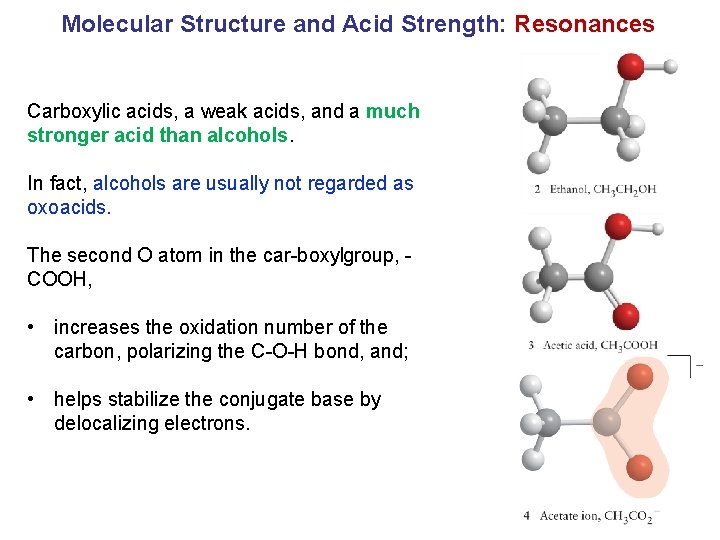
Molecular Structure and Acid Strength: Resonances Carboxylic acids, a weak acids, and a much stronger acid than alcohols. In fact, alcohols are usually not regarded as oxoacids. The second O atom in the car boxyl group, COOH, • increases the oxidation number of the carbon, polarizing the C O H bond, and; • helps stabilize the conjugate base by delocalizing electrons.
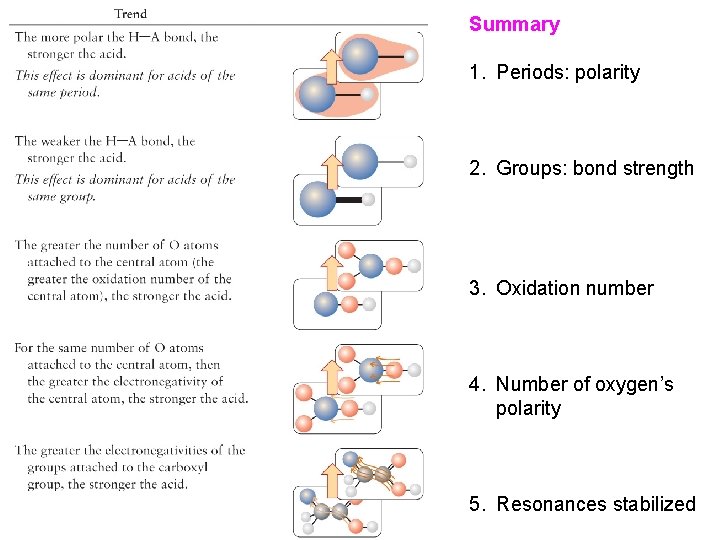
Summary 1. Periods: polarity 2. Groups: bond strength 3. Oxidation number 4. Number of oxygen’s polarity 5. Resonances stabilized
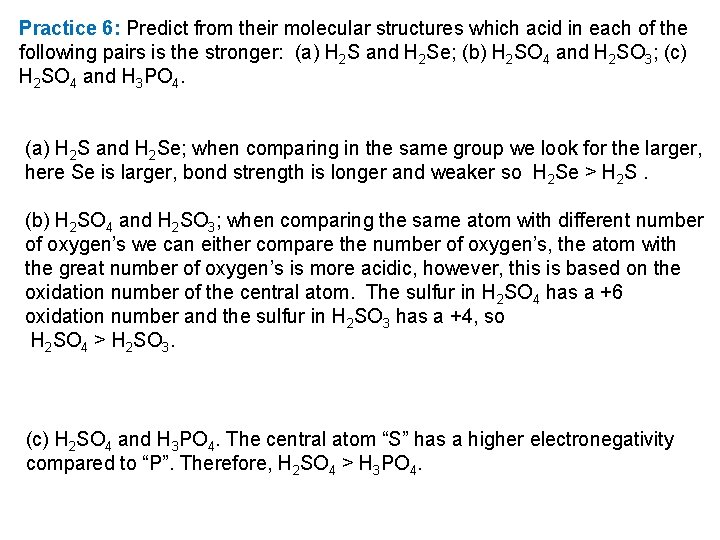
Practice 6: Predict from their molecular structures which acid in each of the following pairs is the stronger: (a) H 2 S and H 2 Se; (b) H 2 SO 4 and H 2 SO 3; (c) H 2 SO 4 and H 3 PO 4. (a) H 2 S and H 2 Se; when comparing in the same group we look for the larger, here Se is larger, bond strength is longer and weaker so H 2 Se > H 2 S. (b) H 2 SO 4 and H 2 SO 3; when comparing the same atom with different number of oxygen’s we can either compare the number of oxygen’s, the atom with the great number of oxygen’s is more acidic, however, this is based on the oxidation number of the central atom. The sulfur in H 2 SO 4 has a +6 oxidation number and the sulfur in H 2 SO 3 has a +4, so H 2 SO 4 > H 2 SO 3. (c) H 2 SO 4 and H 3 PO 4. The central atom “S” has a higher electronegativity compared to “P”. Therefore, H 2 SO 4 > H 3 PO 4.
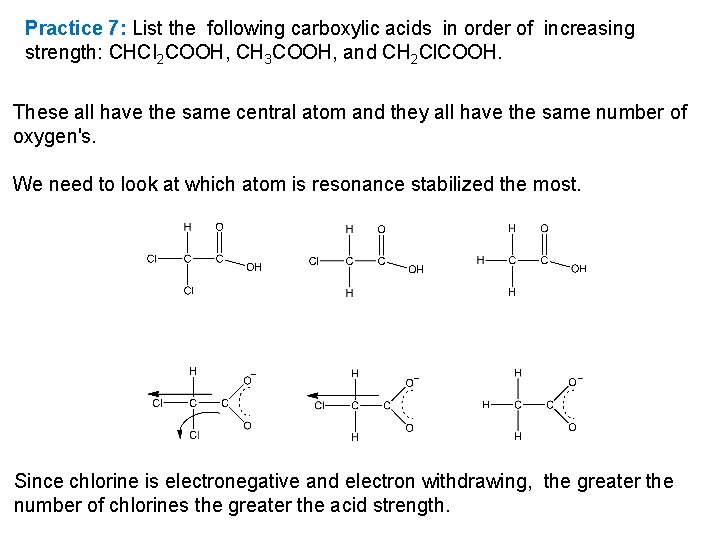
Practice 7: List the following carboxylic acids in order of increasing strength: CHCI 2 COOH, CH 3 COOH, and CH 2 Cl. COOH. These all have the same central atom and they all have the same number of oxygen's. We need to look at which atom is resonance stabilized the most. Since chlorine is electronegative and electron withdrawing, the greater the number of chlorines the greater the acid strength.
The p. H of solutions of weak acids and bases We will use equilibrium tables to calculate Ka’s/Kb’s and initial/finial concentrations. One notable difference is we’ll use p. H as a way to find our final concentrations of our solutions.
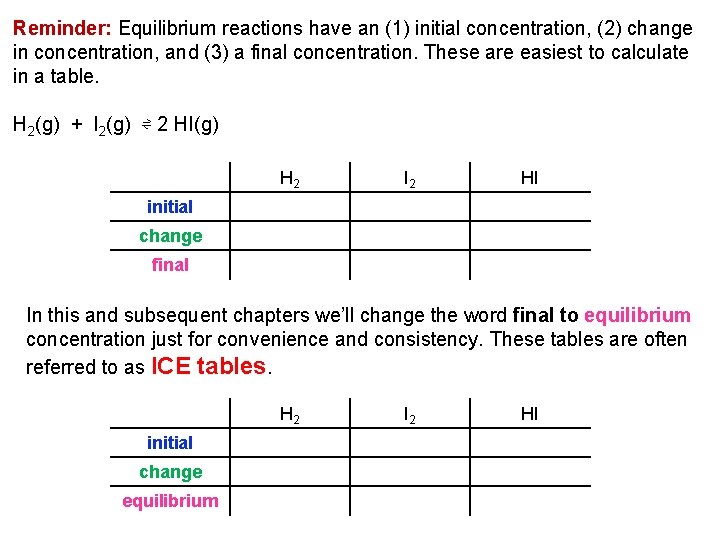
Reminder: Equilibrium reactions have an (1) initial concentration, (2) change in concentration, and (3) a final concentration. These are easiest to calculate in a table. H 2(g) + I 2(g) ⇌ 2 HI(g) H 2 I 2 HI initial change final In this and subsequent chapters we’ll change the word final to equilibrium concentration just for convenience and consistency. These tables are often referred to as ICE tables. H 2 initial change equilibrium I 2 HI
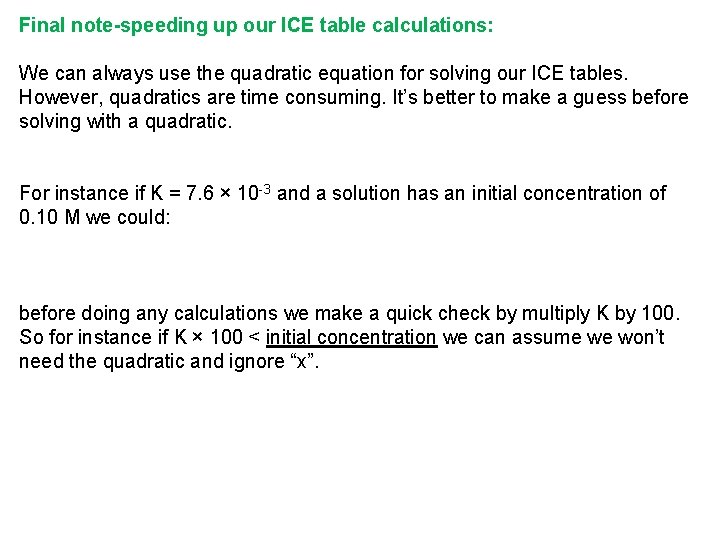
Final note speeding up our ICE table calculations: We can always use the quadratic equation for solving our ICE tables. However, quadratics are time consuming. It’s better to make a guess before solving with a quadratic. For instance if K = 7. 6 × 10 3 and a solution has an initial concentration of 0. 10 M we could: before doing any calculations we make a quick check by multiply K by 100. So for instance if K × 100 < initial concentration we can assume we won’t need the quadratic and ignore “x”.

Practice 8: Calculate the p. H and percentage deprotonation of 0. 10 M CH 3 COOH(aq), given that Ka for acetic acid is 1. 8 × 10 5. It’s important to be able to write an equation (this is a problem for many students). We write this as a weak acid reaction. CH 3 COOH(aq) + H 2 O(l) ⇌ H 3 O+ (aq) + CH 3 COO (aq) Next we make an ICE table with known values. CH 3 COOH H 3 O+ CH 3 COO initial 0. 10 0 0 change –x +x +x equilibrium 0. 10 x x x Noting –x means the concentration is going away, and +x means appearing.

Practice 8: Calculate the p. H and percentage deprotonation of 0. 10 M CH 3 COOH(aq), given that Ka for acetic acid is 1. 8 × 10 5.
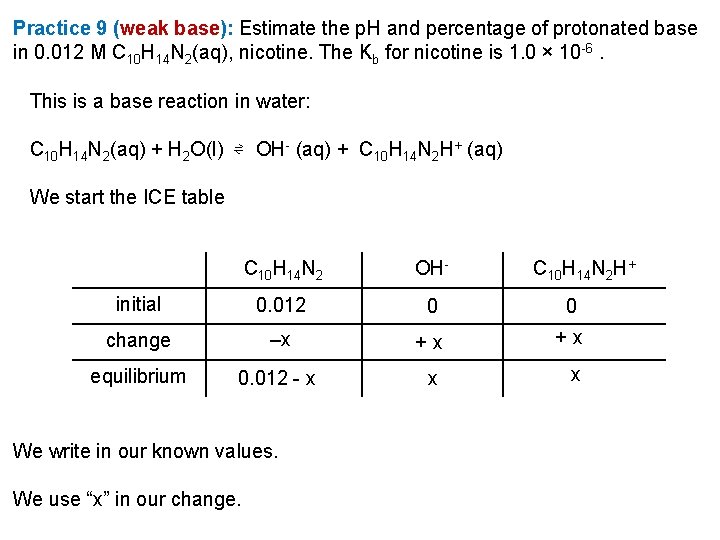
Practice 9 (weak base): Estimate the p. H and percentage of protonated base in 0. 012 M C 10 H 14 N 2(aq), nicotine. The Kb for nicotine is 1. 0 × 10 6. This is a base reaction in water: C 10 H 14 N 2(aq) + H 2 O(l) ⇌ OH (aq) + C 10 H 14 N 2 H+ (aq) We start the ICE table C 10 H 14 N 2 OH initial 0. 012 0 0 change –x + x equilibrium 0. 012 x x x We write in our known values. We use “x” in our change. C 10 H 14 N 2 H+
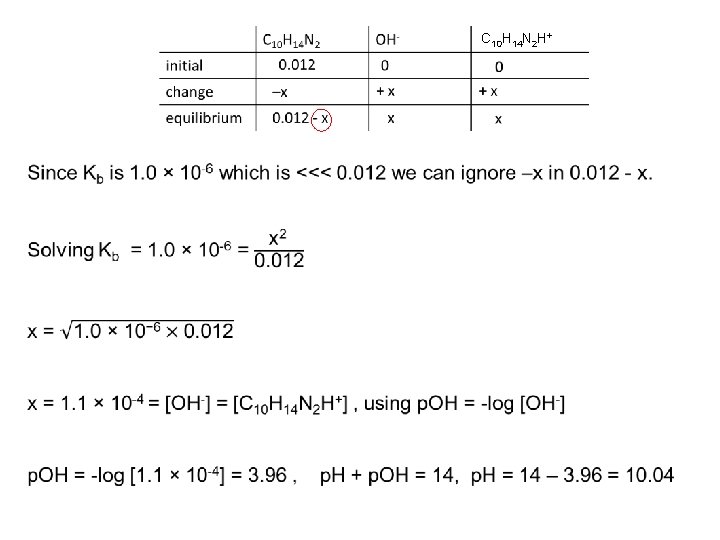
C 10 H 14 N 2 H+
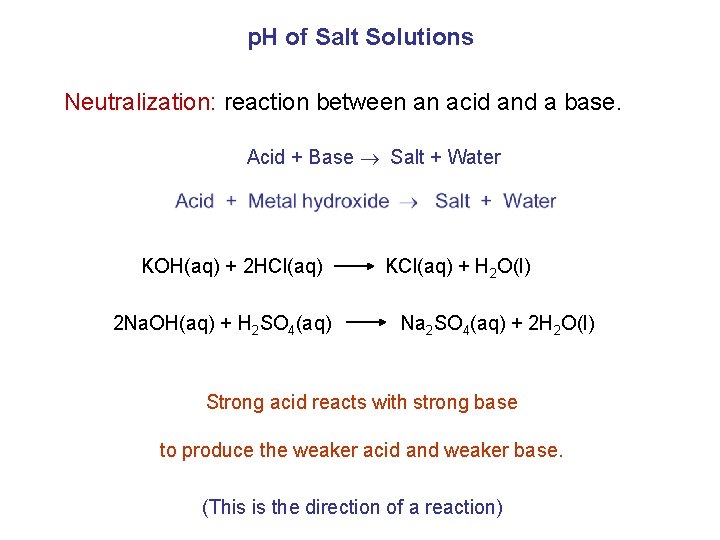
p. H of Salt Solutions Neutralization: reaction between an acid and a base. Acid + Base Salt + Water KOH(aq) + 2 HCl(aq) 2 Na. OH(aq) + H 2 SO 4(aq) KCl(aq) + H 2 O(l) Na 2 SO 4(aq) + 2 H 2 O(l) Strong acid reacts with strong base to produce the weaker acid and weaker base. (This is the direction of a reaction)

p. H of Salt Solutions CH 3 COOH(aq) + Na. OH(aq) H 2 O(l)(aq) + CH 3 COO Na+(aq) Even though this is a neutralization reaction, the measured p. H is 9. In Brønsted Lowery theory the conjugate acid or base can be either acidic or basic.

p. H of Salt Solutions CH 3 COOH(aq) + Na. OH(aq) H 2 O(l)(aq) + CH 3 COO Na+(aq) In the above example a strong base reacts completely with a weak acid, if this fact is not obvious hopefully it will be soon. The salt product CH 3 COO Na+ is soluble in water and there are two possible reactions that this salt can still go through with water, CH 3 COO (aq) + H 2 O(l) ⇌ OH (aq) + CH 3 COOH(aq) Na+ (aq) + H 2 O(l) H 3 O+ (aq) + Na. OH(aq)
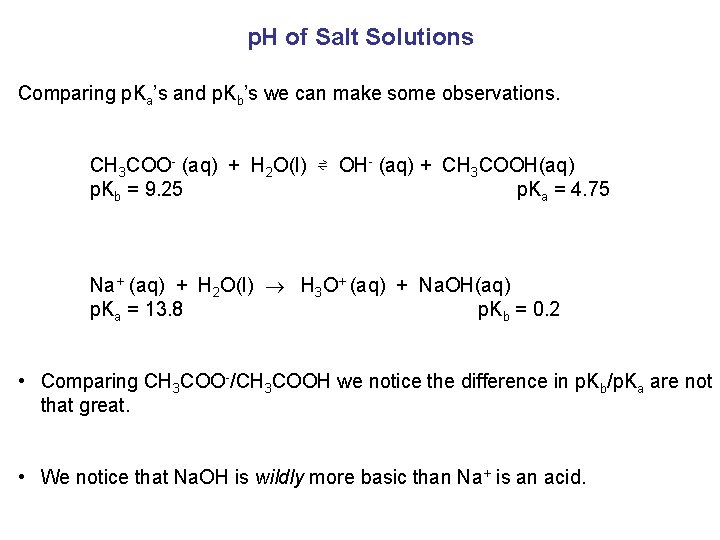
p. H of Salt Solutions Comparing p. Ka’s and p. Kb’s we can make some observations. CH 3 COO (aq) + H 2 O(l) ⇌ OH (aq) + CH 3 COOH(aq) p. Kb = 9. 25 p. Ka = 4. 75 Na+ (aq) + H 2 O(l) H 3 O+ (aq) + Na. OH(aq) p. Ka = 13. 8 p. Kb = 0. 2 • Comparing CH 3 COO /CH 3 COOH we notice the difference in p. Kb/p. Ka are not that great. • We notice that Na. OH is wildly more basic than Na+ is an acid.

p. H of Salt Solutions CH 3 COO (aq) + H 2 O(l) ⇌ OH (aq) + CH 3 COOH(aq) p. Kb = 9. 25 p. Ka = 4. 75 Na+ (aq) + H 2 O(l) H 3 O+ (aq) + Na. OH(aq) p. Ka = 13. 8 p. Kb = 0. 2 The trend is: • it is possible to produce a weak conjugate acid from a weak base. • it is not possible to produce a strong conjugate base from a weak acid; that is going from p. K of 13. 8 to 0. 2 is not possible.
p. H of Salt Solutions

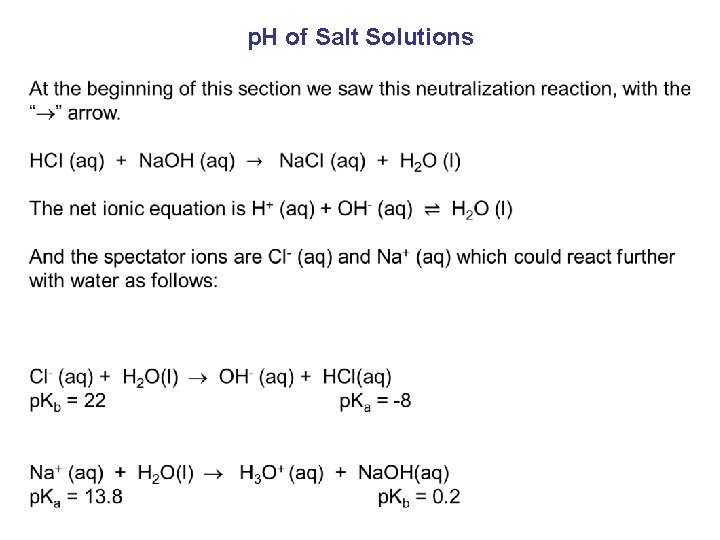
p. H of Salt Solutions Cl (aq) + H 2 O(l) OH (aq) + HCl(aq) p. Kb = 22 p. Ka = 8 Na+ (aq) + H 2 O(l) H 3 O+ (aq) + Na. OH(aq) p. Ka = 13. 8 p. Kb = 0. 2 Both Cl and Na+ are very weak (strong acid↓ p. H 2, a strong base↑ p. H 12) and HCl and Na. OH are very strong, notice the p. K’s. In general it is not possible to make strong acid or base conjugates from weak bases and acids.
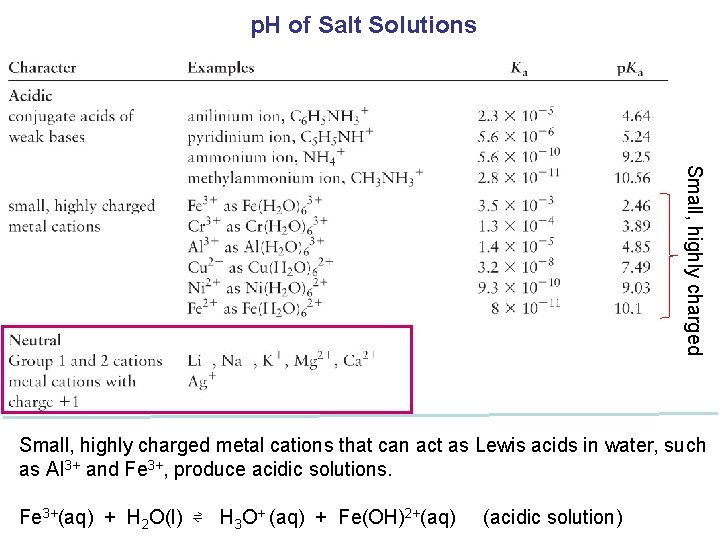
p. H of Salt Solutions Small, highly charged metal cations that can act as Lewis acids in water, such as AI 3+ and Fe 3+, produce acidic solutions. Fe 3+(aq) + H 2 O(l) ⇌ H 3 O+ (aq) + Fe(OH)2+(aq) (acidic solution)
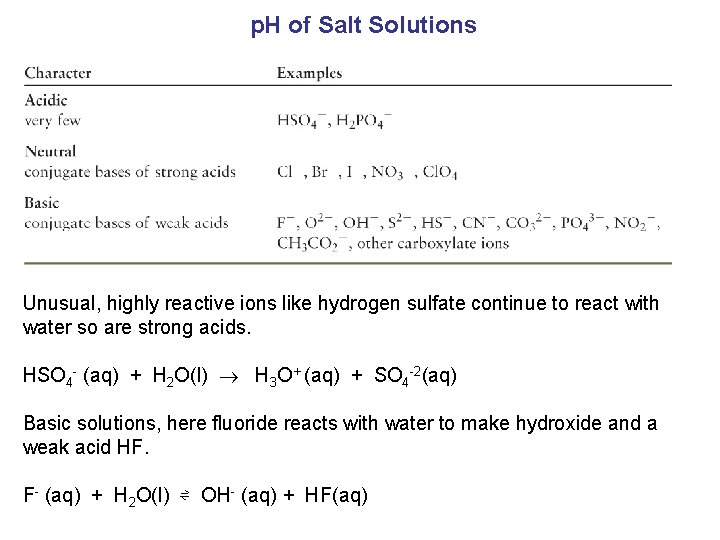
p. H of Salt Solutions Unusual, highly reactive ions like hydrogen sulfate continue to react with water so are strong acids. HSO 4 (aq) + H 2 O(l) H 3 O+ (aq) + SO 4 2(aq) Basic solutions, here fluoride reacts with water to make hydroxide and a weak acid HF. F (aq) + H 2 O(l) ⇌ OH (aq) + HF(aq)
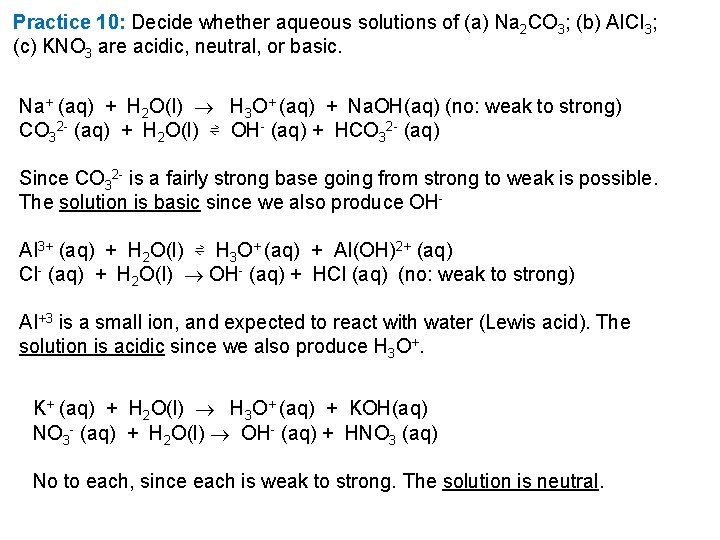
Practice 10: Decide whether aqueous solutions of (a) Na 2 CO 3; (b) AICI 3; (c) KNO 3 are acidic, neutral, or basic. Na+ (aq) + H 2 O(l) H 3 O+ (aq) + Na. OH(aq) (no: weak to strong) CO 32 (aq) + H 2 O(l) ⇌ OH (aq) + HCO 32 (aq) Since CO 32 is a fairly strong base going from strong to weak is possible. The solution is basic since we also produce OH AI 3+ (aq) + H 2 O(l) ⇌ H 3 O+ (aq) + AI(OH)2+ (aq) Cl (aq) + H 2 O(l) OH (aq) + HCl (aq) (no: weak to strong) AI+3 is a small ion, and expected to react with water (Lewis acid). The solution is acidic since we also produce H 3 O+. K+ (aq) + H 2 O(l) H 3 O+ (aq) + KOH(aq) NO 3 (aq) + H 2 O(l) OH (aq) + HNO 3 (aq) No to each, since each is weak to strong. The solution is neutral.
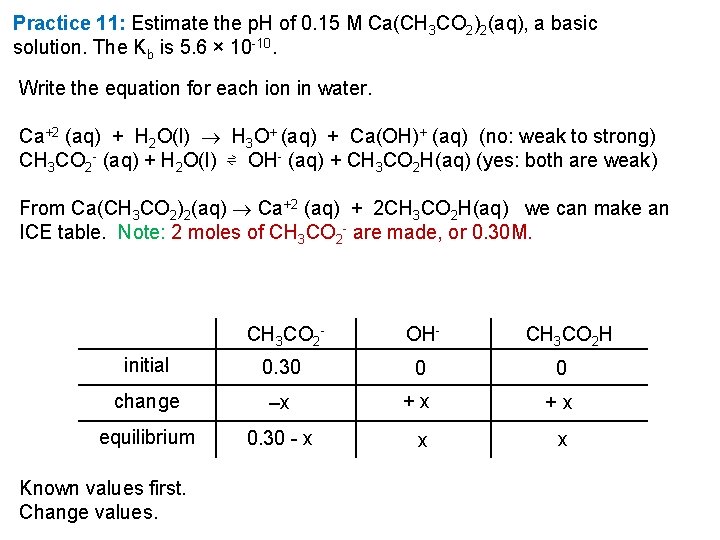
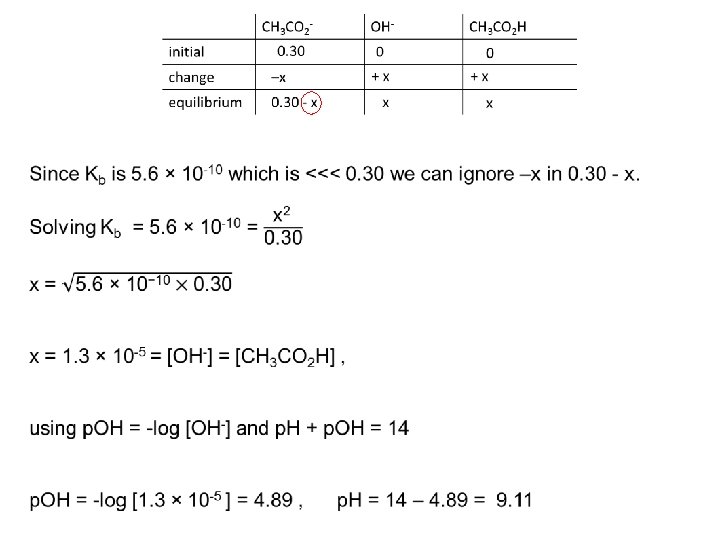
Practice 11: Estimate the p. H of 0. 15 M Ca(CH 3 CO 2)2(aq), a basic solution. The Kb is 5. 6 × 10 10. Write the equation for each ion in water. Ca+2 (aq) + H 2 O(l) H 3 O+ (aq) + Ca(OH)+ (aq) (no: weak to strong) CH 3 CO 2 (aq) + H 2 O(l) ⇌ OH (aq) + CH 3 CO 2 H(aq) (yes: both are weak) From Ca(CH 3 CO 2)2(aq) Ca+2 (aq) + 2 CH 3 CO 2 H(aq) we can make an ICE table. Note: 2 moles of CH 3 CO 2 are made, or 0. 30 M. CH 3 CO 2 OH CH 3 CO 2 H initial 0. 30 0 0 change –x + x equilibrium 0. 30 x x x Known values first. Change values.
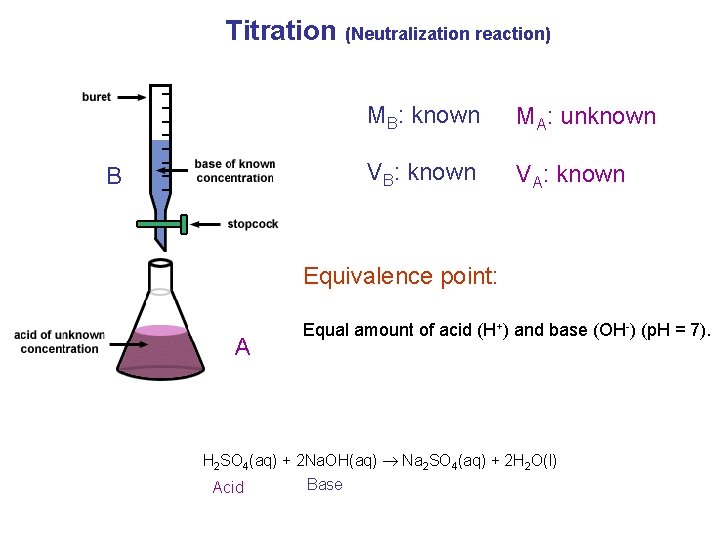
Titration (Neutralization reaction) B MB: known MA: unknown VB: known VA: known Equivalence point: A Equal amount of acid (H+) and base (OH ) (p. H = 7). H 2 SO 4(aq) + 2 Na. OH(aq) Na 2 SO 4(aq) + 2 H 2 O(l) Acid Base
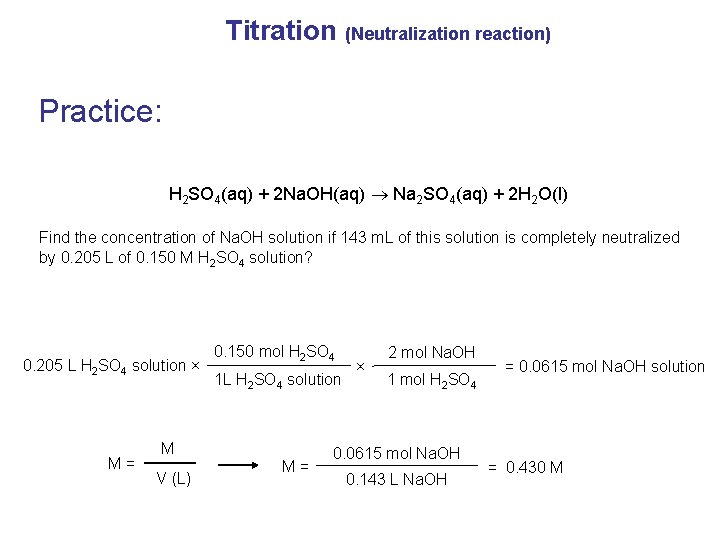
Titration (Neutralization reaction) Practice: H 2 SO 4(aq) + 2 Na. OH(aq) Na 2 SO 4(aq) + 2 H 2 O(l) Find the concentration of Na. OH solution if 143 m. L of this solution is completely neutralized by 0. 205 L of 0. 150 M H 2 SO 4 solution? 0. 205 L H 2 SO 4 solution × M = 0. 150 mol H 2 SO 4 1 L H 2 SO 4 solution M V (L) M = × 2 mol Na. OH 1 mol H 2 SO 4 0. 0615 mol Na. OH 0. 143 L Na. OH = 0. 0615 mol Na. OH solution = 0. 430 M
Polyprotic acids and bases A polyprotic acid is a species that can donate more than one proton. A polyprotic base is a species that can accept more than one proton. Examples include the CO 32 and SO 32 anions, both of which can accept two protons, and the PO 43 anion, which can accept three protons. The existence of each of these species is dependent on p. H.
The p. H of Polyprotic acids Carbonic acid is an important natural component of the environment because it is formed whenever carbon dioxide dissolves [CO 2(g) + H 2 O(l) ⇌ H 2 CO 3(aq)] in lake water or seawater. In fact, the oceans provide one of the critical mechanisms for maintaining a constant concen tration of carbon dioxide in the atmosphere.
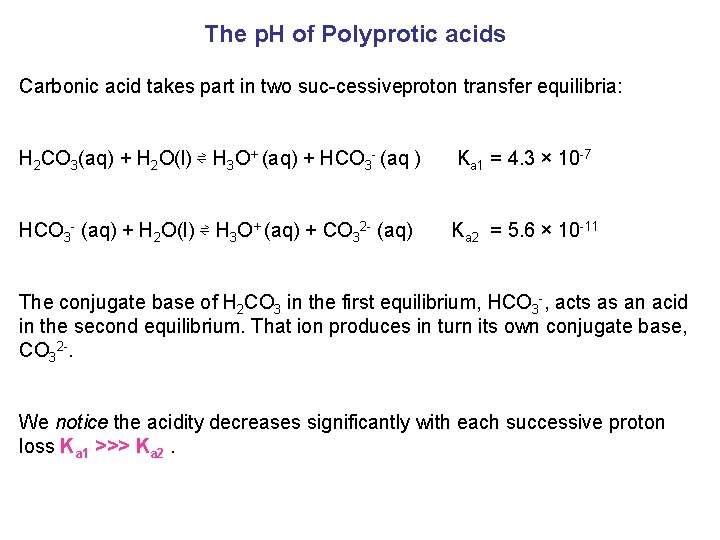
The p. H of Polyprotic acids Carbonic acid takes part in two suc cessive proton transfer equilibria: H 2 CO 3(aq) + H 2 O(l) ⇌ H 3 O+ (aq) + HCO 3 (aq ) Ka 1 = 4. 3 × 10 7 HCO 3 (aq) + H 2 O(l) ⇌ H 3 O+ (aq) + CO 32 (aq) Ka 2 = 5. 6 × 10 11 The conjugate base of H 2 CO 3 in the first equilibrium, HCO 3 , acts as an acid in the second equilibrium. That ion produces in turn its own conjugate base, CO 32. We notice the acidity decreases significantly with each successive proton loss Ka 1 >>> Ka 2.
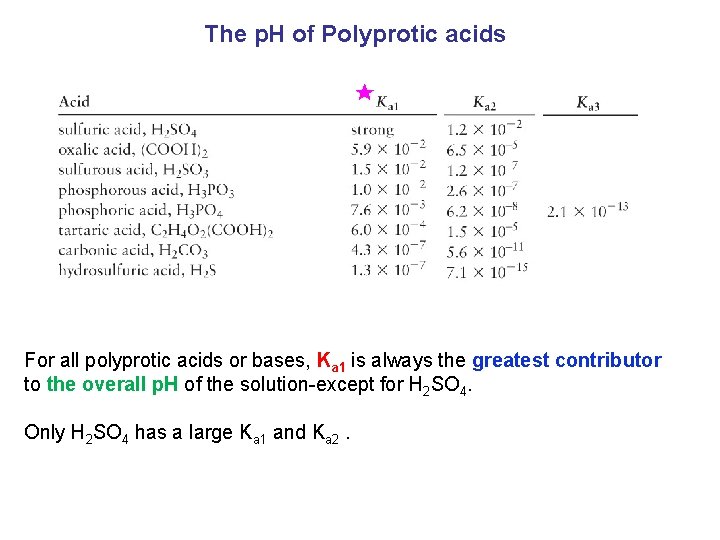
The p. H of Polyprotic acids For all polyprotic acids or bases, Ka 1 is always the greatest contributor to the overall p. H of the solution except for H 2 SO 4. Only H 2 SO 4 has a large Ka 1 and Ka 2.
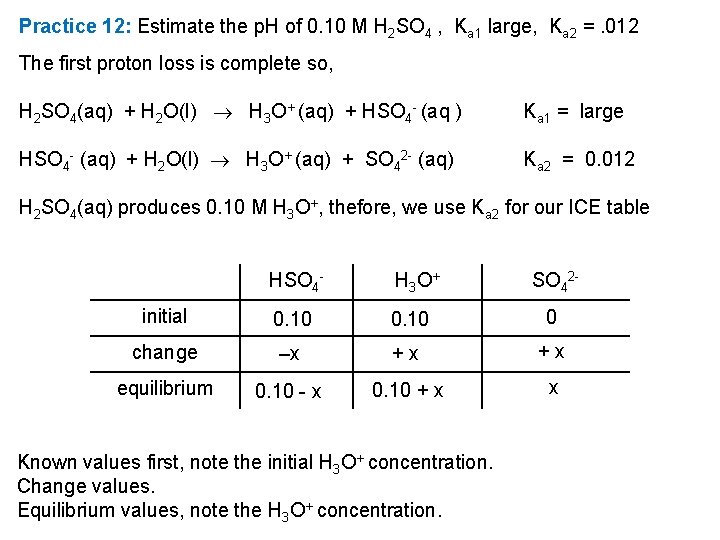
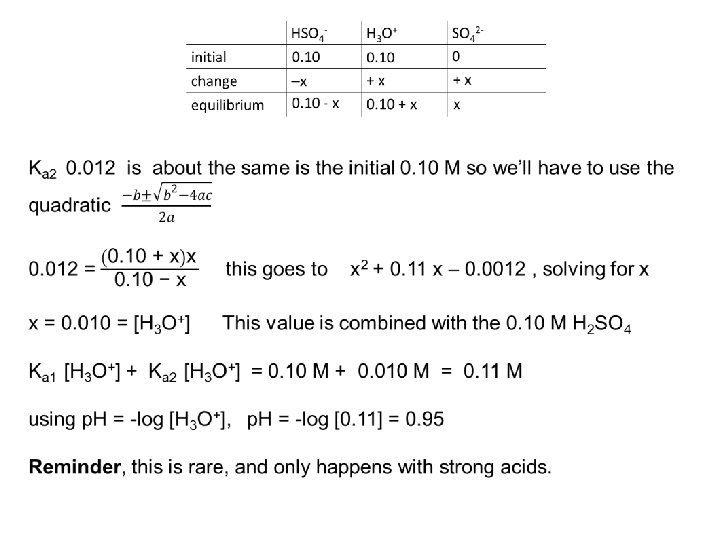
Practice 12: Estimate the p. H of 0. 10 M H 2 SO 4 , Ka 1 large, Ka 2 =. 012 The first proton loss is complete so, H 2 SO 4(aq) + H 2 O(l) H 3 O+ (aq) + HSO 4 (aq ) Ka 1 = large HSO 4 (aq) + H 2 O(l) H 3 O+ (aq) + SO 42 (aq) Ka 2 = 0. 012 H 2 SO 4(aq) produces 0. 10 M H 3 O+, thefore, we use Ka 2 for our ICE table HSO 4 H 3 O+ initial 0. 10 0 change –x + x equilibrium 0. 10 x 0. 10 + x x Known values first, note the initial H 3 O+ concentration. Change values. Equilibrium values, note the H 3 O+ concentration. SO 42
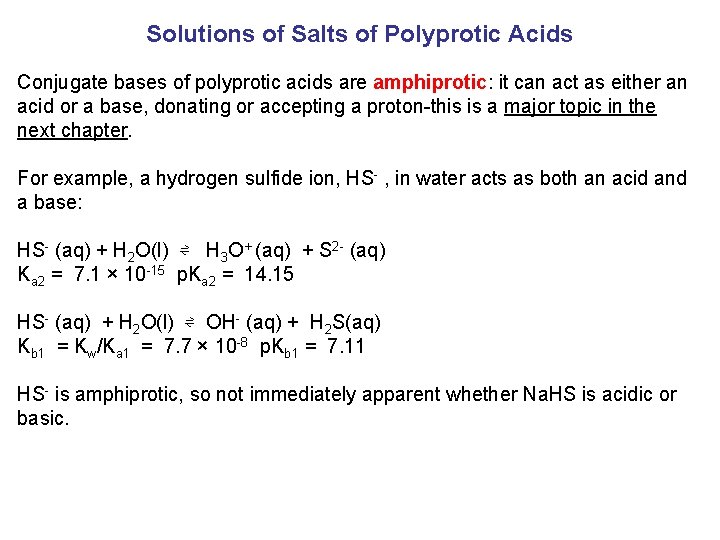
Solutions of Salts of Polyprotic Acids Conjugate bases of polyprotic acids are amphiprotic: it can act as either an acid or a base, donating or accepting a proton this is a major topic in the next chapter. For example, a hydrogen sulfide ion, HS , in water acts as both an acid and a base: HS (aq) + H 2 O(l) ⇌ H 3 O+ (aq) + S 2 (aq) Ka 2 = 7. 1 × 10 15 p. Ka 2 = 14. 15 HS (aq) + H 2 O(l) ⇌ OH (aq) + H 2 S(aq) Kb 1 = Kw/Ka 1 = 7. 7 × 10 8 p. Kb 1 = 7. 11 HS is amphiprotic, so not immediately apparent whether Na. HS is acidic or basic.

Solutions of Salts of Polyprotic Acids HS (aq) + H 2 O(l) ⇌ H 3 O+ (aq) + S 2 (aq) Ka 2 = 7. 1 × 10 15 p. Ka 2 = 14. 15 HS (aq) + H 2 O(l) ⇌ OH (aq) + H 2 S(aq) Kb 1 = Kw/Ka 1 = 7. 7 × 10 8 p. Kb 1 = 7. 11 However, we can use the p. Ka and p. Kb values of the HS ion to conclude that: • HS is a weak acid (Ka 2) and basic character of S 2 will dominate, and p. H > 7. • HS is a weak base; again p. H > 7. A helpful equation is p. H = ½ (p. Ka 1 + p. Ka 2) as long as initial concentration [X]intial >> Ka 1.
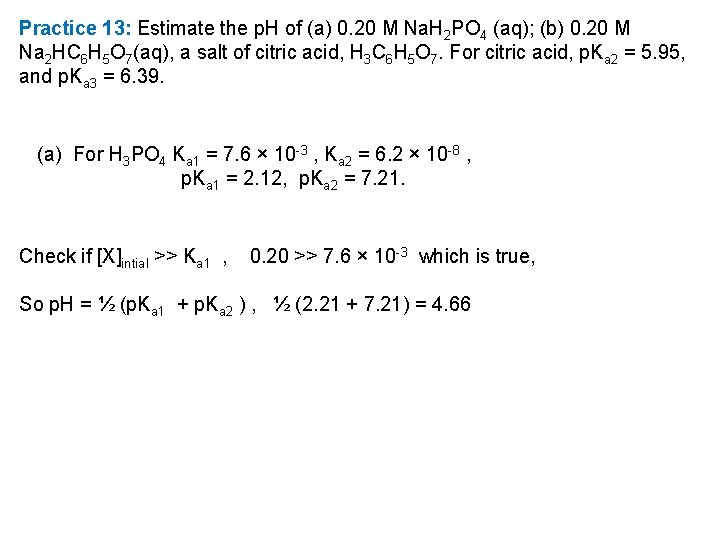
Practice 13: Estimate the p. H of (a) 0. 20 M Na. H 2 PO 4 (aq); (b) 0. 20 M Na 2 HC 6 H 5 O 7(aq), a salt of citric acid, H 3 C 6 H 5 O 7. For citric acid, p. Ka 2 = 5. 95, and p. Ka 3 = 6. 39. (a) For H 3 PO 4 Ka 1 = 7. 6 × 10 3 , Ka 2 = 6. 2 × 10 8 , p. Ka 1 = 2. 12, p. Ka 2 = 7. 21. Check if [X]intial >> Ka 1 , 0. 20 >> 7. 6 × 10 3 which is true, So p. H = ½ (p. Ka 1 + p. Ka 2 ) , ½ (2. 21 + 7. 21) = 4. 66
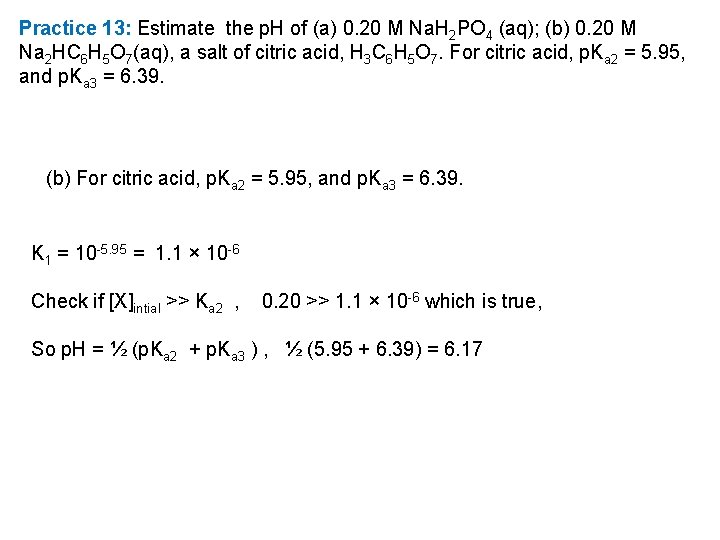
Practice 13: Estimate the p. H of (a) 0. 20 M Na. H 2 PO 4 (aq); (b) 0. 20 M Na 2 HC 6 H 5 O 7(aq), a salt of citric acid, H 3 C 6 H 5 O 7. For citric acid, p. Ka 2 = 5. 95, and p. Ka 3 = 6. 39. (b) For citric acid, p. Ka 2 = 5. 95, and p. Ka 3 = 6. 39. K 1 = 10 5. 95 = 1. 1 × 10 6 Check if [X]intial >> Ka 2 , 0. 20 >> 1. 1 × 10 6 which is true, So p. H = ½ (p. Ka 2 + p. Ka 3 ) , ½ (5. 95 + 6. 39) = 6. 17
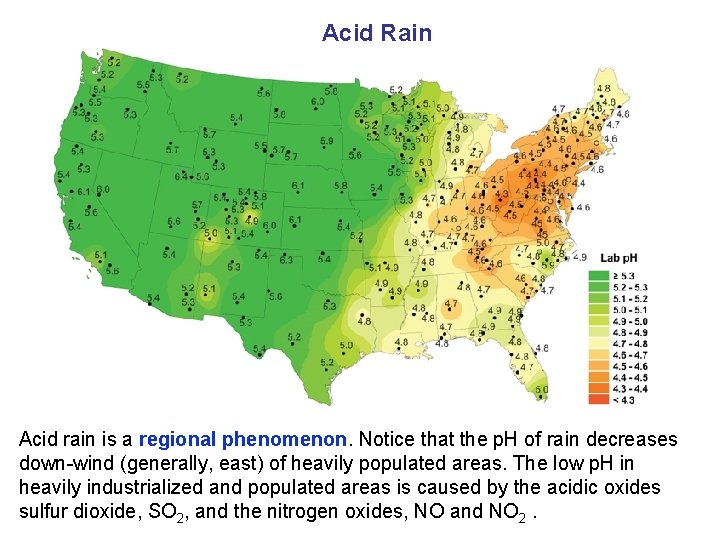
Acid Rain Acid rain is a regional phenomenon. Notice that the p. H of rain decreases down wind (generally, east) of heavily populated areas. The low p. H in heavily industrialized and populated areas is caused by the acidic oxides sulfur dioxide, SO 2, and the nitrogen oxides, NO and NO 2.
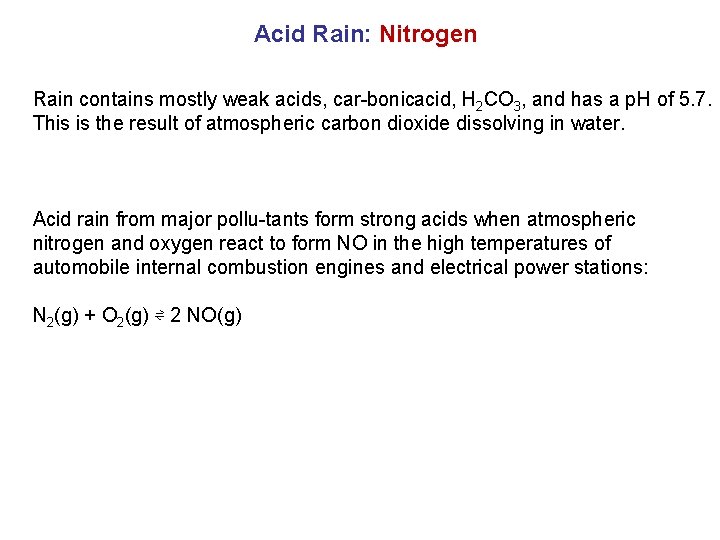
Acid Rain: Nitrogen Rain contains mostly weak acids, car bonic acid, H 2 CO 3, and has a p. H of 5. 7. This is the result of atmospheric carbon dioxide dissolving in water. Acid rain from major pollu tants form strong acids when atmospheric nitrogen and oxygen react to form NO in the high temperatures of automobile internal combustion engines and electrical power stations: N 2(g) + O 2(g) ⇌ 2 NO(g)
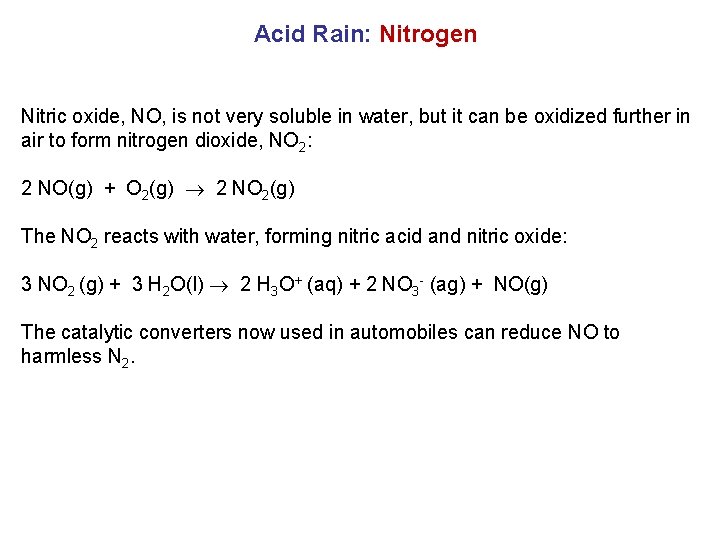
Acid Rain: Nitrogen Nitric oxide, NO, is not very soluble in water, but it can be oxidized further in air to form nitrogen dioxide, NO 2: 2 NO(g) + O 2(g) 2 NO 2(g) The NO 2 reacts with water, forming nitric acid and nitric oxide: 3 NO 2 (g) + 3 H 2 O(l) 2 H 3 O+ (aq) + 2 NO 3 (ag) + NO(g) The catalytic converters now used in automobiles can reduce NO to harmless N 2.
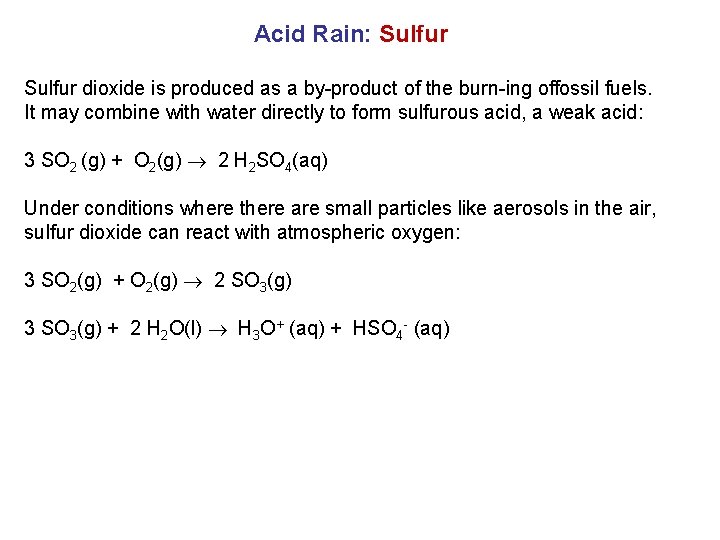
Acid Rain: Sulfur dioxide is produced as a by product of the burn ing of fossil fuels. It may combine with water directly to form sulfurous acid, a weak acid: 3 SO 2 (g) + O 2(g) 2 H 2 SO 4(aq) Under conditions where there are small particles like aerosols in the air, sulfur dioxide can react with atmospheric oxygen: 3 SO 2(g) + O 2(g) 2 SO 3(g) 3 SO 3(g) + 2 H 2 O(l) H 3 O+ (aq) + HSO 4 (aq)
Acid Rain: What we can do? Acid rain affects plants by changing the conditions in the soil. For example, nitric acid deposits nitrates, which fertilize the land. The nitrates allow fast growing weeds such as quack grass to replace and make extinct valuable prairie species. Research on air pollution is complex. Forests and prairies cover vast areas, and the interplay of regional air pollutants is so subtle that it may take years to sort out all the environmental stresses. We can help by using automobiles less and bicycles more or by taking public transportation when we can.
- Slides: 89