
Chemistry 2 Lecture 4 Quantitative MO Theory for


![annulenes Question: [14]-annulene and [16]-annulene are pictured. Which is aromatic? Answer: The 4 n+2](https://slidetodoc.com/presentation_image_h/2671e0775b514c788810c737f29420a8/image-17.jpg "annulenes Question: [14]-annulene and [16]-annulene are pictured. Which is aromatic? Answer: The 4 n+2")
![annulenes Question: Predict the lowest energy at which [18]-annulene might absorb strongly, given your](https://slidetodoc.com/presentation_image_h/2671e0775b514c788810c737f29420a8/image-18.jpg "annulenes Question: Predict the lowest energy at which [18]-annulene might absorb strongly, given your")
- Slides: 25
Chemistry 2 Lecture 4 Quantitative MO Theory for Beginners: Cyclic p Systems
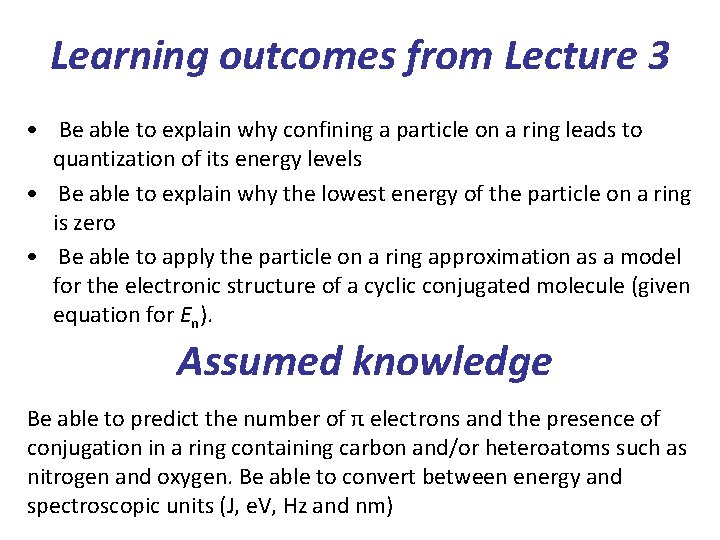
Learning outcomes from Lecture 3 • Be able to explain why confining a particle on a ring leads to quantization of its energy levels • Be able to explain why the lowest energy of the particle on a ring is zero • Be able to apply the particle on a ring approximation as a model for the electronic structure of a cyclic conjugated molecule (given equation for En). Assumed knowledge Be able to predict the number of π electrons and the presence of conjugation in a ring containing carbon and/or heteroatoms such as nitrogen and oxygen. Be able to convert between energy and spectroscopic units (J, e. V, Hz and nm)
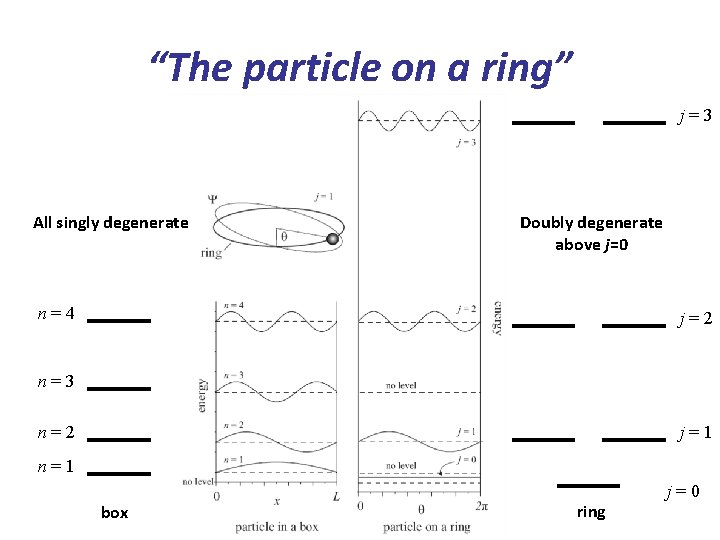
“The particle on a ring” j=3 All singly degenerate Doubly degenerate above j=0 n=4 j=2 n=3 j=1 n=2 n=1 box ring j=0
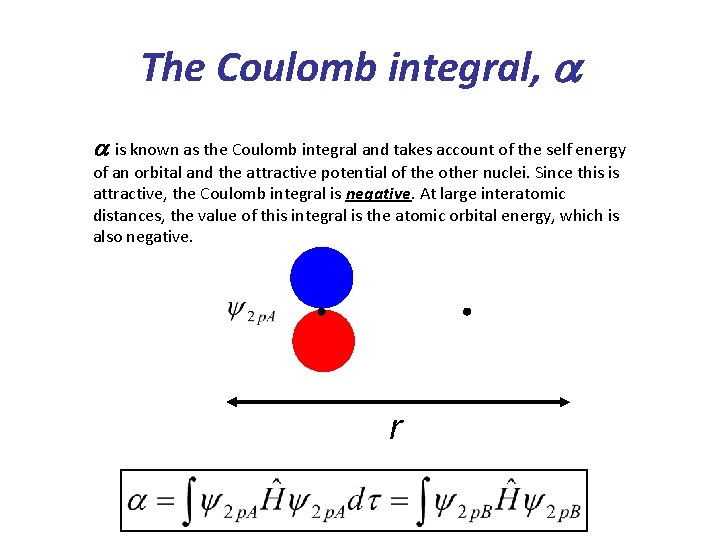
The Coulomb integral, a a is known as the Coulomb integral and takes account of the self energy of an orbital and the attractive potential of the other nuclei. Since this is attractive, the Coulomb integral is negative. At large interatomic distances, the value of this integral is the atomic orbital energy, which is also negative. r
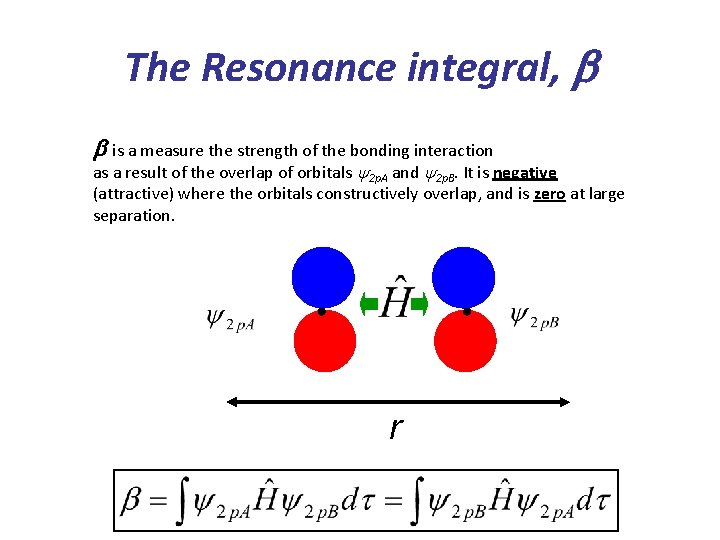
The Resonance integral, b b is a measure the strength of the bonding interaction as a result of the overlap of orbitals y 2 p. A and y 2 p. B. It is negative (attractive) where the orbitals constructively overlap, and is zero at large separation. r
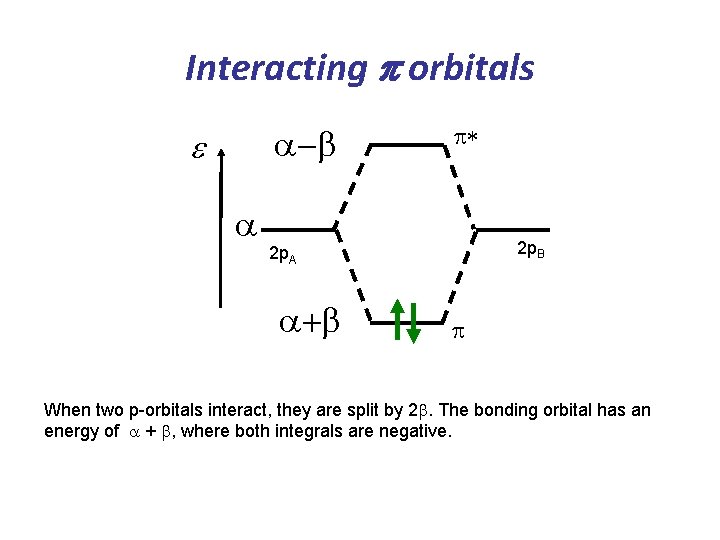
Interacting p orbitals a-b e a p* 2 p. B 2 p. A a+b p When two p-orbitals interact, they are split by 2 b. The bonding orbital has an energy of a + b, where both integrals are negative.
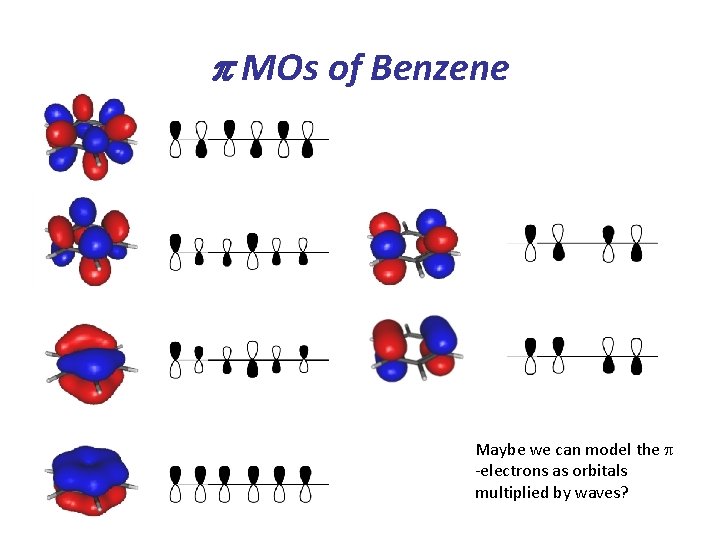
p MOs of Benzene Maybe we can model the p -electrons as orbitals multiplied by waves?
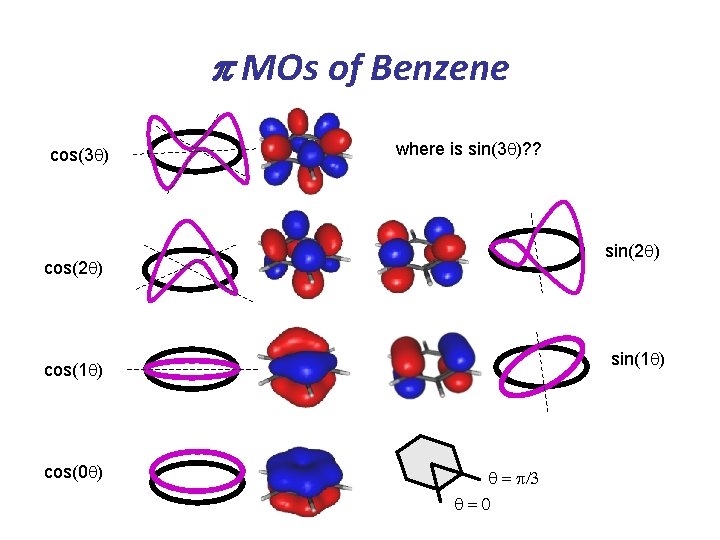
p MOs of Benzene cos(3 q) where is sin(3 q)? ? sin(2 q) cos(2 q) sin(1 q) cos(0 q) q = p/3 q=0
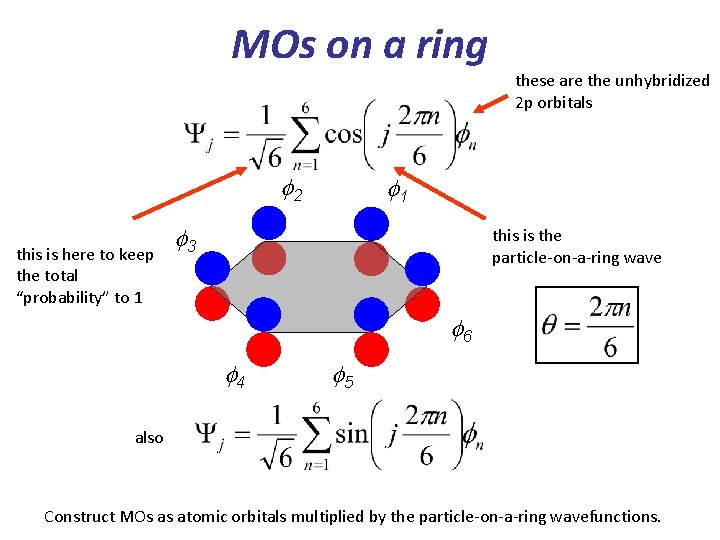
MOs on a ring f 2 this is here to keep the total “probability” to 1 these are the unhybridized 2 p orbitals f 1 f 3 this is the particle-on-a-ring wave f 6 f 4 f 5 also Construct MOs as atomic orbitals multiplied by the particle-on-a-ring wavefunctions.
orbital energies Coefficients of p orbitals given by Particle-on-a-ring wavefunction for benzene, see appendix for derivation
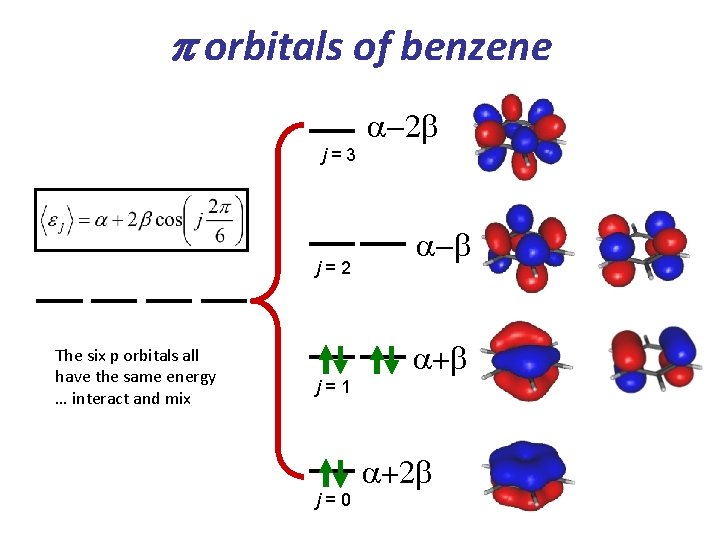
p orbitals of benzene a-2 b j=3 j=2 The six p orbitals all have the same energy … interact and mix a-b a+b j=1 j=0 a+2 b
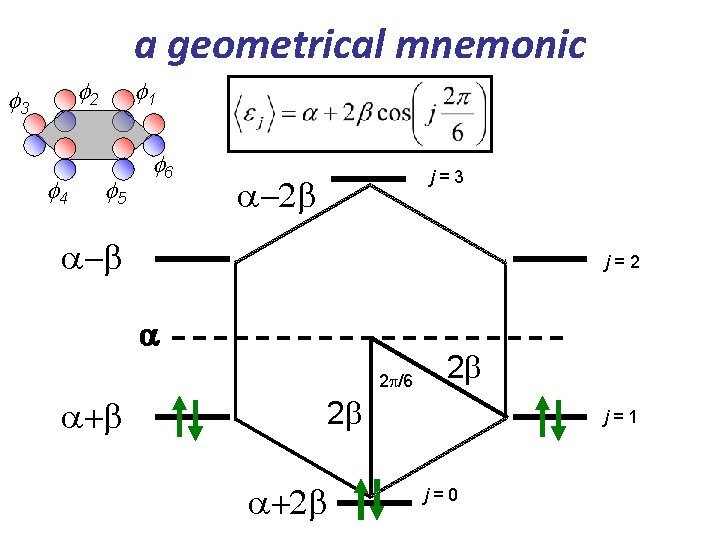
a geometrical mnemonic f 2 f 3 f 4 f 1 f 5 f 6 j=3 a-2 b a-b j=2 a 2 p/6 a+b 2 b 2 b a+2 b j=1 j=0
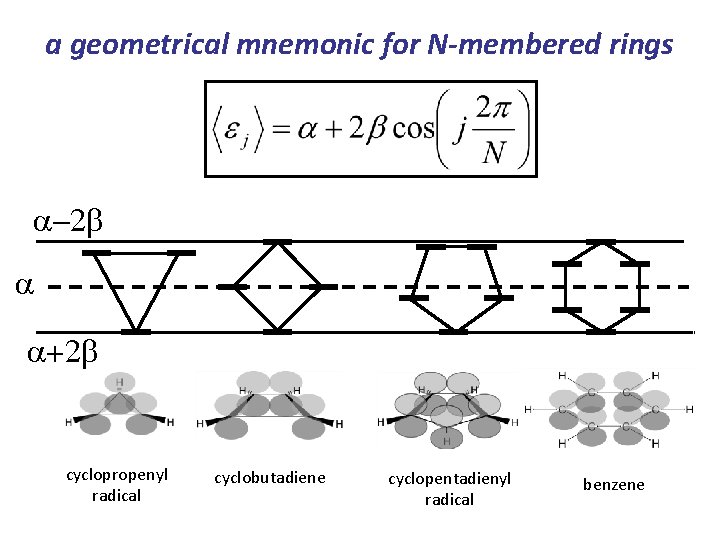
a geometrical mnemonic for N-membered rings a-2 b a a+2 b cyclopropenyl radical cyclobutadiene cyclopentadienyl radical benzene
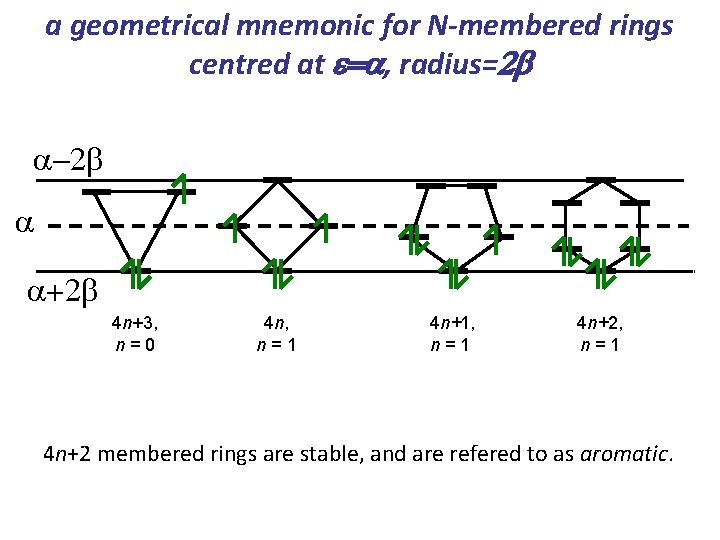
a geometrical mnemonic for N-membered rings centred at e=a, radius=2 b a-2 b a a+2 b 4 n+3, n=0 4 n, n=1 4 n+1, n=1 4 n+2 membered rings are stable, and are refered to as aromatic.
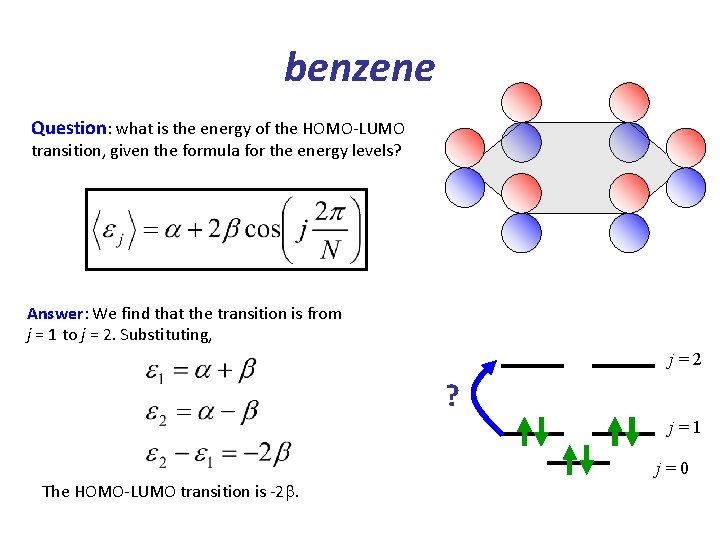
benzene Question: what is the energy of the HOMO-LUMO transition, given the formula for the energy levels? Answer: We find that the transition is from j = 1 to j = 2. Substituting, j=2 ? j=1 j=0 The HOMO-LUMO transition is -2 b.
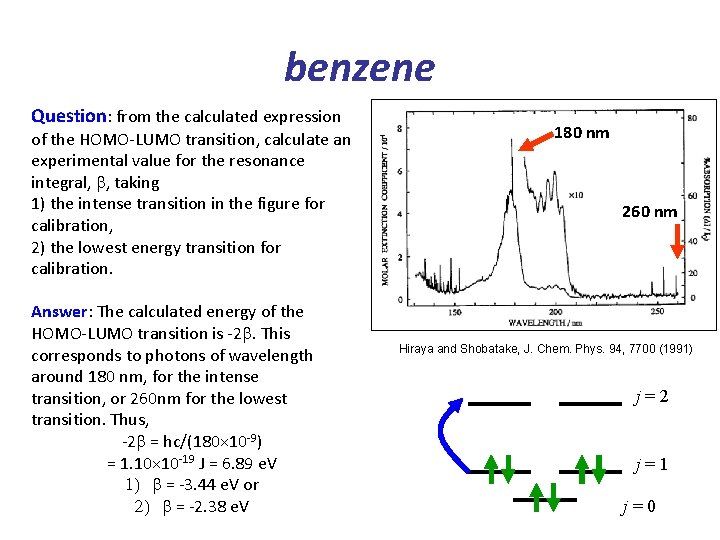
benzene Question: from the calculated expression of the HOMO-LUMO transition, calculate an experimental value for the resonance integral, b, taking 1) the intense transition in the figure for calibration, 2) the lowest energy transition for calibration. Answer: The calculated energy of the HOMO-LUMO transition is -2 b. This corresponds to photons of wavelength around 180 nm, for the intense transition, or 260 nm for the lowest transition. Thus, -2 b = hc/(180× 10 -9) = 1. 10× 10 -19 J = 6. 89 e. V 1) b = -3. 44 e. V or 2) b = -2. 38 e. V 180 nm 260 nm j=3 Hiraya and Shobatake, J. Chem. Phys. 94, 7700 (1991) j=2 j=1 j=0
annulenes Question: [14]-annulene and [16]-annulene are pictured. Which is aromatic? Answer: The 4 n+2 rule applies to [14]annulene, n=3, but not [16]-annulene, which is antiaromatic. [14]-annulene Question: How many p-electrons in [18]- annulene? What are the values of j for the HOMO and the LUMO? Answer: There are 18 p-electrons, so the transition is from j = 4 to j = 5. (draw a picture) [18]-annulene [16]-annulene
annulenes Question: Predict the lowest energy at which [18]-annulene might absorb strongly, given your smaller calculated value for b from benzene. Answer: [18]-annulene This corresponds to 750 nm, or 13300 cm-1, which is a value supported by experiment.
Learning outcomes • Recall and apply the 4 n+2 rule for aromaticity • Recognize and interpret the polygon mnemonic for the energy levels of a conjugated cyclic compound. • Be able to apply molecular orbital theory as a model for the electronic structure of a conjugated ring molecule (given equation for Ej).
Next lecture • Vibrational spectroscopy: the simple harmonic oscillator Week 10 tutorials • Schrödinger equation and molecular orbitals for diatomic molecules
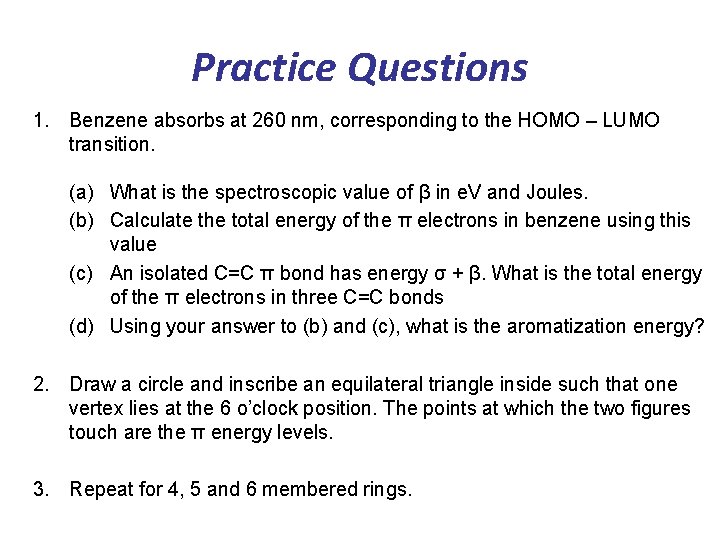
Practice Questions 1. Benzene absorbs at 260 nm, corresponding to the HOMO – LUMO transition. (a) What is the spectroscopic value of β in e. V and Joules. (b) Calculate the total energy of the π electrons in benzene using this value (c) An isolated C=C π bond has energy σ + β. What is the total energy of the π electrons in three C=C bonds (d) Using your answer to (b) and (c), what is the aromatization energy? 2. Draw a circle and inscribe an equilateral triangle inside such that one vertex lies at the 6 o’clock position. The points at which the two figures touch are the π energy levels. 3. Repeat for 4, 5 and 6 membered rings.
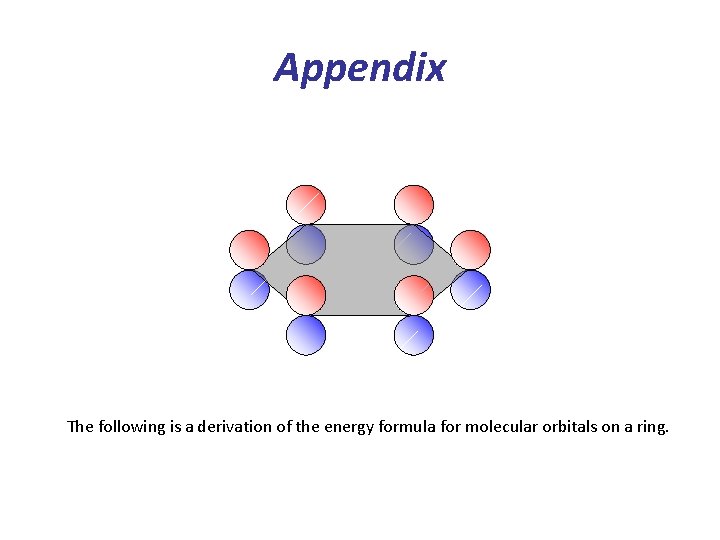
Appendix The following is a derivation of the energy formula for molecular orbitals on a ring.
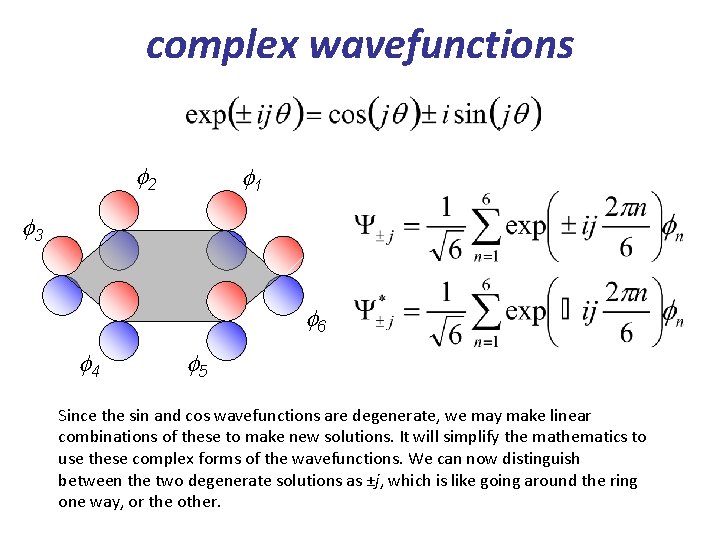
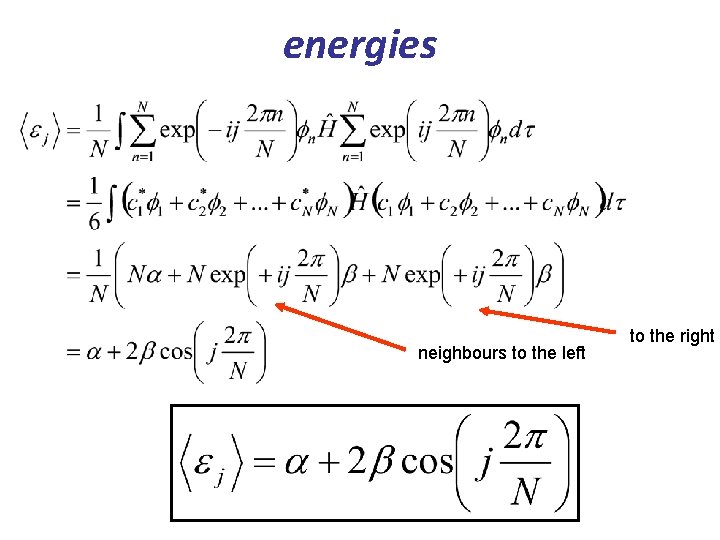
complex wavefunctions f 2 f 1 f 3 f 6 f 4 f 5 Since the sin and cos wavefunctions are degenerate, we may make linear combinations of these to make new solutions. It will simplify the mathematics to use these complex forms of the wavefunctions. We can now distinguish between the two degenerate solutions as ±j, which is like going around the ring one way, or the other.
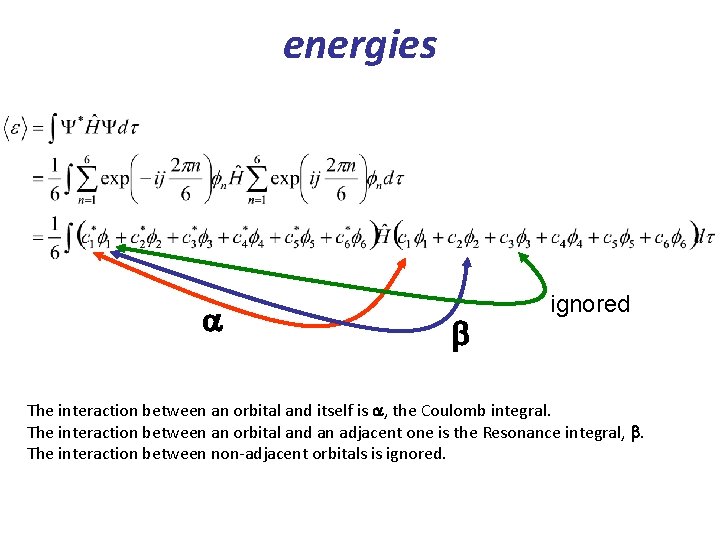
energies a b ignored The interaction between an orbital and itself is a, the Coulomb integral. The interaction between an orbital and an adjacent one is the Resonance integral, b. The interaction between non-adjacent orbitals is ignored.
energies neighbours to the left to the right