
CHEMISTRY 161 Chapter 6 Energy an Chemical Change
- Slides: 45
CHEMISTRY 161 Chapter 6
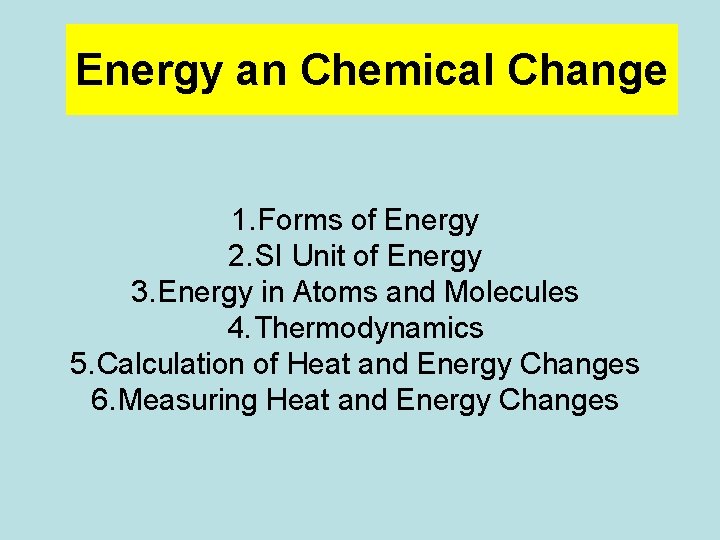
Energy an Chemical Change 1. Forms of Energy 2. SI Unit of Energy 3. Energy in Atoms and Molecules 4. Thermodynamics 5. Calculation of Heat and Energy Changes 6. Measuring Heat and Energy Changes
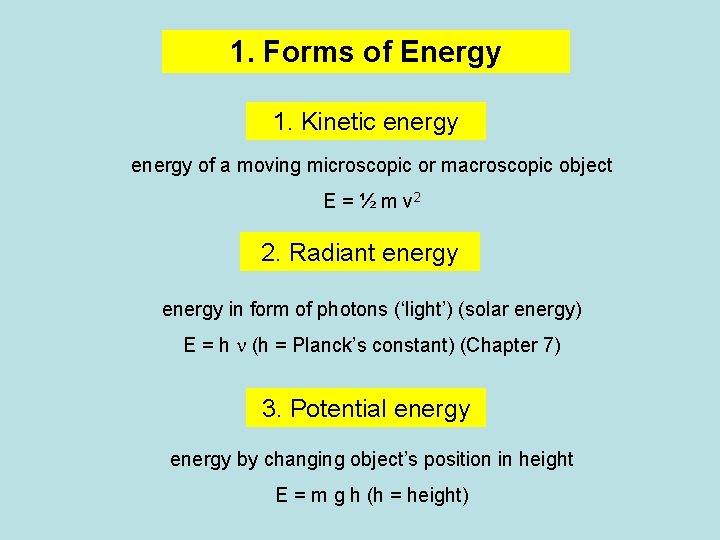
1. Forms of Energy 1. Kinetic energy of a moving microscopic or macroscopic object E = ½ m v 2 2. Radiant energy in form of photons (‘light’) (solar energy) E = h (h = Planck’s constant) (Chapter 7) 3. Potential energy by changing object’s position in height E = m g h (h = height)
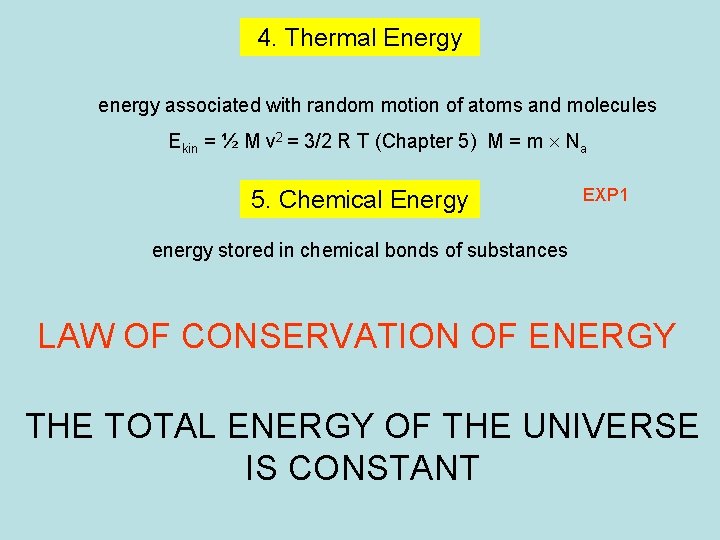
4. Thermal Energy energy associated with random motion of atoms and molecules Ekin = ½ M v 2 = 3/2 R T (Chapter 5) M = m Na 5. Chemical Energy EXP 1 energy stored in chemical bonds of substances LAW OF CONSERVATION OF ENERGY THE TOTAL ENERGY OF THE UNIVERSE IS CONSTANT
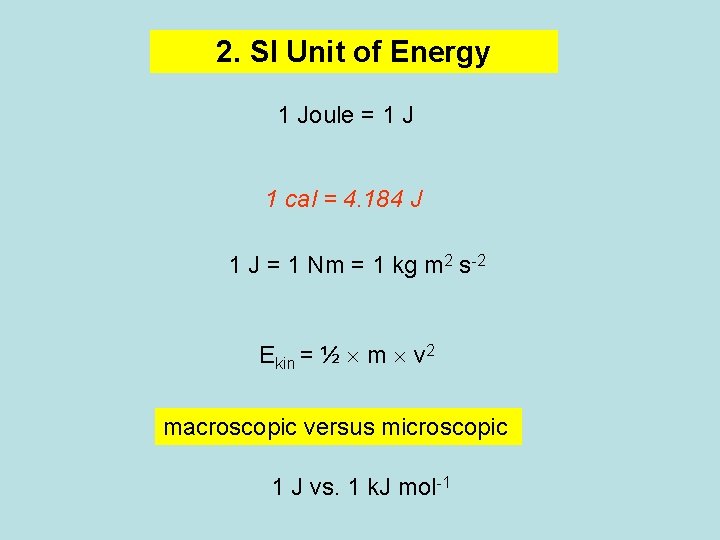
2. SI Unit of Energy 1 Joule = 1 J 1 cal = 4. 184 J 1 J = 1 Nm = 1 kg m 2 s-2 Ekin = ½ m v 2 macroscopic versus microscopic 1 J vs. 1 k. J mol-1
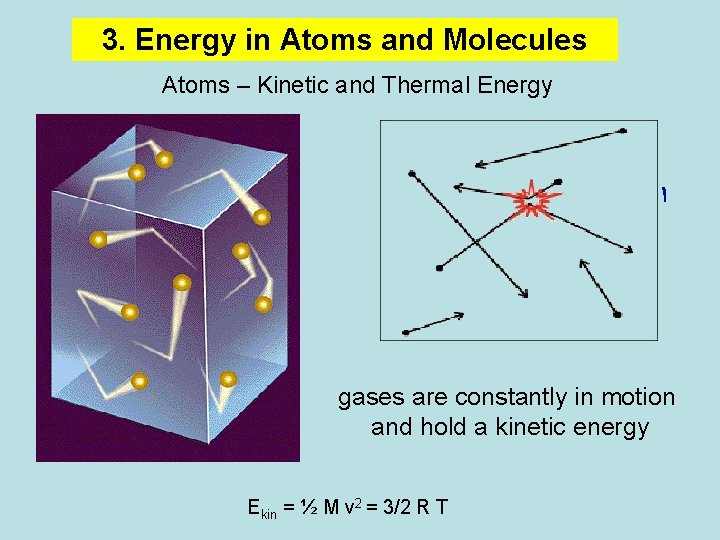
3. Energy in Atoms and Molecules Atoms – Kinetic and Thermal Energy gases are constantly in motion and hold a kinetic energy Ekin = ½ M v 2 = 3/2 R T
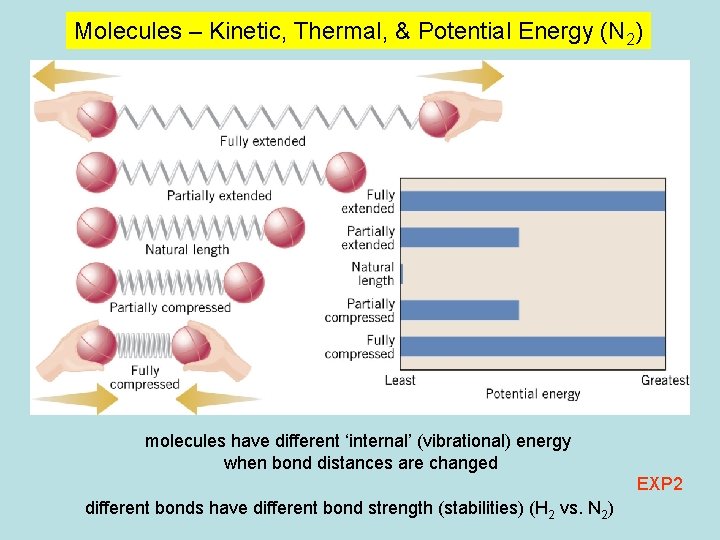
Molecules – Kinetic, Thermal, & Potential Energy (N 2) molecules have different ‘internal’ (vibrational) energy when bond distances are changed EXP 2 different bonds have different bond strength (stabilities) (H 2 vs. N 2)
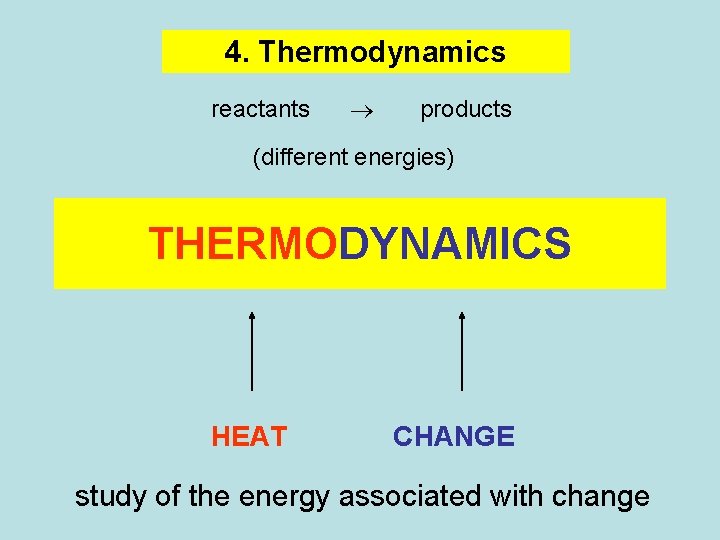
4. Thermodynamics reactants products (different energies) THERMODYNAMICS HEAT CHANGE study of the energy associated with change
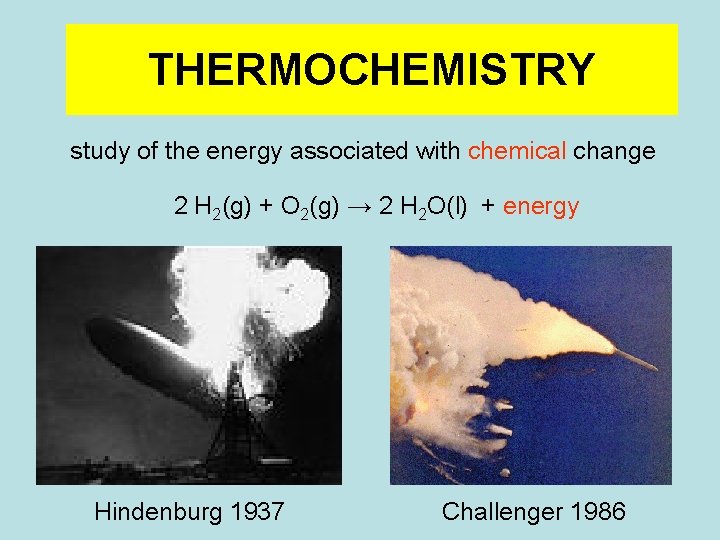
THERMOCHEMISTRY study of the energy associated with chemical change 2 H 2(g) + O 2(g) → 2 H 2 O(l) + energy Hindenburg 1937 Challenger 1986
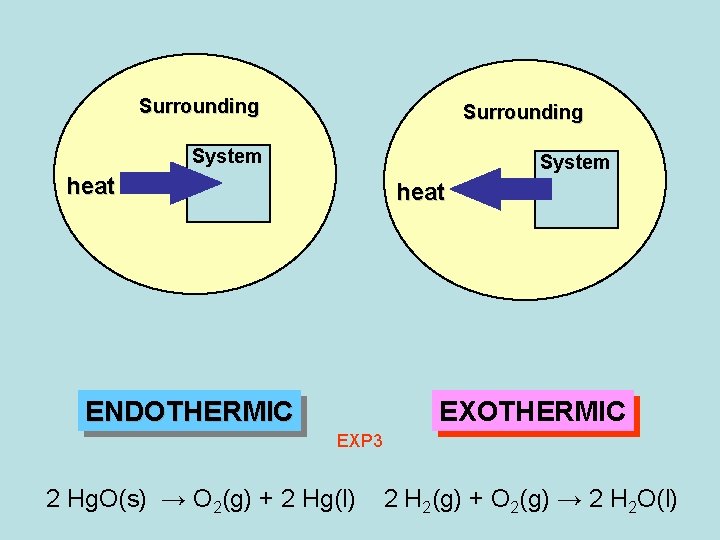
Surrounding System heat ENDOTHERMIC EXP 3 2 Hg. O(s) → O 2(g) + 2 Hg(l) 2 H 2(g) + O 2(g) → 2 H 2 O(l)
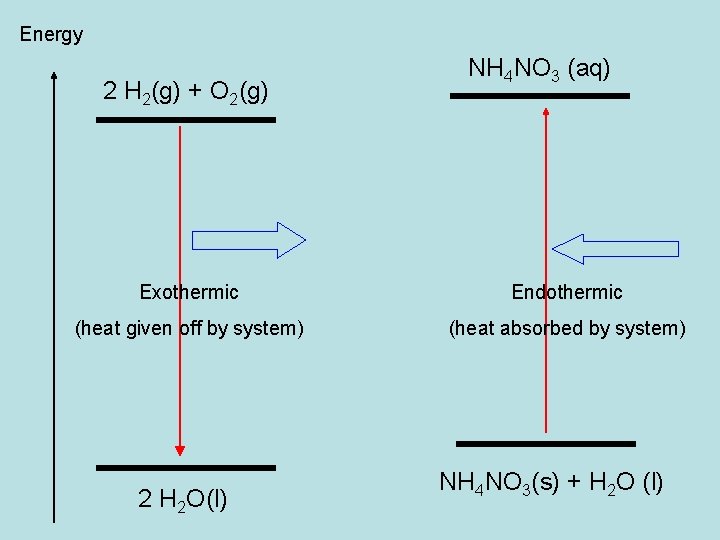
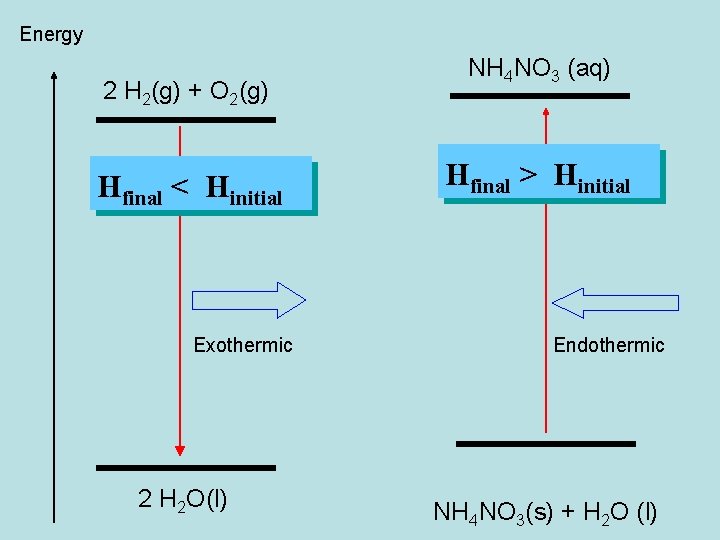
Energy 2 H 2(g) + O 2(g) NH 4 NO 3 (aq) Exothermic Endothermic (heat given off by system) (heat absorbed by system) 2 H 2 O(l) NH 4 NO 3(s) + H 2 O (l)
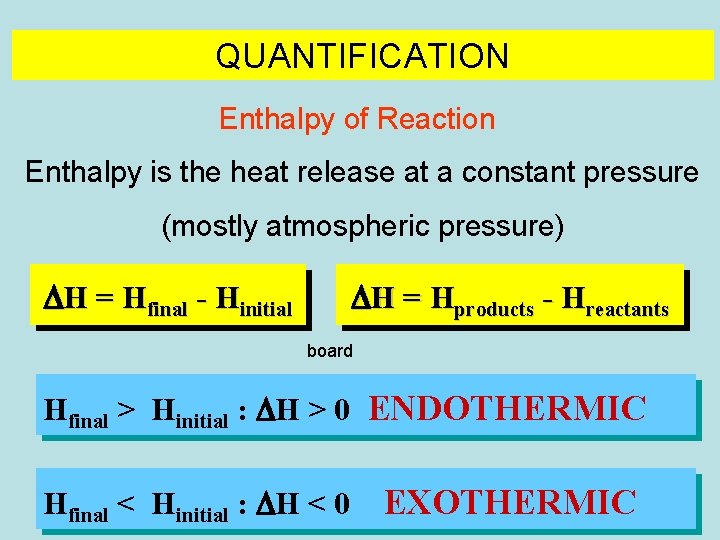
QUANTIFICATION Enthalpy of Reaction Enthalpy is the heat release at a constant pressure (mostly atmospheric pressure) DH = Hfinal - Hinitial DH = Hproducts - Hreactants board Hfinal > Hinitial : DH > 0 ENDOTHERMIC Hfinal < Hinitial : DH < 0 EXOTHERMIC
Energy 2 H 2(g) + O 2(g) Hfinal < Hinitial Exothermic 2 H 2 O(l) NH 4 NO 3 (aq) Hfinal > Hinitial Endothermic NH 4 NO 3(s) + H 2 O (l)
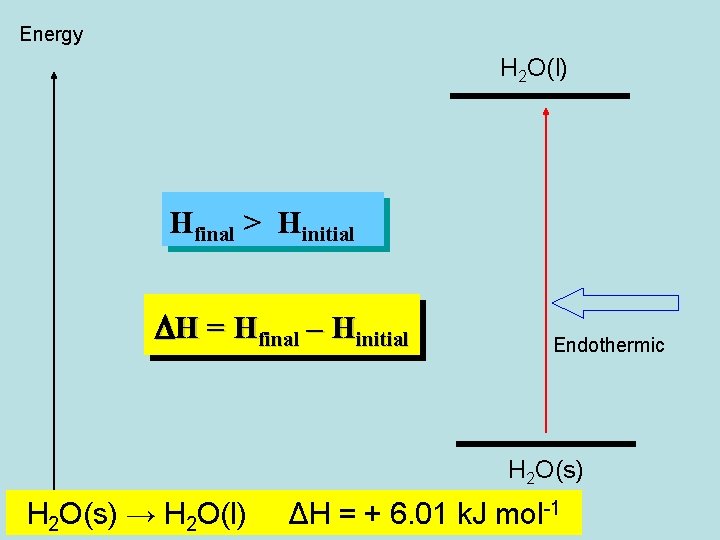
Energy H 2 O(l) Hfinal > Hinitial DH = Hfinal – Hinitial Endothermic H 2 O(s) → H 2 O(l) ΔH = + 6. 01 k. J mol-1
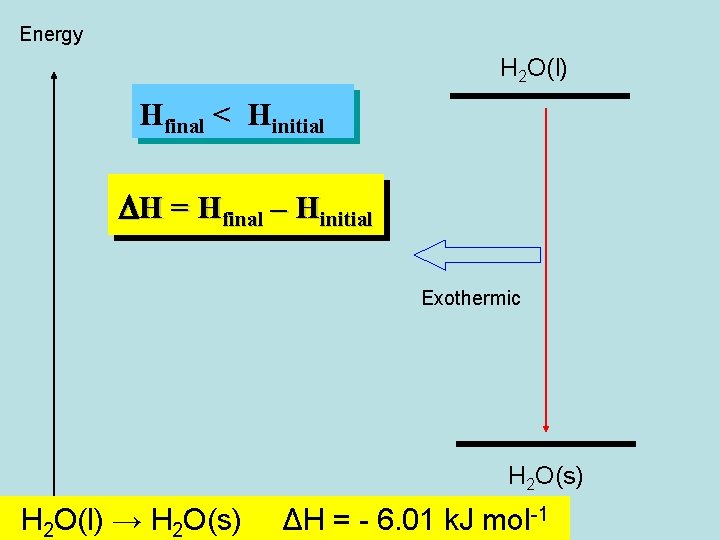
Energy H 2 O(l) Hfinal < Hinitial DH = Hfinal – Hinitial Exothermic H 2 O(s) H 2 O(l) → H 2 O(s) ΔH = - 6. 01 k. J mol-1
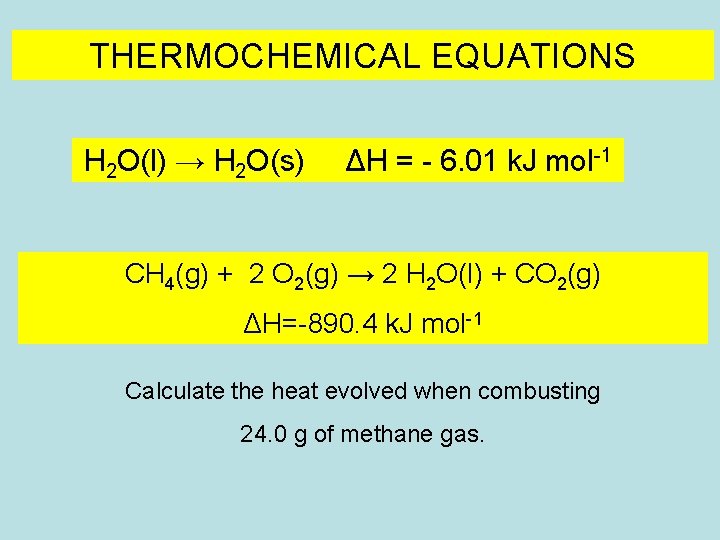
THERMOCHEMICAL EQUATIONS H 2 O(l) → H 2 O(s) ΔH = - 6. 01 k. J mol-1 CH 4(g) + 2 O 2(g) → 2 H 2 O(l) + CO 2(g) ΔH=-890. 4 k. J mol-1 Calculate the heat evolved when combusting 24. 0 g of methane gas.
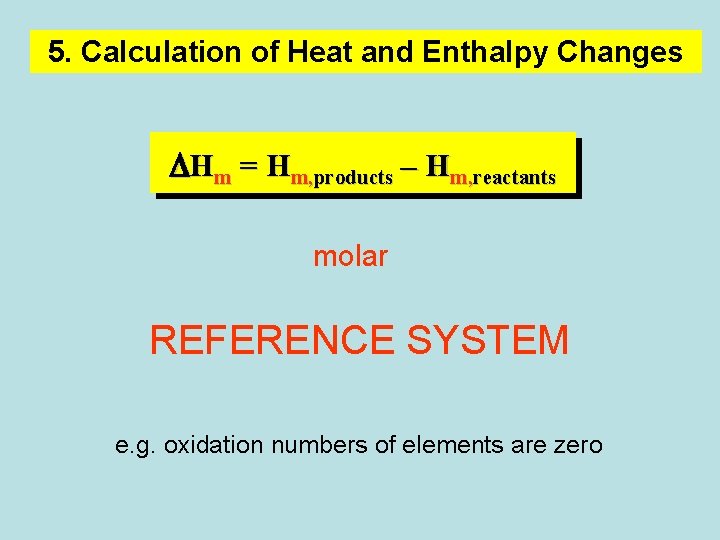
5. Calculation of Heat and Enthalpy Changes DHm = Hm, products – Hm, reactants molar REFERENCE SYSTEM e. g. oxidation numbers of elements are zero
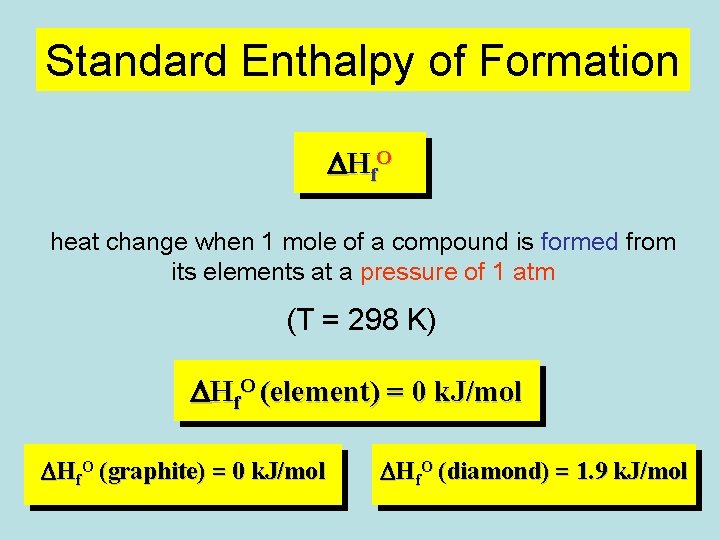
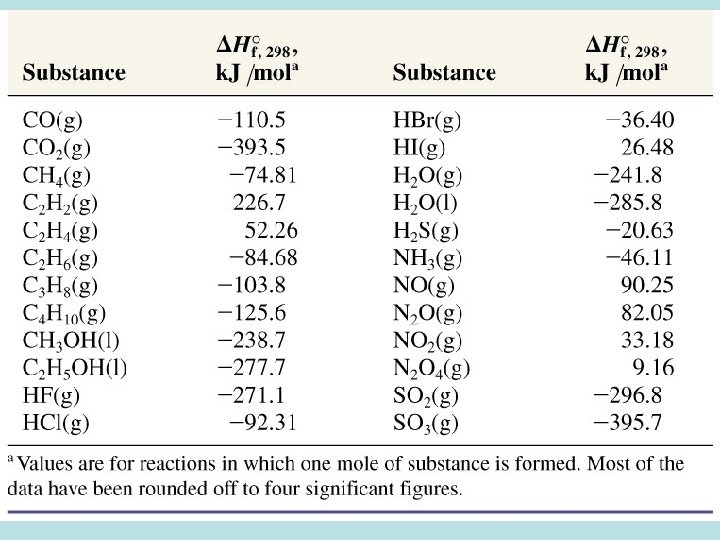
Standard Enthalpy of Formation D H f. O heat change when 1 mole of a compound is formed from its elements at a pressure of 1 atm (T = 298 K) DHf. O (element) = 0 k. J/mol DHf. O (graphite) = 0 k. J/mol DHf. O (diamond) = 1. 9 k. J/mol
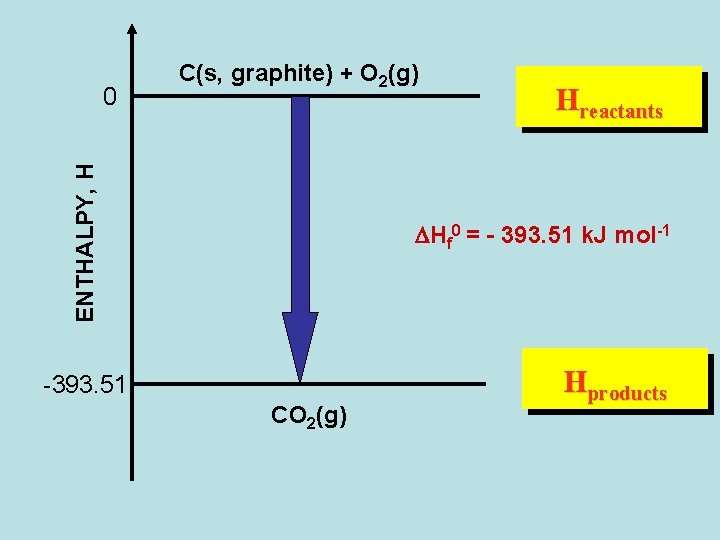
ENTHALPY, H 0 C(s, graphite) + O 2(g) Hreactants DHf 0 = - 393. 51 k. J mol-1 -393. 51 CO 2(g) Hproducts
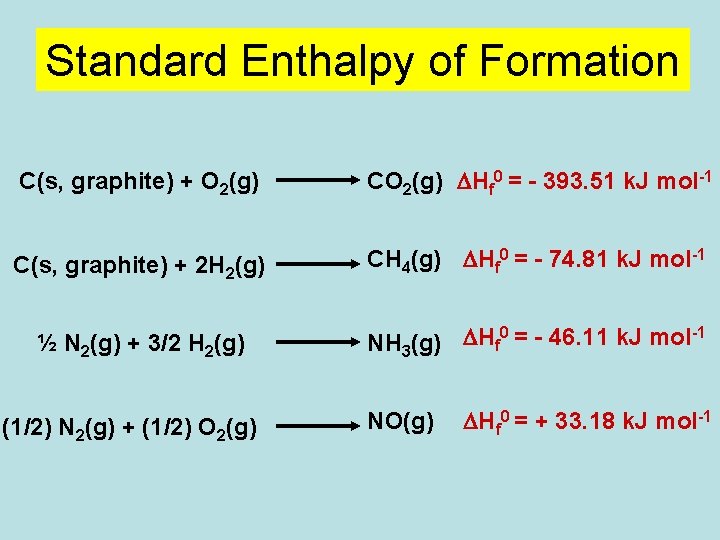
Standard Enthalpy of Formation C(s, graphite) + O 2(g) CO 2(g) DHf 0 = - 393. 51 k. J mol-1 C(s, graphite) + 2 H 2(g) CH 4(g) DHf 0 = - 74. 81 k. J mol-1 ½ N 2(g) + 3/2 H 2(g) 0 -1 NH 3(g) DHf = - 46. 11 k. J mol (1/2) N 2(g) + (1/2) O 2(g) NO(g) DHf 0 = + 33. 18 k. J mol-1
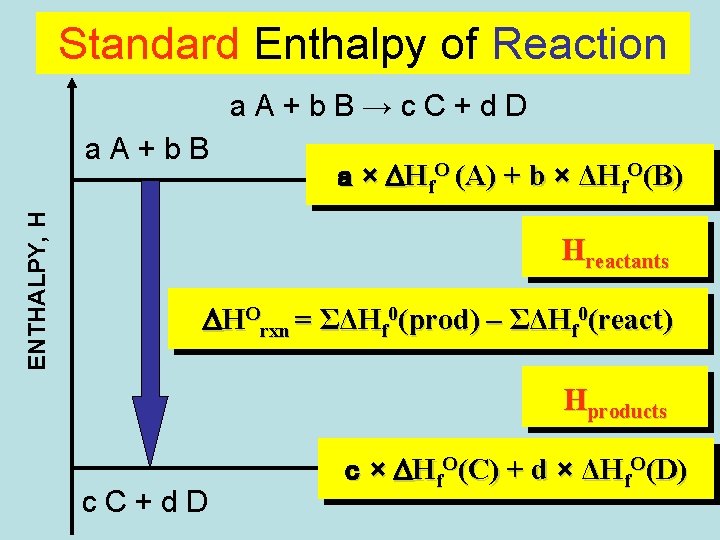
Standard Enthalpy of Reaction a. A+b. B→c. C+d. D ENTHALPY, H a. A+b. B a × DHf. O (A) + b × ΔHf. O(B) Hreactants DHOrxn = ΣΔHf 0(prod) – ΣΔHf 0(react) Hproducts c. C+d. D c × DHf. O(C) + d × ΔHf. O(D)
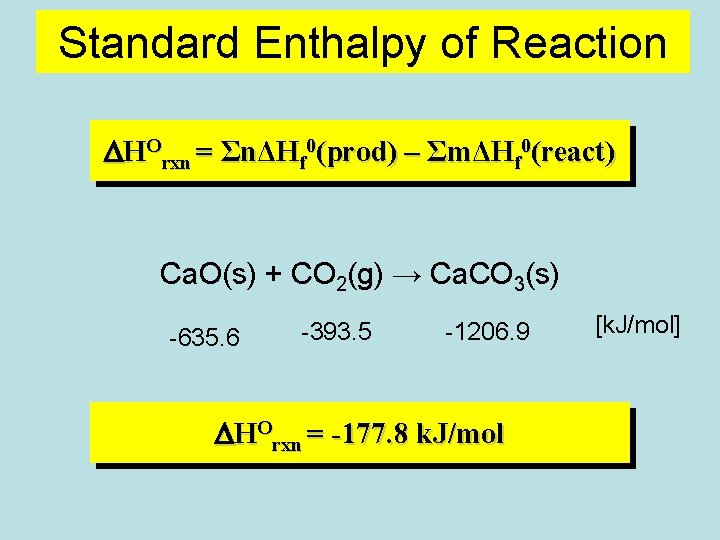
Standard Enthalpy of Reaction DHOrxn = ΣnΔHf 0(prod) – ΣmΔHf 0(react) Ca. O(s) + CO 2(g) → Ca. CO 3(s) -635. 6 -393. 5 -1206. 9 DHOrxn = -177. 8 k. J/mol [k. J/mol]
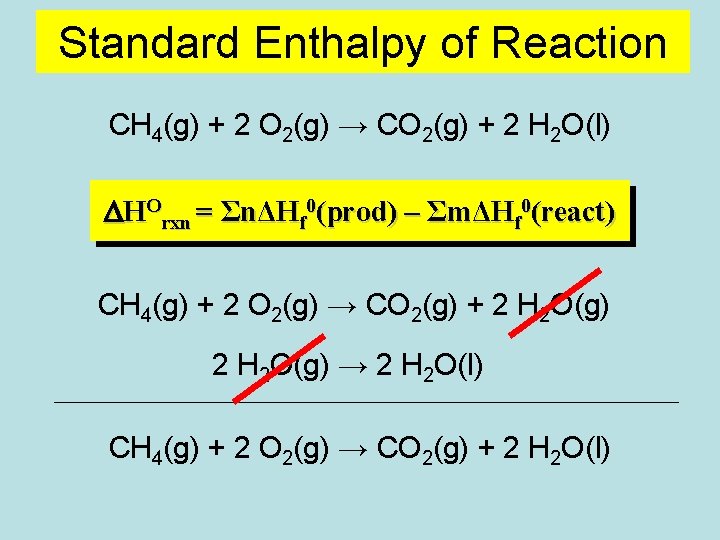
Standard Enthalpy of Reaction CH 4(g) + 2 O 2(g) → CO 2(g) + 2 H 2 O(l) DHOrxn = ΣnΔHf 0(prod) – ΣmΔHf 0(react) CH 4(g) + 2 O 2(g) → CO 2(g) + 2 H 2 O(g) → 2 H 2 O(l) CH 4(g) + 2 O 2(g) → CO 2(g) + 2 H 2 O(l)
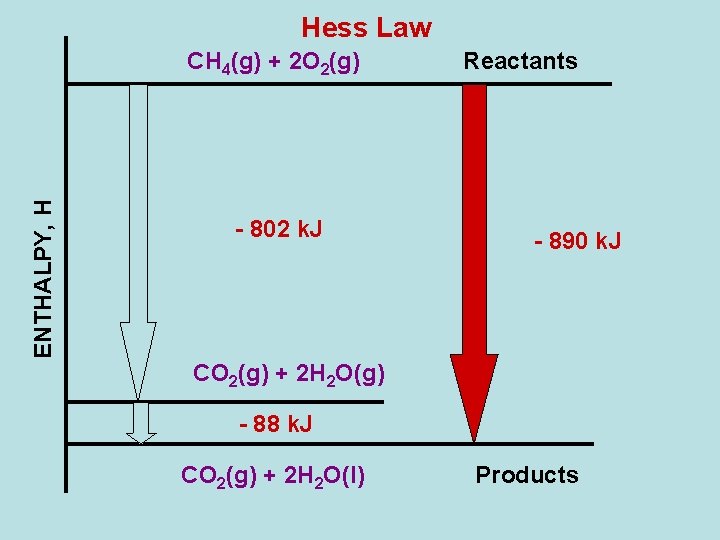
Hess’s Law The overall reaction enthalpy is the sum of the reaction enthalpies of the steps in which the reaction can be divided
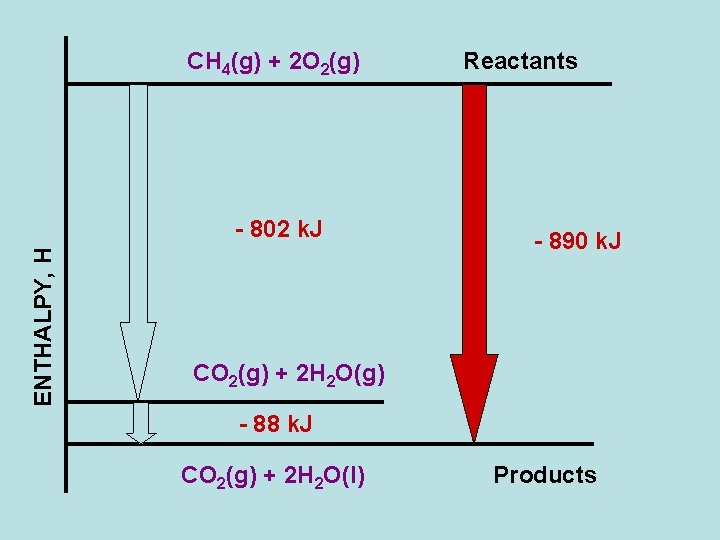
CH 4(g) + 2 O 2(g) ENTHALPY, H - 802 k. J Reactants - 890 k. J CO 2(g) + 2 H 2 O(g) - 88 k. J CO 2(g) + 2 H 2 O(l) Products
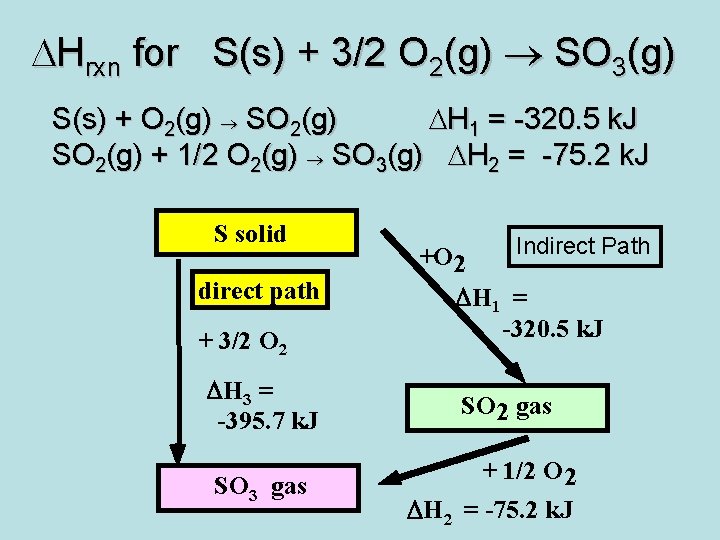
DHrxn for S(s) + 3/2 O 2(g) SO 3(g) S(s) + O 2(g) SO 2(g) DH 1 = -320. 5 k. J SO 2(g) + 1/2 O 2(g) SO 3(g) DH 2 = -75. 2 k. J S solid direct path + 3/2 O 2 DH 3 = -395. 7 k. J SO 3 gas +O 2 Indirect Path DH 1 = -320. 5 k. J SO 2 gas + 1/2 O 2 DH 2 = -75. 2 k. J
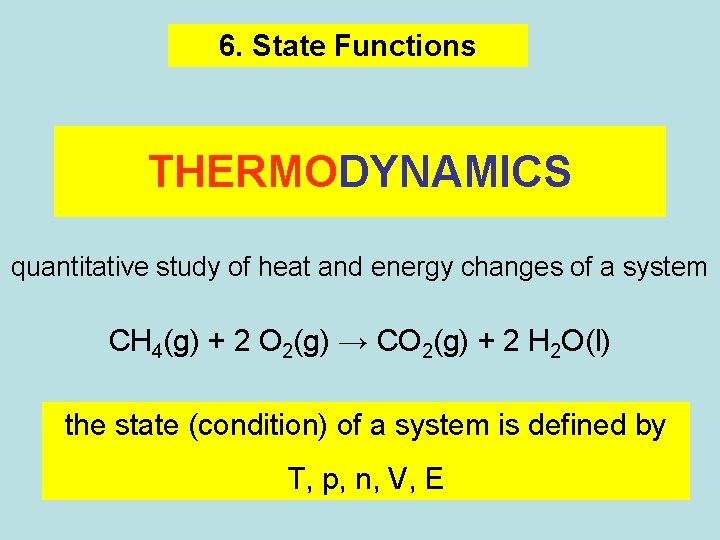
6. State Functions THERMODYNAMICS quantitative study of heat and energy changes of a system CH 4(g) + 2 O 2(g) → CO 2(g) + 2 H 2 O(l) the state (condition) of a system is defined by T, p, n, V, E
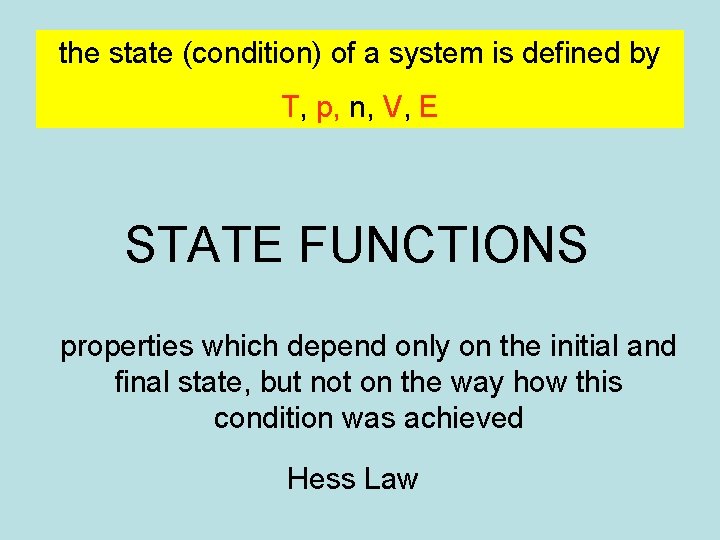
the state (condition) of a system is defined by T, p, n, V, E STATE FUNCTIONS properties which depend only on the initial and final state, but not on the way how this condition was achieved Hess Law
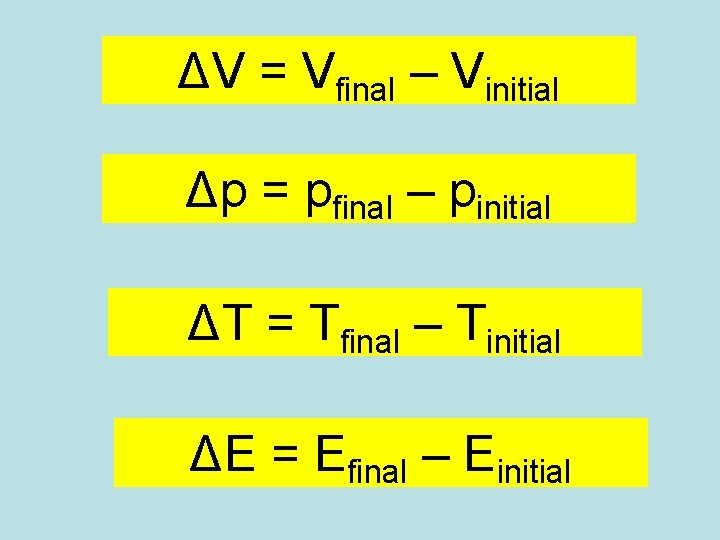
ΔV = Vfinal – Vinitial Δp = pfinal – pinitial ΔT = Tfinal – Tinitial ΔE = Efinal – Einitial
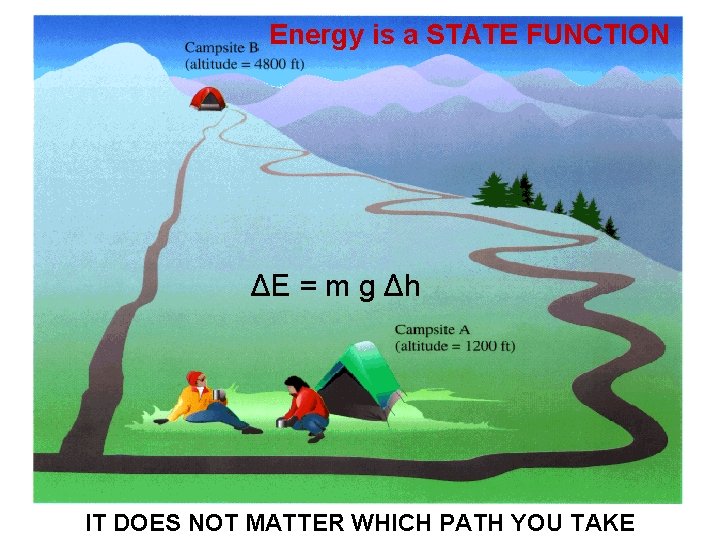
Energy is a STATE FUNCTION ΔE = m g Δh IT DOES NOT MATTER WHICH PATH YOU TAKE
Hess Law ENTHALPY, H CH 4(g) + 2 O 2(g) - 802 k. J Reactants - 890 k. J CO 2(g) + 2 H 2 O(g) - 88 k. J CO 2(g) + 2 H 2 O(l) Products
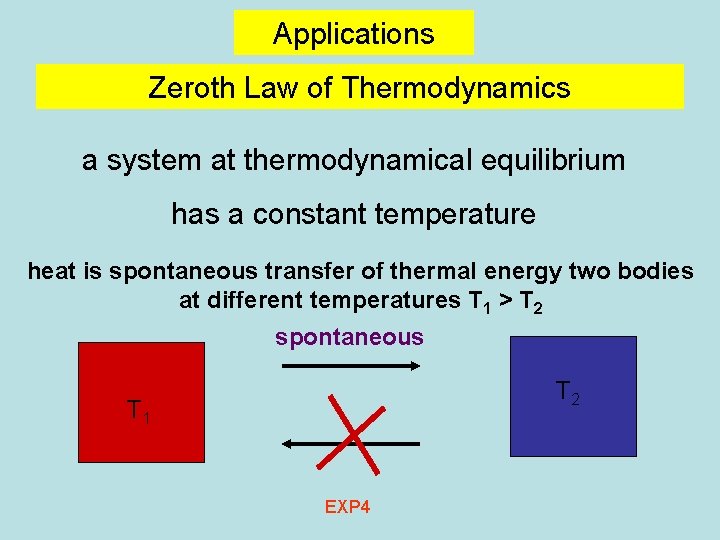
Applications Zeroth Law of Thermodynamics a system at thermodynamical equilibrium has a constant temperature heat is spontaneous transfer of thermal energy two bodies at different temperatures T 1 > T 2 spontaneous T 2 T 1 EXP 4
First Law of Thermodynamics energy can be converted from one form to another, but cannot be created or destroyed CONSERVATION OF ENERGY
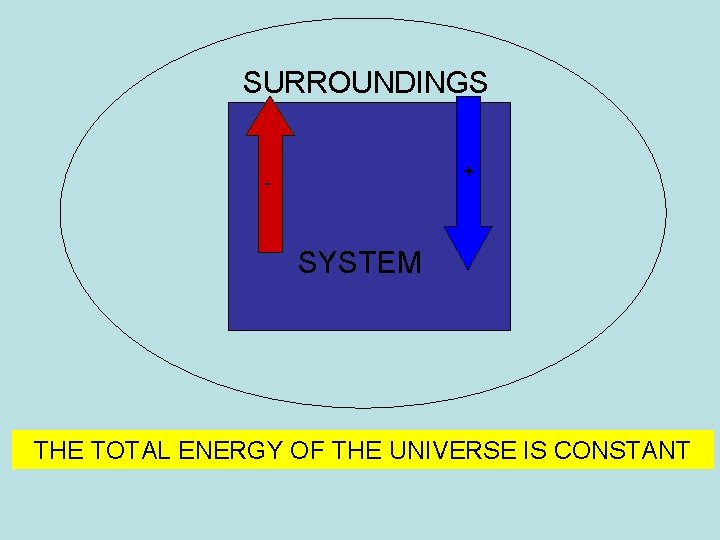
SURROUNDINGS + - SYSTEM THE TOTAL ENERGY OF THE UNIVERSE IS CONSTANT
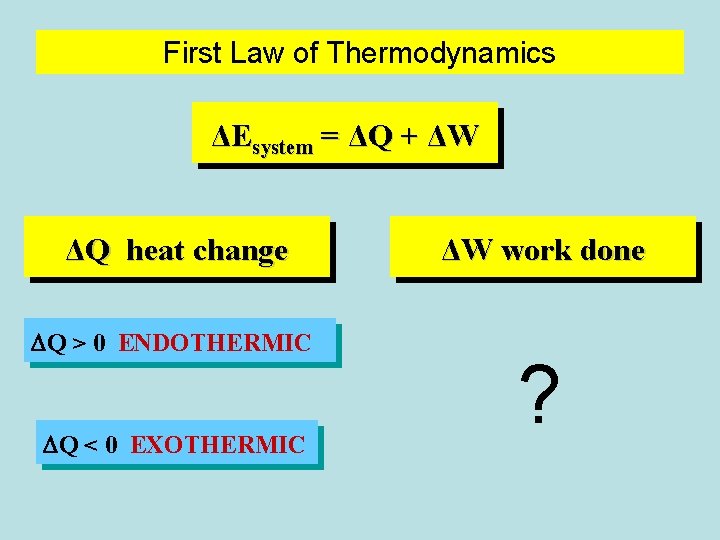
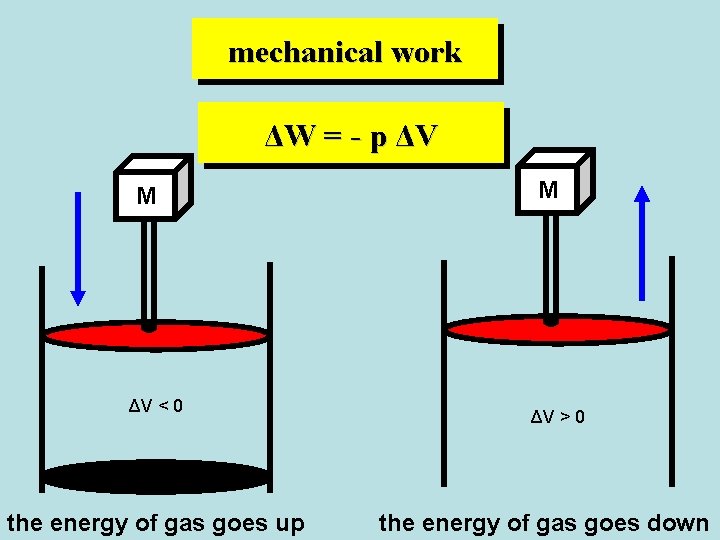
First Law of Thermodynamics ΔEsystem = ΔQ + ΔW ΔQ heat change DQ > 0 ENDOTHERMIC DQ < 0 EXOTHERMIC ΔW work done ?
mechanical work ΔW = - p ΔV M ΔV < 0 the energy of gas goes up M ΔV > 0 the energy of gas goes down
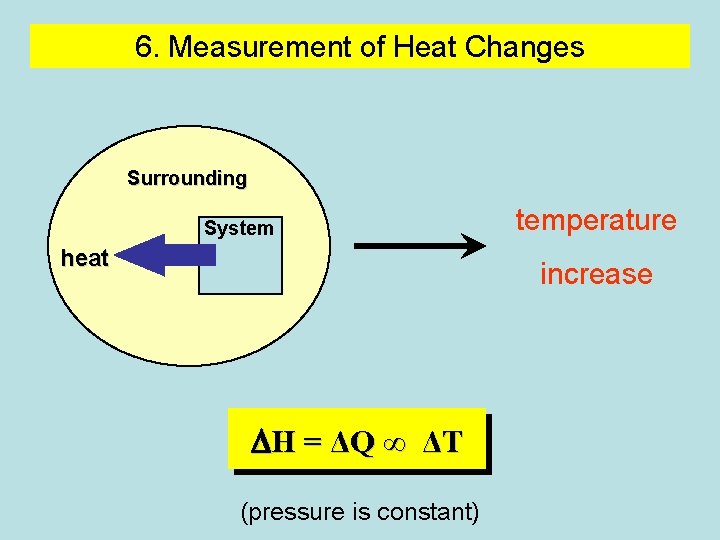
6. Measurement of Heat Changes Surrounding System heat temperature increase DH = ΔQ ∞ ΔT (pressure is constant)
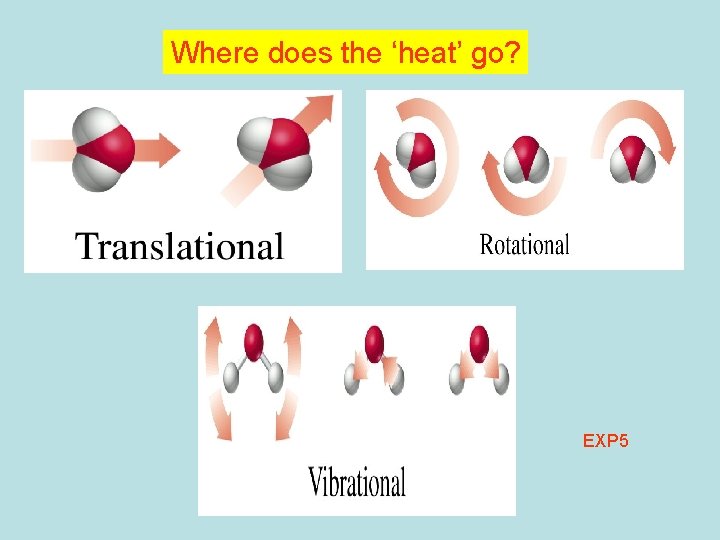
Where does the ‘heat’ go? EXP 5
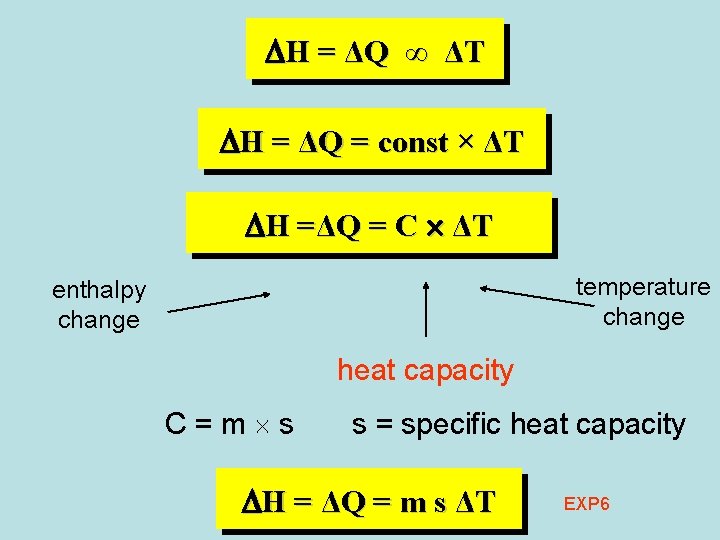
DH = ΔQ ∞ ΔT DH = ΔQ = const × ΔT DH = ΔQ = C ΔT temperature change enthalpy change heat capacity C=m s s = specific heat capacity DH = ΔQ = m s ΔT EXP 6
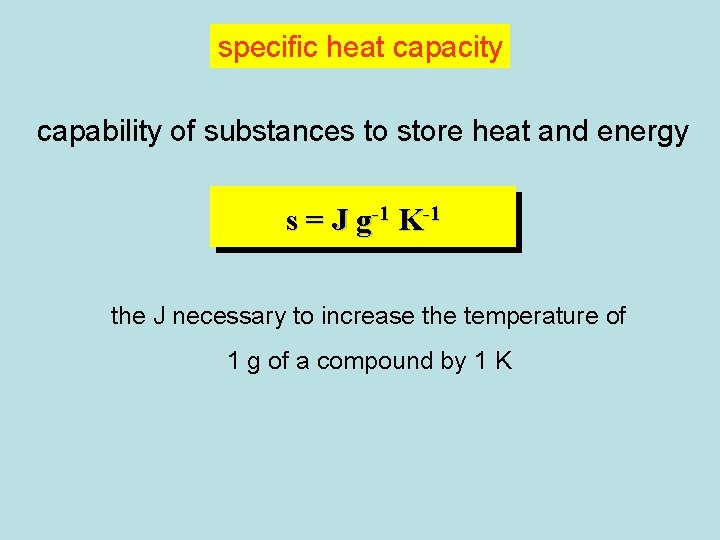
specific heat capacity capability of substances to store heat and energy s = J g-1 K-1 the J necessary to increase the temperature of 1 g of a compound by 1 K
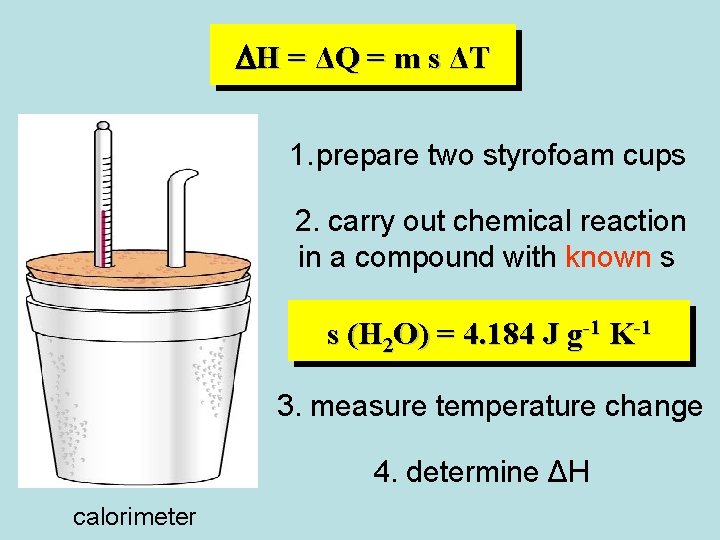
DH = ΔQ = m s ΔT 1. prepare two styrofoam cups 2. carry out chemical reaction in a compound with known s s (H 2 O) = 4. 184 J g-1 K-1 3. measure temperature change 4. determine ΔH calorimeter
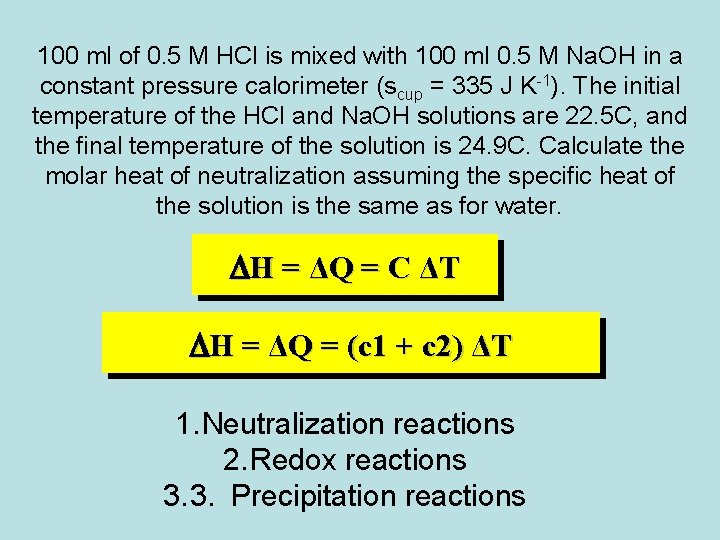
100 ml of 0. 5 M HCl is mixed with 100 ml 0. 5 M Na. OH in a constant pressure calorimeter (scup = 335 J K-1). The initial temperature of the HCl and Na. OH solutions are 22. 5 C, and the final temperature of the solution is 24. 9 C. Calculate the molar heat of neutralization assuming the specific heat of the solution is the same as for water. DH = ΔQ = C ΔT DH = ΔQ = (c 1 + c 2) ΔT 1. Neutralization reactions 2. Redox reactions 3. 3. Precipitation reactions
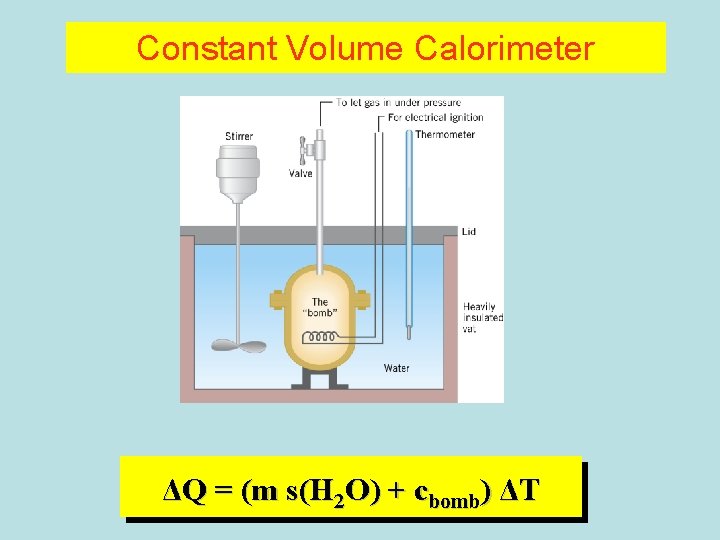
Constant Volume Calorimeter ΔQ = (m s(H 2 O) + cbomb) ΔT
Energy an Chemical Change 1. Forms of Energy 2. SI Unit of Energy 3. Energy in Atoms and Molecules 4. Thermodynamics 5. Calculation of Heat and Energy Changes 6. Measuring Heat and Energy Changes