
Chemistry 151 Basic Chemistry Chapter 3 Part I
Chemistry 151: Basic Chemistry Chapter 3 Part I: Nomenclatur MAR Last update: 8/9/21
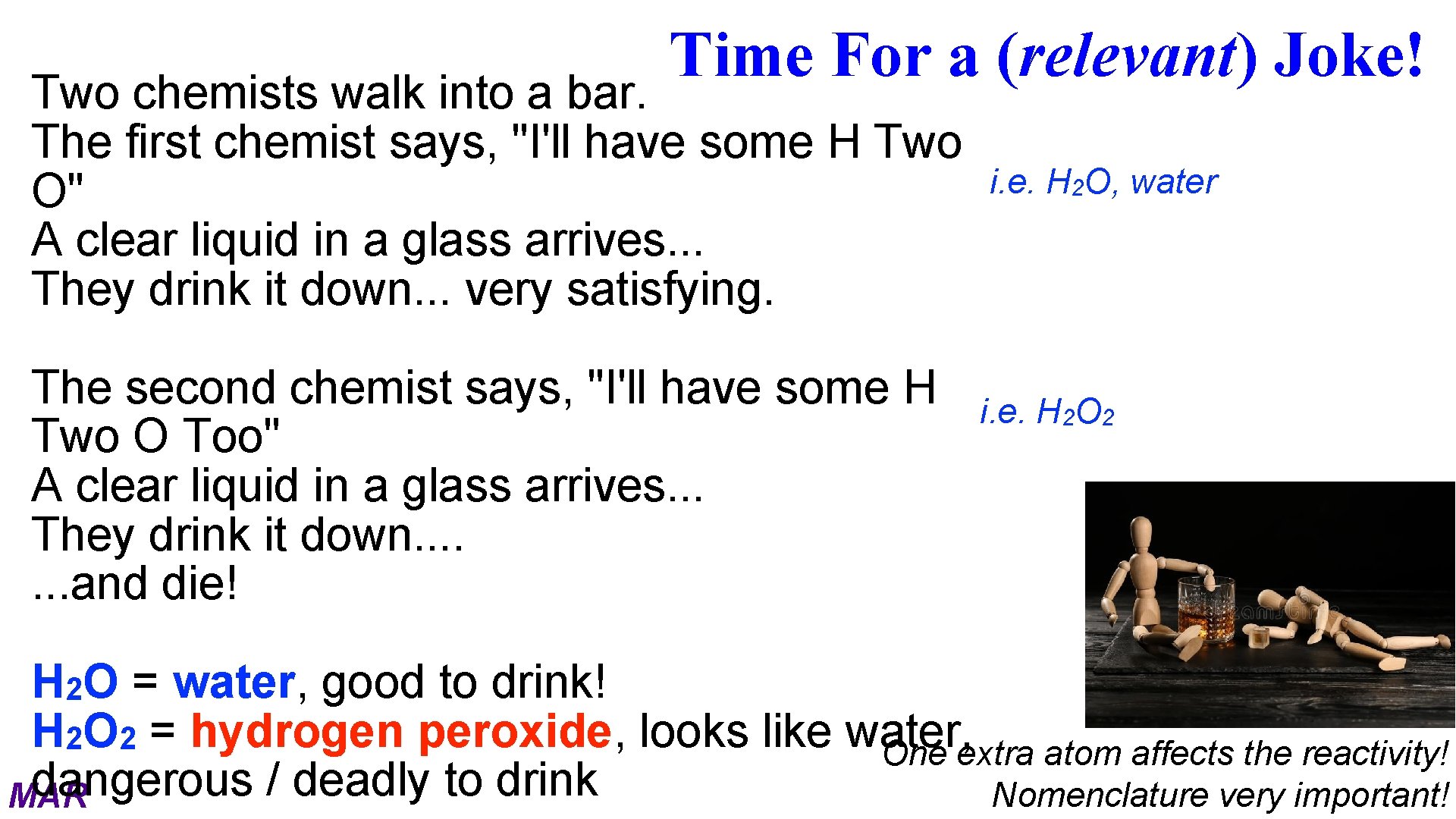
Time For a (relevant) Joke! Two chemists walk into a bar. The first chemist says, "I'll have some H Two O" A clear liquid in a glass arrives. . . They drink it down. . . very satisfying. The second chemist says, "I'll have some H Two O Too" A clear liquid in a glass arrives. . . They drink it down. . . . and die! i. e. H 2 O, water i. e. H 2 O 2 H 2 O = water, good to drink! H 2 O 2 = hydrogen peroxide, looks like water, One extra atom affects the reactivity! dangerous / deadly to drink Nomenclature very important! MAR

Nomenclature: a set of rules used to generate names for chemical compounds - or, being able to "talk the talk" of chemistry Important to describe H 2 O (essential to life) versus H 2 O 2 (deadly oxidizing agent) - one atom (more or less) makes a huge difference MAR This is arguably the most important chapter of CH
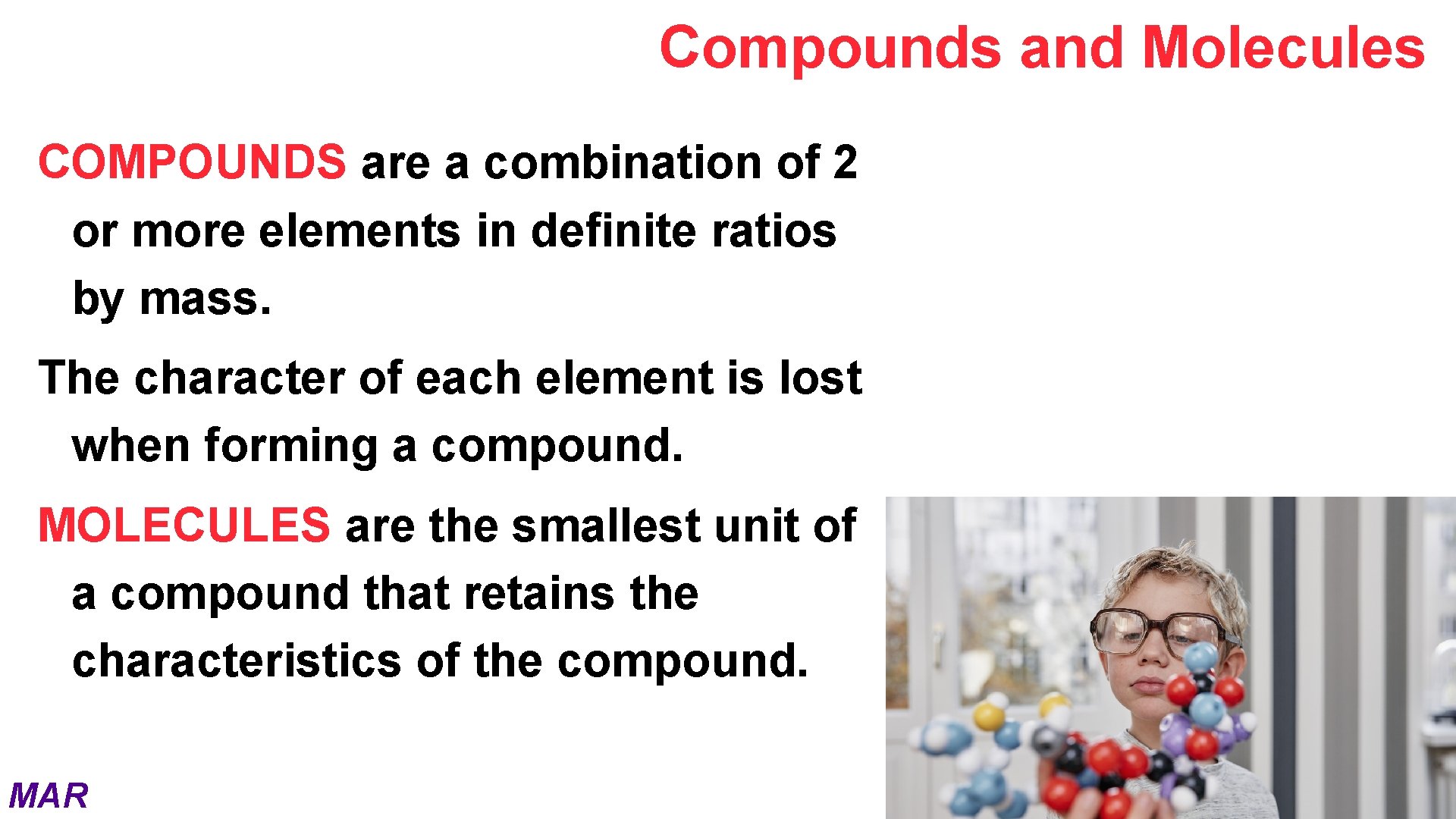
Compounds and Molecules COMPOUNDS are a combination of 2 or more elements in definite ratios by mass. The character of each element is lost when forming a compound. MOLECULES are the smallest unit of a compound that retains the characteristics of the compound. MAR
Bond 8 Bonding, the way atoms are attracted to each other to form molecules, determines nearly all of the chemical properties. We shall see later that the number “ 8” is very important to chemical bonding. Bonding can be ionic or covalent. MAR
Ions Atoms are electrically neutral because number of protons = number of electrons By gaining or losing electrons an atom can be converted into a charged particle called an ion. Loss of one or more electrons gives positively charged ion called a cation. Gaining one or more electrons gives negatively charged ion called a anion. MAR
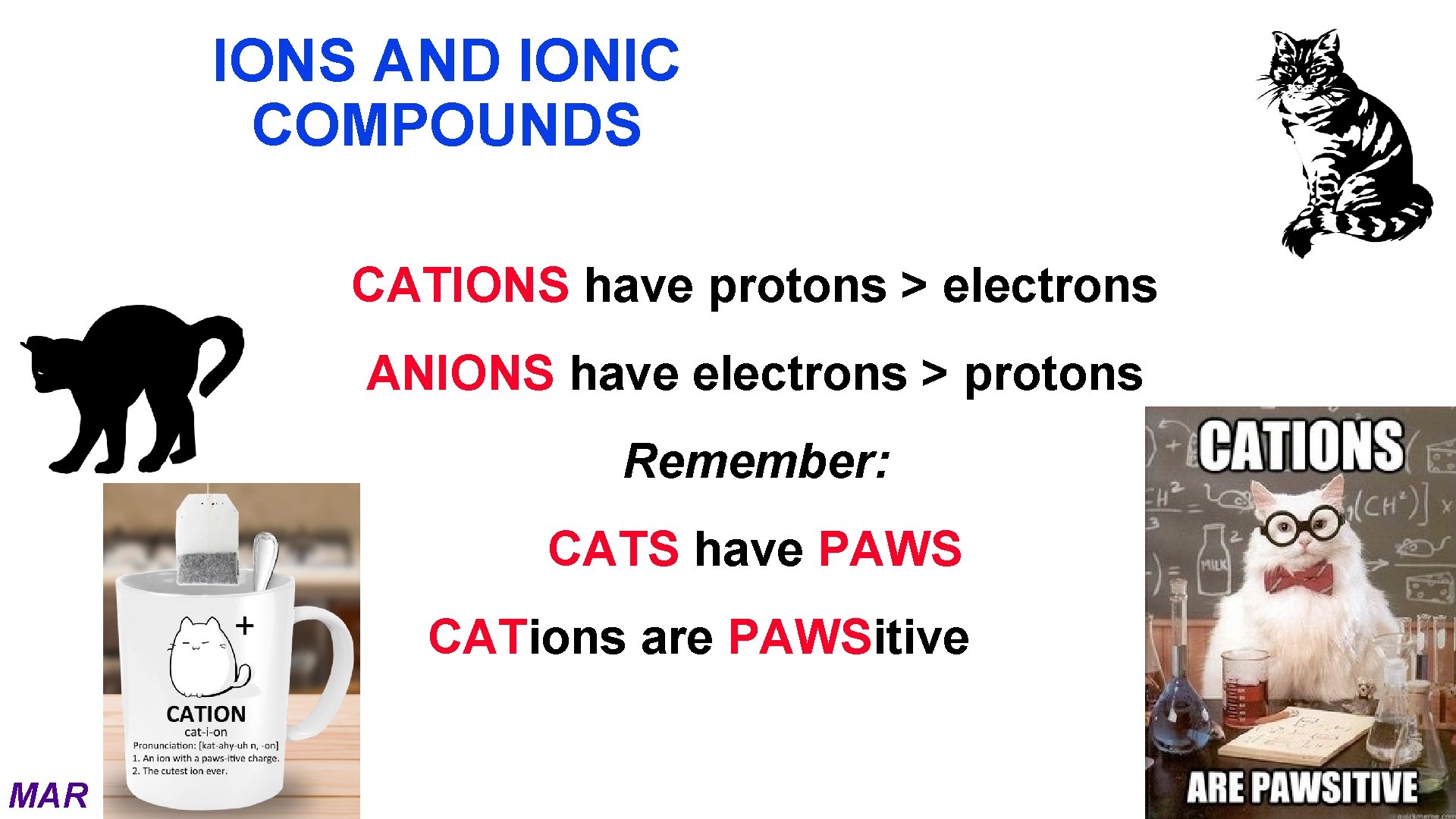
IONS AND IONIC COMPOUNDS CATIONS have protons > electrons ANIONS have electrons > protons Remember: CATS have PAWS CATions are PAWSitive MAR

Cations The symbol for a cation is written by adding a positive charge as a superscript to the symbol for the element. For example, Na loses an electron to make the + sodium cation (Na ). MAR
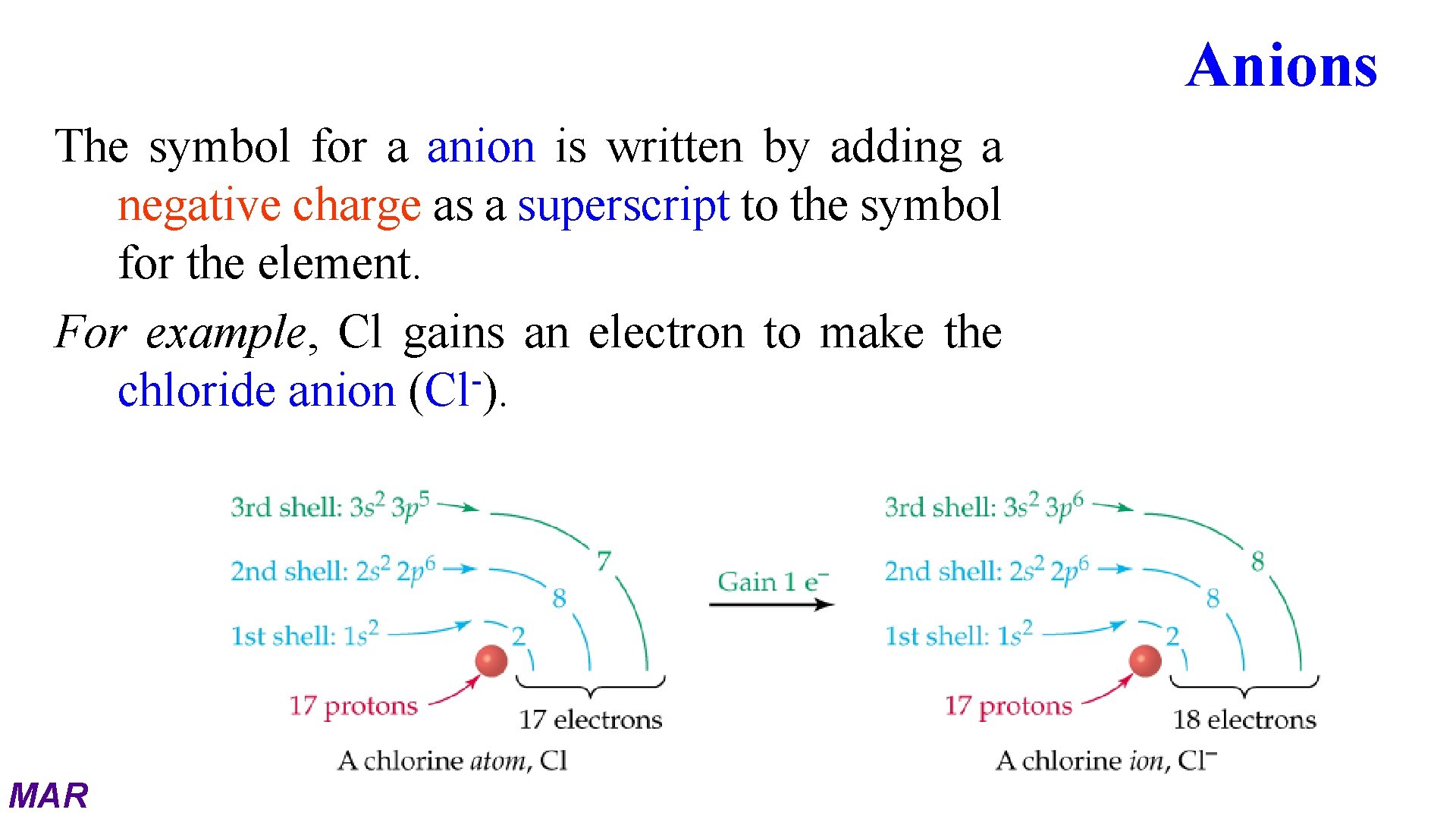
Anions The symbol for a anion is written by adding a negative charge as a superscript to the symbol for the element. For example, Cl gains an electron to make the chloride anion (Cl ). MAR
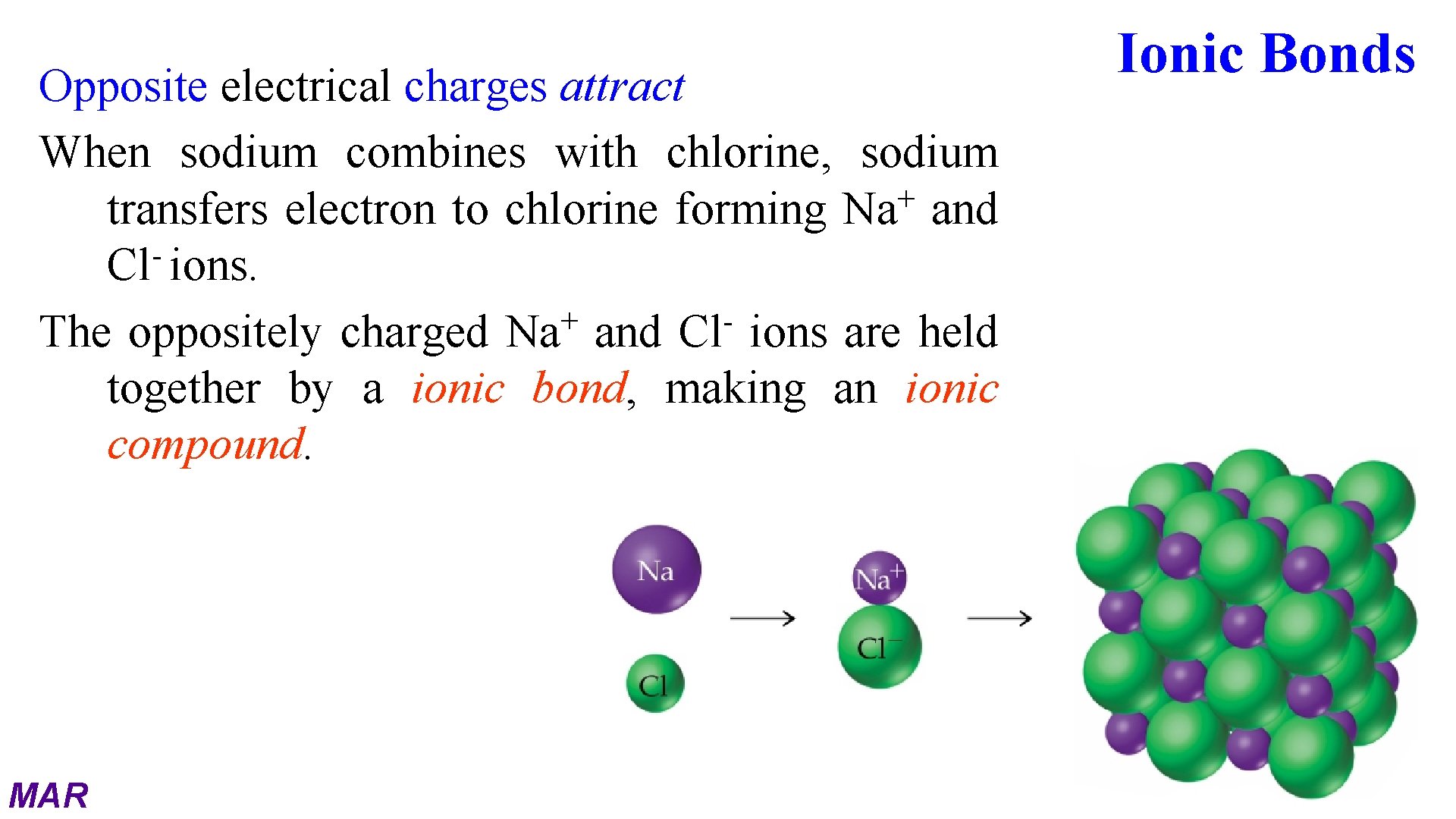
Opposite electrical charges attract When sodium combines with chlorine, sodium + transfers electron to chlorine forming Na and Cl ions. + The oppositely charged Na and Cl ions are held together by a ionic bond, making an ionic compound. MAR Ionic Bonds
Formation of Na. Cl MAR
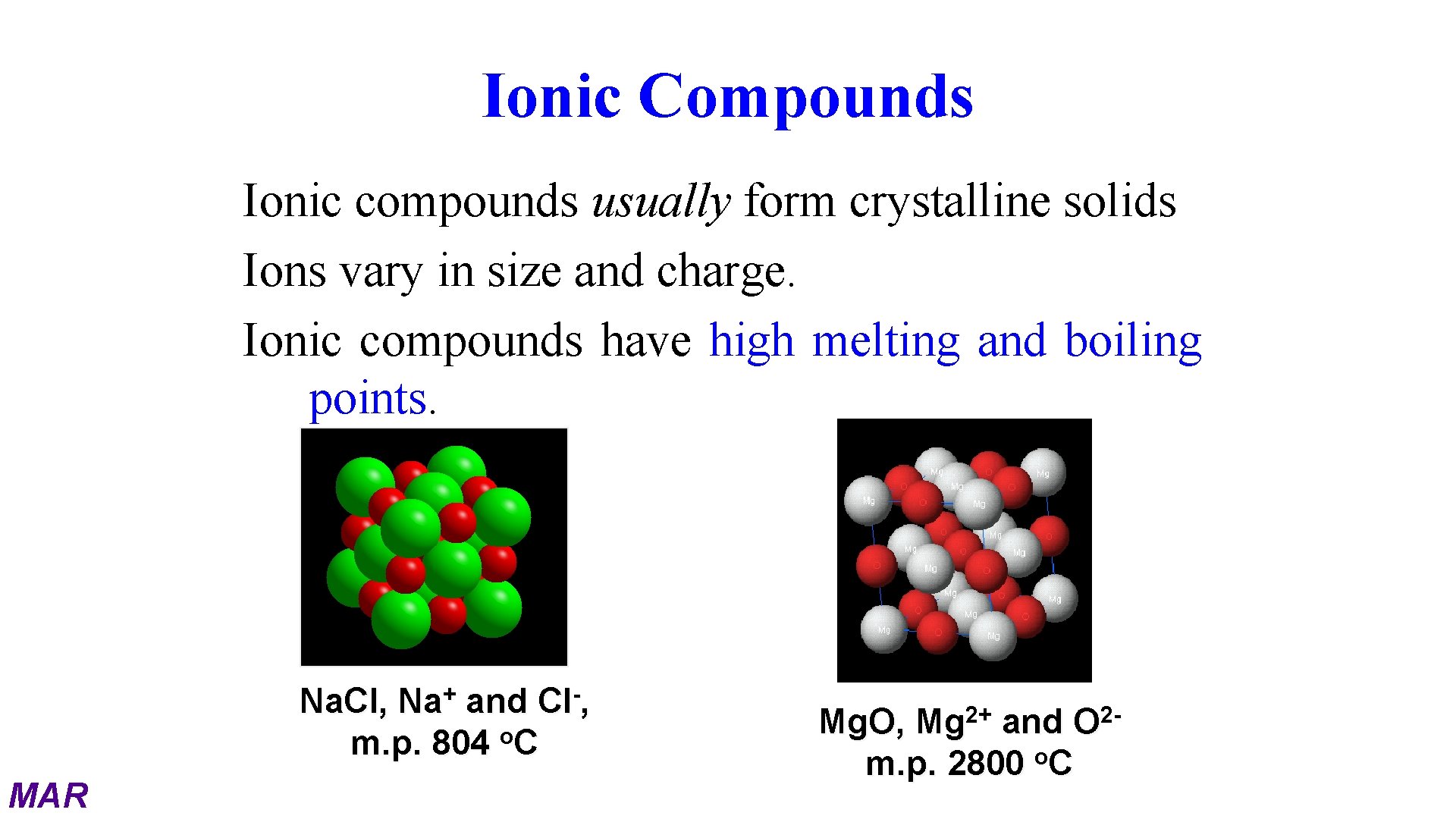
Ionic Compounds Ionic compounds usually form crystalline solids Ions vary in size and charge. Ionic compounds have high melting and boiling points. Na. Cl, Na+ and Cl-, m. p. 804 o. C MAR Mg. O, Mg 2+ and O 2 m. p. 2800 o. C
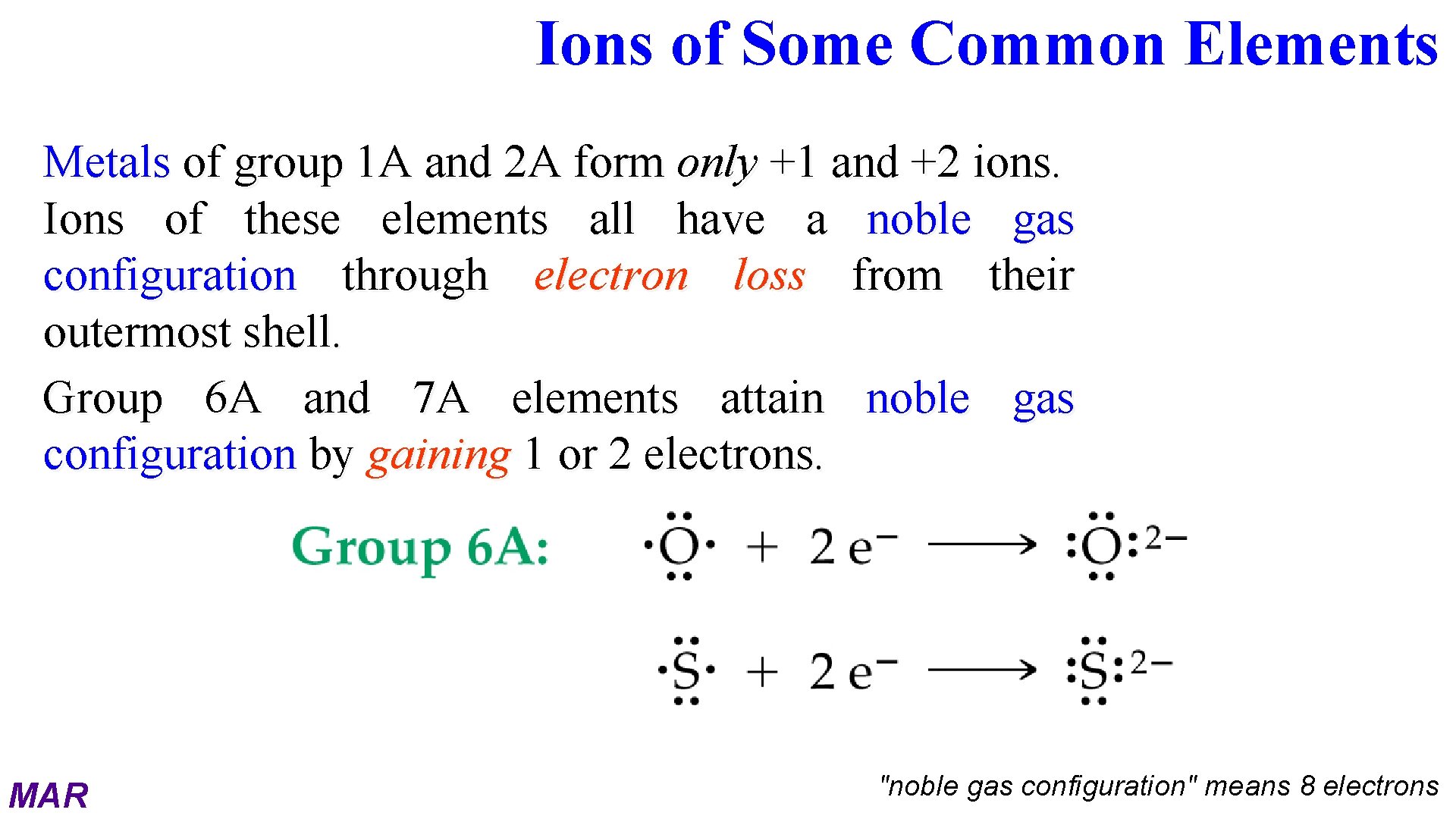
Ions of Some Common Elements Metals of group 1 A and 2 A form only +1 and +2 ions. Ions of these elements all have a noble gas configuration through electron loss from their outermost shell. Group 6 A and 7 A elements attain noble gas configuration by gaining 1 or 2 electrons. MAR "noble gas configuration" means 8 electrons
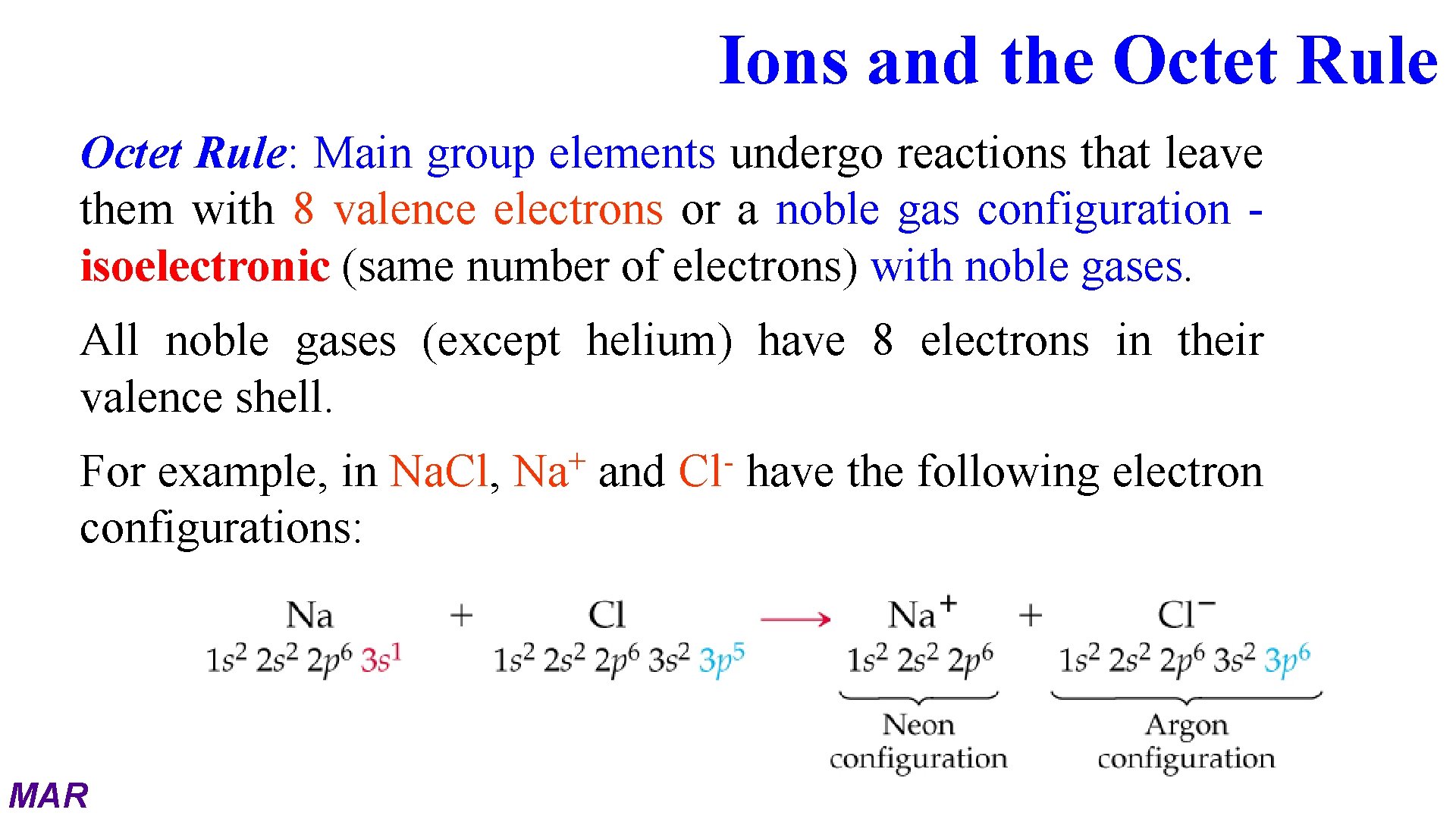
Ions and the Octet Rule: Main group elements undergo reactions that leave them with 8 valence electrons or a noble gas configuration isoelectronic (same number of electrons) with noble gases. All noble gases (except helium) have 8 electrons in their valence shell. For example, in Na. Cl, configurations: MAR + Na and Cl have the following electron
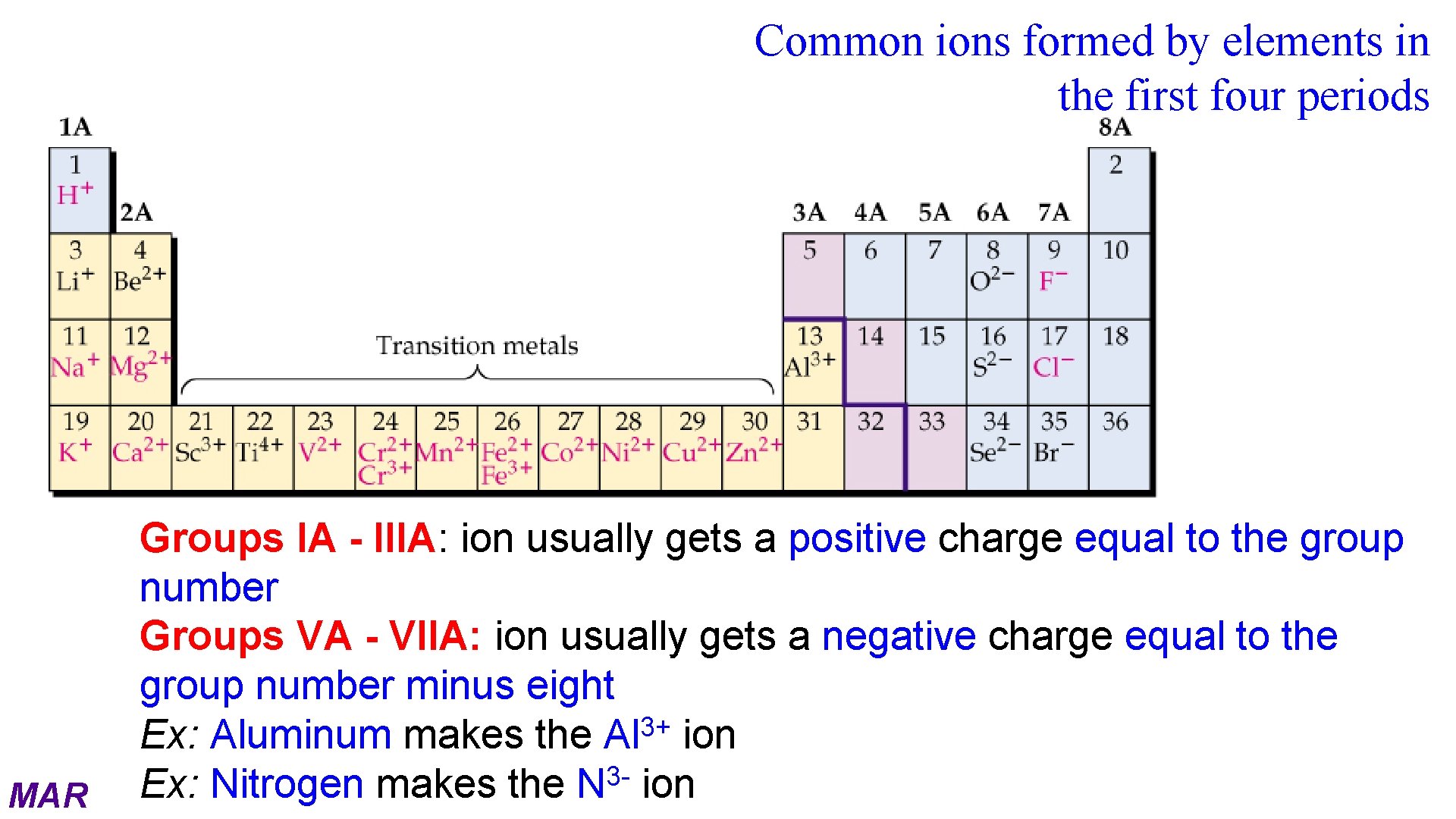
Common ions formed by elements in the first four periods MAR Groups IA - IIIA: ion usually gets a positive charge equal to the group number Groups VA - VIIA: ion usually gets a negative charge equal to the group number minus eight 3+ Ex: Aluminum makes the Al ion 3 Ex: Nitrogen makes the N ion
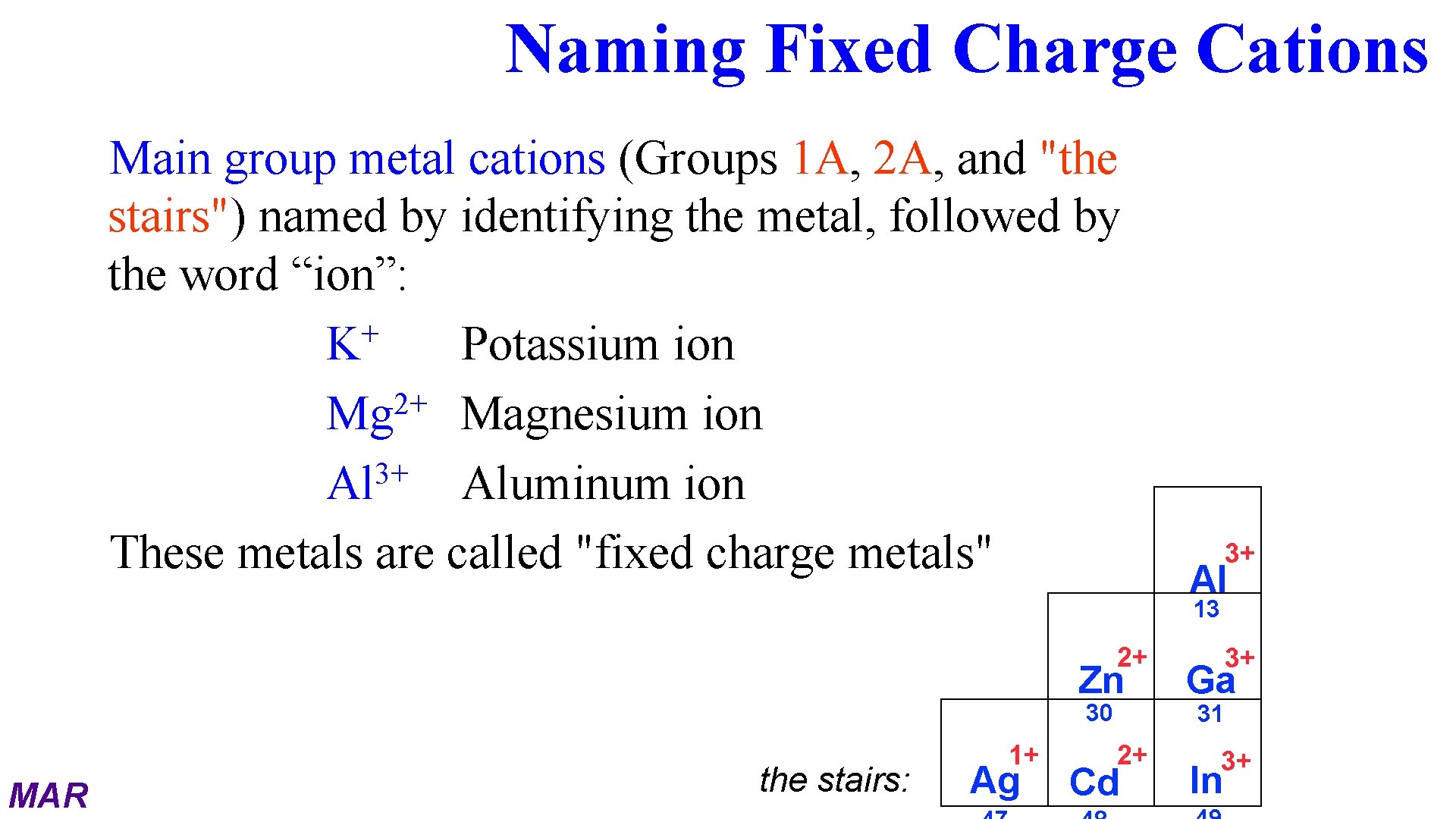
Naming Fixed Charge Cations Main group metal cations (Groups 1 A, 2 A, and "the stairs") named by identifying the metal, followed by the word “ion”: + K Potassium ion 2+ Mg Magnesium ion 3+ Al Aluminum ion These metals are called "fixed charge metals" 3+ Al 13 2+ Zn 30 MAR the stairs: 1+ Ag 2+ Cd 3+ Ga 31 3+ In
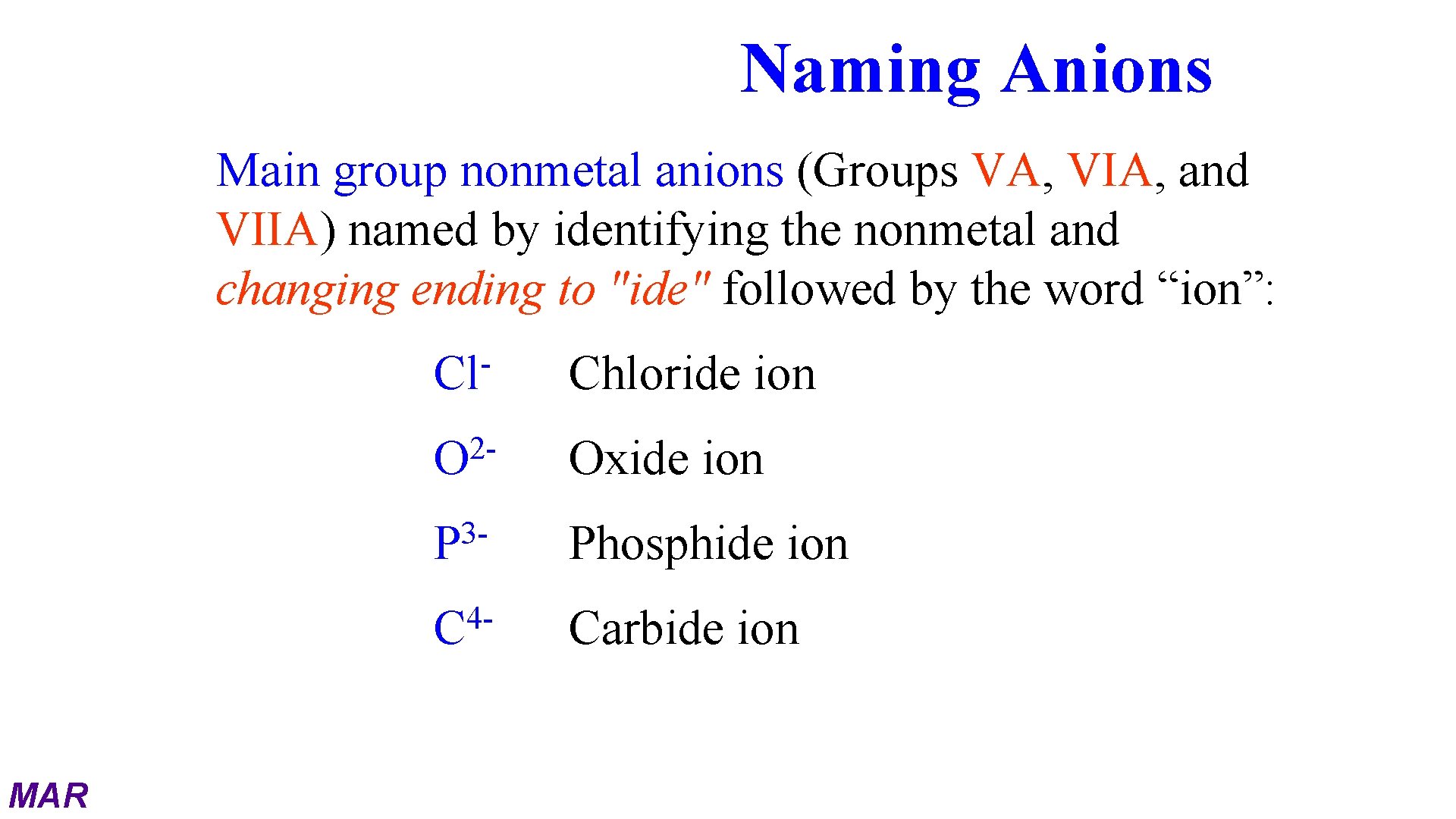
Naming Anions Main group nonmetal anions (Groups VA, VIA, and VIIA) named by identifying the nonmetal and changing ending to "ide" followed by the word “ion”: MAR Cl Chloride ion 2 O Oxide ion 3 P Phosphide ion 4 C Carbide ion
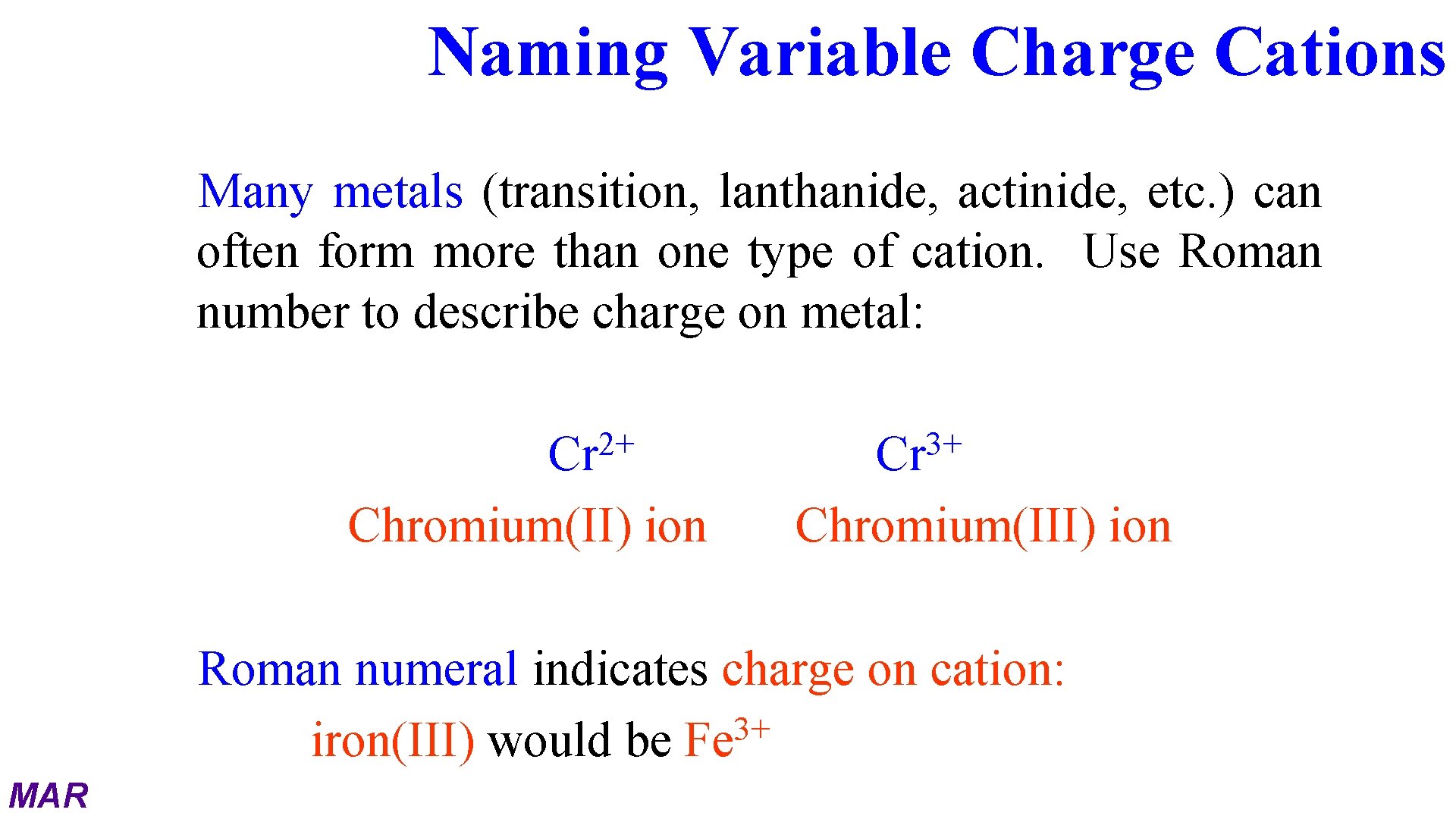
Naming Variable Charge Cations Many metals (transition, lanthanide, actinide, etc. ) can often form more than one type of cation. Use Roman number to describe charge on metal: 2+ Cr Chromium(II) ion 3+ Cr Chromium(III) ion Roman numeral indicates charge on cation: 3+ iron(III) would be Fe MAR
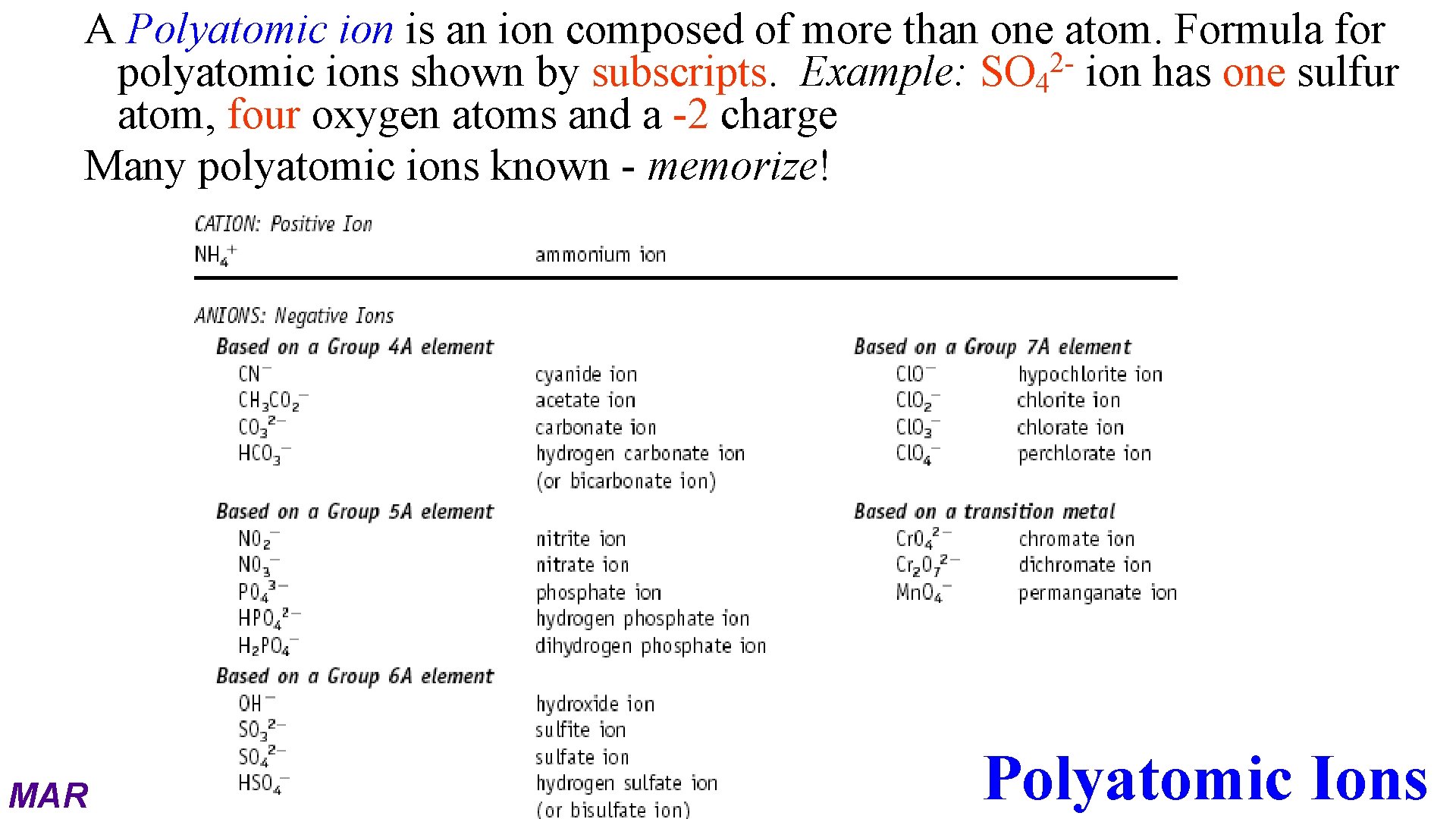
A Polyatomic ion is an ion composed of more than one atom. Formula for 2 polyatomic ions shown by subscripts. Example: SO 4 ion has one sulfur atom, four oxygen atoms and a -2 charge Many polyatomic ions known - memorize! MAR Polyatomic Ions
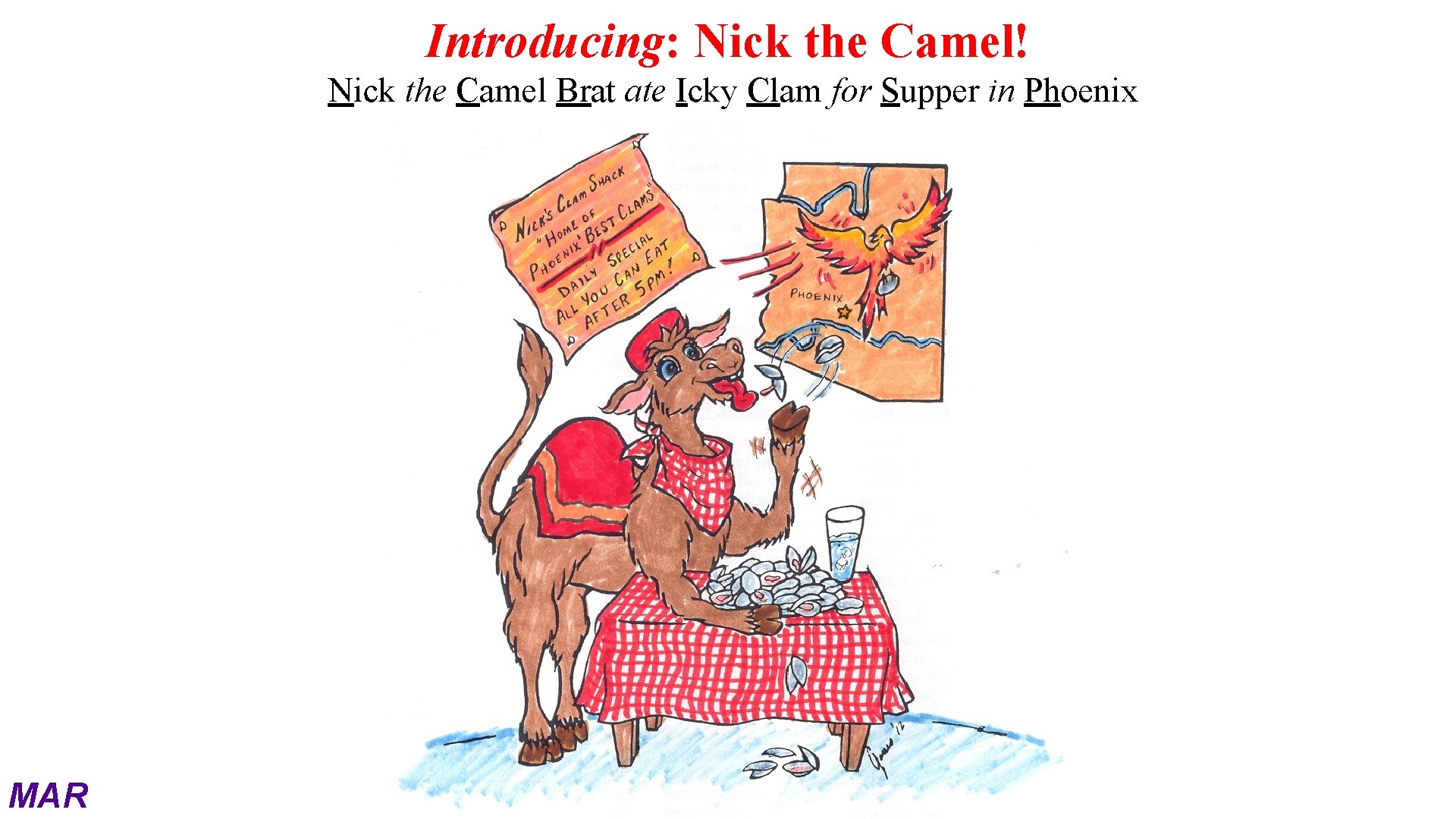
Introducing: Nick the Camel! Nick the Camel Brat ate Icky Clam for Supper in Phoenix MAR
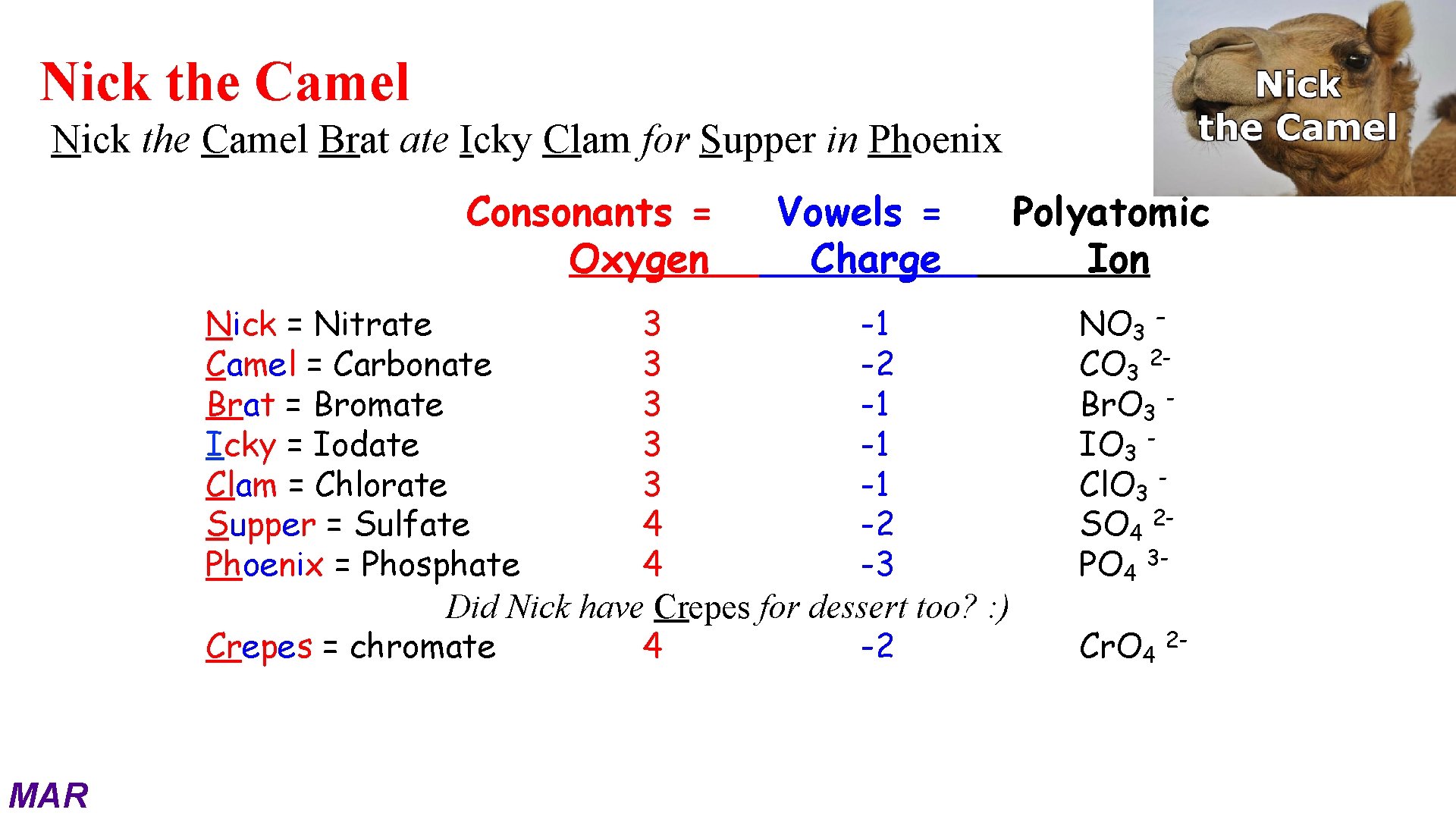
Nick the Camel Brat ate Icky Clam for Supper in Phoenix Consonants = Oxygen Vowels = Charge Nick = Nitrate 3 -1 Camel = Carbonate 3 -2 Brat = Bromate 3 -1 Icky = Iodate 3 -1 Clam = Chlorate 3 -1 Supper = Sulfate 4 -2 Phoenix = Phosphate 4 -3 Did Nick have Crepes for dessert too? : ) Crepes = chromate 4 -2 MAR Polyatomic Ion NO 3 – CO 3 2 Br. O 3 IO 3 Cl. O 3 SO 4 2 PO 4 3 Cr. O 4 2 -
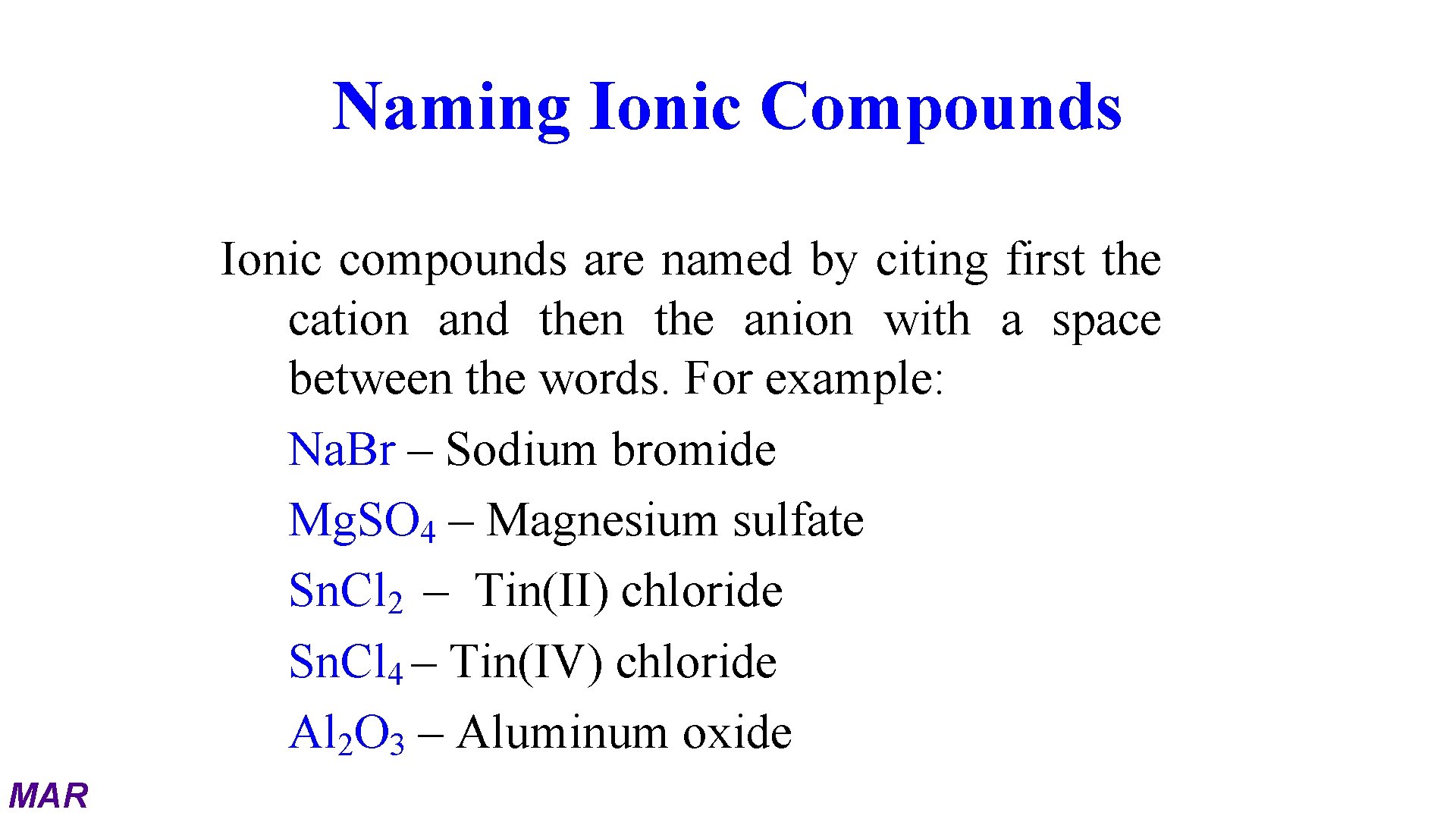
Naming Ionic Compounds Ionic compounds are named by citing first the cation and then the anion with a space between the words. For example: Na. Br – Sodium bromide Mg. SO 4 – Magnesium sulfate Sn. Cl 2 – Tin(II) chloride Sn. Cl 4 – Tin(IV) chloride Al 2 O 3 – Aluminum oxide MAR
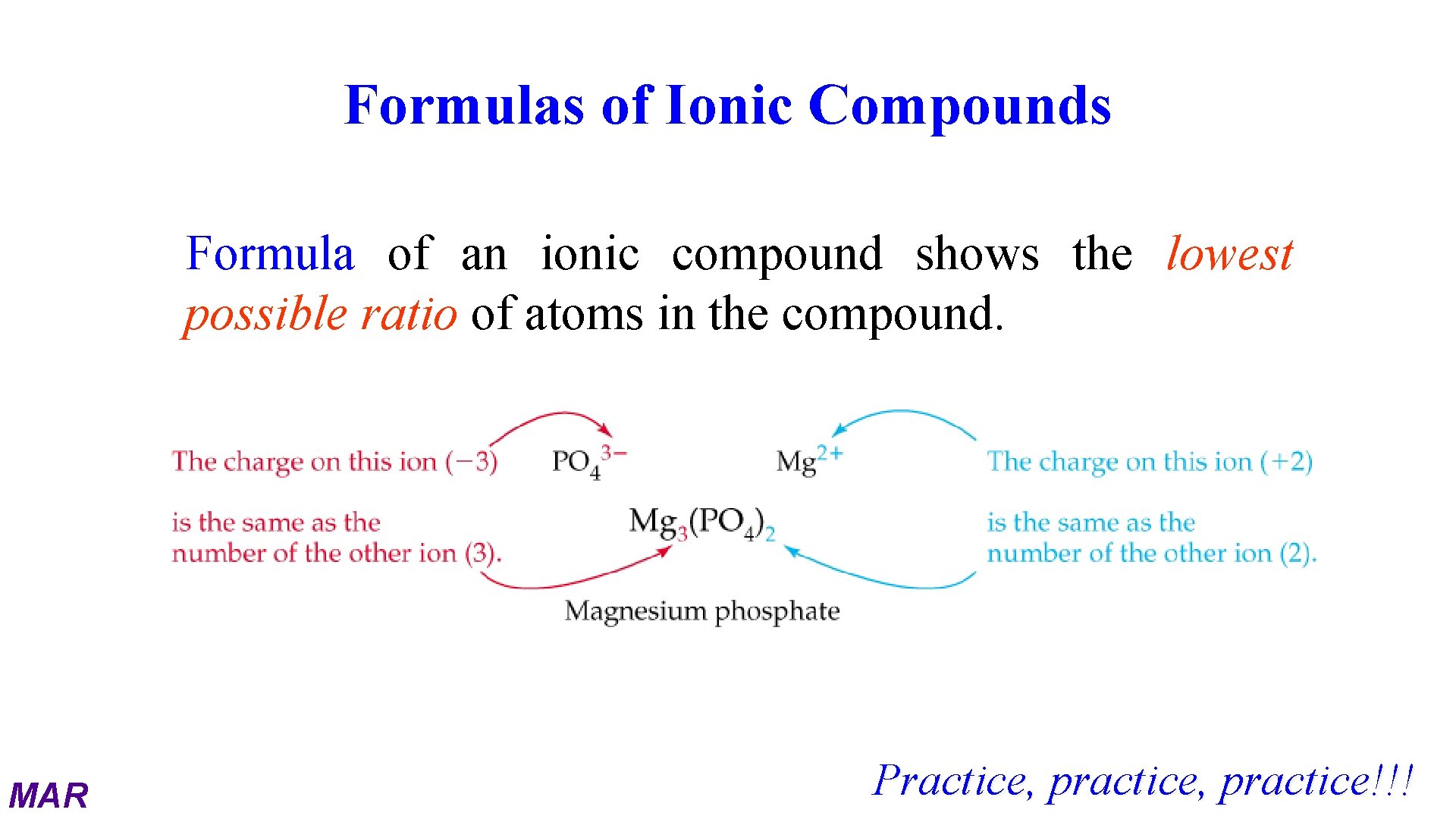
Formulas of Ionic Compounds Formula of an ionic compound shows the lowest possible ratio of atoms in the compound. MAR Practice, practice!!!
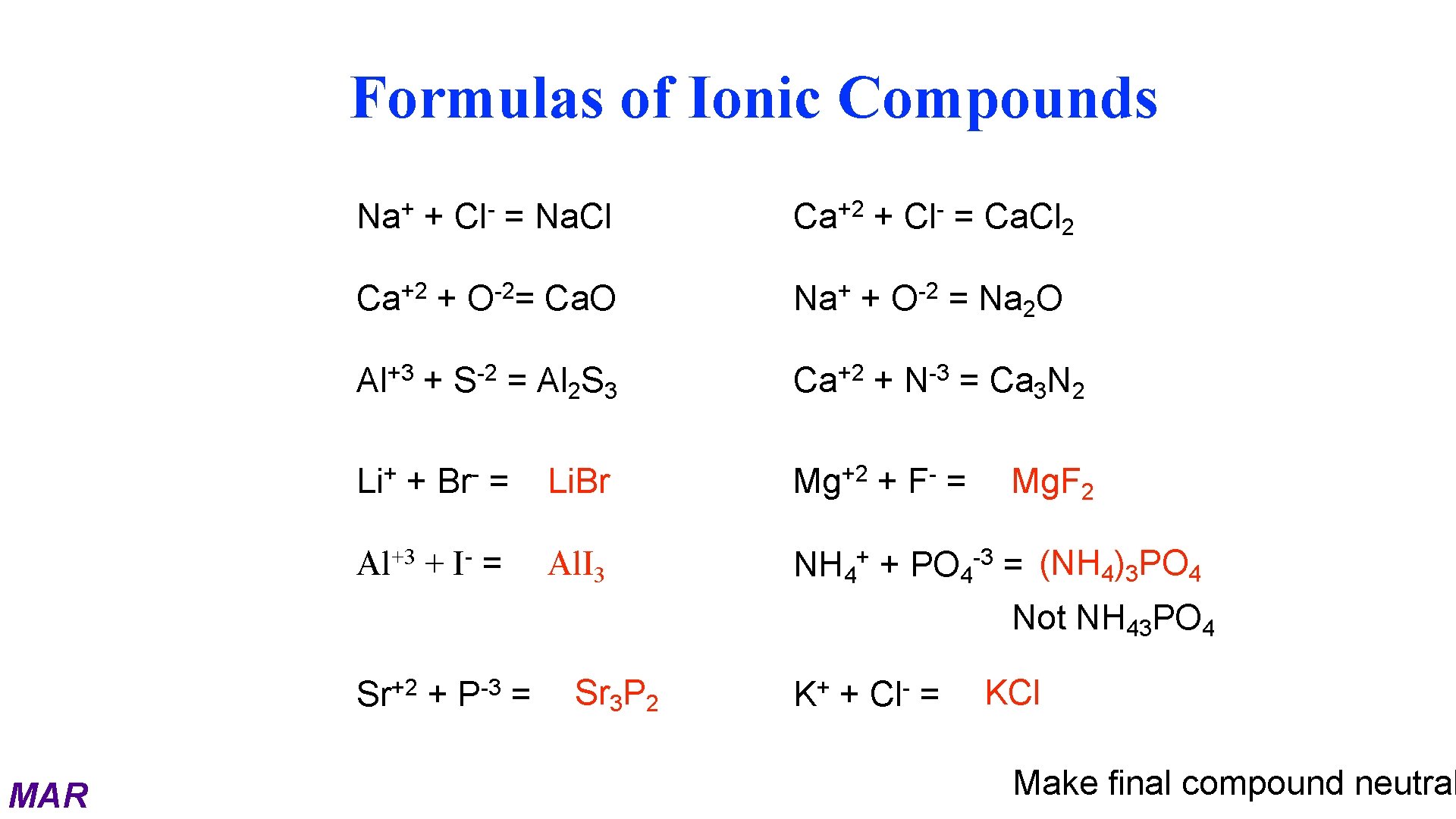
Formulas of Ionic Compounds + Na + +2 Ca +3 Al + Li +3 Al + + + Cl -2 O = -2 S Br + = Na. Cl I Ca. O = Al 2 S 3 +2 Ca + Na + + +2 Ca Cl -2 O = Ca. Cl 2 = Na 2 O + -3 N + F = Ca 3 N 2 = Li. Br +2 Mg = Al. I 3 NH 4+ + PO 4 -3 = (NH 4)3 PO 4 = Mg. F 2 Not NH 43 PO 4 Sr+2 + P-3 = MAR Sr 3 P 2 K+ + Cl- = KCl Make final compound neutral
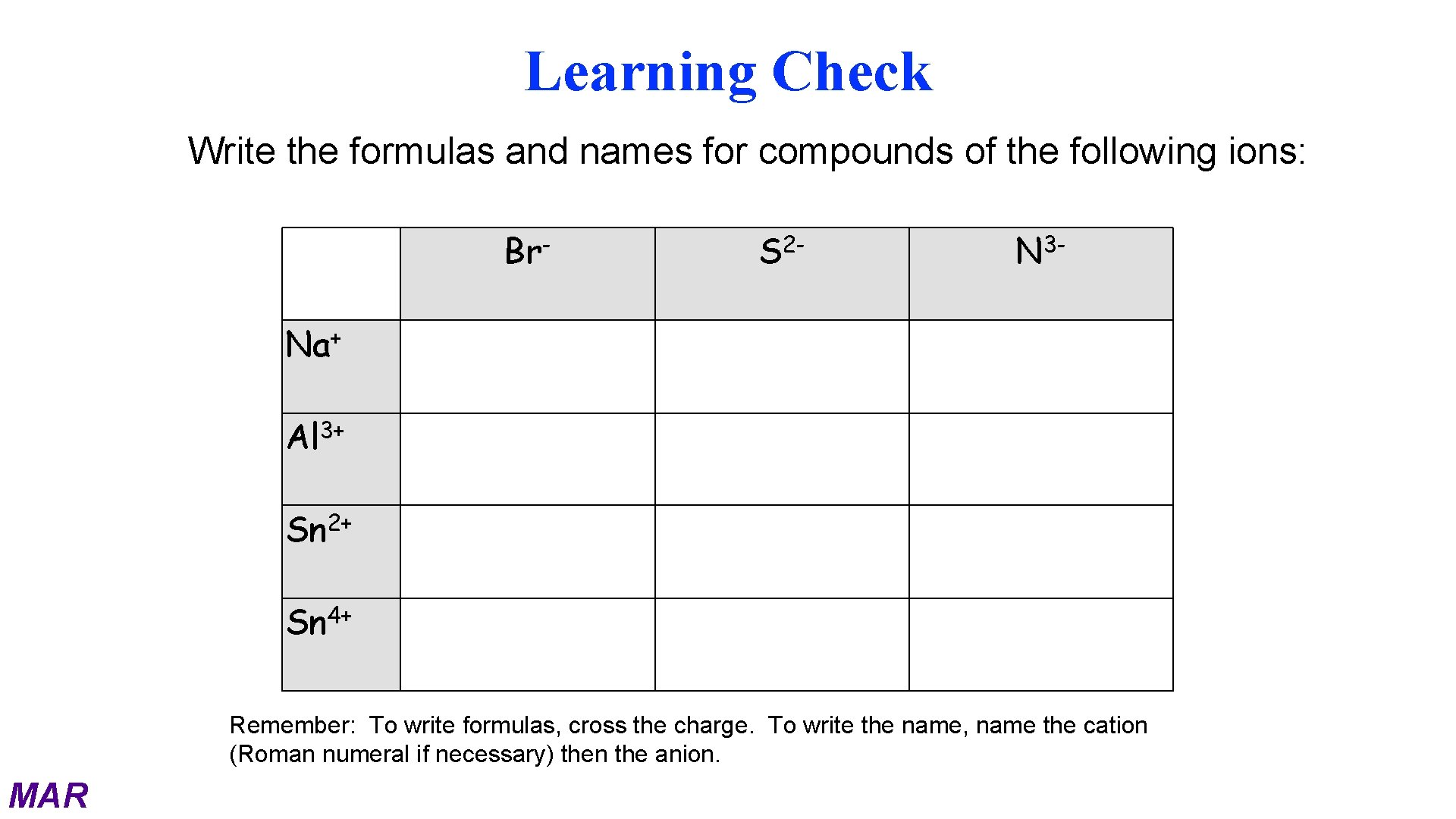
Learning Check Write the formulas and names for compounds of the following ions: Br- S 2 - N 3 - + Na Al 3+ 2+ Sn Sn 4+ Remember: To write formulas, cross the charge. To write the name, name the cation (Roman numeral if necessary) then the anion. MAR
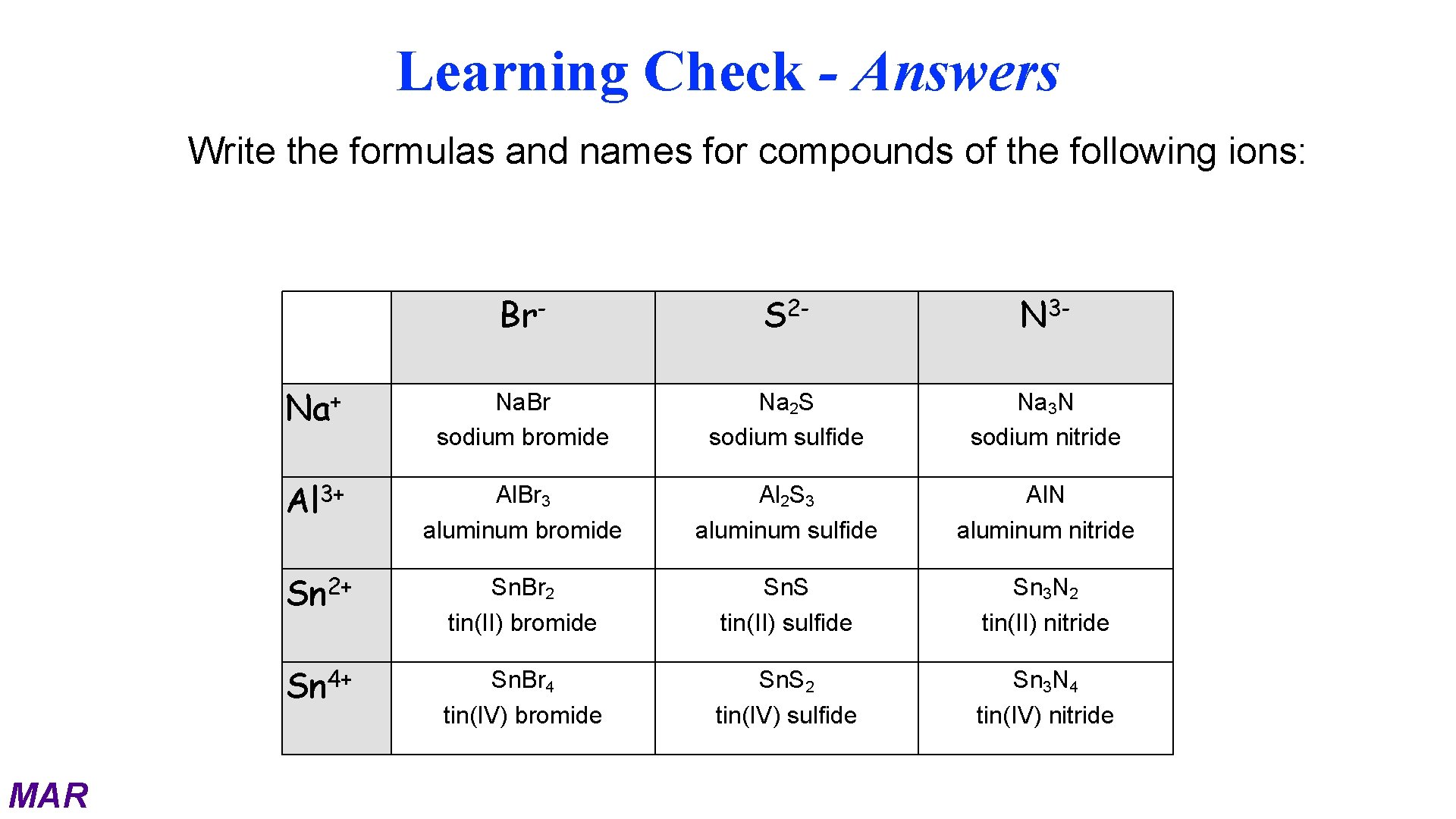
Learning Check - Answers Write the formulas and names for compounds of the following ions: MAR Br- S 2 - N 3 - + Na Na. Br sodium bromide Na 2 S sodium sulfide Na 3 N sodium nitride Al 3+ Al. Br 3 aluminum bromide Al 2 S 3 aluminum sulfide Al. N aluminum nitride 2+ Sn Sn. Br 2 tin(II) bromide Sn. S tin(II) sulfide Sn 3 N 2 tin(II) nitride Sn 4+ Sn. Br 4 tin(IV) bromide Sn. S 2 tin(IV) sulfide Sn 3 N 4 tin(IV) nitride
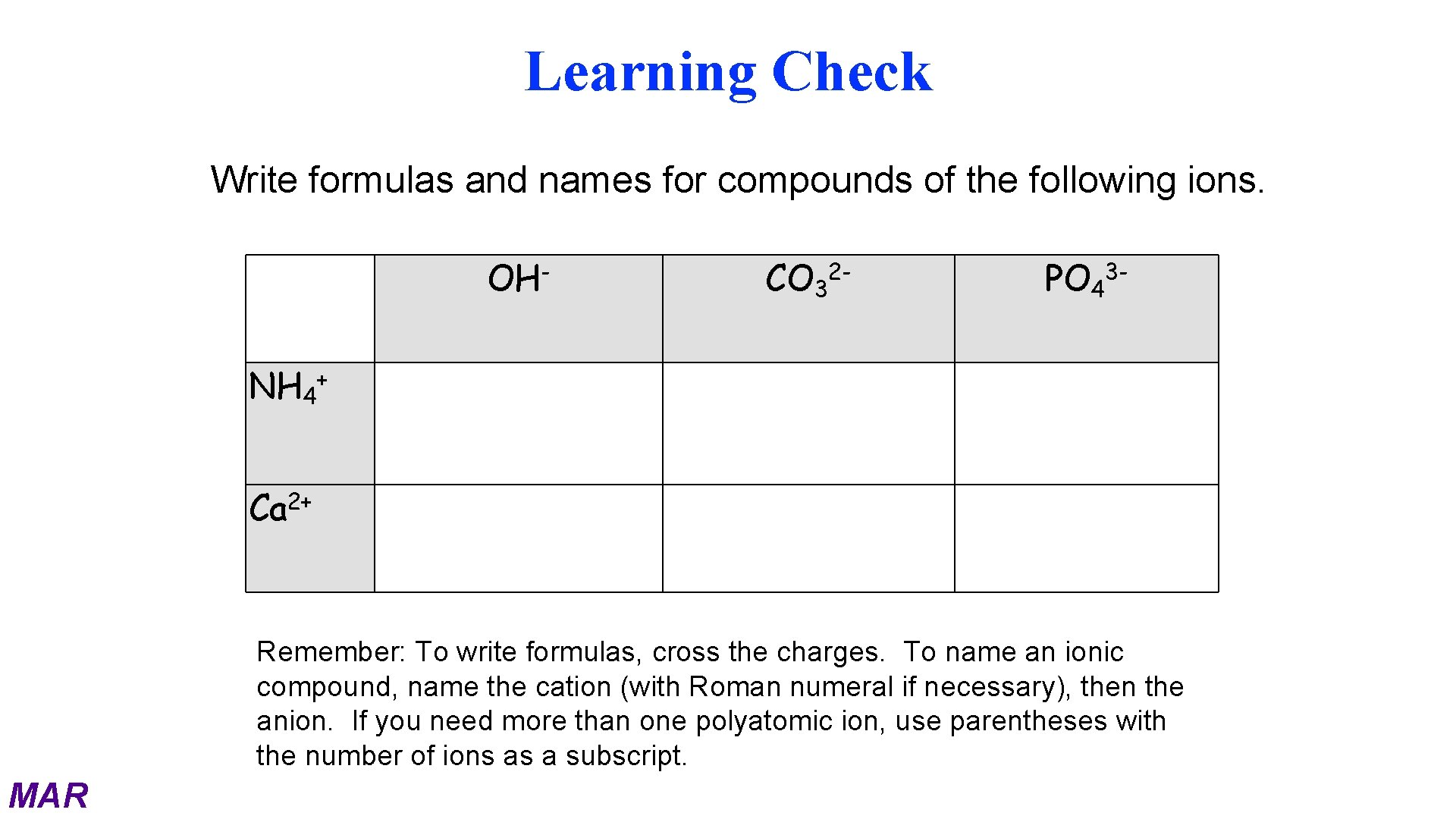
Learning Check Write formulas and names for compounds of the following ions. OHNH 4 CO 32 - PO 43 - + Ca 2+ Remember: To write formulas, cross the charges. To name an ionic compound, name the cation (with Roman numeral if necessary), then the anion. If you need more than one polyatomic ion, use parentheses with the number of ions as a subscript. MAR
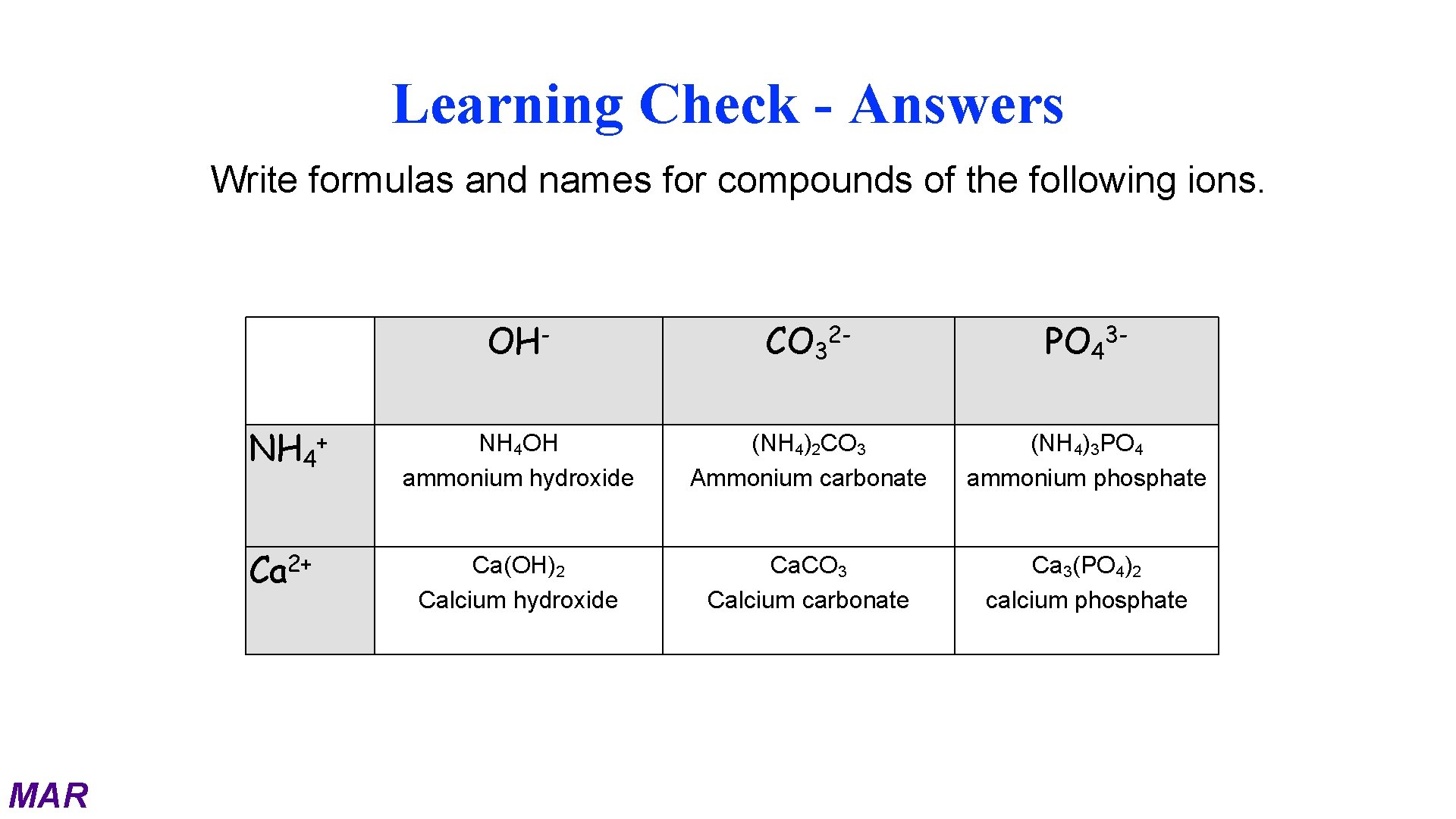
Learning Check - Answers Write formulas and names for compounds of the following ions. OH NH 4+ 2+ Ca MAR CO 3 2 - PO 4 3 - NH 4 OH ammonium hydroxide (NH 4)2 CO 3 Ammonium carbonate (NH 4)3 PO 4 ammonium phosphate Ca(OH)2 Calcium hydroxide Ca. CO 3 Calcium carbonate Ca 3(PO 4)2 calcium phosphate
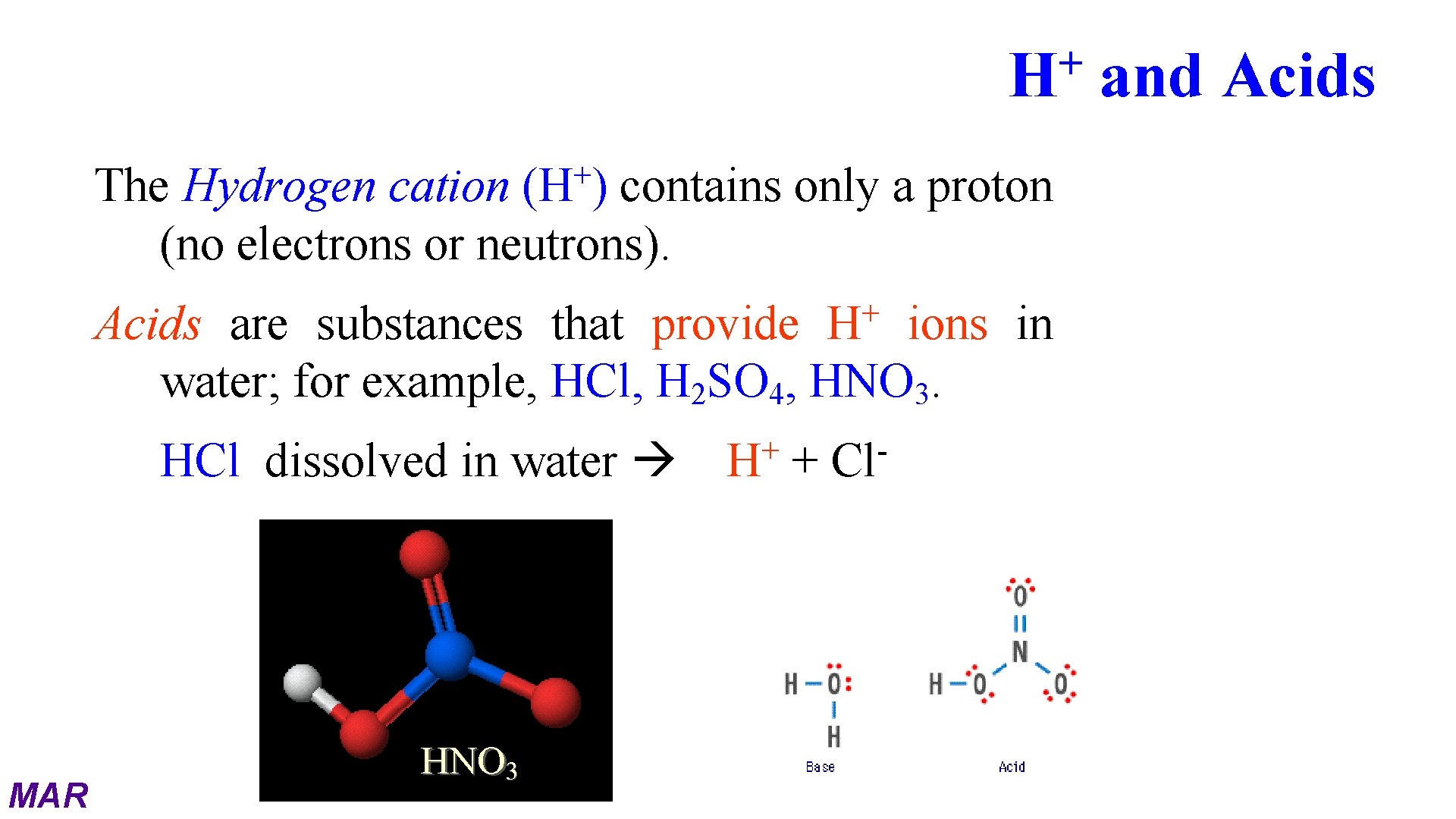
+ H + (H ) The Hydrogen cation contains only a proton (no electrons or neutrons). + H Acids are substances that provide ions in water; for example, HCl, H 2 SO 4, HNO 3. HCl dissolved in water MAR HNO 3 + H + Cl and Acids
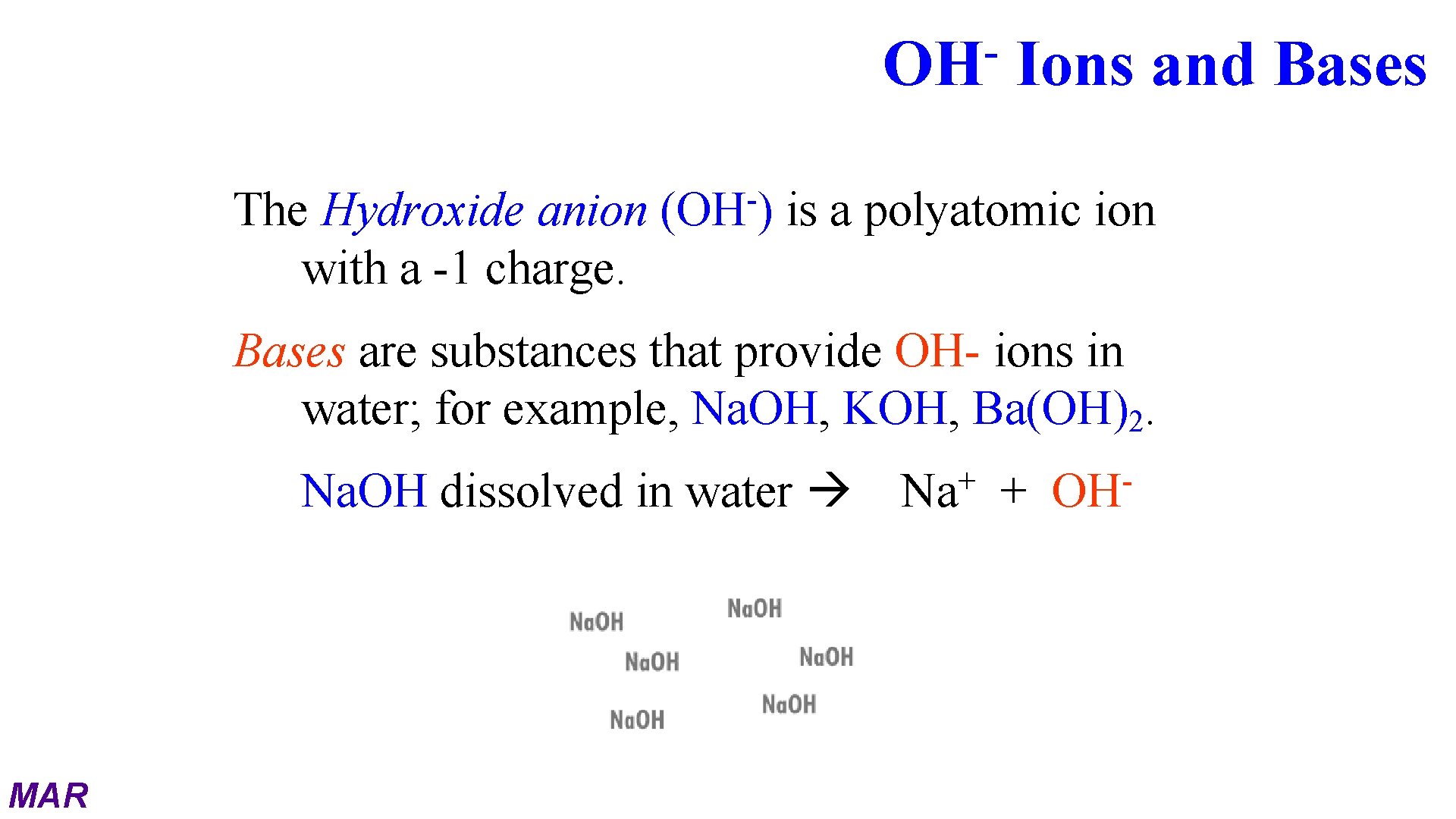
OH The Hydroxide anion with a -1 charge. (OH ) Ions and Bases is a polyatomic ion Bases are substances that provide OH- ions in water; for example, Na. OH, KOH, Ba(OH)2. Na. OH dissolved in water MAR + Na + OH
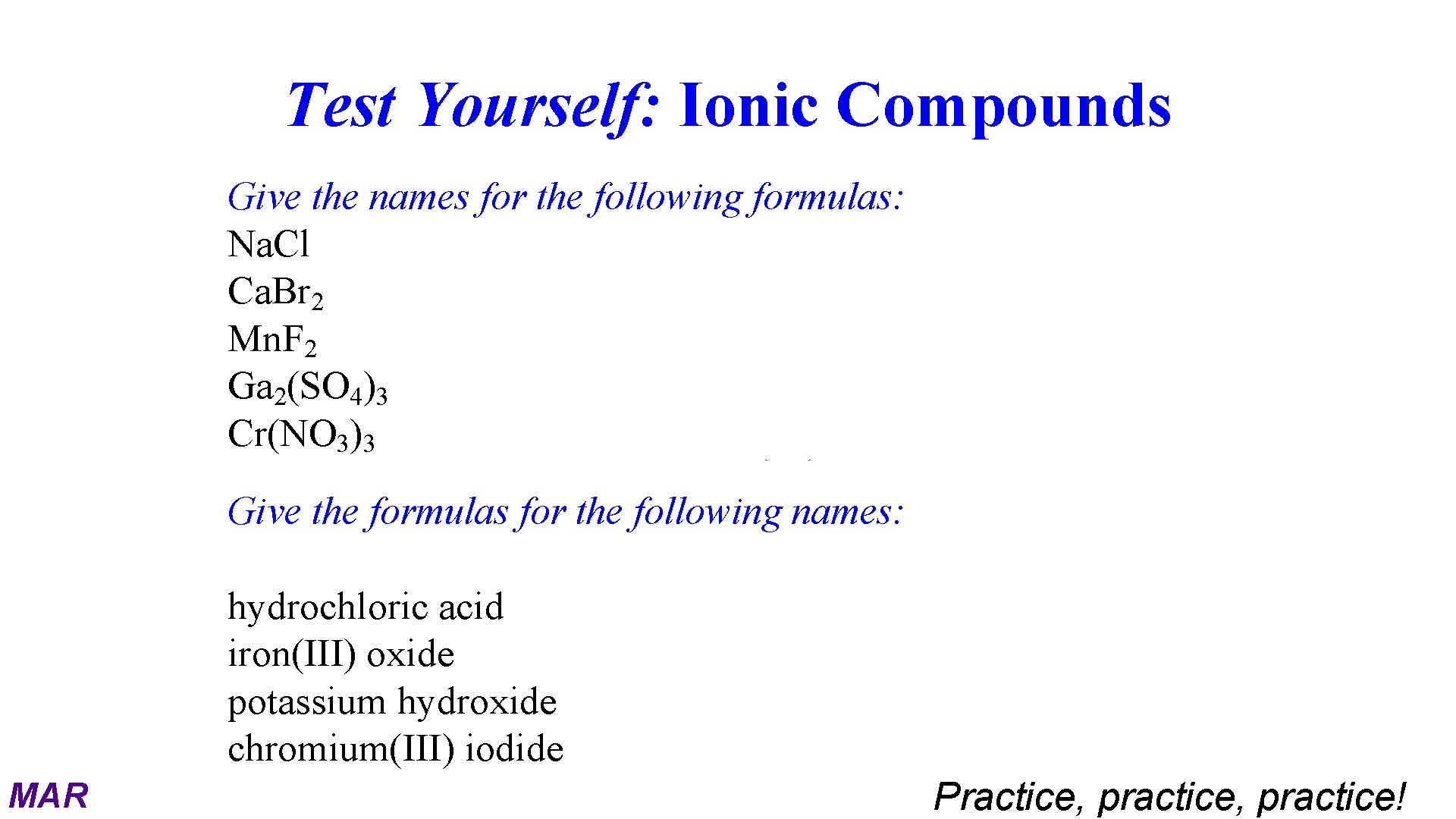
Test Yourself: Ionic Compounds Give the names for the following formulas: Na. Cl sodium chloride Ca. Br 2 calcium bromide Mn. F 2 manganese(II) fluoride Ga 2(SO 4)3 gallium sulfate Cr(NO 3)3 chromium(III) nitrate Give the formulas for the following names: MAR hydrochloric acid HCl Fe 2 O 3 iron(III) oxide potassium hydroxide KOH chromium(III) iodide Cr. I 3 Practice, practice!
Covalent Bonds A covalent bond is a bond formed by sharing electrons between atoms. A molecule is a group of atoms held together by covalent bonds. Nonmetals form covalent bonds with nonmetals. They reach the Noble Gas configuration by sharing an appropriate number of electrons. MAR
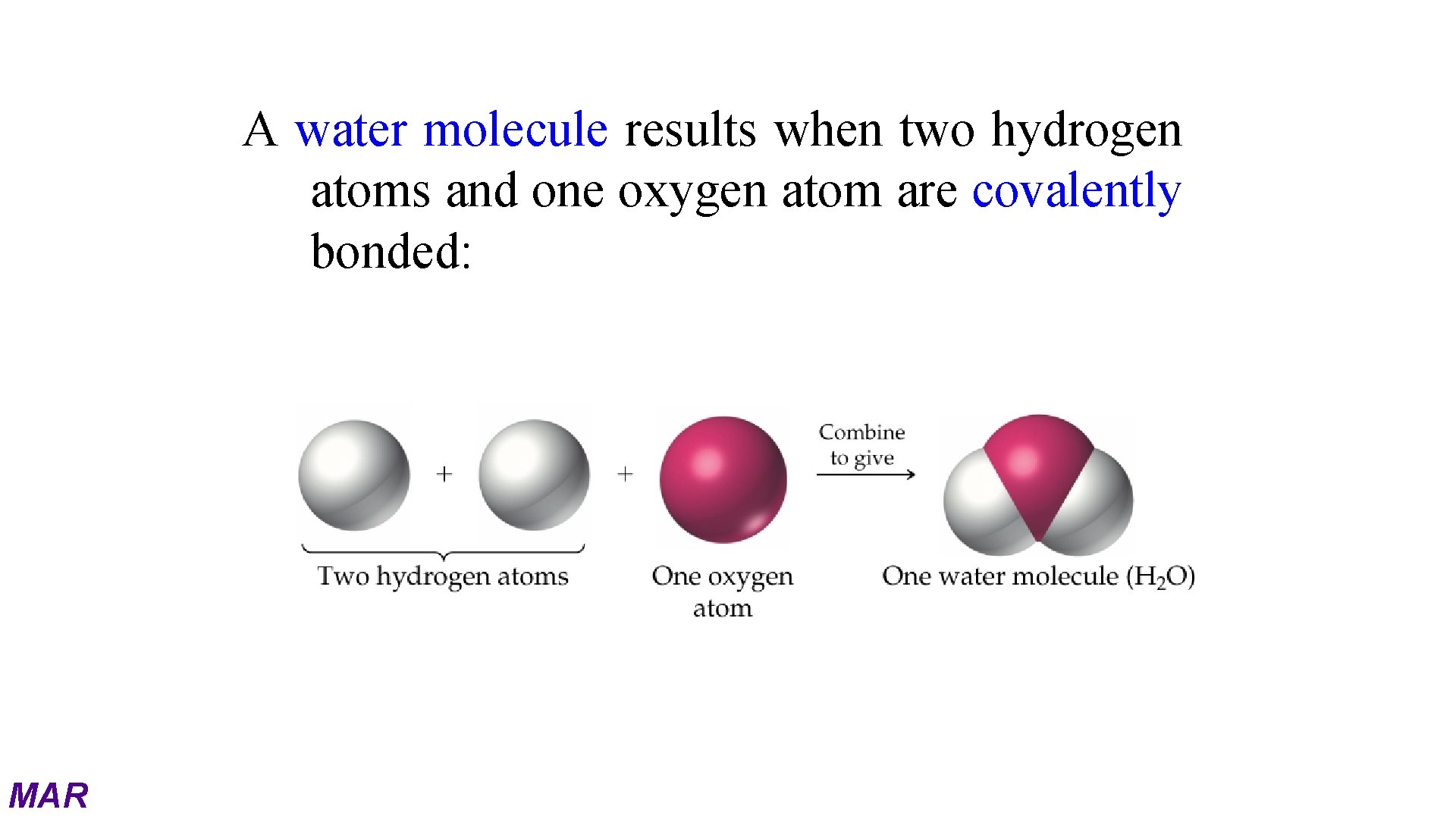
A water molecule results when two hydrogen atoms and one oxygen atom are covalently bonded: MAR
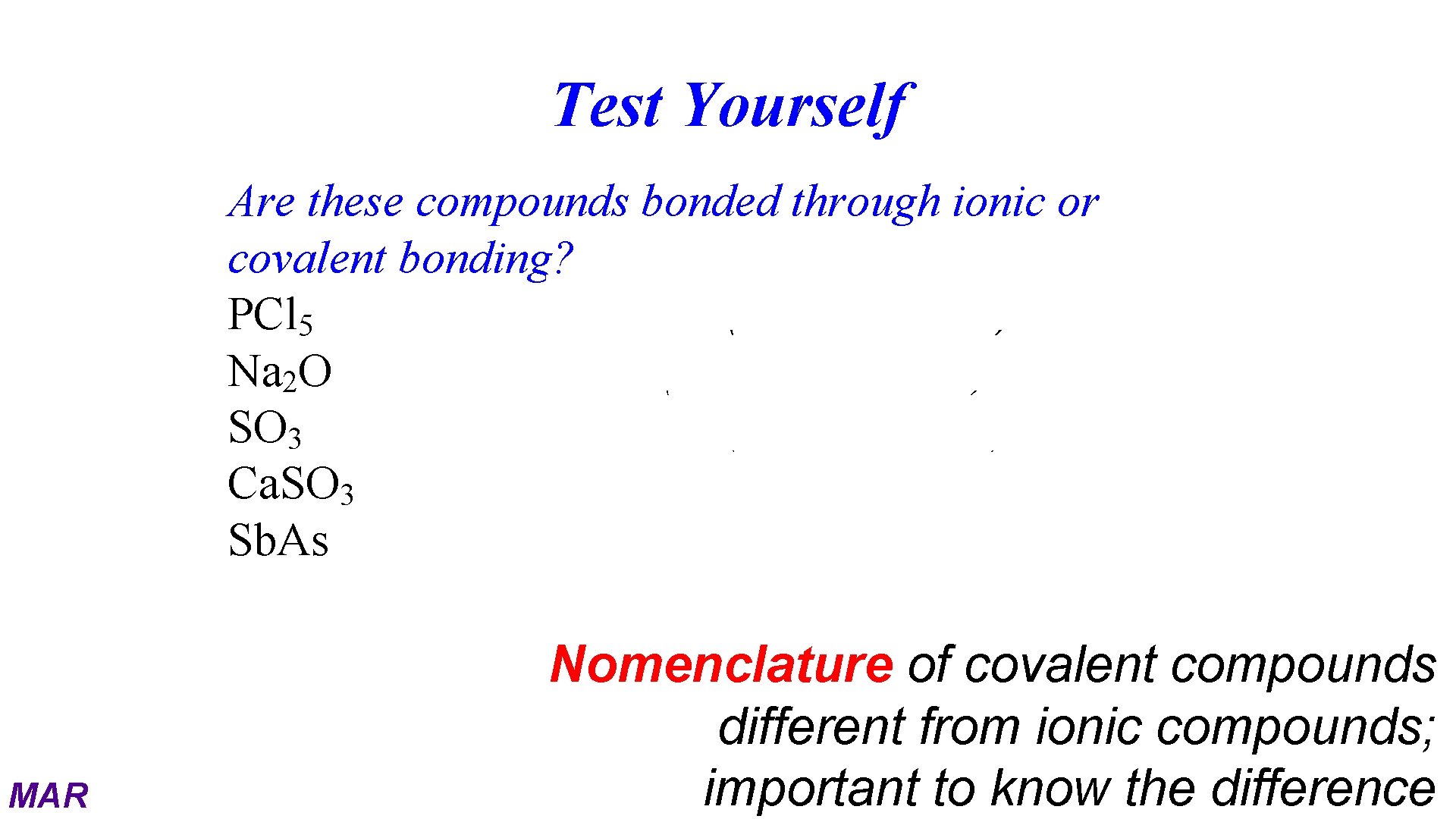
Test Yourself Are these compounds bonded through ionic or covalent bonding? PCl 5 covalent (all nonmetals) Na 2 O ionic (metallic sodium) SO 3 covalent (all nonmetals) Ca. SO 3 ionic (metallic calcium) Sb. As ? !? metalloids go both ways! MAR Nomenclature of covalent compounds different from ionic compounds; important to know the difference
Naming Molecular Compounds When two or more nonmetal elements combine they form covalent compounds. The formulas of covalent compounds are written with the less electronegative (i. e. more metallike) element first. More electronegative element gets -ide suffix Use Greek Prefixes to indicate number of atoms present. MAR
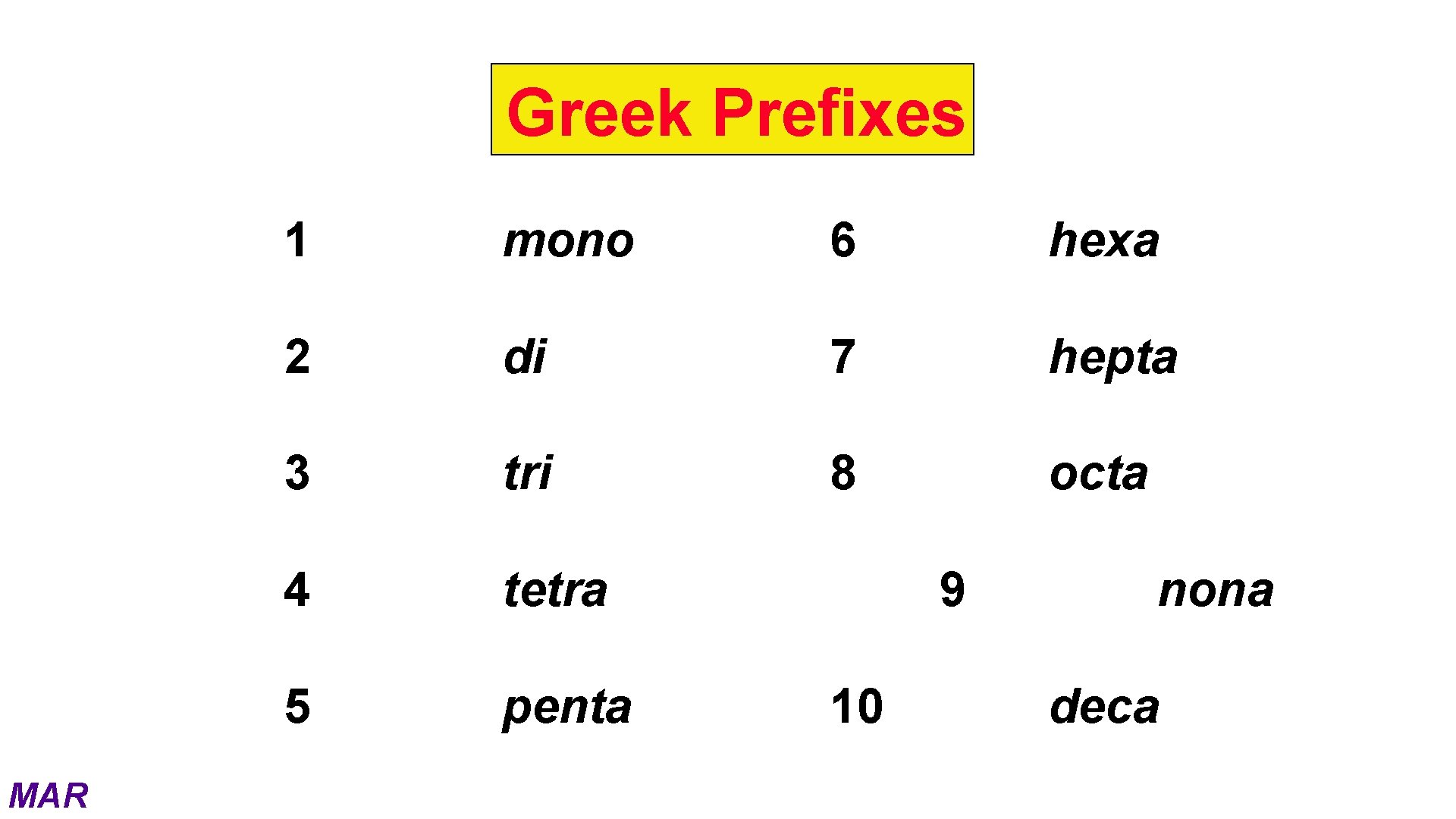
Greek Prefixes MAR 1 mono 6 hexa 2 di 7 hepta 3 tri 8 octa 4 tetra 5 penta 9 10 nona deca
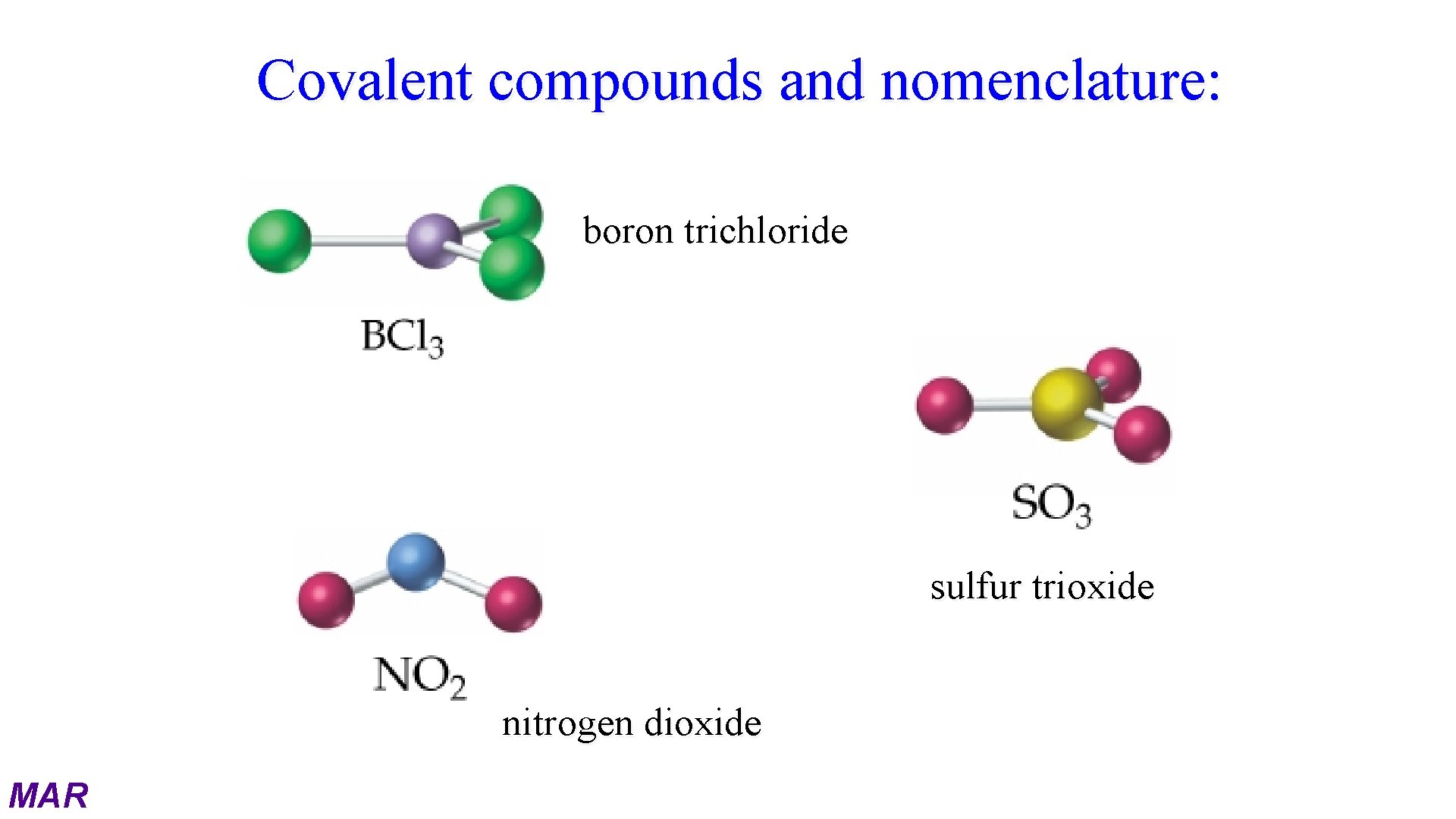
Covalent compounds and nomenclature: boron trichloride sulfur trioxide nitrogen dioxide MAR
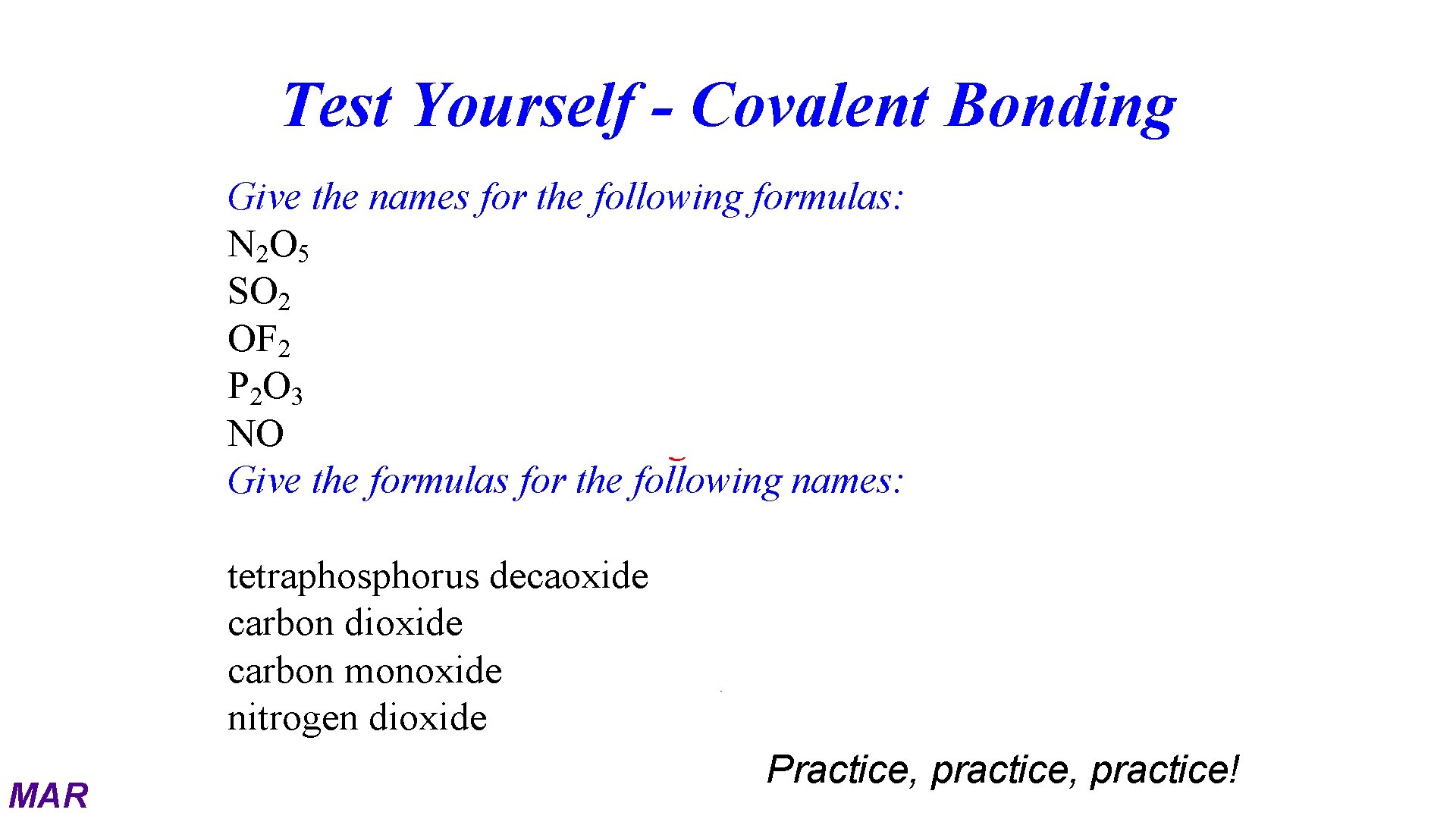
Test Yourself - Covalent Bonding Give the names for the following formulas: N 2 O 5 dinitrogen pentaoxide SO 2 sulfur dioxide OF 2 oxygen difluoride P 2 O 3 diphosphorus trioxide NO nitrogen monoxide Give the formulas for the following names: tetraphosphorus decaoxide carbon dioxide carbon monoxide nitrogen dioxide MAR P 4 O 10 CO 2 CO NO 2 Practice, practice!
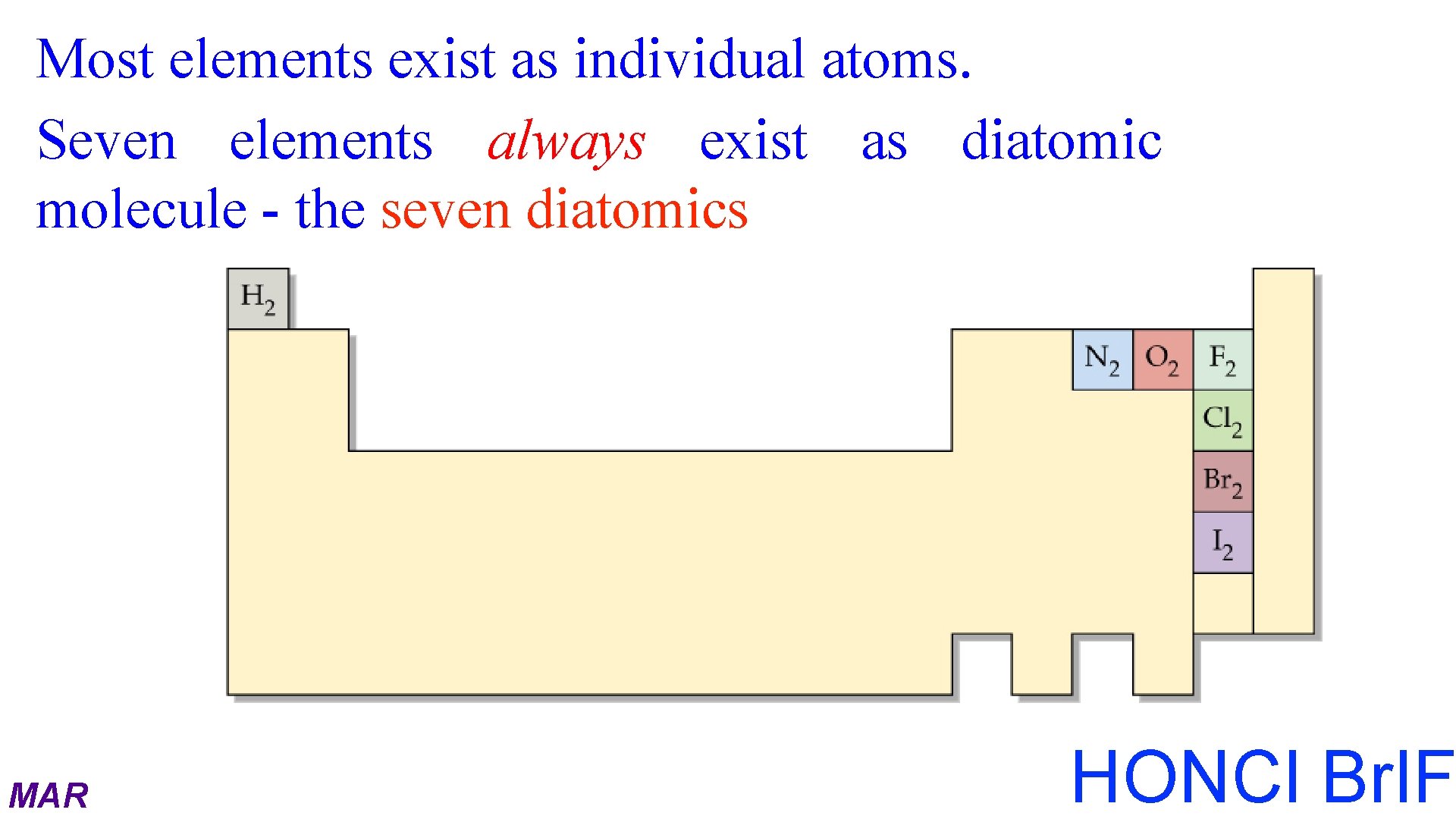
Most elements exist as individual atoms. Seven elements always exist as diatomic molecule - the seven diatomics MAR HONCl Br. IF
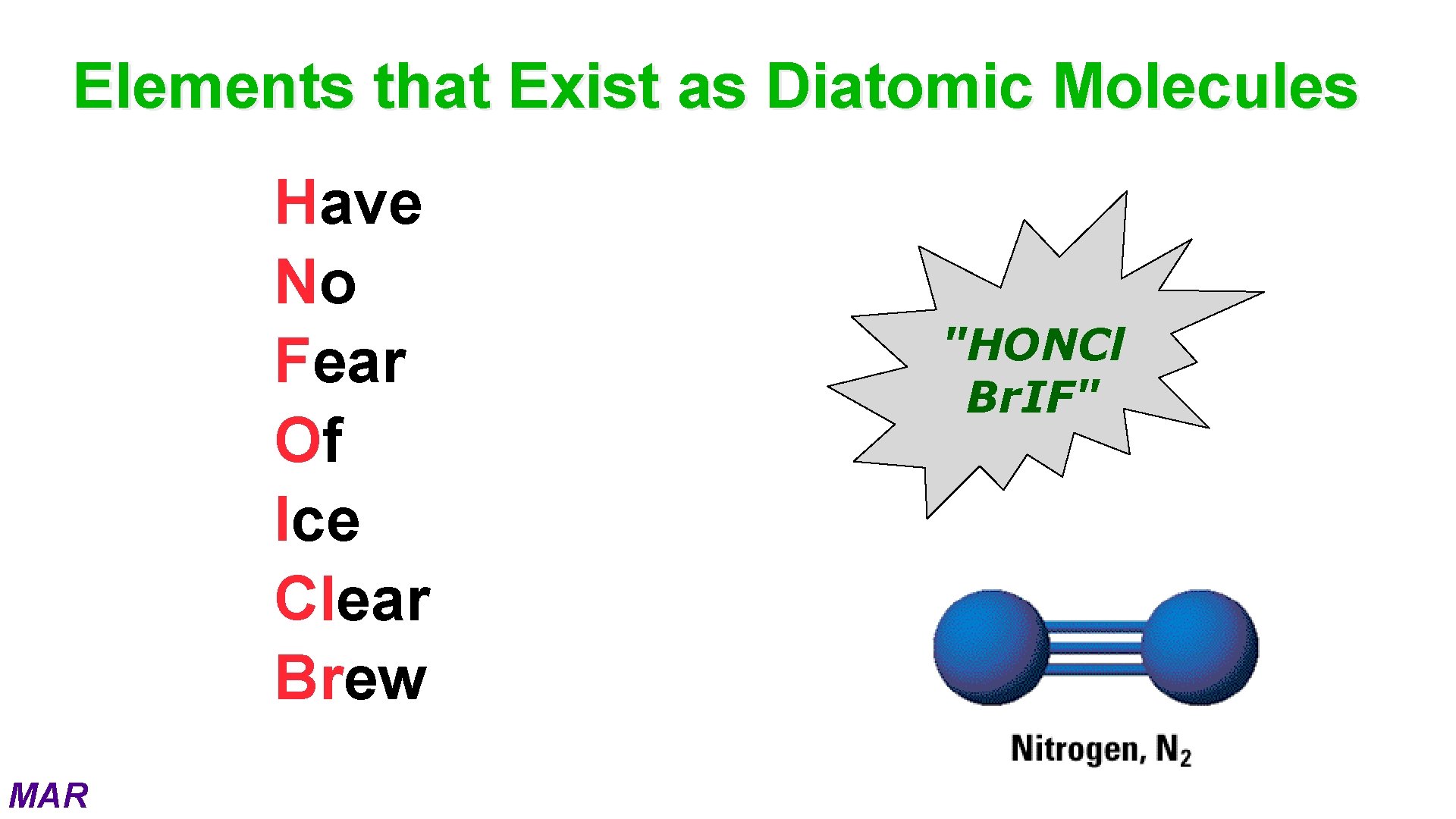
Elements that Exist as Diatomic Molecules Have No Fear Of Ice Clear Brew MAR Hydrogen, H 2 Nitrogen, N 2 Fluorine, F 2 Oxygen, O 2 Iodine, I 2 Chlorine, Cl 2 Bromine, Br 2 "HONCl Br. IF"
End of Chapter 3 Part I MAR
- Slides: 41