
Chemistry 125 Lecture 61 March 25 2011 NMR

- Slides: 20
Chemistry 125: Lecture 61 March 25, 2011 NMR Spectroscopy This Higher-Order Effects Dynamics Proton Decoupling For copyright notice see final page of this file
Spin-Spin Splitting: Other Nuclei & Higher-Order Effects
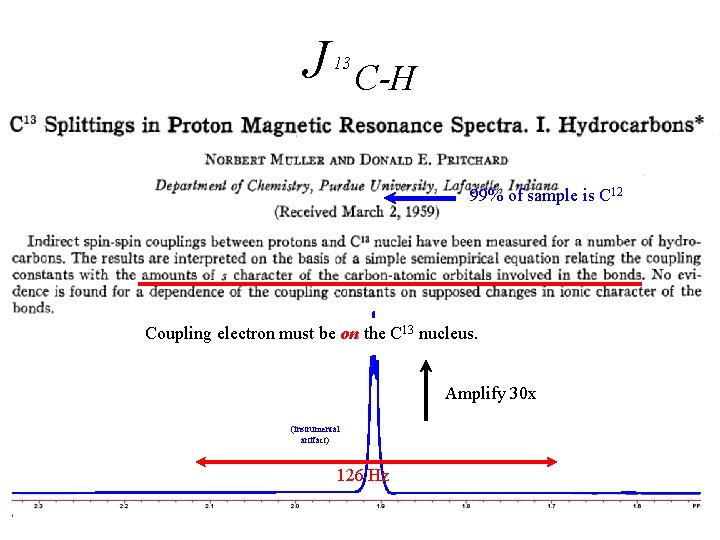
J 13 C-H 99% of sample is C 12 Coupling electron must be on the C 13 nucleus. Amplify 30 x (instrumental artifact) 126 Hz
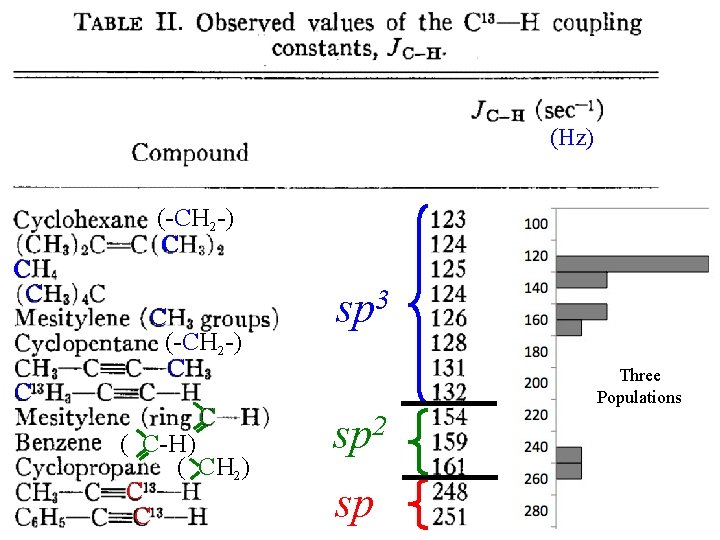
Hybridization and J coupling (Hz) C C C (-CH 2 -) C C ( C-H) ( CH 2) C C sp 3 Three Populations 2 sp sp
Why does CH 4 give a single unsplit peak instead of a quartet?
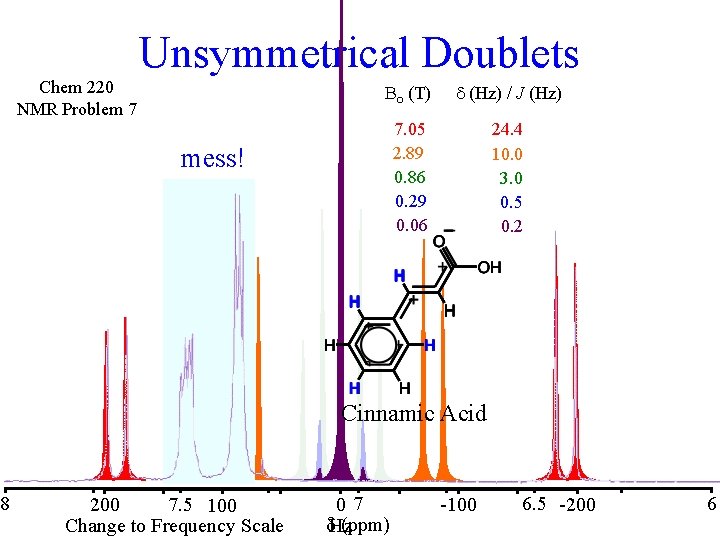
7. 700 7. 647 1. 270 0. 053 Chem 220 15. 7 Hz NMR Problem 7 7. 673 Unsymmetrical Doublets 381 Hz Bo (T) mess! (Hz) / J (Hz) 7. 05 (300 MHz) 2. 89 0. 86 0. 29 0. 06 6. 429 6. 377 0. 052 24. 4 10. 0 3. 0 0. 5 0. 2 15. 6 Hz 6. 403 Cinnamic Acid 8 7. 5 100 200 Change to Frequency Scale 07 (ppm) Hz -100 6. 5 -200 6
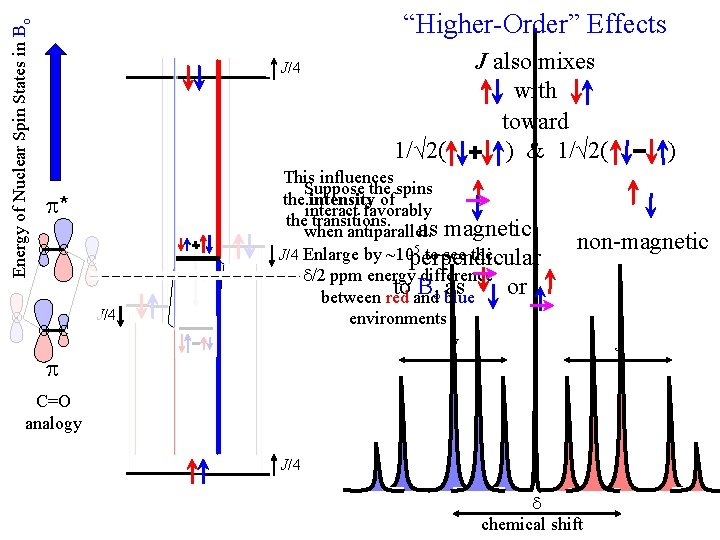
Energy of Nuclear Spin States in Bo O “Higher-Order” Effects J/4 p* O C p C J/4 J also mixes with toward 1/√ 2( ) & 1/√ 2( ) This influences Suppose the spins the intensity of interact favorably the transitions. as magnetic when antiparallel. 5 to see the J/4 Enlarge by ~10 perpendicular /2 ppm energy difference to Bo as or . between red and blue environments J non-magnetic C=O analogy J/4 chemical shift J
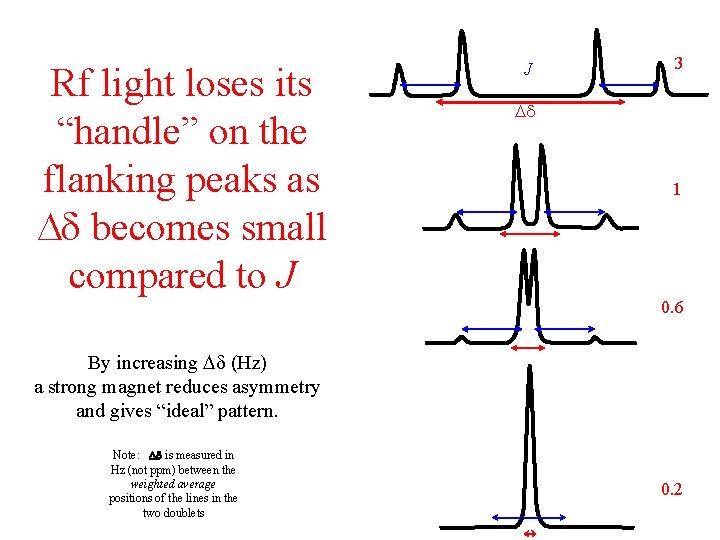
Rf light loses its “handle” on the flanking peaks as becomes small compared to J J 3 1 0. 6 By increasing (Hz) a strong magnet reduces asymmetry and gives “ideal” pattern. Note: is measured in Hz (not ppm) between the weighted average positions of the lines in the two doublets 0. 2
Dynamics (the NMR Time Scale / Decoupling) e. g. J&F Sec. 15. 9 pp. 746 -749 Sec. 15. 6 e p. 739
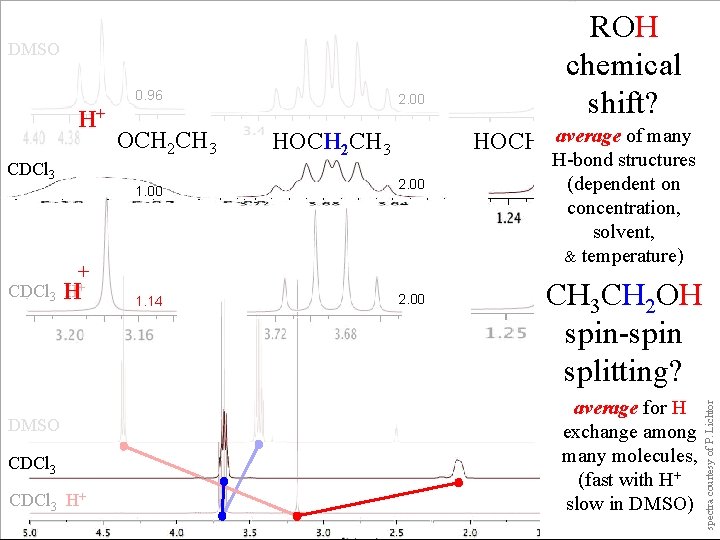
DMSO H+ HOCH 2 CH 3 CDCl 3 2. 00 average of many HOCH 2 CH 3 1. 00 2. 00 1. 14 2. 00 + CDCl 3 H H+ DMSO CDCl 3 H+ H-bond structures 3. 05 (dependent on concentration, solvent, & temperature) 3. 03 OH CH 3 CH 2 spin-spin splitting? average for H exchange among many molecules, (fast with H+ slow in DMSO) spectra courtesy of P. Lichtor 0. 96 ROH chemical 3. 04 shift?
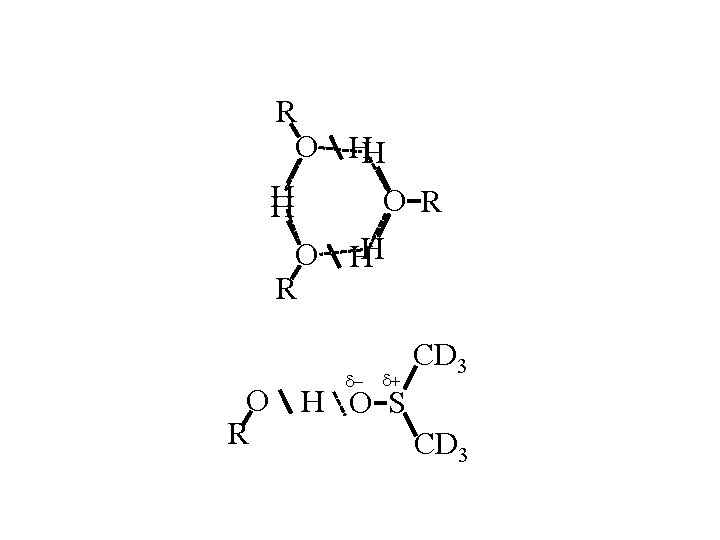
R O HH H O R H O HH R - + CD 3 O H O S R CD 3
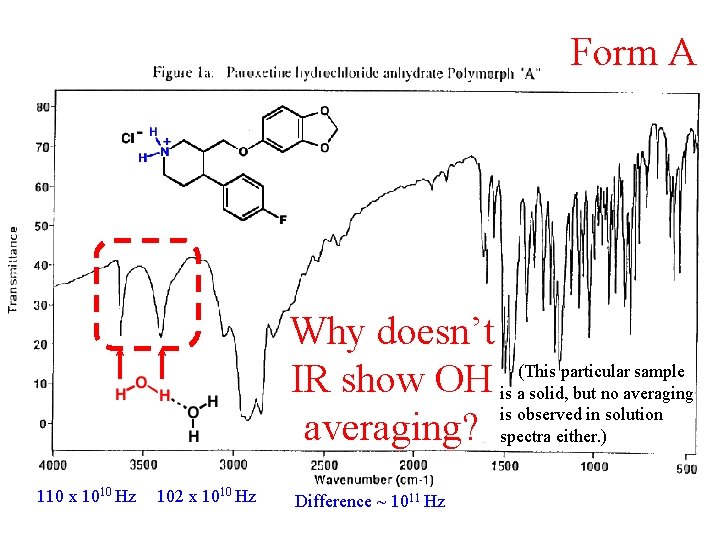
Form A Why doesn’t (This particular sample IR show OH is a solid, but no averaging is observed in solution averaging? spectra either. ) 110 x 1010 Hz 102 x 1010 Hz Difference ~ 1011 Hz
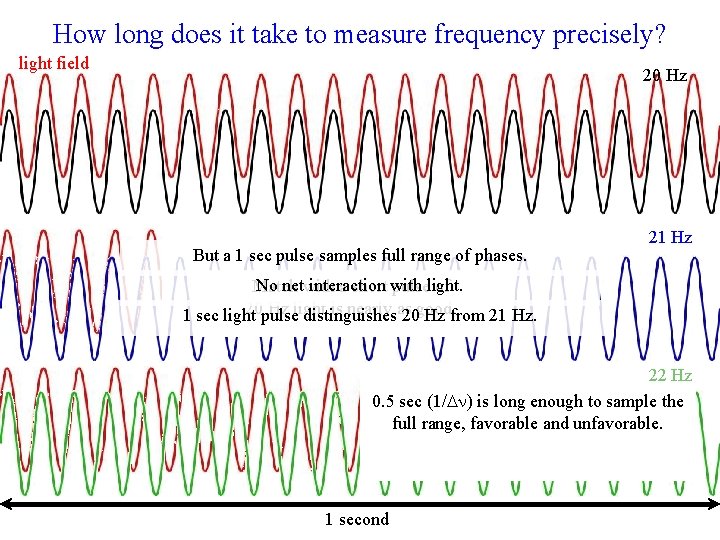
How long does it take to measure frequency precisely? light field 20 Hz But a 1 sec pulse samples full range of phases. 21 Hz No net interaction with light. Match with a short pulse of 20 Hz light is nearly as good. 1 sec light pulse distinguishes 20 Hz from 21 Hz. 22 Hz 0. 5 sec (1/ ) is long enough to sample the full range, favorable and unfavorable. 1 second
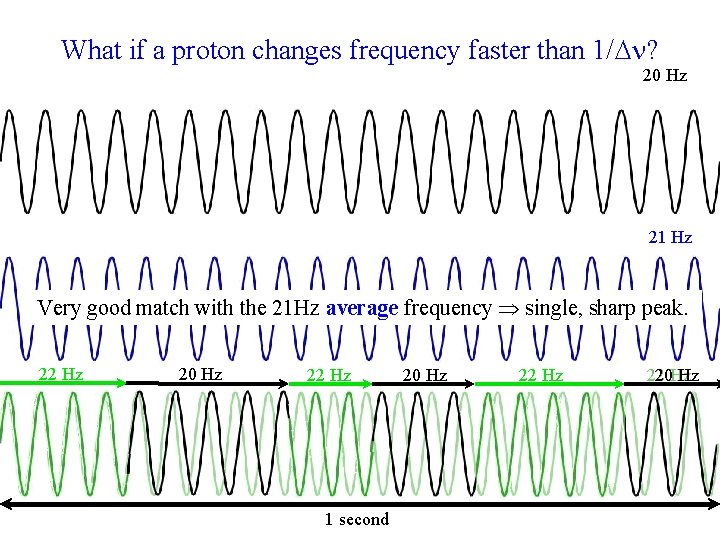
What if a proton changes frequency faster than 1/ ? 20 Hz 21 Hz Very good match with the 21 Hz average frequency single, sharp peak. 22 Hz 20 Hz 22 Hz 1 second 20 Hz 22 Hz 20 Hz
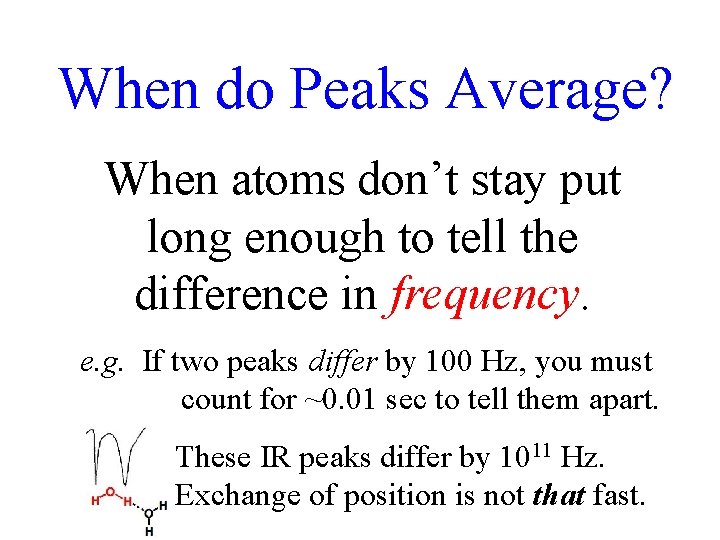
When do Peaks Average? When atoms don’t stay put long enough to tell the difference in frequency. e. g. If two peaks differ by 100 Hz, you must count for ~0. 01 sec to tell them apart. These IR peaks differ by 1011 Hz. Exchange of position is not that fast.
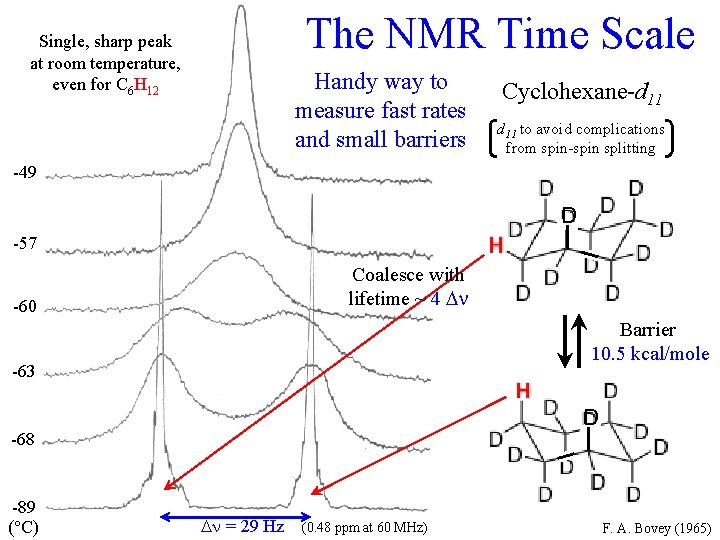
Single, sharp peak at room temperature, even for C 6 H 12 The NMR Time Scale Handy way to measure fast rates and small barriers Cyclohexane-d 11 to avoid complications from spin-spin splitting -49 D -57 -60 Coalesce with lifetime ~ 4 Barrier 10. 5 kcal/mole -63 D -68 -89 (°C) = 29 Hz (0. 48 ppm at 60 MHz) F. A. Bovey (1965)
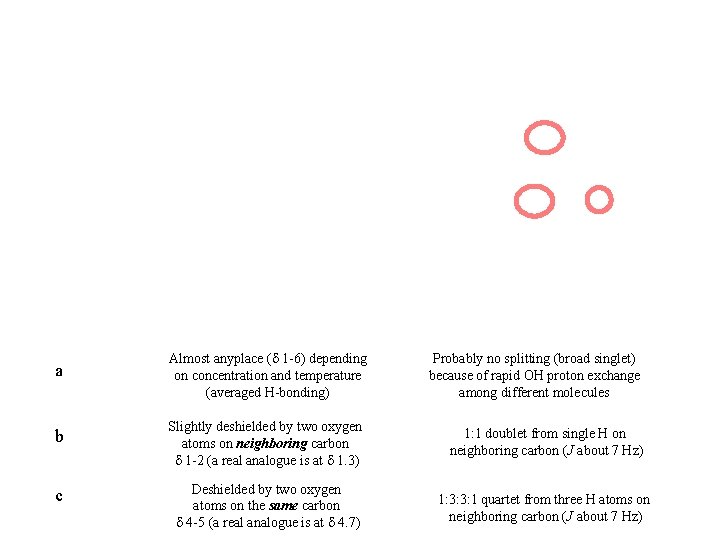
a b c Almost anyplace ( 1 -6) depending on concentration and temperature (averaged H-bonding) Probably no splitting (broad singlet) because of rapid OH proton exchange among different molecules Slightly deshielded by two oxygen atoms on neighboring carbon 1 -2 (a real analogue is at 1. 3) 1: 1 doublet from single H on neighboring carbon (J about 7 Hz) Deshielded by two oxygen atoms on the same carbon 4 -5 (a real analogue is at 4. 7) 1: 3: 3: 1 quartet from three H atoms on neighboring carbon (J about 7 Hz)
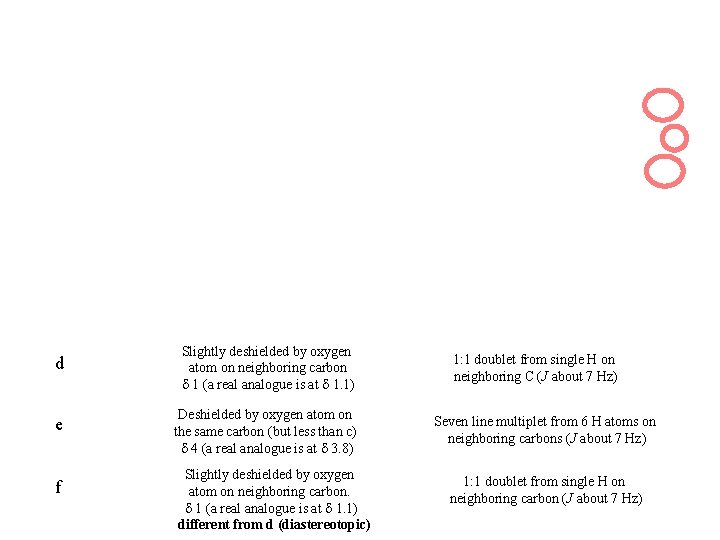
d e f Slightly deshielded by oxygen atom on neighboring carbon 1 (a real analogue is at 1. 1) Deshielded by oxygen atom on the same carbon (but less than c) 4 (a real analogue is at 3. 8) Slightly deshielded by oxygen atom on neighboring carbon. 1 (a real analogue is at 1. 1) different from d (diastereotopic) 1: 1 doublet from single H on neighboring C (J about 7 Hz) Seven line multiplet from 6 H atoms on neighboring carbons (J about 7 Hz) 1: 1 doublet from single H on neighboring carbon (J about 7 Hz)
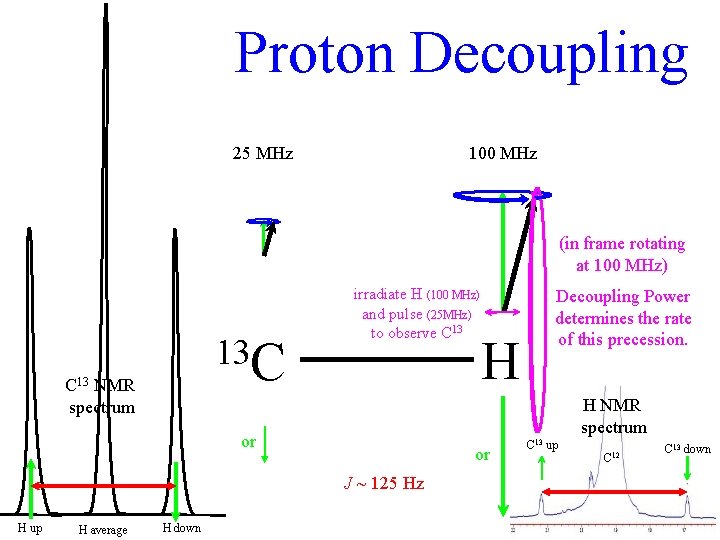
Proton Decoupling 25 MHz 100 MHz (in frame rotating at 100 MHz) 13 C C 13 NMR spectrum irradiate H (100 MHz) and pulse (25 MHz) to observe C 13 H H NMR spectrum or or J ~ 125 Hz H up H average H down Decoupling Power determines the rate of this precession. C 13 up C 12 C 13 down
End of Lecture 61 March 25, 2011 Copyright © J. M. Mc. Bride 2010. Some rights reserved. Except for cited third-party materials, and those used by visiting speakers, all content is licensed under a Creative Commons License (Attribution-Non. Commercial-Share. Alike 3. 0). Use of this content constitutes your acceptance of the noted license and the terms and conditions of use. Materials from Wikimedia Commons are denoted by the symbol . Third party materials may be subject to additional intellectual property notices, information, or restrictions. The following attribution may be used when reusing material that is not identified as third-party content: J. M. Mc. Bride, Chem 125. License: Creative Commons BY-NC-SA 3. 0