
CHEMISTRY 1030 Lewis Structures and Bonding Dr Richard
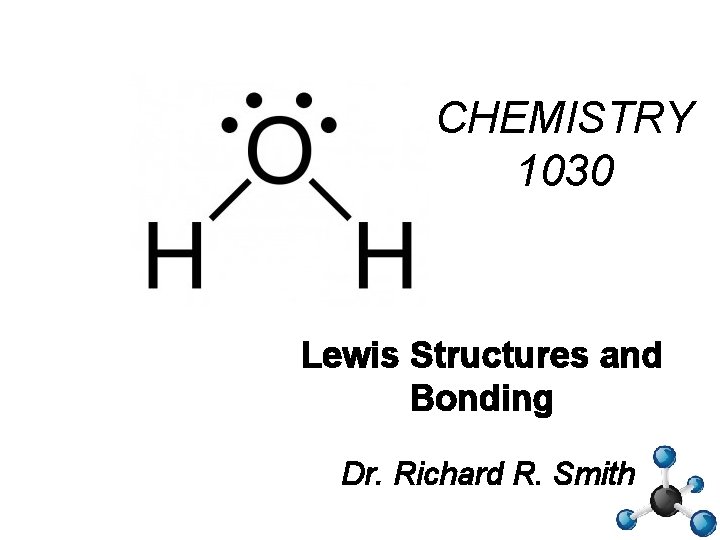
CHEMISTRY 1030 Lewis Structures and Bonding Dr. Richard R. Smith
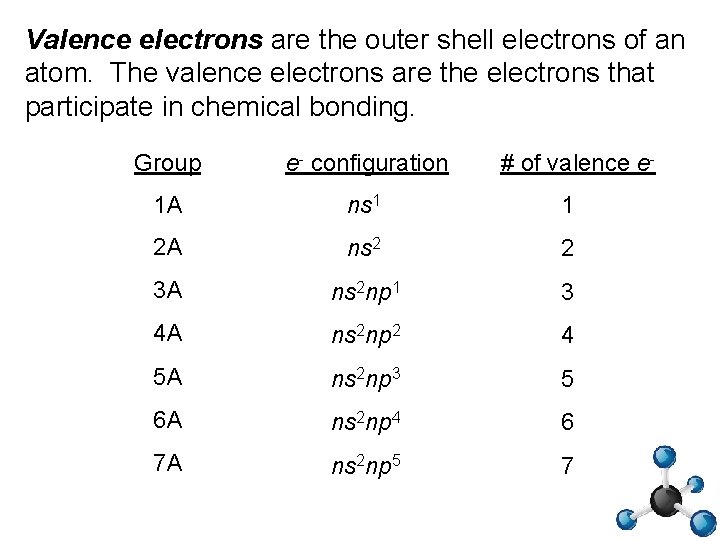
Valence electrons are the outer shell electrons of an atom. The valence electrons are the electrons that participate in chemical bonding. Group e- configuration # of valence e- 1 A ns 1 1 2 A ns 2 2 3 A ns 2 np 1 3 4 A ns 2 np 2 4 5 A ns 2 np 3 5 6 A ns 2 np 4 6 7 A ns 2 np 5 7
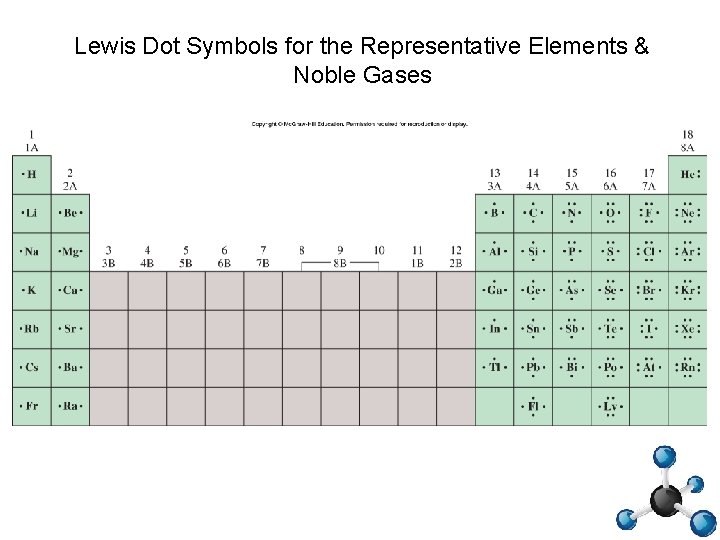
Lewis Dot Symbols for the Representative Elements & Noble Gases
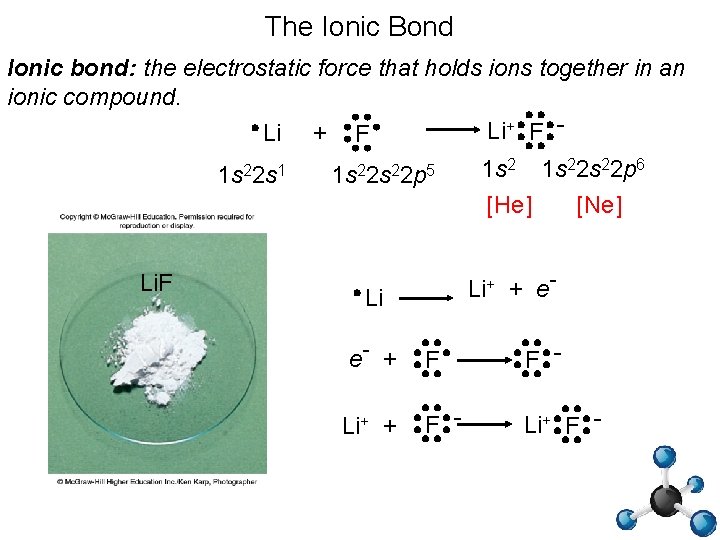
The Ionic Bond Ionic bond: the electrostatic force that holds ions together in an ionic compound. Li+ F Li + F 1 s 22 s 1 Li. F 1 s 22 p 5 Li+ + e- Li e- + Li+ + 1 s 22 s 22 p 6 [He] [Ne] F F - Li+ F -

Example Use Lewis dot symbols to show the formation of aluminum oxide (Al 2 O 3). The mineral corundum (Al 2 O 3).
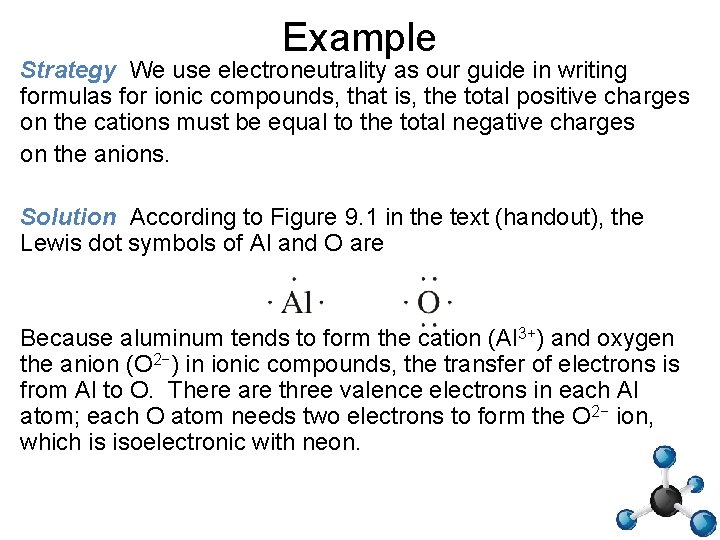
Example Strategy We use electroneutrality as our guide in writing formulas for ionic compounds, that is, the total positive charges on the cations must be equal to the total negative charges on the anions. Solution According to Figure 9. 1 in the text (handout), the Lewis dot symbols of Al and O are Because aluminum tends to form the cation (Al 3+) and oxygen the anion (O 2−) in ionic compounds, the transfer of electrons is from Al to O. There are three valence electrons in each Al atom; each O atom needs two electrons to form the O 2− ion, which is isoelectronic with neon.
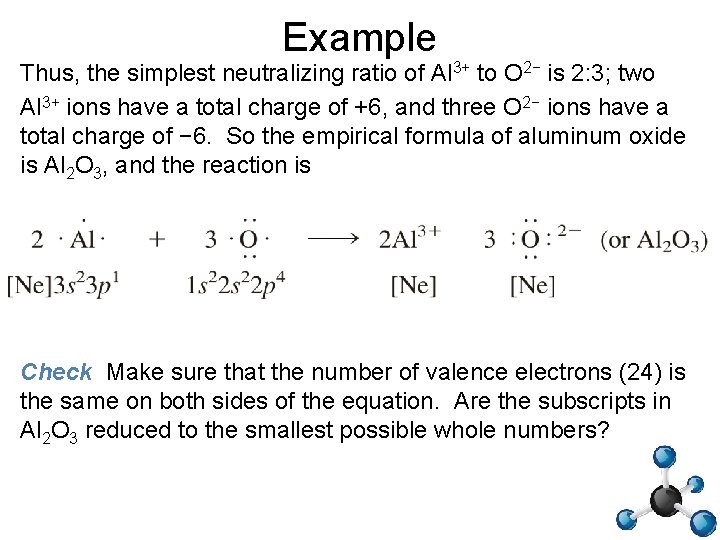
Example Thus, the simplest neutralizing ratio of Al 3+ to O 2− is 2: 3; two Al 3+ ions have a total charge of +6, and three O 2− ions have a total charge of − 6. So the empirical formula of aluminum oxide is Al 2 O 3, and the reaction is Check Make sure that the number of valence electrons (24) is the same on both sides of the equation. Are the subscripts in Al 2 O 3 reduced to the smallest possible whole numbers?
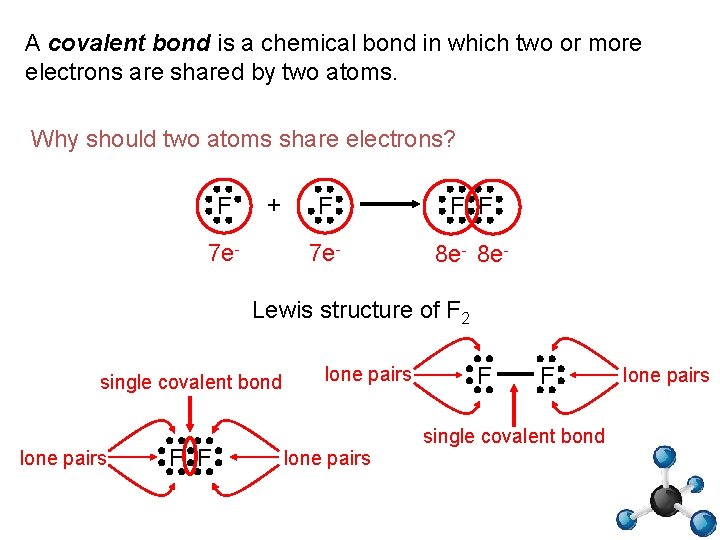
A covalent bond is a chemical bond in which two or more electrons are shared by two atoms. Why should two atoms share electrons? F + 7 e- F F F 7 e- 8 e- Lewis structure of F 2 single covalent bond lone pairs F F single covalent bond lone pairs
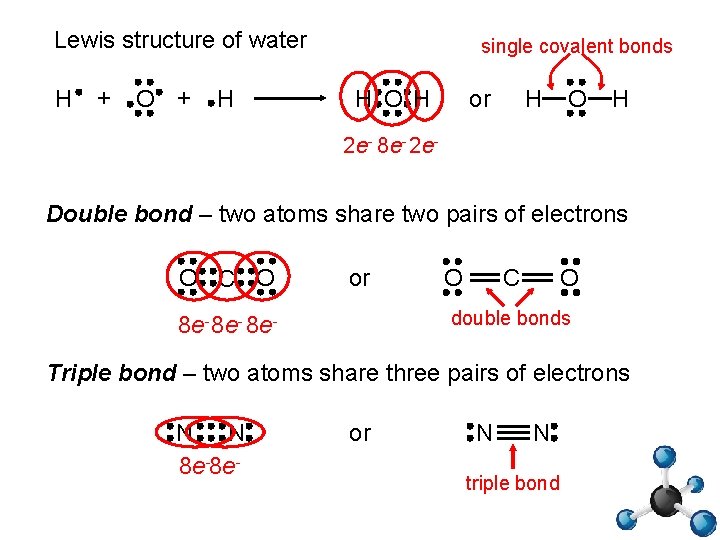
Lewis structure of water H + O + H single covalent bonds H O H H or O H 2 e- 8 e- 2 e- Double bond – two atoms share two pairs of electrons O C O or O O C double bonds 8 e- 8 e- Triple bond – two atoms share three pairs of electrons N N 8 e-8 e- or N N triple bond
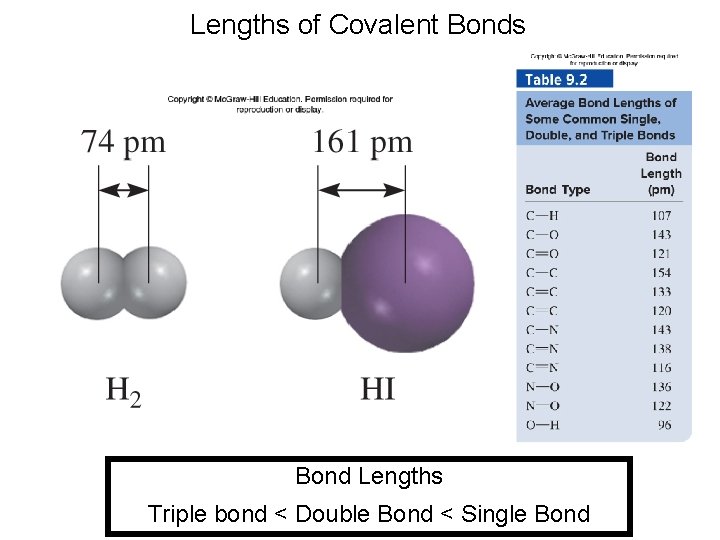
Lengths of Covalent Bonds Bond Lengths Triple bond < Double Bond < Single Bond
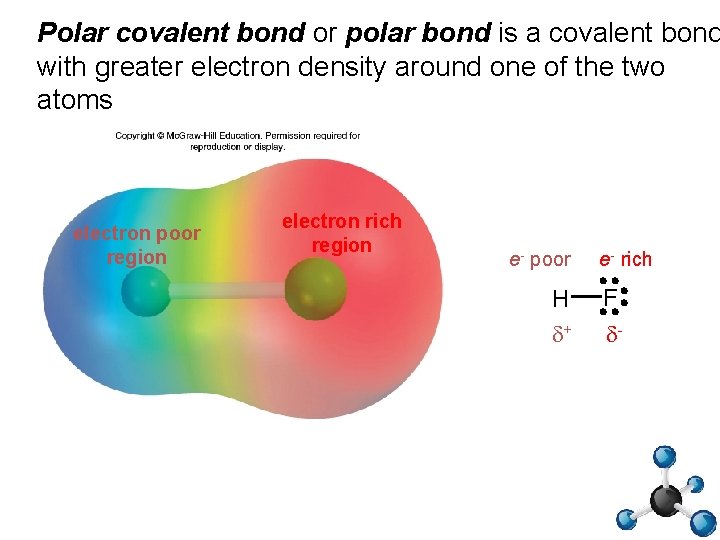
Polar covalent bond or polar bond is a covalent bond with greater electron density around one of the two atoms electron poor region electron rich region e- poor H d+ e- rich F d-
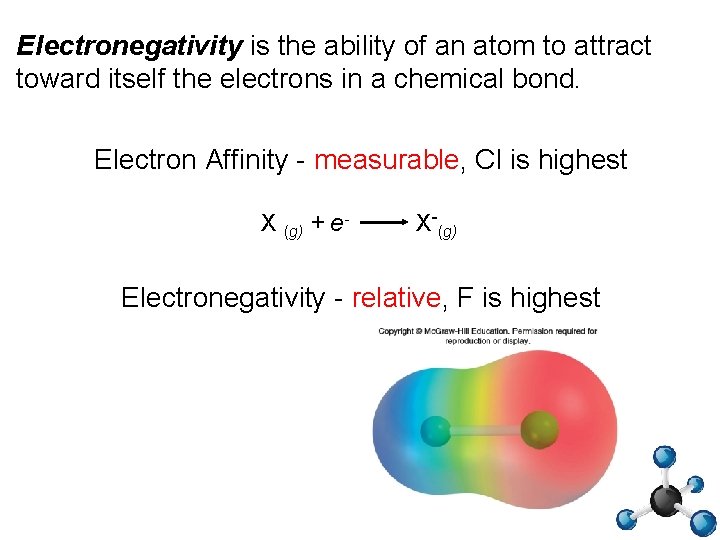
Electronegativity is the ability of an atom to attract toward itself the electrons in a chemical bond. Electron Affinity - measurable, Cl is highest X (g) + e- X-(g) Electronegativity - relative, F is highest
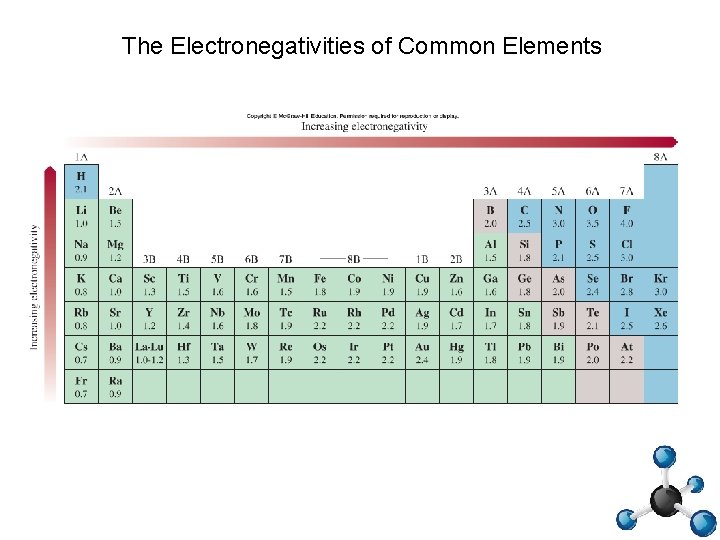
The Electronegativities of Common Elements
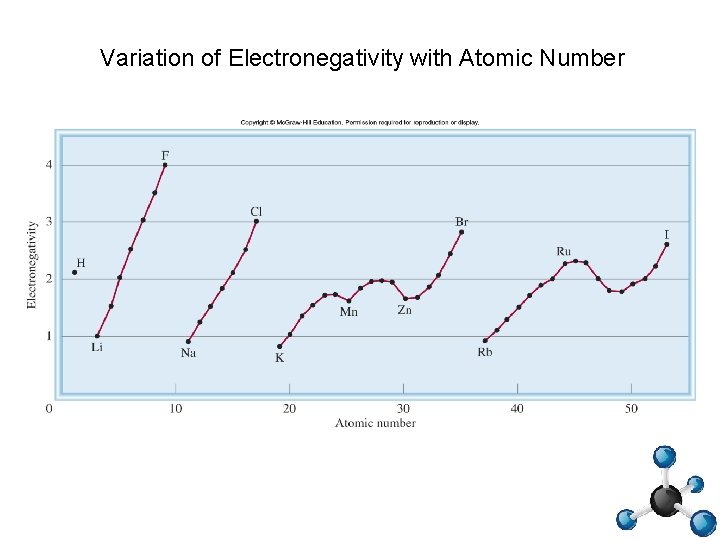
Variation of Electronegativity with Atomic Number
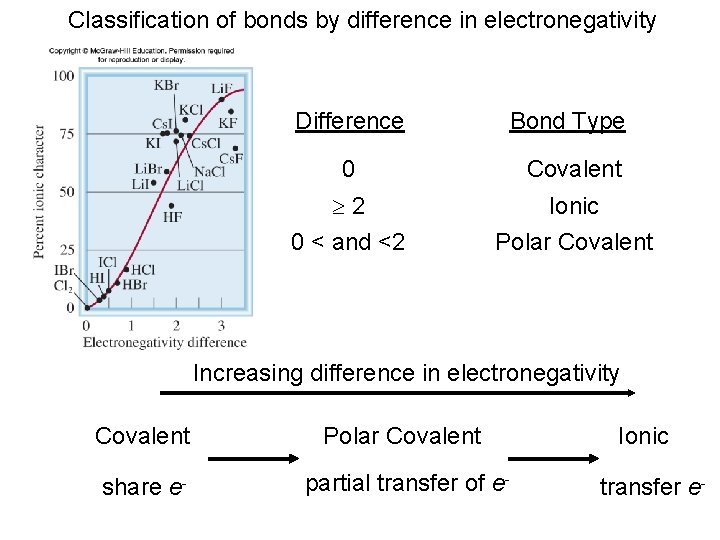
Classification of bonds by difference in electronegativity Difference Bond Type 0 Covalent 2 0 < and <2 Ionic Polar Covalent Increasing difference in electronegativity Covalent Polar Covalent share e- partial transfer of e- Ionic transfer e-
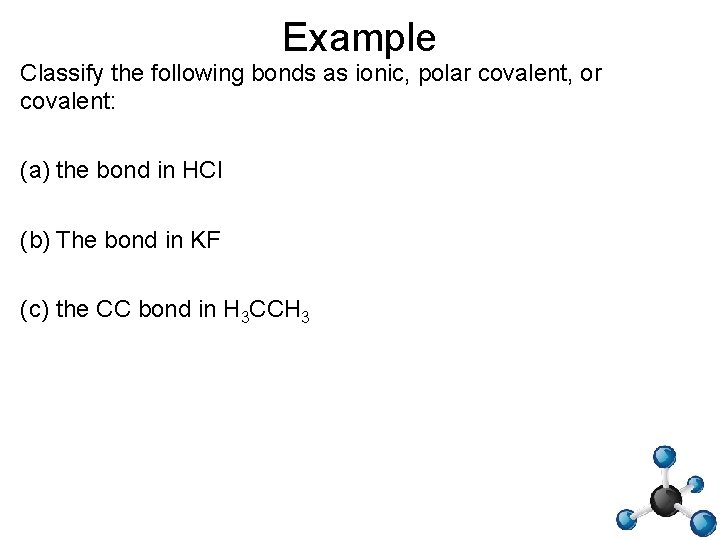
Example Classify the following bonds as ionic, polar covalent, or covalent: (a) the bond in HCl (b) The bond in KF (c) the CC bond in H 3 CCH 3
Example Strategy We follow the 2. 0 rule of electronegativity difference and look up the values in Figure 9. 5 of the text (handout). Solution (a) The electronegativity difference between H and Cl is 0. 9, which is appreciable but not large enough (by the 2. 0 rule) to qualify HCl as an ionic compound. Therefore, the bond between H and Cl is polar covalent. (b) The electronegativity difference between K and F is 3. 2, which is well above the 2. 0 mark; therefore, the bond between K and F is ionic. (c) The two C atoms are identical in every respect—they are bonded to each other and each is bonded to three other H atoms. Therefore, the bond between them is purely covalent.
Writing Lewis Structures 1. Draw skeletal structure of compound showing what atoms are bonded to each other. Put least electronegative element in the center. 2. Count total number of valence e-. Add 1 for each negative charge. Subtract 1 for each positive charge. 3. Complete an octet for all atoms except hydrogen. 4. If structure contains too many electrons, form double and triple bonds on central atom as needed.
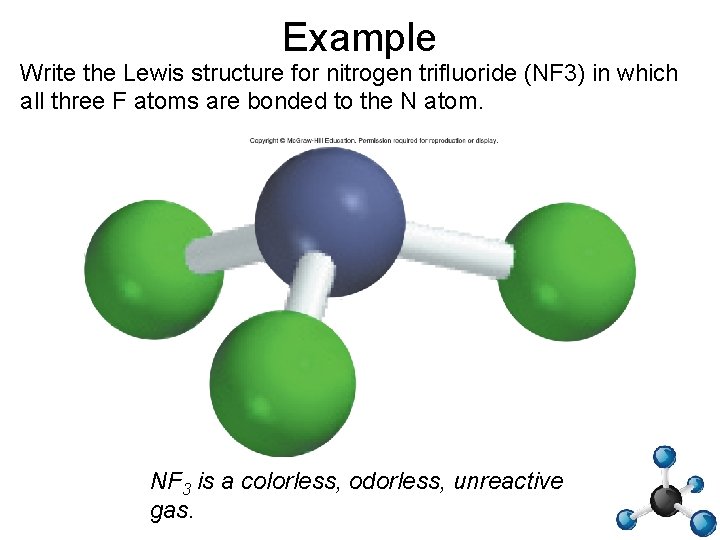
Example Write the Lewis structure for nitrogen trifluoride (NF 3) in which all three F atoms are bonded to the N atom. NF 3 is a colorless, odorless, unreactive gas.
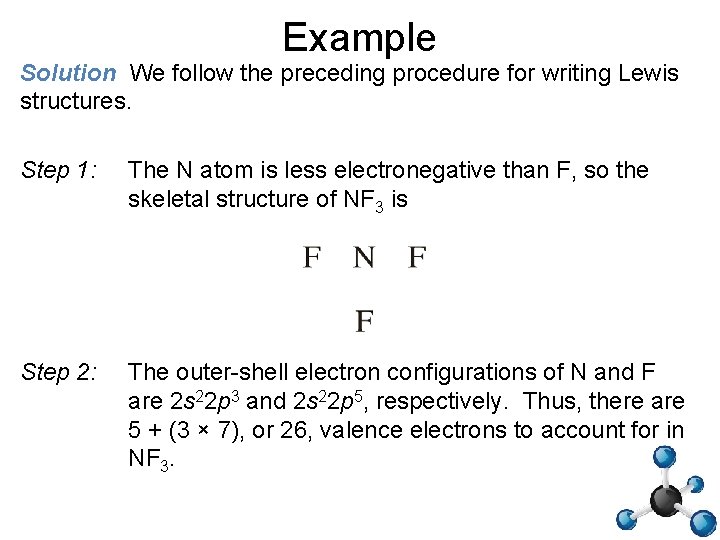
Example Solution We follow the preceding procedure for writing Lewis structures. Step 1: The N atom is less electronegative than F, so the skeletal structure of NF 3 is Step 2: The outer-shell electron configurations of N and F are 2 s 22 p 3 and 2 s 22 p 5, respectively. Thus, there are 5 + (3 × 7), or 26, valence electrons to account for in NF 3.
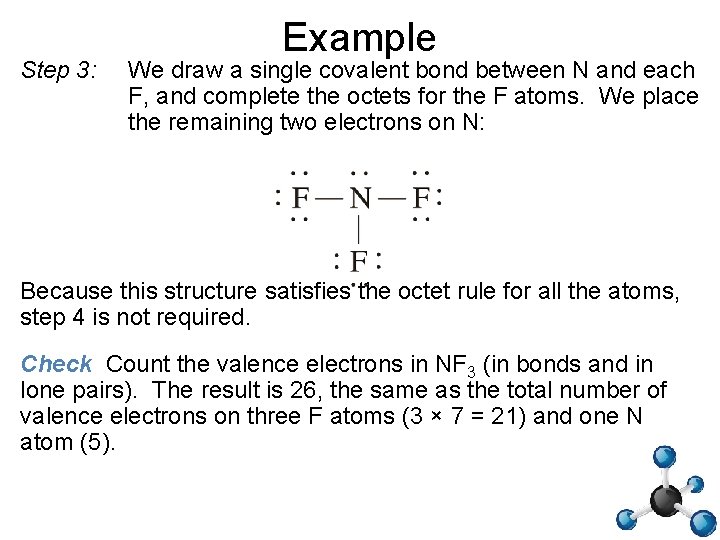
Step 3: Example We draw a single covalent bond between N and each F, and complete the octets for the F atoms. We place the remaining two electrons on N: Because this structure satisfies the octet rule for all the atoms, step 4 is not required. Check Count the valence electrons in NF 3 (in bonds and in lone pairs). The result is 26, the same as the total number of valence electrons on three F atoms (3 × 7 = 21) and one N atom (5).
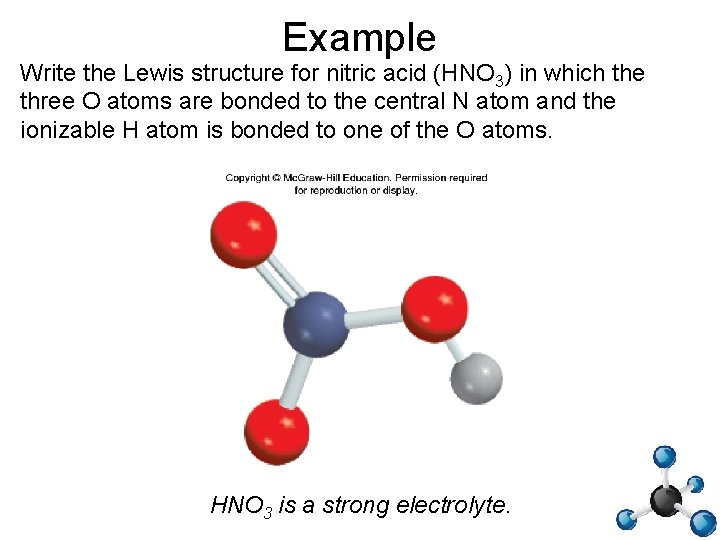
Example Write the Lewis structure for nitric acid (HNO 3) in which the three O atoms are bonded to the central N atom and the ionizable H atom is bonded to one of the O atoms. HNO 3 is a strong electrolyte.
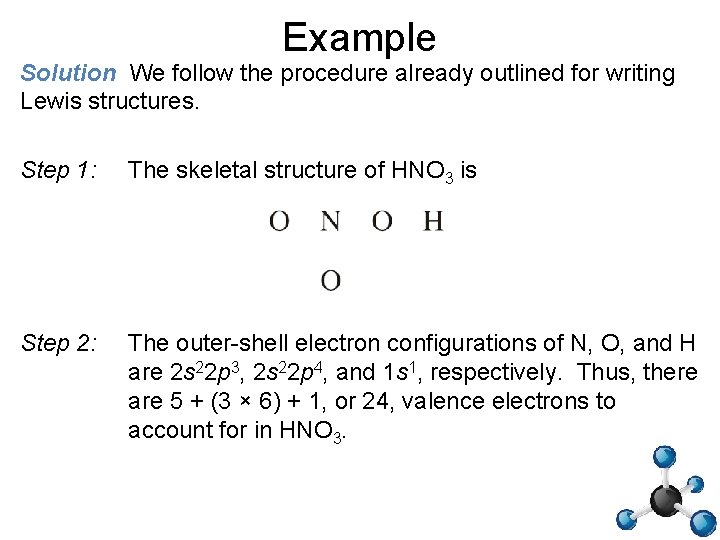
Example Solution We follow the procedure already outlined for writing Lewis structures. Step 1: The skeletal structure of HNO 3 is Step 2: The outer-shell electron configurations of N, O, and H are 2 s 22 p 3, 2 s 22 p 4, and 1 s 1, respectively. Thus, there are 5 + (3 × 6) + 1, or 24, valence electrons to account for in HNO 3.
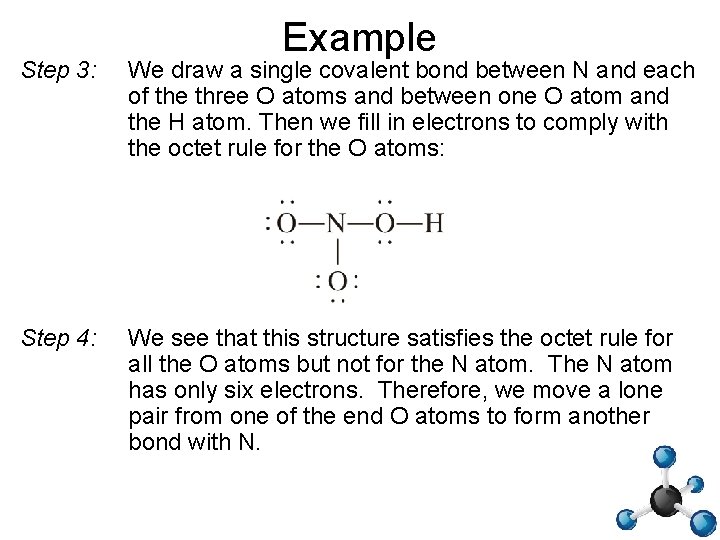
Example Step 3: We draw a single covalent bond between N and each of the three O atoms and between one O atom and the H atom. Then we fill in electrons to comply with the octet rule for the O atoms: Step 4: We see that this structure satisfies the octet rule for all the O atoms but not for the N atom. The N atom has only six electrons. Therefore, we move a lone pair from one of the end O atoms to form another bond with N.
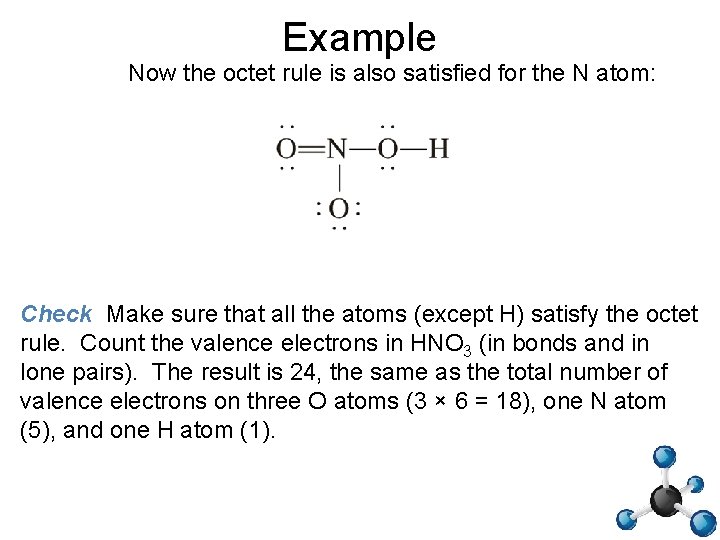
Example Now the octet rule is also satisfied for the N atom: Check Make sure that all the atoms (except H) satisfy the octet rule. Count the valence electrons in HNO 3 (in bonds and in lone pairs). The result is 24, the same as the total number of valence electrons on three O atoms (3 × 6 = 18), one N atom (5), and one H atom (1).
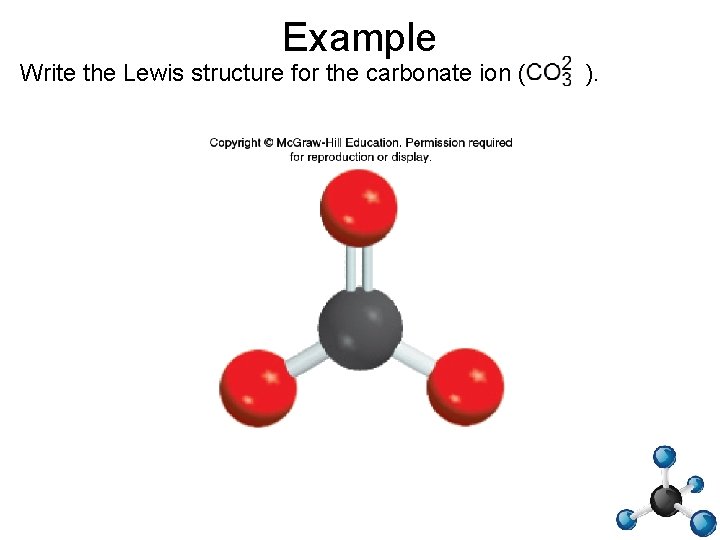
Example Write the Lewis structure for the carbonate ion ( ).
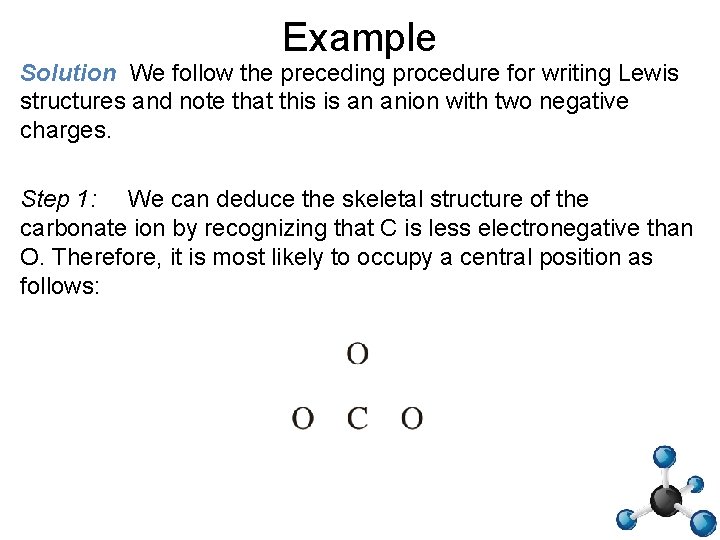
Example Solution We follow the preceding procedure for writing Lewis structures and note that this is an anion with two negative charges. Step 1: We can deduce the skeletal structure of the carbonate ion by recognizing that C is less electronegative than O. Therefore, it is most likely to occupy a central position as follows:
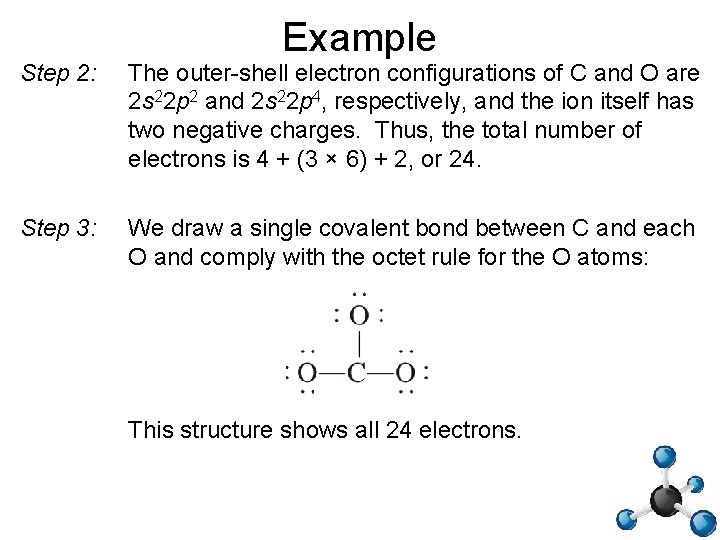
Example Step 2: The outer-shell electron configurations of C and O are 2 s 22 p 2 and 2 s 22 p 4, respectively, and the ion itself has two negative charges. Thus, the total number of electrons is 4 + (3 × 6) + 2, or 24. Step 3: We draw a single covalent bond between C and each O and comply with the octet rule for the O atoms: This structure shows all 24 electrons.
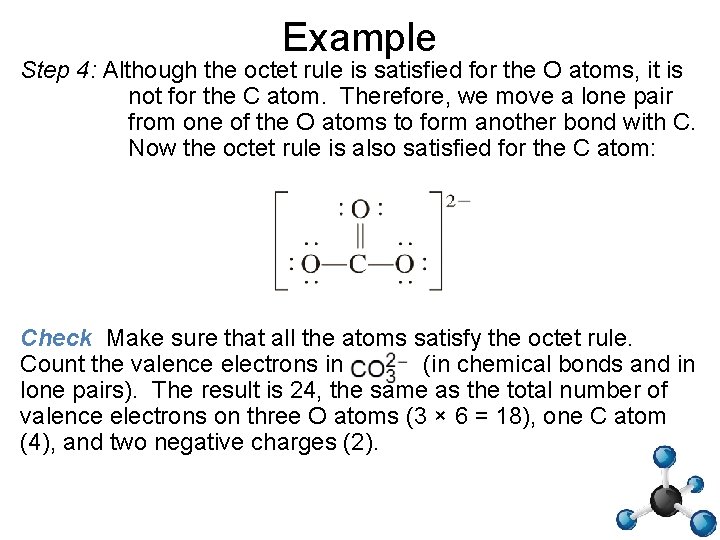
Example Step 4: Although the octet rule is satisfied for the O atoms, it is not for the C atom. Therefore, we move a lone pair from one of the O atoms to form another bond with C. Now the octet rule is also satisfied for the C atom: Check Make sure that all the atoms satisfy the octet rule. Count the valence electrons in (in chemical bonds and in lone pairs). The result is 24, the same as the total number of valence electrons on three O atoms (3 × 6 = 18), one C atom (4), and two negative charges (2).
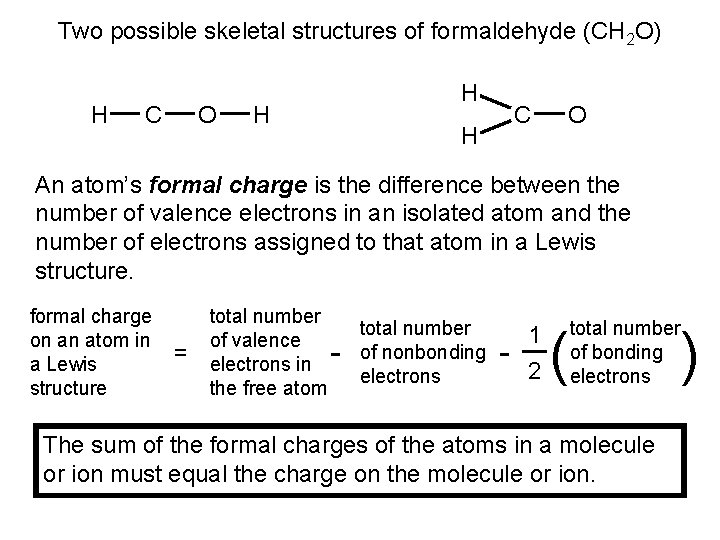
Two possible skeletal structures of formaldehyde (CH 2 O) H C O H H C H O An atom’s formal charge is the difference between the number of valence electrons in an isolated atom and the number of electrons assigned to that atom in a Lewis structure. formal charge on an atom in a Lewis structure = total number of valence electrons in the free atom - total number of nonbonding electrons - 1 2 ( total number of bonding electrons The sum of the formal charges of the atoms in a molecule or ion must equal the charge on the molecule or ion. )
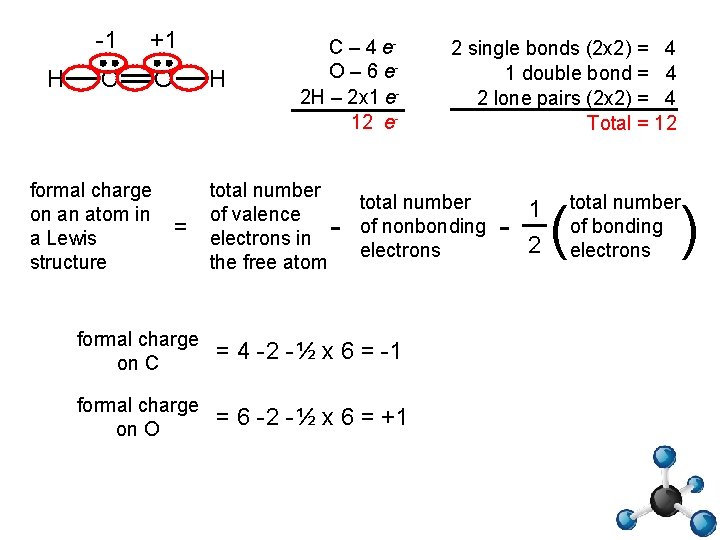
H -1 +1 C O formal charge on an atom in a Lewis structure H = C – 4 e. O – 6 e 2 H – 2 x 1 e 12 e- total number of valence electrons in the free atom - 2 single bonds (2 x 2) = 4 1 double bond = 4 2 lone pairs (2 x 2) = 4 Total = 12 total number of nonbonding electrons formal charge on C = 4 -2 - ½ x 6 = -1 formal charge on O = 6 -2 - ½ x 6 = +1 - 1 2 ( total number of bonding electrons )
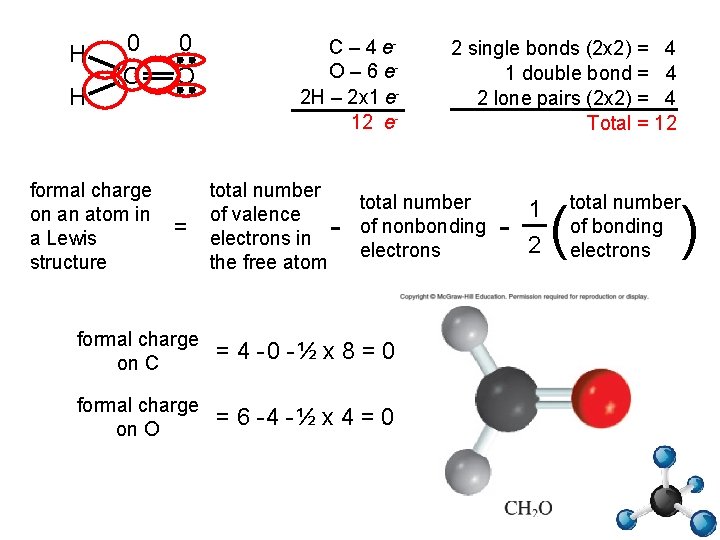
H H 0 C formal charge on an atom in a Lewis structure 0 O = C – 4 e. O – 6 e 2 H – 2 x 1 e 12 etotal number of valence electrons in the free atom - 2 single bonds (2 x 2) = 4 1 double bond = 4 2 lone pairs (2 x 2) = 4 Total = 12 total number of nonbonding electrons formal charge on C = 4 - 0 -½ x 8 = 0 formal charge on O = 6 -4 - ½ x 4 = 0 - 1 2 ( total number of bonding electrons )
Example Write formal charges for the carbonate ion.
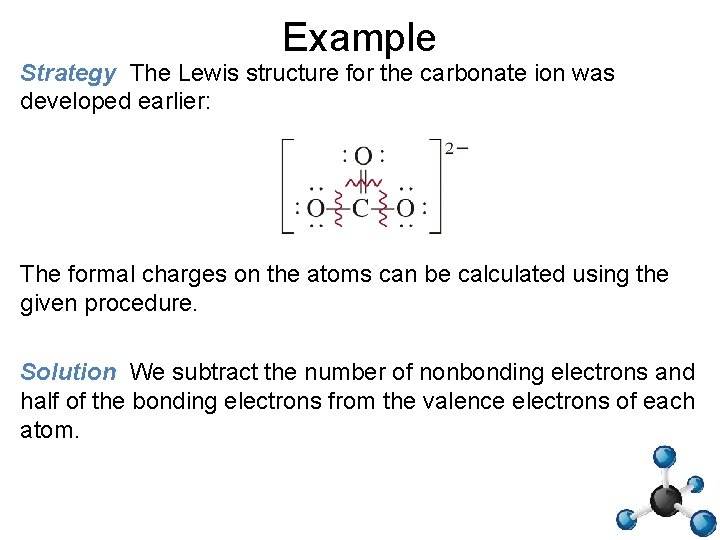
Example Strategy The Lewis structure for the carbonate ion was developed earlier: The formal charges on the atoms can be calculated using the given procedure. Solution We subtract the number of nonbonding electrons and half of the bonding electrons from the valence electrons of each atom.
Example The C atom: The C atom has four valence electrons and there are no nonbonding electrons on the atom in the Lewis structure. The breaking of the double bond and two single bonds results in the transfer of four electrons to the C atom. Therefore, the formal charge is 4 − 4 = 0. The O atom in C=O: The O atom has six valence electrons and there are four nonbonding electrons on the atom. The breaking of the double bond results in the transfer of two electrons to the O atom. Here the formal charge is 6 − 4 − 2 = 0.
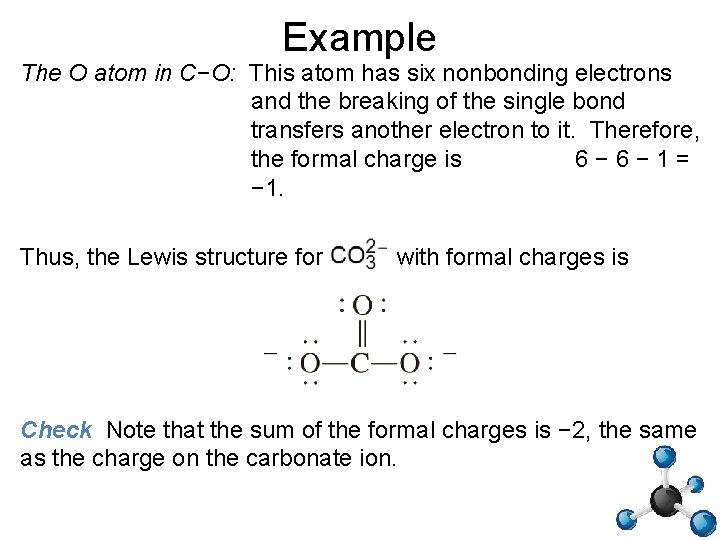
Example The O atom in C−O: This atom has six nonbonding electrons and the breaking of the single bond transfers another electron to it. Therefore, the formal charge is 6− 6− 1= − 1. Thus, the Lewis structure for with formal charges is Check Note that the sum of the formal charges is − 2, the same as the charge on the carbonate ion.
Formal Charge and Lewis Structures 1. For neutral molecules, a Lewis structure in which there are no formal charges is preferable to one in which formal charges are present. 2. Lewis structures with large formal charges are less plausible than those with small formal charges. 3. Among Lewis structures having similar distributions of formal charges, the most plausible structure is the one in which negative formal charges are placed on the more electronegative atoms.
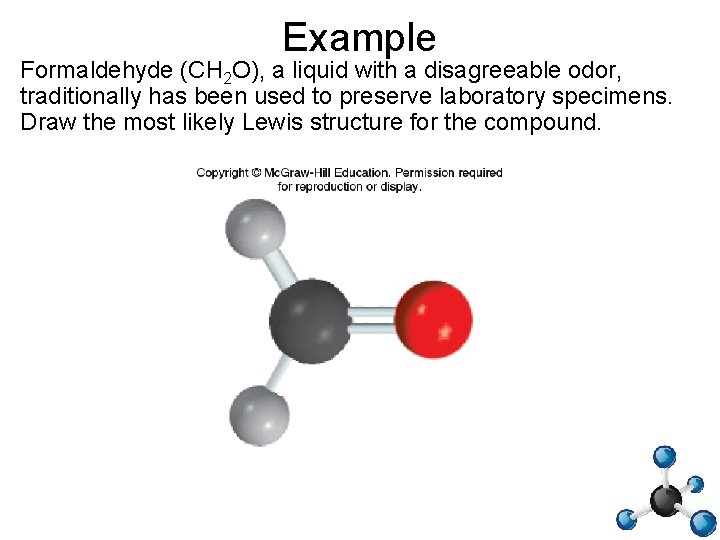
Example Formaldehyde (CH 2 O), a liquid with a disagreeable odor, traditionally has been used to preserve laboratory specimens. Draw the most likely Lewis structure for the compound.
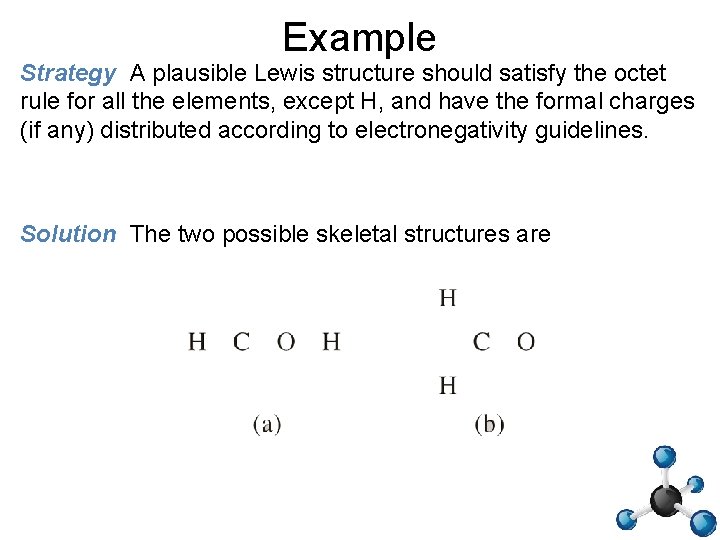
Example Strategy A plausible Lewis structure should satisfy the octet rule for all the elements, except H, and have the formal charges (if any) distributed according to electronegativity guidelines. Solution The two possible skeletal structures are
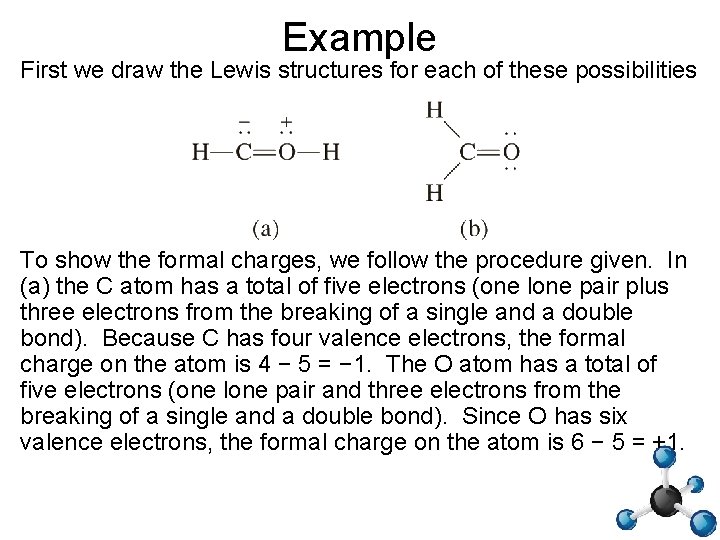
Example First we draw the Lewis structures for each of these possibilities To show the formal charges, we follow the procedure given. In (a) the C atom has a total of five electrons (one lone pair plus three electrons from the breaking of a single and a double bond). Because C has four valence electrons, the formal charge on the atom is 4 − 5 = − 1. The O atom has a total of five electrons (one lone pair and three electrons from the breaking of a single and a double bond). Since O has six valence electrons, the formal charge on the atom is 6 − 5 = +1.
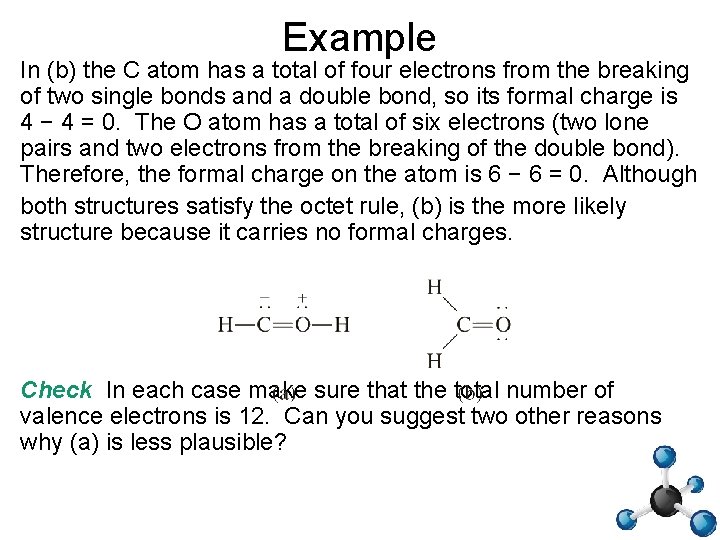
Example In (b) the C atom has a total of four electrons from the breaking of two single bonds and a double bond, so its formal charge is 4 − 4 = 0. The O atom has a total of six electrons (two lone pairs and two electrons from the breaking of the double bond). Therefore, the formal charge on the atom is 6 − 6 = 0. Although both structures satisfy the octet rule, (b) is the more likely structure because it carries no formal charges. Check In each case make sure that the total number of valence electrons is 12. Can you suggest two other reasons why (a) is less plausible?
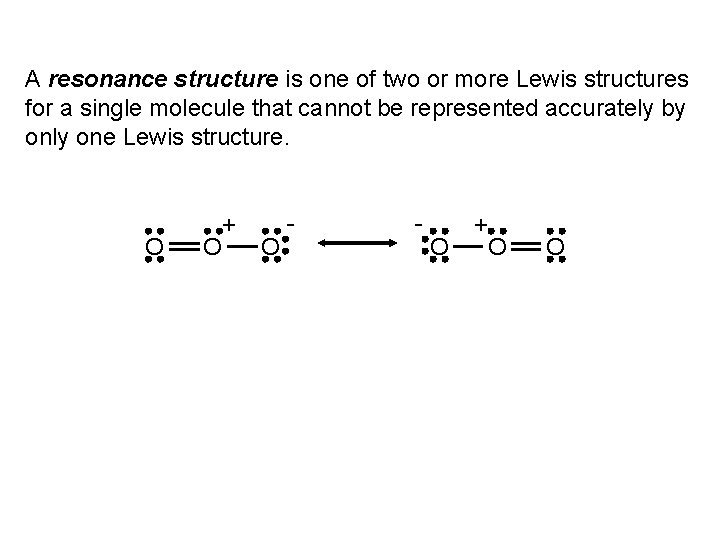
A resonance structure is one of two or more Lewis structures for a single molecule that cannot be represented accurately by only one Lewis structure. O O + O - - O + O O
Example Draw three resonance structures for the molecule nitrous oxide, N 2 O (the atomic arrangement is NNO). Indicate formal charges. Rank the structures in their relative importance to the overall properties of the molecule.
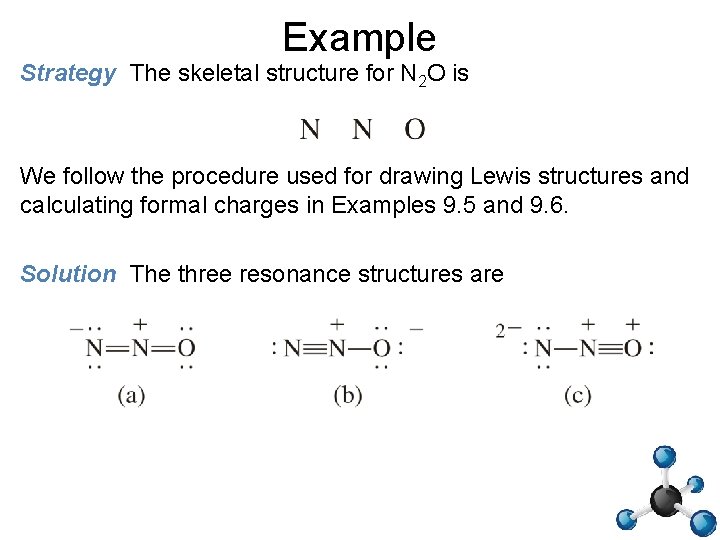
Example Strategy The skeletal structure for N 2 O is We follow the procedure used for drawing Lewis structures and calculating formal charges in Examples 9. 5 and 9. 6. Solution The three resonance structures are
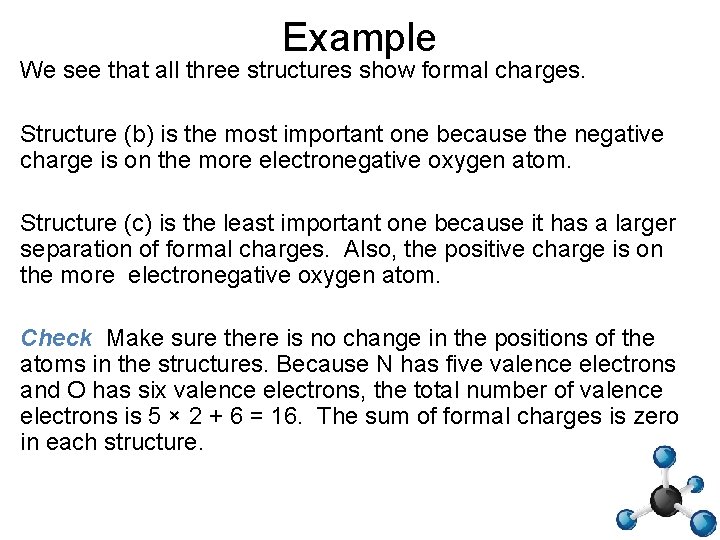
Example We see that all three structures show formal charges. Structure (b) is the most important one because the negative charge is on the more electronegative oxygen atom. Structure (c) is the least important one because it has a larger separation of formal charges. Also, the positive charge is on the more electronegative oxygen atom. Check Make sure there is no change in the positions of the atoms in the structures. Because N has five valence electrons and O has six valence electrons, the total number of valence electrons is 5 × 2 + 6 = 16. The sum of formal charges is zero in each structure.
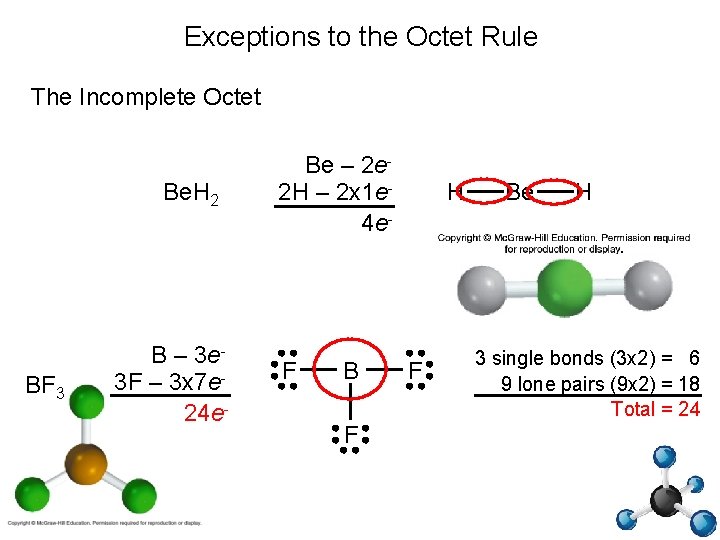
Exceptions to the Octet Rule The Incomplete Octet Be. H 2 BF 3 B – 3 e 3 F – 3 x 7 e 24 e- Be – 2 e 2 H – 2 x 1 e 4 e- F B F H F Be H 3 single bonds (3 x 2) = 6 9 lone pairs (9 x 2) = 18 Total = 24
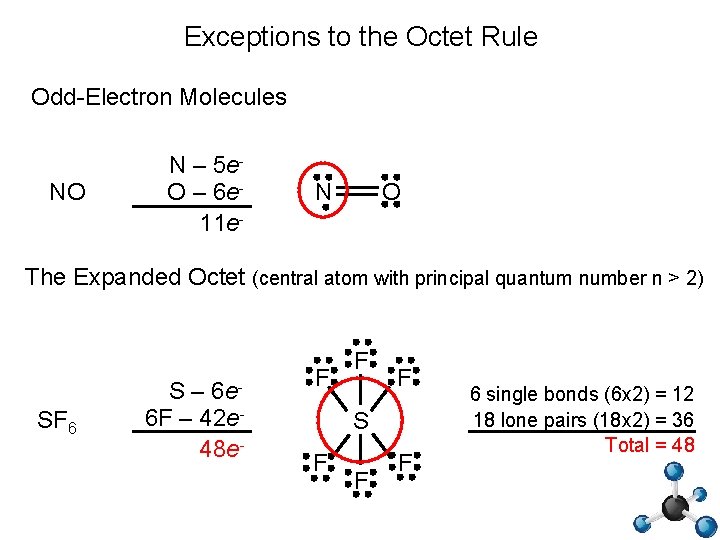
Exceptions to the Octet Rule Odd-Electron Molecules NO N – 5 e. O – 6 e 11 e- N O The Expanded Octet (central atom with principal quantum number n > 2) SF 6 S – 6 e 6 F – 42 e 48 e- F F F S F F F 6 single bonds (6 x 2) = 12 18 lone pairs (18 x 2) = 36 Total = 48
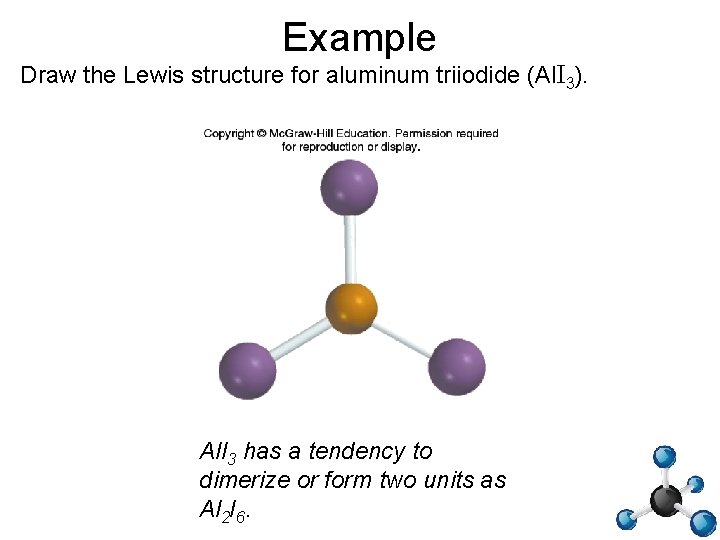
Example Draw the Lewis structure for aluminum triiodide (Al. I 3). Al. I 3 has a tendency to dimerize or form two units as Al 2 I 6.
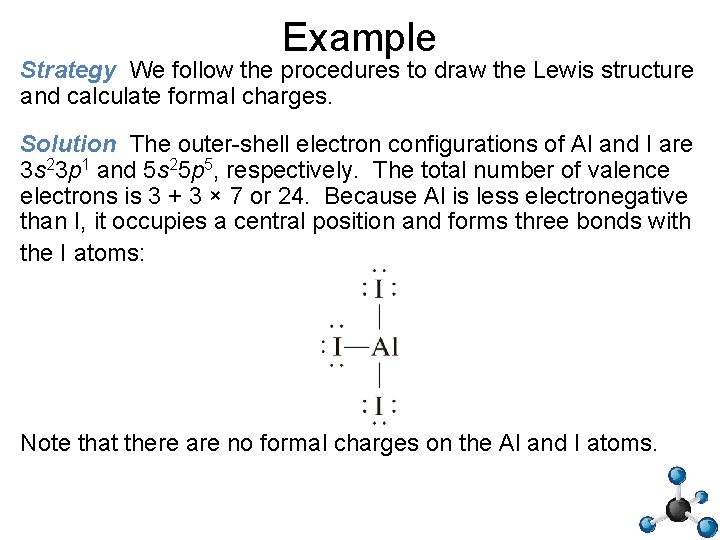
Example Strategy We follow the procedures to draw the Lewis structure and calculate formal charges. Solution The outer-shell electron configurations of Al and I are 3 s 23 p 1 and 5 s 25 p 5, respectively. The total number of valence electrons is 3 + 3 × 7 or 24. Because Al is less electronegative than I, it occupies a central position and forms three bonds with the I atoms: Note that there are no formal charges on the Al and I atoms.
Example Check Although the octet rule is satisfied for the I atoms, there are only six valence electrons around the Al atom. Thus, Al. I 3 is an example of the incomplete octet.
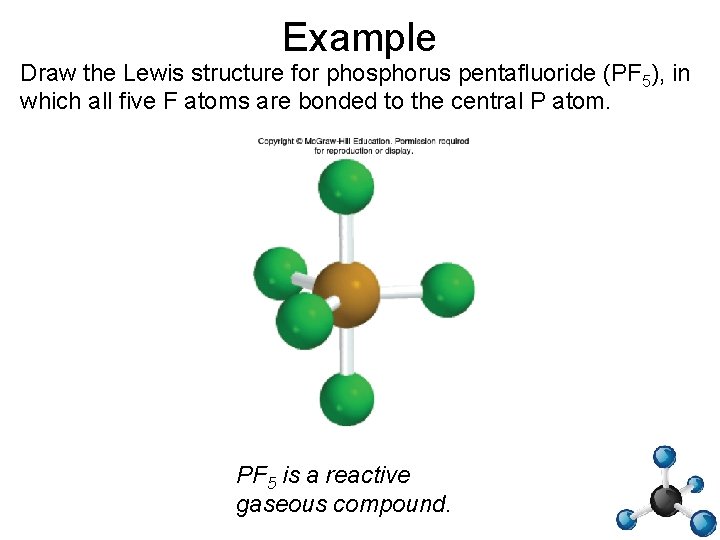
Example Draw the Lewis structure for phosphorus pentafluoride (PF 5), in which all five F atoms are bonded to the central P atom. PF 5 is a reactive gaseous compound.
Example Strategy Note that P is a third-period element. We follow the procedures given in Examples 9. 5 and 9. 6 to draw the Lewis structure and calculate formal charges. Solution The outer-shell electron configurations for P and F are 3 s 23 p 3 and 2 s 22 p 5, respectively, and so the total number of valence electrons is 5 + (5 × 7), or 40. Phosphorus, like sulfur, is a third-period element, and therefore it can have an expanded octet.
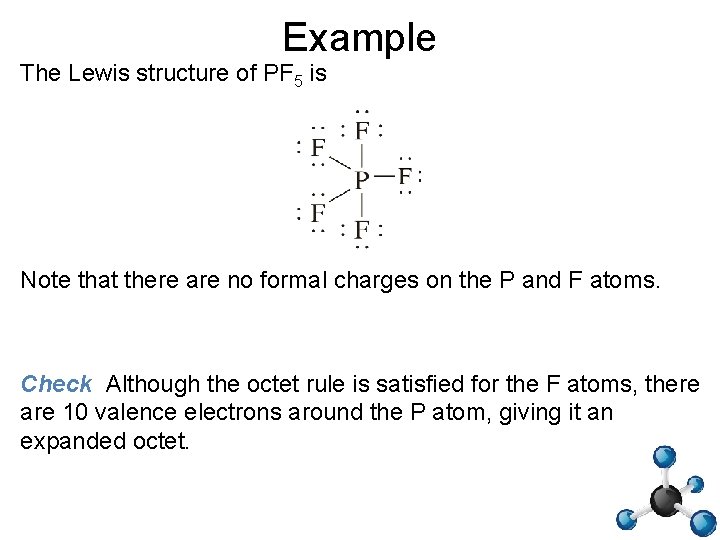
Example The Lewis structure of PF 5 is Note that there are no formal charges on the P and F atoms. Check Although the octet rule is satisfied for the F atoms, there are 10 valence electrons around the P atom, giving it an expanded octet.
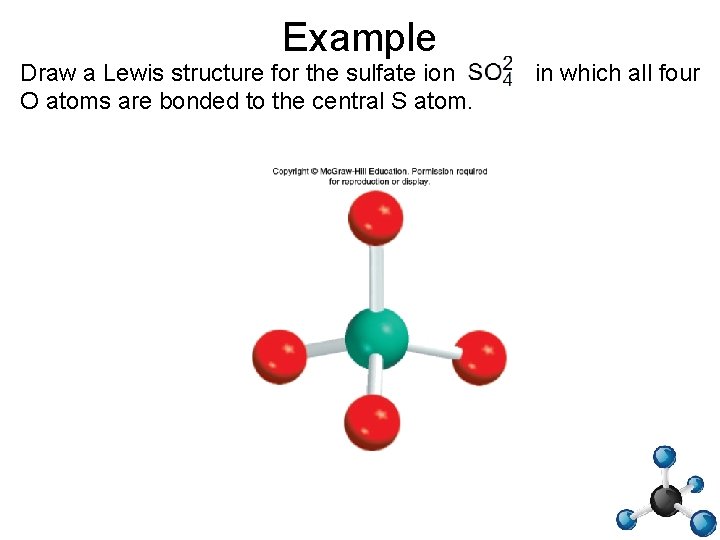
Example Draw a Lewis structure for the sulfate ion O atoms are bonded to the central S atom. in which all four
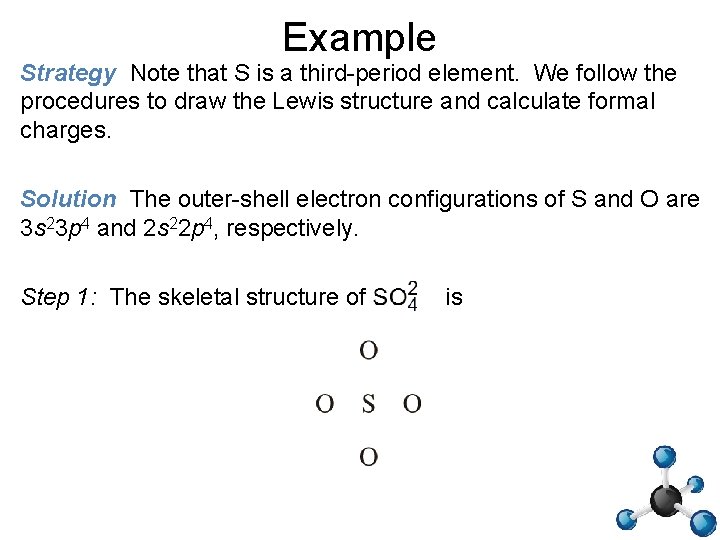
Example Strategy Note that S is a third-period element. We follow the procedures to draw the Lewis structure and calculate formal charges. Solution The outer-shell electron configurations of S and O are 3 s 23 p 4 and 2 s 22 p 4, respectively. Step 1: The skeletal structure of is
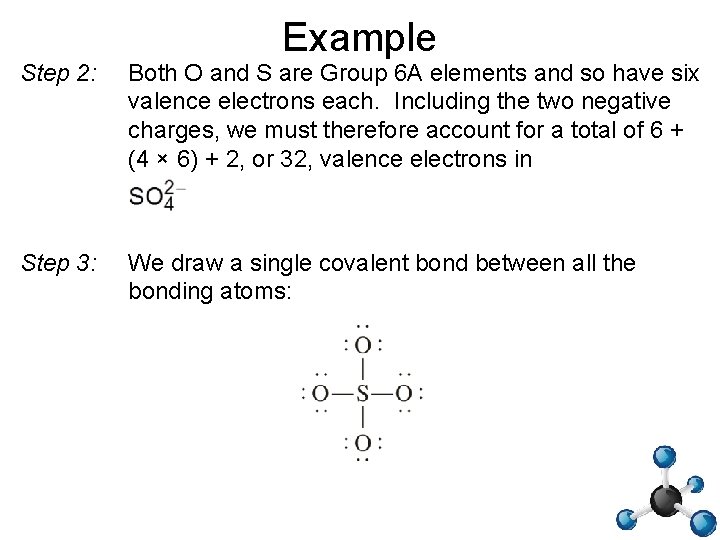
Example Step 2: Both O and S are Group 6 A elements and so have six valence electrons each. Including the two negative charges, we must therefore account for a total of 6 + (4 × 6) + 2, or 32, valence electrons in Step 3: We draw a single covalent bond between all the bonding atoms:
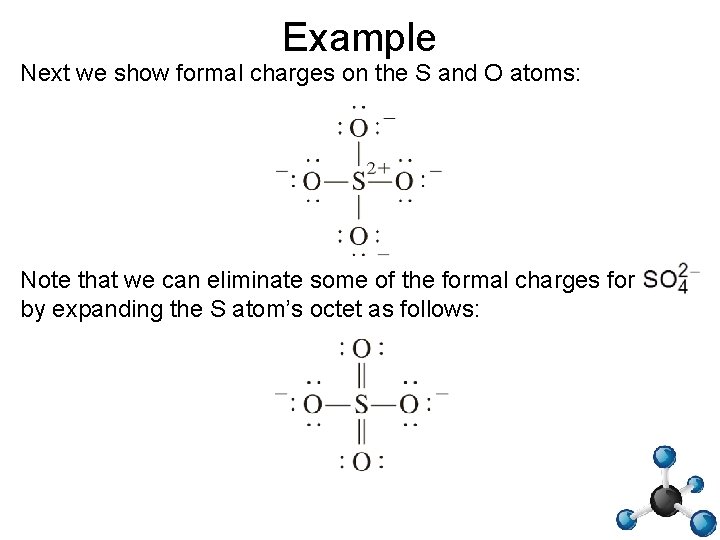
Example Next we show formal charges on the S and O atoms: Note that we can eliminate some of the formal charges for by expanding the S atom’s octet as follows:
Example The question of which of these two structures is more important, that is, the one in which the S atom obeys the octet rule but bears more formal charges or the one in which the S atom expands its octet, has been the subject of some debate among chemists. In many cases, only elaborate quantum mechanical calculations can provide a clearer answer. At this stage of learning, you should realize that both representations are valid Lewis structures and you should be able to draw both types of structures. One helpful rule is that in trying to minimize formal charges by expanding the central atom’s octet, only add enough double bonds to make the formal charge on the central atom zero.
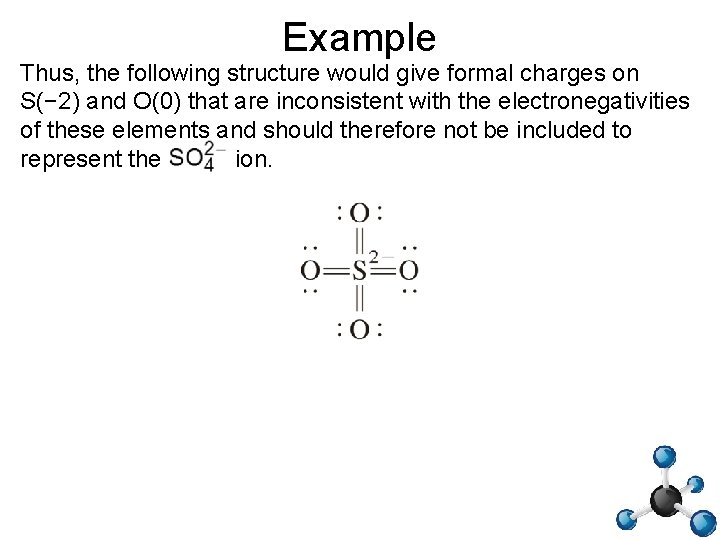
Example Thus, the following structure would give formal charges on S(− 2) and O(0) that are inconsistent with the electronegativities of these elements and should therefore not be included to represent the ion.
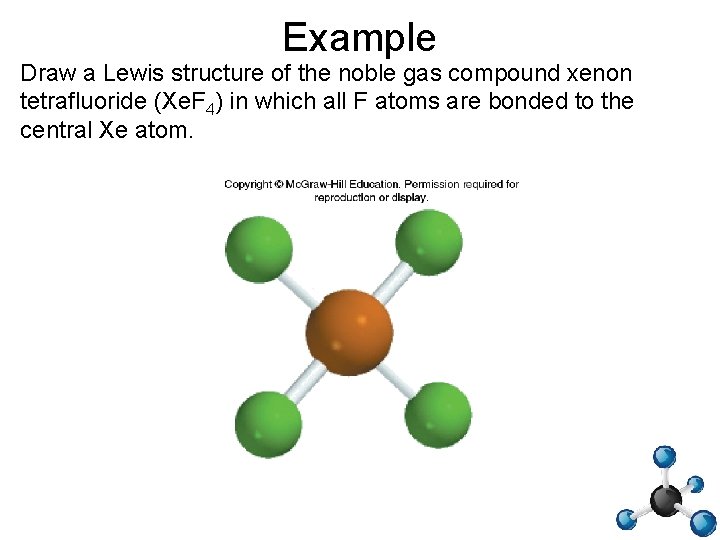
Example Draw a Lewis structure of the noble gas compound xenon tetrafluoride (Xe. F 4) in which all F atoms are bonded to the central Xe atom.
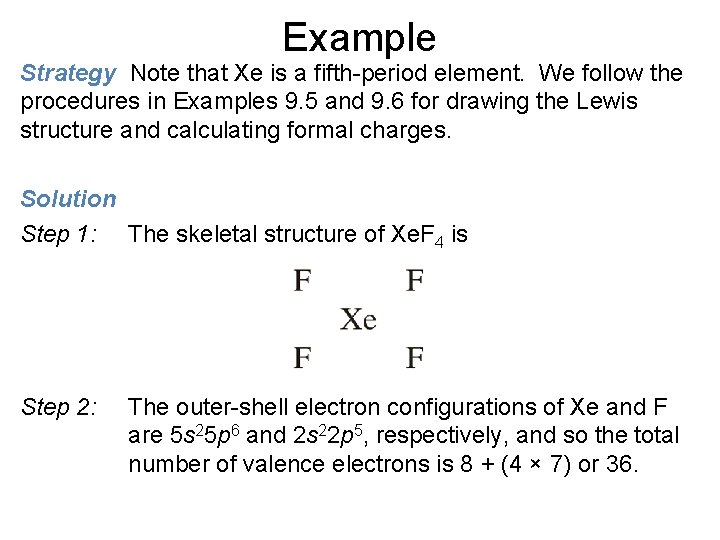
Example Strategy Note that Xe is a fifth-period element. We follow the procedures in Examples 9. 5 and 9. 6 for drawing the Lewis structure and calculating formal charges. Solution Step 1: The skeletal structure of Xe. F 4 is Step 2: The outer-shell electron configurations of Xe and F are 5 s 25 p 6 and 2 s 22 p 5, respectively, and so the total number of valence electrons is 8 + (4 × 7) or 36.
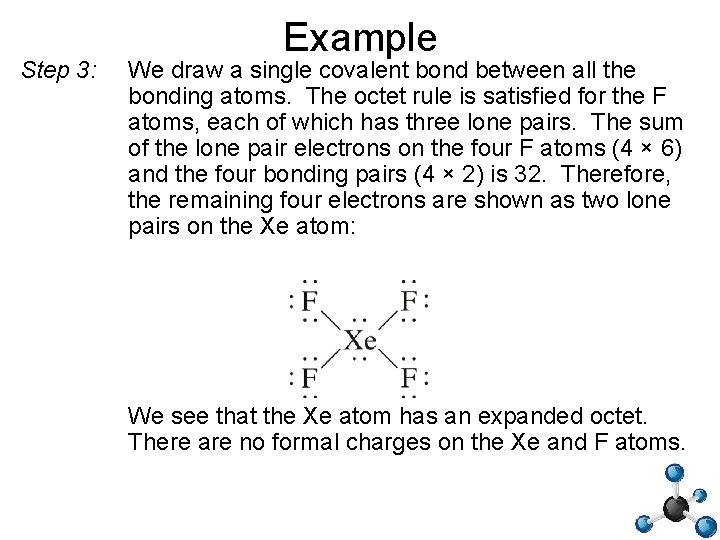
Step 3: Example We draw a single covalent bond between all the bonding atoms. The octet rule is satisfied for the F atoms, each of which has three lone pairs. The sum of the lone pair electrons on the four F atoms (4 × 6) and the four bonding pairs (4 × 2) is 32. Therefore, the remaining four electrons are shown as two lone pairs on the Xe atom: We see that the Xe atom has an expanded octet. There are no formal charges on the Xe and F atoms.
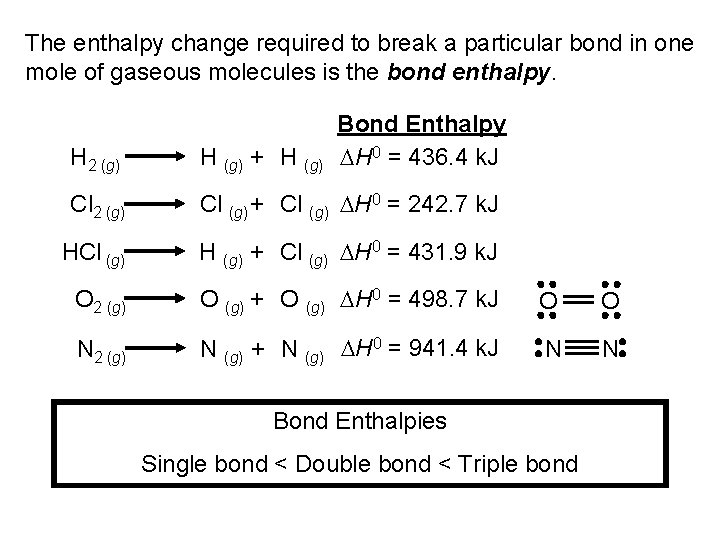
The enthalpy change required to break a particular bond in one mole of gaseous molecules is the bond enthalpy. Bond Enthalpy DH 0 = 436. 4 k. J H 2 (g) H (g) + H (g) Cl 2 (g) Cl (g) + Cl (g) DH 0 = 242. 7 k. J HCl (g) H (g) + Cl (g) DH 0 = 431. 9 k. J O 2 (g) O (g) + O (g) DH 0 = 498. 7 k. J O O N 2 (g) N (g) + N (g) DH 0 = 941. 4 k. J N N Bond Enthalpies Single bond < Double bond < Triple bond
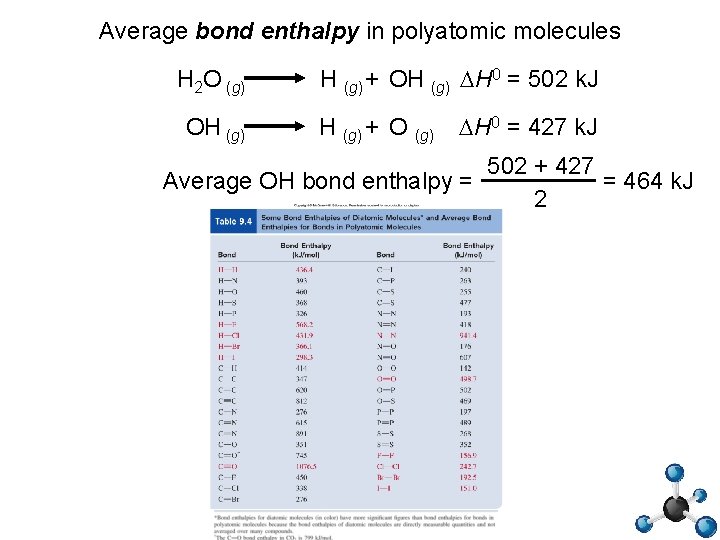
Average bond enthalpy in polyatomic molecules H 2 O (g) OH (g) + OH (g) DH 0 = 502 k. J H (g) + O (g) DH 0 = 427 k. J 502 + 427 Average OH bond enthalpy = = 464 k. J 2
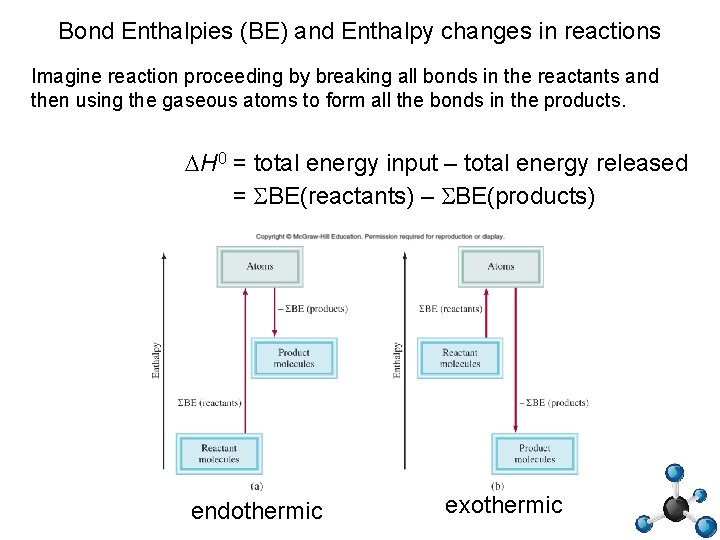
Bond Enthalpies (BE) and Enthalpy changes in reactions Imagine reaction proceeding by breaking all bonds in the reactants and then using the gaseous atoms to form all the bonds in the products. DH 0 = total energy input – total energy released = SBE(reactants) – SBE(products) endothermic exothermic
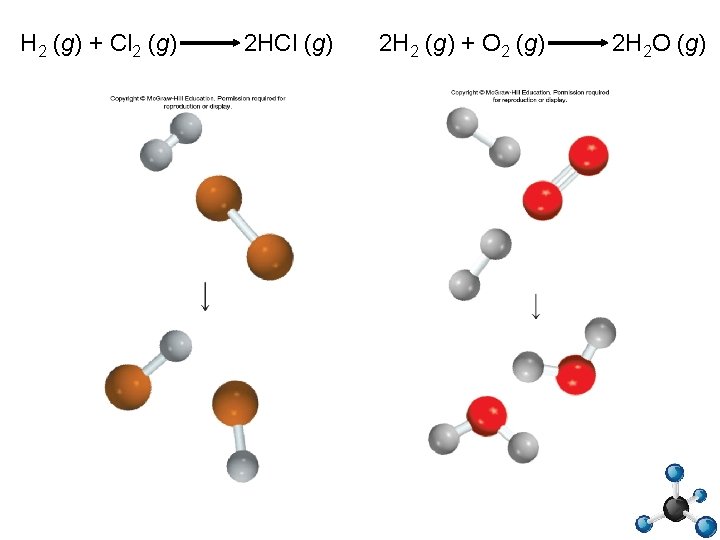
H 2 (g) + Cl 2 (g) 2 HCl (g) 2 H 2 (g) + O 2 (g) 2 H 2 O (g)
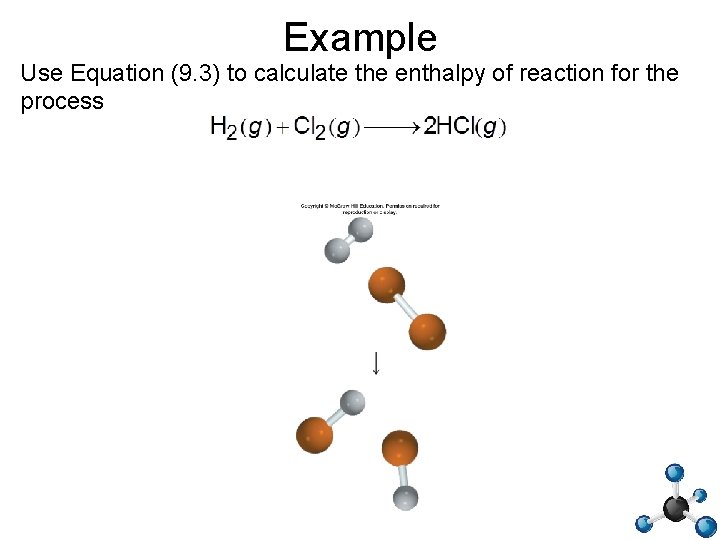
Example Use Equation (9. 3) to calculate the enthalpy of reaction for the process
Example Strategy Keep in mind that bond breaking is an energy absorbing (endothermic) process and bond making is an energy releasing (exothermic) process. Therefore, the overall energy change is the difference between these two opposing processes, as described by Equation (9. 3).
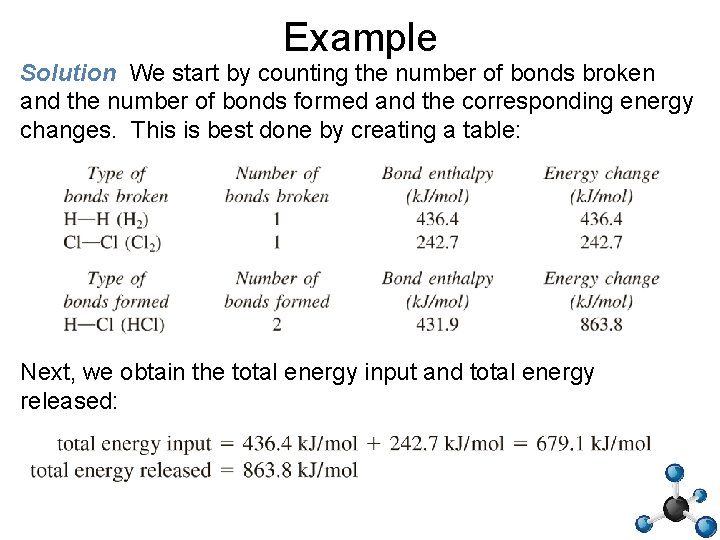
Example Solution We start by counting the number of bonds broken and the number of bonds formed and the corresponding energy changes. This is best done by creating a table: Next, we obtain the total energy input and total energy released:
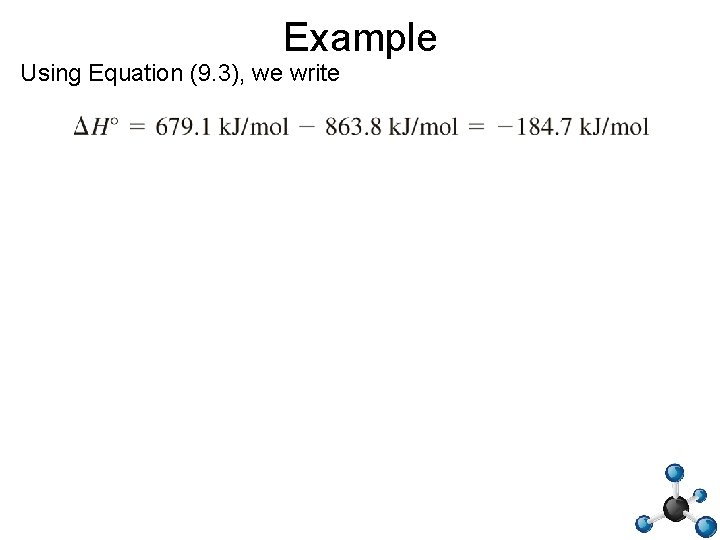
Example Using Equation (9. 3), we write
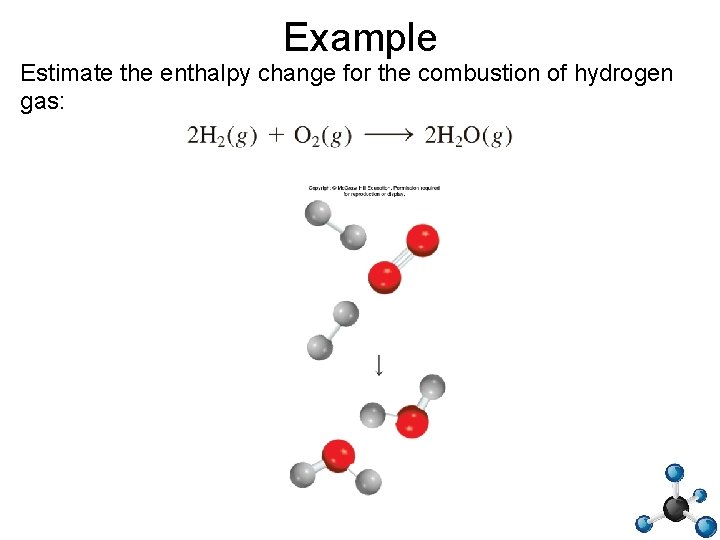
Example Estimate the enthalpy change for the combustion of hydrogen gas:
Example Strategy We basically follow the same procedure as that in Example 9. 13. Note, however, that H 2 O is a polyatomic molecule, and so we need to use the average bond enthalpy value for the O−H bond. Solution We construct the following table:
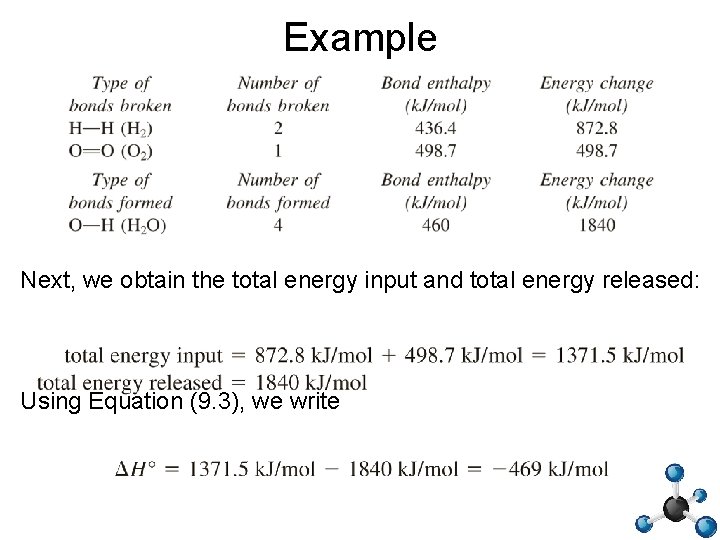
Example Next, we obtain the total energy input and total energy released: Using Equation (9. 3), we write
Assignment(s) • Read 10. 1 -10. 6, 11. 2 for Thursday • There will be a homework set on the last two lectures posted for Today for Thursday. • Another set and quiz will be posted this weekend. • Exam 4 is next Thursday.
- Slides: 75