
Chemistry 100 Chapter 15 Equilibrium Collision AB C
Chemistry 100 Chapter 15 Equilibrium
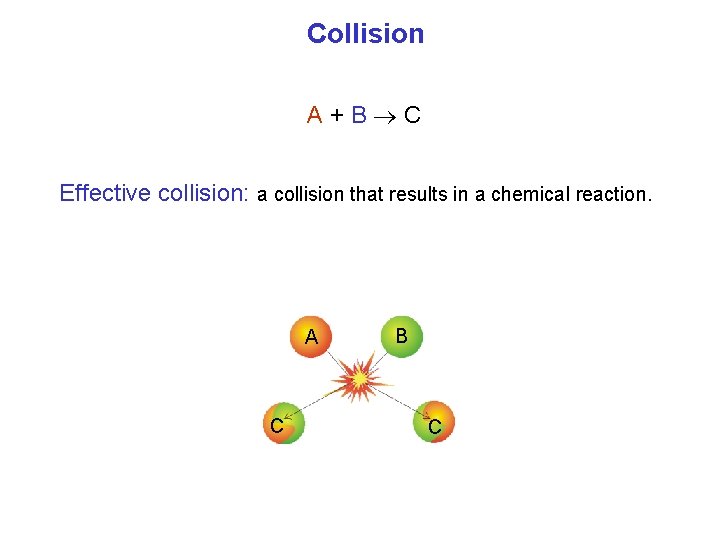
Collision A+B C Effective collision: a collision that results in a chemical reaction. A C B C
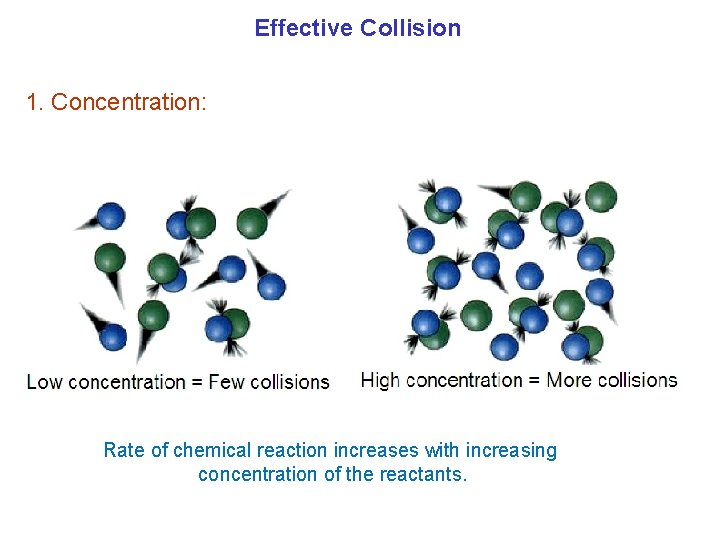
Effective Collision 1. Concentration: Rate of chemical reaction increases with increasing concentration of the reactants.
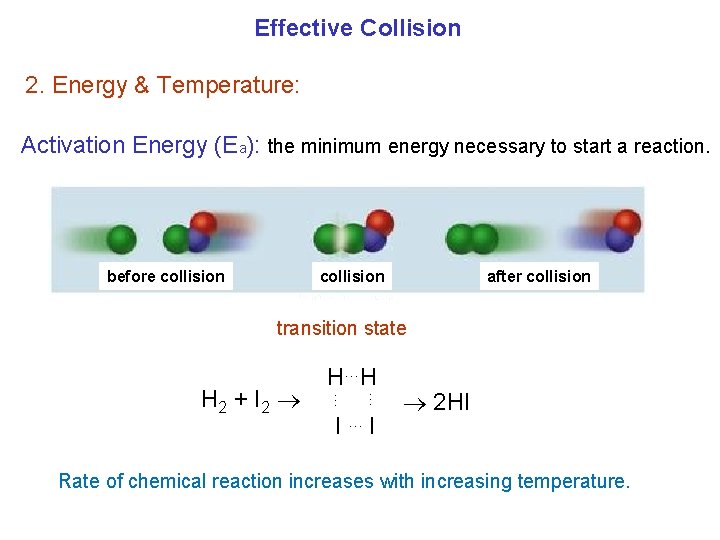
Effective Collision 2. Energy & Temperature: Activation Energy (Ea): the minimum energy necessary to start a reaction. before collision after collision transition state … … H 2 + I 2 H…H I …I 2 HI Rate of chemical reaction increases with increasing temperature.
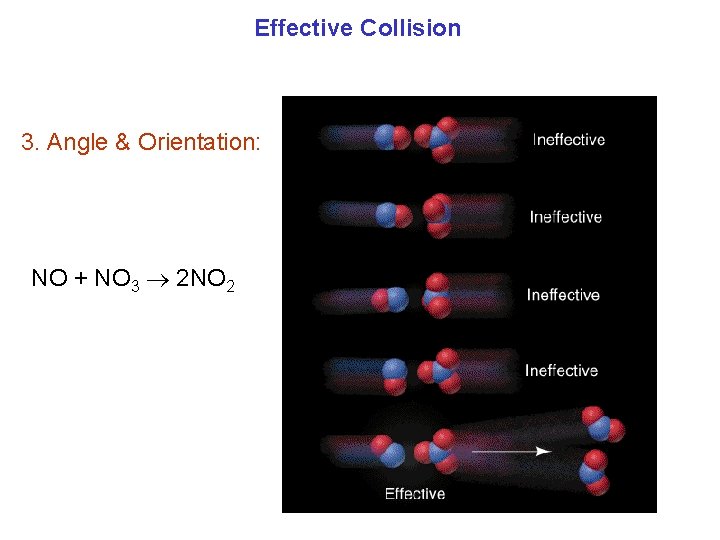
Effective Collision 3. Angle & Orientation: NO + NO 3 2 NO 2
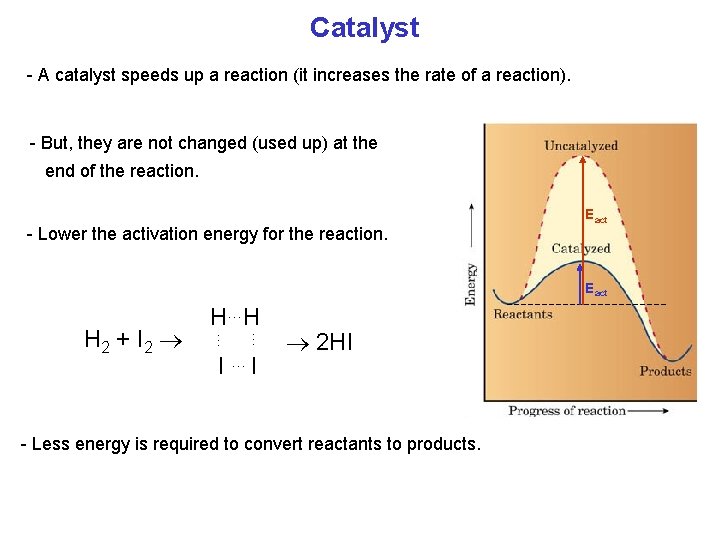
Catalyst - A catalyst speeds up a reaction (it increases the rate of a reaction). - But, they are not changed (used up) at the end of the reaction. - Lower the activation energy for the reaction. Eact … … H 2 + I 2 H…H I …I 2 HI - Less energy is required to convert reactants to products.
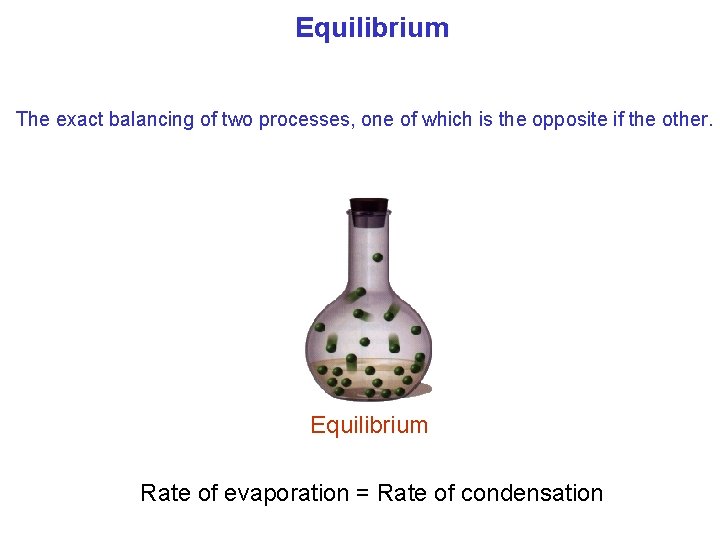
Equilibrium The exact balancing of two processes, one of which is the opposite if the other. Equilibrium Rate of evaporation = Rate of condensation
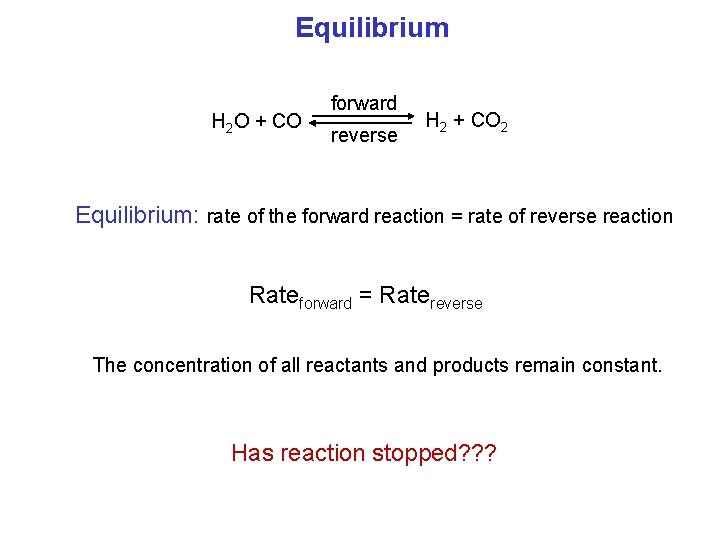
Equilibrium H 2 O + CO forward reverse H 2 + CO 2 Equilibrium: rate of the forward reaction = rate of reverse reaction Rateforward = Ratereverse The concentration of all reactants and products remain constant. Has reaction stopped? ? ?
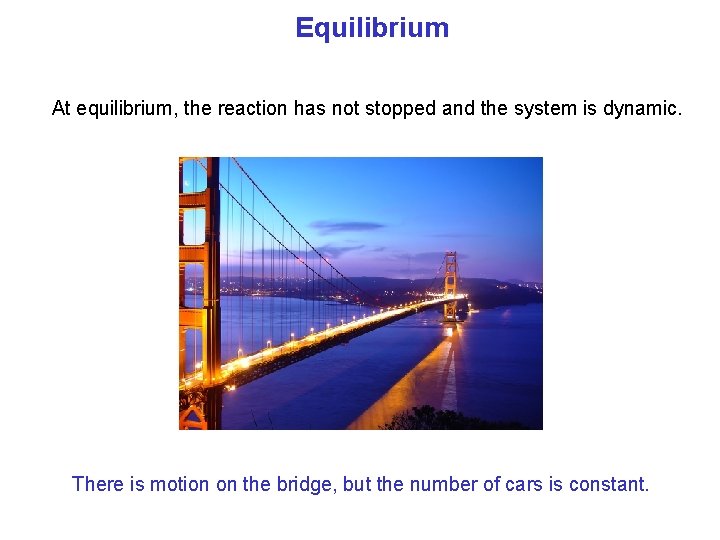
Equilibrium At equilibrium, the reaction has not stopped and the system is dynamic. There is motion on the bridge, but the number of cars is constant.
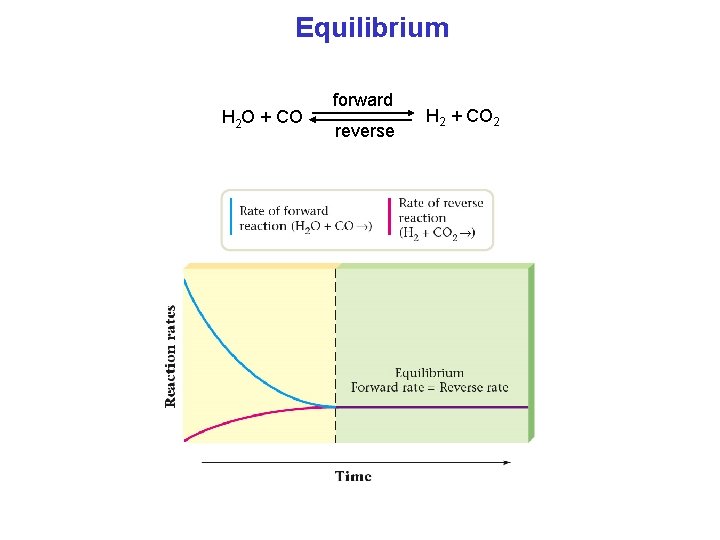
Equilibrium H 2 O + CO forward reverse H 2 + CO 2
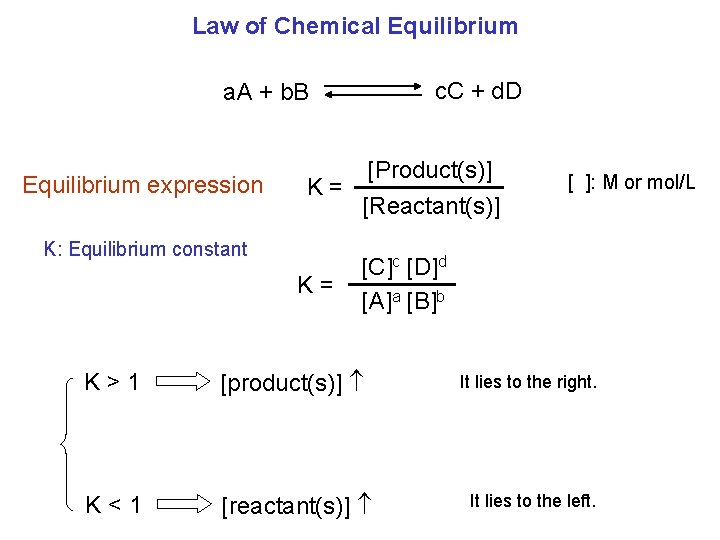
Law of Chemical Equilibrium c. C + d. D a. A + b. B Equilibrium expression [Product(s)] K= [Reactant(s)] K: Equilibrium constant K= [ ]: M or mol/L [C]c [D]d [A]a [B]b K>1 [product(s)] It lies to the right. K<1 [reactant(s)] It lies to the left.
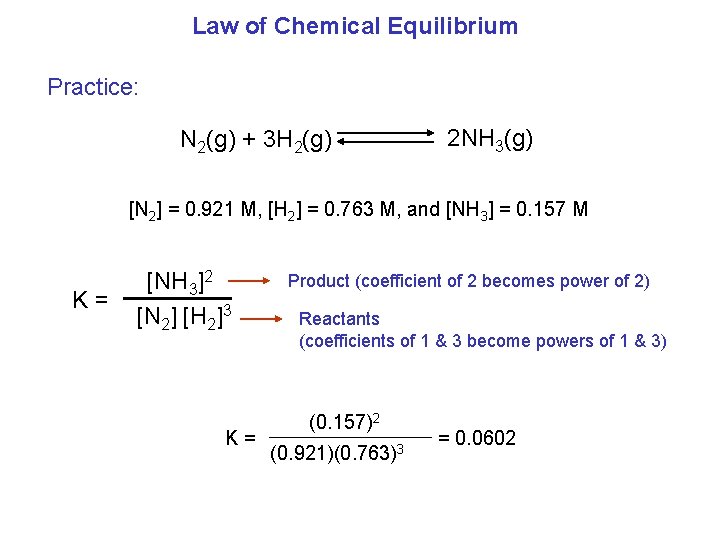
Law of Chemical Equilibrium Practice: N 2(g) + 3 H 2(g) 2 NH 3(g) [N 2] = 0. 921 M, [H 2] = 0. 763 M, and [NH 3] = 0. 157 M K= [NH 3]2 [N 2] [H 2]3 K= Product (coefficient of 2 becomes power of 2) Reactants (coefficients of 1 & 3 become powers of 1 & 3) (0. 157)2 (0. 921)(0. 763)3 = 0. 0602
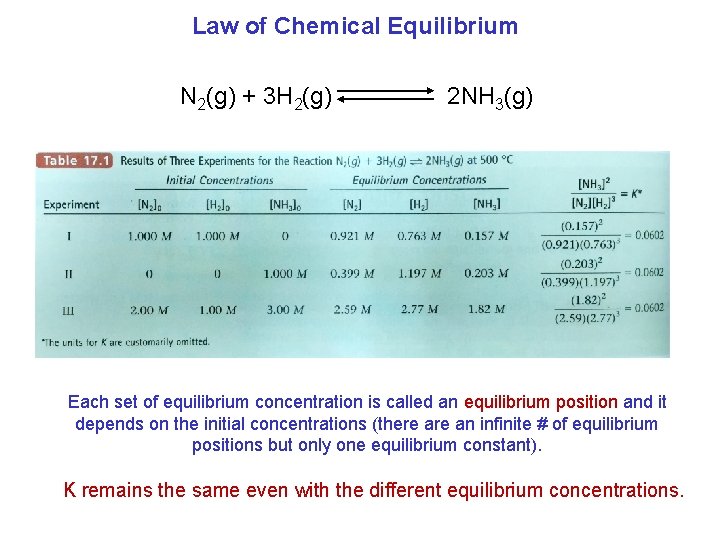
Law of Chemical Equilibrium N 2(g) + 3 H 2(g) 2 NH 3(g) Each set of equilibrium concentration is called an equilibrium position and it depends on the initial concentrations (there an infinite # of equilibrium positions but only one equilibrium constant). K remains the same even with the different equilibrium concentrations.
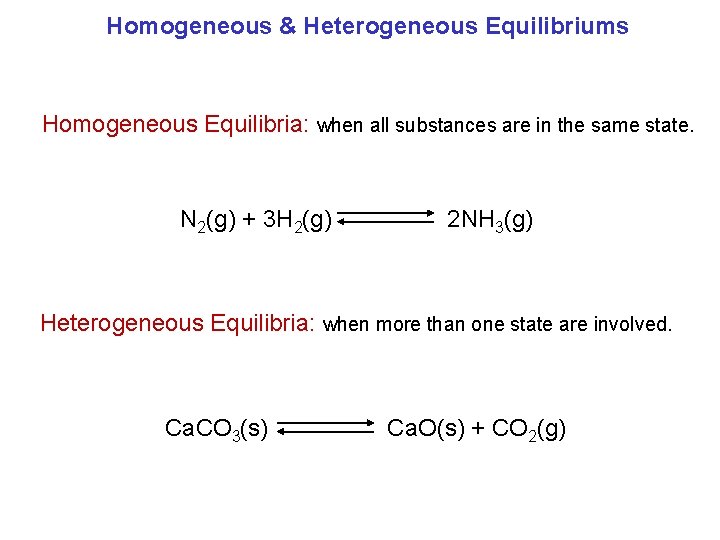
Homogeneous & Heterogeneous Equilibriums Homogeneous Equilibria: when all substances are in the same state. N 2(g) + 3 H 2(g) 2 NH 3(g) Heterogeneous Equilibria: when more than one state are involved. Ca. CO 3(s) Ca. O(s) + CO 2(g)
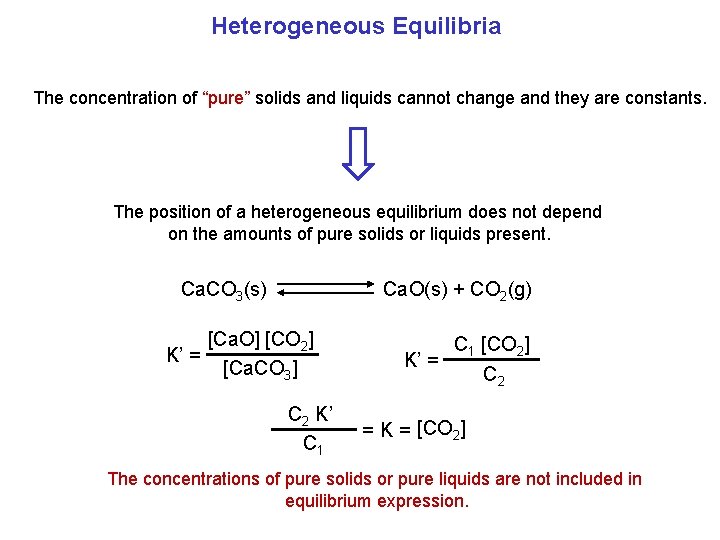
Heterogeneous Equilibria The concentration of “pure” solids and liquids cannot change and they are constants. The position of a heterogeneous equilibrium does not depend on the amounts of pure solids or liquids present. Ca. O(s) + CO 2(g) Ca. CO 3(s) [Ca. O] [CO 2] K’ = [Ca. CO 3] C 2 K’ C 1 [CO 2] K’ = C 2 = K = [CO 2] The concentrations of pure solids or pure liquids are not included in equilibrium expression.
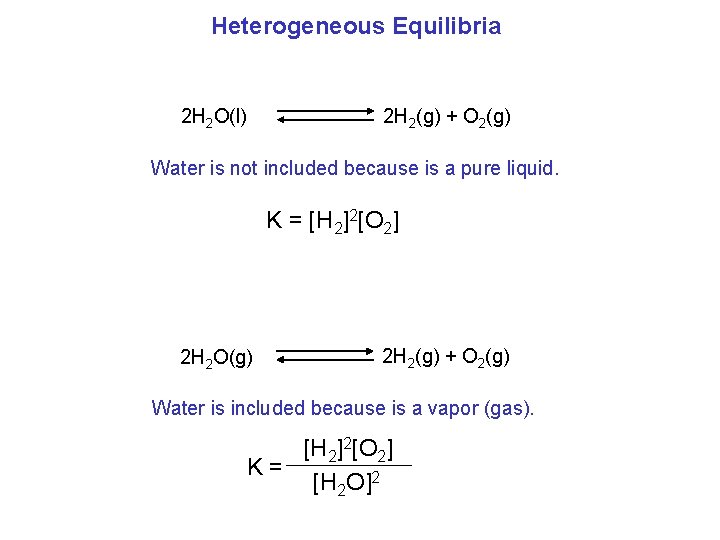
Heterogeneous Equilibria 2 H 2 O(l) 2 H 2(g) + O 2(g) Water is not included because is a pure liquid. K = [H 2]2[O 2] 2 H 2 O(g) 2 H 2(g) + O 2(g) Water is included because is a vapor (gas). [H 2]2[O 2] K= [H 2 O]2
Le Châtelier’s Principle Equilibrium shifts to counter a disturbance. When a change is imposed on a system at equilibrium, the position of the equilibrium shifts in a direction that tends to reduce the effect of that change.
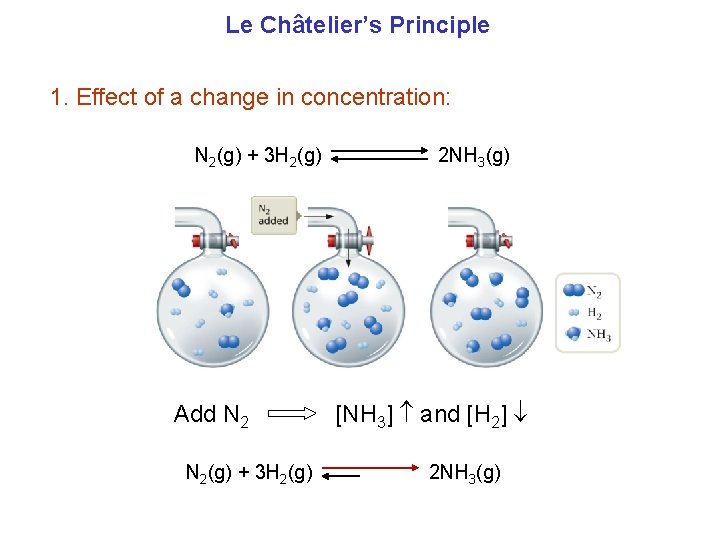
Le Châtelier’s Principle 1. Effect of a change in concentration: N 2(g) + 3 H 2(g) Add N 2(g) + 3 H 2(g) 2 NH 3(g) [NH 3] and [H 2] 2 NH 3(g)
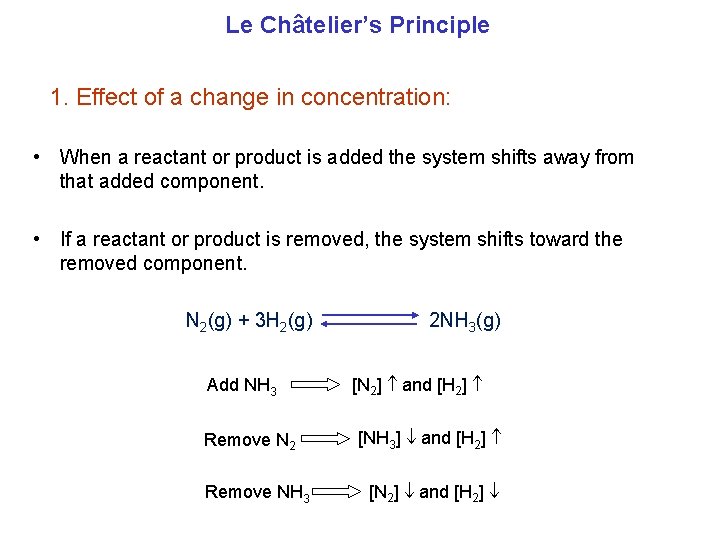
Le Châtelier’s Principle 1. Effect of a change in concentration: • When a reactant or product is added the system shifts away from that added component. • If a reactant or product is removed, the system shifts toward the removed component. N 2(g) + 3 H 2(g) Add NH 3 Remove N 2 Remove NH 3 2 NH 3(g) [N 2] and [H 2] [NH 3] and [H 2] [N 2] and [H 2]
Le Châtelier’s Principle 1. Effect of a change in concentration: K (equilibrium constant) does not change. It remains constant.
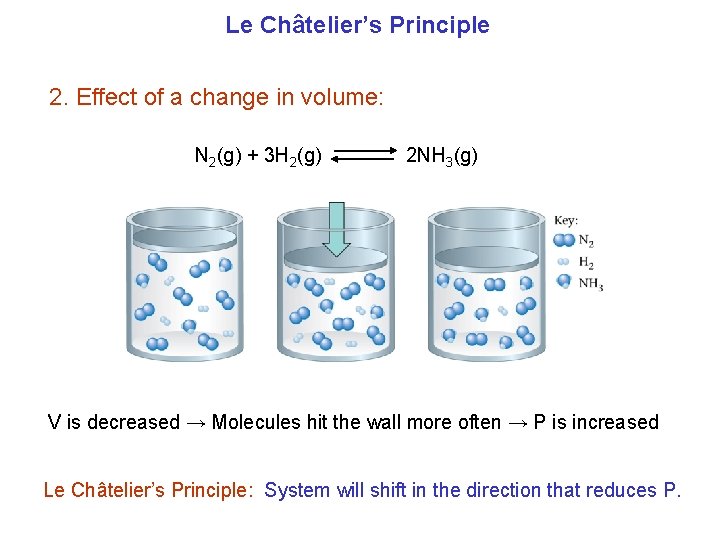
Le Châtelier’s Principle 2. Effect of a change in volume: N 2(g) + 3 H 2(g) 2 NH 3(g) V is decreased → Molecules hit the wall more often → P is increased Le Châtelier’s Principle: System will shift in the direction that reduces P.
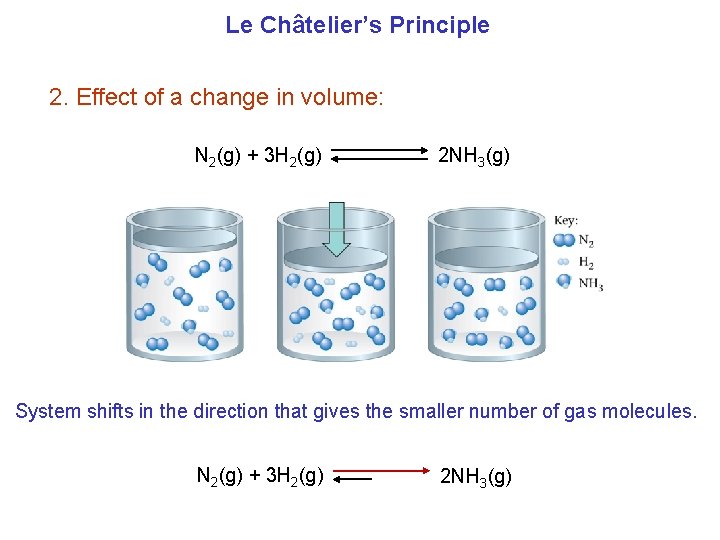
Le Châtelier’s Principle 2. Effect of a change in volume: N 2(g) + 3 H 2(g) 2 NH 3(g) System shifts in the direction that gives the smaller number of gas molecules. N 2(g) + 3 H 2(g) 2 NH 3(g)
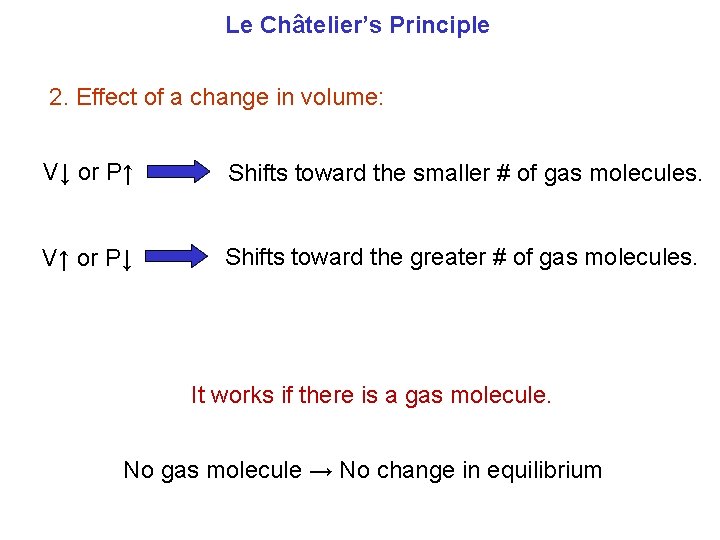
Le Châtelier’s Principle 2. Effect of a change in volume: V↓ or P↑ Shifts toward the smaller # of gas molecules. V↑ or P↓ Shifts toward the greater # of gas molecules. It works if there is a gas molecule. No gas molecule → No change in equilibrium
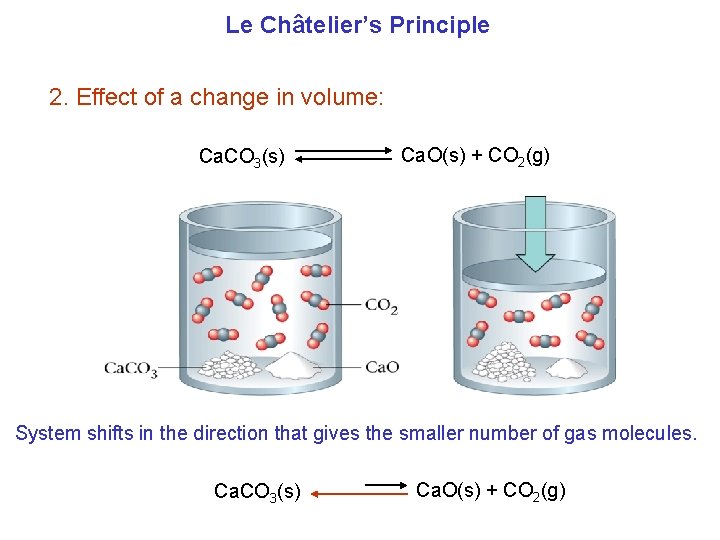
Le Châtelier’s Principle 2. Effect of a change in volume: Ca. CO 3(s) Ca. O(s) + CO 2(g) System shifts in the direction that gives the smaller number of gas molecules. Ca. CO 3(s) Ca. O(s) + CO 2(g)
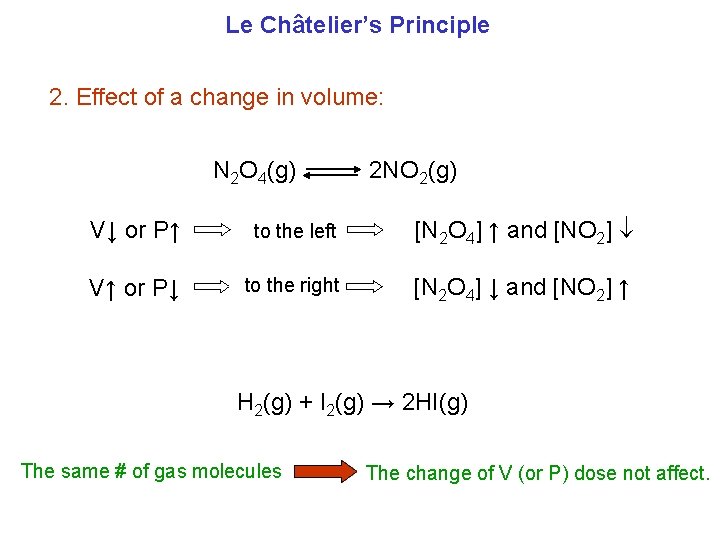
Le Châtelier’s Principle 2. Effect of a change in volume: N 2 O 4(g) 2 NO 2(g) V↓ or P↑ to the left [N 2 O 4] ↑ and [NO 2] V↑ or P↓ to the right [N 2 O 4] ↓ and [NO 2] ↑ H 2(g) + I 2(g) → 2 HI(g) The same # of gas molecules The change of V (or P) dose not affect.
Le Châtelier’s Principle 2. Effect of a change in volume: K (equilibrium constant) does not change. It remains constant.
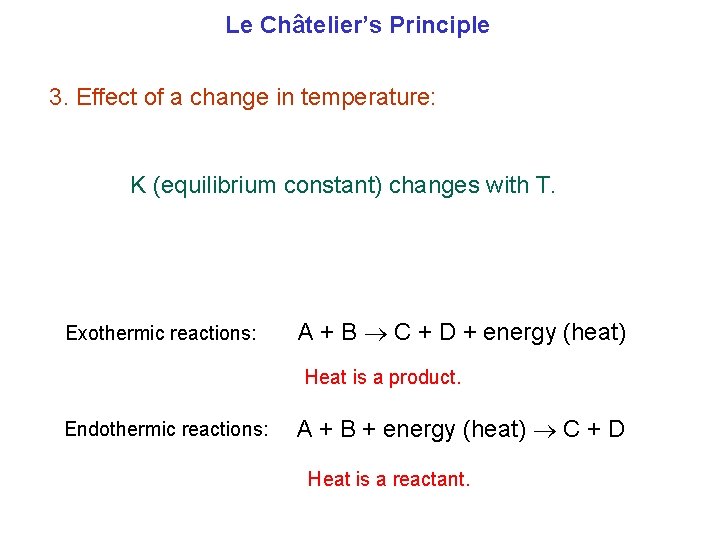
Le Châtelier’s Principle 3. Effect of a change in temperature: K (equilibrium constant) changes with T. Exothermic reactions: A + B C + D + energy (heat) Heat is a product. Endothermic reactions: A + B + energy (heat) C + D Heat is a reactant.
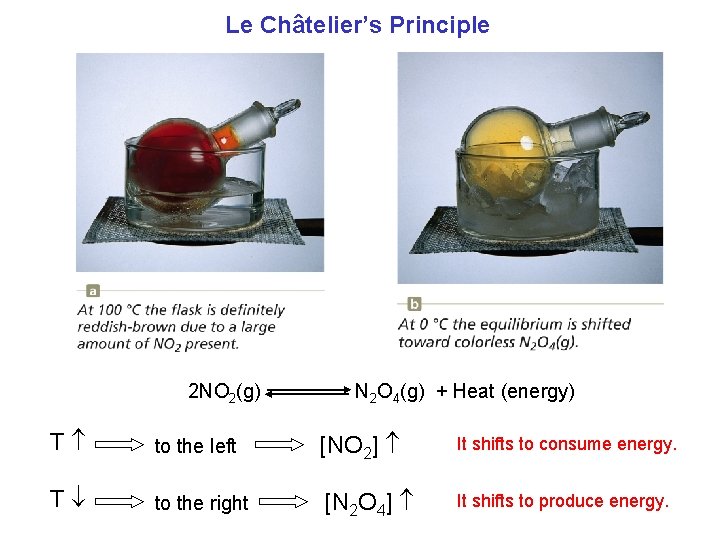
Le Châtelier’s Principle 2 NO 2(g) N 2 O 4(g) + Heat (energy) T to the left [NO 2] It shifts to consume energy. T to the right [N 2 O 4] It shifts to produce energy.
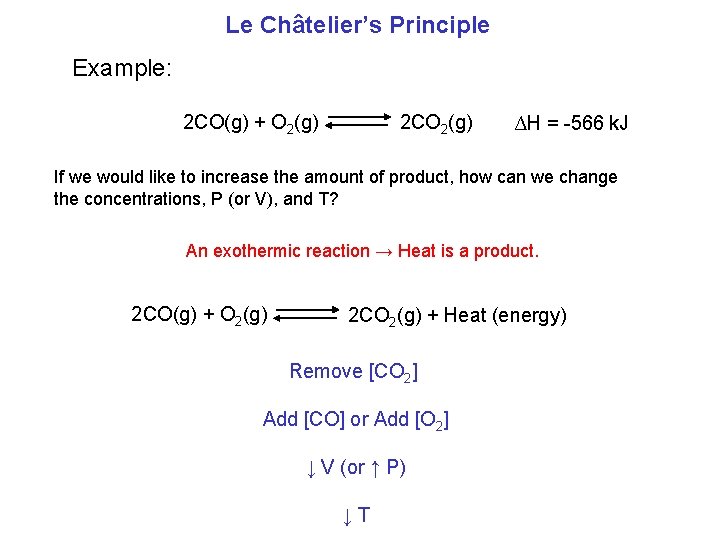
Le Châtelier’s Principle Example: 2 CO(g) + O 2(g) 2 CO 2(g) ∆H = -566 k. J If we would like to increase the amount of product, how can we change the concentrations, P (or V), and T? An exothermic reaction → Heat is a product. 2 CO(g) + O 2(g) 2 CO 2(g) + Heat (energy) Remove [CO 2] Add [CO] or Add [O 2] ↓ V (or ↑ P) ↓T
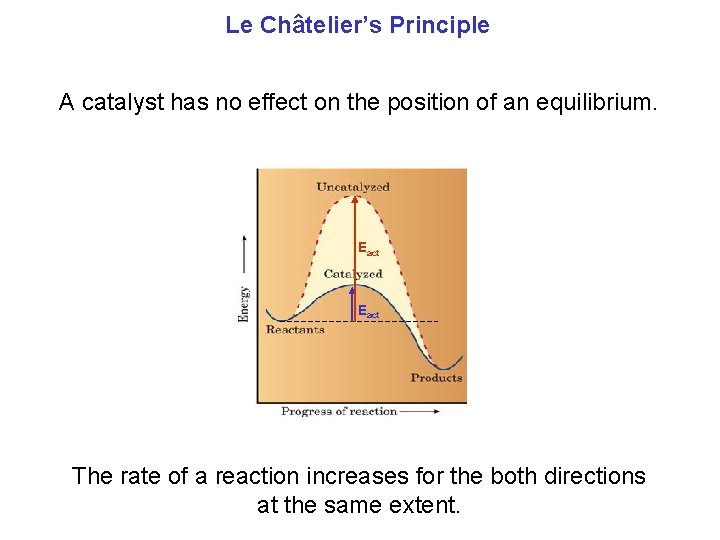
Le Châtelier’s Principle A catalyst has no effect on the position of an equilibrium. Eact The rate of a reaction increases for the both directions at the same extent.
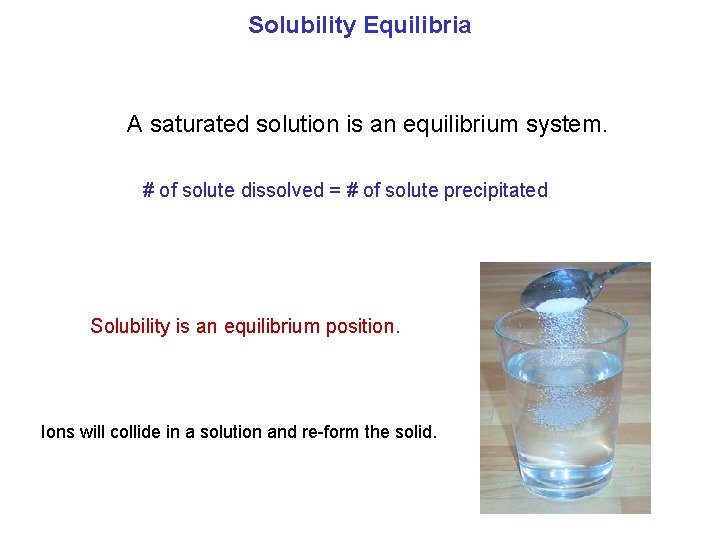
Solubility Equilibria A saturated solution is an equilibrium system. # of solute dissolved = # of solute precipitated Solubility is an equilibrium position. Ions will collide in a solution and re-form the solid.
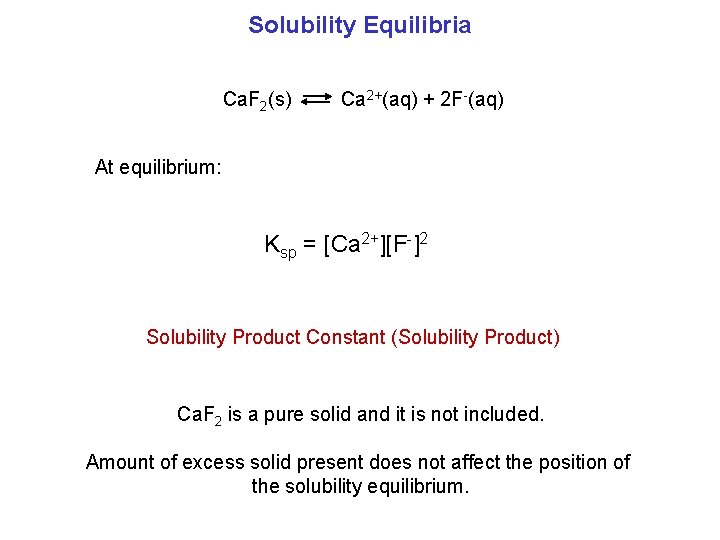
Solubility Equilibria Ca. F 2(s) Ca 2+(aq) + 2 F-(aq) At equilibrium: Ksp = [Ca 2+][F-]2 Solubility Product Constant (Solubility Product) Ca. F 2 is a pure solid and it is not included. Amount of excess solid present does not affect the position of the solubility equilibrium.
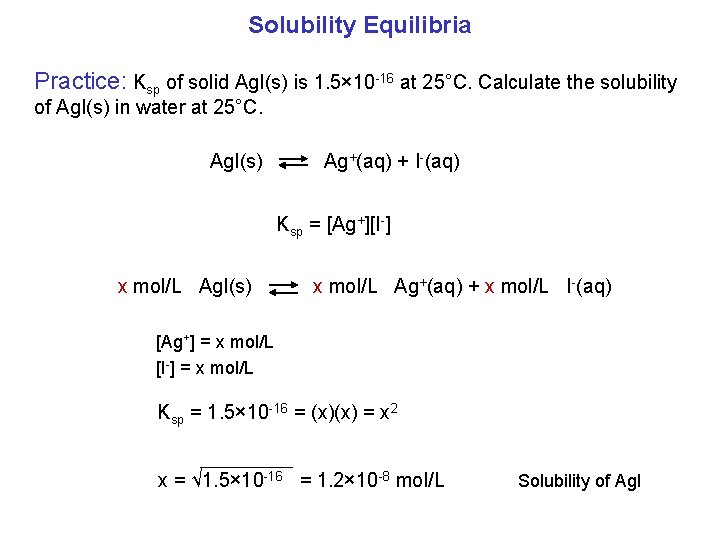
Solubility Equilibria Practice: Ksp of solid Ag. I(s) is 1. 5× 10 -16 at 25°C. Calculate the solubility of Ag. I(s) in water at 25°C. Ag. I(s) Ag+(aq) + I-(aq) Ksp = [Ag+][I-] x mol/L Ag. I(s) x mol/L Ag+(aq) + x mol/L I-(aq) [Ag+] = x mol/L [I-] = x mol/L Ksp = 1. 5× 10 -16 = (x)(x) = x 2 x = √ 1. 5× 10 -16 = 1. 2× 10 -8 mol/L Solubility of Ag. I
- Slides: 33