
Chemistry 1 1 CHEMISTRY 1 1 Investigation Chemistry
- Slides: 49
Chemistry 1. 1
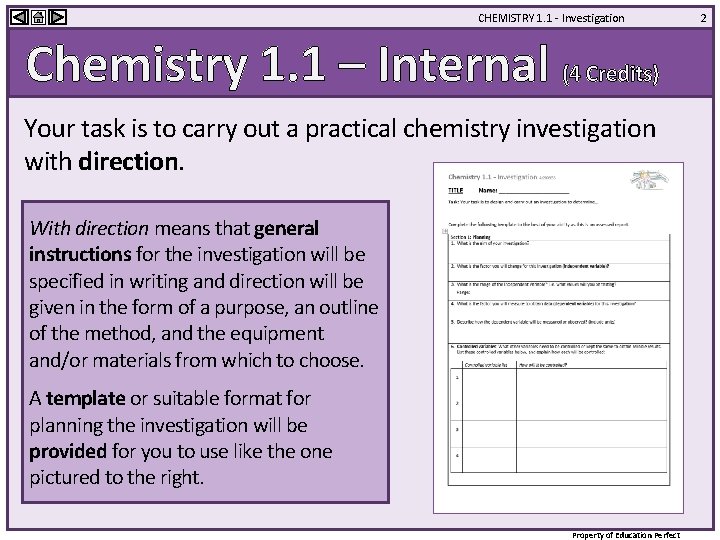
CHEMISTRY 1. 1 - Investigation Chemistry 1. 1 – Internal (4 Credits) Your task is to carry out a practical chemistry investigation with direction. With direction means that general instructions for the investigation will be specified in writing and direction will be given in the form of a purpose, an outline of the method, and the equipment and/or materials from which to choose. A template or suitable format for planning the investigation will be provided for you to use like the one pictured to the right. Property of Education Perfect 2
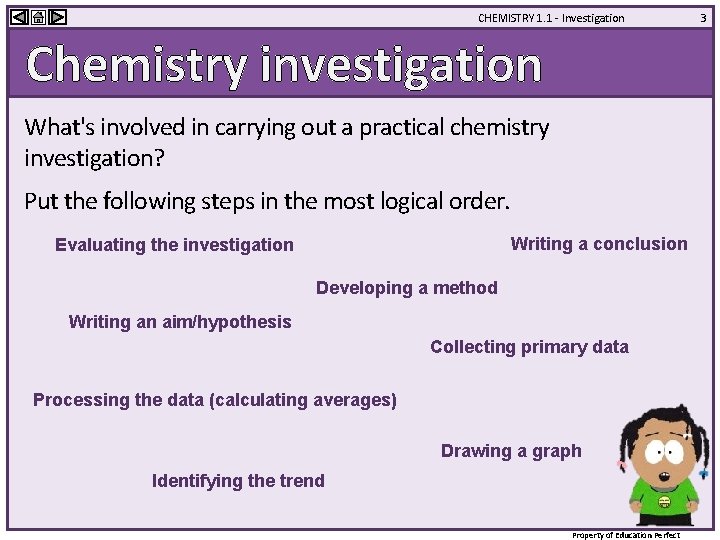
CHEMISTRY 1. 1 - Investigation Chemistry investigation What's involved in carrying out a practical chemistry investigation? Put the following steps in the most logical order. Writing a conclusion Evaluating the investigation Developing a method Writing an aim/hypothesis Collecting primary data Processing the data (calculating averages) Drawing a graph Identifying the trend Property of Education Perfect 3
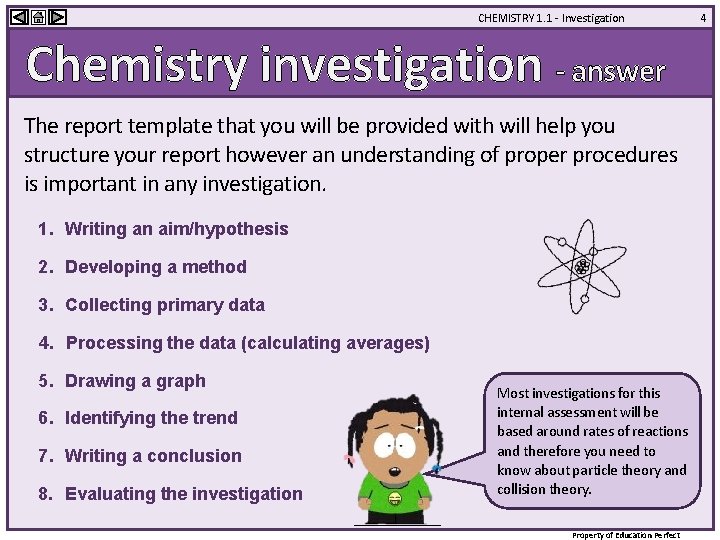
CHEMISTRY 1. 1 - Investigation Chemistry investigation - answer The report template that you will be provided with will help you structure your report however an understanding of proper procedures is important in any investigation. 1. Writing an aim/hypothesis 2. Developing a method 3. Collecting primary data 4. Processing the data (calculating averages) 5. Drawing a graph 6. Identifying the trend 7. Writing a conclusion 8. Evaluating the investigation Most investigations for this internal assessment will be based around rates of reactions and therefore you need to know about particle theory and collision theory. Property of Education Perfect 4
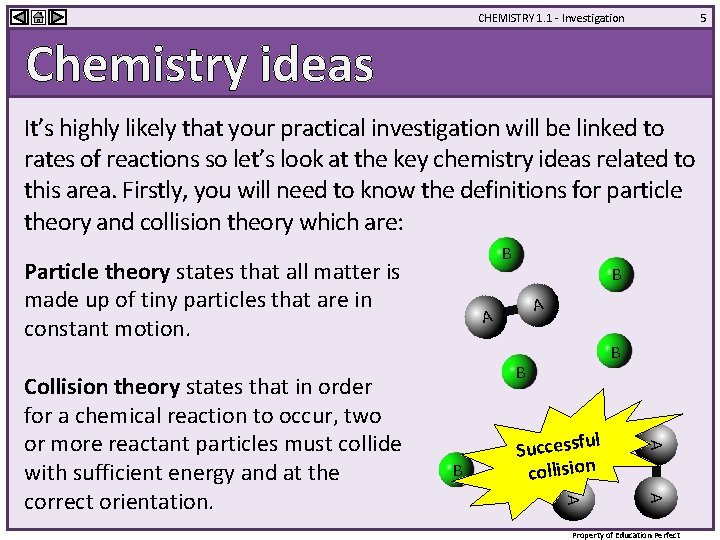
CHEMISTRY 1. 1 - Investigation 5 Chemistry ideas It’s highly likely that your practical investigation will be linked to rates of reactions so let’s look at the key chemistry ideas related to this area. Firstly, you will need to know the definitions for particle theory and collision theory which are: B Particle theory states that all matter is made up of tiny particles that are in constant motion. A A B B A A A B l Successfu c. Bollision A Collision theory states that in order for a chemical reaction to occur, two or more reactant particles must collide with sufficient energy and at the correct orientation. B Property of Education Perfect
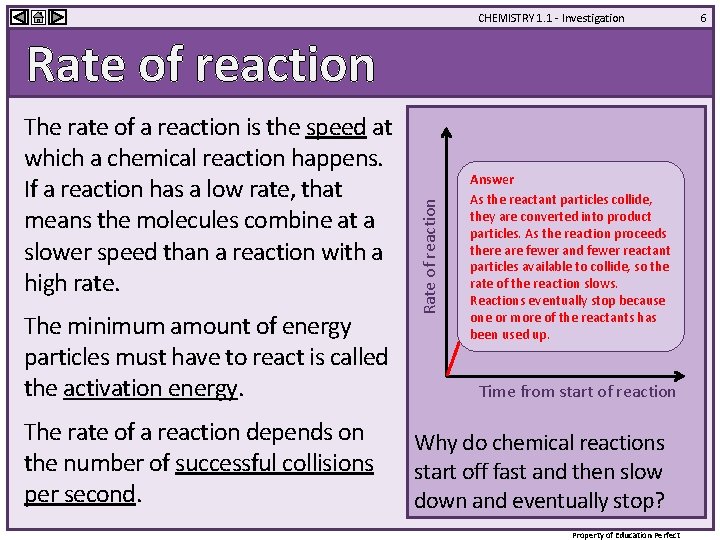
CHEMISTRY 1. 1 - Investigation The rate of a reaction is the speed at which a chemical reaction happens. If a reaction has a low rate, that means the molecules combine at a slower speed than a reaction with a high rate. The minimum amount of energy particles must have to react is called the activation energy. The rate of a reaction depends on the number of successful collisions per second. Rate of reaction Answer As the reactant particles collide, they are converted into product particles. As the reaction proceeds there are fewer and fewer reactant particles available to collide, so the rate of the reaction slows. Reactions eventually stop because one or more of the reactants has been used up. Time from start of reaction Why do chemical reactions start off fast and then slow down and eventually stop? Property of Education Perfect 6
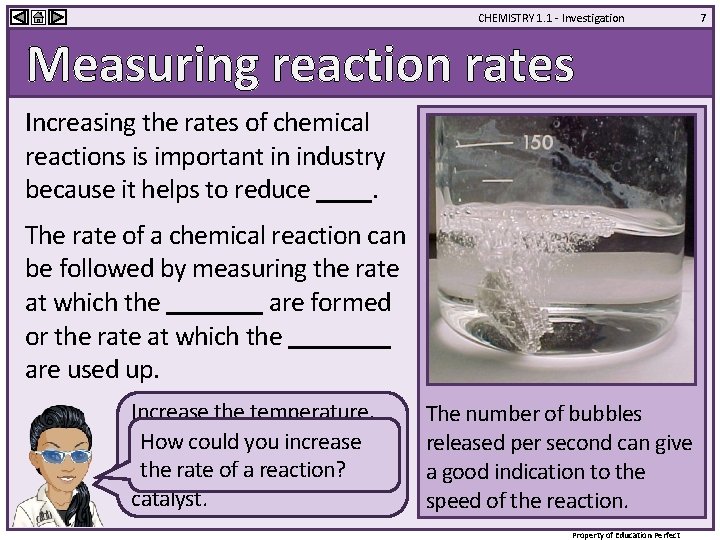
CHEMISTRY 1. 1 - Investigation Measuring reaction rates Increasing the rates of chemical reactions is important in industry because it helps to reduce costs. The rate of a chemical reaction can be followed by measuring the rate at which the products are formed or the rate at which the reactants are used up. Increase the temperature, increase concentration, How could you increase area, add a the ratesurface of a reaction? catalyst. The number of bubbles released per second can give a good indication to the speed of the reaction. Property of Education Perfect 7
CHEMISTRY 1. 1 - Investigation Temperature If the temperature of a solution is increased the rate of the reaction will increase. This is because the reactant particles will be moving faster (higher kinetic energy) and therefore there will be more collisions per second between the reactants. There will also be more energy associated with each collision which means that more of the collisions are likely to be successful. Both of these reasons mean that the rate of the reaction will increase when temperature of the reactants is increased. Answer: The 30 students in the all classroom represent the particles in a Imagine students moving around in an empty reaction. If the students move faster (increased temperature) then their classroom blindfolded. Use scenario explain will be more collisions per second andthis because they haveto more kinetic the above ideas. energy the students will bump into each other with more force. Property of Education Perfect 8
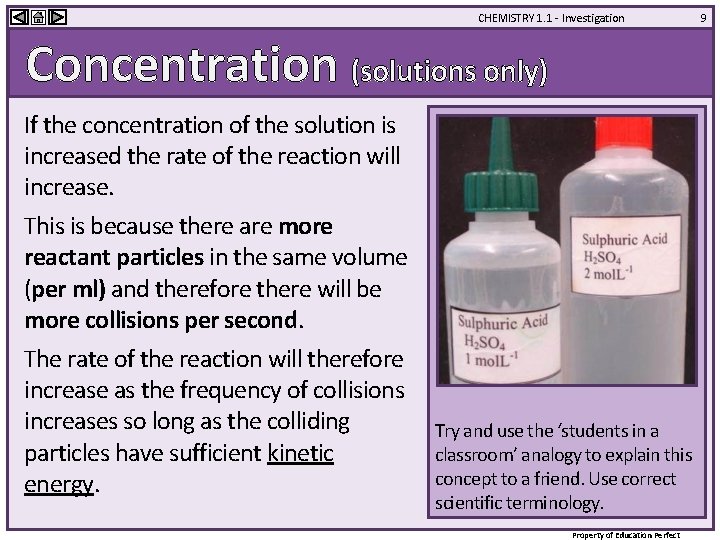
CHEMISTRY 1. 1 - Investigation Concentration (solutions only) If the concentration of the solution is increased the rate of the reaction will increase. This is because there are more reactant particles in the same volume (per ml) and therefore there will be more collisions per second. The rate of the reaction will therefore increase as the frequency of collisions increases so long as the colliding particles have sufficient kinetic energy. Try and use the ‘students in a classroom’ analogy to explain this concept to a friend. Use correct scientific terminology. Property of Education Perfect 9
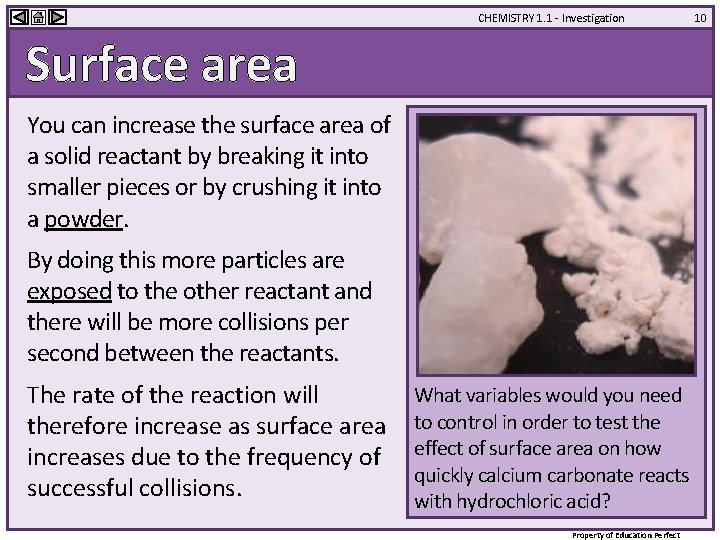
CHEMISTRY 1. 1 - Investigation Surface area You can increase the surface area of a solid reactant by breaking it into smaller pieces or by crushing it into a powder. By doing this more particles are exposed to the other reactant and there will be more collisions per second between the reactants. The rate of the reaction will therefore increase as surface area increases due to the frequency of successful collisions. What variables would you need to control in order to test the effect of surface area on how quickly calcium carbonate reacts with hydrochloric acid? Property of Education Perfect 10
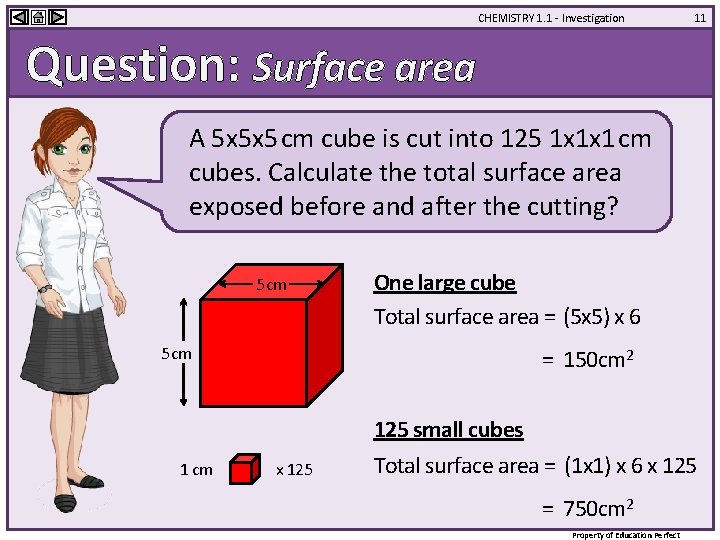
CHEMISTRY 1. 1 - Investigation 11 Question: Surface area A 5 x 5 x 5 cm cube is cut into 125 1 x 1 x 1 cm cubes. Calculate the total surface area exposed before and after the cutting? 5 cm 1 cm One large cube Total surface area = (5 x 5) x 6 = 150 cm 2 x 125 small cubes Total surface area = (1 x 1) x 6 x 125 = 750 cm 2 Property of Education Perfect
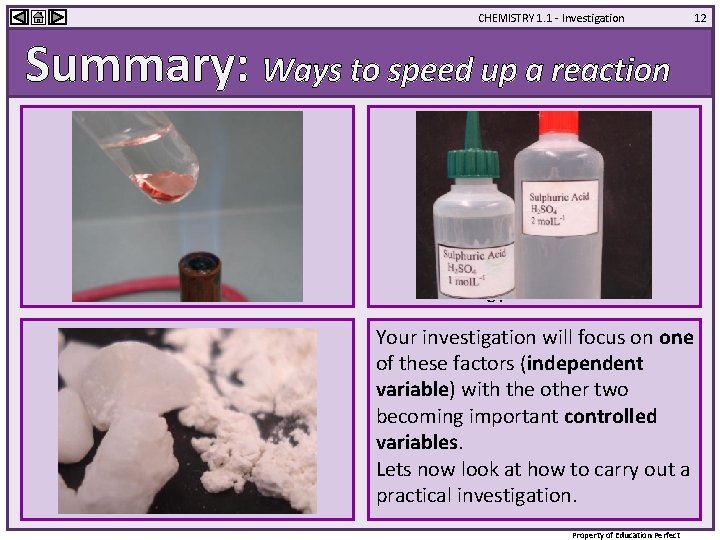
CHEMISTRY 1. 1 - Investigation Summary: Ways to speed up a reaction Increase temperature This gives the particles more kinetic energy so there will be more collisions per second and the success rate of these collisions also increases as each collision will have more force. Increase concentration More particles per ml means there will be more successful collisions per second which should speed up the reaction as long as the particles have enough kinetic energy. Increase surface area By crushing or breaking a solid into smaller pieces you can increase the surface area which increases the number of particles exposed to other chemicals in the reaction = faster rate of reaction. Your investigation will focus on one of these factors (independent variable) with the other two becoming important controlled variables. Lets now look at how to carry out a practical investigation. Property of Education Perfect 12
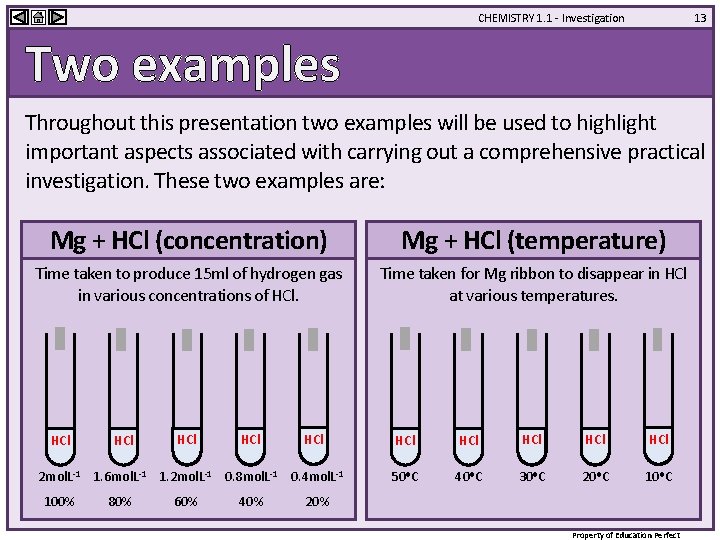
CHEMISTRY 1. 1 - Investigation 13 Two examples Throughout this presentation two examples will be used to highlight important aspects associated with carrying out a comprehensive practical investigation. These two examples are: Mg + HCl (concentration) Mg + HCl (temperature) Time taken to produce 15 ml of hydrogen gas in various concentrations of HCl. Time taken for Mg ribbon to disappear in HCl at various temperatures. HCl HCl HCl 2 mol. L-1 1. 6 mol. L-1 1. 2 mol. L-1 0. 8 mol. L-1 0. 4 mol. L-1 100% 80% 60% 40% HCl HCl HCl 50ᵒC 40ᵒC 30ᵒC 20ᵒC 10ᵒC 20% Property of Education Perfect
CHEMISTRY 1. 1 - Investigation 14 Getting started - Aim and hypothesis To start your investigation you need to reword the task statement into an aim and a hypothesis. Lets have a look at these two aspects: Aim: Hint: take the key phrase directly from the task statement. Your aim should start with “The aim of this investigation is to find the mathematical relationship between___[insert key phrase] ___”. Hypothesis: Hint: choose increase or decrease depending on what you think will happen in the experiment. Your hypothesis is a testable prediction and should be written like this “If __[insert independent variable] ___ increases/decreases then __[insert dependent variable] __ will increase/decrease. ” Property of Education Perfect
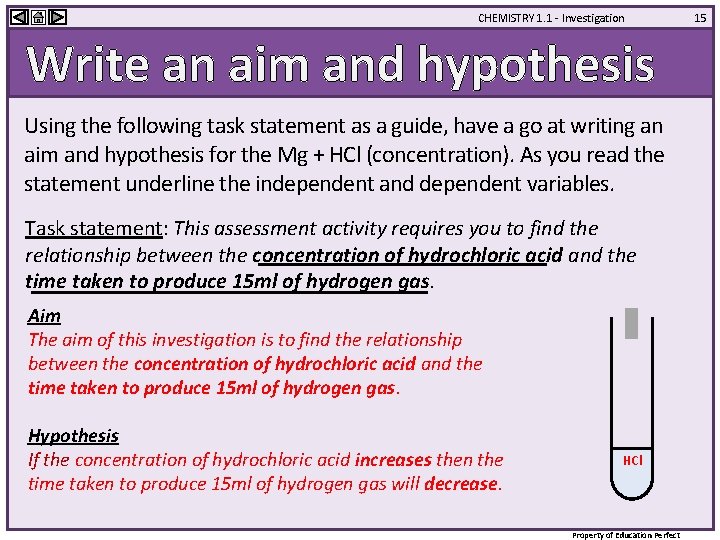
CHEMISTRY 1. 1 - Investigation Write an aim and hypothesis Using the following task statement as a guide, have a go at writing an aim and hypothesis for the Mg + HCl (concentration). As you read the statement underline the independent and dependent variables. Task statement: This assessment activity requires you to find the relationship between the concentration of hydrochloric acid and the time taken to produce 15 ml of hydrogen gas. Aim The aim of this investigation is to find the relationship between the concentration of hydrochloric acid and the time taken to produce 15 ml of hydrogen gas. Hypothesis If the concentration of hydrochloric acid increases then the time taken to produce 15 ml of hydrogen gas will decrease. HCl Property of Education Perfect 15
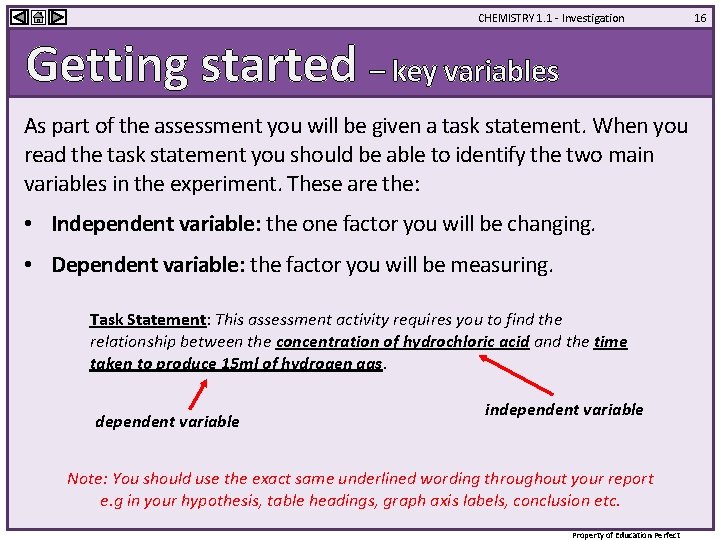
CHEMISTRY 1. 1 - Investigation Getting started – key variables As part of the assessment you will be given a task statement. When you read the task statement you should be able to identify the two main variables in the experiment. These are the: • Independent variable: the one factor you will be changing. • Dependent variable: the factor you will be measuring. Task Statement: This assessment activity requires you to find the relationship between the concentration of hydrochloric acid and the time taken to produce 15 ml of hydrogen gas. dependent variable independent variable Note: You should use the exact same underlined wording throughout your report e. g in your hypothesis, table headings, graph axis labels, conclusion etc. Property of Education Perfect 16
CHEMISTRY 1. 1 - Investigation Independent variable (I. V) The independent variable for an experiment is the factor that is intentionally changed to observe its effect on the dependent variable. For Achieved you need to test at least four different values over a ‘reasonable range’. To decide on what is a reasonable range you need to carry out some pre-trials using the equipment provided. In your evaluation you will need to justify your range, especially the highest and lowest values. Things to consider when doing the pre-trials are: • What range does the equipment allow for? • e. g. what is the maximum concentration or temperature allowed for safety reasons. • What range gives results that you can accurately measure? • e. g if you used 4 mol. L-1 HCl the production of H 2 gas may be too rapid to measure accurately. • The 4 -5 values you choose must spread the data enough so that a trend can be established with no overlapping values? Property of Education Perfect 17
CHEMISTRY 1. 1 - Investigation Range for the I. V In the previous slide it said to choose 4 or 5 values that allow a trend to be established with no overlapping values. For the concentration experiment, explain why a range of: 100%, 95%, 90% and 85% is a poor choice? Answer: This is a very narrow range of only 15% and all values are close to maximum concentration meaning that the reactions will occur quickly. In timed reactions like this there will always be a small human error component such as not starting and stopping the stopwatch at exactly the right time. When timing fast chemical reactions the human error component has a larger proportional effect on the data and therefore it can cause values in a narrow range to overlap. A more suitable range would be: 100%, 80%, 60%, 40% & 85%. Property of Education Perfect 18
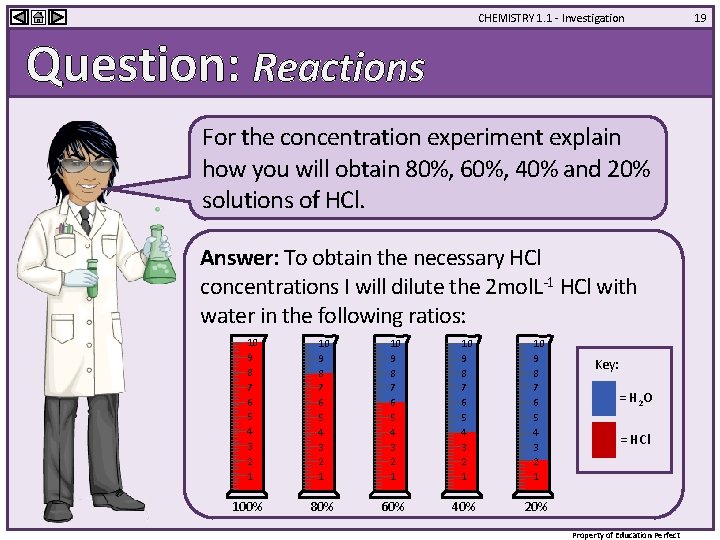
CHEMISTRY 1. 1 - Investigation Question: Reactions For the concentration experiment explain how you will obtain 80%, 60%, 40% and 20% solutions of HCl. Answer: To obtain the necessary HCl concentrations I will dilute the 2 mol. L-1 HCl with water in the following ratios: 10 9 8 7 6 5 4 3 2 1 100% 10 9 8 7 6 5 4 3 2 1 80% 60% 40% 20% Key: = H 2 O = HCl Property of Education Perfect 19
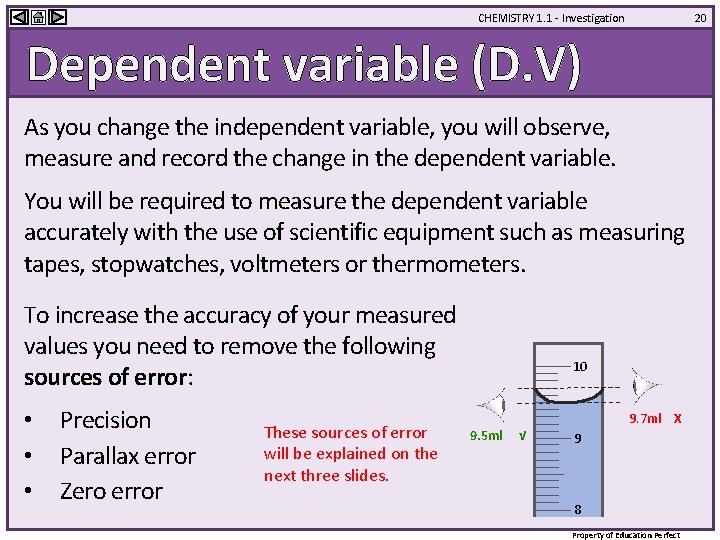
CHEMISTRY 1. 1 - Investigation 20 Dependent variable (D. V) As you change the independent variable, you will observe, measure and record the change in the dependent variable. You will be required to measure the dependent variable accurately with the use of scientific equipment such as measuring tapes, stopwatches, voltmeters or thermometers. To increase the accuracy of your measured values you need to remove the following sources of error: • • • Precision Parallax error Zero error These sources of error will be explained on the next three slides. 10 9. 5 ml √ 9. 7 ml X 9 8 Property of Education Perfect
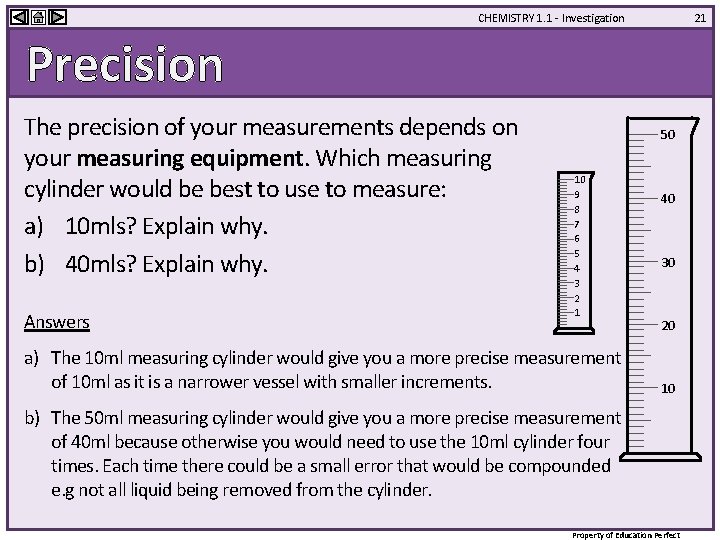
CHEMISTRY 1. 1 - Investigation 21 Precision The precision of your measurements depends on your measuring equipment. Which measuring cylinder would be best to use to measure: a) 10 mls? Explain why. b) 40 mls? Explain why. Answers 50 10 9 8 7 6 5 4 3 2 1 a) The 10 ml measuring cylinder would give you a more precise measurement of 10 ml as it is a narrower vessel with smaller increments. 40 30 20 10 b) The 50 ml measuring cylinder would give you a more precise measurement of 40 ml because otherwise you would need to use the 10 ml cylinder four times. Each time there could be a small error that would be compounded e. g not all liquid being removed from the cylinder. Property of Education Perfect
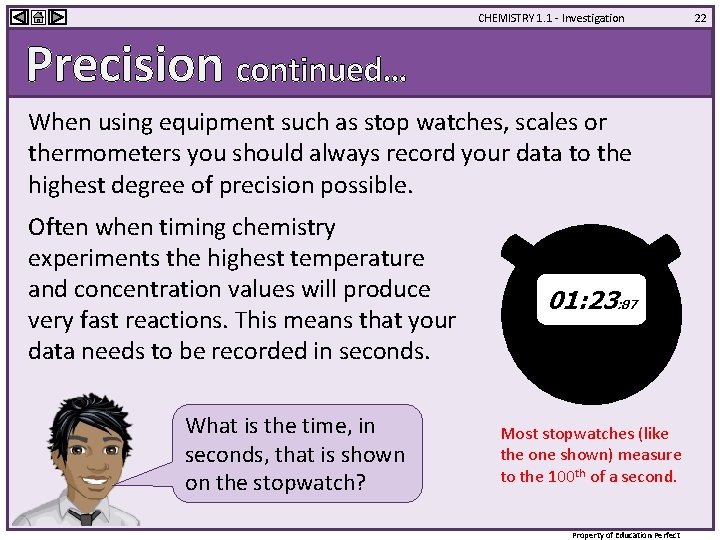
CHEMISTRY 1. 1 - Investigation Precision continued… When using equipment such as stop watches, scales or thermometers you should always record your data to the highest degree of precision possible. Often when timing chemistry experiments the highest temperature and concentration values will produce very fast reactions. This means that your data needs to be recorded in seconds. What is the time, in seconds, that is shown on the stopwatch? 01: 23: 87 Most stopwatches (like the one shown) measure to the 100 th of a second. Property of Education Perfect 22
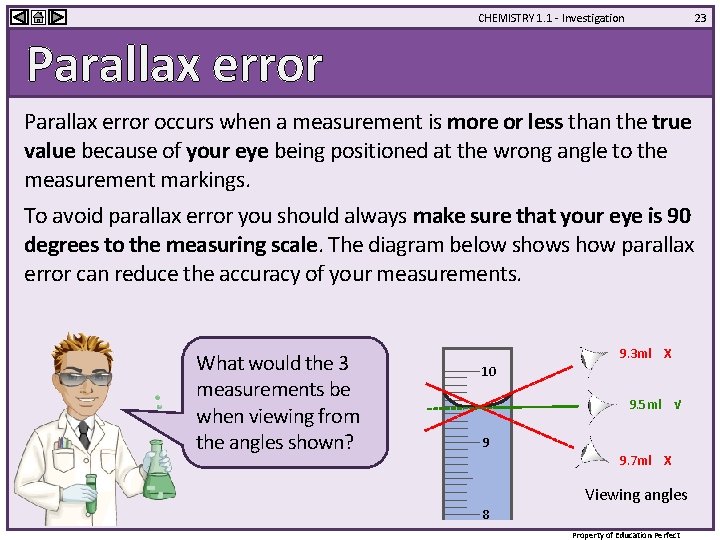
CHEMISTRY 1. 1 - Investigation 23 Parallax error occurs when a measurement is more or less than the true value because of your eye being positioned at the wrong angle to the measurement markings. To avoid parallax error you should always make sure that your eye is 90 degrees to the measuring scale. The diagram below shows how parallax error can reduce the accuracy of your measurements. What would the 3 measurements be when viewing from the angles shown? 9. 3 ml X 10 9. 5 ml √ 9 9. 7 ml X Viewing angles 8 Property of Education Perfect
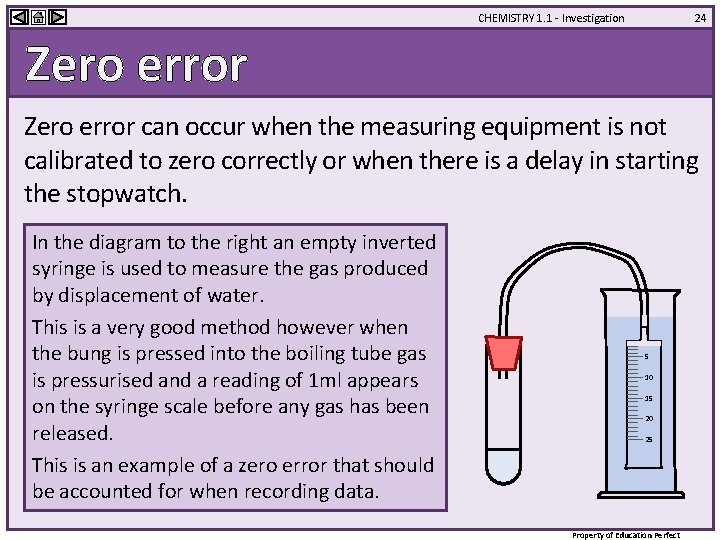
CHEMISTRY 1. 1 - Investigation 24 Zero error can occur when the measuring equipment is not calibrated to zero correctly or when there is a delay in starting the stopwatch. In the diagram to the right an empty inverted syringe is used to measure the gas produced by displacement of water. This is a very good method however when the bung is pressed into the boiling tube gas is pressurised and a reading of 1 ml appears on the syringe scale before any gas has been released. This is an example of a zero error that should be accounted for when recording data. 5 10 15 20 25 Property of Education Perfect
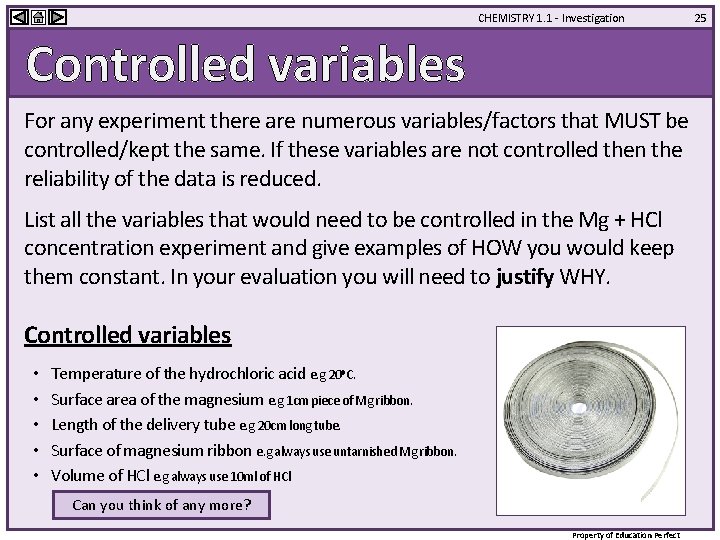
CHEMISTRY 1. 1 - Investigation Controlled variables For any experiment there are numerous variables/factors that MUST be controlled/kept the same. If these variables are not controlled then the reliability of the data is reduced. List all the variables that would need to be controlled in the Mg + HCl concentration experiment and give examples of HOW you would keep them constant. In your evaluation you will need to justify WHY. Controlled variables • • • Temperature of the hydrochloric acid e. g 20ᵒC. Surface area of the magnesium e. g 1 cm piece of Mg ribbon. Length of the delivery tube e. g 20 cm long tube. Surface of magnesium ribbon e. g always use untarnished Mg ribbon. Volume of HCl e. g always use 10 ml of HCl Can you think of any more? Property of Education Perfect 25
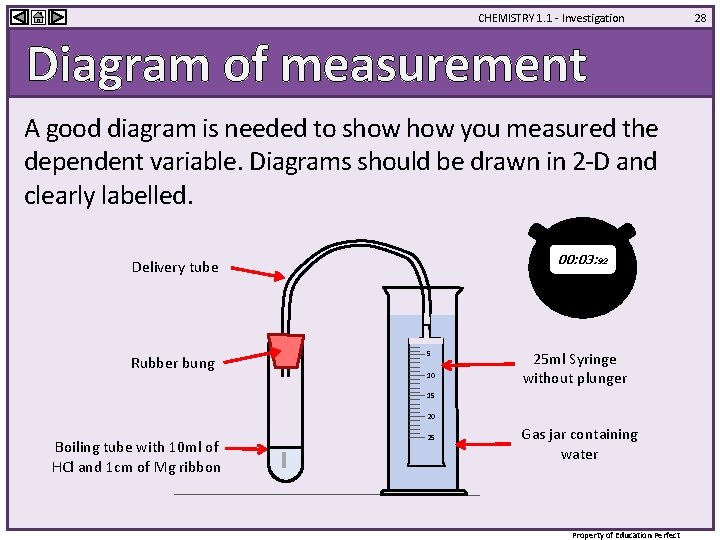
CHEMISTRY 1. 1 - Investigation Method For any investigation you need to develop a detailed step-by-step method for collecting data. Below is a basic method written for the concentration experiment. How could it be improved? 1. 2. 3. 4. Make a 20% HCl solution by diluting with water. Add 10 ml of 20% HCl to a boiling tube. Place the boiling tube into a test tube rack. Prepare your equipment for measuring gas produced by displacement of water. 5. Add your piece of Mg metal to the boiling tube and apply bung. 6. Time how long it takes to produce 15 ml of H 2 gas. 7. Repeat the experiment Note: Try rewriting this method and add in any extra detail you can think of. Also, try to draw a diagram of how you would measure the dependent variable. Property of Education Perfect 26
CHEMISTRY 1. 1 - Investigation Improved Method 1. Measure 2 ml of HCl (2 mol. L-1) using a 10 ml measuring cylinder at eye level. Add 8 ml of tap water to the acid using a dropper to obtain a total volume of 10 ml. This will be a 20% (0. 4 mol. L-1) HCl solution. 2. Place the boiling tube into a test tube rack. 3. Prepare your equipment for measuring gas produced by displacement of water, as shown in the diagram. 4. Angle your boiling tube and place a 1 cm strip of Mg metal to the side of the boiling tube and apply the bung. 5. Tilt the boiling tube further until the acid collects the Mg metal and start your stop watch. 6. Stop the watch when 15 ml of H 2 gas has been produced. 7. Wash and dry the boiling tube. 8. Repeat steps 1 -7 three times. 9. Repeat the experiment for the following concentrations: 40%, 60%, 80%, and 100%. Property of Education Perfect 27
CHEMISTRY 1. 1 - Investigation Diagram of measurement A good diagram is needed to show you measured the dependent variable. Diagrams should be drawn in 2 -D and clearly labelled. 00: 03: 92 Delivery tube Rubber bung 5 10 25 ml Syringe without plunger 15 20 Boiling tube with 10 ml of HCl and 1 cm of Mg ribbon 25 Gas jar containing water Property of Education Perfect 28
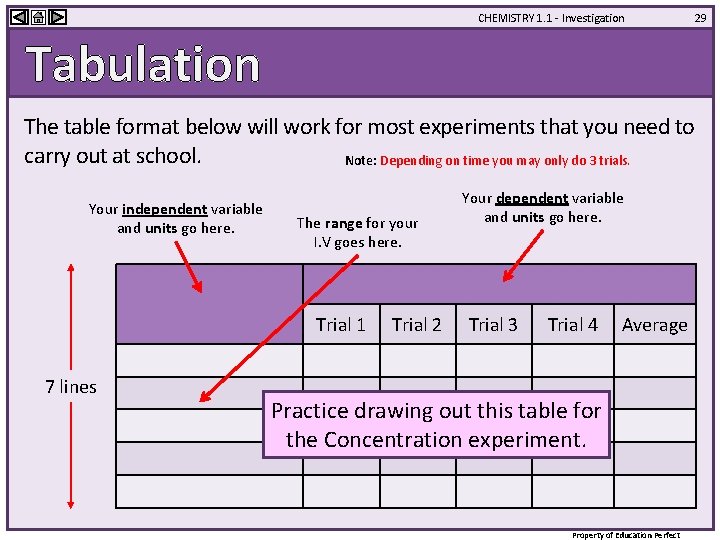
CHEMISTRY 1. 1 - Investigation 29 Tabulation The table format below will work for most experiments that you need to carry out at school. Note: Depending on time you may only do 3 trials. Your independent variable and units go here. The range for your I. V goes here. Trial 1 7 lines Trial 2 Your dependent variable and units go here. Trial 3 Trial 4 Average Practice drawing out this table for the Concentration experiment. Property of Education Perfect
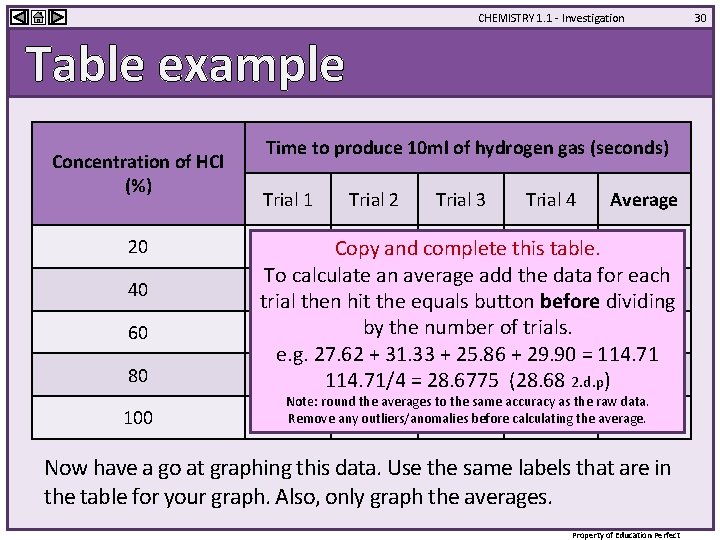
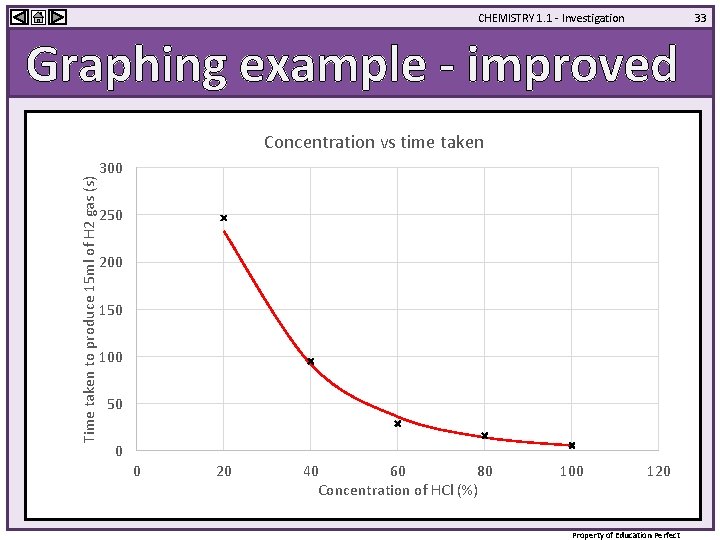
CHEMISTRY 1. 1 - Investigation Table example Concentration of HCl (%) 20 40 60 80 100 Time to produce 10 ml of hydrogen gas (seconds) Trial 1 Trial 2 Trial 3 Trial 4 Average 248. 12 Copy 223. 07 236. 31 this 279. 40 and complete table. 246. 73 To calculate an average add the data for each 94. 87 96. 21 94. 69 98. 10 90. 46 trial then hit the equals button before dividing by the number 28. 68 27. 62 31. 33 25. 86 of trials. 29. 90 e. g. 27. 62 + 31. 33 + 25. 86 + 29. 90 = 114. 71 12. 31 114. 71/4 26. 2 = 28. 6775 13. 82 (28. 68 11. 772. d. p) 16. 03 Note: round the averages to the same accuracy as the raw data. Remove any 5. 39 outliers/anomalies 5. 68 6. 32 5. 11 before calculating 5. 89 the average. Now have a go at graphing this data. Use the same labels that are in the table for your graph. Also, only graph the averages. Property of Education Perfect 30
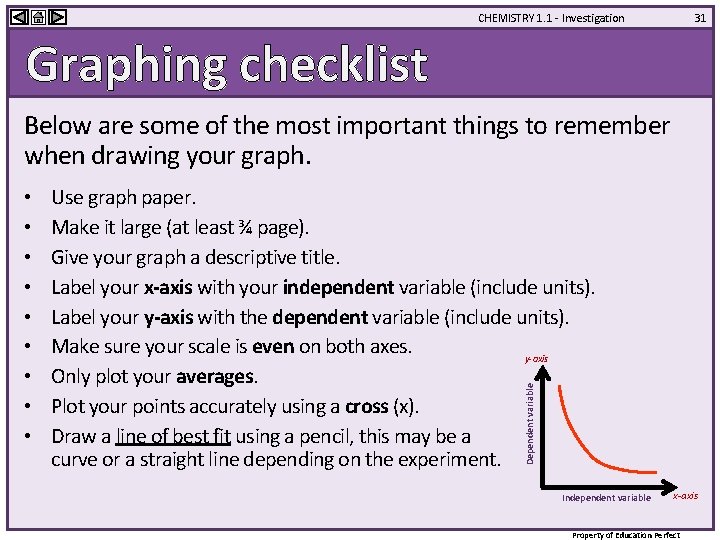
CHEMISTRY 1. 1 - Investigation 31 Graphing checklist Below are some of the most important things to remember when drawing your graph. Use graph paper. Make it large (at least ¾ page). Give your graph a descriptive title. Label your x-axis with your independent variable (include units). Label your y-axis with the dependent variable (include units). Make sure your scale is even on both axes. y-axis Only plot your averages. Plot your points accurately using a cross (x). Draw a line of best fit using a pencil, this may be a curve or a straight line depending on the experiment. Dependent variable • • • Independent variable x-axis Property of Education Perfect
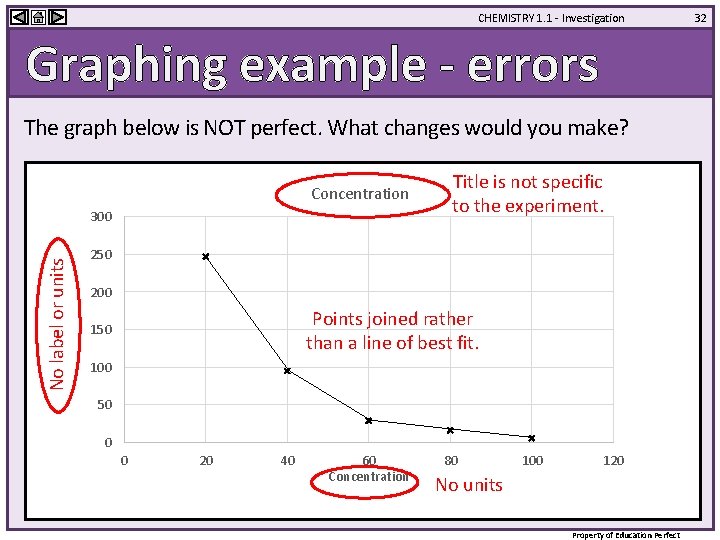
CHEMISTRY 1. 1 - Investigation Graphing example - errors The graph below is NOT perfect. What changes would you make? Concentration No label or units 300 Title is not specific to the experiment. 250 200 Points joined rather than a line of best fit. 150 100 50 0 0 20 40 60 Concentration 80 100 120 No units Property of Education Perfect 32
CHEMISTRY 1. 1 - Investigation 33 Graphing example - improved Time taken to produce 15 ml of H 2 gas (s) Concentration vs time taken 300 250 200 150 100 50 0 0 20 40 60 80 Concentration of HCl (%) 100 120 Property of Education Perfect
CHEMISTRY 1. 1 - Investigation Conclusion When writing your conclusion do the following: • Restate the aim of your investigation The aim of this investigation was to find the relationship between__[insert key phrase]__. • State the trend shown by the graph. The graph shows that as the _[independent variable]__ increased the __[dependent variable]__ increased/decreased. • State whether your hypothesis was proven correct or incorrect. My hypothesis was proven correct/incorrect (remove one). • Compare two averages as proof. For example: on average …. whereas …. which is a faster/slower. Property of Education Perfect 34
CHEMISTRY 1. 1 - Investigation Conclusion example Write a conclusion for the concentration experiment using the structure on the previous slide. The aim of this investigation was to find the relationship between the concentration of hydrochloric acid and the time taken to produce 15 ml of hydrogen gas. The graph shows that as the concentration of hydrochloric acid increased then the time taken to produce 15 ml of hydrogen gas decreased. The hypothesis was therefore proven correct. For example: a 20% HCl produced 15 ml of H 2 gas in 246. 73 seconds whereas 100% HCl produced 15 ml of H 2 gas in 5. 68 seconds which is a lot faster. Property of Education Perfect 35
CHEMISTRY 1. 1 - Investigation Evaluation In your evaluation you need to discuss the Science ideas linked to your investigation and you have to convince the reader/marker that your investigation was comprehensive. Split your evaluation into the following five separate paragraphs: Chemistry ideas – explain your results with relevant chemistry. Accuracy – justify choices made to increase accuracy. Range of I. V – explain why you chose the range you did. Controlled variables – justify how + why you controlled these factors. Reliability of data – explain why your data was reliable. Property of Education Perfect 36
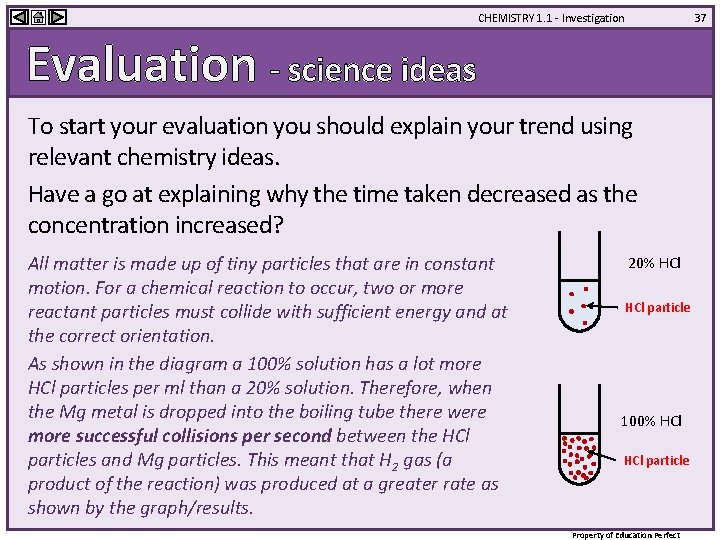
CHEMISTRY 1. 1 - Investigation 37 Evaluation - science ideas To start your evaluation you should explain your trend using relevant chemistry ideas. Have a go at explaining why the time taken decreased as the concentration increased? All matter is made up of tiny particles that are in constant motion. For a chemical reaction to occur, two or more reactant particles must collide with sufficient energy and at the correct orientation. As shown in the diagram a 100% solution has a lot more HCl particles per ml than a 20% solution. Therefore, when the Mg metal is dropped into the boiling tube there were more successful collisions per second between the HCl particles and Mg particles. This meant that H 2 gas (a product of the reaction) was produced at a greater rate as shown by the graph/results. 20% HCl particle 100% HCl particle Property of Education Perfect
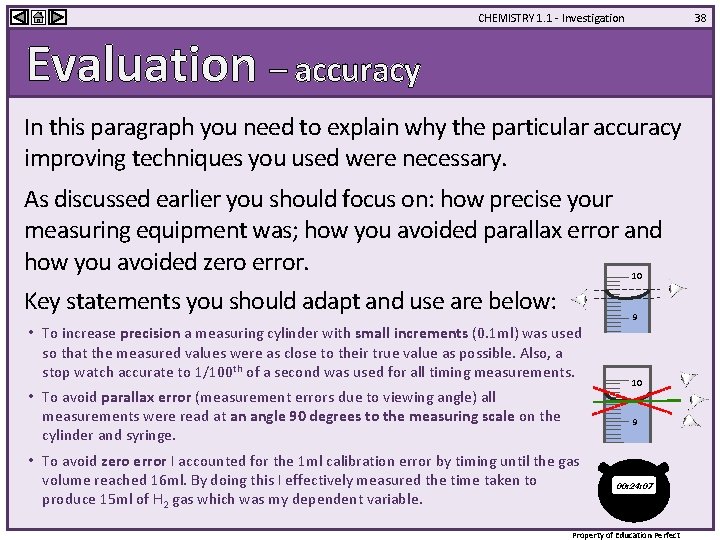
CHEMISTRY 1. 1 - Investigation 38 Evaluation – accuracy In this paragraph you need to explain why the particular accuracy improving techniques you used were necessary. As discussed earlier you should focus on: how precise your measuring equipment was; how you avoided parallax error and how you avoided zero error. 10 Key statements you should adapt and use are below: 9 • To increase precision a measuring cylinder with small increments (0. 1 ml) was used so that the measured values were as close to their true value as possible. Also, a stop watch accurate to 1/100 th of a second was used for all timing measurements. • To avoid parallax error (measurement errors due to viewing angle) all measurements were read at an angle 90 degrees to the measuring scale on the cylinder and syringe. 8 10 9 • To avoid zero error I accounted for the 1 ml calibration error by timing until the gas volume reached 16 ml. By doing this I effectively measured the time taken to produce 15 ml of H 2 gas which was my dependent variable. 8 00: 24: 07 Property of Education Perfect
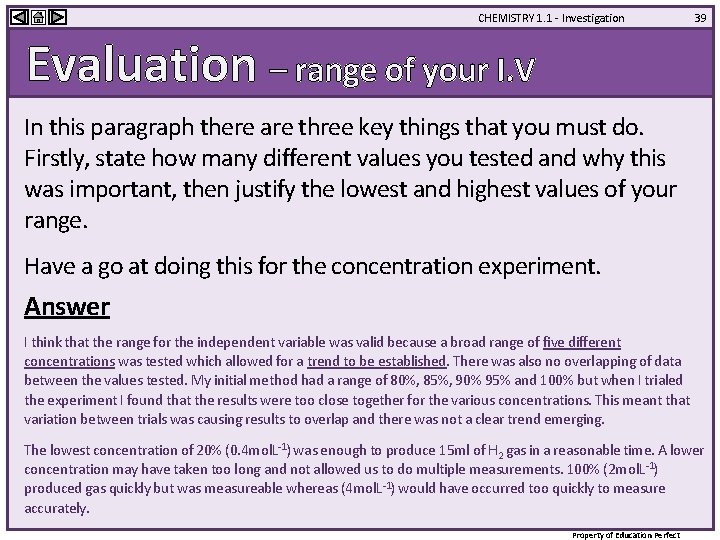
CHEMISTRY 1. 1 - Investigation 39 Evaluation – range of your I. V In this paragraph there are three key things that you must do. Firstly, state how many different values you tested and why this was important, then justify the lowest and highest values of your range. Have a go at doing this for the concentration experiment. Answer I think that the range for the independent variable was valid because a broad range of five different concentrations was tested which allowed for a trend to be established. There was also no overlapping of data between the values tested. My initial method had a range of 80%, 85%, 90% 95% and 100% but when I trialed the experiment I found that the results were too close together for the various concentrations. This meant that variation between trials was causing results to overlap and there was not a clear trend emerging. The lowest concentration of 20% (0. 4 mol. L-1) was enough to produce 15 ml of H 2 gas in a reasonable time. A lower concentration may have taken too long and not allowed us to do multiple measurements. 100% (2 mol. L-1) produced gas quickly but was measureable whereas (4 mol. L-1) would have occurred too quickly to measure accurately. Property of Education Perfect
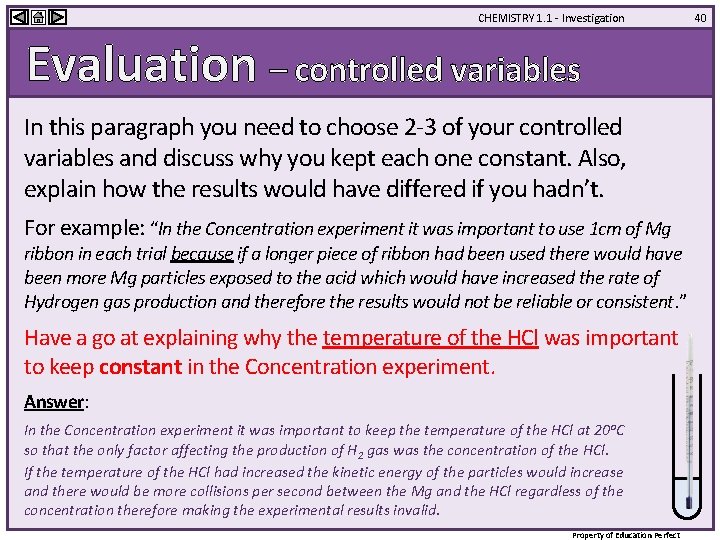
CHEMISTRY 1. 1 - Investigation Evaluation – controlled variables In this paragraph you need to choose 2 -3 of your controlled variables and discuss why you kept each one constant. Also, explain how the results would have differed if you hadn’t. For example: “In the Concentration experiment it was important to use 1 cm of Mg ribbon in each trial because if a longer piece of ribbon had been used there would have been more Mg particles exposed to the acid which would have increased the rate of Hydrogen gas production and therefore the results would not be reliable or consistent. ” Have a go at explaining why the temperature of the HCl was important to keep constant in the Concentration experiment. Answer: In the Concentration experiment it was important to keep the temperature of the HCl at 20ᵒC so that the only factor affecting the production of H 2 gas was the concentration of the HCl. If the temperature of the HCl had increased the kinetic energy of the particles would increase and there would be more collisions per second between the Mg and the HCl regardless of the concentration therefore making the experimental results invalid. Property of Education Perfect 40
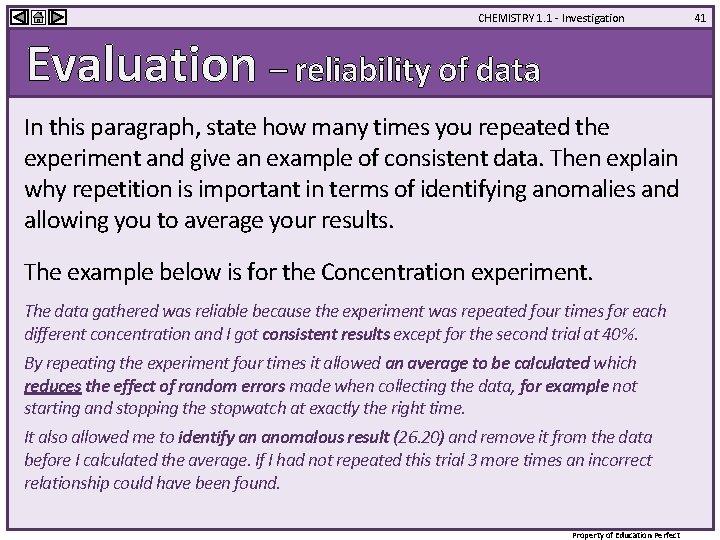
CHEMISTRY 1. 1 - Investigation Evaluation – reliability of data In this paragraph, state how many times you repeated the experiment and give an example of consistent data. Then explain why repetition is important in terms of identifying anomalies and allowing you to average your results. The example below is for the Concentration experiment. The data gathered was reliable because the experiment was repeated four times for each different concentration and I got consistent results except for the second trial at 40%. By repeating the experiment four times it allowed an average to be calculated which reduces the effect of random errors made when collecting the data, for example not starting and stopping the stopwatch at exactly the right time. It also allowed me to identify an anomalous result (26. 20) and remove it from the data before I calculated the average. If I had not repeated this trial 3 more times an incorrect relationship could have been found. Property of Education Perfect 41
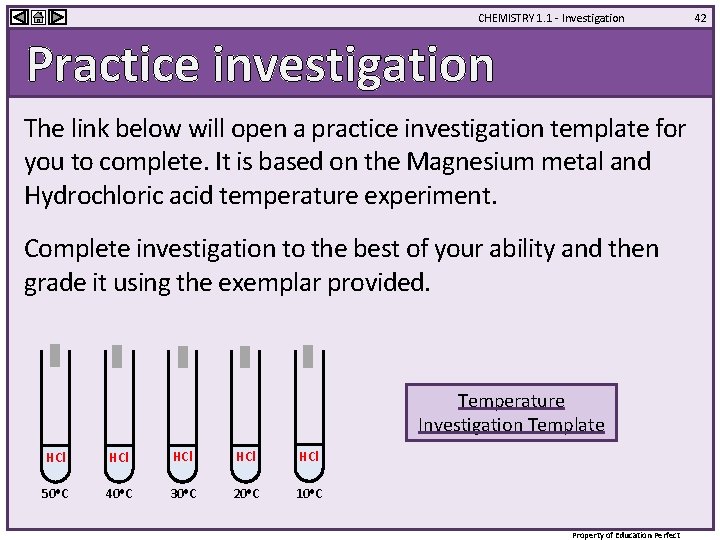
CHEMISTRY 1. 1 - Investigation Practice investigation The link below will open a practice investigation template for you to complete. It is based on the Magnesium metal and Hydrochloric acid temperature experiment. Complete investigation to the best of your ability and then grade it using the exemplar provided. Temperature Investigation Template HCl HCl HCl 50ᵒC 40ᵒC 30ᵒC 20ᵒC 10ᵒC Property of Education Perfect 42
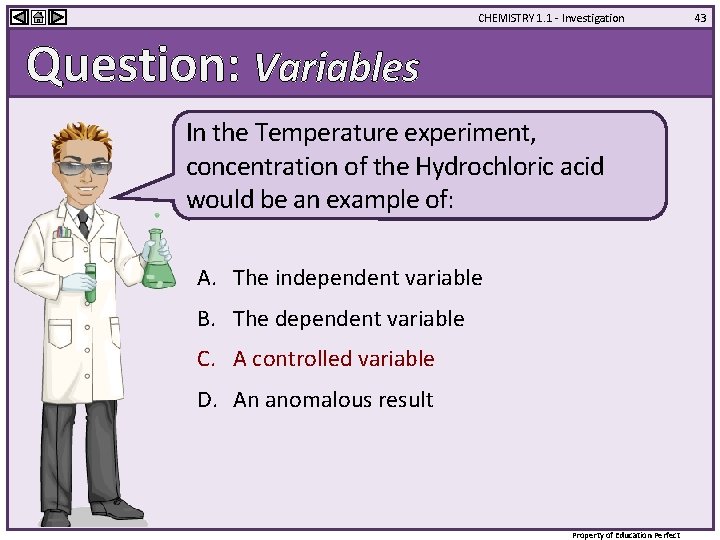
CHEMISTRY 1. 1 - Investigation Question: Variables In the Temperature experiment, concentration of the Hydrochloric acid would be an example of: A. The independent variable B. The dependent variable C. A controlled variable D. An anomalous result Property of Education Perfect 43
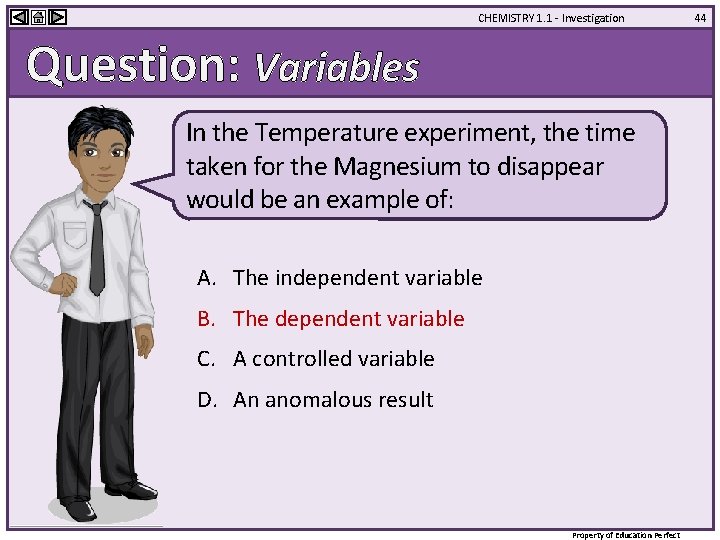
CHEMISTRY 1. 1 - Investigation Question: Variables In the Temperature experiment, the time taken for the Magnesium to disappear would be an example of: A. The independent variable B. The dependent variable C. A controlled variable D. An anomalous result Property of Education Perfect 44
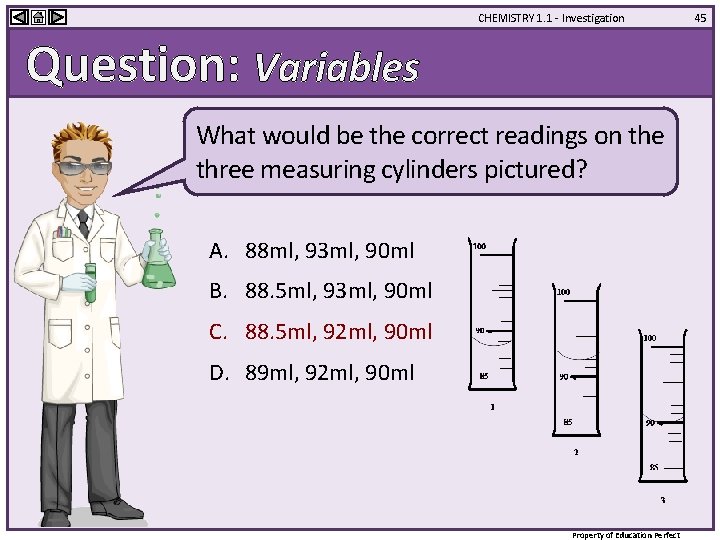
CHEMISTRY 1. 1 - Investigation Question: Variables What would be the correct readings on the three measuring cylinders pictured? A. 88 ml, 93 ml, 90 ml B. 88. 5 ml, 93 ml, 90 ml C. 88. 5 ml, 92 ml, 90 ml D. 89 ml, 92 ml, 90 ml Property of Education Perfect 45
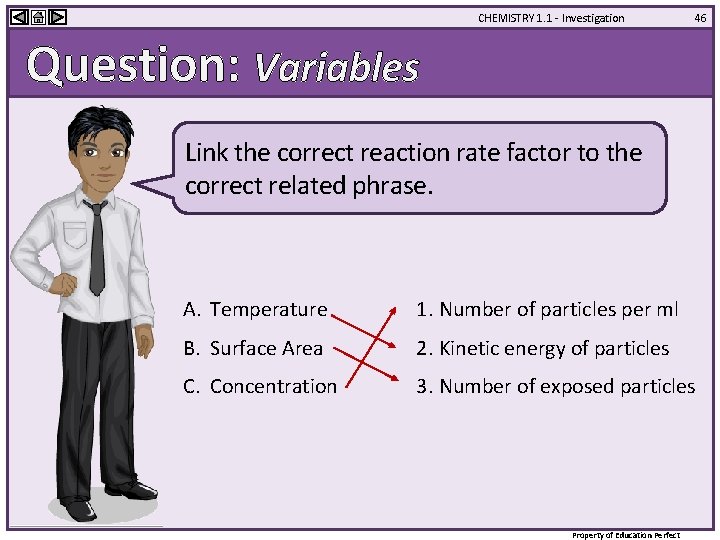
CHEMISTRY 1. 1 - Investigation 46 Question: Variables Link the correct reaction rate factor to the correct related phrase. A. Temperature 1. Number of particles per ml B. Surface Area 2. Kinetic energy of particles C. Concentration 3. Number of exposed particles Property of Education Perfect
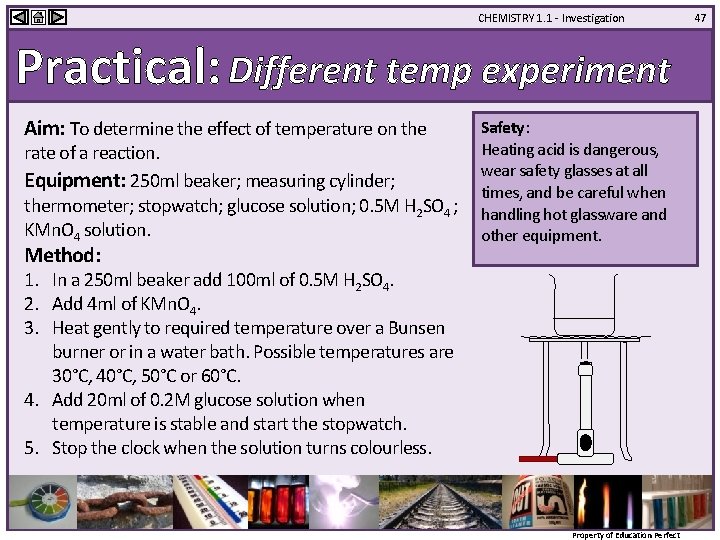
CHEMISTRY 1. 1 - Investigation Practical: Different temp experiment Aim: To determine the effect of temperature on the rate of a reaction. Equipment: 250 ml beaker; measuring cylinder; thermometer; stopwatch; glucose solution; 0. 5 M H 2 SO 4 ; KMn. O 4 solution. Method: Safety: Heating acid is dangerous, wear safety glasses at all times, and be careful when handling hot glassware and other equipment. 1. In a 250 ml beaker add 100 ml of 0. 5 M H 2 SO 4. 2. Add 4 ml of KMn. O 4. 3. Heat gently to required temperature over a Bunsen burner or in a water bath. Possible temperatures are 30°C, 40°C, 50°C or 60°C. 4. Add 20 ml of 0. 2 M glucose solution when temperature is stable and start the stopwatch. 5. Stop the clock when the solution turns colourless. Property of Education Perfect 47
CHEMISTRY 1. 1 - Investigation Terms of use Education Perfect and its creators retain copyright to the intellectual property in all slideshows and associated learning resources. 1. You MAY: a) Use our resources for classroom and school-based learning. b) Place resources on your school intranet (but not in contradiction of 2 d). c) Use and store our files on any computer within your school. 2. You MAY NOT: a) b) c) d) e) Copy, edit, exhibit, rent, hire, lend, broadcast or sell these resources. Photocopy more than five percent of our student workbooks. Remove any references to Education Perfect or our terms of use. Use any part of these resources to create a new document or product. Broadcast these resources on the internet (unless offsite access is password protected). Property of Education Perfect 48
CHEMISTRY 1. 1 - Investigation 49 Our photo sources A number of the photos and images in our slideshows are used under license from other sources. Education Perfect would like to accredit and thank: • Dreamstime • • • Morgue. File Wikimedia Commons Freerange photography Photo Everywhere AJ Hackett Bungy; and Taupo Tandem Skydive Additional photographs and diagrams are the property of Education Perfect. Property of Education Perfect