
Chemical Waste Management What are the potential problems
Chemical Waste Management
What are the potential problems associated with improper disposal? • Pollution - effects all of us - environment • Safety - the individuals that handle the chemicals • Laws - future concern
Hazardous Waste Disposal “Cradle to Grave” and after responsibility
Hazardous Waste Disposal Process Generator Authorized tmnt facility WW tmnt Transport
Chemical Treatment Methods
Flammable Liquids-Fuel Blending • Materials combined in tanks • Tested to ensure specifications • May be used as fuel in cement kilns
Incineration • Destroys organic compounds - burns at roughly 1800 F • Reduces volume of waste • Gases filtered - chemicals altered to less hazardous forms • Generates ash
Solvent Recovery • “Clean” solvents to a condition in which they can be re-used.
WW Treatment • • Removal of contaminants utilizing: Neutralization BOD/COD Particle screens
Chemical Secure Stabilization/Landfill lined • Micro/macro encapsulation • Groundwater monitoring
What can we do to help? • Limit the amount of waste materials that you generate - waste minimization • Make sure to label all chemical wastes appropriately • Make sure to store waste chemicals safely to protect others and the environment • Create a tmnt method?
Waste Minimization Efforts • • • Micro-scale activities Recycling alternatives Less hazardous chemical options Inventory control Prevent mixing of hazardous and nonhazardous wastes • Process modification
Waste Minimization Efforts • • Test outdated chemicals for effectiveness Return expired materials to supplier Chemical redistribution Purchase only what you need - “just in time” deliveries
Regulatory Agencies • Federal • Environmental Protection Agency (EPA) • Nuclear Regulatory Comission • State • New York State Department of Conservation • State Department of Health • Local • Wastewater tmnt
Exposure Control
Regulatory Agencies • Federal • Environmental Protection Agency (EPA) • Nuclear Regulatory Comission • State • New York State Department of Conservation • State Department of Health • Local • Wastewater tmnt
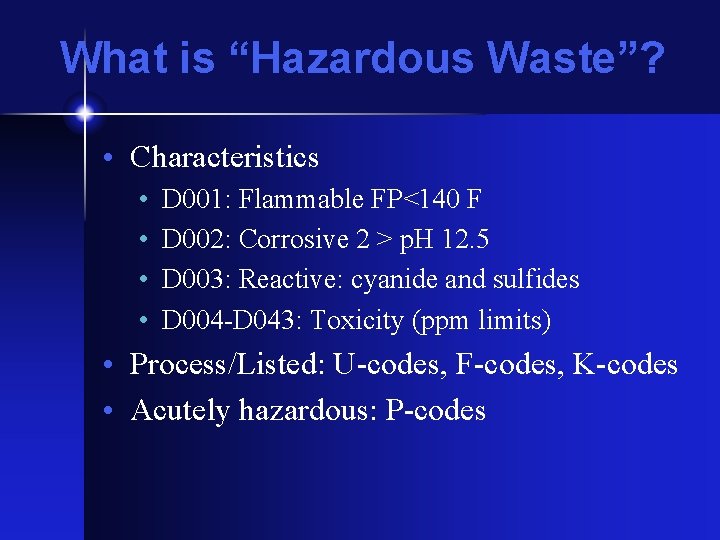
What is “Hazardous Waste”? • Characteristics • • D 001: Flammable FP<140 F D 002: Corrosive 2 > p. H 12. 5 D 003: Reactive: cyanide and sulfides D 004 -D 043: Toxicity (ppm limits) • Process/Listed: U-codes, F-codes, K-codes • Acutely hazardous: P-codes
Exposure Control
Personal Protective Equipment “Routes of Exposure” • • • Inhalation Ingestion Absorption Injection (Eye)
Material Safety Data Sheets (MSDS) - “Tool” • Provide information about specific products/chemicals • Should be reviewed prior to commencement of work with unfamiliar chemicals • Available at http: //msds. rpi. edu or from the EHS office
Example - benzene • • 1% = 10, 000 ppm OSHA PEL: 1 ppm ACGIH: 0. 5 ppm NIOSH REL: 0. 1 ppm • 1 ppm is equivalent ti a single penny in $10, 000. 00
Hazardous Waste Labeling Requirements • Hazardous Waste labels • Department of Transportantion (DOT)
Hazardous Waste Shipping Requirement • Hazardous Waste Manifests • Waste Profiles • Vehicle Placarding
#1. At NO time should any hazardous chemicals be disposed down the drain at RPI. Non-hazardous chemical disposal in sinks must be approved by the Office of Environmental Health and Safety!
Chemical Parameters Specifically Prohibited from Drain Disposal • • p. H less than 2. 5 or greater than 12 Flammable (flashpoint less than 140 F) Reactive materials Toxic materials
Chemical Parameters Specifically Prohibited from Drain Disposal • • Dyes Oil(s) and oily debris Solid or highly viscous materials Waste resulting in the potential of toxic gases, vapors or fumes when combined with liquid • Waste containing viable pathogenic organisms • Radioactive material
#2. Containers of Hazardous Waste must be in good condition, closable with threaded cap or lid and be leak free!
#3. Hazardous Waste must be compatible with the container material! Example: Corrosive materials cannot be stored in steel containers. HF cannot be stored in glass containers.
#4. All Hazardous Waste containers must be stores away from floor drains and sinks. Where this is not possible, a secondary container must be used.
#5. Hazardous Waste containers must be separated in such a manner that incompatible wastes should not mix in the event of a spill, and that no waste materials would be released to the environment.
#6. Containers of Hazardous Waste must be kept tightly closed at all times, unless materials are being added.
#7. Hazardous Waste containers must be labeled with properly completed Hazardous Waste labels.
Proper Container Labeling • • Words not chemical formulas Dated when full Constiuents and appropriate percentages On all containers of Hazardous Waste
#8. Hazardous Waste containers may not be removed from the room in which they were generates unless they are to be brought directly to a designated waste storage area by an appropriately trained individual.
#9. A maximum of 55 gallons of Hazardous Waste, including no more than 1 quart of Acutely Hazardous Waste is allowed in the lab at all time.
#10. In buildings which do not include designated waste storage areas, requests for the pick-up of waste chemicals should be accomplished using a “Request for Hazardous Waste Pick-up” form.
Specific Chemical Hazards • Expired Ether cans • THF • Form peroxides - explosive!
Specific Chemical Hazards Known Peroxidizing Compounds • • • Cyclohexane THF Cumene 1 -Butyl-Alcohol Vinyl Acetate Acetyl Dioxane Ethyl Ether Etc.
Specific Chemical Hazards • Other chemicals commonly used in the laboratory are explosive by nature. • Specific care to: • Storing • Handling • disposing
Specific Chemical Hazards Potentially Explosive Compounds • • • Nitroglycerin Cumene peroxide Acetyl Peroxide Urea Nitrate Picric Acid Nitromethane Succinic Peroxide Lauric Peroxide Trinitrophenol
Summary • Proper Hazardous Waste Practices = • Safe work environment • Financial savings • Clean environment
Summary • Improper Hazardous Waste Practices May = • • Regulatory fines Injuries Expensive disposal - Clean-ups Litigation
- Slides: 42