
Chemical Waste Management Inc v Hunt 504 U







- Slides: 24
Chemical Waste Management, Inc. v. Hunt 504 U. S. 334, 1992 Presented by Group 3 Hyunhai Back, Alice La. Fore, Jason O’Neill, Amanda Robbins, Lydia Robinette, Raina Yudio
Chemical Waste Management CWM, Inc. America‘s Largest hazardous waste company 1957 First Foundation, Illinois & Florida 1971 Publicized as Waste Management, Inc. 1975 C. W. M was first formed (subsidiary) 1978 As a wholly owned subsid of Waste Management, Inc. 1992 The case was argued
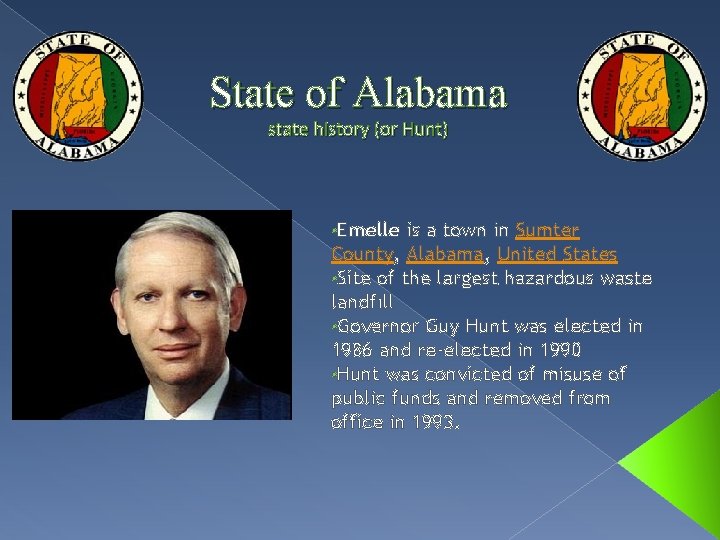
State of Alabama state history (or Hunt) • Emelle is a town in Sumter County, Alabama, United States • Site of the largest hazardous waste landfill • Governor Guy Hunt was elected in 1986 and re-elected in 1990 • Hunt was convicted of misuse of public funds and removed from office in 1993.
What Hunt wanted…. • an additional fee on out-of-state hazardous waste (base fee $25. 60/ton; out-of-state fee $72. 00/ton) • the state for imposing an annual cap on the amount of hazardous waste it would accept Reasons: (1) protection of the health and safety of the citizens of Alabama from toxic substances (2) conservation of the environment and the state's natural resources (3) provision for compensatory revenue for the costs and burdens that out-of-state waste generators impose by dumping their hazardous waste in Alabama (4) reduction of the overall flow of wastes traveling on the state's highways, which flow creates a great risk to the health and safety of the state's citizens Supported by: The Alabama Supreme Court held that this differential treatment does not violate the Commerce Clause
Facts • The parties admitted that the wastes and substances "include substances that are inherently dangerous to human health and safety and to the environment. Such waste consists of ignitable, corrosive, toxic and reactive wastes which contain poisonous and cancer causing chemicals and which can cause birth defects, genetic damage, blindness, crippling and death. “ • From 1985 through 1989, the tonnage of hazardous waste received per year has more than doubled, increasing from 341, 000 tons in 1985 to 788, 000 tons by 1989. Of this, up to 90% of the tonnage permanently buried each year is shipped in from other States.
What CWM argued…. . • the Act violated the Commerce, Due Process, and Equal Protection Clauses of the United States Constitution, and was preempted by various federal statutes because the only basis for the additional fee to be the origin of the waste • Act overall has plainly discouraged the full operation of petitioner's Emelle facility. Such burdensome taxes imposed on interstate commerce alone are generally forbidden: "State may not tax a transaction or incident more heavily when it crosses state lines than when it occurs entirely within the State. “ • there is absolutely no evidence before this Court that waste generated outside Alabama is more dangerous than waste generated in Alabama
Commerce Clause The US Constitution provides that Congress has the Power to regulate commerce with foreign nations and among the states. This clause has two important effects: 1) 2) Allows federal government to regulate the economy. Restricts state regulations that may obstruct or burden interstate commerce. "the Foreign Commerce Clause, " "the Interstate Commerce Clause, " and "the Indian Commerce Clause, " See the next slide for the info.
What the court says……. • Invalidity under the Commerce Clause necessarily follows, for "whatever [Alabama's] ultimate purpose, it may not be accomplished by discriminating against articles of commerce coming from outside the State unless there is some reason, apart from their origin, to treat them differently • Alabama's concern that touches environmental conservation and the health and safety of its citizens does not vary with the point of origin of the waste, and it remains within the State's power to monitor and regulate more closely the transportation and disposal of all hazardous waste within its borders. Even with the possible future financial and environmental risks to be borne by Alabama, such risks likewise do not vary with the waste's State of origin in a way allowing foreign, but not local, waste to be burdened.
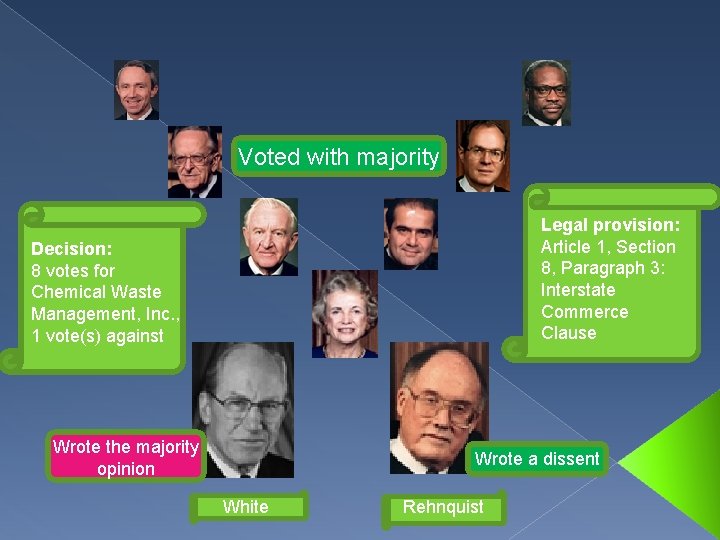
Voted with majority Legal provision: Article 1, Section 8, Paragraph 3: Interstate Commerce Clause Decision: 8 votes for Chemical Waste Management, Inc. , 1 vote(s) against Wrote the majority opinion Wrote a dissent White Rehnquist
Dissenting Opinion…. CHIEF JUSTICE REHNQUIST, dissenting. I have already had occasion to set out my view that States need not ban all waste disposal as a precondition to protecting themselves from hazardous or noxious materials brought across the State's borders. See Philadelphia v. New Jersey, 437 U. S. 617, 629 (1978) (REHNQUIST, J. , dissenting). In a case also decided today, I express my further view that States may take actions legitimately directed at the preservation of the State's natural resources, even if those actions incidentally work to disadvantage some out-of-state waste generators. See Fort Gratiot Sanitary Landfill, Inc. v. Michigan Dept. of Natural Resources, post, p. 368 (REHNQUIST, C. J. , dissenting). I dissent today, largely for the reasons I have set out in those two cases. Several additional comments that pertain specifically to this case, though, are in order. Taxes are a recognized and effective means for discouraging the consumption of scarce commodities-in this case the safe environment that attends appropriate disposal of hazardous wastes. Cf. 26 U. S. C. §§ 4681, 4682 (1988 ed. , Supp. III) (tax on ozone-depleting chemicals); 26 U. S. C. § 4064 (gas guzzler excise tax). I therefore see nothing unconstitutional in Alabama's use of a tax to discourage the export of this commodity to other States, when the commodity is a public good that Alabama has helped to produce. Cf. Fort Gratiot, post, at 372 (REHNQUIST, C. J. , dissenting). Nor do I see any significance in the fact that Alabama has chosen to adopt a differential tax rather than an outright ban. Nothing in the Commerce Clause requires Alabama to adopt an "all or nothing" regulatory approach to noxious materials coming
Facts • State of Alabama tried to restrict the flows of waste into the state • Chemical Waste Management Landfill in Emelle, Alabama is the largest in the United States • Alabama legislature attempted to restrict waste flows into the landfill • Chemical Waste Management challenged the fee as a barrier to interstate commerce • Supreme Court ruled in an eight to one decision that the fee was unconstitutional • Court asserted that “no state may attempt to isolate itself from a problem [of waste disposal]. . . by raising barriers to the free flow of interstate trade” • I think we better make this lager size of font, short and make it in 2 slides, you know … just I think …
Related Cases • Fort Gratiot Sanitary Landfill, Inc. v. Michigan Dept. of Natural Resources, post, p. 353 The Waste Import Restrictions of Michigan's Solid Waste Management Act (SWMA) provide that solid waste generated in another county, State, or country cannot be accepted for disposal unless explicitly authorized in the receiving county's plan. http: //supreme. justia. com/us/504/353/ • Philadelphia v. New Jersey 437 U. S. 617 New Jersey statute (ch. 363) that prohibits the importation of most "solid or liquid waste which originated or was collected outside the territorial limits of the State. . . “ http: //supreme. justia. com/us/437/617/
Related Cases • Philadelphia v. New Jersey precedent: evil of protectionism can reside in legislative means as well as legislative ends. Thus, it does not matter whether the ultimate aim of ch. 363 is to reduce the waste disposal costs of New Jersey residents or to save remaining open lands from pollution, for we assume New Jersey has every right to protect its residents' pocketbooks as well as their environment. And it may be assumed as well that New Jersey may pursue those ends by slowing the flow of all waste into the State's remaining landfills, even though interstate commerce may incidentally be affected. But whatever New Jersey's ultimate purpose, it may not be accompanied by discriminating against articles of commerce coming from outside the State unless there is some reason, apart from their origin, to treat them differently. Both on its face and in its plain effect, ch. 363 violates this principle of nondiscrimination. • ‘The
Commerce Clause From Wikipedia, the free encyclopedia (Redirected from Commerce clause) Jump to: navigation, search The Commerce Clause is an enumerated power listed in the United States Constitution (Article 1, Section 8, Clause 3). The clause states that the United States Congress has the power to regulate commerce with foreign nations, among the states, and with the Native American tribes. Courts and commentators have tended to discuss each of these three areas of commerce as a separate power granted to the Congress of the United States. It is common to see the Commerce Clause referred to as "the Foreign Commerce Clause, " "the Interstate Commerce Clause, " and "the Indian Commerce Clause, " each of which refers to a different application of the same single sentence in the Constitution. Dispute exists as to the range of powers granted to Congress by the Commerce Clause. As noted below, the clause is often paired with the Necessary and Proper Clause, the combination used to take a broad, expansive perspective of these powers. Many strict constructionists deny that this is the proper application of the Commerce Clause.
Breadth part •
Significance • Considered one of the top commerce clause cases in history
• • I think for now it is enough, I mean we can add the stuffs more later • The parts we can add are, accuracy, precision, relevance bla