
Chemical Warfare Agent Mustard Gas Matthew J Geraci
- Slides: 2
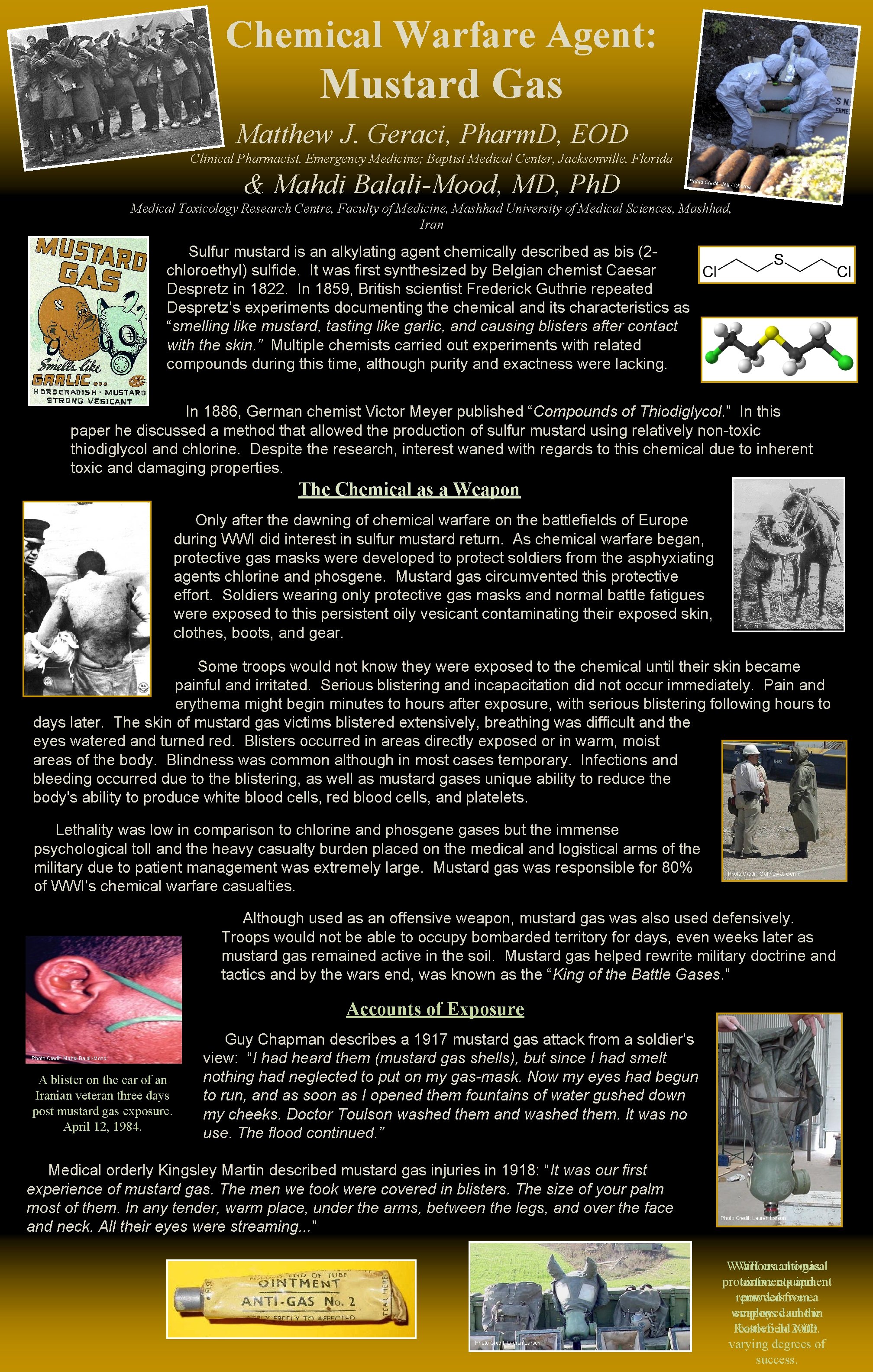
Chemical Warfare Agent: Mustard Gas Matthew J. Geraci, Pharm. D, EOD Clinical Pharmacist, Emergency Medicine; Baptist Medical Center, Jacksonville, Florida & Mahdi Balali-Mood, MD, Ph. D Photo Cred it : Jeff Osbo rne Medical Toxicology Research Centre, Faculty of Medicine, Mashhad University of Medical Sciences, Mashhad, Iran Sulfur mustard is an alkylating agent chemically described as bis (2 chloroethyl) sulfide. It was first synthesized by Belgian chemist Caesar Despretz in 1822. In 1859, British scientist Frederick Guthrie repeated Despretz’s experiments documenting the chemical and its characteristics as “smelling like mustard, tasting like garlic, and causing blisters after contact with the skin. ” Multiple chemists carried out experiments with related compounds during this time, although purity and exactness were lacking. In 1886, German chemist Victor Meyer published “Compounds of Thiodiglycol. ” In this paper he discussed a method that allowed the production of sulfur mustard using relatively non-toxic thiodiglycol and chlorine. Despite the research, interest waned with regards to this chemical due to inherent toxic and damaging properties. The Chemical as a Weapon Only after the dawning of chemical warfare on the battlefields of Europe during WWI did interest in sulfur mustard return. As chemical warfare began, protective gas masks were developed to protect soldiers from the asphyxiating agents chlorine and phosgene. Mustard gas circumvented this protective effort. Soldiers wearing only protective gas masks and normal battle fatigues were exposed to this persistent oily vesicant contaminating their exposed skin, clothes, boots, and gear. Some troops would not know they were exposed to the chemical until their skin became painful and irritated. Serious blistering and incapacitation did not occur immediately. Pain and erythema might begin minutes to hours after exposure, with serious blistering following hours to days later. The skin of mustard gas victims blistered extensively, breathing was difficult and the eyes watered and turned red. Blisters occurred in areas directly exposed or in warm, moist areas of the body. Blindness was common although in most cases temporary. Infections and bleeding occurred due to the blistering, as well as mustard gases unique ability to reduce the body's ability to produce white blood cells, red blood cells, and platelets. Lethality was low in comparison to chlorine and phosgene gases but the immense psychological toll and the heavy casualty burden placed on the medical and logistical arms of the military due to patient management was extremely large. Mustard gas was responsible for 80% of WWI’s chemical warfare casualties. Photo Credit: Matthew J. Geraci Although used as an offensive weapon, mustard gas was also used defensively. Troops would not be able to occupy bombarded territory for days, even weeks later as mustard gas remained active in the soil. Mustard gas helped rewrite military doctrine and tactics and by the wars end, was known as the “King of the Battle Gases. ” Accounts of Exposure Photo Credit: Mahdi Balali-Mood A blister on the ear of an Iranian veteran three days post mustard gas exposure. April 12, 1984. Guy Chapman describes a 1917 mustard gas attack from a soldier’s view: “I had heard them (mustard gas shells), but since I had smelt nothing had neglected to put on my gas-mask. Now my eyes had begun to run, and as soon as I opened them fountains of water gushed down my cheeks. Doctor Toulson washed them and washed them. It was no use. The flood continued. ” Medical orderly Kingsley Martin described mustard gas injuries in 1918: “It was our first experience of mustard gas. The men we took were covered in blisters. The size of your palm most of them. In any tender, warm place, under the arms, between the legs, and over the face and neck. All their eyes were streaming. . . ” Photo Credit: Lauren Larson WWII Various era anti-gas chemical protective ointments equipment and removed powdersfrom werea weapons employedcache on the in Kosovo battlefield in 2000. with varying degrees of success.
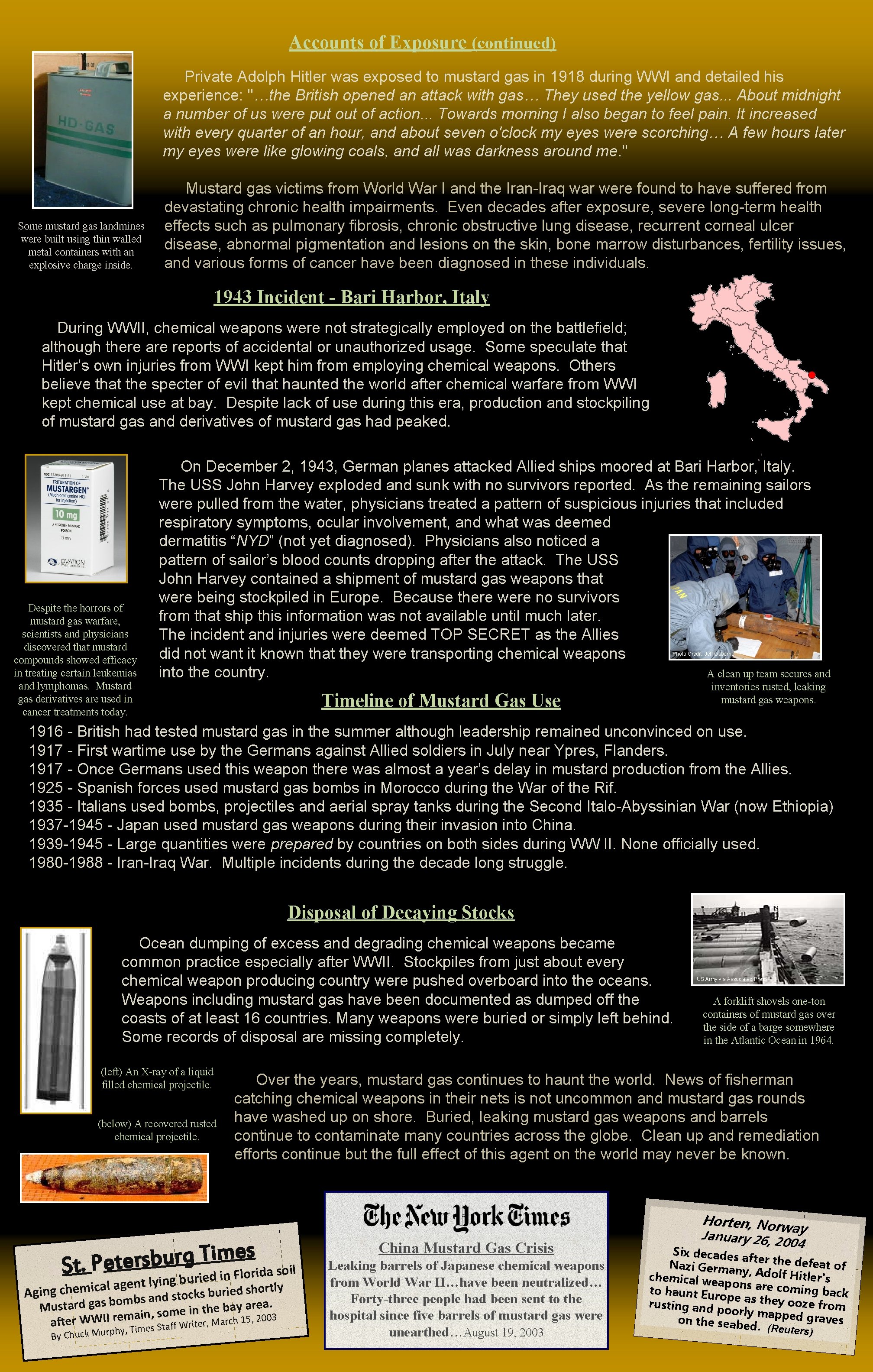
Accounts of Exposure (continued) Private Adolph Hitler was exposed to mustard gas in 1918 during WWI and detailed his experience: "…the British opened an attack with gas… They used the yellow gas. . . About midnight a number of us were put of action. . . Towards morning I also began to feel pain. It increased with every quarter of an hour, and about seven o'clock my eyes were scorching… A few hours later my eyes were like glowing coals, and all was darkness around me. " Some mustard gas landmines were built using thin walled metal containers with an explosive charge inside. Mustard gas victims from World War I and the Iran-Iraq war were found to have suffered from devastating chronic health impairments. Even decades after exposure, severe long-term health effects such as pulmonary fibrosis, chronic obstructive lung disease, recurrent corneal ulcer disease, abnormal pigmentation and lesions on the skin, bone marrow disturbances, fertility issues, and various forms of cancer have been diagnosed in these individuals. 1943 Incident - Bari Harbor, Italy During WWII, chemical weapons were not strategically employed on the battlefield; although there are reports of accidental or unauthorized usage. Some speculate that Hitler’s own injuries from WWI kept him from employing chemical weapons. Others believe that the specter of evil that haunted the world after chemical warfare from WWI kept chemical use at bay. Despite lack of use during this era, production and stockpiling of mustard gas and derivatives of mustard gas had peaked. Despite the horrors of mustard gas warfare, scientists and physicians discovered that mustard compounds showed efficacy in treating certain leukemias and lymphomas. Mustard gas derivatives are used in cancer treatments today. On December 2, 1943, German planes attacked Allied ships moored at Bari Harbor, Italy. The USS John Harvey exploded and sunk with no survivors reported. As the remaining sailors were pulled from the water, physicians treated a pattern of suspicious injuries that included respiratory symptoms, ocular involvement, and what was deemed dermatitis “NYD” (not yet diagnosed). Physicians also noticed a pattern of sailor’s blood counts dropping after the attack. The USS John Harvey contained a shipment of mustard gas weapons that were being stockpiled in Europe. Because there were no survivors from that ship this information was not available until much later. The incident and injuries were deemed TOP SECRET as the Allies did not want it known that they were transporting chemical weapons A clean up team secures and into the country. Photo Credit: Jeff Osborne inventories rusted, leaking mustard gas weapons. Timeline of Mustard Gas Use 1916 - British had tested mustard gas in the summer although leadership remained unconvinced on use. 1917 - First wartime use by the Germans against Allied soldiers in July near Ypres, Flanders. 1917 - Once Germans used this weapon there was almost a year’s delay in mustard production from the Allies. 1925 - Spanish forces used mustard gas bombs in Morocco during the War of the Rif. 1935 - Italians used bombs, projectiles and aerial spray tanks during the Second Italo-Abyssinian War (now Ethiopia) 1937 -1945 - Japan used mustard gas weapons during their invasion into China. 1939 -1945 - Large quantities were prepared by countries on both sides during WW II. None officially used. 1980 -1988 - Iran-Iraq War. Multiple incidents during the decade long struggle. Disposal of Decaying Stocks Ocean dumping of excess and degrading chemical weapons became common practice especially after WWII. Stockpiles from just about every chemical weapon producing country were pushed overboard into the oceans. Weapons including mustard gas have been documented as dumped off the coasts of at least 16 countries. Many weapons were buried or simply left behind. Some records of disposal are missing completely. (left) An X-ray of a liquid filled chemical projectile. (below) A recovered rusted chemical projectile. US Army via Associated Press A forklift shovels one-ton containers of mustard gas over the side of a barge somewhere in the Atlantic Ocean in 1964. Over the years, mustard gas continues to haunt the world. News of fisherman catching chemical weapons in their nets is not uncommon and mustard gas rounds have washed up on shore. Buried, leaking mustard gas weapons and barrels continue to contaminate many countries across the globe. Clean up and remediation efforts continue but the full effect of this agent on the world may never be known. Horten, Norw s e m i T g r u b s r e t e St. P Florida soil n i d e i r u b g n i y l t n e g a l a y c l i t r o h s d e i r u b Aging chem ks c o t s d n a s b om b s a. g a d e r r a a t s y u a b M e h t n i e m o s , n i a 03 r, March 15, 20 after WWII rem rite W f f a t S s e im T , y h By Chuck Murp China Mustard Gas Crisis Leaking barrels of Japanese chemical weapons from World War II…have been neutralized… Forty-three people had been sent to the hospital since five barrels of mustard gas were unearthed…August 19, 2003 January 26, 2 ay 004 Six decades after the de feat of Nazi Germa ny, Adolf Hi tler's chemical we apons are co ming back to haunt Eu rope as they ooze from rusting and poorly map ped graves on the seab ed. (Reuters )