
Chemical Transportation Risk Management SAND No 2012 2778
- Slides: 57
Chemical Transportation Risk Management SAND No: 2012 -2778 C Sandia National Laboratories is a multi-program laboratory managed and operated by Sandia Corporation, a wholly owned subsidiary of Lockheed Martin Corporation, for the U. S. Department of Energy's National Nuclear Security Administration under contract DE-AC 04 -94 AL 85000
Overview of Presentation � � Effects of globalization on chemical transportation Complexity in the global chemical supply chain Chemical transportation risks Chemical transportation risk management approach ◦ Center for Chemical Process Safety (CCPS) � � Case study Chemical transportation security risk management Selecting a transportation contractor Summary 2
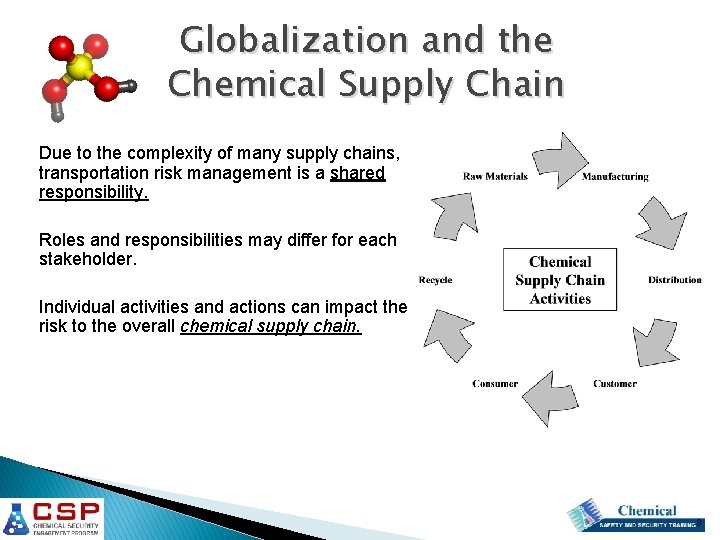
Globalization and the Chemical Supply Chain Due to the complexity of many supply chains, transportation risk management is a shared responsibility. Roles and responsibilities may differ for each stakeholder. Individual activities and actions can impact the risk to the overall chemical supply chain. 3
Globalization and the Chemical Supply Chain � Chemical transportation is an essential element in the chemical supply chain; however, � Globalization in the chemical supply chain has resulted in: ◦ Increased volume of chemicals transported ◦ Increased speed of transport ◦ Resultant strain on transportation infrastructure
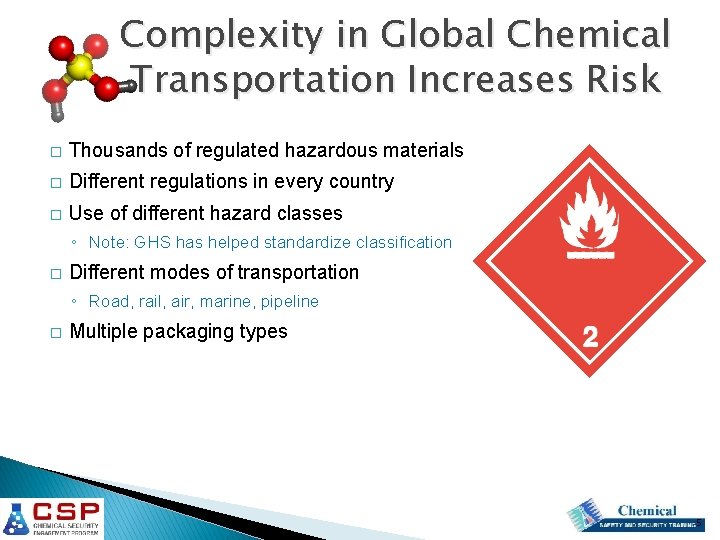
Complexity in Global Chemical Transportation Increases Risk � Thousands of regulated hazardous materials � Different regulations in every country � Use of different hazard classes ◦ Note: GHS has helped standardize classification � Different modes of transportation ◦ Road, rail, air, marine, pipeline � Multiple packaging types 5
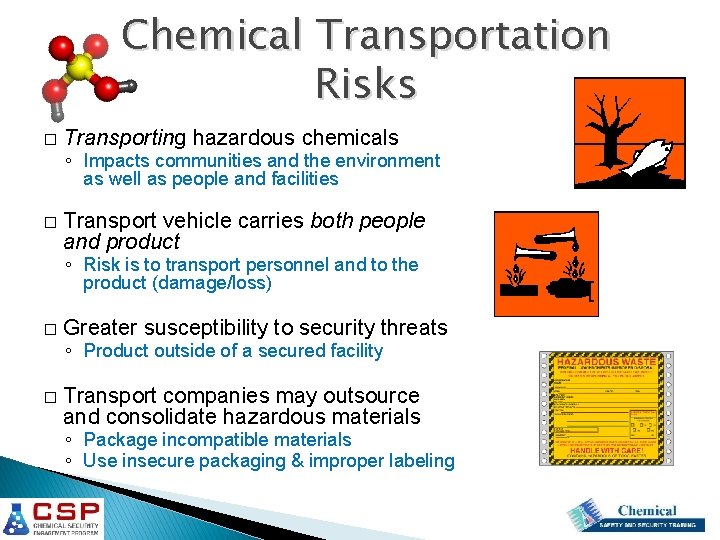
Chemical Transportation Risks � Transporting hazardous chemicals ◦ Impacts communities and the environment as well as people and facilities � Transport vehicle carries both people and product ◦ Risk is to transport personnel and to the product (damage/loss) � Greater susceptibility to security threats ◦ Product outside of a secured facility � Transport companies may outsource and consolidate hazardous materials ◦ Package incompatible materials ◦ Use insecure packaging & improper labeling
Chemical Transportation Risk Management
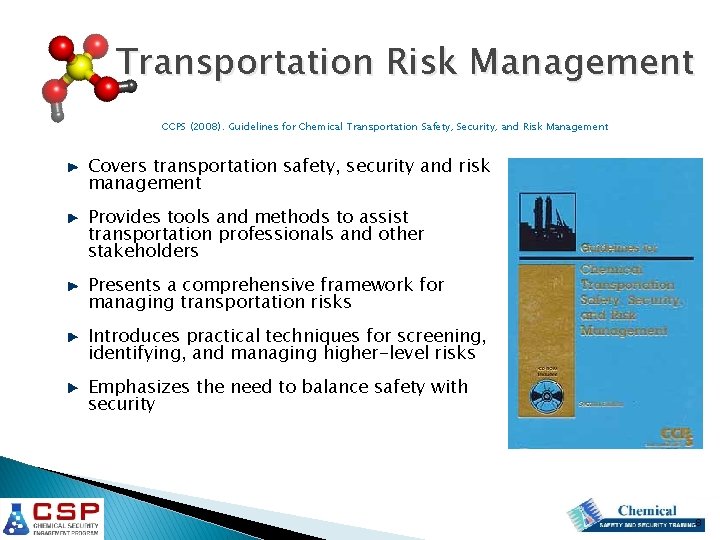
Transportation Risk Management CCPS (2008). Guidelines for Chemical Transportation Safety, Security, and Risk Management Covers transportation safety, security and risk management Provides tools and methods to assist transportation professionals and other stakeholders Presents a comprehensive framework for managing transportation risks Introduces practical techniques for screening, identifying, and managing higher-level risks Emphasizes the need to balance safety with security 8
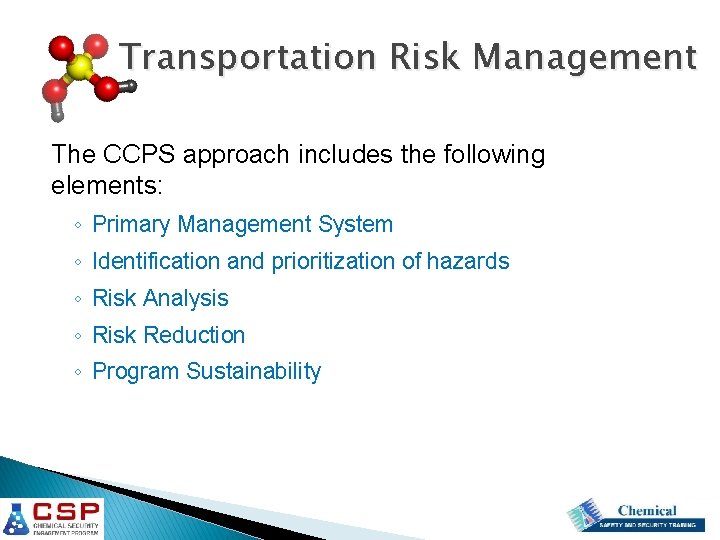
Transportation Risk Management The CCPS approach includes the following elements: ◦ Primary Management System ◦ Identification and prioritization of hazards ◦ Risk Analysis ◦ Risk Reduction ◦ Program Sustainability
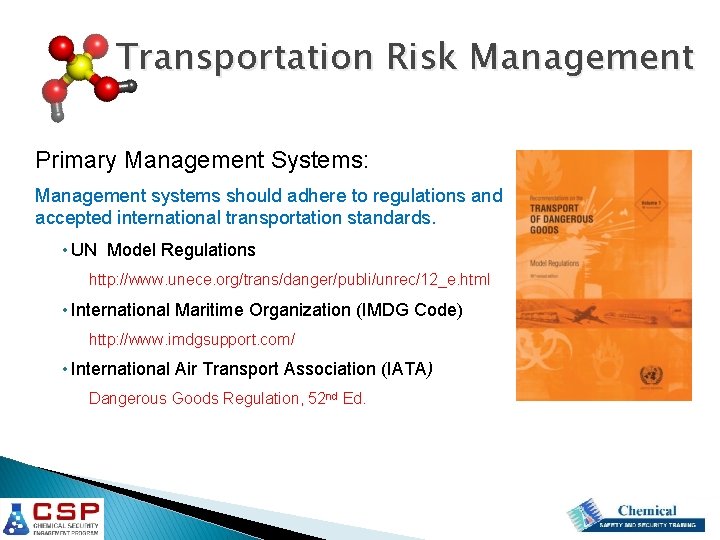
Transportation Risk Management Primary Management Systems: Management systems should adhere to regulations and accepted international transportation standards. • UN Model Regulations http: //www. unece. org/trans/danger/publi/unrec/12_e. html • International Maritime Organization (IMDG Code) http: //www. imdgsupport. com/ • International Air Transport Association (IATA) Dangerous Goods Regulation, 52 nd Ed.
Transportation Risk Management A Primary Management System should also include: Management Commitment “Risk Reduction Culture” Policies, procedures & practices Emergency preparedness & response procedures Incident reporting system Management of change Periodic auditing of the system 11
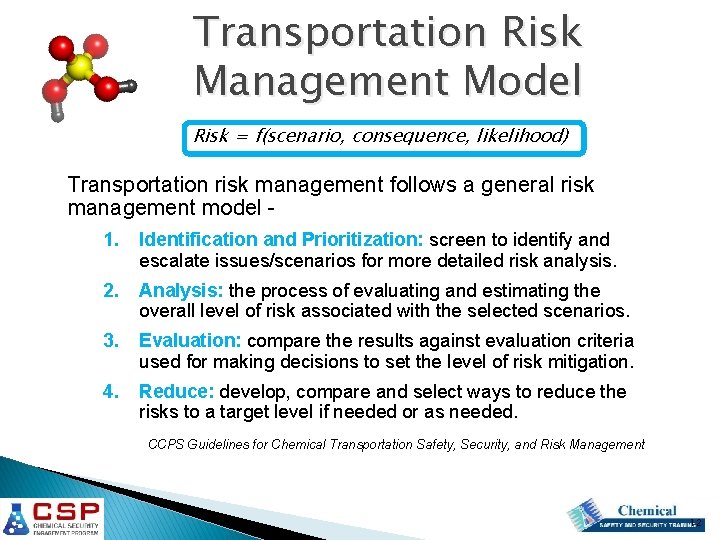
Transportation Risk Management Model Risk = f(scenario, consequence, likelihood) Transportation risk management follows a general risk management model 1. Identification and Prioritization: screen to identify and escalate issues/scenarios for more detailed risk analysis. 2. Analysis: the process of evaluating and estimating the overall level of risk associated with the selected scenarios. 3. Evaluation: compare the results against evaluation criteria used for making decisions to set the level of risk mitigation. 4. Reduce: develop, compare and select ways to reduce the risks to a target level if needed or as needed. CCPS Guidelines for Chemical Transportation Safety, Security, and Risk Management 12
Transportation Risk Management Risk = f(scenario, consequence, likelihood) � CCPS Publication gives estimates for the likelihood of incidents involving: ◦ Pipelines ◦ Rail ◦ Trucks ◦ Barges ◦ Ocean-going vessels ◦ Intermodal transport
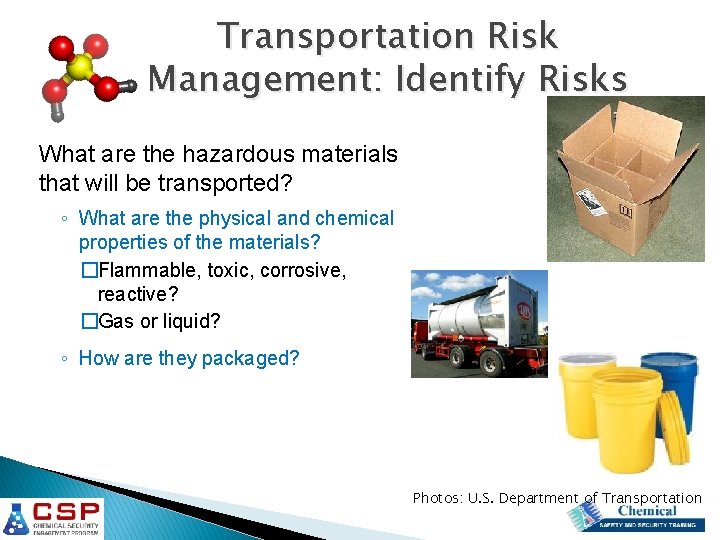
Transportation Risk Management: Identify Risks What are the hazardous materials that will be transported? ◦ What are the physical and chemical properties of the materials? �Flammable, toxic, corrosive, reactive? �Gas or liquid? ◦ How are they packaged? Photos: U. S. Department of Transportation
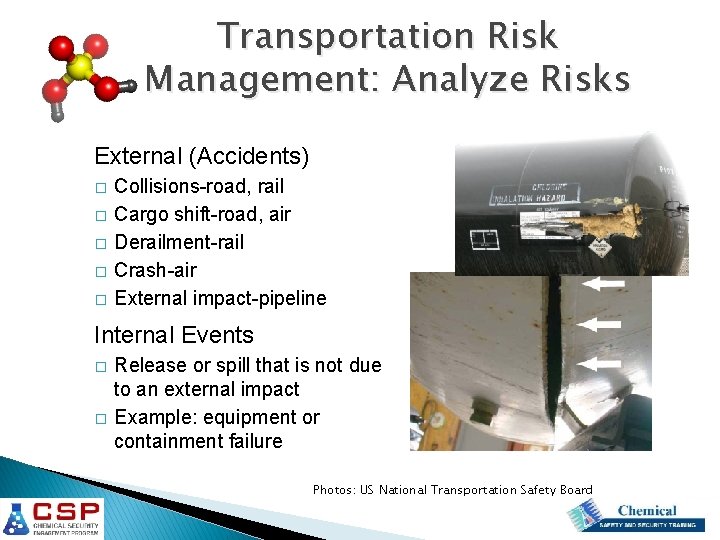
Transportation Risk Management: Analyze Risks External (Accidents) � � � Collisions-road, rail Cargo shift-road, air Derailment-rail Crash-air External impact-pipeline Internal Events � � Release or spill that is not due to an external impact Example: equipment or containment failure Photos: US National Transportation Safety Board
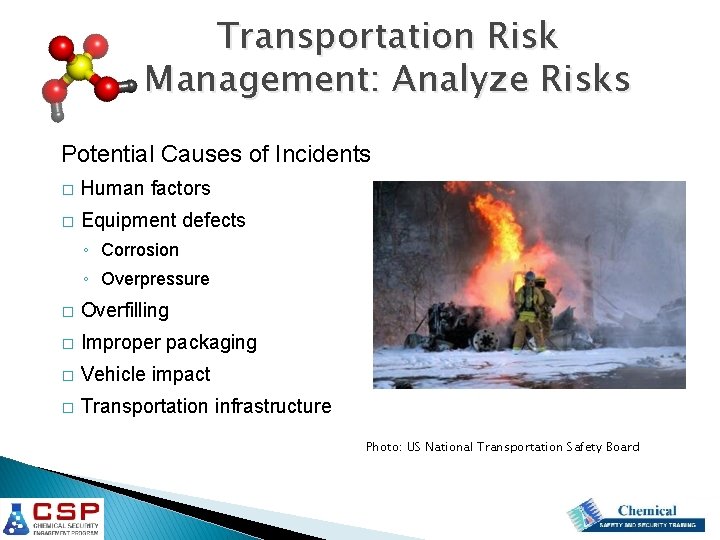
Transportation Risk Management: Analyze Risks Potential Causes of Incidents � Human factors � Equipment defects ◦ Corrosion ◦ Overpressure � Overfilling � Improper packaging � Vehicle impact � Transportation infrastructure Photo: US National Transportation Safety Board
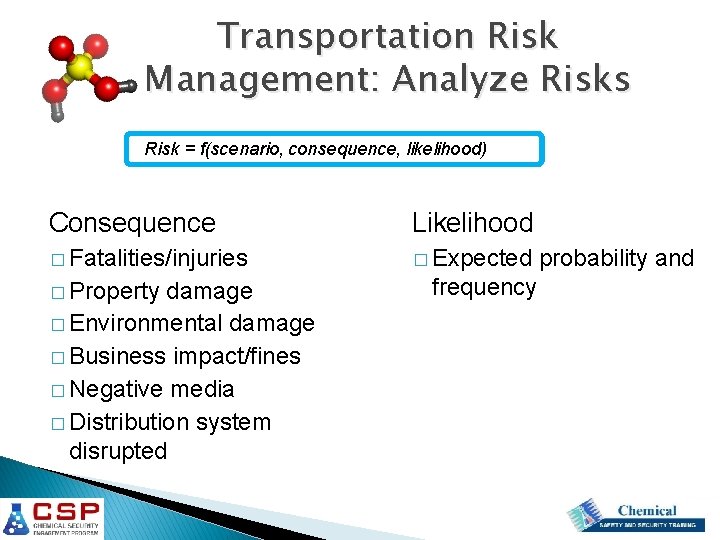
Transportation Risk Management: Analyze Risks Risk = f(scenario, consequence, likelihood) Consequence Likelihood � Fatalities/injuries � Expected � Property damage � Environmental damage � Business impact/fines � Negative media � Distribution system disrupted frequency probability and
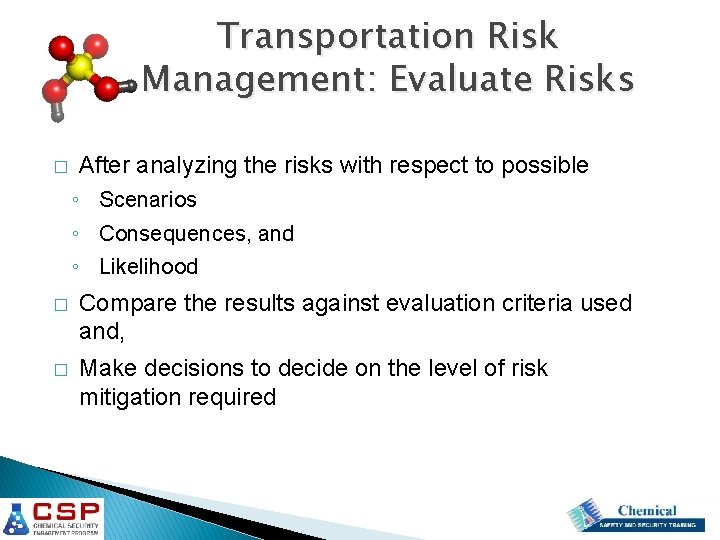
Transportation Risk Management: Evaluate Risks � After analyzing the risks with respect to possible ◦ Scenarios ◦ Consequences, and ◦ Likelihood � Compare the results against evaluation criteria used and, � Make decisions to decide on the level of risk mitigation required
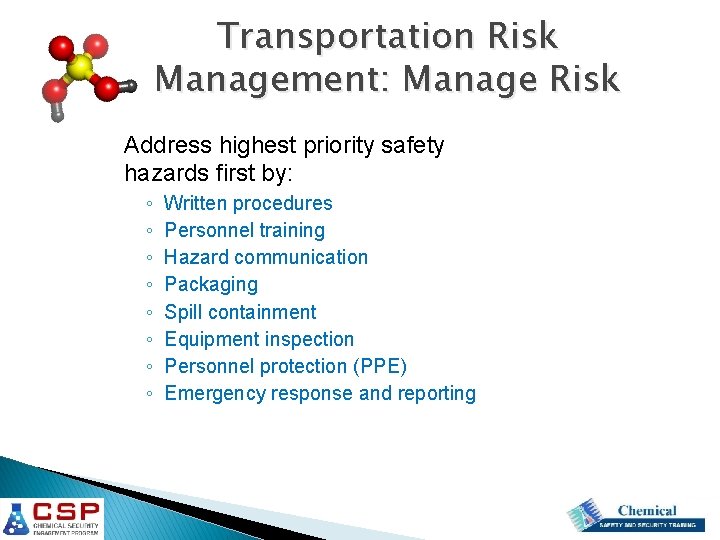
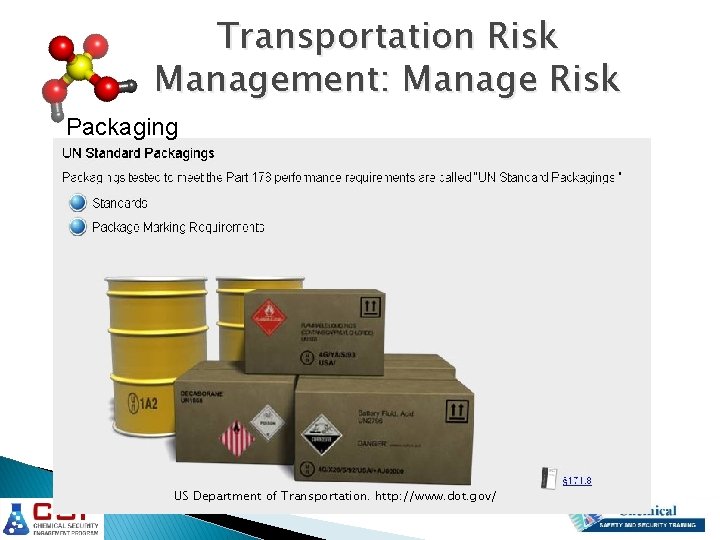
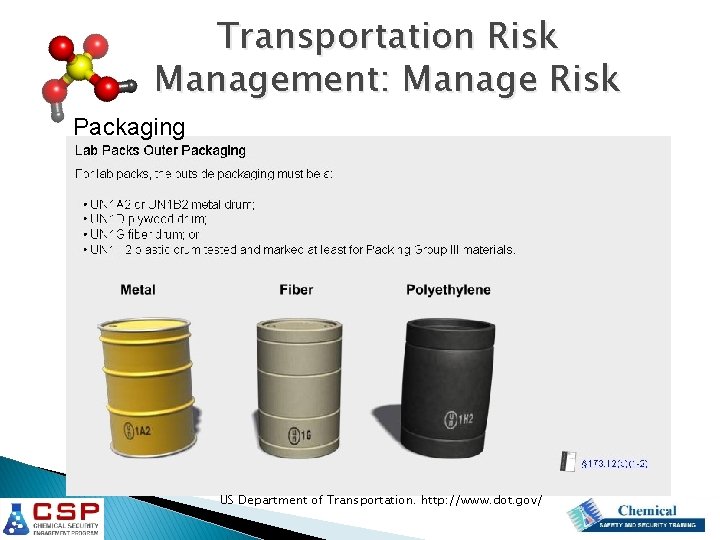
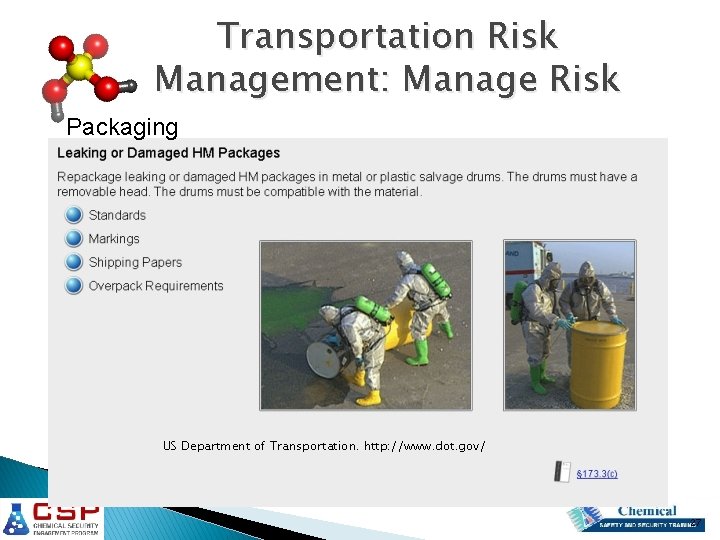
Transportation Risk Management: Manage Risk Address highest priority safety hazards first by: ◦ ◦ ◦ ◦ Written procedures Personnel training Hazard communication Packaging Spill containment Equipment inspection Personnel protection (PPE) Emergency response and reporting
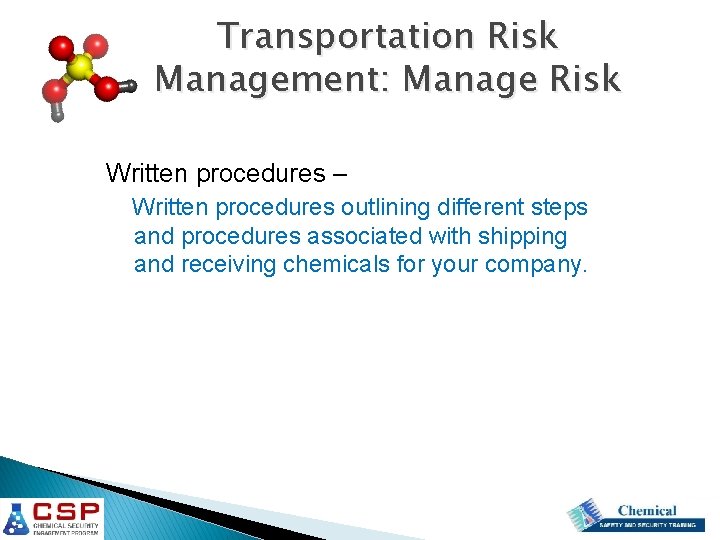
Transportation Risk Management: Manage Risk Written procedures – Written procedures outlining different steps and procedures associated with shipping and receiving chemicals for your company.
Transportation Risk Management: Manage Risk Personnel Training – o o Train personnel on the handling, packaging, shipping and receiving of chemicals. They need to know local transportation as well as international regulations for the shipment of hazardous chemicals. Make sure that more than one person has the training. Make sure training is up-to-date.
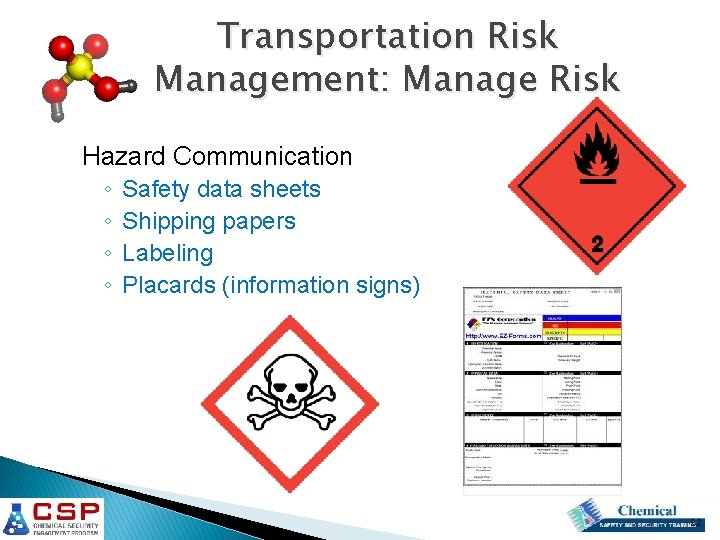
Transportation Risk Management: Manage Risk Hazard Communication ◦ ◦ Safety data sheets Shipping papers Labeling Placards (information signs) 22
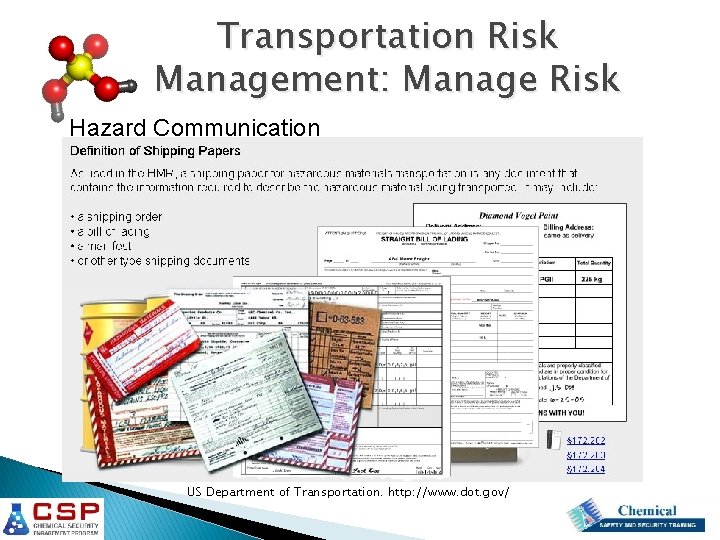
Transportation Risk Management: Manage Risk Hazard Communication US Department of Transportation. http: //www. dot. gov/
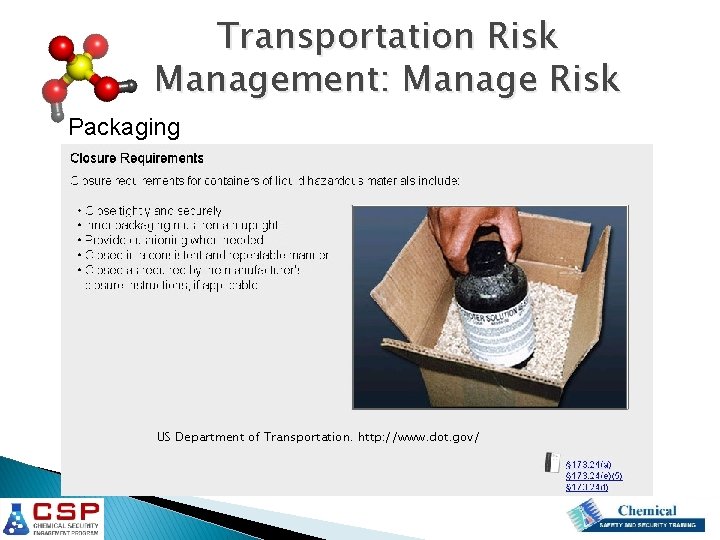
Transportation Risk Management: Manage Risk Packaging US Department of Transportation. http: //www. dot. gov/
Transportation Risk Management: Manage Risk Packaging US Department of Transportation. http: //www. dot. gov/
Transportation Risk Management: Manage Risk Packaging US Department of Transportation. http: //www. dot. gov/
Transportation Risk Management: Manage Risk Packaging US Department of Transportation. http: //www. dot. gov/ 27
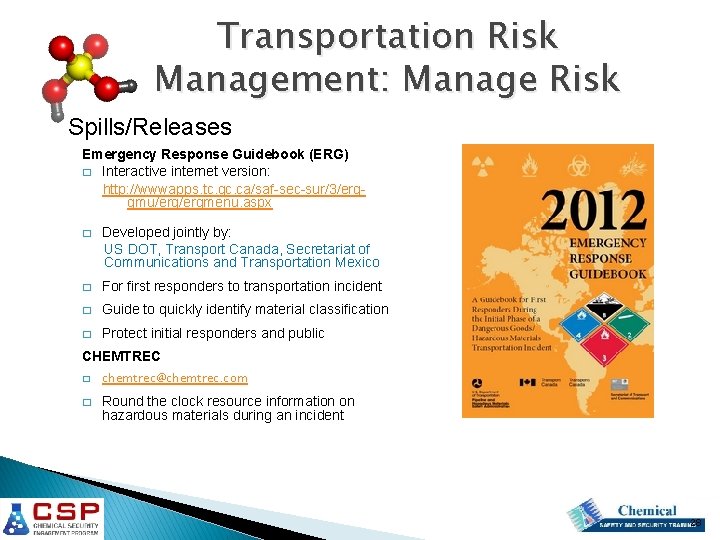
Transportation Risk Management: Manage Risk Spills/Releases Emergency Response Guidebook (ERG) � Interactive internet version: http: //wwwapps. tc. gc. ca/saf-sec-sur/3/erggmu/ergmenu. aspx � Developed jointly by: US DOT, Transport Canada, Secretariat of Communications and Transportation Mexico � For first responders to transportation incident � Guide to quickly identify material classification � Protect initial responders and public CHEMTREC � � chemtrec@chemtrec. com Round the clock resource information on hazardous materials during an incident 28
A Case Study Involving Lithium Batteries and Improper Packaging Accident No. DCA 04 MZ 001 U. S. National Transportation Safety Board. http: //www. ntsb. gov/ 29
Lithium Batteries and Improper Packaging Transportation mode: Air Date: 7 Aug. 2004 Hazardous Material: Lithium-ion batteries Type of accident: Cargo fire at the terminal Carrier: Air freight line (non-passenger carrier) Result: Damage to cargo unit load device ~$20, 000 USD. No injuries. Accident No. DCA 04 MZ 001 U. S. National Transportation Safety Board. http: //www. ntsb. gov/ 30
Lithium Batteries and Improper Packaging Background Information: � � Lithium batteries are described as Class 9 goods [miscellaneous dangerous goods – international term is hazardous materials]. This was a prototype battery pack manufactured by a US firm. Battery pack was to be shipped to France for electric car research. Because it was a prototype battery pack special approval was required for this shipment. U. S. National Transportation Safety Board. http: //www. ntsb. gov/ 31
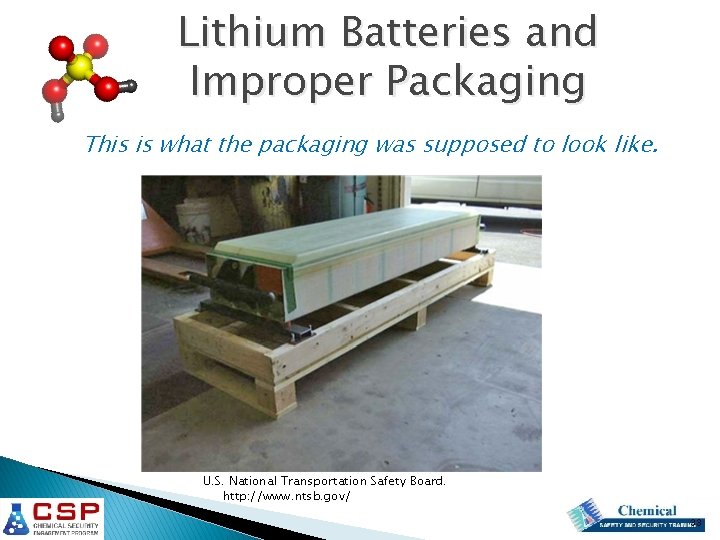
Lithium Batteries and Improper Packaging Shipping Requirements as specified by the US Department of Transportation – � Battery pack ◦ Size - 157 x 43 x 23 cm ◦ Weight = 159 Kg � Package ◦ ◦ specifications – Insulating fiber glass case Inside a wooden box Fiberglass case bolted to the wooden box Total weight = 240 Kg U. S. National Transportation Safety Board. http: //www. ntsb. gov/ 32
Lithium Batteries and Improper Packaging This is what the packaging was supposed to look like. U. S. National Transportation Safety Board. http: //www. ntsb. gov/ 33
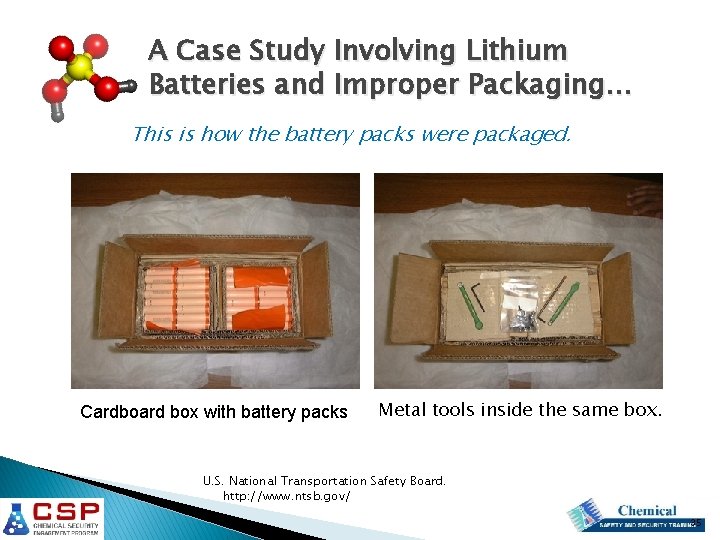
Lithium Batteries and Improper Packaging How did the company prepare the lithium battery pack for packaging? � Type of Package – ◦ Cardboard box package contained – ◦ Battery pack with exposed terminals ◦ Metal wrenches with a plastic bag of nuts and bolts. � The U. S. National Transportation Safety Board. http: //www. ntsb. gov/ 34
A Case Study Involving Lithium Batteries and Improper Packaging… This is how the battery packs were packaged. Cardboard box with battery packs Metal tools inside the same box. U. S. National Transportation Safety Board. http: //www. ntsb. gov/ 35
A Case Study Involving Lithium Batteries and Improper Packaging… What Happened? � It was determined that the metal tools shifted during transportation and short circuited the positive and negative terminals of the battery pack causing localized heating. � This heating caused the packaging to burn and ruptured of some of the other lithium ion battery cells. U. S. National Transportation Safety Board. http: //www. ntsb. gov/ 36
A Case Study Involving Lithium Batteries and Improper Packaging… Why did this accident happen? 37
A Case Study Involving Lithium Batteries and Improper Packaging… There were guidelines detailing the proper packaging of the lithium-ion batteries. These guidelines were not followed. 38
A Case Study Involving Lithium Batteries and Improper Packaging… What could have been the outcome? This fire could have occurred during the flight, resulting in the loss of the airplane and possibly the loss of life. The freight box containing the battery pack was being loaded into the airplane when the worker smelled smoke. 39
Transportation Security Risk Management Security Risk = f(consequence, vulnerability, threat) Is similar to safety risks Safety Risk = f(scenario, consequence, likelihood) � For security risks the initiating event is a direct attack. � The magnitude of the incident could be greater. ◦ Larger releases of hazardous material are possible, ◦ Populations would be most likely the target.
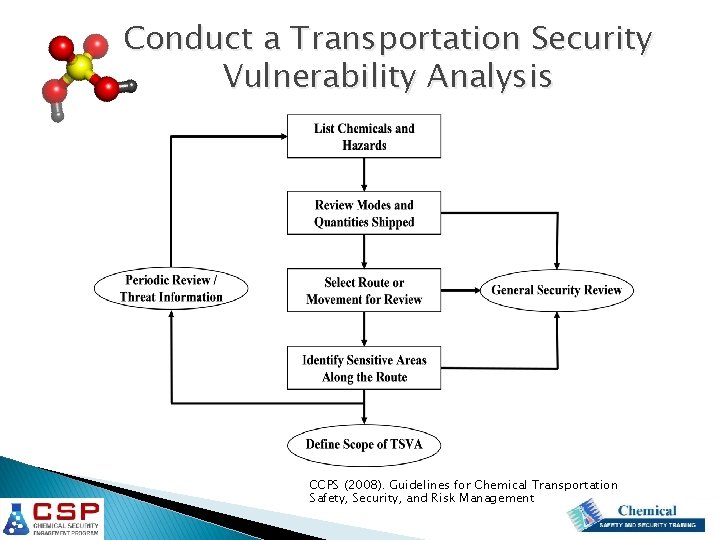
Conduct a Transportation Security Vulnerability Analysis CCPS (2008). Guidelines for Chemical Transportation Safety, Security, and Risk Management
Transportation Security Risk Management: Identify Threat � In-plant ◦ Sabotage shipments ◦ Intentional release ◦ Theft � In-transit ◦ Hijacking ◦ Theft of materials ◦ Sabotage � Attacks on pipelines http: //www. phmsa. dot. gov/hazmat/security 42
Transportation Security Risk Management: Manage Risk In-plant: � Include internal transfers in plant security plan � Limit access to facilities and shipping information � Secure transportation equipment � Keep an inventory of hazardous materials ◦ Use tamper resistant seals � Personnel Security ◦ Background checks ◦ Identification cards or badges 43
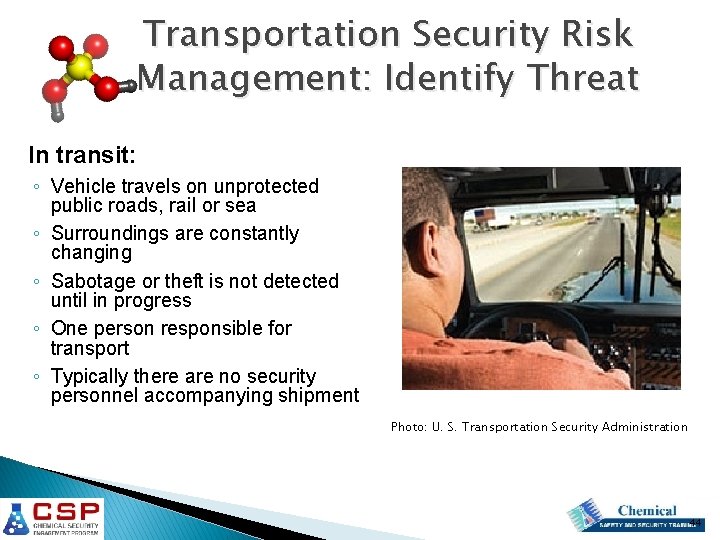
Transportation Security Risk Management: Identify Threat In transit: ◦ Vehicle travels on unprotected public roads, rail or sea ◦ Surroundings are constantly changing ◦ Sabotage or theft is not detected until in progress ◦ One person responsible for transport ◦ Typically there are no security personnel accompanying shipment Photo: U. S. Transportation Security Administration 44
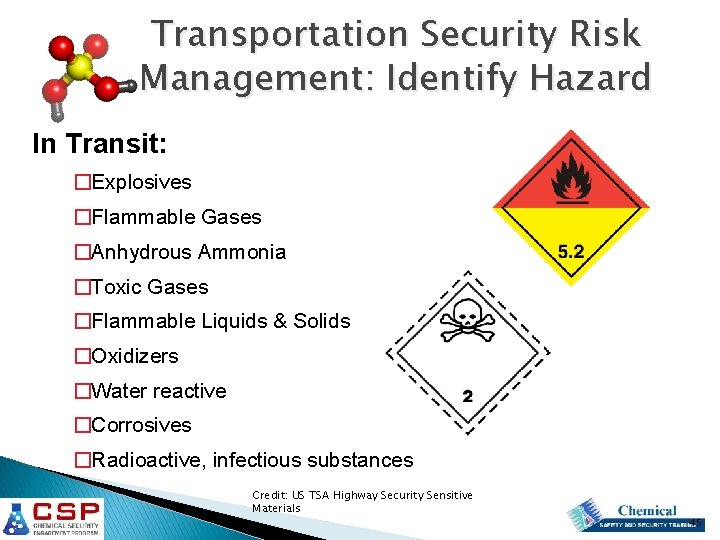
Transportation Security Risk Management: Identify Hazard In Transit: �Explosives �Flammable Gases �Anhydrous Ammonia �Toxic Gases �Flammable Liquids & Solids �Oxidizers �Water reactive �Corrosives �Radioactive, infectious substances Credit: US TSA Highway Security Sensitive Materials 45
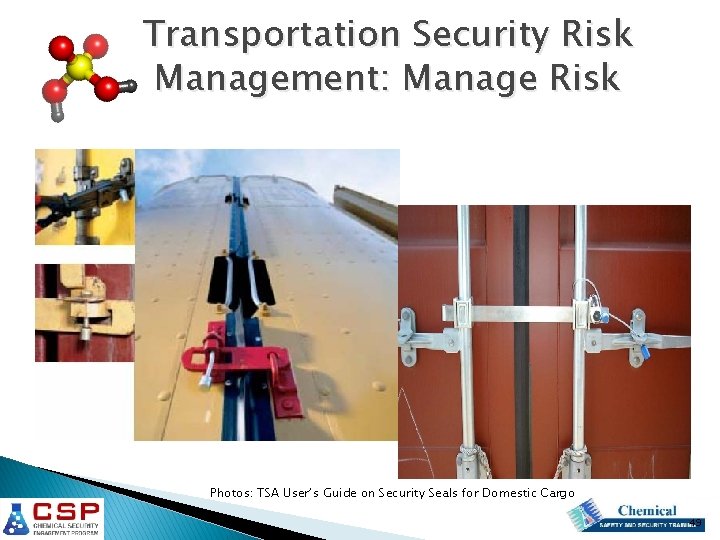
Transportation Security Risk Management: Manage Risk In Transit: � High risk shipments require high-level controls � Increase the possibility of detecting an attack ◦ Alarm the shipment ◦ Use communication systems �GPS Increase the possibility of delaying an attack � ◦ Secure high risk materials ◦ Use obscurants Increase the possibility of responding to an attack � o Provide for additional security personnel 46
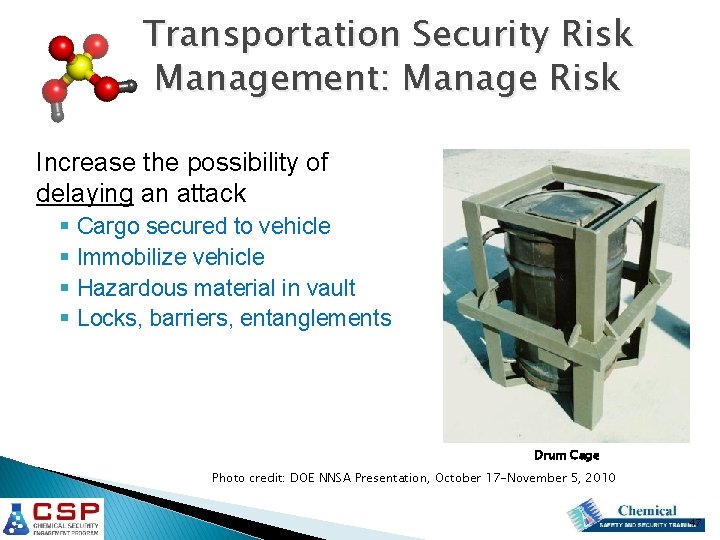
Transportation Security Risk Management: Manage Risk Increase the possibility of delaying an attack § § Cargo secured to vehicle Immobilize vehicle Hazardous material in vault Locks, barriers, entanglements Drum Cage Photo credit: DOE NNSA Presentation, October 17 -November 5, 2010 47
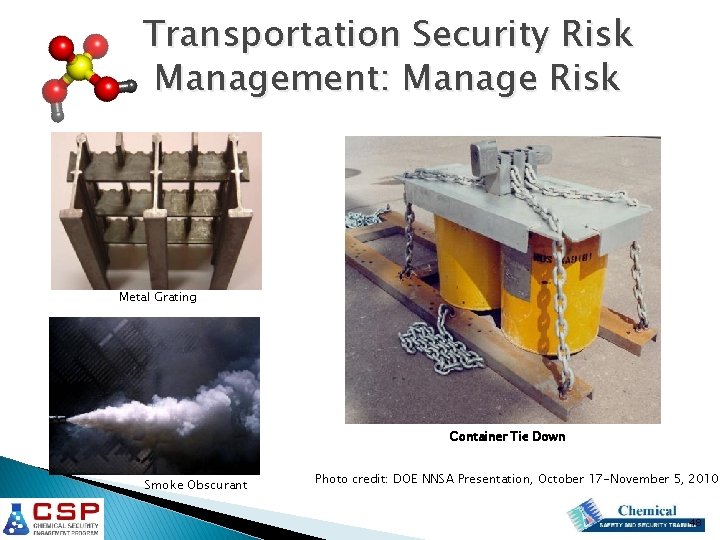
Transportation Security Risk Management: Manage Risk Metal Grating Container Tie Down Smoke Obscurant Photo credit: DOE NNSA Presentation, October 17 -November 5, 2010 48
Transportation Security Risk Management: Manage Risk Photos: TSA User’s Guide on Security Seals for Domestic Cargo 49
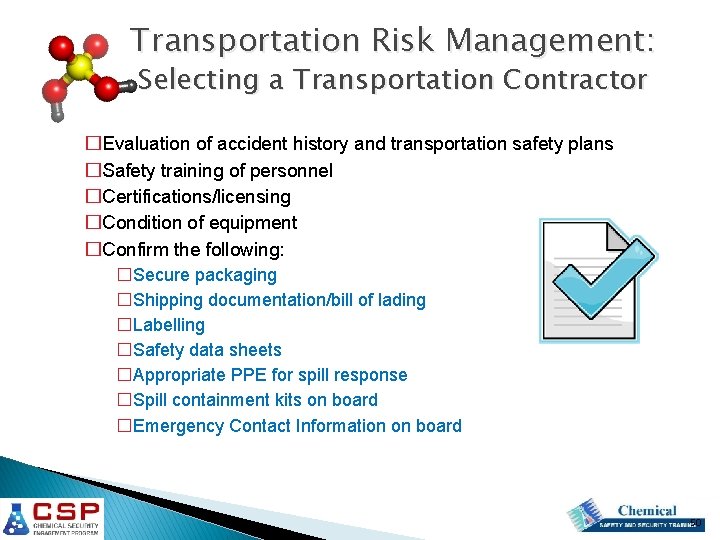
Transportation Risk Management: Selecting a Transportation Contractor �Evaluation of accident history and transportation safety plans �Safety training of personnel �Certifications/licensing �Condition of equipment �Confirm the following: �Secure packaging �Shipping documentation/bill of lading �Labelling �Safety data sheets �Appropriate PPE for spill response �Spill containment kits on board �Emergency Contact Information on board 50
Transportation Risk Management: Selecting a Transportation Contractor US regulates: § § § § Driver qualifications Years of service Equipment standards Driving and parking rules Alcohol and controlled substances Financial responsibility Operational requirements HAZMAT training required for: § Personnel who prepare, load/unload, or transport hazardous materials. 51
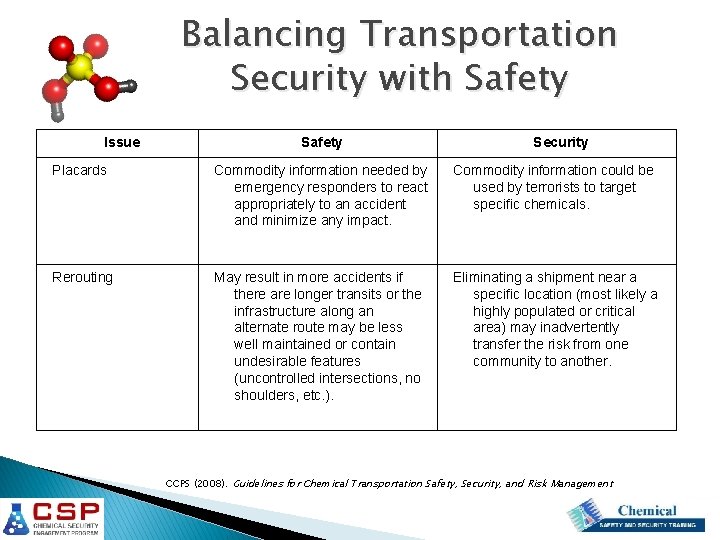
Balancing Transportation Security with Safety Issue Safety Security Placards Commodity information needed by emergency responders to react appropriately to an accident and minimize any impact. Commodity information could be used by terrorists to target specific chemicals. Rerouting May result in more accidents if there are longer transits or the infrastructure along an alternate route may be less well maintained or contain undesirable features (uncontrolled intersections, no shoulders, etc. ). Eliminating a shipment near a specific location (most likely a highly populated or critical area) may inadvertently transfer the risk from one community to another. CCPS (2008). Guidelines for Chemical Transportation Safety, Security, and Risk Management
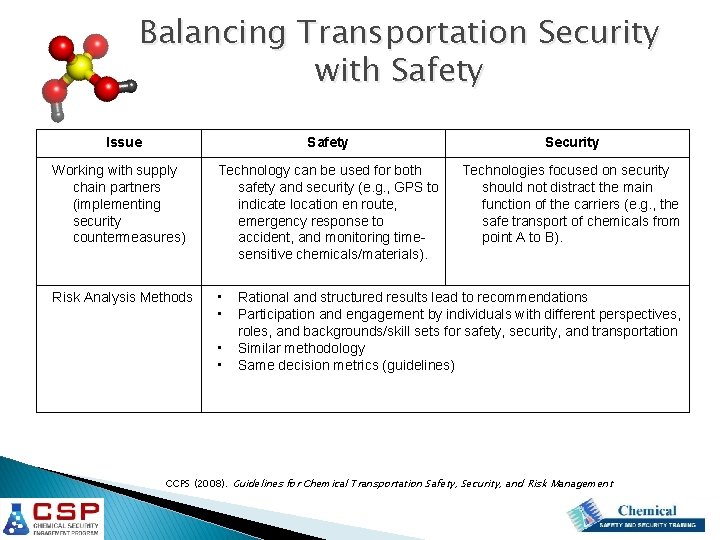
Balancing Transportation Security with Safety Issue Safety Security Working with supply chain partners (implementing security countermeasures) Technology can be used for both safety and security (e. g. , GPS to indicate location en route, emergency response to accident, and monitoring timesensitive chemicals/materials). Technologies focused on security should not distract the main function of the carriers (e. g. , the safe transport of chemicals from point A to B). Risk Analysis Methods • • Rational and structured results lead to recommendations Participation and engagement by individuals with different perspectives, roles, and backgrounds/skill sets for safety, security, and transportation Similar methodology Same decision metrics (guidelines) CCPS (2008). Guidelines for Chemical Transportation Safety, Security, and Risk Management
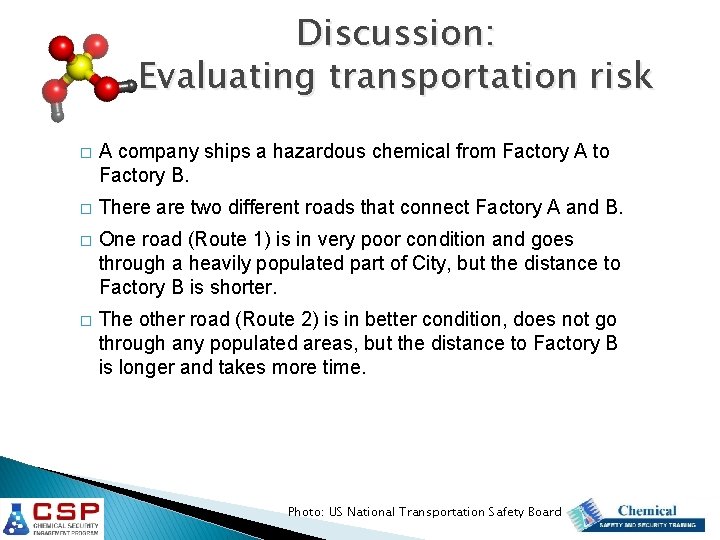
Discussion: Evaluating transportation risk � A company ships a hazardous chemical from Factory A to Factory B. � There are two different roads that connect Factory A and B. � One road (Route 1) is in very poor condition and goes through a heavily populated part of City, but the distance to Factory B is shorter. � The other road (Route 2) is in better condition, does not go through any populated areas, but the distance to Factory B is longer and takes more time. Photo: US National Transportation Safety Board
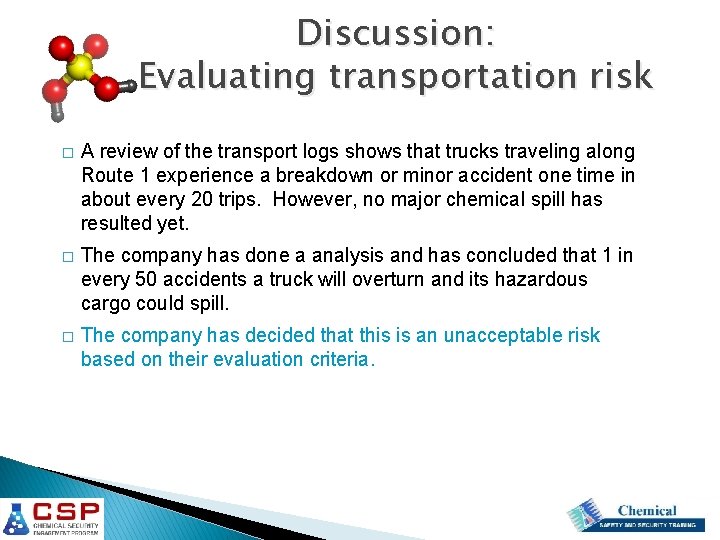
Discussion: Evaluating transportation risk � A review of the transport logs shows that trucks traveling along Route 1 experience a breakdown or minor accident one time in about every 20 trips. However, no major chemical spill has resulted yet. � The company has done a analysis and has concluded that 1 in every 50 accidents a truck will overturn and its hazardous cargo could spill. � The company has decided that this is an unacceptable risk based on their evaluation criteria.
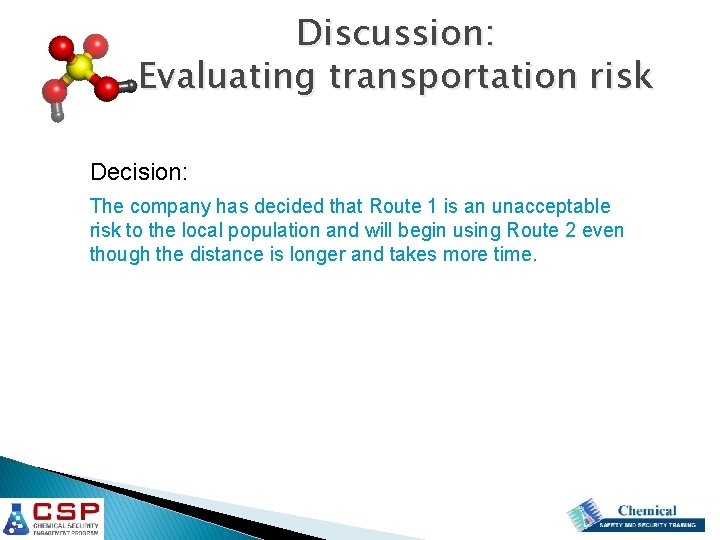
Discussion: Evaluating transportation risk Decision: The company has decided that Route 1 is an unacceptable risk to the local population and will begin using Route 2 even though the distance is longer and takes more time.
Summary of Presentation � � � � Summarized current issues with globalization in transportation Summarized the elements of a chemical transportation risk management program Described safety hazards/risks in chemical transportation and risk management Provided an example of a case study involving the shipment of lithium batteries Described security threats in chemical transportation and risk management Compared transportation safety versus security risk reduction strategies Provided an example of a security vulnerability assessment 57