
Chemical Transport Model Recreates Vertical and Spatial Propagation
- Slides: 6
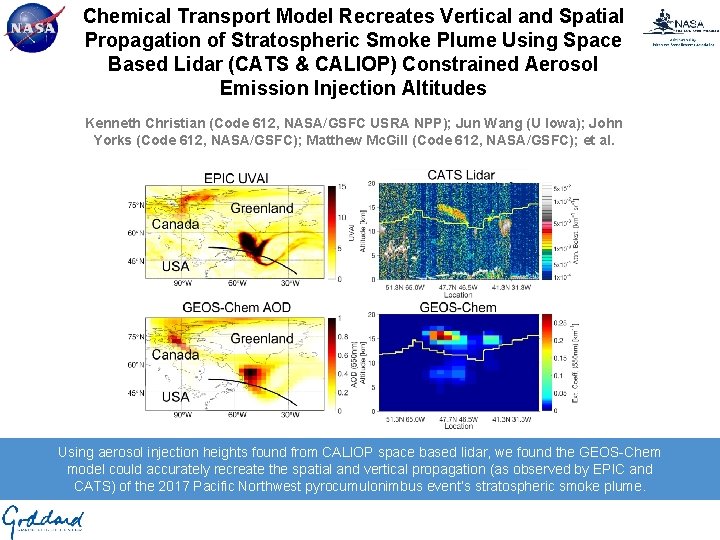
Chemical Transport Model Recreates Vertical and Spatial Propagation of Stratospheric Smoke Plume Using Space Based Lidar (CATS & CALIOP) Constrained Aerosol Emission Injection Altitudes Kenneth Christian (Code 612, NASA/GSFC USRA NPP); Jun Wang (U Iowa); John Yorks (Code 612, NASA/GSFC); Matthew Mc. Gill (Code 612, NASA/GSFC); et al. Using aerosol injection heights found from CALIOP space based lidar, we found the GEOS-Chem model could accurately recreate the spatial and vertical propagation (as observed by EPIC and CATS) of the 2017 Pacific Northwest pyrocumulonimbus event’s stratospheric smoke plume.
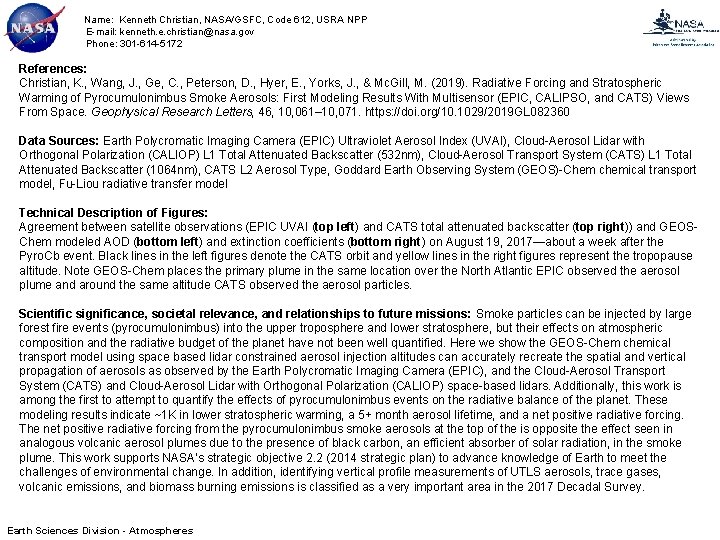
Name: Kenneth Christian, NASA/GSFC, Code 612, USRA NPP E-mail: kenneth. e. christian@nasa. gov Phone: 301 -614 -5172 References: Christian, K. , Wang, J. , Ge, C. , Peterson, D. , Hyer, E. , Yorks, J. , & Mc. Gill, M. (2019). Radiative Forcing and Stratospheric Warming of Pyrocumulonimbus Smoke Aerosols: First Modeling Results With Multisensor (EPIC, CALIPSO, and CATS) Views From Space. Geophysical Research Letters, 46, 10, 061– 10, 071. https: //doi. org/10. 1029/2019 GL 082360 Data Sources: Earth Polycromatic Imaging Camera (EPIC) Ultraviolet Aerosol Index (UVAI), Cloud-Aerosol Lidar with Orthogonal Polarization (CALIOP) L 1 Total Attenuated Backscatter (532 nm), Cloud-Aerosol Transport System (CATS) L 1 Total Attenuated Backscatter (1064 nm), CATS L 2 Aerosol Type, Goddard Earth Observing System (GEOS)-Chem chemical transport model, Fu-Liou radiative transfer model Technical Description of Figures: Agreement between satellite observations (EPIC UVAI (top left) and CATS total attenuated backscatter (top right)) and GEOSChem modeled AOD (bottom left) and extinction coefficients (bottom right) on August 19, 2017—about a week after the Pyro. Cb event. Black lines in the left figures denote the CATS orbit and yellow lines in the right figures represent the tropopause altitude. Note GEOS-Chem places the primary plume in the same location over the North Atlantic EPIC observed the aerosol plume and around the same altitude CATS observed the aerosol particles. Scientific significance, societal relevance, and relationships to future missions: Smoke particles can be injected by large forest fire events (pyrocumulonimbus) into the upper troposphere and lower stratosphere, but their effects on atmospheric composition and the radiative budget of the planet have not been well quantified. Here we show the GEOS-Chem chemical transport model using space based lidar constrained aerosol injection altitudes can accurately recreate the spatial and vertical propagation of aerosols as observed by the Earth Polycromatic Imaging Camera (EPIC), and the Cloud-Aerosol Transport System (CATS) and Cloud-Aerosol Lidar with Orthogonal Polarization (CALIOP) space-based lidars. Additionally, this work is among the first to attempt to quantify the effects of pyrocumulonimbus events on the radiative balance of the planet. These modeling results indicate ~1 K in lower stratospheric warming, a 5+ month aerosol lifetime, and a net positive radiative forcing. The net positive radiative forcing from the pyrocumulonimbus smoke aerosols at the top of the is opposite the effect seen in analogous volcanic aerosol plumes due to the presence of black carbon, an efficient absorber of solar radiation, in the smoke plume. This work supports NASA’s strategic objective 2. 2 (2014 strategic plan) to advance knowledge of Earth to meet the challenges of environmental change. In addition, identifying vertical profile measurements of UTLS aerosols, trace gases, volcanic emissions, and biomass burning emissions is classified as a very important area in the 2017 Decadal Survey. Earth Sciences Division - Atmospheres
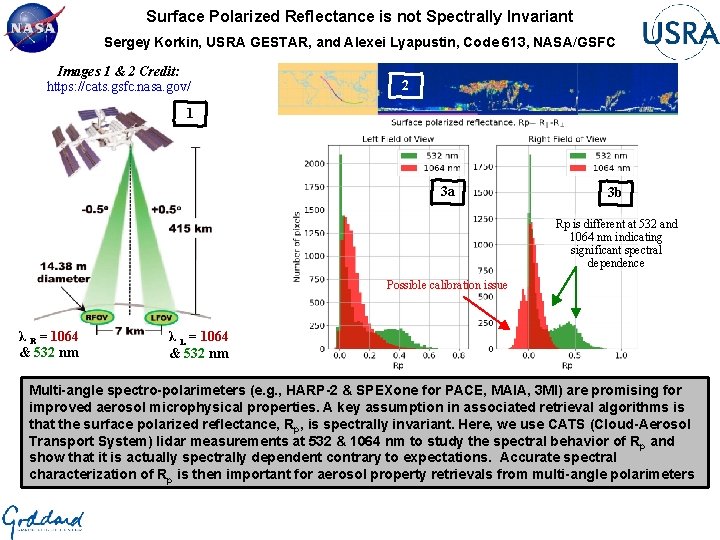
Surface Polarized Reflectance is not Spectrally Invariant Sergey Korkin, USRA GESTAR, and Alexei Lyapustin, Code 613, NASA/GSFC Images 1 & 2 Credit: https: //cats. gsfc. nasa. gov/ 2 1 3 a 3 b Rp is different at 532 and 1064 nm indicating significant spectral dependence Possible calibration issue λ R = 1064 & 532 nm λ L = 1064 & 532 nm Multi-angle spectro-polarimeters (e. g. , HARP-2 & SPEXone for PACE, MAIA, 3 MI) are promising for improved aerosol microphysical properties. A key assumption in associated retrieval algorithms is that the surface polarized reflectance, Rp, is spectrally invariant. Here, we use CATS (Cloud-Aerosol Transport System) lidar measurements at 532 & 1064 nm to study the spectral behavior of R p and show that it is actually spectrally dependent contrary to expectations. Accurate spectral characterization of Rp is then important for aerosol property retrievals from multi-angle polarimeters
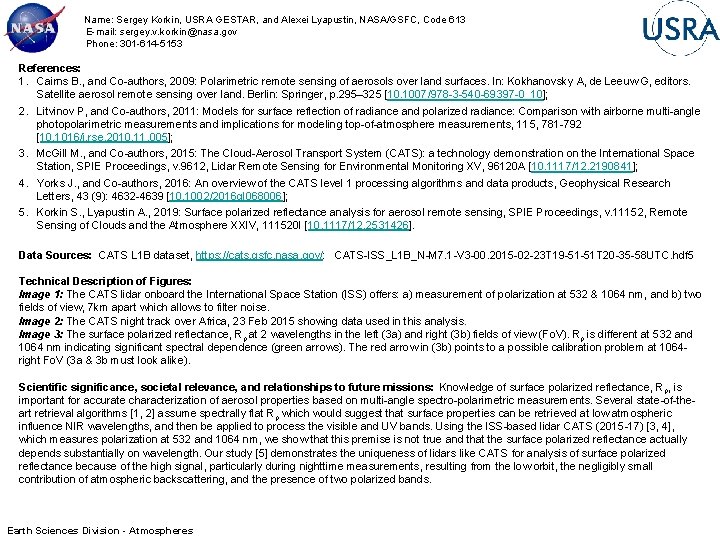
Name: Sergey Korkin, USRA GESTAR, and Alexei Lyapustin, NASA/GSFC, Code 613 E-mail: sergey. v. korkin@nasa. gov Phone: 301 -614 -5153 References: 1. Cairns B. , and Co-authors, 2009: Polarimetric remote sensing of aerosols over land surfaces. In: Kokhanovsky A, de Leeuw G, editors. Satellite aerosol remote sensing over land. Berlin: Springer, p. 295– 325 [10. 1007/978 -3 -540 -69397 -0_10]; 2. Litvinov P, and Co-authors, 2011: Models for surface reflection of radiance and polarized radiance: Comparison with airborne multi-angle photopolarimetric measurements and implications for modeling top-of-atmosphere measurements, 115, 781 -792 [10. 1016/j. rse. 2010. 11. 005]; 3. Mc. Gill M. , and Co-authors, 2015: The Cloud-Aerosol Transport System (CATS): a technology demonstration on the International Space Station, SPIE Proceedings, v. 9612, Lidar Remote Sensing for Environmental Monitoring XV, 96120 A [10. 1117/12. 2190841]; 4. Yorks J. , and Co-authors, 2016: An overview of the CATS level 1 processing algorithms and data products, Geophysical Research Letters, 43 (9): 4632 -4639 [10. 1002/2016 gl 068006]; 5. Korkin S. , Lyapustin A. , 2019: Surface polarized reflectance analysis for aerosol remote sensing, SPIE Proceedings, v. 11152, Remote Sensing of Clouds and the Atmosphere XXIV, 111520 I [10. 1117/12. 2531426]. Data Sources: CATS L 1 B dataset, https: //cats. gsfc. nasa. gov/: CATS-ISS_L 1 B_N-M 7. 1 -V 3 -00. 2015 -02 -23 T 19 -51 -51 T 20 -35 -58 UTC. hdf 5 Technical Description of Figures: Image 1: The CATS lidar onboard the International Space Station (ISS) offers: a) measurement of polarization at 532 & 1064 nm, and b) two fields of view, 7 km apart which allows to filter noise. Image 2: The CATS night track over Africa, 23 Feb 2015 showing data used in this analysis. Image 3: The surface polarized reflectance, Rp at 2 wavelengths in the left (3 a) and right (3 b) fields of view (Fo. V). Rp is different at 532 and 1064 nm indicating significant spectral dependence (green arrows). The red arrow in (3 b) points to a possible calibration problem at 1064 right Fo. V (3 a & 3 b must look alike). Scientific significance, societal relevance, and relationships to future missions: Knowledge of surface polarized reflectance, Rp, is important for accurate characterization of aerosol properties based on multi-angle spectro-polarimetric measurements. Several state-of-theart retrieval algorithms [1, 2] assume spectrally flat Rp which would suggest that surface properties can be retrieved at low atmospheric influence NIR wavelengths, and then be applied to process the visible and UV bands. Using the ISS-based lidar CATS (2015 -17) [3, 4], which measures polarization at 532 and 1064 nm, we show that this premise is not true and that the surface polarized reflectance actually depends substantially on wavelength. Our study [5] demonstrates the uniqueness of lidars like CATS for analysis of surface polarized reflectance because of the high signal, particularly during nighttime measurements, resulting from the low orbit, the negligibly small contribution of atmospheric backscattering, and the presence of two polarized bands. Earth Sciences Division - Atmospheres
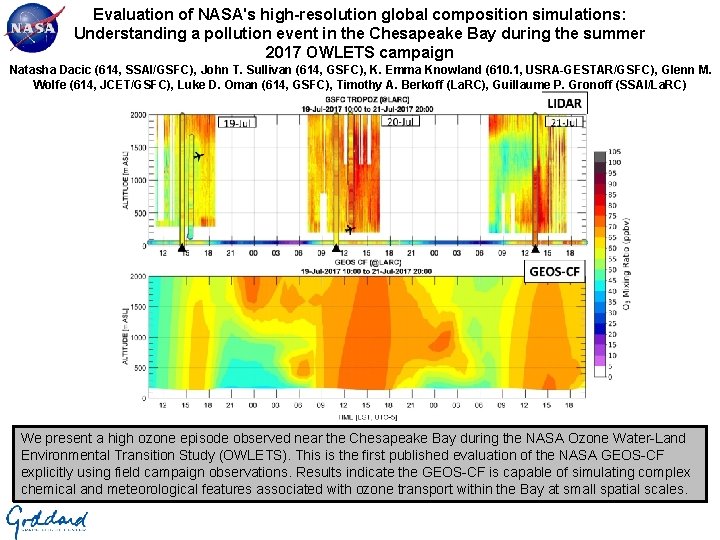
Evaluation of NASA's high-resolution global composition simulations: Understanding a pollution event in the Chesapeake Bay during the summer 2017 OWLETS campaign Natasha Dacic (614, SSAI/GSFC), John T. Sullivan (614, GSFC), K. Emma Knowland (610. 1, USRA-GESTAR/GSFC), Glenn M. Wolfe (614, JCET/GSFC), Luke D. Oman (614, GSFC), Timothy A. Berkoff (La. RC), Guillaume P. Gronoff (SSAI/La. RC) We present a high ozone episode observed near the Chesapeake Bay during the NASA Ozone Water-Land Environmental Transition Study (OWLETS). This is the first published evaluation of the NASA GEOS-CF explicitly using field campaign observations. Results indicate the GEOS-CF is capable of simulating complex chemical and meteorological features associated with ozone transport within the Bay at small spatial scales.
Name: John T. Sullivan, NASA/GSFC, Code 614 E-mail: john. t. sullivan@nasa. gov Phone: 301 -614 -5549 References: Dacic, N. , Sullivan, J. T. , Knowland, K. E. , Wolfe, G. M. , Oman, L. D. , Berkoff, T. A. , Gronoff, G. P. , Evaluation of NASA's high-resolution global composition simulations: Understanding a pollution event in the Chesapeake Bay during the summer 2017 OWLETS campaign, Atmospheric Environment (2019), doi: https: //doi. org/10. 1016/j. atmosenv. 2019. 117133. Data Sources: OWLETS data used in this paper can be found on the OWLETS archive (www-air. larc. nasa. gov/missions/owlets/) and the EPA AQS from the Air. Data website (www. epa. gov/outdoor-air-quality-data). Additional data from the monitoring sites throughout Maryland were provided by Joel Dreessen from the Maryland Department of the Environment upon request and throughout Virginia by Daniel Salkovitz from the Virginia Department of Environmental Quality found on the OWLETS archive. The NASA MERRA 2 -GMI data and the NASA GEOS-CF data used in this study is available on the OWLETS archive. This work was supported by the NASA Internship Program and NASA Goddard Space Flight Center. Support for OWLETS was provided by the 2017 NASA Science Innovation Fund, NASA HQ Tropospheric Composition Program, and NASA TOLNet. Technical Description of Figures: Top Figure Panel: The figure highlights the observed ozone vertical profiles at La. RC from 10: 00 LST July 19 th to 20: 00 LST July 21 st. There is excellent agreement between the ozonesondes and Li. DAR observations on each day in addition to a near replica of ozone concentrations measured from the Sherpa on July 19 th and 20 th in the afternoon. Bottom Figure Panel: The figure highlights the GEOS-CF model simulations. On July 19 th, the model simulates the correct timing of the ozone peak; but it does not replicate the aloft residual layer until the late evening hours. On July 20 th, the model simulates the persistence and well-mixed atmosphere that the Li. DAR observes, however it appears to smooth out small vertical gradients observed in the Li. DAR (e. g. , any gradients below 500 m ASL). The model is unable to fully resolve the ozone depletion over night at the surface between 21: 00 LST to 6: 00 LST each night. The model recreates the return to 50– 60 ppbv throughout the morning hours of July 21 st. However, it appears that on July 21 st, the model may be simulating a larger than observed boundary layer depth and growth period, and therefore restricting the ability to reproduce peak ozone conditions. Although not shown, the final manuscript highlights the C 23 aircraft observations cross sampled at the altitude of the research aircraft to better illustrate vertical and temporal changes throughout the region. Scientific significance, societal relevance, and relationships to future missions: The complex climate, emissions, and meteorological processes in coastal environments, such as the Chesapeake Bay, can only be fully understood in combination of observational data and model simulations. This work has shown that global chemical model simulations can help air quality investigations of complex processes occurring at small spatial and temporal scales within changing terrain. This study presented one of the first known evaluations of the NASA GEOS-CF through a comparison to observations obtained in an intensive field campaign (OWLETS). The GEOS-CF, freely-available near-real-time global simulation with a resolution of 25 × 25 km 2, is able to simulate surface level ozone diurnal cycles and vertical ozone profiles at sub-regional scales. For these reasons, the GEOS-CF simulations should be considered as a potential reference tool for air quality managers and forecasters. The high-resolution vertical structure characterized by TOLNet Li. DARs, in conjunction with CCMMs, will be critical to fully evaluate future geostationary satellite instruments like the Tropospheric Emissions: Monitoring of Pollution (TEMPO) which will provide hourly measurements of pollutants for North America. Application of the synergistic approach used here should be further utilized for evaluations of intensive field campaigns that have applications for future air quality satellites such as TEMPO. Evaluations of model simulations coupled with various campaign measurements (e. g. , surface, airborne, ground-based Li. DARs, etc. ) at smaller scales will aid air quality scientists’ understanding of complex processes occurring at small spatial and temporal scales within complex terrain changes and yield improvement to mechanisms used for model simulations and atmospheric composition forecasts. Earth Sciences Division - Atmospheres