
Chemical Texture Services Part 2 Chemical Hair Relaxers

- Slides: 37
Chemical Texture Services Part 2 Chemical Hair Relaxers
Chemical Hair Relaxing - the process of rearranging the basic structure of extremely curly hair into a straight form
Extremely curly hair - grows in long, twisted spirals or coils - cross-sections are highly elliptical - vary in shape and thickness along their lengths
The two most common types of chemical hair relaxers are thio (ATG) & hydroxide
Thio Relaxers
Ammonium Thioglycolate (ATG) Same reducing agent used in Permanent Waving but… • • Usually has a p. H above 10 Higher concentration of ATG thicker, with a higher viscosity break disulfide bonds and soften hair
The neutralizer used with thio relaxers is an oxidizing agent usually hydrogen peroxide.
Hydroxide Relaxers
Hydroxide Ions • active ingredient in all hydroxide relaxer • very strong alkalis • swell the hair up to twice its normal diameter • average p. H of hydroxide relaxers is over 13. 0
Lanthionization: process where hydroxide relaxers remove one atom of sulfur from a disulfide bond converting it to a lanthionine bond
Neutralization • does not involve oxidation • neutralizes the alkaline residues left in the hair by the relaxer • must apply an acid-balanced shampoo or a normalizing lotion • lowers the p. H of the hair & scalp
Types of Hydroxide Relaxers
Metal Hydroxide Relaxers A. One solution – No mixing B. ionic compounds formed by a metal (sodium (Na), potassium (K), & lithium (Li)) which is combined with 1) oxygen (O) 2) hydrogen (H)
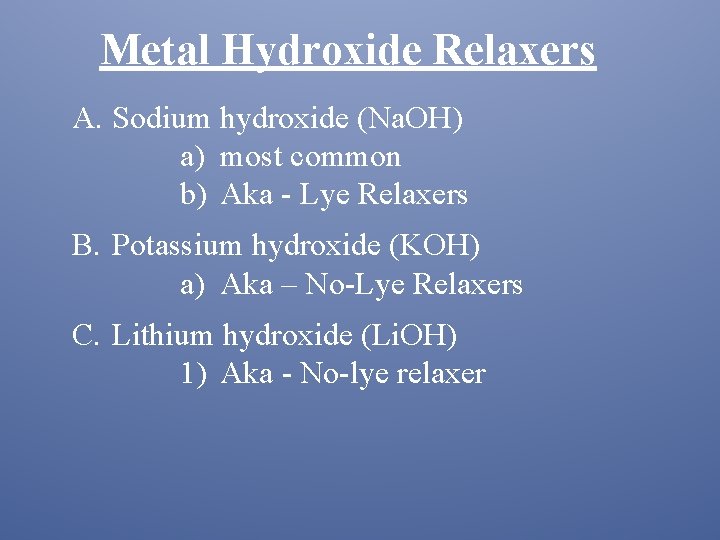
Metal Hydroxide Relaxers A. Sodium hydroxide (Na. OH) a) most common b) Aka - Lye Relaxers B. Potassium hydroxide (KOH) a) Aka – No-Lye Relaxers C. Lithium hydroxide (Li. OH) 1) Aka - No-lye relaxer
Guanidine Hydroxide Relaxers • advertised and sold as “no lye” relaxers • contain two components that must be mixed immediately prior to use
Low-p. H Relaxers • sulfites and bisulfites are sometimes used • the most commonly used are ammonium sulfite and ammonium bisulfate
Hydroxide Relaxers Base and No-Base Relaxers 1. )Base Relaxer • base cream AKA protective base cream applied to the skin and scalp during hair relaxing 2. )No-base formula base cream AKA protective base cream applied to the hairline during hair relaxing
Base Relaxers • require the application of a protective base cream to the entire scalp prior to the application of the relaxer
No-Base Relaxers • does not require the application of a protective base cream • contains a protective base cream designed to melt at body temperature
Relaxer strengths • Determined by the concentration of hydroxide ions • Most chemical hair relaxers are available in three strengths: • Mild • Regular • Super
Thermal Ionic Reconstructors • first manufactured and marketed in Asia • consist of a thio relaxer with a double hot blow-dry and a double hot press with flat irons
Soft Curl Permanents (Curl Re-forming) - do not STRAIGHTEN the hair - they make the existing curl larger and looser - AKA Jheri curl or simply a curl - actually two services
Soft Curl Permanent Procedure 1. hair must be relaxed with a thio relaxer 2. Wrap hair on proper tools 3. process with a second thio solution 4. Always follow manufacturer’s directions
Keratin Based Straightening Treatments
Keratin Based Straightening Treatments • AKA Brazillian keratin treatments
Hydroxide Relaxer Procedures
Hydroxide Relaxer Procedures • Virgin relaxer application – used for hair that has not had previous chemical texture services • Retouch relaxer application – used for hair that has had previous chemical texture services
Hydroxide Relaxer Procedures • Normalizing Lotions used after rinsing out the relaxer and prior to shampooing – conditioners with an acidic p. H – condition the hair and restore the natural p. H prior to shampooing –
Strand Tests • Done during processing • helps determine when the hair is sufficiently relaxed • AKA Thumb print –If the hair pops up/follows your finger it is NOT finished processing
Thio Relaxer Procedures
Thio Relaxer Procedures • application steps for thio relaxers are the same as those for hydroxide relaxer • the neutralization procedure is different
Safety Precautions for Hair Relaxing 1) Perform a thorough hair analysis and client consultation prior to the service 2) Examine the scalp for abrasions & do not proceed if redness, swelling, or skin lesions are present 3) Keep accurate and detailed client records of the services performed and the results
4) Have the client sign a release statement that indicated that the client understands the possible risks involved 5) Do not apply a hydroxide relaxer on hair that has been previously treated with a thio relaxer 6) Do not apply a thio relaxer on hair that has been previously treated with a hydroxide relaxer 7) Do not chemically relax hair that has been treated with a metallic dye
8) application of a hydroxide relaxer 9) Do not relax overly damaged hair 10)Do not shampoo the client prior to the The client’s hair and scalp must be completely dry and free from perspiration prior to the application of a hydroxide relaxer 11)Apply a protective base cream to avoid scalp irritation 12)Wear gloves during the relaxer application
13) Protect the client’s eyes 14) If any solution accidentally gets into the client’s eye, flush the eye immediately with cool water and refer the client to a doctor 15) Do not allow chemical relaxers to accidentally come into contact with the client’s ears, scalp, or skin 16) Perform periodic strand tests to see how fast the natural curls are being removed Avoid scratching the scalp with your comb or nails
17) Do not allow the application of a relaxer retouch to overlap onto previously relaxed hair 18) Never use a strong relaxer on fine or damaged hair, it may cause breakage 19) Do not attempt to remove more than 80% of the natural curl 20) Thoroughly rinse the chemical relaxer from the hair
21) Use a normalizing lotion to restore the hair and scalp to their normal acidic p. H 22) Use a neutralizing shampoo with a color indicator to guarantee that the hair/scalp have been restored to their normal acidic p. H 23) Use a conditioner and wide-tooth comb to eliminate excessive stretching when combing out tangles 24) Do not use hot irons or excessive heat on chemically relaxed hair