
Chemical Sciences Geosciences Biosciences CSGB Strategic Planning Process
Chemical Sciences, Geosciences & Biosciences (CSGB) Strategic Planning Process BESAC Meeting June 9, 2016 Gail Mc. Lean Jeff Krause Raul Miranda
CSGB Division Mission and Goals “The division supports experimental, theoretical, and computational research to provide fundamental understanding of chemical transformations and energy flow in systems relevant to DOE missions. This knowledge serves as the basis for the development of new processes for the generation, storage, and use of energy and for the mitigation of the environmental impacts of energy use. ” CSGB research programs embrace the two BES strategies: Ø Discovery or Grand Challenge Research: • • Understand, direct, and control matter and energy flow in materials and chemical processes. May be conducted on model systems not immediately relevant to energy technologies. Ø Use-Inspired Basic Research: • • Basic research required for the development of transformative energy technologies. Usually conducted on systems that have a clear potential relevance to energy technologies 2
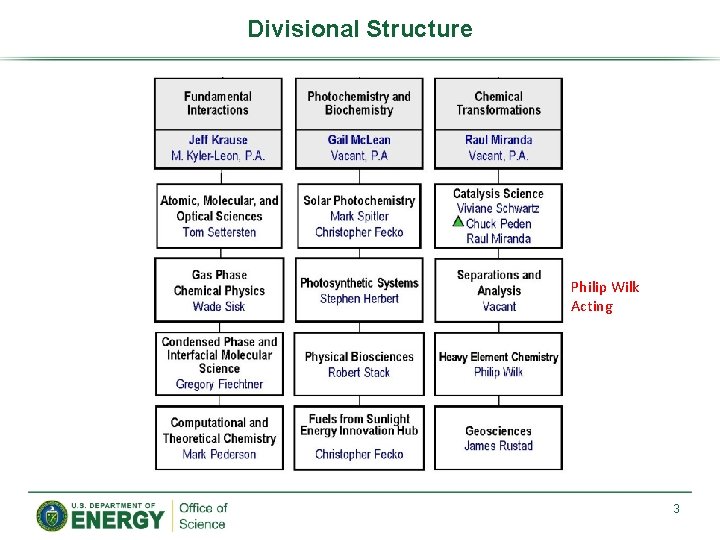
Divisional Structure Philip Wilk Acting 3
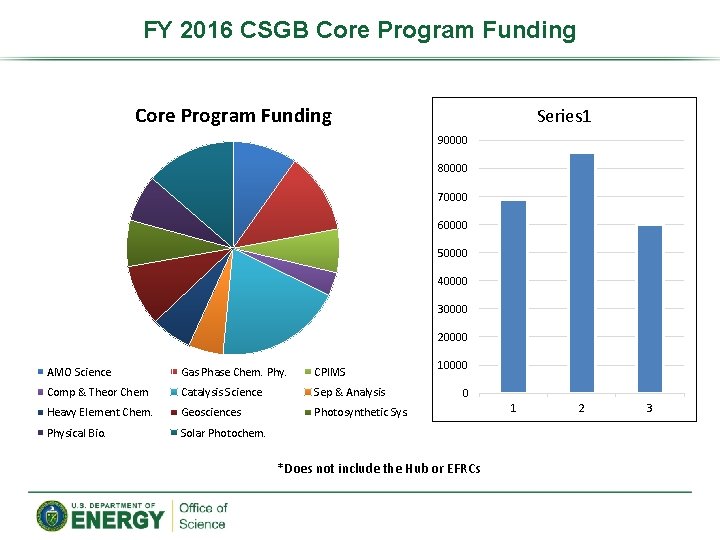
FY 2016 CSGB Core Program Funding Series 1 90000 80000 70000 60000 50000 40000 30000 20000 AMO Science Gas Phase Chem. Phy. CPIMS Comp & Theor Chem Catalysis Science Sep & Analysis Heavy Element Chem. Geosciences Photosynthetic Sys. Physical Bio. Solar Photochem. 10000 0 *Does not include the Hub or EFRCs 1 2 3
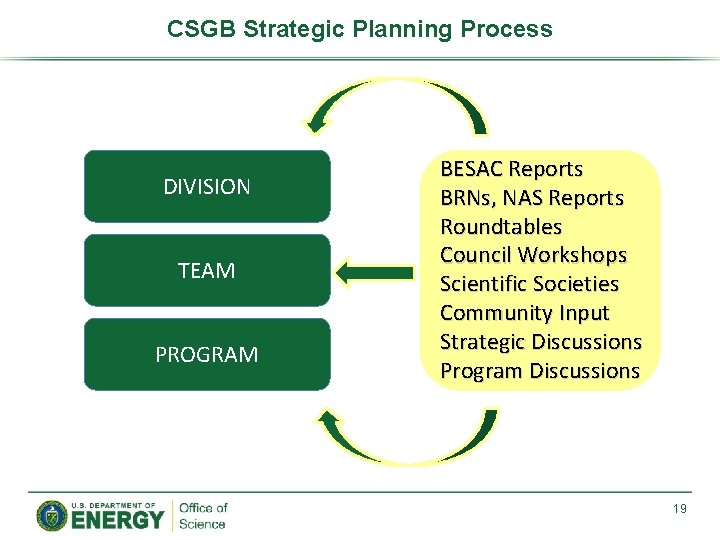
CSGB Strategic Planning Process DIVISION TEAM PROGRAM BESAC Reports BRNs, NAS Reports Roundtables Council Workshops Scientific Societies Community Input Strategic Discussions Program Discussions 19
CSGB Council Intent of the Council is to • Identify emerging research needs and opportunities through focused workshops/panel studies • Publish workshop review papers in peer-reviewed publications in archival journals • CSGB previously had two Councils: “Chemistry and Biochemistry” and “Earth Sciences. ” • These two Councils were merged into a single CSGB Council in late 2015 and the Charter revised. Council Chair: Mark Thompson University of Southern California Council Co-Chair: Laura Pyrak-Nolte Purdue University 6
CSGB Council Workshops Recent and Upcoming Workshops: § “Optimal Coherence in Chemical and Biophysical Dynamics; ” April 4 -5, 2016. Initial draft completed. § “Fracture mechanics and fracture pattern evolution in deep, hydrothermal and reactive environments; ” May 9 -10, 2016. Publication being drafted. § “Nitrogen Activation; ” Dates TBD. Workshop on different complementary topic to that of the Ammonia Synthesis Roundtable held February 18, 2016. Previous Workshops: § “What is the Efficiency of Photosynthesis? ” (Chem/Bio 2009); R. E. Blankenship et al. , “Comparing Photosynthetic and Photovoltaic Efficiencies and Recognizing the Potential for Improvement”, Science 2011, 332, 805 -809. § “CO 2 Fixation” (Chem/Bio 2011); “Frontiers, Opportunities, and Challenges in Biochemical and Chemical Catalysis of CO 2 Fixation”, A. M. Appel et al. , Chem. Rev. 2013, 113, 6621 -6658. § “Unraveling the Interpretations of Attosecond Measurements” (Chem/Bio 2012); “What will it take to observe processes in ‘real time’? , S. R. Leone et al. , Nature Photonics 2014, 8, 162 -166. § “Crystallization by Particle Attachment” (Geo 2013); “Crystallization by Particle Attachment in Synthetic, Biogenic, and Geologic Environments”, J. J. De Yoreo et al. , Science 2015, 349, aaa 6760, doi: 10. 1126/science. aaa 6760. 7
Program Strategic Discussions • All core programs have presented an overview of their programs, research challenges, and the strategic research directions being considered • Program discussions for calendar year 2016 still to be scheduled. 21
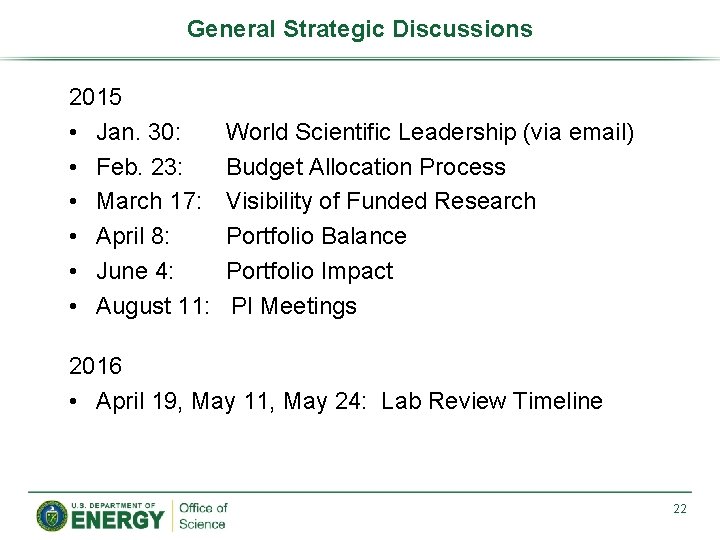
General Strategic Discussions 2015 • Jan. 30: • Feb. 23: • March 17: • April 8: • June 4: • August 11: World Scientific Leadership (via email) Budget Allocation Process Visibility of Funded Research Portfolio Balance Portfolio Impact PI Meetings 2016 • April 19, May 11, May 24: Lab Review Timeline 22
Team Presentations
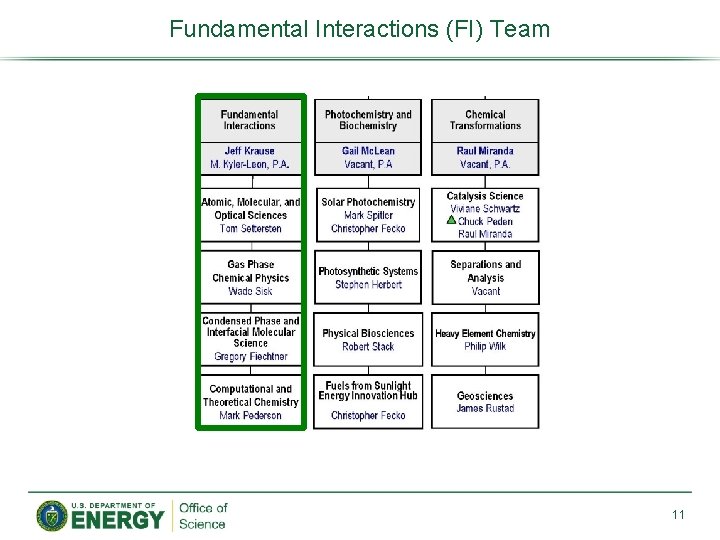
Fundamental Interactions (FI) Team 11
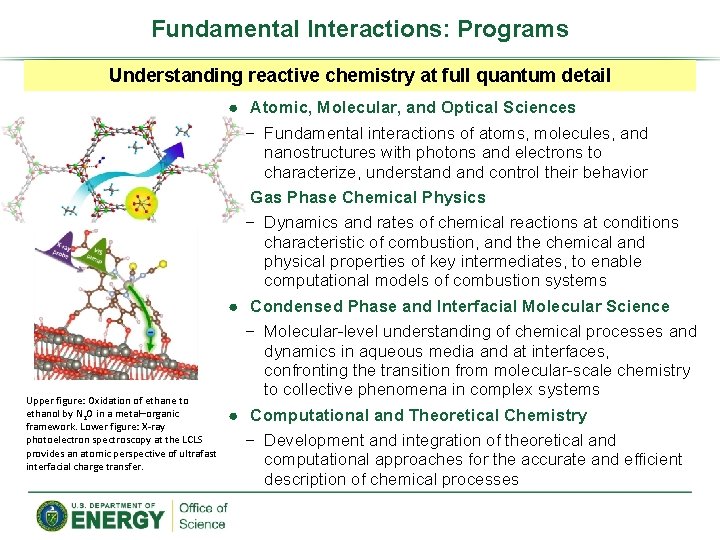
Fundamental Interactions: Programs Understanding reactive chemistry at full quantum detail Upper figure: Oxidation of ethane to ethanol by N 2 O in a metal–organic framework. Lower figure: X-ray photoelectron spectroscopy at the LCLS provides an atomic perspective of ultrafast interfacial charge transfer. ● Atomic, Molecular, and Optical Sciences − Fundamental interactions of atoms, molecules, and nanostructures with photons and electrons to characterize, understand control their behavior ● Gas Phase Chemical Physics − Dynamics and rates of chemical reactions at conditions characteristic of combustion, and the chemical and physical properties of key intermediates, to enable computational models of combustion systems ● Condensed Phase and Interfacial Molecular Science − Molecular-level understanding of chemical processes and dynamics in aqueous media and at interfaces, confronting the transition from molecular-scale chemistry to collective phenomena in complex systems ● Computational and Theoretical Chemistry − Development and integration of theoretical and computational approaches for the accurate and efficient description of chemical processes
Fundamental Interactions: Mission Emphasis on structural and dynamical studies of atoms, molecules, and nanostructures, and the description of their interactions in full quantum detail, with the aim of providing a complete understanding of reactive chemistry in the gas phase, condensed phase, and at interfaces. BES Mission: BES supports fundamental research to understand, predict, and ultimately control matter and energy at the electronic, atomic, and molecular levels in order to provide the foundations for new energy technologies and to support DOE missions in energy, environment, and national security. SC Mission: Delivery of scientific discoveries and major scientific tools to transform our understanding of nature and to advance the energy, economic, and national security of the United States.
Fundamental Interactions: Division Integration § Crosscutting, division-wide relevance; Synergy within team and across the division: – Gas-phase chemical physics & CPIMS closely coupled (formerly one program) – AMOS intersects strongly with chemical physics in molecular systems – Theory/computation very strong in team and across division, joint efforts with MSE and ASCR – Ultrafast chemical science growing theme across division, anchored in AMOS – Interfacial chemistry in CPIMS connects with catalysis and geochemistry; condensed phase chemical physics relevant to radiation and heavy element chemistry § Relationship to use-inspired science opportunities/mission: – AMOS tied strongly to application of current and next generation light sources, e. g. , lasers, synchrotrons, X-ray FELS, LCLS and LCLS-II – Gas-phase chemical physics has significant impact on clean & efficient combustion processes; management of Combustion Research Facility, SNL
AMOS: Current Investment Portfolio • Intense Field and Ultrafast X-Ray Science (60%) – Goal: Discover, understand, and exploit fundamental phenomena associated with interactions of intense electromagnetic fields and matter on ultrashort time scales. • Correlated Dynamics (35%) – Goal: Characterize, understand, and control strongly correlated dynamics involving electrons, atoms, and molecules. • Nanoscale Science (5%) – Goal: Discover, understand, and exploit novel phenomena in light-matter interactions in nanoscale structures.
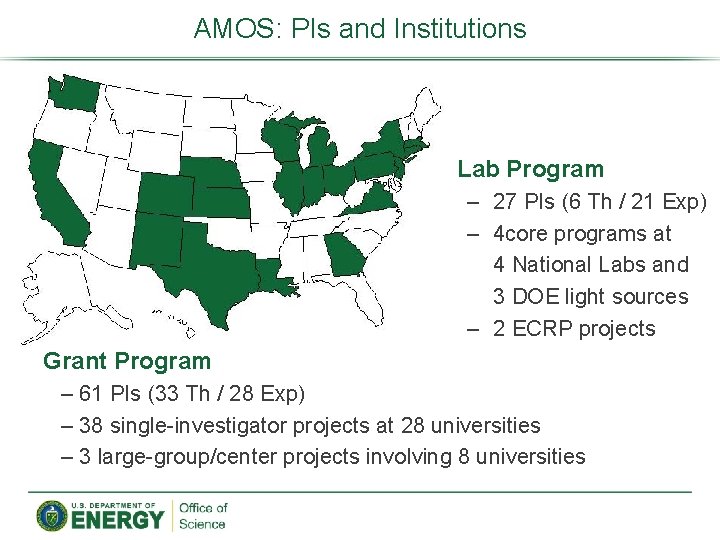
AMOS: PIs and Institutions Lab Program – 27 PIs (6 Th / 21 Exp) – 4 core programs at 4 National Labs and 3 DOE light sources – 2 ECRP projects Grant Program – 61 PIs (33 Th / 28 Exp) – 38 single-investigator projects at 28 universities – 3 large-group/center projects involving 8 universities
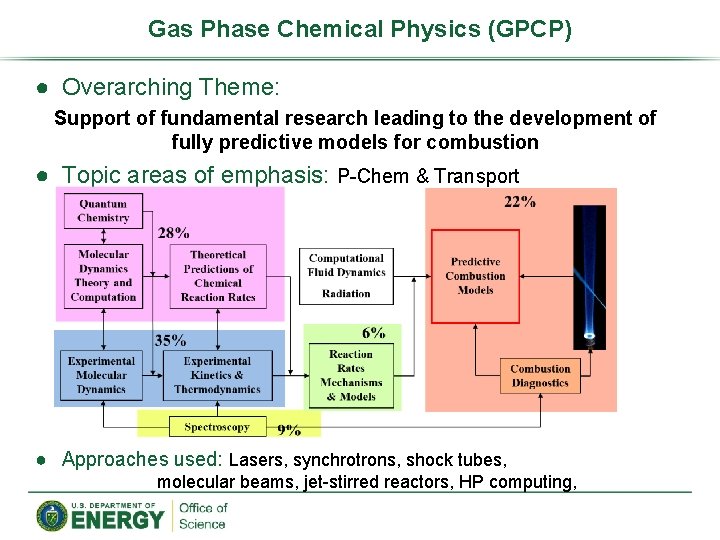
Gas Phase Chemical Physics (GPCP) ● Overarching Theme: Support of fundamental research leading to the development of fully predictive models for combustion ● Topic areas of emphasis: P-Chem & Transport ● Approaches used: Lasers, synchrotrons, shock tubes, molecular beams, jet-stirred reactors, HP computing,
GPCP Composition 86 PIs at 36 universities and 4 DOE Labs Universities [49 PIs (57%)] / Labs [37 PIs (43%)] Theory/Simulation [42 PIs (49%)] / Experiment [44 PIs (51%)] 3 Early Career Grants: Blanquart (2011), Douberly (2012) and Dawes (2013) New investigators: 15 since FY 11 (including 3 ECs) FY 15: 83% Labs (39% SNL/CRF), 17% Universities
CPIMS: Condensed Phase and Interfacial Molecular Science Emphasis: • Studies of reactions and dynamics at well-characterized metal and metal-oxide surfaces and clusters lead to the development of theories on the molecular origins heterogeneous chemistry. • Single molecule studies with extreme spatial and/or temporal resolution on well-characterized, model surfaces. • Understand the transition from molecular-scale chemistry to collective phenomena in complex systems, such as the effects of solvation on chemical structure and reactivity. • Studies of model condensed-phase systems target first-principles understandings of molecular reactivity and dynamical processes in solution and at interfaces. Key Relationships: • BES research programs (for example, Solar Photochemistry), Nanoscience Centers, Synchrotron Facilities, BER EMSL User Facility.
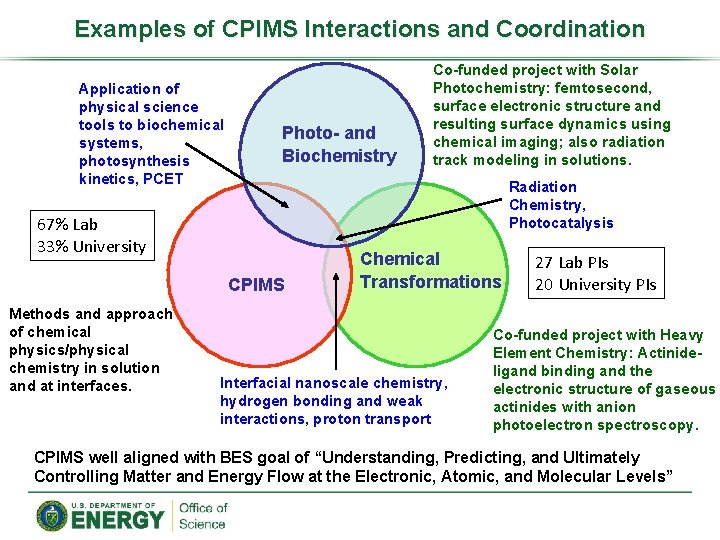
Examples of CPIMS Interactions and Coordination Application of physical science tools to biochemical systems, photosynthesis kinetics, PCET Photo- and Biochemistry Radiation Chemistry, Photocatalysis 67% Lab 33% University CPIMS Methods and approach of chemical physics/physical chemistry in solution and at interfaces. Co-funded project with Solar Photochemistry: femtosecond, surface electronic structure and resulting surface dynamics using chemical imaging; also radiation track modeling in solutions. Chemical Transformations Interfacial nanoscale chemistry, hydrogen bonding and weak interactions, proton transport 27 Lab PIs 20 University PIs Co-funded project with Heavy Element Chemistry: Actinideligand binding and the electronic structure of gaseous actinides with anion photoelectron spectroscopy. CPIMS well aligned with BES goal of “Understanding, Predicting, and Ultimately Controlling Matter and Energy Flow at the Electronic, Atomic, and Molecular Levels”
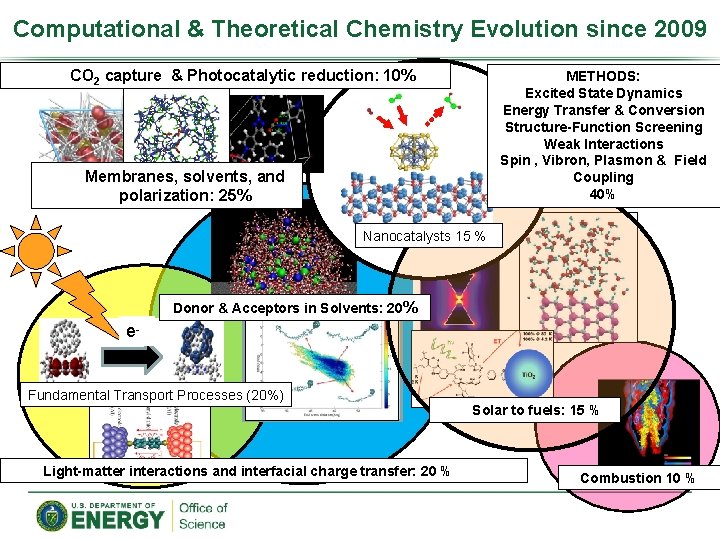
Computational & Theoretical Chemistry Evolution since 2009 CO 2 capture & Photocatalytic reduction: 10% METHODS: Excited State Dynamics Energy Transfer & Conversion Structure-Function Screening Weak Interactions Spin , Vibron, Plasmon & Field Coupling 40% Membranes, solvents, and polarization: 25% Nanocatalysts 15 % Donor & Acceptors in Solvents: 20% e- Fundamental Transport Processes (20%) Light-matter interactions and interfacial charge transfer: 20 % Solar to fuels: 15 % Combustion 10 %
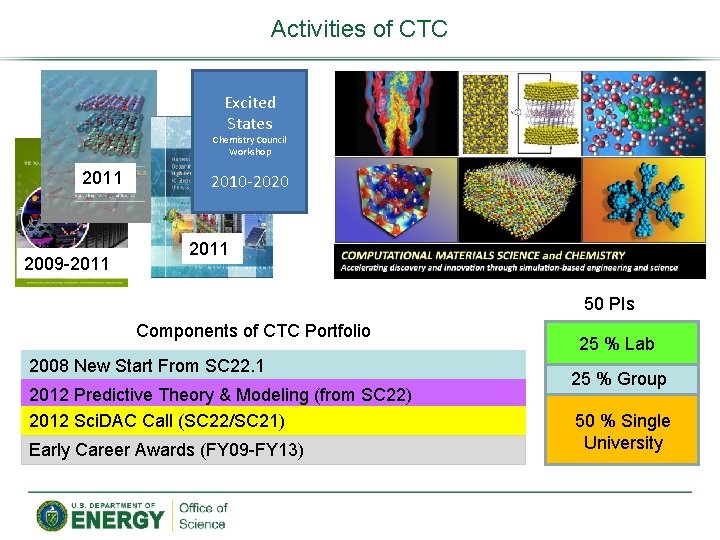
Activities of CTC Excited States Chemistry Council Workshop 2011 2009 -2011 2010 -2020 2011 50 PIs Components of CTC Portfolio 2008 New Start From SC 22. 1 2012 Predictive Theory & Modeling (from SC 22) 2012 Sci. DAC Call (SC 22/SC 21) Early Career Awards (FY 09 -FY 13) 25 % Lab 25 % Group 50 % Single University
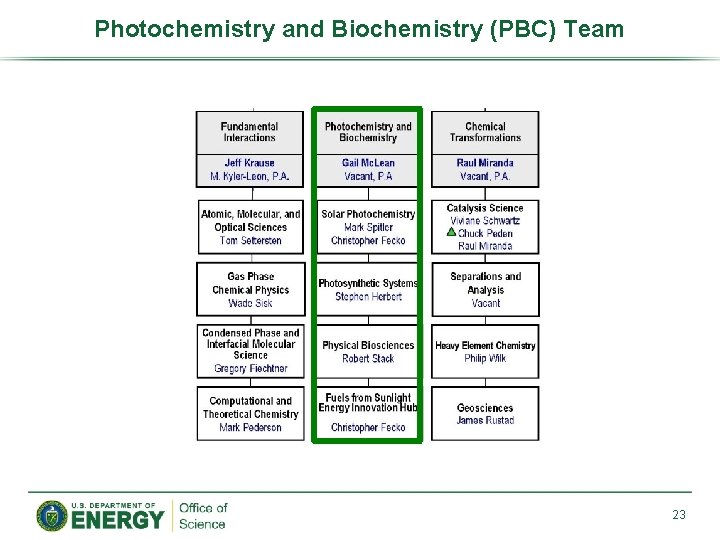
Photochemistry and Biochemistry (PBC) Team 23
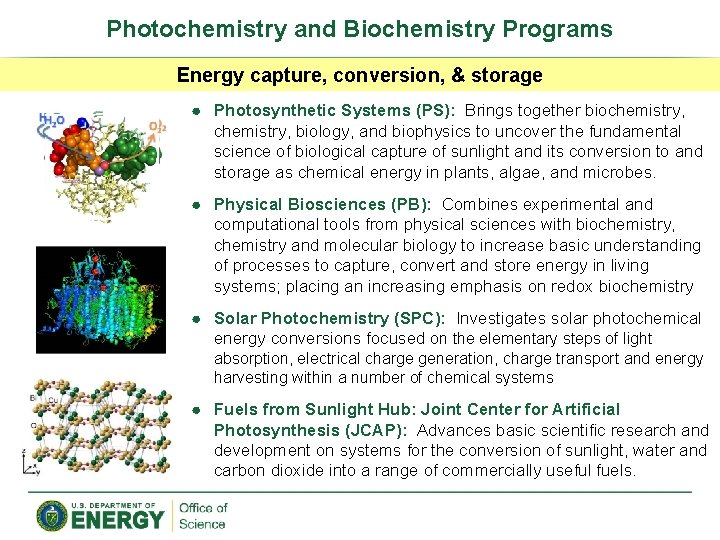
Photochemistry and Biochemistry Programs Energy capture, conversion, & storage ● Photosynthetic Systems (PS): Brings together biochemistry, biology, and biophysics to uncover the fundamental science of biological capture of sunlight and its conversion to and storage as chemical energy in plants, algae, and microbes. ● Physical Biosciences (PB): Combines experimental and computational tools from physical sciences with biochemistry, chemistry and molecular biology to increase basic understanding of processes to capture, convert and store energy in living systems; placing an increasing emphasis on redox biochemistry ● Solar Photochemistry (SPC): Investigates solar photochemical energy conversions focused on the elementary steps of light absorption, electrical charge generation, charge transport and energy harvesting within a number of chemical systems ● Fuels from Sunlight Hub: Joint Center for Artificial Photosynthesis (JCAP): Advances basic scientific research and development on systems for the conversion of sunlight, water and carbon dioxide into a range of commercially useful fuels.
Photochemistry and Biochemistry: Mission Fundamental studies of the molecular mechanisms involved in capture of light energy and its conversion into chemical and electrical energy through biological and chemical pathways. BES Mission: BES supports fundamental research to understand, predict, and ultimately control matter and energy at the electronic, atomic, and molecular levels in order to provide the foundations for new energy technologies and to support DOE missions in energy, environment, and national security. SC Mission: Delivery of scientific discoveries and major scientific tools to transform our understanding of nature and to advance the energy, economic, and national security of the United States.
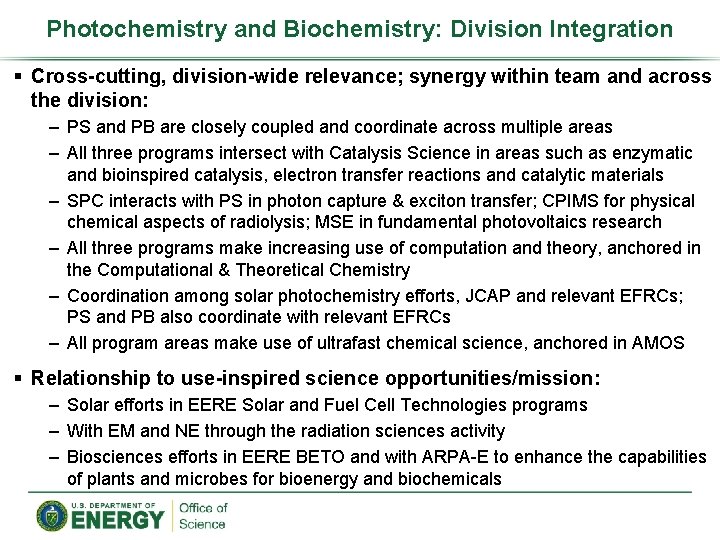
Photochemistry and Biochemistry: Division Integration § Cross-cutting, division-wide relevance; synergy within team and across the division: – PS and PB are closely coupled and coordinate across multiple areas – All three programs intersect with Catalysis Science in areas such as enzymatic and bioinspired catalysis, electron transfer reactions and catalytic materials – SPC interacts with PS in photon capture & exciton transfer; CPIMS for physical chemical aspects of radiolysis; MSE in fundamental photovoltaics research – All three programs make increasing use of computation and theory, anchored in the Computational & Theoretical Chemistry – Coordination among solar photochemistry efforts, JCAP and relevant EFRCs; PS and PB also coordinate with relevant EFRCs – All program areas make use of ultrafast chemical science, anchored in AMOS § Relationship to use-inspired science opportunities/mission: – Solar efforts in EERE Solar and Fuel Cell Technologies programs – With EM and NE through the radiation sciences activity – Biosciences efforts in EERE BETO and with ARPA-E to enhance the capabilities of plants and microbes for bioenergy and biochemicals
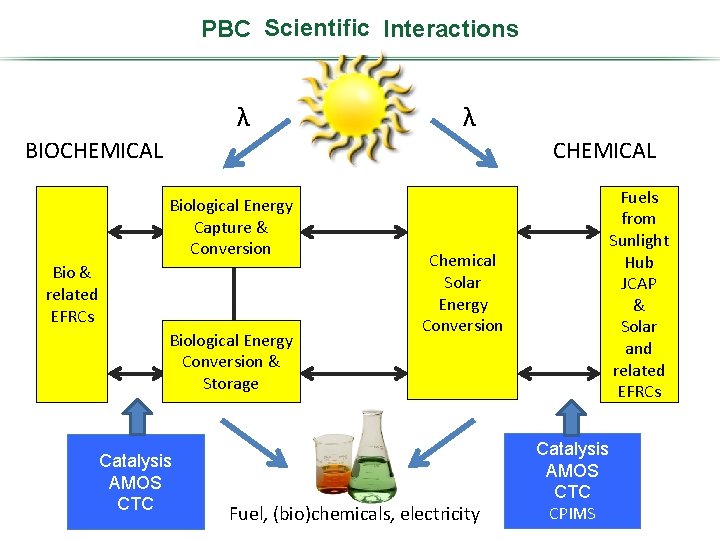
PBC Scientific Program Interactions λ λ BIOCHEMICAL Biological Energy Photosynthetic Capture Systems& Conversion Bio & related EFRCs Biological Energy Physical & Conversion Biosciences Storage Catalysis AMOS CTC Fuels from Sunlight Hub JCAP & Solar and related EFRCs Solar Chemical Photochemistry Solar (including Energy Conversion photocatalysis) Fuel, (bio)chemicals, electricity Catalysis AMOS CTC CPIMS
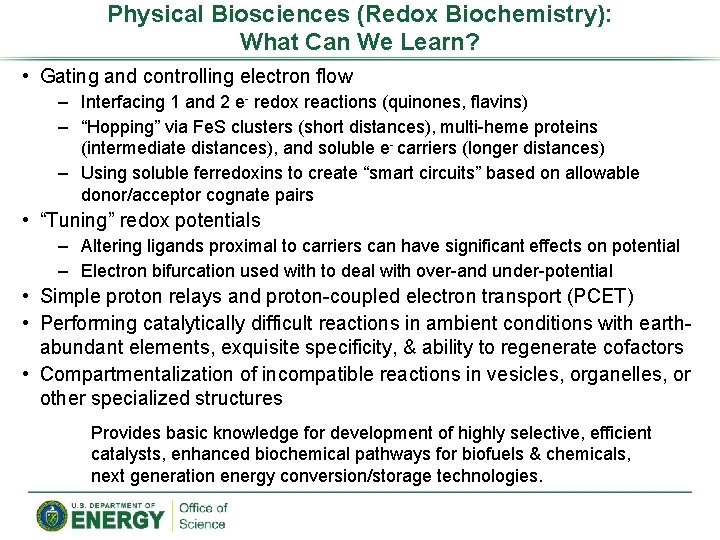
Physical Biosciences (Redox Biochemistry): What Can We Learn? • Gating and controlling electron flow – Interfacing 1 and 2 e- redox reactions (quinones, flavins) – “Hopping” via Fe. S clusters (short distances), multi-heme proteins (intermediate distances), and soluble e- carriers (longer distances) – Using soluble ferredoxins to create “smart circuits” based on allowable donor/acceptor cognate pairs • “Tuning” redox potentials – Altering ligands proximal to carriers can have significant effects on potential – Electron bifurcation used with to deal with over-and under-potential • Simple proton relays and proton-coupled electron transport (PCET) • Performing catalytically difficult reactions in ambient conditions with earthabundant elements, exquisite specificity, & ability to regenerate cofactors • Compartmentalization of incompatible reactions in vesicles, organelles, or other specialized structures Provides basic knowledge for development of highly selective, efficient catalysts, enhanced biochemical pathways for biofuels & chemicals, next generation energy conversion/storage technologies.
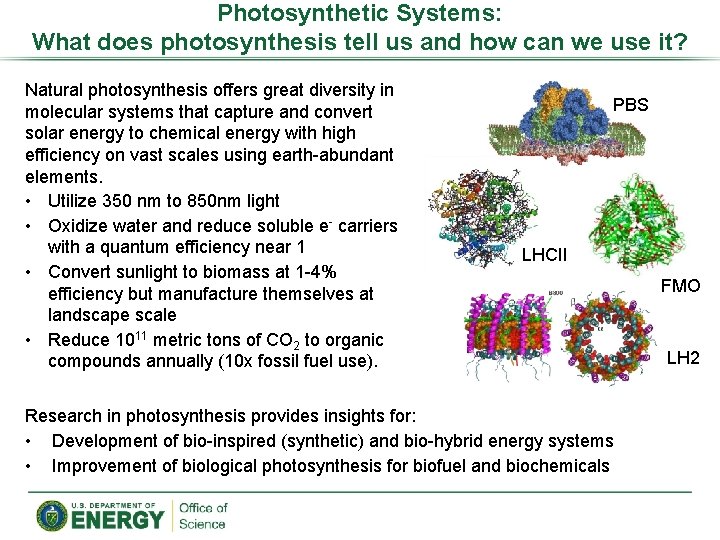
Photosynthetic Systems: What does photosynthesis tell us and how can we use it? Natural photosynthesis offers great diversity in molecular systems that capture and convert solar energy to chemical energy with high efficiency on vast scales using earth-abundant elements. • Utilize 350 nm to 850 nm light • Oxidize water and reduce soluble e- carriers with a quantum efficiency near 1 • Convert sunlight to biomass at 1 -4% efficiency but manufacture themselves at landscape scale • Reduce 1011 metric tons of CO 2 to organic compounds annually (10 x fossil fuel use). PBS LHCII Research in photosynthesis provides insights for: • Development of bio-inspired (synthetic) and bio-hybrid energy systems • Improvement of biological photosynthesis for biofuel and biochemicals FMO LH 2
Solar Photochemistry: Supra Photosynthesis • Natural photosynthetic model systems have motivated efforts in Solar Photochemistry since the program’s creation in 1977. • Chemists are now capable of both building on and advancing beyond the original model photosynthetic systems: • Emulate the proteins in photosynthesis and synthesize new variants based on Nature’s blueprint. • Can readily make structures of solid inorganic composition not typically found in Nature – photoelectrodes and nanostructures of metals and semiconductors with an immense variety. • The photosynthetic system remains a good model but other biological reaction pathways and structures could also guide non-biological systems. • Learning to envision new systems and extrapolate back to the basic research problems to enable their assembly and operation and vice versa. Fundamental knowledge for development of semiconductor photovoltaic cells and solar photochemical and photoelectrochemical conversion processes for production of fuels, chemicals, and electricity with minimal environmental impact and with closed renewable energy cycles.
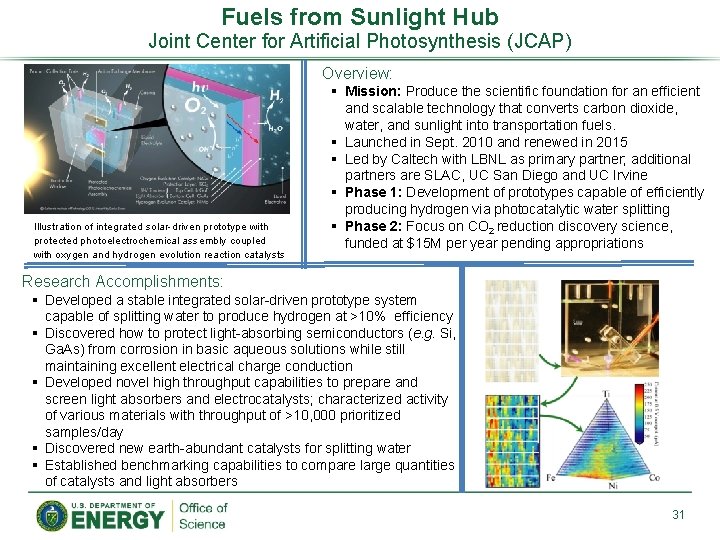
Fuels from Sunlight Hub Joint Center for Artificial Photosynthesis (JCAP) Overview: Illustration of integrated solar-driven prototype with protected photoelectrochemical assembly coupled with oxygen and hydrogen evolution reaction catalysts § Mission: Produce the scientific foundation for an efficient and scalable technology that converts carbon dioxide, water, and sunlight into transportation fuels. § Launched in Sept. 2010 and renewed in 2015 § Led by Caltech with LBNL as primary partner; additional partners are SLAC, UC San Diego and UC Irvine § Phase 1: Development of prototypes capable of efficiently producing hydrogen via photocatalytic water splitting § Phase 2: Focus on CO 2 reduction discovery science, funded at $15 M per year pending appropriations Research Accomplishments: § Developed a stable integrated solar-driven prototype system capable of splitting water to produce hydrogen at >10% efficiency § Discovered how to protect light-absorbing semiconductors (e. g. Si, Ga. As) from corrosion in basic aqueous solutions while still maintaining excellent electrical charge conduction § Developed novel high throughput capabilities to prepare and screen light absorbers and electrocatalysts; characterized activity of various materials with throughput of >10, 000 prioritized samples/day § Discovered new earth-abundant catalysts for splitting water § Established benchmarking capabilities to compare large quantities of catalysts and light absorbers 31
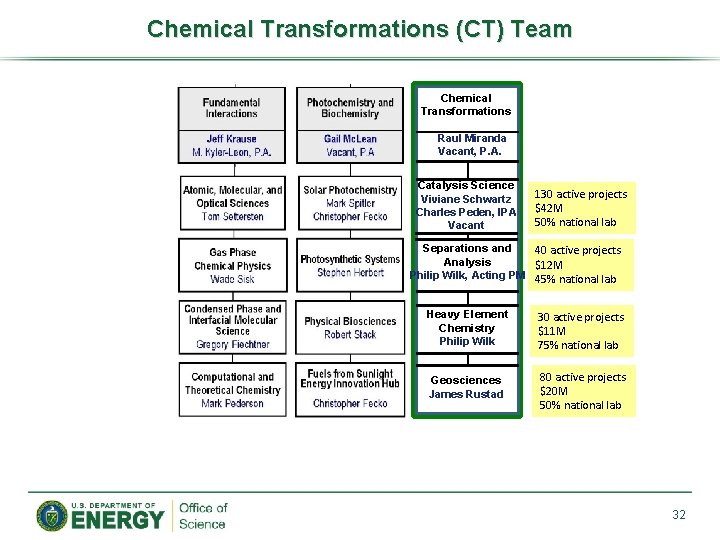
Chemical Transformations (CT) Team Chemical Transformations Raul Miranda Vacant, P. A. Catalysis Science Viviane Schwartz Charles Peden, IPA Vacant 130 active projects $42 M 50% national lab Separations and 40 active projects Analysis $12 M Philip Wilk, Acting PM 45% national lab Heavy Element Chemistry Philip Wilk 30 active projects $11 M 75% national lab Geosciences James Rustad 80 active projects $20 M 50% national lab 32
Chemical Transformations: Programs Understanding and controlling the stabilization, transport, and chemical conversion of matter ● Catalysis Science Mechanisms of clean and efficient synthesis and conversion of fuels and chemicals; synthesis of organic, inorganic, nano and hybrid complex catalysts; surface chemistry, electrochemistry, and bio-inspired processes ● Separations and Analysis Chemical separations relevant to energy processes; purification of critical materials; selected analytical methods ● Heavy Element Chemistry Spectroscopy, bonding, reactivity and separations of actinides and fission products ● Geosciences Geochemistry and selected areas of geophysics, including subsurface imaging, mineral-fluid interactions and flow/transport phenomena Cross-cutting: theory and simulation, synthesis, imaging and characterization
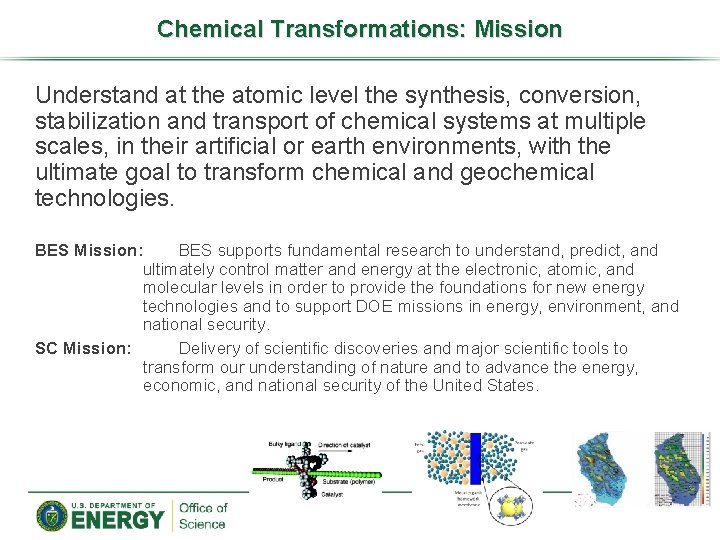
Chemical Transformations: Mission Understand at the atomic level the synthesis, conversion, stabilization and transport of chemical systems at multiple scales, in their artificial or earth environments, with the ultimate goal to transform chemical and geochemical technologies. BES Mission: BES supports fundamental research to understand, predict, and ultimately control matter and energy at the electronic, atomic, and molecular levels in order to provide the foundations for new energy technologies and to support DOE missions in energy, environment, and national security. SC Mission: Delivery of scientific discoveries and major scientific tools to transform our understanding of nature and to advance the energy, economic, and national security of the United States.
Chemical Transformations: Division Integration § Crosscutting, division-wide relevance; synergy within team and across the division: – Catalysis Science, Separations and Analysis, Geosciences and Heavy Element Chemistry share similar goals in synthetic chemistry, nanoscience, operando characterization with multi-modal techniques at lab-scale or at synchrotron and neutron facilities. – Catalysis Science and Heavy Element Chemistry co-review and have exchanged principal investigators in the area of organometallic chemistry. – All of the programs share reviewers with specific expertise in theoretical reaction mechanisms, microkinetics, and transport phenomena in multiphase environments. – Geosciences and Heavy Element Chemistry share goals in chemistry aspects that have applications to environmental management. – Heavy Element Chemistry and Separations and Analysis have related goals related to the stabilization of f-element compounds. They have exchanged principal investigators on occasion. – Geosciences and Catalysis share similar interests in inorganic nucleation, crystallization, liquid-solid interfacial chemistry and fluid transport.
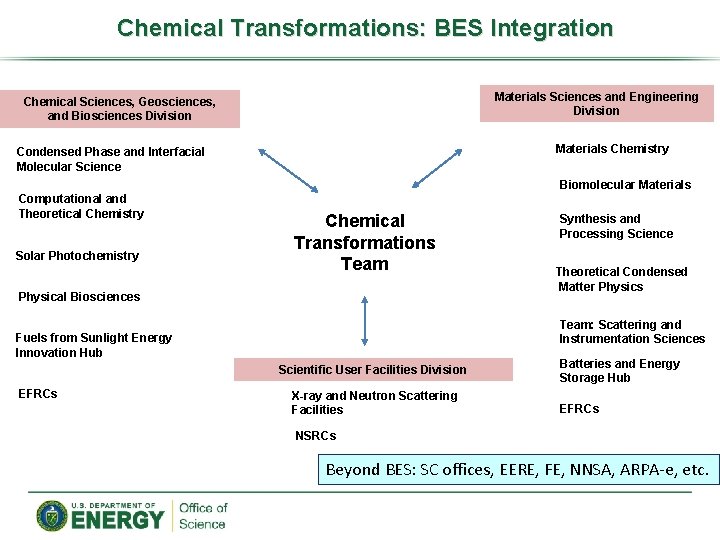
Chemical Transformations: BES Integration Materials Sciences and Engineering Division Chemical Sciences, Geosciences, and Biosciences Division Materials Chemistry Condensed Phase and Interfacial Molecular Science Biomolecular Materials Computational and Theoretical Chemistry Solar Photochemistry Chemical Transformations Team Physical Biosciences Theoretical Condensed Matter Physics Team: Scattering and Instrumentation Sciences Fuels from Sunlight Energy Innovation Hub Scientific User Facilities Division EFRCs Synthesis and Processing Science X-ray and Neutron Scattering Facilities Batteries and Energy Storage Hub EFRCs NSRCs Beyond BES: SC offices, EERE, FE, NNSA, ARPA-e, etc.
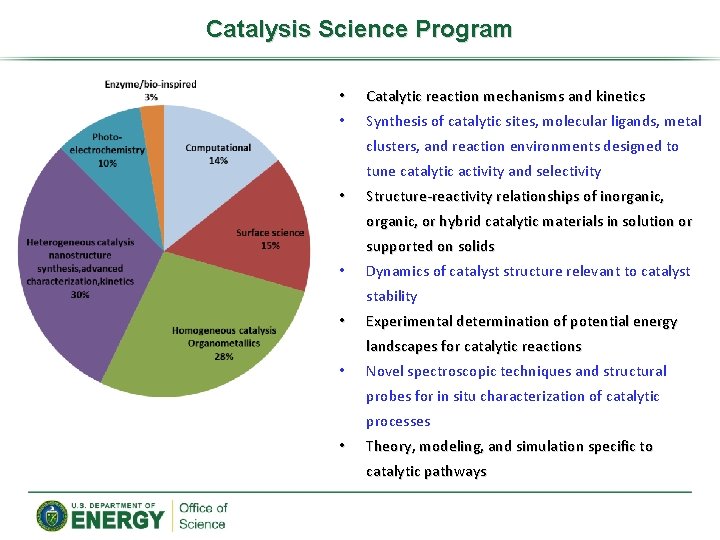
Catalysis Science Program • • Catalytic reaction mechanisms and kinetics Synthesis of catalytic sites, molecular ligands, metal clusters, and reaction environments designed to tune catalytic activity and selectivity • Structure-reactivity relationships of inorganic, or hybrid catalytic materials in solution or supported on solids • Dynamics of catalyst structure relevant to catalyst stability • Experimental determination of potential energy landscapes for catalytic reactions • Novel spectroscopic techniques and structural probes for in situ characterization of catalytic processes • Theory, modeling, and simulation specific to catalytic pathways
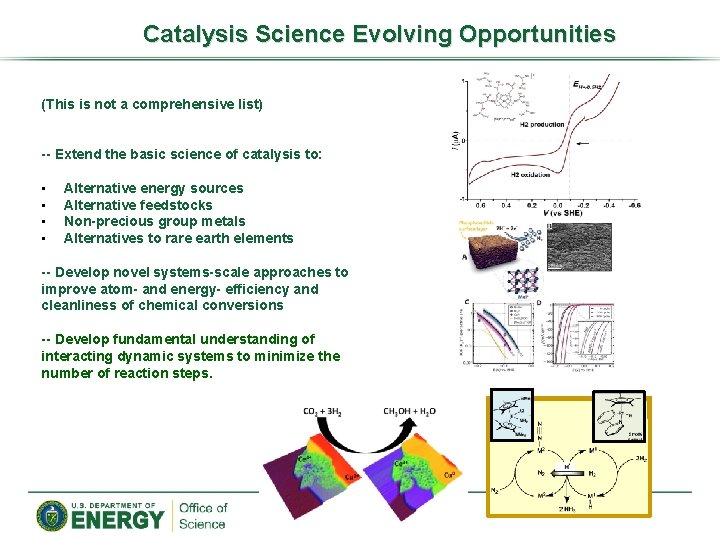
Catalysis Science Evolving Opportunities (This is not a comprehensive list) -- Extend the basic science of catalysis to: • • Alternative energy sources Alternative feedstocks Non-precious group metals Alternatives to rare earth elements -- Develop novel systems-scale approaches to improve atom- and energy- efficiency and cleanliness of chemical conversions -- Develop fundamental understanding of interacting dynamic systems to minimize the number of reaction steps.
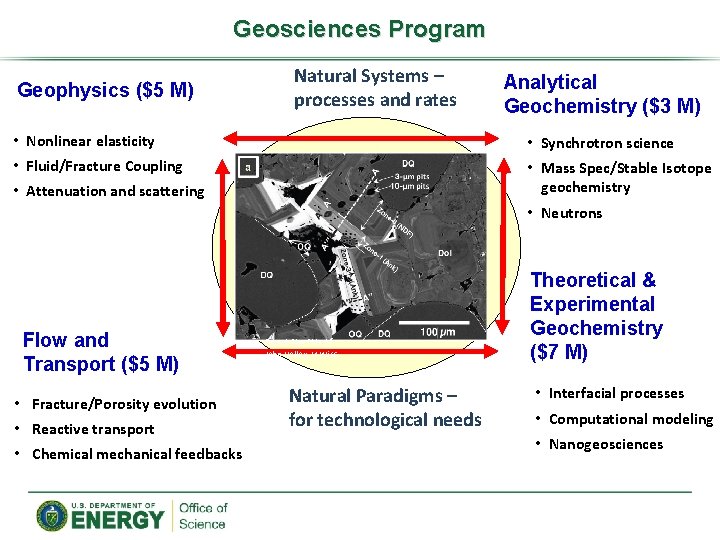
Geosciences Program Geophysics ($5 M) Natural Systems – processes and rates Analytical Geochemistry ($3 M) • Nonlinear elasticity • Synchrotron science • Fluid/Fracture Coupling • Mass Spec/Stable Isotope geochemistry • Attenuation and scattering • Neutrons Flow and Transport ($5 M) • Fracture/Porosity evolution • Reactive transport • Chemical mechanical feedbacks Figure courtesy of John Valley, U Wisc. Natural Paradigms – for technological needs Theoretical & Experimental Geochemistry ($7 M) • Interfacial processes • Computational modeling • Nanogeosciences
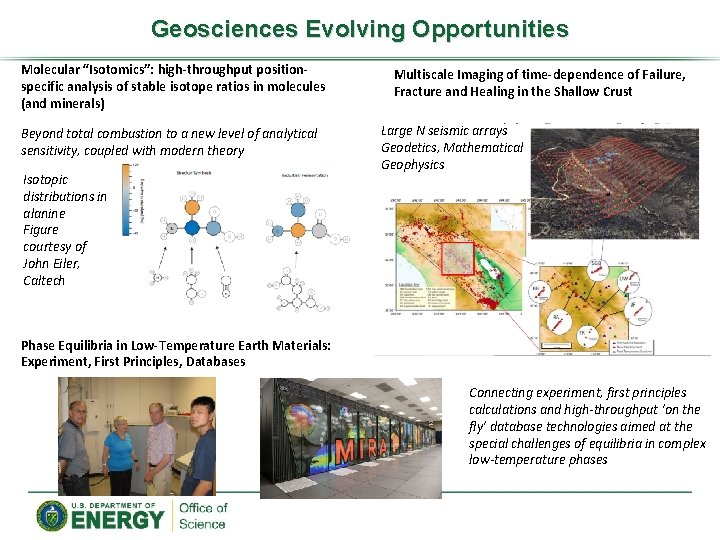
Geosciences Evolving Opportunities Molecular “Isotomics”: high-throughput positionspecific analysis of stable isotope ratios in molecules (and minerals) Beyond total combustion to a new level of analytical sensitivity, coupled with modern theory Isotopic distributions in alanine Figure courtesy of John Eiler, Caltech Multiscale Imaging of time-dependence of Failure, Fracture and Healing in the Shallow Crust Large N seismic arrays Geodetics, Mathematical Geophysics Phase Equilibria in Low-Temperature Earth Materials: Experiment, First Principles, Databases Connecting experiment, first principles calculations and high-throughput ‘on the fly’ database technologies aimed at the special challenges of equilibria in complex low-temperature phases
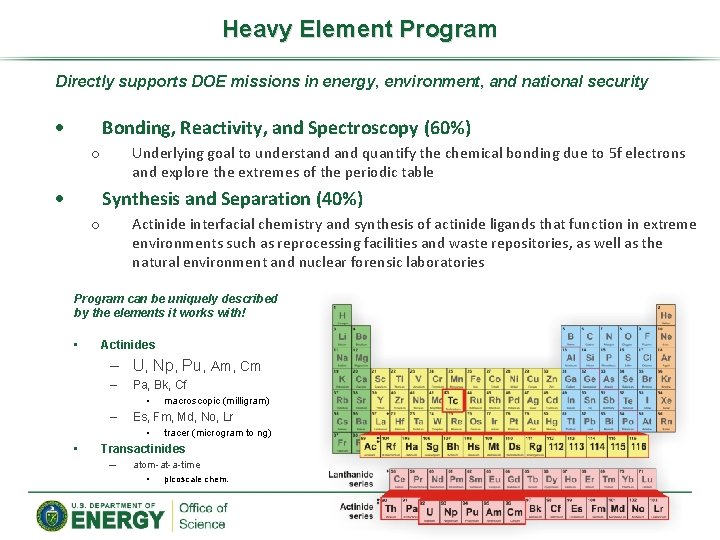
Heavy Element Program Directly supports DOE missions in energy, environment, and national security Bonding, Reactivity, and Spectroscopy (60%) Underlying goal to understand quantify the chemical bonding due to 5 f electrons and explore the extremes of the periodic table o Synthesis and Separation (40%) Actinide interfacial chemistry and synthesis of actinide ligands that function in extreme environments such as reprocessing facilities and waste repositories, as well as the natural environment and nuclear forensic laboratories o Program can be uniquely described by the elements it works with! • Actinides – U, Np, Pu, Am, Cm – Pa, Bk, Cf • – Es, Fm, Md, No, Lr • • macroscopic (milligram) tracer (microgram to ng) Transactinides – atom-at-a-time • picoscale chem.
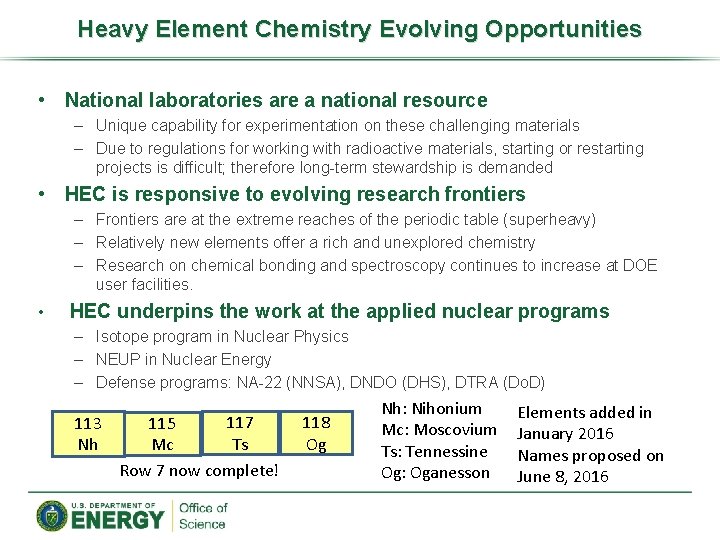
Heavy Element Chemistry Evolving Opportunities • National laboratories are a national resource – Unique capability for experimentation on these challenging materials – Due to regulations for working with radioactive materials, starting or restarting projects is difficult; therefore long-term stewardship is demanded • HEC is responsive to evolving research frontiers – Frontiers are at the extreme reaches of the periodic table (superheavy) – Relatively new elements offer a rich and unexplored chemistry – Research on chemical bonding and spectroscopy continues to increase at DOE user facilities. • HEC underpins the work at the applied nuclear programs – Isotope program in Nuclear Physics – NEUP in Nuclear Energy – Defense programs: NA-22 (NNSA), DNDO (DHS), DTRA (Do. D) 117 115 113 Ts Mc Nh Row 7 now complete! 118 Og Nh: Nihonium Mc: Moscovium Ts: Tennessine Og: Oganesson Elements added in January 2016 Names proposed on June 8, 2016
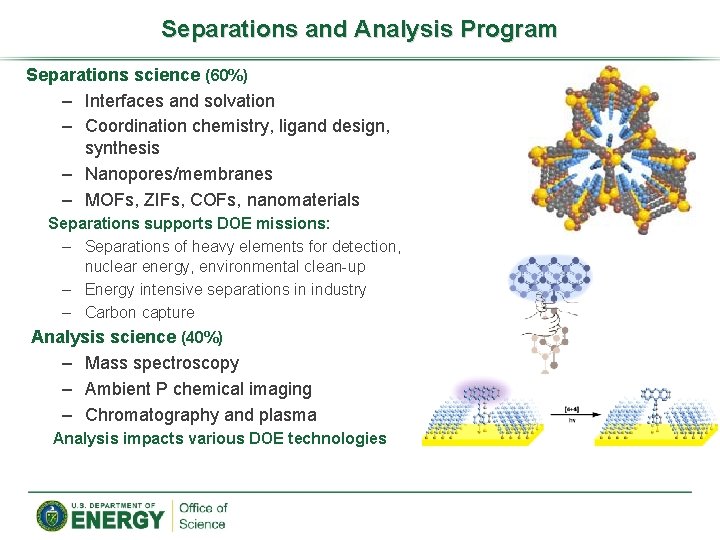
Separations and Analysis Program Separations science (60%) – Interfaces and solvation – Coordination chemistry, ligand design, synthesis – Nanopores/membranes – MOFs, ZIFs, COFs, nanomaterials Separations supports DOE missions: – Separations of heavy elements for detection, nuclear energy, environmental clean-up – Energy intensive separations in industry – Carbon capture Analysis science (40%) – Mass spectroscopy – Ambient P chemical imaging – Chromatography and plasma Analysis impacts various DOE technologies
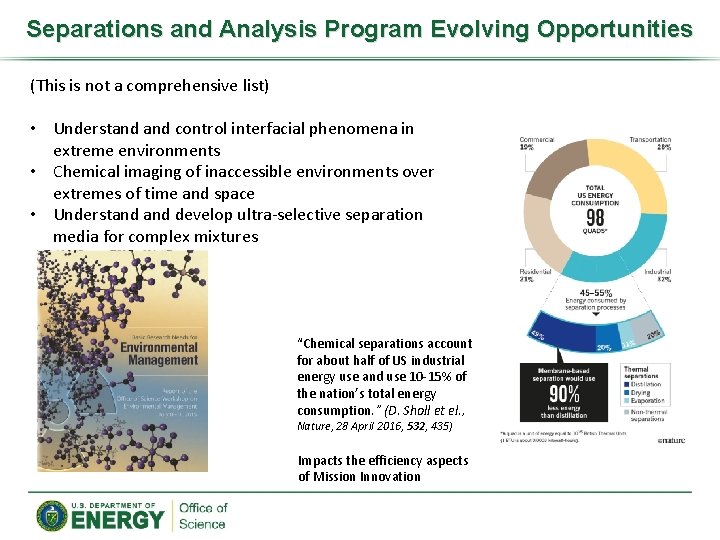
Separations and Analysis Program Evolving Opportunities (This is not a comprehensive list) • Understand control interfacial phenomena in extreme environments • Chemical imaging of inaccessible environments over extremes of time and space • Understand develop ultra-selective separation media for complex mixtures “Chemical separations account for about half of US industrial energy use and use 10 -15% of the nation’s total energy consumption. ” (D. Sholl et el. , Nature, 28 April 2016, 532, 435) Impacts the efficiency aspects of Mission Innovation
Next Steps: Divisional Strategic Discussions • Program Discussions (recurring) • CRA assessments, program scope • Portfolio balance and impact • Lab review documents best practices • Selection statement best practices • Communication of science results • Improvements since first discussion but still a work in progress • … 35
Program Directions: On-Going Strategic Questions Strategic planning is an ongoing iterative process within programs, teams, and the division as a whole and considers questions such as: • Where are the knowledge gaps? • What are the most pressing scientific needs and key scientific challenges? • Where can programmatic investment make a real difference? • Where do we have and want leadership? • What integrates best with other BES programs? • In light of constrained budgets, how do we focus programs for the most energy relevant impact?
Summary Ultimate Goals remain: • Support an impactful portfolio that produces highly visible world-class science that is aligned with DOE’s mission. • Continue to develop synergism among the core research activities that takes advantage of the diverse disciplines in the Division. Continuing the Process of • Using BESAC reports as guidance in portfolio development • Soliciting community input (Councils, Roundtables, Scientific Societies, PI meetings, etc. ) • Annual program discussions • Strategic discussions of division activities and processes • Hiring strategically for tomorrow’s portfolio • Increasing PM conference attendance
- Slides: 47