
Chemical Safety Module Working Safely With Chemicals Lawson
- Slides: 61
Chemical Safety Module
Working Safely With Chemicals Lawson Health Research Institute’s Chemical Safety Education Module
Program Components 1. Safe Chemical Concepts 2. Safe Use and Storage of Chemicals 3. Hazardous Waste 4. Emergency Procedures
Important Regulations for Chemical Safety Occupational Health and Safety Act – Part IV (Toxic Substances), sections 34 to 42; Ontario Regulation 67/93 - Health Care, sections 98 to 117 (Flammable Liquids, Material Handling & Housekeeping and Waste); Ontario Regulation 833 – Control of Exposure to Biological or Chemical Agents; Ontario Regulation 860 – Workplace Hazardous Materials Information System; Ontario Regulation 350/06 – Building Code; and NFPA 45 – Standard Fire Protection for Laboratories Using Chemicals.
Safe Chemical Concepts
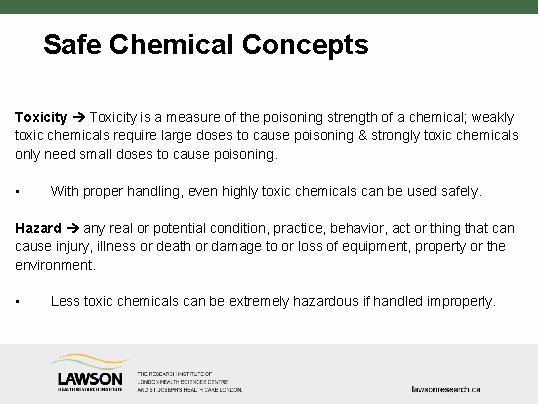
Safe Chemical Concepts Toxicity is a measure of the poisoning strength of a chemical; weakly toxic chemicals require large doses to cause poisoning & strongly toxic chemicals only need small doses to cause poisoning. • With proper handling, even highly toxic chemicals can be used safely. Hazard any real or potential condition, practice, behavior, act or thing that can cause injury, illness or death or damage to or loss of equipment, property or the environment. • Less toxic chemicals can be extremely hazardous if handled improperly.
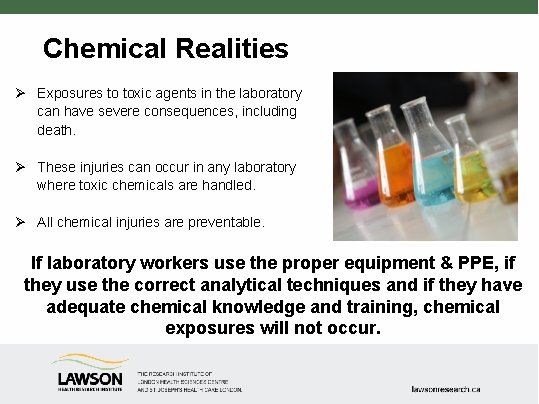
Chemical Realities Ø Exposures to toxic agents in the laboratory can have severe consequences, including death. Ø These injuries can occur in any laboratory where toxic chemicals are handled. Ø All chemical injuries are preventable. If laboratory workers use the proper equipment & PPE, if they use the correct analytical techniques and if they have adequate chemical knowledge and training, chemical exposures will not occur.
Best Practice Methodology • Keep lab worker’s exposure to chemicals below the regulatory levels (O. Reg 833); • Substitute, eliminate or isolate hazardous chemicals where possible; • Designate a person to manage chemical safety in your lab; ALWAYS ask your supervisor or senior lab technician for help when you are unsure about how to use a chemical or conduct a procedure or protocol! • Train / inform workers (on high risk chemicals as well as general laboratory etiquette); • Label ALL chemical containers, even decanted ones (WHMIS 2015); and • Keep all SDS’s up to date.
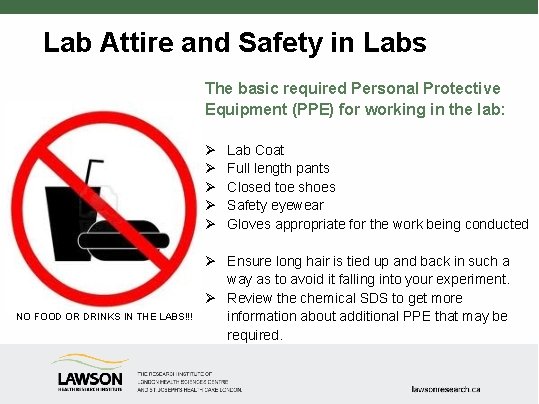
Lab Attire and Safety in Labs The basic required Personal Protective Equipment (PPE) for working in the lab: Ø Ø Ø NO FOOD OR DRINKS IN THE LABS!!! Lab Coat Full length pants Closed toe shoes Safety eyewear Gloves appropriate for the work being conducted Ø Ensure long hair is tied up and back in such a way as to avoid it falling into your experiment. Ø Review the chemical SDS to get more information about additional PPE that may be required.
Lab Attire and Safety in Labs Food, drinks and personal items are not allowed in lab areas and containment zones. Ø Food and/or drinks provide the opportunity to accidentally ingest chemicals and biologicals that you or others in the lab may be working with. Ø Personal items, such as cell phones, provide the opportunity for them to become contaminated and you can bring this contamination home with you. Ø Use designated food and drink areas within your area to store, eat and drink your food and drinks. Ø Do not store your food inside fridges and freezers that are used to store cells, cultures, chemicals, pharmaceuticals, etc. Use a designated lunch room fridge.
Working with Chemicals Safely Know the Hazards; Read the SDS; Use effective labelling (WHMIS 2015); Know your EMERGENCY RESPONSE PROCEDURES; Use the PPE listed on the SDS, or perform a hazard analysis to determine the best PPE for your procedure; Know the most effective First Aid procedures; and Understand ACUTE vs. CHRONIC effects.
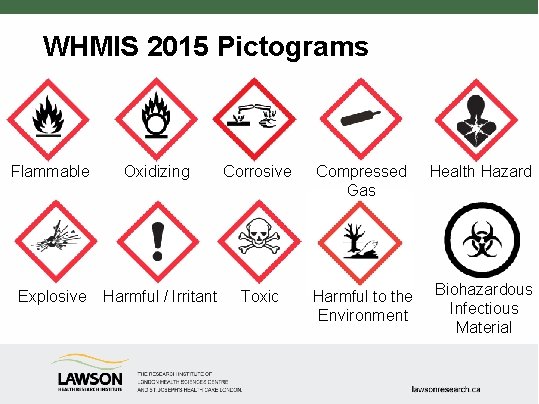
WHMIS 2015 Pictograms Flammable Oxidizing Corrosive Compressed Gas Health Hazard Explosive Harmful / Irritant Toxic Harmful to the Environment Biohazardous Infectious Material
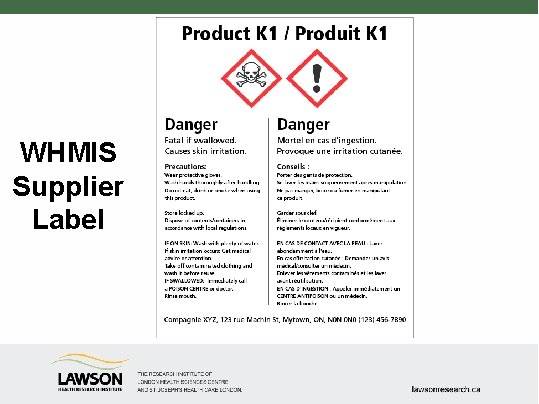
WHMIS Supplier Label
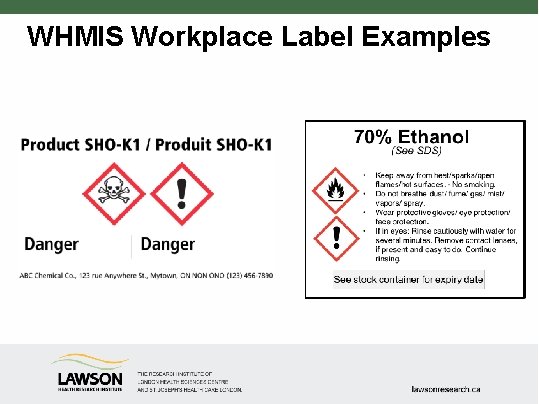
WHMIS Workplace Label Examples
WHMIS Workplace Label Example Additional Information: A fold-out or accordion style label is allowed if there is not enough space on the product to provide a label that meets the legibility requirements of the Hazardous Products Regulations. Note that: Ø the required pictogram(s), signal word and hazard statement(s) must be grouped together on the label, Ø the label must be clearly and prominently displayed on a surface that is visible under normal conditions of use, and Ø the label must, under normal conditions of transport and use, remain affixed to, printed or written on, or attached to the product or its container and remain legible
WHMIS Workplace Label Example Exceptions/Exemptions: 100 m. L or less – Exempt only from requirement to have precautionary or hazard statements on the label. 3 m. L or less – Where the label will interfere with normal use of the product, the product would be required to have a label that is durable and legible for transport and storage, but may be removable for when you need to use the container.
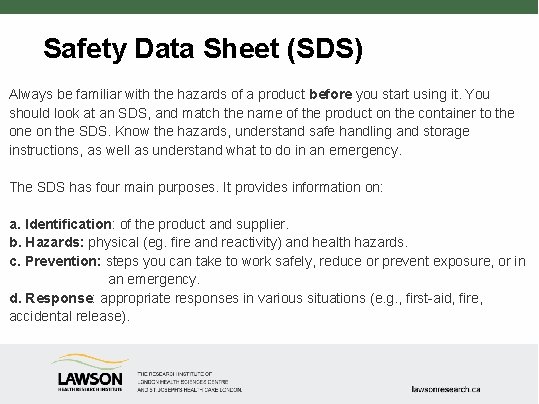
Safety Data Sheet (SDS) Always be familiar with the hazards of a product before you start using it. You should look at an SDS, and match the name of the product on the container to the on the SDS. Know the hazards, understand safe handling and storage instructions, as well as understand what to do in an emergency. The SDS has four main purposes. It provides information on: a. Identification: of the product and supplier. b. Hazards: physical (eg. fire and reactivity) and health hazards. c. Prevention: steps you can take to work safely, reduce or prevent exposure, or in an emergency. d. Response: appropriate responses in various situations (e. g. , first-aid, fire, accidental release).
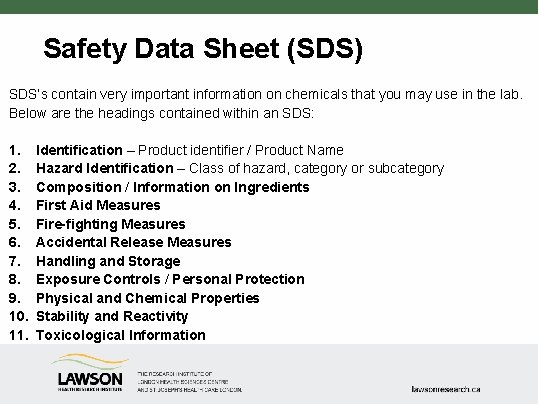
Safety Data Sheet (SDS) SDS’s contain very important information on chemicals that you may use in the lab. Below are the headings contained within an SDS: 1. 2. 3. 4. 5. 6. 7. 8. 9. 10. 11. Identification – Product identifier / Product Name Hazard Identification – Class of hazard, category or subcategory Composition / Information on Ingredients First Aid Measures Fire-fighting Measures Accidental Release Measures Handling and Storage Exposure Controls / Personal Protection Physical and Chemical Properties Stability and Reactivity Toxicological Information
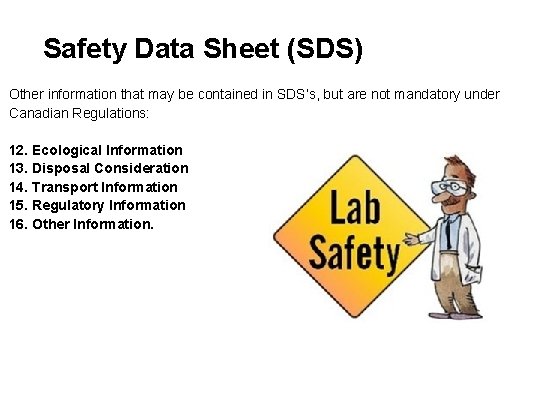
Safety Data Sheet (SDS) Other information that may be contained in SDS’s, but are not mandatory under Canadian Regulations: 12. Ecological Information 13. Disposal Consideration 14. Transport Information 15. Regulatory Information 16. Other Information.
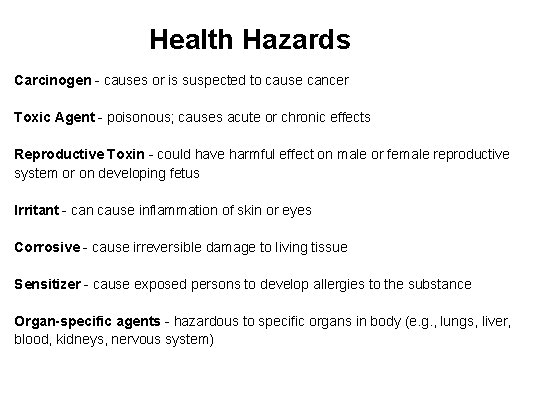
Health Hazards Carcinogen - causes or is suspected to cause cancer Toxic Agent - poisonous; causes acute or chronic effects Reproductive Toxin - could have harmful effect on male or female reproductive system or on developing fetus Irritant - can cause inflammation of skin or eyes Corrosive - cause irreversible damage to living tissue Sensitizer - cause exposed persons to develop allergies to the substance Organ-specific agents - hazardous to specific organs in body (e. g. , lungs, liver, blood, kidneys, nervous system)
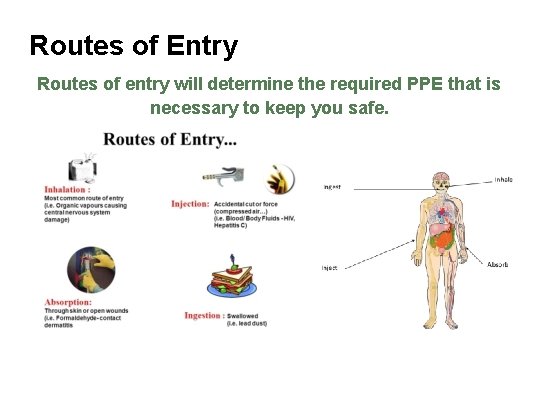
Routes of Entry Routes of entry will determine the required PPE that is necessary to keep you safe.
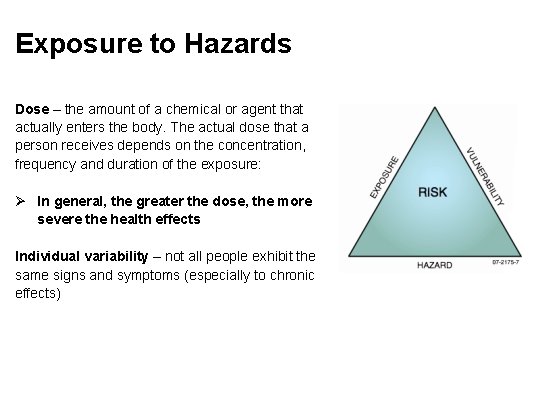
Exposure to Hazards Dose – the amount of a chemical or agent that actually enters the body. The actual dose that a person receives depends on the concentration, frequency and duration of the exposure: Ø In general, the greater the dose, the more severe the health effects Individual variability – not all people exhibit the same signs and symptoms (especially to chronic effects)
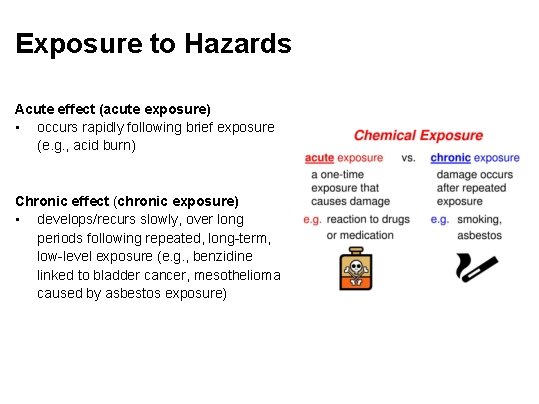
Exposure to Hazards Acute effect (acute exposure) • occurs rapidly following brief exposure (e. g. , acid burn) Chronic effect (chronic exposure) • develops/recurs slowly, over long periods following repeated, long-term, low-level exposure (e. g. , benzidine linked to bladder cancer, mesothelioma caused by asbestos exposure)
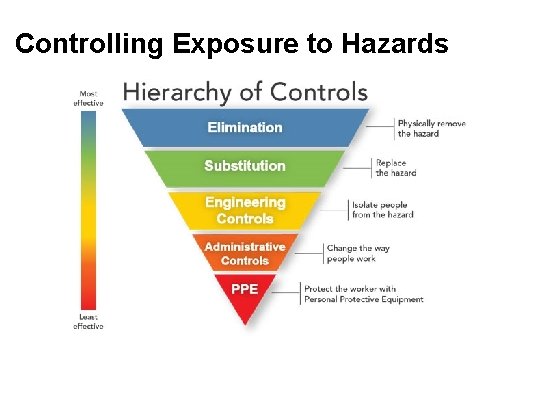
Controlling Exposure to Hazards
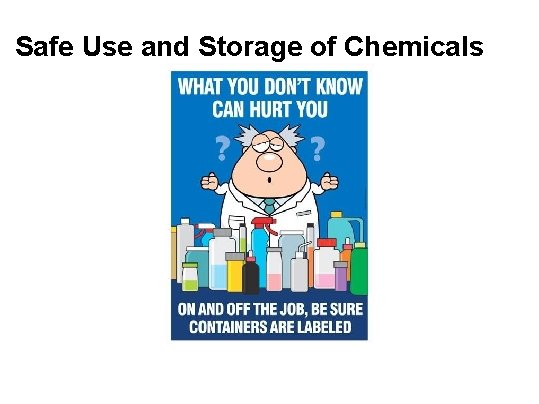
Safe Use and Storage of Chemicals
Safe Use of Chemicals Personal Protective Equipment (PPE): The PPE that you require should be detailed in the lab Standard Operating Procedures for that particular experiment or procedure. Remember that PPE is your last line of defense! Remember the basics of PPE: Lab coat, full length pants, closed toe shoes, safety eyewear and gloves. If you don’t wear a lab coat, you may take chemicals or agents home on your clothing. If it is listed on the SDS, the Ministry of Labour expects you to use it! § Chemical goggles vs. Glasses § Nitrile vs Urethane gloves § Face Shield § Fire Retardant Clothing § CSA Approved Clothing § Chemical Apron
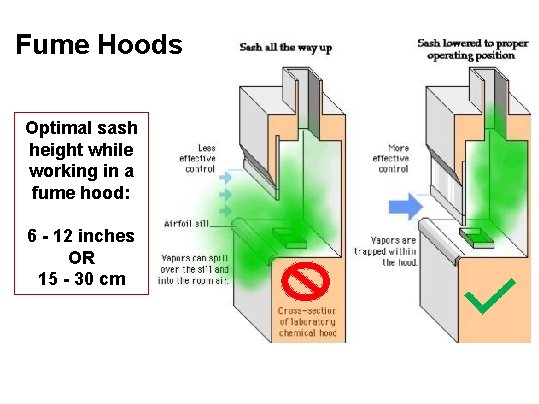
Safe Use of Chemicals Laboratory Safety Equipment: Fume Hoods • Fume Hoods are ventilated enclosures that protect you from being exposed to chemical fumes, gases and aerosols generated within the hood. • Room air drawn into the hood is vented out the stack to outside. Use: • Hood should always be ON. Ensure it is functioning by closing the sash almost completely and put a tissue at the opening. The tissue should be drawn into the hood. • If equipped, test that the air flow alarm is functioning by opening the sash completely. After a few moments, the alarm should sound. OR use the test button if the fume hood is equipped with one. • Lower sash to marked (working level) position – at 6 to 12 inches (15 – 30 cm).
Fume Hoods Optimal sash height while working in a fume hood: 6 - 12 inches OR 15 - 30 cm
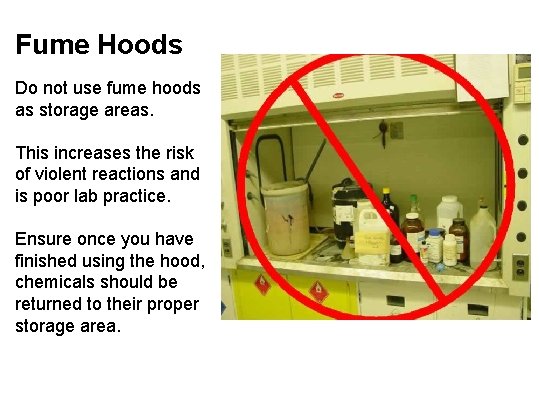
Fume Hoods Do not use fume hoods as storage areas. This increases the risk of violent reactions and is poor lab practice. Ensure once you have finished using the hood, chemicals should be returned to their proper storage area.
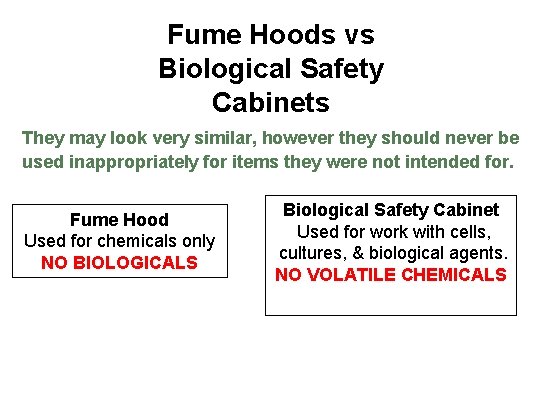
Fume Hoods vs Biological Safety Cabinets They may look very similar, however they should never be used inappropriately for items they were not intended for. Fume Hood Used for chemicals only NO BIOLOGICALS Biological Safety Cabinet Used for work with cells, cultures, & biological agents. NO VOLATILE CHEMICALS
Fume Hoods & Biological Safety Cabinets Fume Hoods and Biological Safety Cabinets are inspected yearly to ensure they work within the required parameters. Inspections: Ø Ø Ø Annually Tested for adequate flow Results are labeled on the hood and indicate next inspection date Safe sash level marked with a sticker Never use an unsafe fume hood and report issues to your supervisor
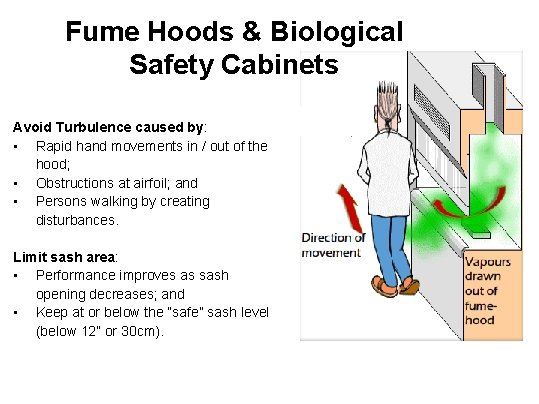
Fume Hoods & Biological Safety Cabinets Avoid Turbulence caused by: • Rapid hand movements in / out of the hood; • Obstructions at airfoil; and • Persons walking by creating disturbances. Limit sash area: • Performance improves as sash opening decreases; and • Keep at or below the “safe” sash level (below 12” or 30 cm).
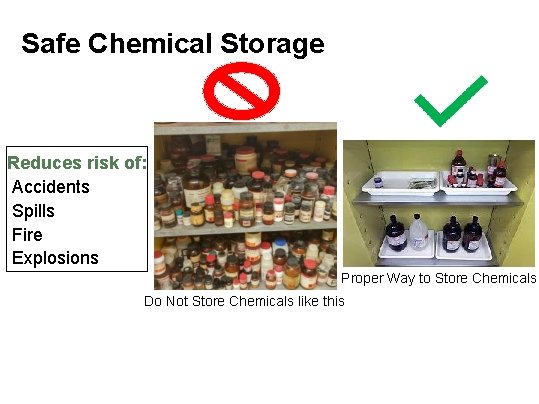
Safe Chemical Storage Reduces risk of: Accidents Spills Fire Explosions Proper Way to Store Chemicals Do Not Store Chemicals like this
Safe Chemical Storage General Considerations: Ø Dry Chemicals and Liquids Ø Storage Groups vs Alphabetical Ø Storage Locations Flammable Liquids Corrosive Materials Reactive Chemicals (Oxidizers and Reducers) Cryogenics Compressed Gases
Safe Chemical Storage: General Considerations Liquid and solid chemicals must NEVER be stored together. Organic and inorganic chemicals must NEVER be stored together. Know your Chemical Incompatibilities. Store dry chemicals together (separating the organic and inorganic). NEVER store chemicals alphabetically (unless they are compatible).
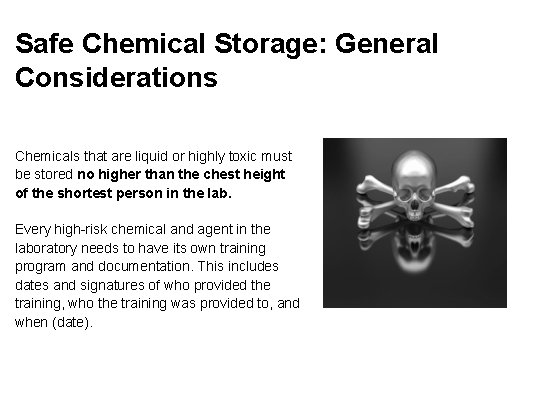
Safe Chemical Storage: General Considerations Chemicals that are liquid or highly toxic must be stored no higher than the chest height of the shortest person in the lab. Every high-risk chemical and agent in the laboratory needs to have its own training program and documentation. This includes dates and signatures of who provided the training, who the training was provided to, and when (date).
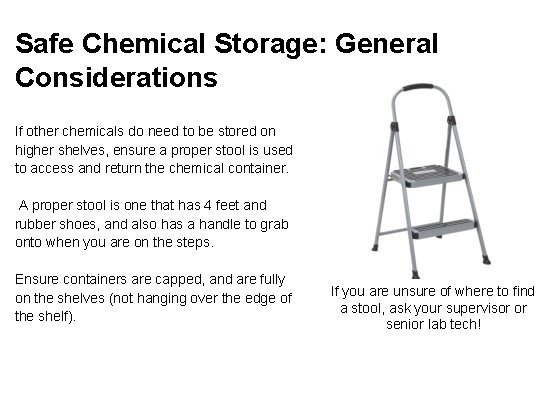
Safe Chemical Storage: General Considerations If other chemicals do need to be stored on higher shelves, ensure a proper stool is used to access and return the chemical container. A proper stool is one that has 4 feet and rubber shoes, and also has a handle to grab onto when you are on the steps. Ensure containers are capped, and are fully on the shelves (not hanging over the edge of the shelf). If you are unsure of where to find a stool, ask your supervisor or senior lab tech!
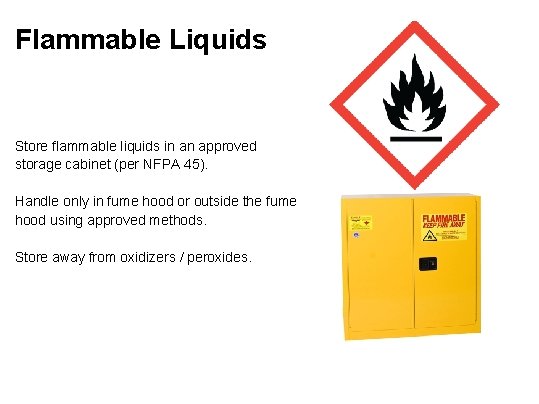
Flammable Liquids Store flammable liquids in an approved storage cabinet (per NFPA 45). Handle only in fume hood or outside the fume hood using approved methods. Store away from oxidizers / peroxides.
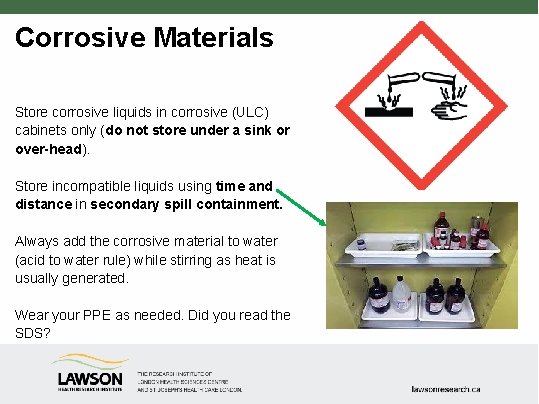
Corrosive Materials Store corrosive liquids in corrosive (ULC) cabinets only (do not store under a sink or over-head). Store incompatible liquids using time and distance in secondary spill containment. Always add the corrosive material to water (acid to water rule) while stirring as heat is usually generated. Wear your PPE as needed. Did you read the SDS?
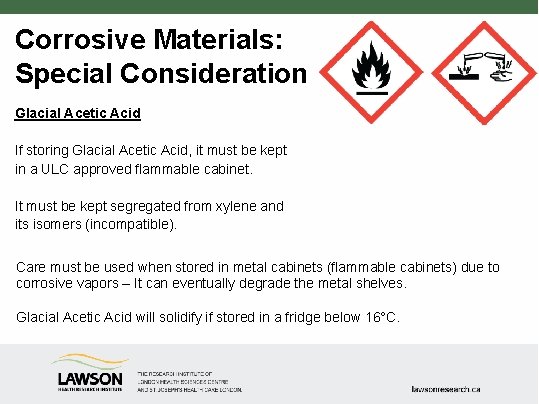
Corrosive Materials: Special Consideration Glacial Acetic Acid If storing Glacial Acetic Acid, it must be kept in a ULC approved flammable cabinet. It must be kept segregated from xylene and its isomers (incompatible). Care must be used when stored in metal cabinets (flammable cabinets) due to corrosive vapors – It can eventually degrade the metal shelves. Glacial Acetic Acid will solidify if stored in a fridge below 16°C.
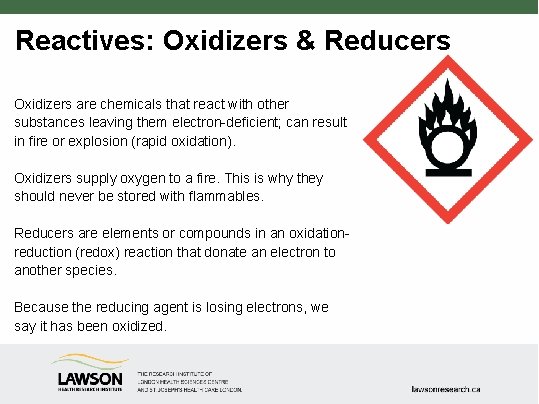
Reactives: Oxidizers & Reducers Oxidizers are chemicals that react with other substances leaving them electron-deficient; can result in fire or explosion (rapid oxidation). Oxidizers supply oxygen to a fire. This is why they should never be stored with flammables. Reducers are elements or compounds in an oxidationreduction (redox) reaction that donate an electron to another species. Because the reducing agent is losing electrons, we say it has been oxidized.
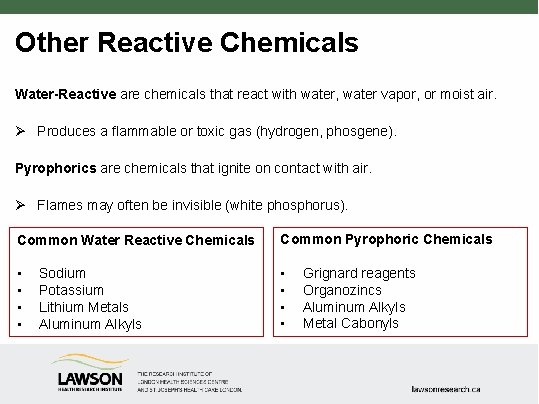
Other Reactive Chemicals Water-Reactive are chemicals that react with water, water vapor, or moist air. Ø Produces a flammable or toxic gas (hydrogen, phosgene). Pyrophorics are chemicals that ignite on contact with air. Ø Flames may often be invisible (white phosphorus). Common Water Reactive Chemicals Common Pyrophoric Chemicals • • Sodium Potassium Lithium Metals Aluminum Alkyls Grignard reagents Organozincs Aluminum Alkyls Metal Cabonyls
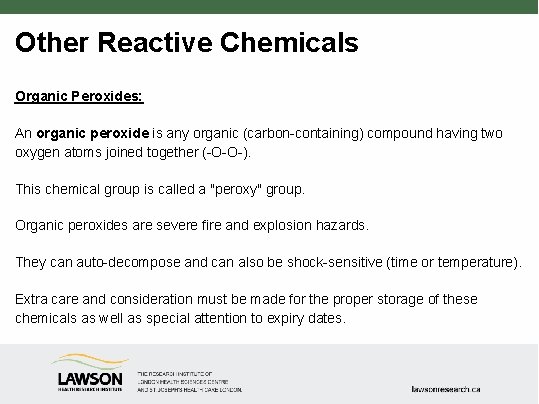
Other Reactive Chemicals Organic Peroxides: An organic peroxide is any organic (carbon-containing) compound having two oxygen atoms joined together (-O-O-). This chemical group is called a "peroxy" group. Organic peroxides are severe fire and explosion hazards. They can auto-decompose and can also be shock-sensitive (time or temperature). Extra care and consideration must be made for the proper storage of these chemicals as well as special attention to expiry dates.
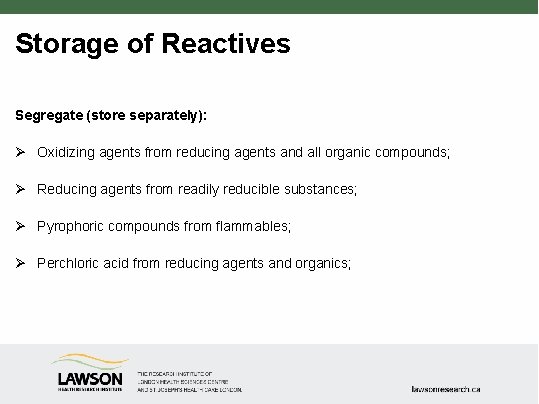
Storage of Reactives Segregate (store separately): Ø Oxidizing agents from reducing agents and all organic compounds; Ø Reducing agents from readily reducible substances; Ø Pyrophoric compounds from flammables; Ø Perchloric acid from reducing agents and organics;
Storage of Reactives Segregate (store separately): Water from water-reactive chemicals; Ø Segregate Sodium/Phosphorus & aqueous material [fire danger]; Ø Segregate Acid with Cyanide compounds [toxic gas release]; and Ø Segregate Chlorine & Ammonia [toxic chloramines release]. Finally, store thermally unstable materials in an approved refrigerator.
Chemicals Requiring Special Attention, Handling and Training Any chemical that poses a greater danger (reactive, highly toxic, carcinogenic, mutagen, etc. ) must have a separate training program that is documented with dates, who provided the training, and signature of trainee. The program must include: i. Basic Chemical Hazards (Material Knowledge); ii. Storage; iii. Material and Waste Handling; iv. Movement Through the Hospital; v. Engineering Controls & PPE; vi. Emergency Response; and vii. Reference to the MSDS.
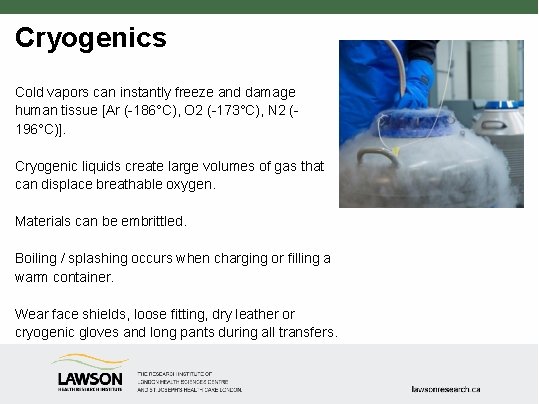
Cryogenics Cold vapors can instantly freeze and damage human tissue [Ar (-186°C), O 2 (-173°C), N 2 (196°C)]. Cryogenic liquids create large volumes of gas that can displace breathable oxygen. Materials can be embrittled. Boiling / splashing occurs when charging or filling a warm container. Wear face shields, loose fitting, dry leather or cryogenic gloves and long pants during all transfers.
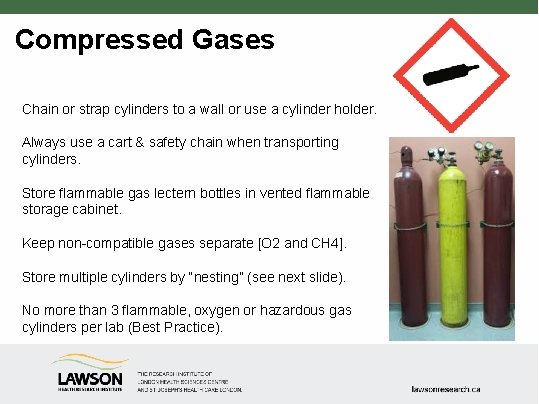
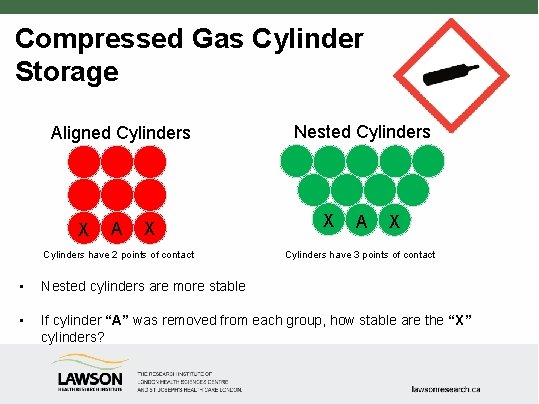
Compressed Gases Chain or strap cylinders to a wall or use a cylinder holder. Always use a cart & safety chain when transporting cylinders. Store flammable gas lectern bottles in vented flammable storage cabinet. Keep non-compatible gases separate [O 2 and CH 4]. Store multiple cylinders by “nesting” (see next slide). No more than 3 flammable, oxygen or hazardous gas cylinders per lab (Best Practice).
Compressed Gas Cylinder Storage Aligned Cylinders X A X Cylinders have 2 points of contact Nested Cylinders X A X Cylinders have 3 points of contact • Nested cylinders are more stable • If cylinder “A” was removed from each group, how stable are the “X” cylinders?
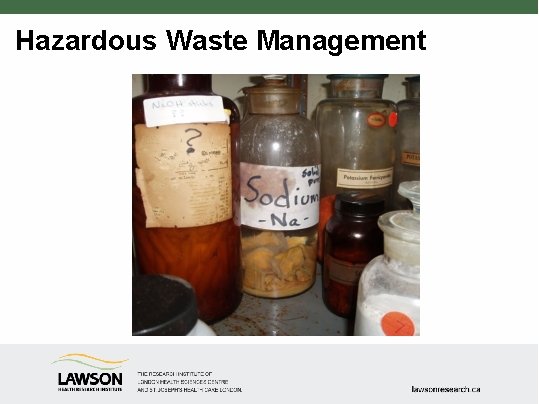
Hazardous Waste Management
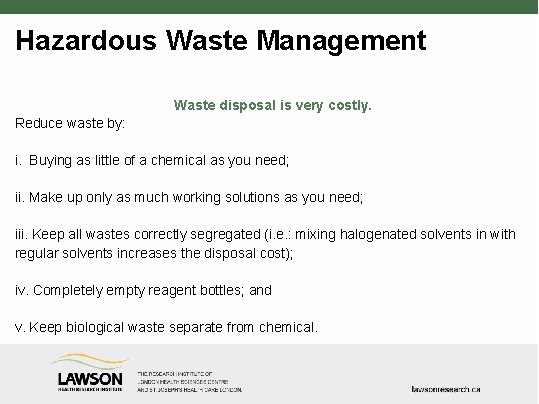
Hazardous Waste Management Waste disposal is very costly. Reduce waste by: i. Buying as little of a chemical as you need; ii. Make up only as much working solutions as you need; iii. Keep all wastes correctly segregated (i. e. : mixing halogenated solvents in with regular solvents increases the disposal cost); iv. Completely empty reagent bottles; and v. Keep biological waste separate from chemical.
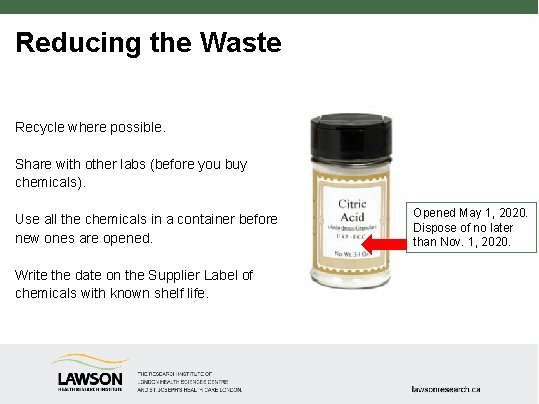
Reducing the Waste Recycle where possible. Share with other labs (before you buy chemicals). Use all the chemicals in a container before new ones are opened. Write the date on the Supplier Label of chemicals with known shelf life. Opened May 1, 2020. Dispose of no later than Nov. 1, 2020.
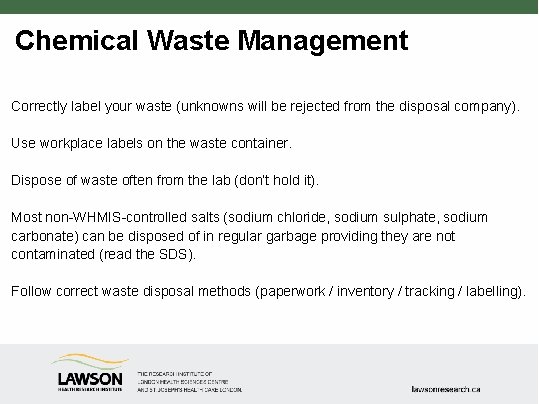
Chemical Waste Management Correctly label your waste (unknowns will be rejected from the disposal company). Use workplace labels on the waste container. Dispose of waste often from the lab (don’t hold it). Most non-WHMIS-controlled salts (sodium chloride, sodium sulphate, sodium carbonate) can be disposed of in regular garbage providing they are not contaminated (read the SDS). Follow correct waste disposal methods (paperwork / inventory / tracking / labelling).
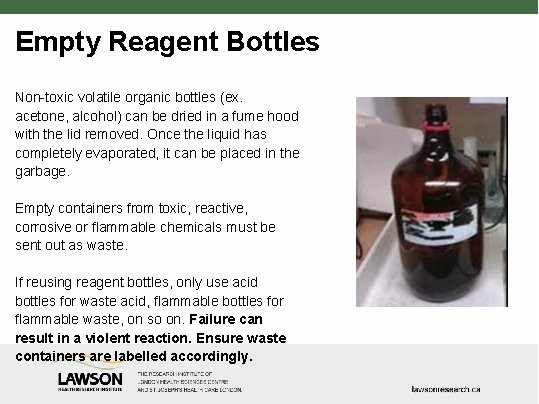
Empty Reagent Bottles Non-toxic volatile organic bottles (ex. acetone, alcohol) can be dried in a fume hood with the lid removed. Once the liquid has completely evaporated, it can be placed in the garbage. Empty containers from toxic, reactive, corrosive or flammable chemicals must be sent out as waste. If reusing reagent bottles, only use acid bottles for waste acid, flammable bottles for flammable waste, on so on. Failure can result in a violent reaction. Ensure waste containers are labelled accordingly.
Chemical Emergencies
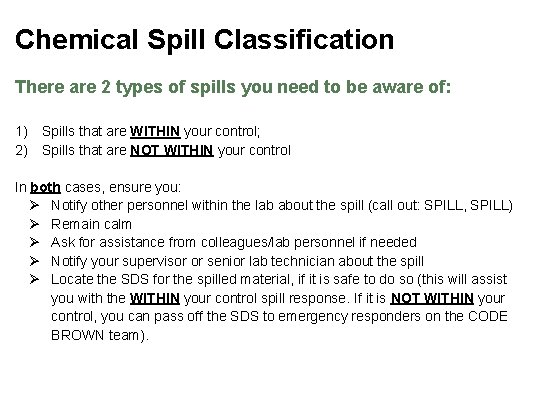
Chemical Spill Classification There are 2 types of spills you need to be aware of: 1) Spills that are WITHIN your control; 2) Spills that are NOT WITHIN your control In both cases, ensure you: Ø Notify other personnel within the lab about the spill (call out: SPILL, SPILL) Ø Remain calm Ø Ask for assistance from colleagues/lab personnel if needed Ø Notify your supervisor or senior lab technician about the spill Ø Locate the SDS for the spilled material, if it is safe to do so (this will assist you with the WITHIN your control spill response. If it is NOT WITHIN your control, you can pass off the SDS to emergency responders on the CODE BROWN team).
Chemical Spill Classification Spills WITHIN your control Ø A spill that you can safely clean up yourself based on training, experience and knowledge of the materials involved. Ask for assistance from colleagues when needed. Consider your knowledge of the material and the training you’ve received on it. Consider the quantity and hazards of the spilled material (look up the SDS!). Notify your senior lab technician and supervisor when possible and safe to do so. Ensure you notify everyone else in the lab that a spill has occurred, and secure the area so that no one accidentally comes in contact with the spilled material.
Chemical Spill Classification Spills NOT WITHIN your control Ø A spill that you can not safely clean up yourself and requires the attention of Trained Specialists. Notify everyone in the lab and evacuate if necessary. You must initiate a CODE BROWN by calling x 55555 on any hospital phone. Notify your supervisor as soon as you can however your first priority is to notify everyone in the lab and initiate a CODE BROWN to get a response from the CODE BROWN team. More information about CODE BROWN will be covered in hospital Emergency Code learning module.
Chemical Spill Classification Spills NOT within your control An acronym to remember for a spill NOT WITHIN your control is: S. P. I. L. L. S - Safely evacuate everyone from the immediate area P - Prevent any further injuries, damage to property or environment and the spread of fumes I - Initiate notification to the Emergency Response Team, from a safe location by calling x 55555 and state CODE BROWN L - Leave electrical equipment; do not turn switches on or off L - Locate the "Safety Data Sheet (SDS)" of the spilled substance(s)
Remember, in the event of a spill: Keep yourself and others safe (safe location away from the spill and vapors that may be emitted). Where needed, provide first aid (in a safe location), only if you are trained. Prevent the spread of fumes by closing doors and windows (if possible). Provide the location, size and make-up of the spill when calling x 55555. Assist the Spill Response team as needed (with more information, or by keeping people out of the area where the spill occurred).
You have now completed this education module. Please complete the Chemical Management Safety Quiz.