
Chemical Risk Assessment and Exposure Guidelines and how


- Slides: 35
Chemical Risk Assessment and Exposure Guidelines (and how AEGLs fit in) Veronique Hauschild, MPH Directorate of Health Risk Management US Army Center for Health Promotion and Preventive Medicine Presentation to Arkansas Dept of Health - March 2003
AGENDA • Background –CHPPM • Introduction to Chemical Risk Assessment • What are AEGLs • What are the health effects associated with chemical warfare agent AEGLs? • How are AEGLs used? 2
Who is USACHPPM? 1994 – Present Pre – 1994 Army Environmental Hygiene Agency US Army Center for Health Promotion and Preventive Medicine (USACHPPM) (AEHA) - Occupational Health - Environmental Health - Epidemiology and Disease Surveillance - Toxicology - Health Promotion and Wellness - Laboratory Sciences 3 - Health Risk Management
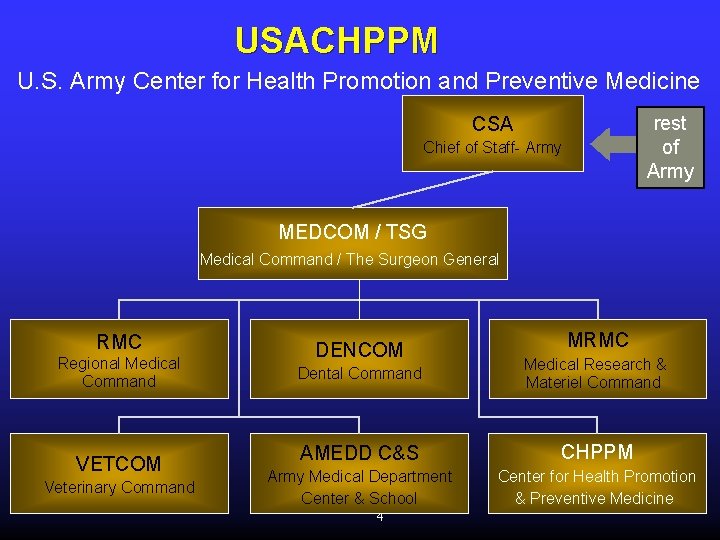
USACHPPM U. S. Army Center for Health Promotion and Preventive Medicine rest of Army CSA Chief of Staff- Army MEDCOM / TSG Medical Command / The Surgeon General RMC Regional Medical Command VETCOM Veterinary Command DENCOM MRMC Dental Command Medical Research & Materiel Command AMEDD C&S CHPPM Army Medical Department Center & School Center for Health Promotion & Preventive Medicine 4
USACHPPM MISSION • Preventive medicine, public health, occupational health and safety, and health promotion/wellness technical services • Advise/assist Army OTSG in policy and guidance development • Evaluate compliance and adequacy of programs and policies (report to OTSG) • Support world-wide technical support (Army and Do. D; other Federal and State entities; international efforts) 5
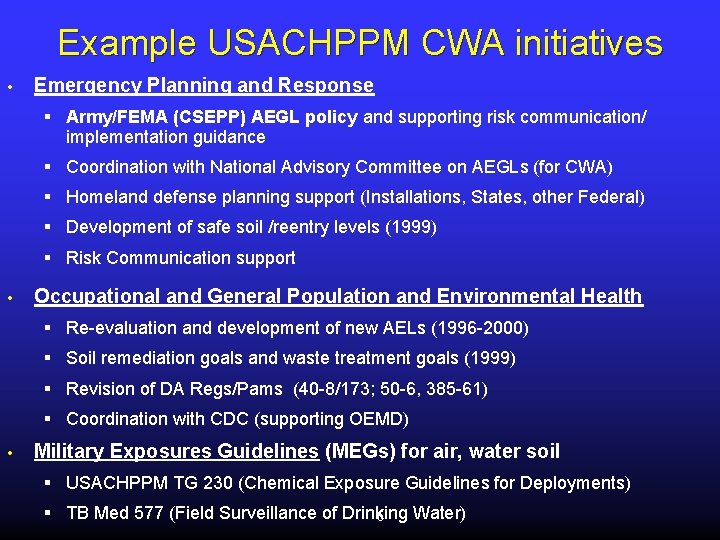
Example USACHPPM CWA initiatives • Emergency Planning and Response § Army/FEMA (CSEPP) AEGL policy and supporting risk communication/ implementation guidance § Coordination with National Advisory Committee on AEGLs (for CWA) § Homeland defense planning support (Installations, States, other Federal) § Development of safe soil /reentry levels (1999) § Risk Communication support • Occupational and General Population and Environmental Health § Re-evaluation and development of new AELs (1996 -2000) § Soil remediation goals and waste treatment goals (1999) § Revision of DA Regs/Pams (40 -8/173; 50 -6, 385 -61) § Coordination with CDC (supporting OEMD) • Military Exposures Guidelines (MEGs) for air, water soil § USACHPPM TG 230 (Chemical Exposure Guidelines for Deployments) § TB Med 577 (Field Surveillance of Drinking Water) 6
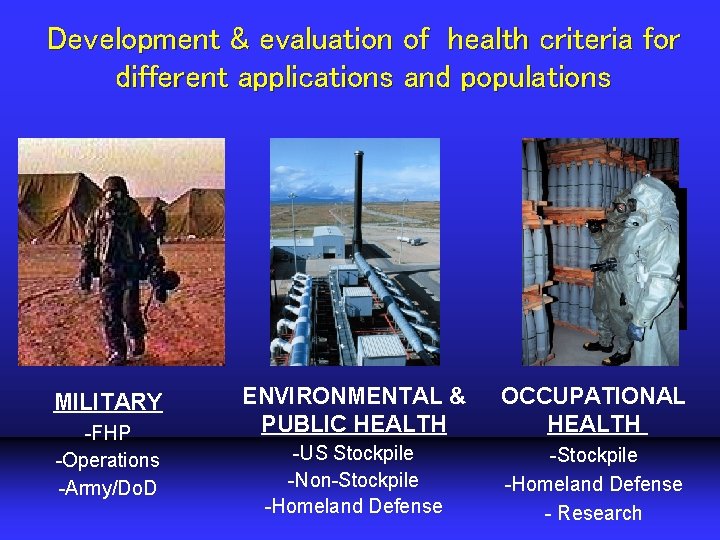
Development & evaluation of health criteria for different applications and populations MILITARY -FHP -Operations -Army/Do. D ENVIRONMENTAL & PUBLIC HEALTH OCCUPATIONAL HEALTH -US Stockpile -Non-Stockpile -Homeland Defense - Research
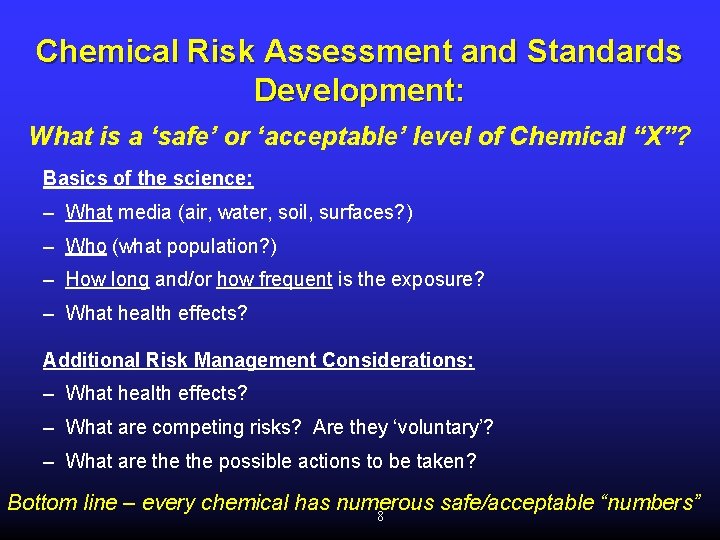
Chemical Risk Assessment and Standards Development: What is a ‘safe’ or ‘acceptable’ level of Chemical “X”? Basics of the science: – What media (air, water, soil, surfaces? ) – Who (what population? ) – How long and/or how frequent is the exposure? – What health effects? Additional Risk Management Considerations: – What health effects? – What are competing risks? Are they ‘voluntary’? – What are the possible actions to be taken? Bottom line – every chemical has numerous safe/acceptable “numbers” 8
Chemical Air Exposure Levels Continuum* Catastrophic release Work environments Single exposure Lifetime exposure mg/m 3 LC 50 Ambient air (emissions) ug/m 3 IDLH EC 50 15 min AEGL-1 AEGL-2 AEGL-3 4 x per day worker “STEL” Daily 8 -hr worker TWA “WPL” Ambient air general population lifetime “GPL” *not to scale for any specific chemical– general representation
So what are Acute Exposure Guideline Levels (AEGLs)? - Short-term, one-time, airborne exposure levels - 3 levels of health severity and different exposure times - For risk managers to appropriately balance risks and prioritize resources in • Emergency planning/prevention • Emergency response Concept started in the mid-80’s – result of Bhopal incident
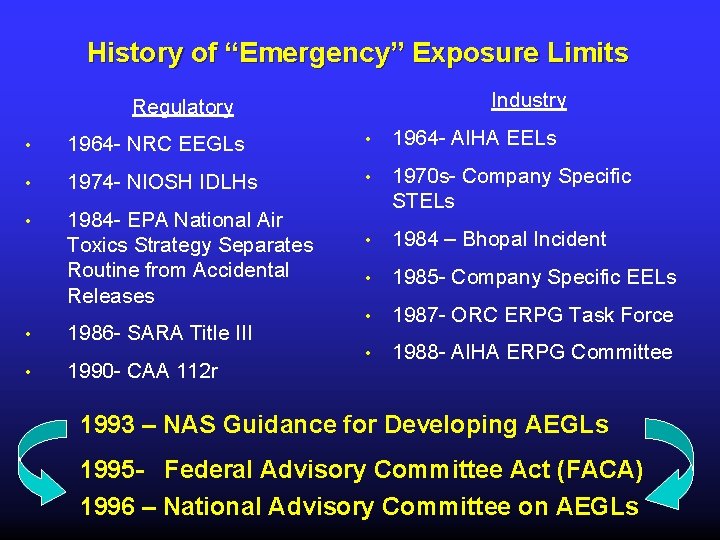
History of “Emergency” Exposure Limits Industry Regulatory • 1964 - NRC EEGLs • 1964 - AIHA EELs • 1974 - NIOSH IDLHs • • 1984 - EPA National Air Toxics Strategy Separates Routine from Accidental Releases 1970 s- Company Specific STELs • 1984 – Bhopal Incident • 1985 - Company Specific EELs • 1987 - ORC ERPG Task Force • 1988 - AIHA ERPG Committee • • 1986 - SARA Title III 1990 - CAA 112 r 1993 – NAS Guidance for Developing AEGLs 1995 - Federal Advisory Committee Act (FACA) 1996 – National Advisory Committee on AEGLs
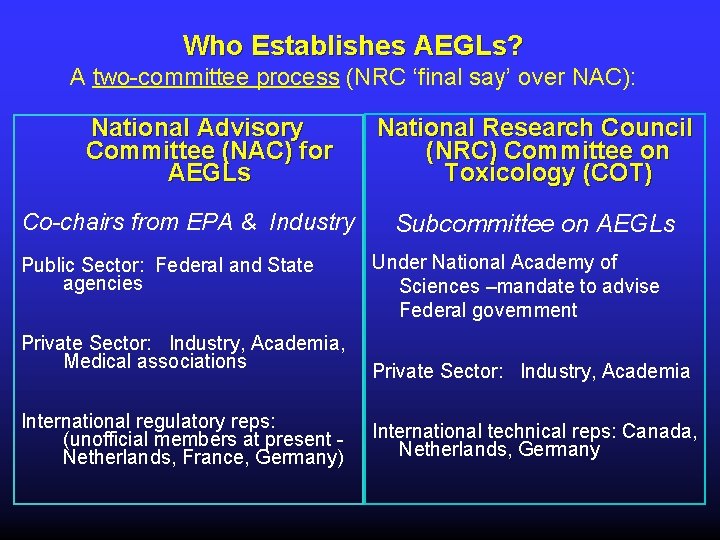
Who Establishes AEGLs? A two-committee process (NRC ‘final say’ over NAC): National Advisory Committee (NAC) for AEGLs Co-chairs from EPA & Industry Public Sector: Federal and State agencies National Research Council (NRC) Committee on Toxicology (COT) Subcommittee on AEGLs Under National Academy of Sciences –mandate to advise Federal government Private Sector: Industry, Academia, Medical associations Private Sector: Industry, Academia International regulatory reps: (unofficial members at present Netherlands, France, Germany) International technical reps: Canada, Netherlands, Germany
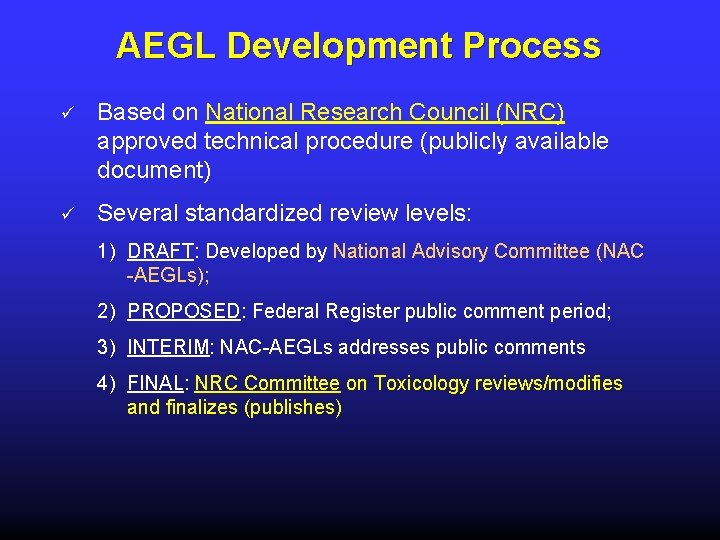
AEGL Development Process ü Based on National Research Council (NRC) approved technical procedure (publicly available document) ü Several standardized review levels: 1) DRAFT: Developed by National Advisory Committee (NAC -AEGLs); 2) PROPOSED: Federal Register public comment period; 3) INTERIM: NAC-AEGLs addresses public comments 4) FINAL: NRC Committee on Toxicology reviews/modifies and finalizes (publishes)
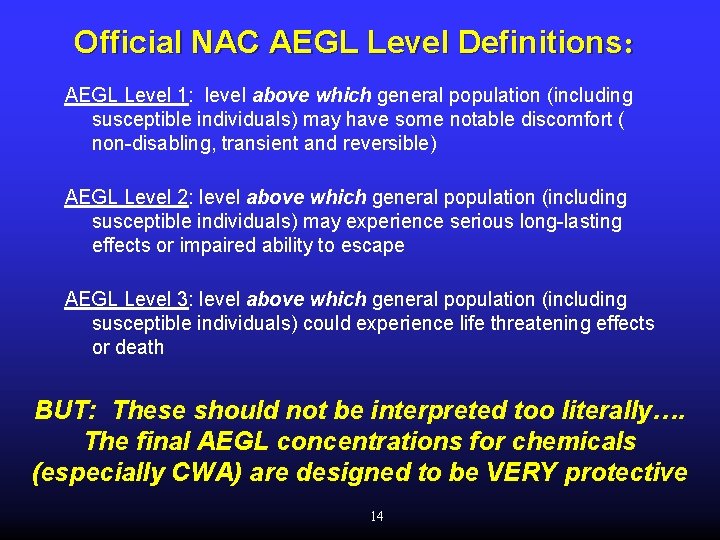
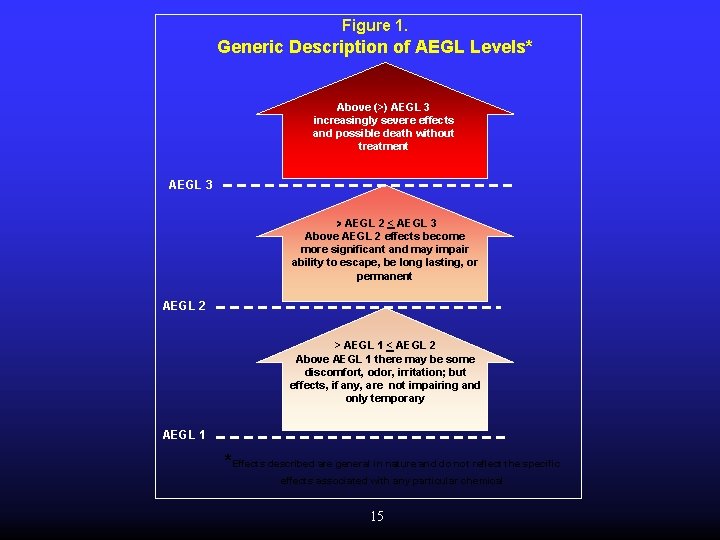
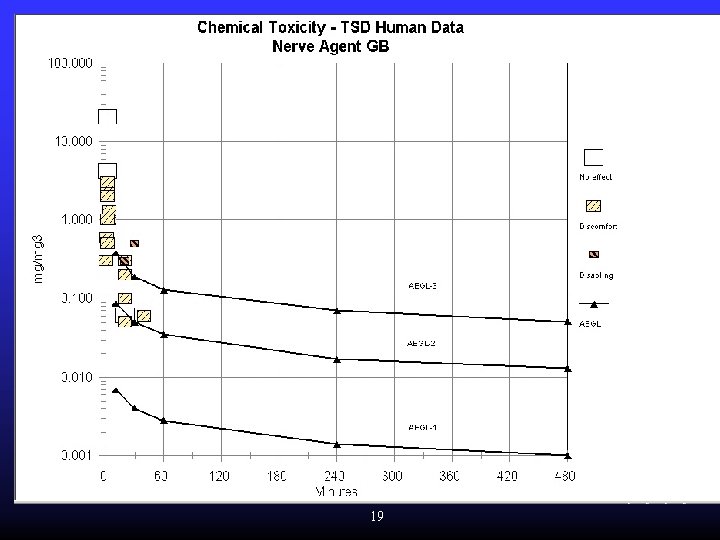
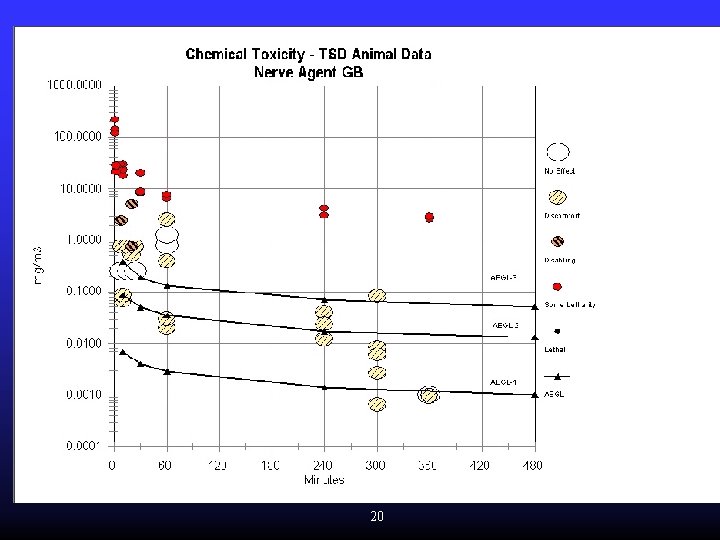
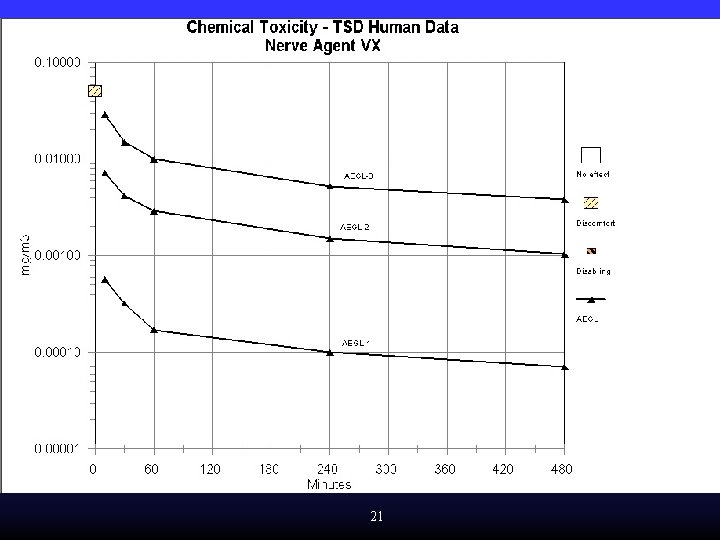
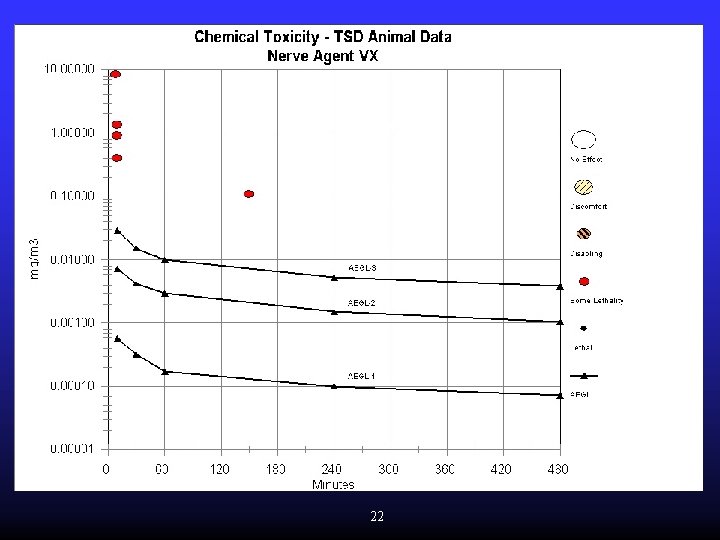
Official NAC AEGL Level Definitions: AEGL Level 1: level above which general population (including susceptible individuals) may have some notable discomfort ( non-disabling, transient and reversible) AEGL Level 2: level above which general population (including susceptible individuals) may experience serious long-lasting effects or impaired ability to escape AEGL Level 3: level above which general population (including susceptible individuals) could experience life threatening effects or death BUT: These should not be interpreted too literally…. The final AEGL concentrations for chemicals (especially CWA) are designed to be VERY protective 14
Figure 1. Generic Description of AEGL Levels* Above (>) AEGL 3 increasingly severe effects and possible death without treatment AEGL 3 > AEGL 2 < AEGL 3 Above AEGL 2 effects become more significant and may impair ability to escape, be long lasting, or permanent AEGL 2 > AEGL 1 < AEGL 2 Above AEGL 1 there may be some discomfort, odor, irritation; but effects, if any, are not impairing and only temporary AEGL 1 *Effects described are general in nature and do not reflect the specific effects associated with any particular chemical 15
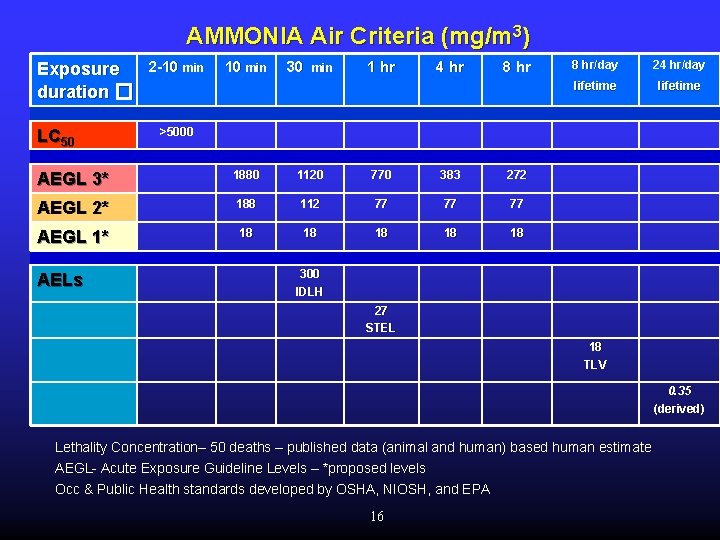
AMMONIA Air Criteria (mg/m 3) 2 -10 min Exposure duration � LC 50 10 min 30 min 1 hr 4 hr 8 hr 24 hr/day lifetime >5000 AEGL 3* 1880 1120 770 383 272 AEGL 2* 188 112 77 77 77 AEGL 1* 18 18 18 AELs 8 hr/day 300 IDLH 27 STEL 18 TLV 0. 35 (derived) Lethality Concentration– 50 deaths – published data (animal and human) based human estimate AEGL- Acute Exposure Guideline Levels – *proposed levels Occ & Public Health standards developed by OSHA, NIOSH, and EPA 16
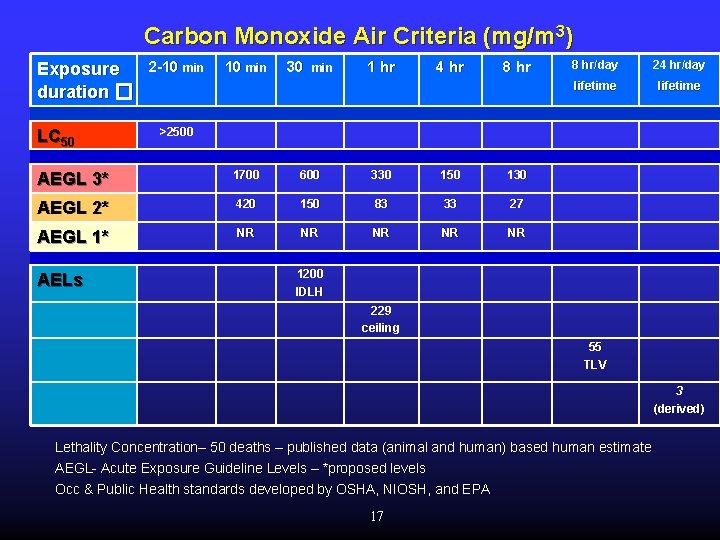
Carbon Monoxide Air Criteria (mg/m 3) 2 -10 min Exposure duration � LC 50 10 min 30 min 1 hr 4 hr 8 hr 24 hr/day lifetime >2500 AEGL 3* 1700 600 330 150 130 AEGL 2* 420 150 83 33 27 AEGL 1* NR NR NR AELs 8 hr/day 1200 IDLH 229 ceiling 55 TLV 3 (derived) Lethality Concentration– 50 deaths – published data (animal and human) based human estimate AEGL- Acute Exposure Guideline Levels – *proposed levels Occ & Public Health standards developed by OSHA, NIOSH, and EPA 17
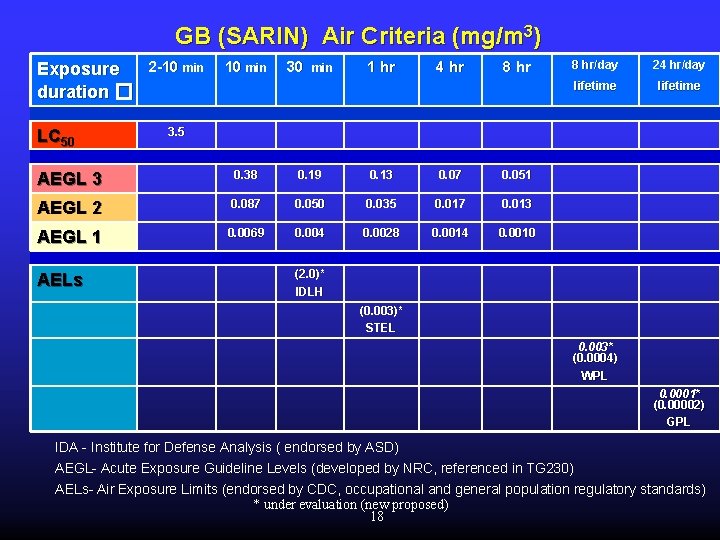
GB (SARIN) Air Criteria (mg/m 3) 2 -10 min Exposure duration � LC 50 10 min 30 min 1 hr 4 hr 8 hr 24 hr/day lifetime 3. 5 AEGL 3 0. 38 0. 19 0. 13 0. 07 0. 051 AEGL 2 0. 087 0. 050 0. 035 0. 017 0. 013 AEGL 1 0. 0069 0. 004 0. 0028 0. 0014 0. 0010 AELs 8 hr/day (2. 0)* IDLH (0. 003)* STEL 0. 003* (0. 0004) WPL 0. 0001* (0. 00002) GPL IDA - Institute for Defense Analysis ( endorsed by ASD) AEGL- Acute Exposure Guideline Levels (developed by NRC, referenced in TG 230) AELs- Air Exposure Limits (endorsed by CDC, occupational and general population regulatory standards) * under evaluation (new proposed) 18
19
20
21
22
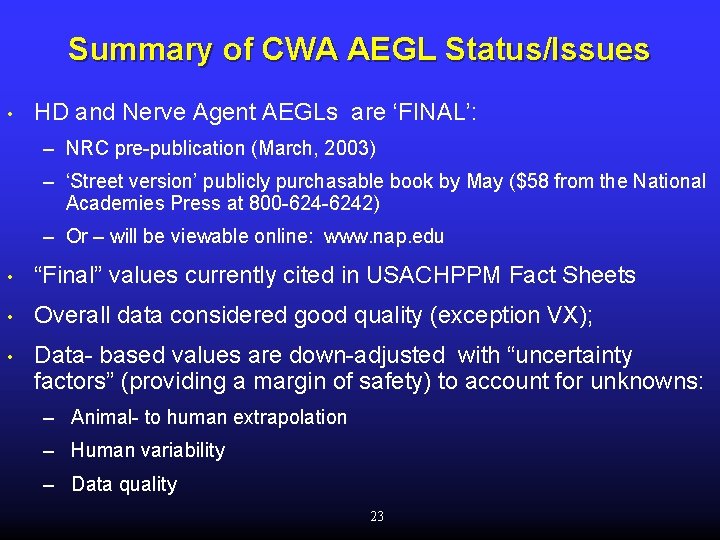
Summary of CWA AEGL Status/Issues • HD and Nerve Agent AEGLs are ‘FINAL’: – NRC pre-publication (March, 2003) – ‘Street version’ publicly purchasable book by May ($58 from the National Academies Press at 800 -6242) – Or – will be viewable online: www. nap. edu • “Final” values currently cited in USACHPPM Fact Sheets • Overall data considered good quality (exception VX); • Data- based values are down-adjusted with “uncertainty factors” (providing a margin of safety) to account for unknowns: – Animal- to human extrapolation – Human variability – Data quality 23
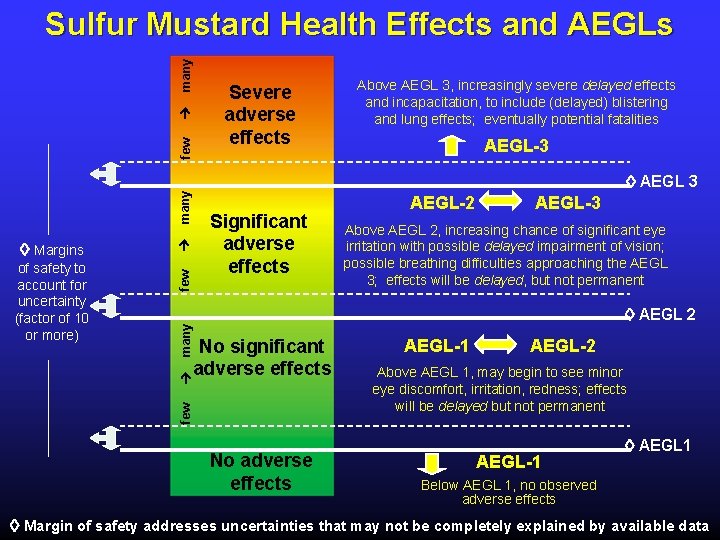
many Sulfur Mustard Health Effects and AEGLs few Severe adverse effects many few Significant adverse effects AEGL-2 AEGL-3 Above AEGL 2, increasing chance of significant eye irritation with possible delayed impairment of vision; possible breathing difficulties approaching the AEGL 3; effects will be delayed, but not permanent AEGL 2 No significant adverse effects few of safety to account for uncertainty (factor of 10 or more) AEGL-3 AEGL 3 many Margins Above AEGL 3, increasingly severe delayed effects and incapacitation, to include (delayed) blistering and lung effects; eventually potential fatalities No adverse effects AEGL-1 AEGL-2 Above AEGL 1, may begin to see minor eye discomfort, irritation, redness; effects will be delayed but not permanent AEGL-1 AEGL 1 Below AEGL 1, no observed adverse effects Margin of safety addresses uncertainties that may not be completely explained by available data
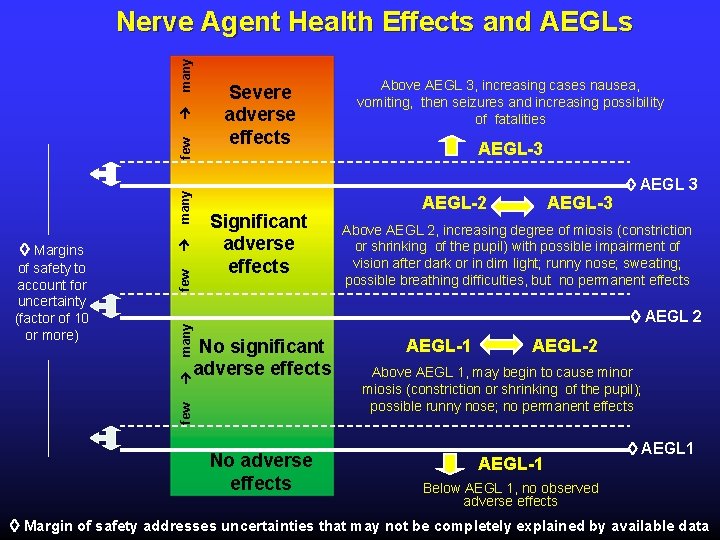
many Nerve Agent Health Effects and AEGLs many few Severe adverse effects few AEGL-3 AEGL-2 AEGL-3 AEGL 3 Above AEGL 2, increasing degree of miosis (constriction or shrinking of the pupil) with possible impairment of vision after dark or in dim light; runny nose; sweating; possible breathing difficulties, but no permanent effects AEGL 2 No significant adverse effects few of safety to account for uncertainty (factor of 10 or more) many Margins Significant adverse effects Above AEGL 3, increasing cases nausea, vomiting, then seizures and increasing possibility of fatalities No adverse effects AEGL-1 AEGL-2 Above AEGL 1, may begin to cause minor miosis (constriction or shrinking of the pupil); possible runny nose; no permanent effects AEGL-1 AEGL 1 Below AEGL 1, no observed adverse effects Margin of safety addresses uncertainties that may not be completely explained by available data
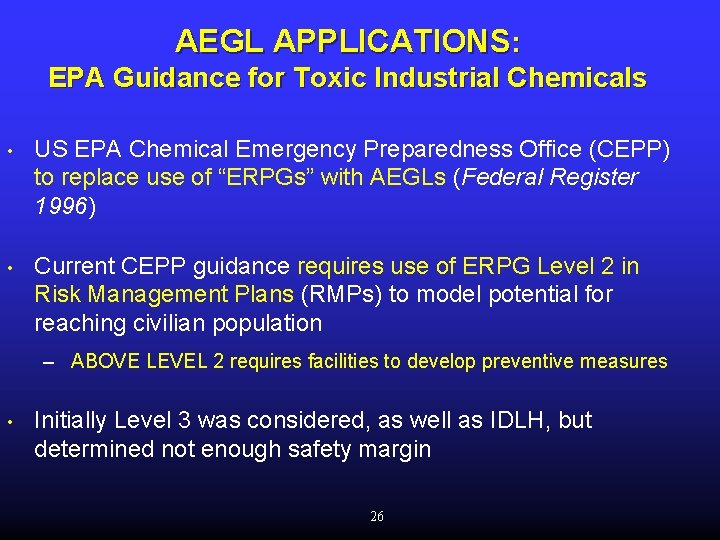
AEGL APPLICATIONS: EPA Guidance for Toxic Industrial Chemicals • US EPA Chemical Emergency Preparedness Office (CEPP) to replace use of “ERPGs” with AEGLs (Federal Register 1996) • Current CEPP guidance requires use of ERPG Level 2 in Risk Management Plans (RMPs) to model potential for reaching civilian population – ABOVE LEVEL 2 requires facilities to develop preventive measures • Initially Level 3 was considered, as well as IDLH, but determined not enough safety margin 26
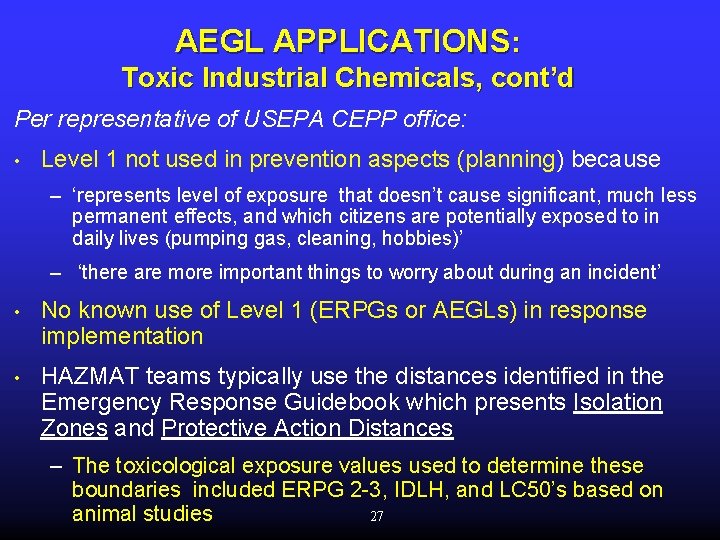
AEGL APPLICATIONS: Toxic Industrial Chemicals, cont’d Per representative of USEPA CEPP office: • Level 1 not used in prevention aspects (planning) because – ‘represents level of exposure that doesn’t cause significant, much less permanent effects, and which citizens are potentially exposed to in daily lives (pumping gas, cleaning, hobbies)’ – ‘there are more important things to worry about during an incident’ • No known use of Level 1 (ERPGs or AEGLs) in response implementation • HAZMAT teams typically use the distances identified in the Emergency Response Guidebook which presents Isolation Zones and Protective Action Distances – The toxicological exposure values used to determine these boundaries included ERPG 2 -3, IDLH, and LC 50’s based on animal studies 27
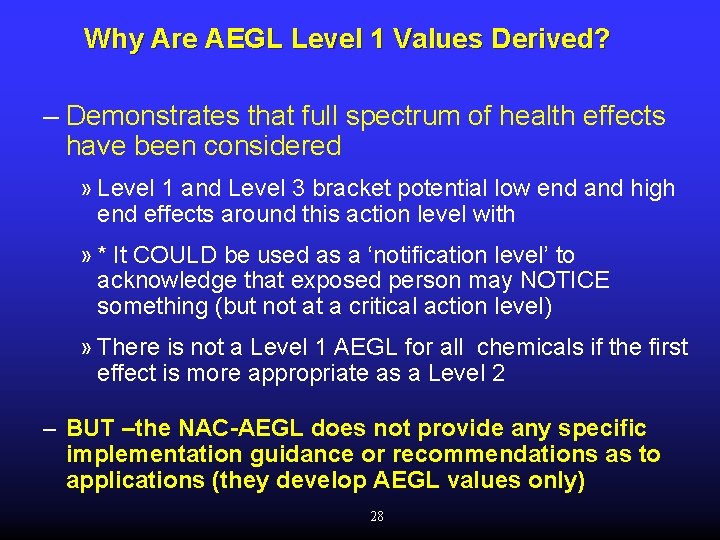
Why Are AEGL Level 1 Values Derived? – Demonstrates that full spectrum of health effects have been considered » Level 1 and Level 3 bracket potential low end and high end effects around this action level with » * It COULD be used as a ‘notification level’ to acknowledge that exposed person may NOTICE something (but not at a critical action level) » There is not a Level 1 AEGL for all chemicals if the first effect is more appropriate as a Level 2 – BUT –the NAC-AEGL does not provide any specific implementation guidance or recommendations as to applications (they develop AEGL values only) 28
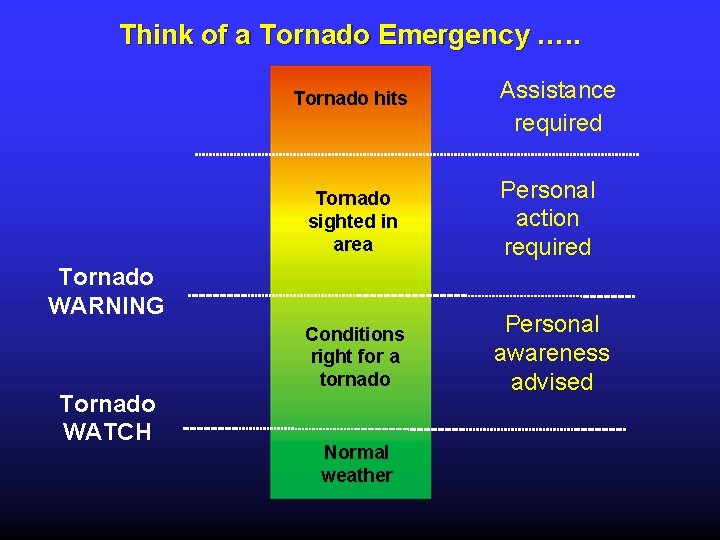
Think of a Tornado Emergency …. . Tornado hits Tornado sighted in area Personal action required Conditions right for a tornado Personal awareness advised Tornado WARNING Tornado WATCH Assistance required Normal weather
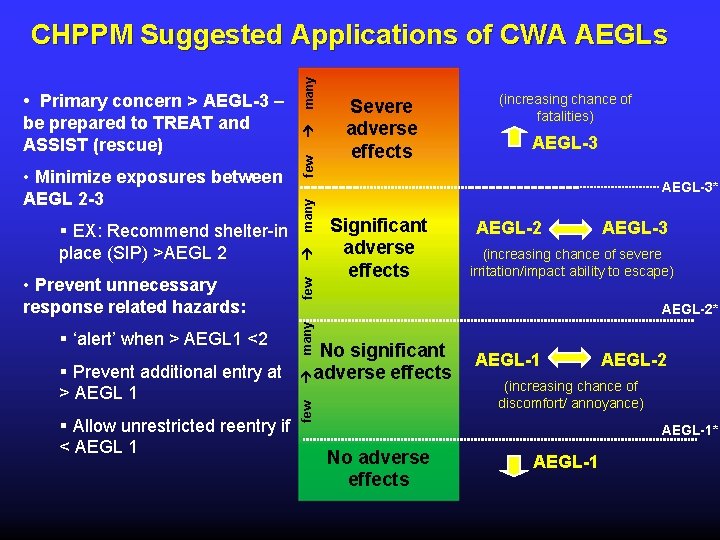
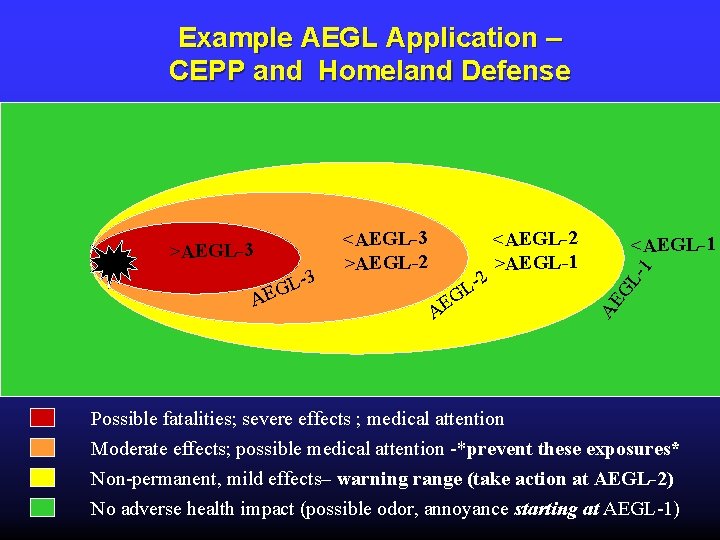
• Prevent unnecessary response related hazards: § ‘alert’ when > AEGL 1 <2 § Prevent additional entry at > AEGL 1 § Allow unrestricted reentry if < AEGL 1 few many few § EX: Recommend shelter-in place (SIP) >AEGL 2 (increasing chance of fatalities) AEGL-3* Significant adverse effects AEGL-2 AEGL-3 (increasing chance of severe irritation/impact ability to escape) AEGL-2* many • Minimize exposures between AEGL 2 -3 No significant adverse effects be prepared to TREAT and ASSIST (rescue) Severe adverse effects few • Primary concern > AEGL-3 – many CHPPM Suggested Applications of CWA AEGLs AEGL-1 AEGL-2 (increasing chance of discomfort/ annoyance) AEGL-1* No adverse effects AEGL-1
Example AEGL Application – CEPP and Homeland Defense AE AE <AEGL-1 -1 -2 L G <AEGL-2 >AEGL-1 GL -3 L G <AEGL-3 >AEGL-2 AE >AEGL-3 Possible fatalities; severe effects ; medical attention Moderate effects; possible medical attention -*prevent these exposures* Non-permanent, mild effects– warning range (take action at AEGL-2) No adverse health impact (possible odor, annoyance starting at AEGL-1)
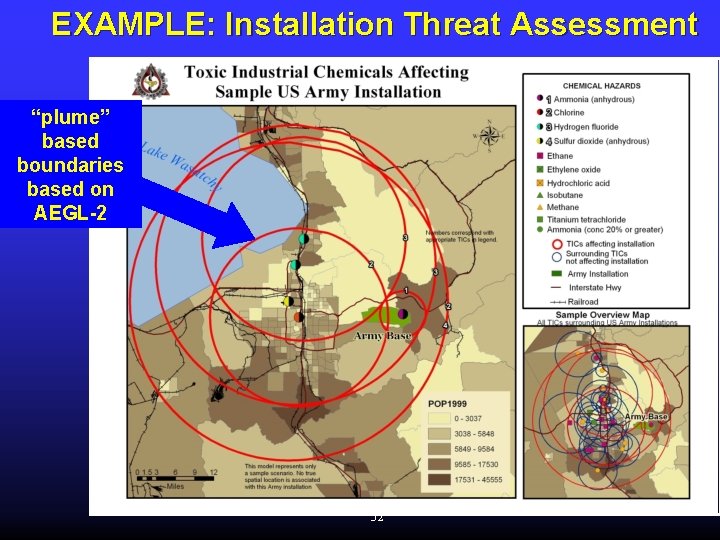
EXAMPLE: Installation Threat Assessment “plume” based boundaries based on AEGL-2 32
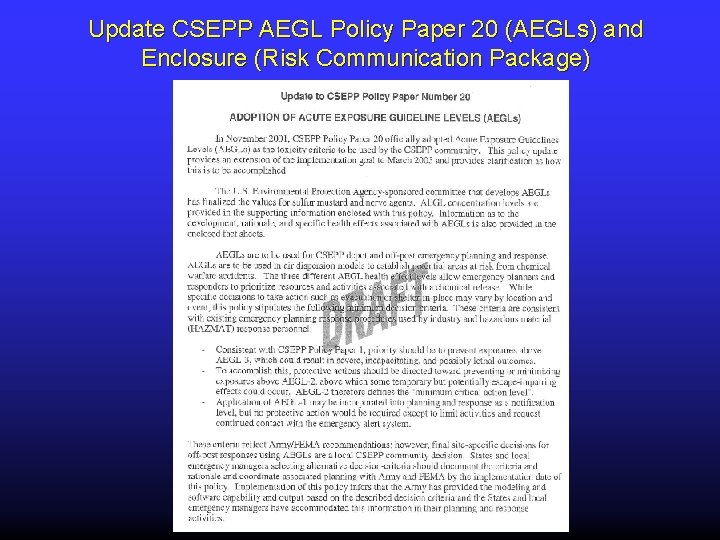
Update CSEPP AEGL Policy Paper 20 (AEGLs) and Enclosure (Risk Communication Package) 33
USACHPPM Health Risk Communication Workshops • April -- Las Vegas, NV • June -- Providence, RI • August -- Seattle, WA For more information or to register on line, go to: http: //chppm-www. apgea. army. mil/risk or call Ms. Suaquita Perry at 410 -436 -3515 34
USACHPPM POCs: USACHPPM Chemical Agent Health Standards WEBSITE http: //chppm-www. apgea. army. mil/HRA/Caw/index. html Veronique Hauschild, MPH Deployment Environmental Surveillance Program (DESP) 410 -436 -5213/DSN 548 -5213 FAX – 2407 Veronique. Hauschild@apg. amedd. army. mil Coleen Weese, MD PM, Occupational and Environmental Medicine Program 410 -436 -2578/DSN 584 -2578 FAX -4117 Coleen. Weese@apg. amedd. army. mil Stephen Graham, CIH PM, Industrial Hygiene Field Services 410 -436 -5244/DSN 548 -3118 FAX – 9988 Stephen. Graham@apg. amedd. army. mil Glenn Leach, Ph. D Director of Toxicology (US Army official member of NAC-AEGL) 410 -436 -5244/DSN 548 -5244 FAX – 2407 Glenn. Leach@apg. amedd. army. mil